
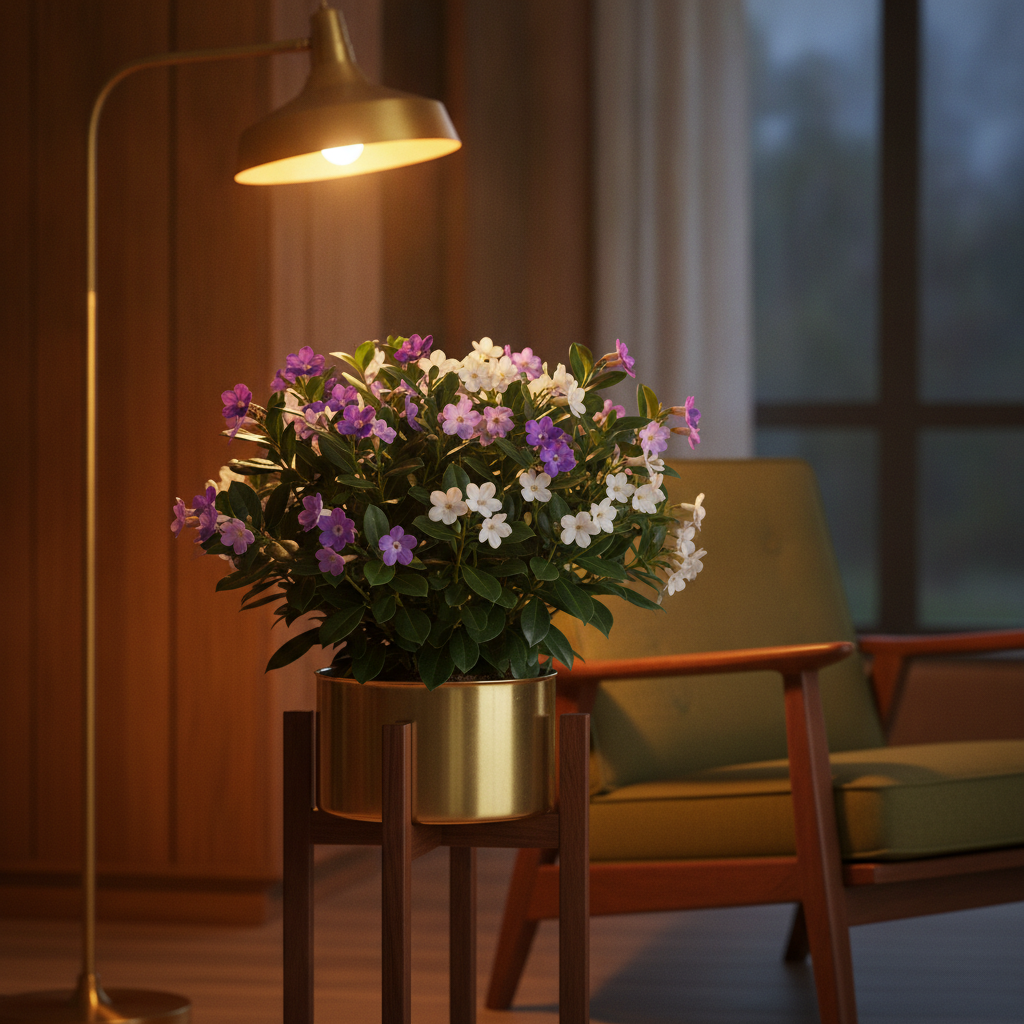
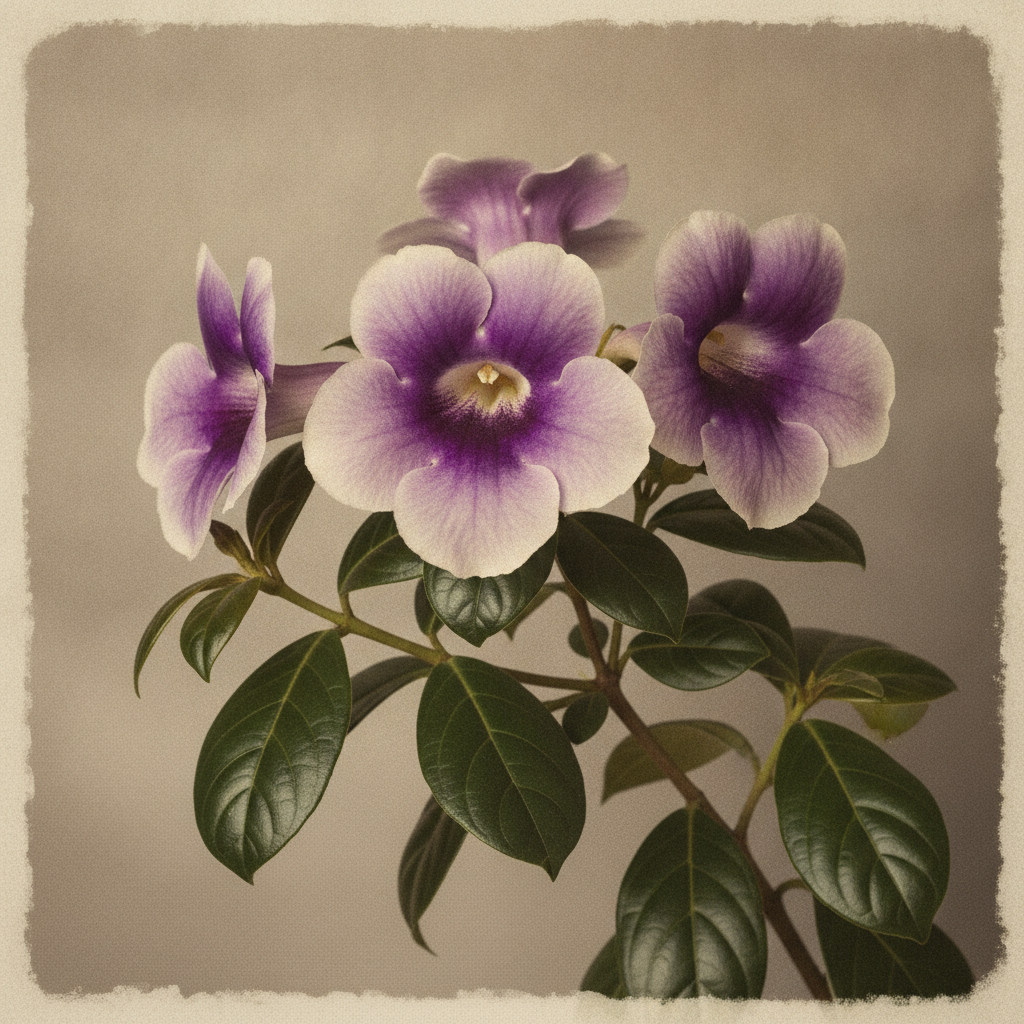
Few flowering houseplants put on a daily costume change quite like brunfelsia. Known affectionately as “yesterday-today-and-tomorrow,” Brunfelsia pauciflora opens deep violet-purple blooms that fade to soft lavender on the second day and to pure white on the third, so a single well-grown plant carries all three shades at once. A member of the nightshade family (Solanaceae) and native to the Atlantic coastal forests of Brazil, it has been cherished in conservatories and warm gardens since the Victorian era for its colour-shifting flowers and their sweet, clove-like evening fragrance.
Grown indoors as a container shrub, brunfelsia has a reputation for being a touch temperamental, and that reputation is only half-deserved. It will survive in a range of indoor conditions, but it only truly thrives, and flowers generously, when its particular preferences for bright light, steady moisture, slightly acidic soil and a cool winter rest are met. This guide walks through every aspect of its care, from reading light levels to coaxing a shy plant back into bloom, so you can move it from merely alive to genuinely flourishing.
Contents
- Quick Reference
- Why Brunfelsia Makes a Rewarding Houseplant
- Light Requirements
- Watering & Humidity
- Soil, Potting & Repotting
- Fertilising
- Propagation
- Pests & Diseases
- Popular Varieties
- Frequently Asked Questions
Quick Reference: Brunfelsia at a Glance
| Light | Bright indirect light with two to three hours of gentle direct sun; an east or lightly shaded south window is ideal |
| Watering | Keep the mix evenly moist in spring and summer, allowing only the top centimetre to dry; reduce in winter |
| Temperature | 18 to 24°C (64 to 75°F) in growth, with a cool winter rest of 10 to 15°C (50 to 59°F) to set flower buds |
| Humidity | Moderate to high, ideally 50 to 60 per cent |
| Fertiliser | Balanced or slightly acidic feed every two weeks through the growing season, halved in strength |
| Toxicity | All parts are toxic to people, dogs and cats; the berries are especially dangerous |
Why Brunfelsia Makes a Rewarding Houseplant
The headline appeal of brunfelsia is, of course, its flowers. Borne in flushes from late winter through spring and often again in autumn, the blooms emerge a rich purple, soften to lavender and pale to white over roughly three days, giving the plant its evocative common name. Because new flowers open continuously while older ones fade, a healthy specimen displays a constellation of purple, mauve and white at the same time, an effect no single-coloured plant can match. In the evening the flowers release a warm, slightly spicy fragrance that drifts well beyond the pot.
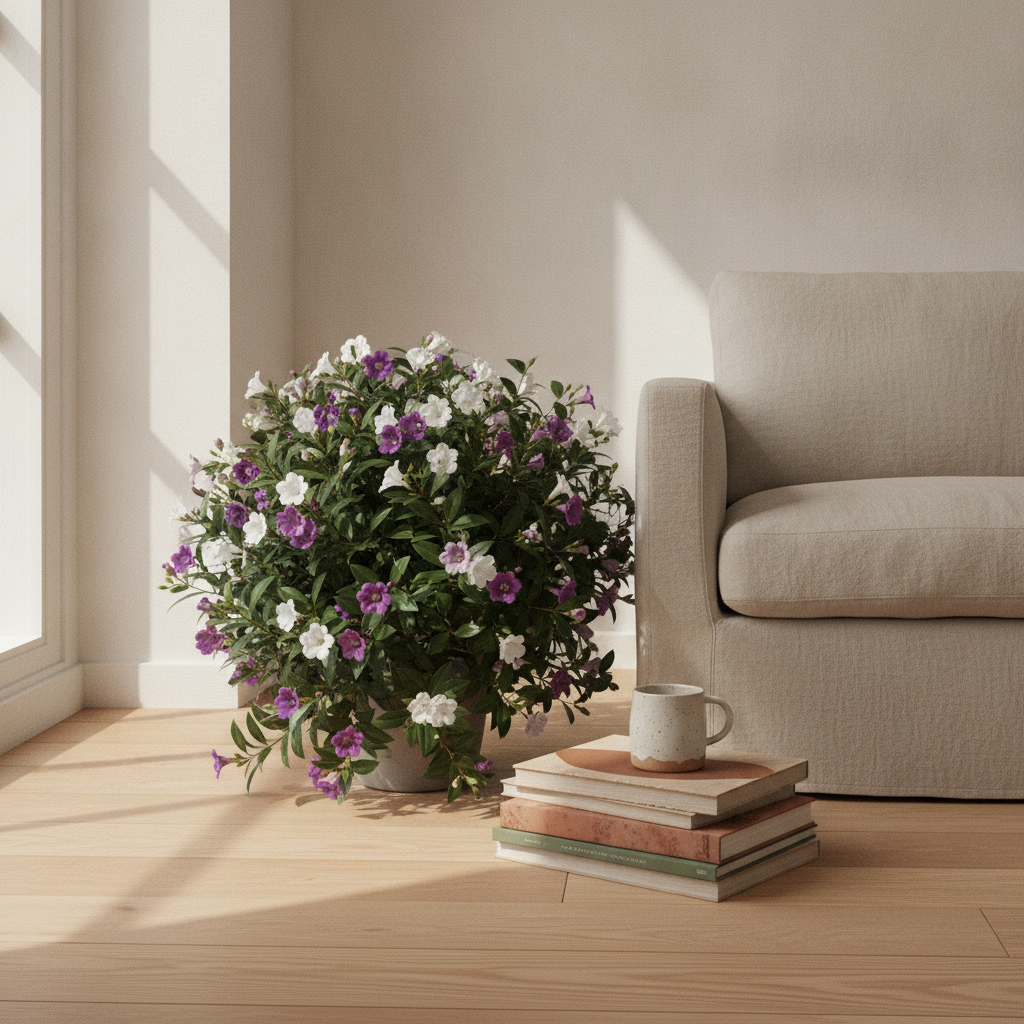
Beyond the spectacle, brunfelsia rewards the attentive grower with a dense, glossy, evergreen habit that holds its shape well in a container. Mature plants stay manageable indoors at around one to one and a half metres (three to five feet) and respond gracefully to pruning, making them suitable for a bright corner, a heated conservatory or a sunroom. It is a plant that genuinely responds to good care, so the effort you invest in getting its conditions right is repaid visibly in flower count and fragrance. That direct feedback loop is precisely what makes it so satisfying to grow.
Important — Toxicity: Every part of brunfelsia is poisonous. The plant contains alkaloids and other compounds, and the small green-to-brown berries that may follow the flowers are particularly hazardous if eaten by children, dogs or cats, causing vomiting, tremors and seizures in severe cases. Keep the plant out of reach, clear away any fallen fruit promptly, and wash your hands after pruning. If ingestion is suspected, contact a doctor or veterinarian without delay.
Light Requirements
Light is the single biggest lever you have over how freely brunfelsia flowers. As a plant adapted to the bright margins and clearings of Brazilian forest, it wants generous illumination indoors: plenty of bright indirect light supplemented by a few hours of gentle direct sun each day. In too little light it survives perfectly well as a leafy green shrub but produces few or no blooms, which is the most common disappointment new owners report.
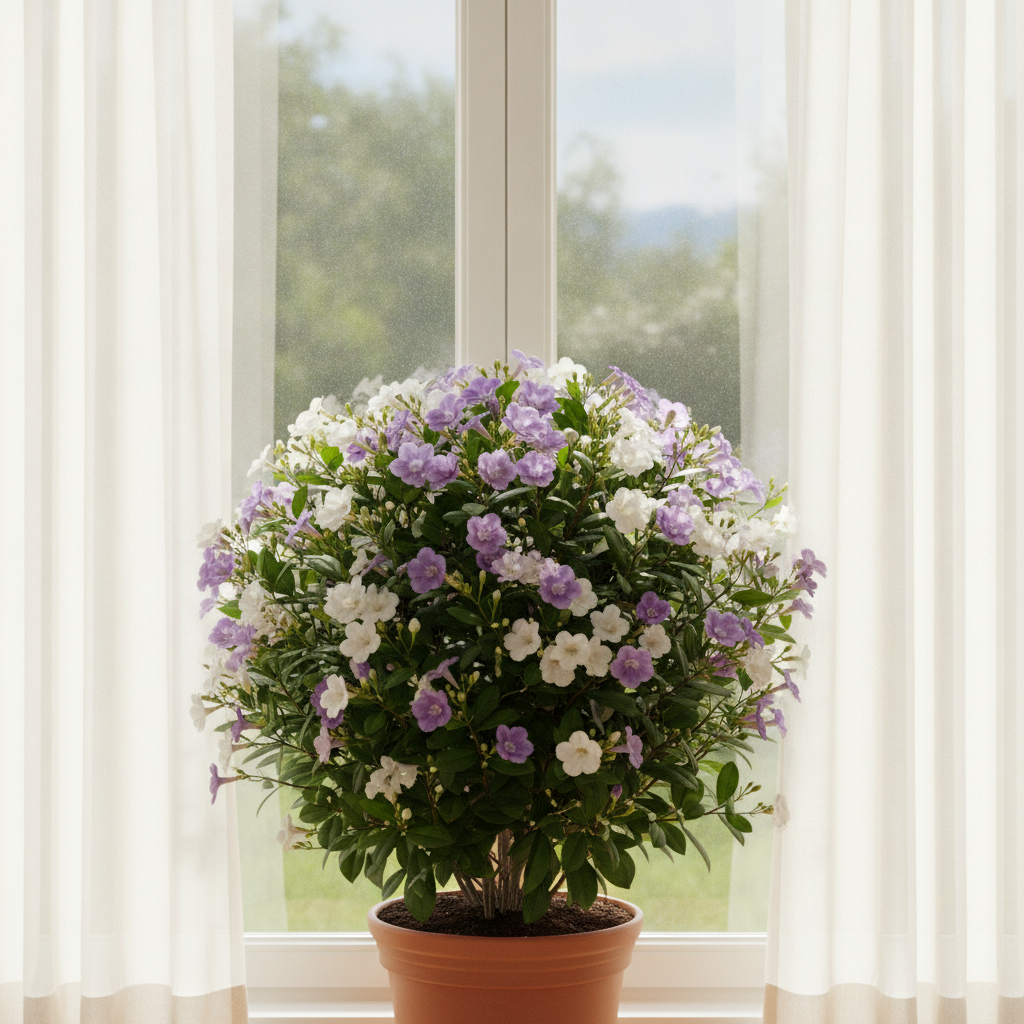
The ideal indoor position offers strong, slightly filtered light for most of the day with a window of soft morning or late-afternoon sun. Harsh, unbroken midday sun through glass can scorch the foliage, so the goal is brightness without prolonged exposure to the most intense rays. Many growers find a spot just back from a sunny window, or beside an east-facing one, hits the sweet spot perfectly.
Light Levels Explained
Plant-care advice often refers to vague categories like “bright” or “low” light. The table below translates those terms into approximate illumination levels and practical locations, so you can judge where brunfelsia will perform best in your home.
| Light Category | Approx. Level | Typical Location | Outcome |
|---|---|---|---|
| Direct sun | Over 50,000 lux | On a south windowsill, unshaded | Risk of leaf scorch in summer; tolerable in winter |
| Bright indirect | 10,000 to 25,000 lux | Beside an east window or just back from a south one | Best flowering and compact growth |
| Medium | 5,000 to 10,000 lux | A few metres from a bright window | Healthy foliage, sparse flowering |
| Low | 1,000 to 5,000 lux | North room or deep interior | Survival only; leggy, no blooms |
| Very low | Under 1,000 lux | Hallway, far from any window | Gradual decline |
Window Orientation and Placement
South-facing window: Excellent in winter, when the low sun is weak, but in summer the plant should sit slightly back or behind a sheer curtain to avoid scorched leaf tips and bleached flowers.
East-facing window: Arguably the best year-round position. Brunfelsia receives bright, cool morning sun followed by softer indirect light through the afternoon, which suits both its foliage and its flowering.
West-facing window: A good option, though the strong afternoon sun in midsummer can be harsh; a little filtering protects the leaves during the hottest months.
North-facing window: Generally too dim for reliable flowering. The plant will hold its leaves but tends to grow leggy and bloom poorly unless supplemented with a grow light.
Pro Tip — Rotate for Even Growth: Brunfelsia leans noticeably towards its light source. Give the pot a quarter turn every week or so to keep the canopy balanced and the flowers facing outward rather than all pressed against the glass.
How Light Affects Flowering
The connection between light and bloom is direct: the more bright light brunfelsia receives during its active season, the more flower buds it forms. Plants kept in dim corners channel their limited energy into stems and leaves, stretching towards the nearest window and skipping flowers altogether. If your brunfelsia is all leaf and no bloom, insufficient light is the first thing to suspect, ahead of feeding or watering issues.
Warning — Direct Sunlight: While brunfelsia loves brightness, prolonged direct summer sun magnified through glass can burn the foliage, leaving bleached or crispy brown patches. Introduce a plant to stronger light gradually over a week or two rather than moving it abruptly from shade into full sun.
Artificial Lighting
In darker homes or through gloomy winters, a full-spectrum LED grow light can make the difference between a flowering plant and a merely surviving one. Position the light 30 to 45 centimetres (12 to 18 inches) above the canopy and run it for ten to twelve hours a day to supplement natural light. This is especially useful for keeping a plant in good condition during the short days before its spring flush.
Seasonal Adjustments
Light intensity falls dramatically indoors between autumn and early spring, so a position that risked scorching in July may be perfect in December. Move the plant closer to the brightest available window for the winter, then ease it back as the sun strengthens again. These seasonal shifts also dovetail with the cool winter rest that helps trigger the next round of bud formation.
Watering & Humidity
Brunfelsia likes its soil consistently moist but never waterlogged, a balance that sits between the bone-dry preferences of a succulent and the swampy demands of a fern. During active growth it is thirsty, and letting the rootball dry out completely is one of the quickest ways to trigger bud drop and leaf yellowing. The aim is steady, even moisture with good drainage to carry off any excess.
When to Water
The most reliable guide is your finger. Push it into the top of the mix: when the upper centimetre (about half an inch) feels dry but the soil below is still cool and slightly moist, it is time to water. In the warmth of spring and summer this may mean watering two or three times a week, while a mature plant in a small pot during a heatwave can dry out faster still.
In winter, as growth slows and the plant takes its cool rest, watering should drop back markedly. Let a little more of the surface dry between drinks, but never allow the rootball to become completely parched, which can damage the fine roots. The cooler the room, the less water the plant uses, so judge by the soil rather than by the calendar.
Pro Tip — Read the Buds: Brunfelsia signals watering stress through its flower buds before its leaves. If unopened buds shrivel and drop, the plant has most likely dried out too far between waterings; tighten up your routine and the next flush should hold.
How to Water Correctly
- Water at the soil surface rather than over the foliage, using room-temperature water to avoid shocking the roots.
- Pour slowly and evenly until water runs freely from the drainage holes, ensuring the whole rootball is wetted.
- Let the pot drain fully for several minutes so no water sits at the base.
- Empty the saucer or cachepot; brunfelsia must never stand in a pool of water.
- Wait until the top centimetre dries again before the next watering rather than topping up little and often.
Signs of Overwatering vs. Underwatering
| Symptom | Overwatering | Underwatering |
|---|---|---|
| Leaf colour | Yellowing of lower leaves, sometimes widespread | Dull green fading to brown, starting at the tips |
| Leaf texture | Soft, limp, sometimes translucent | Crisp, dry and brittle |
| Soil | Stays wet for days, may smell sour | Pulls away from the pot edge, dusty and dry |
| Roots | Brown, mushy and foul-smelling | Dry, thin and brittle |
| Buds and flowers | Buds blacken and rot before opening | Buds shrivel and drop while still small |
Warning — Root Rot: Persistently soggy soil starves the roots of oxygen and invites rot, the most common killer of container brunfelsia. If the soil smells sour and lower leaves yellow despite a wet pot, unpot the plant, trim away any brown mushy roots, and repot into fresh, free-draining mix.
Humidity Requirements
Coming from humid Brazilian forests, brunfelsia is happiest in moderate to high humidity of around 50 to 60 per cent. Average centrally heated rooms, which often drop to 30 per cent or below in winter, can leave the plant looking tired with browning leaf margins and a tendency to shed buds.
Tell-tale signs that the air is too dry include crisp brown leaf edges, slow growth and flowers that fade and fall faster than expected. These often appear in winter when the heating is running, precisely when the plant is also coping with lower light.
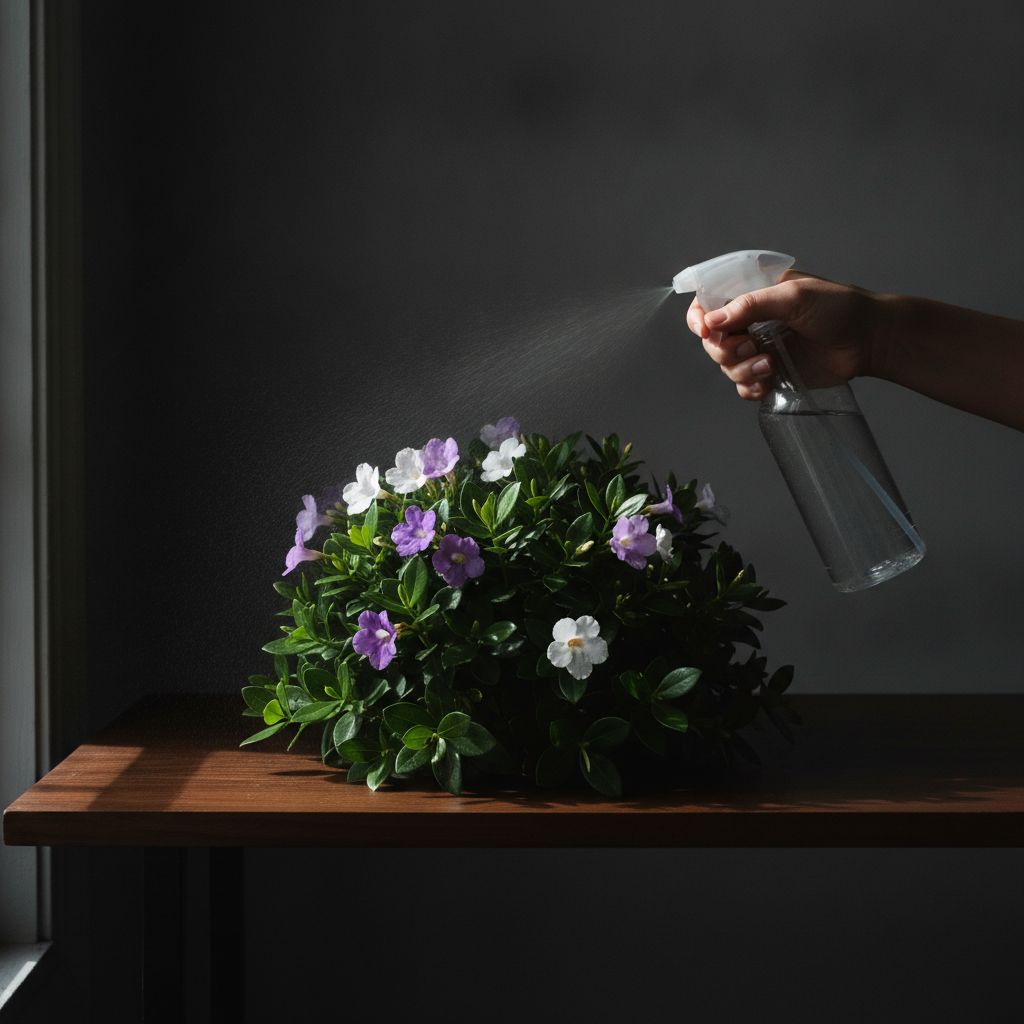
To raise humidity, stand the pot on a wide tray of damp pebbles, group it with other plants to create a moister microclimate, or run a small humidifier nearby during the driest months. Occasional misting helps a little but evaporates quickly, so it is best treated as a supplement rather than a primary method.
Water Quality
Because brunfelsia prefers slightly acidic conditions, hard tap water rich in lime can gradually raise the soil pH and lock up iron, leading to yellowing leaves with green veins. Where your water is very hard, using filtered water, cooled boiled water or collected rainwater helps keep the soil chemistry where the plant likes it. Letting tap water stand overnight also allows some chlorine to dissipate before use.
Soil, Potting & Repotting
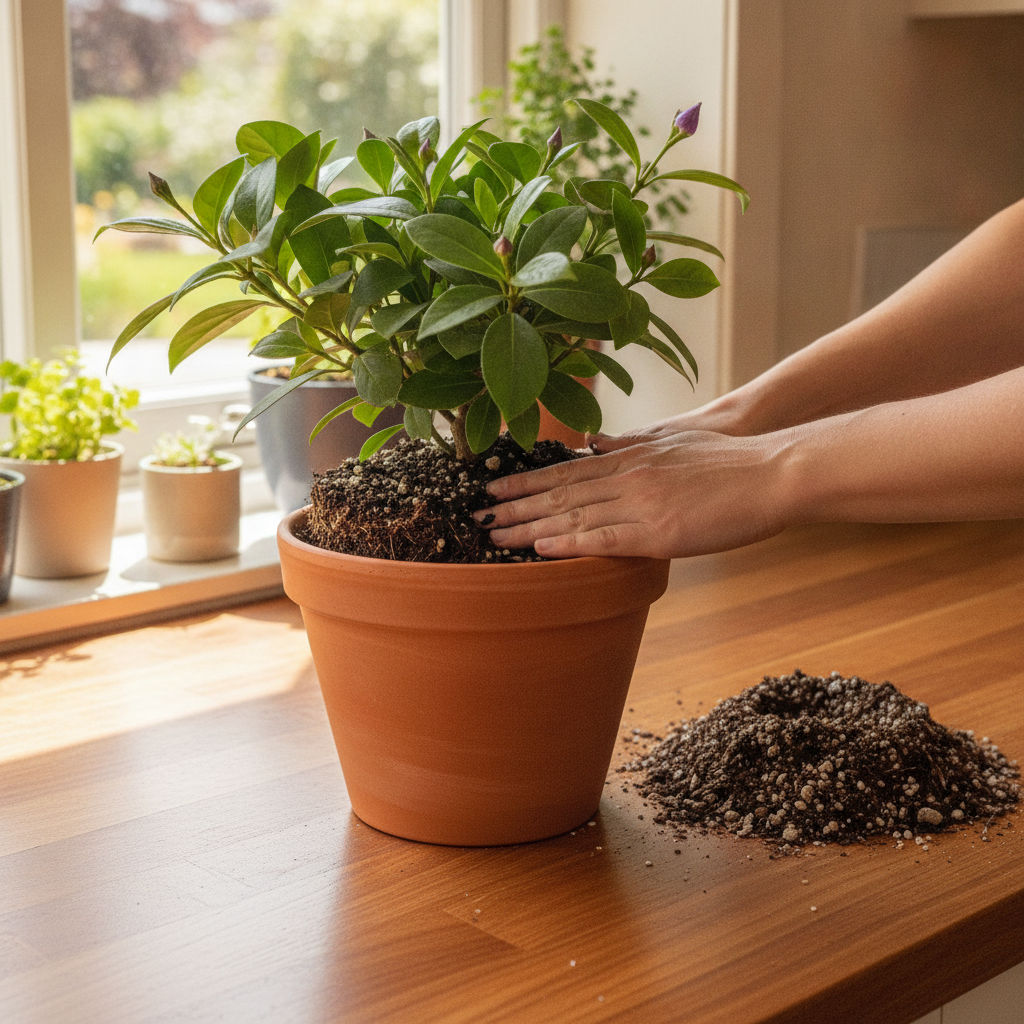
The right growing medium does two jobs at once for brunfelsia: it holds enough moisture to keep the rootball evenly damp, and it drains freely enough to prevent the waterlogging that leads to rot. A slightly acidic, rich but open mix delivers both, and it underpins almost every other aspect of the plant’s health.
Ideal Soil Composition
A good base is a quality peat-free houseplant or ericaceous compost lightened with materials that improve aeration and drainage. The combination below gives the moisture retention brunfelsia wants alongside the air pockets its roots need.
| Component | Proportion | Function |
|---|---|---|
| Quality houseplant or ericaceous compost | 50 per cent | Holds moisture and nutrients, keeps pH slightly acidic |
| Composted bark or coco coir | 25 per cent | Adds structure and steady moisture without compaction |
| Perlite or coarse grit | 20 per cent | Opens the mix and improves drainage and aeration |
| Worm castings or leaf mould | 5 per cent | Provides gentle, slow-release nutrition |
Brunfelsia prefers a soil pH of roughly 5.5 to 6.5. If your leaves yellow between green veins, the soil may have drifted too alkaline, in which case an ericaceous compost base and acidified water help bring it back into range.
Pro Tip — Quick Mix Recipe: For a fast, reliable blend, combine two handfuls of ericaceous compost with one handful of composted bark and one of perlite. The result drains well, stays lightly acidic and keeps a steady level of moisture between waterings.
Choosing the Right Pot
Pot choice influences both drainage and how often you need to water, so it is worth a moment’s thought rather than simply reaching for whatever is to hand.
Drainage holes are non-negotiable. Whatever the material, the pot must have open drainage holes so excess water can escape. A decorative cachepot is fine as an outer cover provided you lift the inner pot out to water and drain it.
Pot material: Terracotta breathes and dries faster, which suits growers who tend to overwater, while glazed ceramic and plastic hold moisture longer and need a more careful hand. In dry, centrally heated homes, a less porous pot can make it easier to maintain the even moisture brunfelsia prefers.
Pot size: Choose a pot only slightly larger than the current rootball. Brunfelsia actually flowers more freely when a little snug, and an oversized pot holds excess wet soil around the roots, raising the risk of rot.
When to Repot
Repot every two to three years, or when roots circle the base and emerge from the drainage holes. The best time is early spring, just as growth resumes but before or just after the main flush of flowers, so the plant can settle into fresh soil during its most active season. Avoid repotting a plant in full bloom, which often triggers bud drop.
How to Repot: Step-by-Step
- Water the plant a day ahead so the rootball is moist and slides out cleanly.
- Ease the plant from its pot and gently tease apart any tightly circling roots around the base.
- Trim away any soft, brown or dead roots with clean, sharp secateurs.
- Add a layer of fresh mix to a pot one size larger and position the plant at its previous depth.
- Fill around the rootball with fresh mix, firming gently to remove large air gaps.
- Water thoroughly and allow to drain, then return the plant to its usual bright spot.
Warning — Transplant Shock: Brunfelsia can sulk after repotting, dropping a few leaves or buds while it re-establishes. Keep it warm, evenly moist and out of harsh sun for a fortnight, and hold off on feeding until you see new growth.
Fertilising
As a fast-growing, free-flowering shrub, brunfelsia is a relatively hungry plant during its active season and benefits from regular, balanced feeding. Well-fed plants produce more buds, richer flower colour and denser foliage, while underfed ones grow slowly and bloom sparsely.
That said, more is not better. Over-feeding builds up salts in the soil and can scorch the roots, so the goal is a steady, moderate supply through spring and summer, tapering off as the plant enters its winter rest.
Understanding Plant Nutrients
Fertilisers are labelled with an NPK ratio showing the percentage of nitrogen, phosphorus and potassium, the three nutrients plants need in the largest amounts. For a flowering shrub like brunfelsia, a balanced feed supports leaves and blooms alike, while a formula slightly higher in potassium can encourage flowering. The table below summarises the key nutrients and the signs of deficiency.
| Nutrient | Symbol | Primary Function | Deficiency Symptoms |
|---|---|---|---|
| Nitrogen | N | Leaf and stem growth, deep green colour | Pale, yellowing older leaves and weak growth |
| Phosphorus | P | Root development and flowering | Poor flowering, dull or purplish foliage |
| Potassium | K | Flower production and overall vigour | Browning leaf edges, few buds |
| Calcium | Ca | Cell wall strength | Distorted new growth, dying tips |
| Magnesium | Mg | Core of the chlorophyll molecule | Yellowing between the veins of older leaves |
| Iron | Fe | Chlorophyll formation in new leaves | Yellow new leaves with green veins |
Types of Fertiliser
Liquid fertilisers: The easiest way to feed brunfelsia, diluted in water and applied during routine watering. They act quickly and let you adjust the dose precisely, which suits the plant’s seasonal rhythm well.
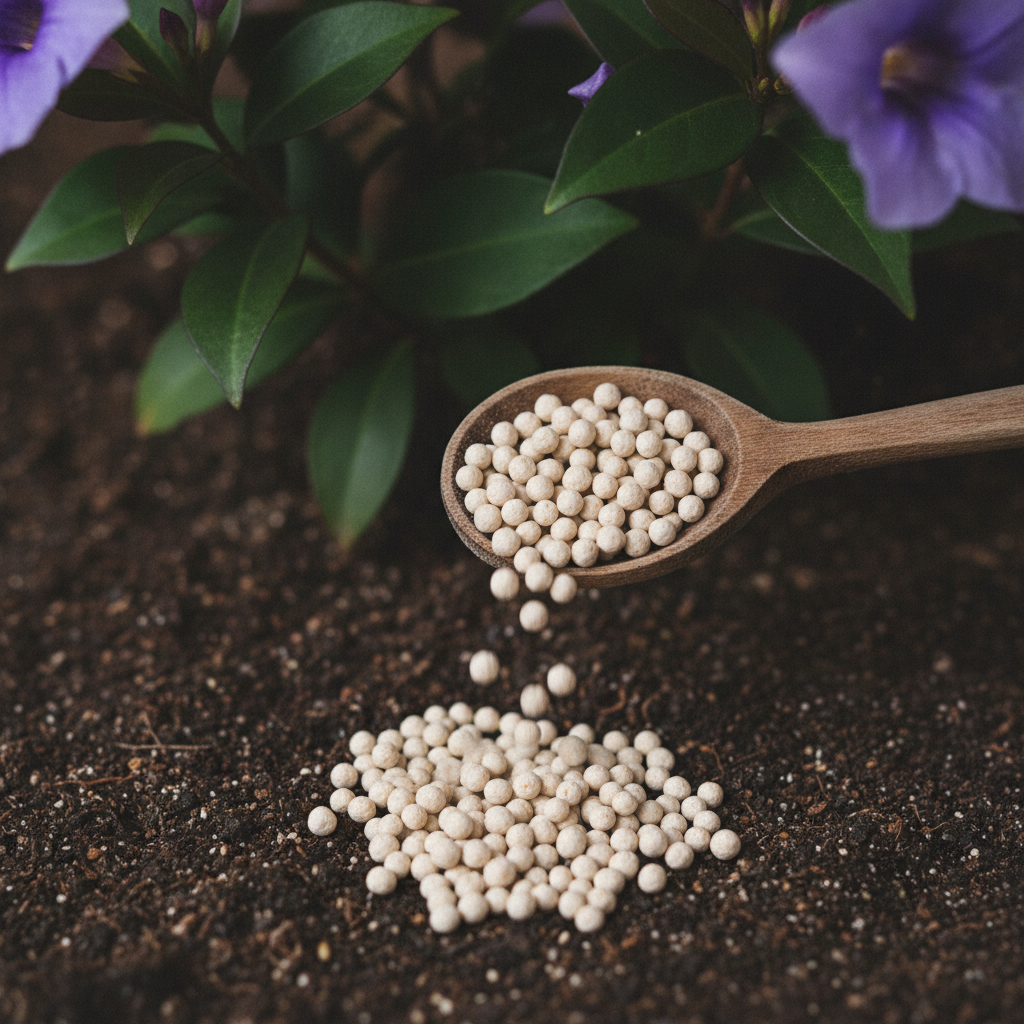
Slow-release granular: Coated prills release nutrients gradually over several months and are convenient for busy growers, though they offer less control over timing. Scatter them on the soil surface at the start of the growing season.
Organic fertilisers: Worm castings, seaweed extract and similar products feed gently while improving soil life. They are forgiving and low-risk, making them a good choice if you worry about over-feeding.
Feeding Schedule
Feed every two weeks from spring through late summer with a balanced liquid fertiliser at half the recommended strength. Reduce to monthly in early autumn, then stop entirely through the winter rest, when the plant is not actively growing and cannot use the extra nutrients. Resume feeding only when new growth appears in spring.
Pro Tip — Feed for Acidity: An occasional ericaceous (acid-loving plant) feed helps keep brunfelsia’s preferred soil chemistry in balance and supplies iron in a form the plant can use, warding off the yellow-leaf, green-vein look of iron lock-out.
How to Fertilise
- Dilute the fertiliser to half the label strength in room-temperature water.
- Water the plant with plain water first if the soil is very dry, to protect the roots.
- Apply the diluted feed evenly across the soil surface until it begins to drain.
- Avoid splashing concentrated feed on the leaves or flowers, which can scorch them.
- Flush the pot with plain water every couple of months to wash out accumulated salts.
Warning — Salt Build-Up: A white crust on the soil surface or pot rim, along with browning leaf tips, signals a build-up of fertiliser salts. Leach the pot by running plenty of plain water through it until it drains freely, and ease back on feeding strength.
Propagation
Brunfelsia is propagated most reliably from stem cuttings taken in late spring or early summer, when the plant is growing strongly. Unlike many soft-stemmed houseplants, it does not root well in water, so cuttings are best started in a moist, free-draining medium with warmth and humidity to encourage rooting.
Patience is essential: brunfelsia cuttings can take several weeks to months to root, and a proportion will fail even under good conditions. Taking several cuttings at once improves your odds of ending up with at least one strong young plant.
Understanding Stem Cuttings
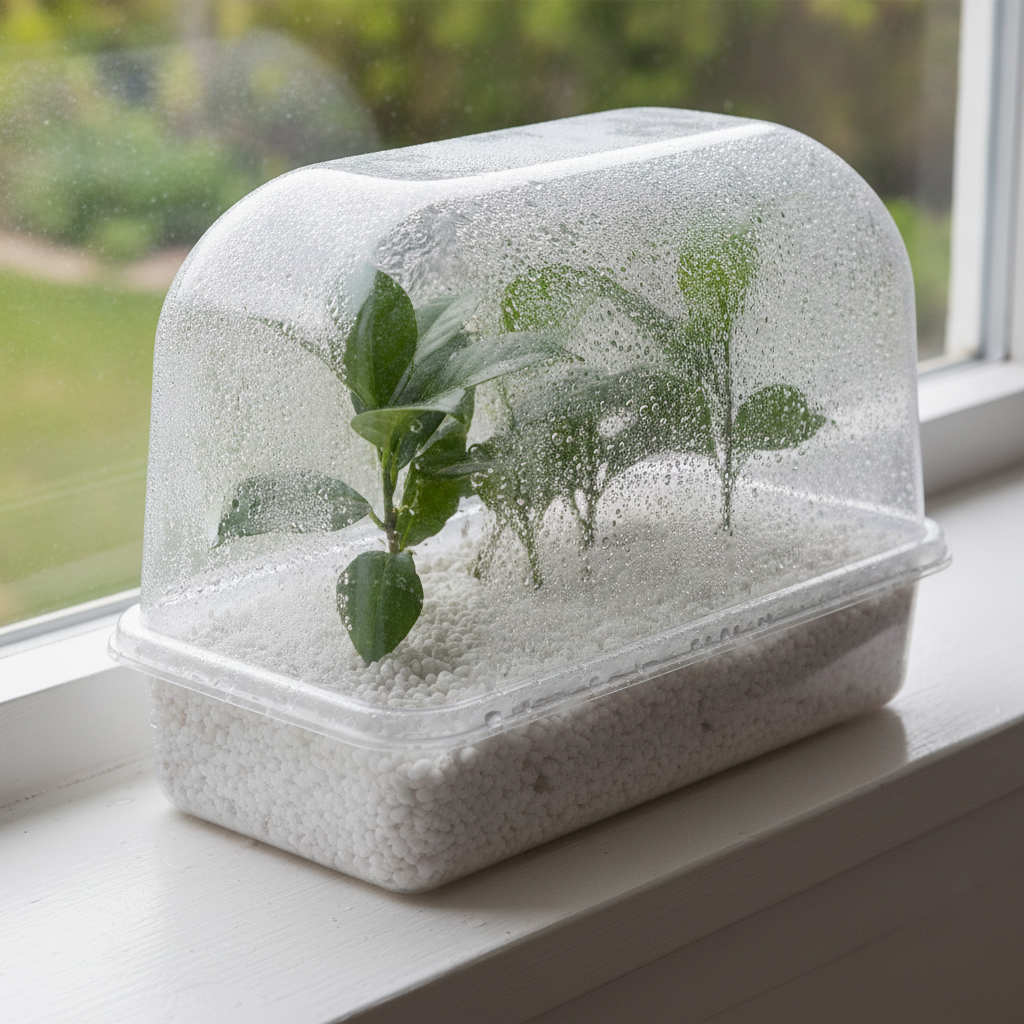
The best material is semi-hardwood: this season’s growth that has begun to firm up but is not yet woody and brittle. Each cutting should include several leaf nodes, the points along the stem where leaves attach, because roots form most readily from these nodes. Bottom heat of around 21 to 24°C (70 to 75°F) and steady humidity dramatically improve the success rate.
Stem Cuttings: Step-by-Step
This is the standard and most dependable method for brunfelsia. Work with clean tools and fresh, sterile medium to minimise the risk of rot.
- Cut a 10 to 15 centimetre (4 to 6 inch) length of semi-hardwood stem just below a node, using sterilised secateurs.
- Remove the lower leaves, leaving two or three at the top, and pinch off any flower buds.
- Dip the cut end in rooting hormone to speed root formation and reduce fungal problems.
- Insert the cutting into a moist mix of perlite and coir or a gritty cutting compost, firming it in.
- Cover with a clear humidity dome or a loose plastic bag, and place in bright, indirect light with gentle bottom heat.
- Keep the medium lightly moist and ventilate briefly each day to prevent mould; pot on once new growth and resistance to a gentle tug confirm rooting.
Pro Tip — Warmth Wins: The single biggest factor in rooting brunfelsia is steady warmth at the base. A heated propagation mat set to around 21°C makes a striking difference to both speed and success rate, especially early in the season.
Seed Propagation: Step-by-Step
Brunfelsia can also be grown from seed, though this is slower and seed-grown plants take longer to reach flowering size. Because the berries are toxic, handle seed with care and keep it well away from children and pets.
- Extract seed from ripe berries and rinse away the pulp, wearing gloves throughout.
- Sow on the surface of a moist, fine seed compost and cover very lightly.
- Keep warm at around 21 to 24°C and consistently moist, covered to retain humidity.
- Be patient, as germination is erratic and can take several weeks or longer.
- Prick out seedlings into individual pots once they have a couple of true leaves and grow on in bright, indirect light.
Troubleshooting Propagation
| Problem | Likely Cause | Solution |
|---|---|---|
| Cuttings blacken and rot | Medium too wet or not sterile | Use fresh, free-draining medium and ventilate the dome daily |
| Cuttings wilt then dry out | Too little humidity or excess heat | Maintain a humid cover and keep out of direct sun |
| No roots after many weeks | Too cold or wood too soft or too hard | Add bottom heat and choose semi-hardwood material |
| Mould on the medium surface | Stagnant, overly humid air | Increase ventilation and remove affected material promptly |
Pests & Diseases
A healthy, well-grown brunfelsia is reasonably resilient, but stressed plants and the dry, warm air of indoor environments can attract several common sap-sucking pests. Regular inspection, particularly of the undersides of leaves and the points where leaves meet the stem, lets you catch infestations early when they are easiest to control.
Most problems are far easier to prevent than to cure, so good cultural care, sensible watering and the occasional close look at your plant go a long way. The sections below cover the pests and diseases you are most likely to encounter and how to deal with each.

Common Pests
Aphids (Aphidoidea)
Small green, black or pink soft-bodied insects that cluster on new shoots and flower buds, sucking sap and leaving sticky honeydew. They can distort fresh growth and deform developing flowers.
Treatment: Rinse off light infestations with a strong jet of water, then treat with insecticidal soap or a diluted neem oil spray every few days until clear.
Mealybugs (Pseudococcidae)
Slow-moving insects that look like small tufts of white cotton wool, hiding in leaf axils and along stems. They weaken the plant and, like aphids, excrete honeydew that encourages sooty mould.
Treatment: Dab individual mealybugs with a cotton bud dipped in isopropyl alcohol, then follow up with neem oil or insecticidal soap, repeating weekly to catch newly hatched young.
Spider Mites (Tetranychus urticae)
Tiny mites that thrive in hot, dry air, stippling the leaves with pale dots and spinning fine webbing in bad cases. They are hard to see without a magnifier but quick to multiply.
Treatment: Raise humidity, shower the foliage to dislodge mites, and apply neem oil or a miticide to the leaf undersides, repeating to break the breeding cycle.
Whitefly (Trialeurodes vaporariorum)
Tiny white moth-like insects that rise in a cloud when the plant is disturbed and gather on leaf undersides, weakening growth and spreading honeydew. They are especially common on plants summered outdoors.
Treatment: Hang yellow sticky traps to catch the adults and treat the plant with insecticidal soap or neem oil over several weeks until populations collapse.
Common Diseases
Root Rot (Phytophthora and Pythium spp.)
Caused by waterlogged soil and poor drainage, root rot turns roots brown and mushy, with the plant wilting and yellowing even though the soil is wet. It is the most serious threat to container brunfelsia.
Treatment: Unpot the plant, cut away all affected roots, and repot into fresh, free-draining mix; thereafter water only when the surface has begun to dry.
Iron Chlorosis (nutrient disorder)
Not an infection but a physiological problem, chlorosis shows as new leaves yellowing while their veins stay green, caused by soil that is too alkaline for the plant to take up iron.
Treatment: Switch to acidified or rainwater, use an ericaceous feed and, in stubborn cases, apply a chelated iron product to green the foliage back up.
Powdery Mildew (Erysiphales)
A white, powdery coating on leaves that develops in stagnant, humid air with poor circulation, disfiguring foliage and slowing growth if left unchecked.
Treatment: Improve air movement, remove badly affected leaves, and treat with a suitable fungicide or a dilute potassium bicarbonate spray.
Pest and Disease Summary
| Pest / Disease | Identification | Treatment |
|---|---|---|
| Aphids | Clusters on buds and shoots, sticky honeydew | Water jet, insecticidal soap, neem oil |
| Mealybugs | White cottony tufts in leaf axils | Alcohol swab, neem oil, repeat weekly |
| Spider mites | Fine stippling and webbing, dry air | Raise humidity, shower, neem or miticide |
| Whitefly | Tiny white flies under leaves | Sticky traps, insecticidal soap |
| Root rot | Mushy brown roots, wilting in wet soil | Trim roots, repot, water less |
| Iron chlorosis | Yellow new leaves, green veins | Acidify water and soil, chelated iron |
| Powdery mildew | White powder on leaves | Improve airflow, fungicide |
Prevention Strategies
The best defence is a healthy, unstressed plant. Provide the bright light, even moisture and good drainage brunfelsia prefers, keep the foliage clean and the air gently moving, and quarantine any new plants for a couple of weeks before letting them join your collection.
Inspect your plant whenever you water, paying attention to leaf undersides and growing tips. Catching a handful of aphids or a single mealybug early is far simpler than tackling an established outbreak that has spread across the whole canopy.
Pro Tip — Neem as Routine: A light monthly spray of diluted neem oil, applied in the evening out of direct sun, acts as a gentle preventative against several common pests and keeps the foliage glossy. Always test on a single leaf first to check for sensitivity.
Popular Varieties
Most plants sold simply as brunfelsia belong to Brunfelsia pauciflora, but the genus includes several species and named selections that differ in flower size, fragrance and habit. Knowing the main types helps you choose a plant that suits your space and your expectations.
The selections below are the ones most often encountered by indoor growers, ranging from compact, free-flowering forms to large-bloomed and especially fragrant relatives.
| Variety | Flower Appearance | Light Needs | Growth Rate | Availability |
|---|---|---|---|---|
| ‘Floribunda’ | Masses of small purple-to-white blooms | Bright indirect | Moderate | Common |
| ‘Macrantha’ | Large royal-purple flowers fading to lilac | Bright indirect | Moderate | Frequent |
| Brunfelsia australis | Profuse purple-to-white, very fragrant | Bright, some sun | Vigorous | Occasional |
| Brunfelsia americana (Lady of the Night) | Cream to yellow, intensely night-scented | Bright, some sun | Moderate | Uncommon |
| ‘Eximia’ | Compact with abundant smaller flowers | Bright indirect | Slow to moderate | Specialist |
Featured Varieties
‘Floribunda’
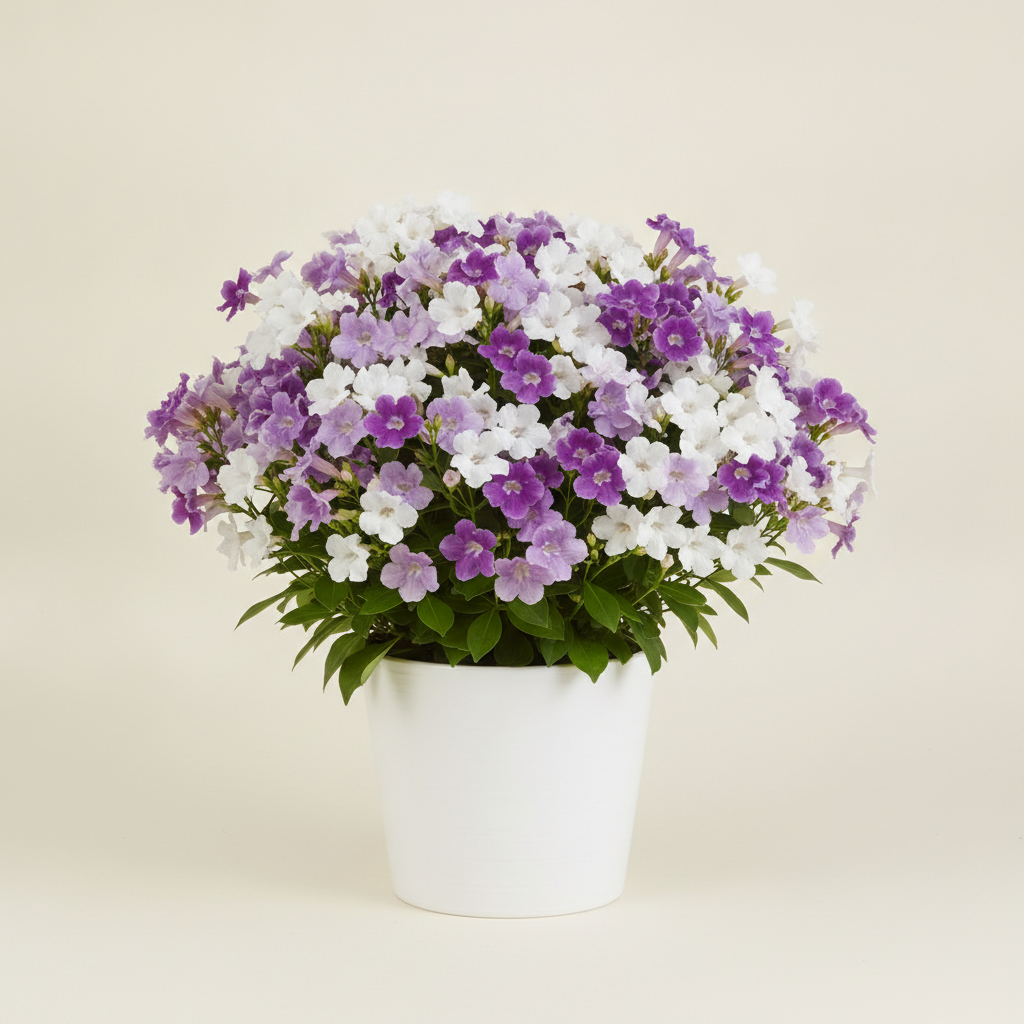
The most widely grown form, prized for the sheer number of fragrant flowers it carries. Its compact, bushy habit and reliable display from purple through lavender to white make it the classic choice for a container.
‘Macrantha’
A large-flowered selection whose broad blooms can reach 5 centimetres across, opening a deep royal purple and ageing to pale lilac. The bigger flowers make the daily colour change especially dramatic on a maturing plant.
Variety Profiles in Detail
Floribunda Brunfelsia (Brunfelsia pauciflora ‘Floribunda’)
This is the brunfelsia most people picture: a dense, rounded shrub that comes into bloom in waves and covers itself in tricoloured flowers. It stays a sensible size in a pot, responds well to light pruning after flowering, and is the easiest selection to source from general nurseries.
Macrantha Brunfelsia (Brunfelsia pauciflora ‘Macrantha’)
Grown for the size and impact of its individual flowers rather than sheer quantity, ‘Macrantha’ makes a striking specimen where you want the colour change to be the centrepiece. Its care is identical to the species, though the larger blooms appreciate steady moisture to avoid premature dropping.
Lady of the Night (Brunfelsia americana)
A related species grown chiefly for its powerful night-time fragrance, with longer, more tubular cream-to-yellow flowers rather than the purple-to-white shift. It needs the same warm, bright, humid conditions and is a rewarding choice for anyone who prizes scent above all.
Choosing the Right Variety for Your Space
For most indoor growers, ‘Floribunda’ is the natural starting point: reliable, compact and freely flowering. Choose ‘Macrantha’ if you want larger, showier individual blooms, or seek out Brunfelsia americana if evening fragrance matters most to you. Whichever you grow, the underlying care is the same, so the decision really comes down to the flower display and scent you most want to enjoy.
Frequently Asked Questions
Why is my brunfelsia not flowering?
The usual culprit is too little light, followed closely by the lack of a cool winter rest. Brunfelsia needs bright light through the growing season and a spell of cooler temperatures, around 10 to 15°C (50 to 59°F), in winter to set its flower buds. Move it to a brighter spot and give it that cool dormant period, and flowering usually follows.
Why are the flower buds dropping before they open?
Bud drop is almost always a sign of stress, most often from the soil drying out too far between waterings, but also from sudden changes in temperature, draughts or being moved while in bud. Keep the plant evenly moist, away from heat sources and cold draughts, and avoid relocating it once buds have formed.
Is brunfelsia poisonous to cats and dogs?
Yes. Every part of the plant is toxic to dogs, cats and people, and the berries are particularly dangerous, capable of causing vomiting, tremors and seizures. Keep the plant out of reach of pets and children, clear away any fallen fruit, and seek medical or veterinary advice immediately if ingestion is suspected.
Why are the leaves turning yellow?
Yellow lower leaves often point to overwatering or poor drainage, while yellow new leaves with green veins indicate iron chlorosis from soil that is too alkaline. Check that the pot drains freely and the soil is not waterlogged, and if the veins stay green, switch to acidified water and an ericaceous feed.
How and when should I prune brunfelsia?
Prune lightly just after the main flush of flowers fades, shortening leggy stems and shaping the plant to keep it bushy. Because flowers form on new growth, pruning at this point encourages fresh shoots that will carry the next round of blooms. Avoid hard pruning in autumn or winter.
Can I grow brunfelsia outdoors?
In frost-free, subtropical climates brunfelsia thrives outdoors as a garden shrub. In cooler regions it is best grown in a container that can spend summer outside in a sheltered, partly sunny spot and come back indoors or into a frost-free conservatory before the first cold nights of autumn.
How big does brunfelsia get indoors?
Kept in a container and pruned after flowering, indoor brunfelsia typically reaches one to one and a half metres (three to five feet) tall and wide. Pot size, pruning and overall vigour all influence the final dimensions, and the plant takes well to being kept compact.
Why do the flowers fade so quickly?
The fading is entirely natural and is the whole point of the plant: each flower opens purple and changes through lavender to white over about three days before falling. Fast fading is only a concern if buds drop unopened or flowers collapse within a day, which usually signals dryness, heat or low humidity rather than anything wrong with the plant itself.






