
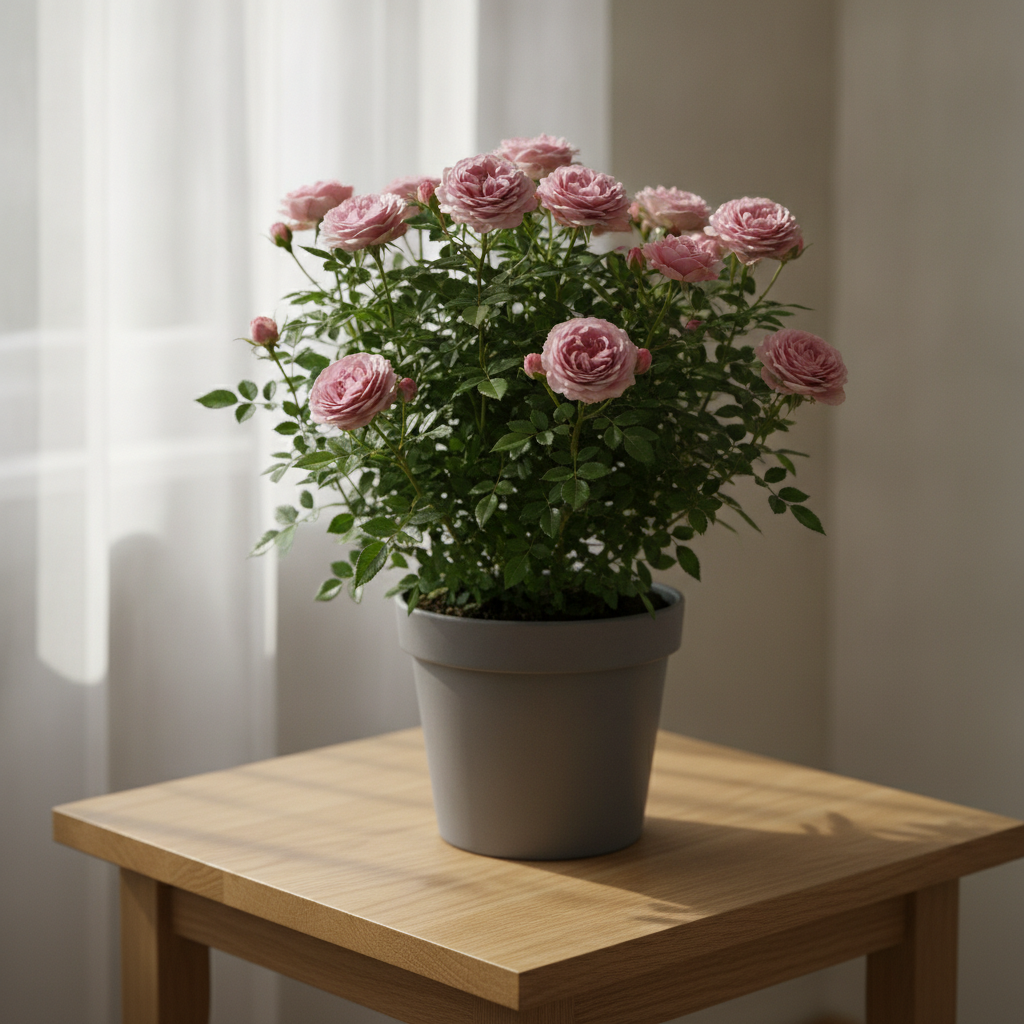
Few plants compress so much classic garden beauty into so little space as the miniature rose. A true rose in every botanical respect, Rosa chinensis minima simply does everything at a smaller scale: shrubby woody stems rarely climb above 30 to 45 centimetres (12 to 18 inches), the glossy pinnate leaves shrink to fingernail size, and the fully double, sweetly formed blooms open no wider than a coin. Descended from the dwarf China roses that reached Europe in the early nineteenth century, these patio roses carry the repeat-flowering habit and refined flower shape of their larger cousins in a frame compact enough for a windowsill, a balcony railing, or a bright kitchen counter.
Miniature roses have a slightly misleading reputation. They appear in supermarkets and florists as cheerful, disposable gift plants, which leads many people to treat them as short-lived decorations. In truth they are tough, long-lived perennials that can flourish for years and even decades, but only if you understand one essential fact: a rose is a sun-worshipping outdoor shrub at heart, not a low-light foliage houseplant. This guide covers everything that separates merely keeping a miniature rose alive from helping it truly thrive, from reading its demanding light needs to managing the fungal diseases that are the bane of every rose grower, indoors or out.
Contents
- Quick Reference
- Why the Miniature Rose Makes a Rewarding Houseplant
- Light Requirements
- Watering & Humidity
- Soil, Potting & Repotting
- Fertilising
- Propagation
- Pests & Diseases
- Popular Varieties
- Frequently Asked Questions
Quick Reference: Miniature Rose at a Glance
| Light | Very bright. A minimum of six hours of direct sun daily; a south-facing window indoors or full sun outdoors. |
| Watering | Keep the soil evenly moist but never waterlogged. Water when the top centimetre (half an inch) begins to dry, often daily in summer heat. |
| Temperature | 15 to 24 degrees Celsius (59 to 75 degrees Fahrenheit) in growth; tolerates a cool winter rest down to near freezing. |
| Humidity | Moderate, around 40 to 50 percent, with excellent air circulation to deter fungal disease. |
| Fertiliser | A balanced or rose-specific feed every two weeks through spring and summer; none in winter dormancy. |
| Toxicity | Non-toxic to cats, dogs and humans, though the prickles can scratch and the foliage may cause mild stomach upset if eaten. |
Why the Miniature Rose Makes a Rewarding Houseplant
The appeal of the miniature rose rests on a simple promise that no foliage plant can match: continuous, recognisable rose blooms in a footprint small enough for the most modest home. A healthy plant in its season is almost never out of flower, throwing up fresh buds in flushes every five to seven weeks. The flowers carry the same intricate, spiralled petal arrangement as a florist’s hybrid tea, scaled down to two or three centimetres across, and many cultivars are lightly fragrant. For anyone who loves roses but lacks a garden, a windowsill miniature is the closest thing to a rose border on a balcony rail.
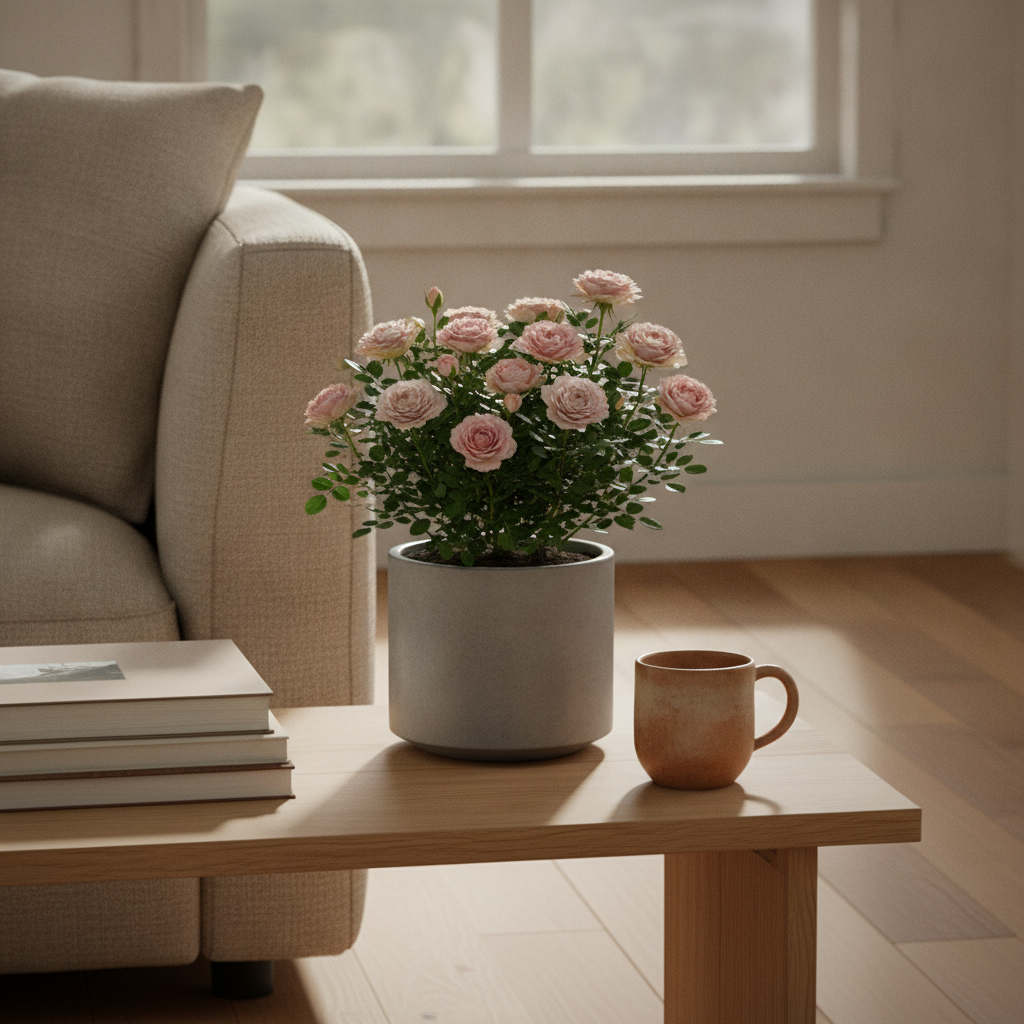
There is honesty required here, though. The miniature rose is not a forgiving, shade-tolerant survivor in the mould of a pothos or a snake plant. It is a deciduous woody shrub that has been bred small but not changed in its fundamental needs. It wants more direct light than almost any plant marketed for indoor life, it resents stagnant air, and it benefits enormously from a genuine cool winter rest. Treated as a permanent dim-corner houseplant it will limp along for a few months and then decline. Treated as a sun-loving patio plant that happens to live in a pot, it becomes a long-term companion that can be lifted outdoors in summer, brought to a bright cold windowsill in winter, and enjoyed year after year. The reward is proportional to how closely you honour its true nature.
Important — Toxicity: Roses are listed as non-toxic to cats, dogs and horses by the ASPCA, and the petals are even edible. The real hazard is physical: the woody stems carry sharp prickles that can scratch curious pets and children, so site the plant where it will not be brushed against constantly. Eating large amounts of foliage may cause mild, temporary digestive upset in pets.
Light Requirements
Light is the single most important factor in miniature rose care, and the one most often responsible for the plant’s failure indoors. Roses evolved as full-sun shrubs, and the miniature forms have inherited that appetite undiminished. A miniature rose needs a minimum of six hours of direct sunlight every day to bloom well and stay healthy; more is better. This is a far higher requirement than the “bright indirect light” so often quoted for tropical foliage plants, and it is why a rose that looks magnificent in a garden centre’s glasshouse so often falters once it reaches an average living room.
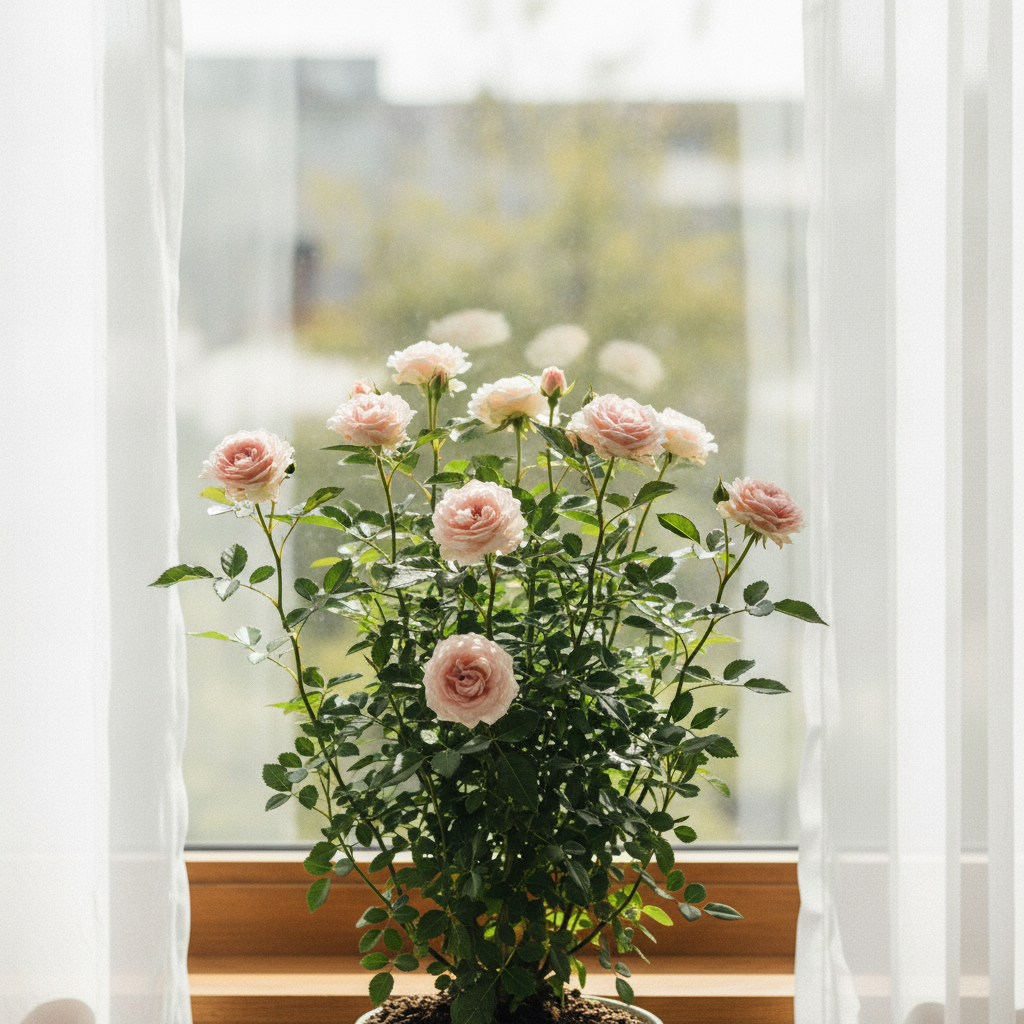
Indoors, the ideal position is pressed close to the glass of a south-facing window where the plant bathes in unobstructed sun for most of the day. Outdoors, on a balcony, patio or windowsill box, a miniature rose will be happier still, drinking in the full spectrum and the moving air that no indoor spot can supply. Many experienced growers keep their miniatures outside from late spring to autumn and bring them to the brightest, coolest window only for the winter. If the leaves are small, the new growth is leggy and pale, and flowering is sparse, the cause is almost always insufficient light rather than any failing in watering or feeding.
Light Levels Explained
Understanding how a rose responds across the spectrum of indoor light helps explain why placement matters so much. The categories below describe the practical outcome you can expect at each level.
| Light Category | Approx. Level | Typical Location | Outcome |
|---|---|---|---|
| Full direct sun | Over 50,000 lux | Outdoors or pressed to a south window | Ideal: compact growth, abundant blooms, strong colour |
| Bright with some direct sun | 20,000 to 50,000 lux | East or west window | Acceptable: flowers, but fewer, with slightly looser growth |
| Bright indirect | 10,000 to 20,000 lux | A metre back from a sunny window | Marginal: survives but blooms poorly and stretches |
| Medium | 5,000 to 10,000 lux | North window or interior | Decline: pale, leggy, prone to disease, rarely flowers |
| Low | Below 5,000 lux | Dim corner | Unsuitable: gradual death |
Window Orientation and Placement
South-facing window: This is the best indoor home for a miniature rose in the northern hemisphere, supplying the long hours of direct sun the plant craves. Position it right against the glass and rotate it a quarter turn every few days so all sides develop evenly.
East-facing window: A reasonable second choice. Morning sun is gentle and the plant will flower, though less profusely than in a south aspect. Expect slightly softer, more open growth.
West-facing window: Comparable to an east window but supplying hotter afternoon sun, which the rose tolerates well. Watch that the soil does not dry out too fast on warm afternoons.
North-facing window: Generally inadequate on its own. A north window does not deliver enough direct light to sustain flowering, and a rose kept here will stretch, pale and weaken. Supplement heavily with a grow light or move the plant outdoors for the growing season.
Pro Tip — Summer Holiday Outdoors: The simplest way to grow a thriving miniature rose is to treat the indoor window as winter quarters only. From the last spring frost to early autumn, stand the pot outside in full sun. The extra light, fresh air and natural temperature swings produce sturdier, healthier plants than any indoor spot can, and dramatically reduce pest and disease problems. Acclimatise it gradually over a week to avoid leaf scorch.
How Light Affects Flowering and Colour
Light governs not only whether a miniature rose flowers but how richly it colours. In strong sun the blooms develop their deepest, most saturated tones and the foliage takes on a healthy dark green. In weak light the same plant produces fewer, smaller, paler flowers, and the new shoots elongate with widely spaced leaves as the plant reaches for brightness. This stretching, known as etiolation, leaves the plant structurally weak and far more susceptible to disease. If you notice the gaps between leaves widening and the stems thinning, increase light immediately rather than adjusting any other aspect of care.
Warning — Direct Sunlight: While miniature roses love direct sun, a plant moved suddenly from a dim indoor spot to fierce outdoor midday sun can suffer leaf scorch, appearing as bleached or browned patches. Always harden the plant off over seven to ten days, increasing its sun exposure gradually, before leaving it in full sun.
Artificial Lighting
Because natural indoor light is so often insufficient, a full-spectrum LED grow light is one of the most effective investments for indoor rose growing, especially through the short days of winter or in homes without a bright south window. Position the light 20 to 30 centimetres (8 to 12 inches) above the foliage and run it for 12 to 14 hours a day to mimic a long summer day. A rose under a good grow light will stay compact and may even continue flowering when outdoor light has all but vanished, though many growers prefer to let the plant rest in winter instead.
Seasonal Adjustments
The sun’s intensity and angle change dramatically through the year, and a rose’s placement should follow. In winter, move the plant to the brightest possible window and clean the glass to maximise the feeble light. In high summer, an unscreened south window can grow uncomfortably hot, so a sheer curtain or a step back from the glass during the fiercest midday hours can prevent overheating and rapid soil drying. Many growers sidestep the seasonal juggling entirely by keeping the rose outdoors all summer and reserving the indoor window for the cold months.
Watering & Humidity
Miniature roses are thirstier than most potted plants, a direct consequence of their high light levels and constant flowering. Unlike a succulent that wants to dry out completely, a rose prefers its soil kept evenly moist, never bone dry and never sodden. The small pots these plants are often sold in dry out remarkably fast, and a rose that wilts from drought repeatedly will drop leaves and abort buds. Striking the balance between consistent moisture and good drainage is the heart of good rose watering.
When to Water
Check the soil daily, especially in warm weather. Water when the top centimetre (about half an inch) of compost has begun to dry to the touch, but before the plant shows any sign of wilting. During a hot summer in full sun, a small pot may need watering once or even twice a day; in cool winter conditions the same plant might go several days between drinks. Rather than following a rigid calendar, let the soil and the season guide you.
The plant itself gives clear signals. Slightly soft, drooping leaves and light, dry-feeling compost mean it is thirsty. A pot that feels heavy and soil that stays dark and damp mean you can wait. The most damaging mistake is allowing a flowering rose to dry out completely and wilt, which stresses the plant, scorches leaf edges and causes buds to shrivel before they open.
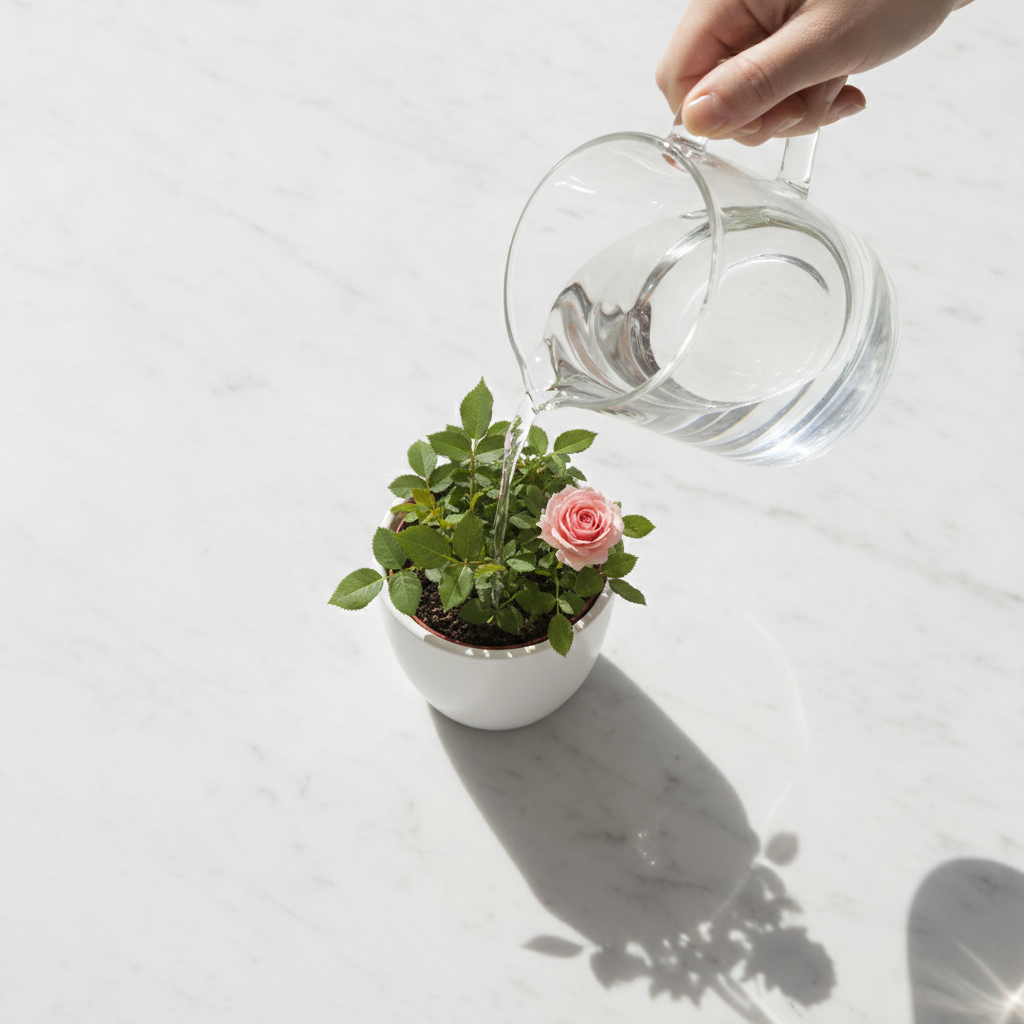
Pro Tip — Water at the Base: Wet foliage left standing overnight is an open invitation to powdery mildew and blackspot, the two diseases roses are most prone to. Whenever possible, water the soil directly and keep the leaves dry. If you do splash the foliage, do it early in the day so the sun and air can dry it quickly.
How to Water Correctly
- Check that the top centimetre of soil has started to dry before watering.
- Direct water at the base of the plant, around the soil surface, avoiding the leaves and flowers.
- Apply water slowly and evenly until it flows freely from the drainage holes, ensuring the entire root ball is moistened.
- Let the pot drain completely for several minutes.
- Empty any water collected in the saucer or cachepot so the roots never stand in it.
- Use room-temperature water to avoid shocking the roots.
Signs of Overwatering vs. Underwatering
| Symptom | Overwatering | Underwatering |
|---|---|---|
| Leaf colour | Yellowing, often from the lower leaves upward | Yellowing with crisp, browning edges |
| Leaf texture | Soft, limp, sometimes translucent | Dry, brittle, curling |
| Soil | Constantly wet, may smell sour | Bone dry, pulling away from the pot sides |
| Roots | Brown, mushy, foul-smelling | Dry and intact but the plant wilts |
| Buds and flowers | Buds blacken and drop before opening | Buds shrivel and dry up |
Warning — Root Rot: A miniature rose left sitting in a saucer of water or grown in a pot without drainage will quickly develop root rot, the most common killer of indoor roses. The first signs are yellowing leaves and a generally wilted look despite wet soil. If you suspect rot, unpot the plant, trim away any brown mushy roots with sterilised scissors, and repot into fresh, free-draining compost.
Humidity Requirements
Miniature roses are comfortable in ordinary household humidity of around 40 to 50 percent and do not need the elevated moisture demanded by tropical foliage plants. What matters far more than the absolute humidity is air movement. Roses are exquisitely vulnerable to fungal disease, and still, stagnant air around the foliage encourages powdery mildew to take hold. A gently moving atmosphere, whether from an open window, a nearby fan on a low setting, or simply life outdoors, does more to keep a rose healthy than any humidity tray.
Very dry indoor air, particularly above a working radiator in winter, can stress the plant and favour spider mites, which thrive in hot dry conditions. If the leaf edges are browning and you spot fine webbing, low humidity combined with heat is the likely culprit. Move the plant away from direct heat sources rather than misting it, since wet leaves carry their own disease risk.
Should you wish to raise humidity a little, do so with methods that keep the foliage dry: stand the pot on a tray of damp pebbles with the pot base clear of the water, or group it loosely with other plants. Avoid heavy misting, which is the one humidity technique that actively works against a disease-prone rose.
Water Quality
Miniature roses are not especially fussy about water quality and tolerate ordinary tap water well in most areas. In regions with very hard water, mineral salts can gradually accumulate in the soil and show as a whitish crust; flushing the pot thoroughly every month or two clears this. If your tap water is heavily chlorinated, letting it stand uncovered overnight allows the chlorine to dissipate. Collected rainwater is excellent when available, being naturally soft and free of additives.
Soil, Potting & Repotting
A miniature rose wants a soil that holds moisture reliably yet drains freely, a combination that supports its thirsty roots without ever letting them sit in water. The light, peaty compost that supermarket roses are usually sold in is rarely ideal in the long term, often either compacting into an airless mass or drying out too quickly. Upgrading to a richer, more structured mix is one of the most worthwhile things you can do for a plant you intend to keep.
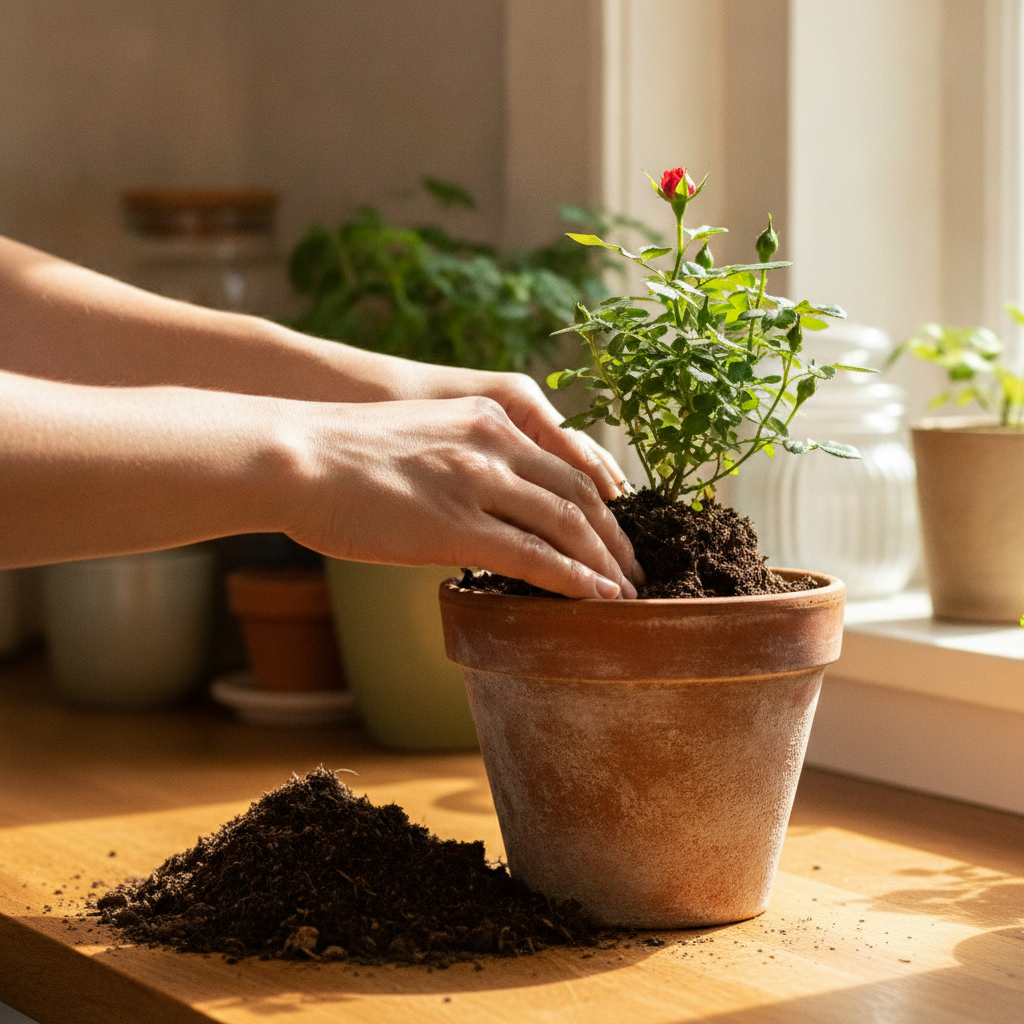
Ideal Soil Composition
Roses are hungry, heavy plants that appreciate a substantial, nutrient-rich growing medium. A good base is a quality loam-based compost, such as a John Innes No. 2 or 3, which holds water and nutrients far better than a peat-free multipurpose mix alone and gives the plant a stable anchorage. To this foundation, added grit or perlite ensures the sharp drainage that prevents root rot, while organic matter feeds the soil life and retains moisture.
| Component | Proportion | Function |
|---|---|---|
| Loam-based compost (John Innes No. 2 or 3) | 60 percent | Holds moisture and nutrients, provides body and stability |
| Quality multipurpose or composted bark | 20 percent | Adds organic matter and improves texture |
| Horticultural grit or perlite | 20 percent | Ensures free drainage and aeration around the roots |
Roses prefer a soil that is neutral to slightly acidic, with an ideal pH of around 6.0 to 6.5. Most loam-based composts sit comfortably in this range, so there is rarely any need to adjust it. Extremely alkaline conditions can lock up iron and cause the yellowing between leaf veins known as chlorosis, which is one more reason to avoid hard-water build-up in the pot.
Pro Tip — Quick Mix Recipe: For a reliable rose mix, combine roughly three parts loam-based John Innes compost, one part composted bark or multipurpose compost, and one part horticultural grit, with a handful of well-rotted manure or worm castings stirred through. This holds moisture for thirsty roots while draining sharply enough to keep rot at bay.
Choosing the Right Pot
The container has a real influence on how easy a miniature rose is to keep watered and how healthy its roots stay. Because roses are deep-rooted relative to their height, a pot with a little depth suits them better than a shallow bowl.
Drainage holes are non-negotiable. Whatever pot you choose, it must have generous drainage holes. The decorative foil-wrapped pots that gift roses arrive in trap water against the roots and cause rot within weeks, so remove the foil and either repot or sit the plant in a properly draining container straight away.
Pot material: Terracotta is an excellent choice for roses because its porous walls allow excess moisture to evaporate and air to reach the roots, reducing rot risk, though it does dry out faster and demands more frequent watering. Glazed ceramic and plastic retain moisture longer, which can be helpful in hot weather but requires more careful watering to avoid sogginess.
Pot size: Choose a pot only one size larger than the current root ball, roughly two to four centimetres (one to two inches) of extra width all round. An oversized pot holds a reservoir of wet soil the small root system cannot use, inviting rot. A pot of 13 to 18 centimetres (5 to 7 inches) in diameter suits most established miniature roses.
When to Repot
A newly purchased miniature rose almost always benefits from repotting soon after you bring it home, since nurseries often crowd several cuttings into one small pot of exhausted compost. Beyond that initial move, repot every one to two years, ideally in early spring just as new growth begins, before the plant comes into heavy flower. Tell-tale signs that a repot is overdue include roots emerging from the drainage holes, water running straight through without wetting the soil, and a plant that wilts within hours of watering.
How to Repot: Step-by-Step
- Water the plant lightly an hour beforehand so the root ball holds together and slides out easily.
- Wearing gloves to guard against the prickles, ease the plant from its pot by tipping it and supporting the base of the stems.
- If several plants are crowded together and you wish to separate them, gently tease the root balls apart; otherwise leave the root mass intact and simply loosen the outer roots.
- Place a layer of fresh, free-draining mix in the new pot, then set the plant so its old soil line sits about two centimetres below the rim.
- Fill around the root ball with fresh compost, firming gently to remove air pockets without compacting the soil hard.
- Water thoroughly to settle the compost, top up any that sinks, and return the plant to its bright position.
- Hold back on feeding for three to four weeks while the roots recover and explore the new soil.
Warning — Transplant Shock: Roses can sulk briefly after repotting, dropping a few leaves or pausing growth. Minimise the shock by repotting in spring, disturbing the roots as little as possible, and keeping the freshly potted plant out of fierce midday sun for a week or so. Avoid the temptation to fertilise immediately, as feeding stressed roots can scorch them.
Fertilising
Few flowering plants are as hungry as roses. The relentless production of bud after bud through the growing season draws heavily on the plant’s nutrient reserves, and a miniature rose confined to a small pot exhausts the limited soil quickly. Regular, balanced feeding through spring and summer is therefore essential for continuous bloom and strong, disease-resistant growth.
The key is to match feeding to the plant’s natural rhythm: feed generously while it is actively growing and flowering, and stop entirely while it rests in winter. Feeding a dormant rose does nothing but risk a build-up of unused salts in the soil.
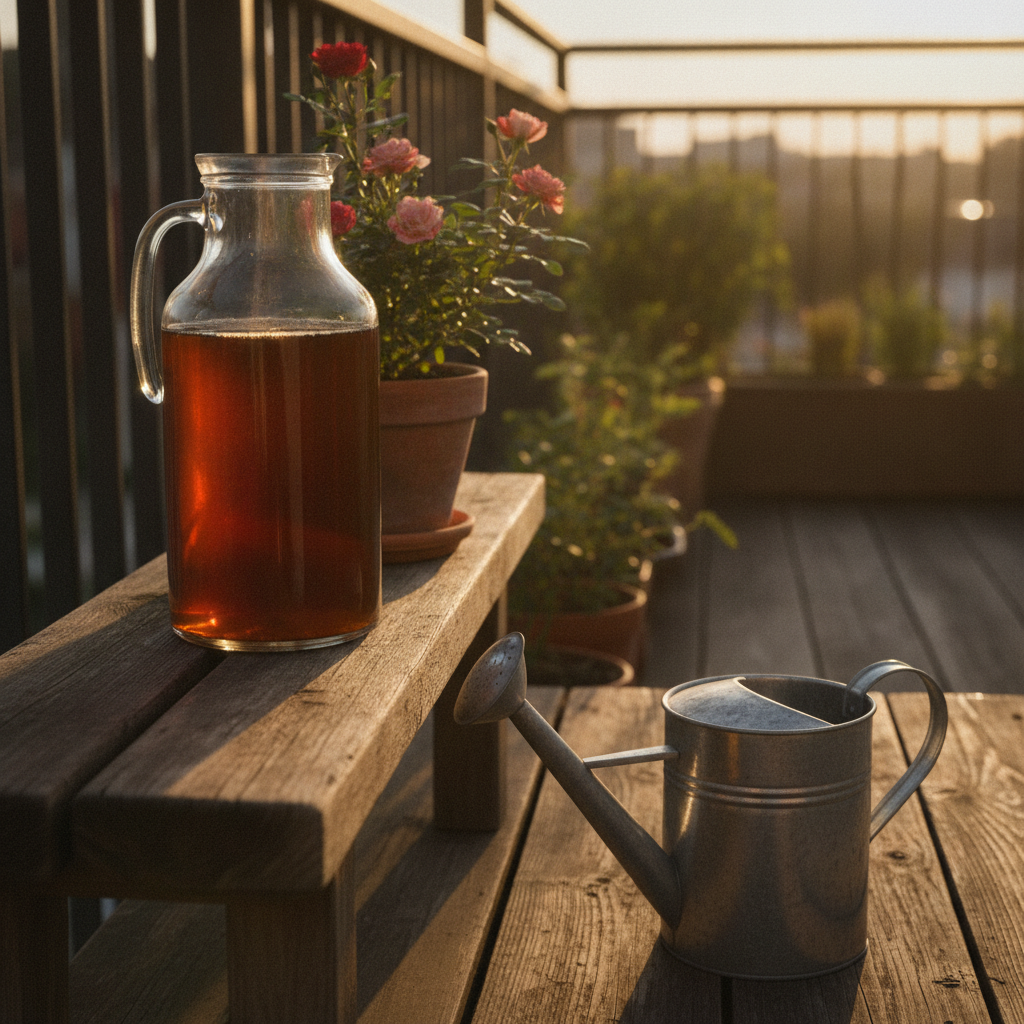
Understanding Plant Nutrients
Fertiliser labels carry three prominent numbers, the N-P-K ratio, describing the proportion of nitrogen, phosphorus and potassium. For roses, potassium is especially valued because it promotes strong flowering and hardier growth, which is why dedicated rose feeds are often slightly higher in potassium than in nitrogen. A balanced general-purpose feed also works well; the table below shows what each major nutrient does and how a deficiency reveals itself.
| Nutrient | Symbol | Primary Function | Deficiency Symptoms |
|---|---|---|---|
| Nitrogen | N | Drives leafy growth and rich green foliage | Pale, yellowing older leaves and weak growth |
| Phosphorus | P | Supports root development and flowering | Dull foliage, poor roots, sparse blooms |
| Potassium | K | Strengthens flowering, stems and disease resistance | Browning leaf edges, weak buds, soft growth |
| Magnesium | Mg | Central to chlorophyll and photosynthesis | Yellowing between the veins of older leaves |
| Iron | Fe | Essential for chlorophyll formation | Yellowing between the veins of young leaves |
Types of Fertiliser
Liquid fertilisers: The most practical choice for potted roses, liquid feeds are diluted in water and applied during normal watering, giving you precise control and fast results. A rose-specific liquid feed or a balanced flowering-plant feed used every two weeks suits a miniature rose well.
Slow-release granular: Granules or pellets stirred into the soil in spring release nutrients steadily over several months, a convenient low-effort option. They pair well with the occasional liquid feed during peak flowering for an extra boost.
Organic fertilisers: Well-rotted manure, worm castings, seaweed extract and proprietary organic rose feeds improve soil health as well as feeding the plant. They release nutrients gently and are very hard to overdose, making them forgiving and sustainable.
Feeding Schedule
Begin feeding as new growth emerges in early spring and continue every two weeks with a liquid feed, or follow the packet timing for slow-release products, right through to late summer. Taper off in early autumn and stop altogether once the plant slows and enters its winter rest. Resuming too early, or feeding through the dormant period, encourages weak winter growth that is prone to disease and damage.
Pro Tip — Feed a Moist Pot: Always apply liquid feed to soil that is already damp, never to a dry, thirsty root ball. Fertiliser salts in contact with dry roots can scorch them. Water the plant first if in doubt, then follow with the diluted feed.
How to Fertilise
- Dilute a rose or balanced flowering feed to the strength stated on the label, or slightly weaker for a small plant.
- Ensure the soil is already moist; water first if it has dried out.
- Apply the diluted feed to the soil, allowing it to soak through to the roots.
- Feed every two weeks through the growing season, withholding entirely in winter.
- Flush the pot with plain water every month or two to wash away any accumulated salts.
Warning — Salt Build-Up: Over-enthusiastic feeding causes mineral salts to accumulate, visible as a white crust on the soil or pot rim and as brown, scorched leaf tips. If you see these signs, leach the pot by running plenty of plain water through it several times, and reduce the feeding frequency.
Propagation
Miniature roses are propagated from stem cuttings rather than by the grafting used for many full-sized garden roses, which means they grow on their own roots and are pleasingly straightforward to multiply at home. A single healthy plant can yield several new ones, and because miniatures root relatively readily, propagation is a satisfying way to share a favourite cultivar or replace an ageing plant.
The best time to take cuttings is late spring through summer, when the plant is in active growth and stems are at the semi-ripe stage: firm but still flexible, neither soft and sappy nor fully woody. Avoid attempting propagation in winter dormancy, when cuttings will simply sit and rot rather than root.
Understanding Nodes and the Cutting
Successful rose propagation hinges on the node, the slightly swollen point on a stem where a leaf joins and where dormant buds and root initials are concentrated. New roots emerge most readily from the tissue at or just below a node, so every cutting must include at least two: one buried to root and one above to produce shoots. A cutting taken from a stem that has just finished flowering, with the spent bloom removed, roots particularly well.
Stem Cuttings: Step-by-Step
Stem cuttings are the standard and most reliable method for miniature roses, producing rooted young plants within a few weeks under warm, humid conditions.
- Select a healthy, pencil-thick semi-ripe stem and cut a length of 10 to 15 centimetres (4 to 6 inches) just below a node, using clean, sharp secateurs.
- Remove any flower or bud and strip the lower leaves, leaving two or three leaves at the top.
- Dip the cut base in rooting hormone powder or gel to improve the success rate, tapping off any excess.
- Insert the cutting into a small pot of moist, free-draining cuttings compost or a mix of perlite and compost, burying the lower node.
- Cover with a clear plastic bag or propagator lid to hold humidity, keeping it from touching the leaves, and place in bright, warm but indirect light.
- Keep the compost lightly moist and ventilate occasionally to deter mould; roots usually form within four to eight weeks, signalled by fresh new growth.
- Once well rooted, pot the young plant on into the standard rose mix and gradually acclimatise it to normal conditions.
Pro Tip — Take Several at Once: Not every cutting will take, so improve your odds by starting five or six at a time. Roses root unevenly, and a small batch all but guarantees a few strong, healthy young plants from a single propagation session.
Air Layering: Step-by-Step
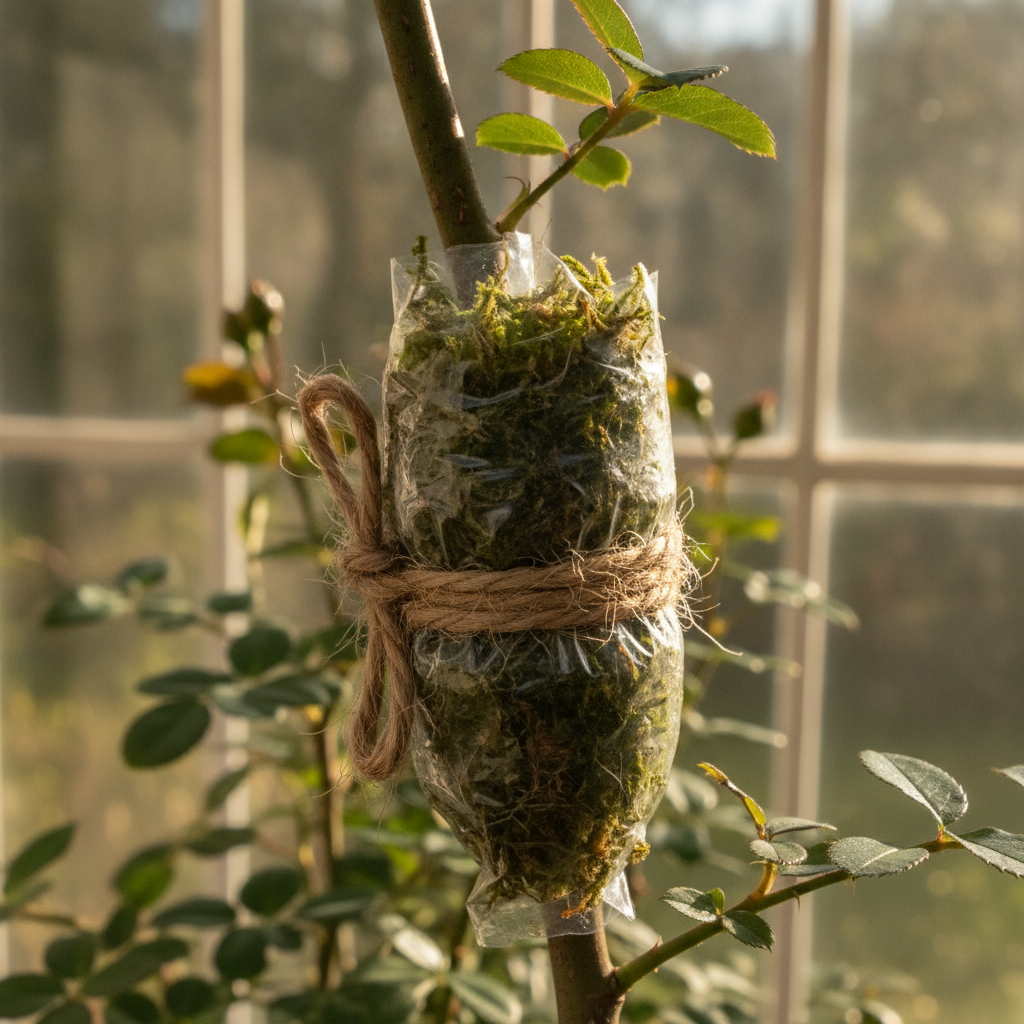
Air layering is a slower but very dependable method, especially useful for a thicker, woodier stem that might be slow to root as a cutting. Because the new roots form while the stem is still attached to and nourished by the parent, the success rate is high.
- Choose a healthy, semi-woody stem and make a shallow upward cut or remove a thin ring of bark just below a node.
- Dust the wounded area lightly with rooting hormone to encourage root formation.
- Wrap the wound in a handful of moist sphagnum moss, enclosing the node completely.
- Cover the moss with clear plastic film and secure it above and below with twine or ties, sealing in the moisture.
- Keep the moss damp by opening and re-misting it if it dries, and wait for roots to appear through the moss, typically over several weeks.
- Once a good root system is visible, cut the stem off just below the new roots and pot it up as an independent plant.
Troubleshooting Propagation
| Problem | Likely Cause | Solution |
|---|---|---|
| Cutting blackens and rots | Compost too wet, or air too stagnant | Use a freer-draining mix and ventilate the propagator regularly |
| Cutting shrivels and dries | Humidity too low, or roots not yet formed | Maintain a humid cover and keep compost lightly moist |
| No roots after many weeks | Stem too soft or too woody, or season too cold | Take semi-ripe cuttings in late spring and summer, with bottom warmth |
| Mould on the cutting or compost | Excess moisture and poor airflow | Remove affected material, ventilate more, ease off watering |
Pests & Diseases
Roses are famously prone to a handful of persistent pests and fungal diseases, and the miniature forms are no exception. Grown indoors, where air circulation is poor and the natural predators of the garden are absent, they can be especially vulnerable. The good news is that vigilance and good cultural practice, above all bright light and moving air, prevent the great majority of problems before they start.
Inspect your plant regularly, paying attention to the undersides of leaves and the soft new growth where pests gather first. Catching an infestation or the earliest spots of disease early makes treatment far simpler and protects the continuous flowering that makes these plants so rewarding.
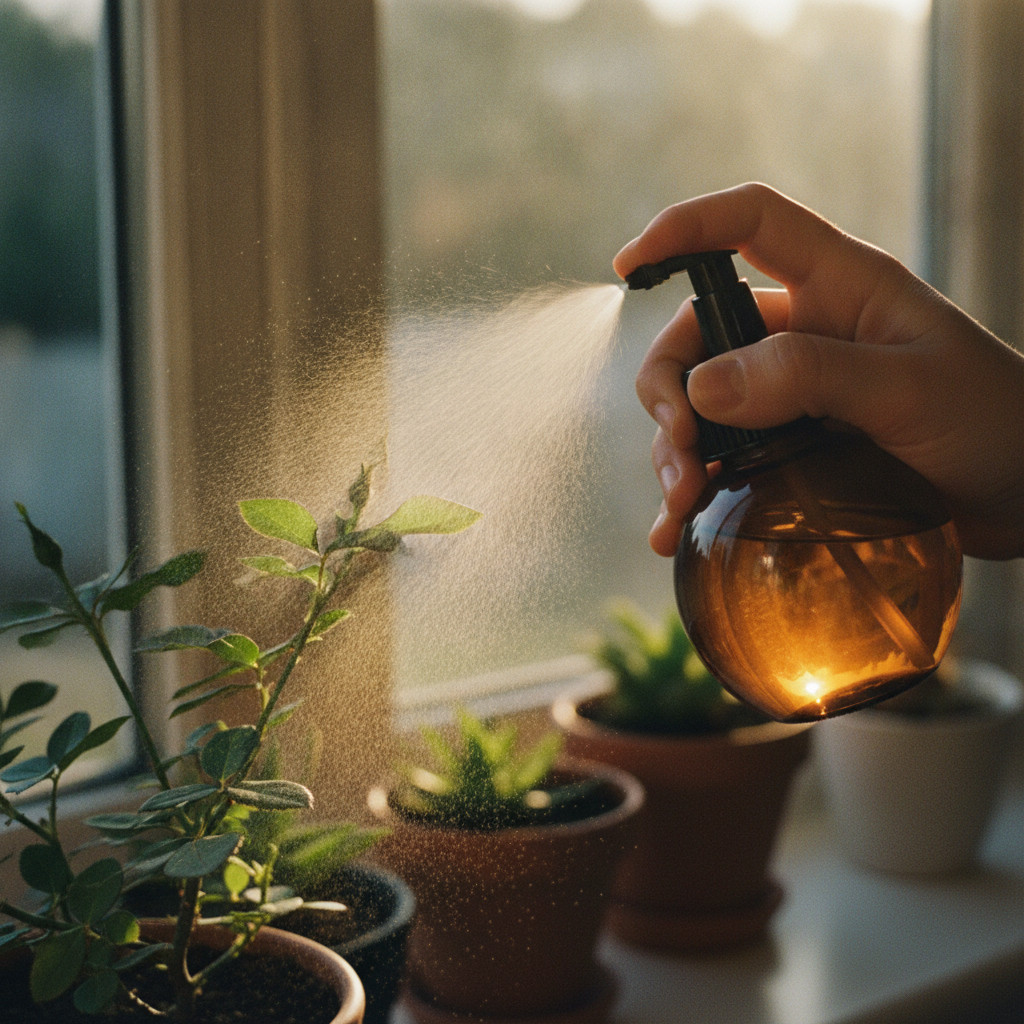
Common Pests
Aphids (Macrosiphum rosae)
Greenfly are the classic rose pest, clustering on the tender new shoots and flower buds where they suck sap, weaken growth and excrete sticky honeydew that attracts sooty mould. A heavy colony can distort buds and stunt the flush of bloom.
Treatment: Dislodge light infestations with a firm jet of water or by wiping the shoots between finger and thumb. For persistent colonies, spray with insecticidal soap or a diluted neem oil solution, repeating every few days until they are gone.
Spider Mites (Tetranychus urticae)
These tiny sap-suckers thrive in the hot, dry air of centrally heated rooms and are one of the most serious indoor rose pests. They cause fine pale stippling on the leaves, followed by yellowing, bronzing and the delicate webbing that betrays a bad infestation.
Treatment: Raise humidity and lower temperature to make conditions less favourable, then treat thoroughly with neem oil or insecticidal soap, coating the leaf undersides where the mites live. Repeat treatments are essential to break the rapid breeding cycle.
Thrips (Frankliniella occidentalis)
Thrips are slender, fast-moving insects that rasp at petals and leaves, leaving silvery streaks and distorted, browned flowers. They are particularly drawn to pale and fragrant blooms and can spoil flowers before they fully open.
Treatment: Remove and destroy badly affected blooms, hang blue sticky traps to monitor and reduce adults, and spray with neem oil or insecticidal soap. Good airflow and the removal of spent flowers limit their numbers.
Common Diseases
Powdery Mildew (Podosphaera pannosa)
The most common disease of indoor roses, powdery mildew coats leaves, buds and stems in a white, dusty film, distorting young growth and weakening the plant. It thrives in stagnant air and the humid microclimate of crowded foliage, and is encouraged by wide swings between dry roots and damp leaves.
Treatment: Improve air circulation immediately, remove the worst affected leaves, and treat with a fungicide or a homemade spray of diluted potassium bicarbonate. Keeping the foliage dry and the plant in bright airy conditions is the best long-term prevention.
Blackspot (Diplocarpon rosae)
Blackspot announces itself as dark, rounded blotches on the leaves, often ringed with yellow, leading to premature leaf drop that can defoliate a plant if unchecked. It spreads through water splashed onto foliage and is more troublesome on plants kept too wet or in still air.
Treatment: Pick off and bin affected leaves promptly, never composting them, water only at the base to keep foliage dry, and apply a rose fungicide if the problem persists. Improving airflow and light goes a long way to keeping blackspot at bay.
Botrytis (Botrytis cinerea)
Also called grey mould, botrytis appears as a fuzzy greyish coating on buds and flowers, especially in cool, damp, still conditions, causing buds to rot and fail to open. Crowded plants and lingering moisture are its chief allies.
Treatment: Remove and destroy affected buds and flowers at once, increase ventilation, and avoid wetting the blooms. Deadheading spent flowers promptly removes the decaying tissue that the mould colonises.
Pest and Disease Summary
| Pest / Disease | Identification | Treatment |
|---|---|---|
| Aphids | Green or black clusters on new shoots and buds | Water jet, insecticidal soap or neem oil |
| Spider mites | Fine stippling, bronzing and webbing on leaves | Raise humidity, neem oil, repeated treatment |
| Thrips | Silvery streaks and distorted, browned flowers | Remove blooms, sticky traps, neem oil |
| Powdery mildew | White dusty film on leaves and buds | Improve airflow, fungicide or bicarbonate spray |
| Blackspot | Dark spots with yellow halos, leaf drop | Remove leaves, water at base, fungicide |
| Botrytis | Grey fuzzy mould on buds and flowers | Remove affected parts, ventilate, keep dry |
Prevention Strategies
Prevention with roses comes down to recreating the open, sunny, airy conditions of a garden as closely as you can indoors. Give the plant the brightest spot you have, ensure air can move freely around it, and avoid the crowded, humid, still pockets where fungal spores flourish. Water at the soil rather than over the leaves, and clear away fallen leaves and spent flowers promptly, since this decaying material harbours both pests and disease.
A vigorous, well-fed plant resists trouble far better than a stressed one, so consistent watering, seasonal feeding and a genuine winter rest all contribute to natural resilience. Quarantine any new plant for a couple of weeks before placing it near your rose, and inspect regularly so that the inevitable occasional problem is caught while it is still small and easily managed.
Pro Tip — Neem as a Routine: A light fortnightly spray of diluted neem oil, applied in the evening to avoid leaf scorch and reaching the leaf undersides, works as both a preventative and an early treatment against the common rose pests. Combined with good airflow it keeps most infestations from ever gaining a foothold.
Popular Varieties
The world of miniature roses is enormous, the product of decades of dedicated breeding that has produced cultivars in nearly every colour, form and fragrance found among full-sized roses. From the prolific Sunblaze series bred for pot culture to heritage favourites that have charmed growers for generations, there is a miniature rose to suit every taste and every bright windowsill.
The varieties below are among the most widely available and reliable for home growing. When choosing, look beyond flower colour to qualities such as disease resistance and compactness, which make a real difference to how easy a plant is to keep happy indoors.
| Variety | Flower Appearance | Light Needs | Growth Rate | Availability |
|---|---|---|---|---|
| Orange Sunblaze | Bright orange, fully double, prolific | Full sun | Moderate, compact | Very common |
| Rise ‘n’ Shine | Clear lemon-yellow, classic high-centred | Full sun | Moderate | Common |
| Cinderella | Tiny white to pale pink, thornless stems | Full sun | Slow, very compact | Specialist |
| Green Ice | Opens cream, ages to soft green | Full sun to bright | Spreading, trailing | Specialist |
| Baby Masquerade | Yellow ageing through pink to red | Full sun | Moderate, bushy | Common |
| Yellow Doll | Soft yellow, many-petalled, fragrant | Full sun | Moderate | Specialist |
| Red Cascade | Deep red, small, abundant, trailing | Full sun | Vigorous, trailing | Common |
Featured Varieties
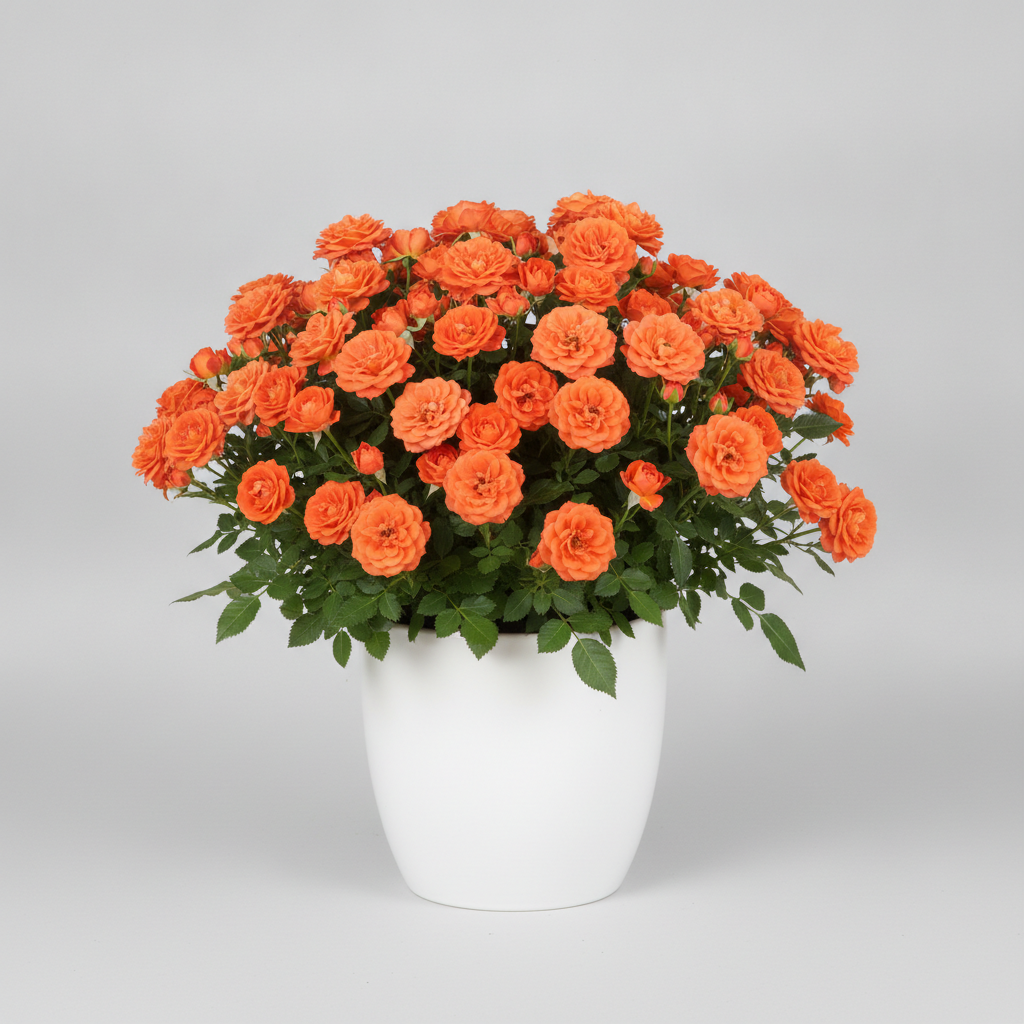
Orange Sunblaze
Part of the famous Sunblaze range bred specifically for container life, this variety smothers itself in small, vivid orange, fully double blooms above glossy dark foliage. Compact, free-flowering and notably weather-tolerant, it is one of the most rewarding and widely sold miniature roses.
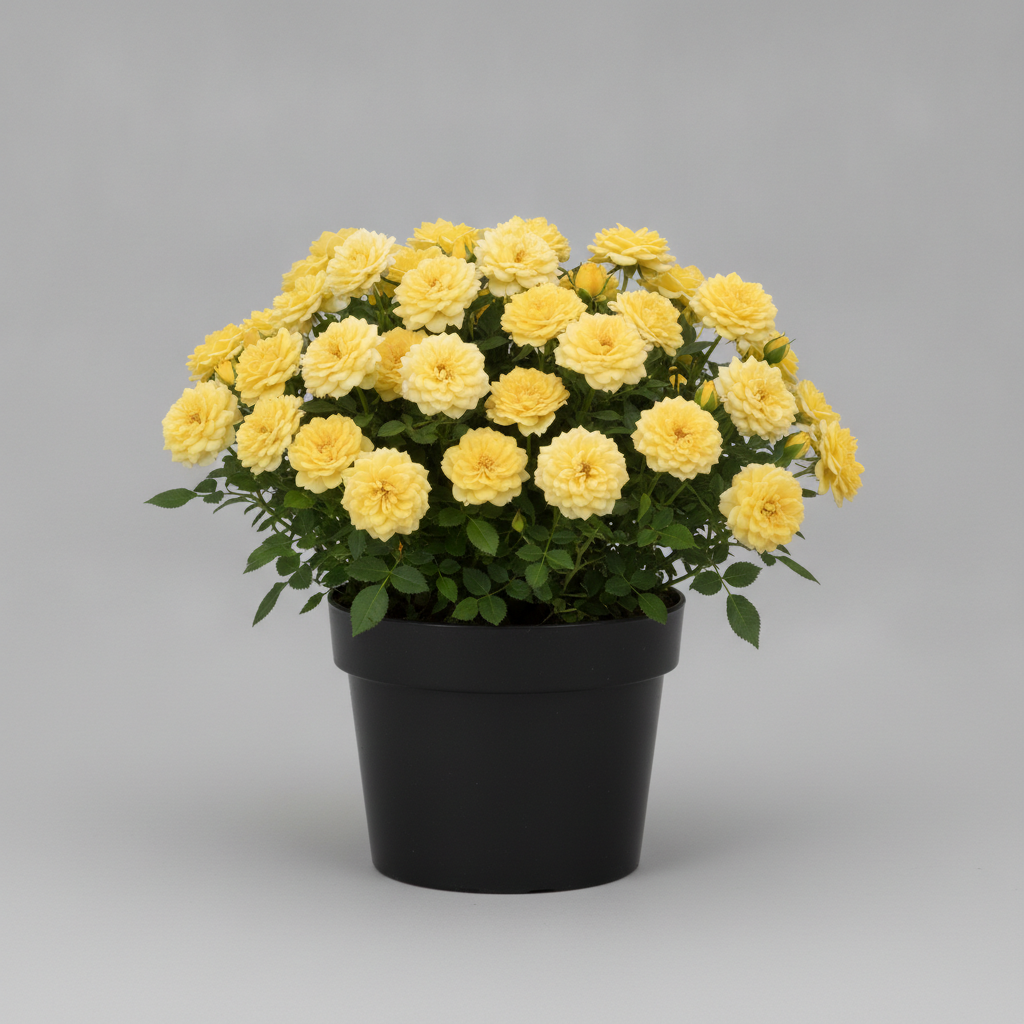
Rise ‘n’ Shine
A celebrated classic and one of the finest yellow miniatures ever bred, Rise ‘n’ Shine bears bright lemon-yellow flowers of perfect high-centred form on a tidy, bushy plant. Reliable, healthy and beautifully proportioned, it remains a benchmark against which other yellow miniatures are judged.
Variety Profiles in Detail
Green Ice (Rosa ‘Green Ice’)
An unusual and much-loved variety whose buds open creamy white and mature to a soft, cool green that gives the plant its name. Its trailing, spreading habit makes it superb in a hanging basket or tumbling over the edge of a raised pot, and its small flowers come in generous sprays throughout the season.
Cinderella (Rosa ‘Cinderella’)
A heritage micro-miniature dating to the 1950s, Cinderella produces tiny, perfectly formed white blooms flushed with the faintest pink on near-thornless stems. Exceptionally compact and dainty, it is a collector’s favourite and ideal for the smallest of spaces where a delicate touch is wanted.
Choosing the Right Variety for Your Space
When selecting a miniature rose, let your conditions guide you as much as your colour preference. If your brightest window is genuinely sunny, almost any variety will reward you; if light is more limited, prioritise the most vigorous and disease-resistant cultivars and be ready to supplement with a grow light. Upright bushy types like Orange Sunblaze and Rise ‘n’ Shine suit a windowsill pot, while trailing varieties such as Green Ice and Red Cascade are made for hanging baskets and the edges of raised containers. Above all, choose a healthy plant with firm green growth and no sign of disease, and give it the sun it craves; the variety matters far less than the light you can offer it.
Frequently Asked Questions
Can a miniature rose really live indoors permanently?
It can survive indoors, but it will struggle to truly thrive without intervention. A miniature rose needs at least six hours of direct sun and good air movement, which most indoor positions cannot supply year round. The healthiest plants are kept on the brightest possible windowsill in winter and moved outdoors into full sun for the summer. If you must keep it inside all year, a full-spectrum grow light makes an enormous difference.
Why is my miniature rose dropping all its leaves?
Sudden leaf drop is usually a response to stress, most often from the soil drying out completely, from sitting waterlogged, or from a dramatic change in conditions such as the move from a humid shop to a dry home. Blackspot disease also causes rapid leaf loss. Check the watering balance first, inspect for dark spots on the leaves, and ensure the plant has enough light. A healthy rose can also drop older leaves naturally as it enters winter dormancy.
Do miniature roses need a winter rest?
Yes, and providing one greatly improves the plant’s long-term health and vigour. Roses are temperate plants that benefit from a cool dormant period, ideally in a bright, unheated room or a sheltered spot outdoors where temperatures fall but stay above hard frost. During this rest the plant may shed leaves and stop flowering, which is entirely normal. Reduce watering, stop feeding, and resume normal care as new growth appears in spring.
Should I deadhead my miniature rose?
Deadheading, the removal of faded flowers, is well worth the small effort. Snipping off spent blooms just above a leaf joint prevents the plant from wasting energy on hips and encourages it to produce the next flush of buds more quickly. It also removes the decaying petals that grey mould loves to colonise, so deadheading keeps the plant both more floriferous and healthier.
How do I prune a miniature rose?
Prune lightly in late winter or early spring before new growth begins. Remove any dead, weak or crossing stems, then shorten the remaining healthy stems by about one third to encourage bushy, vigorous regrowth. Always cut just above an outward-facing bud using clean, sharp secateurs. Miniature roses are forgiving of pruning, so there is little risk in tidying the plant whenever it becomes straggly.
Why won’t my miniature rose flower?
The overwhelming cause of poor flowering is insufficient light. A rose needs many hours of direct sun to bloom, and anything less results in leafy growth with few or no flowers. Other contributors include a lack of feeding during the growing season, a pest or disease check, or the natural pause of winter dormancy. If your plant has plenty of light, is fed regularly and looks healthy, give it time, as the next flush is rarely far away.
Are miniature roses safe around pets?
True roses, including miniatures, are non-toxic to cats and dogs according to the ASPCA, so a curious nibble is not a poisoning risk. The genuine hazard is the prickles on the stems, which can scratch pets and people, so site the plant out of the way of constant traffic. Eating a large quantity of foliage might cause mild, temporary stomach upset, but roses are among the safer flowering plants to keep in a pet household.
My miniature rose came with several plants in one pot. What should I do?
Commercial growers routinely pack several rooted cuttings into a single pot to create an instantly full display, but this crowding leads to competition, poor airflow and a higher risk of disease over time. Once the plant has settled in and is growing, you can gently separate the individual plants when repotting and give each its own container. This produces healthier, longer-lived roses, though if you prefer the lush look you can simply leave them together and accept the slightly higher maintenance.
How long does a miniature rose live?
Despite their reputation as throwaway gift plants, miniature roses are genuine perennial shrubs that can live for many years and, with good care, even decades. The plants sold cheaply in supermarkets are exactly the same species as those treasured by collectors; the difference lies entirely in the care they receive. Give a miniature rose the light, feeding, fresh air and seasonal rest it needs, and it will reward you with flushes of bloom year after year.






