
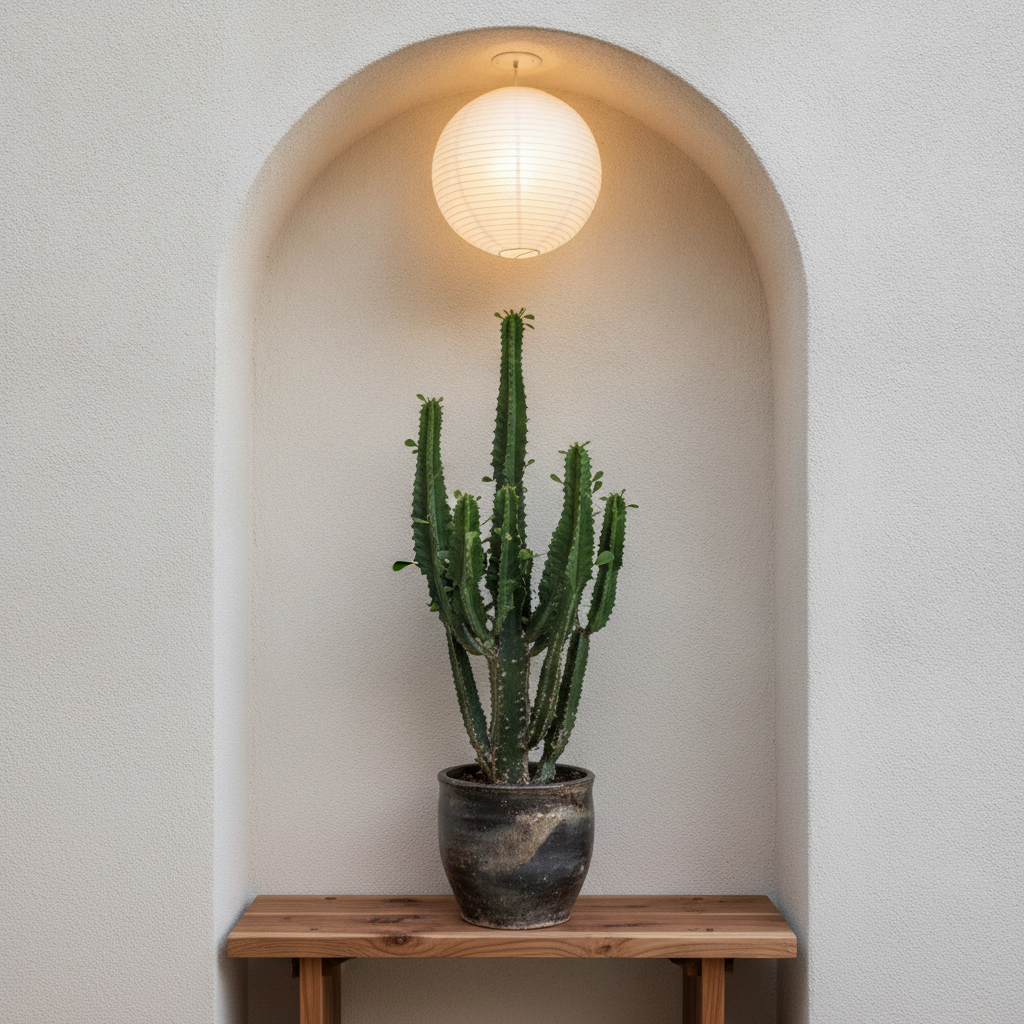
Few houseplants make a statement quite like the African milk tree. With its upright, three-sided ridged columns branching upward in a candelabra silhouette, Euphorbia trigona looks every bit the desert sentinel, which is exactly why it is so often mistaken for a cactus and sold under the name cathedral cactus. It is not a cactus at all but a succulent member of the spurge family, native to Central Africa, where its milky latex and water-storing stems evolved to shrug off long dry spells. The common name nods to that white sap, which seeps from any cut or wound in the plant.
It has earned a reputation as one of the easiest large succulents to keep alive indoors, and that reputation is mostly deserved. It asks for very little: bright light, a quick-draining mix, and the discipline to leave the watering can alone. Yet there is a meaningful gap between a plant that merely survives in a dim corner, growing pale and leggy, and one that thrives into a robust, deeply coloured specimen reaching towards the ceiling. This guide covers everything that separates the two, from reading the light in your home to handling the plant’s irritant sap safely.
Contents
- Quick Reference
- Why the African Milk Tree Makes a Resilient Houseplant
- Light Requirements
- Watering & Humidity
- Soil, Potting & Repotting
- Fertilising
- Propagation
- Pests & Diseases
- Popular Varieties
- Frequently Asked Questions
Quick Reference: African Milk Tree at a Glance
| Light | Bright light with several hours of direct sun; tolerates bright indirect but grows weaker |
| Watering | Only when the soil is fully dry, roughly every 10 to 14 days in summer and far less in winter |
| Temperature | 18 to 29 °C (65 to 85 °F); keep above 10 °C (50 °F) |
| Humidity | Average household humidity is fine; tolerates dry air well |
| Fertiliser | Diluted cactus feed once a month through spring and summer only |
| Toxicity | Toxic. The white latex sap is a serious skin and eye irritant and is harmful if swallowed |
Why the African Milk Tree Makes a Resilient Houseplant
The appeal of Euphorbia trigona begins with its architecture. Where most houseplants offer soft leaves and a rounded shape, this one offers structure: sharp vertical lines, ridged green columns, and a branching habit that turns a single stem into a living sculpture over time. A mature plant can reach 1.8 to 2.7 metres (6 to 9 feet) indoors, though most stay between 1 and 2 metres for years, making it one of the few succulents that can genuinely fill a corner the way a tree does.
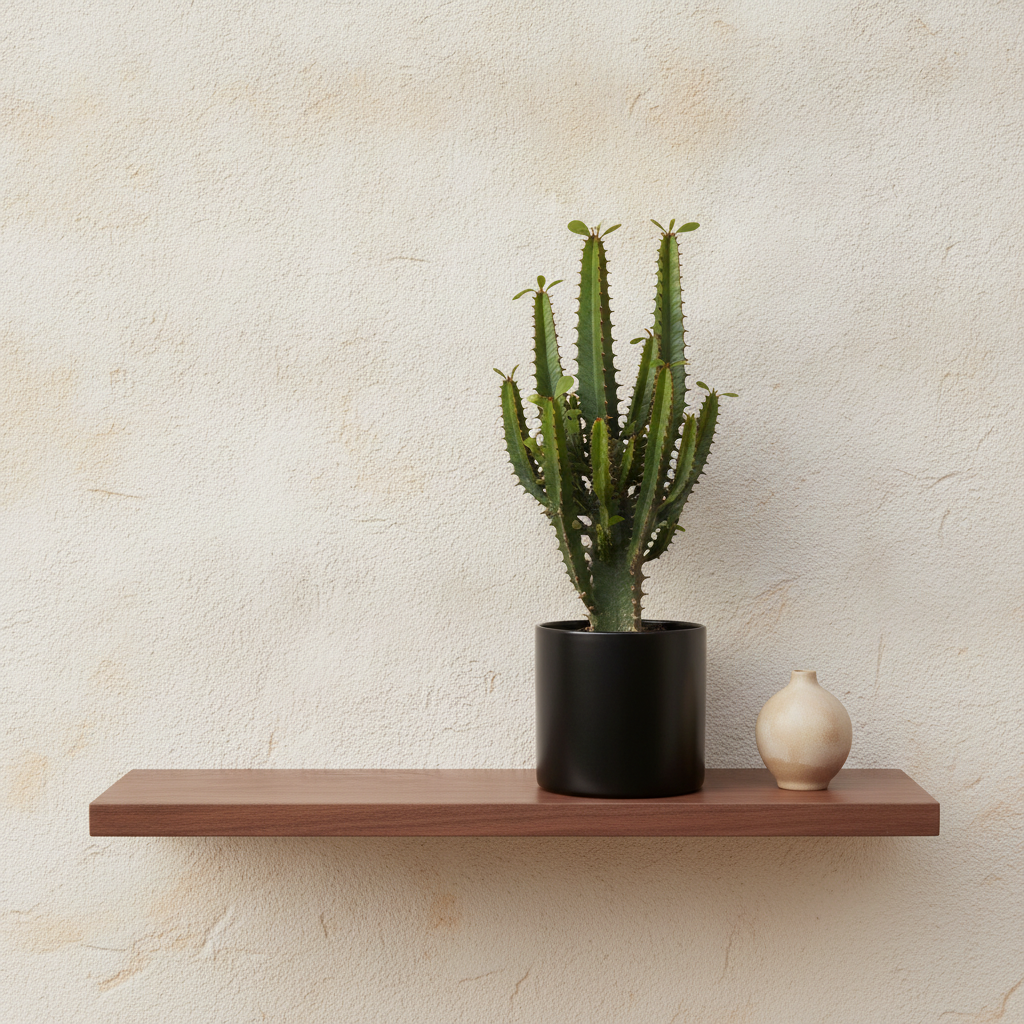
Beyond looks, its great virtue is forgiveness. As a stem succulent, it stores water in those thick triangular columns, which means it copes with neglect far better than it copes with fussing. A forgotten watering schedule rarely troubles it, and it asks for none of the humidity trays, misting routines or frequent repotting that tropical foliage plants demand. Small teardrop-shaped leaves appear along the ridges during active growth and drop again when the plant is stressed or resting, which is normal and not a cause for alarm. For anyone who has lost a fern to dry air or a calathea to tap water, the African milk tree feels almost indestructible by comparison. That resilience comes with one important caveat, covered below.
Important — Toxicity: Every part of this plant carries a milky white latex that is released when stems are cut, snapped or scratched. The sap is a strong irritant that can cause burning, redness and blistering on skin, and it is especially dangerous to the eyes, where it can cause severe pain and temporary loss of vision. It is also toxic if swallowed. Always wear gloves and eye protection when pruning or repotting, keep the plant away from children and pets, and wash any contact site immediately with soap and water.
Light Requirements
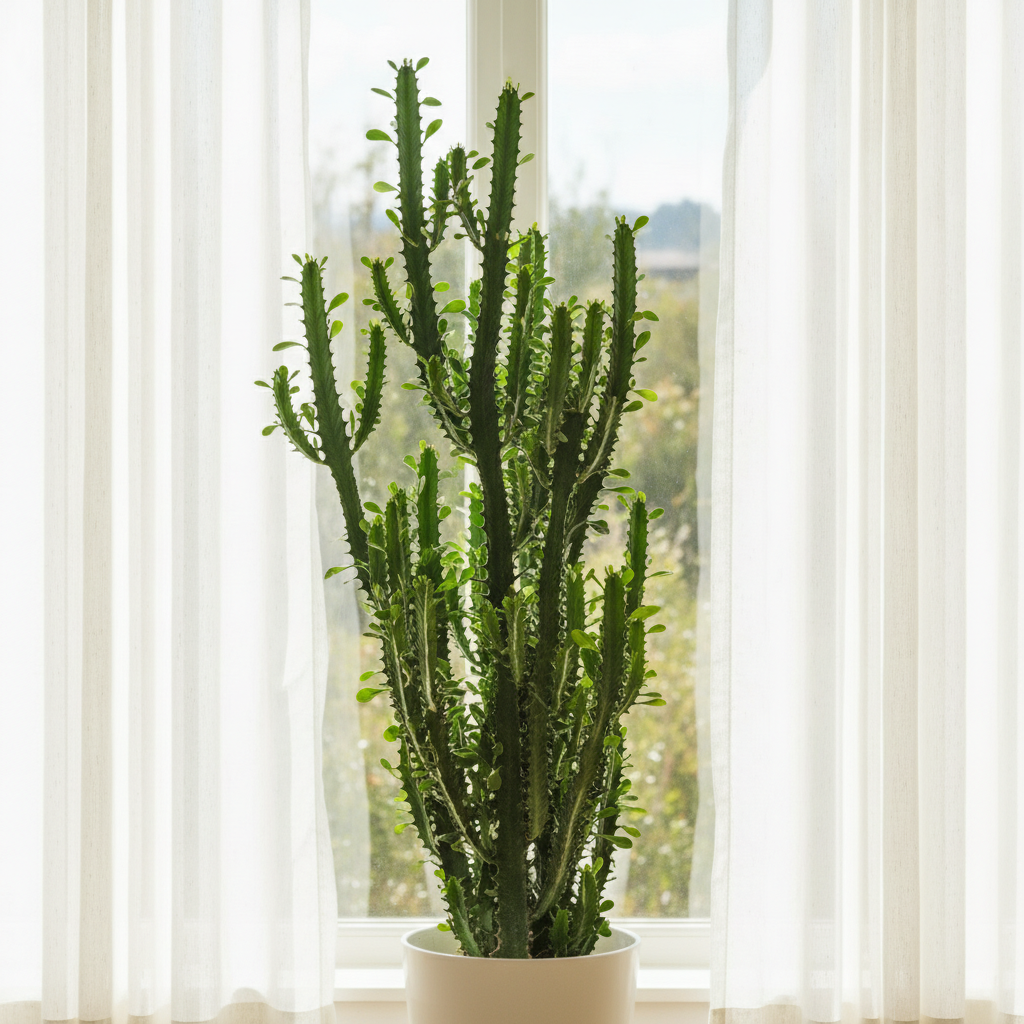
Light is the single biggest factor in whether your African milk tree merely persists or genuinely flourishes. In its native habitat it grows in open, sun-drenched conditions, and indoors it wants as much of that brightness as you can give it. A plant receiving plenty of light stays compact, deeply coloured and stiffly upright, while one in shade tells the story plainly within weeks.
The ideal spot delivers at least four to six hours of direct sun a day, supplemented by bright ambient light for the rest. A position within a metre of a bright window is far better than a shaded interior wall. Unlike many succulents, an established African milk tree handles direct sun through glass without scorching, provided it has been acclimatised gradually rather than moved from gloom to glare overnight.
Light Levels Explained
Indoor light fades much faster than most people expect as you move away from a window, so it helps to think in distinct tiers rather than a vague sense of brightness. The table below maps the common categories to what they mean for this plant.
| Light Category | Approx. Level | Typical Location | Outcome |
|---|---|---|---|
| Direct sun | Over 30,000 lux | On a south or west windowsill | Ideal; compact, strong, well coloured growth |
| Bright indirect | 10,000 to 20,000 lux | Just back from a sunny window | Good; steady growth, slightly softer form |
| Medium | 5,000 to 10,000 lux | A few metres from a bright window | Tolerated; slow, somewhat stretched growth |
| Low | 1,000 to 2,500 lux | An interior wall or north corner | Poor; etiolation, weak pale stems |
| Very low | Under 1,000 lux | A hallway or dim office | Decline over time; not recommended |
Window Orientation and Placement
South-facing window: In the northern hemisphere this is the best position by a wide margin, offering long hours of strong light that keep the plant tight and upright. Place it directly on or beside the sill.
East-facing window: Gentle morning sun followed by bright light suits the plant well, and it is a forgiving spot for a newly bought specimen that has not yet adjusted to strong sun.
West-facing window: Strong afternoon sun makes this another excellent choice, very nearly as good as south, though the warmth means you should watch that the soil does not bake bone dry for too long in summer.
North-facing window: The weakest option. A north window rarely supplies enough light for sustained healthy growth, and a plant kept here will slowly stretch and lose vigour unless you add a grow light.
Pro Tip — Rotate for Even Growth: Because the plant grows so strongly towards light, it will lean noticeably over time if left untouched. Give the pot a quarter turn every week or two so all sides receive their share, keeping the candelabra of stems balanced rather than tilted towards the glass.
How Light Affects Stem Colour and Form
Light does more than fuel growth; it shapes the plant’s whole appearance. In strong light the stems stay short between segments, the ridges grow pronounced, and red-leaved varieties such as Royal Red develop their deepest wine tones. Move the same plant into shade and the response is dramatic. The stems stretch, the spacing between features lengthens, the green pales, and any red flush fades towards a dull olive. This stretching, known as etiolation, cannot be reversed once it happens, so the existing weak growth stays weak even after you correct the light. Only new growth will show the improvement.
Warning — Direct Sunlight: While established plants love sun, a specimen taken straight from a shop or a shaded room can scorch if thrust into intense direct light without acclimatisation. Sunscald shows as pale, bleached or brown patches on the sun-facing side, and the damage is permanent. Introduce strong sun gradually over two to three weeks.
Artificial Lighting
Where natural light falls short, a full-spectrum LED grow light is a reliable substitute. Position it 20 to 40 centimetres above the plant and run it for 10 to 12 hours a day to mimic a bright growing season. This is particularly useful through the short, dark days of winter in higher latitudes, or in rooms where no window can supply the brightness the plant prefers.
Seasonal Adjustments
Light intensity drops sharply in autumn and winter, so a position that was merely bright in summer may become marginal by December. Move the plant closer to its window for the darker months, or supplement with a grow light, and expect growth to slow or pause until spring. As the days lengthen again, ease the plant back from the strongest glass if you notice the new growth looking stressed in the suddenly intense spring sun.
Watering & Humidity
If light is what makes the African milk tree thrive, watering is what most often kills it. The single most common cause of death for this plant is too much water, not too little. Its swollen stems are reservoirs, built to carry it through drought, so the plant is far more comfortable on the dry side than in consistently moist soil. The guiding principle is simple: when in doubt, wait.
When to Water
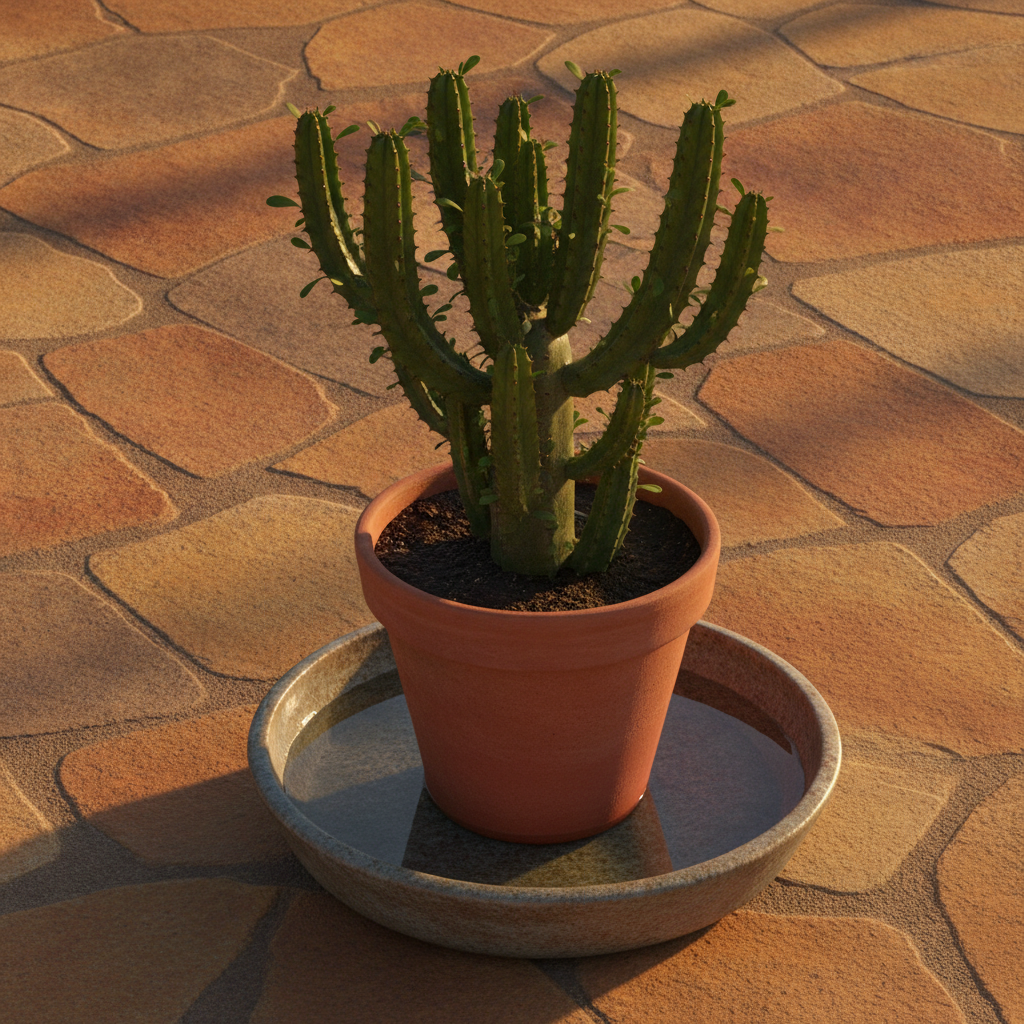
Water only when the potting mix has dried out completely, all the way to the bottom of the pot. In a warm, bright room through the growing season this usually means watering once every 10 to 14 days, but treat that as a loose guide rather than a rule. The pot’s size, the light level, the temperature and the time of year all shift the timing, so the soil itself is always a better signal than the calendar.
Check by pushing a finger several centimetres into the mix or, more reliably, by lifting the pot to feel its weight. A dry pot is conspicuously light, while one still holding water feels heavy. In winter, when growth slows or stops, cut watering back drastically to perhaps once every three to four weeks, just enough to stop the stems shrivelling. A cool, resting plant that is still being watered on a summer schedule is a plant heading for root rot.
Pro Tip — The Weight Test: Lift the pot right after a thorough watering and again once the soil is bone dry, and commit both extremes to memory. With a little practice you can judge exactly when the plant needs a drink by weight alone, which is far more accurate than any fixed schedule.
How to Water Correctly
- Confirm the soil is fully dry from top to bottom before you begin.
- Water thoroughly, letting it run through the entire root ball until it drains freely from the holes in the base.
- Allow the pot to drain completely, then tip away any water that collects in the saucer or cover pot.
- Never let the pot stand in residual water, as waterlogged roots are the fastest route to rot.
- Wait until the mix is completely dry again before the next watering, however long that takes.
Signs of Overwatering vs. Underwatering
| Symptom | Overwatering | Underwatering |
|---|---|---|
| Stem colour | Yellowing, then browning or blackening from the base up | Dulling and slight fading, mostly cosmetic |
| Stem texture | Soft, mushy, water-soaked and collapsing | Wrinkled, puckered, deflated but still firm |
| Soil | Stays wet for days, may smell sour | Bone dry, pulling away from the pot edge |
| Roots | Brown, slimy and foul-smelling | Dry and pale but intact |
| Base of plant | Soft, darkened and rotting at the soil line | Firm, simply thirsty |
The crucial difference is recoverability. An underwatered plant plumps back up within a day or two of a good drink, no harm done. An overwatered one, by contrast, may already be rotting from the roots inward by the time the stems turn soft, and by then saving it means cutting away the healthy upper growth to propagate before the rot climbs.
Warning — Root Rot: Soft, yellowing or blackening stems near the soil line signal advancing root rot, which is usually fatal once it takes hold. If you catch it early, unpot the plant, cut away all mushy tissue with a clean blade, let the wounds callus, and repot the firm remainder into fresh dry mix. If the rot has reached the main stem, take healthy cuttings from the top and start again.
Humidity Requirements
Here the African milk tree is refreshingly undemanding. It is perfectly happy in ordinary household humidity and actively prefers drier air to the damp, stagnant conditions that tropical plants crave. There is no need for misting, pebble trays or humidifiers, and in fact high humidity combined with poor airflow can encourage fungal problems on the stems.
Because it tolerates dry air so well, this is one of the few statement plants that copes near radiators, heating vents or in air-conditioned rooms where humidity-loving species would suffer. Good air circulation matters more than humidity, so a position with some gentle air movement is ideal.
If anything, the risk runs the other way. In a very humid bathroom or a closed-up conservatory the plant can stay damp longer than is healthy, slowing the soil’s drying and raising the chance of rot. In those settings, lean even harder on a gritty mix and generous spacing for airflow.
Water Quality
Unlike sensitive plants such as calatheas, the African milk tree is unbothered by ordinary tap water in most regions, so there is rarely any need for filtered or distilled water. The only real consideration is mineral build-up over time, which gentle, thorough flushing during each watering helps to wash through and out the drainage holes. Lukewarm water is kinder than cold straight from the tap, particularly in winter.
Soil, Potting & Repotting
Everything about watering this plant successfully rests on the soil beneath it. The right mix drains in seconds and holds almost no standing moisture, which is precisely what a stem succulent needs. Heavy, water-retentive potting compost is the enemy here, because it keeps the roots wet long after the plant has taken what it wants.
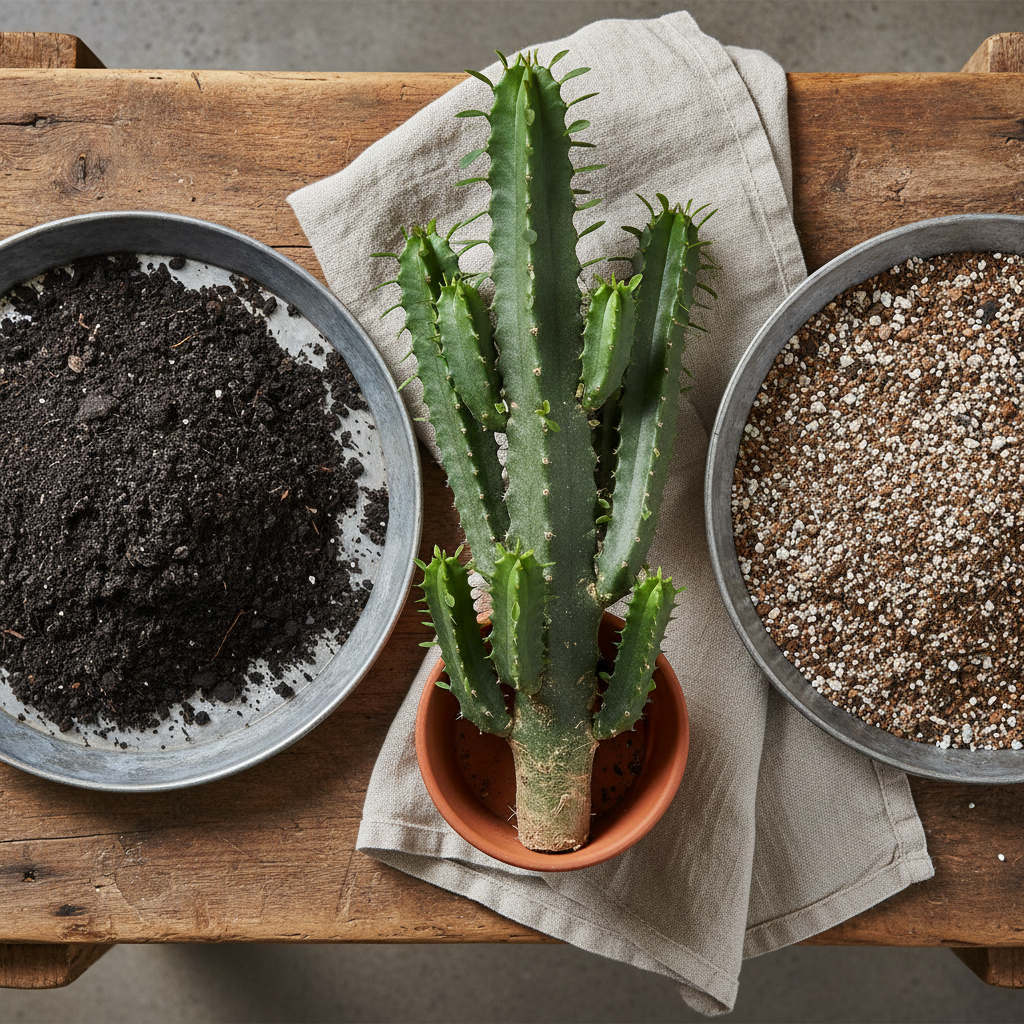
Ideal Soil Composition
A purpose-made cactus and succulent compost is the simplest starting point, and for most growers it is enough on its own. To make it even sharper, cut it with extra mineral grit. The aim is a gritty, open mix that water passes straight through, leaving the roots damp only briefly before air returns to the spaces around them.
| Component | Proportion | Function |
|---|---|---|
| Cactus and succulent compost | Roughly two-thirds | Base medium with light nutrition and structure |
| Perlite or pumice | Roughly one-quarter | Opens the mix and speeds drainage |
| Coarse sand or fine grit | A small handful | Adds weight and sharp, mineral drainage |
The plant is relaxed about pH, growing happily in anything from slightly acidic to slightly alkaline soil, so there is no need to test or adjust it. Drainage and aeration matter far more than chemistry, and a mix that breathes will always serve it better than one tuned to a particular pH.
Pro Tip — Quick Mix Recipe: For a reliable blend, combine three parts shop-bought cactus compost with one part perlite or pumice and a handful of coarse grit. If you can squeeze the moist mix into a ball that holds its shape, it is too rich, so add more grit until it crumbles apart freely.
Choosing the Right Pot
The pot is part of the drainage system, not just a container. Because tall, top-heavy specimens can become unstable, a heavier pot also keeps the plant from toppling as it grows upward and outward.
Drainage holes are non-negotiable. Whatever pot you choose, it must have open holes in the base. Without them, water collects at the bottom out of sight and the roots sit in it, and no amount of careful watering can fully compensate for a sealed container.
Pot material: Unglazed terracotta is the natural partner for this plant, since its porous walls wick moisture out of the mix and help it dry between waterings. Plastic and glazed ceramic hold moisture longer, so if you use them, lean on an even grittier mix and water more conservatively to compensate.
Pot size: Choose a pot only slightly larger than the root ball. An oversized pot holds a large volume of soil that stays wet long after the roots have drunk their fill, which is a recipe for rot. Going up just one size at a time keeps the balance of moisture and air right.
When to Repot
The African milk tree is slow to need repotting and is content to stay slightly snug, so there is no need to disturb it often. Plan on moving it up a pot size every two to three years, or when you see roots emerging from the drainage holes, the plant becoming unstable and top-heavy, or growth slowing despite good light and care. Spring, at the start of the growing season, is the best time to do it.
How to Repot: Step-by-Step
- Put on thick gloves and eye protection before you start, as repotting inevitably disturbs the stems and risks releasing sap.
- Let the soil dry out first, which makes the root ball easier to slide free and reduces breakage.
- Ease the plant out by tipping the pot, supporting the base of the stems with a folded cloth or a thick wad of newspaper rather than gripping bare-handed.
- Gently tease away loose old soil and inspect the roots, trimming off any that are brown, soft or rotten with a clean blade.
- Set the plant in its new pot at the same depth it grew before, then fill around it with fresh dry gritty mix, firming lightly.
- Wait a week before watering, giving any disturbed or cut roots time to callus so they do not rot in damp soil.
Warning — Transplant Shock: Do not water immediately after repotting, however tempting it feels. Freshly disturbed roots and any small tears in the stems need time to seal, and watering straight away invites rot into those open wounds. A dry week in bright, indirect light lets the plant settle before its first drink in the new pot.
Fertilising
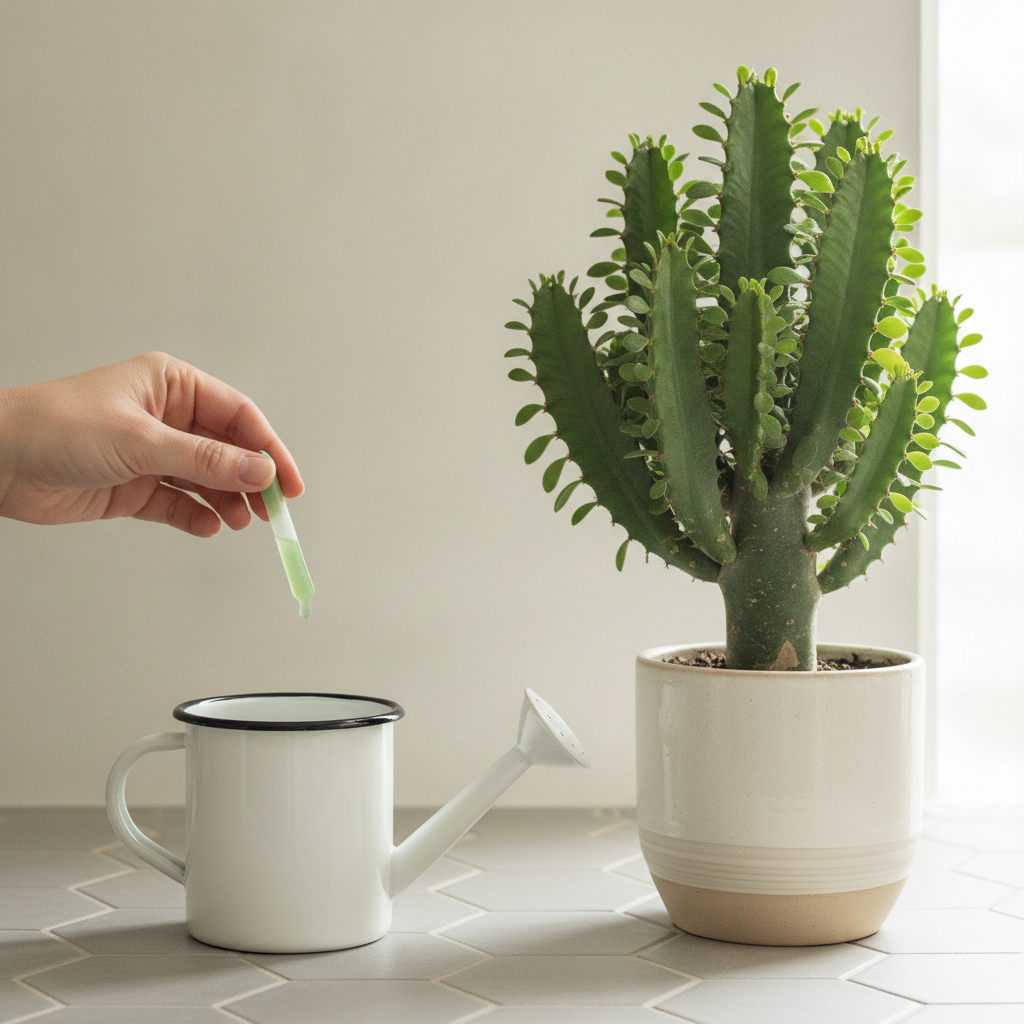
The African milk tree is a light feeder, evolved for poor, lean soils, so its fertiliser needs are modest. A little feeding through the growing season supports steady growth and good colour, but the plant suffers far more from overfeeding than from going hungry. Restraint is the watchword.
Think of fertiliser as a gentle supplement rather than a main course. Too much pushes soft, weak, overly stretched growth that is prone to flopping and more attractive to pests, the opposite of the firm, compact form you want.
Understanding Plant Nutrients
Most fertilisers are labelled with three numbers, the NPK ratio, showing the proportion of nitrogen, phosphorus and potassium. For a succulent like this, a balanced or slightly low-nitrogen feed is best, since heavy nitrogen drives the soft, sappy growth you are trying to avoid. The table below summarises the nutrients that matter and the signs of their absence.
| Nutrient | Symbol | Primary Function | Deficiency Symptoms |
|---|---|---|---|
| Nitrogen | N | Stem and overall green growth | Pale, stalled, weak growth |
| Phosphorus | P | Root development and energy transfer | Poor rooting, sluggish establishment |
| Potassium | K | Overall vigour and stress resistance | Weak stems, browning edges on leaves |
| Magnesium | Mg | Chlorophyll production | Yellowing between green veins |
| Calcium | Ca | Cell wall strength | Distorted or weak new growth |
| Iron | Fe | Healthy green colour in new growth | Pale yellow newest stems |
Types of Fertiliser
Liquid fertilisers: A diluted liquid cactus feed is the easiest and most controllable option, added to the watering can during the growing season. Because you mix each dose yourself, it is simple to keep the strength well below the label rate, which is exactly what this plant prefers.
Slow-release granular: Granules mixed into the soil release nutrients gradually over months, which suits a low-feeder reasonably well, though they give you less precise control over timing and quantity than liquids do.
Organic fertilisers: Mild organic options such as worm castings or a gentle seaweed feed work fine in moderation, releasing nutrients slowly and at low concentration, which fits the plant’s preference for lean conditions.
Feeding Schedule
Feed only during the active growing months of spring and summer, roughly once a month, and always with a diluted solution. Stop fertilising entirely in autumn and winter, when the plant is resting and cannot use the extra nutrients, leaving them to accumulate as harmful salts in the soil instead. A plant that is dormant has no appetite, and feeding it then does only harm.
Pro Tip — Half Strength or Less: Always dilute fertiliser to half the recommended rate or weaker for this plant. Succulents are easily burned by concentrated feed, and a weak solution applied occasionally is far safer than a strong one. When unsure, feed less.
How to Fertilise
- Mix a balanced or cactus-specific fertiliser to half strength or weaker in your watering can.
- Water the plant with plain water first if the soil is bone dry, to avoid feeding onto parched roots.
- Apply the diluted feed evenly across the soil surface until it drains from the base.
- Resume normal dry-then-water cycles afterwards, and feed again no sooner than a month later.
Warning — Salt Build-Up: Over time, fertiliser salts accumulate in the soil and can scorch the roots, showing as crusty white deposits on the soil surface or pot rim. Flush the pot thoroughly with plain water every few months, letting plenty run through the drainage holes to wash the excess away.
Propagation
The African milk tree propagates readily from stem cuttings, and a single mature plant can yield several new ones from a routine prune. The process is straightforward, but it demands more caution than most propagation because of the irritant sap, so preparation and protection matter as much as technique.
Spring and early summer are the best times to take cuttings, when the plant is growing actively and wounds heal fastest. Cuttings taken in the warmth of the growing season root far more reliably than those started in the cool, dim months.
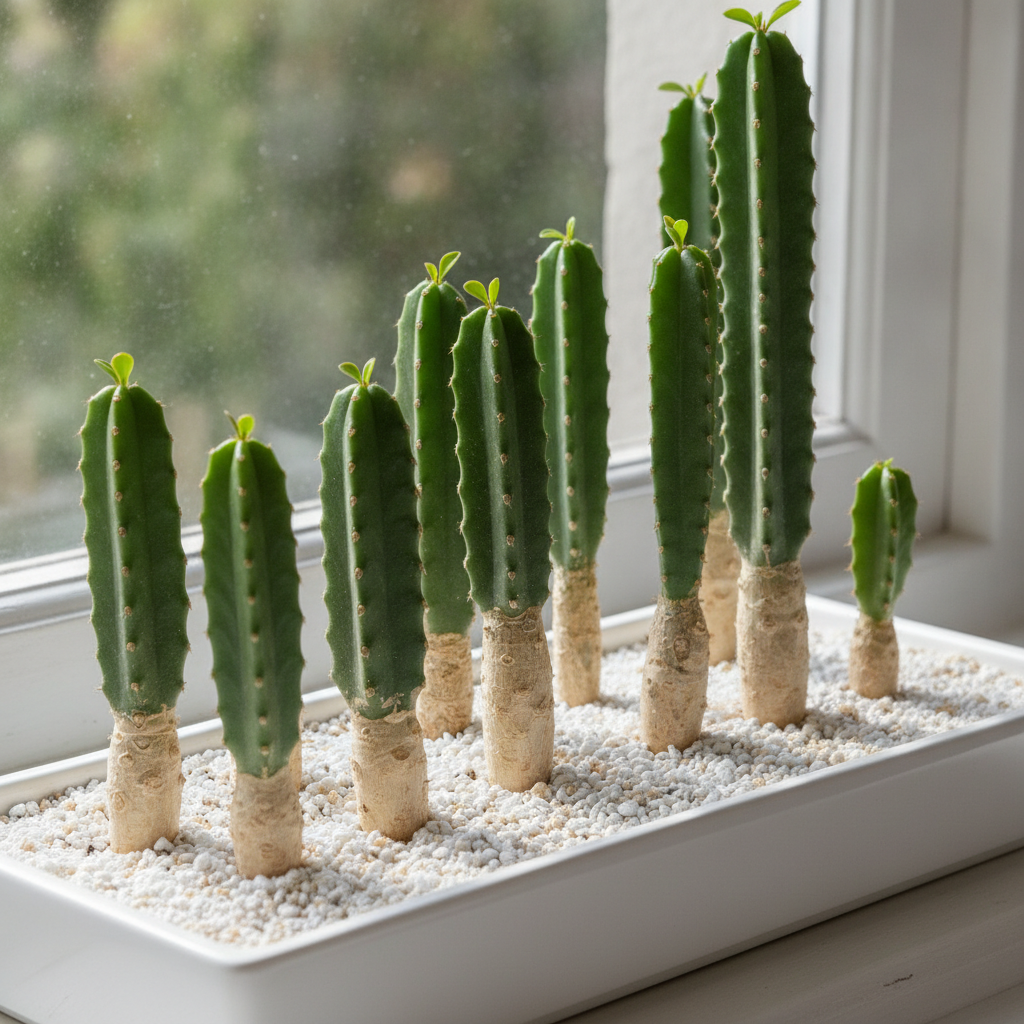
Understanding the Latex and the Callus
Two things make propagating this euphorbia different from rooting a pothos. First, every cut releases the milky latex, which must be rinsed and stopped before the cutting will behave, and which is hazardous to your skin and eyes throughout. Second, the cut end must be allowed to dry and form a hard callus over several days before it touches soil. Skip the callus and the open wound simply rots in the mix instead of rooting. Water rooting, which works for so many houseplants, is the wrong approach here, as a euphorbia cutting left in water almost always rots.
Stem Cuttings: Step-by-Step
This is the standard and most reliable method. Work somewhere easy to clean, wear gloves and eye protection throughout, and keep a bowl of water to hand for rinsing the cut.
- Put on thick gloves and eye protection, and lay down newspaper to catch drips of sap.
- Using a clean, sharp knife, cut a healthy upper branch 8 to 15 centimetres long, ideally where a side branch meets the main stem.
- Rinse the cut end of both the cutting and the parent under cool water, or dab with a damp cloth, until the flow of white latex stops.
- Set the cutting aside in a dry, airy, shaded place for five to seven days until the cut end forms a firm, dry callus.
- Insert the calloused end a few centimetres into a pot of dry gritty cactus mix so it stands upright, propping it if needed.
- Wait about a week, then begin watering sparingly, keeping the mix on the dry side until roots establish over the following weeks.
Pro Tip — Note the Orientation: A cutting must be planted the same way up it grew, since a euphorbia stem will not root if inserted upside down. If you take several pieces at once, mark or remember which end was the base before they all start to look alike.
Offsets and Branch Divisions: Step-by-Step
Older plants sometimes produce branches low on the main stem that can be removed and rooted in the same way, giving you a head start over a fresh cutting. The principle is identical, with the same emphasis on rinsing the sap and callusing the wound.
- Identify a sturdy low side branch and cut it cleanly away from the main stem with a sterile blade.
- Rinse both cut surfaces until the latex stops flowing, then let the branch callus for several days.
- Pot the calloused branch into dry gritty mix, supporting it upright until it has rooted.
- Treat it exactly like a stem cutting thereafter, watering sparingly until new growth confirms it has taken.
Troubleshooting Propagation
| Problem | Likely Cause | Solution |
|---|---|---|
| Cutting rots at the base | Planted before callusing, or soil kept too wet | Allow a full callus and keep the mix nearly dry until rooted |
| No roots after many weeks | Cool temperatures or too little light | Move somewhere warm and bright; be patient in the growing season |
| Cutting shrivels badly | Excessive moisture loss before rooting | A light, occasional watering once calloused helps it hold up |
| Cutting falls over | Top-heavy with no roots yet to anchor it | Prop it upright with sticks or grit until roots form |
Pests & Diseases
For all its toughness, the African milk tree is not immune to trouble, though it faces fewer problems than most houseplants. The overwhelming majority of issues trace back to overwatering rather than to any pest, so a plant kept on the dry side in good light is already most of the way to staying healthy.
When pests do appear, they tend to be the usual sap-feeding suspects, and they are easiest to deal with when caught early. Inspect the ridges and the crevices where leaves meet the stem from time to time, since these sheltered spots are where infestations begin.

Common Pests
Mealybugs (Pseudococcidae)
The most frequent pest on this plant, mealybugs appear as small, soft, white cottony tufts tucked into the ridges and joints, where they suck sap and weaken growth. They breed quickly and spread to neighbouring plants if ignored.
Treatment: Dab each insect with a cotton bud dipped in isopropyl alcohol, then treat the whole plant with insecticidal soap or a diluted neem solution, repeating weekly until no new bugs appear.
Spider Mites (Tetranychus urticae)
Tiny and hard to see, spider mites thrive in hot, dry conditions and reveal themselves through fine webbing and faint stippling or bronzing on the stems. A heavy infestation saps the plant’s vigour over time.
Treatment: Wipe the stems down, improve air circulation, and apply a miticide or neem oil at intervals, since their rapid breeding means repeat treatments are essential.
Scale (Coccoidea)
Scale insects show up as small, hard, brown bumps clinging to the stems, often along the ridges. They are easy to overlook because they barely move, yet they steadily drain sap and leave sticky honeydew behind.
Treatment: Scrape or rub them off with an alcohol-dipped cloth, then follow up with horticultural oil or insecticidal soap to catch any crawlers that remain.
Common Diseases
Root and Stem Rot (Pythium and Phytophthora species)
By far the most serious threat to this plant, rot sets in when the roots stay wet, then climbs into the base of the stems, turning them soft, yellow and eventually black and mushy. Once it reaches the main stem it is usually fatal.
Treatment: There is no cure for advanced rot. Catch it early by unpotting and cutting away every soft, discoloured part, let the wounds callus, and repot the firm remainder dry. If the base is lost, salvage healthy top cuttings and start over.
Fungal Leaf and Stem Spots (various fungi)
In damp, stagnant conditions, fungal spots can appear as small discoloured patches on the stems. They are largely cosmetic but signal that the plant is too wet or poorly ventilated.
Treatment: Improve airflow, reduce watering and humidity, remove badly affected tissue with a sterile blade, and apply a fungicide only if the spread continues.
Pest and Disease Summary
| Pest / Disease | Identification | Treatment |
|---|---|---|
| Mealybugs | White cottony tufts in ridges and joints | Alcohol swab, then insecticidal soap or neem |
| Spider mites | Fine webbing and bronzed stippling | Wipe down, raise airflow, apply miticide or neem |
| Scale | Hard brown bumps on stems with honeydew | Scrape off, then horticultural oil or soap |
| Root and stem rot | Soft, yellowing or blackening base | Cut away rot, callus, repot dry, or restart from cuttings |
| Fungal spots | Small discoloured patches on stems | Improve airflow, reduce moisture, remove tissue |
Prevention Strategies
Prevention is almost entirely about getting the basics right, because a plant grown in bright light, a gritty mix and a dry-then-water rhythm is rarely troubled. The conditions that suit the plant are precisely the conditions that discourage both pests and disease, so good culture does double duty.
Quarantine any new plant for a couple of weeks before placing it near your collection, inspect regularly during routine watering, and keep the foliage and surroundings free of fallen debris. Above all, resist the urge to overwater, since the damp conditions that cause rot also invite the fungus gnats and other problems that follow.
Pro Tip — Isolate and Treat Early: At the first sign of any pest, move the plant away from its neighbours and begin treatment at once. A small infestation caught on day one is a quick fix, while the same pests left a fortnight can spread through a whole shelf of plants.
Popular Varieties
While the species itself is the most widely grown, the African milk tree comes in a handful of distinct forms that differ mainly in colour. All share the same upright, ridged architecture and the same easy care, so choosing between them is largely a question of the look you want.
The most sought-after is the red-toned Royal Red, prized for the deep wine colour it develops in strong light, but the classic green form has an understated, sculptural appeal of its own. The table below sets out the main options.
| Variety | Leaf Appearance | Light Needs | Growth Rate | Availability |
|---|---|---|---|---|
| Green species form | Bright green ridged stems, small green leaves | Bright with some direct sun | Moderate | Very common |
| ‘Rubra’ / ‘Royal Red’ | Stems and leaves flushed deep burgundy-red | High; needs strong light for colour | Moderate | Common |
| ‘Variegata’ | Green stems marbled with cream and pink | Bright indirect to direct | Slow | Less common |
Featured Varieties
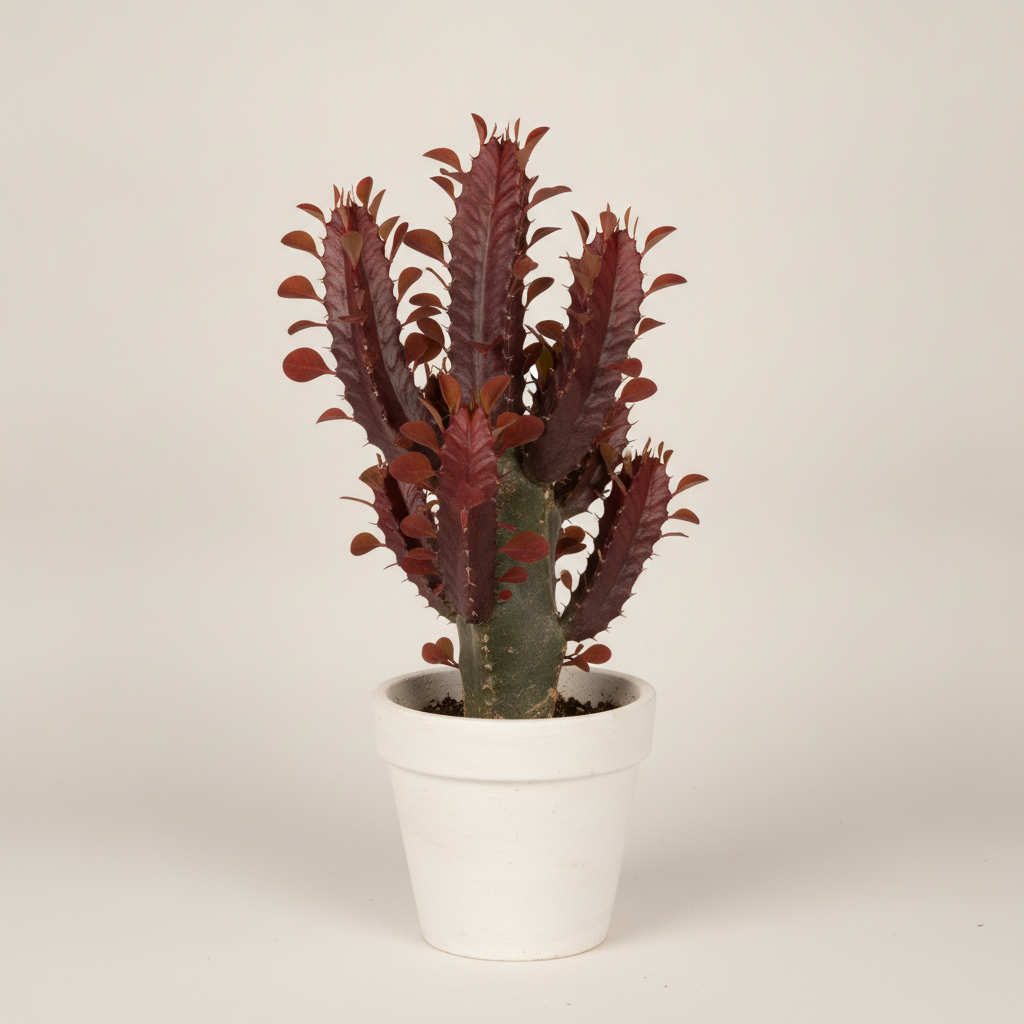
‘Royal Red’ (Euphorbia trigona ‘Rubra’)
The showpiece of the group, Royal Red develops rich wine-red and burgundy tones across its stems and leaves when given strong light. Grown in shade it reverts towards green, so a bright sunny window is essential to keep its signature colour.
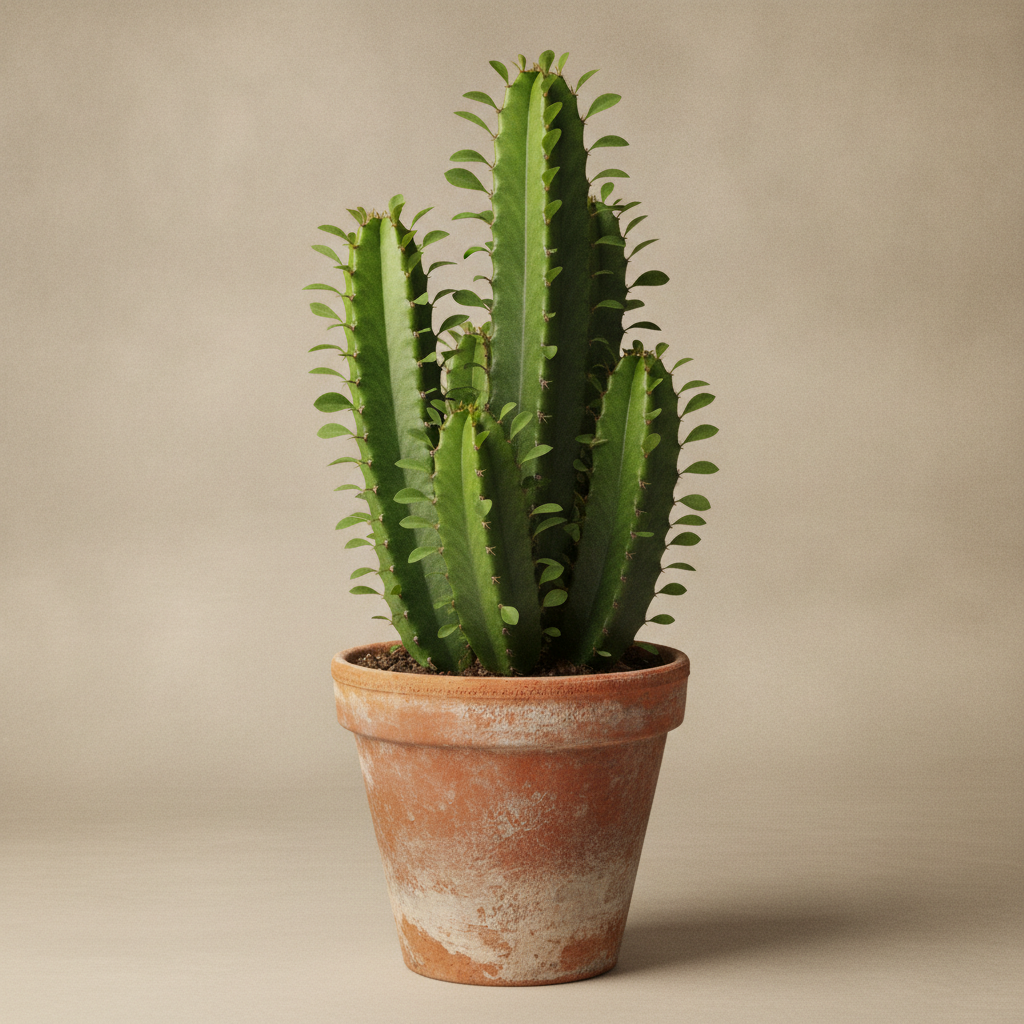
Green Species Form (Euphorbia trigona)
The original and most widely available form, with bright green triangular columns and small teardrop leaves along the ridges. It is the most forgiving of lower light of the three and makes an effortless, sculptural floor plant.
Variety Profiles in Detail
‘Royal Red’ (Euphorbia trigona ‘Rubra’)
Also sold simply as Rubra or Red African milk tree, this cultivar is grown entirely for its colour. New growth often emerges green and deepens to burgundy as it matures under bright light, giving an established plant a striking two-tone effect. It is no harder to grow than the green form, but its colour is a direct report card on the light it receives, fading quickly if the plant is too shaded.
‘Variegata’ (Euphorbia trigona ‘Variegata’)
The least common of the three, the variegated form carries irregular cream and pink marbling across its green stems. The reduced chlorophyll in the pale tissue makes it grow more slowly and need a touch more care with light, since too little leaves it dull and too much can scorch the cream sections. For collectors, its marbled colouring makes it a desirable and unusual specimen.
Choosing the Right Variety for Your Space
If you have a bright, sunny window to fill, Royal Red rewards you with colour no green plant can match, and it is the obvious choice for a sun-drenched spot. For a position with good but less intense light, the classic green form is the safest and most reliable, asking little and growing steadily into an architectural feature. The variegated form is best reserved for those happy to give it the extra attention it needs in exchange for its rarity. Whichever you choose, the care described in this guide applies equally, since beneath the colour they are one and the same easy-going plant.
Frequently Asked Questions
Is the African milk tree a cactus?
No, despite the common name cathedral cactus and its spiny, columnar look, it is not a cactus. It is a succulent in the spurge family, Euphorbiaceae, and the milky latex it produces is a sure sign it is a euphorbia rather than a true cactus, which never carries such sap.
Why is my African milk tree dropping its leaves?
Some leaf drop is completely normal, especially in autumn and winter or after a change in conditions, since the small leaves are seasonal and the stems do the real work of photosynthesis. Sudden heavy drop can point to overwatering, cold draughts or a big environmental change, so review those before worrying.
How fast and how tall does it grow?
Growth is moderate, often around 15 to 30 centimetres a year in good light, and indoors the plant can eventually reach 1.8 to 2.7 metres (6 to 9 feet). Most stay between 1 and 2 metres for many years, and you can keep one shorter by pruning the top, always with gloves and eye protection.
Is the African milk tree toxic to pets and children?
Yes. The white latex sap is a serious irritant to skin and eyes and is harmful if swallowed by people or animals, causing mouth and stomach upset. Keep the plant well out of reach of children and pets, and take care that no one brushes against a damaged stem.
What should I do if I get the sap on my skin or in my eyes?
Wash skin contact immediately with soap and plenty of water, as prompt washing limits the irritation. If sap reaches the eyes, rinse with copious clean water for at least fifteen minutes and seek medical attention without delay, because eye exposure can cause severe pain and temporary vision loss and should always be treated as urgent.
Why is my plant turning yellow or going soft?
Yellowing and softness, especially starting at the base, almost always mean overwatering and the onset of rot. Stop watering at once, check the roots, and cut away any mushy tissue, letting the firm remainder dry before repotting into gritty mix. A simply thirsty plant wrinkles rather than going soft, and recovers with a drink.
Why is my African milk tree growing tall and thin?
Stretched, pale, weak growth is etiolation, caused by too little light. Move the plant to a brighter, sunnier spot or add a grow light, though the existing thin growth will not thicken again. Only new growth produced in better light will return to the compact, sturdy form you want.
Does it ever flower indoors?
Flowering is rare on indoor specimens, and the plant is grown almost entirely for its striking stems rather than its blooms. When it does flower, the blooms are small and inconspicuous, so there is no need to feel you are missing out if yours never does.
How do I prune or control the size of my plant?
Prune in spring with a clean, sharp knife, wearing gloves and eye protection, cutting the top or any wayward branches back to the height you want. Rinse the sap from the cuts, and remember that pruning often encourages branching below the cut, which can give the plant an even fuller candelabra shape. The removed tops can be calloused and rooted as new plants.
Why is my plant leaning to one side?
The plant grows strongly towards its light source, so a specimen left in one position will gradually lean towards the window. Rotate the pot a quarter turn every week or two to keep the growth even and upright, and use a heavier pot to stop a tall, top-heavy plant from tipping over.






