
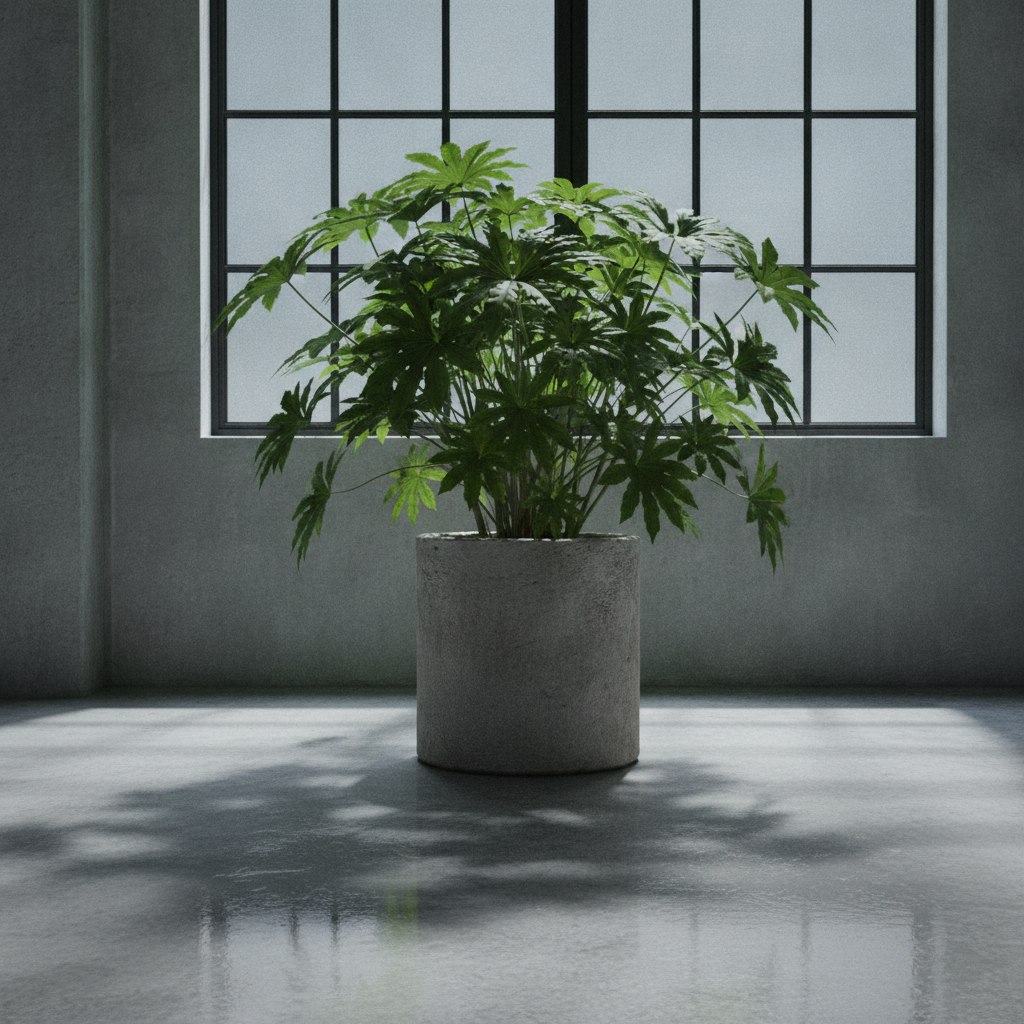
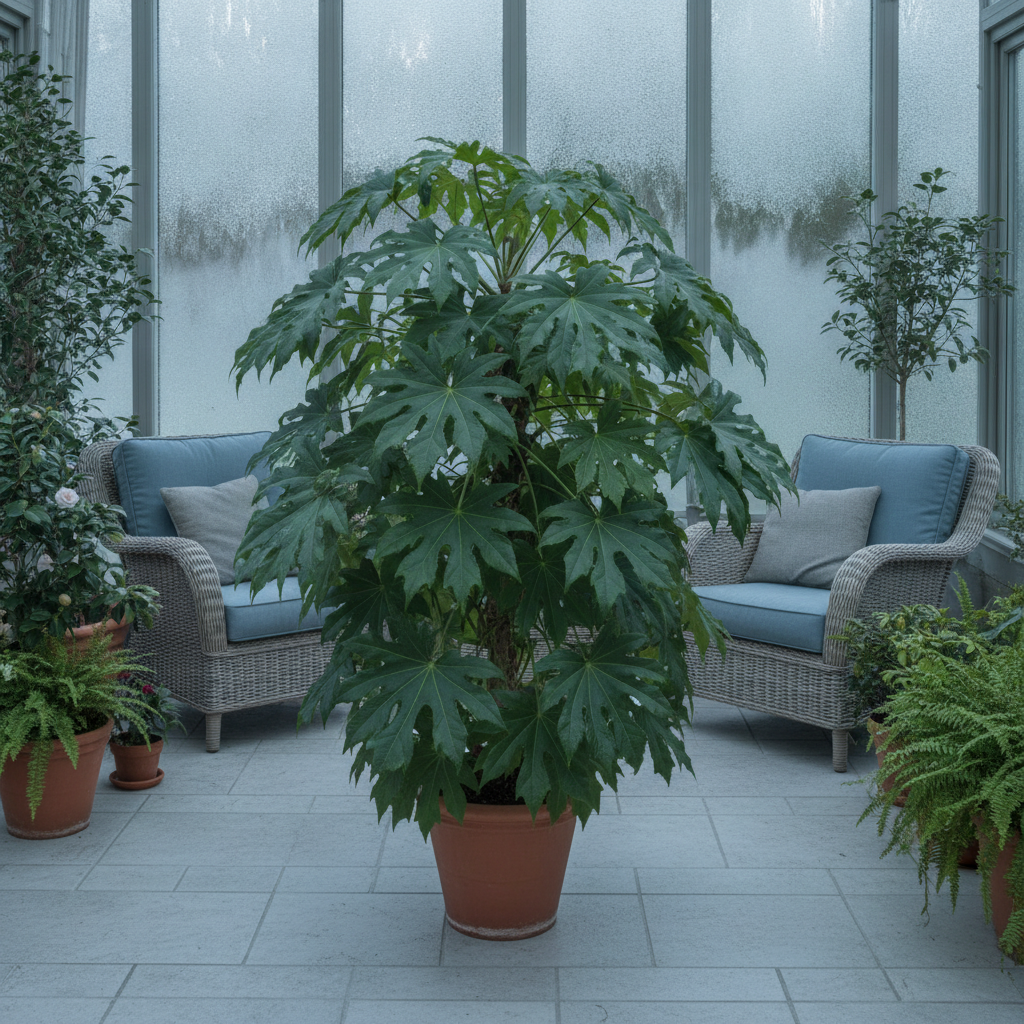
Few houseplants manage to look genuinely tropical while shrugging off the cold, but the Japanese aralia (Fatsia japonica) does exactly that. Its enormous glossy leaves, splayed like green hands across long arching stalks, give a room the lush, jungly architecture of a far warmer climate, yet the plant itself hails from the shaded, mild coastal woodlands of southern Japan and Korea. That contradiction is the whole point of growing it: here is a plant built for the dim, draughty, cooler corners where most leafy statement plants sulk and decline. Understanding the difference between merely keeping a Japanese aralia alive and helping it truly thrive comes down to respecting its woodland origins rather than treating it like a sun-loving tropical.
Quick Reference
The table below distils the essentials for growing Fatsia japonica indoors. Treat it as a starting orientation rather than rigid rules, because the right care always shifts with your home, the season and the size of your plant.
| Common names | Japanese aralia, paperplant, fatsia, glossy-leaf paper plant, false castor oil plant |
| Botanical name | Fatsia japonica |
| Family | Araliaceae |
| Light | Bright indirect to moderate shade; no harsh direct midday sun |
| Water | Keep evenly moist; never let the rootball dry out completely |
| Humidity | Moderate to high; struggles in hot, dry air |
| Temperature | 10 to 21 degrees C (50 to 70 F); tolerates brief dips near freezing |
| Soil | Rich, moisture-retentive yet free-draining loam-based mix |
| Feeding | Balanced liquid feed monthly through spring and summer |
| Mature size indoors | 1 to 2 metres (3 to 6 feet) tall and almost as wide |
| Toxicity | Generally regarded as non-toxic to cats and dogs; sap may irritate sensitive skin |
| Difficulty | Easy, provided rooms stay cool and the plant is never allowed to bake |
If you read only one line, read this one: a Japanese aralia wants to be cool, shaded and consistently moist. Almost every problem owners encounter traces back to a room that is too warm, too bright or too dry for a plant that evolved on the dim, damp floor of a temperate forest.
- Why Japanese Aralia Makes a Good Houseplant
- Light
- Watering
- Soil and Potting
- Fertilising
- Propagation
- Pests and Problems
- Varieties
- Frequently Asked Questions
Why Japanese Aralia Makes a Good Houseplant
The appeal of Fatsia japonica starts with the leaves. Each one is a large, leathery, deeply lobed disc, typically 20 to 45 centimetres (8 to 18 inches) across, divided into seven to nine glossy fingers radiating from a central point on a long, slender petiole. The overall effect is sculptural and emphatic in a way that few other temperate plants achieve. A single mature specimen reads as a piece of living architecture, filling an awkward corner or softening a hard wall with broad, light-catching foliage. Because the leaf surface is so reflective, even in a dim room the plant seems to gather what little light there is and throw it back into the space.
What sets the species apart from other large-leaved indoor plants is its genuine tolerance of conditions they cannot abide. Outdoors in mild maritime climates it is hardy down to roughly minus 10 to minus 15 degrees C (5 to 14 F), making it one of the toughest broadleaf evergreens available to temperate gardeners. That same constitution translates indoors into a plant that copes happily with cool hallways, unheated conservatories, shaded north-facing rooms and the kind of fluctuating, draughty spots where a fiddle-leaf fig would drop every leaf in protest. For anyone whose home runs cool, or whose brightest available corner is still fairly shady, the Japanese aralia is one of the most rewarding large plants you can choose.
It is also a fast and generous grower when content, pushing out flushes of new leaves through spring and summer and gradually building from a tidy tabletop plant into a substantial floor specimen. Mature plants kept cool may even produce their curious autumn flowers, drumstick clusters of small creamy-white blooms held in rounded umbels above the foliage, followed by ink-black berries. Indoors this flowering is uncommon, but it speaks to the plant’s underlying vigour. The name false castor oil plant, incidentally, refers only to the superficial resemblance of its leaves to those of the genuinely poisonous castor oil plant (Ricinus communis); the two are unrelated, and Fatsia carries none of that danger.
Pro Tip — Match the plant to the room: Before buying a Japanese aralia, be honest about how warm your home runs. In a centrally heated flat held at 22 degrees C all winter with dry forced air, this plant will fight you. In a cooler, humid, lower-light home it is close to unkillable. Choose your spot around its love of cool shade, not the other way around.
Light
In the wild, Japanese aralia grows in the understorey and along the shaded margins of coastal forests, where it receives bright, indirect light filtered through a canopy rather than full, unbroken sun. Recreating that woodland brightness is the single most reliable way to keep it looking its best indoors. A position a metre or two back from an east or north-facing window, or beside a south or west window screened by a sheer curtain, supplies the gentle, ambient light it prefers. In that kind of spot the leaves stay large, deep green and well spaced, and the plant grows into a balanced, full shape.
The crucial distinction is between bright shade, which the plant loves, and harsh direct sun, which it does not. Strong midday rays striking the foliage through unscreened glass will scorch the leaves, bleaching them to a sickly pale green or burning crisp brown patches into the surface that never recover. This is the most common avoidable mistake with the species, because owners assume a big leafy plant must be a sun lover. It is the opposite. If you can see a hard-edged patch of sunlight crossing the leaves at any point in the day, move the plant back or diffuse the window.
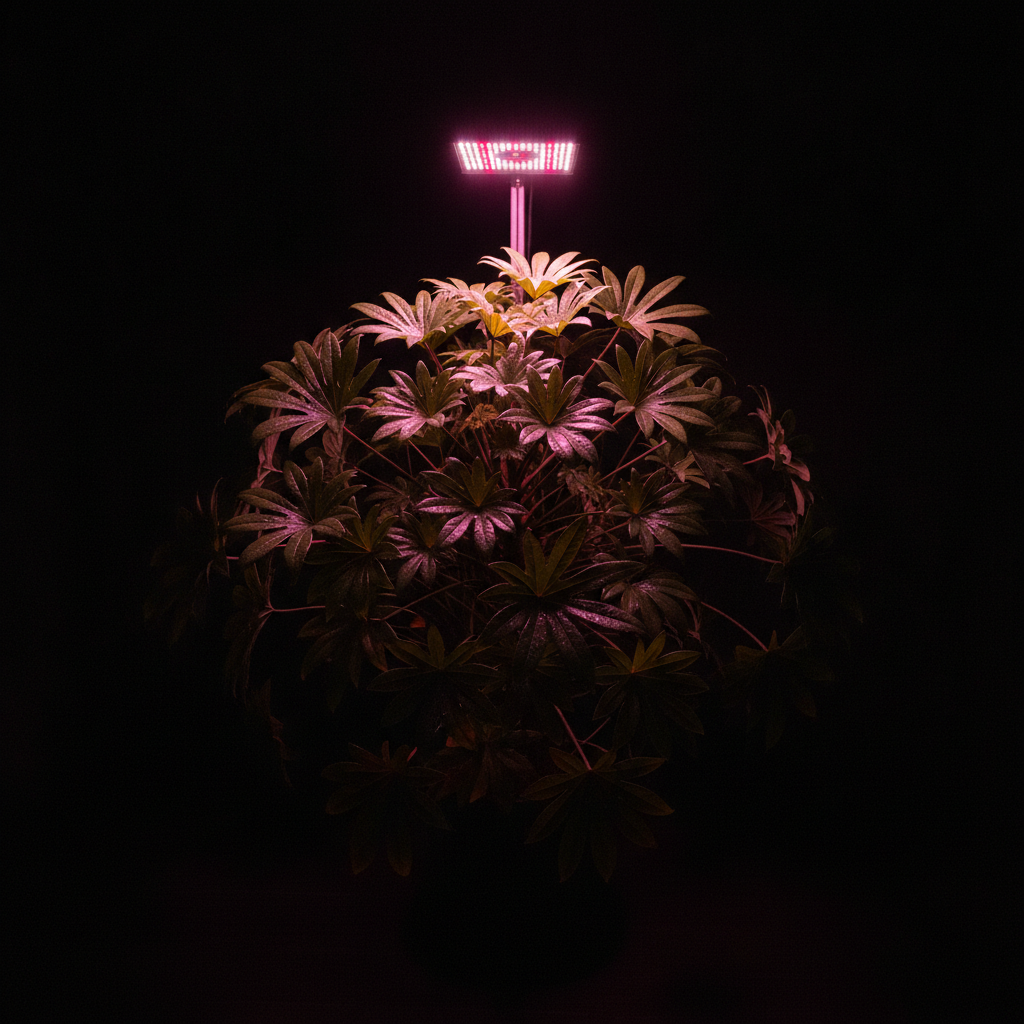
At the other extreme, the plant survives genuine shade better than almost any comparable foliage plant, which is why it is so often recommended for dim hallways and shaded stairwells. The trade-off is that in very low light growth slows markedly, the gaps between leaves stretch out, and the plant takes on a sparse, reaching, leggy look as it strains toward the nearest window. To keep a shade-grown aralia full and compact, rotate it a quarter turn every week or two so all sides develop evenly, and consider supplementing with a full-spectrum LED grow light through the darkest winter months. Variegated forms such as Spider’s Web need a little more light than the plain green species to hold their patterning, but they too will scorch in direct sun.
Watering
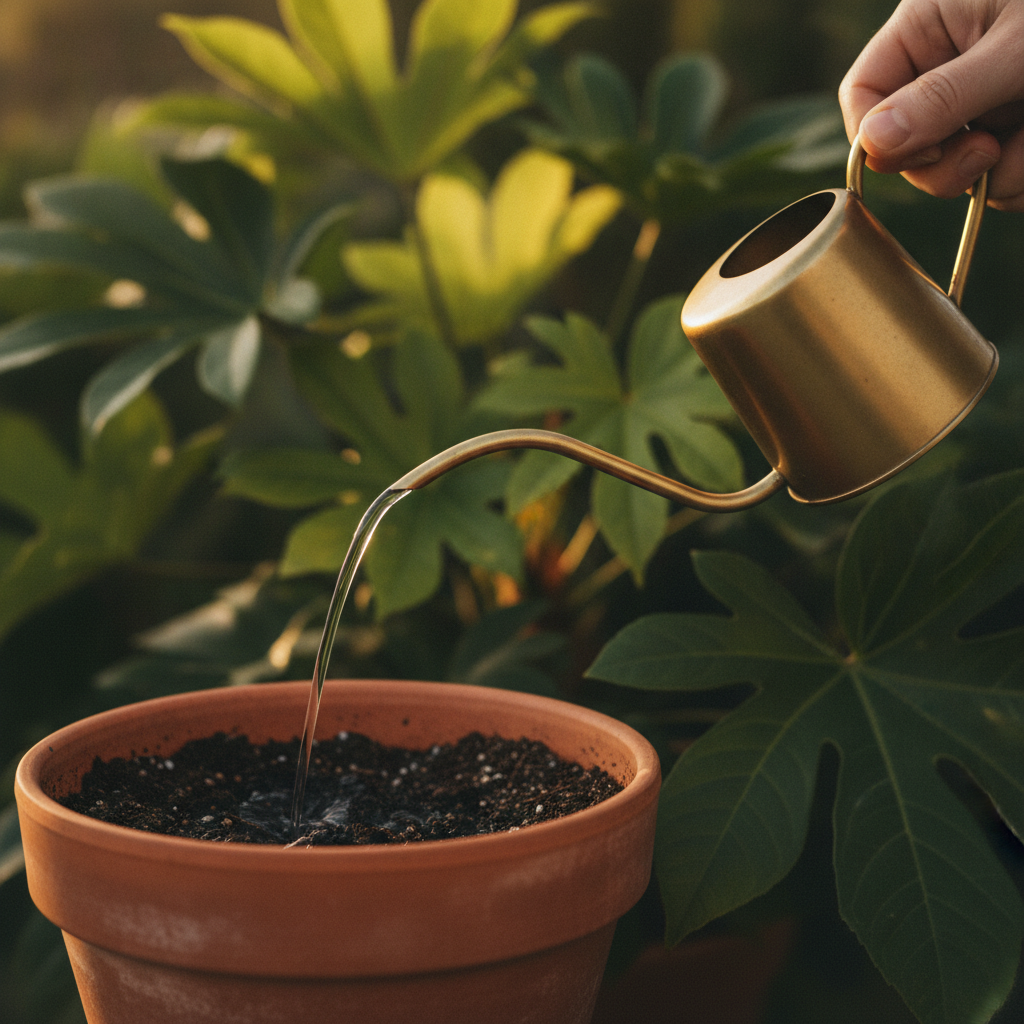
Unlike the succulents and drought-adapted plants that dominate so much houseplant advice, the Japanese aralia is not built to dry out. It comes from moist, humus-rich forest soil and expects its roots to stay evenly damp through the growing season. The goal is consistent moisture: a rootball that feels like a wrung-out sponge, never sodden and stagnant but never bone dry either. Water thoroughly whenever the top two to three centimetres (roughly an inch) of the mix begins to feel dry to the touch, letting water run freely from the drainage holes each time so the entire rootball is wetted rather than just the surface.
The plant gives unusually clear feedback about its water status, which makes it forgiving once you learn to read it. When the soil dries out too far, the long leaf stalks lose their rigidity and the whole plant droops dramatically, the big leaves folding down like a closing umbrella. It is an alarming sight the first time, but a good soak usually revives it within a few hours with no lasting harm, provided this is an occasional lapse rather than a routine. Repeated drought, on the other hand, shows up as crisp brown leaf edges and tips and the loss of the oldest lower leaves. The aim is to head off that wilting point rather than treat it as a watering cue, because every severe wilt costs the plant a little vigour.
Overwatering is the other side of the same coin and is just as damaging, though slower to reveal itself. Roots left sitting in waterlogged, airless compost begin to rot, and the first visible signs, yellowing leaves and a soft, sour-smelling base, are easily mistaken for underwatering. The safeguard is drainage rather than restraint: always use a pot with holes, never leave the plant standing in a full saucer or decorative cover for more than a few minutes after watering, and ease off considerably in winter. As light and temperatures fall, growth slows and the plant uses far less water, so let the surface dry a little further between drinks through the dormant months while still never allowing a complete drought.
Because it relishes humidity, the Japanese aralia also appreciates attention to the air around it, not just the soil. In a dry, centrally heated room the leaf tips and margins brown readily. Grouping it with other plants, standing the pot on a tray of damp pebbles, or running a humidifier nearby all help maintain the moderate to high humidity it favours and keep that bold foliage looking crisp.
Soil and Potting
The ideal growing medium for Fatsia japonica reconciles two demands that sound contradictory: it must hold moisture reliably, because the plant hates to dry out, yet it must also drain freely, because the roots rot in stagnant wet. A good loam-based potting compost forms the backbone of such a mix, holding water and nutrients far better than a peat-free multipurpose compost alone while resisting the collapse into a dense, airless mass that fine peaty mixes are prone to. To that base, work in a generous handful of grit, perlite or fine bark to open up the structure and create the air pockets that healthy roots depend on. The result should feel moisture-retentive but loose, draining within seconds when you water rather than puddling on the surface.
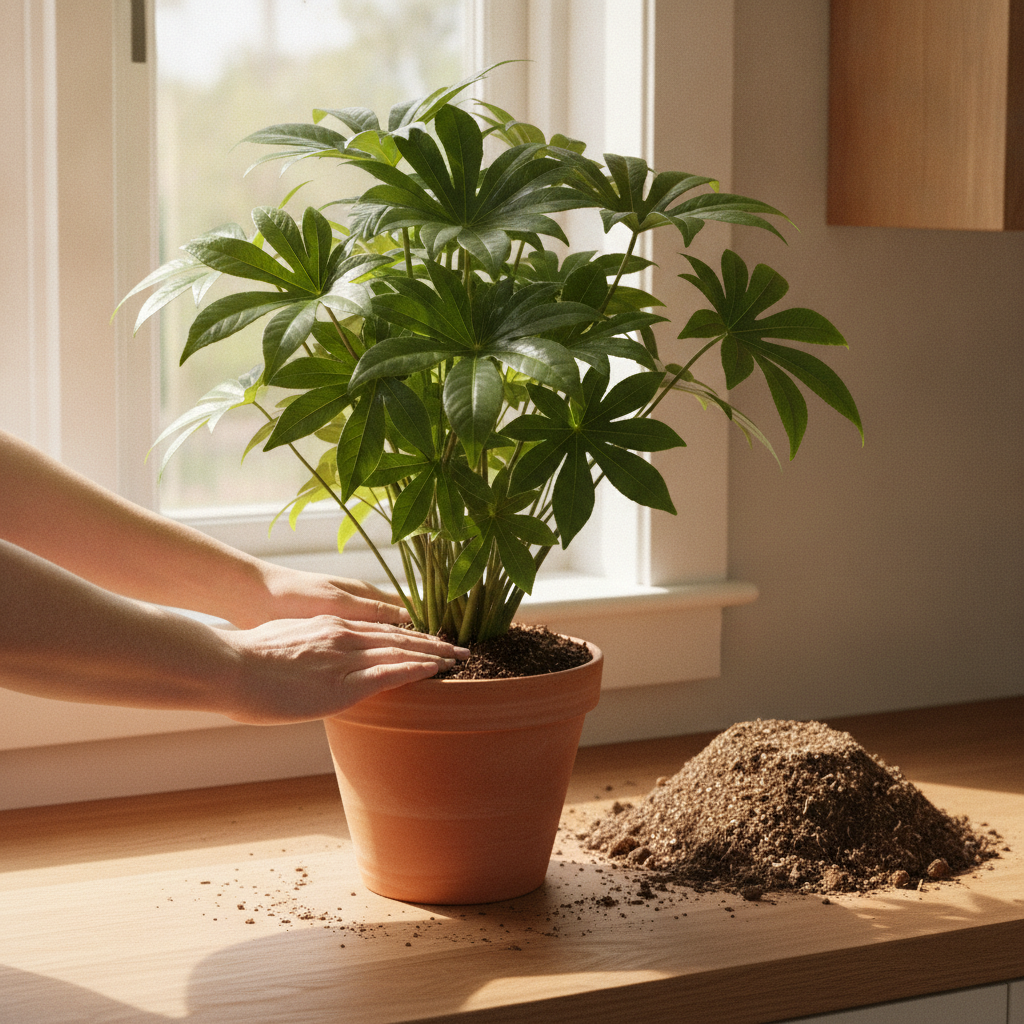
Japanese aralia is a vigorous plant that builds a substantial root system, so it benefits from being potted on every spring while young, moving up one container size each time, until it reaches the size you want it to stay. A large specimen in its final pot does not need repotting every year; instead, refresh the top few centimetres of compost annually by scraping away the old surface layer and replacing it with fresh mix, which renews nutrients without the disturbance of a full repot. Choose a heavy, stable pot for any sizeable plant, as the broad canopy of leaves makes a tall aralia surprisingly top-heavy and easy to tip.
The best time to repot is early spring, just as the plant is waking into active growth and able to recover quickly. Slide the rootball out, tease apart any tightly circling roots around the outside, and settle it into the new pot at the same depth it sat before, firming fresh mix gently around the sides without compacting it hard. Water it in well to close the air gaps. Avoid the temptation to jump several pot sizes at once in the hope of saving effort later; an oversized pot holds far more wet compost than the roots can use, and that reservoir of stagnant moisture is a direct invitation to root rot.
Warning — Drainage is non-negotiable: However moisture-loving this plant is, it will not survive standing in water. Every pot must have drainage holes, and the mix must never turn to mud. Moisture-retentive and waterlogged are different things, and confusing them is the fastest way to lose a healthy aralia.
Fertilising
As a fast grower with large leaves to build and maintain, the Japanese aralia is a moderately hungry plant during its active season, and regular feeding pays off directly in leaf size and colour. Through spring and summer, when new growth is unfurling, apply a balanced liquid houseplant fertiliser roughly once a month, or use a more dilute solution with most waterings if you prefer little and often. A general-purpose feed with a fairly even ratio of nitrogen, phosphorus and potassium suits it well; the nitrogen in particular supports the lush green foliage that is the whole reason for growing the plant.
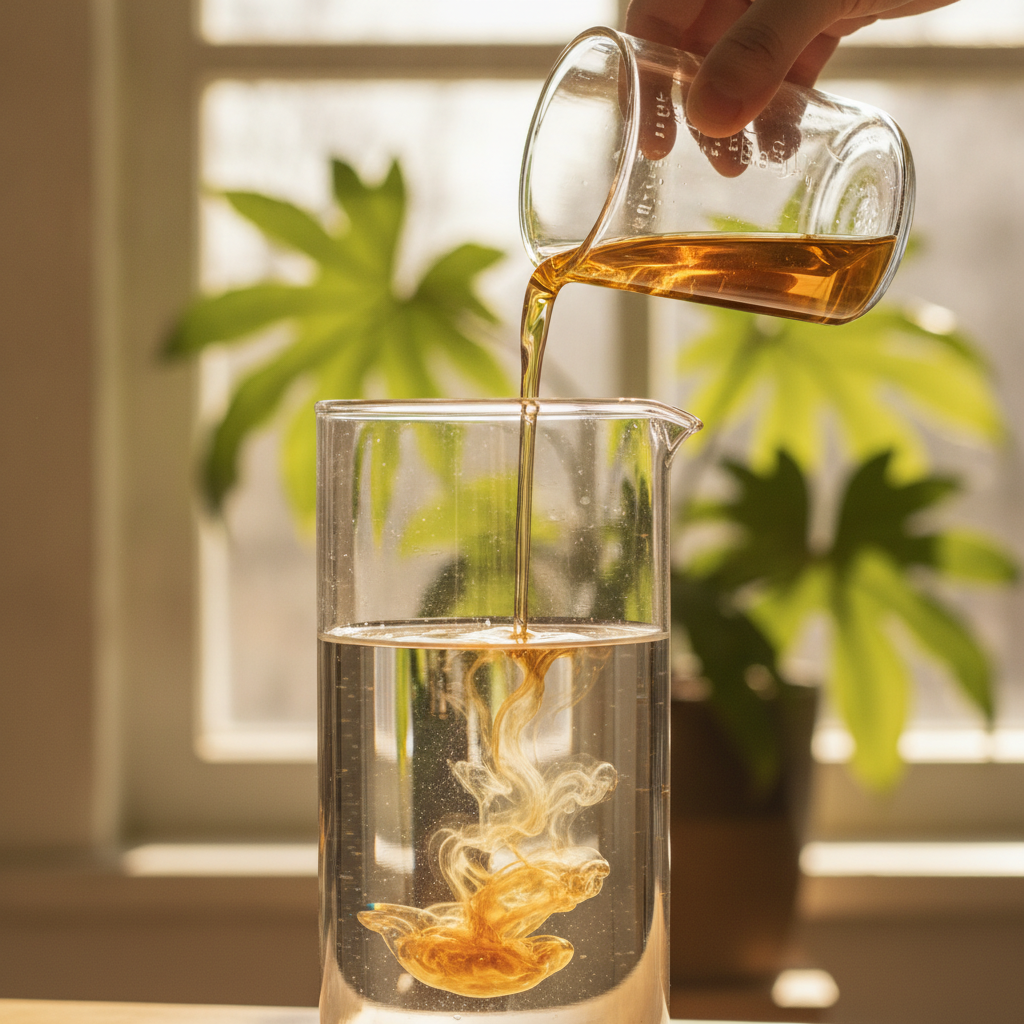
Restraint matters as much as generosity. It is far better to under-feed slightly than to overdo it, because excess fertiliser salts build up in the compost and scorch the roots, showing as brown, crisped leaf margins that look deceptively like underwatering or low humidity. Always dilute liquid feeds to at least the strength recommended on the label, and water the plant normally before feeding if the compost is very dry, so the nutrients spread evenly rather than concentrating against thirsty roots. If you suspect salts have accumulated after a long period of feeding, flush the pot through with plain water every couple of months, letting it drain fully, to wash the excess away.
Feeding should follow the plant’s natural rhythm, which means stopping or sharply reducing it through autumn and winter. As growth slows in the shorter, cooler days, the plant cannot use a steady supply of nutrients, and continuing to feed simply lets unused salts accumulate in the soil. Resume the monthly routine in spring when you see fresh leaves beginning to push out, the plant’s own signal that it is ready to grow and feed again. A specimen kept in a cool, brightly lit spot may take a little longer to wake than one in a warm room, so let the new growth, rather than the calendar alone, set the timing.
Propagation
Japanese aralia can be propagated in several ways, the most accessible of which is stem cuttings taken in spring or early summer when the plant is growing strongly. Because it is a woodier, shrubbier plant than the trailing aroids most people learn to propagate on, it roots a little more slowly and rewards patience and warmth. Look for a healthy shoot and cut a section 10 to 15 centimetres (4 to 6 inches) long just below a leaf node, using clean, sharp secateurs. Remove the lower leaves, and if the remaining leaves are very large, cut each one in half across to reduce the surface area the cutting must support while it has no roots. Dipping the cut end in rooting hormone improves the odds noticeably with a semi-woody plant like this.
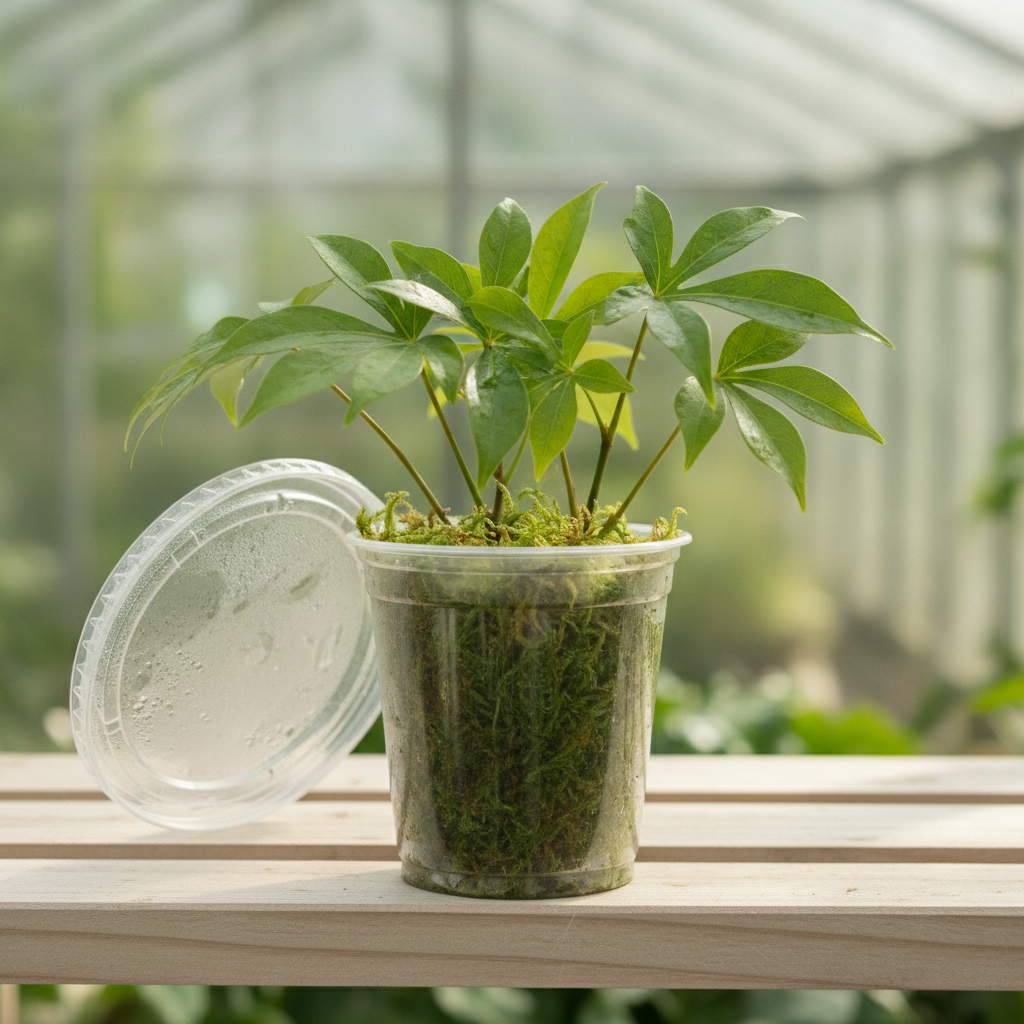
The cutting can be rooted either in a glass of water or, more reliably, in a moist, free-draining medium such as damp sphagnum moss or a mix of compost and perlite. Whichever you choose, high humidity around the cutting greatly improves success, so enclose it in a clear plastic bag, a propagator or a covered deli cup to trap moisture, and keep it somewhere warm and bright but out of direct sun. Open the cover briefly every few days to refresh the air and prevent mould. Roots typically take several weeks to a couple of months to develop, after which the cutting can be potted on into a small container of the standard mix and gradually acclimatised to normal room humidity. The reliable steps are as follows.
- In spring or early summer, cut a 10 to 15 centimetre healthy shoot just below a node with clean secateurs.
- Strip the lower leaves and halve any remaining oversized leaves to cut water loss.
- Dip the cut end in rooting hormone to encourage a semi-woody stem to root.
- Insert it into damp sphagnum moss or a compost and perlite mix, or stand it in water.
- Enclose the cutting to hold high humidity and keep it warm, bright and out of direct sun.
- Vent briefly every few days, and pot on once roots are several centimetres long.
Two other methods are worth knowing. Air layering, in which a node partway up a stem is wrapped in damp moss and clear film until it roots in place before being severed, is slower but almost foolproof and a good way to propagate from a large, established plant without sacrificing a whole shoot. Established specimens also sometimes throw up suckers or offshoots from around the base, and these can be carefully separated with a portion of root attached and potted up as new plants. Finally, the plant can be grown from its black autumn berries if you are lucky enough to have it flower and fruit, though seed-raised plants take considerably longer to reach any size.
Pests and Problems
A Japanese aralia grown in the cool, humid, shaded conditions it prefers is a robust plant that shrugs off most trouble. Nearly all the pests and disorders it suffers indoors are downstream of conditions drifting too far from that ideal, and the most telling culprit is dry, warm air. Spider mites are the classic example: these tiny sap-suckers thrive in exactly the hot, arid environment the plant dislikes, stippling the leaves with fine pale speckling and spinning faint webbing in the leaf axils and undersides. Their appearance is often the first sign that a room has become too warm and dry for the plant’s comfort, and raising humidity is both the cure and the prevention.
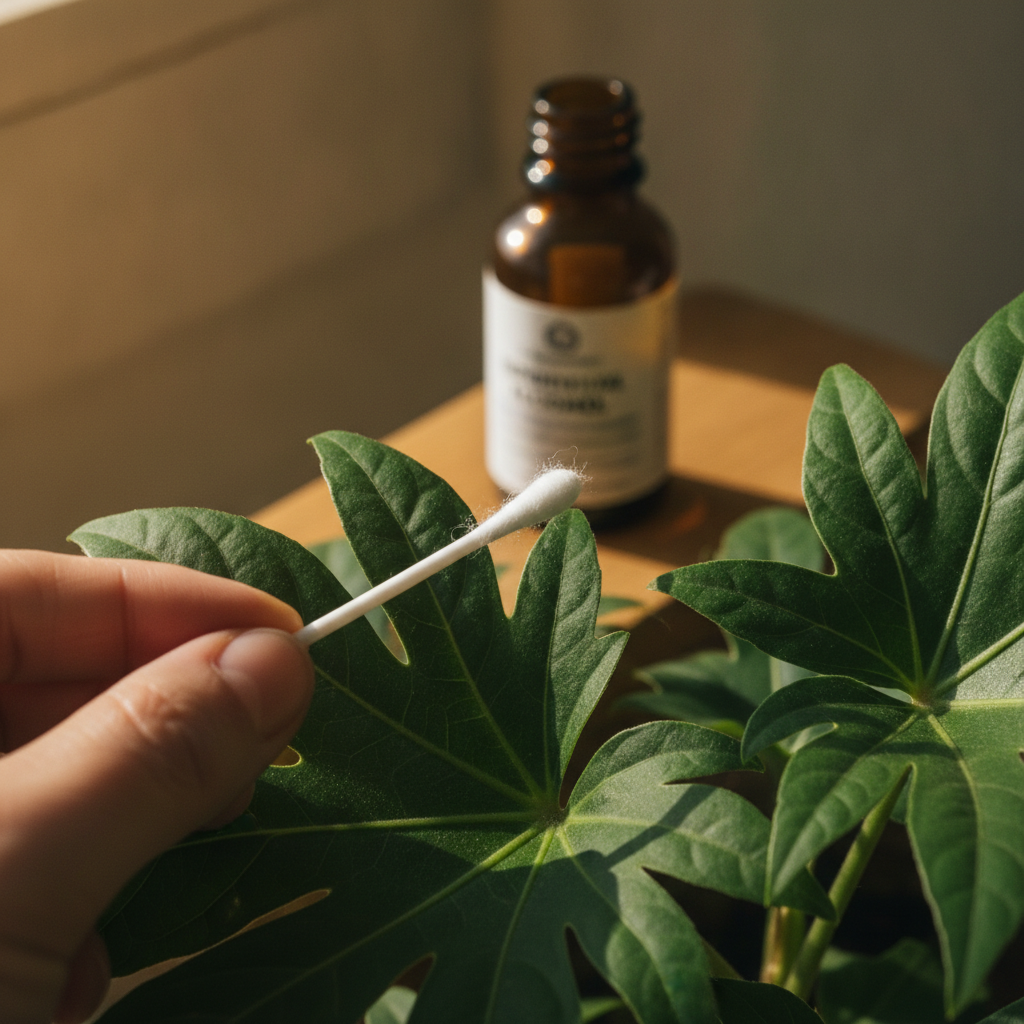
Scale insects and mealybugs are the other pests most likely to find their way onto an indoor aralia. Scale appears as small, flat brown discs clinging to stems and the undersides of leaves along the veins, while mealybugs show as soft white cottony tufts tucked into the leaf axils and joints. Both can be dealt with on a small scale by dabbing each insect directly with a cotton bud dipped in isopropyl alcohol, which dissolves their protective coating, followed up with a thorough wipe of the foliage. For heavier infestations, treat the whole plant with insecticidal soap or a neem oil solution, repeating every week or two until no live insects remain, and always check newly acquired plants carefully before placing them near the rest of your collection. The aralia’s large, smooth leaves make wiping and spraying straightforward, which is a real advantage when tackling pests.
Beyond pests, most complaints about Japanese aralia are cultural rather than biological, and the table below maps the commonest symptoms to their usual causes. Browning, crisp leaf edges almost always point to air that is too dry, soil that has been allowed to dry out, or a build-up of fertiliser salts. Yellowing leaves, especially when accompanied by a soft base, usually indicate overwatering and the onset of root rot, whereas pale, bleached or scorched patches betray too much direct sun. A leggy, stretched plant with widely spaced leaves is simply reaching for light it cannot find. Reading these signals correctly, rather than reflexively reaching for the watering can, is the key to keeping the plant healthy.
| Symptom | Likely cause | Remedy |
| Brown, crisp leaf edges and tips | Dry air, underwatering, or salt build-up | Raise humidity, water more consistently, flush the soil |
| Sudden dramatic drooping of all leaves | Soil dried out too far | Water thoroughly; the plant usually recovers in hours |
| Yellowing leaves and soft, sour base | Overwatering and root rot | Ease off water, improve drainage, repot if roots are rotting |
| Pale, bleached or scorched patches | Too much direct sun | Move to bright indirect light or diffuse the window |
| Leggy growth, widely spaced leaves | Too little light | Move brighter, rotate regularly, add a grow light in winter |
| Fine speckling and webbing | Spider mites in warm, dry air | Raise humidity and treat with neem or insecticidal soap |
Varieties
While the plain green species is the most widely grown and arguably the most striking in its bold simplicity, Fatsia japonica has given rise to a handful of distinctive cultivars, most of them variegated forms prized for the way pale markings light up a shaded corner. The two most popular are shown below. All share the same care requirements as the species, though the more heavily variegated forms appreciate slightly brighter indirect light to keep their patterning crisp, and none should ever be exposed to direct sun, which scorches their paler tissue especially fast.
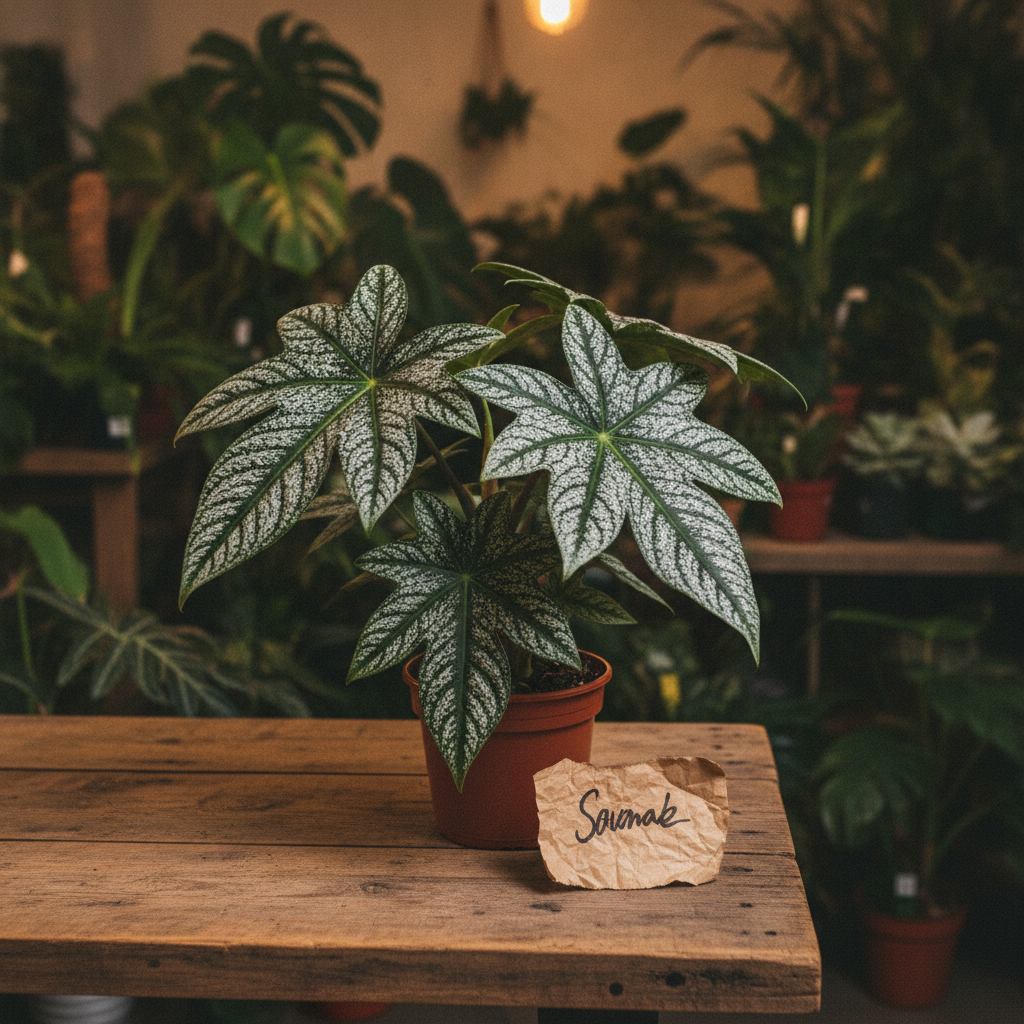
‘Spider’s Web’ is the most sought-after cultivar, its dark green leaves heavily dusted and frosted with fine white speckling that intensifies toward the margins, as though the foliage has been dragged through cobwebs or lightly snowed upon. No two leaves are marked identically, and the variegation is brightest on plants given good indirect light. It is a touch slower and more compact than the species.
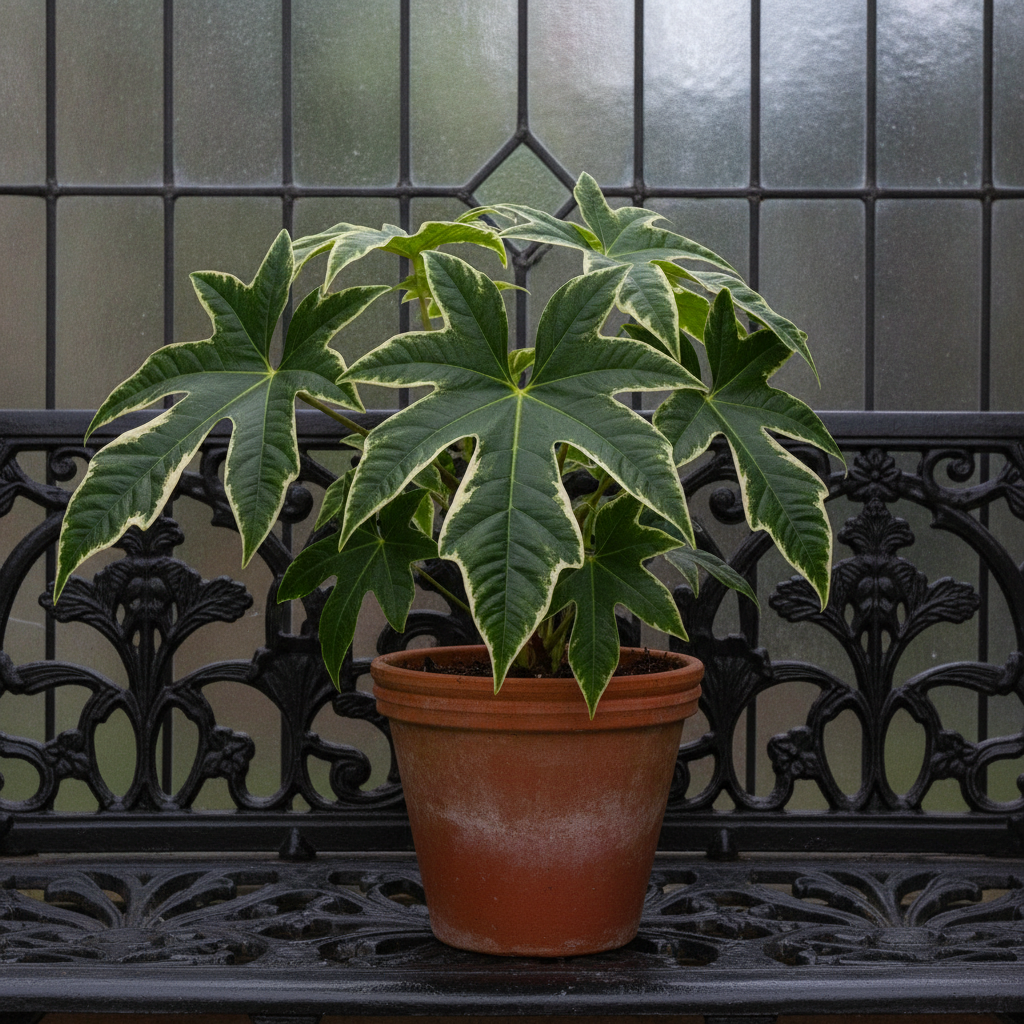
‘Variegata’ carries the classic broad variegation, its glossy green leaves edged and tipped with irregular bands of creamy white that give the whole plant a bright, painterly quality. The contrast is bolder and more clearly defined than the misty speckling of Spider’s Web, making it a strong choice for lifting a dim spot. Like all variegated forms it grows a little less vigorously than the all-green species.
Beyond these two, keen collectors seek out ‘Camouflage’ with its mottled, marbled cream-and-green leaves, the golden-splashed ‘Annelise’, and ‘Murakumo Nishiki’ with its delicate flecking. Worth a mention too is ×Fatshedera lizei, the tree ivy, a remarkable bigeneric hybrid between Fatsia and ivy (Hedera) that combines aralia-like lobed leaves with a looser, semi-climbing habit and makes an easy, elegant houseplant in its own right.
Frequently Asked Questions
Is Japanese aralia toxic to cats and dogs?
Japanese aralia is generally regarded as non-toxic to cats and dogs and does not appear on the main lists of plants seriously poisonous to pets. The name false castor oil plant can cause needless alarm, but it refers only to a passing resemblance to the genuinely dangerous castor oil plant, to which Fatsia is unrelated. As with any houseplant, nibbling the foliage may cause mild stomach upset, and the sap can irritate sensitive skin, so it is still sensible to keep curious pets and small children from chewing on it.
Why are the leaves on my Japanese aralia turning brown at the edges?
Crisp brown leaf edges and tips are the plant’s commonest complaint and almost always point to air that is too dry, soil that has been allowed to dry out between waterings, or a build-up of fertiliser salts in the compost. Raise the humidity around the plant, keep the rootball more consistently moist, and flush the pot through with plain water if you have been feeding heavily. Browning that follows a hot, dry spell beside a radiator is a particularly clear sign the plant wants cooler, damper air.
My Japanese aralia has suddenly wilted and collapsed. Can I save it?
Almost certainly, yes. A dramatic, sudden droop in which the long leaf stalks lose their stiffness and the whole plant flops is the classic response to a rootball that has dried out too far. Water it thoroughly, letting the excess drain away, and in most cases the plant perks back up within a few hours. Treat it as a warning rather than a routine, though; repeated severe wilting gradually weakens the plant and costs it the lowest leaves, so aim to water before it reaches that point.
How big does a Japanese aralia get indoors?
Indoors a Japanese aralia typically reaches 1 to 2 metres (3 to 6 feet) tall and almost as wide, growing into a substantial floor plant over several years. Outdoors in a mild climate it can become a shrub of 2 to 3 metres or more. You can keep an indoor plant more compact by pruning the tallest stems back in spring, which also encourages bushier growth lower down; the plant responds well to cutting back and resprouts readily from below the cut.
Can Japanese aralia grow outdoors?
Yes, and it is one of the hardiest large-leaved evergreens available to temperate gardeners, tolerating winter cold down to roughly minus 10 to minus 15 degrees C (5 to 14 F) in a sheltered, shaded spot. Many people grow it both ways, as a hardy shade shrub in the garden and as a cool-room houseplant indoors. If you move an indoor plant outside for summer, place it in full shade and bring it back in before hard frosts if your winters are severe, since plants grown soft indoors are less cold-tolerant than established garden specimens.






