
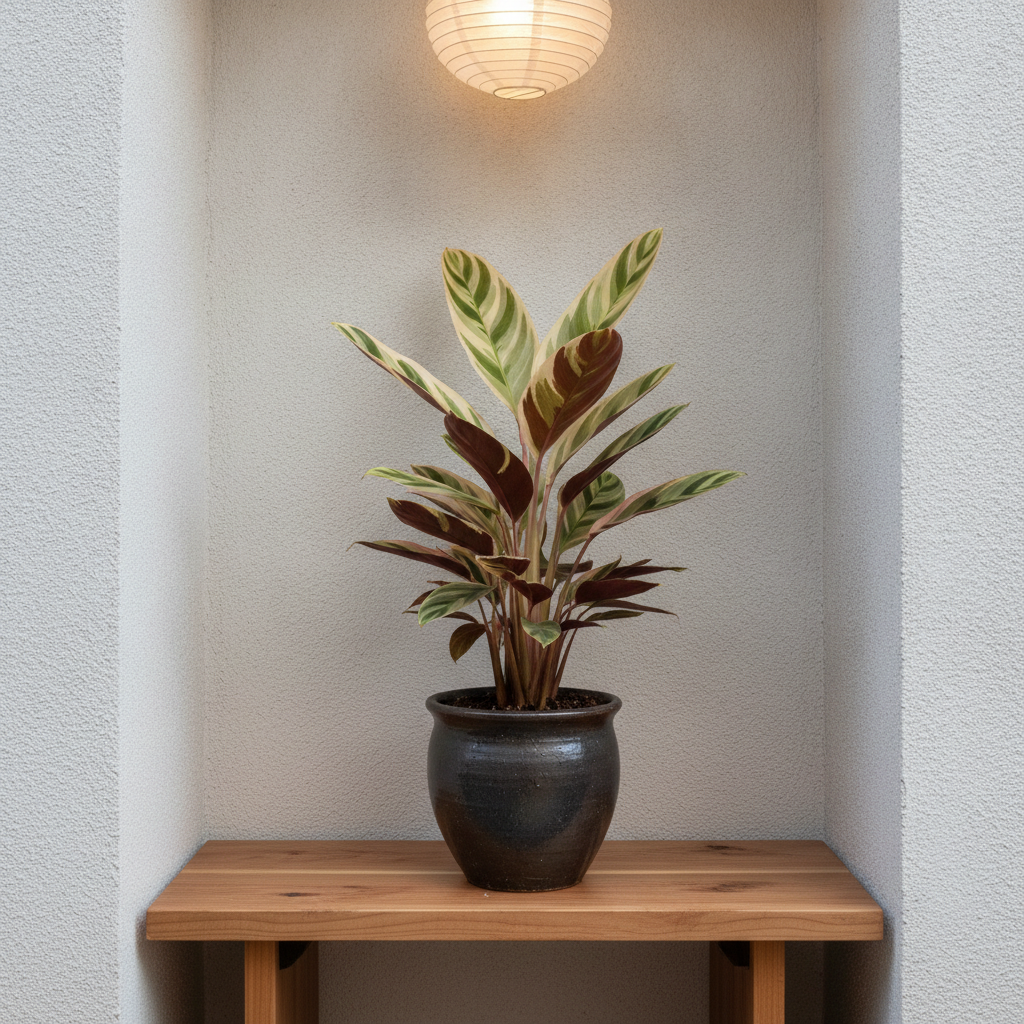
Few houseplants put on a show quite like the Triostar stromanthe, a Brazilian rainforest native whose lance-shaped leaves are brushed in irregular streaks of cream, mint green and rose-pink, then turned over to reveal undersides the colour of crushed raspberries. Sold under the cultivar name Stromanthe sanguinea ‘Triostar’ (and often labelled ‘Tricolor’), it belongs to the prayer plant family, Marantaceae, and shares that family’s most endearing habit: every evening the leaves fold upward along their stems, lifting their pink bellies toward the ceiling, and every morning they relax open again.
That theatrical beauty comes with a reputation for being temperamental, and the reputation is partly deserved. A Triostar will survive a surprising amount of neglect, but it will only thrive when its three core demands are met: steady moisture, generous humidity and clean water. This guide walks through every aspect of its care, from reading the light in your room to dividing a mature clump, with the goal of taking you past mere survival and into the lush, fully variegated growth that makes this plant worth the effort.
Contents
- Quick Reference
- Why Triostar Stromanthe Makes a Rewarding Houseplant
- Light Requirements
- Watering & Humidity
- Soil, Potting & Repotting
- Fertilising
- Propagation
- Pests & Diseases
- Popular Varieties
- Frequently Asked Questions
Quick Reference: Triostar Stromanthe at a Glance
| Light | Bright, indirect light. No harsh direct midday sun, which scorches and bleaches the variegation. |
| Watering | Keep the mix evenly moist but never waterlogged. Water when the top 2 to 3 cm (about 1 inch) begins to dry. |
| Temperature | 18 to 27 degrees Celsius (65 to 80 degrees Fahrenheit). Avoid anything below 15 degrees Celsius (59 degrees Fahrenheit) or cold draughts. |
| Humidity | High. Aim for 60 percent or more; tolerable down to about 50 percent with effort. |
| Fertiliser | Balanced liquid feed at half strength every 2 to 4 weeks in spring and summer; none in winter. |
| Toxicity | Non-toxic to cats, dogs and humans. A genuinely pet-safe choice. |
Why Triostar Stromanthe Makes a Rewarding Houseplant
The first thing anyone notices about a Triostar is the colour. Unlike variegation that comes from a virus or an unstable mutation, the cream and pink streaking here is a stable cultivar trait, so a well-grown plant holds its tricolour patterning across every new leaf. The undersides take it further, glowing a deep wine-magenta that catches the light when the plant moves, and move it does: the nightly folding and morning unfolding, driven by a hinge-like joint called the pulvinus at the base of each leaf, gives the plant a quiet sense of life that few others can match.
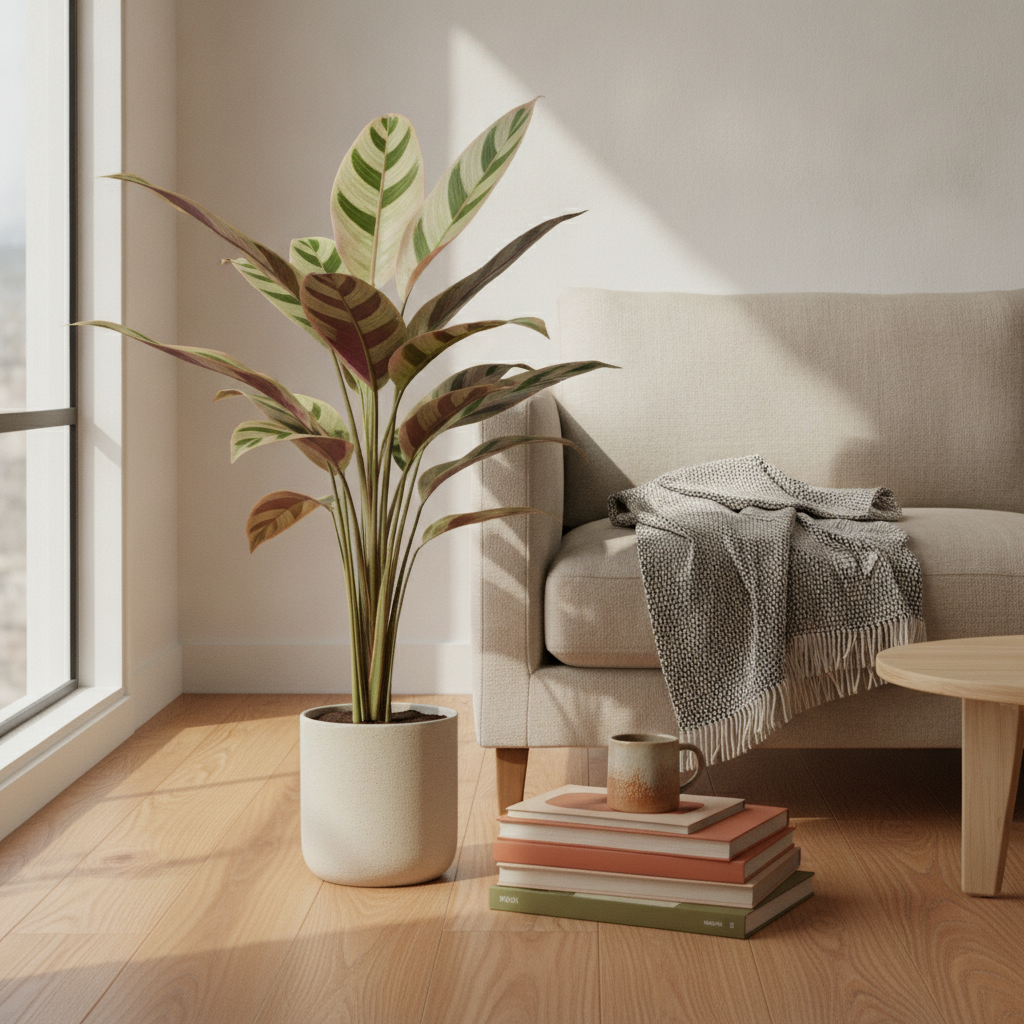
Beyond looks, the Triostar has two practical virtues. It is genuinely non-toxic, which makes it one of the safest statement plants you can keep around curious cats, dogs and small children, a rare combination in the world of dramatic foliage. And although it asks for attentive care, it is forgiving of the most common beginner mistake of all, occasional underwatering, far more readily than it forgives soggy roots. Master humidity and water quality and you remove the two issues responsible for the vast majority of crispy, disappointing Triostars, leaving you with a plant that rewards consistency with steady, colourful growth.
Important — Toxicity: The Triostar stromanthe is listed as non-toxic to cats and dogs and is not poisonous to humans. It is one of the few boldly variegated houseplants you can grow without worrying about pets nibbling a leaf, though as with any plant it is still best not to encourage chewing.
Light Requirements
In its native habitat the Triostar grows on the floor of the Brazilian rainforest, beneath a dense canopy that filters sunlight into soft, dappled brightness. That origin tells you everything about its light needs indoors: it wants plenty of light, but almost none of it direct. Bright, indirect light keeps the variegation crisp and the growth compact, while too little light causes the cream and pink to fade back toward plain green as the plant prioritises chlorophyll for survival.
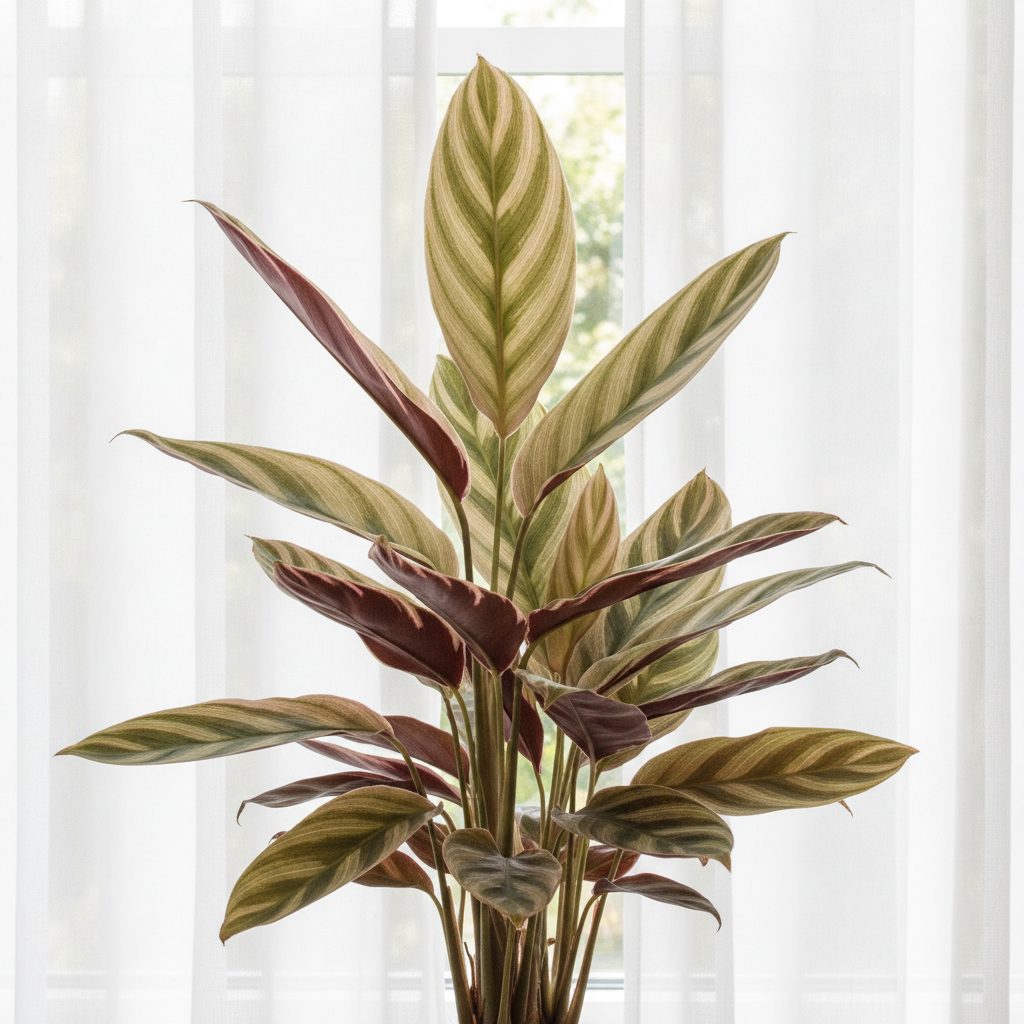
The ideal spot is a position a metre or two (3 to 6 feet) back from a bright window, or directly in front of one screened by a sheer curtain. You are looking for light strong enough to read by comfortably all day, without any patch of direct sun falling across the leaves. Get this balance right and the Triostar holds its full tricolour patterning; get it wrong in either direction and the plant will tell you, either by bleaching and scorching or by reverting toward green.
Light Levels Explained
Understanding how the Triostar responds across the spectrum of indoor light makes placement far easier. The table below translates the usual light categories into what you can expect from this plant in each.
| Light Category | Approx. Level | Typical Location | Outcome |
|---|---|---|---|
| Direct sun | Over 50,000 lux | On an unscreened south or west sill | Leaves scorch, fade and crisp at the edges. Avoid. |
| Bright indirect | 10,000 to 20,000 lux | Near an east window or set back from a bright one | Ideal. Full variegation, compact growth. |
| Medium | 5,000 to 10,000 lux | A metre or two into a well-lit room | Good. Growth a little slower, colour still strong. |
| Low | 1,000 to 5,000 lux | A north corner or deep in a room | Survives but variegation fades and leaves stretch. |
| Very low | Under 1,000 lux | An interior hallway or dim bathroom | Decline over time. Not recommended without grow-lights. |
Window Orientation and Placement
South-facing window: The brightest exposure in the northern hemisphere and the one to be most careful with. Place the Triostar well back from the glass, or filter the light with a sheer curtain, so it never sits in a direct beam. Used carefully, a south room provides ample brightness year round.
East-facing window: Often the sweet spot. Gentle morning sun is rarely strong enough to burn, and the rest of the day delivers the bright, indirect light the plant craves. A Triostar can usually sit right on or beside an east sill.
West-facing window: Workable, but the afternoon sun can be fierce. Keep the plant a short distance back or behind a curtain so it is bathed in brightness rather than struck by direct rays.
North-facing window: The softest light, with no direct sun at all. A Triostar will hold on here, but in a dim north room you may see the variegation dull and the leaves reach. Position it as close to the glass as possible and consider supplementing in winter.
Pro Tip — Rotate for Even Growth: The Triostar leans steadily toward its light source. Give the pot a quarter turn each time you water so the clump fills out evenly rather than growing lopsided toward the window.
How Light Affects Variegation
The cream and pink areas of a Triostar leaf contain little or no chlorophyll, so they contribute nothing to feeding the plant. In bright, indirect light the green portions photosynthesise efficiently enough that the plant can afford to keep producing heavily variegated leaves. Move it somewhere dimmer and the plant compensates by pushing each new leaf greener, packing in more chlorophyll to capture the scarce light. If your Triostar’s fresh growth is emerging plainer than the older leaves, insufficient light is almost always the cause, and the fix is simply to move it brighter.
Warning — Direct Sunlight: A few hours of direct summer sun can bleach the variegation to a papery white and burn dry, brown patches into the leaf surface that never recover. Damaged leaves do not heal, so prevention through screening or distance is the only real protection.
Artificial Lighting
The Triostar responds well to supplementary lighting, which makes it a viable plant even in rooms with poor natural light. A full-spectrum LED grow-light positioned 30 to 45 cm (12 to 18 inches) above the foliage, run for 10 to 12 hours a day, will keep variegation strong through the darkest months. Because the plant is naturally an understorey species, it does not need intense horticultural lighting; a modest panel or even a quality LED bulb in a nearby fixture can make a real difference.
Seasonal Adjustments
As daylight weakens through autumn and winter, move the Triostar closer to its window to compensate for the loss of intensity, and clean the glass so nothing dims the light further. Come spring, watch for the first hot, direct beams angling in as the sun climbs higher, and pull the plant back or re-screen the window before those rays start to scorch. A plant that was perfectly placed in December can find itself in a burning patch of March sun if you forget to adjust.
Watering & Humidity
Watering is where most Triostars are won or lost. This is a plant that wants its soil to stay consistently, lightly moist, never bone-dry and never waterlogged, mimicking the damp leaf litter of its rainforest home. Add to that a notorious sensitivity to the minerals in tap water, and you have the two factors behind almost every case of crispy brown leaf edges. Get the moisture rhythm and the water quality right, and the Triostar becomes far less dramatic than its reputation suggests.
When to Water
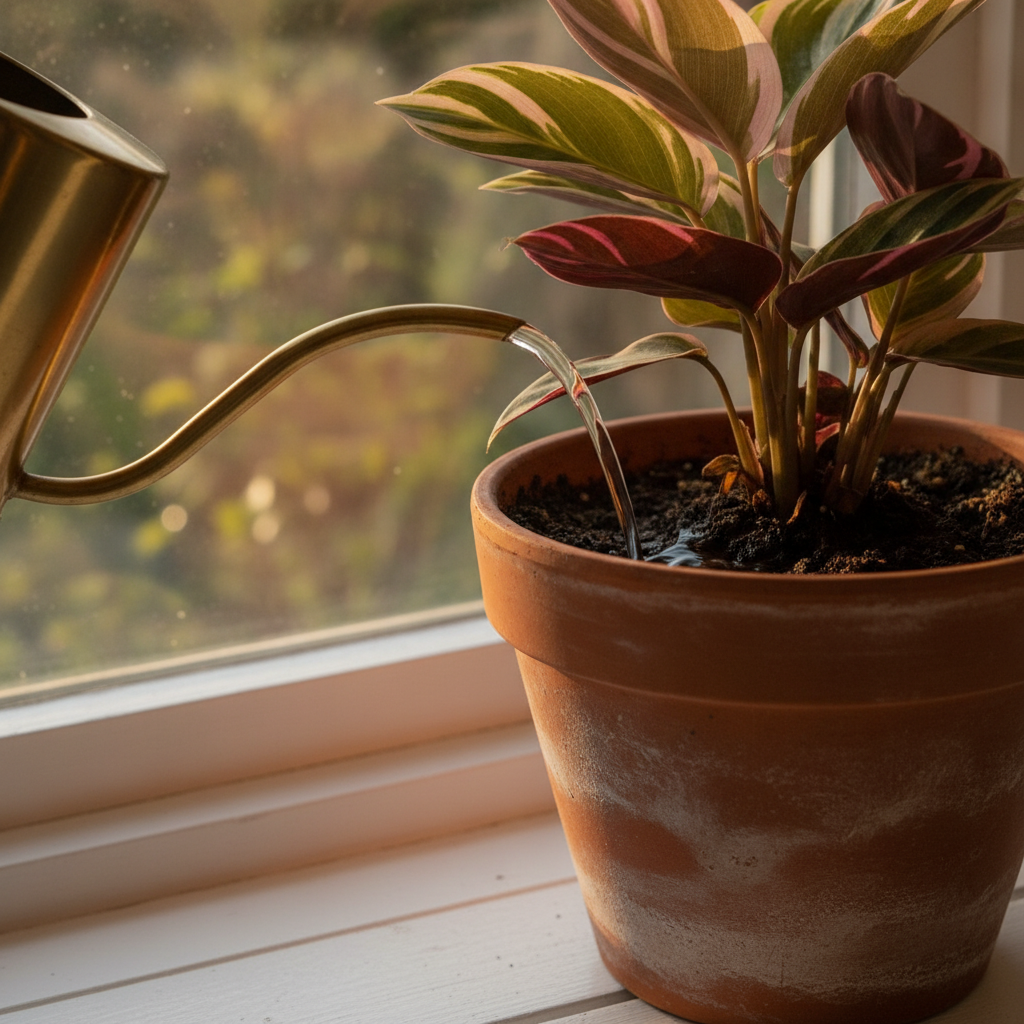
Check the Triostar by pressing a finger into the top of the mix. When the top 2 to 3 cm (about 1 inch) has begun to dry but the soil below is still cool and slightly damp, it is time to water. You should not let the pot dry out completely, as a fully dry root ball triggers leaf curling and crisping within a day or two, but you also must not water on a fixed schedule regardless of conditions, which is the fast road to root rot.
How often this works out to depends entirely on your conditions. In a warm, bright room in summer a Triostar may need watering twice a week; in a cooler room in winter it might be every week or ten days. Light, temperature, pot size and humidity all shift the rhythm, so let the soil, not the calendar, be your guide. The leaves are also expressive: gentle curling inward is an early thirst signal that usually reverses within hours of a good drink.
Pro Tip — Tepid Water Only: Cold water straight from the tap shocks the warmth-loving roots of a Triostar and can cause leaf spotting. Use water at room temperature, and if you can, let it stand overnight, which both warms it and lets some chlorine dissipate.
How to Water Correctly
- Check the top 2 to 3 cm (1 inch) of soil and water only once it has started to dry.
- Use room-temperature filtered, distilled or rainwater rather than fresh tap water.
- Pour slowly and evenly over the surface until water flows freely from the drainage holes.
- Let the pot drain fully for several minutes so no excess sits at the bottom.
- Empty the saucer or cachepot completely; never leave the plant standing in water.
- Return the plant to its spot and feel the weight of the pot so you learn what well-watered feels like.
Signs of Overwatering vs. Underwatering
| Symptom | Overwatering | Underwatering |
|---|---|---|
| Leaf colour | Yellowing, often starting with lower leaves | Edges browning and crisping, colour otherwise holding |
| Leaf texture | Soft, limp, sometimes translucent | Dry, papery, curling tightly inward |
| Soil | Stays wet for days, may smell sour | Pulls away from the pot, dries quickly |
| Roots | Brown, mushy and foul-smelling | Pale and intact but dry |
| Stem base | Soft or blackened at the soil line | Firm, though new growth may stall |
Warning — Root Rot: A Triostar left sitting in soggy soil will develop root rot, the single most common killer of this plant. If leaves yellow and droop while the soil stays wet, unpot immediately, trim away any brown mushy roots with sterile scissors, and repot into fresh, well-draining mix.
Humidity Requirements
If water quality is the Triostar’s first obsession, humidity is its second. As a rainforest understorey plant it expects moisture in the air around it, ideally 60 percent or higher. It will cope down to around 50 percent with some help, but in the dry air of a centrally heated or air-conditioned room, often 30 percent or less, it suffers visibly.
The clearest symptom of low humidity is brown, crispy leaf edges and tips, frequently accompanied by leaves that curl and refuse to unfurl properly. Because these are the same symptoms low-quality water and underwatering produce, dry air is often misdiagnosed, and people drown a plant that simply needed moister surroundings.
To raise humidity, group the Triostar with other plants so they share transpired moisture, stand the pot on a wide tray of pebbles topped up with water (keeping the pot base above the waterline), or run a small room humidifier nearby, which is by far the most reliable method. Bathrooms and kitchens with good light also tend to be naturally more humid. Misting is popular but only lifts humidity for minutes at a time and can encourage fungal spotting, so treat it as a minor extra rather than a real solution.
Water Quality
The Triostar is sensitive to the fluoride, chlorine and dissolved salts found in much tap water, which accumulate in the leaf margins and burn them brown over time. If your plant keeps crisping despite good humidity and careful watering, your water is the likely culprit. Switch to filtered water, distilled water or collected rainwater, all of which the plant accepts gratefully. If you must use tap water, letting it stand uncovered overnight allows some chlorine to evaporate, though it does nothing for fluoride or salts.
Soil, Potting & Repotting
The Triostar needs a growing medium that performs a careful balancing act: it must hold enough moisture to keep the roots evenly damp, yet drain freely enough that water never pools and suffocates them. A heavy, water-retentive compost on its own will stay sodden and rot the roots, while a fast-draining cactus mix will dry too quickly and crisp the leaves. The answer is a light, organic-rich blend with plenty of structure.
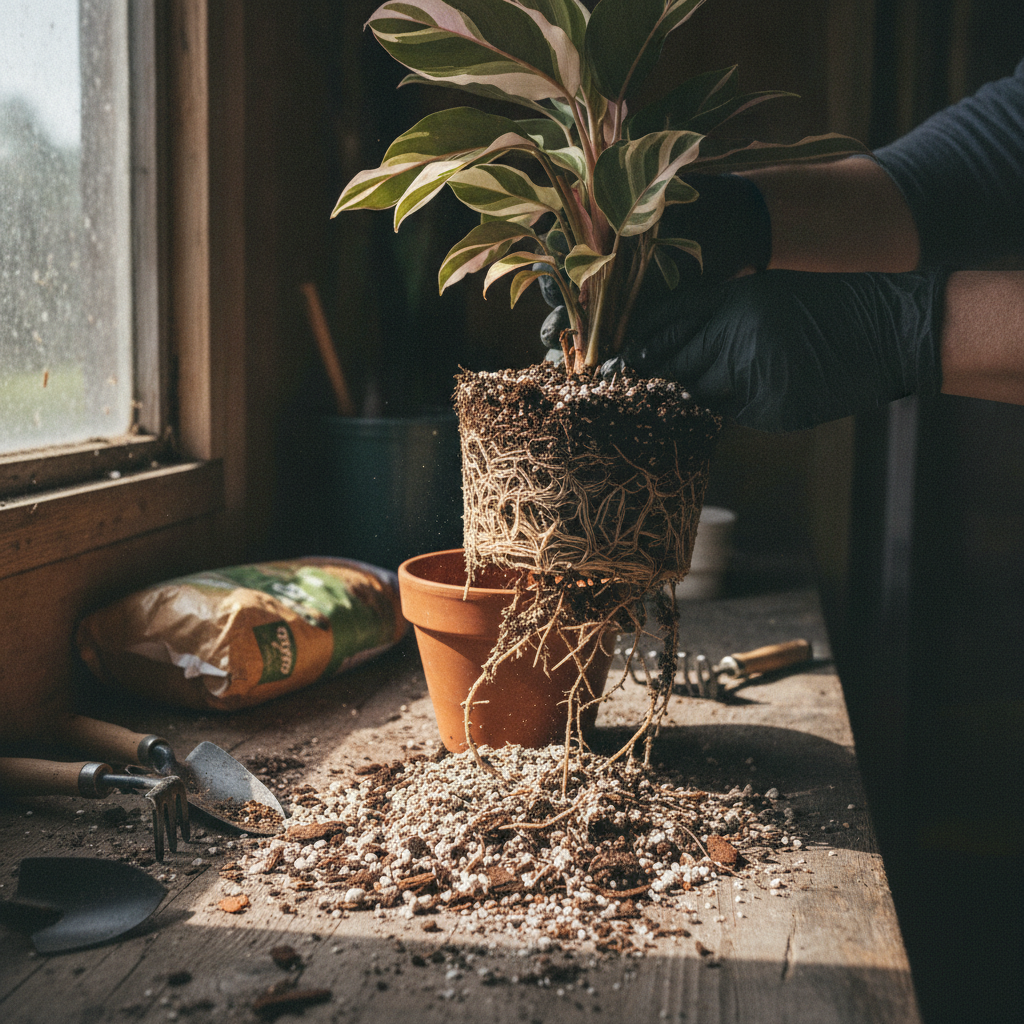
Ideal Soil Composition
A reliable Triostar mix starts with a quality peat-free houseplant compost or coco coir as the moisture-holding base, opened up with perlite for drainage and aeration and enriched with a little orchid bark or fine compost for structure and nutrients. The goal is a medium that feels spongy and damp after watering but never claggy.
| Component | Proportion | Function |
|---|---|---|
| Peat-free houseplant compost or coco coir | 50 percent | Holds moisture evenly and provides the bulk of the medium |
| Perlite | 30 percent | Opens the mix for drainage and root aeration |
| Fine orchid bark | 10 percent | Adds structure and prevents compaction |
| Worm castings or fine compost | 10 percent | Supplies gentle, slow-release nutrition |
The Triostar prefers a slightly acidic to neutral pH, roughly 6.0 to 6.5, which most peat-free and coir-based mixes fall comfortably within. There is no need to test or adjust pH for a healthy plant; simply avoid heavily limed or alkaline composts.
Pro Tip — Quick Mix Recipe: No time to blend? Take a bag of standard peat-free houseplant compost and stir in roughly one third its volume of perlite by hand. This two-ingredient shortcut drains far better than compost alone and suits a Triostar perfectly well.
Choosing the Right Pot
The Triostar grows from a spreading rhizome and produces a clumping, slowly widening crown rather than a deep tap root, so a pot that is wider than it is deep suits it well. Plastic nursery pots hold moisture more steadily than porous terracotta, which can be an advantage for a plant that hates drying out, though either works if your watering matches the material.
Drainage holes are non-negotiable. Whatever pot you choose, it must have holes in the base so excess water can escape. A decorative cachepot without drainage is fine as an outer cover, but the plant itself should sit in an inner pot that drains, and you must tip out any water that collects in the cachepot after watering.
Pot material: Plastic and glazed ceramic retain moisture and are the easiest choice for keeping a Triostar evenly damp. Unglazed terracotta wicks water away through its walls, which means more frequent watering and a higher risk of the soil drying out, so use it only if you tend to overwater.
Pot size: Choose a pot only 2 to 4 cm (1 to 2 inches) wider than the current root ball. An oversized pot holds a large volume of wet soil the roots cannot use quickly, which stays sodden and invites rot. Move up one modest size at a time as the plant grows.
When to Repot
A Triostar typically needs repotting every one to two years, ideally in spring as growth resumes. Tell-tale signs that it is ready include roots circling the surface or emerging from the drainage holes, water running straight through without wetting the mix, and growth that has slowed despite good care. Repotting also refreshes the soil, which gradually compacts and loses structure, and offers the perfect chance to divide a crowded clump.
How to Repot: Step-by-Step
- Water the plant a day beforehand so the root ball is hydrated and slides out cleanly.
- Ease the plant from its pot by tipping it and supporting the base of the crown; never pull by the leaves.
- Gently tease loose the outer roots and shake away a little of the old, spent soil.
- Inspect the roots and trim any that are brown, soft or rotten with sterilised scissors.
- Add fresh mix to the new pot, set the plant at the same depth it grew before, and fill around it.
- Firm the soil lightly to remove air pockets, leaving a small gap below the rim for watering.
- Water thoroughly with room-temperature filtered water and return the plant to bright, indirect light.
Warning — Transplant Shock: Expect some drooping or sulking for a week or two after repotting; this is normal. Keep humidity high and the soil lightly moist, and resist the urge to fertilise straight away, as feeding stressed roots can do more harm than good. New growth signals recovery.
Fertilising
The Triostar is a modest feeder rather than a hungry one. In the growing season it benefits from regular dilute feeding to fuel its colourful new leaves, but it is easily harmed by too much fertiliser, which scorches the sensitive root tips and burns the leaf margins much as poor water does. The guiding principle is little and often, always weak.
Because the plant’s roots and leaf edges react badly to salt build-up, the form and concentration of feed matter as much as the schedule. A balanced houseplant fertiliser, well diluted, applied to already-moist soil, gives steady results without risk.
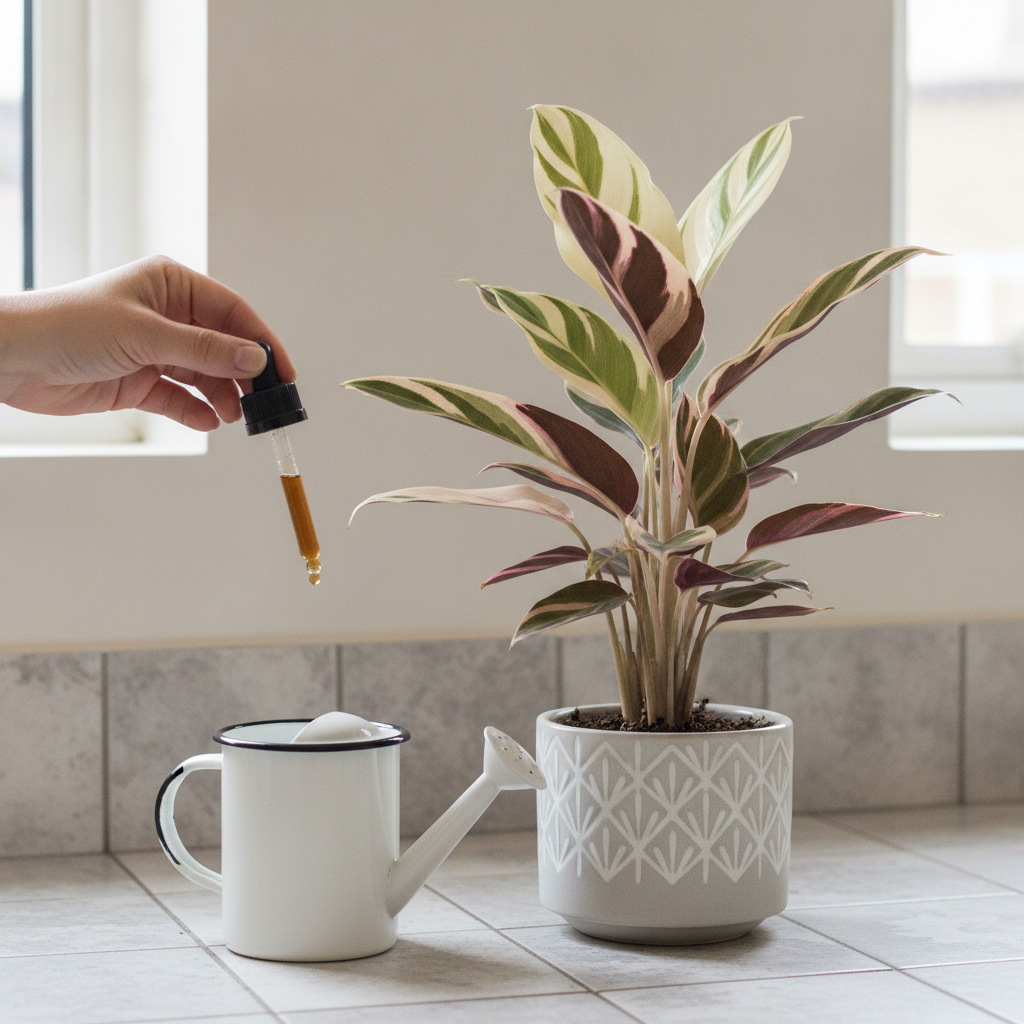
Understanding Plant Nutrients
Most fertilisers list three headline numbers, the N-P-K ratio, representing nitrogen, phosphorus and potassium. For a foliage plant like the Triostar, a balanced ratio such as 10-10-10, or a formula slightly higher in nitrogen, supports lush, well-coloured leaves. The secondary nutrients matter too, and deficiencies show up in the foliage long before you would otherwise notice a problem.
| Nutrient | Symbol | Primary Function | Deficiency Symptoms |
|---|---|---|---|
| Nitrogen | N | Leaf growth and green pigment | Pale, yellowing older leaves; slow growth |
| Phosphorus | P | Root development and energy transfer | Stunted growth, dull foliage |
| Potassium | K | Overall vigour and water regulation | Yellow or brown leaf margins |
| Calcium | Ca | Cell wall structure | Distorted, weak new growth |
| Magnesium | Mg | Core of the chlorophyll molecule | Yellowing between leaf veins |
| Iron | Fe | Chlorophyll production | Yellow new leaves with green veins |
Types of Fertiliser
Liquid fertilisers: The best match for a Triostar. Diluting a balanced liquid feed to half the recommended strength gives you precise control over concentration and lets you flush the soil easily, making salt build-up simple to avoid. This is the method most growers should default to.
Slow-release granular: Convenient prills that release nutrients over months. They work, but they remove your control over dose and can concentrate salts in the small pot of a moisture-loving plant, so use sparingly if at all and at less than the label rate.
Organic fertilisers: Worm castings, diluted seaweed extract and gentle organic feeds suit the Triostar well, feeding slowly and improving the soil without the sharp salt spikes of strong synthetics. Worm castings worked lightly into the topsoil are an excellent low-risk option.
Feeding Schedule
Feed every two to four weeks through spring and summer, when the plant is actively growing, using a balanced liquid fertiliser at half strength. As growth slows in autumn, taper off, and stop feeding entirely through winter, when the plant is resting and unused nutrients would simply accumulate as harmful salts. Resume in spring once you see fresh leaves unfurling.
Pro Tip — Always Feed Moist Soil: Never apply fertiliser to a dry root ball. Water the plant first, or feed as part of a normal watering, so the diluted nutrients spread evenly and cannot burn dry, exposed roots.
How to Fertilise
- Dilute a balanced liquid fertiliser to half the recommended strength in room-temperature water.
- Water the plant lightly first if the soil is dry, so the roots are never fed bone-dry.
- Apply the diluted feed evenly across the soil surface until it begins to drain.
- Let the pot drain fully and empty any liquid from the saucer or cachepot.
- Every month or two, water with plain water alone to flush accumulated salts from the mix.
Warning — Salt Build-Up: A white crust on the soil surface or pot rim, combined with worsening brown leaf edges, signals fertiliser salts accumulating in the mix. Flush the soil thoroughly with several pot-volumes of clean water, and cut back on feeding strength and frequency.
Propagation
Unlike many trailing houseplants, the Triostar cannot be propagated from leaf or stem cuttings. It does not root from a snipped section the way a pothos or philodendron does, because it grows from a central rhizome and produces new shoots from that underground structure rather than from nodes along a vine. The only reliable way to make more Triostars is by division, separating an established clump into smaller plants, each with its own roots and shoots.
This makes propagation refreshingly straightforward but also self-limiting: you can only divide a plant that has grown large and full enough to spare a section. The best time is spring, ideally combined with a scheduled repotting, when the plant is entering active growth and recovers fastest from the disturbance.
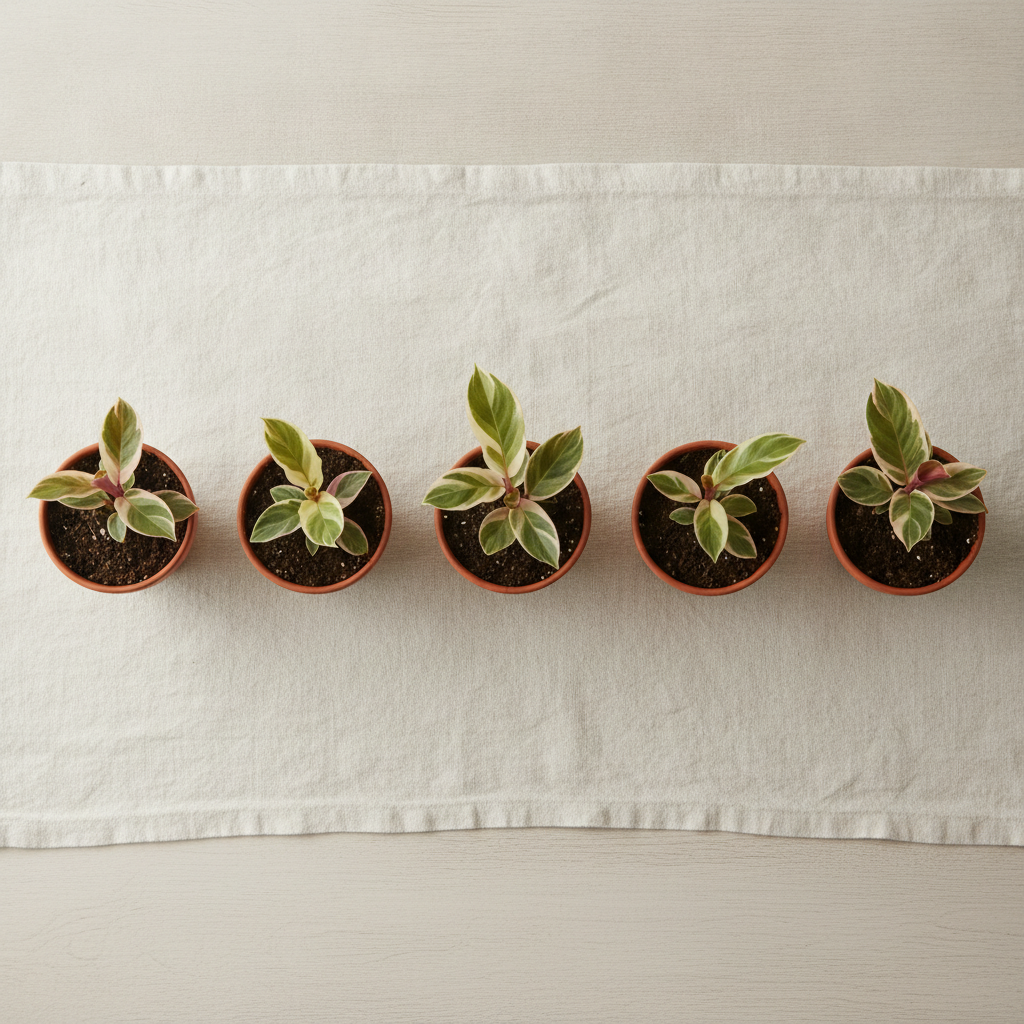
Understanding the Rhizome
The Triostar spreads via a rhizome, a thickened, horizontal underground stem from which both roots and new leaf shoots emerge. When you tip a mature plant out of its pot, you will see the clump is made up of several connected crowns rising from this shared root mass. Division simply means teasing or cutting that mass into pieces, each containing at least two or three healthy shoots and a good share of roots. Understanding this structure is the key to dividing confidently rather than tearing the plant apart at random.
Division at Repotting: Step-by-Step
This is the primary, and for most growers the only, propagation method. Done carefully in spring, it gives you two or more well-rooted plants that establish quickly.
- Water the plant a day ahead, then slide it gently from its pot.
- Brush and shake away enough soil to expose where the separate crowns join at the roots.
- Identify natural divisions, each clump with several shoots and its own roots attached.
- Tease the sections apart by hand where you can, using a clean, sharp knife only where roots refuse to separate.
- Pot each division into its own appropriately sized pot of fresh, well-draining mix at its original depth.
- Water thoroughly with filtered water and place in bright, indirect light.
Pro Tip — Build a Recovery Tent: Fresh divisions have reduced roots and lose water fast. Cover each new plant loosely with a clear plastic bag or place it in a propagator for the first week or two to hold humidity high, opening it daily for fresh air. This dramatically reduces the post-division sulk.
Aftercare: Step-by-Step
The fortnight after division decides whether your new plants thrive or fail. Treat them gently and consistently.
- Keep the soil lightly and evenly moist, never letting it dry out while roots re-establish.
- Maintain high humidity with a cover, propagator or humidifier for the first one to two weeks.
- Place divisions in bright, indirect light, well away from any direct sun.
- Do not fertilise until you see new growth, a sign the roots have taken hold.
- Expect drooping at first; steady care usually brings the plants around within two to three weeks.
Troubleshooting Propagation
| Problem | Likely Cause | Solution |
|---|---|---|
| Division wilts badly and does not recover | Too few roots taken with the section | Always divide with ample roots per crown; keep humidity very high |
| Leaves crisp and brown after potting | Low humidity or dry soil during establishment | Use a humidity cover and keep the mix evenly moist |
| Rot at the base of a division | Soil kept too wet or a cut left exposed to damp | Use free-draining mix, let knife cuts dry briefly, water carefully |
| No new growth after a month | Cold temperatures or division done outside the growing season | Keep warm, be patient, and divide in spring next time |
Pests & Diseases
A healthy, well-watered Triostar in humid surroundings is reasonably resistant to pests, but the dry indoor air it dislikes is exactly the condition many common pests love, which links its two biggest vulnerabilities. Spider mites in particular thrive when humidity drops, so the same care that keeps the leaves uncrisped also keeps the bugs at bay.
The habit of leaves folding up at night means pests can shelter on the protected undersides, so inspect both surfaces regularly, ideally during the day when the foliage is open. Catching an infestation early, when it is a few insects rather than a colony, makes treatment far easier.

Common Pests
Spider Mites (Tetranychus urticae)
The Triostar’s number one pest, encouraged by dry air. These tiny arachnids speckle the leaves with pale stippling and spin fine webbing in the leaf joints and undersides. Left unchecked they bronze and dry whole leaves.
Treatment: Raise humidity immediately, rinse the foliage in a shower to dislodge mites, then treat with insecticidal soap or neem oil every five to seven days for three weeks, coating the leaf undersides thoroughly.
Mealybugs (Pseudococcus spp.)
Small, soft insects coated in white, cottony wax that cluster in leaf axils and along stems, sucking sap and leaving sticky honeydew behind. They multiply slowly but persistently if ignored.
Treatment: Dab each insect with a cotton bud dipped in isopropyl alcohol, then follow up with neem oil or insecticidal soap. Check weekly, as mealybugs hide in tight crevices and re-emerge.
Thrips (Thrips spp.)
Slender, fast-moving insects that rasp the leaf surface, leaving silvery scarring and tiny black faecal specks. They can distort new growth and are notoriously difficult to clear once established.
Treatment: Isolate the plant, remove the worst-affected leaves, and treat repeatedly with neem oil or a suitable insecticide; sticky blue traps help monitor and reduce the adult population.
Common Diseases
Root Rot (Pythium and Phytophthora spp.)
The most serious disease of the Triostar, caused by soil-borne fungi that thrive in waterlogged conditions. Roots turn brown and mushy, leaves yellow and wilt, and the plant can collapse rapidly if not addressed.
Treatment: Unpot at once, cut away all soft, brown roots with sterile scissors, repot into fresh free-draining mix, and water more sparingly. Prevention through correct watering is far easier than cure.
Fungal Leaf Spot (various pathogens)
Brown or yellow-rimmed spots that appear when leaves stay wet, often from misting or splashing in poorly ventilated, overly damp conditions. The spots may spread and merge if the leaves are not allowed to dry.
Treatment: Remove affected leaves, stop misting, improve air circulation, and water at the soil rather than over the foliage. A copper-based fungicide can help in stubborn cases.
Pest and Disease Summary
| Pest / Disease | Identification | Treatment |
|---|---|---|
| Spider mites | Pale stippling and fine webbing, worst in dry air | Raise humidity, rinse, neem or insecticidal soap |
| Mealybugs | White cottony clusters in axils and on stems | Alcohol on a cotton bud, then neem oil |
| Thrips | Silvery scarring and black specks on leaves | Isolate, prune, repeated neem treatment, blue traps |
| Root rot | Yellow wilting leaves with mushy brown roots | Trim rotten roots, repot, water sparingly |
| Fungal leaf spot | Brown spots on persistently wet leaves | Remove leaves, stop misting, improve airflow |
Prevention Strategies
Prevention with the Triostar comes down to keeping the plant in the conditions it wants, because a stressed plant is a magnet for trouble. Maintain humidity above 50 percent, which discourages spider mites; water correctly to avoid the soggy soil that breeds rot; and ensure decent air circulation so leaves dry and fungal spores cannot settle. A vigorous, well-cared-for Triostar shrugs off problems that would overwhelm a struggling one.
Quarantine every new plant for a couple of weeks before it joins your collection, and inspect your Triostar whenever you water, paying attention to the leaf undersides where pests begin. Wiping the leaves occasionally with a damp cloth both removes dust that blocks light and lets you spot the earliest signs of an infestation before it takes hold.
Pro Tip — Neem as Routine: A light monthly application of diluted neem oil during the growing season, sprayed over and under the leaves in the evening to avoid leaf burn, acts as a gentle deterrent that keeps most pests from ever establishing.
Popular Varieties
The plant most people mean by “Triostar” is itself a cultivar, Stromanthe sanguinea ‘Triostar’, frequently sold under the alternative name ‘Tricolor’. The two names refer to the same striking tricolour plant. Around it sits a small group of related Stromanthe selections and the plain species, giving collectors a handful of options that share the same care but differ in colouring.
Because the genus is fairly compact in cultivation, you will not find the dozens of cultivars that exist for, say, calatheas, but the choices below cover what you are realistically likely to encounter for sale.
| Variety | Leaf Appearance | Light Needs | Growth Rate | Availability |
|---|---|---|---|---|
| ‘Triostar’ (‘Tricolor’) | Cream, green and pink streaks; magenta undersides | Bright indirect | Moderate | Common |
| ‘Magicstar’ | Green with fine creamy-white speckling; pink-purple undersides | Bright indirect | Moderate | Uncommon |
| ‘Multicolor’ | Bold irregular cream and green blocks; red undersides | Bright indirect | Moderate | Rare |
| Stromanthe sanguinea (species) | Glossy deep green above, rich red beneath | Bright indirect to medium | Moderate to fast | Occasional |
| ‘Horticolor’ | Green marbled with yellow-cream; reddish undersides | Bright indirect | Moderate | Rare |
Featured Varieties
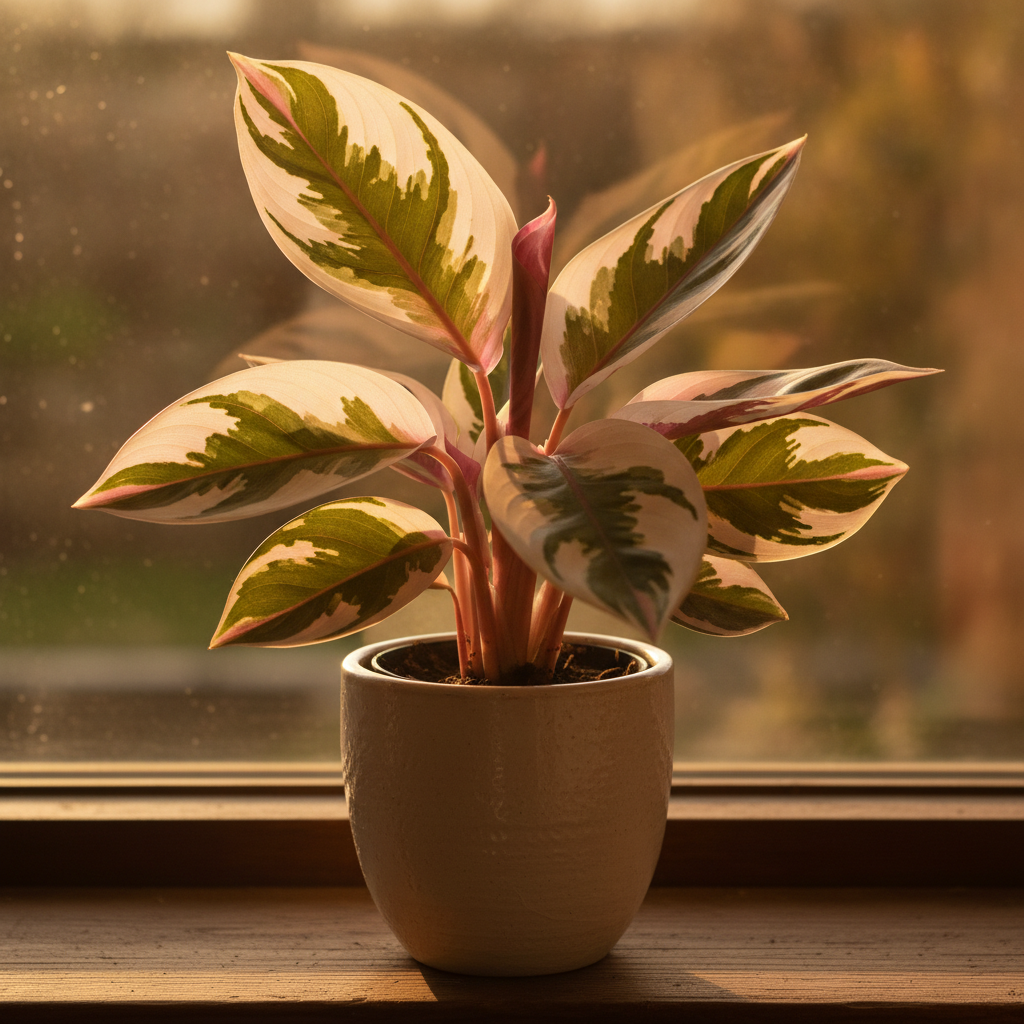
‘Triostar’ (‘Tricolor’)
The definitive variety and the reason the plant is famous. Leaves are splashed and streaked with cream, mint green and rose-pink, each one flipping over to show a deep magenta underside. No two leaves are patterned alike, and bright indirect light keeps the colour at its most vivid.
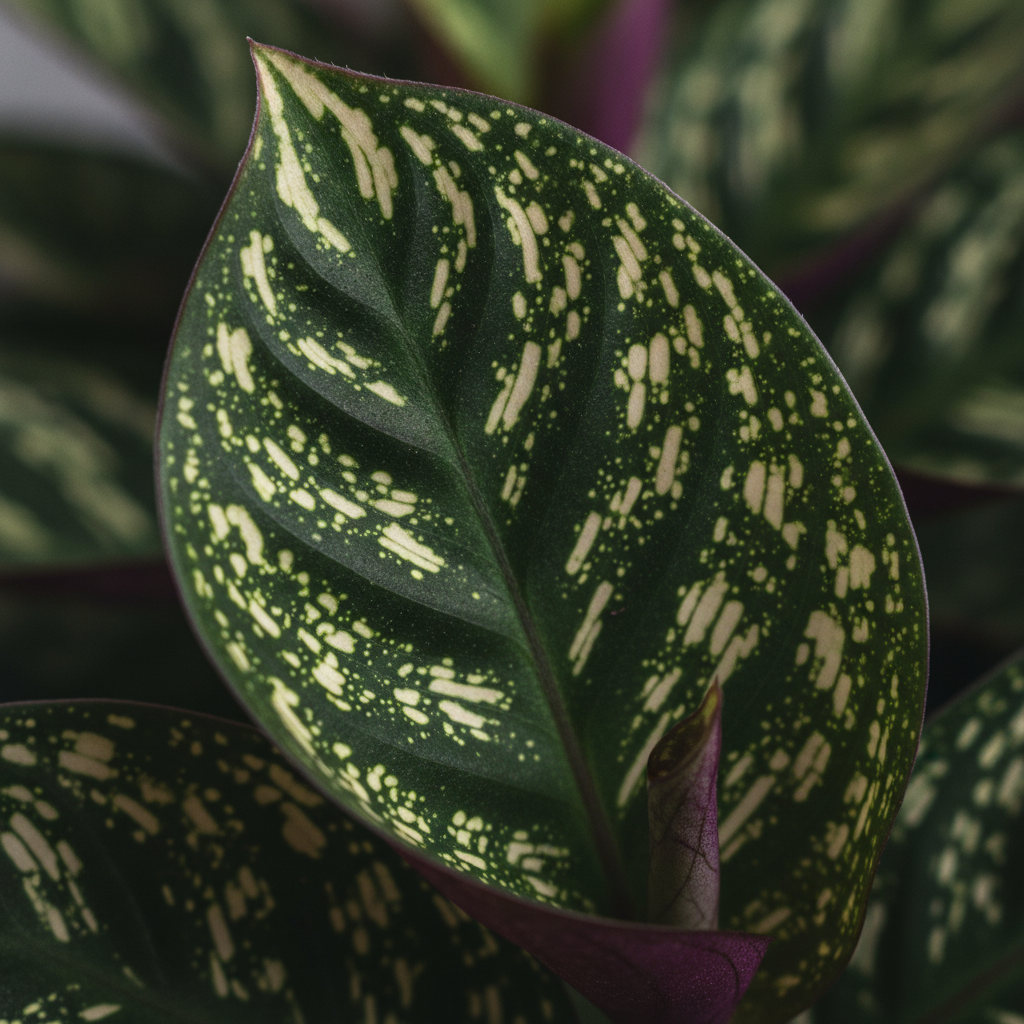
‘Magicstar’
A subtler relative whose deep green leaves are finely speckled and flecked with creamy white, as though dusted with paint, over the same purple-pink undersides. Less brash than ‘Triostar’ but elegant, and a sought-after find for collectors who already own the classic.
Variety Profiles in Detail
‘Triostar’ (Stromanthe sanguinea ‘Triostar’)
This is the plant in almost every shop and the one this guide is written around. Mature specimens form a dense clump 60 to 80 cm (24 to 32 inches) tall, each leaf a unique canvas of cream, green and pink. It demands the most light of any Stromanthe to keep its pale variegation from greening over, but is otherwise no fussier than its relatives.
‘Magicstar’ (Stromanthe sanguinea ‘Magicstar’)
A more recent introduction with a speckled, splattered variegation quite different from the bold streaks of ‘Triostar’. Because more of each leaf is green, it copes slightly better in medium light, though bright indirect light still produces the best contrast against the purple undersides.
The Species (Stromanthe sanguinea)
The unvariegated parent, with glossy dark green upper surfaces and dramatic blood-red undersides that give the species its name. Without the pale variegation to protect, it is the most forgiving and fastest-growing of the group, and a handsome plant in its own right for anyone who finds the tricolour forms too busy.
Choosing the Right Variety for Your Space
If you have a genuinely bright, indirect spot and want maximum impact, ‘Triostar’ is the obvious choice and the easiest to find. If your light is a little more modest, or you prefer a quieter, more textural look, ‘Magicstar’ or the plain species will both reward you with less risk of fading. Whichever you choose, the care is essentially identical, so let your light levels and your taste in colour, rather than any difference in difficulty, guide the decision.
Frequently Asked Questions
Why are the leaf edges on my Triostar turning brown and crispy?
This is the most common Triostar complaint and usually points to one of three causes: low humidity, mineral-laden tap water, or letting the soil dry out too far. Raise humidity above 50 percent, switch to filtered, distilled or rainwater, and keep the mix evenly moist. The damage already done will not reverse, but new leaves should emerge clean.
Why does my Triostar fold its leaves up at night?
This is entirely normal and is one of the plant’s most charming traits. Like all members of the prayer plant family, the Triostar performs nyctinastic movement, raising its leaves in the evening and lowering them in the morning using a small hinge at the base of each leaf. A plant that folds and unfolds is a healthy, happy plant.
Is the Triostar stromanthe safe for cats and dogs?
Yes. The Triostar is non-toxic to both cats and dogs, as well as to humans, making it one of the safest dramatic foliage plants you can keep in a home with pets. As with any plant, it is still wise to discourage pets from chewing it, but an accidental nibble will not poison them.
Can I propagate a Triostar from a leaf or stem cutting?
No. The Triostar grows from a rhizome and will not root from a leaf or a cut stem section. The only reliable way to make new plants is by dividing a mature clump into sections, each with its own roots and shoots, ideally in spring while repotting.
Why is my Triostar’s new growth coming in greener than the old leaves?
Fading variegation almost always means too little light. The cream and pink parts of the leaf cannot photosynthesise, so in dim conditions the plant produces greener leaves to capture more light. Move it somewhere brighter, though still out of direct sun, and the variegation on new leaves should return.
How often should I water my Triostar?
There is no fixed schedule. Water whenever the top 2 to 3 cm (about 1 inch) of soil has begun to dry, which in practice might mean twice a week in warm summer conditions or once every week to ten days in cool winter rooms. Always check the soil rather than watering by the calendar.
My Triostar’s leaves are curling. What does that mean?
Curling leaves usually signal that the plant is thirsty or that the air is too dry. Check the soil first; if it is dry, a thorough watering often sees the leaves relax within hours. If watering is correct, suspect low humidity and take steps to raise it. Persistent curling alongside soggy soil, by contrast, can indicate root problems.
Does the Triostar need a humidifier?
Not strictly, but it is the most reliable way to keep this humidity-loving plant happy in a typical home. Grouping plants together and using a pebble tray help, but a small room humidifier delivers the consistent 60 percent humidity the Triostar prefers, especially in winter when central heating dries the air. If your home is naturally humid, you may manage without one.
Where should I place my Triostar in the home?
An east-facing room, or a position set back from a brighter south or west window, suits it best, giving plenty of light without direct sun. Bright bathrooms and kitchens are excellent because they tend to be more humid. Keep the plant away from cold draughts, radiators and air-conditioning vents, all of which dry it out and stress it.






