
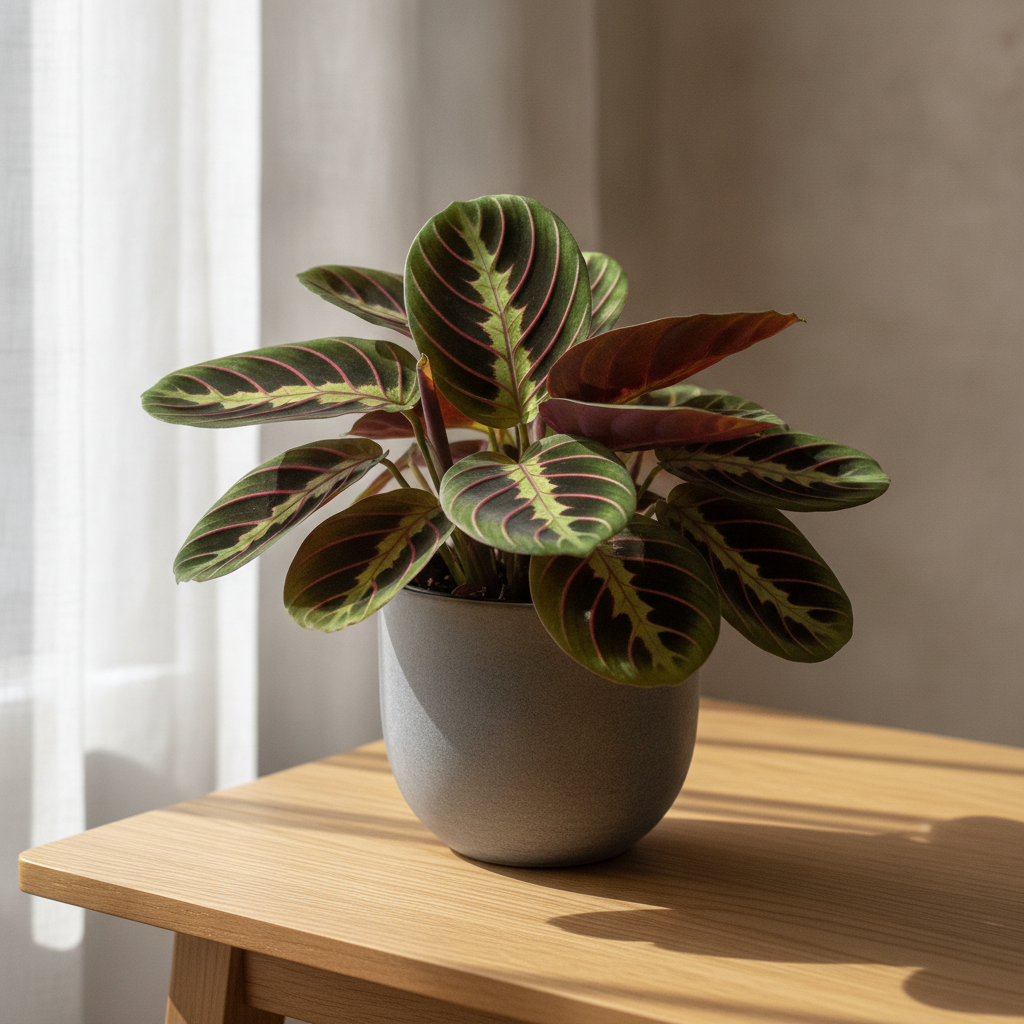
Few houseplants put on a daily performance quite like the velvet prayer plant. Each evening its soft, oval leaves rise and fold together along the midrib, only to lower again at dawn, a rhythmic movement that gives the entire Maranta group its common name. Known botanically as Maranta leuconeura, this low, spreading member of the Marantaceae family hails from the humid, shaded forest floors of Brazil, where its velvety foliage and intricately patterned veins evolved to capture the dim, filtered light reaching the understorey. The leaves are a study in detail: deep green with a feathered paler midrib, crimson herringbone lateral veins on the most popular forms, and a flush of purple-red on their undersides.
The velvet prayer plant carries a reputation for being temperamental, and that reputation is only half deserved. It will tolerate a surprising amount of neglect and still cling to life, but the gap between a plant that merely survives and one that genuinely thrives is wider here than with most houseplants. Crisp brown leaf edges, faded patterns and stalled growth are not signs of a difficult plant so much as signals that one or two specific needs are going unmet. This guide walks through every aspect of its care, from light and water quality to humidity, feeding, propagation and the pests most likely to trouble it, so you can keep those nightly prayers going for years.
Contents
- Quick Reference
- Why the Velvet Prayer Plant Makes a Rewarding Houseplant
- Light Requirements
- Watering & Humidity
- Soil, Potting & Repotting
- Fertilising
- Propagation
- Pests & Diseases
- Popular Varieties
- Frequently Asked Questions
Quick Reference: Velvet Prayer Plant at a Glance
| Light | Bright, indirect light; no direct sun |
| Watering | Keep evenly moist, never soggy; water when the top centimetre is dry |
| Temperature | 18 to 27 degrees Celsius (65 to 81 degrees Fahrenheit) |
| Humidity | High, ideally 60 per cent or above |
| Fertiliser | Balanced feed at half strength, every two to four weeks in spring and summer |
| Toxicity | Non-toxic to cats, dogs and humans |
Why the Velvet Prayer Plant Makes a Rewarding Houseplant
The first reason to welcome a velvet prayer plant into your home is simply how it looks. The foliage has a tactile, almost suede-like quality, and the contrast between the dark green leaf body, the lighter feathering along the central vein and the vivid red lateral veins makes each leaf resemble a hand-painted miniature. Because the plant grows low and spreading rather than tall, it works beautifully cascading from a shelf, trailing over the lip of a hanging pot, or filling out the front of a grouped plant display. It rarely exceeds 30 centimetres (about 12 inches) in height, which makes it ideal for flats, desks and other compact spaces where a towering floor plant would overwhelm.

The second reason is the nightly spectacle of nyctinasty, the technical term for the plant’s sleep movements. Tiny swollen joints called pulvini sit at the base of each leaf and shift their water pressure as light fades, raising the leaves into an upright, clasped position that genuinely looks like a pair of praying hands. By morning they relax flat again. Children and adults alike find this living clock captivating, and it doubles as a useful health indicator: a plant that stops moving may be stressed by poor light or erratic watering. Add to this the fact that the velvet prayer plant is listed as non-toxic to cats and dogs, and you have a plant that is as safe as it is mesmerising.
Important — Toxicity: The velvet prayer plant is non-toxic to cats, dogs and humans, making it one of the safest choices for homes with curious pets or small children. Even so, encourage everyone to leave the leaves alone, as nibbling can cause mild stomach upset and will quickly spoil the foliage.
Light Requirements
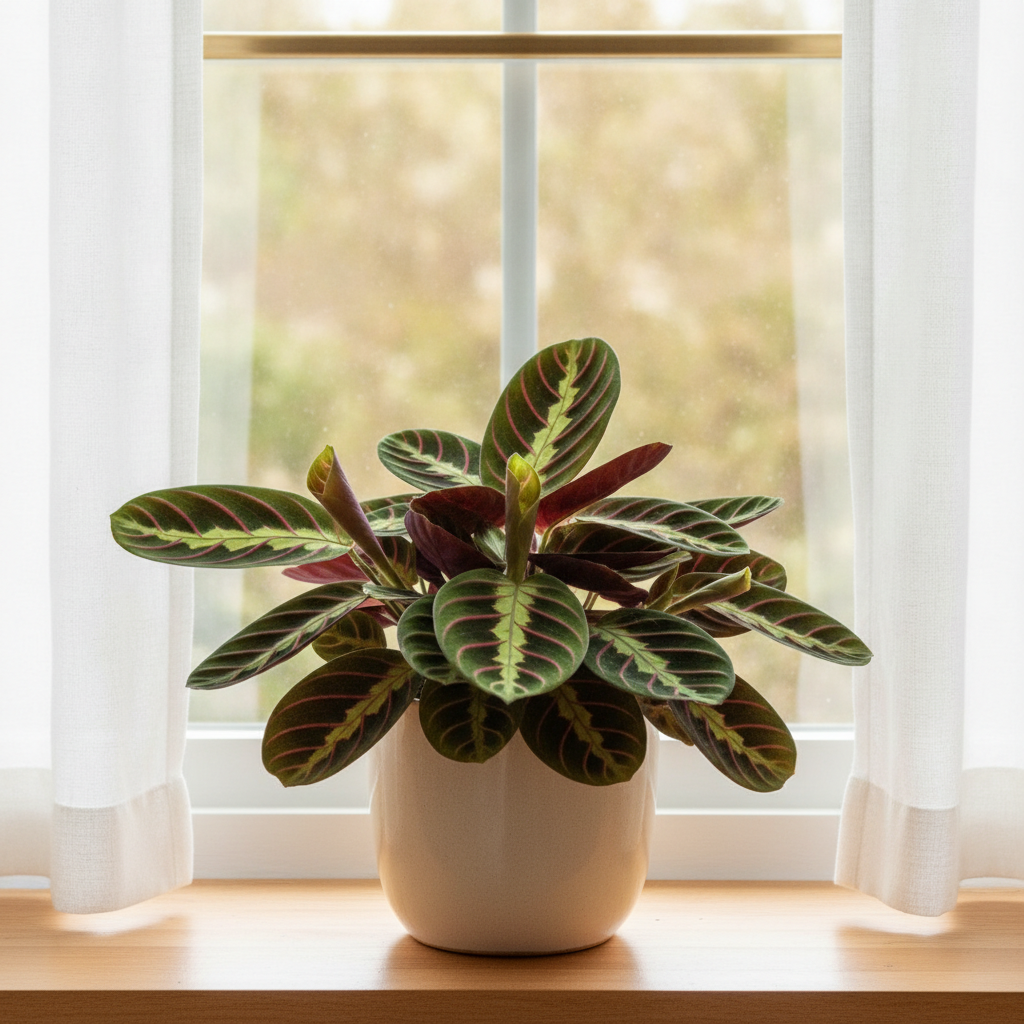
On the forest floors of its native Brazil, the velvet prayer plant lives beneath a dense canopy of taller trees, receiving only the soft, dappled light that filters down through the leaves above. Recreating that environment indoors is the single most important thing you can do for it. The plant wants bright but thoroughly indirect light, the kind found a metre or two back from a bright window or directly beside a window screened with a sheer curtain.
Get the light right and the plant rewards you with rich colour, tight spacing between leaves and reliable nightly folding. Get it wrong in either direction and the signs appear quickly. Too much direct sun bleaches the leaves to a washed-out pale green and scorches crisp brown patches into the surface, while too little light causes the patterns to fade, the stems to stretch and the prayer movements to become sluggish or stop altogether.
Light Levels Explained
Understanding the broad categories of indoor light makes it far easier to find the right spot. The table below outlines each tier and the likely outcome for a velvet prayer plant placed within it.
| Light Category | Approx. Level | Typical Location | Outcome |
|---|---|---|---|
| Direct sun | Over 50,000 lux | On a south windowsill | Leaves scorch and fade; avoid |
| Bright indirect | 10,000 to 20,000 lux | Near an east window or behind a sheer curtain | Ideal; rich colour and tight growth |
| Medium | 5,000 to 10,000 lux | A metre or two from a bright window | Good; slightly slower growth |
| Low | 1,000 to 5,000 lux | A north corner or interior wall | Survives but stretches and fades |
| Very low | Under 1,000 lux | A windowless room | Declines steadily; not viable |
Window Orientation and Placement
South-facing window: The brightest exposure in the northern hemisphere and usually too intense for a velvet prayer plant placed directly on the sill. Set the plant a couple of metres back from the glass, or diffuse the light with a sheer curtain to soften the midday sun.
East-facing window: Often the perfect position. The gentle morning sun is rarely strong enough to scorch the leaves, and the light remains bright and indirect for the rest of the day.
West-facing window: Workable, but the harsh afternoon sun can be a problem in summer. Pull the plant back from the glass or add a light curtain to take the edge off the strongest rays.
North-facing window: The light is gentle and never direct, which suits the plant, though in winter a north window may not supply quite enough brightness. Watch for stretching and consider supplementing with a grow light during the darkest months.
Pro Tip — Read the Leaves: Let the plant tell you whether the light is right. Vivid colour and leaves that fold crisply each night mean the spot is working. Pale, stretched growth means move it brighter, while bleached or scorched patches mean move it back from the sun.
How Light Affects Leaf Pattern
The dramatic veining that makes this plant so collectable is itself a product of correct lighting. In bright indirect light the contrast between the dark leaf body and the red or pale veins stays sharp and saturated. In dim conditions the plant produces more uniform green pigment to maximise photosynthesis, and the beautiful markings gradually wash out. If your plant’s patterning seems to be fading, low light is the most likely culprit, ahead of any nutrient issue.
Warning — Direct Sunlight: A few hours of unfiltered midday sun can permanently scorch the velvety leaves, leaving bleached patches that never recover. When moving a plant to a brighter spot, increase its sun exposure gradually over a week or two rather than all at once.
Artificial Lighting
Because it evolved in low, filtered light, the velvet prayer plant takes very well to artificial lighting and is a strong candidate for a windowless office or a dim corner. A standard full-spectrum LED grow light positioned 30 to 45 centimetres (12 to 18 inches) above the foliage and run for 10 to 12 hours a day provides ample energy. The plant’s nightly folding makes a natural on-off rhythm easy to honour: simply run the light on a timer that mimics daylight hours.
Seasonal Adjustments
Light intensity indoors can drop by half or more between summer and winter as the sun sits lower and days shorten. A spot that delivered perfect bright indirect light in July may leave the plant straining by December. Move plants closer to windows in autumn and winter, clean the glass to maximise transmission, and return them to their summer positions as the light strengthens again in spring.
Watering & Humidity
Watering is where most velvet prayer plant problems begin, and it is also where the difference between surviving and thriving is most pronounced. The plant likes its soil to stay consistently, evenly moist, like a wrung-out sponge, but it will not tolerate sitting in waterlogged compost. The goal is steady moisture without sogginess, achieved by watering little and often rather than letting the pot swing between bone dry and saturated.
When to Water
Check the plant every few days by pressing a finger into the top of the compost. When the top centimetre (about half an inch) feels dry, it is time to water; when it still feels damp, wait. In a warm, bright spot during the growing season this often means watering once or twice a week, while in winter the interval stretches as growth slows and the compost dries more slowly.
Never water purely on a fixed schedule, because the rate at which a pot dries depends on temperature, light, humidity and the season. A calendar reminder to check the soil is helpful, but the finger test should always have the final say. The plant is far more forgiving of a slightly late watering than of constant sogginess.
Pro Tip — Lukewarm Water: This tropical plant dislikes a cold shock at the roots. Let tap water come to room temperature before pouring, or mix in a little warm water, so the temperature roughly matches the room.
How to Water Correctly
- Check that the top centimetre of compost has dried before watering.
- Use room-temperature water that is low in minerals, such as rainwater, filtered or distilled water.
- Pour slowly and evenly across the surface until water runs freely from the drainage holes.
- Let the pot drain completely for several minutes so no excess water remains.
- Empty the saucer or cache pot; never leave the plant standing in collected water.
- Return the plant to its spot and check again in a few days.
Signs of Overwatering vs. Underwatering
| Symptom | Overwatering | Underwatering |
|---|---|---|
| Leaf colour | Yellowing, often lower leaves first | Fading and dull, edges turning brown |
| Leaf texture | Soft, limp and translucent | Dry, papery and curling at the edges |
| Soil | Stays wet for days, may smell sour | Pulls away from the pot edge, dries fast |
| Roots | Brown, mushy, foul-smelling | Dry and brittle but still firm |
| Stem base | Blackened and soft | Firm but growth stalls |
Warning — Root Rot: Persistently soggy compost suffocates the roots and invites the fungal and bacterial pathogens that cause root rot. If you notice yellowing leaves, a sour smell and mushy brown roots, unpot the plant immediately, trim away all affected tissue with clean scissors and repot into fresh, airy compost.
Humidity Requirements
If watering is the most common source of trouble, humidity is the most common reason a velvet prayer plant looks tatty even when everything else is right. Coming from a rainforest understorey where humidity rarely drops below 60 per cent, the plant suffers in the dry air of centrally heated or air-conditioned rooms. Crispy brown leaf edges are the classic symptom of air that is too dry.
Aim for relative humidity of 60 per cent or more. Below about 40 per cent the leaf tips and margins begin to brown and curl, and the plant becomes far more attractive to spider mites. A small hygrometer takes the guesswork out of monitoring the air around your plant.
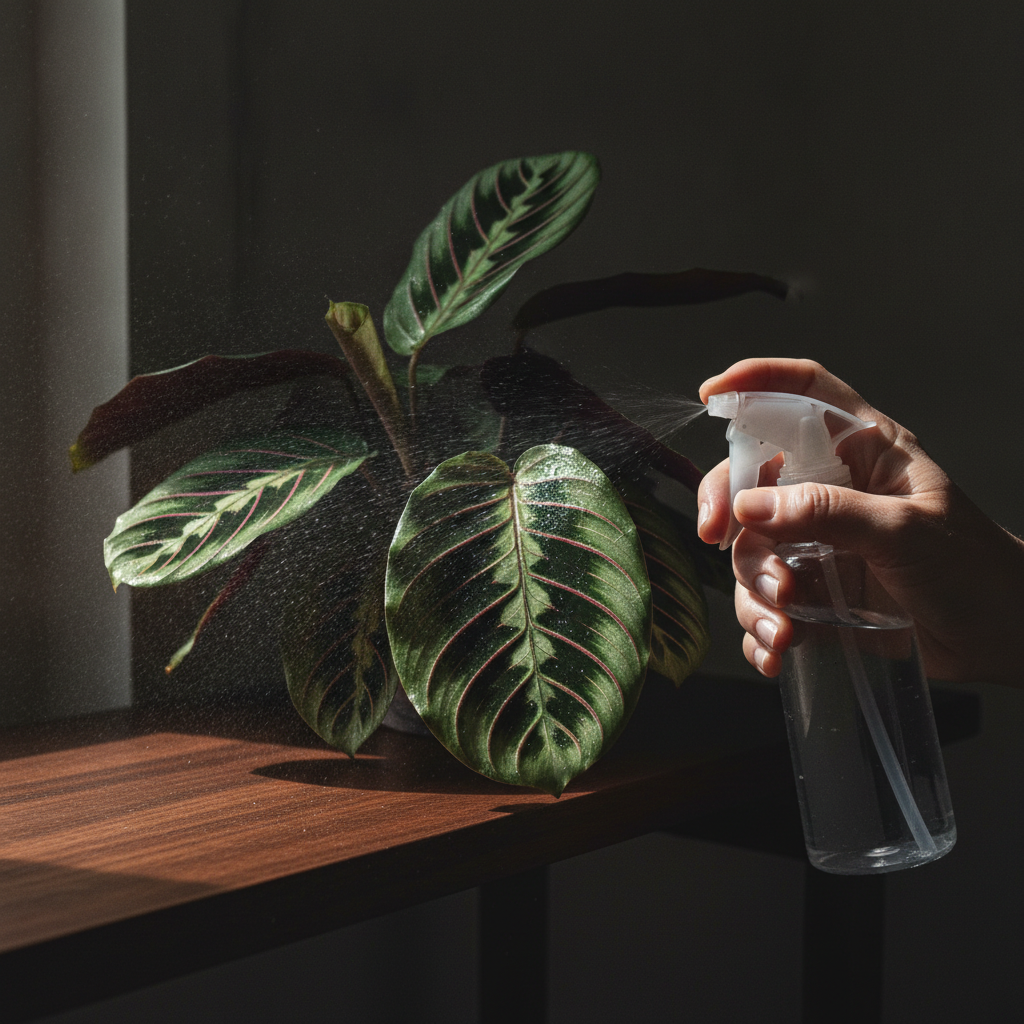
The most reliable way to raise humidity is a small electric humidifier running near the plant, especially through winter. Grouping plants together, standing the pot on a tray of damp pebbles, or moving the plant to a naturally humid room such as a bright bathroom all help too. Misting offers only a brief lift and can encourage fungal leaf spot if the foliage stays wet, so treat it as a minor supplement rather than a solution.
Water Quality
Marantas are notably sensitive to the minerals and additives in tap water. Fluoride, chlorine and the dissolved salts in hard water accumulate in the leaf tissue and show up as brown, scorched leaf tips and edges. This is one of the most frequent complaints from new owners, and it has nothing to do with watering frequency. Switching to rainwater, filtered water or distilled water often clears the problem entirely. If only tap water is available, leaving it to stand uncovered overnight allows some chlorine to dissipate, though it does nothing for fluoride or hardness.
Soil, Potting & Repotting
The right compost lets you achieve the seemingly contradictory aim of keeping the velvet prayer plant evenly moist while never letting it become waterlogged. The ideal mix holds plenty of moisture yet drains freely and stays aerated, so the fine, shallow roots get both the water and the oxygen they need.
Ideal Soil Composition
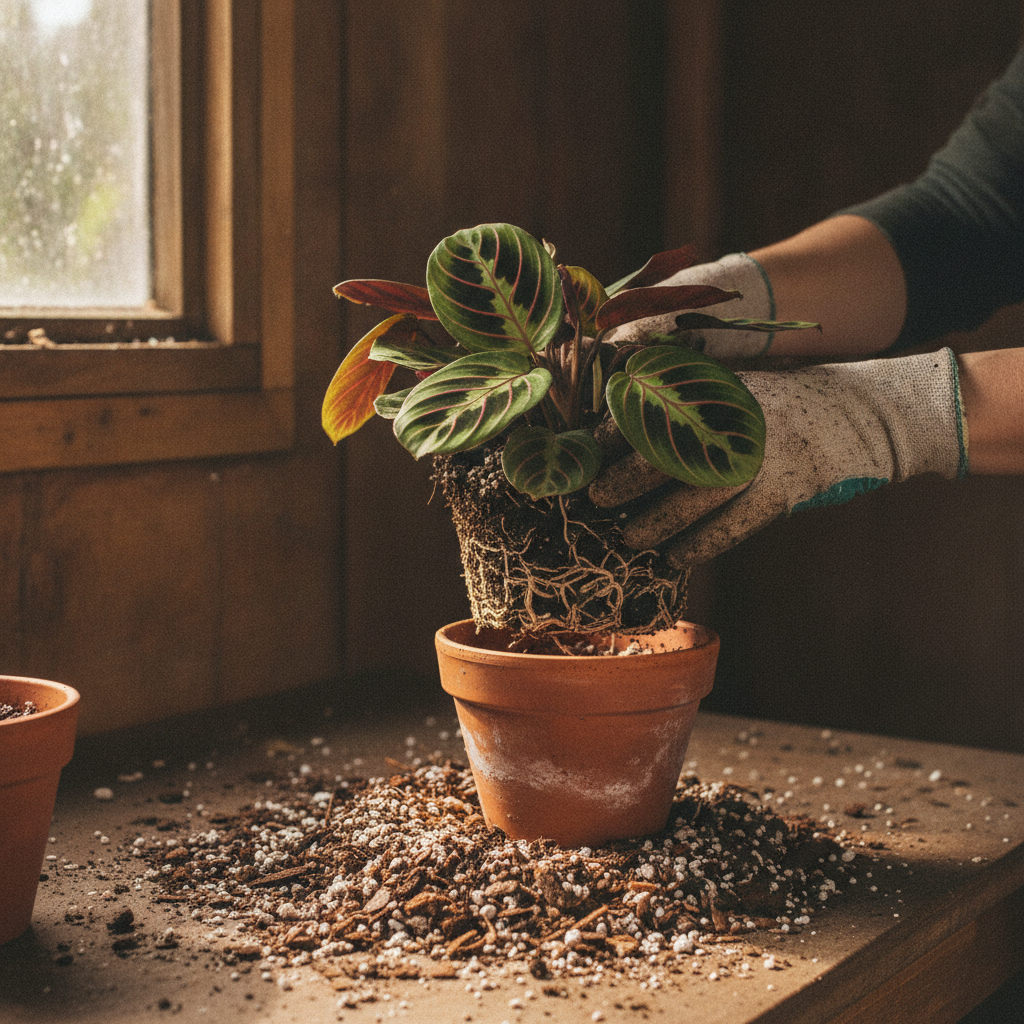
A peat-free or coir-based houseplant compost lightened with perlite and a little orchid bark or fine composted bark suits the plant well. The coir or peat substitute retains moisture, the perlite opens up the structure for drainage and air, and the bark adds chunkiness that stops the mix compacting into a dense, airless block over time.
| Component | Proportion | Function |
|---|---|---|
| Coir or peat-free compost | 50 per cent | Holds moisture and provides body |
| Perlite | 30 per cent | Improves drainage and aeration |
| Fine orchid or composted bark | 20 per cent | Keeps the mix open and airy |
The velvet prayer plant prefers a slightly acidic compost, with a pH of roughly 5.5 to 6.5. Most peat-free houseplant composts fall naturally within or close to this range, so there is rarely any need to adjust it deliberately. Adding a handful of worm castings provides gentle, slow-release nutrition without pushing the pH out of bounds.
Pro Tip — Quick Mix Recipe: For a reliable blend, combine two handfuls of coir-based compost with one handful of perlite and a small handful of fine orchid bark. The result holds moisture without ever turning to mud.
Choosing the Right Pot
Because the velvet prayer plant has a shallow, spreading root system, it is happier in a wide, shallow pot than in a deep one. A pot that is too deep holds a large reservoir of compost the roots cannot reach, and that unused, constantly wet soil is a recipe for rot.
Drainage holes are non-negotiable. Whatever pot you choose, it must have drainage holes. Without them, excess water collects at the base and the roots sit in stagnant moisture, which is the fastest route to root rot for a moisture-loving plant like this one.
Pot material: Plastic and glazed ceramic pots retain moisture well and suit this thirsty plant, helping the compost stay evenly damp between waterings. Unglazed terracotta wicks moisture away through its porous walls and dries out faster, so if you love the look of terracotta be prepared to water more often.
Pot size: Move up only one size at a time, choosing a pot two to three centimetres (about an inch) wider than the current one. Overpotting surrounds the roots with excess wet compost and does more harm than good.
When to Repot
The velvet prayer plant is a slow to moderate grower and only needs repotting every one to two years, ideally in spring as new growth begins. Signs that it is ready include roots emerging from the drainage holes, compost that dries out unusually quickly, or growth that has visibly slowed despite good care. Repotting is also the perfect moment to refresh tired compost and divide an overcrowded clump.
How to Repot: Step-by-Step
- Water the plant a day beforehand so the roots are hydrated and the rootball slides out more easily.
- Gently ease the plant from its pot, supporting the base of the stems with one hand.
- Tease apart the outer roots and brush away some of the old, spent compost.
- Inspect the roots, trimming any that are brown, soft or rotten with clean scissors.
- Add fresh mix to the new pot, set the plant at the same depth as before, and fill in around the rootball.
- Firm the compost gently to remove air pockets without compacting it.
- Water thoroughly and return the plant to bright, indirect light.
Warning — Transplant Shock: Expect a little drooping or sulking for a week or two after repotting. Keep the compost evenly moist, hold off on fertiliser for a month, and resist the urge to fuss; the plant will settle on its own.
Fertilising
The velvet prayer plant is not a heavy feeder, but a little regular nourishment through the growing season keeps its foliage full and its colours vivid. Because it is sensitive to a build-up of mineral salts, the watchword with feeding is restraint: dilute, modest and never on dry roots.
The plant draws on the nutrients in its compost, and over a few months a potful of compost becomes depleted. Feeding tops up that supply, while overdoing it scorches the roots and worsens the brown leaf tips this plant is already prone to.
Understanding Plant Nutrients
Most houseplant fertilisers list three numbers on the label, the NPK ratio, representing nitrogen, phosphorus and potassium. A balanced feed where these three numbers are roughly equal suits the velvet prayer plant well, supporting both leafy growth and overall vigour. The table below summarises the main nutrients and the symptoms that appear when each runs short.
| Nutrient | Symbol | Primary Function | Deficiency Symptoms |
|---|---|---|---|
| Nitrogen | N | Leaf and stem growth | Pale, yellowing older leaves; weak growth |
| Phosphorus | P | Root and energy systems | Stunted growth, dull foliage |
| Potassium | K | Overall vigour and water regulation | Brown leaf edges, weak stems |
| Magnesium | Mg | Core of the chlorophyll molecule | Yellowing between leaf veins |
| Iron | Fe | Chlorophyll production | Yellowing of the newest leaves |
Types of Fertiliser
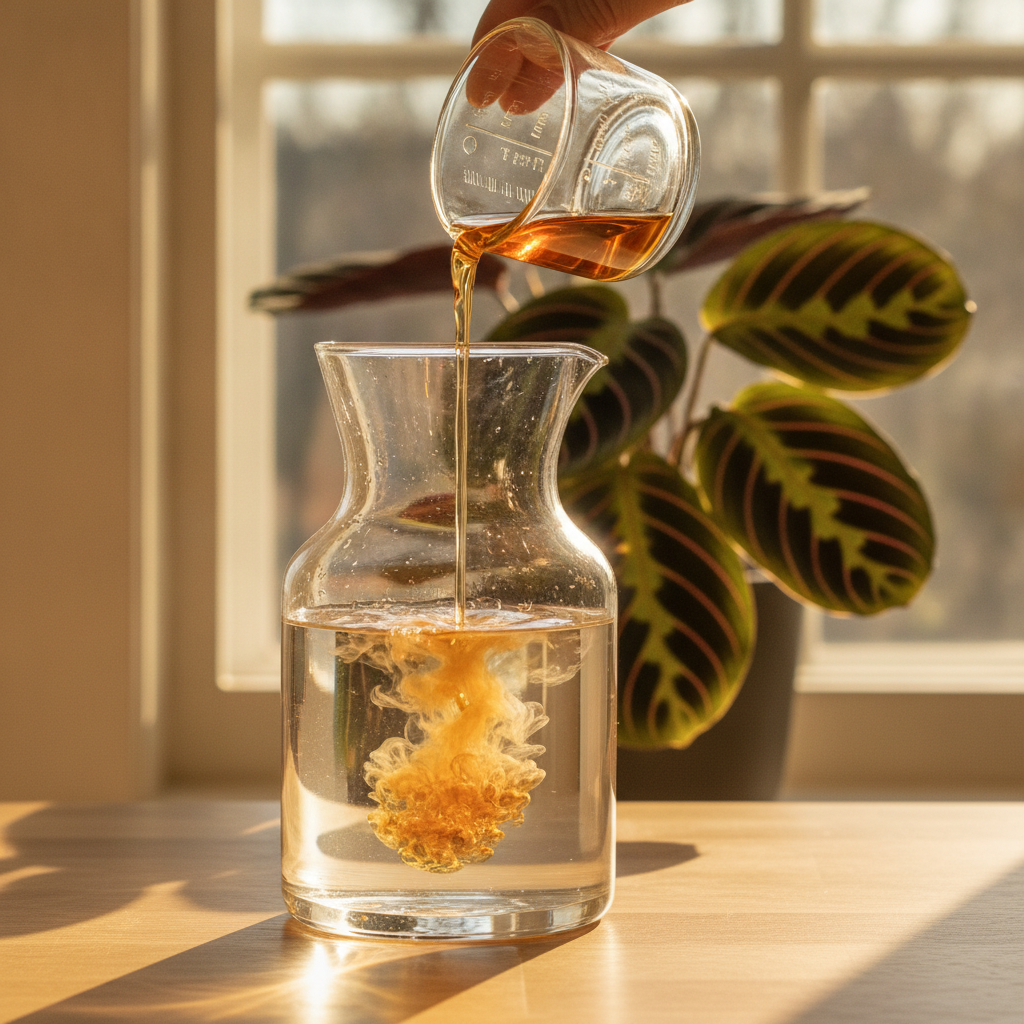
Liquid fertilisers: The easiest and most controllable option for this plant. Diluted into the watering can, they deliver nutrients evenly and let you dial the strength down, which is exactly what a salt-sensitive maranta needs.
Slow-release granular: Pellets that release nutrients gradually over months are convenient, but they offer less control over dosing and can release a flush of salts in warm conditions. If you use them, apply at the lower end of the recommended rate.
Organic fertilisers: Worm castings, diluted seaweed extract and gentle organic feeds suit the plant’s preference for light, steady nutrition and carry little risk of salt burn. A top-dressing of worm castings in spring is a simple, forgiving option.
Feeding Schedule
Feed every two to four weeks during the active growing season of spring and summer, always at half the strength recommended on the label. As growth slows in autumn, taper off, and stop feeding altogether through winter when the plant is resting. Resume in spring once you see fresh leaves unfurling.
Pro Tip — Half Strength, Always: When in doubt, under-feed. A velvet prayer plant recovers easily from too little fertiliser but struggles to shed the salt build-up caused by too much. Half the recommended dose is the safe default all season.
How to Fertilise
- Water the plant lightly first, or feed straight after a normal watering, so the roots are never fed while dry.
- Dilute a balanced liquid fertiliser to half the recommended strength in low-mineral water.
- Pour the solution evenly over the compost until it begins to drain.
- Discard any feed that collects in the saucer rather than letting the pot reabsorb it.
Warning — Salt Build-Up: Over time, fertiliser salts and tap-water minerals accumulate in the compost and appear as a white crust on the surface or pot rim. Flush the pot thoroughly with plain low-mineral water every couple of months, letting plenty run out of the drainage holes to wash the salts away.
Propagation
One of the quiet pleasures of growing a velvet prayer plant is how readily it multiplies. A single healthy plant can be turned into several over a year or two, whether to fill out a fuller display, replace an ageing specimen or share with friends. The two reliable methods are division and stem cuttings, both best attempted in spring or early summer when the plant is growing strongly.
Success in either case comes down to warmth, humidity and patience. New roots form fastest when the plant is in active growth and the surrounding air is humid, so a warm spot and a little enclosure to trap moisture go a long way.

Understanding Nodes
The key to cutting-based propagation is the node, the slightly swollen point on a stem where a leaf and its sheath join. Nodes contain the dormant cells that produce new roots, so every cutting must include at least one. A cutting taken from a bare length of stem with no node will simply sit in water and rot; one taken just below a node will root reliably.
Division: Step-by-Step
Division is the simplest method and works best on a mature, clumping plant, ideally combined with a routine repotting so you only disturb the roots once.
- Water the plant the day before, then slide it from its pot.
- Gently shake and tease away the loose compost to expose the root system.
- Find natural divisions in the clump where separate crowns of stems share their own roots.
- Ease the sections apart by hand, or cut through the rootball with a clean knife, making sure each piece keeps healthy roots and several leaves.
- Pot each division into fresh, airy compost at its original depth.
- Water well and keep warm and humid while the divisions settle and resume growth.
Pro Tip — Don’t Divide Too Small: Each division needs a decent cluster of roots and at least three or four leaves to re-establish quickly. Splitting a plant into too many tiny pieces leaves each one weak and slow to recover.
Stem Cuttings: Step-by-Step
Stem cuttings let you make several new plants from one parent and are a good way to use the trimmings from a tidy-up.
- Choose a healthy stem and cut just below a node with clean, sharp scissors.
- Make each cutting around 8 to 10 centimetres (3 to 4 inches) long with one or two leaves and at least one node.
- Remove any leaf that would sit below the water line to prevent rot.
- Place the cutting in a jar of low-mineral water, or insert it into damp sphagnum moss, keeping the node submerged or buried.
- Set it in bright, indirect light and refresh the water every few days.
- Once roots reach two to three centimetres (about an inch), pot the cutting into compost and keep it humid while it adjusts.
Troubleshooting Propagation
| Problem | Likely Cause | Solution |
|---|---|---|
| Cutting rots in water | No node submerged, or stagnant water | Use a node-bearing cutting and refresh the water often |
| No roots after weeks | Too cold or too dark | Move somewhere warmer and brighter |
| Divisions wilt badly | Too much root disturbance or low humidity | Keep warm and humid; trim a leaf or two to reduce stress |
| Potted cutting collapses | Shock moving from water to soil | Pot earlier with shorter roots and keep humidity high |
Pests & Diseases
A well-cared-for velvet prayer plant is reasonably resilient, but the warm, occasionally dry conditions of an indoor home can invite a handful of common pests. The plant’s thin, soft leaves are particularly appealing to sap-sucking insects, and low humidity, the very thing that browns its leaf tips, also makes it a magnet for spider mites.
The best defence is regular inspection. Turn a few leaves over each week and check the undersides and the points where leaves meet stems, where pests like to gather. Catching an infestation early makes it far easier to clear.
Common Pests
Spider Mites (Tetranychus urticae)
By far the most common pest on prayer plants, spider mites are tiny arachnids that thrive in dry air. They cause fine yellow stippling on the leaves and spin delicate webbing across the undersides and between stems. A badly affected plant takes on a dusty, faded look.
Treatment: Rinse the plant thoroughly under a gentle shower, then treat with insecticidal soap or diluted neem oil, repeating every five to seven days for three weeks to break the breeding cycle. Raising the humidity makes the plant far less hospitable to them in the first place.
Mealybugs (Pseudococcus species)
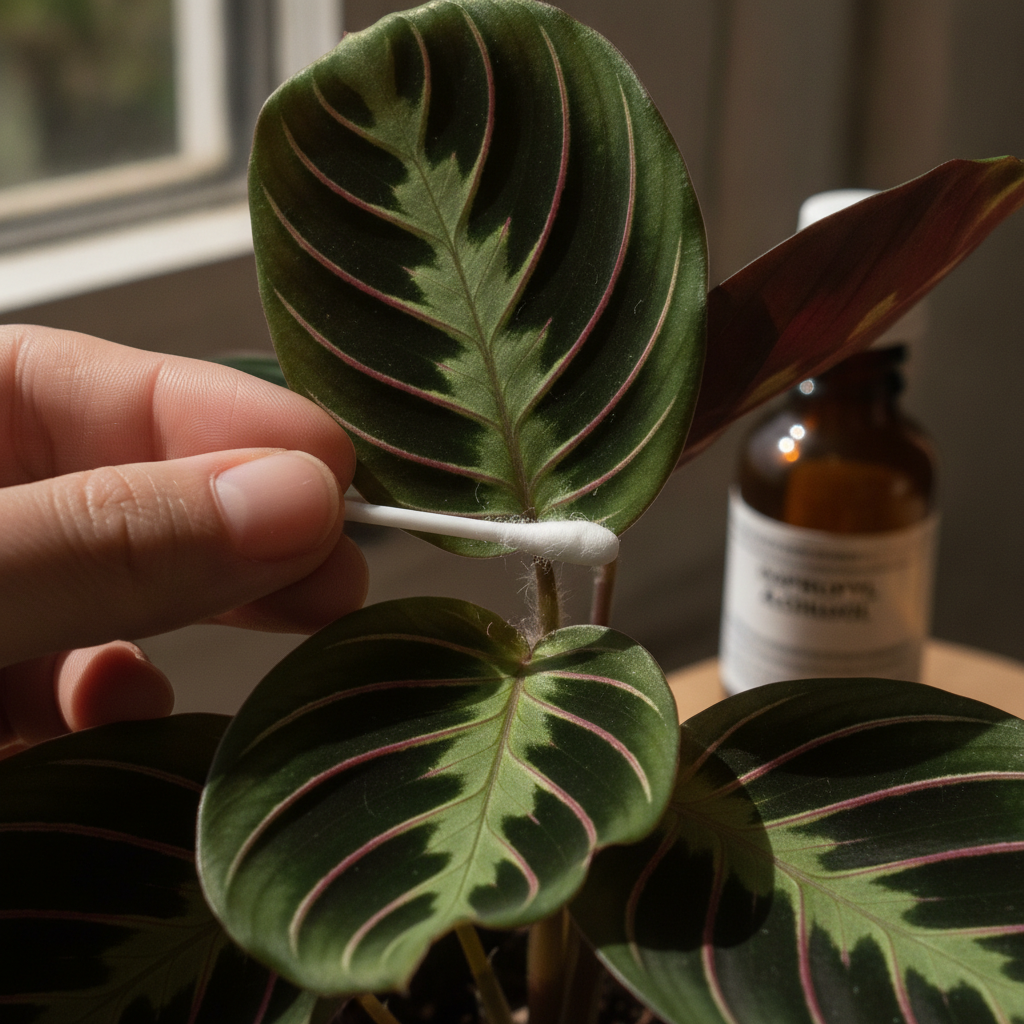
Mealybugs appear as small, white, cotton-wool-like tufts tucked into leaf axils and along the veins. They suck sap and excrete sticky honeydew, which can lead to sooty mould, and a heavy infestation weakens the plant noticeably.
Treatment: Dab each insect directly with a cotton bud dipped in isopropyl alcohol, then follow up with insecticidal soap or neem oil. Check weekly, as mealybugs are persistent and easily missed in the crevices.
Fungus Gnats (Bradysia species)
The constantly moist compost this plant enjoys is also perfect for fungus gnats, small black flies whose larvae live in the top layer of soil. The adults are more of a nuisance than a danger, but large larval populations can nibble at fine roots.
Treatment: Let the very top of the compost dry slightly between waterings, set out yellow sticky traps to catch the adults, and water with a biological control containing beneficial nematodes or Bacillus thuringiensis to tackle the larvae.
Common Diseases
Root Rot (Pythium and Fusarium species)
The most serious threat to a velvet prayer plant, root rot sets in when compost stays waterlogged and oxygen-starved, letting fungal pathogens attack the roots. Symptoms include yellowing leaves, a wilting plant despite wet soil, a sour smell and blackened, mushy roots.
Treatment: Unpot the plant, wash the roots and cut away every soft, brown section with sterilised scissors. Repot into fresh, airy compost in a clean pot with good drainage, and correct the watering habits that caused the problem.
Leaf Spot (Helminthosporium species)
Fungal leaf spot shows as small water-soaked spots that enlarge into brown or tan lesions, sometimes ringed with yellow. It is encouraged by water sitting on the foliage, which is one reason misting can do more harm than good on this plant.
Treatment: Remove affected leaves, improve air circulation and keep water off the foliage when watering. For stubborn cases, a copper-based or general houseplant fungicide applied according to the label will help.
Pest and Disease Summary
| Pest / Disease | Identification | Treatment |
|---|---|---|
| Spider mites | Fine yellow stippling and webbing | Rinse, neem oil or insecticidal soap, raise humidity |
| Mealybugs | White cottony tufts in leaf axils | Alcohol on a cotton bud, then neem oil |
| Fungus gnats | Small black flies around the soil | Dry the top soil, sticky traps, nematodes |
| Root rot | Yellowing, wilting, mushy roots | Trim roots and repot in fresh, airy mix |
| Leaf spot | Brown lesions ringed with yellow | Remove leaves, keep foliage dry, fungicide if needed |
Prevention Strategies
Prevention is far easier than cure. A plant kept in the right light, watered with care and given the humidity it craves is naturally more resistant to both pests and disease. Keep the leaves clean and dust-free, ensure decent air movement around the plant, and avoid the chronic overwatering that underlies most serious problems.
Quarantine every new plant for a couple of weeks before placing it near your collection, since shop-bought plants are the most common way pests arrive. A quick weekly inspection during routine watering will catch the vast majority of issues while they are still trivial to deal with.
Pro Tip — Humidity Is Pest Control: Because spider mites thrive in dry air, the same humidifier that keeps your velvet prayer plant’s leaf tips green also makes the plant a far less welcoming home for its most common pest. Good humidity is preventive medicine.
Popular Varieties
Though all are forms of the same species, Maranta leuconeura comes in several distinct varieties that differ markedly in leaf colour and pattern. Choosing between them is largely a matter of taste, as their care needs are essentially identical.
The two most widely sold are the red-veined Herringbone form and the gentler, spotted Rabbit’s Foot form, but several others appear in specialist collections. The table below compares the main varieties at a glance.
| Variety | Leaf Appearance | Light Needs | Growth Rate | Availability |
|---|---|---|---|---|
| var. erythroneura | Dark olive with red herringbone veins and lime midrib | Bright indirect | Moderate | Very common |
| var. kerchoveana | Grey-green with two rows of dark blotches | Bright indirect | Moderate | Common |
| var. leuconeura (Black Maranta) | Blackish-green with silver feathering | Bright indirect | Slow | Less common |
| ‘Lemon Lime’ | Bright lime veins on deep green | Bright indirect | Moderate | Increasingly common |
Featured Varieties
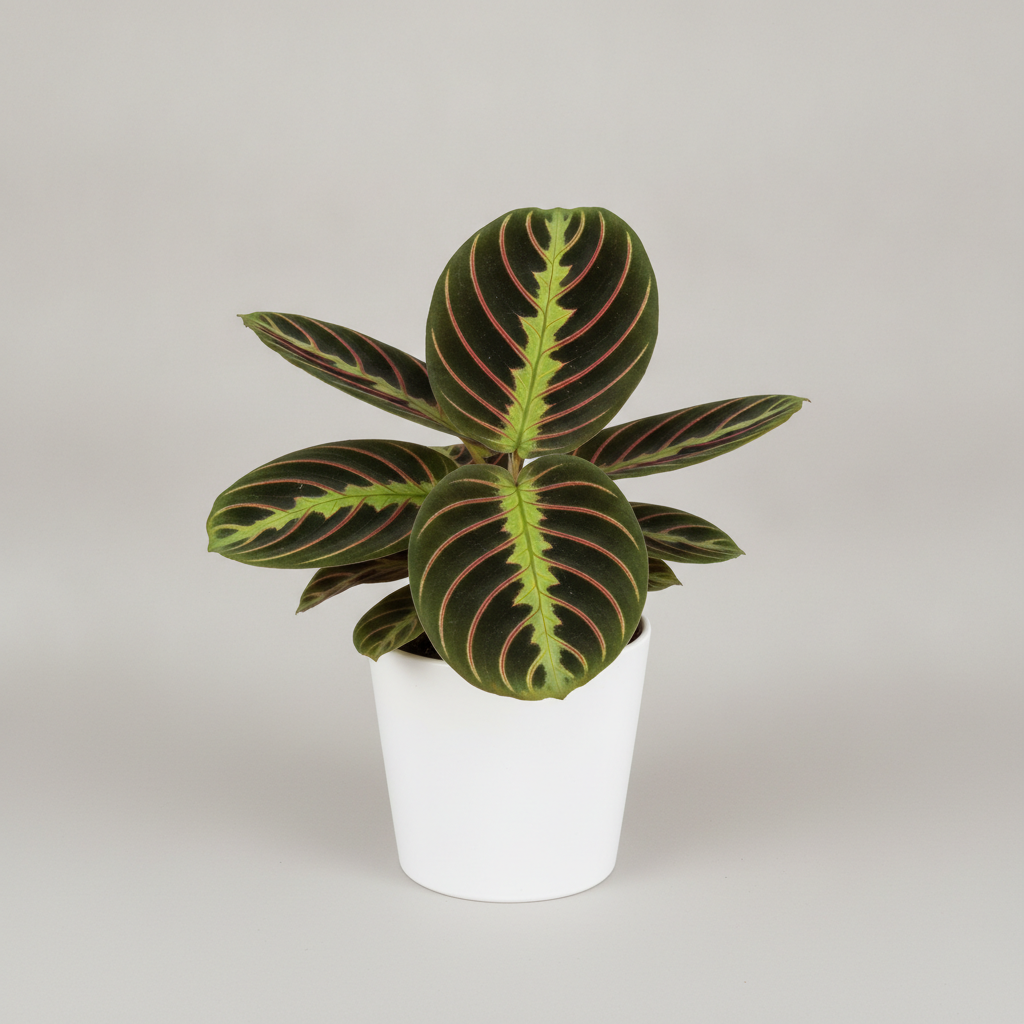
‘Erythroneura’ (Herringbone Prayer Plant)
The most iconic form, with velvety dark olive leaves crossed by vivid red herringbone veins and a bright lime-green blaze down the centre. It is the variety most people picture when they hear the words prayer plant.
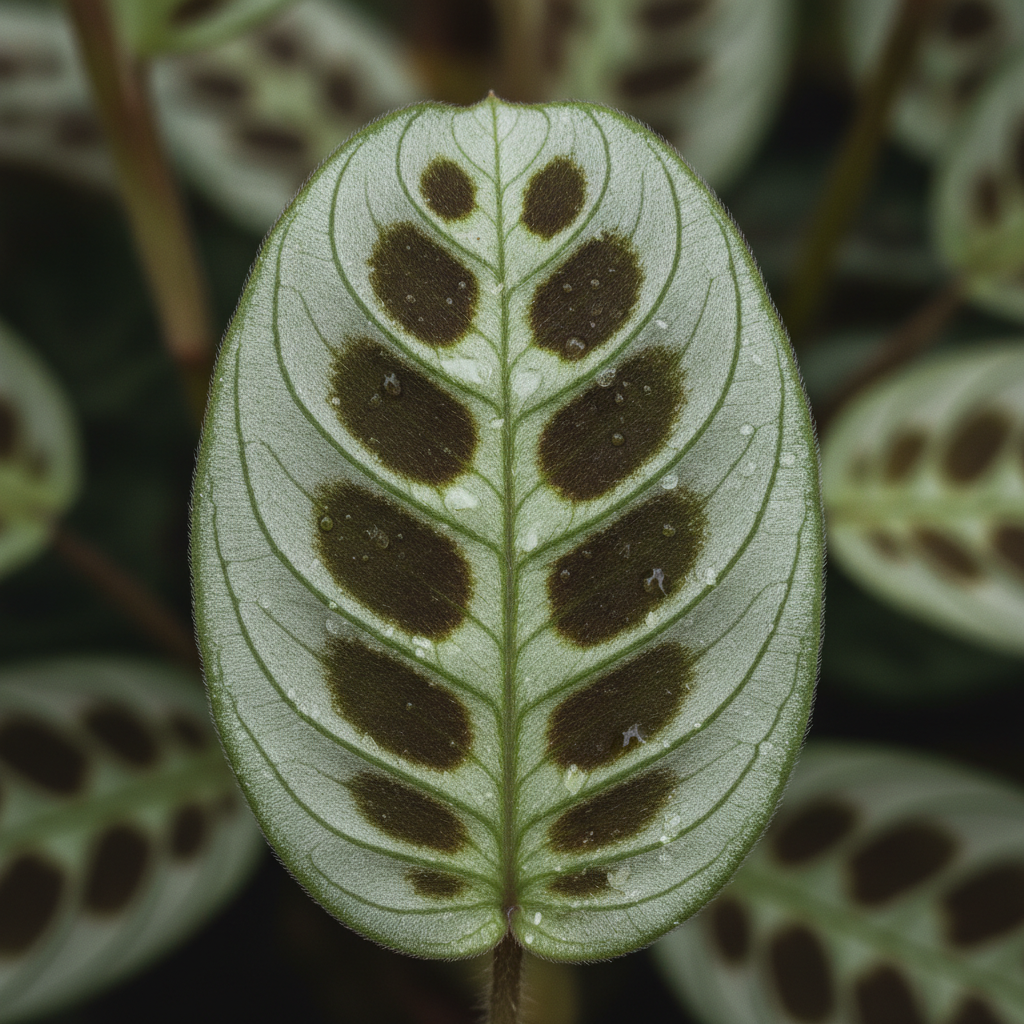
‘Kerchoveana’ (Rabbit’s Foot Prayer Plant)
A softer, more subtle form with pale grey-green leaves marked by two neat rows of dark olive-brown blotches that fade towards green as the leaf matures. The blotches are said to resemble a rabbit’s footprints, giving the plant its common name.
Variety Profiles in Detail
Herringbone Plant (Maranta leuconeura var. erythroneura)
The undisputed star of the genus, this variety pairs a deep, velvety green leaf with bright crimson veins that radiate outward in a herringbone pattern, all centred on a glowing lime-green midrib. The undersides flush a rich purple-red, so the nightly folding reveals a second colour scheme entirely. It is widely available and the form most often sold simply as the prayer plant.
Rabbit’s Foot Prayer Plant (Maranta leuconeura var. kerchoveana)
An older garden form valued for its quieter elegance. The leaves are a soft, almost silvery grey-green, decorated with two rows of dark spots either side of the midrib. Young spots are nearly black and mellow to green as the leaf ages, giving the plant a constantly shifting appearance. It tends to be a little more forgiving than the red-veined form.
Choosing the Right Variety for Your Space
Because every variety of Maranta leuconeura shares the same care requirements, the choice comes down to which patterning appeals most to you and what will suit your room. The bold red veining of the Herringbone form makes a striking focal point against neutral interiors, while the muted Rabbit’s Foot form blends gently into a layered, green display. Whichever you choose, all of them perform the same enchanting nightly ritual that makes the prayer plant a perennial favourite.
Frequently Asked Questions
Why are the tips of my velvet prayer plant turning brown?
Brown, crispy leaf tips and edges are almost always caused by air that is too dry or by minerals in tap water. Raise the humidity to 60 per cent or above with a humidifier, and switch to rainwater, filtered or distilled water. The fluoride and salts in hard tap water are a frequent and often overlooked cause.
Why has my plant stopped folding its leaves at night?
The nightly folding, or nyctinasty, is triggered by changes in light. If the movement weakens or stops, the most likely reason is too little light during the day, so try a brighter, indirect spot. Severe stress from over- or underwatering can also dampen the movement until the plant recovers.
Is the velvet prayer plant safe for cats and dogs?
Yes. Maranta leuconeura is listed as non-toxic to both cats and dogs, making it an excellent choice for pet-owning households. As with any plant, discourage pets from chewing the leaves, as that can cause mild stomach upset and will spoil the foliage.
How often should I water my velvet prayer plant?
There is no fixed schedule. Water when the top centimetre of compost feels dry, which in a warm, bright spot often means once or twice a week in summer and less in winter. Keep the soil evenly moist but never waterlogged, and always use the finger test rather than the calendar.
Why are the leaves curling?
Curling leaves usually signal that the plant is too dry, either at the roots or in the air. Check whether the compost has dried out too far, and assess the humidity. Curling that eases after watering points to underwatering, while persistent curling alongside crispy edges points to low humidity.
Why are the lower leaves turning yellow?
A single old leaf yellowing occasionally is normal ageing. Several leaves yellowing at once, especially the lower ones, usually indicates overwatering. Check that the compost is not staying soggy and that the pot drains freely, and allow the top of the soil to dry a little more between waterings.
Can I grow a velvet prayer plant in a hanging pot?
Absolutely. Its low, spreading habit looks wonderful trailing from a hanging pot, and the elevated position can help with air circulation. Just remember that hanging spots near ceilings can be warmer and drier, so keep an eye on humidity and water needs.
Does the velvet prayer plant flower?
It can. Mature, happy plants sometimes produce small, delicate flowers on thin stalks, usually white or pale lilac. The blooms are modest and short-lived, since this plant is grown firmly for its spectacular foliage rather than its flowers.






