
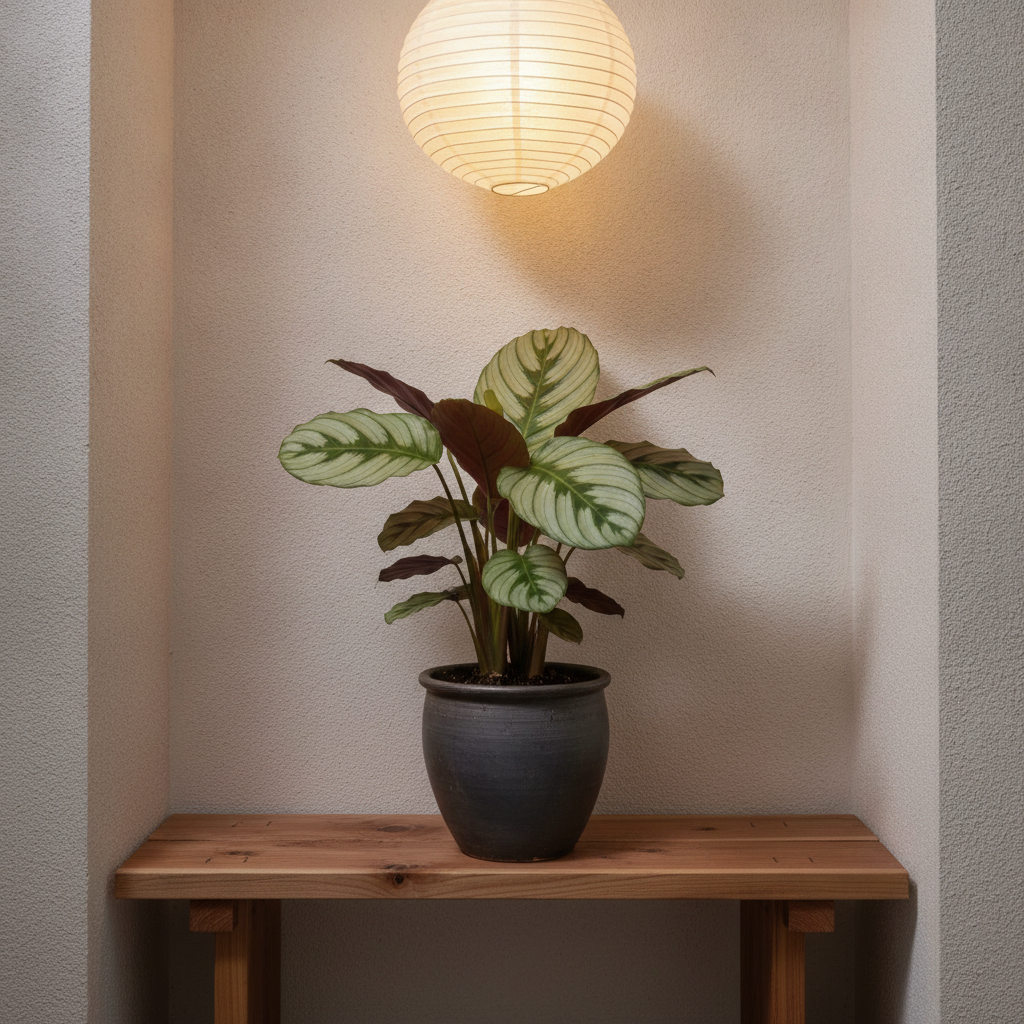
Few houseplants earn their common name as literally as Cathedral Windows. Hold a mature leaf of Goeppertia makoyana up to the light and the foliage glows like leaded glass, its fine dark-green veining and feathered blades floating over a pale, almost translucent ground, with the whole pane backed in soft purple-red. Long sold under the older name Calathea makoyana and also widely known as the Peacock Plant, this Brazilian native belongs to the prayer plant family (Marantaceae) and shares that family’s most endearing trick: every evening the leaves fold upward along their stems, then relax open again with the morning light.
Cathedral Windows has a reputation as a diva, and that reputation is only half deserved. The plant is not difficult to keep alive in the narrow sense, but the gap between a specimen that merely survives and one that genuinely thrives is wider here than with almost any other common houseplant. Survival asks little more than warmth and water. Thriving, the kind that produces unmarred leaves with crisp patterning and no brown edges, asks for attention to humidity, water quality and consistency. This guide walks through every element of its care, from reading light correctly to dividing the clump, so that you can close that gap and grow a plant worthy of the name.
Contents
- Quick Reference
- Why Cathedral Windows Makes a Rewarding Houseplant
- Light Requirements
- Watering & Humidity
- Soil, Potting & Repotting
- Fertilising
- Propagation
- Pests & Diseases
- Popular Varieties
- Frequently Asked Questions
Quick Reference: Cathedral Windows at a Glance
| Light | Bright, indirect light only. No direct sun, which bleaches the pattern and scorches the leaf. |
| Watering | Keep the mix lightly and evenly moist. Water when the top 2 to 3 cm (about 1 in) feels barely dry. Never waterlogged, never bone dry. |
| Temperature | 18 to 24 degrees C (65 to 75 degrees F). Avoid anything below 15 degrees C (59 degrees F) and all cold draughts. |
| Humidity | High, ideally 60 percent or more. Below 50 percent the leaf edges brown. |
| Fertiliser | Balanced feed at quarter to half strength, monthly through spring and summer only. |
| Toxicity | Non-toxic to cats, dogs and humans. Safe to grow in homes with pets and children. |
Why Cathedral Windows Makes a Rewarding Houseplant
The first reason to grow Cathedral Windows is, unavoidably, the foliage. Each large oval leaf carries a pattern that looks painted by hand: a central feathered blade of deep green, flanked by an alternating series of short and long brushstrokes that run toward the margin, all of it set against a translucent pale-green field. Turn the leaf over and the underside is flushed a rich maroon. The effect changes constantly with the light, glowing at midday and deepening at dusk, and no two leaves are identical. For a plant that rarely flowers indoors, it offers more visual interest than most flowering houseplants manage in a year.

The second reason is behaviour. Like all members of the prayer plant family, Goeppertia makoyana performs nyctinasty, the daily raising and lowering of its leaves driven by a swollen joint called the pulvinus at the base of each leaf stem. By night the leaves stand almost vertical, revealing their purple undersides and sometimes producing a faint rustle as they move; by day they lower and spread to catch the light. Living with the plant means watching it breathe in slow motion, a quality that makes it feel less like an ornament and more like a companion. Add to this its genuine safety around animals and toddlers, confirmed by its absence from the toxic plant lists maintained by animal welfare bodies, and the appeal is easy to understand.
Important — Toxicity: Cathedral Windows is non-toxic to cats, dogs and people. It is one of the safest statement foliage plants you can choose for a household with curious pets, though as with any plant, nibbling can still cause mild stomach upset and is best discouraged.
Light Requirements
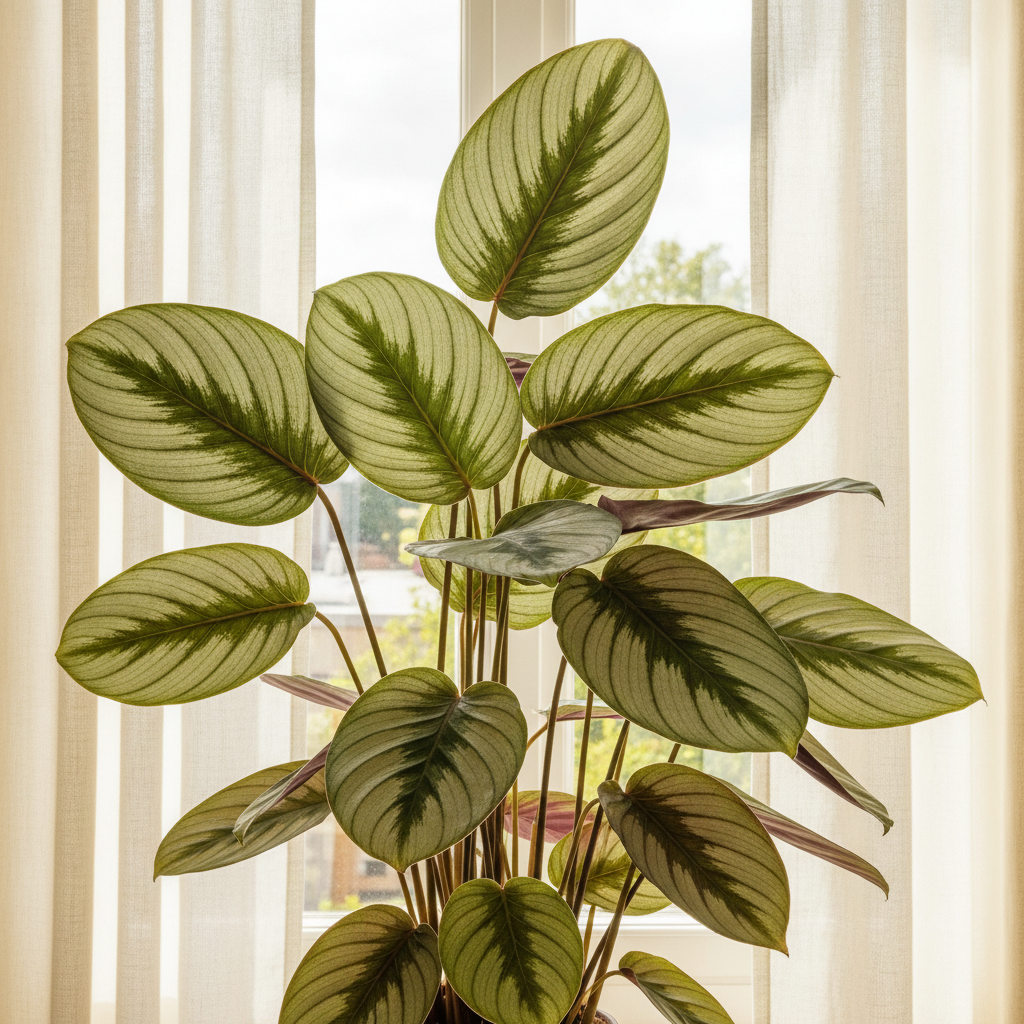
In its native eastern Brazil, Cathedral Windows grows on the rainforest floor beneath a dense canopy, receiving only the dappled, filtered light that reaches the understorey. This origin dictates everything about its light needs indoors. The plant wants brightness without ever standing in a direct beam, the equivalent of the bright but shaded conditions a few steps back from a sunny window.
Bright indirect light keeps the patterning crisp, the colours saturated and the growth compact. Too little light and the plant survives but grows leggy, the new leaves emerging smaller and more faintly marked, while the prayer movement becomes sluggish. Too much, and especially any direct sun, and the delicate leaves bleach to a washed-out green, develop scorched patches and lose the very contrast that makes them beautiful. Reading and respecting this narrow band is the single most important thing you can do for the plant’s appearance.
Light Levels Explained
Houseplant light is often described in vague terms, so the table below translates the common categories into approximate illuminance and the outcome you can expect from Cathedral Windows in each. Illuminance is measured in lux, and you can gauge it roughly with a phone light meter app held at leaf level on an average day.
| Light Category | Approx. Level | Typical Location | Outcome |
|---|---|---|---|
| Direct sun | Over 50,000 lux | On an unshaded south or west sill | Harmful. Bleaching and scorch within days. |
| Bright indirect | 10,000 to 20,000 lux | Near an east window, or a metre back from a curtained south one | Ideal. Strong pattern, compact growth. |
| Medium | 5,000 to 10,000 lux | A few metres into a bright room | Acceptable. Growth slower, colour slightly muted. |
| Low | 1,000 to 5,000 lux | A north corner or interior wall | Survives but stretches, leaves smaller and paler. |
| Very low | Under 1,000 lux | Far from any window | Decline. Leaf loss and stalled growth over time. |
Window Orientation and Placement
South-facing window: The brightest aspect in the northern hemisphere and potentially too strong. Place the plant at least a metre back, or directly on the sill only behind a sheer curtain that filters the midday sun.
East-facing window: Often the sweet spot. The gentle morning sun is rarely strong enough to harm the leaves, and the rest of the day provides bright, indirect light. A Cathedral Windows can usually sit right on an east sill.
West-facing window: Workable, but the harsher afternoon sun means the plant should sit back from the glass or behind a diffusing curtain to avoid the late-day beam.
North-facing window: The safest aspect for avoiding scorch, and a north sill suits the plant well in summer. In winter, when north light is weak, the plant may need to move closer to the glass or receive supplementary lighting.
Pro Tip — Rotate for Even Growth: Cathedral Windows leans gently toward its light source. Give the pot a quarter turn each time you water so every side receives equal exposure and the plant grows into a balanced, upright rosette rather than a one-sided lean.
How Light Affects Leaf Pattern
The contrast and depth of the markings are directly tied to light quality. In good bright indirect light the dark feathering stays bold against a luminous pale ground and the purple underside is rich. In light that is too low, new leaves emerge with weaker, greyer patterning and the overall plant looks dull. In light that is too strong, the opposite happens: the pattern flattens as the pale areas bleach toward yellow and the green areas fade. If your plant’s new growth is consistently less striking than its older leaves, light, in one direction or the other, is usually the cause.
Warning — Direct Sunlight: Even an hour of direct midday sun can leave permanent pale, papery scorch marks on the thin leaves. These patches do not recover, so prevention through shading or distance is the only remedy. Damaged leaves can be removed once new growth is established.
Artificial Lighting
Cathedral Windows responds well to supplementary lighting, which makes it a good candidate for darker rooms or for boosting growth through winter. A full-spectrum LED grow light positioned 30 to 45 cm (12 to 18 in) above the plant for 10 to 12 hours a day will comfortably maintain it. Because the plant naturally lives in filtered light, you do not need a high-intensity panel; a modest household grow bulb is usually sufficient. Run lights on a timer to keep the daily rhythm consistent, which also helps preserve the leaf movement.
Seasonal Adjustments
As the sun’s angle and intensity shift through the year, so should the plant’s position. A spot that is perfectly bright in winter may become too harsh as the spring sun strengthens, so be ready to move the plant back from the window or add a curtain from around March. In autumn and winter, reverse the move and bring it closer to the glass to compensate for shorter, weaker days. Cleaning your windows and the leaves themselves also matters more in winter, when every bit of available light counts.
Watering & Humidity
Watering is where most Cathedral Windows are won or lost. The plant wants its mix kept evenly and lightly moist at all times, never swinging to either the soggy or the bone-dry extreme. This is a narrower target than the dry-then-drench routine that suits many houseplants, and getting it right is the foundation of healthy, unmarked foliage.
When to Water
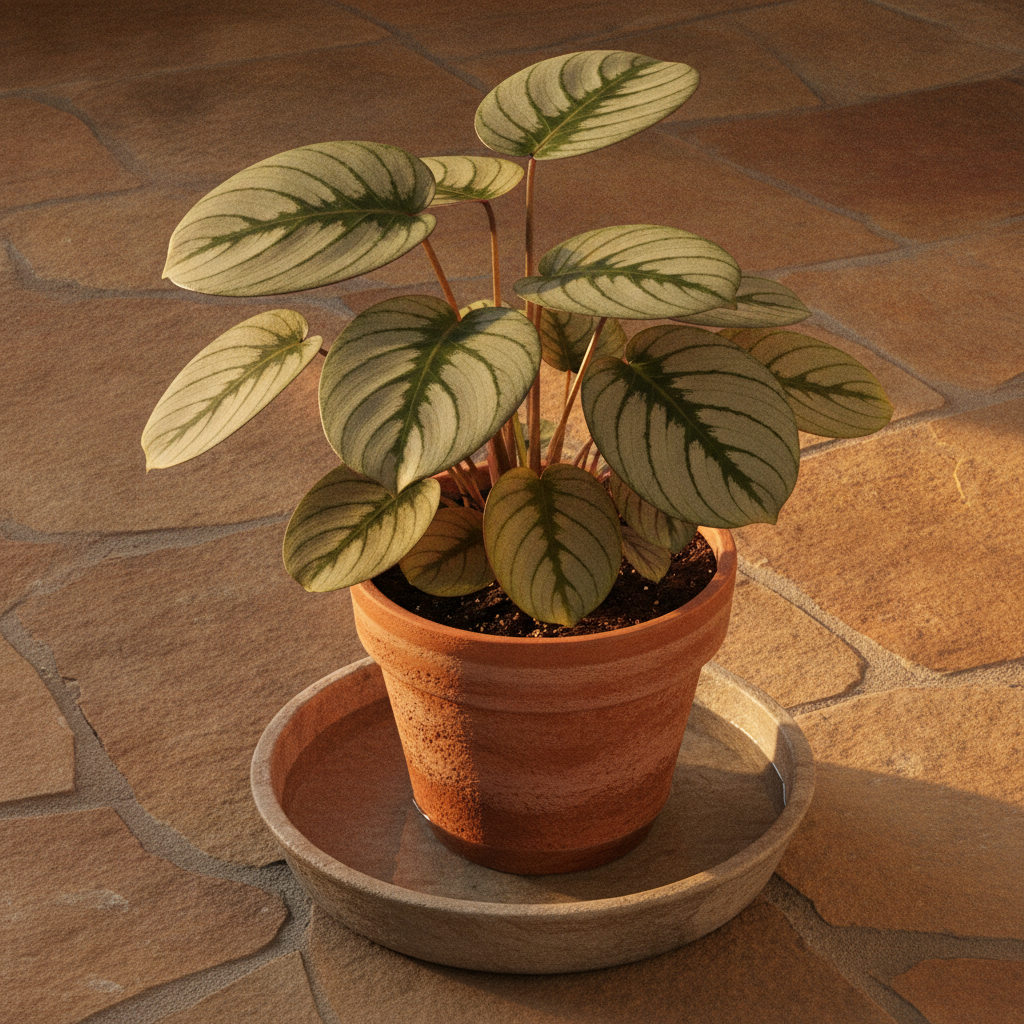
Check the plant every few days by pushing a finger into the mix. When the top 2 to 3 cm (about 1 in) feels barely dry to the touch, it is time to water. You should not let the mix dry out further than this, and you should certainly not let it stay wet enough to feel muddy. In a warm, bright spot during the growing season this often means watering once or twice a week; in the cooler, darker months it may drop to once every week or ten days.
Conditions matter more than the calendar. A plant in a small terracotta pot in a warm room dries far faster than one in a large plastic pot in a cool one, so always let the mix, not a fixed schedule, tell you when to water. The goal is consistency: the same gentle moisture, topped up before it disappears, week after week.
Pro Tip — Use Tepid Water: Cold water straight from the tap can shock the roots of this tropical plant. Let water come to room temperature before using it, and your plant will respond with steadier growth and fewer sulking, curled leaves.
How to Water Correctly
- Check that the top few centimetres of mix are barely dry before you begin.
- Use room-temperature filtered water, rainwater or distilled water rather than hard tap water.
- Water slowly and evenly across the surface, or stand the pot in a tray of water to soak from below for 15 to 20 minutes.
- Let the excess drain away completely through the drainage holes.
- Empty the saucer or cache pot so the plant never stands in standing water.
- Return the plant to its spot and give the pot a quarter turn for even growth.
Signs of Overwatering vs. Underwatering
| Symptom | Overwatering | Underwatering |
|---|---|---|
| Leaf colour | Yellowing, often starting with lower leaves | Edges and tips browning and crisping |
| Leaf texture | Soft, limp, sometimes translucent | Curled, dry and papery |
| Soil | Stays wet for days, may smell sour | Pulls away from the pot edge, very dry |
| Roots | Brown, mushy, foul-smelling | Dry and brittle, but usually still firm |
| Stem base | Soft and darkened at soil level | Firm but the whole plant droops |
Warning — Root Rot: Soggy mix that never dries is the fastest way to kill Cathedral Windows. If you find soft, brown, smelly roots, remove the plant, cut away all affected roots with sterile scissors, and repot into fresh, airy mix in a clean pot. Catching it early is the difference between recovery and loss.
Humidity Requirements
If watering is where the plant is won or lost, humidity is where it is made beautiful. Cathedral Windows evolved in the humid air of the rainforest floor and expects relative humidity of 60 percent or more. Average indoor air, especially in heated or air-conditioned rooms, often sits between 30 and 40 percent, which is far drier than the plant likes and the most common cause of the crispy brown leaf edges that give Calatheas their fussy reputation.
The clearest symptom of low humidity is browning along the leaf margins and tips, sometimes with the leaves curling inward to reduce water loss. Because the leaves are so thin, this plant shows humidity stress sooner than most. Once a leaf edge has browned it will not turn green again, though it can be trimmed for tidiness, so the aim is to raise humidity before the damage appears.
The most reliable way to raise humidity is a small room humidifier running near the plant, which holds the air steadily moist without wetting the foliage. Grouping plants together also lifts local humidity, as does standing the pot on a wide tray of pebbles topped up with water, keeping the pot base above the waterline. Misting is often suggested but offers only brief relief and, if the leaves stay wet into the cool evening, can encourage fungal spotting, so treat it as a minor supplement at most.
Water Quality
Cathedral Windows is genuinely sensitive to the minerals, fluoride and chlorine found in much tap water, which accumulate in the leaf tissue and show up as browning along the edges. This is one fussy reputation the plant has earned. Wherever possible, water with rainwater, distilled water or filtered water. If only tap water is available, leaving it to stand uncovered overnight allows some chlorine to dissipate, though it does nothing for fluoride or dissolved salts. Many growers find that simply switching to rainwater eliminates leaf-edge browning that no amount of humidity tweaking had solved.
Soil, Potting & Repotting
The right growing medium for Cathedral Windows resolves the apparent contradiction at the heart of its watering needs: it must hold moisture so the roots never dry out, yet drain freely enough that they never sit in water. A light, airy, moisture-retentive mix achieves both, and getting it right makes the consistent watering the plant demands far easier to deliver.
Ideal Soil Composition
A good base is a peat-free mix built around coco coir or a quality houseplant compost, opened up with perlite for drainage and aeration and enriched with a little organic matter to hold moisture and nutrients. The texture you are aiming for is fluffy and spongy rather than dense and heavy, so that water moves through quickly while the medium stays evenly damp.
| Component | Proportion | Function |
|---|---|---|
| Coco coir or peat-free houseplant compost | 50 percent | Holds moisture evenly and forms the body of the mix |
| Perlite or pumice | 30 percent | Creates drainage and keeps air around the roots |
| Fine orchid bark | 10 percent | Adds structure and prevents compaction |
| Worm castings or leaf mould | 10 percent | Supplies gentle, slow-release nutrition |
Cathedral Windows prefers a slightly acidic to neutral pH, broadly in the range of 6.0 to 6.5. A coir-based mix naturally falls close to this, so as long as you avoid heavy, alkaline garden soil the pH usually takes care of itself.
Pro Tip — Quick Mix Recipe: For a fast, reliable blend, combine two parts peat-free houseplant compost, one part perlite and a generous handful of fine orchid bark. It drains freely yet stays evenly moist, which is exactly what this plant asks for.
Choosing the Right Pot
The pot is part of the watering system, not just a container. Its material, drainage and size all influence how quickly the mix dries and therefore how easy it is to keep the moisture even.
Drainage holes are non-negotiable. Whatever pot you choose, it must have holes in the base. Cathedral Windows will not tolerate sitting in trapped water, and a decorative pot without drainage is the surest route to root rot. If you love a cache pot, keep the plant in a plastic nursery pot inside it and lift it out to water.
Pot material: Plastic and glazed ceramic both retain moisture well and suit this plant, helping the mix stay damp between waterings. Unglazed terracotta breathes and dries quickly, which can be useful if you tend to overwater but means you will need to water more often to keep up with the plant’s demand for steady moisture.
Pot size: Choose a pot only 2 to 4 cm (1 to 2 in) wider than the current root ball. An oversized pot holds a large volume of wet mix that the roots cannot use quickly, and that lingering moisture invites rot. Cathedral Windows is also happiest with its roots a little snug.
When to Repot
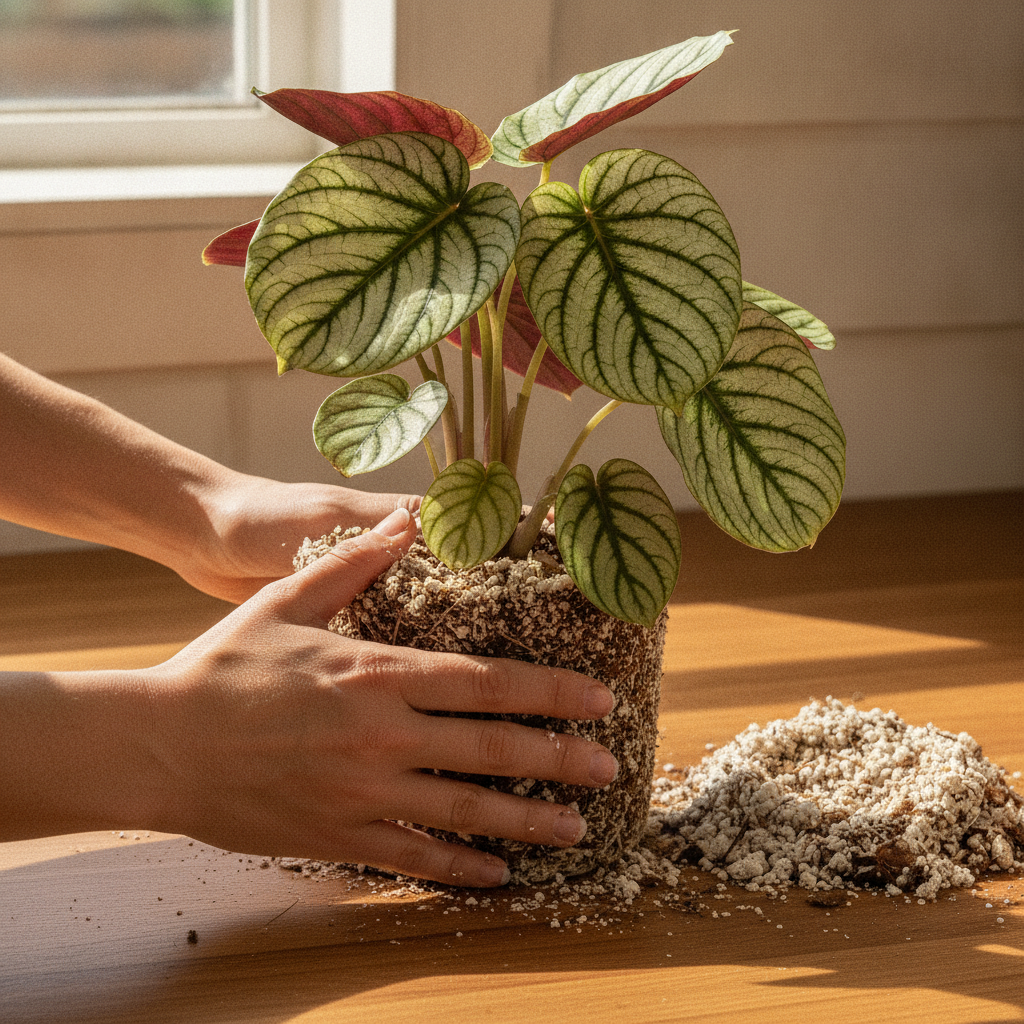
This is a slow to moderate grower that rarely needs frequent repotting, typically only once every one to two years. Repot when roots begin to circle the base or emerge from the drainage holes, when the plant dries out unusually fast because roots have displaced the mix, or simply to refresh tired soil. The best time is spring or early summer, at the start of active growth, which lets the plant recover quickly. Repotting also offers the ideal moment to divide the plant, covered in the propagation section below.
How to Repot: Step-by-Step
- Water the plant a day beforehand so the root ball is hydrated and holds together.
- Gently ease the plant from its pot, supporting the base of the stems rather than pulling on the leaves.
- Tease away the old, loose mix from around the roots and inspect them, trimming any that are brown or mushy.
- Add a layer of fresh mix to the base of a clean pot only slightly larger than the last.
- Position the plant at the same depth it grew before, then fill around it with fresh mix, firming gently to remove air pockets.
- Water thoroughly with room-temperature filtered water and let it drain completely.
- Return the plant to a warm, bright but indirect spot and hold off feeding for a month while it settles.
Warning — Transplant Shock: Cathedral Windows can sulk for a week or two after repotting, drooping or curling its leaves. Resist the urge to fix it with extra water or feed. Keep conditions stable, warm and humid, and it will recover on its own as new roots establish.
Fertilising
Cathedral Windows is a light feeder, and a restrained hand with fertiliser serves it far better than enthusiasm. Coming from nutrient-modest rainforest soils, it grows steadily on small, regular amounts of nutrition through the growing season and is easily harmed by excess.
The plant’s sensitivity to mineral build-up, the same sensitivity that makes water quality matter, also applies to fertiliser salts. Over-feeding shows up quickly as browned, burnt leaf edges that look much like the damage from hard water or low humidity, so when in doubt, feed less.
Understanding Plant Nutrients
Most fertilisers are labelled with an N-P-K ratio, the percentages of nitrogen, phosphorus and potassium they contain. For a foliage plant like Cathedral Windows, a balanced ratio that supplies steady nitrogen for leaf growth, alongside the other essential nutrients, is ideal. The table below outlines what each major nutrient does and how a shortage shows itself.
| Nutrient | Symbol | Primary Function | Deficiency Symptoms |
|---|---|---|---|
| Nitrogen | N | Drives leaf and stem growth and green colour | Pale, yellowing older leaves and slow growth |
| Phosphorus | P | Supports root development and energy transfer | Stunted growth, dull or purplish foliage |
| Potassium | K | Regulates water use and overall vigour | Yellow or brown leaf margins |
| Calcium | Ca | Builds cell walls and new growth | Distorted, hooked or weak new leaves |
| Magnesium | Mg | Central to chlorophyll and photosynthesis | Yellowing between the veins of older leaves |
| Iron | Fe | Needed for chlorophyll production | Yellowing between the veins of new leaves |
Types of Fertiliser
Liquid fertilisers: The easiest type to control for this plant. Diluted well below the recommended strength and applied during normal watering, they let you feed little and often and stop instantly if you see any sign of stress. This is the recommended approach for Cathedral Windows.
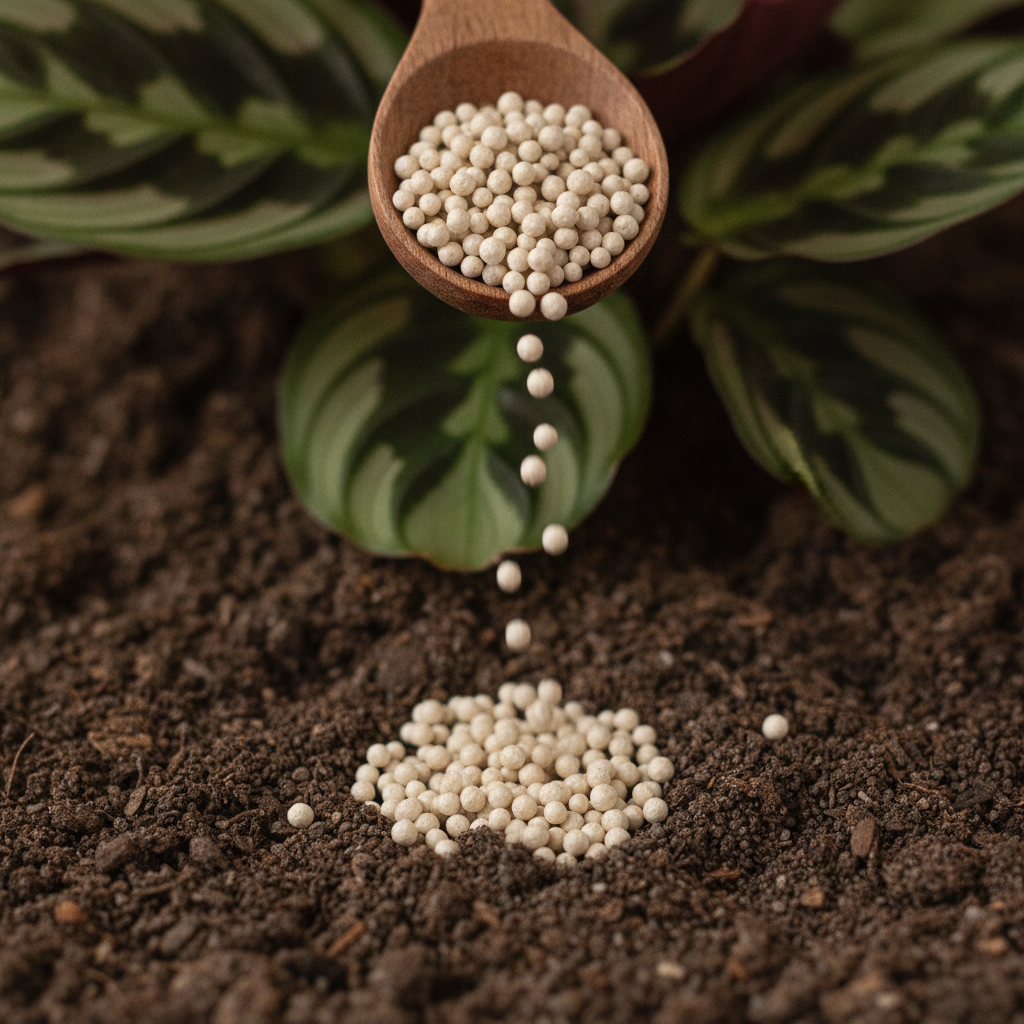
Slow-release granular: Convenient prills that release nutrients gradually over months. They work, but they give you less moment-to-moment control over dosage, which matters for a salt-sensitive plant, so use them sparingly and at the lower end of the recommended rate.
Organic fertilisers: Worm castings, diluted seaweed extract and similar gentle organic feeds suit Cathedral Windows well. They release nutrients slowly and are far less likely to scorch the roots, making them a forgiving choice.
Feeding Schedule
Feed only during the active growing season, from spring through to the end of summer, roughly once a month with a balanced liquid feed diluted to a quarter or half of its recommended strength. Stop feeding entirely in autumn and winter, when growth naturally slows and unused fertiliser simply accumulates as harmful salts in the mix. A plant that is resting does not need to be fed.
Pro Tip — Dilute and Halve: Whatever the bottle recommends, mix it at half that strength or less for Cathedral Windows. This plant thrives on a light touch, and a weaker, more frequent feed is always safer than a strong one.
How to Fertilise
- Make sure the mix is already lightly moist, never apply feed to bone-dry soil.
- Dilute a balanced liquid fertiliser to a quarter or half strength in room-temperature water.
- Water the plant with the solution, letting it run evenly through the mix.
- Allow the excess to drain fully and empty the saucer.
- Every couple of months, flush the pot with plain water to wash out any accumulated salts.
Warning — Salt Build-Up: A white crust on the soil surface or pot rim, together with browning leaf edges, signals a build-up of fertiliser salts. Flush the pot thoroughly with plain water, letting it drain several times, and ease off feeding until the plant recovers.
Propagation
Propagating Cathedral Windows is straightforward in method but limited in technique. Unlike vining houseplants, it cannot be grown from leaf or stem cuttings, because it has no trailing stems with nodes to root. Instead it grows as a clump from an underground rhizome, and the only reliable way to make more plants is to divide that clump.
This single method is dependable and rewarding, producing fully formed new plants rather than fragile cuttings. The best time to do it is in spring or early summer, ideally combined with a scheduled repotting so the plant only has to recover from disturbance once.
Understanding the Rhizome and Clump
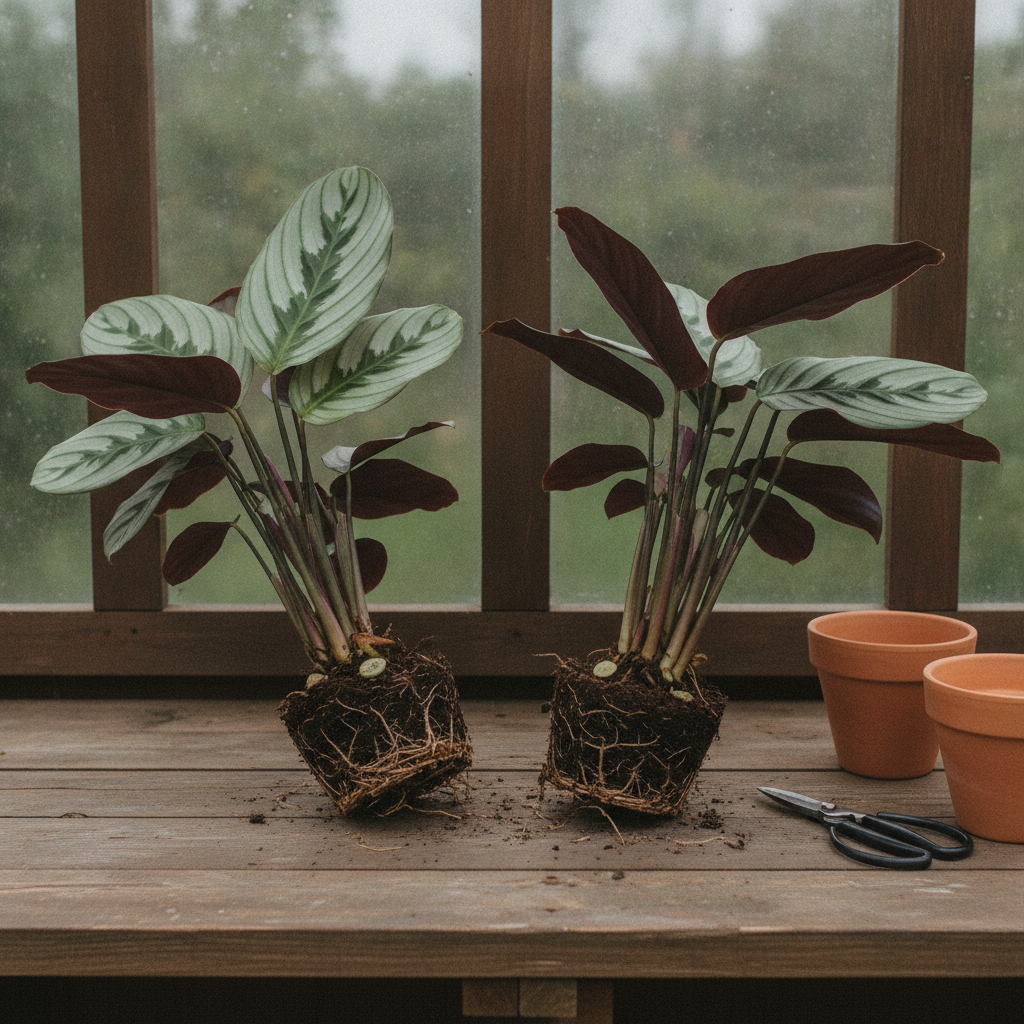
Cathedral Windows spreads by sending up new leaf stems from a branching underground rhizome, gradually forming a dense clump of growth points, each with its own roots. Because every mature growth point is effectively a small plant in waiting, you can separate the clump into sections that will each continue growing independently. The key to success is making sure every division keeps both a healthy share of roots and at least a few leaves.
Division at Repotting: Step-by-Step
This is the primary and most reliable method. Use it on a mature, well-established plant that has formed a full clump, and your single specimen becomes two or three.
- Water the plant a day ahead so the roots are hydrated and the mix holds together.
- Remove the plant from its pot and gently brush away enough mix to see the roots and the natural clumps of stems.
- Identify sections where the clump separates naturally, each with several leaves and a good portion of roots attached.
- Ease the sections apart by hand where you can, using a clean, sharp knife only to cut through tough rhizome where needed.
- Pot each division into its own appropriately sized pot of fresh, airy mix at its original depth.
- Water in thoroughly with room-temperature filtered water and let the pots drain.
- Place the divisions somewhere warm, bright and humid, and keep them out of direct sun while they re-establish.
Pro Tip — Higher Humidity After Division: Fresh divisions lose water faster than they can take it up while their roots recover. Raising the humidity around them, with a humidifier or a loose clear cover for the first week or two, dramatically improves the success rate.
Aftercare: Step-by-Step
The weeks after division decide whether the new plants establish smoothly, so treat them gently while their roots settle in.
- Keep the mix lightly and evenly moist, but never soggy, while new roots form.
- Maintain warmth of around 20 to 24 degrees C (68 to 75 degrees F) and steady high humidity.
- Provide bright, indirect light only, as direct sun will stress the recovering plants.
- Do not fertilise for at least a month, until you see signs of fresh growth.
- Expect some drooping at first and be patient; new leaves are the signal that the division has taken.
Troubleshooting Propagation
| Problem | Likely Cause | Solution |
|---|---|---|
| Division wilts badly and does not recover | Too few roots kept, or air too dry | Raise humidity, keep warm, and divide into larger sections next time |
| Leaves brown and crisp after potting | Low humidity or hard water shock | Increase humidity and water only with filtered or rainwater |
| No new growth for many weeks | Cool temperatures or root disturbance | Move somewhere warmer and be patient; growth resumes in warmth |
| Division rots at the base | Mix kept too wet during recovery | Use an airy mix, water more lightly, and ensure free drainage |
Pests & Diseases
A well-cared-for Cathedral Windows is reasonably resilient, but the same conditions that keep it beautiful also influence its vulnerability to trouble. Dry air, the plant’s chief enemy, is also what most invites its commonest pest, while overwatering opens the door to its commonest diseases. Good culture is therefore the first line of defence.
Inspect your plant regularly, paying particular attention to the undersides of the leaves and the leaf joints, where pests like to hide. Catching an infestation early, when it is a handful of insects rather than a colony, makes treatment far simpler and protects both this plant and its neighbours.

Common Pests
Spider Mites (Tetranychus urticae)
By far the most likely pest on Cathedral Windows, and a direct consequence of dry air. These tiny mites cluster on the leaf undersides, causing fine yellow stippling and, in heavy infestations, delicate webbing in the leaf joints. Because they thrive precisely when humidity is low, the plant’s natural stress condition doubles as an open invitation.
Treatment: Rinse the foliage thoroughly, including the undersides, then treat with insecticidal soap or neem oil every five to seven days until clear. Crucially, raise the humidity, as the higher moisture that suits the plant also discourages the mites from returning.
Thrips (Thrips tabaci)
Slender, fast-moving insects that rasp at the leaf surface, leaving silvery, stippled patches and tiny dark specks of excrement. On a patterned plant their damage can be hard to spot at first, so look for a dulling or silvering of the normally crisp markings.
Treatment: Isolate the plant, remove the worst-affected leaves, and treat with neem oil or insecticidal soap at weekly intervals. Yellow sticky traps help catch the adults and monitor whether the problem is subsiding.
Fungus Gnats (Bradysia species)
Small black flies that hover around the pot, drawn to the consistently moist mix this plant requires. The adults are merely a nuisance, but their larvae feed on organic matter and tender roots in the soil, which can set back a young or recovering plant.
Treatment: Let the very top layer of mix dry slightly between waterings to break their breeding cycle, use yellow sticky traps for the adults, and treat the soil with a beneficial nematode or bacterial larvicide if numbers persist.
Mealybugs (Pseudococcus species)
Small, soft insects coated in a white, cottony wax, usually found tucked into leaf joints and along the stems. They suck sap and excrete sticky honeydew, weakening the plant and encouraging sooty mould.
Treatment: Dab each insect directly with a cotton bud dipped in isopropyl alcohol, then follow up with neem oil or insecticidal soap. Check regularly for several weeks, as their waxy coating protects egg clusters from a single treatment.
Common Diseases
Root Rot (Pythium and Phytophthora species)
The most serious threat to Cathedral Windows, caused by waterlogged mix that suffocates the roots and lets soil-borne pathogens take hold. Signs include yellowing, wilting leaves despite wet soil, a soft stem base and dark, mushy, foul-smelling roots.
Treatment: Act quickly. Unpot the plant, cut away all rotten roots with sterile scissors, and repot into fresh, airy mix in a clean pot with good drainage. Then correct the watering routine that caused it, as recovery depends on the roots being able to dry appropriately between waterings.
Leaf Spot (Helminthosporium and bacterial pathogens)
Brown or dark spots, often ringed with a yellow halo, that appear on the foliage when leaves stay wet for too long, particularly in cool, still air. It spreads through water splash and contact between leaves.
Treatment: Remove affected leaves with sterile scissors, avoid wetting the foliage when watering, and improve air circulation around the plant. For persistent cases a copper-based fungicide can help bring it under control.
Powdery Mildew (Erysiphe species)
A white, powdery coating on the leaf surface, favoured by high humidity combined with poor air movement. While Cathedral Windows loves humidity, stagnant damp air around crowded plants can tip the balance toward mildew.
Treatment: Improve airflow, space plants further apart, and treat affected foliage with a suitable fungicide or a dilute potassium bicarbonate spray until the coating clears.
Pest and Disease Summary
| Pest / Disease | Identification | Treatment |
|---|---|---|
| Spider mites | Yellow stippling and fine webbing on leaf undersides | Rinse, neem or insecticidal soap, raise humidity |
| Thrips | Silvery patches and tiny dark specks on leaves | Isolate, remove leaves, neem and sticky traps |
| Fungus gnats | Small black flies around moist soil | Dry the top layer, sticky traps, soil larvicide |
| Mealybugs | White cottony clusters in leaf joints | Alcohol on a cotton bud, then neem oil |
| Root rot | Yellowing, wilting, mushy dark roots | Trim rot, repot in fresh mix, correct watering |
| Leaf spot | Brown spots with yellow halos | Remove leaves, keep foliage dry, improve airflow |
| Powdery mildew | White powdery coating on leaves | Improve airflow, fungicide or bicarbonate spray |
Prevention Strategies
The best defence is consistent good culture. A plant kept at the right humidity, watered with clean water on a steady schedule and given bright indirect light is far less attractive to pests and far less prone to disease than a stressed one. Because spider mites in particular exploit dry air, maintaining humidity does double duty, keeping the plant looking its best while denying its chief pest a foothold.
Quarantine every new plant for a couple of weeks before letting it join your collection, and check your Cathedral Windows whenever you water. Wiping the leaves occasionally with a soft damp cloth both removes dust that blocks light and gives you a regular, close look at the leaf surfaces where problems first appear.
Pro Tip — Neem as Routine Defence: A monthly preventative spray of dilute neem oil on the leaf undersides, applied in the evening out of direct light, deters spider mites and thrips before they establish. Always test on one leaf first and never apply it to a plant in strong sun.
Popular Varieties
Cathedral Windows is a single species, Goeppertia makoyana, rather than a group of cultivars, so its leaf pattern is fairly consistent from plant to plant. Where it gets interesting is in its wider family. The prayer plants now grouped under Goeppertia, and still widely sold as Calatheas, include a remarkable range of patterned foliage, and several close relatives are commonly compared with and grown alongside Cathedral Windows.
The relatives below share the same fundamental care, bright indirect light, steady moisture, high humidity and clean water, so if you can grow one you can grow them all. They differ mainly in the colour and structure of their markings, which makes them natural companions for building a collection with a coherent look but plenty of variety.
| Variety | Leaf Appearance | Light Needs | Growth Rate | Availability |
|---|---|---|---|---|
| Cathedral Windows (G. makoyana) | Translucent feathered green on pale ground, purple back | Bright indirect | Slow to moderate | Common |
| Network Calathea (G. musaica) | Fine mosaic grid of pale and dark green | Bright indirect | Moderate | Increasingly common |
| Rose Painted Calathea (G. roseopicta) | Pink-to-cream feathering around the midrib | Bright indirect | Moderate | Common |
| Pinstripe Calathea (G. ornata) | Dark leaves with fine pink pinstripes | Bright indirect | Moderate | Common |
| Rattlesnake Plant (G. insignis) | Wavy leaves with alternating dark blotches | Bright indirect | Moderate to fast | Common |
| Medallion Calathea (G. veitchiana) | Bold concentric patterning, deep purple back | Bright indirect | Moderate | Common |
Featured Varieties
Network Calathea
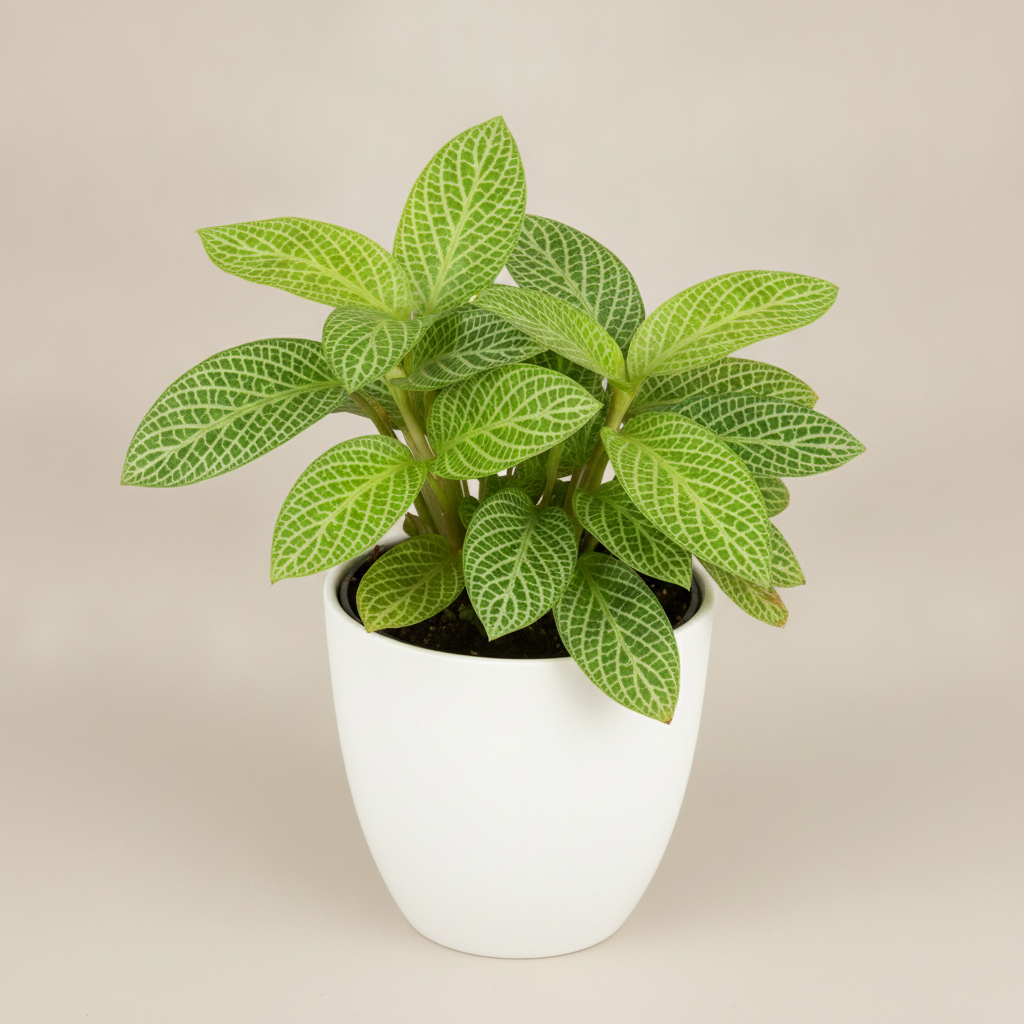
Perhaps the most extraordinary patterning in the whole group, the Network Calathea covers its glossy bright-green leaves with an impossibly fine mosaic of pale and dark green lines, like delicate stained-glass tracery. It is a natural counterpoint to the bolder feathering of Cathedral Windows.
Rose Painted Calathea
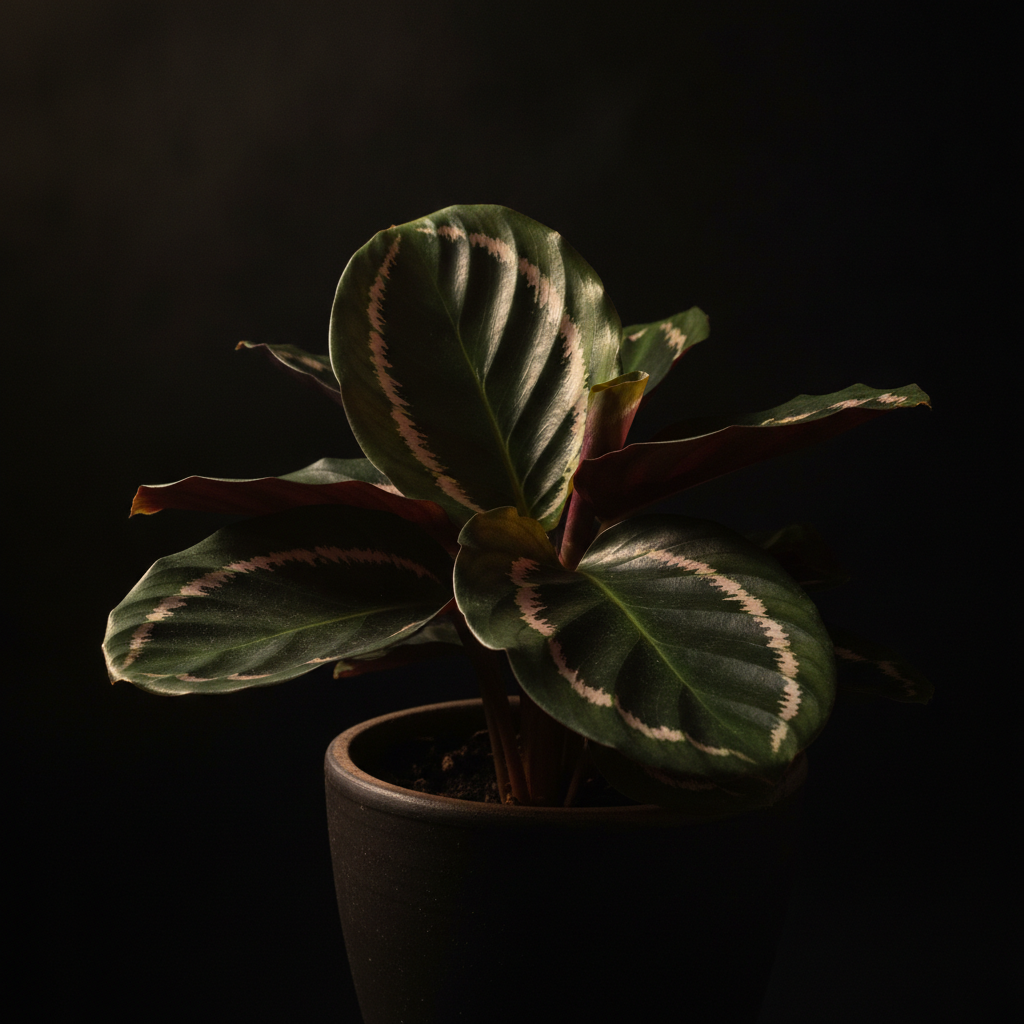
Where Cathedral Windows works in greens, the Rose Painted Calathea brings colour. Its rounded deep-green leaves are brushed with a soft, feathered pink-to-cream halo around the midrib, and the undersides flush deep burgundy, giving the whole plant a warm, painterly glow.
Variety Profiles in Detail
Network Calathea (Goeppertia musaica)
Once sold as Calathea musaica and often labelled ‘Network’, this species has become hugely popular for its unique tessellated patterning, which looks almost digital up close. It tends to be a little more forgiving of average humidity than some relatives, though it still rewards the same attentive care, and its compact, upright habit suits a shelf or desk where the fine detail can be appreciated at close range.
Rose Painted Calathea (Goeppertia roseopicta)
A species with many named selections, including the popular ‘Medallion’ and ‘Dottie’, all sharing the same broad rounded leaves and feathered central halo in shades from pink to cream. It is among the showier prayer plants and one of the most widely available, making it an easy and rewarding step up for anyone who has succeeded with Cathedral Windows.
Choosing the Right Variety for Your Space
Because every plant in this group wants the same conditions, the choice comes down to looks and to honesty about your environment. If your home runs dry, start with Cathedral Windows or the slightly tougher Network Calathea and invest in a humidifier before adding the more demanding, colourful types. If you can already provide steady humidity and clean water, the whole palette is open to you, and a grouping of two or three different Goeppertia makes a striking, cohesive display that also raises the local humidity they all enjoy. Match the plant to the light you have, bright but indirect, rather than trying to bend your conditions to the plant, and any of them will thrive.
Frequently Asked Questions
Why are the edges of my Cathedral Windows leaves turning brown and crispy?
This is the most common complaint with the plant and almost always points to one of three causes: low humidity, hard or chemically treated tap water, or a build-up of fertiliser salts. Raise the humidity to 60 percent or more, switch to filtered or rainwater, and ease off feeding. The existing brown edges will not turn green again, but new growth should emerge clean once the underlying cause is fixed.
Why do the leaves fold up at night?
This is natural and healthy behaviour called nyctinasty, shared by the whole prayer plant family. A swollen joint at the base of each leaf stem raises the leaves toward vertical each evening and lowers them again by morning. It is a sign of a happy plant responding to the daily light cycle, not a problem to fix.
Is Cathedral Windows safe for cats and dogs?
Yes. Goeppertia makoyana is non-toxic to cats, dogs and humans, which is one of its great advantages over many statement foliage plants. As with any plant, eating large amounts may cause mild stomach upset, so it is still best to discourage nibbling, but there is no risk of serious poisoning.
Why are the leaves curling?
Curling leaves usually mean the plant is too dry, either at the roots or in the air. Check whether the mix has dried out too far and whether humidity has dropped, particularly near radiators or air conditioning. Curling can also follow a watering with cold or hard water. Restore even moisture, raise humidity and use room-temperature filtered water, and the leaves should relax.
How often should I water Cathedral Windows?
There is no fixed schedule, because it depends on warmth, light and pot type, but most plants need watering once or twice a week in the growing season and less in winter. The reliable guide is the mix itself: water when the top 2 to 3 cm (about 1 in) is barely dry, keeping it lightly and evenly moist without ever letting it become soggy or bone dry.
Can I propagate Cathedral Windows from a leaf or stem cutting?
No. Unlike vining plants, Cathedral Windows has no stem nodes that will root, so leaf and stem cuttings will not work. The only reliable method is division, separating an established clump into sections that each have their own roots and leaves, ideally done in spring when you repot.
Why is my Cathedral Windows losing its pattern or colour?
Faded patterning is almost always a light problem. Too little light produces weak, greyish markings on new leaves, while too much, especially direct sun, bleaches the leaf and flattens the contrast. Move the plant into bright but indirect light, and new growth should return to its full, striking pattern.
Should I mist my Cathedral Windows?
Misting is a popular suggestion but a weak solution. It raises humidity only briefly, and leaves left wet into a cool evening can develop fungal leaf spot. A room humidifier, a pebble tray or grouping plants together all provide the steady humidity this plant needs far more effectively than misting does.
Why is my plant drooping?
Some drooping is normal at night as part of the daily leaf movement, but persistent daytime drooping signals a watering issue. It can mean the mix is too dry and needs water, or, less obviously, that it is waterlogged and the roots are struggling. Check the soil moisture and the roots before acting, then correct the watering accordingly. Recent repotting or division can also cause temporary drooping that resolves on its own.
What temperature does Cathedral Windows need?
It is happiest between 18 and 24 degrees C (65 to 75 degrees F), comfortable ordinary room temperatures. Keep it away from anything below about 15 degrees C (59 degrees F), and protect it from cold draughts, sudden temperature swings and the dry blast of heating vents or air conditioning, all of which stress this tropical plant.






