
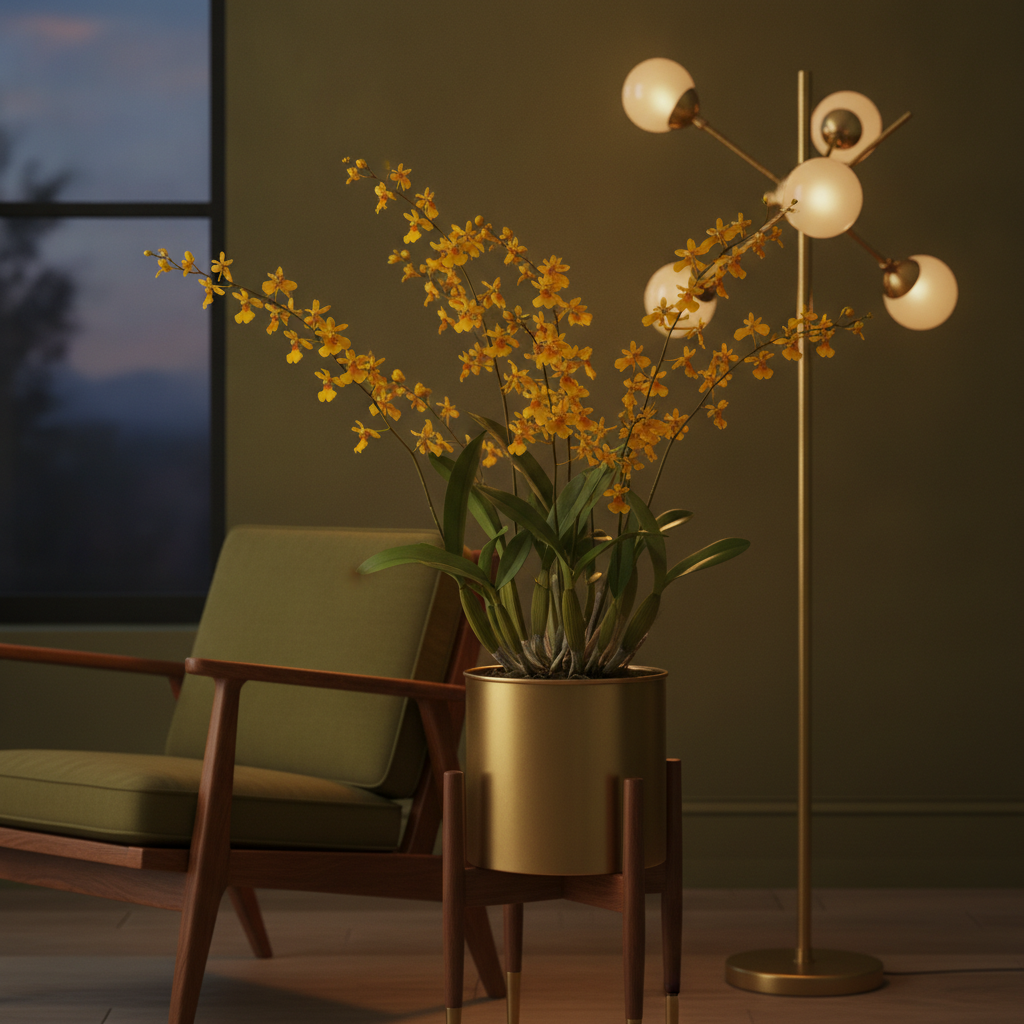
Few houseplants put on a show quite like the dancing lady orchid. When an established plant comes into bloom it lifts a branching spray well above its foliage and opens dozens, sometimes hundreds, of small golden flowers, each with a broad ruffled lip that catches the slightest draught and trembles like a dancer in a flouncing skirt. The botanical name is Oncidium sphacelatum, and it belongs to one of the largest and most rewarding genera in the orchid family, native to the seasonally dry forests of Mexico and Central America, where it clings to tree branches and rocky outcrops rather than rooting in the ground.
That epiphytic, tree-dwelling habit is the single most useful thing to understand about this plant, because it explains almost every care decision you will make. Despite a reputation that lumps all orchids together as fussy and short-lived, the dancing lady is genuinely one of the more tolerant orchids for a home windowsill. The gap between merely keeping one alive and coaxing it into that spectacular annual bloom comes down to a handful of habits around light, watering rhythm and feeding. This guide walks through each of them in turn, so you can move your plant from surviving to thriving.
Contents
- Quick Reference
- Why the Dancing Lady Orchid Makes a Rewarding Houseplant
- Light Requirements
- Watering & Humidity
- Potting Medium & Repotting
- Fertilising
- Propagation
- Pests & Diseases
- Popular Varieties
- Frequently Asked Questions
Quick Reference: Dancing Lady Orchid at a Glance
| Light | Bright indirect light with one to two hours of gentle direct sun; an east or lightly shaded south window is ideal |
| Watering | Drench thoroughly, then let the bark approach dryness before watering again, roughly every 5 to 9 days indoors |
| Temperature | 18 to 29 degrees C (64 to 84 degrees F) by day, with a useful night drop to 13 to 18 degrees C (55 to 64 degrees F) |
| Humidity | 40 to 70 per cent; happiest above 50 per cent |
| Fertiliser | Balanced orchid feed at quarter to half strength, weekly in growth, the “weakly, weekly” approach |
| Toxicity | Generally considered non-toxic to cats and dogs, though not a food plant and best kept out of reach |
Why the Dancing Lady Orchid Makes a Rewarding Houseplant
The appeal starts with the flowers, but it does not end there. A mature Oncidium sphacelatum can carry a flowering spike a metre (around 3 feet) long, arching outward and branching into a cascade of bloom that lasts four to six weeks, and often longer in cool, stable conditions. The individual flowers are small, typically 2 to 3 centimetres (around 1 inch) across, but they come in such numbers that the overall effect is of a golden cloud hovering over the plant. Many forms carry a soft, sweet fragrance that is strongest in the morning sun.
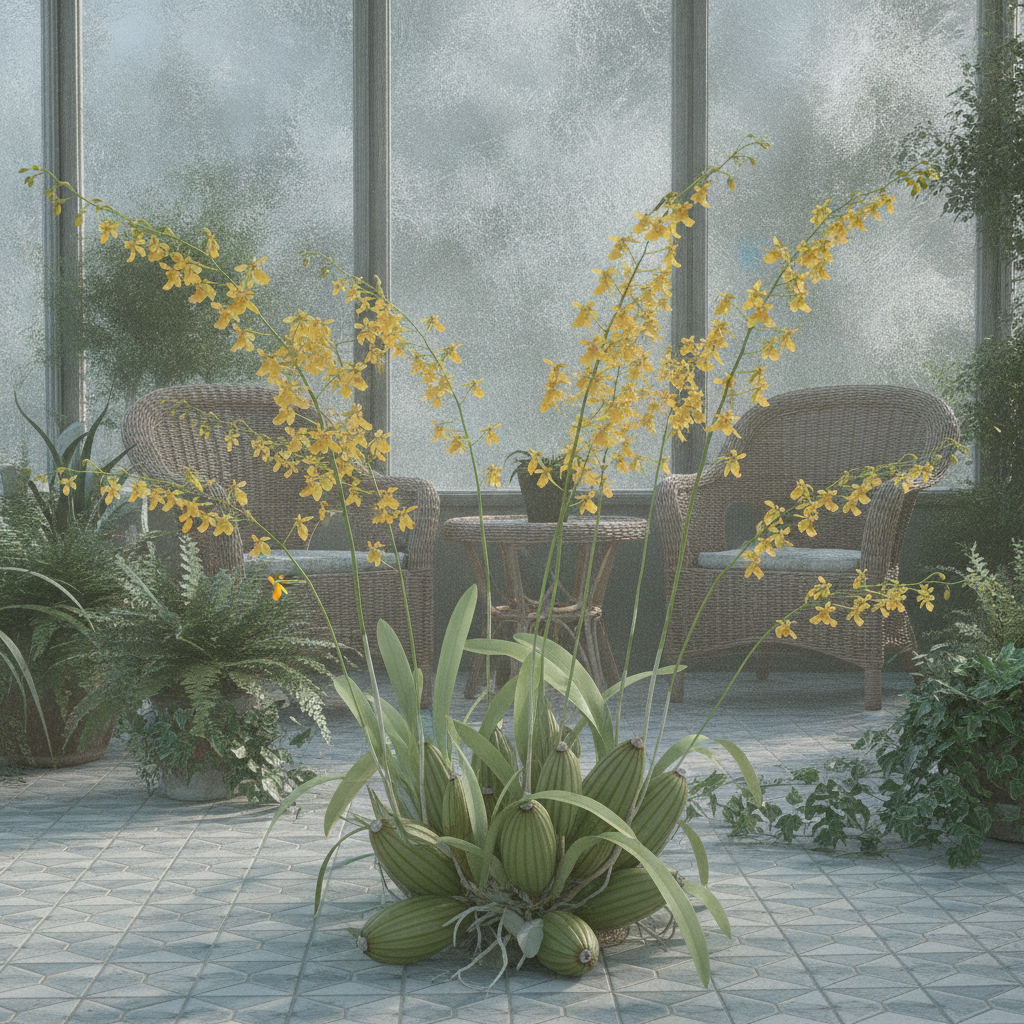
Beyond the spectacle, this is a forgiving plant by orchid standards. It stores water and energy in plump green pseudobulbs at its base, which means it shrugs off the occasional missed watering far better than a thin-leaved plant would. It does not demand the high, constant humidity of a jungle terrarium, and it adapts to ordinary household temperatures. Give it a bright spot, a free-draining medium and a sensible watering rhythm, and it will reward you year after year, slowly building into a larger clump that produces more spikes with each passing season. That combination of drama and resilience is exactly why the dancing lady has become a gateway orchid for so many growers.
Important — Toxicity: The dancing lady orchid is generally regarded as non-toxic to cats, dogs and people, and it does not appear on the ASPCA’s list of plants poisonous to pets. Even so, it is not edible, and chewed foliage can cause mild stomach upset in a curious pet, so place the plant where it is admired rather than nibbled.
Light Requirements
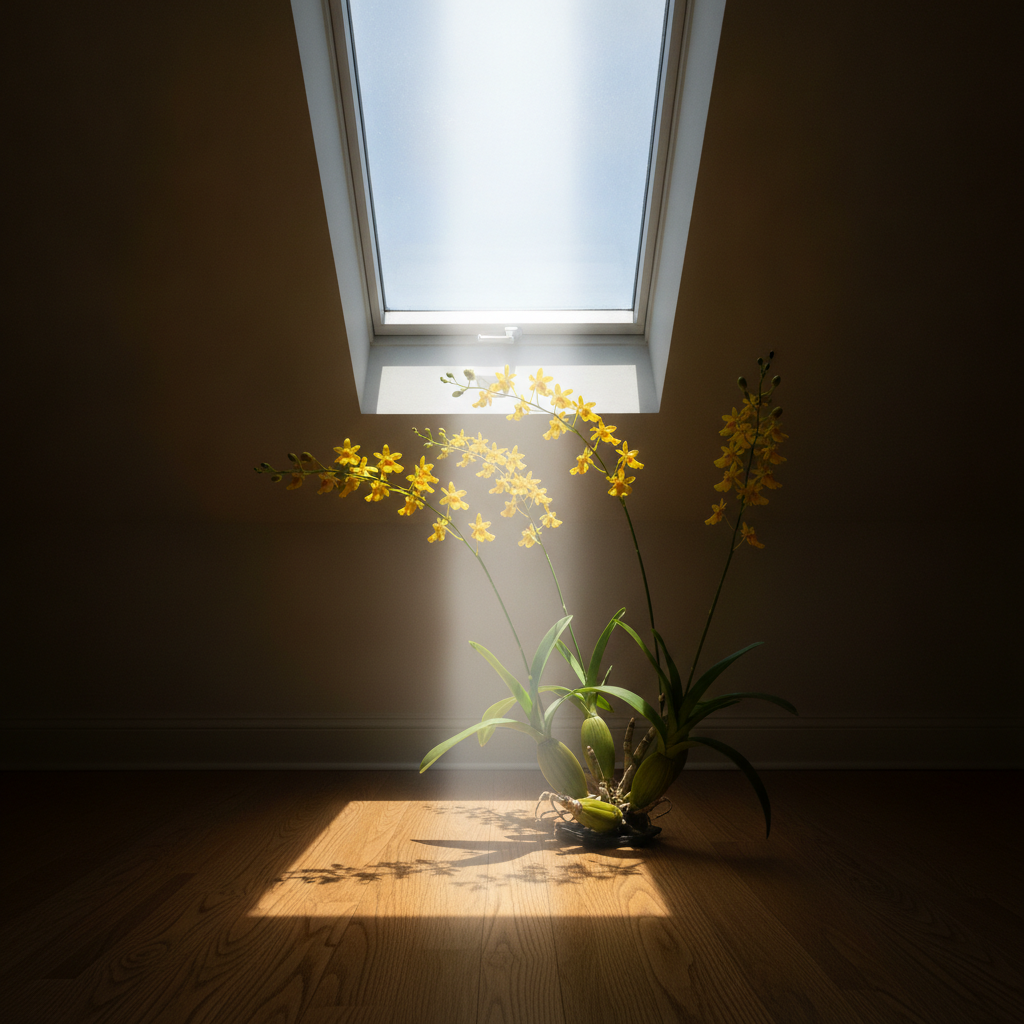
Light is the lever that controls whether your dancing lady orchid blooms or simply grows leaves. In the wild it perches in the brighter parts of the forest canopy, catching filtered sun for much of the day, so it wants noticeably more light than the moth orchids most people start with. Insufficient light is the most common reason an otherwise healthy Oncidium refuses to flower.
The ideal is bright, mostly indirect light with a gentle hour or two of direct sun at the softer ends of the day. The leaves give you a reliable readout: a plant in good light holds foliage that is a fresh mid-green, perhaps with the faintest hint of warmth, while deep, lush dark green usually signals that the plant is comfortable but underlit and unlikely to bloom. Leaves that turn yellowish or develop reddish-bronze tints are catching too much sun and need a step back.
Light Levels Explained
Orchid growers often talk in terms of foot-candles or lux. You do not need a meter to succeed, but the table below translates the categories into something you can picture, and shows where the dancing lady wants to sit within them.
| Light Category | Approx. Level | Typical Location | Outcome |
|---|---|---|---|
| Direct sun | Over 50,000 lux | Unshaded south window in summer | Too harsh; risk of leaf scorch |
| Very bright indirect | 25,000 to 40,000 lux | East window, or south behind a sheer | Ideal; strong growth and reliable bloom |
| Bright indirect | 15,000 to 25,000 lux | A metre back from a bright window | Good; healthy plant, flowering possible |
| Medium | 10,000 to 15,000 lux | North window, or deeper in a room | Survives; lush leaves, few or no flowers |
| Low | Under 10,000 lux | Interior wall, dim corner | Decline over time; not recommended |
Window Orientation and Placement
South-facing window: An excellent option in most homes, but in summer the midday sun is too strong for unprotected foliage. Diffuse it with a sheer curtain, or set the plant a short distance back from the glass so it receives brilliant light without the full force of direct rays.
East-facing window: Often the single best position. The plant catches gentle, slanting morning sun that it loves, then sits in bright indirect light for the rest of the day, with little risk of scorch.
West-facing window: Workable, and similar in total light to an east window, but the direct sun arrives in the afternoon when it is hotter and more intense. Watch for scorch and be ready to add a sheer during the height of summer.
North-facing window: Usually too dim to trigger flowering, though the plant will survive and grow. If a north window is your only option, supplementing with a grow light is the surest route to bloom.
Pro Tip — The Shadow Test: Hold your hand a few centimetres above the leaves at midday. A soft, fuzzy-edged shadow means bright indirect light, which is close to ideal. A hard, sharply defined shadow means direct sun strong enough to risk burning the foliage, while no real shadow at all means the spot is too dark for good flowering.
How Light Affects Flowering
Unlike variegated foliage plants, where light governs leaf colour, the dancing lady’s relationship with light is all about energy for bloom. Each mature pseudobulb represents a season’s stored resources, and only a well-lit plant accumulates enough to push out a strong, well-branched flower spike. A plant kept too dark will keep making new growths that are progressively weaker, never quite mustering the strength to flower. If your orchid grows happily but never blooms, the first thing to change is almost always the amount of light it receives, not the feed or the watering.
Warning — Direct Sunlight: Acclimatise the plant gradually whenever you increase its light. Moving a shade-grown orchid straight into strong direct sun can scorch the leaves within a single afternoon, leaving permanent bleached or blackened patches. Increase exposure over two to three weeks so the foliage can adapt.
Artificial Lighting
The dancing lady responds well to grow lights, which makes it a viable bloomer even in rooms with poor natural light. A full-spectrum LED positioned 20 to 30 centimetres (8 to 12 inches) above the plant, running for 12 to 14 hours a day, supplies the intensity this orchid needs. Because it wants high light, err towards a more powerful fixture than you would use for a foliage plant, and keep the daily cycle consistent with a timer so the plant experiences a steady rhythm.
Seasonal Adjustments
Light shifts dramatically through the year, and the dancing lady notices. In summer you may need a sheer curtain on a south or west window that was perfect in winter; in the depths of winter you may want to move the plant closer to the glass, or switch on a supplementary light, to keep growth ticking over. The slightly shorter, cooler days of autumn are a natural trigger for many Oncidiums to initiate spikes, so resist the urge to over-warm and over-light the plant at that time; a gentle seasonal change actually helps cue flowering.
Watering & Humidity
Watering is where most dancing lady orchids are won or lost, and the key is to picture how the plant lives in nature. As an epiphyte, its roots are exposed to air on a tree branch, drenched by tropical downpours and then dried by breezes within hours. They are never sitting in stagnant wet. Your watering job is to recreate that swing between a thorough soak and a near-dry rest, rather than keeping the medium evenly moist the way you would for a typical foliage plant.
When to Water
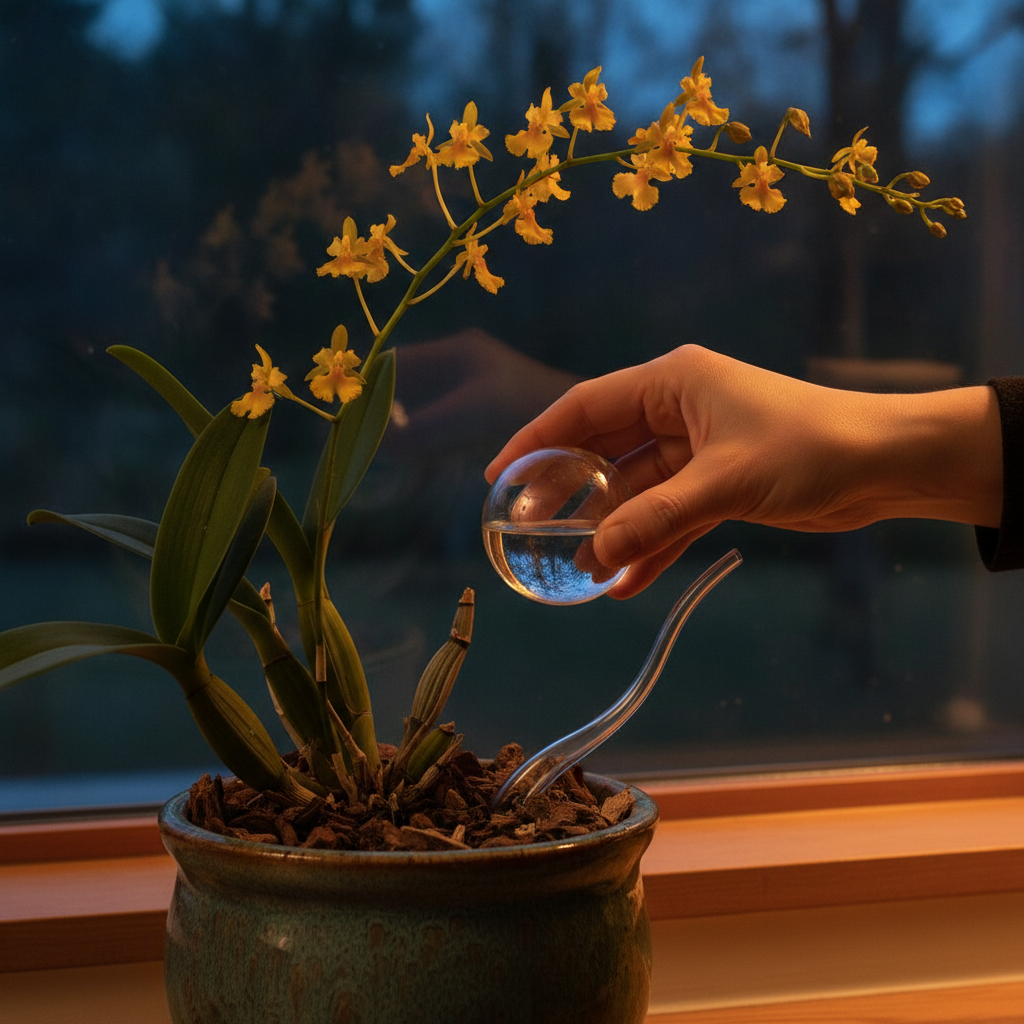
Rather than watering on a fixed calendar, learn to read the plant and the medium. The roots are the most honest indicator: silvery-white roots are thirsty and ready for water, while roots flushed bright green have just drunk and are still satisfied. The bark itself should feel barely damp, and the pot noticeably light when lifted, before you water again. Indoors this typically lands somewhere between every five and nine days, but it varies enormously with light, warmth, pot size and the season.
One subtlety worth knowing is that Oncidium sphacelatum appreciates a slightly drier rest once its pseudobulbs have matured and before a spike appears, mimicking the dry season of its homeland. During active growth, when fresh roots and a new pseudobulb are forming, keep it more consistently moist. Pay attention and the plant will tell you which phase it is in.
Pro Tip — Weight Tells the Truth: Lift the pot right after a thorough watering and commit that heavy weight to memory, then lift it again every couple of days. When it feels distinctly light, it is time to water. This simple habit is far more reliable than any fixed schedule and prevents the slow overwatering that rots orchid roots.
How to Water Correctly
- Take the plant to a sink rather than watering it in place, so excess can drain freely.
- Pour room-temperature water slowly over the surface of the bark, working around the whole pot.
- Keep pouring for fifteen to thirty seconds, letting water run right through and out of the drainage holes to flush the medium.
- For a deeper soak, stand the pot in a basin of water for ten to fifteen minutes, allowing the bark to absorb moisture fully.
- Let the pot drain completely, and tip away any water that collects in an outer cachepot or saucer.
- Avoid leaving water pooled in the crown or among the leaf bases, which can invite rot.
Signs of Overwatering vs. Underwatering
| Symptom | Overwatering | Underwatering |
|---|---|---|
| Pseudobulbs | Soft, yellowing or mushy at the base | Shrivelled, wrinkled and deeply ridged |
| Leaves | Yellowing from the base, limp and soft | Accordion-like pleating, dry leaf tips |
| Roots | Brown, brown-black, hollow and mushy | Papery, grey-white, brittle and dry |
| Medium | Sour-smelling, constantly soggy, breaking down | Bone dry, repelling water when poured |
| Overall | General collapse despite a wet pot | Slow shrivelling that recovers when watered |
Warning — Root Rot: Soft, blackened roots and a sour smell from the pot signal rot, almost always from a medium kept too wet for too long. Act quickly: unpot the plant, trim every mushy root back to firm, pale tissue with sterilised scissors, and repot into fresh, dry bark. A dancing lady can regrow a healthy root system if you catch the problem before the pseudobulbs collapse.
Humidity Requirements
Coming from humid forests, the dancing lady is happiest when relative humidity sits between 40 and 70 per cent, and it grows most lushly above 50 per cent. Most homes hover lower than that, especially in winter when central heating dries the air, so a little intervention often pays off in better root growth and longer-lasting flowers.
The plant will tell you when the air is too dry. Flower buds that yellow and drop before opening, a problem orchid growers call bud blast, are frequently a humidity issue, as are leaf tips that brown and crisp despite correct watering. New growth that struggles to expand cleanly is another clue.
To raise humidity, stand the pot on a wide tray of pebbles topped up with water, keeping the pot itself above the waterline so the roots never sit in it. Grouping plants together creates a shared pocket of moister air, and a small room humidifier is the most effective option of all during dry winter months. Good air movement matters just as much as moisture, so pair any humidity boost with gentle circulation to keep fungal problems at bay.
Water Quality
Oncidiums are moderately sensitive to the mineral content and salts in tap water. In hard-water areas, the buildup can gradually damage the fine root tips and leave white crusting on the medium. Rainwater is ideal, and filtered or distilled water is a good substitute. If you do use tap water, let it stand overnight so chlorine can dissipate, and flush the pot thoroughly with plain water every month or so to wash accumulated salts out of the bark.
Potting Medium & Repotting
Forget ordinary potting compost entirely. An epiphytic orchid planted in dense soil will suffocate and rot within a season, because its roots need air around them as much as they need moisture. The dancing lady is grown in a loose, chunky, fast-draining medium built around bark, which holds the roots in place while letting water rush through and air circulate freely.
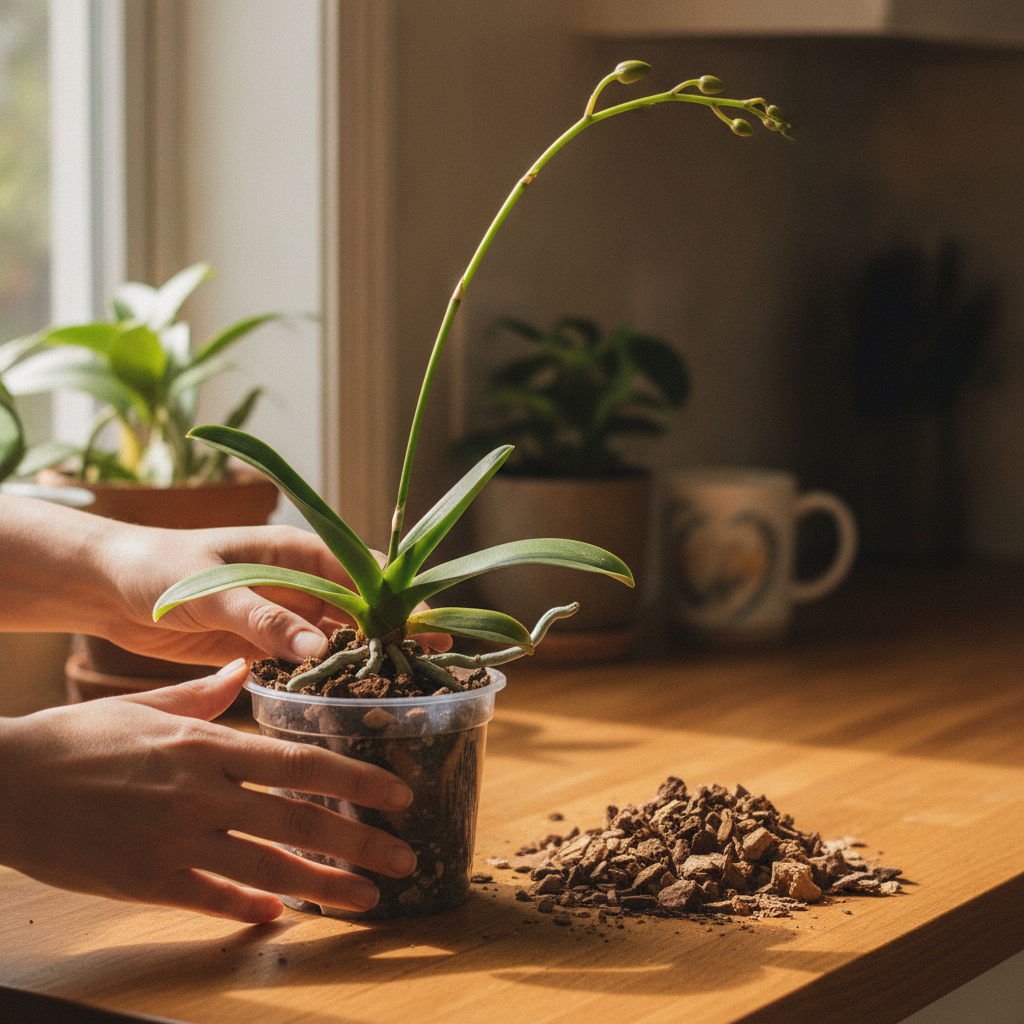
Ideal Potting Medium
A medium-grade orchid bark forms the backbone of the mix, with extra components added to fine-tune drainage and moisture retention. The proportions below suit the dancing lady’s preference for sharp drainage with just enough moisture to carry it between waterings. Because this orchid likes to dry out a little more than a moth orchid does, keep the mix on the chunkier, more open side.
| Component | Proportion | Function |
|---|---|---|
| Medium-grade fir or pine bark | 60 to 70 per cent | Core structure; holds roots while allowing air |
| Perlite or pumice | 15 to 20 per cent | Opens the mix and improves drainage |
| Horticultural charcoal | 10 per cent | Keeps the medium sweet and absorbs impurities |
| Coarse sphagnum or coco chips | 5 to 10 per cent | Adds a little moisture retention around roots |
The dancing lady prefers a slightly acidic root environment, broadly in the range of pH 5.5 to 6.5, which most bark-based orchid mixes naturally provide. You do not need to test or adjust it; simply refresh the medium on schedule, because as bark breaks down it becomes both more acidic and more water-retentive, which is one of the main reasons regular repotting matters for orchids.
Pro Tip — Quick Mix Recipe: For a reliable all-round blend, combine roughly six parts medium orchid bark, two parts perlite or pumice, one part charcoal and one part coarse sphagnum. Soak the bark for a few hours before potting so it absorbs water rather than repelling it, and your first post-repot watering will actually reach the roots.
Choosing the Right Pot
The pot is part of the growing system, not just a container. Orchids do well in pots that are generously vented, and many growers favour clear plastic pots so they can watch root health and judge moisture at a glance, with the added benefit that the green roots photosynthesise a little through the walls.
Drainage holes are non-negotiable. The pot must drain freely from the base, and ideally from slots in the sides as well. Any container that traps water at the bottom will rot the roots of a dancing lady orchid faster than almost any other mistake you can make.
Pot material: Clear plastic is the practical favourite for the reasons above. Terracotta breathes well and wicks away excess moisture, which suits heavy-handed waterers, but it dries faster and the roots tend to grip the porous walls tightly. Decorative ceramic cachepots are fine as outer covers, provided you lift the inner pot out to water and never leave it standing in collected runoff.
Pot size: Choose a pot that just accommodates the root mass with a little room for one or two seasons of growth, and no more. Oncidiums flower best when slightly snug, and an oversized pot holds a reservoir of wet bark that the roots cannot use quickly enough, which encourages rot.
When to Repot
Repot every 18 to 24 months, or sooner if the bark has broken down into a soft, soil-like consistency that no longer drains. The other prompts are a plant that has climbed up and over the rim of its pot, or roots so crowded there is no room left for fresh growth. Crucially, time the job for just after flowering, when you can see new roots and a fresh growth beginning to push, because roots establish fastest at that moment. Avoid repotting a plant in spike or in full bloom unless an emergency such as severe rot forces your hand.
How to Repot: Step-by-Step
- Water the plant a day ahead so the roots are supple and less likely to snap.
- Ease the orchid out of its pot and gently tease away as much of the old bark as you can from between the roots.
- Inspect the roots and trim away any that are brown, hollow or mushy, using scissors sterilised with isopropyl alcohol or a flame.
- If the plant has outgrown its space, this is the moment to divide it, keeping at least three to four healthy pseudobulbs per piece.
- Position the plant in the new pot with the oldest growth against one edge, leaving room for new growth to advance across the pot.
- Trickle fresh, pre-soaked bark around the roots, tapping the pot to settle it into the gaps, until the base of the plant sits just at the surface.
- Stake the plant lightly if it is unstable, then wait a few days before watering to let any cut surfaces heal.
Warning — Transplant Shock: After repotting, the plant may pause and sulk for a few weeks, and a little leaf wrinkling is normal as new roots take hold. Resist the temptation to overwater in an effort to help; soggy bark around freshly cut roots is the quickest route to rot. Keep humidity up, light bright but not harsh, and let the plant find its feet.
Fertilising
Bark is a near-inert medium that offers little nutrition of its own, so regular, dilute feeding is how the dancing lady builds the plump pseudobulbs that fuel flowering. The watchword among orchid growers is “weakly, weekly”: a much-diluted feed applied often, which mirrors the steady trickle of nutrients an epiphyte gathers from rain, dust and decaying matter in the wild.
Over-feeding is more dangerous than under-feeding. Orchid roots are easily scorched by concentrated fertiliser salts, so always lean towards too little rather than too much, and never apply feed to a bone-dry plant.
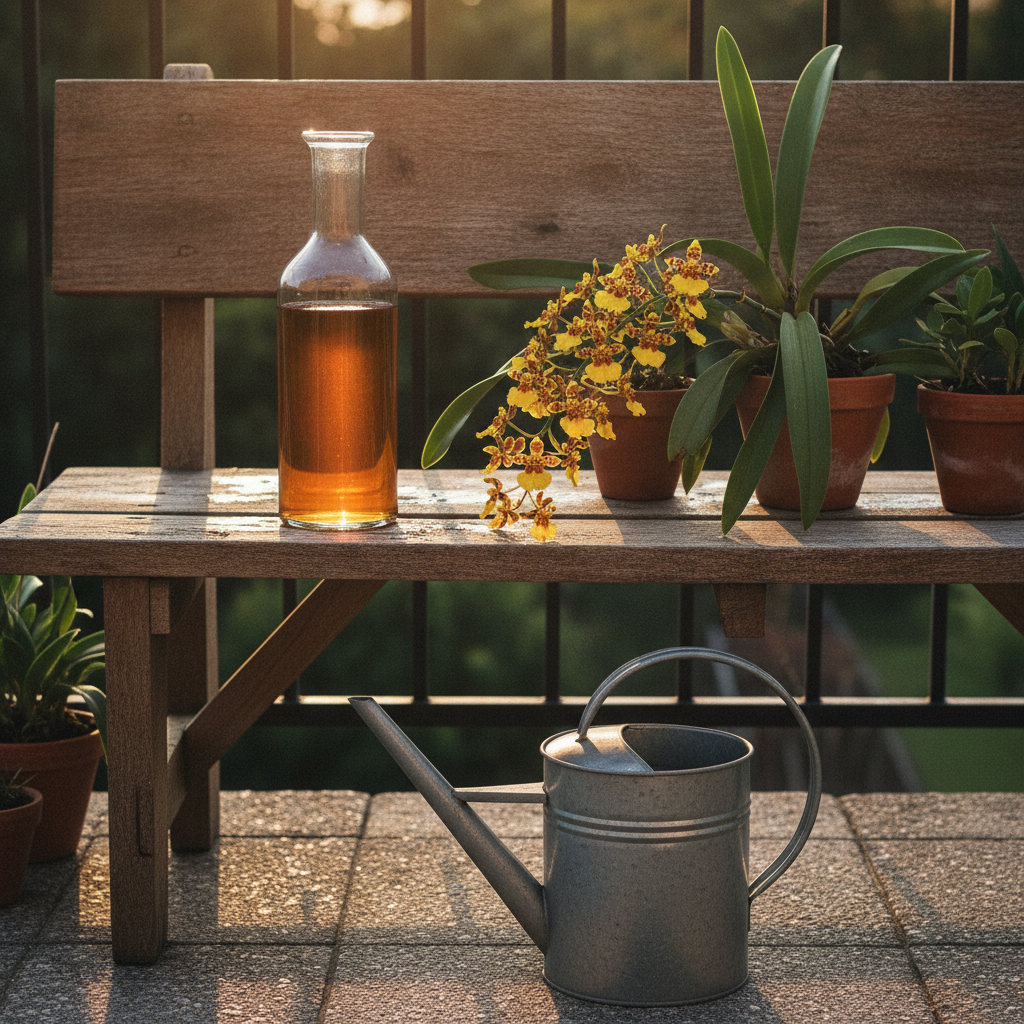
Understanding Plant Nutrients
Fertilisers are labelled with three numbers, the NPK ratio, showing the percentages of nitrogen, phosphorus and potassium. A balanced orchid fertiliser supplies these in roughly equal measure along with the trace elements orchids need. The table below outlines the nutrients that matter most and the signs that your plant is running short.
| Nutrient | Symbol | Primary Function | Deficiency Symptoms |
|---|---|---|---|
| Nitrogen | N | Leaf and pseudobulb growth | Pale, stunted new growth |
| Phosphorus | P | Roots, flowering and energy transfer | Poor rooting, reluctance to bloom |
| Potassium | K | Overall vigour and flower quality | Yellowing leaf margins, weak spikes |
| Calcium | Ca | Cell-wall strength in new tissue | Deformed or blackened new growth tips |
| Magnesium | Mg | Core of the chlorophyll molecule | Yellowing between the leaf veins |
| Iron | Fe | Chlorophyll production | Pale young leaves with green veins |
Types of Fertiliser
Liquid fertilisers: The standard and most controllable choice for orchids. A balanced formula, diluted to a quarter or half the label strength, lets you feed little and often and flush easily. Specialist orchid feeds are formulated for bark culture and are the simplest route to good results.
Slow-release granular: Less commonly used for orchids in bark, since release rates are hard to predict in such an open, fast-draining medium and the salts can accumulate unevenly. If you use them, choose a gentle formulation and keep a careful eye on the root tips.
Organic fertilisers: Diluted seaweed or kelp extracts and fish-based feeds work well as supplements and provide useful trace elements, often improving root vigour. They are gentle and forgiving, making them a sound choice for growers nervous about chemical burn.
Feeding Schedule
Through the active growing months of spring and summer, feed with every watering or every second watering at quarter to half strength. As autumn arrives and growth slows, taper the feeding back, and through the coolest, darkest part of winter you can pause it almost entirely, resuming as light and growth pick up again. A plant pushing a new pseudobulb is in its hungriest phase and benefits from the most consistent feeding.
Pro Tip — Flush Before You Feed: Once a month, water with plain water first to rinse out accumulated salts, then follow with your dilute feed. This simple two-step routine keeps the root zone clean and prevents the fertiliser buildup that browns root tips and stalls growth over time.
How to Fertilise
- Dilute a balanced orchid fertiliser to a quarter or half the recommended strength in room-temperature water.
- Make sure the bark is already slightly damp from a previous watering, never bone dry, before applying feed.
- Pour the dilute solution slowly through the medium until it runs from the drainage holes.
- Once a month, skip the feed and flush with plain water instead to clear out any salt buildup.
Warning — Salt Build-Up: A white crust on the bark or pot rim, or blackened, dying root tips, points to a buildup of fertiliser salts. Leach the pot by running plain water through it several times, and ease off both the strength and frequency of feeding until the plant recovers.
Propagation
The reliable way to make more dancing lady orchids at home is by division, splitting a large clump into smaller plants, each with its own roots and pseudobulbs. Unlike many foliage plants, you cannot grow a new Oncidium from a leaf or a piece of stem; the plant grows from advancing pseudobulbs, and division simply separates those into independent units.
Patience is the watchword. A division needs enough mature pseudobulbs to support itself while it re-establishes, so this is a technique for established, crowded plants rather than young ones. Done at the right moment, it is straightforward and gives you robust new plants that often flower within a season or two.
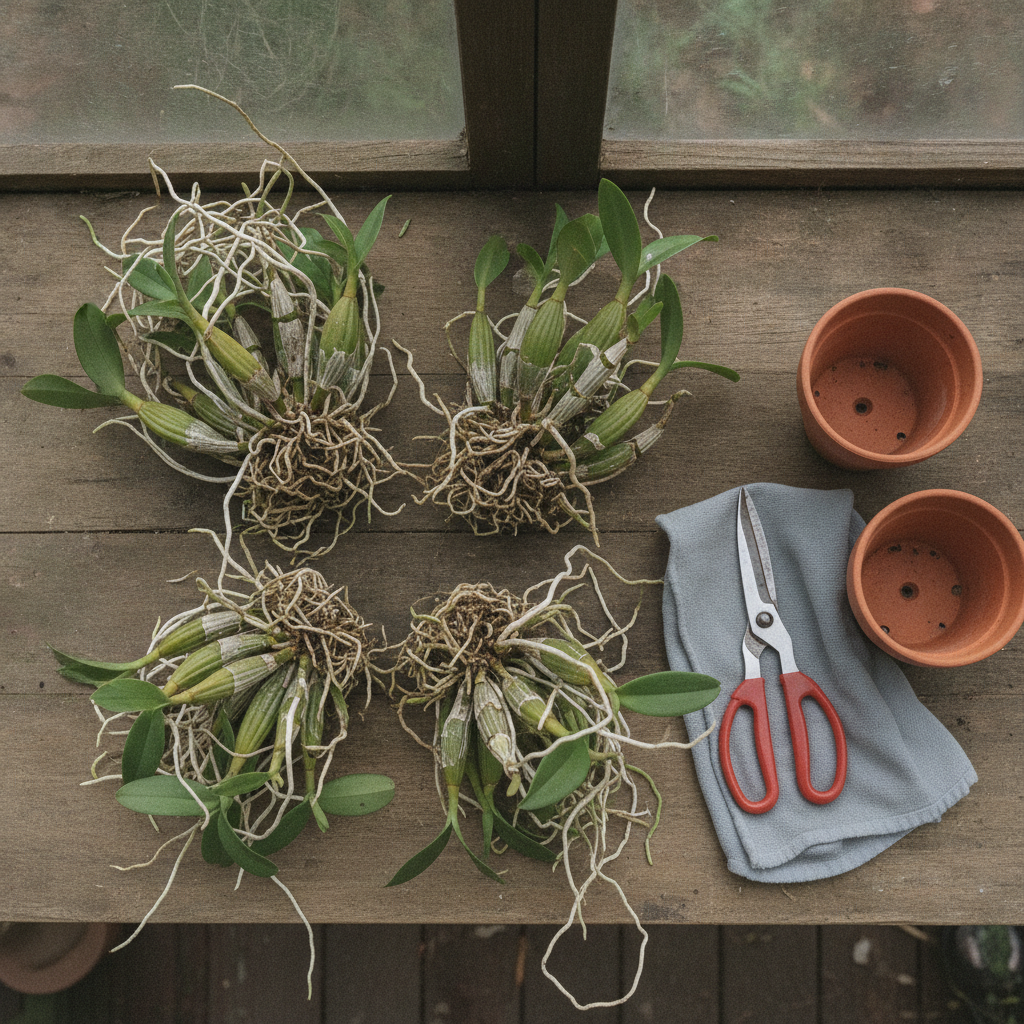
Understanding Pseudobulbs and the Rhizome
The dancing lady has a sympodial growth habit, meaning it advances sideways along a horizontal stem called a rhizome, producing a new pseudobulb at the leading edge each season. Each pseudobulb is a swollen, water- and energy-storing organ topped with leaves, and from its base emerge the roots and, in season, the flower spike. When you divide the plant, you are cutting the rhizome to separate a cluster of these pseudobulbs, ideally keeping at least one young leading bulb in each piece so the division can grow onward.
Division: Step-by-Step
Carry out division when you repot, just after flowering as new growth begins. This is the moment the plant is primed to root and recover quickly.
- Unpot the orchid and clear the old bark away so you can see the rhizome and how the pseudobulbs connect.
- Plan your cuts so each section keeps at least three to four healthy pseudobulbs, including one with a recent or developing growth.
- Using scissors or a knife sterilised with alcohol or flame, sever the rhizome cleanly between the chosen pseudobulbs.
- Trim away any dead or rotten roots from each division, keeping the firm, pale, living ones.
- Dust the cut surfaces with cinnamon or a little sulphur powder to guard against infection.
- Pot each division into a snug container of fresh, pre-soaked bark mix, settling the medium around the roots.
- Keep the new plants warm, humid and in bright indirect light, and wait several days before the first light watering.
Pro Tip — Mind the Back Bulbs: The oldest, leafless pseudobulbs at the rear of a clump, known as back bulbs, still hold reserves of energy. Potted up on their own in damp sphagnum and kept warm, many will eventually wake a dormant eye and sprout a new growth, giving you a bonus plant from material you might otherwise discard.
Growing On Keikis
Occasionally an Oncidium produces a keiki, a small plantlet that forms on an old flower spike or at the base of the plant, complete with its own tiny leaves and roots. These are less common on dancing ladies than on some other orchids, but where one appears it is an easy way to gain a new plant.
- Leave the keiki attached until it has produced two or three roots at least 3 to 5 centimetres (1 to 2 inches) long.
- Cut it from the parent with sterilised scissors, taking a small section of the spike or rhizome with it.
- Pot the keiki into a tiny container of fine bark, keep it warm and humid, and grow it on gently until it establishes.
Troubleshooting Propagation
| Problem | Likely Cause | Solution |
|---|---|---|
| Division fails to root | Too few pseudobulbs, or kept too wet | Divide into larger pieces; keep just humid, not soggy |
| Cut rhizome rots | Unsterilised tools or untreated cuts | Sterilise tools and dust cuts with cinnamon |
| Pseudobulbs shrivel after splitting | Root loss outpacing recovery | Raise humidity, mist lightly, be patient as roots regrow |
| Back bulb never sprouts | Eye dormant or bulb exhausted | Keep warm and lightly moist for several months |
Pests & Diseases
A well-grown dancing lady orchid in bright, airy conditions is fairly resistant to trouble, but no houseplant is immune. Most problems arrive either as sap-sucking insects hitching in on a new plant or as fungal and bacterial rots that follow overwatering and stagnant air. Catching them early makes all the difference.
Make a habit of inspecting your plant whenever you water, paying attention to the undersides of leaves, the leaf bases and the crevices between pseudobulbs where pests like to shelter. A quick weekly glance is the cheapest pest control there is.

Common Pests
Scale Insects (Coccoidea)
Scale are among the most persistent orchid pests, appearing as small brown or tan bumps clinging to leaves, pseudobulbs and flower spikes. They suck sap, weaken the plant and excrete sticky honeydew that attracts sooty mould. Their waxy shells make them stubborn.
Treatment: Wipe every visible scale off with a cotton bud dipped in isopropyl alcohol, then follow up with horticultural oil or insecticidal soap. Repeat weekly for several weeks, since newly hatched crawlers are easy to miss, and isolate the plant until it is clear.
Mealybugs (Pseudococcidae)
Mealybugs look like tiny tufts of white cotton wool tucked into leaf bases, the crevices around pseudobulbs and along flower spikes. Like scale, they feed on sap and leave honeydew behind, and they multiply quickly in warm rooms.
Treatment: Dab each insect with an alcohol-soaked cotton bud, then treat the whole plant with insecticidal soap or neem oil. Check hidden crevices thoroughly and repeat every week or so until no new tufts appear.
Spider Mites (Tetranychus urticae)
These almost invisible mites thrive in hot, dry air, exactly the conditions a heated winter room provides. They cause fine pale stippling on the leaves and, in bad cases, spin delicate webbing on the undersides. Leaves take on a dull, silvery, lifeless look.
Treatment: Rinse the foliage, especially the undersides, then treat with neem oil or a miticide. Raising humidity makes the environment far less hospitable to them and discourages a return.
Aphids (Aphidoidea)
Aphids cluster on tender new growth and, most damagingly for an Oncidium, on emerging flower spikes and buds, where their feeding distorts blooms and can cause buds to drop. They are soft-bodied and green, black or pink.
Treatment: Rinse them off with a gentle stream of water and follow with insecticidal soap. Keep a close eye on developing spikes through the budding period, when aphids do the most harm.
Common Diseases
Black Rot (Phytophthora cactorum)
A fast-moving water mould that produces spreading black, watery patches on leaves and pseudobulbs, often fatal if it reaches the rhizome. It thrives where water sits in the crown or among the leaves and air is stagnant.
Treatment: Cut out all affected tissue well into healthy growth with a sterile blade, dust the wounds with cinnamon or a fungicide, and move the plant somewhere drier with better airflow. Keep water off the foliage entirely while it recovers.
Root Rot (Pythium and others)
The classic consequence of overwatering or a broken-down, airless medium, root rot turns roots brown, hollow and mushy until the plant can no longer take up water and begins to collapse from the base despite a wet pot.
Treatment: Unpot, trim every dead root back to firm tissue, and repot into fresh, fast-draining bark. Correct the underlying watering habit, because no amount of trimming will help if the conditions that caused it remain.
Pest and Disease Summary
| Pest / Disease | Identification | Treatment |
|---|---|---|
| Scale insects | Brown bumps on leaves and bulbs, sticky residue | Alcohol swab, then horticultural oil, repeated |
| Mealybugs | White cottony tufts in crevices | Alcohol swab, then neem or insecticidal soap |
| Spider mites | Fine stippling and webbing, dull leaves | Rinse, neem or miticide, raise humidity |
| Aphids | Clusters on buds and new growth | Rinse off, insecticidal soap |
| Black rot | Spreading black watery patches | Cut out, dust with fungicide, improve airflow |
| Root rot | Brown mushy roots, base collapse | Trim, repot in fresh bark, fix watering |
Prevention Strategies
Prevention rests on a few simple habits. Quarantine every new plant for a couple of weeks before it joins your collection, so any hitchhiking pests reveal themselves in isolation. Keep the air moving with an open window or a gentle fan, since stagnant, humid air is the single biggest invitation to rot.
Water in the morning so any moisture that lands on the foliage dries before the cooler night, and never let water pool in the crown. Above all, get the watering rhythm right; a plant grown on the dry side in an open medium with good light is remarkably resistant to almost everything that troubles orchids.
Pro Tip — Neem as Routine: A light monthly spray of dilute neem oil, applied in the evening or out of direct sun to avoid leaf burn, works as a gentle preventive against scale, mites and mealybugs before they ever gain a foothold. Coat the leaf undersides and crevices, where pests like to begin.
Popular Varieties
“Dancing lady orchid” is a common name shared across the wider Oncidium group and its many hybrids, so the plants sold under it vary considerably in size, colour and scent. Oncidium sphacelatum itself is the classic large, golden-flowered species, but breeders have produced a wealth of crosses, some compact enough for a windowsill, others famous for remarkable fragrances.
The selection below covers the forms you are most likely to meet, from the scented showstopper ‘Sharry Baby’ to dainty miniatures and intergeneric hybrids. Any of them will respond to the same broad care described in this guide, with minor tweaks for size and vigour.
| Variety | Flower Appearance | Light Needs | Growth Rate | Availability |
|---|---|---|---|---|
| O. sphacelatum | Large sprays of small golden-yellow blooms | Bright | Moderate to vigorous | Common |
| ‘Sharry Baby’ | Mahogany-red and white, chocolate-scented | Bright | Vigorous | Very common |
| ‘Twinkle’ | Masses of tiny fragrant white to pink stars | Bright indirect | Compact, steady | Common |
| ‘Gower Ramsey’ | Tall sprays of bright yellow flowers | Bright | Vigorous | Common |
| O. varicosum | Large skirted lips, vivid canary yellow | Bright | Moderate | Specialist |
| ‘Sweet Sugar’ | Clear golden-yellow, free-flowering | Bright | Vigorous | Common |
| Tolumnia hybrids | Small “equitant” types, bold patterned lips | Very bright | Compact | Specialist |
Featured Varieties
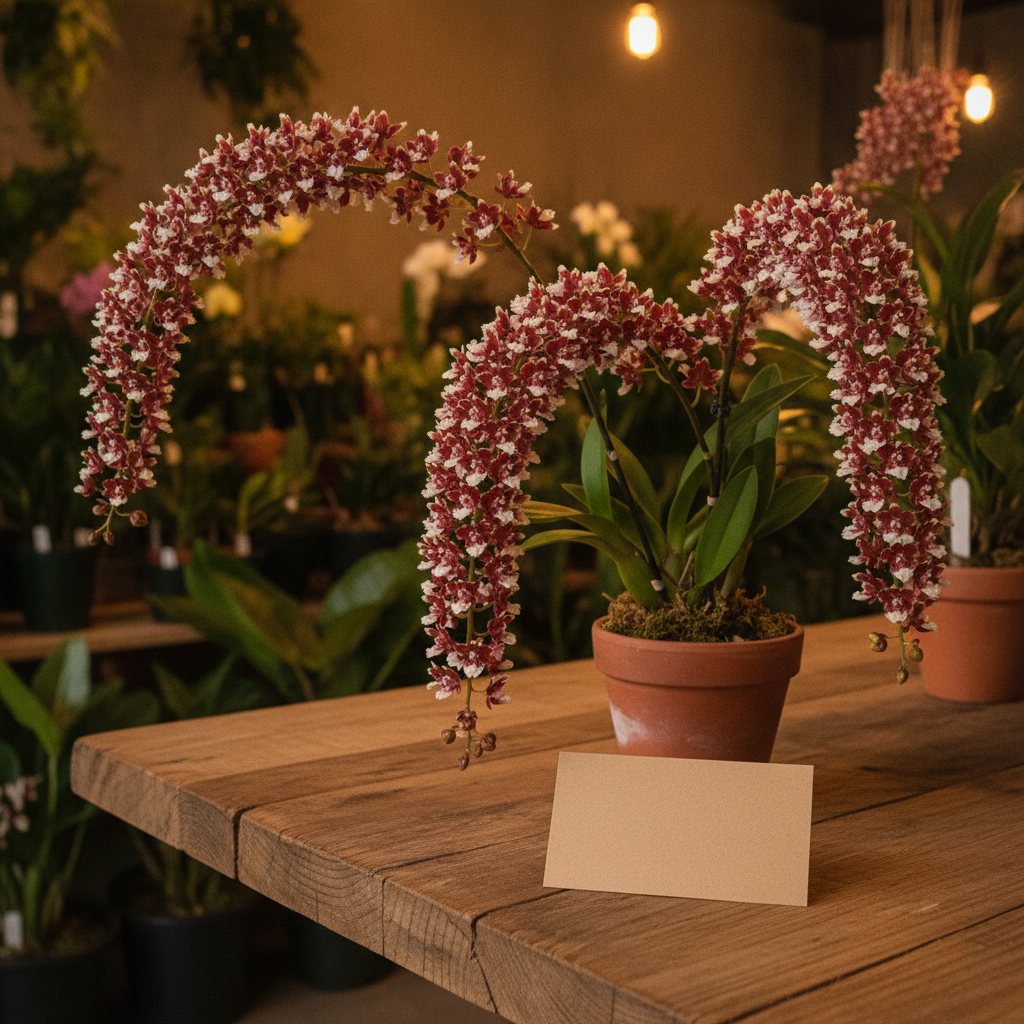
‘Sharry Baby’
Perhaps the most famous Oncidium hybrid of all, prized for tall arching sprays of small mahogany-red and creamy-white flowers that fill a room with the scent of chocolate and vanilla, strongest in the morning. Vigorous and reliable, it is an ideal first dancing lady.
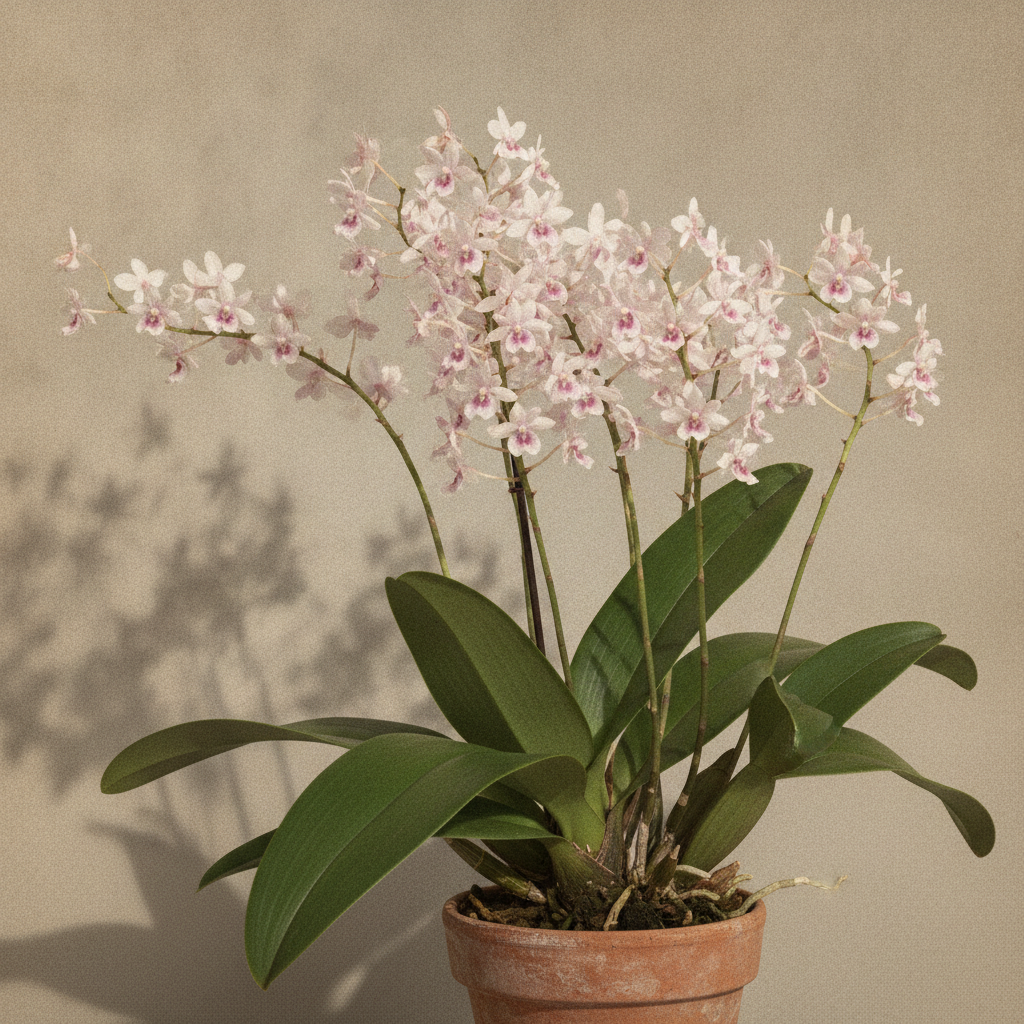
‘Twinkle’
A compact miniature that packs dense clusters of tiny, star-shaped, sweetly fragrant flowers in white and soft pink onto a plant small enough for any windowsill. Free-flowering and tolerant of slightly lower light, it suits growers short on space.
Variety Profiles in Detail
Dancing Lady Orchid (Oncidium sphacelatum)
The defining species, a robust grower that builds into an impressive clump of flat green pseudobulbs and produces branching spikes of dozens of golden-yellow flowers, each with a broad fluttering lip marked in chestnut brown. Given strong light it is one of the most generous bloomers in the genus.
Gower Ramsey (Oncidium Gower Ramsey)
A classic commercial hybrid valued for its tall, freely branching spikes of bright yellow flowers and its willingness to bloom in the home. Vigorous and adaptable, it is widely grown and an excellent choice for anyone wanting the quintessential golden dancing lady look.
Tolumnia Hybrids (Tolumnia spp.)
Once grouped within Oncidium, these “equitant” dancing ladies are tiny, fan-leaved plants bearing surprisingly large, boldly patterned flowers. They want even brighter light and faster drainage than their larger cousins, often grown almost bare-root, but reward the effort with intricate, jewel-like blooms.
Choosing the Right Variety for Your Space
If you have a bright window and room for a statement plant, the species or a vigorous hybrid like ‘Gower Ramsey’ delivers the full cascading spectacle. Where space is tight, ‘Twinkle’ and other miniatures offer the same charm in a fraction of the footprint. And if fragrance is the draw, ‘Sharry Baby’ is hard to beat. Whichever you choose, match it honestly to the light you can provide, because that, more than anything, decides how often you will enjoy those dancing flowers.
Frequently Asked Questions
Why won’t my dancing lady orchid flower?
The usual culprit is insufficient light. This orchid needs bright conditions, brighter than a moth orchid, to store enough energy in its pseudobulbs to bloom. Move it to an east window or a lightly shaded south window, or add a grow light, and give it a slightly cooler, drier rest in autumn to help cue spike formation.
Why are the pseudobulbs wrinkled and shrivelled?
Wrinkled pseudobulbs mean the plant is not taking up enough water, which is most often a root problem rather than simple underwatering. Check the roots: if they are healthy and the bark is dry, water more often; if they are brown and mushy, root rot is preventing uptake and the plant needs trimming and repotting into fresh medium.
What is the accordion-like pleating on the new leaves?
That concertina texture, sometimes called pleated or fan-folded growth, develops when a new growth expands during a period of insufficient water or low humidity. It is permanent on the affected leaves but harmless; correcting watering and raising humidity ensures the next round of growth emerges smooth.
Should I cut the flower spike after blooming?
Unlike moth orchids, Oncidiums do not rebloom from old spikes, so once the flowers have finished and the spike has browned, cut it off near the base with sterilised scissors. The plant will direct its energy into new growth and produce a fresh spike from the next mature pseudobulb instead.
How often should I repot?
Every 18 to 24 months, or whenever the bark has broken down into a dense, soil-like state that no longer drains freely. Always repot just after flowering, as new roots begin to appear, since that is when the plant re-establishes fastest. Avoid repotting a plant in active spike unless rot forces the issue.
Is the dancing lady orchid safe around pets?
It is generally considered non-toxic to cats and dogs and does not appear on the main lists of pet-poisonous plants. Even so, it is not food, and a pet that chews the foliage may suffer mild digestive upset, so the sensible course is to keep the plant somewhere it can be enjoyed but not nibbled.
Why are the flower buds dropping before they open?
Bud blast, where buds yellow and fall before opening, usually points to a sudden change in conditions: a sharp drop in humidity, a draught of hot or cold air, underwatering, or being moved while in spike. Keep a budding plant in stable, humid, draught-free conditions and avoid relocating it until the flowers have opened.
Can I grow a dancing lady orchid mounted instead of potted?
Yes. Because it is naturally epiphytic, the dancing lady grows beautifully mounted on a slab of cork or a piece of hardwood with a pad of sphagnum at the roots, which mimics its life on a tree branch. Mounted plants need much higher humidity and daily watering or misting, however, so this approach suits a greenhouse or a dedicated humid spot better than a typical living room.
What temperature does it prefer?
It is an intermediate-to-warm grower, comfortable between roughly 18 and 29 degrees C (64 to 84 degrees F) by day. A drop of a few degrees at night, down to around 13 to 18 degrees C (55 to 64 degrees F), is beneficial and, combined with the shorter days of autumn, helps trigger flowering. Protect it from temperatures below about 10 degrees C (50 degrees F).






