
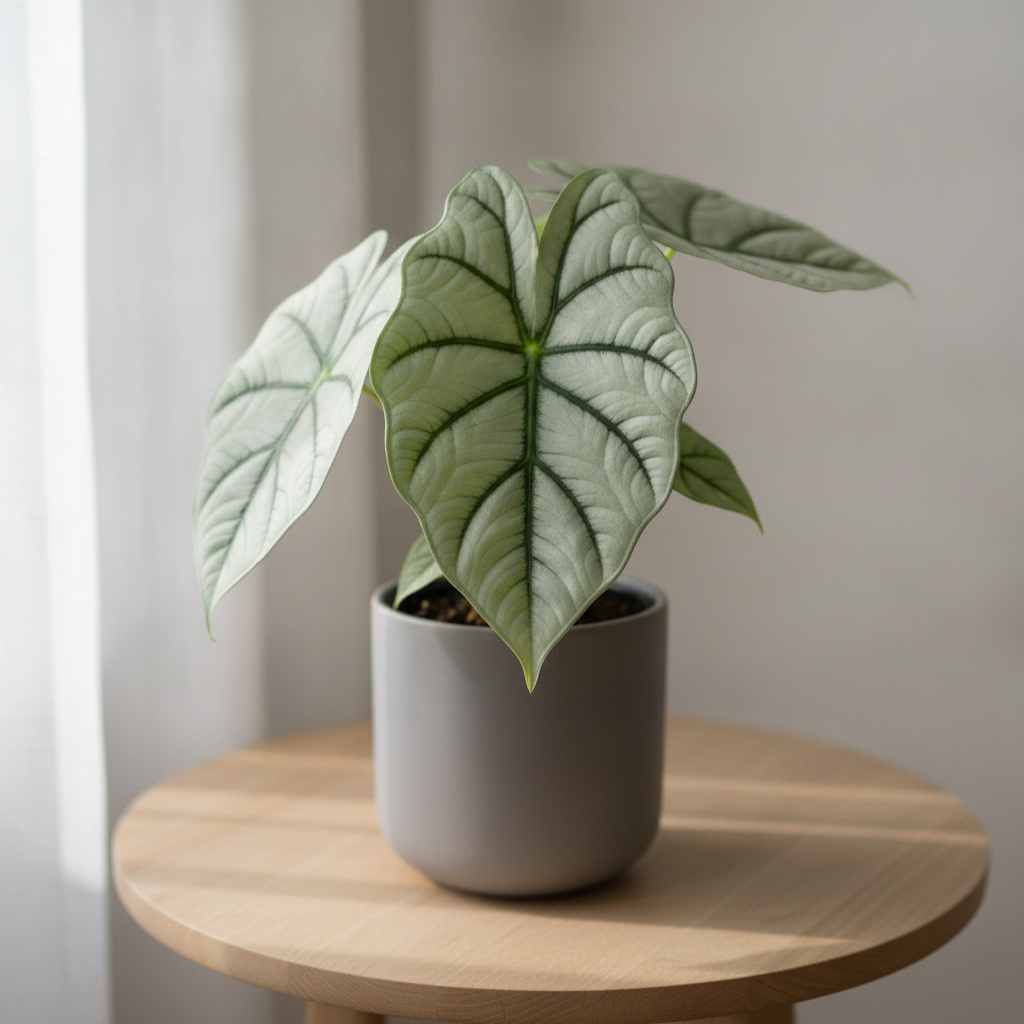
Few houseplants look quite as mineral and otherworldly as the Silver Dragon. A compact jewel alocasia derived from Alocasia baginda, the cultivar ‘Silver Dragon’ carries thick, almost succulent leaves of pale silvery mint, each one ribbed with dark, sunken veins that catch the light like the scales of a sleeping reptile. It hails from the limestone hills and shaded forest floors of Borneo, where its ancestors evolved to hoard water in swollen underground stems and to make the most of the dim, humid air beneath the canopy. That heritage explains almost everything about how it behaves on a windowsill.
The Silver Dragon has a reputation as a temperamental plant, and that reputation is only half deserved. It is not difficult so much as specific: it knows exactly what it wants, and it sulks visibly when it does not get it. Keeping one alive through a single season is straightforward. Keeping it thriving, pushing out new silver leaves and clumping into a full pot year after year, is a more rewarding challenge that comes down to reading moisture, humidity and warmth correctly. This guide covers everything from light and water to soil, feeding, propagation by division and the pests that find alocasias irresistible, so you can move your plant from merely surviving to genuinely flourishing.
Contents
- Quick Reference
- Why Silver Dragon Alocasia Makes a Striking Houseplant
- Light Requirements
- Watering & Humidity
- Soil, Potting & Repotting
- Fertilising
- Propagation
- Pests & Diseases
- Popular Varieties
- Frequently Asked Questions
Quick Reference: Silver Dragon Alocasia at a Glance
| Light | Bright, indirect light. No harsh direct midday sun. |
| Watering | Keep lightly and evenly moist in growth; let the top 2 to 3 cm (1 in) dry between waterings. Reduce sharply in winter. |
| Temperature | 18 to 27 degrees C (64 to 81 F). Avoid anything below 15 degrees C (59 F). |
| Humidity | High, ideally 60 to 80 percent. Struggles below about 50 percent. |
| Fertiliser | Balanced liquid feed at half strength, every 3 to 4 weeks in spring and summer only. |
| Toxicity | Toxic to cats, dogs and humans if chewed or swallowed, due to insoluble calcium oxalate crystals. |
Why Silver Dragon Alocasia Makes a Striking Houseplant
The appeal of the Silver Dragon begins and ends with its foliage. Unlike the broad, glossy green leaves of most aroids, this plant produces stiff, thick blades in a frosted silver-green, overlaid with a network of deeply impressed veins so dark they read as charcoal. The effect is sculptural rather than leafy, more like worked metal or carved stone than living tissue. Because the plant stays compact, usually reaching 35 to 45 cm (14 to 18 in) tall as a houseplant, it delivers that drama on a tabletop, a shelf or a windowsill without demanding the floor space a Monstera or a fiddle leaf fig would.
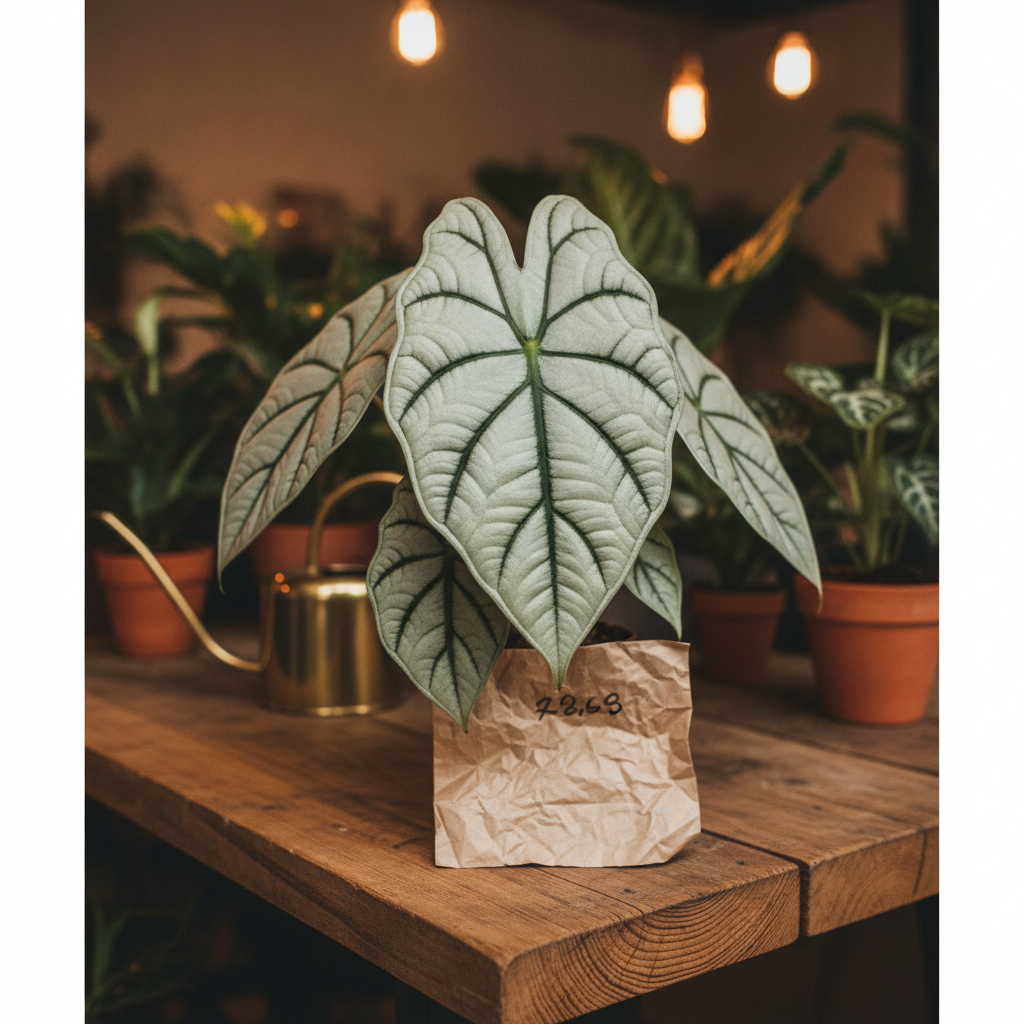
There is also a collector’s satisfaction in growing one well. The Silver Dragon is part of the wave of jewel alocasias that moved from rare-plant auctions into mainstream availability over the last decade, and it carries a faint air of the difficult and desirable. Master its watering and humidity and you join a fairly small club of growers who can coax it to clump and fill a pot. It grows from an underground corm, or rather a cluster of corms, which means a single healthy plant slowly becomes a colony, and that habit makes it generous: an established Silver Dragon will, in time, produce offsets you can separate and share.
Important — Toxicity: Every part of the Silver Dragon contains insoluble calcium oxalate crystals. If chewed or swallowed by a cat, dog or child, these cause intense burning of the mouth, drooling, swelling and difficulty swallowing, and the sap can irritate skin and eyes. Keep the plant well out of reach of pets and small children, and wash your hands after handling cut tissue. Contact a vet or doctor if a significant amount is ingested.
Light Requirements
In the wild, Alocasia baginda grows on shaded limestone slopes where light arrives filtered and softened by the forest above. That makes the Silver Dragon a bright-indirect-light plant through and through. It wants plenty of illumination to keep its leaves compact and its silver colour crisp, but it has no tolerance for the scorching, unbroken sun that succulents enjoy. Get the balance right and the plant rewards you with tight internodes and well-coloured foliage; get it wrong and you see either stretched, faded growth or bleached, crisping leaves.
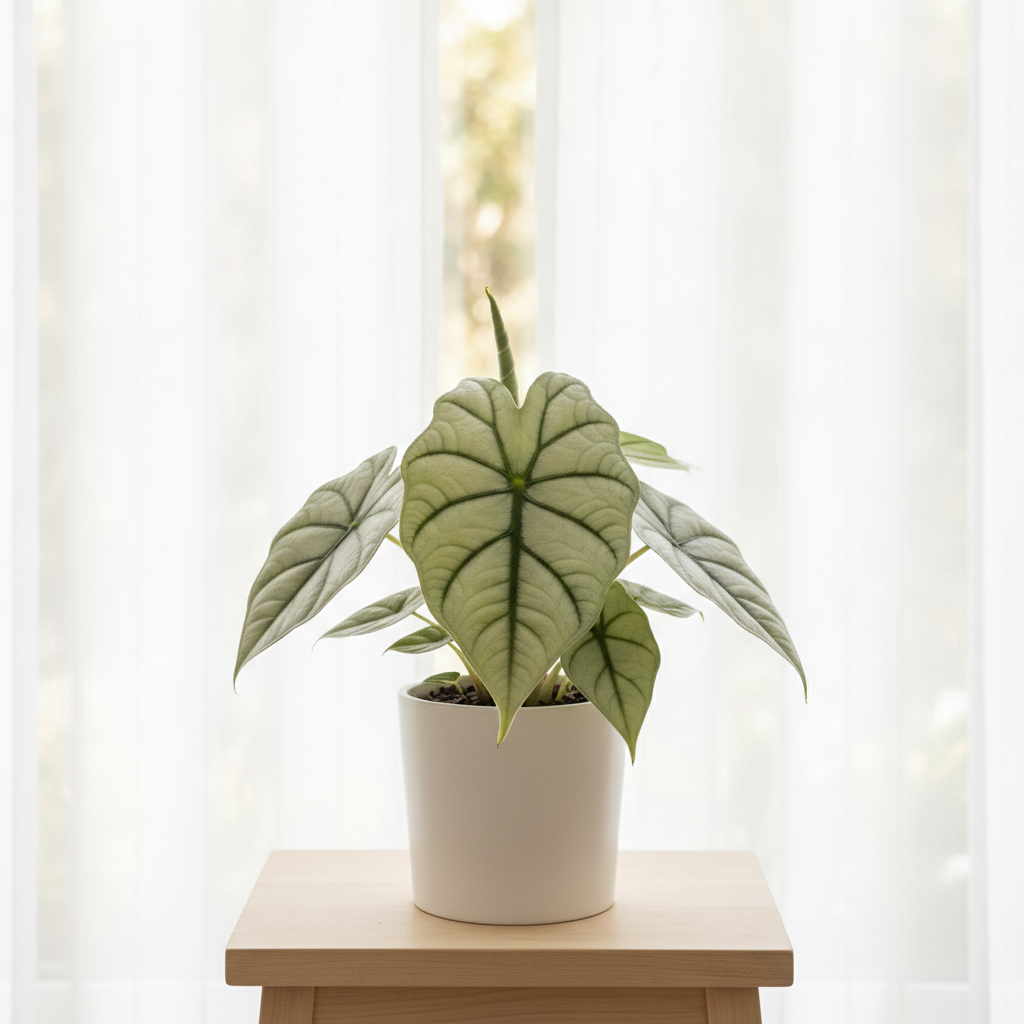
The ideal spot is within a metre or two of a bright window where direct rays are diffused by a sheer curtain or by the angle of the sun. A position that receives gentle morning light and bright ambient light for the rest of the day suits it perfectly. The plant will tell you quickly if it is unhappy, so treat its first few weeks in a new location as an experiment and be ready to move it.
Light Levels Explained
Indoor light is far dimmer than most people assume, and a spot that looks bright to the eye can be surprisingly weak for a plant. The table below sets out the broad tiers and how the Silver Dragon responds to each.
| Light Category | Approx. Level | Typical Location | Outcome |
|---|---|---|---|
| Direct sun | Over 50,000 lux | On an unshaded south or west sill | Leaves bleach and scorch, edges crisp |
| Bright indirect | 10,000 to 25,000 lux | Near an east window or behind a sheer curtain | Ideal: compact growth, strong silver colour |
| Medium | 5,000 to 10,000 lux | A metre or two back from a bright window | Acceptable, growth slows a little |
| Low | 1,000 to 5,000 lux | A north window or a dim corner | Stretched, weak, prone to rot from slow drying |
| Very low | Under 1,000 lux | Interior room with no nearby window | Decline and eventual dormancy or death |
Window Orientation and Placement
South-facing window: A strong source of light that needs taming. Set the plant back from the glass or filter the sun with a voile curtain so the leaves never sit in direct midday rays. Used carefully, a south aspect gives excellent colour.
East-facing window: Often the sweet spot. Soft morning sun followed by bright indirect light for the rest of the day matches the plant’s preferences almost exactly, with little risk of scorch.
West-facing window: Workable, but the late-afternoon sun in summer can be fierce. Pull the plant back from the glass or diffuse the light, particularly during the hottest months.
North-facing window: Usually too dim for the Silver Dragon to thrive. The plant may hold on but tends to stretch and dries slowly, which raises the risk of rot. Supplement with a grow light if a north aspect is your only option.
Pro Tip — Rotate for Even Growth: Alocasias lean strongly toward their light source. Give the pot a quarter turn each time you water so the plant grows upright and symmetrical rather than reaching out across the room.
How Light Affects Leaf Colour
The signature silver wash on a Silver Dragon’s leaves is at its most pronounced under good, bright indirect light. In too little light, new leaves emerge greener, larger and more widely spaced as the plant strains toward whatever illumination it can find, and the prized metallic quality fades. In too much direct sun, the opposite happens: the silver bleaches toward a sickly pale yellow and the leaf surface develops dry, papery patches that never recover. Aim for the bright middle ground and the contrast between silver blade and dark vein stays sharp and crisp.
Warning — Direct Sunlight: The thick leaves of the Silver Dragon scorch easily. A few hours of unfiltered summer sun can leave permanent bleached or brown patches that will not green up again. When you move the plant into a brighter spot, do so gradually over a week or two to let it acclimatise.
Artificial Lighting
The Silver Dragon responds very well to a full-spectrum LED grow light, which makes it a good candidate for a cabinet, a shelf away from windows or a dim winter room. Position the light roughly 20 to 40 cm (8 to 16 in) above the plant and run it for around 10 to 12 hours a day. Because grow lights let you control the intensity and duration precisely, many growers find their plants colour up and stay more compact under artificial light than on a marginal windowsill.
Seasonal Adjustments
Light levels indoors fall dramatically between summer and the depths of winter, and the Silver Dragon often slows or pauses growth in the colder months in any case. Move the plant closer to its window as the days shorten to compensate for the weaker sun, and clean the glass so it is not filtering out light unnecessarily. If your plant goes dormant over winter, which it commonly does, it needs far less light during that rest and you can ease off until spring growth resumes.
Watering & Humidity
Watering is where most Silver Dragons live or die. The plant grows from water-storing corms and resents both extremes: it will rot in soggy soil and collapse if left bone dry for too long. The goal is even, light moisture during active growth, achieved through a chunky, fast-draining mix rather than through stingy watering of a dense one. Get into the habit of checking the soil with a finger rather than watering on a fixed schedule, because the plant’s needs change sharply with the season.
When to Water
During spring and summer, water when the top 2 to 3 cm (about 1 in) of the mix has dried but the rest remains lightly moist. In a bright, warm spot in a chunky aroid mix, that often works out to roughly once or twice a week, but treat that only as a rough guide and always check first. The plant likes consistency: long droughts followed by a flood stress it and can trigger leaf drop or dormancy.
In autumn and winter the picture changes completely. As growth slows and the plant may enter dormancy, its water use drops, and the same watering routine that suited summer will now leave the mix wet for days and invite rot. Stretch the interval out, letting the mix dry further between waterings, and if your plant loses its leaves and rests as a corm, keep the soil barely damp, just enough that the corm does not desiccate, until new growth appears.
Pro Tip — Lift the Pot: A chunky aroid mix can read dry on top while still holding moisture deeper down. Learn the weight of the pot just after watering and again when it is ready for more. Lifting it becomes the quickest, most reliable moisture check you have.
How to Water Correctly
- Check the top few centimetres of mix with a finger, or lift the pot to feel its weight, before deciding to water.
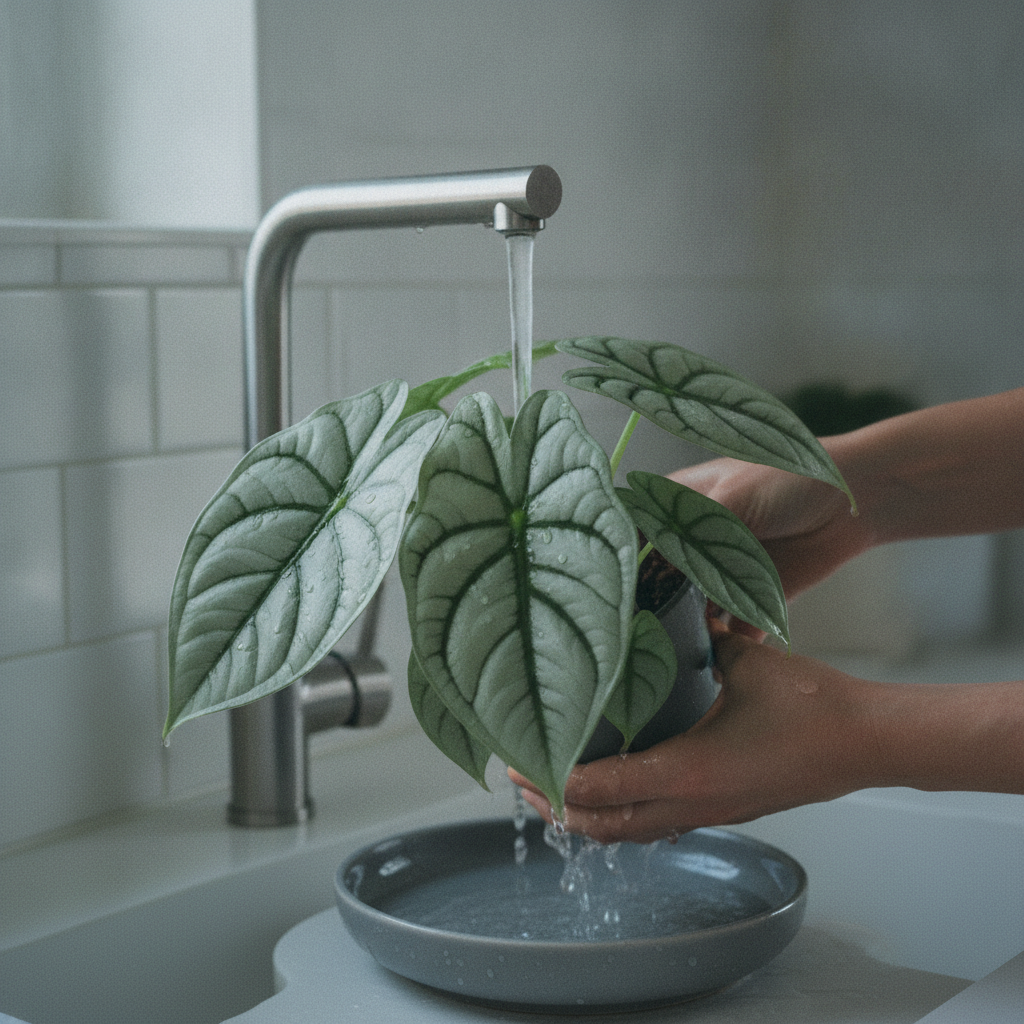
- Water at the soil surface with room-temperature water, moving around the pot so the whole root zone is wetted evenly.
- Continue until water runs freely from the drainage holes, which flushes the mix and ensures the corm is reached.
- Let the pot drain completely for several minutes in a sink or over a tray.
- Empty the saucer or cachepot so the plant never stands in collected water.
- Return the plant to its spot and note the date or pot weight so you can judge the next interval.
Signs of Overwatering vs. Underwatering
| Symptom | Overwatering | Underwatering |
|---|---|---|
| Leaf colour | Yellowing, often starting low and spreading | Dull, with browning at edges and tips |
| Leaf texture | Soft, limp, sometimes translucent | Thin, curling, crisp at the margins |
| Soil | Stays wet for days, may smell sour | Pulls away from the pot, dust-dry throughout |
| Roots and corm | Brown, mushy, foul-smelling | Dry and wiry but generally still firm |
| Stem base | Soft and darkened where it meets the soil | Firm but the plant droops overall |
Warning — Root Rot: Root rot is the single most common killer of jewel alocasias. If leaves yellow and the base feels soft, unpot the plant immediately, rinse the corm, cut away any brown mushy tissue with sterilised scissors, and repot into fresh, barely-damp chunky mix. A firm corm with no leaves can often be saved; a mushy one rarely recovers.
Humidity Requirements
Humidity is not optional for this plant. Coming from the humid understorey of Borneo, the Silver Dragon wants moisture in the air at around 60 to 80 percent and tends to struggle once levels fall much below 50 percent. In a typical centrally heated home, especially in winter, indoor humidity can drop to 30 percent or lower, which the plant finds genuinely stressful.
Low humidity shows up as crisping leaf edges, slow or stalled growth, and a heightened vulnerability to spider mites, which thrive in dry air. New leaves may fail to unfurl cleanly, emerging stuck or torn. These symptoms often appear alongside the dry, browning margins of underwatering, and the two problems frequently travel together.
The most reliable way to raise humidity is a small room humidifier running near the plant, which lifts the ambient level far more consistently than misting. Grouping plants together creates a moister microclimate, and a pebble tray of water beneath the pot helps a little. Many growers find the easiest answer is to keep the Silver Dragon in a glass cabinet, a terrarium or a bright bathroom, where high humidity is simply part of the environment. Misting, by contrast, raises humidity only briefly and can encourage fungal spots on the leaves, so it is not a substitute for any of these.
Water Quality
The Silver Dragon can be sensitive to the dissolved minerals, chlorine and fluoride in hard tap water, which over time may contribute to brown leaf tips. If your water is heavily treated or very hard, leaving it to stand overnight lets some chlorine dissipate, and using filtered or rainwater is better still. Always water at room temperature, as cold water from the tap can shock the warmth-loving roots.
Soil, Potting & Repotting
If watering is where Silver Dragons are lost, the soil is usually the underlying reason. A standard bag of dense houseplant compost holds far too much water around the corm and roots, and is a near-guarantee of rot. The plant needs an open, chunky, fast-draining medium that holds a little moisture while letting air reach the roots, much closer to what you would mix for an orchid than for a fern.
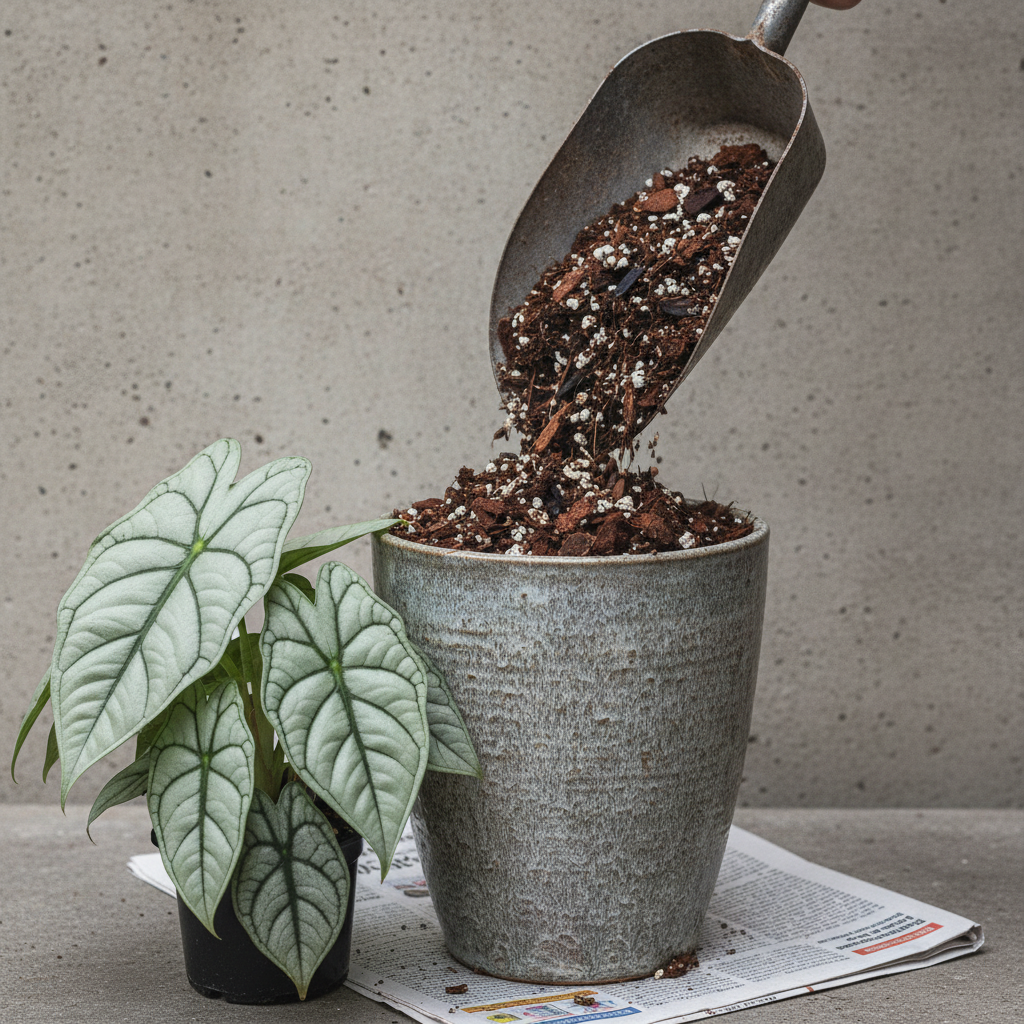
Ideal Soil Composition
A good Silver Dragon mix is built around bark and aeration rather than peat. The aim is a medium that drains within seconds of watering yet retains enough moisture in its components to keep the corm from drying out entirely. The proportions below give a reliable starting point that you can adjust to your home and watering habits.
| Component | Proportion | Function |
|---|---|---|
| Orchid bark (fine to medium) | About 30 percent | Creates large air pockets and structure |
| Coco coir or peat-free compost | About 25 percent | Holds light, even moisture |
| Perlite or pumice | About 25 percent | Sharpens drainage and keeps the mix open |
| Worm castings or compost | About 10 percent | Supplies gentle, slow nutrition |
| Horticultural charcoal | About 10 percent | Keeps the mix fresh and helps deter rot |
The Silver Dragon prefers a slightly acidic to neutral medium, around pH 5.5 to 6.5, which a bark-based aroid mix naturally provides. There is rarely any need to adjust pH directly if you use quality ingredients and water that is not strongly alkaline.
Pro Tip — Quick Mix Recipe: For a fast, dependable blend, combine roughly one part orchid bark, one part perlite or pumice and one part peat-free houseplant compost, then stir through a generous handful of horticultural charcoal. It drains freely, holds just enough moisture and suits almost every jewel alocasia.
Choosing the Right Pot
Pot choice has a real effect on how easy the plant is to keep alive, because it governs how quickly the mix dries and how much air reaches the corm.
Drainage holes are non-negotiable. The Silver Dragon must never sit in standing water, so its pot needs at least one generous drainage hole. If you love a decorative cachepot without holes, keep the plant in a plain plastic nursery pot inside it and lift that inner pot out to water and drain.
Pot material: Plastic and glazed ceramic hold moisture longer, which suits growers who tend to underwater or who keep the plant in strong light. Terracotta breathes and dries faster, which can be a useful safety margin against rot if you have a heavy hand with the watering can.
Pot size: Choose a snug pot. Alocasias generally prefer to be a little tight in their containers, and an oversized pot holds a reservoir of wet mix the small root system cannot use, which sits soggy and invites rot. Pot up only one size at a time.
When to Repot
The Silver Dragon is slow-growing and happy snug, so it rarely needs frequent repotting; once every one to two years is typical. Signs that it is ready include roots circling the bottom or emerging from the drainage holes, a pot that dries out unusually fast, or a visible cluster of offsets crowding the surface. The best time to repot is spring, as the plant moves into active growth and can recover quickly. Repotting is also your chance to inspect the corm and roots for any early signs of rot.
How to Repot: Step-by-Step
- Water lightly a day beforehand so the root ball holds together and the plant is less stressed.
- Ease the plant out by tipping the pot and supporting the base, rather than pulling on the leaves.
- Gently tease away the old mix and examine the corm and roots, trimming any brown, soft or foul-smelling parts with sterilised scissors.
- Note any offsets; this is the natural moment to divide the plant if you wish (see Propagation below).
- Settle the plant into a pot only one size larger, on a layer of fresh chunky mix, at the same depth it grew before.
- Fill around the roots with mix, firming gently so there are no large air gaps but the medium stays open.
- Water in lightly, then keep the plant warm, humid and out of strong direct sun while it settles.
Warning — Transplant Shock: Alocasias dislike being disturbed and often sulk for a week or two after repotting, sometimes dropping a leaf. This is normal. Resist the urge to overwater the freshly repotted plant in an attempt to revive it, as wet mix around disturbed roots is exactly what triggers rot. Keep it warm, humid and barely moist, and let it recover at its own pace.
Fertilising
The Silver Dragon is a light feeder, not a hungry one, and the most common fertilising mistake is overdoing it. A modest, regular feed during the growing season keeps the leaves well coloured and the corm building reserves, while heavy feeding does nothing but accumulate damaging salts in a mix that should stay lean and open.
The key principle is to feed only when the plant is actively growing, in spring and summer, and to dilute well below the strength a generic houseplant might tolerate. A plant that is dormant or resting over winter is not using nutrients, and feeding it then simply loads the soil with salt around an idle corm.
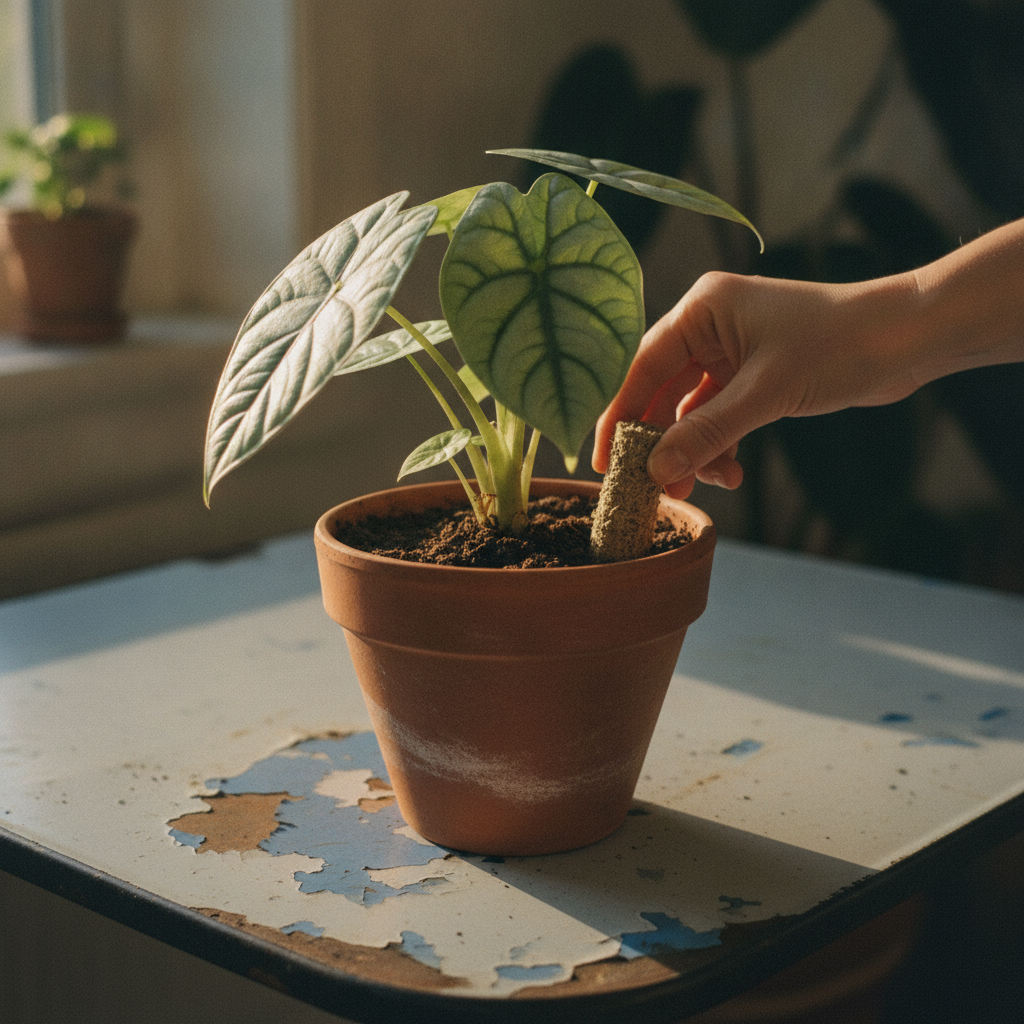
Understanding Plant Nutrients
Fertiliser labels carry three numbers, the N-P-K ratio, showing the percentages of nitrogen, phosphorus and potassium. For a foliage plant like the Silver Dragon, a balanced ratio or one slightly higher in nitrogen supports healthy leaf growth. Beyond those three, several secondary nutrients matter for keeping the leaves clean and well coloured, as the table sets out.
| Nutrient | Symbol | Primary Function | Deficiency Symptoms |
|---|---|---|---|
| Nitrogen | N | Leaf and stem growth | Overall paling, slow growth, older leaves yellow first |
| Phosphorus | P | Root and corm development | Stunted growth, dull or purplish tints |
| Potassium | K | Overall vigour and water regulation | Yellow or brown leaf margins |
| Calcium | Ca | Cell wall strength | Distorted or poorly formed new leaves |
| Magnesium | Mg | Core of the chlorophyll molecule | Yellowing between the veins of older leaves |
| Iron | Fe | Chlorophyll production | Yellowing between the veins of new leaves |
Types of Fertiliser
Liquid fertilisers: The easiest choice for the Silver Dragon. A balanced liquid feed diluted to half strength gives you precise control and lets you flush it through easily. Mix it into your watering can during the growing season and apply to already-moist soil.
Slow-release granular: Coated prills release nutrients gradually over months. They are convenient but harder to control with a salt-sensitive plant, so if you use them, dose lightly and keep an eye out for any tip burn.
Organic fertilisers: Worm castings worked into the mix, or a dilute organic feed, release nutrients gently and are very forgiving, which suits a plant that dislikes a sudden salt load. They feed more slowly and mildly, making them a safe option for cautious growers.
Feeding Schedule
Feed every three to four weeks through spring and summer with a balanced liquid fertiliser at half the recommended strength. Stop feeding entirely from autumn through winter while growth slows or the plant rests. If your Silver Dragon goes fully dormant, withhold fertiliser completely until new leaves emerge in spring, then resume gently.
Pro Tip — Less Is More: When in doubt, underfeed. A Silver Dragon kept slightly hungry will grow steadily and stay healthy, whereas one that is overfed develops scorched leaf tips and a crust of mineral salts on the soil. You can always add more; you cannot easily take it back out.
How to Fertilise
- Confirm the plant is in active growth and that the soil is already lightly moist, never bone dry.
- Dilute a balanced liquid fertiliser to half the strength stated on the label.
- Apply the solution evenly to the soil, avoiding splashing it onto the leaves.
- Let any excess drain away so nutrients do not pool around the corm.
- Every couple of months, water thoroughly with plain water to flush accumulated salts from the mix.
Warning — Salt Build-Up: A white or yellowish crust on the soil surface or pot rim, together with browning leaf tips, signals a build-up of fertiliser salts. Flush the pot by running plenty of plain water through it until it drains freely, and ease back on the feeding strength and frequency.
Propagation
The Silver Dragon does not propagate from leaf or stem cuttings the way a pothos or a philodendron does. Instead, like other alocasias, it multiplies underground, producing clusters of small corms and offsets around the base of the parent. Propagation therefore means division: separating those offsets, or potting up the corms, to grow new plants. It is a slow but very reliable method, and it is the only one that works for this plant.
The best moment to propagate is in spring, ideally combined with a routine repot, when the plant is gearing up to grow and any divisions will establish quickly in the warming months ahead. Avoid dividing in autumn or winter, when a disturbed offset is far more likely to stall or rot than to root.
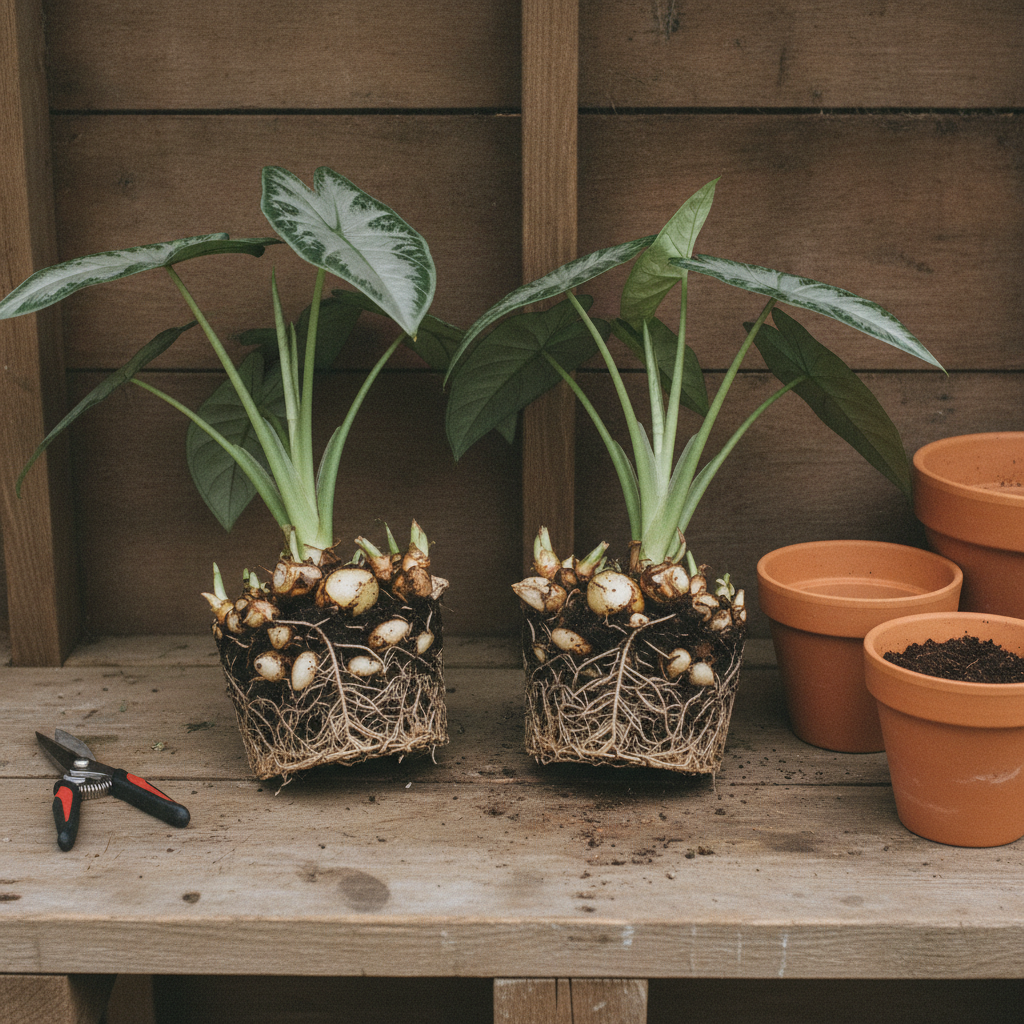
Understanding Corms and Offsets
An alocasia corm is a small, rounded, swollen stem that stores energy and water and can sprout into a whole new plant. A mature Silver Dragon will, over time, develop these corms and small rooted offsets around its base. Some offsets are already growing their own leaves and roots and are easy to separate; others are loose corms with no top growth yet, which can be sprouted separately in moss or water before potting. Recognising what you are looking at is the first step to dividing successfully.
Division of Offsets: Step-by-Step
Separating an established, rooted offset is the quickest route to a new plant and the most likely to succeed.
- Unpot the parent plant and gently wash or tease the mix away from the roots so you can see where the offsets join.
- Identify an offset that already has its own roots and ideally at least one leaf of its own.
- Separate it by hand where it naturally divides, or cut cleanly with sterilised scissors, keeping as many of its roots intact as possible.
- Pot the division into a small container of the same chunky aroid mix, settling it at the depth it grew before.
- Water in lightly and place it somewhere warm, bright and humid, out of direct sun.
- Keep the mix barely moist while the division establishes, and resist feeding for the first few weeks.
Pro Tip — Sprout Bare Corms in Moss: Loose corms with no leaves are easiest to start in a small container of damp sphagnum moss or in water, kept warm and humid with the top of the corm exposed. Once they have sprouted a shoot and a few roots, pot them into mix. Starting them this way lets you watch progress and avoid burying a corm that simply rots in soil.
Sprouting Corms: Step-by-Step
When you find loose corms with no top growth, this slower method gives them the best chance.
- Gently clean each corm and peel away only the loose, papery brown outer layer to expose the firm tissue beneath.
- Nestle the corms into damp sphagnum moss in a clear container, pointed growth end upward and just proud of the surface.
- Cover loosely to hold humidity, leaving a little airflow, and keep the setup warm at around 22 to 25 degrees C (72 to 77 F).
- Keep the moss lightly moist but never sodden, and be patient; sprouting can take several weeks.
- Once a shoot and roots a few centimetres long have formed, pot the young plant into a small pot of chunky aroid mix.
Troubleshooting Propagation
| Problem | Likely Cause | Solution |
|---|---|---|
| Corm turns soft or mushy | Too wet, or rot already present | Discard affected corms; keep moss only lightly damp and add airflow |
| No sprouting after weeks | Too cold, or natural dormancy | Raise the temperature and be patient; warmth is the main trigger |
| Division wilts after potting | Too few roots, or transplant shock | Keep humid and barely moist; a small humidity dome helps it recover |
| Offset rots in soil | Mix too dense or kept too wet | Use a chunkier mix and water sparingly until established |
Pests & Diseases
Alocasias are magnets for sap-sucking pests, and the Silver Dragon is no exception. Its preference for warmth and the dry air it often endures indoors make it especially prone to spider mites, which can build up unseen until the damage is done. Regular, close inspection is your best defence, because catching an infestation early is the difference between a quick wipe-down and a full-blown crisis.
Get into the habit of turning a few leaves over each time you water and looking closely at the leaf undersides and the points where leaf meets stem, the sheltered spots pests favour. The thick, silvery leaves can mask early symptoms, so a magnifying glass is a genuinely useful tool for this plant.
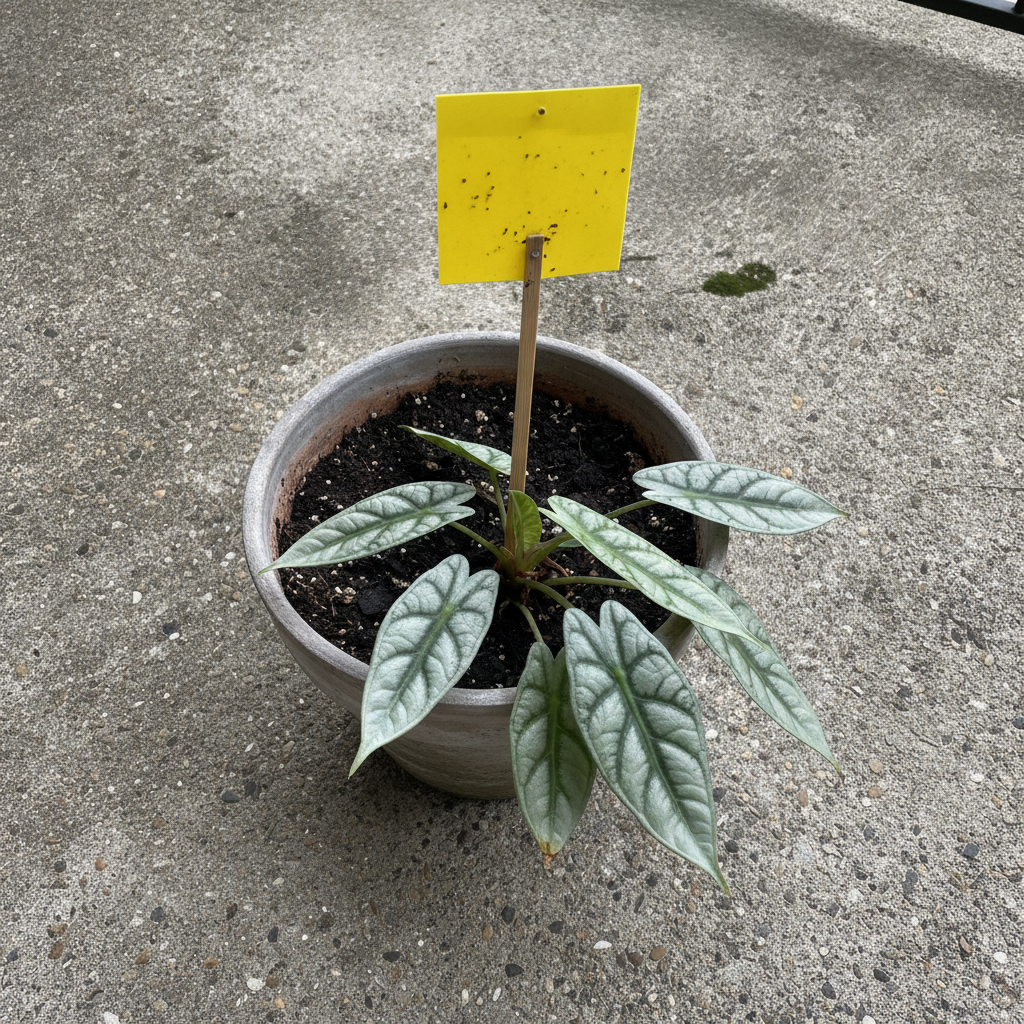
Common Pests
Spider Mites (Tetranychus urticae)
The most serious threat to the Silver Dragon. These tiny arachnids thrive in warm, dry air and cluster on leaf undersides, stippling the surface with fine pale dots and, in bad cases, spinning delicate webbing between leaf and stem. Left unchecked they can defoliate a plant quickly.
Treatment: Rinse the foliage thoroughly, then treat all surfaces, especially the undersides, with insecticidal soap or a neem oil solution, repeating every five to seven days for several cycles to break the breeding cycle. Raising humidity makes the environment far less hospitable to them.
Mealybugs (Pseudococcus species)
White, cottony insects that lodge in leaf axils and along stems, sucking sap and excreting sticky honeydew that can turn into sooty mould. They are slow-moving but persistent and spread readily between plants.
Treatment: Dab each insect directly with a cotton bud dipped in isopropyl alcohol, then follow up with insecticidal soap or neem oil. Inspect weekly, as eggs and crawlers are easy to miss.
Thrips (Thrips species)
Slender, fast-moving insects that rasp at the leaf surface, leaving silvery streaks, pale flecking and distorted new growth. They can be hard to spot but do disproportionate damage to the prized leaves.
Treatment: Isolate the plant, prune the worst-affected leaves, and treat repeatedly with neem oil or insecticidal soap. Yellow or blue sticky traps help catch the adults and monitor the population.
Fungus Gnats (Bradysia species)
Small black flies that hover around the soil, more a symptom than a cause; their larvae thrive in soil kept persistently wet. They signal that the mix is staying too moist, which is itself a risk to the plant.
Treatment: Let the top of the mix dry out more between waterings, use yellow sticky traps to catch the adults, and a layer of coarse grit or a BTI-based drench will deal with the larvae.
Common Diseases
Root and Corm Rot (Pythium and Phytophthora species)
The most dangerous disease of the Silver Dragon, caused by waterlogged conditions in which fungal-like pathogens attack the roots and corm. It shows as yellowing, wilting and a soft, blackened, foul-smelling base.
Treatment: Unpot at once, rinse the corm, and cut away all soft, discoloured tissue with sterilised tools back to firm, healthy flesh. Repot into fresh, barely-damp chunky mix and water very sparingly while the plant recovers. Prevention through good drainage is far more effective than any cure.
Leaf Spot (various fungal and bacterial pathogens)
Brown or yellow spots, sometimes with a darker ring or a yellow halo, that appear when leaves stay wet for too long or air circulation is poor. The spots can spread and merge if conditions do not improve.
Treatment: Remove affected leaves, avoid wetting the foliage when watering, and improve airflow around the plant. A copper-based fungicide can help in stubborn cases.
Pest and Disease Summary
| Pest / Disease | Identification | Treatment |
|---|---|---|
| Spider mites | Fine stippling, webbing, dry air | Rinse, neem or insecticidal soap, raise humidity, repeat |
| Mealybugs | White cottony clumps in axils | Alcohol dab, then neem or soap, inspect weekly |
| Thrips | Silvery streaks, distorted growth | Isolate, prune, repeated neem or soap, sticky traps |
| Fungus gnats | Black flies over wet soil | Dry the topsoil, sticky traps, BTI drench |
| Root and corm rot | Yellowing, soft black base, odour | Cut to firm tissue, fresh dry mix, water sparingly |
| Leaf spot | Spots with rings or halos | Remove leaves, keep foliage dry, improve airflow |
Prevention Strategies
Prevention is overwhelmingly easier than cure with this plant. Quarantine any new arrival for a couple of weeks before it joins your collection, inspect your Silver Dragon every time you water, and keep the leaves clean and dust-free so pests have nowhere to hide. Healthy, unstressed plants in good humidity are markedly more resistant to attack, so consistent care is itself a form of pest control.
On the disease side, almost everything comes back to water and air. A chunky, free-draining mix, a pot with drainage, restrained watering and decent airflow between plants together prevent the great majority of rot and fungal problems before they can start. If you fix the growing conditions, the diseases largely take care of themselves.
Pro Tip — Treat at the First Sign: Spider mites in particular explode in number if ignored. The moment you notice fine stippling or webbing, isolate the plant and begin treatment, repeating the neem or soap application on a strict weekly schedule for at least three rounds. Half-hearted, one-off treatments are why infestations come roaring back.
Popular Varieties
The Silver Dragon is itself a cultivar of Alocasia baginda, a species native to Borneo, and it sits within a small family of closely related jewel alocasias prized for their textured, sculptural leaves. Knowing its relatives helps you place it among the collector aroids and choose companions that share its care needs.
The varieties below all reward the same essentials, bright indirect light, high humidity, warmth and a chunky, fast-draining mix, so once you have mastered one you can grow most of the others. They differ mainly in colour and the degree of texture in their veining.
| Variety | Leaf Appearance | Light Needs | Growth Rate | Availability |
|---|---|---|---|---|
| ‘Silver Dragon’ | Silvery mint with dark embossed veins | Bright indirect | Slow | Increasingly common |
| ‘Dragon Scale’ | Emerald to silver-green, dark sunken veins | Bright indirect | Slow | Common |
| ‘Pink Dragon’ | Glossy green leaves on pink-blushed stems | Bright indirect | Moderate | Common |
| Alocasia ‘Maharani’ | Compact, leathery grey-green, textured | Bright indirect | Very slow | Less common |
| Alocasia ‘Reginula’ (Black Velvet) | Near-black velvety leaves, silver veins | Medium to bright indirect | Slow | Common |
| Alocasia ‘Frydek’ | Velvety dark green with bright white veins | Bright indirect | Moderate | Common |
Featured Varieties
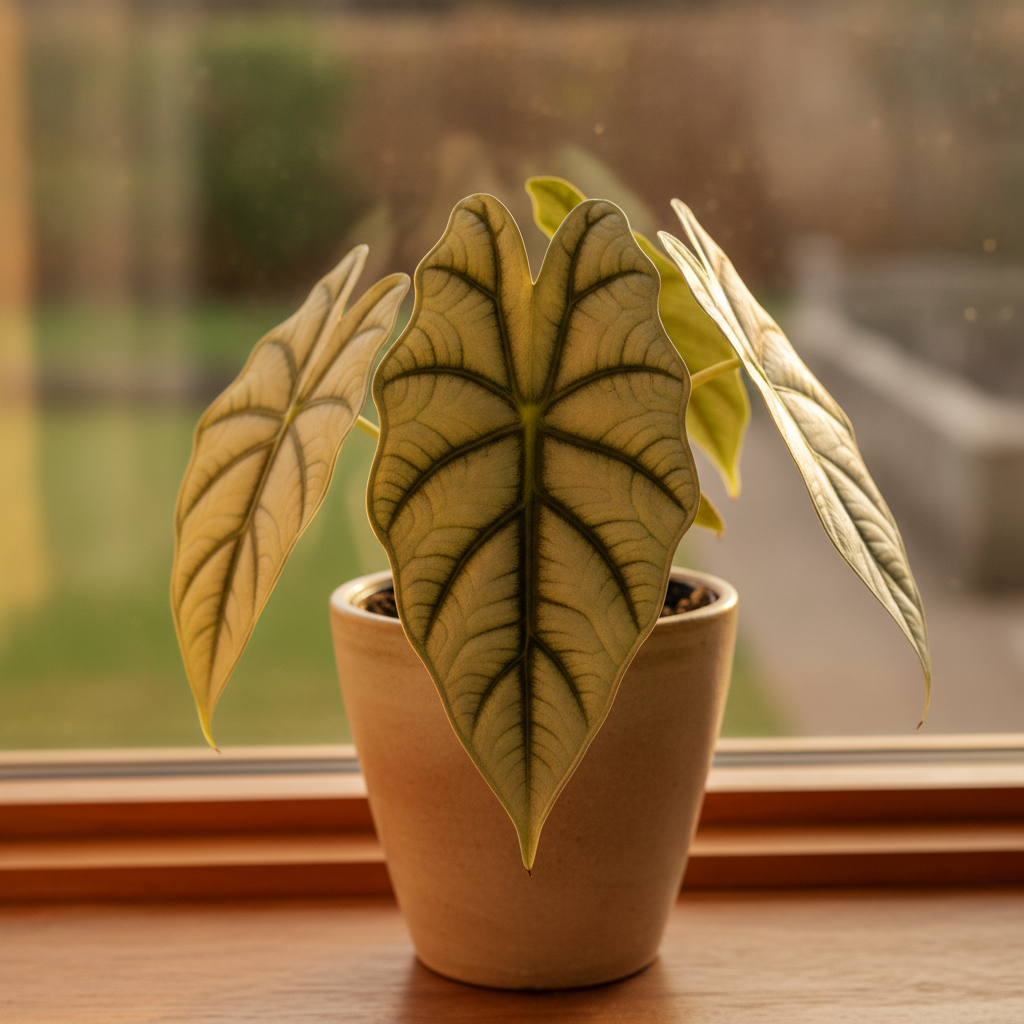
‘Silver Dragon’
The variety this guide is built around: pale silvery mint leaves with strongly raised, near-black veining that gives a scaly, dragon-hide texture. Compact and slow-growing, it is the most luminous of the baginda cultivars.
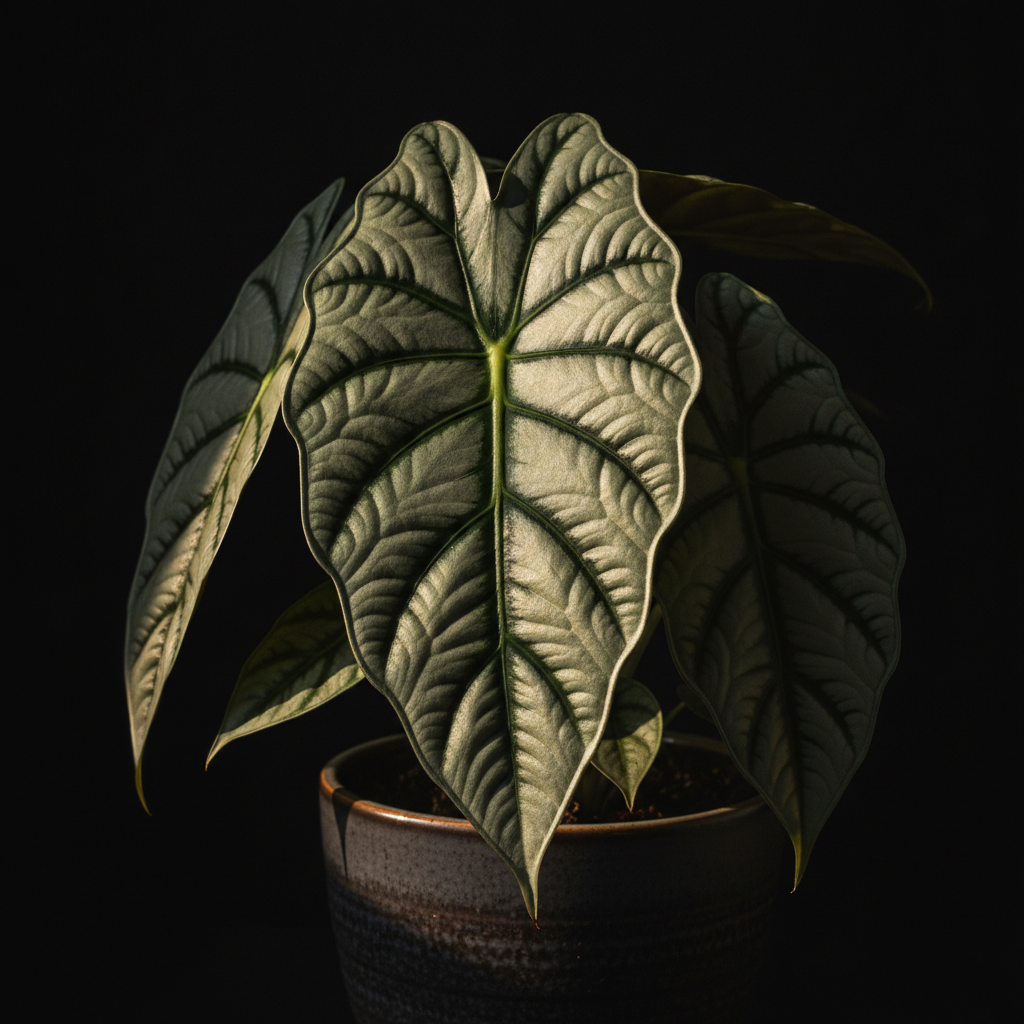
‘Dragon Scale’
The Silver Dragon’s closest sibling, also a cultivar of Alocasia baginda. Its deep emerald to silver-green leaves carry a metallic sheen and very dark, sunken veins that read like overlapping reptilian scales. Care is identical to the Silver Dragon.
Variety Profiles in Detail
‘Silver Dragon’ (Alocasia baginda ‘Silver Dragon’)
A compact jewel alocasia whose thick, silvery leaves and dark embossed veins make it one of the most distinctive small aroids in cultivation. It stays neat and shelf-friendly, grows slowly, and develops corms and offsets at its base that allow it to clump and be divided over time.
‘Dragon Scale’ (Alocasia baginda ‘Dragon Scale’)
Often grown alongside the Silver Dragon and frequently confused with it, this cultivar trades silver for richer green tones and an even more pronounced, scale-like texture. It shares the same demanding humidity, warmth and drainage needs.
‘Pink Dragon’ (Alocasia ‘Pink Dragon’)
A larger, faster relative with glossy arrow-shaped green leaves held on striking pink-blushed petioles. It is more forgiving and quicker to grow than the baginda cultivars, making it a good stepping stone for those new to the group.
Choosing the Right Variety for Your Space
If you want maximum drama in a small footprint and can supply high humidity, the Silver Dragon and Dragon Scale are unmatched, especially in a glass cabinet or terrarium. If your conditions are drier or you want something a little more forgiving, the Pink Dragon or a velvety Frydek will tolerate ordinary room humidity better while still giving you that unmistakable alocasia presence. Whichever you choose, the core lesson is the same: bright filtered light, warmth, moisture in the air and a mix that drains in seconds.
Frequently Asked Questions
Why is my Silver Dragon dropping leaves in winter?
This is usually dormancy rather than disaster. As light and temperatures fall, Silver Dragons often shed most or all of their leaves and rest as a corm. Keep the soil barely damp, hold off on feeding, keep it warm, and new growth should appear in spring. Check that the corm is still firm; as long as it is, the plant is simply resting.
How often should I water my Silver Dragon Alocasia?
There is no fixed schedule. In spring and summer, water when the top 2 to 3 cm (1 in) of mix has dried, which in a bright, warm spot is often once or twice a week. In autumn and winter, water far less. Always check the soil or lift the pot before watering rather than watering by the calendar.
Is the Silver Dragon Alocasia toxic to cats and dogs?
Yes. Like all alocasias it contains insoluble calcium oxalate crystals, which cause painful burning and swelling of the mouth and throat, drooling and vomiting if chewed. Keep it out of reach of pets and children, and contact a vet or doctor if a significant amount is eaten.
Why are the edges of my plant’s leaves turning brown and crispy?
Crispy brown edges almost always point to low humidity, and sometimes to underwatering or a build-up of mineral salts. Raise the humidity toward 60 percent or more with a humidifier, check your watering is consistent, and flush the pot with plain water if you suspect salt build-up from fertiliser or hard water.
Does the Silver Dragon really need a humidifier?
In most homes, especially in winter, yes. The plant strongly prefers humidity of 60 percent or higher, and a humidifier is the most reliable way to provide it. A glass cabinet, terrarium or humid bathroom can do the same job. Misting alone does not raise humidity meaningfully and can encourage leaf spot.
Can I propagate a Silver Dragon from a leaf cutting?
No. Alocasias do not root from leaf or stem cuttings. They multiply by producing corms and offsets underground, so propagation is by division: separating rooted offsets or sprouting loose corms in moss or water. A single leaf placed in water will simply rot.
Why has my Silver Dragon stopped growing?
Some pausing is normal, as this is a slow plant that often rests in winter. If it has stalled during the growing season, check for too little light, cold temperatures, low humidity, or roots sitting in soggy mix. Address whichever condition is off and growth usually resumes once the plant is comfortable again.
What is the difference between Silver Dragon and Dragon Scale?
Both are cultivars of Alocasia baginda with the same scaly, textured leaves and identical care needs. The simplest distinction is colour: the Silver Dragon has pale silvery mint leaves, while the Dragon Scale is a deeper emerald to silver-green. Grown side by side, the Silver Dragon is the noticeably lighter, more frosted of the two.
My Silver Dragon’s leaves are losing their silver colour. What is wrong?
Fading silver and larger, greener, more widely spaced leaves usually mean too little light. Move the plant to a brighter spot with strong indirect light, or add a grow light, and new leaves should come through with the proper frosted colour and compact form.






