
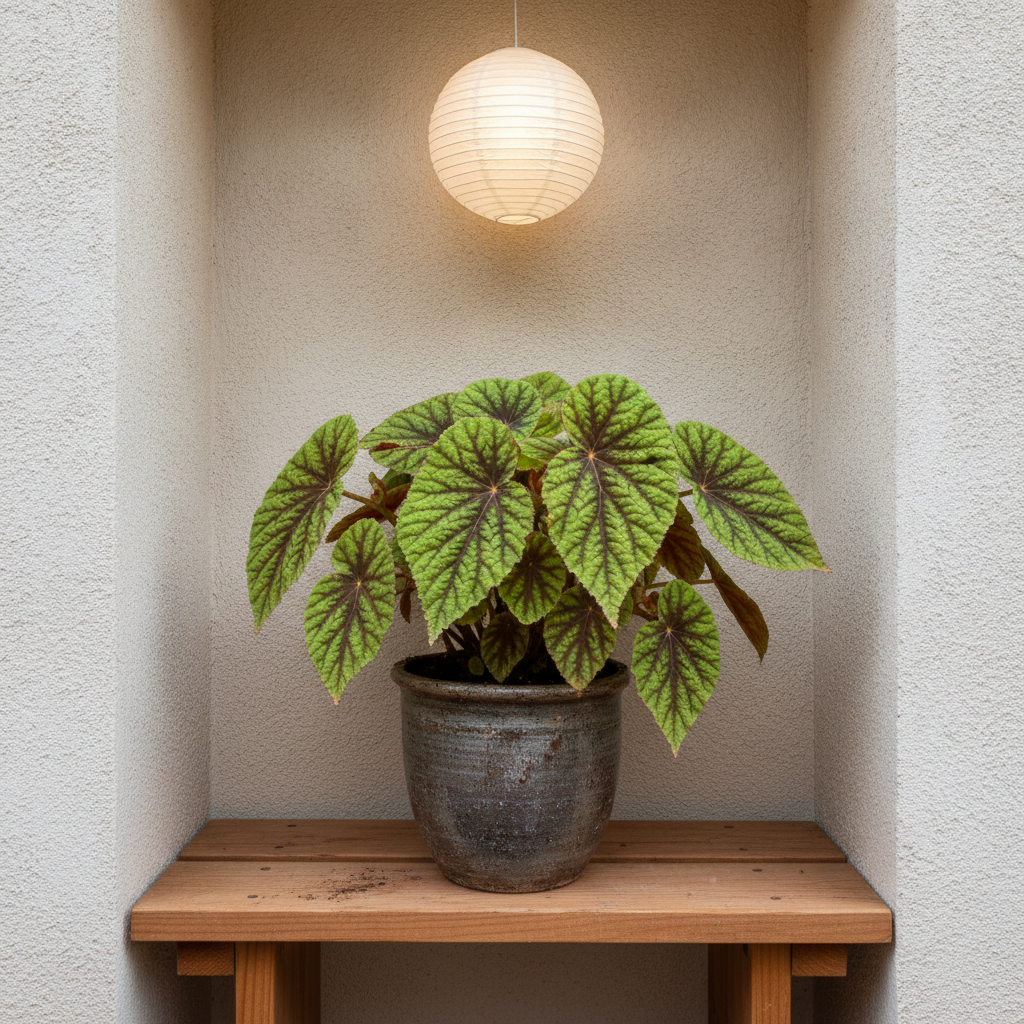
Few houseplants announce themselves as boldly as the Iron Cross Begonia. Each large, rounded leaf is stamped with a dark chocolate-brown marking that radiates from the centre like the arms of a German military cross, the feature that gave the plant its common name. Botanically it is Begonia masoniana, a rhizomatous begonia native to the humid forests of southern China and northern Vietnam, where it creeps across shaded forest floors rather than reaching for the canopy. It belongs to the same vast genus as the trailing wax begonias and the cane-stemmed angel wings, but it is grown for one reason above all others: its astonishing foliage.
The Iron Cross Begonia has a reputation for being temperamental, and that reputation is only half deserved. It will survive a surprising amount of neglect, but the gap between a plant that survives and one that genuinely thrives is wider here than with almost any other common houseplant. Get the humidity, watering and airflow right and you are rewarded with a dense mound of deeply textured, bullate leaves in vivid apple green. Get them wrong and the plant sulks, drops leaves and becomes a magnet for fungal trouble. This guide covers everything you need to move your plant firmly into the thriving category, from reading its light to dividing its rhizome.
Contents
- Quick Reference
- Why the Iron Cross Begonia Makes a Striking Houseplant
- Light Requirements
- Watering & Humidity
- Soil, Potting & Repotting
- Fertilising
- Propagation
- Pests & Diseases
- Popular Varieties
- Frequently Asked Questions
Quick Reference: Iron Cross Begonia at a Glance
| Light | Bright, indirect light; never direct midday sun |
| Watering | When the top 2 to 3 cm (1 in) of soil dries; lightly moist, never soggy |
| Temperature | 18 to 24°C (64 to 75°F) |
| Humidity | High, ideally 50 to 70 per cent |
| Fertiliser | Balanced liquid feed at half strength, monthly in spring and summer |
| Toxicity | Toxic to cats and dogs; mildly toxic to humans if eaten |
Why the Iron Cross Begonia Makes a Striking Houseplant
The appeal of Begonia masoniana begins and ends with the leaf. Each one emerges puckered and quilted, the surface raised into a relief of small domes and valleys that catches light from every angle. The base colour is a fresh, almost lime green, overlaid with the signature dark marking that runs from the leaf centre out along the main veins. A scattering of fine red bristles covers the surface, giving mature leaves a faint coppery sheen in raking light. The plant grows from a thick, creeping rhizome rather than an upright stem, so a healthy specimen spreads sideways into a low, layered mound rather than climbing.

As a foliage plant it earns its keep year round. Unlike flowering begonias, it is not grown for blooms; the small greenish-white flowers it occasionally produces indoors are insignificant and many growers remove the flower spikes to keep the plant’s energy directed at its leaves. What you gain instead is a plant with genuine sculptural presence, one that looks deliberate and considered on a shelf or plant stand. It pairs well with simpler-leaved companions that let its texture stand out, and because it stays compact, rarely exceeding 30 to 45 cm (12 to 18 in) across, it suits homes where floor space is at a premium.
Important — Toxicity: Like all begonias, Begonia masoniana contains soluble calcium oxalates and is toxic to cats and dogs, with the highest concentration in the underground rhizome. Ingestion can cause intense mouth irritation, drooling and vomiting in pets, and mild mouth and stomach irritation in people. Keep it out of reach of curious animals and children, and wash your hands after dividing or handling the rhizome.
Light Requirements
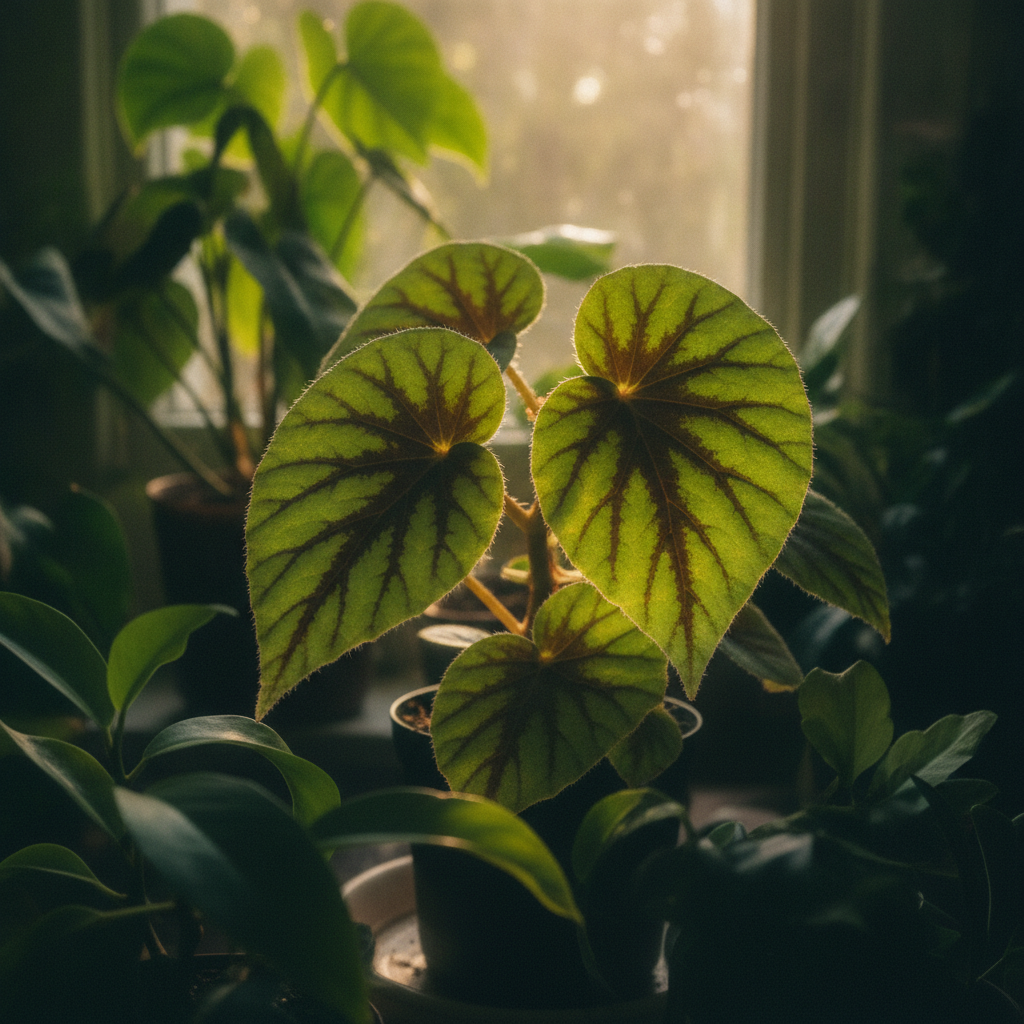
In its native understorey the Iron Cross Begonia lives in dappled shade, screened from the sun by the trees above. That heritage tells you almost everything you need to know about its light needs indoors: it wants brightness without direct exposure. Bright, indirect light keeps the leaves compact, deeply coloured and well textured, while the cross marking stays sharp and dark against vivid green.
The single most common mistake is placing this begonia in too little light in an effort to protect it from scorching. Deep shade produces weak, leggy growth, dull colouring and a plant far more prone to rot because the soil stays wet for longer. The aim is a position that feels bright and airy to you but where the leaves never sit in a direct beam of sun.
Light Levels Explained
Light indoors falls off far more quickly than most people expect, roughly with the square of the distance from the window. The table below translates the usual descriptions into approximate levels and the outcome you can expect from an Iron Cross Begonia in each.
| Light Category | Approx. Level | Typical Location | Outcome |
|---|---|---|---|
| Direct sun | Over 50,000 lux | On a south or west sill, unscreened | Avoid; leaves scorch and bleach |
| Bright indirect | 10,000 to 20,000 lux | Near an east window or just back from a screened south one | Ideal; dense, well-coloured growth |
| Medium | 5,000 to 10,000 lux | A metre or two back from a bright window | Acceptable; slightly slower growth |
| Low | 1,000 to 5,000 lux | A north window or an interior corner | Poor; leggy, dull, rot-prone |
| Very low | Under 1,000 lux | Far from any window | Decline; not viable long term |
Window Orientation and Placement
South-facing window: The brightest exposure in the northern hemisphere, and too intense if the plant sits directly on the sill. Set it a metre back, or filter the glass with a sheer curtain, and a south window becomes one of the best positions you can offer.
East-facing window: Arguably the perfect home for this begonia. The gentle morning sun is rarely strong enough to burn, and the light stays bright and indirect through the rest of the day. Most growers find their plants colour up best here.
West-facing window: Workable, but the hot afternoon sun can scorch leaves placed too close. Pull the plant back from the glass or diffuse the light, and the strong afternoon brightness will keep growth compact.
North-facing window: Usually too dim to sustain vigorous growth, particularly in winter. A plant can hold on here, but expect slower, weaker leaves. If a north window is all you have, a supplementary grow light makes a real difference.
Pro Tip — Rotate for Symmetry: Rhizomatous begonias grow towards the light and can become lopsided. Give the pot a quarter turn each time you water so every side of the rosette receives equal exposure and the mound stays balanced.
How Light Affects Leaf Colour and Texture
Light does more than fuel growth in this plant; it shapes the very feature you bought it for. In good bright indirect light the leaves stay compact, the puckering is pronounced and the dark cross stands out crisply against a saturated green. In low light the leaves stretch, flatten and pale, and the marking fades to a muted smudge. If your plant’s colour has gone flat, the most likely cause is too little light rather than a feeding or watering problem.
Warning — Direct Sunlight: Even an hour of direct midday sun can bleach and crisp the delicate leaf surface, leaving permanent pale or brown patches that will not recover. Introduce any plant moved into brighter conditions gradually over a week or two to let it acclimatise.
Artificial Lighting
The Iron Cross Begonia responds well to supplementary lighting, which makes it a good candidate for darker homes or for keeping growth steady through a dim winter. A full-spectrum LED grow light positioned 30 to 45 cm (12 to 18 in) above the plant for 10 to 12 hours a day provides ample energy without the heat that would dry the foliage. Because the plant is low and spreading rather than tall, a single overhead panel covers it evenly.
Seasonal Adjustments
Light intensity indoors can halve between summer and midwinter, so a position that was perfect in July may be too dim in January. Move the plant closer to its window as the days shorten, and clean the glass to claw back every bit of brightness. As spring returns and the sun climbs higher, step it back again to avoid scorching, and resume the gentle acclimatisation routine if you relocate it.
Watering & Humidity
Watering is where most Iron Cross Begonias are won or lost. The plant wants soil that is lightly and evenly moist, never bone dry and never waterlogged. Its shallow, fibrous roots and surface-creeping rhizome rot quickly in stagnant wet soil, yet the same roots resent drying out completely. The trick is consistency: small, regular drinks that keep the mix just damp, rather than the soak-and-forget cycle that suits a succulent.
When to Water
Check the top 2 to 3 cm (about 1 in) of soil with a finger before every watering. When that layer feels dry but the soil deeper down is still cool and slightly damp, it is time to water. In a warm, bright spot during the growing season this usually works out to roughly once or twice a week, but you should always let the soil decide rather than the calendar.
In winter, when growth slows and light is weak, the plant uses far less water and the soil stays damp for longer. Ease off accordingly, perhaps to once every week to ten days, and never let the mix stay saturated in cool conditions. More begonias die from a wet, cold winter pot than from any other single cause.
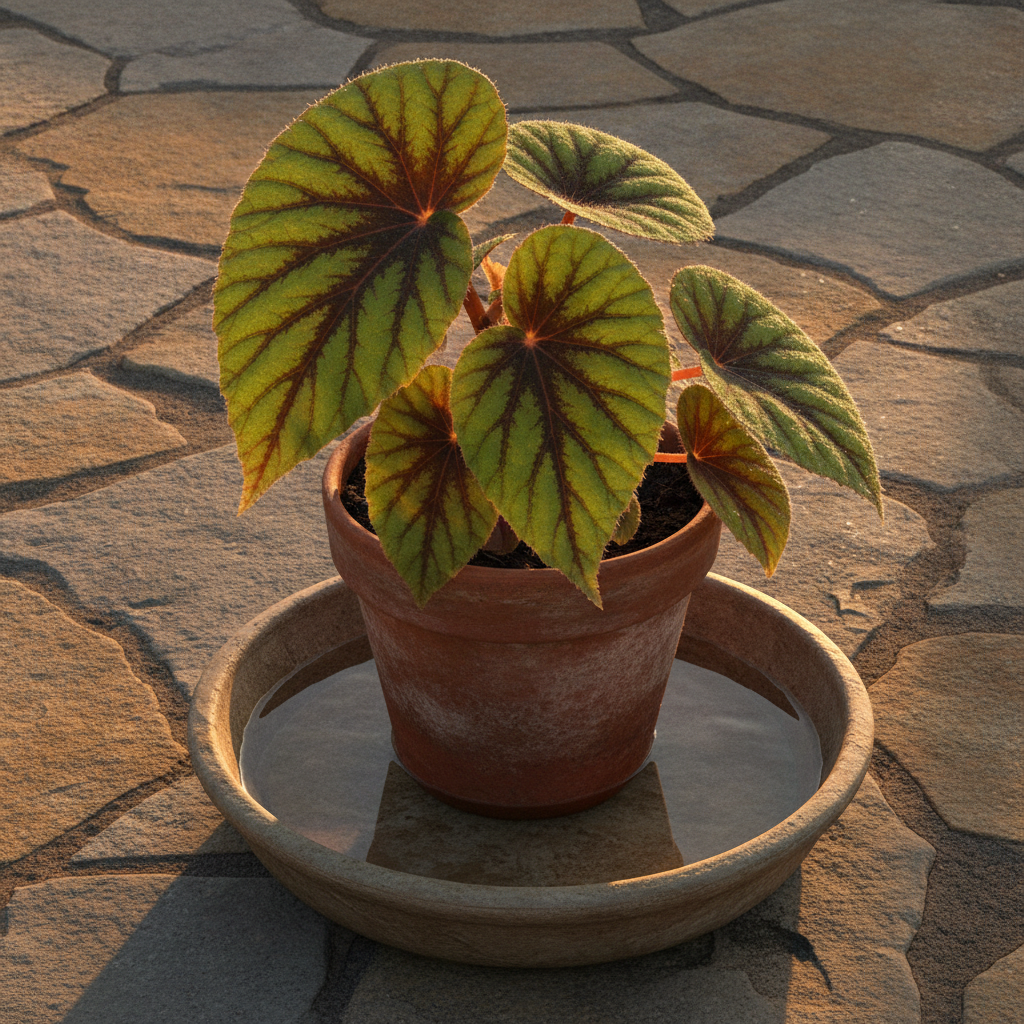
Pro Tip — Water from Below: The bristly leaves and the fleshy rhizome both dislike sitting wet. Set the pot in a shallow dish of water for 15 to 20 minutes and let the soil wick moisture up from the base, then tip away whatever is left. This keeps the crown dry and greatly reduces the risk of fungal disease.
How to Water Correctly
- Check that the top 2 to 3 cm (1 in) of soil has dried before watering.
- Use room-temperature water; cold water from the tap can shock the roots.
- Water at the soil surface or from below, keeping the leaves and rhizome crown dry.
- If watering from above, apply slowly until moisture runs from the drainage holes.
- Let the pot drain fully and never leave it standing in a saucer of water.
- Empty any catch tray within half an hour of watering.
Signs of Overwatering vs. Underwatering
| Symptom | Overwatering | Underwatering |
|---|---|---|
| Leaf colour | Yellowing, often starting from the centre out | Dull, with browning crispy edges |
| Leaf texture | Soft, limp, sometimes translucent | Thin, curling and brittle |
| Soil | Stays wet for days, may smell sour | Pulls away from the pot, dusty dry |
| Rhizome | Soft, mushy or blackened | Shrivelled and wrinkled |
| Overall | Sudden leaf drop, stem-base collapse | Slow wilting that perks up after watering |
Warning — Root and Rhizome Rot: A soft, blackening rhizome is the most serious problem this plant faces and is almost always caused by overwatering or poor drainage. If you catch it early, unpot the plant, cut away every soft section back to firm white tissue with a sterilised blade, dust the cuts, and repot the healthy remainder into fresh, barely moist mix.
Humidity Requirements
This is a humidity-loving plant. It is happiest at 50 to 70 per cent relative humidity, well above the 30 to 40 per cent typical of a centrally heated home. In dry air the leaf edges brown and crisp, new growth comes in small, and the plant looks perpetually thirsty no matter how carefully you water.
The early warning signs of low humidity are crisp brown leaf margins and tips, paired with smaller, less textured new leaves. Because these can be confused with underwatering, check the soil first; if it is appropriately moist and the edges are still browning, dry air is the likely culprit.
To raise humidity, group the begonia with other plants so they share their collective transpiration, stand the pot on a wide tray of damp pebbles with the pot base clear of the water, or run a small room humidifier nearby, which is by far the most reliable method. Avoid misting the leaves directly: the hairy, puckered surface holds water in its valleys and invites the powdery mildew and grey mould this species is so prone to. Good humidity paired with steady airflow is the winning combination.
Water Quality
Iron Cross Begonias are moderately sensitive to the salts and minerals in hard tap water, which can accumulate in the soil and brown the leaf edges over time. Where your water is very hard or heavily chlorinated, use filtered or rainwater, or leave tap water standing overnight to let some of the chlorine dissipate. Whatever you use, bring it to room temperature first.
Soil, Potting & Repotting
The right soil is the foundation of a healthy Iron Cross Begonia, and it must do two slightly contradictory things at once: hold enough moisture to keep the shallow roots evenly damp, yet drain freely enough that water never lingers around the rhizome. A dense, water-retentive potting compost used straight from the bag is the wrong choice; it stays wet too long and invites rot.
Ideal Soil Composition
Aim for a light, airy, slightly chunky mix built around a peat-free base with plenty of drainage material worked through it. The goal is a substrate that feels fluffy and open in the hand, holds together when lightly squeezed but crumbles apart again, and lets water run straight through when poured.
| Component | Proportion | Function |
|---|---|---|
| Peat-free coir or quality houseplant compost | 50 per cent | Holds moisture and provides body |
| Perlite or pumice | 25 per cent | Opens the mix and improves drainage |
| Fine orchid bark | 15 per cent | Creates air pockets and structure |
| Worm castings or leaf mould | 10 per cent | Adds gentle, slow-release nutrition |
The Iron Cross Begonia prefers a slightly acidic to neutral soil, around pH 5.5 to 6.5, which suits the coir-based mix above without any adjustment. If you garden with very alkaline tap water, the occasional flush with rainwater will help keep the root zone in this comfortable range.
Pro Tip — Quick Mix Recipe: If you want a fast, reliable blend, combine two parts peat-free houseplant compost, one part perlite and one part fine orchid bark, with a generous handful of worm castings stirred through. This open, free-draining mix suits the great majority of rhizomatous begonias.
Choosing the Right Pot
Because the plant grows from a surface-creeping rhizome and has shallow roots, it does best in a wide, shallow pot rather than a deep one. A broad container gives the rhizome room to spread and reduces the volume of soil sitting wet below the roots.
Drainage holes are non-negotiable. Whatever pot you choose must have one or more drainage holes. Without them, water collects at the base, the rhizome sits in a permanent puddle and rot is only a matter of time. Decorative cover pots are fine, but lift the inner pot out to water and drain.
Pot material: Terracotta is the safest choice for this rot-prone plant because its porous walls let the soil breathe and dry more evenly. Glazed ceramic and plastic both hold moisture longer, which can work in a very dry home but demands more careful watering elsewhere.
Pot size: Pot up only one size at a time, choosing a container 2 to 3 cm (1 in) wider than the current one. An oversized pot holds a reservoir of wet soil the small root system cannot use, which is a recipe for rot.
When to Repot
Iron Cross Begonias are not vigorous growers and dislike being disturbed, so they need repotting only every other year at most, or when the rhizome has visibly reached the edge of the pot and begun to grow over the rim. The best time is early spring, just as new growth resumes, which gives the plant the whole season to settle. Refreshing the top few centimetres of soil each spring is a gentler alternative that keeps nutrition topped up without the stress of a full repot.
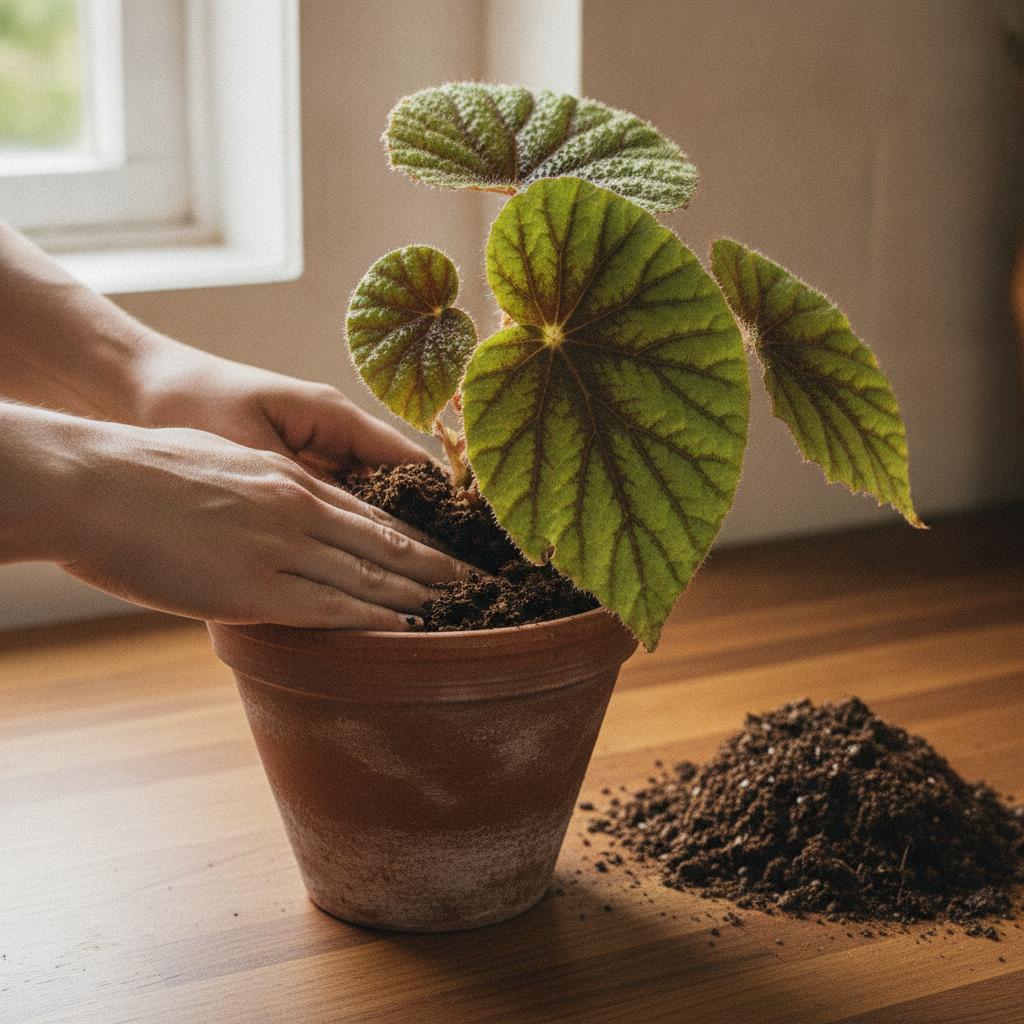
How to Repot: Step-by-Step
- Water the plant lightly a day ahead so the root ball holds together.
- Ease the plant out by tipping the pot rather than pulling on the rhizome.
- Gently tease away loose old soil and inspect the rhizome and roots for any soft, dark patches.
- Cut away any rotten tissue with a sterilised blade and let large cuts air for an hour.
- Position the plant in the new pot so the rhizome rests on the surface, never buried.
- Fill around it with fresh mix, firming lightly, keeping the rhizome at or just above soil level.
- Water sparingly and keep the plant out of direct sun for a week while it recovers.
Warning — Transplant Shock: This begonia resents root disturbance and may drop a leaf or two after repotting. Do not respond by watering more; keep the mix barely moist, hold off feeding for a month, and let the plant settle. Overwatering a freshly repotted, stressed begonia is the quickest way to lose it.
Fertilising
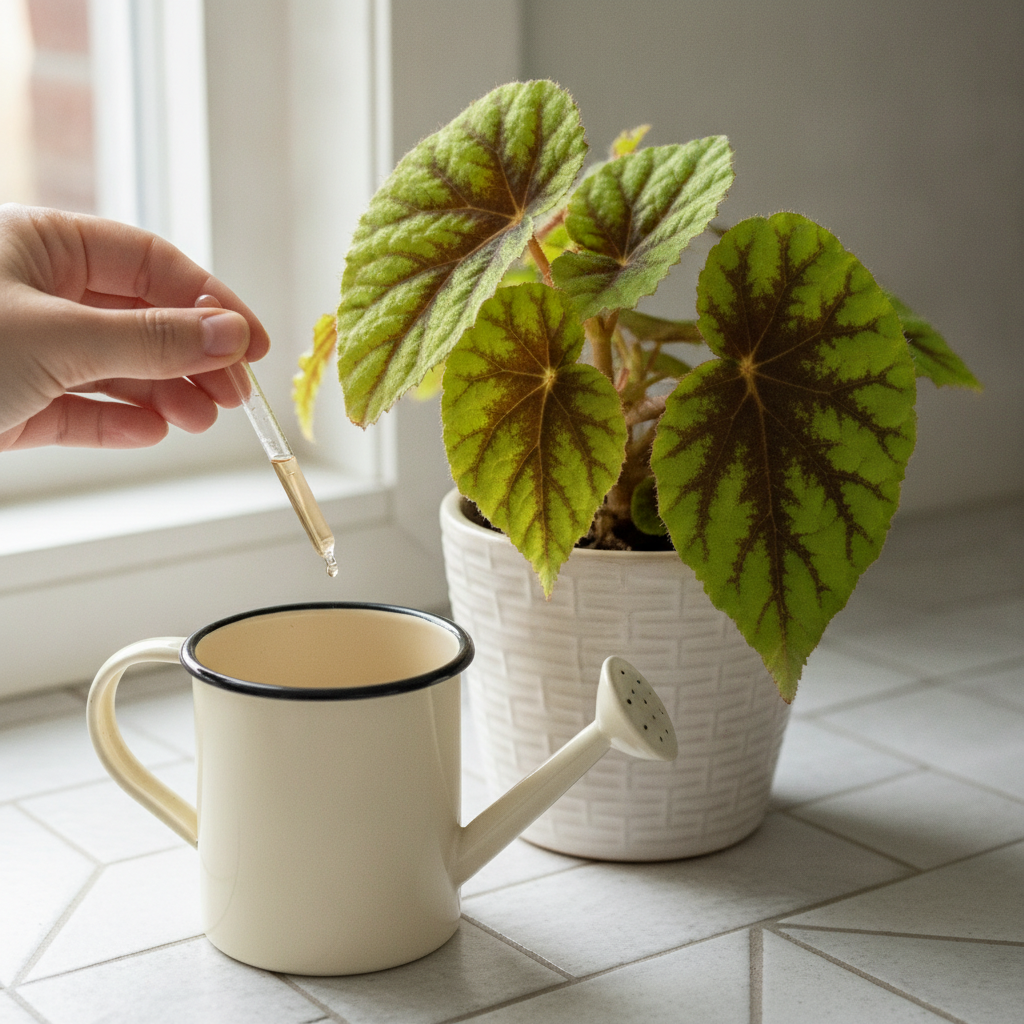
The Iron Cross Begonia is a light feeder. In the wild it draws modest nutrition from decaying leaf litter on the forest floor, and indoors it needs only a gentle, regular supply during the growing season to keep its leaves large and well coloured. Overfeeding does far more harm than underfeeding, scorching the sensitive roots and browning the leaf edges.
Feed only when the plant is actively growing, from spring through to early autumn, and stop entirely in winter when growth pauses. A plant fed steadily through the warm months has the resources to push out generously sized new leaves; one fed in the dark of winter simply accumulates unused salts in its soil.
Understanding Plant Nutrients
A balanced fertiliser supplies the three primary nutrients shown on the label as an N-P-K ratio, along with secondary nutrients and trace elements. For a foliage plant like this begonia, a roughly even balance works well, with nitrogen supporting leaf growth while the other elements keep roots and overall metabolism healthy.
| Nutrient | Symbol | Primary Function | Deficiency Symptoms |
|---|---|---|---|
| Nitrogen | N | Leaf and stem growth | Pale, yellowing older leaves |
| Phosphorus | P | Root development and energy | Stunted growth, dull foliage |
| Potassium | K | Overall vigour and disease resistance | Browning leaf edges, weak growth |
| Calcium | Ca | Cell-wall structure | Distorted, weak new leaves |
| Magnesium | Mg | Core of the chlorophyll molecule | Yellowing between leaf veins |
| Iron | Fe | Chlorophyll production | Yellow new leaves with green veins |
Types of Fertiliser
Liquid fertilisers: The easiest and most controllable option for this plant. Diluted into the watering can, a balanced liquid feed delivers nutrients evenly and is simple to dial back if the plant shows any sign of overfeeding. This is the recommended approach for most growers.
Slow-release granular: Convenient but harder to control, since the prills release nutrients with warmth and moisture regardless of the plant’s needs. If you use them, apply at half the stated rate to avoid overwhelming a light feeder.
Organic fertilisers: Worm castings worked into the soil or a dilute seaweed feed suit this begonia well, providing gentle, low-concentration nutrition that is very hard to overdo and that also supports healthy soil life.
Feeding Schedule
Feed once a month with a balanced liquid fertiliser diluted to half the recommended strength throughout spring and summer. That cadence is plenty for a plant of this modest appetite. Suspend feeding entirely from mid-autumn until the following spring, and resume only once you see fresh new leaves unfurling.
Pro Tip — Always Half Strength: The roots of Begonia masoniana are easily burned by concentrated feed. Whatever the label recommends, dilute to half, and feed onto already-damp soil rather than dry, so the nutrients spread evenly and never sit in a concentrated pocket against the roots.
How to Fertilise
- Water the plant lightly first, or feed onto soil that is already damp.
- Dilute a balanced liquid fertiliser to half the recommended strength.
- Apply at the soil surface, avoiding the leaves and rhizome crown.
- Allow any excess to drain, and empty the catch tray.
- Every few months, flush the pot with plain water to wash out accumulated salts.
Warning — Salt Build-Up: A white crust on the soil surface or pot rim, paired with browning leaf edges, signals a build-up of fertiliser salts. Flush the pot thoroughly with plenty of plain water, letting it run freely from the drainage holes, and scale back your feeding for a while.
Propagation
One of the quiet joys of the Iron Cross Begonia is how readily it can be multiplied. Because it grows from a rhizome and because begonias are famous for regenerating from leaf tissue, you have two reliable routes to new plants: dividing the rhizome and taking leaf cuttings. Both are best attempted in spring or early summer, when warmth and lengthening days drive fast, vigorous rooting.
Propagation is also a useful rescue technique. If a plant succumbs to rot at the base, you can often save it by taking healthy leaves or firm sections of rhizome from the surviving top growth and starting again, leaving the diseased material behind.
Understanding the Rhizome
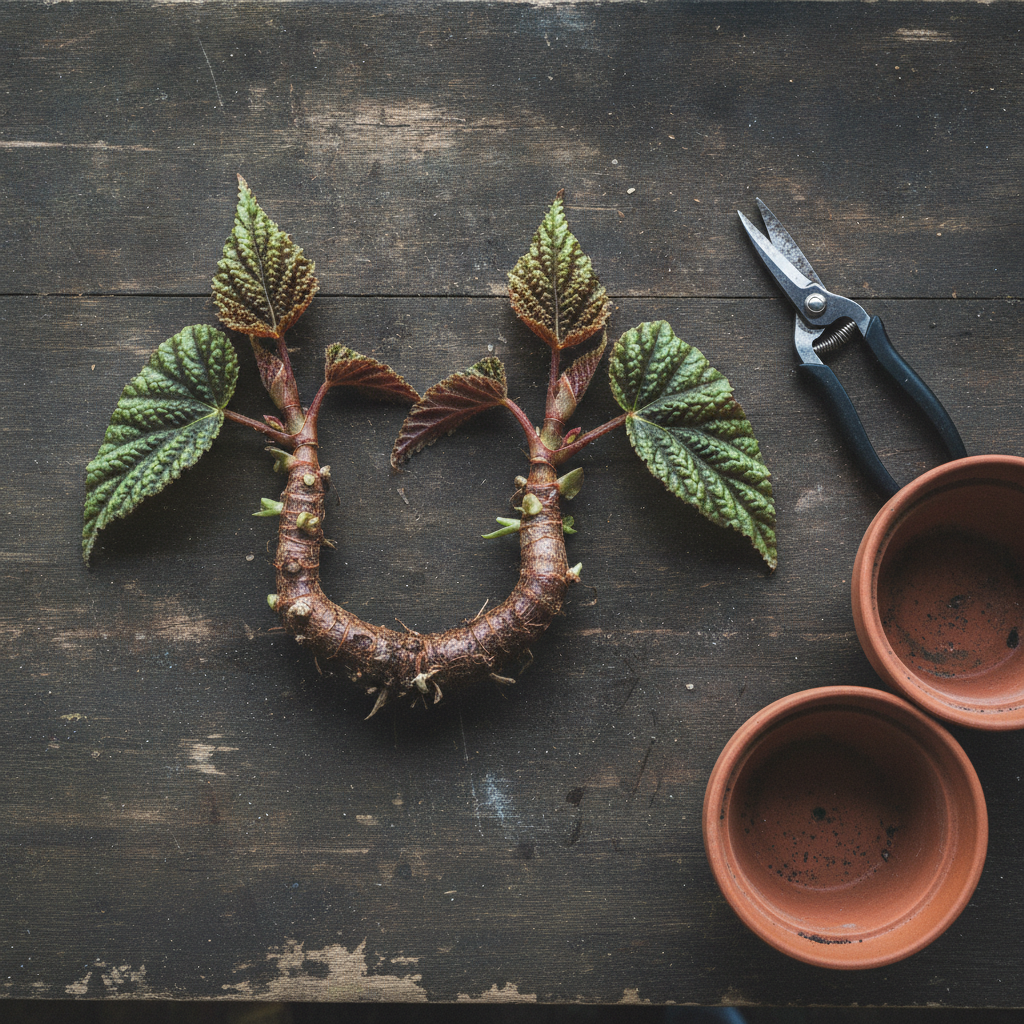
The rhizome is the thick, knobbly, horizontal stem that creeps along the soil surface, sending roots down and leaves up as it goes. It is the plant’s engine and its storehouse, and it holds dormant growth points along its length. Both propagation methods rely on this structure: division splits the rhizome into self-sufficient pieces, while leaf cuttings coax entirely new rhizomes to form from leaf tissue. Knowing where the growth points and veins sit makes both techniques far more reliable.
Rhizome Division: Step-by-Step
Division is the quickest method and gives you established plants almost immediately. It works best on a mature plant whose rhizome has branched, and it pairs naturally with spring repotting.
- Unpot the plant and gently shake away enough soil to see the rhizome clearly.
- Identify sections that each carry a length of rhizome, some roots and at least one or two leaves.
- Cut between these sections with a sterilised, sharp blade, making clean cuts.
- Let the cut surfaces air-dry for an hour to form a protective callus.
- Pot each division into its own small pot of fresh, barely moist begonia mix, rhizome resting on the surface.
- Keep warm, in bright indirect light, and water sparingly until you see new growth.
Pro Tip — Sterilise Your Blade: Begonias are vulnerable to bacterial and fungal infection through fresh cuts. Wipe your knife or secateurs with isopropyl alcohol before every cut, and let all cut surfaces callus over before they touch damp soil. This single habit prevents the majority of propagation failures.
Leaf Cuttings: Step-by-Step
Leaf cuttings are slower but more productive, and they are the classic way to propagate rhizomatous begonias. A single healthy leaf can yield several plantlets. The method relies on wounding the major veins, from which new rhizomes and roots emerge.
- Choose a healthy, mature leaf and remove it with a short length of stalk attached.
- Turn the leaf over and make shallow cuts across the main veins with a sterilised blade.
- Lay the leaf underside down on a tray of damp, well-draining propagation mix, weighting the cut points into contact with the surface.
- Cover with a clear lid or place in a humidity box to hold moisture, and keep warm in bright indirect light.
- Ventilate daily to prevent mould, and keep the mix lightly moist but never wet.
- After several weeks, tiny plantlets form at the cut veins; pot them on once they have a few leaves of their own.
Troubleshooting Propagation
| Problem | Likely Cause | Solution |
|---|---|---|
| Cuttings rot before rooting | Mix too wet or cuts not callused | Use a leaner mix, callus cuts, and ventilate the propagator |
| Leaf goes mouldy | Stagnant, overly humid air | Open the cover daily and improve airflow |
| No plantlets after weeks | Too cold or too dark | Raise the temperature and increase light gently |
| Divisions wilt and fail | Too little root, or watered too heavily | Keep divisions warm and humid, water sparingly until established |
Pests & Diseases
The Iron Cross Begonia’s combination of high humidity needs and dense, hairy foliage makes it more disease-prone than the average houseplant, and its soft tissue appeals to several common sap-feeding pests. The good news is that almost every problem is preventable with good airflow, careful watering and regular inspection. Catching trouble early is the difference between a quick fix and a lost plant.
Make a habit of turning over a few leaves and checking the leaf axils each time you water. Pests are far easier to control when you spot the first few than when an infestation has taken hold, and fungal diseases spread quickly once established on this species.

Common Pests
Mealybugs (Pseudococcus species)
Small, soft-bodied insects coated in white, cottony wax that gather in leaf axils and along the rhizome, sucking sap and weakening the plant. Their hiding places among the textured leaves and crown make them especially troublesome on this begonia.
Treatment: Dab each insect with a cotton bud dipped in isopropyl alcohol, then treat the whole plant with insecticidal soap. Repeat every week for three to four weeks to catch newly hatched young, and isolate the plant while you do.
Spider Mites (Tetranychus urticae)
Tiny arachnids that thrive in dry air, exactly the conditions that already stress this plant. They cause fine pale stippling on the leaves and spin delicate webbing in severe cases, gradually bronzing the foliage.
Treatment: Raise the humidity, which mites hate, and treat affected plants with insecticidal soap or a suitable miticide, paying particular attention to the leaf undersides. Improving humidity alone often turns the tide.
Fungus Gnats (Bradysia species)
Small black flies whose larvae live in consistently moist soil, the very condition this begonia is kept in. The adults are a nuisance and the larvae can nibble fine roots and seedlings.
Treatment: Let the top layer of soil dry a little more between waterings, cover the surface with a thin layer of grit, and use yellow sticky traps to catch the adults. A biological control such as Bacillus thuringiensis can break the larval cycle.
Common Diseases
Powdery Mildew (Oidium species)
The signature disease of begonias, appearing as a dusty white coating on the leaf surface. It thrives in humid, stagnant air and is one of the main reasons this plant should never be misted.
Treatment: Remove affected leaves promptly, dramatically improve airflow around the plant, and treat with a suitable fungicide or a dilute potassium bicarbonate spray. Lowering leaf wetness while keeping ambient humidity up is the key to lasting control.
Grey Mould (Botrytis cinerea)
A fuzzy grey-brown fungal growth that takes hold on damaged or wet tissue, especially in cool, damp, poorly ventilated conditions. It can rot leaves and stems rapidly once established.
Treatment: Cut away all affected material with a sterilised blade, reduce humidity slightly, increase airflow and avoid wetting the foliage. Remove fallen leaves and debris from the soil surface, which is where the fungus often starts.
Rhizome and Root Rot (Pythium and Rhizoctonia species)
Soil-borne rots that attack the rhizome and roots in waterlogged conditions, turning firm white tissue soft, brown and mushy. This is the most dangerous disease for the plant and is almost entirely a watering and drainage problem.
Treatment: Unpot immediately, cut away every soft section back to firm tissue, and repot the healthy remainder into fresh, free-draining mix kept barely moist. Correct the underlying overwatering or the rot will simply return.
Pest and Disease Summary
| Pest / Disease | Identification | Treatment |
|---|---|---|
| Mealybugs | White cottony tufts in axils and crown | Alcohol swab, then insecticidal soap weekly |
| Spider mites | Fine stippling and faint webbing | Raise humidity, treat with soap or miticide |
| Fungus gnats | Small black flies around moist soil | Dry the surface, grit topping, sticky traps |
| Powdery mildew | Dusty white coating on leaves | Remove leaves, improve airflow, fungicide |
| Grey mould | Fuzzy grey-brown growth on damp tissue | Cut out, reduce humidity, increase airflow |
| Rhizome rot | Soft, brown, mushy rhizome or roots | Cut to firm tissue, repot dry, fix watering |
Prevention Strategies
Prevention with this plant comes down to a handful of habits. Provide steady airflow around the foliage, water at the soil rather than over the leaves, avoid misting, and never let the pot stand in water. Good light and a free-draining mix keep the plant vigorous enough to shrug off minor pest pressure on its own.
Quarantine every new plant for a couple of weeks before it joins your collection, inspect your begonia each time you water, and remove dead or damaged leaves promptly so fungi have nowhere to gain a foothold. A clean, well-ventilated growing spot does more to prevent disease than any spray.
Pro Tip — Airflow Is Everything: The most effective single thing you can do to keep an Iron Cross Begonia healthy is to keep the air around it moving. A small fan on a low setting nearby, or simply a position that is not boxed into a stagnant corner, prevents the humid microclimate around the leaves that mildew and mould need to take hold.
Popular Varieties
Although Begonia masoniana is most often sold simply as the Iron Cross Begonia, the species has produced several distinct selections and closely related forms, prized for variations in leaf size, puckering and the boldness of the central marking. Collectors seek these out, and a few have become reasonably available through specialist nurseries.
Beyond the named forms below, the wider world of rhizomatous begonias offers many leaves with similar texture and patterning, so if you fall for the iron cross you will find no shortage of relatives to grow alongside it. The forms here are the ones most often offered under the masoniana name.
| Variety | Leaf Appearance | Light Needs | Growth Rate | Availability |
|---|---|---|---|---|
| Iron Cross (species) | Bright green, puckered, bold dark cross | Bright indirect | Moderate | Common |
| ‘Mountain’ | Coarser puckering, broader marking | Bright indirect | Moderate | Specialist |
| ‘River’ | Elongated leaves, silvery overlay | Bright indirect | Moderate | Specialist |
| ‘China Curl’ | Spiralled, curling leaf lobes | Bright indirect | Slow | Rare |
Featured Varieties
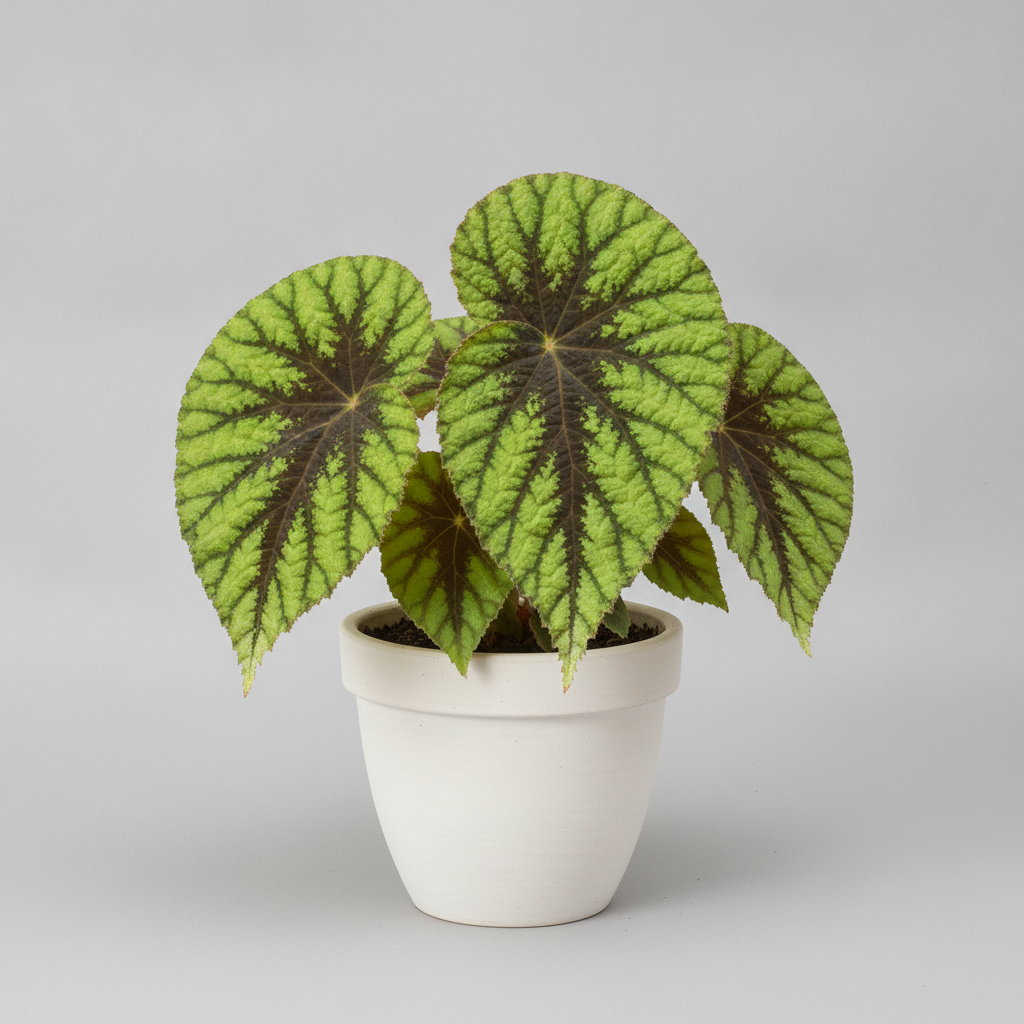
‘Mountain’
A rugged selection with deeper, coarser puckering across the leaf and a broader, bolder iron-cross marking, giving it an even more sculptural, three-dimensional look than the species.
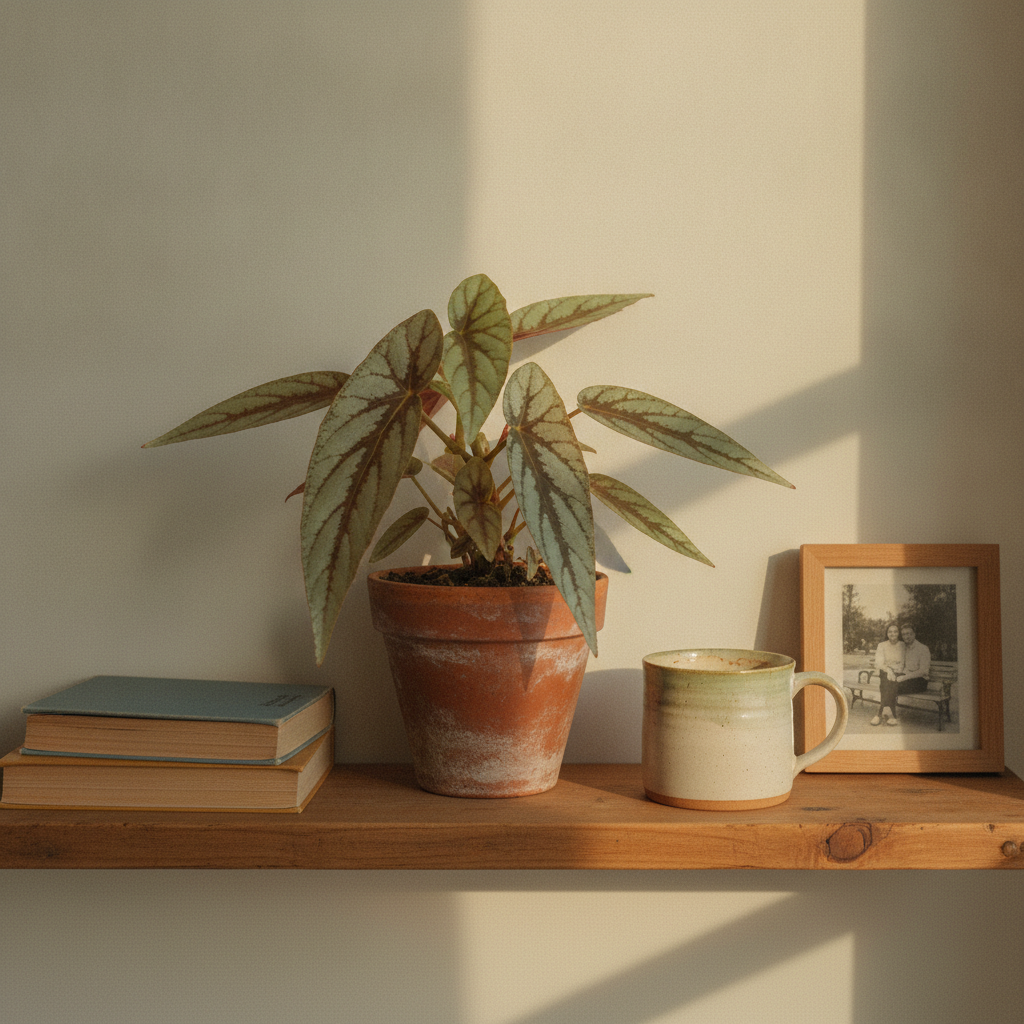
‘River’
A distinctive form with more elongated, narrower leaves and a softer silvery-green overlay around the central bronze marking, lending it a cooler, more luminous appearance.
Variety Profiles in Detail
Iron Cross, the species (Begonia masoniana)
The original and still the most widely grown form, with rounded, heavily quilted apple-green leaves and the unmistakable five-armed chocolate cross at the centre. Everything in this guide applies first and foremost to the species, and it remains the best entry point for anyone new to rhizomatous begonias.
‘Mountain’ (Begonia masoniana ‘Mountain’)
Sometimes listed as a botanical variety rather than a cultivar, ‘Mountain’ pushes the texture of the species further still, with thicker, more deeply puckered leaves and a heavier, broader marking. It is a touch more robust than the type but appreciates exactly the same care.
‘River’ (Begonia masoniana ‘River’)
A more recent introduction with a markedly different silhouette, its leaves longer and narrower and washed with a silvery sheen that softens the cross into a bronze blush. It brings welcome variation to a collection while keeping the family resemblance.
Choosing the Right Variety for Your Space
For most homes the species itself is the obvious choice: widely available, reasonably priced and the most forgiving of the group. If you already grow the standard plant and want to expand, ‘Mountain’ offers more drama in the same compact footprint, while ‘River’ brings a cooler, silvery contrast. All of them want the same bright indirect light, careful watering and good airflow, so adding a second form is a matter of taste rather than a change in routine.
Frequently Asked Questions
Why are the edges of my Iron Cross Begonia’s leaves turning brown and crispy?
Crispy brown leaf margins almost always point to low humidity, sometimes combined with hard water or a build-up of fertiliser salts. Raise the humidity towards 50 to 70 per cent with a humidifier or pebble tray, switch to filtered or rainwater if your tap water is hard, and flush the pot occasionally to clear accumulated salts.
Is the Iron Cross Begonia toxic to cats and dogs?
Yes. Like all begonias it contains soluble calcium oxalates and is toxic to cats and dogs, with the highest concentration in the underground rhizome. Eating it can cause intense mouth irritation, drooling and vomiting in pets, so keep the plant well out of their reach.
Should I mist my Iron Cross Begonia to raise humidity?
No. Although the plant loves humidity, its hairy, puckered leaves trap water in their valleys and misting invites powdery mildew and grey mould, two diseases this species is highly prone to. Raise humidity around the plant instead, using a humidifier, a pebble tray or by grouping plants together.
Why is my plant’s rhizome turning soft and black?
A soft, blackening rhizome is rhizome rot, caused by overwatering or poor drainage. Unpot the plant at once, cut away all soft tissue back to firm white flesh with a sterilised blade, let the cuts air-dry, and repot the healthy remainder into fresh, free-draining mix kept only barely moist.
How often should I water an Iron Cross Begonia?
Water when the top 2 to 3 cm (1 in) of soil has dried, which usually means once or twice a week in the growing season and less in winter. Let the soil guide you rather than a fixed schedule, and aim for evenly moist soil that is never waterlogged.
Why does my Iron Cross Begonia look leggy and pale?
Stretched, weak growth and faded colouring are classic signs of insufficient light. Move the plant to a brighter spot with plenty of indirect light, such as near an east-facing window, or add a grow light. Be sure to acclimatise it gradually so brighter conditions do not scorch the leaves.
Does the Iron Cross Begonia flower?
It can produce small, greenish-white flowers on tall stalks, but they are insignificant compared with the foliage. Many growers remove the flower spikes so the plant channels its energy into producing larger, better leaves, which is the real reason to grow this begonia.
How do I propagate an Iron Cross Begonia?
You can divide the rhizome into sections that each carry roots and leaves, or take leaf cuttings by wounding the veins of a healthy leaf and laying it on damp propagation mix. Both work best in spring or early summer, in warmth and bright indirect light, with sterilised tools to avoid infection.
What is the ideal temperature for this plant?
The Iron Cross Begonia prefers a steady 18 to 24°C (64 to 75°F). Keep it away from cold draughts, unheated rooms below about 15°C (59°F) and the hot, dry air directly above radiators, all of which stress the plant and damage the foliage.
Why is my Iron Cross Begonia dropping leaves?
Sudden leaf drop usually follows a stress such as overwatering, a cold draught, repotting shock or a sharp drop in humidity. Review your conditions, make sure the soil is moist but not soggy, keep the plant warm and stable, and avoid the temptation to water more, which often makes the problem worse.






