
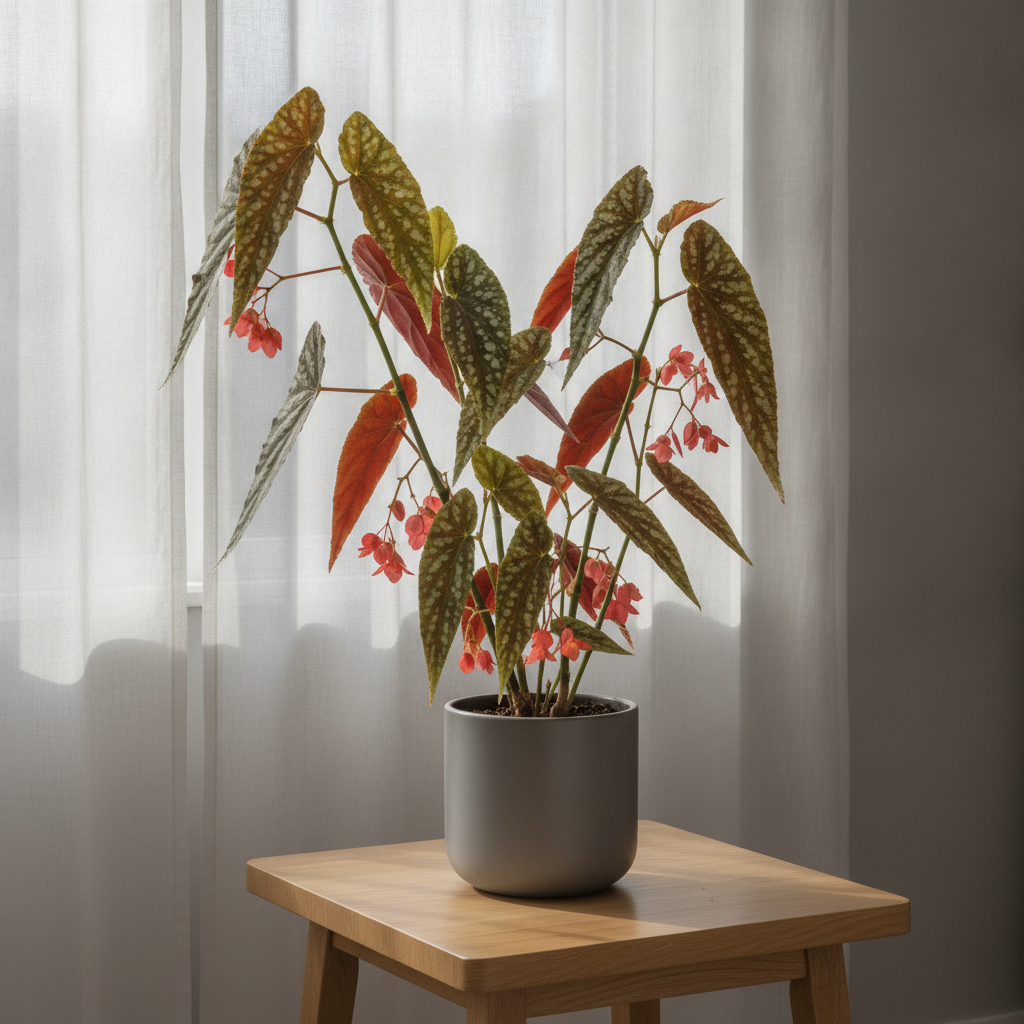
The Swiss Cheese Begonia, known to botanists as Begonia coccinea and sold almost as often under its older name of Angel Wing Begonia, is one of the founding members of the cane begonia group. It grows from upright, jointed stems that look remarkably like slender green bamboo, and from those canes hang large, lopsided leaves shaped like the wings of an angel, deep olive green on top, frequently scattered with silver flecks, and flushed a rich burgundy red beneath. Add to that the pendant clusters of waxy coral-red flowers that appear for much of the year, and it becomes clear why this Brazilian native has been a windowsill favourite since the Victorian era.
Begonias carry an unfair reputation for being temperamental, and the cane types are actually among the most forgiving you can grow. The gap between a plant that merely survives and one that genuinely thrives comes down to a handful of details: enough bright light to keep the canes stocky and the flowers coming, a watering rhythm that never leaves the roots either bone dry or waterlogged, and air that moves freely enough to keep fungal disease at bay. This guide walks through every one of those factors in depth, from the science of how light drives flowering to step-by-step propagation, so that you can keep a Swiss Cheese Begonia looking its best for years rather than months.
Contents
- Quick Reference
- Why the Swiss Cheese Begonia Makes a Rewarding Houseplant
- Light Requirements
- Watering & Humidity
- Soil, Potting & Repotting
- Fertilising
- Propagation
- Pests & Diseases
- Popular Varieties
- Frequently Asked Questions
Quick Reference: Swiss Cheese Begonia at a Glance
| Light | Bright, indirect light with an hour or two of gentle morning sun. Avoid harsh midday sun on the leaves. |
| Watering | Water when the top 2 to 3 cm (1 inch) of mix has dried. Keep evenly moist in growth, slightly drier in winter. |
| Temperature | 18 to 24 degrees C (64 to 75 degrees F). Keep above 13 degrees C (55 degrees F). |
| Humidity | Moderate to high, ideally 50 to 60 percent, but with good airflow and dry foliage. |
| Fertiliser | Balanced liquid feed at half strength every two to four weeks from spring to early autumn. |
| Toxicity | Toxic to cats, dogs and horses if eaten. Mildly irritating to people. Keep away from pets and small children. |
Why the Swiss Cheese Begonia Makes a Rewarding Houseplant
Few houseplants offer as much in a single specimen as a well-grown cane begonia. The Swiss Cheese Begonia earns its place on three counts at once: striking foliage, near year-round flowers, and an upright habit that adds height to a collection without sprawling across the room. The angel-wing leaves alone would justify growing it, but the pendulous trusses of coral blooms, which can appear in almost any month given enough light and warmth, lift it into the category of a flowering houseplant that also happens to have spectacular leaves.
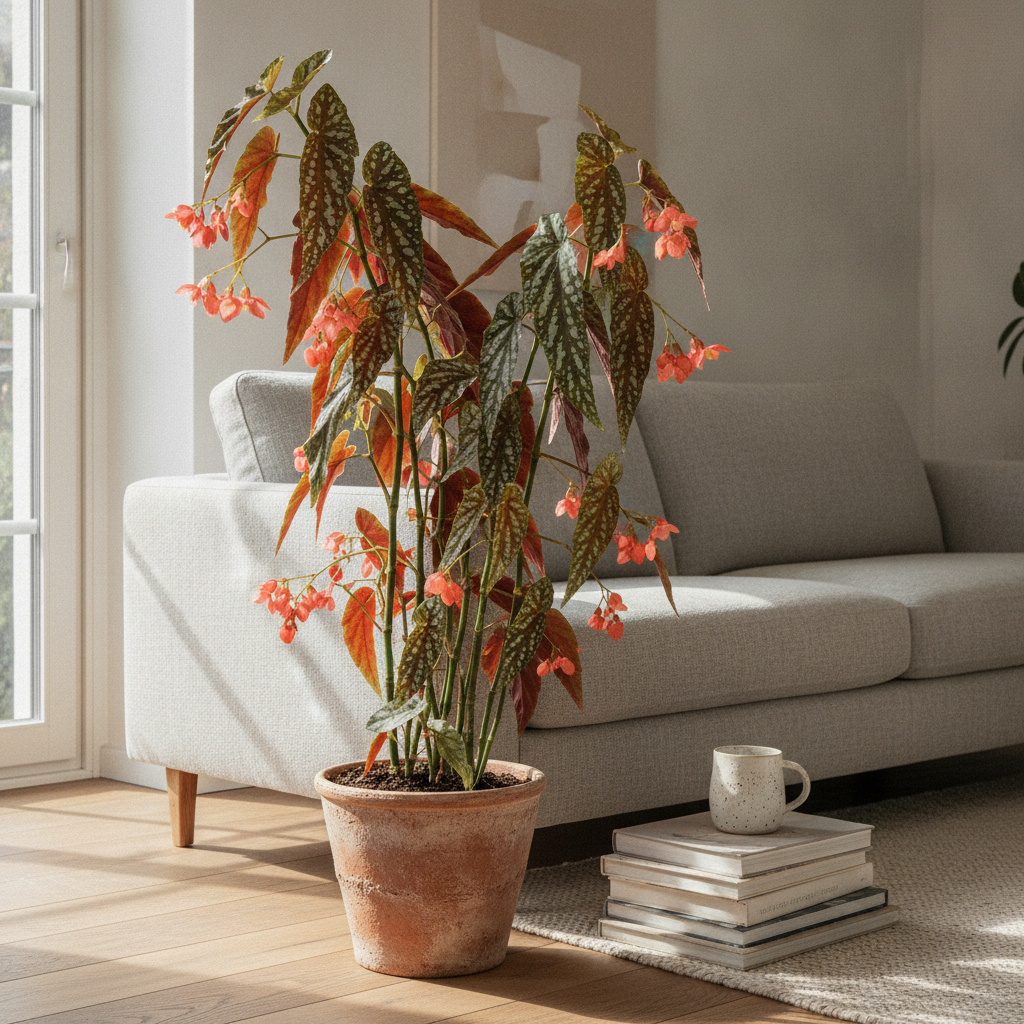
It is also genuinely easy to live with. Cane begonias tolerate ordinary household conditions far better than the fussier rex and rhizomatous begonias, they shrug off the occasional missed watering thanks to moisture stored in their thick canes, and they root so readily from cuttings that one plant can quickly become a windowsill full. For a beginner wanting a plant that looks advanced, or an experienced grower wanting reliable colour, Begonia coccinea delivers on both fronts. The main thing it asks in return is light and air, two things that cost nothing to provide.
Important — Toxicity: All begonias contain insoluble calcium oxalate crystals and soluble oxalic acid, with the highest concentration in the underground parts. Chewing the leaves or stems can cause intense mouth and throat irritation, drooling, vomiting and difficulty swallowing in cats, dogs and horses, and mild mouth irritation in people. Site the plant out of reach of pets and small children, and wash your hands after taking cuttings.
Light Requirements
Light is the single biggest lever you have over how a Swiss Cheese Begonia performs. In its native Brazilian forests it grows at the bright edges of the canopy rather than in deep shade, which translates indoors to a need for strong, mostly indirect light. Give it enough and you are rewarded with short spaces between the leaf joints, sturdy self-supporting canes, vivid silver markings and a steady supply of flowers. Give it too little and the plant stretches, the leaves grow further apart, the silver fades, and flowering stops altogether.
The ideal is a position that receives bright ambient light all day with a short spell of direct sun that is gentle rather than scorching, such as early morning light. A spot just back from an east-facing window, or a metre or so inside a bright south-facing room shielded by a sheer curtain, suits it almost perfectly. The leaves will tell you when the balance is right: they sit flat and hold good colour, and new growth emerges compact and well marked.
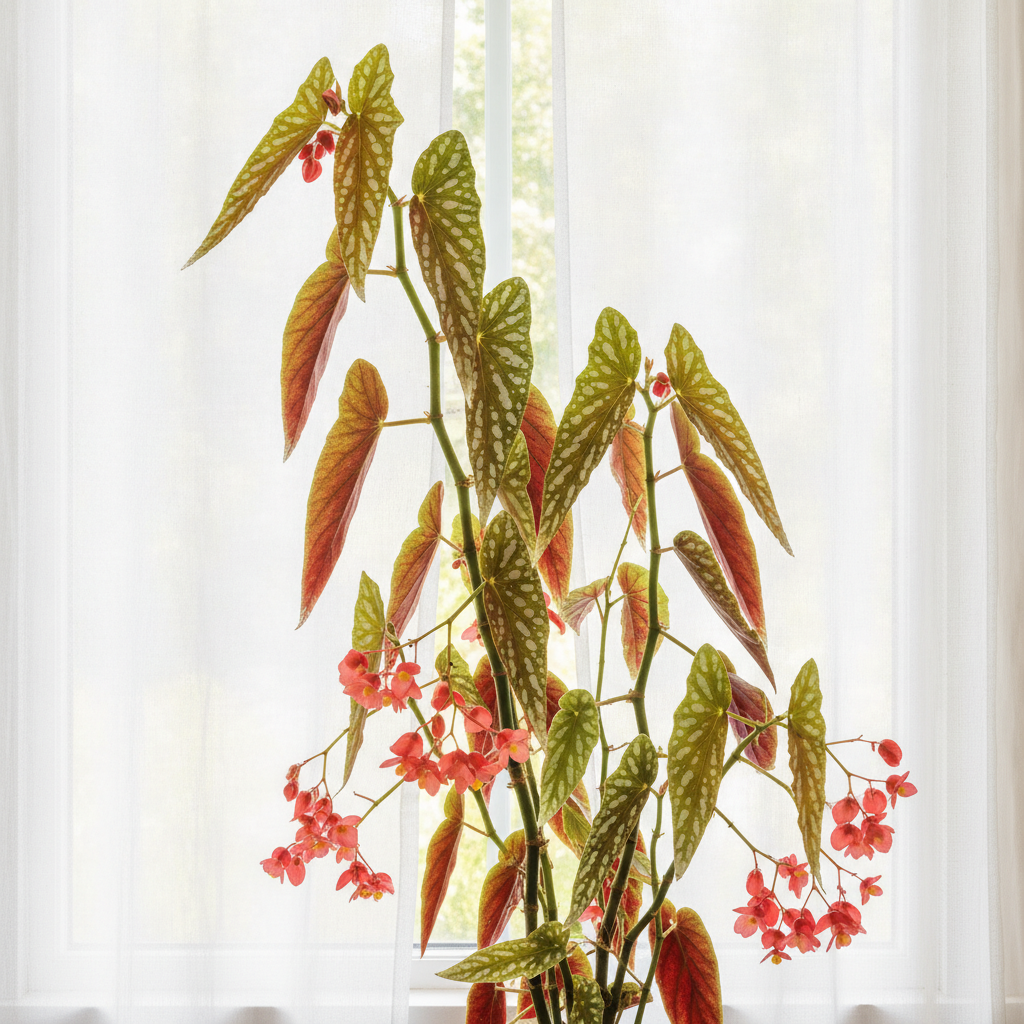
Light Levels Explained
Plant light is measured in lux, and understanding roughly how much light reaches a given spot makes it far easier to place a begonia well. The table below sets out the practical categories and what each one means for this plant.
| Light Category | Approx. Level | Typical Location | Outcome |
|---|---|---|---|
| Direct sun | 50,000 lux and up | On a south sill, midday | Risk of scorched, bleached patches on the leaves |
| Bright indirect | 10,000 to 25,000 lux | Just back from an east or filtered south window | Ideal: compact growth, strong colour, free flowering |
| Medium | 5,000 to 10,000 lux | A metre or two from a bright window | Acceptable: grows well but flowers less reliably |
| Low | 1,000 to 5,000 lux | A north room or interior wall | Leggy stems, faded markings, little or no bloom |
| Very low | Under 1,000 lux | A dim hallway or far corner | Steady decline, dropped leaves, eventual loss |
Window Orientation and Placement
South-facing window: The brightest option and an excellent one, provided you diffuse the midday sun with a sheer curtain or set the plant a short distance back. Unfiltered summer sun directly on the leaves will scorch them, so use the intensity but soften it.
East-facing window: Arguably the perfect aspect. The plant catches cool, gentle morning sun that it can take directly, then enjoys bright indirect light for the rest of the day. Colour and flowering are usually excellent here with no special measures.
West-facing window: Works well, but the afternoon sun is stronger and warmer than morning light, so pull the plant back slightly or filter the glass to avoid leaf burn on hot days.
North-facing window: Usually too dim for good flowering. The plant will live but tends to stretch and lose its silver markings. If a north window is your only option, plan to supplement with a grow light.
Pro Tip — Rotate for Symmetry: Cane begonias lean noticeably toward their light source. Give the pot a quarter turn each time you water so that the canes grow upright and evenly rather than all crowding toward the glass.
How Light Affects Leaf Colour and Flowering
The silver spotting that makes these leaves so distinctive is partly light-dependent. In strong, bright conditions the plant invests in dense, well-defined markings and the burgundy reverse deepens, while in dim light the spots blur and the leaves turn a flatter, plainer green. Flowering responds even more sharply, because forming the heavy coral trusses takes a great deal of stored energy that only enough light can supply. A begonia that has stopped blooming is, nine times out of ten, simply telling you it wants to be brighter.
Warning — Direct Sunlight: Move a begonia into full sun gradually. A plant taken straight from a shaded interior to a sunny sill can develop pale, papery scorch marks within a day or two, and those burned areas never recover. Acclimatise it over a week or two of slowly increasing exposure.
Artificial Lighting
Swiss Cheese Begonias respond very well to supplementary lighting, which makes them a good choice for rooms that lack a bright window. A full-spectrum LED grow light positioned 30 to 45 cm (12 to 18 inches) above the canopy and run for 12 to 14 hours a day will keep growth compact and, crucially, can sustain flowering through the darker months when natural light alone would not. Combining a north window with a grow light often produces better results than a south window with no supplement.
Seasonal Adjustments
Light intensity indoors can fall by half or more between summer and midwinter, so a position that was perfect in June may be too dim by December. As the days shorten, move the plant closer to the window, clean the glass to maximise transmission, and consider switching on a grow light. In high summer, do the reverse and pull the plant back from any window where the strengthening sun could scorch it. Treating placement as a seasonal task rather than a permanent decision keeps the plant in its comfort zone all year.
Watering & Humidity
Watering is where most begonia problems begin, almost always on the side of too much rather than too little. The thick canes act as a water reserve, so the plant copes far better with brief dryness than with sodden roots. The goal is a rhythm of thorough wetting followed by partial drying, never a permanently damp pot and never complete desiccation. Get this balance right and the rest of begonia care becomes straightforward.
When to Water
The reliable cue is the top of the mix. When the top 2 to 3 cm (about 1 inch) has dried out, it is time to water again. During the active growing months of spring and summer this might mean watering every five to seven days, while in the cooler, darker months of late autumn and winter the interval often stretches to once every ten days or fortnight. Rather than watering on a fixed calendar, check the mix with a finger or a wooden skewer each time and let the plant’s actual needs guide you.
Temperature, light and pot size all change how fast a begonia dries out, so a single schedule will never fit every situation. A plant in a small terracotta pot on a warm, bright sill will drink far more often than the same plant in a large plastic pot in a cool room. Learn to read the pot’s weight too: a freshly watered pot is noticeably heavy, and a pot ready for water feels light when lifted. That tactile check quickly becomes second nature.
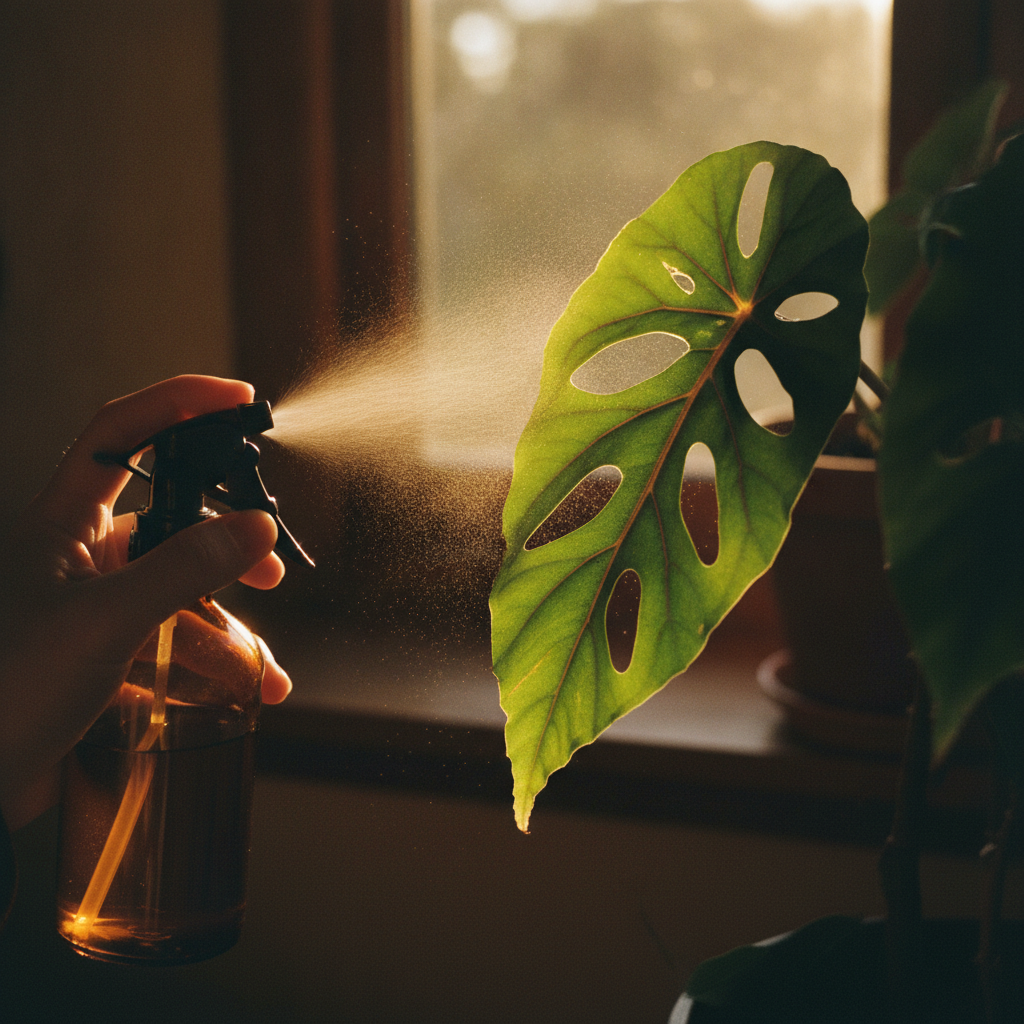
Pro Tip — Keep the Leaves Dry: Begonias are prone to powdery mildew, and standing water on the foliage invites it. Water at the soil level or from below, and if you must mist the air for humidity, do it in the morning so any droplets on the leaves dry quickly.
How to Water Correctly
- Check that the top 2 to 3 cm of mix has dried before reaching for the watering can.
- Water around the base of the canes at soil level, keeping the spout below the leaves to avoid wetting the foliage.
- Apply water slowly and steadily until it runs freely from the drainage holes, which ensures the whole root ball is moistened.
- Let the pot drain completely for several minutes so no water is left sitting in the saucer or cover pot.
- Tip away any water that collects in the saucer, since a begonia left standing in it is the fastest route to root rot.
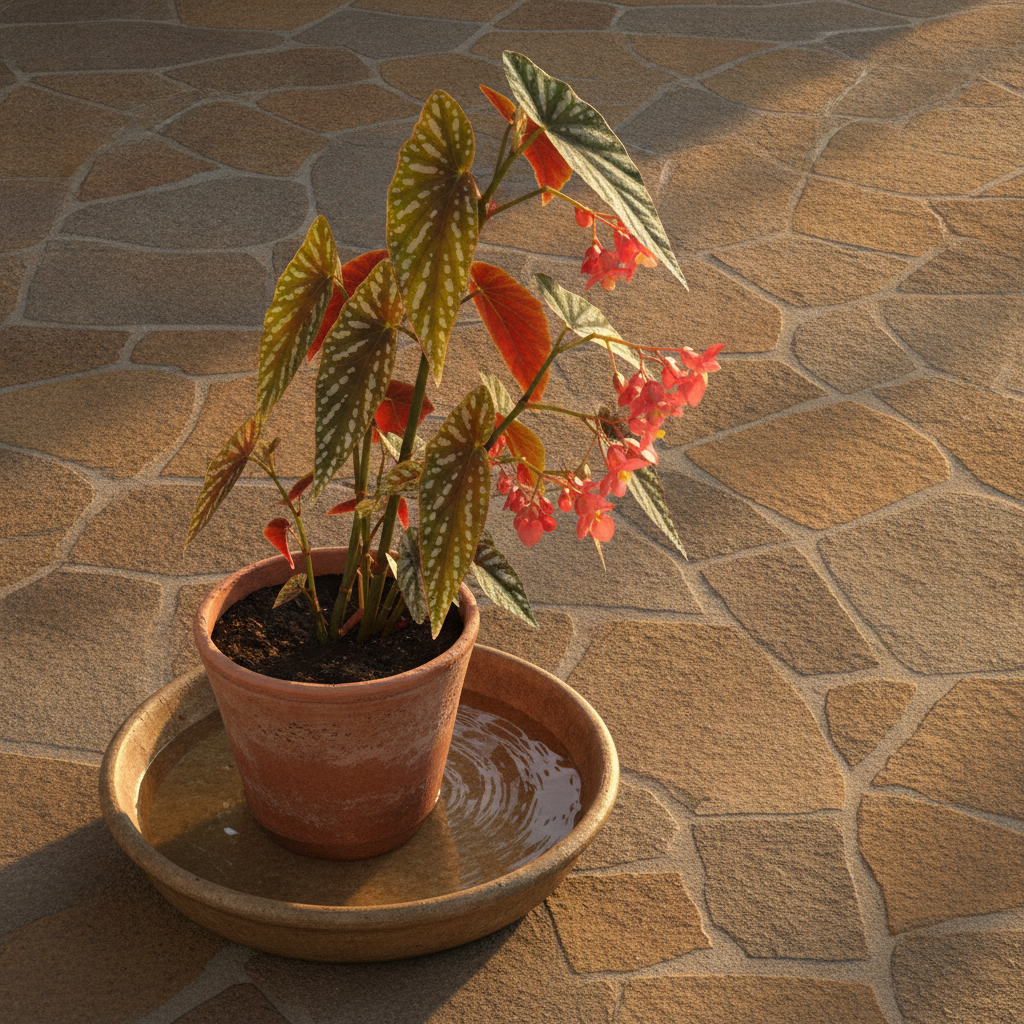
- For an even gentler approach, set the pot in a shallow dish of water for 15 to 20 minutes, let it draw moisture up from below, then drain.
Signs of Overwatering vs. Underwatering
| Symptom | Overwatering | Underwatering |
|---|---|---|
| Leaf colour | Yellowing, often starting with lower leaves | Browning and crisping at the leaf edges |
| Leaf texture | Soft, limp, sometimes translucent | Thin, papery and curling |
| Soil | Constantly wet, may smell sour | Bone dry, pulling away from the pot sides |
| Roots | Brown, mushy and foul smelling | Dry but firm and pale |
| Stem base | Soft, blackened or collapsing canes | Shrivelled, slightly wrinkled canes |
Warning — Root Rot: Blackened, collapsing canes and a sour smell from the pot signal advanced root rot. Act fast: unpot the plant, cut away every soft brown root and any rotted cane back to firm green tissue, and repot into fresh, airy mix. Healthy upper sections of cane can often be saved as cuttings even if the base is lost.
Humidity Requirements
As a plant of warm, humid Brazilian forests, the Swiss Cheese Begonia appreciates moisture in the air and is happiest at around 50 to 60 percent relative humidity. It will tolerate ordinary room humidity, but in very dry conditions, such as a room with central heating running through winter, the leaf edges may brown and new growth can be small. The trick is to raise humidity without leaving the foliage wet, because damp leaves and stagnant air together breed disease.
Browning leaf tips, crisp leaf margins and buds that dry up before opening are the classic signs that the air is too dry for the plant’s liking. These symptoms are easy to confuse with underwatering, so check the mix first, and if it is appropriately moist yet the edges still brown, suspect low humidity as the culprit.
The safest ways to raise humidity for a begonia are indirect ones: stand the pot on a tray of damp pebbles so evaporation lifts the local humidity, group it with other plants to create a moister microclimate, or run a small room humidifier nearby. All of these avoid the misting that, for begonias specifically, does more harm than good by encouraging mildew. Good airflow from an open door or a gently oscillating fan complements raised humidity and keeps fungal problems away.
Water Quality
Swiss Cheese Begonias are not especially fussy about water, but they do best with water at room temperature rather than straight from a cold tap, which can shock the roots. In areas with very hard or heavily chlorinated water, mineral build-up can gradually mark the leaf edges, so if you notice this, switch to filtered water, collected rainwater, or tap water that has been left to stand overnight so the chlorine can dissipate.
Soil, Potting & Repotting
Cane begonias have relatively fine, fibrous roots that need both moisture and air. A heavy, dense potting soil holds too much water and suffocates those roots, while a fast-draining gritty mix dries out before the plant can drink. The aim is a light, open, moisture-retentive medium that stays evenly damp without ever turning to mud, and getting the mix right does more to prevent disease than any treatment you can apply later.
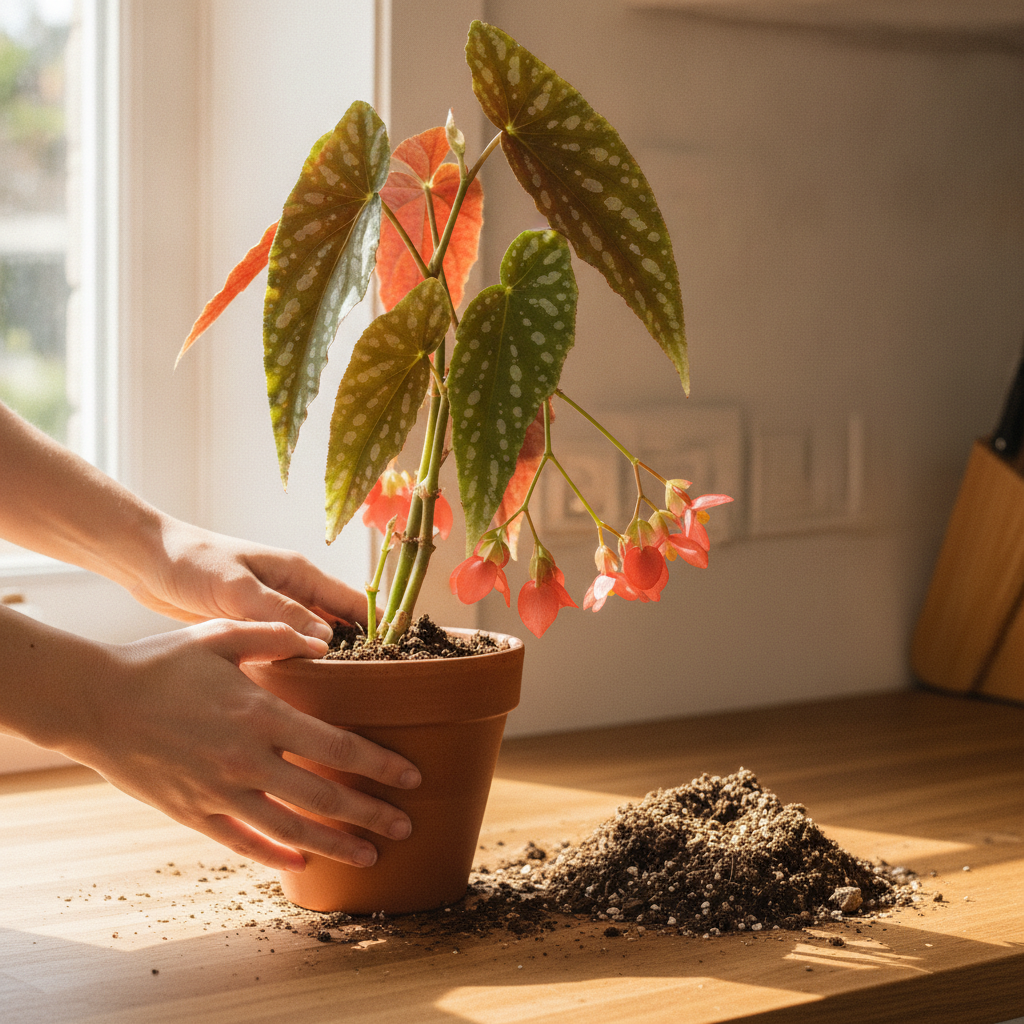
Ideal Soil Composition
A good begonia mix starts from a peat-free base such as coir or a quality houseplant compost, then has generous amounts of drainage and aeration material worked through it. The components below combine to hold moisture at the roots while letting excess water escape and air circulate, which is exactly the environment these plants evolved for.
| Component | Proportion | Function |
|---|---|---|
| Coir or peat-free houseplant compost | Half | Holds moisture and provides the body of the mix |
| Perlite or pumice | One quarter | Opens the structure and improves drainage and air flow |
| Fine orchid bark | One eighth | Creates air pockets and resists compaction over time |
| Worm castings or leaf mould | One eighth | Adds gentle, slow-release nutrition and beneficial microbes |
Begonias prefer a slightly acidic to neutral root environment, roughly pH 5.5 to 6.5, which most peat-free and coir-based mixes naturally fall within. There is rarely any need to adjust pH deliberately, but it is worth avoiding limestone-based grit or alkaline tap water as the sole water source, since both can nudge the mix toward an alkalinity the plant dislikes.
Pro Tip — Quick Mix Recipe: If you want a no-fuss blend, combine four handfuls of peat-free houseplant compost, two handfuls of perlite and one handful of fine bark. It takes a minute to mix and gives a cane begonia almost everything it needs.
Choosing the Right Pot
The container matters as much as what goes inside it. Cane begonias grow tall and can become top-heavy, so the pot needs to provide both healthy roots and physical stability, and the wrong choice here undoes good watering habits.
Drainage holes are non-negotiable. Whatever pot you choose must have holes in the base. Without them, water collects unseen at the bottom of the mix and rots the roots, no matter how careful you are with the can. Decorative pots without holes should only ever be used as outer covers, with the plant in a plain inner pot that can be lifted out to drain.
Pot material: Terracotta breathes and wicks away excess moisture, which suits growers who tend to overwater, while glazed ceramic and plastic hold moisture longer and suit drier homes or busier schedules. A heavier terracotta or glazed pot also helps counterbalance the weight of tall canes and stops a maturing plant toppling.
Pot size: Move up only one size at a time, choosing a pot 2 to 4 cm (1 to 2 inches) wider than the current one. Cane begonias actually flower more freely when slightly snug at the roots, and over-potting into a large container leaves a mass of wet, unused mix that invites rot.
When to Repot
A Swiss Cheese Begonia generally needs repotting every one to two years, ideally in spring as growth resumes. The signs that it is due include roots emerging from the drainage holes, water running straight through without wetting the mix, growth slowing despite good care, and the plant becoming unstable and prone to tipping. If the plant is healthy but you simply want to refresh tired mix, you can do so without moving up a pot size by replacing the old medium with fresh.
How to Repot: Step-by-Step
- Water the plant a day beforehand, since a hydrated root ball slides out more cleanly and suffers less stress.
- Support the canes and ease the plant from its pot, tipping it sideways and tapping the rim rather than pulling on the stems.
- Gently tease away the old mix from the outer roots and inspect them, trimming off any that are brown, soft or rotten.
- Add a layer of fresh mix to the base of the new pot so the plant will sit at the same depth it grew at before.
- Centre the plant, then fill around the root ball with fresh mix, firming lightly to remove large air gaps without compacting it.
- Water thoroughly to settle the mix, top up any that sinks, and return the plant to bright, indirect light.
- Hold off on feeding for four to six weeks while new roots establish in the fresh, lightly nourished medium.
Warning — Transplant Shock: Expect a little wilting or leaf drop in the days after repotting. Resist the urge to compensate by watering heavily or feeding, both of which stress freshly disturbed roots further. Keep the plant warm, out of direct sun and evenly moist, and it will recover within a couple of weeks.
Fertilising
Because they grow vigorously and flower for much of the year, cane begonias are moderately hungry plants that benefit from regular feeding through the growing season. Fertiliser supplies the nutrients that potting mix alone runs short of within a few months, fuelling both the lush foliage and the heavy flower trusses. The key is little and often at a dilute strength, rather than occasional heavy doses that can scorch the roots.
A begonia that is underfed shows it through pale, smaller new leaves, weak flowering and generally lacklustre growth, while one that is overfed develops scorched leaf edges and a crust of mineral salts on the soil surface. Feeding correctly means walking the line between these two, and erring slightly toward less rather than more.
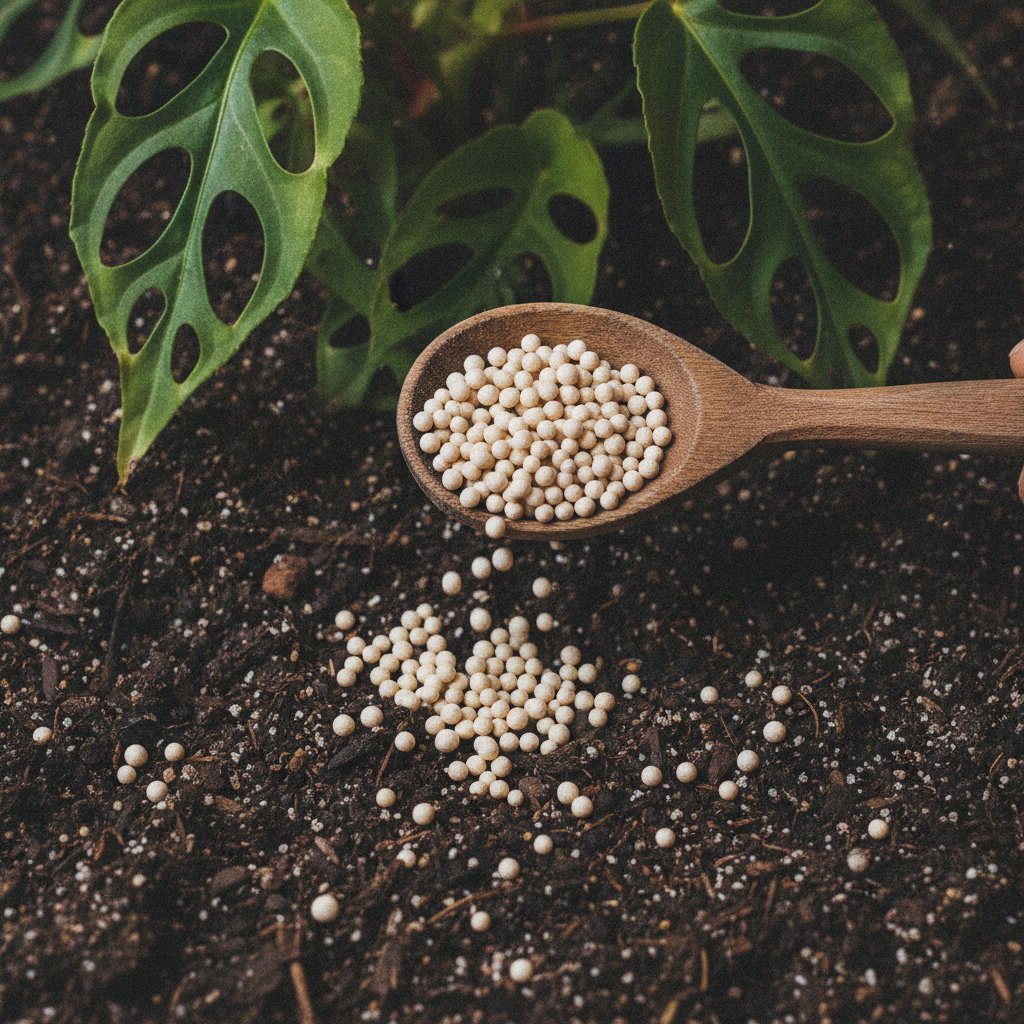
Understanding Plant Nutrients
Fertilisers are labelled with an N-P-K ratio that gives the percentages of nitrogen, phosphorus and potassium, the three nutrients plants use in the largest quantities. For a plant grown for both leaves and flowers, a balanced ratio works well most of the year, with the option of a higher-potassium feed to encourage blooming. The table below summarises the main nutrients and what their absence looks like.
| Nutrient | Symbol | Primary Function | Deficiency Symptoms |
|---|---|---|---|
| Nitrogen | N | Drives leafy growth and green colour | Pale, yellowing older leaves and stunted growth |
| Phosphorus | P | Supports roots, flowers and energy transfer | Poor rooting, weak flowering, dull purplish tints |
| Potassium | K | Regulates water use and flower formation | Browning leaf edges and sparse blooming |
| Calcium | Ca | Builds strong cell walls and new growth | Distorted, weak new leaves and growing tips |
| Magnesium | Mg | Central to chlorophyll and photosynthesis | Yellowing between the veins of older leaves |
| Iron | Fe | Needed for chlorophyll in new growth | Yellowing between veins of the youngest leaves |
Types of Fertiliser
Liquid fertilisers: The most popular choice for begonias because they are easy to dilute and apply with each watering, giving precise control over strength and timing. A balanced houseplant feed used at half the recommended dose suits cane begonias well during active growth.
Slow-release granular: Coated prills that release nutrients gradually over several months as you water. They are convenient for busy growers, though they offer less control than liquids and can keep feeding into autumn when the plant would rather slow down, so use them mainly in spring.
Organic fertilisers: Worm castings, diluted seaweed extract and other organic options feed more gently and improve the soil life over time. They are very forgiving and almost impossible to overdose, making them a safe option for anyone nervous about chemical burn.
Feeding Schedule
From spring through to early autumn, feed every two to four weeks with a balanced liquid fertiliser at half strength, fitting it around your normal watering. As light levels fall in mid to late autumn, taper the feeding off, and stop altogether through winter when growth naturally slows. A plant kept actively growing under grow lights through winter can be fed lightly and occasionally, but for most growers a clear seasonal break is best.
Pro Tip — Feed Half Strength: Begonias are more easily scorched by strong fertiliser than many houseplants, so always dilute to half the label rate. Two gentle feeds spaced a fortnight apart do far more good than one strong dose that risks burning the roots.
How to Fertilise
- Water the plant lightly first if the mix is very dry, since feeding a parched root ball can burn the roots.
- Dilute a balanced liquid fertiliser to half the recommended strength in room-temperature water.
- Apply the solution to the soil until it just begins to drain, keeping it off the leaves and flowers.
- Let the pot drain fully and discard any feed that collects in the saucer.
- Every couple of months, water with plain water alone to flush out accumulated salts and prevent build-up.
Warning — Salt Build-Up: A white or yellowish crust on the soil surface or pot rim is mineral salt from fertiliser. Left unchecked it scorches roots and browns leaf edges. Flush the pot thoroughly with plain water two or three times every few months to wash these salts out of the mix.
Propagation
One of the great pleasures of growing cane begonias is how willingly they propagate. A single plant provides an almost endless supply of cuttings, and because the canes root so readily, the success rate is high even for beginners. Propagation is also a practical tool: it lets you rejuvenate a plant that has grown leggy and bare at the base, and it produces spares to share or to insure against losing the parent.
The best time to take cuttings is spring or early summer, when the plant is growing strongly and a cutting will root in a matter of weeks. Cuttings can be taken at other times, but rooting is slower and less certain in the low light of winter. All you need is a clean, sharp blade, a glass of water or a small pot of moist mix, and a little patience.
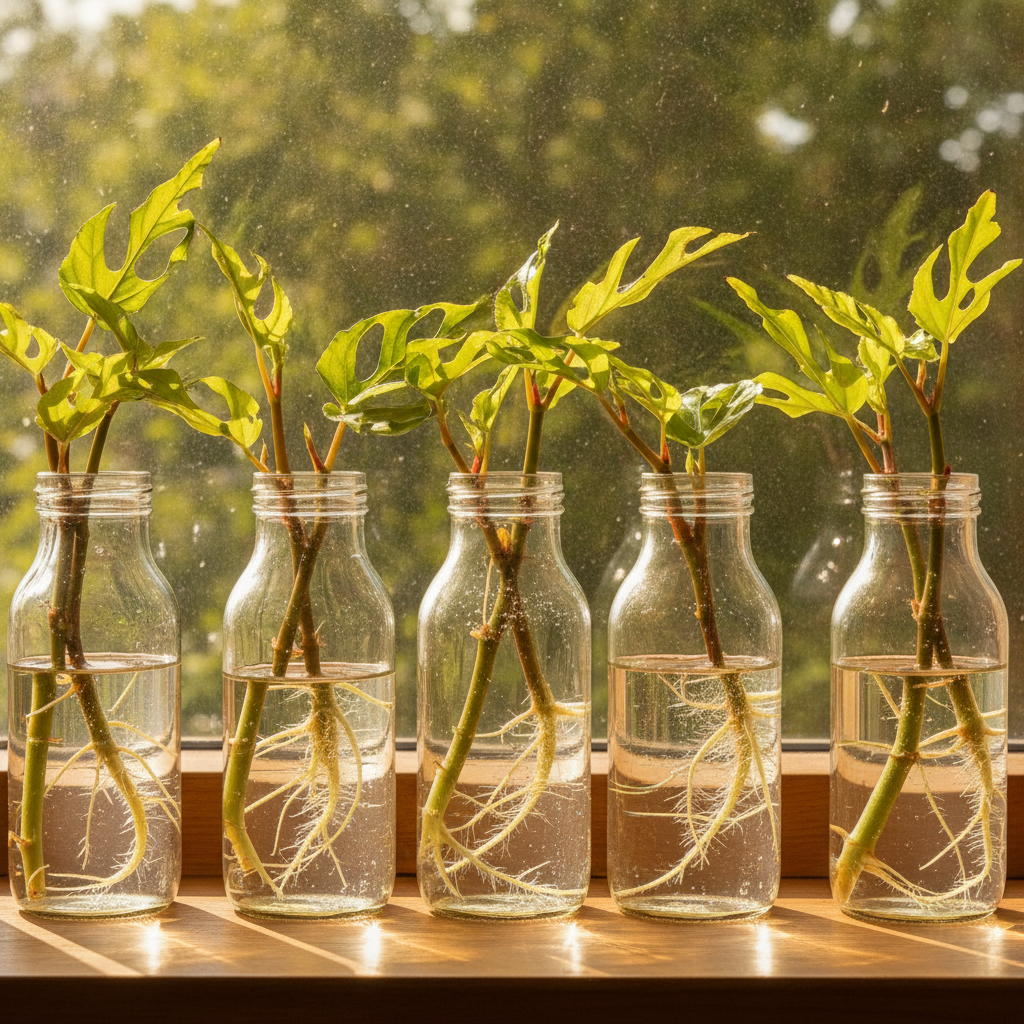
Understanding Nodes and Canes
The secret to propagating cane begonias lies in the node, the slightly swollen joint on the stem where a leaf meets the cane. Every node contains dormant cells capable of producing both roots and new shoots, so a successful cutting must always include at least one node below the surface of water or mix. The stretches of bare cane between nodes are simply spacers and will not root on their own, which is why a cutting is measured by the joints it contains rather than its length.
Water Propagation: Step-by-Step
Rooting in water is the easiest method and has the advantage that you can watch the roots develop, which makes it both reliable and satisfying for newcomers.
- Choose a healthy cane and cut a tip section 10 to 15 cm (4 to 6 inches) long with at least two nodes, snipping just below the lowest node.
- Remove the leaves from the lower node so that no foliage will sit underwater and rot.
- Stand the cutting in a glass of room-temperature water with the bare lower node submerged and the remaining leaves above the rim.
- Place the glass in bright, indirect light and refresh the water every few days to keep it clear and oxygenated.
- Wait two to four weeks for white roots to appear and lengthen to around 3 to 5 cm.
- Pot the rooted cutting into a small container of begonia mix and keep it slightly more humid than usual for the first week or two as it adjusts to soil.
Pro Tip — Pot Before Roots Get Long: Water roots are more brittle than soil roots, so move cuttings into mix once the roots reach a few centimetres rather than letting them grow long. Short roots transplant with far less shock and adapt to soil more quickly.
Soil Propagation: Step-by-Step
Rooting directly in mix skips the transplant stage and often produces sturdier roots, at the cost of being unable to see progress until new growth appears.
- Take a tip cutting with two or more nodes in the same way as for water rooting, and strip the lowest leaves.
- Dip the cut end in rooting hormone if you have it, though cane begonias usually root well without.
- Insert the cutting into a small pot of moist, airy propagation mix so the lowest node is buried.
- Firm the mix gently around the stem and water lightly to settle it.
- Cover loosely with a clear bag or propagator lid to hold humidity, opening it daily for fresh air, and keep in bright, indirect light.
- After three to five weeks, tug the cutting very gently; resistance means roots have formed and the cover can come off.
Troubleshooting Propagation
| Problem | Likely Cause | Solution |
|---|---|---|
| Cutting rots in water | A leaf or node left submerged, or stale water | Strip lower leaves, submerge only the node, and change the water every few days |
| No roots after many weeks | Too little light or temperatures too low | Move to a brighter, warmer spot of 20 to 24 degrees C |
| Cutting wilts in soil | Mix too dry or humidity too low | Keep the mix lightly moist and tent the cutting to raise humidity |
| Roots form but new growth stalls | Cutting potted into too large a container | Use a small pot so the roots fill it quickly and growth resumes |
Pests & Diseases
A healthy, well-grown Swiss Cheese Begonia is reasonably resistant to trouble, but no houseplant is immune. The pests that bother begonias are the common sap-suckers found on most indoor plants, while the diseases are mostly fungal and almost always trace back to leaves that stay wet or air that does not move. Catching problems early, when they affect a leaf or two rather than the whole plant, makes them far easier to deal with.
The best defence is routine observation. Make a habit of turning over a few leaves whenever you water, checking the leaf axils and undersides where pests gather, and acting at the first sign of anything amiss. Prevention through good culture, namely bright light, careful watering and decent airflow, prevents the great majority of issues before they start.
Common Pests
Mealybugs (Pseudococcus species)
Mealybugs are among the most frequent begonia pests, appearing as small white, cottony tufts tucked into leaf axils and along the canes. They suck sap and weaken the plant, leaving a sticky honeydew that can turn black with sooty mould.
Treatment: Dab each insect with a cotton bud dipped in isopropyl alcohol, then follow up with a neem oil or insecticidal soap spray every week until no new bugs appear. Isolate the plant while treating, since mealybugs spread easily.
Aphids (Aphidoidea)
Aphids are tiny green, black or pink soft-bodied insects that cluster on the tender new growth and flower buds, distorting them as they feed. They reproduce quickly and, like mealybugs, leave sticky honeydew behind.
Treatment: Rinse light infestations off under a gentle stream of water, taking care not to soak the foliage for long, then spray with insecticidal soap or neem oil. Repeat every few days until the colonies are gone.
Spider Mites (Tetranychus urticae)
Spider mites thrive in hot, dry air and show up as fine stippling on the leaves, with delicate webbing in bad cases. They are barely visible to the naked eye, so the speckled, dusty look of the foliage is usually the first clue.
Treatment: Raise the humidity, since mites hate moist air, and wipe or spray the leaves with neem oil or insecticidal soap, paying special attention to the undersides. Repeat treatments every five to seven days to break the breeding cycle.
Common Diseases
Powdery Mildew (Oidium species)
Powdery mildew is the classic begonia disease, appearing as a white, dusty coating on the leaves and stems. It flourishes where air is stagnant and humidity is high, and if left unchecked it distorts growth and disfigures the foliage.
Treatment: Remove badly affected leaves, improve airflow around the plant, and avoid wetting the foliage. Treat with a sulphur-based or biological fungicide, or a dilute potassium bicarbonate spray, repeating as directed until the mildew clears.
Botrytis Grey Mould (Botrytis cinerea)
Botrytis appears as a fuzzy grey mould on flowers, leaves or stems, typically in cool, damp, still conditions. It often takes hold on dying flowers or damaged tissue and then spreads to healthy parts of the plant.
Treatment: Cut away all affected material with clean scissors, remove spent flowers promptly, and increase ventilation and light. Reduce humidity around the plant and keep the foliage dry to stop the mould returning.
Pest and Disease Summary
| Pest / Disease | Identification | Treatment |
|---|---|---|
| Mealybugs | White cottony tufts in leaf axils | Alcohol swab, then neem oil weekly |
| Aphids | Clusters on new growth and buds | Rinse off, then insecticidal soap |
| Spider mites | Fine stippling and faint webbing | Raise humidity, treat with neem oil |
| Powdery mildew | White dusty coating on leaves | Improve airflow, fungicide spray |
| Botrytis | Fuzzy grey mould on tissue | Remove affected parts, ventilate |
Prevention Strategies
The overwhelming majority of begonia pest and disease problems are preventable through culture rather than chemistry. Good airflow is the most powerful single measure, as it keeps fungal spores from settling and discourages mites, so position the plant where air moves gently and avoid crowding it tightly among others. Watering at soil level and keeping the leaves dry removes the moisture that mildew and botrytis depend on.
Inspect new plants carefully before bringing them home and quarantine them for a couple of weeks, since shop-bought plants are the commonest way pests enter a collection. Keep the growing area tidy by removing fallen leaves and spent flowers, which otherwise become a breeding ground for disease, and wipe the leaves occasionally to remove dust and let you spot early trouble. A vigorous, well-fed plant in good light simply resists problems better than a stressed one.
Pro Tip — Treat the Undersides: Most sap-sucking pests live and lay eggs on the undersides of leaves and in the leaf axils, not on the upper surfaces. When you spray with neem oil or insecticidal soap, turn the leaves over and coat those hidden areas thoroughly, or the treatment will miss its target.
Popular Varieties
The Swiss Cheese Begonia belongs to the wider family of cane or angel-wing begonias, a group that includes Begonia coccinea itself and a great many hybrids bred from it. These cultivars vary in the size and spotting of their leaves, the colour of their flowers and their ultimate height, but they all share the same upright, jointed canes and the same easy-going temperament, so care is essentially identical across the group.
Choosing between them comes down to looks and scale. Some cultivars stay compact enough for a windowsill, while the most vigorous can reach well over a metre and make a striking floor plant. The table and profiles below cover the most widely grown forms you are likely to encounter.
| Variety | Leaf Appearance | Light Needs | Growth Rate | Availability |
|---|---|---|---|---|
| Begonia coccinea (species) | Glossy green wings, red reverse | Bright indirect | Vigorous | Common |
| ‘Lucerna’ | Large silver-spotted wings, pink flowers | Bright indirect | Vigorous | Common |
| ‘Sophie Cecile’ | Very large, heavily silver-spotted | Bright indirect | Vigorous | Frequent |
| ‘Irene Nuss’ | Bronze-green leaves, coral flowers | Bright indirect | Vigorous | Frequent |
| ‘Tom Ment’ | Compact, well-spotted foliage | Bright indirect | Moderate | Occasional |
| ‘Looking Glass’ | Silvery leaves with green veins | Bright indirect | Moderate | Occasional |
Featured Varieties
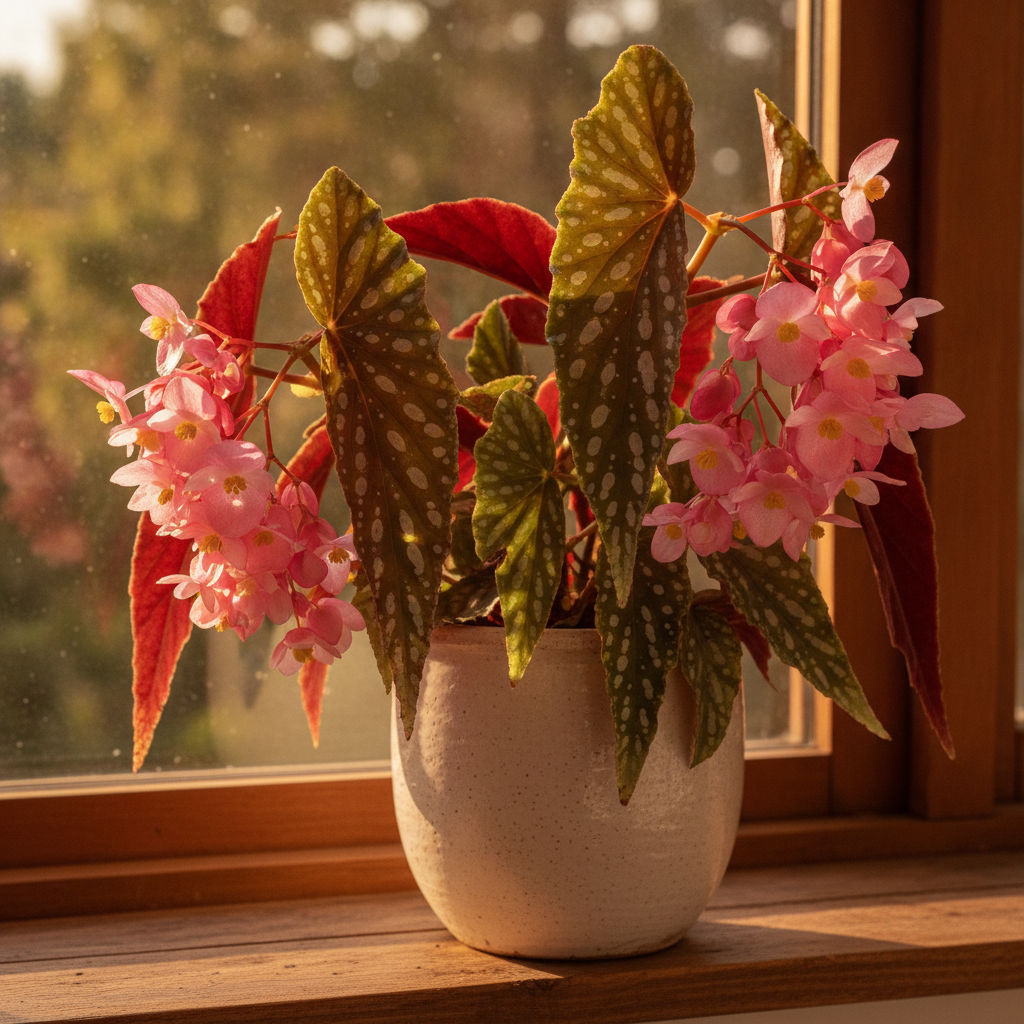
‘Lucerna’
The best-known cane begonia of all, ‘Lucerna’ carries large olive-green wings generously dotted with silver, deep burgundy undersides, and big pendulous trusses of rose-pink flowers for much of the year. It is vigorous, reliable and a fine introduction to the group.
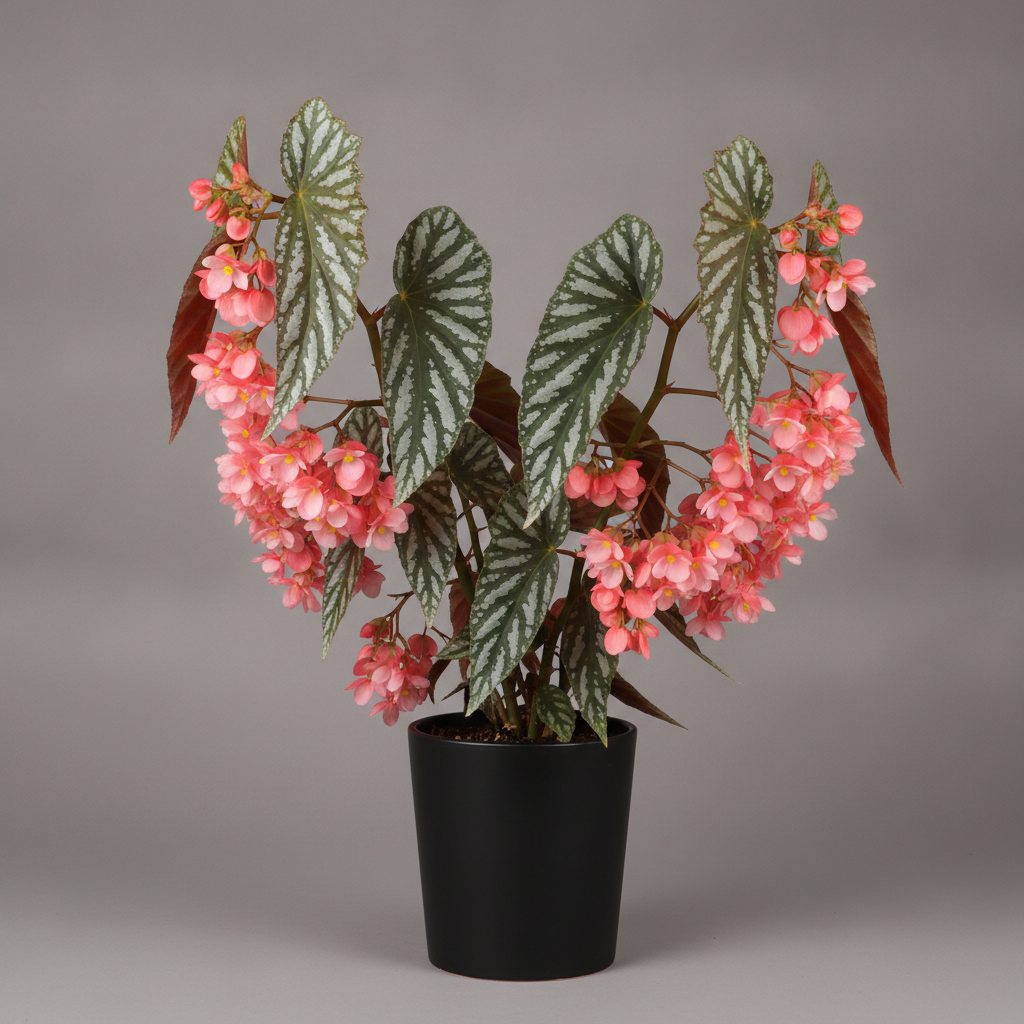
‘Sophie Cecile’
A bold, showy cultivar with very large angel-wing leaves heavily marked with silver and heavy clusters of coral-pink flowers. Vigorous and tall, it makes an impressive statement plant where there is room for it to reach its full height.
Variety Profiles in Detail
‘Irene Nuss’ (Begonia ‘Irene Nuss’)
A classic hybrid prized for its dramatic bronze-green leaves with red undersides and large dangling clusters of deep coral flowers. New growth often emerges a rich coppery red before maturing, giving the plant year-round colour even between flushes of bloom. It is vigorous and benefits from a little support as it gains height.
‘Looking Glass’ (Begonia ‘Looking Glass’)
Grown chiefly for its foliage, ‘Looking Glass’ has striking silvery leaves crossed by green veins and flushed red beneath, with a more restrained, moderate growth habit than the giants of the group. It suits growers who want the cane begonia look on a slightly more manageable scale.
Choosing the Right Variety for Your Space
If you have a bright spot with plenty of headroom, a vigorous cultivar such as ‘Lucerna’, ‘Sophie Cecile’ or ‘Irene Nuss’ will reward you with height and abundant flowers. For a windowsill or a smaller corner, lean toward the more compact, foliage-focused forms like ‘Looking Glass’ or ‘Tom Ment’, which stay in proportion to a tighter space. Whichever you choose, the care described in this guide applies across the board, so you can mix several cane begonias in one collection and treat them all the same way.
Frequently Asked Questions
Why is my Swiss Cheese Begonia not flowering?
The most common reason is insufficient light. Cane begonias need bright, indirect light to build the energy reserves that flowering demands, so a plant that has stopped blooming usually wants a brighter position. Make sure it is also being fed during the growing season and is not sitting in a draughty cold spot, both of which can suppress flowers.
Why are the lower leaves dropping?
Some loss of the oldest, lowest leaves is natural as the canes grow taller, and on its own it is nothing to worry about. Heavier or sudden leaf drop, however, usually points to overwatering, cold draughts or a sharp change in conditions. Check that the mix is not staying soggy and that the plant is in a stable, warm position away from doors and heaters.
My begonia has become tall and bare at the bottom. What can I do?
This legginess is normal for ageing canes, especially in lower light. Prune the tall canes back hard in spring to encourage bushier growth from lower down, and use the cuttings you remove to propagate fresh plants. Brighter light will keep future growth more compact and reduce the bare-stem effect.
How big does a Swiss Cheese Begonia get indoors?
Vigorous cane begonias can reach 1 to 1.5 metres (3 to 5 feet) or more indoors over several years, growing into substantial floor plants. You can keep them shorter and bushier by pruning the canes back regularly, which also encourages branching and more flowers.
Why are the leaf edges turning brown?
Brown, crisp leaf edges most often indicate air that is too dry, especially in heated rooms in winter. Raise the local humidity with a pebble tray, a nearby humidifier or by grouping plants together. Browning can also follow inconsistent watering or a build-up of fertiliser salts, so check those factors too if humidity alone does not solve it.
Is the Swiss Cheese Begonia safe around pets?
No. Like all begonias it is toxic to cats, dogs and horses if eaten, with the underground parts the most potent, and chewing it causes mouth irritation, drooling and vomiting. Keep it well out of reach of pets and small children, and wash your hands after handling cut stems.
How often should I repot?
Every one to two years is typical, ideally in spring, moving up just one pot size at a time. Cane begonias flower better when slightly snug at the roots, so resist the temptation to over-pot. Repot when you see roots through the drainage holes, when water runs straight through, or when the plant becomes top-heavy and unstable.
What is the white powder on the leaves?
A white, dusty coating is almost certainly powdery mildew, a fungal disease that thrives in stagnant, humid air. Improve airflow around the plant, keep water off the foliage, remove the worst-affected leaves, and treat with a suitable fungicide or a potassium bicarbonate spray until it clears.






