
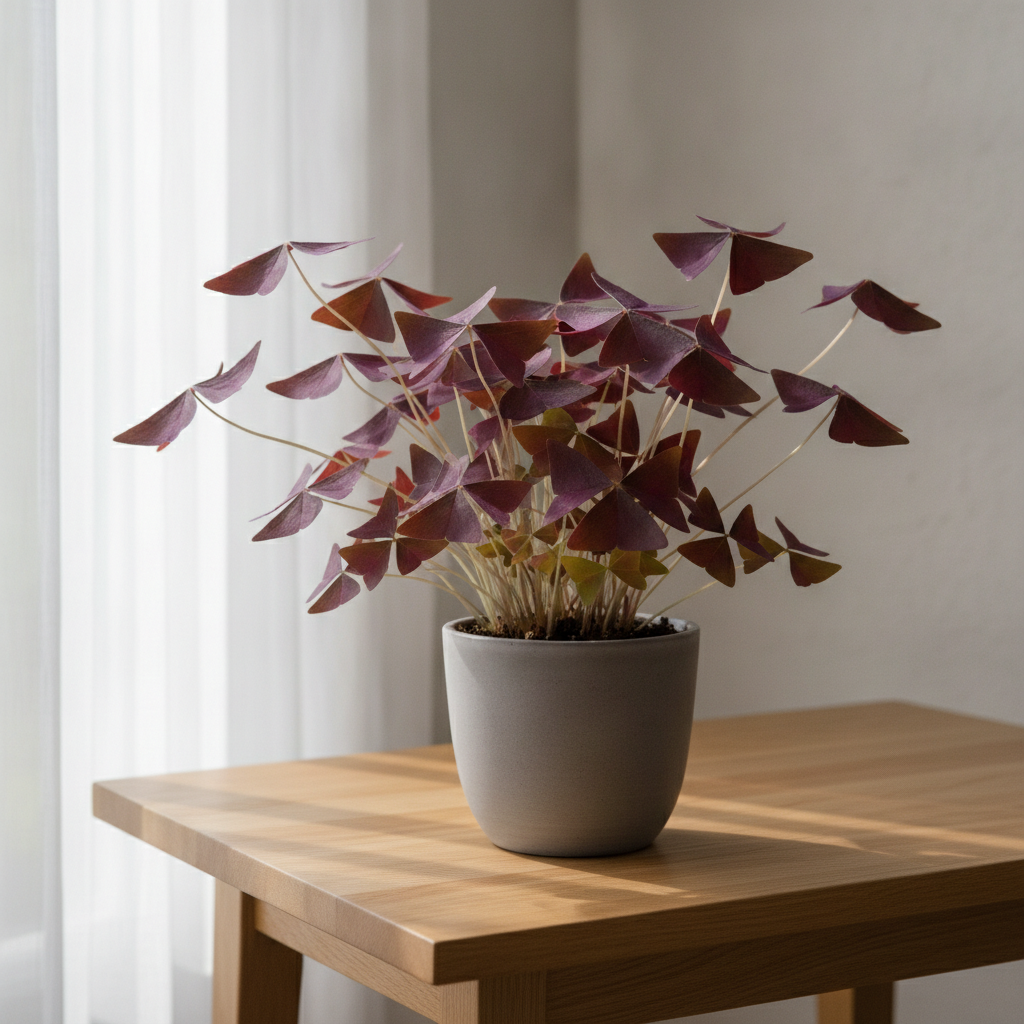
Few houseplants perform quite like the purple shamrock. Officially Oxalis triangularis, a member of the wood sorrel family native to the dappled forest floors of Brazil and neighbouring parts of South America, it carries deep burgundy-purple leaves split into three triangular leaflets that fold shut at dusk and unfurl again with the morning light. Sold under a handful of names, including false shamrock, purple wood sorrel and love plant, it is as much a daily spectacle as it is a decorative pot of foliage.
That nightly movement, called nyctinasty, is the reason so many people fall for this plant, but it is also a reliable indicator of health. A happy purple shamrock opens wide and flat in the day and closes neatly at night; a struggling one stays sluggish and flat, or fails to reopen. This guide covers everything that separates a shamrock that merely survives from one that thrives: the light it craves, how to water without rotting its small bulbs, the soil and pot it prefers, feeding through the growing season, dividing the clump to make more plants, the few pests that bother it, and the natural dormancy that catches so many owners off guard.
Contents
- Quick Reference
- Why Purple Shamrock Makes a Rewarding Houseplant
- Light Requirements
- Watering & Humidity
- Soil, Potting & Repotting
- Fertilising
- Propagation
- Pests & Diseases
- Popular Varieties
- Frequently Asked Questions
Quick Reference: Purple Shamrock at a Glance
| Light | Bright indirect light with a few hours of gentle direct sun; deepest purple colour in good light |
| Watering | Keep lightly moist in growth, letting the top 2 to 3 cm (1 in) dry between waterings; water sparingly during dormancy |
| Temperature | 15 to 24°C (59 to 75°F); tolerates cooler nights, dislikes sustained heat above 27°C (81°F) |
| Humidity | Average household humidity of 40 to 60% is fine; no misting required |
| Fertiliser | Balanced liquid feed at half strength every 3 to 4 weeks while actively growing |
| Toxicity | Toxic to cats, dogs and humans if eaten in quantity, owing to soluble oxalates; keep away from pets and children |
Why Purple Shamrock Makes a Rewarding Houseplant
The appeal of the purple shamrock begins with colour. Against the sea of green that most houseplant collections become, a pot of saturated burgundy foliage reads almost like a flowering plant even when it is not in bloom, and it does in fact bloom readily, throwing up sprays of small pale-pink to white trumpet flowers through much of the year. The triangular leaflets sit on slender stems and catch light beautifully, giving the whole clump a soft, hovering quality that larger-leaved plants cannot match.
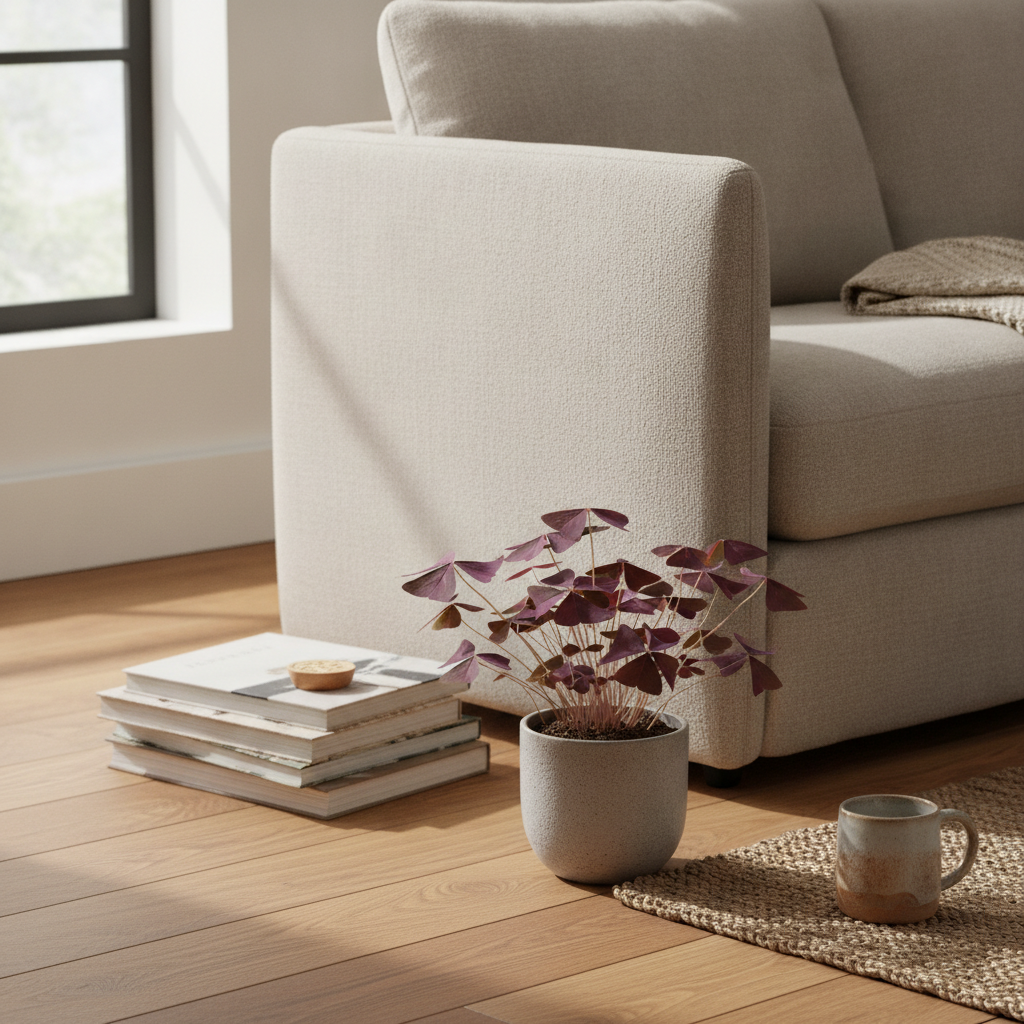
Beyond looks, it is genuinely easy to keep, provided you understand one quirk: the purple shamrock grows from a cluster of small scaly bulbs and cycles through periods of dormancy. Rather than dying when the foliage flops and fades, it is simply resting, and it will rebound from the bulbs within weeks if you cut it back and ease off the water. Owners who know this treat the plant as a perennial that comes and goes; owners who do not often throw a perfectly healthy plant in the bin. Master that single concept and the shamrock becomes one of the most forgiving and rewarding plants you can own.
Important — Toxicity: All parts of Oxalis triangularis contain soluble oxalic acid and oxalate salts. Small nibbles rarely cause more than mild mouth irritation, but larger quantities can cause drooling, vomiting and, in grazing pets, kidney strain. Keep the plant out of reach of cats, dogs and young children, and wash your hands after handling cut bulbs.
Light Requirements
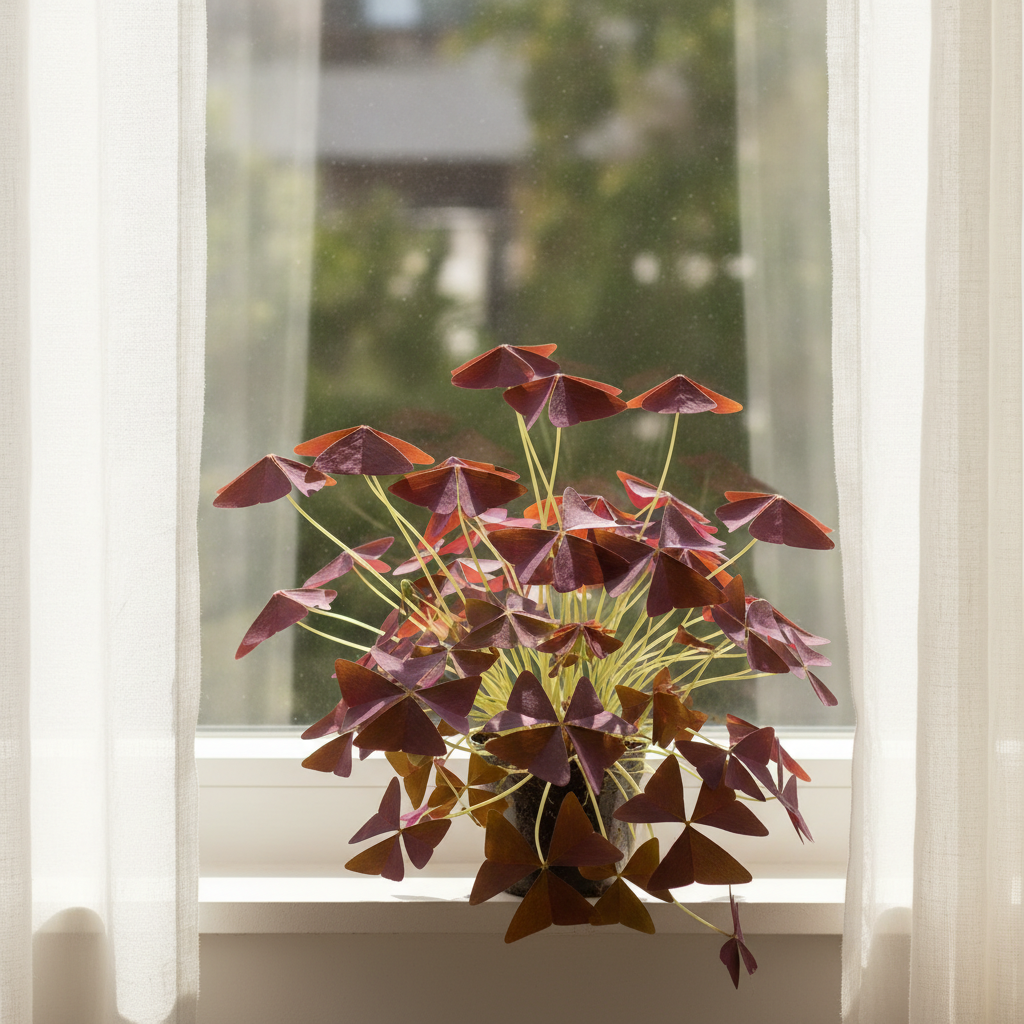
Light is the single biggest lever you have over a purple shamrock, because it controls both how vigorously the plant grows and how deeply pigmented the leaves become. In the wild the plant grows in bright, broken light at the edges of woodland, so indoors it wants a position that is bright for most of the day with some gentle direct sun, ideally morning sun, which it tolerates far better than the harsh rays of midday.
The ideal spot is within a metre (around 3 ft) of an east or west-facing window, or just back from a south-facing one behind a sheer curtain. In this kind of light the foliage holds its rich burgundy tone, the stems stay short and sturdy, and the plant opens its leaves crisply each morning. Too little light and the colour washes out toward muddy green, the stems stretch and flop, and flowering slows or stops altogether.
Light Levels Explained
Houseplant light is easier to judge once you can put rough numbers to it. The table below maps the common light categories to approximate brightness and to the result you can expect from a purple shamrock in each.
| Light Category | Approx. Level | Typical Location | Outcome |
|---|---|---|---|
| Direct sun | 50,000+ lux | On a south sill, unscreened | Risk of scorch and faded colour in summer; fine in winter |
| Bright indirect | 10,000 to 20,000 lux | Near east or west window | Ideal: rich colour, compact growth, steady flowering |
| Medium | 5,000 to 10,000 lux | A metre back from a bright window | Acceptable; slightly looser growth, still good colour |
| Low | 1,000 to 2,500 lux | Interior wall, north room | Stretched, floppy stems and greenish leaves |
| Very low | Below 1,000 lux | Hallway, far from any window | Decline and eventual collapse; not viable long term |
Window Orientation and Placement
South-facing window: The brightest option and excellent in the darker months, but in spring and summer the midday sun can scorch leaves and bleach their colour. Set the plant back a little or filter the glass with a voile curtain.
East-facing window: Arguably the perfect home. Gentle morning sun brings out the deepest purple and powers strong growth, while the plant is spared the heat of the afternoon.
West-facing window: Also very good. The warmer afternoon light is stronger than morning sun, so watch for any signs of scorch in high summer and pull the plant back slightly if needed.
North-facing window: Usable but marginal. Expect greener, looser growth and reduced flowering. If a north window is your only option, supplement with a grow light to keep the plant compact.
Pro Tip — Rotate for Even Growth: Purple shamrock leans hard toward its light source. Give the pot a quarter turn every few days so the clump fills out evenly rather than growing lopsided and reaching to one side.
How Light Affects Leaf Colour
The burgundy pigment in the leaves comes from anthocyanins, the same family of compounds that colour red cabbage and autumn maples. These pigments build up in response to good light, partly as a natural sunscreen, which is why a well-lit shamrock is so much darker and richer than one kept in the shadows. If your plant has drifted toward green, the cause is almost always insufficient light rather than anything wrong with feeding or watering, and moving it brighter will restore the colour in the next flush of leaves.
Warning — Direct Sunlight: While morning sun is welcome, prolonged direct summer sun through glass can crisp the leaf edges and fade the purple to a washed-out bronze. Introduce any increase in direct light gradually over a week or two so the foliage can adapt.
Artificial Lighting
Purple shamrock responds well to supplemental lighting, which makes it a good candidate for rooms with poor natural light. A full-spectrum LED grow light positioned 20 to 30 cm (8 to 12 in) above the plant and run for 12 to 14 hours a day will keep growth compact and colour deep. Because the plant tracks its light with such obvious daily leaf movement, it is easy to tell whether your lamp is doing the job: leaves that open fully under the light are getting enough.
Seasonal Adjustments
As the days shorten through autumn, move the plant closer to its window or add supplemental light to compensate for the weaker, lower sun. A south or west window that was too fierce in July becomes ideal in December. Watch too for the natural dormancy that can coincide with the seasonal change: if the foliage thins and flops in late summer or autumn, that is often a rest cycle rather than a light problem, and is covered in detail under watering below.
Watering & Humidity
Watering is where purple shamrock owners most often go wrong, because the plant’s small bulbs sit just beneath the surface and rot quickly in waterlogged soil. The guiding principle is moist but never soggy: the plant likes regular, modest watering through its growing phase, and a much drier regime when it slips into dormancy. Get the rhythm right and the bulbs stay plump and healthy; keep the mix permanently wet and they soften and collapse.
When to Water
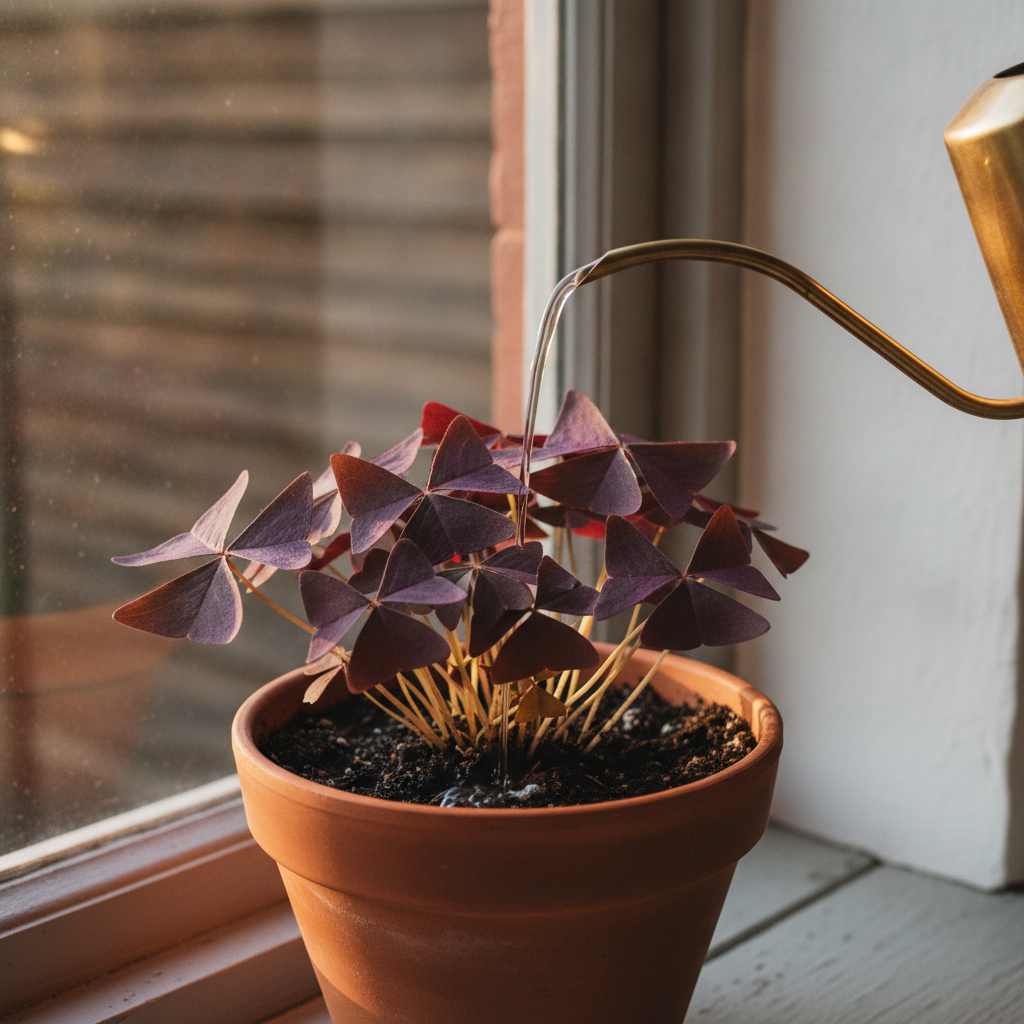
During active growth in spring and summer, water once the top 2 to 3 cm (about 1 in) of the mix has dried out. In a bright spot and a small pot this usually means watering roughly once a week, but you should always check with a finger rather than working to a fixed calendar, as pot size, temperature and light all change how fast the soil dries.
When the plant enters dormancy, signalled by foliage that yellows, flops and dies back, cut watering right down to an occasional sip just enough to stop the bulbs shrivelling, roughly once every two to three weeks. Resume normal watering only when you see fresh shoots pushing up from the bulbs, which marks the start of the next growth cycle.
Pro Tip — Read the Leaves: A purple shamrock that is thirsty closes and droops earlier in the day and is slow to reopen; one that is overwatered develops soft, translucent stems near the base. The plant tells you what it needs if you watch its daily rhythm.
How to Water Correctly
- Check the top few centimetres of mix with a finger; water only once it feels dry.
- Water at the soil level rather than over the foliage, which helps keep the delicate stems dry and free of rot.
- Add water steadily until it runs freely from the drainage holes, wetting the whole root and bulb zone.
- Let the pot drain completely for several minutes before returning it to its saucer or cover pot.
- Tip away any water that collects in the saucer so the bulbs never sit in standing moisture.
Signs of Overwatering vs. Underwatering
| Symptom | Overwatering | Underwatering |
|---|---|---|
| Leaf colour | Pale, yellowing from the base | Dull, edges browning and crisping |
| Leaf texture | Soft, limp, translucent | Thin, papery, wilting but dry |
| Soil | Constantly wet, sour smell | Bone dry, pulling away from the pot |
| Bulbs and roots | Soft, mushy, blackened bulbs | Firm but shrunken, wrinkled bulbs |
| Stem base | Mushy and collapsing at soil line | Dry and shrivelled but intact |
Warning — Root Rot: Soft, blackened bulbs and a sour-smelling, permanently wet mix point to rot. Lift the plant, discard any mushy bulbs, rinse the firm survivors, and repot into fresh, barely-moist mix. Recovery is common as long as a few healthy bulbs remain.
Humidity Requirements
Purple shamrock is refreshingly relaxed about humidity. Ordinary household levels of 40 to 60% suit it perfectly, and unlike many tropical houseplants it has no need of misting, pebble trays or a humidifier. This tolerance is part of what makes it such an approachable plant for beginners.
Very dry air, such as the parched conditions near a radiator in winter, can cause some browning at the leaf tips, but this is cosmetic rather than dangerous. If you notice it, simply move the plant away from the direct heat source rather than reaching for a mister.
If anything, the bigger risk in humid conditions is poor air circulation around the dense clump, which can encourage fungal problems on the foliage. A spot with gentle airflow keeps the leaves healthy without any need to raise humidity at all.
Water Quality
Tap water is fine for purple shamrock in most areas. The plant is not notably sensitive to fluoride or chlorine, so there is rarely any need to switch to filtered or distilled water. In regions with very hard water you may see a faint mineral crust build up on the soil surface over time, which a periodic flush with plenty of water will clear. Room-temperature water is gentler on the roots than water straight from a cold tap.
Soil, Potting & Repotting
Because the whole plant grows from shallow bulbs that resent sitting wet, the soil you choose matters more than it does for many houseplants. The aim is a mix that holds enough moisture to keep growth steady but drains freely enough that the bulbs are never left in saturated ground.
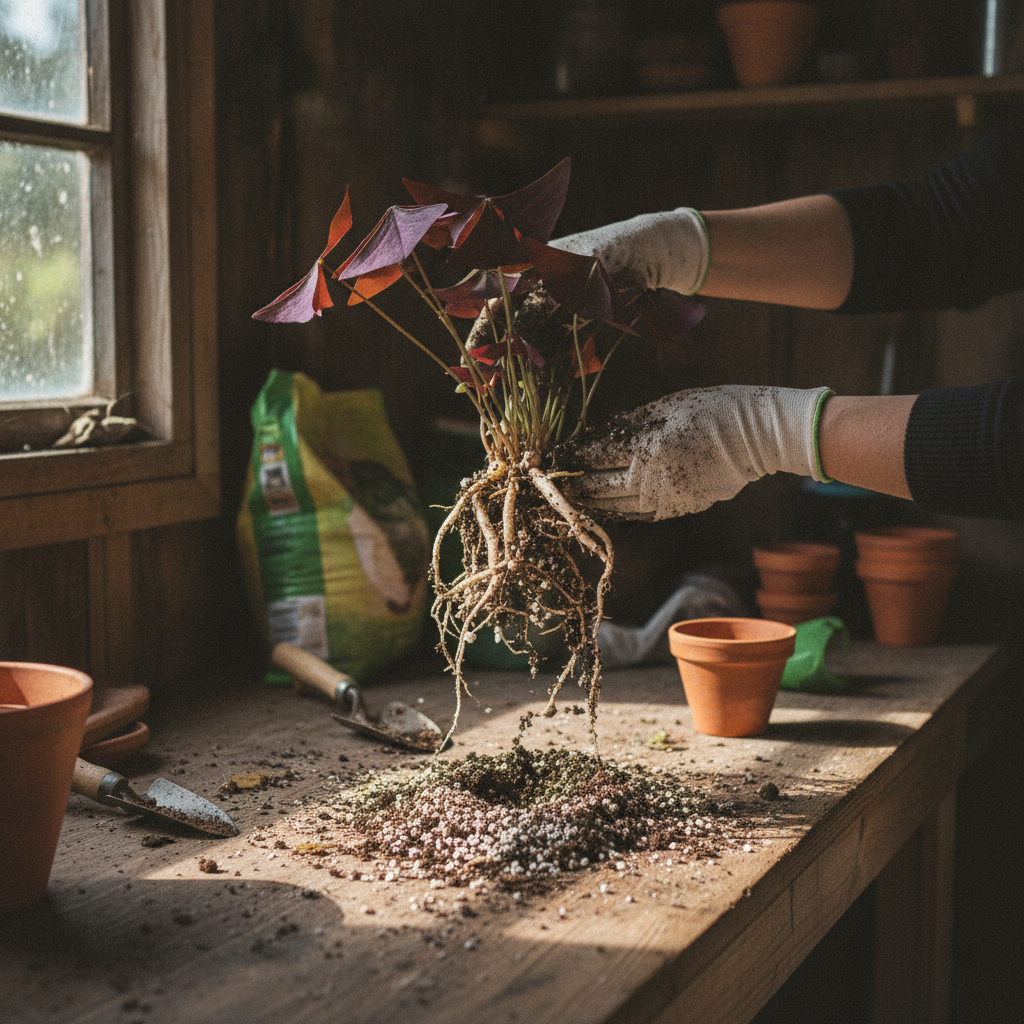
Ideal Soil Composition
A good starting point is a quality peat-free houseplant compost lightened with extra drainage material. The compost provides the moisture retention and nutrients the plant needs in growth, while added perlite or coarse grit opens up the structure so excess water drains away from the bulbs quickly.
| Component | Proportion | Function |
|---|---|---|
| Peat-free houseplant compost | 3 parts | Holds moisture and supplies nutrients |
| Perlite or coarse grit | 1 part | Opens drainage, prevents waterlogging around bulbs |
| Fine bark or coir | 1 part | Adds airy structure and slows compaction |
Purple shamrock prefers a slightly acidic to neutral mix, somewhere around pH 6.0 to 7.0, which most standard houseplant composts fall within naturally. There is no need to test or adjust pH for this plant under normal circumstances.
Pro Tip — Quick Mix Recipe: Three handfuls of peat-free houseplant compost, one handful of perlite and one handful of fine bark, mixed in a bucket, gives a light, free-draining medium that suits the bulbs perfectly. Keep a little spare for topping up after division.
Choosing the Right Pot
Pot choice for a shallow-rooted, bulb-forming plant is mostly about drainage and restraint. The shamrock does not want a large volume of soil around its small bulbs, as that holds water the plant cannot use and invites rot.
Drainage holes are non-negotiable. Whatever the material or style, the pot must have holes in the base. A decorative cover pot is fine for appearance, but lift the inner pot out to water and drain so the bulbs never stand in collected water.
Pot material: Terracotta is an excellent choice because its porous walls wick away excess moisture and make overwatering far harder. Glazed ceramic and plastic both work too, but with these you must be a little more disciplined about letting the mix dry between waterings.
Pot size: Choose a snug pot only a little wider than the cluster of bulbs. A 12 to 15 cm (5 to 6 in) pot suits most plants and can hold a generous, full-looking clump. Oversized pots simply mean more wet soil and more risk.
When to Repot
Purple shamrock is happy a little crowded and does not need frequent repotting. Every two to three years is plenty, and the best time is at the start of a new growth cycle, just as fresh shoots appear from dormant bulbs. Repotting then doubles as the ideal moment to divide the multiplying bulbs, refresh tired soil and move up a pot size only if the clump has genuinely filled its container.
How to Repot: Step-by-Step
- Water lightly the day before so the rootball holds together as you work.
- Ease the plant out by tipping the pot and supporting the clump, rather than pulling on the fragile stems.
- Gently tease away the old mix to expose the cluster of small bulbs, checking for any that are soft or rotten.
- Discard damaged bulbs and, if you wish, separate the cluster into smaller groups for new pots.
- Settle the bulbs into fresh mix in a clean pot, covering them with about 2 cm (1 in) of soil.
- Firm the surface lightly, water just enough to settle the mix, and return the plant to bright, indirect light.
Warning — Transplant Shock: Newly repotted shamrocks sometimes sulk for a week or two, with leaves that flop or fade. Resist the urge to overwater in response. Keep the mix barely moist and bright, and fresh growth will follow once the bulbs settle.
Fertilising
Purple shamrock is a modest feeder. It is not a plant that needs heavy fertilising to look its best, and overfeeding does more harm than good, but a light, regular feed through the growing season supports the steady production of new leaves and keeps the flowers coming.
The cardinal rule is to feed only when the plant is actively growing. A dormant or resting shamrock has no use for nutrients, and fertiliser applied to a plant that is not growing simply builds up as salt in the soil, where it can scorch the delicate bulbs and roots.
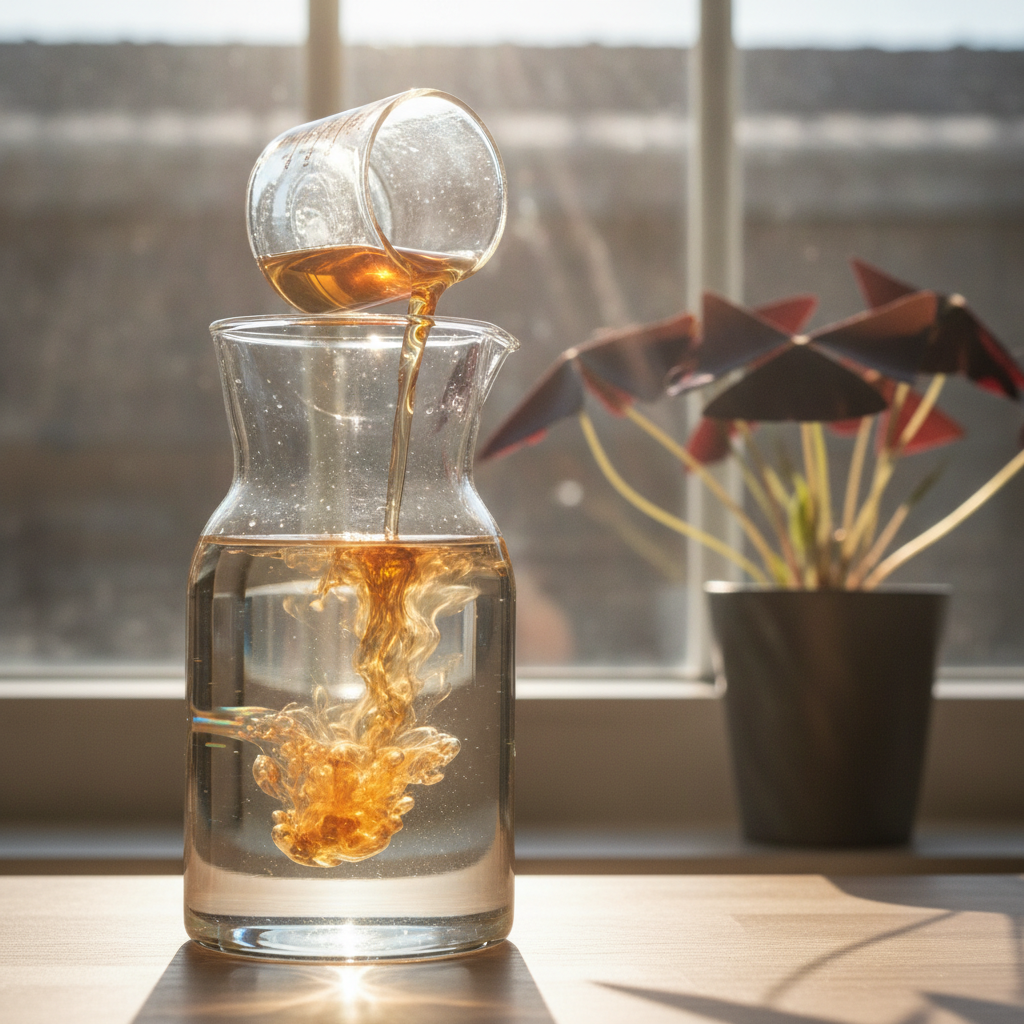
Understanding Plant Nutrients
Most fertilisers are labelled with three numbers, the NPK ratio, standing for nitrogen, phosphorus and potassium, the three nutrients plants use in the greatest quantity. A balanced houseplant feed supplies all three along with smaller amounts of the secondary and trace nutrients listed below.
| Nutrient | Symbol | Primary Function | Deficiency Symptoms |
|---|---|---|---|
| Nitrogen | N | Leaf and stem growth | Pale, undersized new leaves |
| Phosphorus | P | Root and flower development | Weak roots, poor flowering |
| Potassium | K | Overall vigour and stress tolerance | Browning leaf margins |
| Calcium | Ca | Cell-wall strength | Distorted new growth |
| Magnesium | Mg | Core of the chlorophyll molecule | Yellowing between leaf veins |
| Iron | Fe | Chlorophyll production | Pale young leaves with green veins |
Types of Fertiliser
Liquid fertilisers: The easiest and most controllable choice for shamrock. Diluted into the watering can, they let you feed lightly and stop instantly when the plant goes dormant, which is exactly the control this plant calls for.
Slow-release granular: Convenient but harder to manage on a plant that cycles in and out of growth, since the granules keep releasing nutrients even when the plant has stopped feeding. If you use them, apply at half the recommended rate.
Organic fertilisers: Worm castings worked lightly into the soil surface, or a dilute organic seaweed feed, provide gentle, low-risk nutrition that is very forgiving of slight over-application and suits the plant’s modest appetite well.
Feeding Schedule
Through spring and summer, while the plant is pushing out new leaves, feed with a balanced liquid fertiliser at half the label strength every three to four weeks. Taper off as growth slows in autumn, and stop entirely once the plant rests or goes dormant. Resume only when fresh shoots signal the next cycle of active growth.
Pro Tip — Less Is More: When in doubt, underfeed. A purple shamrock that is slightly hungry stays compact and richly coloured, whereas an overfed one produces soft, floppy, paler growth that is far more prone to rot and pests.
How to Fertilise
- Confirm the plant is in active growth, with fresh leaves emerging.
- Dilute a balanced liquid feed to half the recommended strength in your watering can.
- Water the plant with plain water first if the soil is very dry, to avoid feeding into bone-dry mix.
- Apply the diluted feed evenly to the soil, letting any excess drain away.
- Flush the pot with plain water every couple of months to clear any accumulated fertiliser salts.
Warning — Salt Build-Up: A white crust on the soil or pot rim, or brown, scorched leaf edges despite careful watering, signals fertiliser salts accumulating in the mix. Leach the pot by running plenty of plain water through it, and ease back on feeding.
Propagation
Propagating purple shamrock is one of the simplest and most reliable jobs in the houseplant calendar, because the plant does most of the work for you. Each season the bulbs multiply underground, so over time a single pot becomes a dense cluster of bulbs that can be lifted and split into several new plants.
Unlike many houseplants, the shamrock is not propagated from leaf or stem cuttings, which simply will not root. Division of the bulbs is the method that works, and it is so forgiving that even a clumsy first attempt usually succeeds.
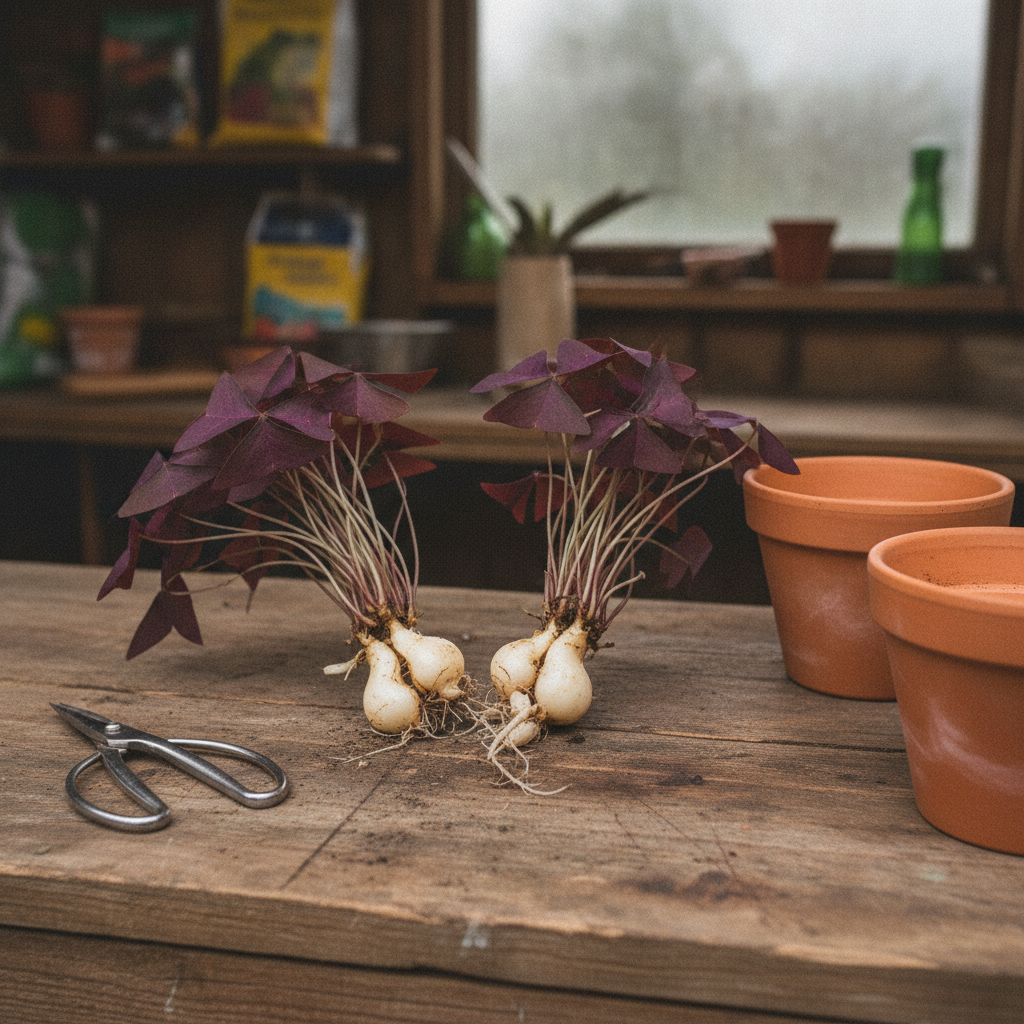
Understanding the Bulbs
The small, scaly, pale structures you find when you lift the plant are technically rhizomatous bulbs, each capable of producing its own shoots and roots. They look a little like tiny pine cones and detach easily from one another. Because every viable bulb can become a whole new plant, a mature clump can yield half a dozen or more divisions in a single sitting, making this one of the most generous houseplants to share with friends.
Division by Bulb Separation: Step-by-Step
The most straightforward approach is to lift the whole plant and gently pull the bulb cluster apart into smaller groups, each with several bulbs, then pot them up separately. Spring, at the start of a growth cycle, is the best time.
- Ease the plant out of its pot and shake or brush off most of the loose soil to expose the bulbs.
- Gently separate the cluster into groups of three to five bulbs, keeping any attached roots intact.
- Fill small pots with the free-draining mix described above and make a shallow hollow in each.
- Nestle a group of bulbs into each pot and cover them with about 2 cm (1 in) of mix.
- Water lightly to settle the soil and place the pots in bright, indirect light.
- Keep barely moist until new shoots appear, usually within two to three weeks, then resume normal care.
Pro Tip — Plant a Few Per Pot: A single bulb will grow, but a cluster of several planted together fills a pot far faster and gives a lush, generous look within a couple of months rather than a sparse one.
Dividing During Dormancy: Step-by-Step
You can also divide while the plant is dormant and leafless, which some growers find easier because there is no foliage to work around. The bulbs are fully visible and the plant is not actively transpiring, so it copes with handling especially well.
- Wait until the foliage has died back fully and the bulbs are resting.
- Tip out the pot and sift through the dry-ish mix to collect all the bulbs.
- Discard any that are soft, mushy or hollow, keeping only firm, plump bulbs.
- Replant the firm bulbs in fresh mix at a depth of about 2 cm (1 in), spacing them out a little.
- Water sparingly and wait; new growth will emerge when the bulbs break dormancy.
Troubleshooting Propagation
| Problem | Likely Cause | Solution |
|---|---|---|
| Bulbs rot after planting | Mix too wet or bulbs damaged | Use free-draining mix, water sparingly until shoots appear |
| No shoots for weeks | Bulbs naturally dormant | Be patient; keep barely moist and warm, growth will come |
| Weak, thin shoots | Insufficient light after potting | Move divisions to brighter, indirect light |
| Some bulbs fail entirely | Those bulbs were not viable | Normal; the healthy bulbs will more than compensate |
Pests & Diseases
Purple shamrock is relatively untroubled by pests and diseases, and a healthy plant in good light with sensible watering rarely suffers serious problems. The issues that do arise are mostly the usual indoor sap-suckers and, more commonly, the fungal troubles that follow overwatering.
Prevention is far easier than cure. Inspecting the plant when you water, keeping the foliage uncrowded for airflow, and avoiding soggy soil between them head off the great majority of problems before they take hold.
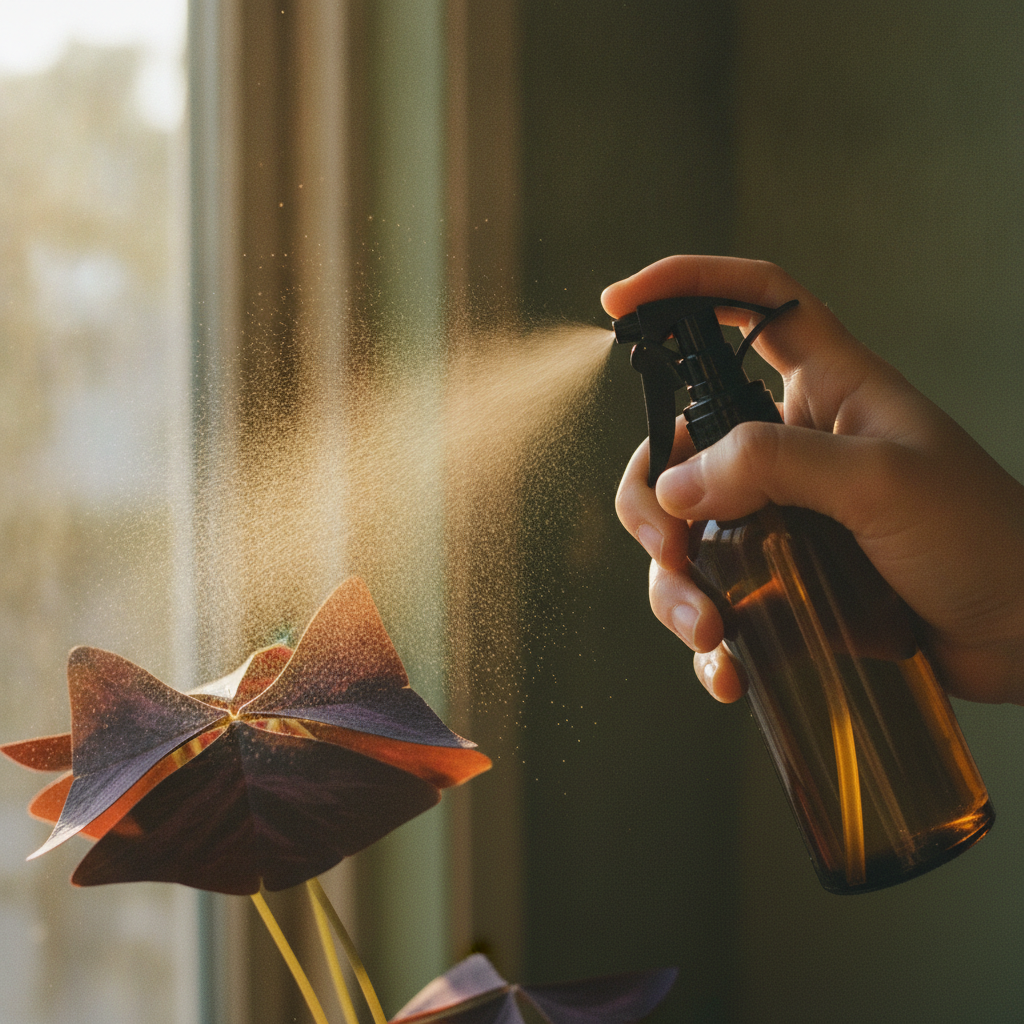
Common Pests
Spider Mites (Tetranychus urticae)
These tiny sap-suckers thrive in warm, dry conditions and show up as fine stippling on the leaves, a dusty look, and sometimes delicate webbing between stems. The dense foliage of a shamrock can hide them until numbers build, so check the undersides of leaves regularly.
Treatment: Rinse the plant under a gentle shower to knock numbers down, then treat with insecticidal soap or neem oil every five to seven days until clear. Improving airflow helps prevent their return.
Aphids (Aphidoidea)
Soft-bodied green, black or pink insects that cluster on tender new shoots and flower stems, sucking sap and leaving sticky honeydew behind. They are particularly fond of the soft flower stalks of a shamrock in bloom.
Treatment: Wipe or rinse them off, then apply insecticidal soap to the affected growth. Repeat every few days until no new colonies appear, and check nearby plants, as aphids spread quickly.
Mealybugs (Pseudococcidae)
Small white, cottony insects that lodge where leaves meet stems and at the base of the clump, weakening the plant as they feed. They are slower-moving than aphids but can be stubborn once established among the dense stems.
Treatment: Dab each insect with a cotton bud dipped in diluted isopropyl alcohol, then follow up with neem oil. Severe infestations may be easiest to manage by cutting the foliage back hard and letting the plant regrow clean from the bulbs.
Common Diseases
Root and Bulb Rot (Pythium and Fusarium)
The most serious threat to a purple shamrock, caused almost always by overwatering. The bulbs turn soft, brown and mushy, the stems collapse at soil level, and the mix takes on a sour smell. Left unchecked it can wipe out the whole clump.
Treatment: Lift the plant, discard all soft bulbs, rinse the firm survivors and repot into fresh, barely-moist, free-draining mix. Water far more cautiously going forward. Prevention through careful watering is far more effective than any cure.
Powdery Mildew (Erysiphales)
A dusty white coating on the leaves, most likely when air is stagnant and humidity high around a crowded clump. It is unsightly and, if it spreads, can weaken the foliage, though it rarely kills an otherwise healthy plant.
Treatment: Remove the worst affected leaves, improve air circulation around the plant, and treat with a suitable fungicide or a dilute potassium bicarbonate spray. Avoid wetting the foliage when watering.
Pest and Disease Summary
| Pest / Disease | Identification | Treatment |
|---|---|---|
| Spider mites | Stippled leaves, fine webbing | Rinse, then neem or insecticidal soap weekly |
| Aphids | Clusters on shoots, sticky honeydew | Rinse off, apply insecticidal soap |
| Mealybugs | White cottony tufts at leaf joints | Alcohol on a cotton bud, then neem oil |
| Root and bulb rot | Soft brown bulbs, sour wet soil | Remove rot, repot dry, water less |
| Powdery mildew | Dusty white film on leaves | Improve airflow, fungicidal spray |
Prevention Strategies
The best defence is a plant kept in conditions it likes: bright light, a free-draining mix, and water only when the top of the soil has dried. A vigorous, well-grown shamrock shrugs off the occasional pest that a stressed one would succumb to, so good general care is itself the most powerful preventative measure.
Quarantine any new plant for a couple of weeks before it joins the rest of your collection, inspect your shamrock each time you water, and deal with the first few pests promptly rather than waiting for an infestation. Removing dead and yellowing foliage keeps the clump open and airy and denies pests and fungi a place to hide.
Pro Tip — Cut Back and Reset: Because the plant regenerates so readily from its bulbs, a badly infested or diseased shamrock can simply be cut back to soil level. The bulbs send up fresh, clean foliage within weeks, often solving the problem more easily than repeated spraying.
Popular Varieties
The plant most people mean by purple shamrock is the deep-burgundy Oxalis triangularis, but the wider group of ornamental wood sorrels offers a surprising range of leaf colours and forms, from near-black purples to fresh greens and even bicoloured selections.
All share the same butterfly-leaf habit and the same easy, bulb-based care, so once you can grow one you can grow them all. The table and profiles below cover the selections you are most likely to encounter.
| Variety | Leaf Appearance | Light Needs | Growth Rate | Availability |
|---|---|---|---|---|
| Triangularis (type) | Deep burgundy-purple triangles | Bright indirect | Moderate | Very common |
| Charmed Wine | Rich wine-red, dense clump | Bright indirect | Moderate | Common |
| Charmed Velvet | Near-black velvety purple | Bright indirect | Moderate | Common |
| Mijke | Dark purple, compact | Bright indirect | Moderate | Occasional |
| Green Shamrock (regnellii) | Bright apple-green triangles | Bright indirect | Moderate | Common |
| Irish Mist | Green flecked with cream | Bright indirect | Moderate | Less common |
Featured Varieties
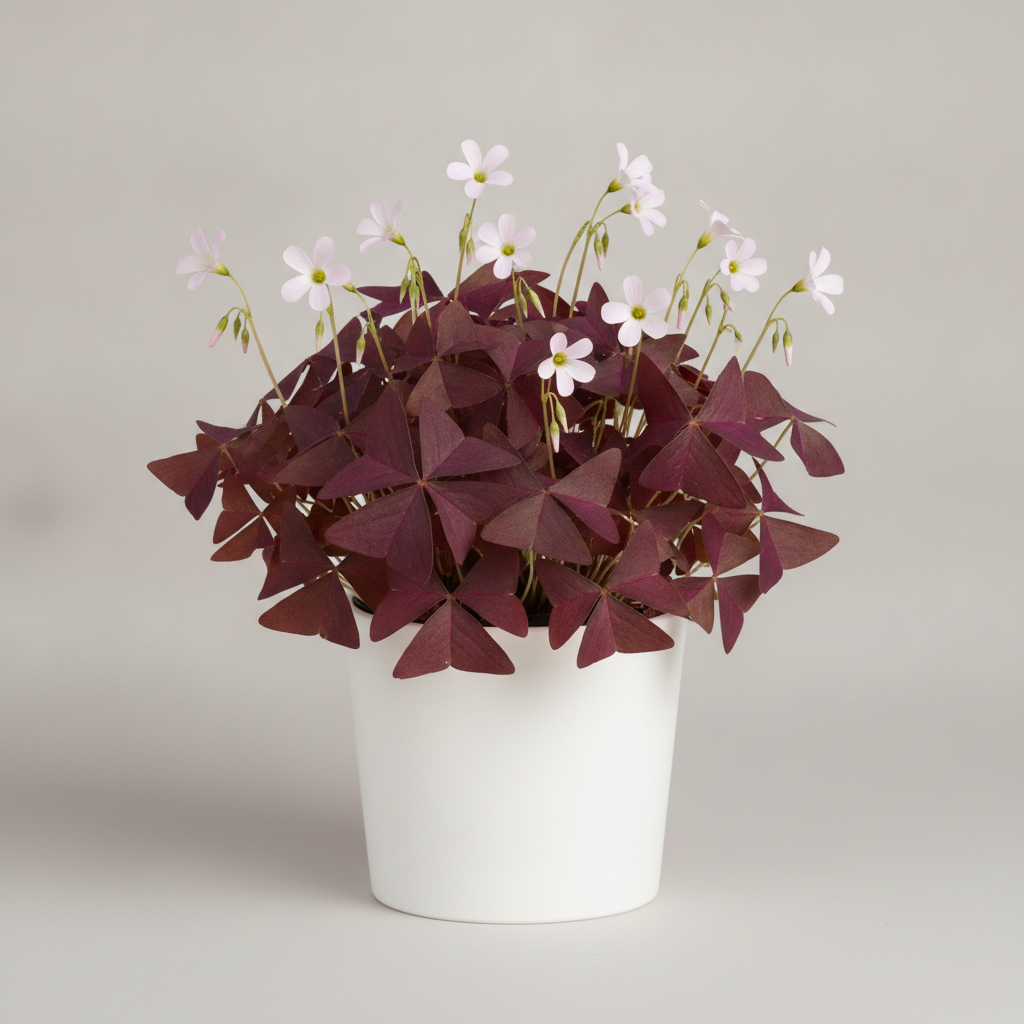
Charmed Wine
A widely sold selection with rich wine-red leaflets that form a particularly dense, full clump, topped with delicate pale-pink flowers. Its deep, even colour and generous habit make it a favourite for a statement pot.

Green Shamrock
The fresh-green cousin, Oxalis regnellii, with bright apple-green triangular leaflets and crisp white star flowers. It brings the same nightly leaf movement in a lighter, airier palette that suits a brighter, more minimal interior.
Variety Profiles in Detail
Charmed Velvet (Oxalis triangularis ‘Charmed Velvet’)
The darkest of the common selections, with leaves so deeply pigmented they read as near-black in lower light and reveal their true plum-purple only when the sun catches them. It needs good light to hold this depth of colour and makes a dramatic contrast against pale pots and walls.
Irish Mist (Oxalis regnellii ‘Irish Mist’)
A variegated green form speckled and flecked with cream, giving a softer, painterly look than the solid colours. Less common in shops, it is worth seeking out for collectors who already have the standard purple and green forms and want something a little different.
Choosing the Right Variety for Your Space
If you want maximum colour impact and a plant that pops against green foliage and neutral interiors, reach for the classic purple type, Charmed Wine or the near-black Charmed Velvet. For a brighter, fresher feel, or to pair with bold-coloured pots, the green forms such as Oxalis regnellii and Irish Mist are the better fit. Whichever you choose, the care is identical, so you can mix and match freely and build a collection that performs the same nightly show in a range of colours.
Frequently Asked Questions
Why do my purple shamrock’s leaves close up at night?
This is normal and healthy behaviour called nyctinasty. The plant folds its leaflets shut in darkness and reopens them in daylight, driven by changes in water pressure at the base of each leaf. A plant that opens wide by day and closes neatly at night is doing exactly what it should.
My plant has suddenly died back. Is it dead?
Almost certainly not. Purple shamrock goes through periods of dormancy in which the foliage yellows, flops and dies back to the bulbs. Cut away the spent leaves, reduce watering to an occasional sip, and within a few weeks fresh shoots will emerge. Resist the temptation to bin a resting plant.
How often should I water a purple shamrock?
While it is actively growing, water once the top 2 to 3 cm (1 in) of mix has dried, which is often around once a week in good light. During dormancy, cut back to roughly once every two to three weeks, just enough to keep the bulbs from shrivelling.
Why are the leaves turning green instead of purple?
Fading to green is the classic sign of insufficient light. The purple pigment builds up in response to bright conditions, so move the plant somewhere brighter, ideally near an east or west window, and the rich colour will return with the next flush of leaves.
Is purple shamrock safe around pets?
No. The leaves and bulbs contain soluble oxalates that are toxic to cats and dogs, and to people, if eaten in quantity. A small nibble usually causes only mild irritation, but it is safest to keep the plant well out of reach of curious pets and young children.
Does the purple shamrock flower indoors?
Yes, readily. Given good light it produces sprays of small, pale-pink to white trumpet flowers on slender stems for much of its growing season, often almost continuously. Flowering slows in low light, so a bright position encourages the best display.
How do I make my shamrock bushier?
The most effective route is to plant several bulbs together and keep the plant in bright light, which keeps stems short and the clump dense. If growth has stretched and flopped, cut it back to soil level and let it regrow in a brighter spot, where the new foliage will come in far more compact.
Can I grow purple shamrock outdoors?
In mild climates it can be grown outdoors in a sheltered, partly shaded spot, and in warmer regions it naturalises easily. In colder areas it is best treated as a houseplant or container plant brought under cover before frost, since the bulbs are not reliably hardy through a hard winter.
When is the best time to repot or divide?
The ideal moment is at the start of a new growth cycle, typically in spring, just as fresh shoots appear from the bulbs. Repotting and dividing then lets the plant establish quickly. You can also divide during dormancy, when the bare bulbs are easy to sort and separate.
Why are the leaf tips going brown?
Brown, crispy tips usually point to very dry air, underwatering, or a build-up of fertiliser salts in the soil. Move the plant away from direct heat sources such as radiators, keep watering consistent, and flush the pot occasionally with plain water to clear accumulated salts.






