
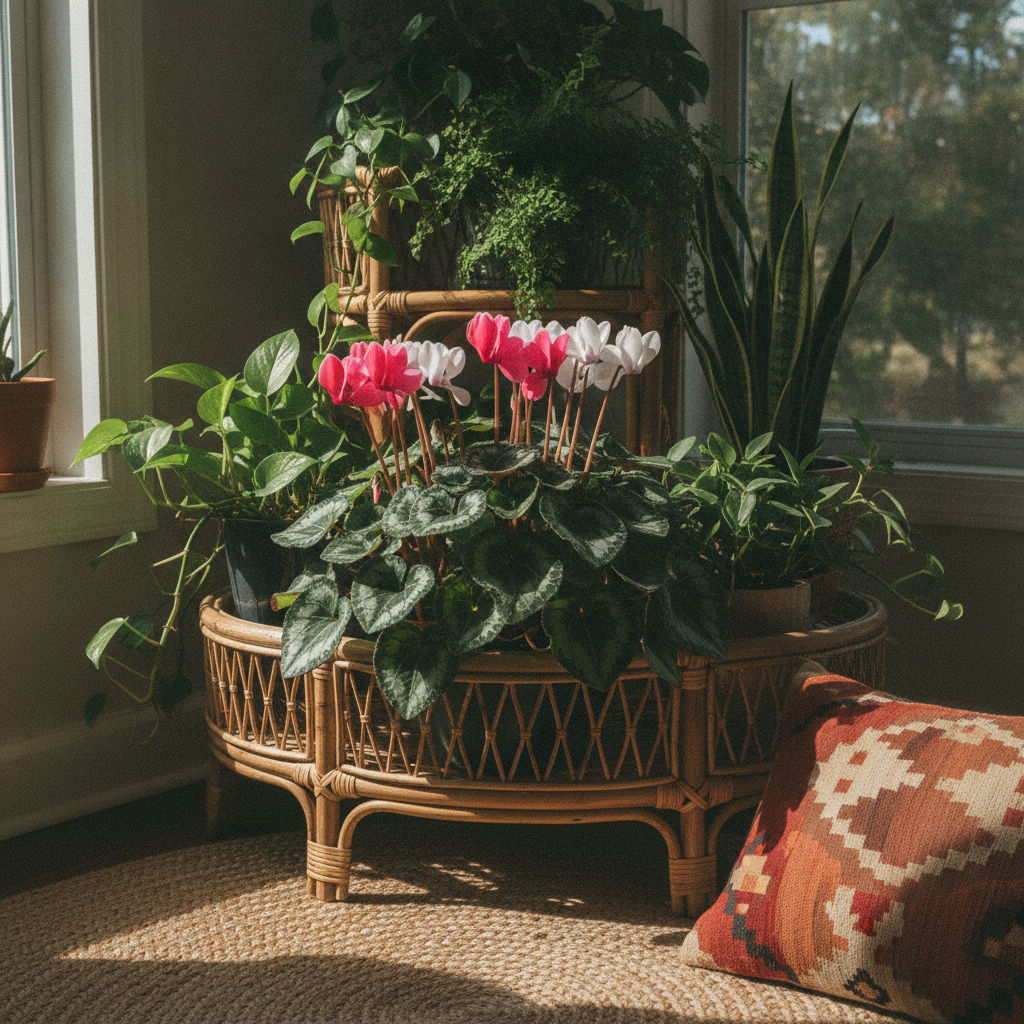
Few flowering houseplants arrive in the depths of winter looking quite as poised as the florist cyclamen. With its swept-back petals held high above a mound of silver-marbled, heart-shaped leaves, Cyclamen persicum brings colour to the windowsill precisely when most other plants have retreated into rest. Also sold simply as the Persian cyclamen, it is a tuberous perennial in the primrose family, Primulaceae, native to the rocky woodlands and scrub of the eastern Mediterranean, from Greece and the Aegean islands across southern Turkey to the Levant and into parts of North Africa. The compact, jewel-toned plants found in garden centres each autumn are highly bred selections of that wild species, prized for their long winter display in shades of white, rose, salmon, magenta, scarlet and deep purple.
The florist cyclamen carries an unfair reputation as a short-lived, almost disposable plant, bought in bud, enjoyed for a few weeks and then thrown away once the flowers fade. That reputation comes almost entirely from a single misunderstanding: most people treat it like a warm-room tropical when it is, in fact, a cool-growing Mediterranean plant with a strict seasonal cycle. Get the temperature and watering right and the same plant will flower for months, go quietly dormant through summer, and return to bloom year after year. This guide covers everything that separates merely keeping a cyclamen alive from genuinely helping it thrive, from reading its dormancy signals to watering in a way that never rots the crown.
Contents
- Quick Reference
- Why Florist Cyclamen Makes a Rewarding Houseplant
- Light Requirements
- Watering & Humidity
- Soil, Potting & Repotting
- Fertilising
- Propagation
- Pests & Diseases
- Popular Varieties
- Frequently Asked Questions
Quick Reference: Florist Cyclamen at a Glance
| Light | Bright, indirect light, with an hour or two of soft morning sun in winter; protect from strong direct midday sun |
| Watering | Keep compost evenly moist while in growth, ideally watering from below; let the surface dry slightly between waterings; nearly dry during summer dormancy |
| Temperature | 10 to 15°C (50 to 59°F) is ideal; flowering and leaf health decline quickly above about 18°C (64°F) |
| Humidity | Moderate, around 50 percent; dislikes the dry, hot air of a centrally heated room |
| Fertiliser | Half-strength high-potassium feed every two weeks during active growth and flowering; none while dormant |
| Toxicity | Toxic to cats, dogs and humans if eaten; the tuber is the most poisonous part |
Why Florist Cyclamen Makes a Rewarding Houseplant
The great appeal of the florist cyclamen is its timing. It flowers through autumn and winter and into early spring, the very months when daylight is short and most leafy houseplants are coasting, so a single plant can carry the mood of a room from October to March. The blooms themselves are unusual and elegant: five petals that twist back on themselves so each flower resembles a tiny shuttlecock or a hovering butterfly, held on slender stalks well clear of the foliage. Beneath them sits a rosette of rounded, heart-shaped leaves patterned with silver, pewter and grey marbling that is attractive in its own right even between flushes of flower.
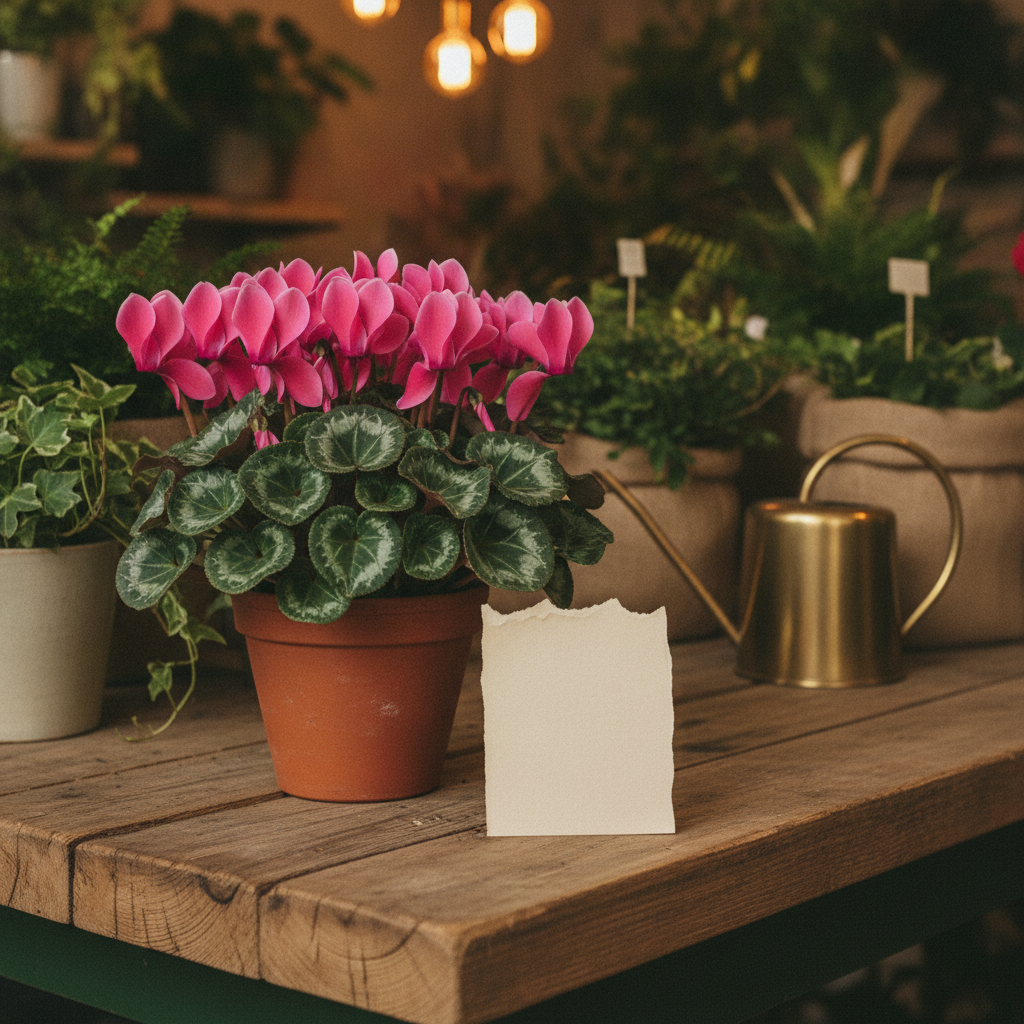
Beyond the display, cyclamen reward the grower who understands them with genuine longevity. In their native range they survive hot, dry Mediterranean summers by dying back to a dormant tuber, then springing back into leaf and flower with the cooler, wetter months. A plant kept on a cool, bright sill and allowed to follow that rhythm is not a seasonal throwaway at all; it is a long-lived perennial that can be coaxed into bloom every winter for a decade or more. The species is also compact, rarely exceeding 20 to 30 cm (8 to 12 in) across, which makes it ideal for windowsills, cool porches and bright bathrooms where larger plants would not fit.
Important — Toxicity: All parts of the cyclamen contain irritant saponins, with the highest concentration in the tuber and roots. Eaten, the plant can cause drooling, vomiting and diarrhoea in cats, dogs and people, and ingestion of a quantity of tuber can lead to more serious effects such as an irregular heartbeat or seizures. Keep plants where curious pets and small children cannot reach them, and wash your hands after handling the tuber.
Light Requirements
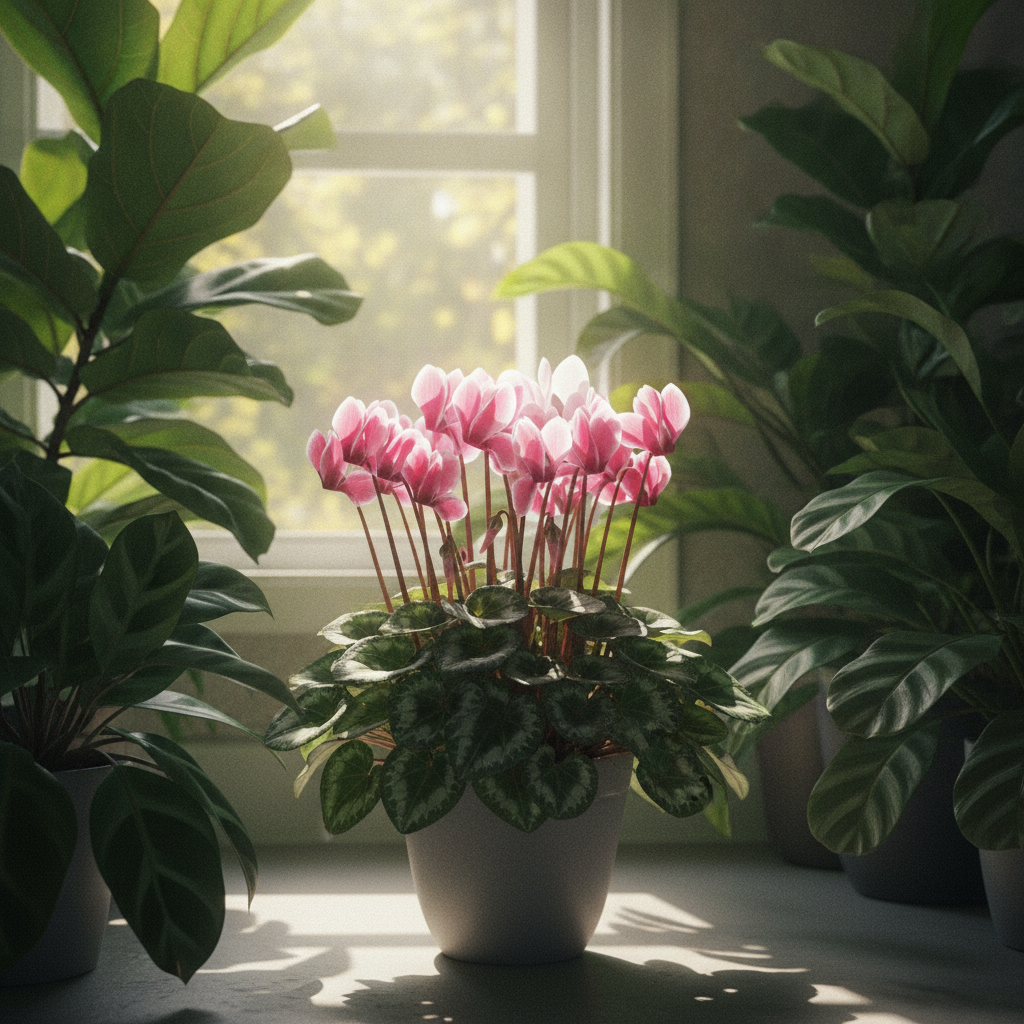
Because the florist cyclamen does its growing in autumn and winter, its light needs run almost opposite to those of a summer-growing tropical. During the short, dim days of the colder months it wants as much bright light as it can get, and the weak winter sun that would scorch a fern is exactly what a cyclamen enjoys. The goal is plenty of brightness without the fierce, heating direct sun of late spring and summer, which both bleaches the flower colour and pushes the plant towards dormancy before its time.
In practical terms, a position that receives strong, diffuse daylight with a little gentle morning or late-afternoon sun is close to perfect. A cool, bright windowsill that stays well lit but never bakes will keep the foliage compact, the flower stems short and upright, and the colours saturated.
Light Levels Explained
The table below translates the usual indoor light categories into what they mean for a winter-growing cyclamen. Remember that the same window delivers far less energy in December than in June, so a sill that is “bright indirect” in winter may become “direct and too hot” by the time the plant is heading into dormancy.
| Light Category | Approx. Level | Typical Location | Outcome |
|---|---|---|---|
| Winter direct sun | 10,000 lux and above | On a south sill in midwinter | Well tolerated in cold months; keeps colour and form excellent |
| Bright indirect | 5,000 to 10,000 lux | Near an east or west window, or just back from a south one | Ideal; abundant flowering and compact growth |
| Medium | 2,000 to 5,000 lux | A metre or so inside a bright room | Acceptable; fewer flowers, slightly looser habit |
| Low | 500 to 2,000 lux | A north room or a shaded corner | Stretched, weak stems and sparse, short-lived flowers |
| Summer direct sun | 50,000 lux and above | An unshaded south window in summer | Overheats the plant, fades colour and forces early dormancy |
Window Orientation and Placement
South-facing window: Excellent in autumn and winter, when the low sun is gentle and the extra light keeps growth tight and flowering generous. As spring strengthens, move the plant back from the glass or filter the light, since a hot south sill in March can cook a cyclamen and trigger premature yellowing.
East-facing window: One of the best positions all season. The plant gets cool, bright morning light and is spared the heat of the afternoon, which suits its preference for brightness without warmth.
West-facing window: Also very good through the colder months, offering strong afternoon light. Watch for overheating on warm, sunny spring afternoons and shade lightly if the leaves feel hot to the touch.
North-facing window: Usually too dim for sustained flowering, especially in midwinter. A cyclamen here will tend to produce pale, stretched stalks and few blooms. It can serve as a short-term display spot, but move the plant somewhere brighter to keep it in good health.
Pro Tip — Turn for Even Growth: Cyclamen lean noticeably towards the light. Give the pot a quarter turn every few days so the flower stalks stand upright and the leaf mound stays symmetrical rather than crowding to one side.
How Light Affects Flowering and Colour
Light drives flowering in cyclamen more directly than in many foliage plants, because it is the engine of the winter display. In good light the plant keeps producing a steady succession of buds from the centre of the tuber, the stalks stay short and rigid, and the petal colours hold their depth. In poor light the same plant stops setting new buds, the existing stalks elongate and flop, and the leaves grow large and soft as they reach for brightness. If your cyclamen looks lank and floppy rather than neat and upright, insufficient light combined with too much warmth is almost always the cause.
Warning — Summer Direct Sunlight: The cool-season sun a cyclamen loves becomes its enemy once the weather warms. Strong direct sun through glass in late spring overheats the tuber and foliage, fades the leaf marbling, and can scorch leaf margins. By the time the plant is winding down for summer, keep it bright but out of any hot, direct beam.
Artificial Lighting
Because cyclamen flower in the darkest part of the year, a full-spectrum LED grow light can genuinely improve the display in a dim home, lengthening the effective day and keeping growth compact. Position the light 30 to 45 cm (12 to 18 in) above the foliage and run it for ten to twelve hours a day through the flowering season. Choose a cool-running fixture and keep it far enough away that it adds light without adding heat, since warmth is the one thing a cyclamen does not want.
Seasonal Adjustments
Treat the cyclamen’s light year as two halves. From autumn through to mid-spring, while it is in leaf and flower, give it the brightest, coolest spot you have and welcome the weak direct sun. From late spring onward, as the leaves begin to yellow and the plant enters dormancy, light becomes far less important than keeping the resting tuber cool and on the dry side. Bright but indirect light, or even a shaded, airy spot outdoors in a frost-free climate, suits the summer rest.
Watering & Humidity
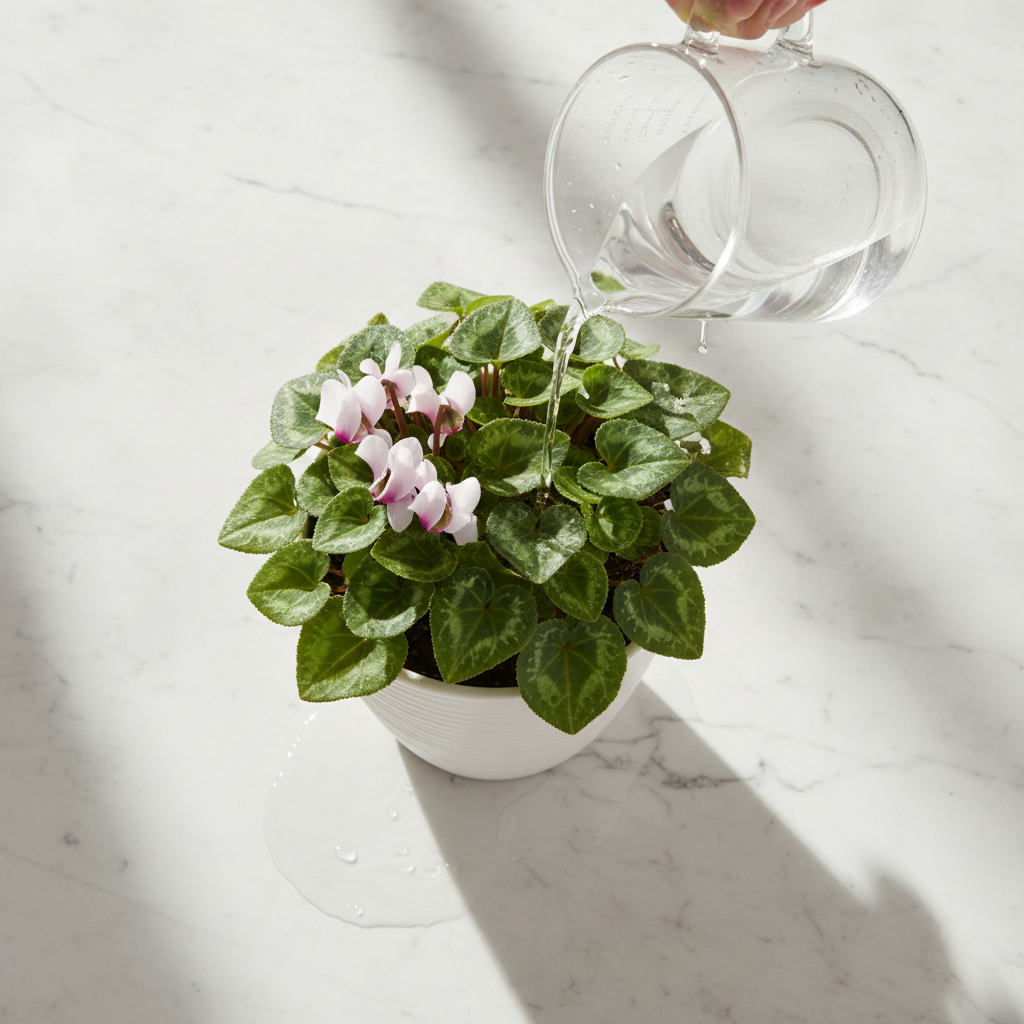
Watering is where most cyclamen are won or lost, and the single most important rule is to keep water off the crown. The crown is the cluster of growing points at the top of the tuber, from which the leaves and flower stalks emerge, and it sits at or just above the soil surface. Splash water into that crown and let it sit, and the plant is highly prone to rot. The safest approach is to water from below, letting the roots draw moisture up while the crown stays dry.
When to Water
While the plant is in active growth and flower, aim to keep the compost evenly moist but never waterlogged. Check by lifting the pot and feeling its weight, or by pressing a finger into the compost near the rim: when the top centimetre or two feels just dry, it is time to water again. In a cool room this might mean watering once every five to seven days, but the plant should tell you rather than the calendar, so always check before you pour.
As flowering ends in spring and the leaves begin to yellow, gradually reduce watering. Through the summer dormancy the tuber needs to stay barely moist to bone dry, with only the occasional splash to stop it shrivelling completely. Resume more regular watering in late summer or early autumn, once you see fresh leaf buds pushing from the crown, and the new growing season begins again.
Pro Tip — Bottom Watering: Stand the pot in a saucer or bowl of room-temperature water for fifteen to twenty minutes, let the compost soak moisture up from below, then tip away whatever is left so the plant never sits in standing water. This keeps the crown dry and waters the rootball thoroughly in one step.
How to Water Correctly
- Check the compost first by weight or by touch near the rim, and only water when the surface has begun to dry.
- Stand the pot in a few centimetres of room-temperature water, or pour gently onto the compost at the edge of the pot, well away from the crown.
- Allow the rootball to take up water for fifteen to twenty minutes if bottom watering, or until moisture appears at the drainage holes if watering from above.
- Lift the pot out and let all excess drain away completely.
- Empty the saucer so the plant is never left standing in water, which quickly leads to root and tuber rot.
- Use water at room temperature, since cold water on an already cool-loving plant can shock the roots.
Signs of Overwatering vs. Underwatering
Confusingly, an overwatered and an underwatered cyclamen can both present with drooping, yellowing leaves, so it pays to read the other clues. The state of the compost, the firmness of the tuber and the texture of the foliage together tell you which way the plant has gone.
| Symptom | Overwatering | Underwatering |
|---|---|---|
| Leaf colour | Yellowing that spreads while the soil stays wet | Yellowing with crisp, browning edges as the soil dries out |
| Leaf texture | Soft, limp and sometimes translucent | Wilted but recovering quickly once watered |
| Soil | Constantly wet, may smell sour | Dry, light and pulling away from the pot sides |
| Tuber and crown | Soft, mushy or browning, often with mould at the crown | Firm but shrivelled and slightly wrinkled |
| Flowers | Buds collapse and rot before opening | Buds and open flowers wilt and dry prematurely |
Warning — Crown and Tuber Rot: Water pooling in the crown is the most common killer of indoor cyclamen. A tuber that has gone soft, brown and foul-smelling cannot usually be saved. Always water from below or at the pot edge, keep the top of the tuber proud of the compost, and ensure good airflow so the crown dries quickly after watering.
Humidity Requirements
Cyclamen prefer moderate humidity of around 50 percent, the kind of fresh, slightly damp air found in a cool conservatory or an unheated porch. The conflict in most homes is not the humidity itself but the dry, hot air produced by central heating, which both lowers humidity and raises the temperature into a range the plant dislikes. A cool room is therefore worth far more to a cyclamen than any amount of misting.
When the air is too dry and warm, leaf edges brown, buds blast before they open, and flowers fade fast. These symptoms are usually a sign that the plant is both too hot and too dry at the same time, so the most effective fix is to move it somewhere cooler and brighter rather than to fuss over the air.
To raise humidity gently without wetting the crown, stand the pot on a tray of damp gravel or expanded clay pebbles, keeping the base of the pot above the water line, or group it with other plants so they share a moister microclimate. Avoid heavy misting directly onto the foliage and flowers, since the lingering moisture invites grey mould on the delicate petals.
Water Quality
Cyclamen are not especially fussy about water chemistry, but they appreciate water at room temperature rather than straight from a cold tap. In hard-water areas the occasional use of cooled boiled water or rainwater helps keep the slightly acidic to neutral soil conditions they prefer, though ordinary tap water left to stand and reach room temperature is perfectly adequate for most growers.
Soil, Potting & Repotting
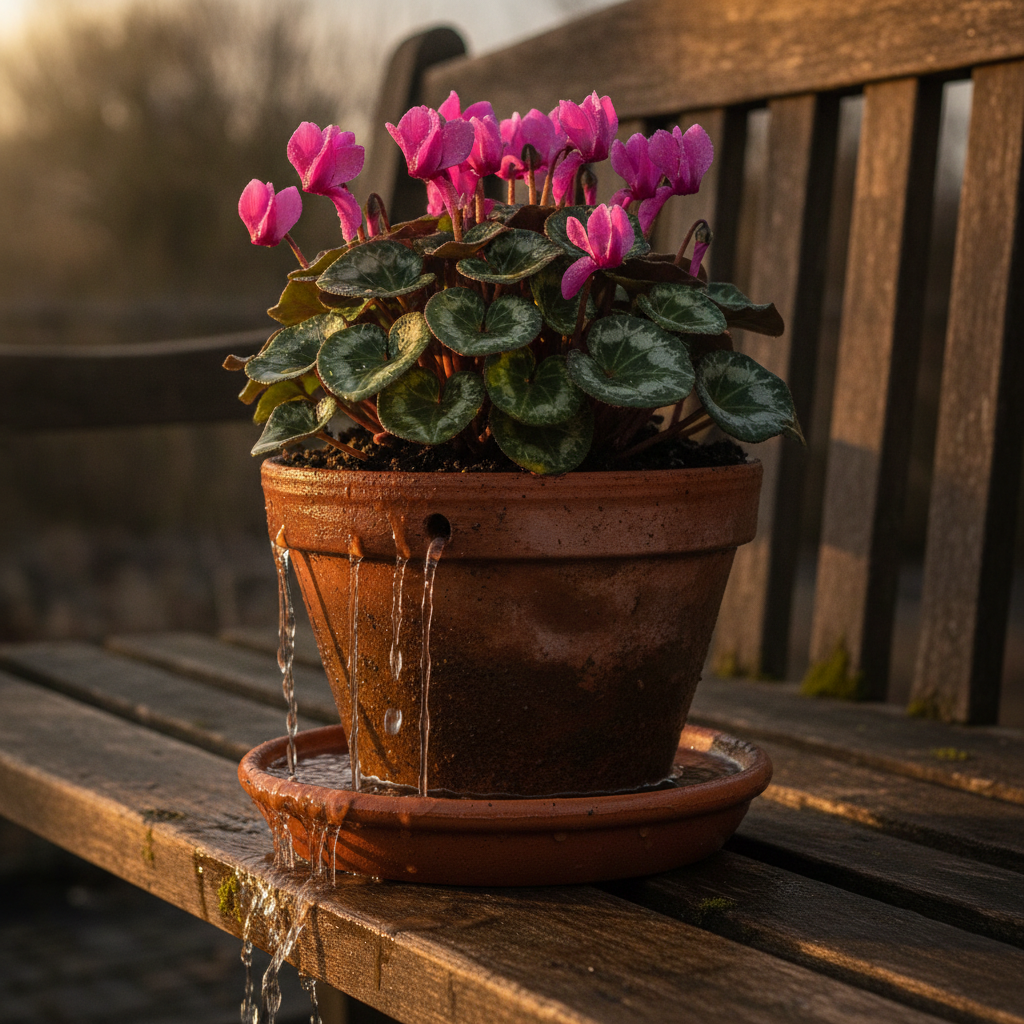
A florist cyclamen needs a compost that holds enough moisture to support its winter growth yet drains freely enough that the tuber never sits in soggy ground. The wild plant grows in gritty, humus-rich woodland soil over limestone, and a good potting mix echoes that: open, airy and just slightly acidic to neutral. Equally important is how the tuber is planted, since burying it too deeply is a direct route to rot.
Ideal Soil Composition
A reliable cyclamen mix combines a quality peat-free multipurpose or coir-based compost for moisture retention and structure with a generous measure of grit or perlite for drainage, plus a little fine bark or leaf mould to mimic the woodland humus the plant evolved in. The aim is a medium that stays evenly moist after watering but lets surplus water run straight through.
| Component | Proportion | Function |
|---|---|---|
| Peat-free multipurpose or coir compost | 50 percent | Holds moisture and provides the bulk of the structure |
| Horticultural grit or perlite | 30 percent | Opens the mix and ensures sharp drainage around the tuber |
| Fine composted bark or leaf mould | 20 percent | Adds humus and air, echoing native woodland soil |
Cyclamen prefer a soil pH in the slightly acidic to neutral range, roughly 6.0 to 7.0. Most peat-free and coir-based composts fall comfortably within this band, so no special adjustment is usually needed, but avoid strongly alkaline mixes which can lock up iron and leave the foliage pale.
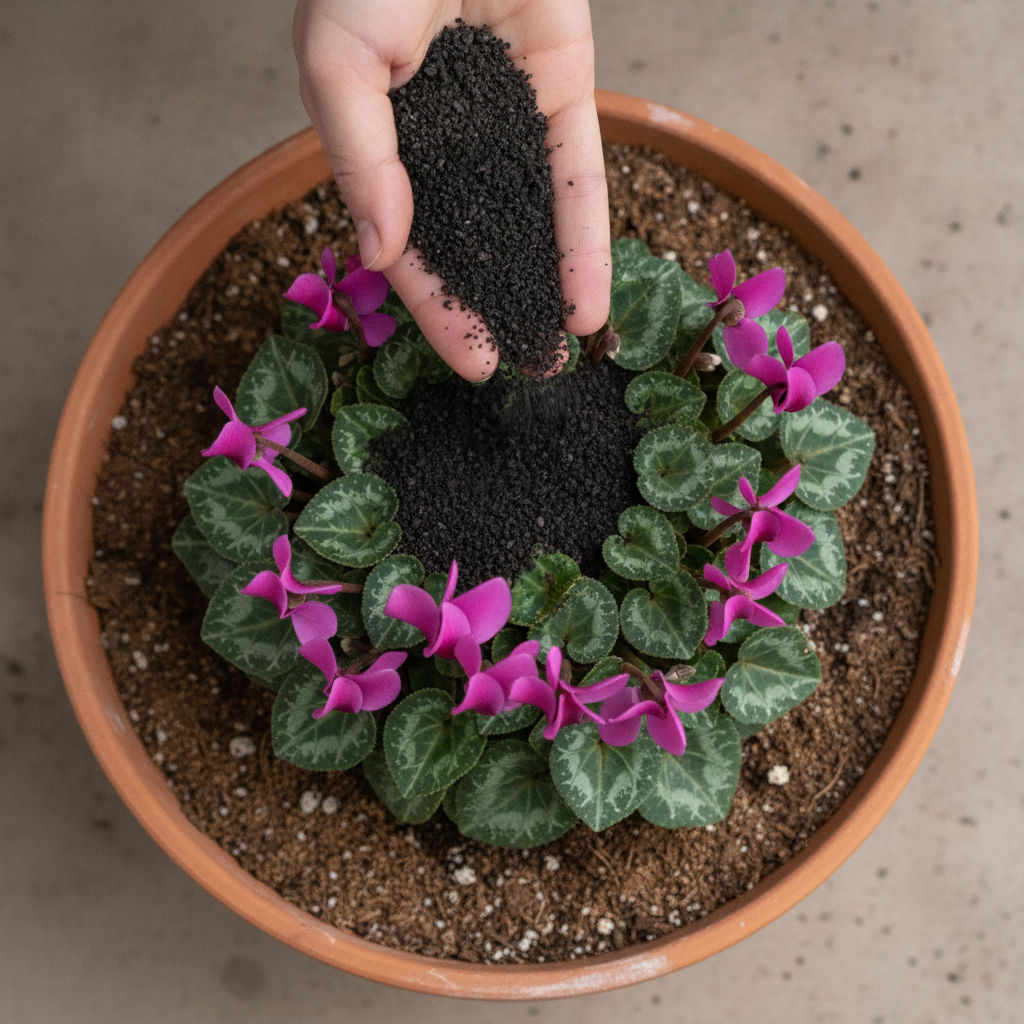
Pro Tip — Quick Mix Recipe: For a single plant, combine five handfuls of peat-free compost, three handfuls of perlite or fine grit and two handfuls of composted bark in a bucket. Plant the tuber so its top third stands proud of the surface, and top the soil with a thin layer of grit to keep the crown dry and discourage mould.
Choosing the Right Pot
Cyclamen flower best when slightly underpotted, with the tuber filling most of the pot and only a centimetre or two of compost around its sides. An oversized pot holds a reservoir of damp soil the small root system cannot use, which stays wet and encourages rot. A snug pot, by contrast, dries out at a sensible pace and keeps the plant in the slightly tight conditions it likes.
Drainage holes are non-negotiable. Whatever pot you choose, it must have open drainage holes so water can escape freely. A decorative cachepot without holes is fine as an outer sleeve, but lift the inner pot out to water and never let it stand in collected water.
Pot material: Terracotta is excellent for cyclamen because its porous walls let the compost breathe and dry evenly, reducing the risk of waterlogging around the tuber. Plastic and glazed ceramic retain moisture longer, which is workable as long as you water more cautiously and rely on a free-draining mix.
Pot size: Match the pot to the tuber, allowing only a modest margin around it. A tuber 8 to 10 cm (3 to 4 in) across is happy in a pot around 12 to 14 cm (5 to 6 in) wide. Step up only one size at a time, and only when the plant has genuinely outgrown its container.
When to Repot
The right moment to repot a cyclamen is at the very end of its summer dormancy, in late summer, just as the first new leaf buds appear on the tuber. Repotting then gives the plant fresh nutrients and room for the coming growing season without disturbing it in full flower. Established plants usually need refreshing every one to two years; signs that it is time include roots filling the pot, compost that has broken down and stays soggy, or a tuber visibly crowding the container.
How to Repot: Step-by-Step
- Repot in late summer as new growth begins, not while the plant is flowering.
- Ease the tuber and rootball out of the old pot and gently tease away the spent, loose compost from around the roots.
- Inspect the tuber and trim off any soft, brown or rotten patches with a clean, sharp blade, letting cut surfaces dry briefly.
- Part-fill the new pot with fresh, gritty cyclamen mix and set the tuber so its upper third will stand above the finished soil line.
- Fill in around the sides, firming lightly, and keep the crown clear of compost.
- Top-dress with a thin layer of grit, then water sparingly from below to settle the mix.
- Place the freshly potted plant in a cool, bright spot and increase watering only as new leaves develop.
Warning — Burying the Tuber: Never plant a cyclamen tuber fully below the soil. Its top should sit proud of the surface so the crown stays dry and well aired. A buried tuber traps moisture against the growing points and is one of the most common, and most avoidable, causes of rot.
Fertilising
Cyclamen are light feeders, but a steady supply of the right nutrients while they are in growth makes a marked difference to the number and quality of flowers. The key is to feed only during the active autumn-to-spring season and to favour potassium, the nutrient most associated with flowering, over the nitrogen that drives leafy growth at the expense of bloom.
Overfeeding is more damaging than underfeeding. Too much fertiliser, particularly high-nitrogen feed, produces a lush mound of soft leaves and very few flowers, and the excess salts can scorch the roots. Little and often, at reduced strength, is the way to keep a cyclamen both healthy and floriferous.
Understanding Plant Nutrients
Fertiliser labels show three numbers, the N-P-K ratio, standing for nitrogen, phosphorus and potassium. For a flowering plant like cyclamen, a feed where the potassium figure is higher than the nitrogen, such as a tomato fertiliser, encourages flowering and sturdy growth. The table below summarises the main nutrients and the signs that a plant is short of each.
| Nutrient | Symbol | Primary Function | Deficiency Symptoms |
|---|---|---|---|
| Nitrogen | N | Leaf and stem growth | Pale, yellowing older leaves and weak growth |
| Phosphorus | P | Root development and energy transfer | Dull foliage, poor roots, purplish leaf tints |
| Potassium | K | Flowering, water regulation and overall vigour | Few flowers, browning leaf edges, soft growth |
| Calcium | Ca | Cell wall strength | Distorted new leaves and weak stems |
| Magnesium | Mg | Core of the chlorophyll molecule | Yellowing between the veins of older leaves |
| Iron | Fe | Chlorophyll production | Yellowing between the veins of young leaves |
Types of Fertiliser
Liquid fertilisers: The most practical choice for cyclamen, since they are easy to dilute to half strength and to apply with the regular watering. A high-potassium liquid tomato feed is ideal, delivering nutrients gently and predictably throughout the flowering season.
Slow-release granular: A small amount of slow-release fertiliser mixed into the compost at repotting can provide a steady background of nutrition, but it offers less control than liquid feeding and risks overfeeding if combined with regular liquid feed. Use one or the other, not both at full rate.
Organic fertilisers: Diluted seaweed extract and other gentle organic feeds suit cyclamen well, supplying trace elements and improving overall vigour without the risk of a sudden nitrogen surge. They are a good choice for growers who prefer a softer feeding regime.
Feeding Schedule
Feed every two weeks with a half-strength high-potassium liquid feed from the moment growth resumes in autumn until flowering tails off in spring. As the leaves begin to yellow and the plant heads into its summer rest, stop feeding entirely; a dormant tuber takes up almost nothing and added fertiliser simply accumulates as harmful salts. Begin feeding again only once new leaves emerge the following season.
Pro Tip — Half Strength Is Plenty: Always dilute cyclamen feed to half the strength recommended on the bottle. These are modest feeders, and a weaker solution applied more often gives far better flowering than an occasional strong dose, which tends to build up salts and burn the roots.
How to Fertilise
- Confirm the plant is in active growth, with leaves and flowers present, before feeding.
- Dilute a high-potassium liquid feed to half the recommended strength in room-temperature water.
- Water the plant first if the compost is very dry, so the feed never hits parched roots.
- Apply the diluted feed from below or at the soil edge, keeping it off the crown and foliage.
- Flush the compost with plain water every month or so to wash away any accumulated salts.
Warning — Salt Build-Up: A white crust on the soil surface or pot rim signals a build-up of fertiliser salts, which can scorch the roots and brown the leaf edges. Periodically flush the compost with plenty of plain water, and never feed a dormant or barely growing plant.
Propagation
Propagating florist cyclamen is rather different from rooting a cutting of a trailing houseplant, because the plant grows from a single tuber and does not produce offsets or rooting stems. The two realistic routes are growing from seed, which is slow but reliable and the way commercial growers raise their plants, and dividing the tuber, which is quicker but carries a real risk of rot. Understanding the tuber is the key to both.
It is worth being honest about expectations. Cyclamen do not propagate quickly or freely the way pothos or spider plants do, and seed-raised plants take a year or more to reach flowering size. For most growers, propagation is a slow and satisfying project rather than a fast way to fill the house with new plants.
Understanding the Tuber
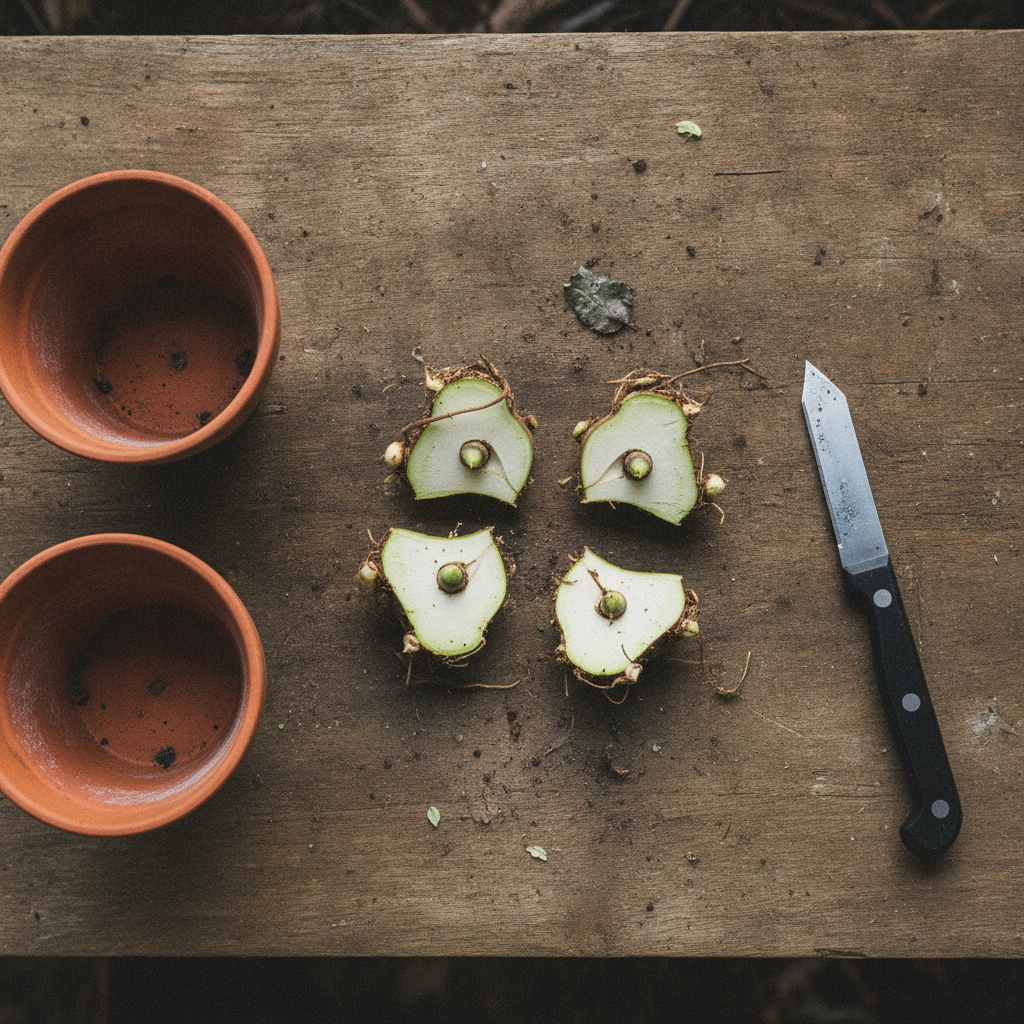
A cyclamen tuber is a flattened, rounded storage organ that holds the energy the plant lives on through its summer dormancy. The growing points, from which leaves and flowers arise, are clustered on the upper surface, while the roots emerge mainly from the base. Because the tuber does not naturally split into separate plants, any division must be done deliberately with a knife, ensuring every piece keeps at least one healthy growing point. Cut surfaces are vulnerable to infection, which is why seed is the safer method for most people.
Growing From Seed: Step-by-Step
Seed is the dependable way to raise new cyclamen, and sowing fresh seed in late summer or autumn gives the best results. Patience is essential, as germination is slow and uneven, but the method is forgiving and produces strong, healthy plants.
- Soak the seed in room-temperature water for around twelve to twenty-four hours to soften the coat and improve germination.
- Sow thinly on the surface of moist, free-draining seed compost and cover with a thin layer of grit or vermiculite, since cyclamen germinate best in darkness.
- Keep the tray in a cool, dark place at around 12 to 15°C (54 to 59°F), as warmth above this slows or prevents germination.
- Maintain even moisture and be patient: seedlings may take four to eight weeks, sometimes longer, to appear.
- Once tiny tubers and the first true leaves form, move the seedlings into gentle light and prick them out into individual small pots.
- Grow them on cool and bright, and expect the first flowers around twelve to fifteen months after sowing.
Pro Tip — Sow Fresh and Cool: Cyclamen seed germinates far more readily when it is fresh and kept cool and dark. If you can, collect and sow your own seed promptly, and resist the urge to warm the tray on a heated propagator, since heat is the usual reason home-sown cyclamen fail to come up.
Dividing the Tuber: Step-by-Step
Tuber division is the faster but riskier option, best attempted only on a large, mature, dormant tuber and only by growers willing to accept that pieces may rot. It is done at the end of dormancy, just before new growth begins.
- Lift a large, firm, dormant tuber and brush off the loose compost so you can see the growing points clearly.
- With a clean, sharp, sterilised knife, cut the tuber into sections, making sure each piece carries at least one growing point and some root area.
- Dust the cut surfaces with a fungicide or powdered sulphur and leave them in a dry, airy place for a day or two to callus over.
- Pot each section into its own small pot of gritty cyclamen mix, keeping the top of the piece proud of the surface.
- Water very sparingly from below and keep the pots cool and bright until new growth shows the division has taken.
Troubleshooting Propagation
| Problem | Likely Cause | Solution |
|---|---|---|
| Seed fails to germinate | Old seed, or compost kept too warm | Use fresh seed and keep the tray cool and dark, below 15°C (59°F) |
| Divided tuber rots | Cut surfaces infected or kept too wet | Sterilise tools, dust cuts with fungicide, callus before potting and water sparingly |
| Seedlings damp off | Overwatering and poor airflow | Water from below, improve ventilation and avoid waterlogged compost |
| Slow, weak seedlings | Too little light or too much heat | Grow on cool and bright once germinated, with steady but gentle light |
Pests & Diseases
A cyclamen grown cool and watered carefully is reasonably resistant to trouble, but its dense crown of leaves and its dislike of warm, stuffy air make it prone to a handful of specific pests and diseases. Most problems trace back to conditions that are too warm, too wet or too still, so good culture is the first line of defence.
Inspect plants regularly, paying attention to the undersides of leaves, the leaf stalks and the crown where pests and rot tend to hide. Catching an infestation or an outbreak of mould early makes it far easier to deal with before it spreads through the whole plant.

Common Pests
Vine Weevil (Otiorhynchus sulcatus)
Vine weevil is the most serious pest of cyclamen. The adults notch the leaf edges at night, but the real damage is done underground by the plump, white, C-shaped grubs, which eat the roots and tunnel into the tuber, often causing a plant to collapse suddenly with no obvious warning above ground. A cyclamen that wilts despite correct watering should always be checked for grubs.
Treatment: Tip the plant out and pick off any grubs you find, repotting into fresh compost. A biological control of parasitic nematodes watered into the compost in late summer or autumn is the most effective long-term answer, as it targets the larvae in the soil.
Cyclamen Mite (Phytonemus pallidus)
Cyclamen mites are microscopic and invisible to the naked eye, but their effect is unmistakable: distorted, curled and stunted new leaves, deformed buds and flowers, and a general failure to grow properly. They thrive in the warm, humid conditions the plant itself dislikes, so an outbreak is often a sign the plant is being kept too warm.
Treatment: There is no easy home cure once an infestation is established. Isolate the plant at once to protect others, remove and destroy the worst-affected growth, and in serious cases dispose of the plant entirely. Keeping cyclamen cool and well ventilated is the best prevention.
Aphids (Aphidoidea)
Aphids cluster on soft new growth, buds and flower stalks, sucking sap and leaving sticky honeydew that can turn black with sooty mould. They weaken the plant and can distort developing flowers, and they multiply quickly in mild indoor conditions.
Treatment: Wipe or rinse off small colonies, or spray with insecticidal soap, taking care to keep heavy moisture off the crown. Repeat every few days until no new aphids appear, and inspect nearby plants too.
Fungus Gnats (Sciaridae)
Small black flies hovering around the pot are fungus gnats, whose larvae live in constantly damp compost and feed on organic matter and fine roots. They are more a symptom of overwatering than a primary threat, but heavy populations can damage seedling roots and indicate the soil is being kept too wet.
Treatment: Let the compost surface dry between waterings, water from below, and use yellow sticky traps to catch the adults. A top layer of grit also discourages the females from laying in the soil.
Common Diseases
Grey Mould (Botrytis cinerea)
Grey mould is the most common cyclamen disease, appearing as a fuzzy grey growth on flowers, leaves or the crowded crown, usually where moisture has been allowed to linger in cool, still air. It spreads fast through congested foliage and can quickly ruin a display.
Treatment: Remove affected leaves and flowers promptly, snapping off spent stalks at the base rather than cutting and leaving stubs. Improve airflow, reduce humidity around the crown, and keep water off the foliage to stop it returning.
Cyclamen Wilt (Fusarium oxysporum)
Fusarium wilt is a soil-borne fungal disease that invades the tuber and blocks the plant’s water-conducting tissue, causing leaves to yellow and wilt from one side or all over while the roots and tuber slowly rot. It is difficult to cure once established.
Treatment: There is no reliable home remedy. Remove and destroy badly affected plants to prevent spread, use fresh sterile compost and clean pots when repotting, and avoid overwatering, which favours the fungus.
Crown and Tuber Rot (Erwinia and various fungi)
Soft, brown, foul-smelling decay at the crown or tuber is the result of water sitting in the growing points, usually from watering into the crown or burying the tuber too deep. The whole plant can collapse rapidly once the rot takes hold.
Treatment: Catch it early by cutting away any soft tissue back to firm, clean flesh and dusting with fungicide, then keep the plant on the dry side. Advanced rot, especially of the tuber itself, cannot usually be reversed, so prevention through careful watering is essential.
Pest and Disease Summary
| Pest / Disease | Identification | Treatment |
|---|---|---|
| Vine weevil | Notched leaf edges; white grubs eating roots and tuber | Remove grubs, repot, apply nematode biological control |
| Cyclamen mite | Distorted, curled new leaves and deformed buds | Isolate, remove affected growth, keep cool; dispose if severe |
| Aphids | Clusters on buds and soft growth, sticky honeydew | Rinse off or treat with insecticidal soap, repeat |
| Fungus gnats | Small black flies around damp compost | Dry the surface, water from below, use sticky traps |
| Grey mould | Fuzzy grey growth on flowers, leaves or crown | Remove affected parts, improve airflow, keep foliage dry |
| Cyclamen wilt | One-sided or general yellowing and wilting; rotting tuber | Destroy the plant, use sterile compost, avoid overwatering |
| Crown and tuber rot | Soft, brown, smelly decay at the crown or tuber | Cut back to firm tissue early; prevent by careful watering |
Prevention Strategies
Almost every cyclamen problem is easier to prevent than to cure, and the prevention nearly always comes down to the same few habits. Keep the plant cool, bright and well ventilated, water from below so the crown stays dry, and remove spent flowers and yellowing leaves promptly so dead material does not become a seat for mould.
When you remove a faded flower or a tired leaf, pull the whole stalk away from the tuber with a gentle twist rather than cutting it and leaving a stub, since stubs rot and invite grey mould into the crown. Quarantine any newly bought plant for a couple of weeks, and inspect regularly so that any pest or disease is caught while it is still a small, manageable problem.
Pro Tip — Twist, Do Not Cut: Deadhead spent flowers and remove yellowing leaves by holding the stalk low down and twisting it sharply away from the tuber so it detaches cleanly at the base. This removes the entire stem and leaves no rotting stub, which is one of the simplest ways to keep grey mould out of the crown.
Popular Varieties
Decades of breeding have turned the wild Persian cyclamen into a vast range of cultivated forms, grouped less by individual name than by size class and flower type. Understanding those groups makes it much easier to choose a plant that suits your space, since they range from grand, large-flowered standards to tiny, often scented miniatures.
Broadly, cyclamen are sold as large-flowered standards, intermediate or midi types, and compact mini or micro forms, with flower styles spanning plain, picotee-edged, ruffled and fully frilled. Many of the most popular plants belong to named commercial series bred for uniformity, vigour and a particular look, and the table below sets out the main types to look for.
| Variety | Flower Appearance | Light Needs | Growth Rate | Availability |
|---|---|---|---|---|
| Standard large-flowered | Large blooms 4 to 6 cm tall in solid colours | Bright indirect | Moderate | Very common |
| Victoria | White petals with a magenta-red fringed picotee edge | Bright indirect | Moderate | Common |
| Rococo | Large, frilled and ruffled petals in pinks and reds | Bright indirect | Moderate | Common |
| Midi or Metis | Intermediate-sized flowers on compact plants | Bright indirect | Moderate | Common |
| Mini and micro | Small, dainty, often scented flowers | Bright indirect | Moderate | Common |
| Silverado and silver-leaf types | Standard flowers above strongly silvered foliage | Bright indirect | Moderate | Occasional |
| Scented series (Concerto, Miracle) | Compact plants bred for fragrance | Bright indirect | Moderate | Occasional |
Featured Varieties
Victoria
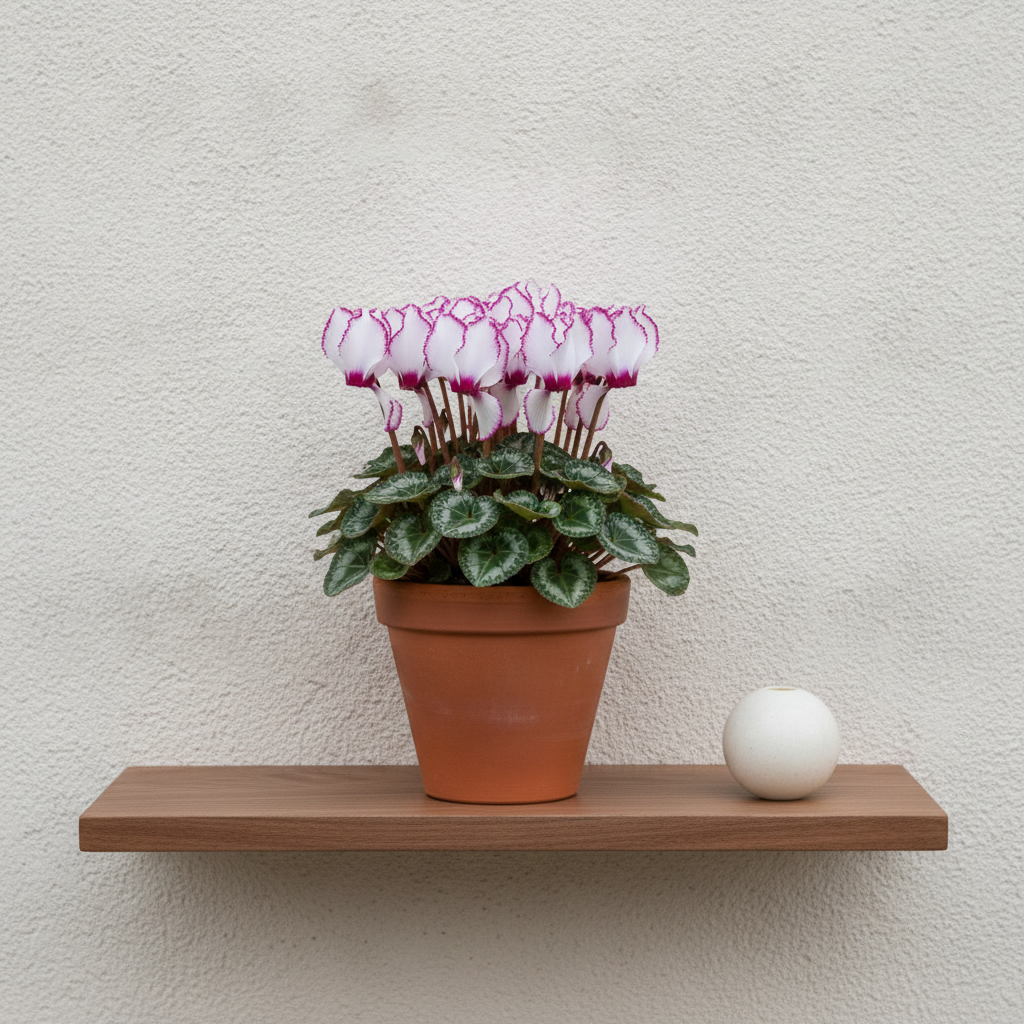
One of the most recognisable cyclamen, Victoria carries white, upswept petals finished with a ruffled magenta-red picotee edge, held above neatly silver-marbled foliage. The crisp two-tone effect makes it a long-standing favourite for winter displays.
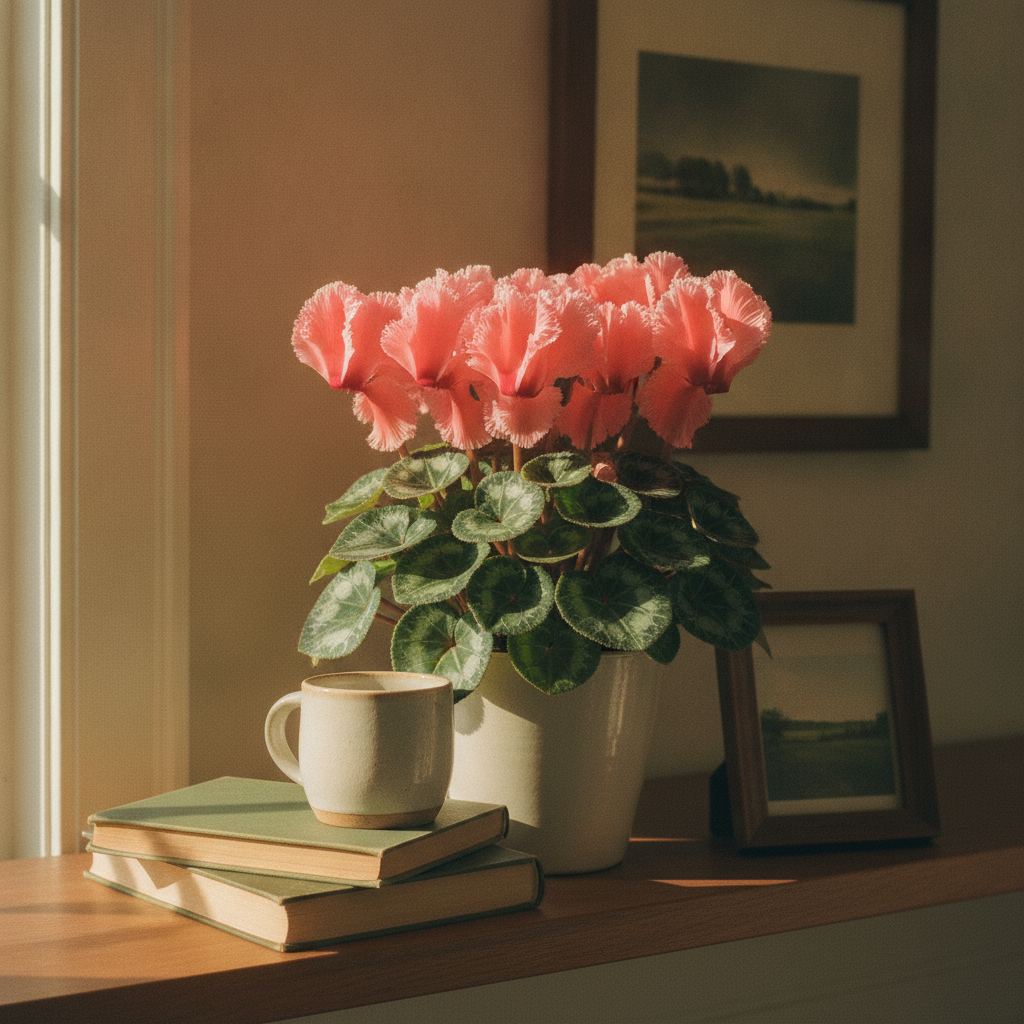
Rococo
The Rococo group is prized for its large, heavily frilled and ruffled petals, which flare outward rather than sweeping fully back, giving the flowers a soft, full, almost double appearance in shades of salmon, pink and red above broad marbled leaves.
Variety Profiles in Detail
Standard Large-Flowered Cyclamen (Cyclamen persicum)
The classic florist cyclamen, with bold, upswept flowers in pure single colours from white through pink and salmon to scarlet and deep purple. These are the most widely sold plants, generous in flower and reliable in performance, and they form the backbone of the winter houseplant display.
Mini and Scented Cyclamen (Cyclamen persicum)
Compact mini and micro cyclamen pack a profusion of small flowers onto a plant only 10 to 15 cm (4 to 6 in) tall, and many of them, unlike the larger standards, carry a genuine sweet fragrance reminiscent of their wild ancestors. They are ideal for small sills and grouped displays where their scent can be appreciated up close.
Choosing the Right Variety for Your Space
For a bold splash of winter colour on a generous sill, a standard large-flowered cyclamen gives the most impact, while a cool, narrow windowsill or a grouped tabletop arrangement is better suited to the dainty minis, especially the scented ones. Whichever type you choose, the care is essentially the same, so let the size of the space and your preference for plain, fringed or frilled flowers guide the decision. Above all, pick a plant with plenty of unopened buds nestled in the centre, since these promise weeks of flowers still to come rather than a display already past its peak.
Frequently Asked Questions
Why are my cyclamen leaves turning yellow?
Yellowing leaves have two main causes. If it happens in spring as flowering ends, it is the natural onset of summer dormancy and nothing to worry about; simply reduce watering and let the plant rest. If it happens in autumn or winter while the plant should be growing, the usual culprit is too much warmth, often combined with overwatering or too little light. Move the plant somewhere cooler and brighter and check that water is not sitting in the crown.
Is my cyclamen dead, or just dormant?
A cyclamen that loses its leaves in late spring is almost always dormant rather than dead. Gently feel the tuber: if it is firm and solid it is simply resting and will regrow in late summer. Only a tuber that has gone soft, brown and mushy is genuinely lost. Through dormancy, keep the firm tuber cool and nearly dry, and watch for new leaf buds as the signal to resume normal care.
How do I get my cyclamen to flower again?
The key to reblooming is respecting the dormancy. After the flowers fade in spring, let the leaves die back and keep the tuber cool and dry through summer, watering only enough to stop it shrivelling. In late summer, resume watering and feeding as new growth appears, and the plant will build towards a fresh display through the following autumn and winter. A consistently cool position is the single most important factor.
Why are the flowers and stems flopping over?
Floppy, elongated stems usually mean the plant is too warm, too dark, or both, causing it to stretch and lose rigidity. Sometimes it simply needs water, in which case it will perk up within hours of a thorough soak from below. If it stays limp after watering and the soil is moist, move it to a cooler, brighter spot, since persistent flopping in a warm room is the plant telling you the conditions do not suit it.
Should I water cyclamen from the top or the bottom?
From the bottom whenever possible. Standing the pot in water for fifteen to twenty minutes lets the rootball drink while keeping the crown completely dry, which is the best defence against the rot that kills so many cyclamen. If you do water from above, pour carefully onto the soil at the edge of the pot and never into the centre where the leaves and flower stalks emerge.
What temperature do cyclamen like?
Cool, around 10 to 15°C (50 to 59°F), which is cooler than most living rooms. They struggle above about 18°C (64°F) and a warm, dry room will quickly send them yellow and floppy. A cool bedroom, an unheated porch, a bright hallway or a windowsill away from radiators all suit them far better than a cosy lounge, and getting the temperature right solves most cyclamen problems before they start.
Are cyclamen poisonous to cats and dogs?
Yes. All parts of the plant contain irritant saponins, concentrated most heavily in the tuber, and they are toxic to cats, dogs and humans if eaten. Ingestion typically causes drooling, vomiting and diarrhoea, and eating a significant amount of tuber can lead to more serious effects. Keep plants out of reach of pets and children, and if you suspect an animal has eaten any part of a cyclamen, contact a vet promptly.
Can I plant my florist cyclamen outside?
The florist cyclamen is not reliably hardy and will not survive a hard frost, so it cannot be treated as a garden plant in cold climates the way hardy species such as Cyclamen hederifolium can. In a frost-free or mild climate it can spend its dormant summer in a shaded, sheltered spot outdoors, but in most regions it is best kept as a cool indoor or conservatory plant, brought to a frost-free place well before winter.
Why are the buds dying before they open?
Buds that wither or rot before opening, known as bud blast, are usually a sign of air that is too hot and dry, inconsistent watering, or water sitting in the crown. Move the plant to a cooler position, keep the compost evenly moist by watering from below, and ensure good airflow around the crown so moisture does not linger. With steadier, cooler conditions the remaining buds should open normally.






