

The yucca cane is one of the most architectural houseplants you can grow indoors, instantly recognisable by its woody, scarred trunks topped with fountain-like rosettes of stiff, sword-shaped leaves. Sold under the common names yucca cane, spineless yucca, stick yucca and giant yucca, the species behind almost every plant labelled “yucca cane” in a garden centre is Yucca gigantea, also widely known by its older synonym Yucca elephantipes. Native to the dry forests and rocky slopes of southern Mexico and Central America, where it can reach the size of a small tree, it has been domesticated for indoor life into manageable potted forms that bring a desert sculpture quality to the corner of any living room.
Among easy-care houseplants, the yucca cane has a reputation for being almost impossible to kill, and that reputation is largely deserved. It tolerates dry air, dim corners, missed watering and the kind of household neglect that would finish off most of its competitors. The catch is that surviving and thriving are very different things. A neglected yucca can hang on for years while slowly losing its lower leaves, growing leggy, fading in colour and eventually toppling sideways under its own weight. This guide is designed to take you past mere survival and into the conditions that produce a tight, full rosette of deep grey-green leaves and steady, balanced growth, year after year.
Contents
- Quick Reference
- Why Yucca Cane Makes an Excellent Houseplant
- Light Requirements
- Watering and Humidity
- Soil, Potting and Repotting
- Fertilising
- Propagation
- Pests and Diseases
- Popular Varieties
- Frequently Asked Questions
Quick Reference: Yucca Cane at a Glance
| Botanical name | Yucca gigantea (syn. Yucca elephantipes, Yucca guatemalensis) |
| Light | Bright direct to bright indirect; tolerates a few hours of full sun at a window |
| Watering | Allow the top half of the pot to dry out between waterings; soak and drain fully |
| Temperature | 15 to 27 degrees Celsius (59 to 81 degrees Fahrenheit); hardy down to about 7 degrees Celsius (45 degrees Fahrenheit) for short periods |
| Humidity | 30 to 50 percent; happy in normal household air, no misting required |
| Fertiliser | Balanced liquid feed at half strength once a month during spring and summer only |
| Soil | Free-draining cactus or succulent mix amended with extra perlite or pumice |
| Mature size indoors | 1.2 to 2.5 metres (4 to 8 feet) tall; up to 60 centimetres (2 feet) wide rosette |
| Growth rate | Slow to moderate; faster in bright light with regular feeding |
| Toxicity | Mildly toxic to cats, dogs and horses if ingested; sap and leaf tips can cause skin and eye irritation |
| Difficulty | Beginner-friendly; one of the most forgiving sculptural houseplants |
Why Yucca Cane Makes an Excellent Houseplant
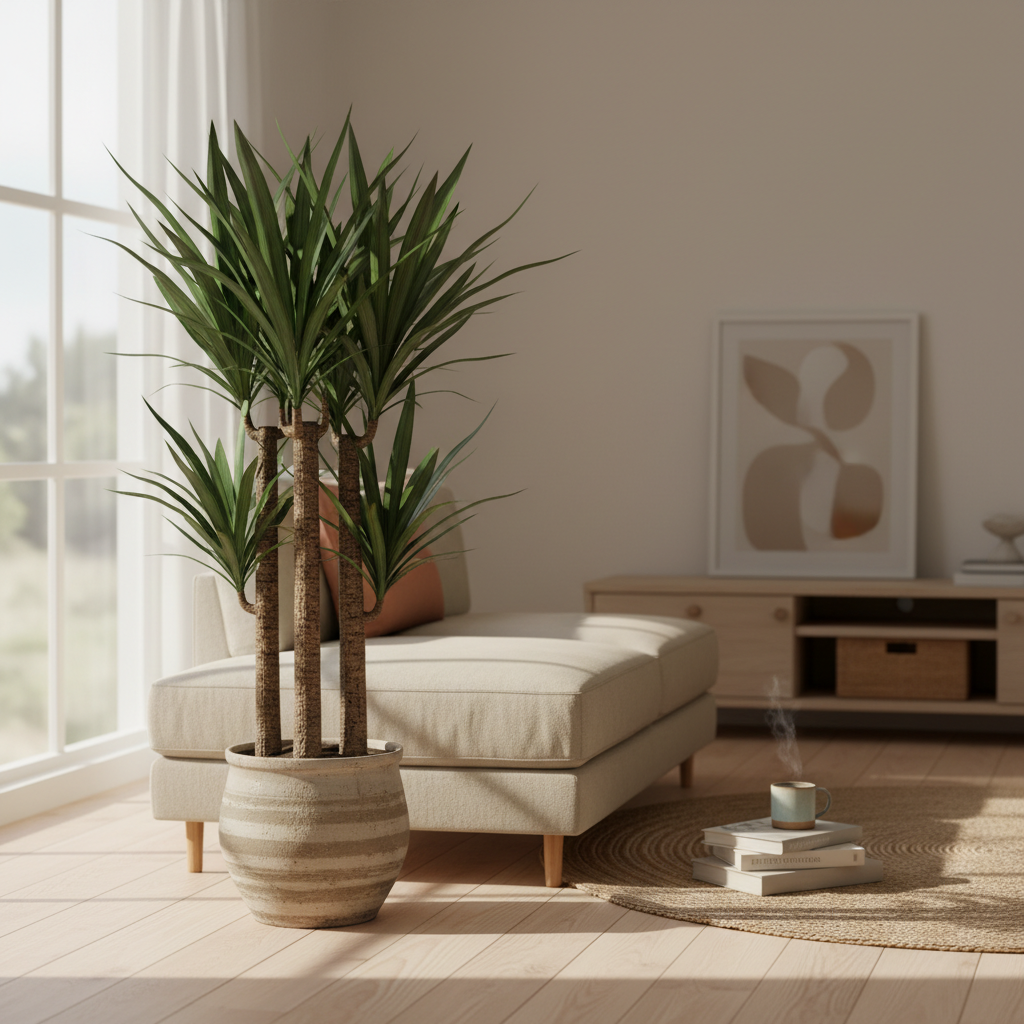
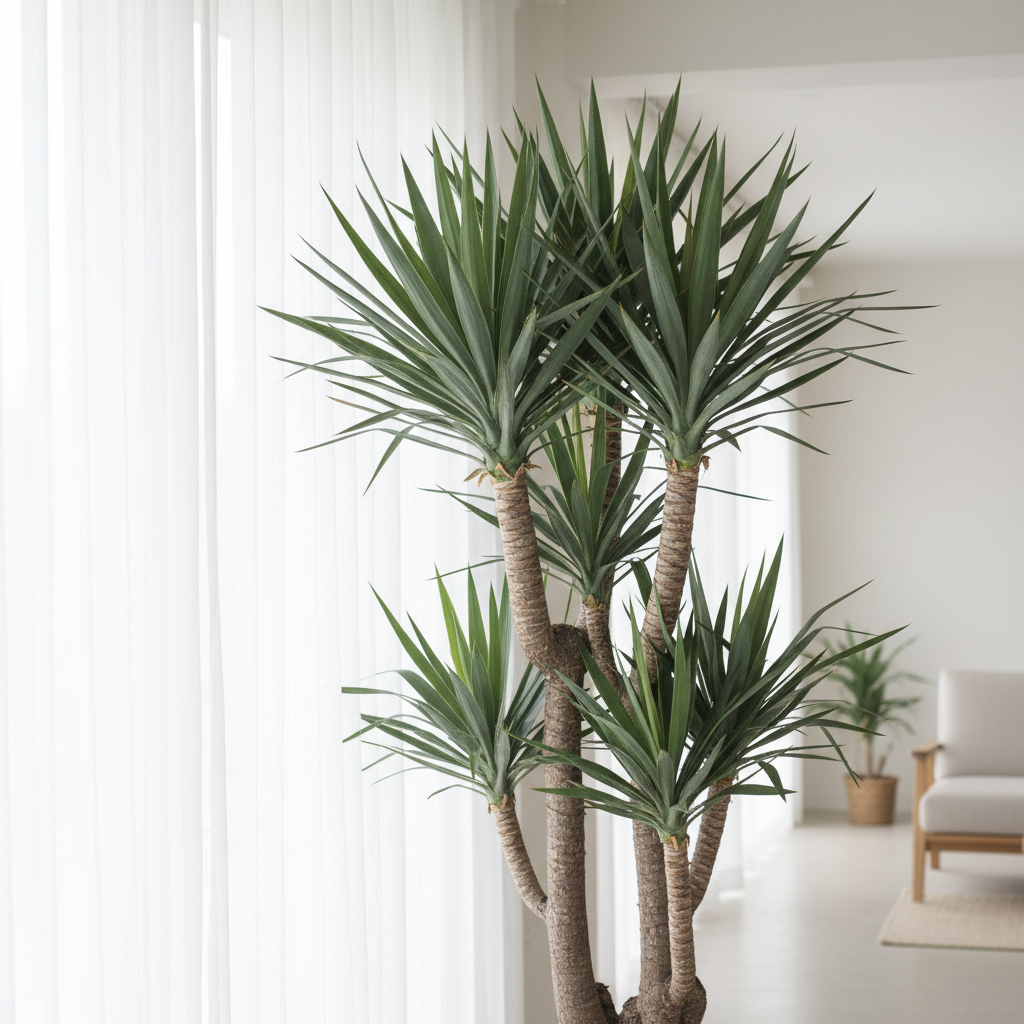
Most popular houseplants earn their place on the windowsill by being adaptable, attractive or easy. The yucca cane is one of the rare specimens that manages all three at once, which is why interior designers reach for it whenever they want a piece of living architecture rather than another softly cascading vine. The plant grows as a series of woody canes that resemble miniature palm trunks, often offered for sale with two or three canes of staggered heights bound together in one pot. From each cane bursts a fountain rosette of stiff, narrow, sword-shaped leaves in a cool grey-green that pairs effortlessly with concrete, pale wood, linen and brass. The contrast between the rough, scarred bark of the cane and the clean geometric spray of the leaves is what gives the plant its sculptural quality.
Beyond looks, the yucca cane is genuinely robust. It evolved on sun-baked slopes in Mexico and Guatemala where water arrives in unpredictable pulses, so it stores moisture in its thick stems and copes well with the periodic dryness most indoor plants resent. Its tough leaves resist the dry, heated air of winter living rooms, and it is unfazed by air conditioning and short cold draughts that would shrivel a calathea or a fern. It is one of the very few houseplants that can be moved out onto a sunny balcony in summer and brought back indoors without sulking, which makes it a flexible long-term companion rather than a one-room specialist.
It is also a long-lived plant. With reasonable care, a yucca cane bought today can still be the centrepiece of a living room twenty years from now, slowly thickening and gaining character as old leaves fall away and new rosettes form. Few houseplants give you that kind of multi-decade presence in exchange for so little fuss. The trade-off, and there is one, is that the yucca is not a plant for nervous tinkerers. It will reward a hands-off owner who waters when the soil is genuinely dry and otherwise leaves it alone, and it will punish the well-meaning attentive owner who waters every week. Almost every yucca that dies indoors dies of love, not neglect.
Important — Toxicity: The yucca cane contains saponins that are mildly toxic to cats, dogs and horses if leaves or roots are chewed, causing drooling, vomiting and digestive upset. The leaves are also stiff with sharply pointed tips that can scratch eyes and skin. Place the plant out of reach of curious pets and children, and consider clipping the very tips of the lowest leaves if it sits in a busy walkway.
Light Requirements
Light is the single biggest variable that decides whether your yucca cane thrives or merely persists. In its native range the plant grows in open scrub and exposed rocky ground, drinking in eight or more hours of direct sun a day. That history matters because it sets the ceiling for what the plant can do indoors. The brighter the position you can give it, the more compact, deeply coloured and fully leaved your yucca will be. Move it into a dim corner and it will not die quickly, but it will stretch towards the nearest light source, drop its lower leaves to feed the new growth and gradually lose its sculptural shape.
The ideal indoor position is right next to a south or west-facing window, where the plant can catch several hours of direct morning or late-afternoon sun and bright indirect light the rest of the day. If you can place the rosette within a metre of the glass, you have given the plant about as good a home as an indoor space can offer. A yucca that sits at the back of a north-facing room will hang on, but it will not look the way it did when you bought it.
Light Levels Explained
Light is often discussed in vague terms like “bright” or “low”, but houseplants respond to measurable values, and a simple lux reading from a phone app is enough to place your yucca with confidence. The table below maps the categories you will see on plant tags to the conditions a yucca actually experiences indoors.
| Light Category | Approx. Lux | Typical Location | Outcome for Yucca Cane |
|---|---|---|---|
| Direct sun | 20,000 to 100,000 | On a south or west windowsill | Tight rosette, deep grey-green colour, fastest growth; some bleaching possible in midsummer behind unshaded glass |
| Bright indirect | 10,000 to 20,000 | Within 1 metre of a sunny window, behind a sheer curtain | Excellent growth and form, the ideal indoor position |
| Medium light | 2,000 to 10,000 | Two to three metres back from a sunny window, or beside an east window | Slow but steady growth, slightly looser rosette, leaves a touch darker |
| Low light | 500 to 2,000 | Interior of a room, north window | Survival only; lower leaves yellow and drop, canes stretch towards the light |
| Very low light | Below 500 | Dim hallway, far interior corner | Decline; not suitable as a permanent home |
Window Orientation and Placement
South-facing window: The best position in most homes. A yucca placed directly in or beside a south window will receive the high-intensity light it evolved to use. A newly acquired plant may need a brief acclimatisation period of a week or two with a sheer curtain in place before being moved into unfiltered sun, particularly in summer.
West-facing window: An excellent alternative to south. West windows deliver several hours of strong late-afternoon sun, which yucca canes enjoy. The light is warm in tone and casts long shadows that flatter the plant’s silhouette.
East-facing window: A workable but not ideal home. East windows give gentle morning sun and bright light for the rest of the day, which keeps a yucca healthy but does not push the rapid, compact growth you get with stronger exposures. Plan to rotate the plant a quarter turn every two weeks so all sides receive equal light.
North-facing window: Marginal. In summer a yucca can survive at a north window in temperate latitudes, but in winter the light is too weak to maintain healthy growth. Plants in this position are the most likely to stretch, drop lower leaves and tip out of balance over time.
Pro Tip — The 30-second light test: Stand where the plant will live and hold your hand a metre above the pot at midday. If it casts a hard-edged shadow with clear definition, the light is bright enough. A soft, blurry shadow means medium light, and no real shadow means low light. Use this test before committing to a spot rather than after the leaves start dropping.
How Light Affects Leaf Colour and Form
A well-lit yucca holds its leaves stiffly upright and slightly arching outwards at the tips, with a uniform grey-green colour that has a hint of blue at its edges. As light decreases, the leaves lose stiffness and droop more steeply, the spacing between them on the cane increases, and the colour deepens to a duller forest green as the plant builds extra chlorophyll to compensate. Variegated cultivars are particularly sensitive: their creamy-yellow margins fade and narrow under low light, and in extreme cases the variegation can disappear entirely as the plant prioritises green tissue for photosynthesis.
Warning — Sudden Direct Sunlight: A yucca that has lived indoors for months or years has soft, shade-acclimatised tissue, even though the species can tolerate full sun in nature. Moving it abruptly into intense midsummer sun, especially behind unshaded glass which concentrates ultraviolet, can scorch the leaves in a single afternoon, leaving pale yellow patches that turn papery brown. Always reintroduce strong sun gradually over seven to fourteen days.
Artificial Lighting
If your home cannot offer a bright window, a yucca cane responds well to a full-spectrum LED grow light positioned 30 to 60 centimetres above the rosette. A single 20 to 30 watt panel running for ten to twelve hours a day will keep the plant healthy and growing during the darker months, and it can be combined with whatever natural light the room provides rather than replacing it. Cool white office strip lighting is not bright enough on its own to sustain healthy growth, but it does no harm as supplementary light.
Seasonal Adjustments
Northern hemisphere winters drop indoor light to a fraction of what your plant receives in June. Move the yucca closer to the window when daylight shortens, even if that means pulling it forward by half a metre, and consider rotating it so the side that has been turned away regains exposure. In summer, reverse the move if the glass is unshaded and the room temperature climbs above 30 degrees Celsius (86 degrees Fahrenheit), pulling the plant back slightly to avoid both leaf scorch and the soil cooking dry within hours.
Watering and Humidity
Watering is where most yucca canes meet their end, and the cause is almost always too much rather than too little. The plant has evolved to store water in its thick, woody trunk and its swollen base, which means it carries a buffer that lets it sail through several weeks of drought. What it has not evolved for is sitting in damp soil for days on end, the typical fate of a houseplant on a strict weekly watering schedule. Treat the yucca more like a cactus than a tropical foliage plant and it will reward you with steady growth and no complaints.
When to Water
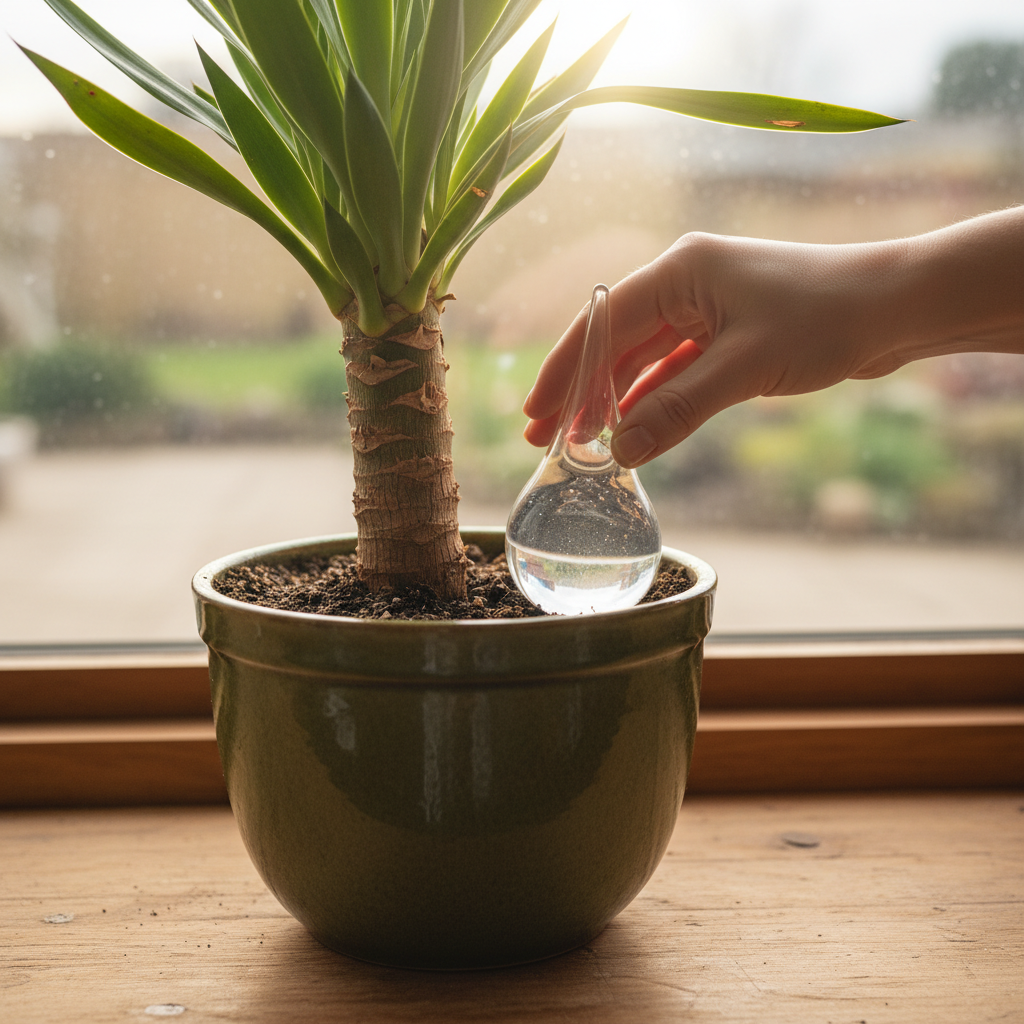
The reliable rule for a yucca cane is to allow at least the top half of the pot to dry out completely before watering again, and in winter to let it dry almost all the way through. A finger pushed five centimetres into the soil should come out clean and feel cool but not damp; if it picks up any clinging particles or feels chilly and moist, wait. For a yucca in a 20 centimetre (8 inch) pot in average household conditions, that usually translates to a thorough soak every ten to fourteen days in spring and summer, and every three to four weeks in autumn and winter. The number is less important than the soil check that produced it.
Several environmental variables shift the schedule and are worth thinking through. A plant in a south-facing window with central heating running will dry out faster than one in a cooler room with east light. A terracotta pot loses water through its walls and dries out a yucca more quickly than a glazed ceramic or plastic pot of the same size. A larger plant in a relatively small pot draws moisture out faster than a small plant in a generous pot. Rather than memorising a schedule, calibrate to your specific plant for a few weeks by sticking with the dryness check and noting when it actually reaches the trigger point.
Pro Tip — The lift test: Pick up the pot before watering and again immediately after. The weight difference is striking, and over a few weeks you will learn to feel exactly when the soil has dried out by hefting the pot for a second. This shortcut is faster than a finger or a moisture meter and it is the method used by most experienced yucca owners.
How to Water Correctly
- Confirm the top half of the pot is dry using a finger or the lift test described above. If in doubt, wait another two or three days.
- Move the pot to a sink or a wide tray to catch overflow. Yucca cane water should never sit in a saucer afterwards.
- Pour room-temperature water slowly across the entire soil surface, working in a circle, until water runs freely from the drainage holes. For a typical 20 centimetre pot, this is usually about one litre of water.
- Let the pot drain undisturbed for at least ten minutes, then tip out any water that has collected in the saucer or cache pot.
- Return the plant to its position and do not water again until the dryness check repeats.
Signs of Overwatering vs Underwatering
| Symptom Area | Overwatering | Underwatering |
|---|---|---|
| Leaf colour | Lower leaves turn yellow, often progressing up the cane; new growth may appear pale | Older leaves turn dull, with brown crispy tips and gradual fading at the edges |
| Leaf texture | Soft, limp, sometimes translucent; leaves bend rather than break | Stiff but light, slightly curled inwards; leaves snap cleanly when bent |
| Soil | Damp for more than a week after watering; may smell sour or musty | Pulls away from the sides of the pot, looks pale and dusty, water runs straight through without soaking in |
| Cane and stem base | Soft to the touch, may show vertical black streaks; squeezing reveals a spongy, hollow feel | Hard and slightly wrinkled, with a faintly papery skin; rehydrates quickly after a soak |
| Roots | Black, soft, foul-smelling, breaking apart easily when handled | Pale tan or brown, dry but firm, still holding together when teased |
Warning — Root Rot: A yucca with a soft, hollow-feeling cane base has almost certainly developed root rot, and at that stage the plant is in real trouble. Tip it out of the pot immediately, cut away every soft black root with sterilised secateurs, dust the cuts with cinnamon or sulphur powder, and repot into entirely fresh, dry, gritty mix. Do not water for at least a week, then resume very sparingly. The plant may still be saved if any healthy tissue remains higher up the cane, but the lower section is often lost.
Humidity Requirements
Unlike the tropical foliage plants that dominate Instagram feeds, the yucca cane is genuinely indifferent to humidity. It is happy at the 30 to 50 percent that most heated and air-conditioned homes provide, and it neither needs nor benefits from misting or a pebble tray. In fact, very high humidity around the cane base can encourage fungal issues, so a yucca should not share a steamy bathroom with your alocasias and ferns. The one place humidity becomes relevant is in winter, when central heating drops indoor air below 25 percent and the very tips of the leaves can crisp brown. That is a cosmetic issue rather than a health one, and trimming the tips at a sharp angle restores the silhouette without changing the plant’s wellbeing.
Water Quality
Yucca canes are not as sensitive to water chemistry as a calathea or a carnivorous plant, but they do show fluoride and chlorine stress at the leaf tips after years of tap water in hard-water areas. The most common symptom is brown tip burn that resists every other corrective measure. If you are seeing this and your tap water is heavily treated, switch to room-temperature filtered or rainwater for a few months and watch whether new leaves emerge cleaner. Letting tap water stand uncovered for 24 hours allows chlorine to dissipate but does nothing for chloramine, which is the chemical many municipalities now use and which only carbon filtration removes.
Soil, Potting and Repotting
The single most important property of yucca cane soil is drainage. The plant’s roots are adapted to porous, gritty substrates that drain within seconds and dry out between waterings, and they rot quickly in the dense, peat-heavy mixes sold as generic houseplant compost. If you take only one thing from this section, let it be that a free-draining mix is not optional but essential. Most yucca canes that arrive home in cheap chocolate-brown peat-based potting soil are living on borrowed time, and the first useful thing you can do for a new plant is to repot it into something coarser.
The Ideal Mix
A commercial cactus and succulent mix is the simplest starting point, and for most owners it will be perfectly adequate as long as it is amended to lift its drainage further. A reliable recipe is two parts of a quality cactus mix, one part coarse perlite or pumice, and one part fine orchid bark or horticultural grit. The result should look chunky in the bag, feel gritty between the fingers, and almost shake apart rather than clumping. When dry, a handful should fall through the fingers rather than holding its shape. If you cannot source a cactus mix, you can build the same texture from one part standard houseplant compost, one part perlite and one part coarse sand, with a small handful of bark or pumice for extra structure.
Avoid mixes labelled “moisture retentive”, “for ferns” or “with added water crystals”. These are designed for plants that resent drying out and they will hold water against the yucca’s roots for far too long. Coco coir is acceptable as a small component for structure but should never make up the bulk of the mix on its own, as it tends to compact and stay damp longer than it appears on the surface.
Choosing the Right Pot
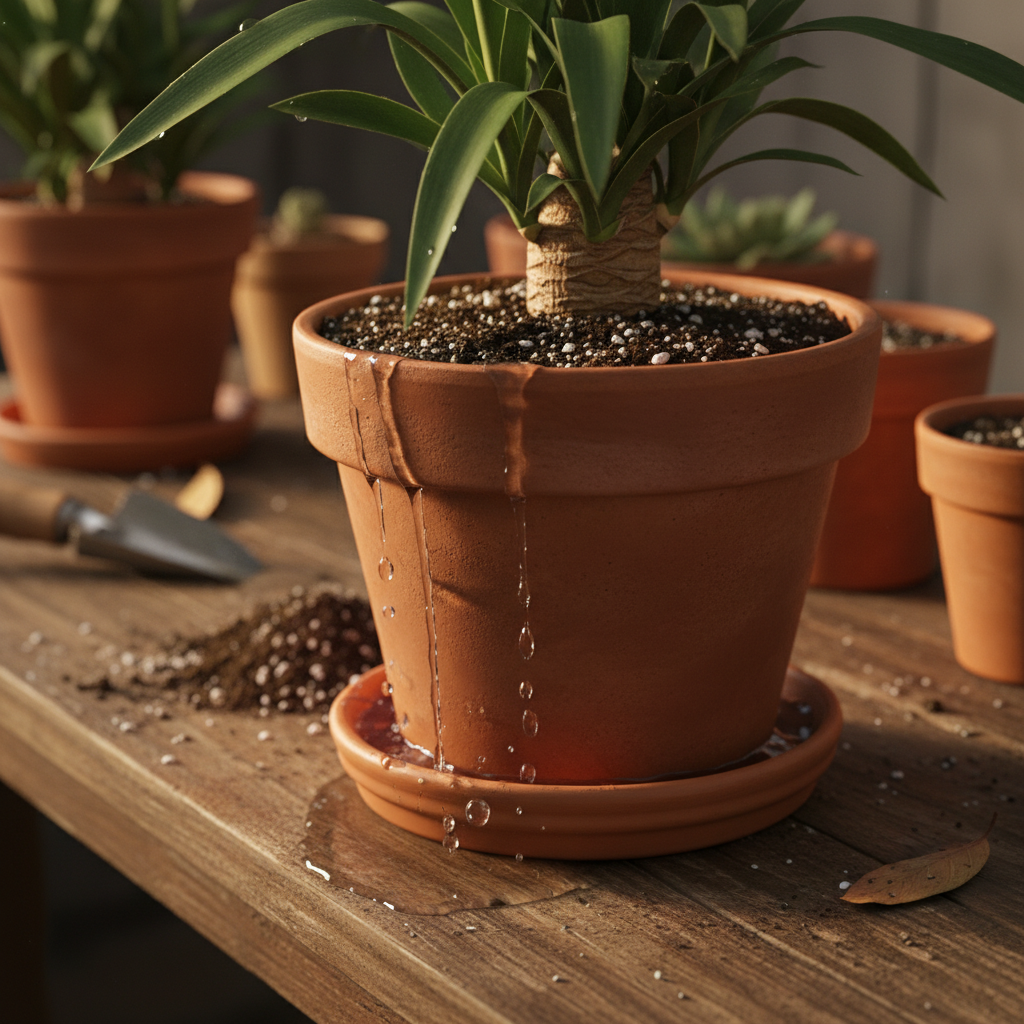
Pot choice matters more for a yucca cane than for almost any other houseplant, because the wrong pot can keep an otherwise ideal soil mix wet for too long. Terracotta is the classic answer and it is hard to beat: the unglazed clay walls breathe, the pot wicks moisture out into the air, and a yucca planted in terracotta dries out predictably and evenly. The visual pairing of weathered terracotta with the warm grey-green of yucca leaves is also striking. The trade-off is weight, since a large yucca in a clay pot can need two people to move and you may want a wheeled saucer if the plant lives on a tile floor.
Glazed ceramic and plastic pots are workable but call for a slightly grittier mix and a slower watering rhythm to compensate for their reduced evaporation. Whatever you choose, drainage holes are non-negotiable: a yucca planted in a sealed cache pot, however attractive, is on a countdown to root rot. If you fall in love with a decorative pot that has no drainage, use it as a cover only and keep the plant in a plastic nursery pot inside.
Size the pot conservatively. A yucca prefers to be slightly snug rather than swimming in soil, and an oversized pot acts as a reservoir that holds moisture in the centre long after the surface has dried. As a rough rule, the pot should be about 2 to 4 centimetres (1 to 1.5 inches) wider than the root ball at the time of repotting, no more. If you have a heavy top-growth and a top-heavy plant, choose a wider but not deeper pot, or weight the base of a plastic pot with a layer of clean pebbles for stability.
When and How to Repot
Yucca canes are slow-growing and do not need frequent repotting. Most plants are happy in the same pot for two to three years, and very large specimens can go four or five years between moves. Look for the usual signs that an upgrade is due: roots circling visibly inside the pot, roots emerging from drainage holes, water running straight through without absorbing, or a plant that becomes top-heavy and tips easily. The best time to repot is early spring, just as growth resumes after winter, which gives the plant a full growing season to settle into its new mix.
- Water the plant lightly a day or two before repotting so the root ball holds together without crumbling, but is not waterlogged.
- Prepare the new pot by placing a piece of broken terracotta or fine mesh over the drainage holes and adding a few centimetres of fresh, dry mix to the base.
- Tip the plant out of its old pot by inverting it and supporting the cane base with one hand. Tap firmly on the rim with the other hand to loosen the root ball.
- Inspect the roots. Trim away any blackened, mushy or rotten sections with sterilised secateurs, and tease apart tightly circled roots so they can spread into fresh soil.
- Lower the plant into the new pot so the top of the root ball sits about 2 centimetres below the rim. Backfill with fresh dry mix, tapping the pot gently to settle the soil between the roots without compacting it.
- Water once, thoroughly, then allow the plant to drain and place it back in a slightly shadier position for a week to recover before returning it to its usual spot.
Pro Tip — Top-dress instead of repotting: If your plant is already in an ideal pot and you do not want to disturb the roots, simply scrape away the top 3 to 5 centimetres of tired old soil every spring and replace it with fresh chunky mix. This refreshes nutrients and texture without the stress of a full repot, and a large yucca can be maintained this way for many years.
Fertilising
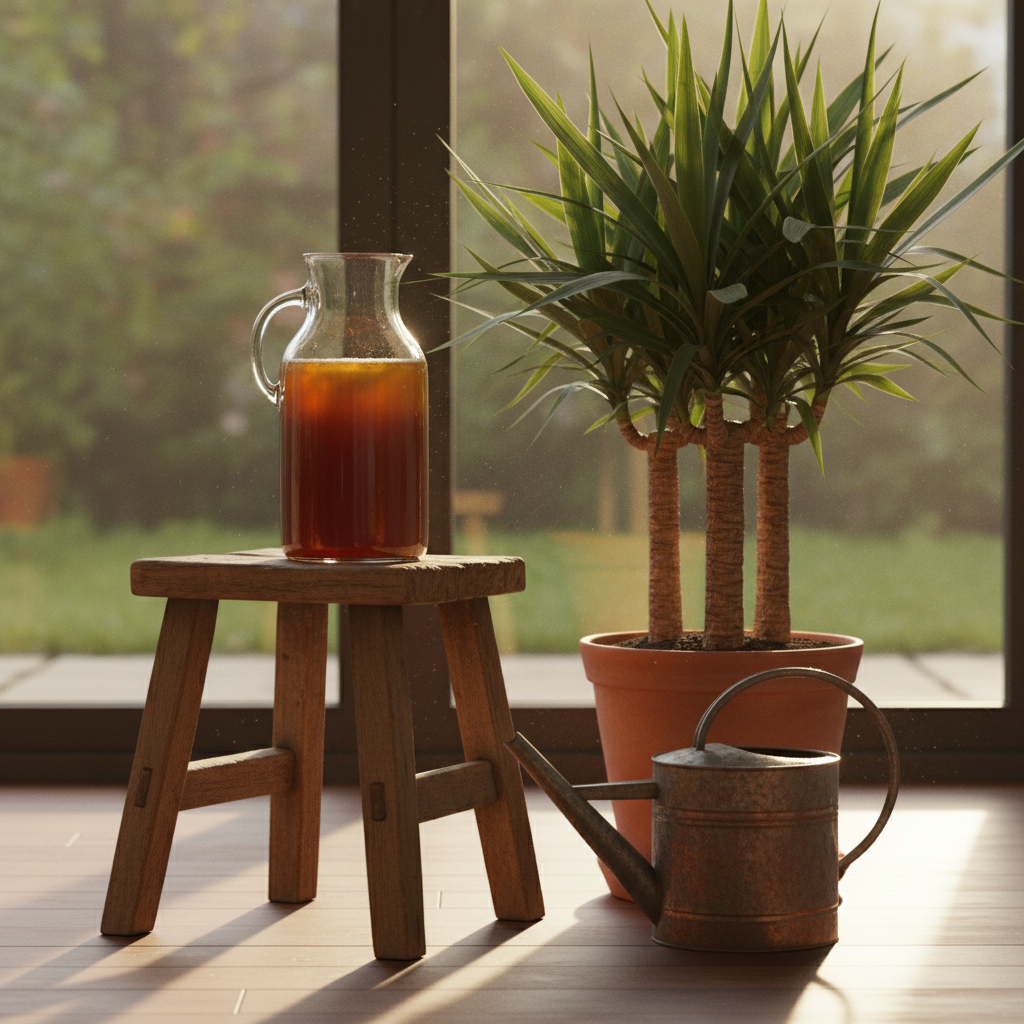
Yucca canes are not heavy feeders, and a plant that survives drought, dim corners and unpredictable watering in its native range did not evolve to be choosy about fertiliser. The temptation, particularly with a new plant, is to feed regularly in the hope of pushing growth, but a yucca responds to overfeeding the same way it responds to overwatering: slowly at first, then catastrophically. A modest, well-timed feeding schedule is more than enough to keep yours healthy and steadily growing.
What to Use
A balanced liquid houseplant fertiliser with a roughly equal NPK ratio, such as 10-10-10 or 7-7-7, suits a yucca well when diluted to half the strength printed on the label. Some growers prefer a cactus and succulent feed, which is usually slightly lower in nitrogen and skews towards phosphorus and potassium, and this is also an excellent choice because it matches the plant’s slow, structural growth pattern rather than pushing soft, leafy expansion.
Slow-release granular fertilisers are convenient and work well for yucca canes too, scattered lightly on the soil surface once in early spring and once in midsummer. Use half the dose recommended for general houseplants. Organic options such as worm castings or diluted seaweed extract are gentle and forgiving, with very little risk of over-application. A thin layer of fresh worm castings as a top-dressing each spring is enough on its own for many established plants and skips the need for a separate liquid feed entirely.
When to Feed
Feed only during the active growing season, which for a yucca means roughly mid-spring to late summer in temperate latitudes. The simplest rhythm is to add a half-strength liquid feed to one watering per month from April to September inclusive, then stop entirely. In winter, the plant slows almost to a halt regardless of indoor temperatures, and any fertiliser applied during this period sits in the soil unused, gradually building up salts that will burn the roots when the next growing season begins. A yucca that has been fertilised through winter often shows brown leaf tips and stalled growth in spring, both classic symptoms of salt buildup rather than nutrient deficiency.
Pro Tip — Flush the pot annually: Even a careful feeder accumulates mineral salts in the soil over time. Once a year, preferably in early spring before resuming fertilisation, water the plant heavily with plain water and let several litres flow through the pot in the sink. This flush rinses out accumulated salts and resets the soil chemistry for the year ahead.
Symptoms of Over- and Underfeeding
Overfed yuccas show crisp brown leaf tips that progress inwards, a white crust of mineral salts on the soil surface or on the pot rim, and in severe cases, a sudden yellowing and softening of the lower leaves. Underfed plants, which are much rarer, simply slow down and produce smaller, paler new growth. Erring on the side of underfeeding is always safer with a yucca: a hungry plant can be revived with a single dose, while an overfed plant requires repotting into fresh mix to recover.
Propagation
Yucca canes propagate readily, which is part of why the plant is so common and so affordable in the houseplant trade. Commercial growers ship enormous quantities of leafless cane sections from Central America, root them in nurseries and sell the resulting plants as soon as the rosettes have established. At home, the two practical methods are dividing offsets, often called pups, from a parent plant, and rooting cane cuttings from a stem section. Both are forgiving, with high success rates as long as you respect a few principles around timing, sterility and dryness.
Method 1 — Separating Pups
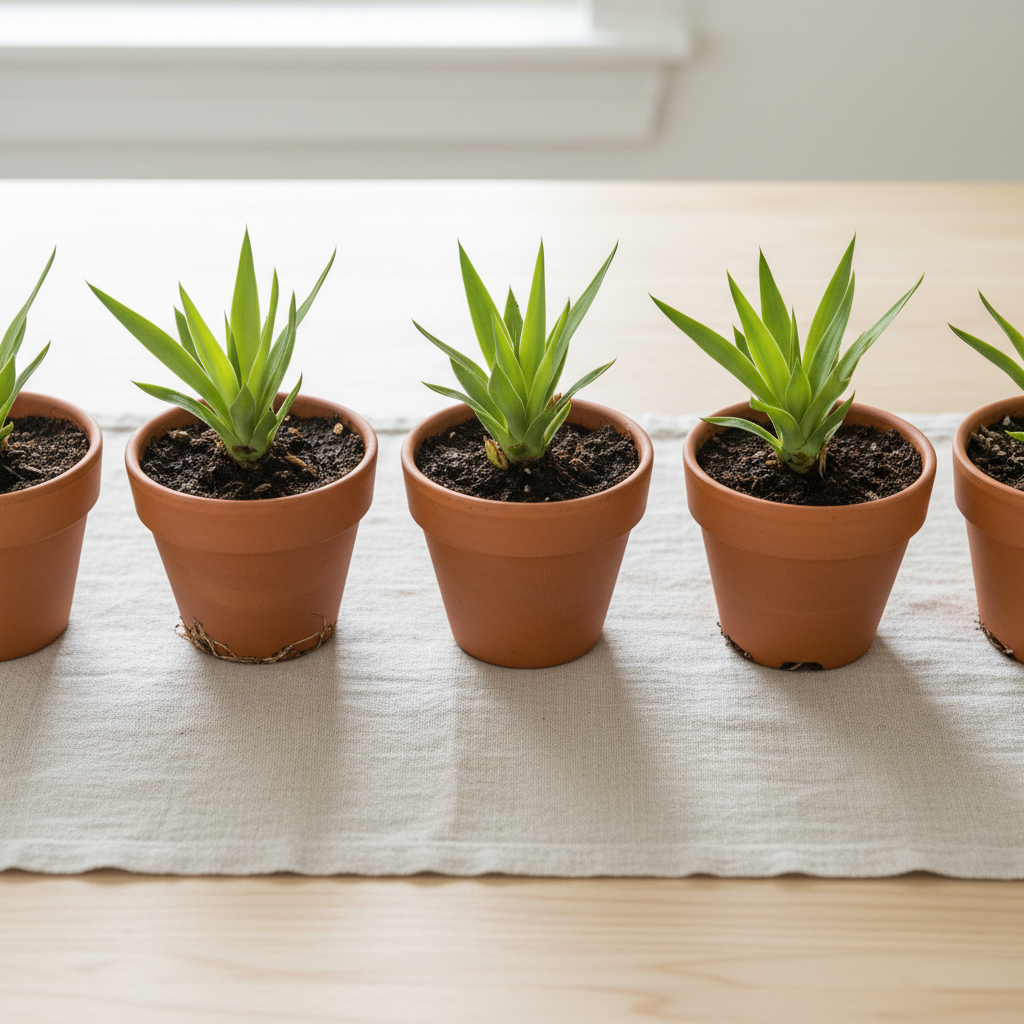
A healthy mature yucca produces offsets, small new plants that emerge from the base of the parent cane. These pups carry their own roots once they reach about 10 to 15 centimetres tall, and they can be separated and potted up as independent plants. This is the easiest and most reliable propagation method, with success rates close to 100 percent when the pup is mature enough.
- Wait until spring or early summer, when the parent plant is in active growth and recovers quickly from disturbance.
- Tip the parent plant out of its pot and gently brush soil away from the base to expose where the pup joins the main cane.
- Identify pups that have their own visible roots emerging from their bases. Pups without roots are not yet ready and should be left attached.
- Using a sterilised sharp knife, sever the connection between the pup and the parent cane in a single clean cut. Try to leave as many of the pup’s own roots intact as possible.
- Let both cut surfaces, on the pup and on the parent, dry in open air for 24 to 48 hours until they form a dry callus. This is essential to prevent rot.
- Pot the pup into a small container of dry, gritty cactus mix, just deep enough to cover the roots. Do not water for the first week.
- After a week, water lightly and place in bright indirect light. New growth from the centre of the rosette confirms the pup has rooted in within four to eight weeks.
Method 2 — Cane Cuttings
If your yucca has grown unbalanced, leggy or simply too tall for the room, you can cut the cane back and root the removed section as a new plant. The parent will resprout from below the cut, often producing two or three new growing points where there was previously one, which is also a useful way to bush out a sparse specimen. Cane cuttings are remarkable in that they will root from a bare stem section with no leaves attached, although the process is slower.
- In spring, use a sharp clean saw or large secateurs to cut the cane horizontally at the desired height. The cut surface should be flat and clean, not torn or splintered.
- If the section you have removed is more than 30 centimetres long, you can cut it into shorter pieces, each at least 15 centimetres tall. Mark the cut sections clearly so you know which end is the top and which is the bottom — yucca canes will not root if planted upside down.
- Let all cut surfaces dry and callus for three to seven days in a warm, airy spot out of direct sun. The thicker the cane, the longer the callus period should be.
- Dip the bottom end of each cutting in rooting hormone powder if you have it, and push the cane vertically into a deep pot of dry cactus mix, burying the lower third.
- Place the pot in bright indirect light at a temperature of 21 to 27 degrees Celsius (70 to 81 degrees Fahrenheit). Wait two weeks before watering at all, then water lightly every two to three weeks.
- Roots typically form within four to eight weeks, with new leaf growth appearing at the top of the cane shortly afterwards. A gentle tug on the cane tests for resistance, which confirms successful rooting.
Pro Tip — Sealing the parent cut: The horizontal cut you have left on the parent plant is vulnerable to rot from above. Brush it with melted candle wax or a thick paste of cinnamon and water once it has dried to seal the surface. New shoots will emerge from below the cut within a few weeks.
A Note on Water Propagation and Seed
Some growers attempt to root yucca cuttings in water before potting them up. It can work, but the resulting water roots are fragile and often die back when transferred to soil, and the cane is much more likely to rot below the waterline before it produces any roots at all. Direct potting into dry, gritty mix is the more reliable route. Seed propagation is technically possible and rewarding for hobbyists, but yucca canes rarely flower indoors and the seed available commercially is often of mixed species, so most home propagators stick with vegetative methods.
Pests and Diseases
Yucca canes are among the more pest-resistant houseplants, partly because their tough waxy leaves do not appeal to most sap-sucking insects and partly because their dry growing conditions discourage the moisture-loving pathogens that plague tropical plants. The handful of problems that do arise are mostly preventable and almost always treatable if caught early. The single most important habit is the one most owners skip: a brief inspection of the leaves, cane and soil surface every couple of weeks, ideally when you are checking whether the plant needs water anyway.

Common Pests
Mealybugs are the pest most likely to find a yucca, particularly in the protected crevices where leaves meet the cane. They appear as small white cottony lumps and can quickly multiply to several dozen if missed. Treat by dabbing each insect with a cotton bud dipped in 70 percent isopropyl alcohol, which kills on contact. Follow up by spraying the entire plant with diluted neem oil once a week for three weeks to catch any unhatched eggs. Isolate the plant during treatment to prevent spread to neighbours.
Spider mites are less common but can colonise a yucca that lives in particularly dry air for long periods, especially in winter beside a radiator. They are too small to see clearly with the naked eye, but their fine pale webbing on the undersides of leaves and at the leaf bases is the giveaway. A weekly shower under a gentle stream of room-temperature water dislodges most populations, followed by a neem oil spray on the underside of every leaf. Raising humidity slightly during the treatment period helps.
Scale insects appear as small brown raised bumps along the cane and on leaf bases. They are well protected by their hard shells and ignore most contact sprays. Remove them physically by scraping with a fingernail or a soft toothbrush, then treat the plant with systemic neem oil applied as a soil drench, which the plant takes up through its roots and which poisons any survivors as they feed.
Fungus gnats are not strictly a yucca pest, but they will breed in the top layer of moist soil if the plant is being overwatered. Their presence is therefore a useful early warning: cut back on watering, let the soil surface dry between drinks, and consider top-dressing with a layer of dry sand or fine grit to discourage egg laying.
Common Diseases
Root rot is the single greatest threat to indoor yuccas and is almost always caused by overwatering combined with poorly drained soil. Symptoms include soft, blackened lower cane tissue, a sour smell from the soil, lower leaves yellowing and falling off, and in advanced cases the plant simply toppling over when nudged. Treatment is detailed in the watering section above. Prevention is far easier: drainage, drainage, drainage.
Cane rot can also develop from the top of the cane downwards if a cut surface, such as one left after pruning, was not allowed to callus and was kept wet. The cane becomes mushy and black, and the affected section must be cut away above any healthy tissue, with the new cut allowed to dry and seal before the plant is watered again.
Leaf spot fungus shows as small brown spots with yellow halos, usually on the older leaves of a plant that has been kept in stagnant, humid air. The fix is to improve airflow, reduce humidity, remove affected leaves and avoid wetting the foliage when watering.
Warning — Cosmetic damage versus active problem: A yucca’s lower leaves naturally yellow and drop as the plant grows taller and ages, leaving the characteristic bare cane below the rosette. This is normal, not a sign of trouble. The distinction is straightforward: natural drop happens one leaf at a time, slowly, on the very lowest old leaves, while disease or pest damage spreads quickly, affects multiple leaves at once and often appears higher up.
Environmental Issues That Mimic Pests
Crisp brown leaf tips on a yucca that looks otherwise healthy are almost never caused by pests. The likely culprits are low humidity, fluoridated or chlorinated tap water, salt buildup from overfeeding, or accidental contact between the leaf tips and a cold window pane in winter. Trim the offending tips at a sharp angle with sterilised scissors to restore the silhouette and address the underlying cause to stop new tips from browning.
Popular Varieties
The houseplant trade leans heavily on a single species for what it calls “yucca cane”, but there is more variation than the green-leaved standard offered in most garden centres. Whether you want bold creamy variegation, a tightly stacked multi-cane silhouette, or simply a more refined version of the classic, the following two cultivars cover the cultivated indoor range and are reasonably easy to source through specialist growers and well-stocked nurseries.
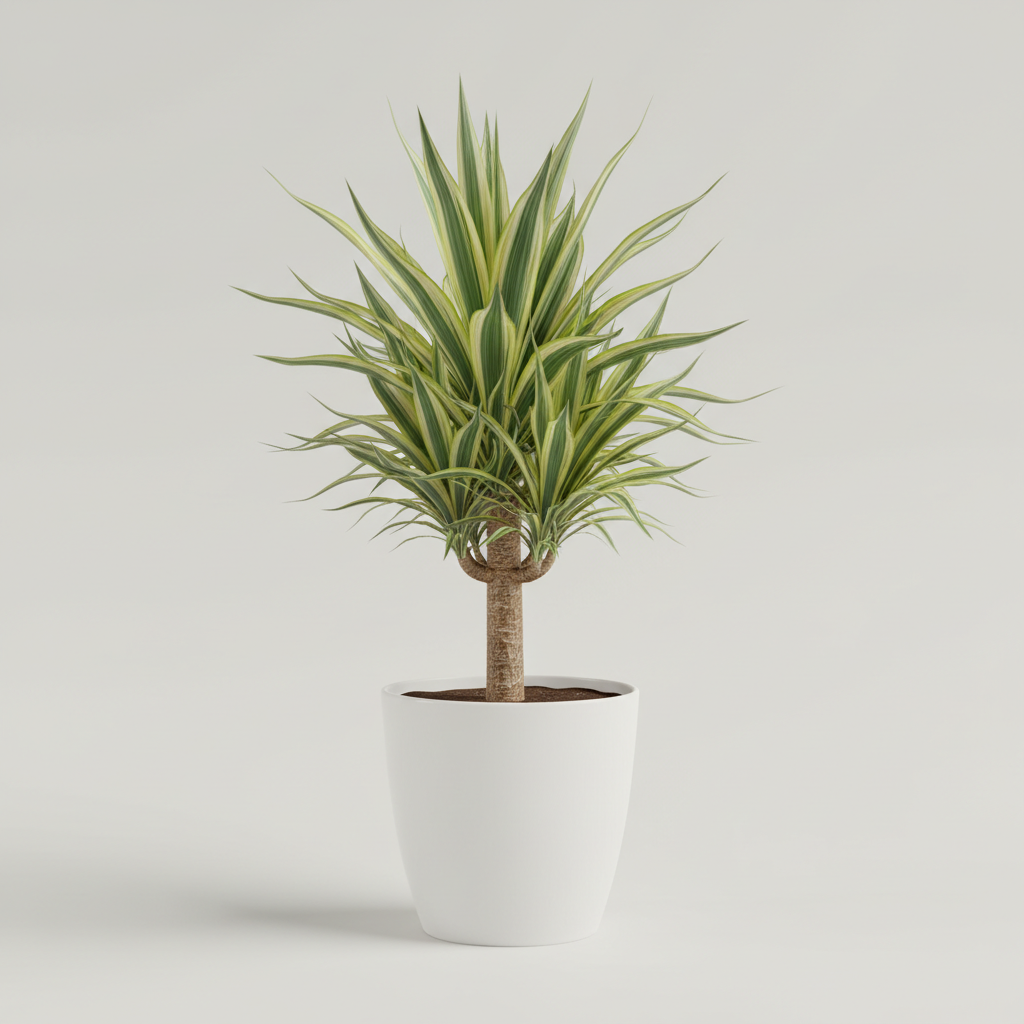
Yucca gigantea ‘Variegata’ (Yucca ‘Jewel’): The most striking of the cultivated yucca canes, this variety has broad creamy-yellow margins running the full length of each sword-shaped leaf, with a deep green central stripe. The variegation glows in good light and is at its richest on plants grown within a metre of a sunny window. Variegated yuccas grow slightly more slowly than the species and need brighter light to maintain their patterning, so this is a plant for a dedicated bright spot rather than a corner.
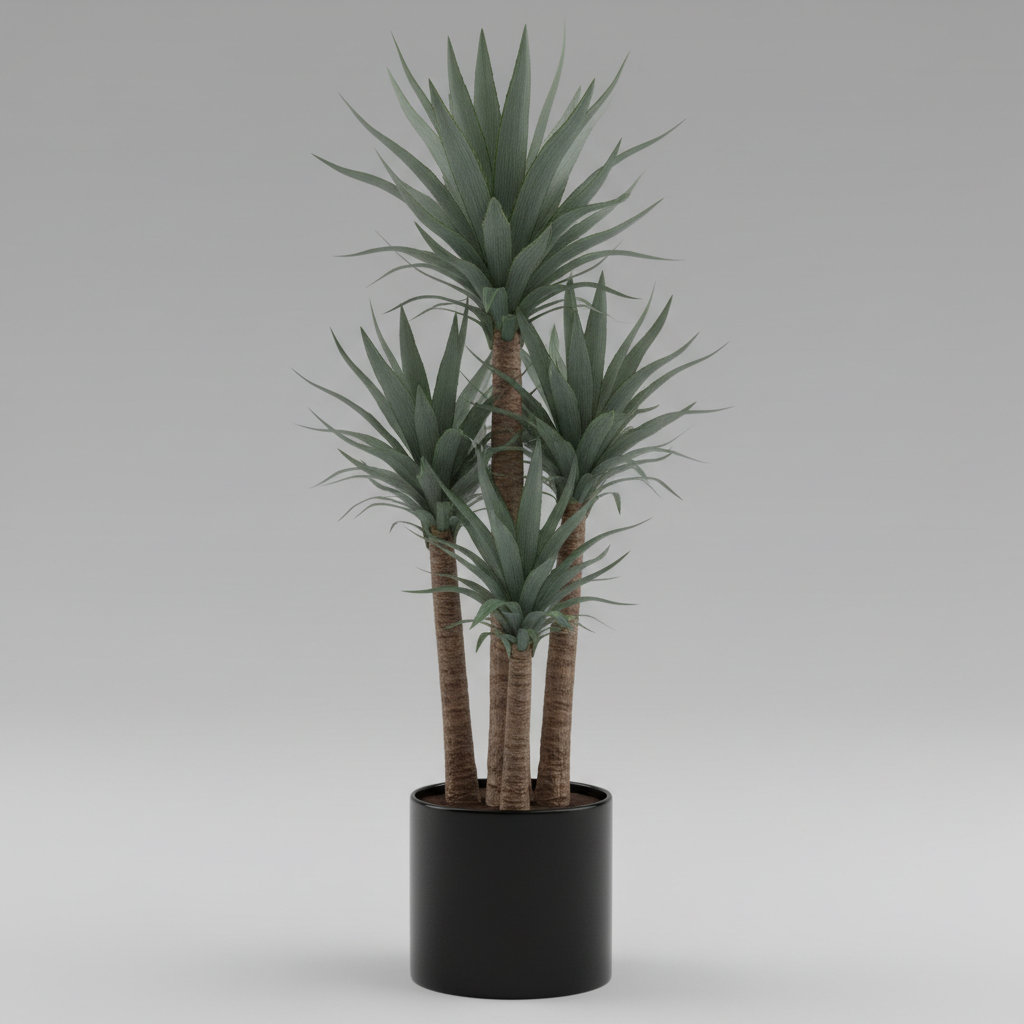
Multi-cane staircase form: Not strictly a cultivar but a method of presentation, this is the version most people think of when they hear “yucca cane”. Three or four bare canes of staggered heights are bundled in a single pot, each topped with its own rosette. The staircase effect adds visual interest and gives an instant impression of maturity. Each cane is an independent plant inserted into the soil, so individual canes can be removed and re-rooted if one fails or grows unevenly.
Other related yuccas occasionally sold as houseplants include Yucca aloifolia, the Spanish bayonet, which has wickedly sharp leaf tips that make it less suitable for indoor life, and Yucca rostrata, the beaked yucca, with a dome of much finer blue leaves on a slender trunk that is more often grown in conservatories than living rooms. For a houseplant context, the spineless Yucca gigantea remains the practical choice.
Frequently Asked Questions
Why are the lower leaves of my yucca cane turning yellow and falling off?
Most often this is simply the natural ageing process: a yucca gradually sheds its oldest leaves to build the bare-trunk silhouette that gives the plant its character. If only one or two of the lowest leaves yellow and drop every few months, that is normal. If multiple leaves are turning yellow at once, or if the yellowing is creeping up the cane rapidly, suspect overwatering, root rot or a sudden change in light.
My yucca’s leaves are bending and drooping instead of standing stiffly. What is wrong?
Soft, drooping leaves are usually a sign of overwatering, with root rot beginning to compromise the plant’s ability to take up water properly, even though the soil is wet. Tip the plant out and check the roots and cane base. If the lower cane is firm and the roots look healthy, the cause is more likely too little light: a yucca in dim conditions cannot hold the structural turgor that keeps its leaves upright.
Can I prune a yucca cane to keep it short?
Yes. Yucca canes tolerate hard pruning extremely well. Cut the cane horizontally at the height you want, seal the cut with wax or cinnamon paste, and the plant will sprout new growth from below the cut within a few weeks. The removed top section can be rooted as a new plant using the cane cutting method described in the propagation section.
Is yucca cane safe for cats and dogs?
The plant is mildly toxic to cats, dogs and horses thanks to saponins in its leaves and roots, which can cause drooling, vomiting and digestive upset if chewed. The stiff leaf tips can also cause physical injury to eyes and skin. Place the plant out of reach of pets and supervise small children around it.
Does my yucca need to be repotted into a bigger pot every year?
No. Yuccas prefer a snug pot and grow slowly enough that two or three years between repottings is normal. An annual refresh of the top few centimetres of soil keeps nutrients available without disturbing the roots.
Will my yucca ever flower indoors?
Indoor flowering is rare but not impossible. A mature, well-lit yucca grown for many years in optimal conditions occasionally produces a tall spike of creamy bell-shaped flowers from the centre of a rosette. Most indoor specimens never reach this stage, and the plant is grown for its foliage and form rather than its blooms.
Can I move my yucca outdoors in summer?
Yes, and it is one of the easiest houseplants to summer outside. Acclimatise the plant gradually to direct sun over a week or two, place it in a position sheltered from heavy rain, and bring it back indoors well before the first cold autumn nights, when temperatures begin to dip below 10 degrees Celsius (50 degrees Fahrenheit).
My yucca is leaning to one side. What should I do?
Leaning is usually a sign of uneven light, with the plant stretching towards the brighter side of the room. Rotate the pot a quarter turn every two weeks to even out exposure. A persistent lean despite rotation can indicate root issues on the leaning side, in which case a careful inspection at the next repotting is worthwhile.
How long does a yucca cane live indoors?
With reasonable care, a yucca cane houseplant can live for several decades. Twenty to thirty year old specimens are common in homes that have provided consistent bright light and minimal overwatering, and the plant only becomes more sculptural with age as its canes thicken and its silhouette evolves.






