
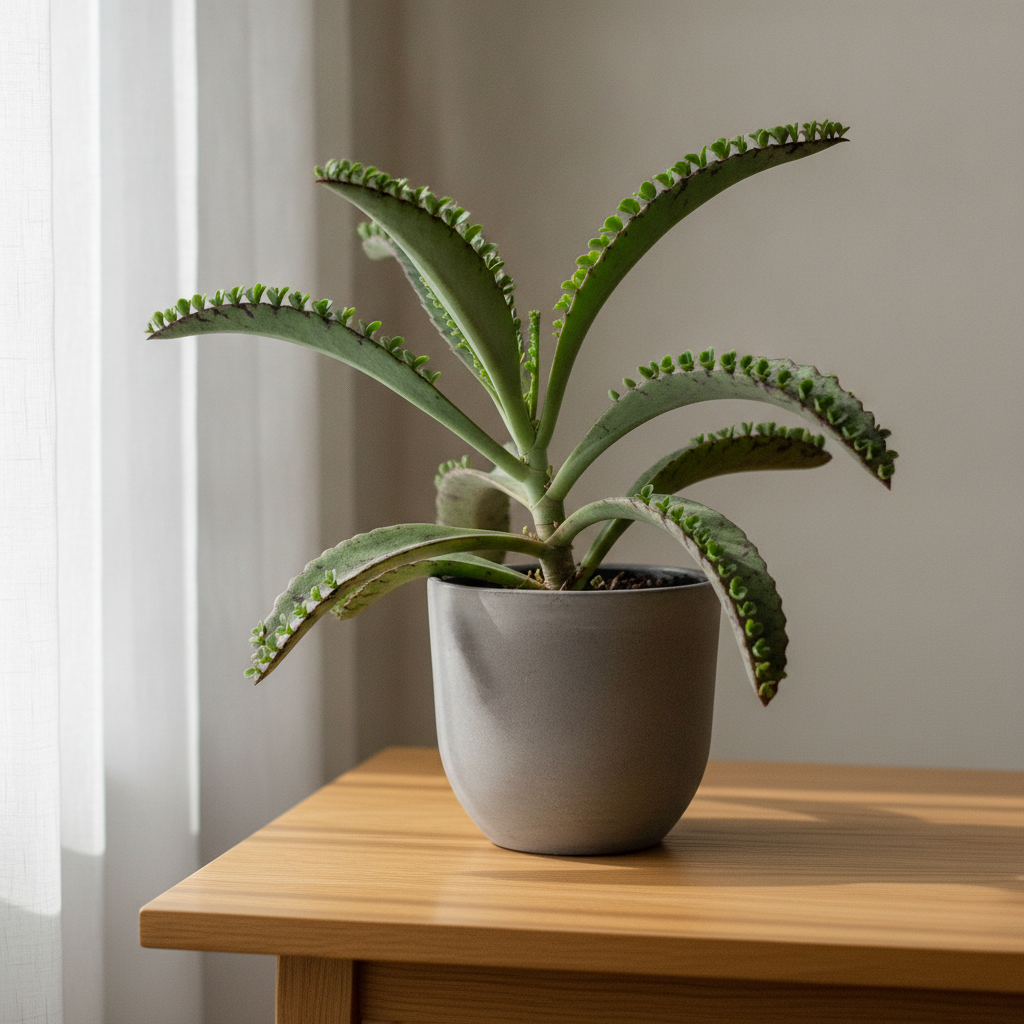
Few houseplants announce their strategy for world domination quite so openly as the mother of thousands. Native to the dry, rocky south-west of Madagascar, Kalanchoe daigremontiana is a succulent that has dispensed with the patience of seeds altogether: along the scalloped margin of every blue-green leaf it raises a continuous fringe of miniature, fully formed plantlets, each with its own pair of leaves and a set of waiting roots. The plant is known by an honest roll-call of common names, among them alligator plant, devil’s backbone and Mexican hat plant, but the most fitting remains mother of thousands, because a single mature specimen can shed enough plantlets to colonise every pot within reach.
That same generosity is what makes the plant both a gift and a responsibility. It is genuinely difficult to kill and almost impossible to stop, which means the real skill in growing it lies not in coaxing survival but in directing its vigour, keeping the plantlets where you want them and the parent plant upright and handsome rather than leggy and exhausted. This guide covers everything from light and watering through soil, feeding and propagation to the pests it occasionally attracts, with particular attention to the difference between a plant that merely survives on a forgotten shelf and one that thrives into a sculptural, architectural specimen. It also addresses, plainly, the plant’s significant toxicity, which every grower should understand before bringing one home.
Contents
- Quick Reference
- Why Mother of Thousands Makes a Fascinating Houseplant
- Light Requirements
- Watering & Humidity
- Soil, Potting & Repotting
- Fertilising
- Propagation
- Pests & Diseases
- Popular Varieties
- Frequently Asked Questions
Quick Reference: Mother of Thousands at a Glance
| Light | Bright indirect light with a few hours of direct sun; tolerates full sun once acclimatised |
| Watering | Soak and dry; water only when the soil is fully dry, roughly every 10 to 14 days in summer and monthly in winter |
| Temperature | 18 to 27 degrees Celsius (64 to 81 Fahrenheit); protect from anything below 10 degrees Celsius (50 Fahrenheit) |
| Humidity | Low to average; ordinary room humidity of 30 to 50 percent is ideal |
| Fertiliser | Light feeding once a month in spring and summer with a diluted, low-nitrogen succulent feed |
| Toxicity | Highly toxic to cats, dogs, livestock and humans if eaten; contains cardiac glycosides |
Why Mother of Thousands Makes a Fascinating Houseplant
The appeal of Kalanchoe daigremontiana is partly architectural and partly theatrical. Architecturally, it grows as a single upright stem that can reach a metre (around 3 feet) indoors, topped with large, lance-shaped leaves held almost horizontally like the rungs of a ladder. The leaves are a soft grey-green above, often blushed with purple and patterned with chocolate-coloured blotches on the underside, and they curl gently inward to form the shallow trough that gives the alligator plant its name. There is a precision to the way the foliage is arranged that few succulents match.
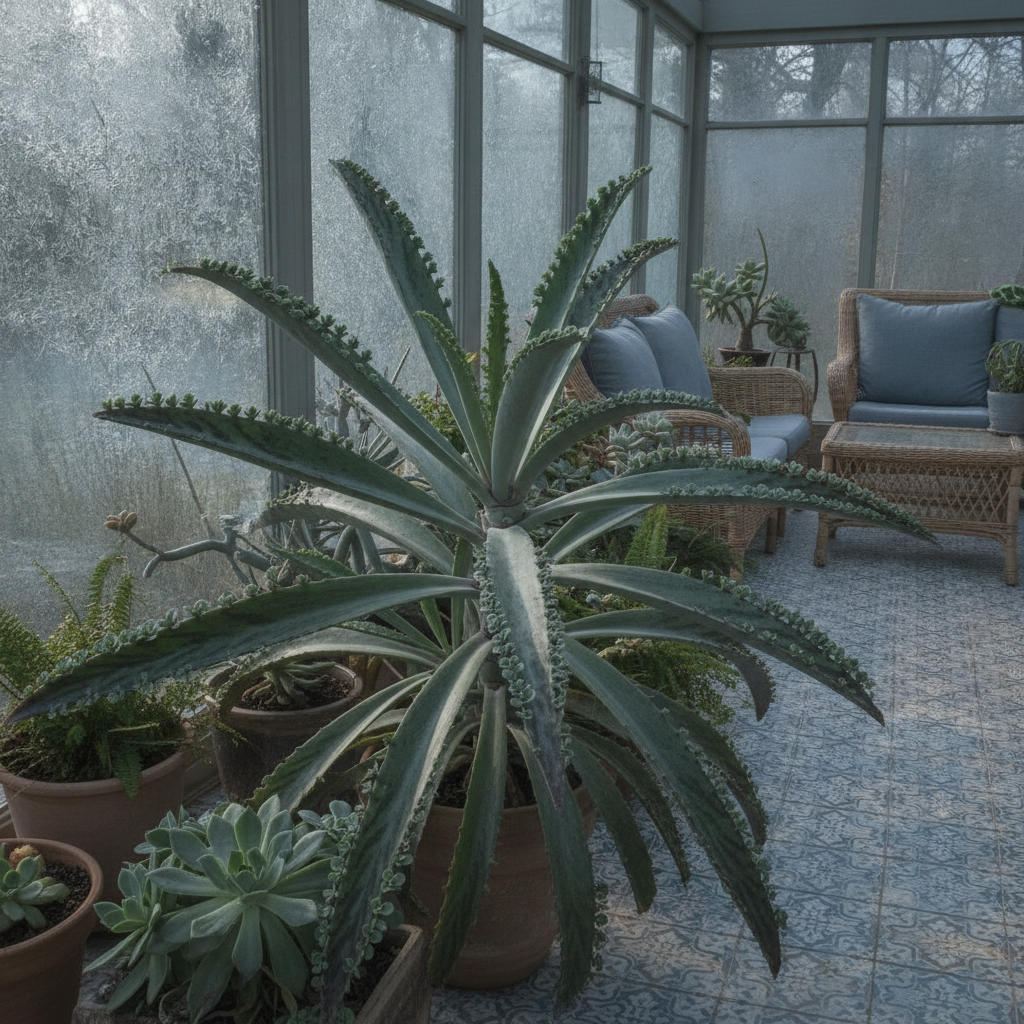
The theatre comes from those plantlets. Every leaf produces a fringe of bulbils, sometimes called bulbliferous spurs, that develop in the notches along the margin. Each is a complete clone of the parent, and once it grows large enough it simply detaches, falls, and roots wherever it lands. For a curious grower this is endlessly entertaining, and for anyone learning propagation it is the gentlest possible introduction, since the plant does all the work. The trade-off is that the same mechanism makes it weedy: in frost-free climates it is treated as an invasive species in parts of Australia, South Africa and the southern United States, so plantlets and spent material should always go in the bin rather than the compost or garden.
Important — Toxicity: All parts of mother of thousands contain bufadienolide cardiac glycosides, with the highest concentration in the tiny plantlets. Ingestion can cause vomiting, drooling, lethargy and, in serious cases, dangerous heart-rhythm disturbances in cats, dogs and grazing animals. Keep the plant well out of reach of pets and children, sweep up dropped plantlets promptly, and wash your hands after handling. If ingestion is suspected, contact a vet or poison-control service without delay.
Light Requirements
Light is the single biggest lever you have over the appearance of this plant. In its native Madagascan habitat it grows in open, sun-baked terrain, and that heritage shows: given plenty of light it stays compact, deeply coloured and sturdy, while in dim conditions it stretches, pales and topples. Mother of thousands will survive in a surprising range of light levels, but it only looks its best, and only develops the purple flush and the tight leaf spacing that make it attractive, when it receives generous illumination.
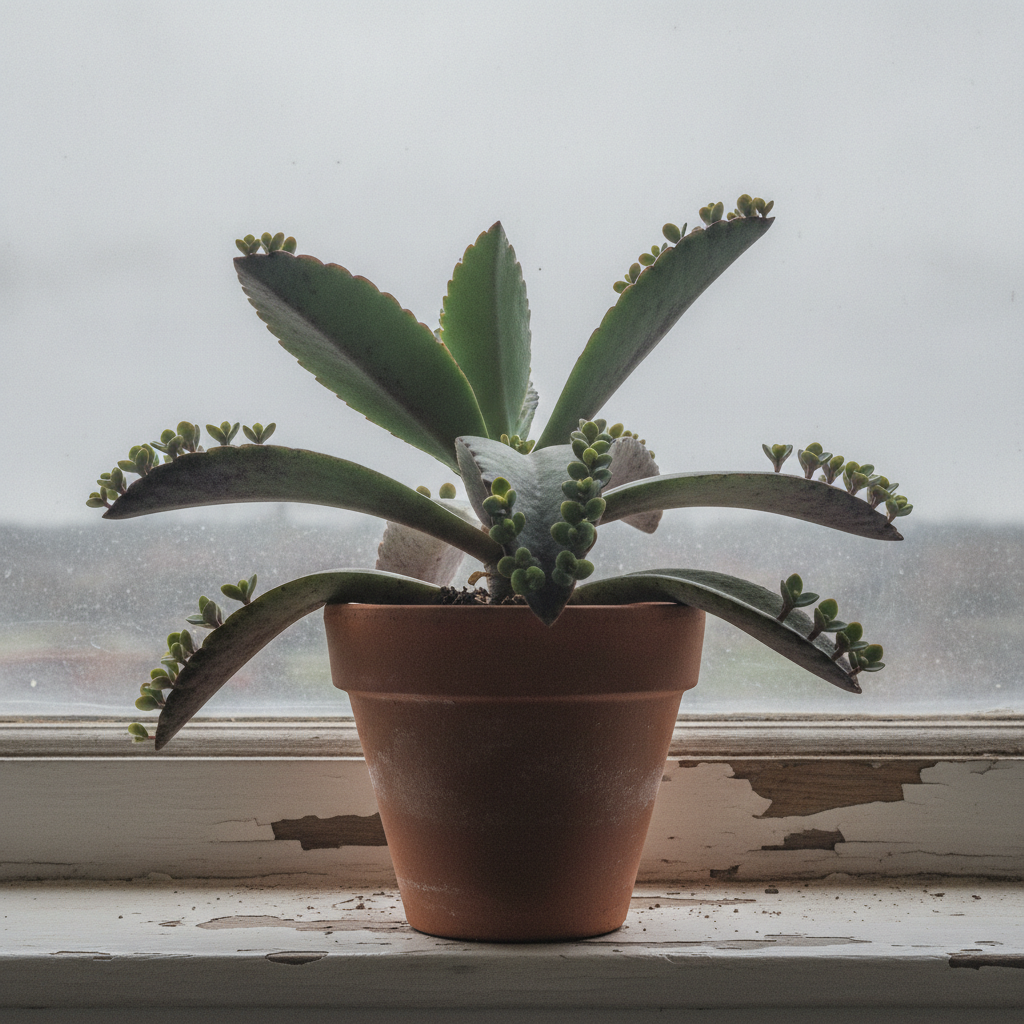
The ideal position is bright indirect light with two to four hours of gentle direct sun each day, such as an east-facing windowsill or a spot set slightly back from a south or west window. Mature, well-acclimatised plants tolerate full sun happily, but a plant moved abruptly from a shop shelf into blazing midday glare can scorch, so increase exposure gradually over a couple of weeks.
Light Levels Explained
The table below translates the usual vague advice into something more concrete, using approximate light intensity measured in lux and the everyday locations that tend to deliver it.
| Light Category | Approx. Level | Typical Location | Outcome |
|---|---|---|---|
| Direct sun | 50,000 lux and above | On a south or west sill | Compact, deeply coloured, strongest growth once acclimatised |
| Bright indirect | 10,000 to 25,000 lux | Beside an east window or near a bright south one | Ideal; healthy, sturdy, good colour |
| Medium | 5,000 to 10,000 lux | A metre or two back from a bright window | Survives, slightly stretched, muted colour |
| Low | 1,000 to 5,000 lux | North window or interior corner | Etiolates, leans toward light, weak stem |
| Very low | Below 1,000 lux | Hallways, windowless rooms | Decline; not suitable long term |
Window Orientation and Placement
South-facing window: The best choice in most homes. A position on or just beside a south sill gives the long hours of bright light the plant craves. In a very hot climate, a sheer curtain at the height of summer prevents leaf scorch on a newly moved plant.
East-facing window: Excellent. Gentle morning sun followed by bright light for the rest of the day suits the plant well and rarely causes scorching, making east windows the safest spot for a recently purchased specimen.
West-facing window: Very good, offering strong afternoon sun. Watch for heat build-up against the glass in summer, and rotate the pot regularly so the plant does not lean.
North-facing window: The weakest option. The plant will live but tends to etiolate, stretching toward the light with pale, widely spaced leaves. If a north window is all you have, supplement with a grow light to keep growth tight.
Pro Tip — Rotate for Symmetry: Because the single stem leans strongly toward its light source, give the pot a quarter turn every week or two. This keeps the plant growing straight and upright rather than developing a permanent bend that becomes hard to correct later.
How Light Affects Leaf Colour and Plantlet Production
The grey-green of the leaves intensifies into bronze and purple tones under strong light, a stress pigmentation the plant produces to protect itself from intense sun. Bright conditions also encourage heavier plantlet production along the leaf margins, so a sun-grown specimen tends to be both more colourful and more prolific. In low light the leaves revert to a flatter, paler green, the purple fades, and the plant invests its energy in stretching upward rather than building plantlets, the visible signature of a plant that is surviving rather than thriving.
Warning — Direct Sunlight: Despite its sun-loving nature, a plant grown indoors in low light over winter can burn if moved suddenly into fierce spring sun. The symptom is pale, bleached or brown patches on the upper leaf surfaces. Always reintroduce strong light gradually over ten to fourteen days to let the plant build up its protective pigments.
Artificial Lighting
Mother of thousands responds well to supplementary lighting, which is the simplest fix for a stretched, etiolated plant in a dark room. A full-spectrum LED grow light positioned 20 to 30 centimetres (8 to 12 inches) above the plant for ten to twelve hours a day will keep growth compact and colour strong. Because the species is a sun-lover, do not be shy with the intensity; ordinary low-output bulbs will not be enough to prevent stretching.
Seasonal Adjustments
Light levels indoors fall sharply through autumn and winter, and the plant’s growth slows to match. Move it to your brightest available window for the darker months and accept that some stretching is normal. As days lengthen again in spring, reintroduce stronger light gradually rather than all at once, and resume regular care as new growth appears at the crown.
Watering & Humidity
As a true succulent, mother of thousands stores water in its thick leaves and is built to endure long dry spells. The overwhelming majority of problems growers encounter trace back to too much water rather than too little, so the governing principle is simple: when in doubt, wait. A plant that is slightly underwatered will recover within hours of a drink, while one that is chronically overwatered develops root rot that is far harder to reverse.
When to Water
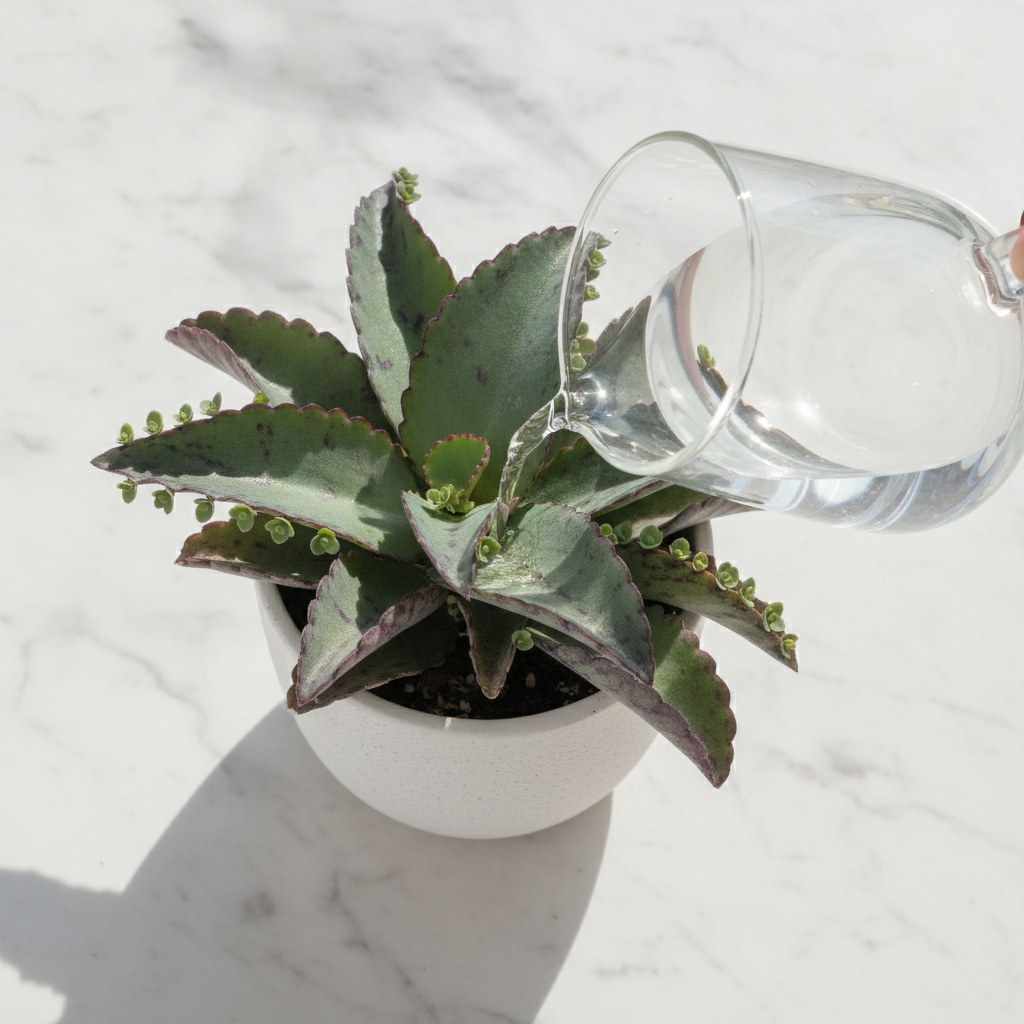
Use the soak-and-dry method. Water the plant thoroughly, then leave it completely alone until the soil has dried out from top to bottom. In practice that tends to mean watering roughly every ten to fourteen days during the active growing season of spring and summer, and as little as once a month, sometimes less, through the dormant winter period. These are starting points, not rules; pot size, light, temperature and the time of year all shift the schedule.
The most reliable guide is the soil itself rather than the calendar. Push a finger a few centimetres into the mix, or lift the pot to judge its weight; a pot that feels light and dry needs water, while one that still feels heavy and damp does not. The leaves give a second signal: plump, firm foliage means the plant is well hydrated, while leaves that look slightly soft or wrinkled indicate it is ready for a drink.
Pro Tip — Read the Leaves: The lowest, oldest leaves are your moisture gauge. When they begin to feel a little soft or pucker at the edges, the plant has used most of its reserves and a thorough watering is due. Firm, taut leaves mean you can comfortably wait longer.
How to Water Correctly
- Check first that the top few centimetres of soil are completely dry, and ideally that the whole pot feels light.
- Water at the soil surface, directing the flow around the base of the stem rather than over the leaves and into the central trough, where trapped water can encourage rot.
- Continue until water runs freely from the drainage holes, which ensures the entire root ball is moistened.
- Let the pot drain fully for several minutes, then tip away any water left standing in the saucer or cachepot.
- Return the plant to its spot and do not water again until the soil has dried out completely.
Signs of Overwatering vs. Underwatering
| Symptom | Overwatering | Underwatering |
|---|---|---|
| Leaf colour | Yellowing, often translucent or blackened | Dull, slightly reddened or faded |
| Leaf texture | Soft, mushy, water-soaked | Thin, wrinkled, puckered but still firm |
| Soil | Stays wet for days, may smell sour | Bone dry, pulling away from the pot edge |
| Roots | Brown, soft and foul-smelling | Dry but firm and pale |
| Stem base | Blackened, soft, collapsing | Firm, perhaps slightly shrivelled |
Warning — Root Rot: A soft, darkening stem base is the most serious warning sign and usually means rot has taken hold. Act fast: unpot the plant, cut away all mushy roots and tissue with clean tools, let the healthy remainder callus for a day or two, and replant in fresh, dry, gritty mix. Mother of thousands roots so readily that even a salvaged top section will often re-establish.
Humidity Requirements
This is refreshingly undemanding where humidity is concerned. Ordinary household air, somewhere between 30 and 50 percent relative humidity, suits it perfectly, and it has no need of the misting, pebble trays or humidifiers that tropical foliage plants often require.
In fact, high humidity works against this plant. Damp, still air raises the risk of fungal problems and powdery mildew on the leaves, so the species is better suited to a dry, airy room than a steamy bathroom. If anything, good air circulation is more valuable to it than added moisture.
Avoid the instinct to mist. Water settling in the leaf trough and among the marginal plantlets simply invites rot and disease, with no benefit in return. Keep the foliage dry and let the plant breathe.
Water Quality
Mother of thousands is not fussy about water quality and tolerates ordinary tap water in most areas. In regions with very hard water you may see a faint white mineral crust form on the soil surface over time; flushing the pot thoroughly every few months, or using filtered or collected rainwater, keeps this in check. Room-temperature water is gentler on the roots than water straight from a cold tap.
Soil, Potting & Repotting
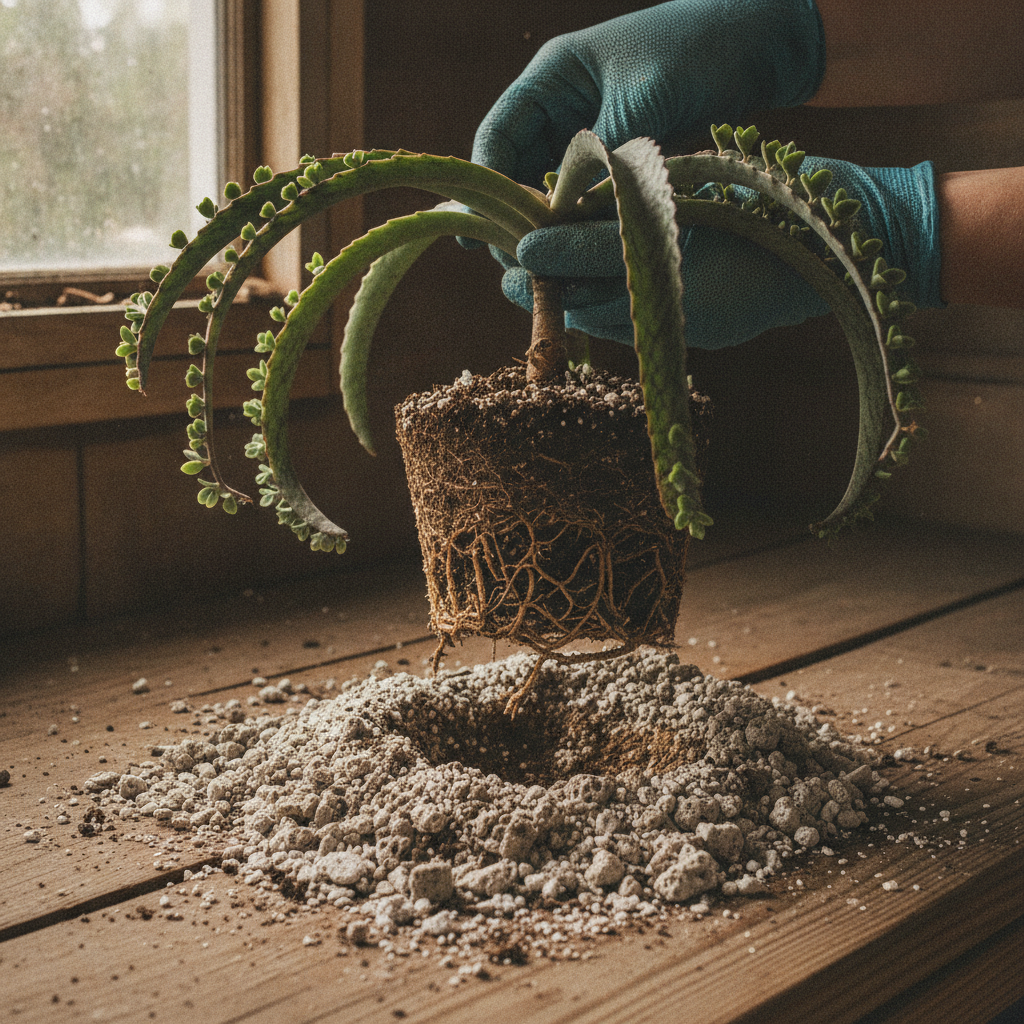
Drainage is everything for this plant. Its roots need to take up water quickly and then dry out fast, and a heavy, moisture-retentive compost is the surest route to rot. The aim is a gritty, free-draining medium that mimics the lean, rocky soils of its native Madagascar far more closely than a bag of standard houseplant potting mix.
Ideal Soil Composition
A purpose-made cactus and succulent compost is the easy starting point, but most bagged mixes still hold a little too much moisture for comfort and benefit from extra grit. A reliable home blend combines a base of cactus or general potting mix with generous additions of inorganic, free-draining material to open up the structure and speed up drainage.
| Component | Proportion | Function |
|---|---|---|
| Cactus or general potting mix | 50 percent | Holds a little moisture and provides body and nutrients |
| Perlite or pumice | 30 percent | Opens the structure and speeds drainage and aeration |
| Coarse horticultural sand or fine grit | 20 percent | Adds weight and sharp drainage around the roots |
The plant is not particular about pH and grows well in anything from slightly acidic to slightly alkaline soil, roughly 6.0 to 7.5. Far more important than pH is the physical openness of the mix; if water pools on the surface or takes more than a moment to drain through, add more grit.
Pro Tip — Quick Mix Recipe: For a fast, forgiving blend, combine two handfuls of cactus compost with one handful of perlite and one handful of coarse grit or sand. If in doubt, err toward more grit; this plant would far rather be too dry than too wet.
Choosing the Right Pot
The container matters almost as much as the compost. Because the plant grows tall and somewhat top-heavy, a stable, slightly weighty pot helps prevent the whole thing tipping over as it matures.
Drainage holes are non-negotiable. Never plant mother of thousands in a pot without drainage. No matter how careful your watering, a sealed container traps moisture at the roots and rot will follow. If you love a decorative cachepot without holes, use it only as an outer sleeve and keep the plant in a plastic nursery pot inside.
Pot material: Terracotta is the ideal choice. Its porous walls wick moisture out of the soil and let it evaporate, which suits a plant that hates wet feet, and its weight adds welcome stability. Glazed ceramic and plastic both work but hold moisture longer, so be a little more cautious with watering if you use them.
Pot size: Choose a pot only slightly larger than the root ball. An oversized container holds a reservoir of damp soil that the modest roots cannot use, and that lingering moisture is exactly what causes trouble. Snug is safe.
When to Repot
This is a fast grower, and a healthy plant typically needs moving on every one to two years, ideally in spring as the growing season begins. Tell-tale signs that it is time include roots emerging from the drainage holes, the plant becoming top-heavy and unstable, water running straight through a compacted root ball, or growth slowing noticeably. Repotting is also the perfect moment to refresh tired soil and tidy away the inevitable crop of plantlets.
How to Repot: Step-by-Step
- Water lightly a day or two beforehand so the root ball holds together, then withhold water on the day of repotting so the soil is not soggy.
- Ease the plant out by tipping the pot and supporting the stem; avoid pulling on the brittle leaves, which snap easily and shed plantlets as they go.
- Gently tease away the old soil from the roots and inspect them, trimming any that are brown, soft or dead with clean tools.
- Add a layer of fresh gritty mix to the base of the new pot and position the plant at the same depth it sat before.
- Backfill around the roots with more mix, firming gently to remove air pockets and to steady the top-heavy stem.
- Wait three to seven days before watering, giving any disturbed or trimmed roots time to callus and reducing the risk of rot.
- Sweep up any plantlets that have dropped during the process and dispose of them, unless you intend to grow them on deliberately.
Warning — Transplant Shock: Some leaf drop and a brief pause in growth after repotting are normal and not a cause for alarm. Resist the urge to water heavily to compensate; keep the plant in bright light, hold off on feeding for a few weeks, and let it settle. Overwatering a freshly disturbed plant is the quickest way to turn mild shock into fatal rot.
Fertilising
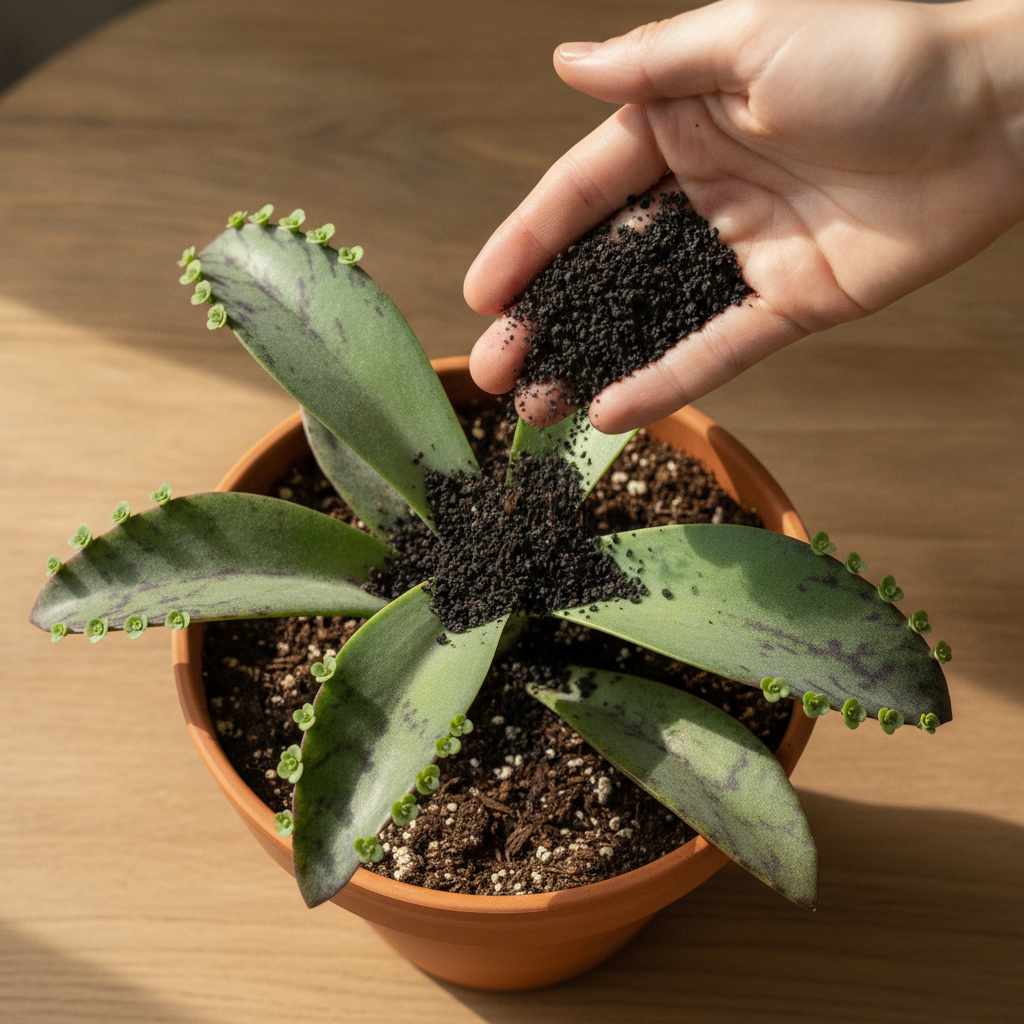
Mother of thousands is adapted to lean, nutrient-poor soils and needs very little feeding to do well. In truth, the commonest fertiliser mistake with this plant is giving it too much, which produces soft, sappy, over-stretched growth that flops and is more vulnerable to pests.
A light hand is the whole secret. A modest feed during the growing months keeps the foliage healthy and the colour strong without pushing the kind of weak, rapid growth that undermines the plant’s naturally sturdy, sculptural form.
Understanding Plant Nutrients
Fertilisers are labelled with an N-P-K ratio showing the proportion of nitrogen, phosphorus and potassium they contain. For a succulent like this one a balanced or slightly low-nitrogen formula is best, since excess nitrogen drives exactly the leggy, soft growth you want to avoid. The table below summarises the main nutrients and the symptoms a plant shows when each runs short.
| Nutrient | Symbol | Primary Function | Deficiency Symptoms |
|---|---|---|---|
| Nitrogen | N | Leaf and stem growth, green pigment | Pale, yellowing older leaves, stunted growth |
| Phosphorus | P | Root development and flowering | Weak roots, poor vigour, dull foliage |
| Potassium | K | Overall hardiness and water regulation | Browning leaf edges, soft growth |
| Calcium | Ca | Cell-wall strength | Distorted new growth, weak tissue |
| Magnesium | Mg | Core of the chlorophyll molecule | Yellowing between leaf veins |
| Iron | Fe | Chlorophyll production | Pale new leaves with green veins |
Types of Fertiliser
Liquid fertilisers: The easiest to control, which makes them ideal here. A succulent or cactus feed, or a balanced houseplant feed diluted to half or even quarter strength, lets you apply small, measured doses through the growing season and stop instantly in winter.
Slow-release granular: Convenient but harder to moderate, since the prills keep releasing nutrients with every watering. If you use them, choose a low-rate succulent formulation and apply at half the recommended quantity to avoid overfeeding.
Organic fertilisers: Gentle options such as a light top-dressing of worm castings or a very dilute seaweed feed release nutrients slowly and are difficult to overdo, making them well suited to a plant that resents being pushed.
Feeding Schedule
Feed only during the active growing season of spring and summer, roughly once a month, and always with a diluted solution. Stop completely in autumn and winter, when the plant is resting and cannot use the extra nutrients; feeding a dormant plant simply allows salts to accumulate in the soil. A plant repotted into fresh mix needs no feeding at all for its first couple of months, as the new compost already supplies what it requires.
Pro Tip — Less Is More: If you are unsure whether to feed, don’t. A mother of thousands will grow perfectly well on a single light feed each month, or even none at all, but it suffers visibly from overfeeding. Treat fertiliser as an occasional tonic, not a staple.
How to Fertilise
- Dilute a succulent or balanced liquid feed to half strength or less, following the product directions as a maximum rather than a target.
- Water the plant with plain water first if the soil is bone dry, so the feed does not scorch dry roots.
- Apply the diluted solution to the soil at the base of the plant, never over the leaves.
- Let any excess drain away fully and empty the saucer, then resume your normal soak-and-dry routine.
Warning — Salt Build-Up: A white crust on the soil surface or pot rim signals accumulated fertiliser salts, which can burn the roots. Flush the pot thoroughly with plain water two or three times every few months, letting it drain freely each time, to wash the build-up away.
Propagation
If any plant could be said to propagate itself, this is it. Mother of thousands earns its name through the production of countless plantlets, and turning those into new plants requires almost no effort or skill. The challenge, ironically, is usually restraint rather than success.
The plantlets are the primary and overwhelmingly easiest method, but established clumps can also be divided, and even a detached leaf will often sprout. Whichever route you take, spring and summer give the fastest, most reliable results, when warmth and light drive vigorous rooting.
Understanding the Marginal Plantlets
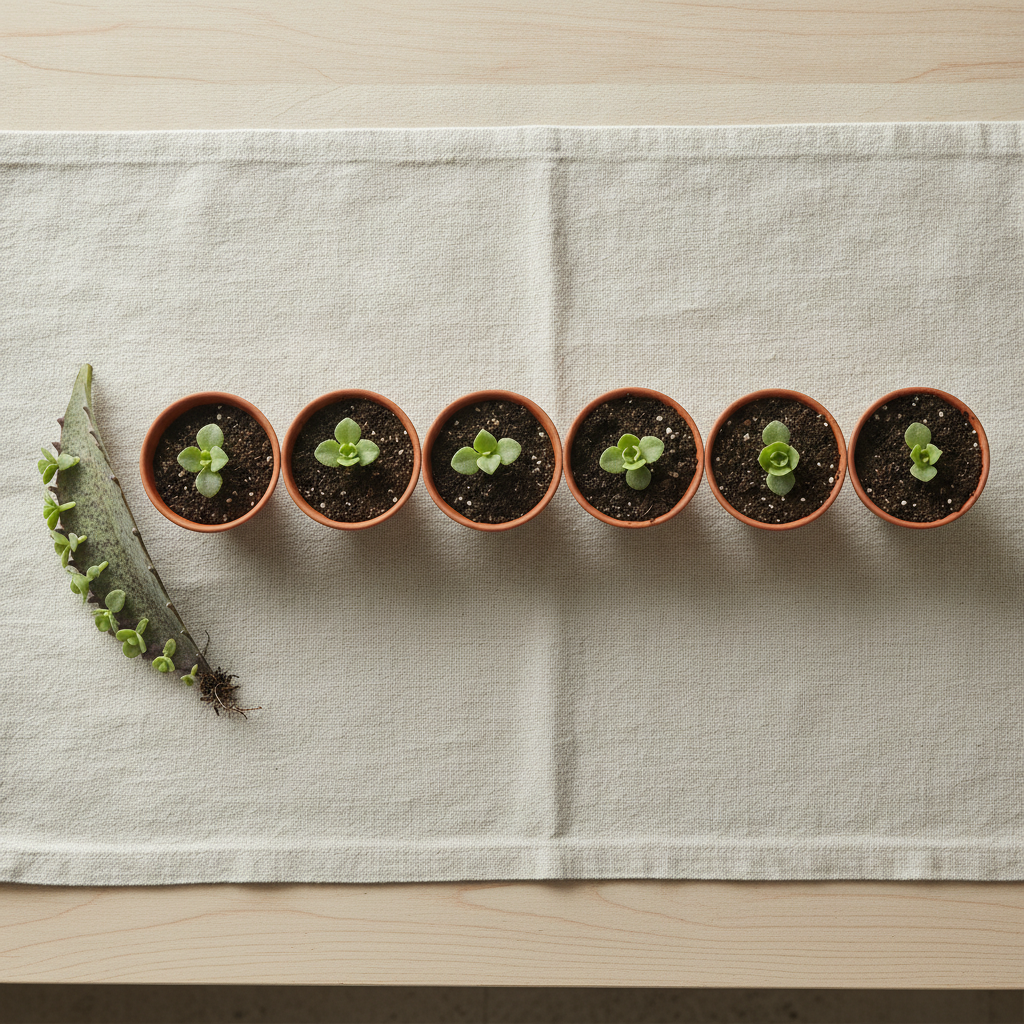
The bulbils that line each leaf are not seedlings but vegetative clones, produced asexually in the notches of the leaf margin. Each carries a tiny pair of leaves and a cluster of pale, undeveloped roots before it ever leaves the parent. When a plantlet reaches a few millimetres across it abscises, drops, and roots within days on contact with soil. This is why the plant spreads so readily, and why every grower eventually finds seedling-like rosettes appearing in the pots of entirely unrelated houseplants nearby.
Growing On the Plantlets: Step-by-Step
This is the method that requires nothing more than a tray of soil and a little patience. It works because the plantlets are already primed to root the moment they meet a suitable surface.
- Collect a handful of plantlets, either by gently brushing mature ones from a leaf margin or simply gathering those that have already dropped.
- Fill a shallow tray or small pots with the same gritty, free-draining mix you use for the parent plant.
- Scatter or place the plantlets on the surface, root-side down, without burying them; they need light and air contact to establish.
- Mist the surface lightly or water sparingly to keep it just barely moist, never wet.
- Set the tray in bright indirect light at room temperature and wait; roots usually anchor within a week or two and small rosettes follow.
- Once the young plants are a couple of centimetres across and clearly growing, pot them up individually into their own small containers.
Pro Tip — Control the Spread: Because the plantlets root so freely, they easily become a nuisance, sprouting in every nearby pot. To keep the plant in check, snip off and bin the leaf margins of plantlets before they drop, and stand the pot away from other plants so stray bulbils cannot colonise them.
Division and Leaf Propagation: Step-by-Step
Where a plant has produced offsets at its base, or where you simply want larger starts than the plantlets provide, division and whole-leaf propagation are straightforward alternatives, best carried out at repotting time.
- For division, unpot the plant and separate any rooted offsets or clustered stems from the base, keeping a portion of roots attached to each section.
- For leaf propagation, remove a healthy, intact leaf, ideally one already carrying plantlets along its edge.
- Let cut surfaces dry and callus for a day or two to guard against rot.
- Lay the leaf flat on, or set the division into, gritty, barely moist mix.
- Keep in bright indirect light and water minimally until new growth and roots are well established, then care for as normal.
Troubleshooting Propagation
| Problem | Likely Cause | Solution |
|---|---|---|
| Plantlets rot before rooting | Substrate kept too wet | Reduce moisture; keep the mix barely damp and improve airflow |
| Plantlets shrivel and dry out | Air too dry or no soil contact | Mist lightly and ensure the roots touch the surface |
| Very slow or no rooting | Low light or cold temperatures | Move to brighter, warmer conditions in the growing season |
| Leggy, pale young plants | Insufficient light after rooting | Increase light immediately to keep rosettes compact |
Pests & Diseases
Mother of thousands is robust and relatively pest-resistant, and a plant grown in good light with careful watering rarely suffers serious trouble. Most problems it does encounter are cultural, stemming from overwatering, rather than from any particular vulnerability to pests.
That said, no houseplant is entirely immune. The pests below are the usual suspects on stressed or crowded plants, and the diseases are almost always traceable to excess moisture. Catching any of them early, while the infestation is light, makes treatment far simpler.

Common Pests
Mealybugs (Pseudococcidae)
The most frequent pest on this plant, mealybugs appear as small, white, cottony tufts tucked into leaf joints, the central trough and the base of the stem. They suck sap, weaken the plant and leave behind a sticky honeydew that attracts sooty mould.
Treatment: Dab each insect with a cotton bud dipped in isopropyl alcohol, which dissolves their protective coating on contact. For wider infestations, treat the whole plant with insecticidal soap or a diluted neem oil solution weekly until clear, and isolate the plant meanwhile.
Aphids (Aphidoidea)
Aphids cluster on soft new growth and flower stalks, where they suck sap and cause distorted, sticky foliage. They are most likely to appear when a plant has been pushed into lush growth by overfeeding.
Treatment: Rinse them off with a firm jet of water, then follow up with insecticidal soap or neem oil if they persist. Easing back on nitrogen feeding removes the soft growth they favour.
Spider Mites (Tetranychus urticae)
These tiny mites thrive in hot, dry, stagnant conditions and reveal themselves through fine speckling on the leaves and delicate webbing in the angles of the foliage. They are easy to miss until numbers build.
Treatment: Wipe the leaves, improve air circulation, and apply neem oil or a dedicated miticide at intervals until the population is gone. Repeat treatments are usually needed to break the breeding cycle.
Common Diseases
Root and Stem Rot (Pythium and Phytophthora)
By far the most serious threat to this plant, rot sets in when the roots sit in wet soil. The first visible signs are a yellowing, softening stem base and mushy, blackened lower leaves, by which point the damage below ground is well advanced.
Treatment: Unpot immediately, cut away every soft, discoloured root and section of stem with sterile tools, and let the healthy remainder callus before replanting in fresh, dry, gritty mix. Salvage healthy plantlets or a clean top cutting as insurance, and correct the watering that caused it.
Powdery Mildew (Erysiphales)
A dusty white coating on the leaves, powdery mildew is encouraged by damp, still, humid air and poor circulation. It is more of a problem in crowded, unventilated spots than in the dry, airy conditions this plant prefers.
Treatment: Improve airflow, reduce humidity and avoid wetting the foliage. Remove badly affected leaves and treat with a fungicide or a dilute potassium-bicarbonate spray if it spreads.
Pest and Disease Summary
| Pest / Disease | Identification | Treatment |
|---|---|---|
| Mealybugs | White cottony tufts in leaf joints and crown | Alcohol on a cotton bud; insecticidal soap or neem |
| Aphids | Clusters on new growth, sticky distorted leaves | Rinse off; insecticidal soap or neem; reduce feeding |
| Spider mites | Fine speckling and webbing, dry conditions | Wipe leaves, improve airflow, neem or miticide |
| Root and stem rot | Soft yellow stem base, mushy black leaves | Cut out rot, dry, replant in fresh gritty mix |
| Powdery mildew | Dusty white coating on foliage | Improve airflow, reduce humidity, fungicide |
Prevention Strategies
Prevention with this plant comes down to getting the basics right. Bright light, a gritty free-draining mix, disciplined soak-and-dry watering and good air movement together eliminate the conditions that nearly all of its pests and diseases depend on. A plant grown hard and lean is markedly tougher than one grown soft and wet.
Inspect the plant whenever you water, paying attention to the leaf joints and the central trough where pests like to hide, and quarantine any new arrival for a couple of weeks before letting it join your collection. Promptly removing dropped plantlets and fallen leaves also denies pests the debris they shelter in.
Pro Tip — Neem as Routine Defence: A monthly preventive spray of dilute neem oil through the growing season, applied in the evening to avoid leaf scorch, keeps the common sap-sucking pests from ever gaining a foothold. Cover the undersides of the leaves and the crown, where infestations usually begin.
Popular Varieties
Mother of thousands belongs to a tight-knit group of plantlet-bearing kalanchoes, once gathered under the genus Bryophyllum and now folded into Kalanchoe, whose members are often confused with one another in cultivation. They share the same prolific habit but differ markedly in leaf shape and colour.
The closest relatives and the most sought-after named forms are worth knowing, both to identify what you have and to choose the look you want. The table summarises the main contenders, followed by detailed profiles of the most distinctive.
| Variety | Leaf Appearance | Light Needs | Growth Rate | Availability |
|---|---|---|---|---|
| Kalanchoe daigremontiana | Broad, grey-green, purple-blotched, plantlets along margins | Bright, some direct sun | Fast | Common |
| Mother of Millions (K. delagoensis) | Narrow, cylindrical, pencil-like, plantlets at tips | Bright, some direct sun | Fast | Common |
| Pink Butterflies (K. x houghtonii) | Blue-green leaves with vivid magenta-pink plantlets | Bright indirect to direct | Moderate | Sought-after |
| Kalanchoe x houghtonii | Hybrid, broader than delagoensis, prolific plantlets | Bright, some direct sun | Fast | Occasional |
| Kalanchoe gastonis-bonnieri | Large, paddle-shaped, silvery, plantlets at tips | Bright indirect | Moderate | Specialist |
| Kalanchoe pinnata | Rounded, scalloped leaves, plantlets along margins | Bright indirect to direct | Fast | Occasional |
Featured Varieties
Pink Butterflies
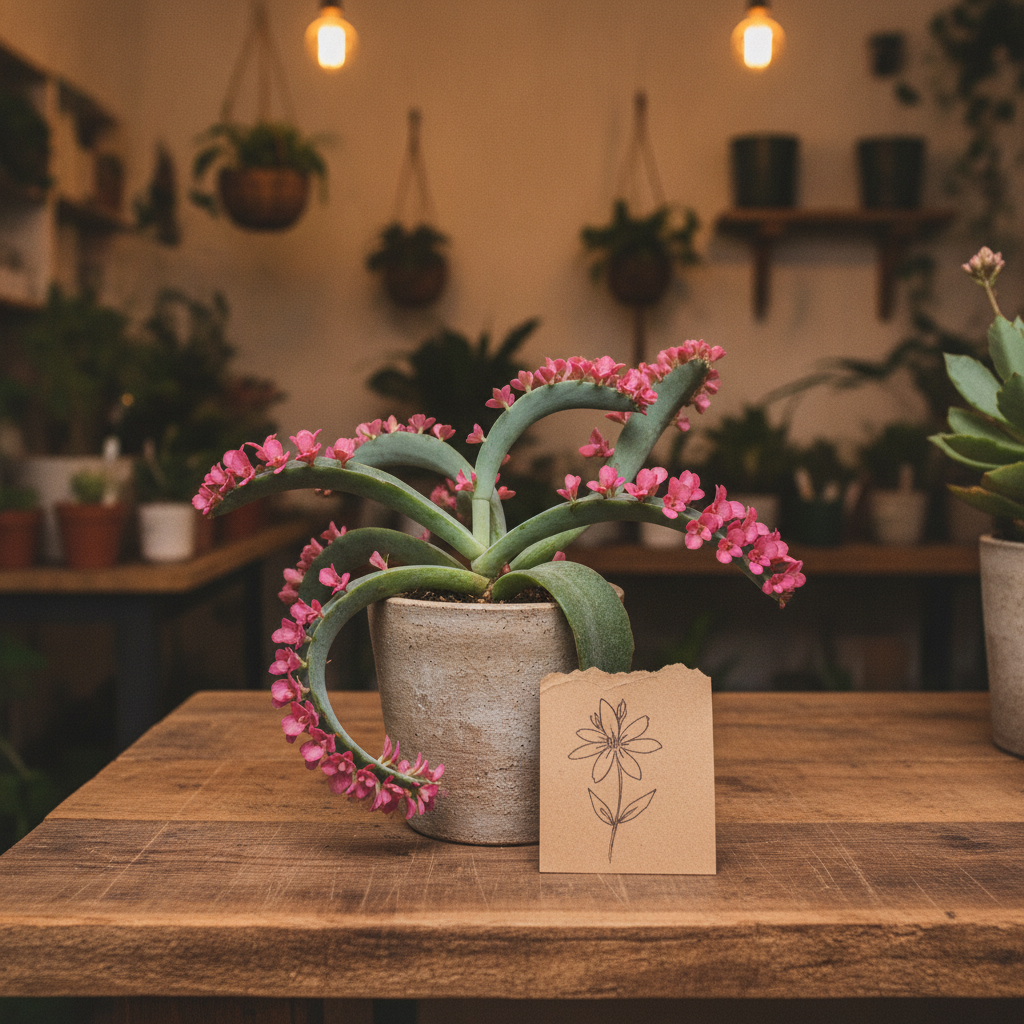
A prized hybrid form whose plantlets emerge a vivid magenta-pink rather than green. The colour comes from a partial lack of chlorophyll in the bulbils, which makes them ornamental but unable to survive on their own, so this cultivar is gentler and less weedy than its parent.
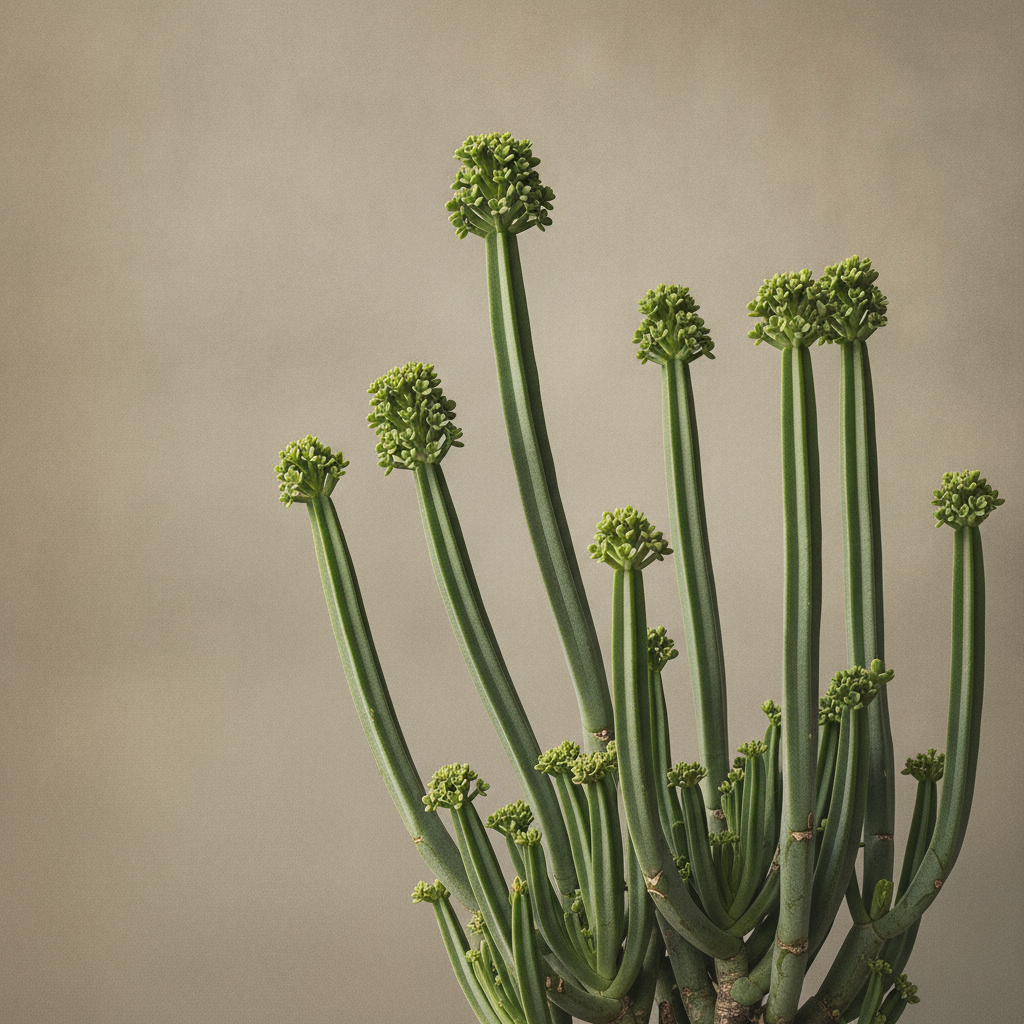
Mother of Millions
The narrow-leaved cousin, Kalanchoe delagoensis, carries slender, almost tubular grey-green leaves with plantlets clustered at the tips rather than along the edges. It is even more prolific than the broad-leaved species and equally easy to grow.
Variety Profiles in Detail
Mother of Thousands (Kalanchoe daigremontiana)
The classic species and the benchmark for the group. Its broad, lance-shaped leaves are grey-green above with chocolate mottling beneath, and the continuous fringe of plantlets along every margin makes it instantly recognisable. Fast, forgiving and architectural, it is the form most people picture when the name is mentioned.
Pink Butterflies (Kalanchoe x houghtonii ‘Pink Butterflies’)
A standout cultivar of the hybrid between daigremontiana and delagoensis, treasured for the rows of bright pink plantlets that line its leaves like a flutter of tiny wings. Because the pink bulbils cannot photosynthesise fully and rarely establish, it is both more decorative and far less invasive than its green-plantleted relatives.
Mother of Millions (Kalanchoe delagoensis)
Often sold interchangeably with mother of thousands, this species is distinguished by its narrow, cylindrical leaves that end in a small cup of plantlets. It produces an extraordinary number of offspring and is treated as a serious invasive weed in warm climates, so its plantlets should always be disposed of responsibly.
Choosing the Right Variety for Your Space
For sheer drama and the classic look, the broad-leaved species is hard to beat, while the narrow-leaved Mother of Millions offers a finer, more architectural silhouette. If the prolific spreading habit gives you pause, especially in a home with pets or curious children, the Pink Butterflies cultivar is the kindest choice, combining the family’s striking marginal plantlets with a fraction of the invasive potential. Whichever you choose, the care described throughout this guide applies equally to them all.
Frequently Asked Questions
Is mother of thousands poisonous to cats and dogs?
Yes, and seriously so. Every part of the plant contains bufadienolide cardiac glycosides, with the highest concentrations in the tiny plantlets, and ingestion can cause vomiting, lethargy and potentially dangerous heart-rhythm problems in cats, dogs and livestock. Keep it well out of reach, clear up dropped plantlets promptly, and contact a vet immediately if you suspect your pet has eaten any.
Why is my mother of thousands growing so tall and leggy?
Legginess is almost always a sign of insufficient light. The plant stretches toward the nearest window, producing a thin, weak stem with widely spaced, pale leaves. Move it to a brighter spot with some direct sun, rotate the pot regularly, and consider adding a grow light in winter. To restore a compact shape you can also behead the stretched top and re-root it.
How do I stop it taking over my other pots?
The plantlets root wherever they land, so the key is to intercept them before they drop. Snip off and bin the plantlet-bearing leaf margins regularly, stand the pot away from other plants, and clear any stray rosettes from neighbouring containers as soon as you spot them. The Pink Butterflies cultivar, whose plantlets rarely establish, is the simplest long-term answer.
Does mother of thousands flower?
It can, though flowering is uncommon indoors. A mature plant, usually two or more years old and grown in strong light, may send up a tall stalk topped with clusters of small, bell-shaped, greyish-pink to orange flowers, typically in winter. Many growers never see it bloom, and after flowering the parent stem often declines, having already secured its succession through countless plantlets.
Why are the lower leaves shrivelling and dropping?
Some loss of the oldest, lowest leaves is entirely natural as the plant grows upward and ages. If many leaves soften and drop at once, however, suspect a watering problem: mushy, yellowing leaves point to overwatering and possible rot, while thin, wrinkled leaves suggest the plant has gone too long without a drink. Check the soil and the stem base to tell which.
How big does mother of thousands get?
Indoors it typically reaches 60 centimetres to 1 metre (2 to 3 feet) tall on a single upright stem, occasionally more in very bright conditions. In frost-free climates grown outdoors it can exceed a metre. The plant tends to grow up rather than out, so it stays narrow, which is part of why a stable, weighted pot is worth choosing.
How often should I water in winter?
Much less than in summer. As growth slows and light fades, the plant uses very little water, so once a month or even less is often plenty. Always let the soil dry out completely first and judge by the weight of the pot and the firmness of the leaves rather than by a fixed schedule. Cold, damp soil in winter is the single most common cause of rot.
Can I grow mother of thousands outdoors?
Only in frost-free climates, roughly USDA zones 9 to 11, and even then with caution. The plant cannot tolerate temperatures below about 10 degrees Celsius (50 Fahrenheit), and in warm regions its prolific self-seeding makes it a recognised invasive weed. In cooler climates keep it as a container plant that can summer outside in a bright, sheltered spot and come indoors well before the first frost.
My plant flowered and now looks like it is dying. Is that normal?
Yes. Like many plantlet-bearing kalanchoes, the main stem is somewhat monocarpic, meaning it often declines after putting its energy into flowering. This is not a failure on your part; the plant has simply completed its cycle. The good news is that it will already have produced abundant plantlets, any of which can be grown on to replace the parent seamlessly.






