

Few cacti bring colour to a windowsill quite like the blue myrtle cactus (Myrtillocactus geometrizans). Where most desert plants lean grey or olive, this Mexican native wears a soft, powdery blue-green bloom that looks almost dusted with chalk, and it carries that colour up a candelabra of geometric, sharply ribbed columns. Known variously as the bilberry cactus, blue candle and garambullo, it earns the “bilberry” name from its small, sweet, reddish-purple fruits, which are gathered and eaten across central Mexico much like wild berries. In the home it reads as a piece of living sculpture, architectural enough to anchor a shelf yet undemanding enough for a first-time cactus owner.
The blue myrtle is also one of the most genuinely beginner-friendly cacti you can grow, which is part of why it has become a staple of garden centres and a favourite rootstock for grafting other species. It asks for very little: strong light, a gritty mix and the discipline to leave it alone between waterings. The gap between merely surviving and truly thriving, though, comes down to a handful of details that this guide walks through in full, from reading the colour of its waxy skin to coaxing it through a proper winter rest. Get those right and you will be rewarded with steady growth, that signature blue bloom and, in time, a branching specimen with real presence.
Contents
- Quick Reference
- Why the Blue Myrtle Cactus Makes a Striking Houseplant
- Light Requirements
- Watering & Humidity
- Soil, Potting & Repotting
- Fertilising
- Propagation
- Pests & Diseases
- Popular Varieties
- Frequently Asked Questions
Quick Reference: Blue Myrtle Cactus at a Glance
| Light | Bright light to full sun; at least 4 to 6 hours of direct sun for the best blue colour and compact growth |
| Watering | Soak thoroughly, then let the mix dry out completely; roughly every 10 to 14 days in summer, monthly or less in winter |
| Temperature | 18 to 30°C (64 to 86°F) in growth; keep above 5°C (41°F) and protect from frost |
| Humidity | Low; ordinary dry household air of 30 to 50% is ideal |
| Fertiliser | Low-nitrogen cactus feed at half strength, once a month in spring and summer only |
| Toxicity | Non-toxic to cats, dogs and people; the ripe berries are edible, but the spines are a physical hazard |
Why the Blue Myrtle Cactus Makes a Striking Houseplant
The appeal of Myrtillocactus geometrizans starts with its colour. The blue-green cast is not a trick of the light but a real waxy bloom on the skin, a fine layer of epicuticular wax that the plant produces to reflect harsh sun and reduce water loss. That bloom gives the cactus its cool, glaucous tone and a velvety, matte finish that contrasts beautifully with the greens of leafy houseplants. Structurally it is just as distinctive: young plants are single, geometric columns with five or six pronounced ribs, and as they mature they branch repeatedly from the base and sides into the candelabra form that gardeners prize. In the wild this can become a small tree of 4 to 5 metres (13 to 16 feet), but as a potted houseplant it stays a manageable 0.3 to 1.5 metres (1 to 5 feet) for many years.
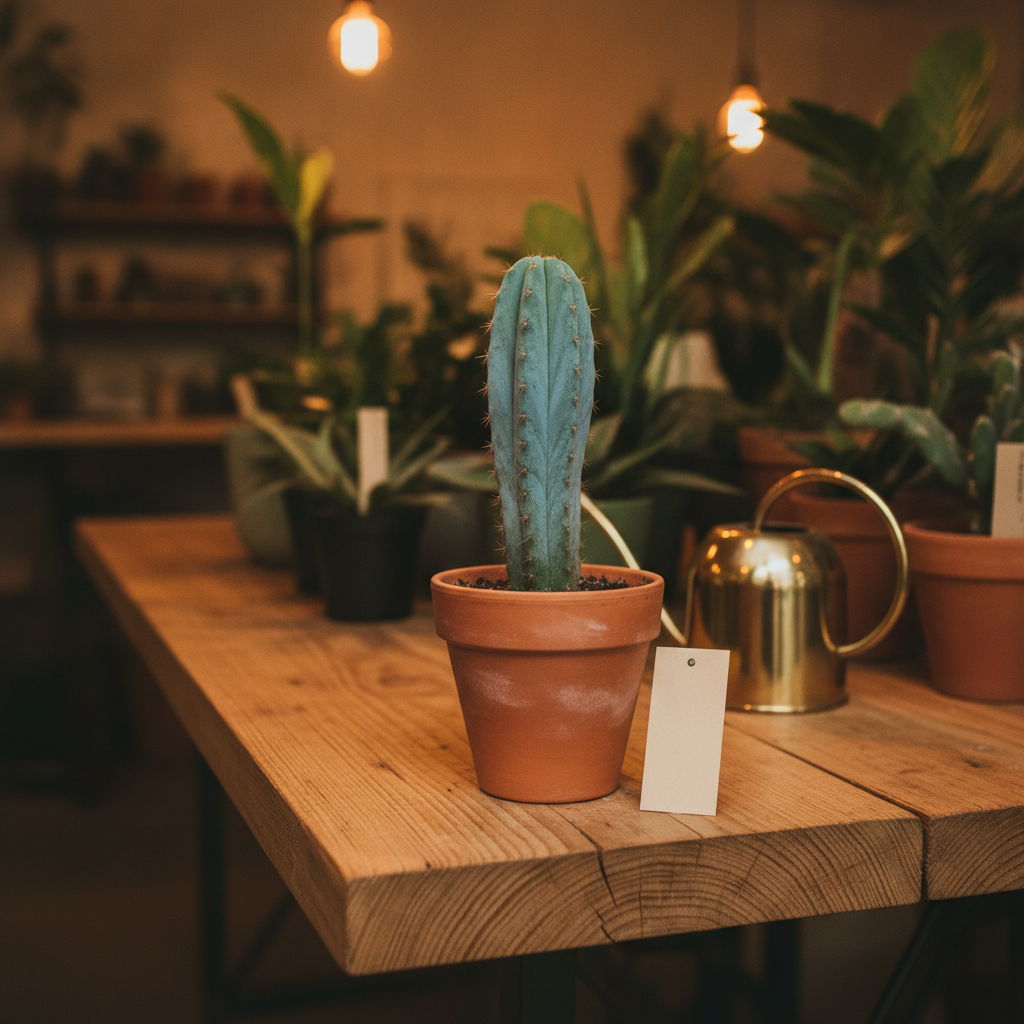
Beyond looks, the blue myrtle is forgiving in a way that few statement plants are. It is drought tolerant to a fault, copes with the dry air that kills tropical houseplants, and grows at a relaxed but steady pace that suits a windowsill rather than overwhelming it. It is so vigorous and trouble-free that commercial growers use it as a grafting rootstock for slower, fussier cacti, which tells you something about its constitution. Mature plants flower in spring with small, fragrant, greenish-white blooms, and these are followed by the sweet purple garambullo berries that give the species its bilberry nickname. For most indoor growers the foliage alone is reason enough, but the prospect of flowers and fruit on a well-grown specimen is a genuine bonus.
Important — Toxicity: The blue myrtle cactus is not considered toxic to cats, dogs or humans, and its ripe berries are eaten as food in Mexico. The real hazard is mechanical: the short, hard spines can puncture skin and are painful to remove, so site the plant out of reach of pets and small children, and handle it with folded newspaper or thick gloves.
Light Requirements
Light is the single most important factor in growing a good blue myrtle cactus, and it is also where most indoor specimens fall short. This is a sun plant from the open, high-light scrub of central and northern Mexico, and it expects a great deal more light than a typical living room provides. Give it too little and it tells you quickly: the columns stretch and narrow, the spacing between ribs and spines opens up, and the prized blue bloom fades towards a thin, sickly green.
The ideal indoor position is directly in front of your brightest window, where the plant receives several hours of unfiltered sun each day. A spot that sees four to six hours of direct sunlight, with bright ambient light for the rest of the day, will keep growth compact and the colour saturated. Outdoors in summer it will happily take full sun once acclimatised, and many growers move their plants outside for the warm months to recharge them before bringing them back in for winter.
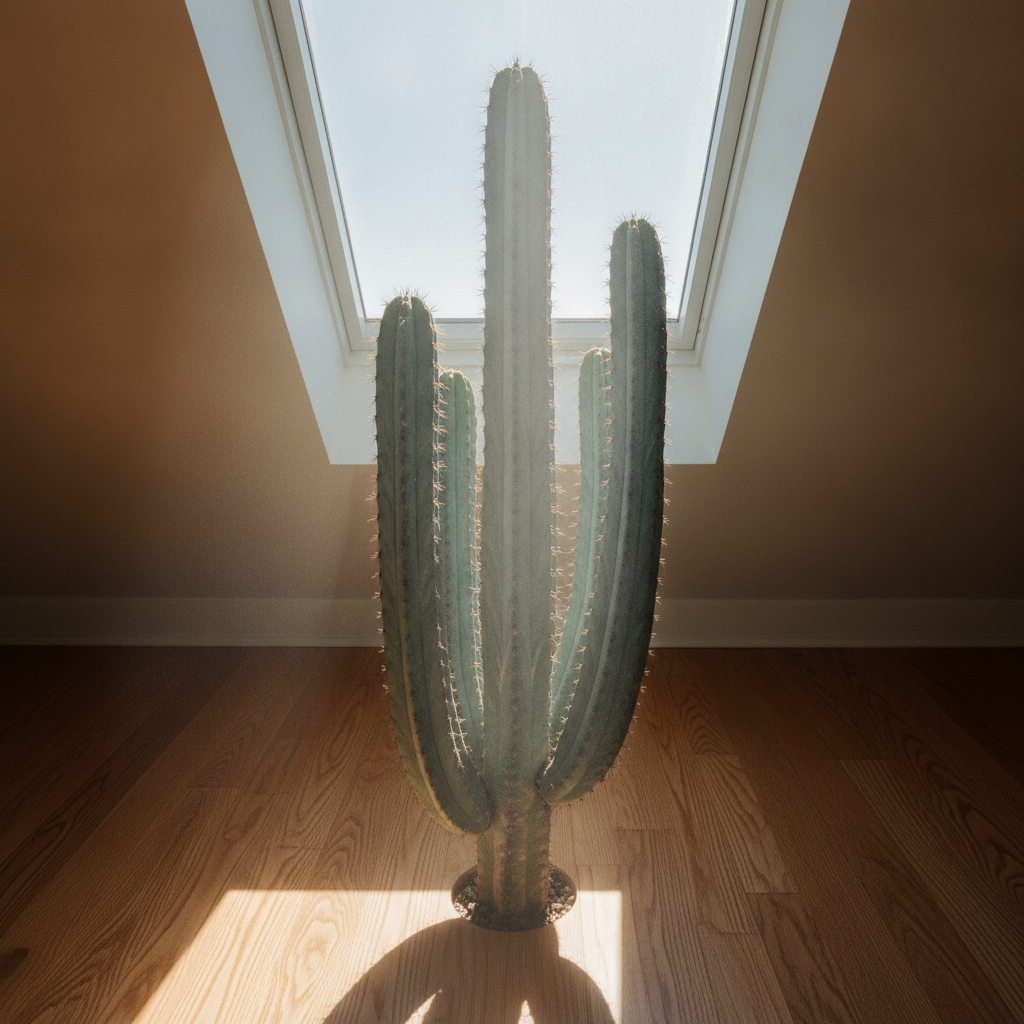
Light Levels Explained
Indoor light falls off far faster than our eyes suggest, so it helps to think in rough categories. The table below maps common light levels to typical locations and the result you can expect from a blue myrtle cactus in each.
| Light Category | Approx. Level | Typical Location | Outcome |
|---|---|---|---|
| Full sun | 50,000 lux and above | Outdoors or against unobstructed south glass | Best colour, compact growth, possible flowering |
| Bright direct | 20,000 to 50,000 lux | On a south or west windowsill | Strong, healthy growth and good blue bloom |
| Bright indirect | 10,000 to 20,000 lux | Near, but not on, a bright window | Slow growth, colour begins to thin |
| Medium | 2,000 to 10,000 lux | A few metres back from a window | Etiolation likely, weak and pale stems |
| Low | Below 2,000 lux | Interior wall or north corner | Decline and stretching; unsuitable long term |
Window Orientation and Placement
South-facing window: In the northern hemisphere this is the prime spot for a blue myrtle cactus. The long hours of direct light keep the plant compact and deepen the blue bloom, and it is the position most likely to encourage flowering on a mature specimen.
East-facing window: Gentle morning sun followed by bright light is a good, safe option, especially for a plant that has not yet been hardened to intense midday rays. Growth may be slightly slower than at a south window, but the risk of scorch is lower.
West-facing window: Strong afternoon sun makes a west aspect almost as good as a south one. Watch for heat build-up behind glass on hot afternoons, particularly if the plant sits in a sun trap with little air movement.
North-facing window: A north aspect rarely supplies enough light for this species. A plant kept here will stretch and pale within a season, so reserve north windows for shade-tolerant foliage and give the cactus a brighter home or a grow light.
Pro Tip — Rotate for Even Growth: A blue myrtle leans and grows towards its light source, so give the pot a quarter turn every week or two. This keeps the columns straight and upright rather than bending towards the glass, which matters a great deal for a plant whose whole charm is its symmetry.
How Light Affects Colour
The blue bloom is, in effect, sunscreen. The plant lays down more of its protective waxy coating when it is exposed to strong light, which is why well-lit specimens are a deeper, more silvered blue while shade-grown plants drift towards a flat green. Good light also keeps the ribs tight and the spines close together, producing the dense, geometric look the species is named for. If your cactus has paled and stretched, increasing the light gradually will restore colour to new growth, though the etiolated sections that already formed will not green back up or shrink.
Warning — Direct Sunlight: Although the blue myrtle loves sun, a plant grown indoors over winter can scorch if moved abruptly into full summer sun. Sudden exposure causes pale, bleached or brown patches that never recover. Acclimatise over two to three weeks, starting with an hour of morning sun and building up, before leaving it in all-day sun.
Artificial Lighting
If no window in your home is bright enough, a full-spectrum LED grow light is a reliable substitute. Position a reasonably powerful fixture 20 to 40 centimetres (8 to 16 inches) above the plant and run it for 12 to 14 hours a day to mimic the long, intense days this cactus expects. Grow lights are also useful through a dim northern winter, supplementing weak natural light to prevent the seasonal stretching that otherwise spoils the plant’s form.
Seasonal Adjustments
Light changes with the seasons, and so should the plant’s position. In summer, move it to your brightest spot or outdoors after acclimatising. As autumn light weakens, shift it as close to the glass as possible, and clean both the window and the cactus so no light is wasted. A blue myrtle in a genuine winter rest, cool and barely watered, tolerates lower light without stretching, but a plant kept warm and growing indoors over winter needs all the light it can get or it will etiolate badly by spring.
Watering & Humidity
If light is what makes a blue myrtle cactus thrive, watering is what most often kills it. Like nearly all cacti it stores water in its thick, ribbed stems and is built to endure long droughts, so the danger is almost always too much water rather than too little. The guiding principle is simple: soak the mix thoroughly, then wait until it is bone dry before watering again. Master that rhythm and the rest of its care is straightforward.
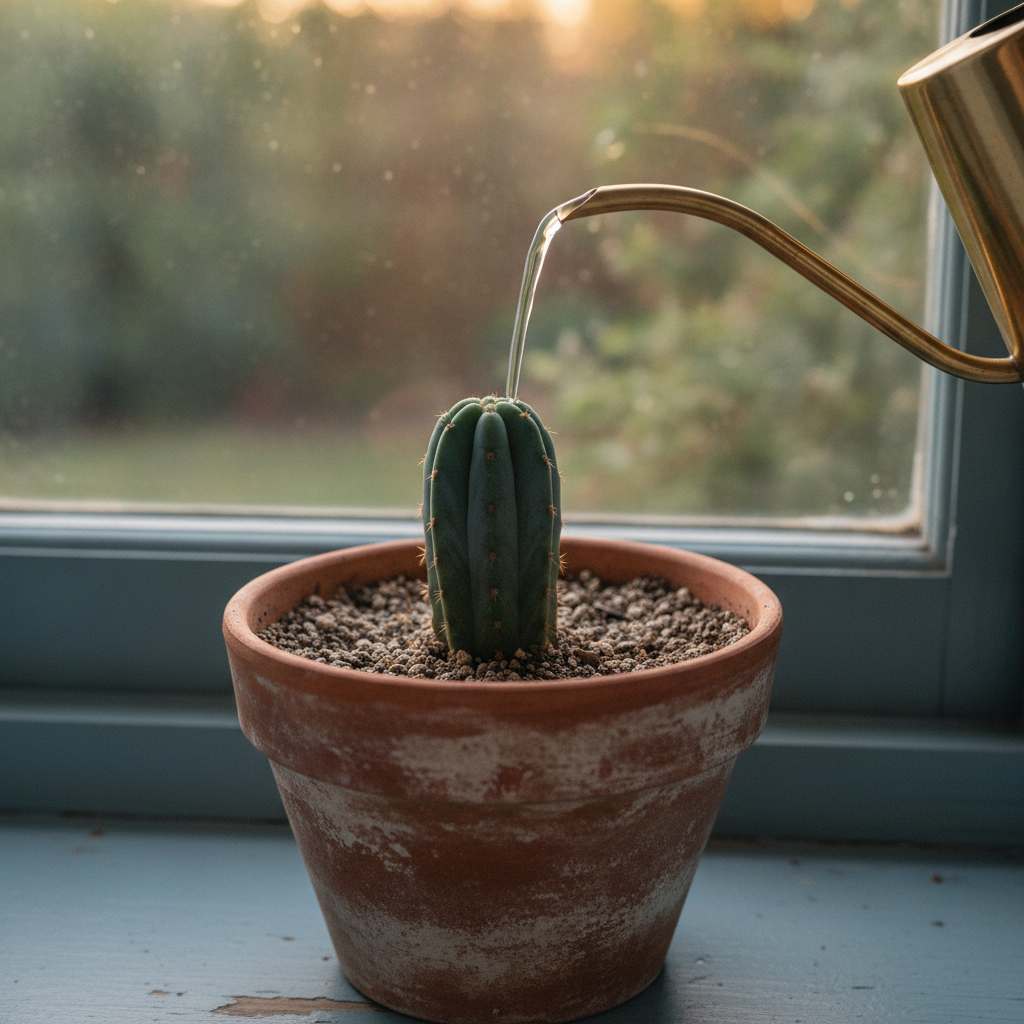
When to Water
Rather than watering on a fixed schedule, water according to how dry the mix is. In the growing season from spring to early autumn, this usually works out at roughly every 10 to 14 days, but pot size, light, warmth and your particular mix all shift that figure. The most reliable test is to push a finger or a wooden skewer right to the bottom of the pot: if it comes out clean and dry, it is time to water, and if any damp soil clings to it, wait a few more days.
In winter the picture changes completely. A blue myrtle kept cool, at around 8 to 12°C (46 to 54°F), should be watered very little, perhaps once a month or even less, to let it enter the dormant rest that hardens it and encourages spring flowering. A plant kept warm indoors over winter will need slightly more, but always err on the dry side during the short, dim days when the cactus is barely growing and cannot use the moisture.
Pro Tip — The Soak and Dry Method: When you do water, water properly. Drench the mix until water runs freely from the drainage holes, which wets the entire root ball and flushes out built-up salts. Then do not water again until everything has dried out. Frequent shallow sips encourage weak surface roots and invite rot, whereas a thorough soak followed by a full dry-out mirrors the desert downpours this plant evolved with.
How to Water Correctly
- Check that the mix is completely dry all the way to the bottom of the pot before you begin.
- Water at the soil surface, taking care to keep water off the body of the cactus where it can pool in the ribs.
- Continue until water flows freely from the drainage holes, ensuring the whole root ball is moistened.
- Let the pot drain fully and never leave it standing in a saucer of water.
- Tip away any water that collects in the saucer or outer cachepot within a few minutes.
- Wait until the mix is bone dry again before the next watering, however long that takes.
Signs of Overwatering vs. Underwatering
| Symptom | Overwatering | Underwatering |
|---|---|---|
| Stem colour | Yellowing, browning or blackening, often from the base up | Dull, slightly faded blue-green |
| Stem texture | Soft, mushy, translucent or weeping | Wrinkled, shrunken and ribbed more deeply than usual |
| Soil | Stays wet for many days, may smell sour | Bone dry and pulling away from the pot sides |
| Roots | Brown, black, slimy and foul-smelling | Dry and intact but sparse |
| Stem base | Soft, dark, collapsing rot at soil level | Firm but progressively more shrivelled |
Warning — Root Rot: A soft, darkening base is the most dangerous sign on any cactus, because once rot reaches the core the plant is usually lost. If you catch it early, cut well above the affected tissue with a clean blade, let the healthy cutting callus for a week or more, and re-root it in dry, gritty mix. Treat the original soggy mix and pot as the cause and do not reuse them.
Humidity Requirements
Humidity is refreshingly simple for this species. As a plant of arid Mexican scrub, the blue myrtle is perfectly happy in the dry air that troubles tropical houseplants, and ordinary household humidity of 30 to 50% suits it well. There is no need to mist it, group it with other plants for moisture, or run a humidifier nearby.
In fact, the bigger risk runs the other way. Persistently humid, stagnant air encourages fungal problems and slows the drying of the mix, both of which work against a desert cactus. Symptoms of an overly damp environment include mould on the soil surface and soft patches on the stem rather than any sign of thirst.
If anything, aim to improve air circulation rather than humidity. A gently moving, well-ventilated room helps the surface of the mix dry quickly and keeps fungal spores from settling, which is exactly the kind of breezy, open environment this cactus prefers.
Water Quality
The blue myrtle is not especially fussy about water quality, and most tap water is fine. Where water is very hard, mineral salts can build up over time and leave pale crusty deposits on the soil and pot, so an occasional thorough flush, or the use of collected rainwater, keeps the root zone clean. Allow cold tap water to reach room temperature before using it, as an icy drench is an unnecessary shock to a warm-loving plant.
Soil, Potting & Repotting
The right soil is the second half of the watering equation. No matter how careful you are with the watering can, a blue myrtle cactus planted in dense, moisture-retentive potting compost will sit wet for too long and eventually rot. What it needs is a fast-draining, mineral-heavy mix that holds a little moisture but lets the rest run straight through, so the roots get a quick drink and then dry out again.
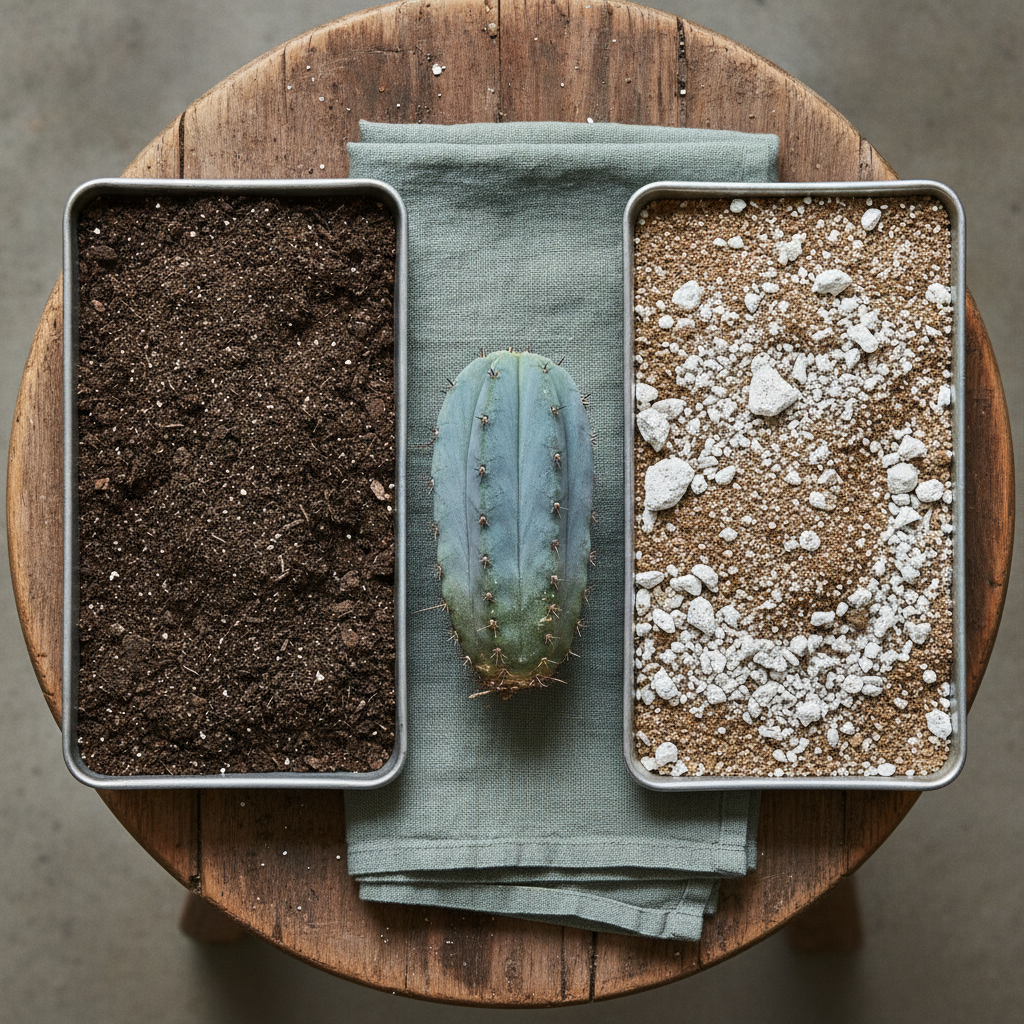
Ideal Soil Composition
A good blue myrtle mix is roughly half mineral grit and half organic matter, leaning grittier rather than richer. Ordinary cactus and succulent compost from the garden centre is a reasonable starting point, but most bagged mixes hold too much moisture on their own and benefit from extra pumice, perlite or coarse grit to open them up. The aim is a mix that feels sharp and crumbly rather than soft and spongy, and that you could not compact into a ball in your hand.
| Component | Proportion | Function |
|---|---|---|
| Pumice or perlite | About one third | Creates air pockets and rapid drainage around the roots |
| Coarse grit or sharp sand | About one sixth | Adds weight and mineral structure to prevent compaction |
| Potting compost or coco coir | About one third | Holds a little moisture and the modest nutrients the plant needs |
| Cactus and succulent base mix | About one sixth | Provides a balanced, ready-made foundation |
The blue myrtle prefers a slightly acidic to neutral root zone, somewhere around pH 6.0 to 7.0, which most standard mixes already provide. There is no need to chase a precise figure; a free-draining mineral mix in that broad range keeps the plant perfectly content.
Pro Tip — Quick Mix Recipe: For a no-fuss blend, combine two parts bagged cactus compost with one part pumice and one part coarse perlite, then add a generous handful of horticultural grit. This stretches a shop-bought mix into something far better drained, at a fraction of the cost of buying a premium cactus soil outright.
Choosing the Right Pot
The pot matters almost as much as the mix, because it governs how quickly the root zone dries and how stable a tall, top-heavy cactus stays as it grows.
Drainage holes are non-negotiable. A blue myrtle should never sit in a pot without drainage, however attractive the container. Without a clear exit for excess water, the mix stays saturated at the base and rot follows. If you love a particular decorative cachepot, plant into a plain nursery pot with holes and slip that inside.
Pot material: Terracotta is the natural partner for this cactus. Its porous walls wick moisture out of the mix and let it dry faster, which suits a plant that hates wet feet, and its weight helps anchor a tall specimen. Glazed ceramic and plastic both hold moisture longer, so if you use them, lean your mix even grittier to compensate.
Pot size: Choose a pot only slightly larger than the root ball. An oversized pot holds a large reservoir of damp mix that the modest roots cannot use, which keeps moisture around them for far too long. A snug pot dries evenly and quickly, which is exactly what a blue myrtle wants.
When to Repot
This is a slow to moderate grower, so it needs repotting only every two to three years, or when the roots clearly fill the pot and growth has stalled. The best time is spring, at the start of the growing season, when the plant can recover quickly and put out new roots. Let the mix dry out before you start, repot into barely moist soil, and then wait about a week before watering so any roots nicked in the process can callus rather than rot.
How to Repot: Step-by-Step
- Wait until the mix is dry, then protect your hands with folded newspaper, a thick towel or heavy gloves before handling the spiny stems.
- Ease the plant out by tipping the pot and supporting the base, rather than pulling on the columns.
- Gently tease away the old mix from the roots and inspect them, trimming any that are brown, black or mushy with a clean blade.
- Add a layer of fresh gritty mix to the base of a clean pot only slightly larger than the last.
- Set the cactus at the same depth it grew before and fill around the roots with mix, firming lightly so it stands upright.
- Leave the plant dry and out of intense sun for about a week, then resume normal watering.
Warning — Transplant Shock: Watering immediately after repotting is the classic mistake. Freshly disturbed roots almost always have small tears, and these open wounds rot easily in damp soil. Keep the plant dry for a week to ten days after repotting so the roots can heal, then water as usual.
Fertilising
The blue myrtle cactus is a light feeder that grows in lean, mineral soils in the wild, so its fertiliser needs are modest. A little feeding through the growing season supports steady growth and good colour, but it is far better to under-feed than to over-feed this plant.
Too much fertiliser, especially anything high in nitrogen, pushes soft, swollen, weakly coloured growth that is prone to splitting and far more attractive to pests. The goal is gentle, balanced nourishment that keeps the plant ticking over rather than forcing it to bulk up unnaturally.
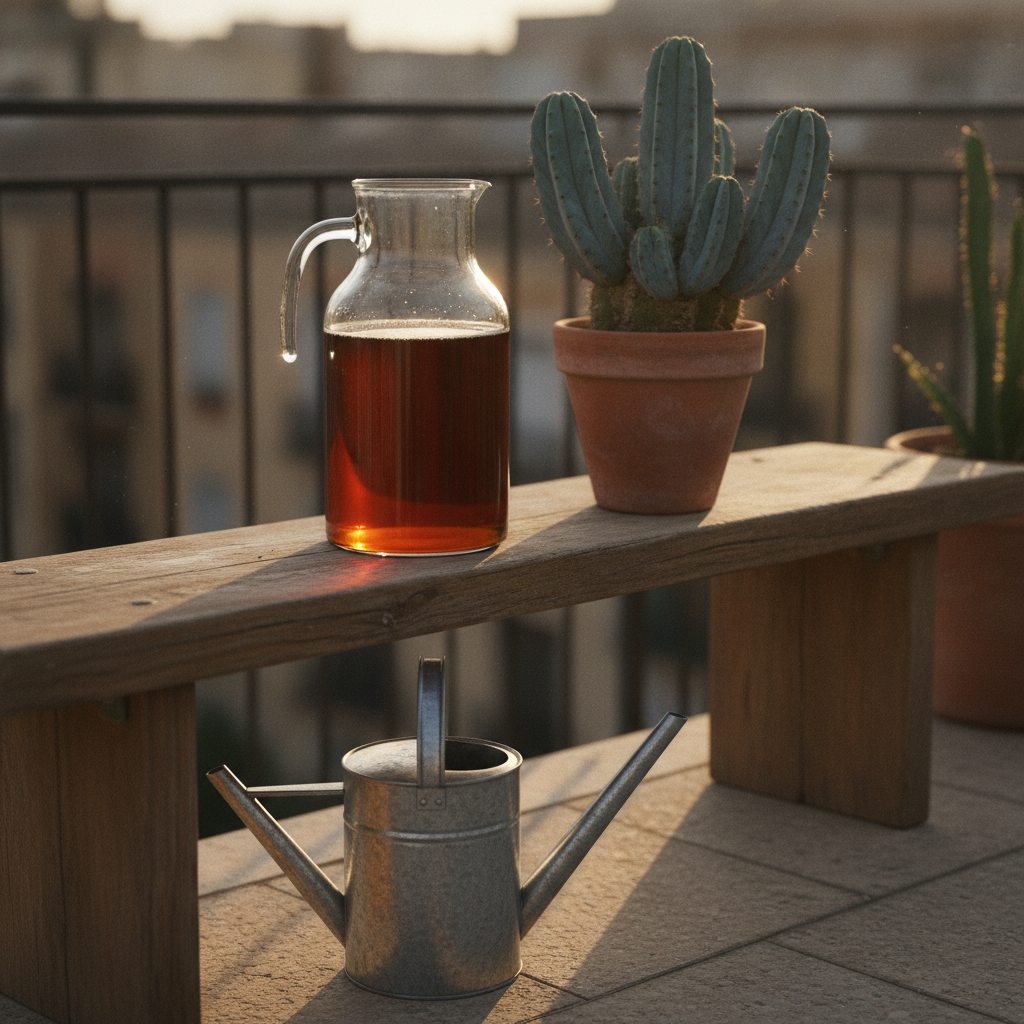
Understanding Plant Nutrients
Fertilisers are labelled with an NPK ratio showing the proportions of nitrogen, phosphorus and potassium. For cacti, a feed relatively low in nitrogen and higher in potassium suits the plant’s slow, firm growth, which is why specialist cactus fertilisers are formulated differently from the leafy houseplant feeds that push lush foliage. The table below outlines the main nutrients and what their shortage looks like.
| Nutrient | Symbol | Primary Function | Deficiency Symptoms |
|---|---|---|---|
| Nitrogen | N | Drives stem growth and overall vigour | Pale colour and stalled, stunted growth |
| Phosphorus | P | Supports roots, flowering and fruiting | Poor rooting and reluctance to flower |
| Potassium | K | Builds firm tissue and stress tolerance | Soft growth and weak, susceptible stems |
| Calcium | Ca | Strengthens cell walls and new growth | Distorted or collapsing growing tips |
| Magnesium | Mg | Central to chlorophyll and colour | Yellowing on older stem tissue |
| Iron | Fe | Aids chlorophyll formation | Pale or yellowing newest growth |
Types of Fertiliser
Liquid fertilisers: A diluted liquid cactus feed is the easiest and most controllable option. Mixed into your watering can at half the recommended strength, it delivers a gentle dose during a normal watering and lets you stop instantly outside the growing season.
Slow-release granular: Slow-release prills worked lightly into the top of the mix in spring feed the plant gradually over several months. They are convenient, but harder to fine-tune, so use a sparing amount given how little this cactus needs.
Organic fertilisers: Gentle organic options such as well-diluted worm-casting tea release nutrients slowly and are very forgiving, with little risk of scorching the roots. They suit growers who prefer to avoid synthetic feeds, though their nutrient content is low and less precisely defined.
Feeding Schedule
Feed only during the active growing season, from mid-spring to early autumn. A single application of half-strength cactus feed once a month across those warmer months is plenty. From autumn through winter, stop feeding entirely so the plant can take its proper rest; fertilising a dormant cactus simply leaves unused salts to accumulate in the mix.
Pro Tip — Half Strength is Plenty: Always dilute cactus fertiliser to half the strength stated on the bottle. A blue myrtle responds far better to a weak, regular feed than to an occasional strong one, and the diluted approach all but removes the risk of fertiliser burn on the sensitive roots.
How to Fertilise
- Confirm the plant is in active growth during the spring to early autumn window.
- Dilute a low-nitrogen cactus fertiliser to half the recommended strength in your watering can.
- Water with plain water first if the mix is completely dry, so the feed never hits parched roots.
- Apply the diluted feed to the soil, keeping it off the body of the cactus.
- Resume normal soak-and-dry watering and do not feed again until the following month.
Warning — Salt Build-Up: Over time, fertiliser salts accumulate in the mix and show up as a white crust on the soil and pot rim. Too much can scorch the roots and brown the stem base. Flush the pot thoroughly with plain water two or three times a year, letting it run freely from the drainage holes, to wash these salts away.
Propagation
One of the quiet pleasures of the blue myrtle cactus is how easily it multiplies. Because it branches so freely, a mature plant offers a ready supply of cutting material, and each removed branch can become a new plant in its own right. This is the same vigour that makes the species such a popular grafting stock, and it makes home propagation refreshingly reliable.
The two practical routes for the home grower are stem cuttings, which are fast and near-foolproof, and seed, which is slower but rewarding if you want to raise a batch. Cuttings are by far the most common method and the one to start with.
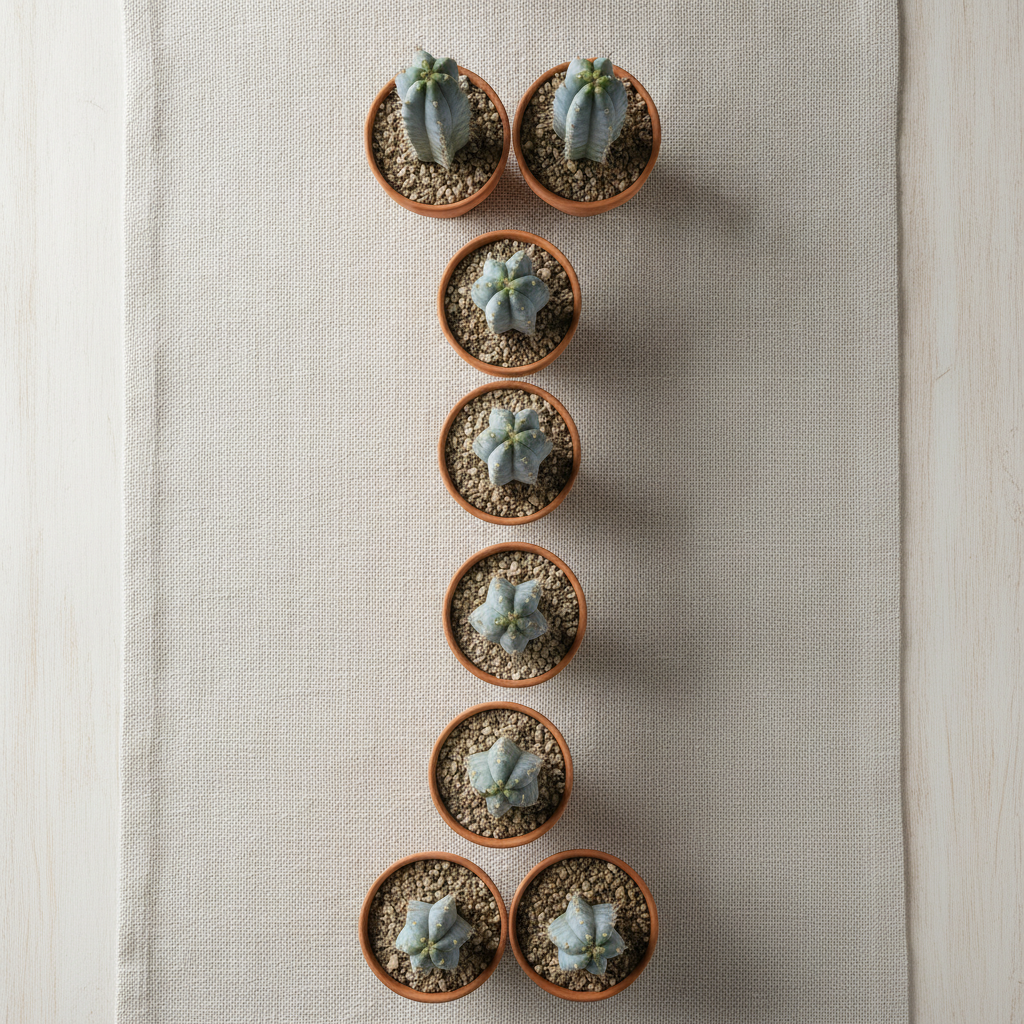
Understanding Branches and Offsets
As a blue myrtle matures it sends out side branches from its main columns, and these lateral arms are the ideal source of cuttings. A removed branch contains everything it needs to grow roots from its cut base, provided that base is allowed to dry and seal first. Unlike many leafy houseplants, this cactus is never propagated in water, because the constant moisture causes the cut surface to rot before it can root. The whole technique hinges instead on a dry callus and a dry start.
Stem Cuttings: Step-by-Step
Take cuttings in the warmth of spring or summer, when the plant roots fastest. The single most important step is patience with the callusing stage.
- Using a clean, sharp knife, cut a healthy side branch cleanly away from the main stem, protecting your hands from the spines.
- Set the cutting aside in a dry, shaded, airy spot for one to two weeks until the cut end forms a hard, dry callus.
- Fill a small pot with dry, gritty cactus mix and insert the callused base just deep enough for the cutting to stand upright.
- Leave it completely dry for a few days, then begin watering very sparingly to encourage roots to reach for moisture.
- Keep the pot warm and brightly lit but out of scorching direct sun while it establishes.
- After a few weeks, a gentle tug that meets resistance shows roots have formed, at which point you can water and treat it as a young plant.
Pro Tip — Let It Callus Properly: The temptation is to pot a fresh cutting straight away, but a moist cut surface is the express route to rot. Give the wound a full week or two to dry into a firm callus before it ever touches soil. A larger cut may need even longer. This single habit is the difference between cuttings that root and cuttings that turn to mush.
Growing From Seed: Step-by-Step
Seed is the slower path, suited to growers who enjoy raising plants from scratch or who have access to fresh seed from the garambullo berries. Expect patience, as seedlings take a long time to reach any size.
- Sow fresh seed thinly on the surface of a moist, sterile, gritty seed mix, barely covering it.
- Cover the tray with a clear lid or bag to hold humidity, and keep it warm at around 21 to 27°C (70 to 81°F).
- Place it in bright, indirect light and keep the surface lightly moist but never waterlogged.
- Watch for tiny green seedlings over the following weeks, ventilating gradually once they appear to harden them off.
- Prick out and pot on the seedlings into individual small pots once they are large and firm enough to handle.
Troubleshooting Propagation
| Problem | Likely Cause | Solution |
|---|---|---|
| Cutting rots at the base | Potted before callusing or kept too wet | Always callus for one to two weeks and start in dry mix |
| Cutting shrivels badly | Taking too long to root with no moisture at all | Begin very light watering once the callus has formed |
| No roots after many weeks | Too cold or too dark to trigger rooting | Move somewhere warmer and brighter and be patient |
| Seeds fail to germinate | Old seed, or a surface that dried out | Use fresh seed and keep the medium consistently moist and warm |
Pests & Diseases
A healthy blue myrtle cactus grown in good light and a dry mix is remarkably resistant to trouble. Most problems that do appear are linked to overwatering and poor air circulation rather than to bad luck, which means that getting the basics right is also your best pest and disease defence.
That said, a few pests find their way onto even well-kept cacti, and the slow-drying conditions of a damp pot invite fungal rots. Catching either early, while the plant is still firm and well coloured, makes treatment straightforward.
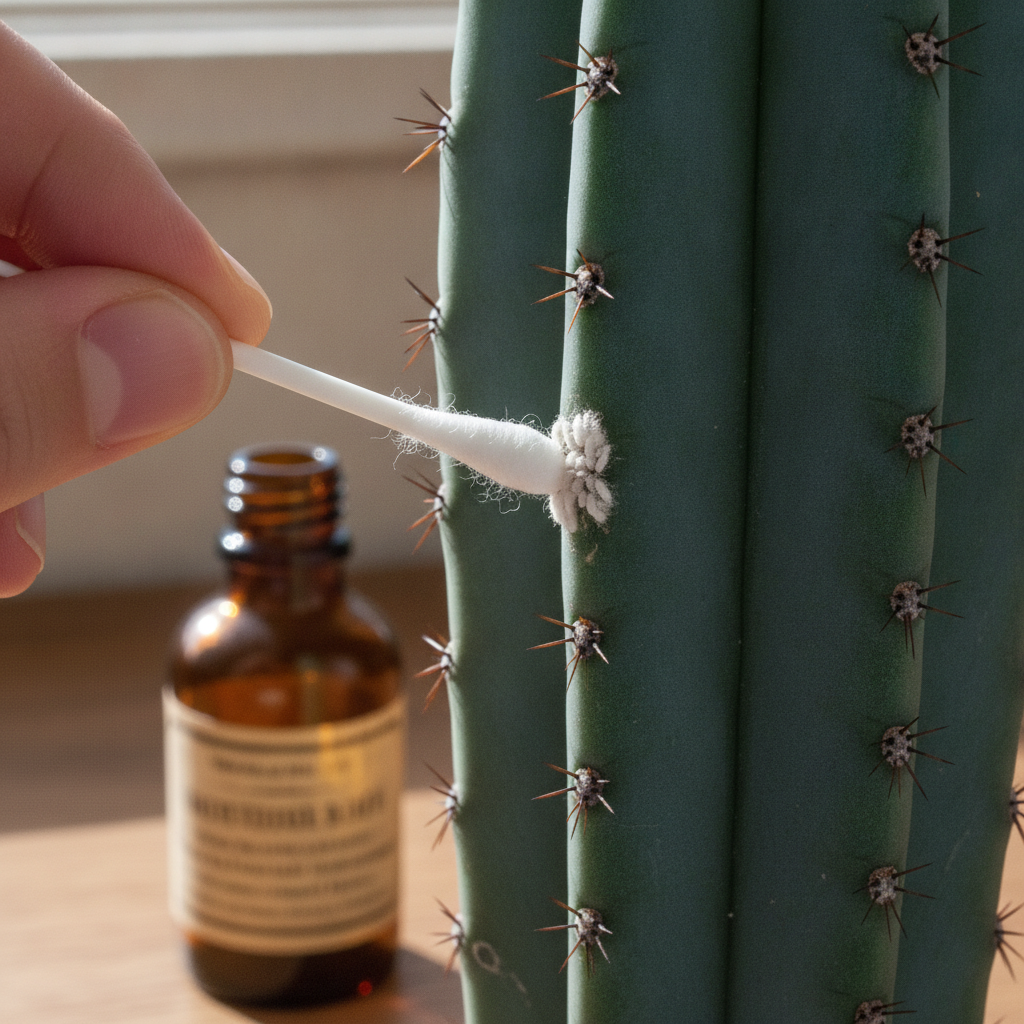
Common Pests
Mealybugs (Pseudococcus species)
Mealybugs are the classic cactus pest, appearing as small, soft, white, cottony tufts tucked into the rib crevices and around the areoles where the spines emerge. They suck sap and weaken the plant, leaving sticky honeydew that can turn into sooty mould.
Treatment: Dab each insect directly with a cotton bud dipped in isopropyl alcohol, which kills it on contact and lifts it free. For heavier infestations, follow up with a horticultural soap or systemic treatment, and check the roots, as a related root mealybug can colonise the soil unseen.
Spider Mites (Tetranychus urticae)
Spider mites thrive in hot, dry, still air and are almost too small to see, betraying themselves through fine webbing and pale, rusty stippling on the stem surface, often near the growing tips. Heavy attacks scar the skin permanently.
Treatment: Rinse the plant under a firm spray of water to dislodge the mites, then treat with a miticide or neem oil, repeating every week or two to break the breeding cycle. Better air movement around the plant discourages them from returning.
Scale Insects (Diaspididae family)
Scale insects look like small, hard, brown or tan bumps fixed to the stem, often along the ribs. Under their protective shells they feed on sap and, like mealybugs, excrete honeydew that fuels sooty mould.
Treatment: Scrape or rub them off gently with a fingernail or a cloth dipped in alcohol, taking care not to damage the skin. Persistent populations respond to a systemic insecticide, and isolating the plant prevents the crawlers spreading to neighbours.
Common Diseases
Root and Stem Rot (Phytophthora and Fusarium species)
By far the most serious threat, rot sets in when the roots or stem base stay wet for too long. It shows as soft, darkening, mushy tissue, usually creeping up from the base, and once it reaches the core the plant collapses.
Treatment: Act fast. Cut well above the affected area into clean, firm tissue, let the healthy top callus, and re-root it as a cutting. Improve drainage, water far less, and discard the rotted base and its sodden mix entirely.
Corky Scab and Fungal Spots (various fungi)
Rough, tan, corky patches or sunken brown spots can develop on the stem, caused by a mix of fungal infection, scarring and the stress of cold, damp conditions. The blemishes are permanent but usually superficial rather than fatal.
Treatment: There is no cure for tissue already marked, so the focus is prevention. Keep the plant warm, dry and well ventilated, avoid splashing water on the body, and remove badly affected sections if a spreading fungus is suspected.
Pest and Disease Summary
| Pest / Disease | Identification | Treatment |
|---|---|---|
| Mealybugs | White cottony tufts in rib crevices and areoles | Alcohol on a cotton bud, then horticultural soap |
| Spider mites | Fine webbing and rusty stippling near the tips | Water rinse, neem oil or miticide, better airflow |
| Scale | Hard brown bumps fixed along the ribs | Scrape off, treat with systemic insecticide |
| Root and stem rot | Soft, dark, mushy tissue from the base up | Cut to clean tissue and re-root; correct watering |
| Corky scab | Rough tan patches or sunken brown spots | Prevent with warmth, dryness and ventilation |
Prevention Strategies
Prevention with this cactus is mostly a matter of good husbandry. Bright light, a sharply drained mix, careful watering and decent air movement together create conditions in which pests struggle to establish and fungal rots cannot take hold. A plant grown well is a plant that rarely needs rescuing.
It also pays to inspect regularly. Look into the rib crevices and around the areoles every couple of weeks, and quarantine any new plant for a few weeks before letting it join your collection, since shop-bought cacti are a common way that mealybugs and scale arrive in the first place.
Pro Tip — Catch It Early: A small magnifier turns a routine glance into a real inspection. Most infestations are trivial to clear when caught as a handful of insects and a nightmare once they have spread across a branching plant, so a minute spent looking closely every couple of weeks is the best pest control there is.
Popular Varieties
Part of the fun of Myrtillocactus geometrizans is that the species has thrown up a small family of curious mutated forms, alongside a couple of close relatives sold under similar names. The straight species, with its tidy candelabra of ribbed blue columns, remains the most widely grown, but the crested and monstrose oddities have a devoted following all their own.
These forms differ mainly in how the growing point behaves, which produces dramatically different silhouettes from the same blue-green skin. Their care is essentially identical to the species, though the densely folded crested and monstrose types need especially sharp drainage and good airflow because water lingers in their crevices.
| Variety | Appearance | Light Needs | Growth Rate | Availability |
|---|---|---|---|---|
| Species form | Geometric blue-green columns with 5 to 6 ribs | Full sun to bright | Slow to moderate | Common |
| Forma cristata | Undulating, brain-like crested fans | Bright, some shade from harsh sun | Slow | Specialist |
| ‘Fukurokuryuzinboku’ | Lumpy, smooth, near-spineless mounds | Bright to full sun | Slow | Specialist |
| Forma monstrose | Irregular, knobbly, disordered columns | Bright to full sun | Slow | Specialist |
| Variegated form | Blue stems streaked with cream or yellow | Bright but not scorching | Very slow | Rare |
| Myrtillocactus cochal | Related species, shrubbier and more tree-like | Full sun | Moderate | Uncommon |
Featured Varieties
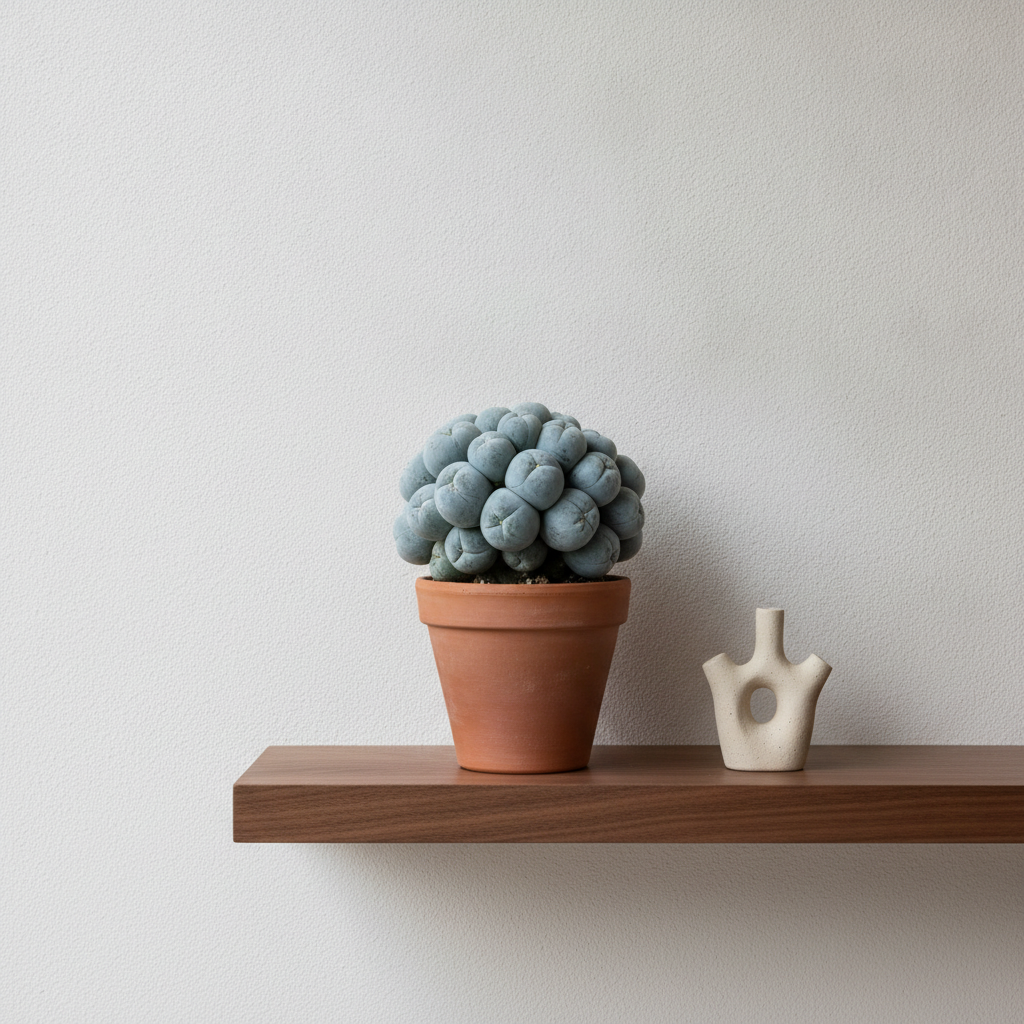
‘Fukurokuryuzinboku’
A monstrose mutation, fondly nicknamed the booby cactus, in which the ribs dissolve into clusters of smooth, rounded, almost spineless protrusions in powdery blue-green. Slow and sculptural, it is one of the most sought-after collector forms of the species.
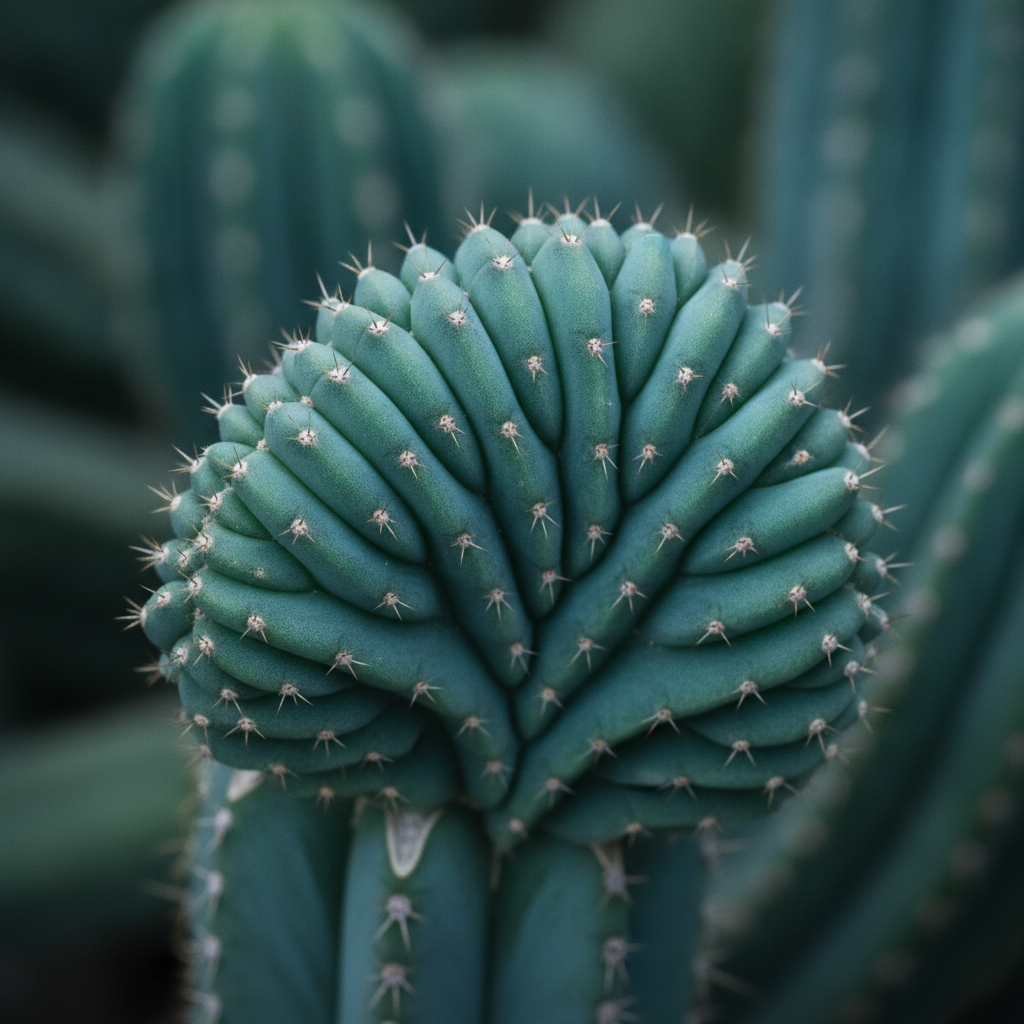
Crested (forma cristata)
The crested form fans its growing point into undulating, brain-like waves of ribbed blue-green tissue. No two crests grow alike, which makes each plant a unique specimen and a centrepiece in any cactus collection, though it demands the sharpest drainage of all.
Variety Profiles in Detail
Species Form (Myrtillocactus geometrizans)
The plant most people picture: upright, geometric columns of glaucous blue-green, each with five or six clean ribs edged with short dark spines, branching into a candelabra with age. It is the easiest to grow, the fastest of a slow genus, and the form that most reliably produces flowers and the edible garambullo berries.
Variegated Form (Myrtillocactus geometrizans f. variegata)
A prized rarity in which the blue stems are streaked and marbled with cream or yellow where the tissue lacks chlorophyll. The reduced pigment makes it slower and a little more delicate, needing bright but not scorching light to keep the pale sections from burning while the green parts feed the plant.
Choosing the Right Variety for Your Space
For a first blue myrtle, or for anyone wanting an architectural plant that grows reliably and may one day flower, the straightforward species form is the obvious choice. If you are drawn instead to the strange and the collectible, the crested and monstrose forms deliver sculptural drama, but they reward a grower who can offer very sharp drainage, strong light and patience with their slow pace. Whichever you pick, the underlying care is the same blue-myrtle recipe of sun, grit and restraint.
Frequently Asked Questions
Why is my blue myrtle cactus turning green instead of blue?
The blue bloom is a waxy sunscreen the plant produces in response to strong light, so a shift towards flat green almost always means it is not getting enough sun. Move it to your brightest window or add a grow light, and new growth will come in bluer, though the already-green sections will not change back.
How often should I water a blue myrtle cactus?
Water only when the mix has dried out completely, which tends to be every 10 to 14 days in summer and as little as once a month or less in winter. Always judge by the dryness of the soil rather than the calendar, since pot size, light and warmth all change how fast it dries.
Is the blue myrtle cactus safe for cats and dogs?
Yes, the plant is not considered toxic to cats, dogs or people, and its ripe fruits are eaten as food. The genuine risk is physical rather than chemical: the spines can injure a curious pet or child, so place the plant somewhere it cannot easily be brushed against or knocked over.
Why is the base of my cactus turning soft and brown?
A soft, dark, mushy base is the hallmark of root or stem rot, caused by too much water or a mix that drains too slowly. Cut the plant back to clean, firm tissue, let the healthy top callus for a week or more, and re-root it as a cutting in dry gritty mix, while correcting the watering that caused the problem.
How big does a blue myrtle cactus get indoors?
In the wild it can reach 4 to 5 metres (13 to 16 feet), but as a potted houseplant it grows slowly and usually stays between 0.3 and 1.5 metres (1 to 5 feet) for many years. Pot size and pruning let you keep it to a comfortable scale, and removed branches make easy cuttings.
Why is my cactus stretching and thin at the top?
Thin, pale, elongated growth, known as etiolation, is a clear signal of too little light. The plant is stretching towards whatever weak light it can find. The stretched portion is permanent, but moving the cactus into much brighter light, gradually to avoid scorch, will return new growth to its proper compact, blue form.
Does the blue myrtle cactus flower indoors?
It can, though flowering needs a mature plant, abundant light and ideally a cool, dry winter rest to trigger it. When it does bloom in spring, it produces small, fragrant, greenish-white flowers, sometimes followed by the sweet purple garambullo berries. Most indoor plants are grown for their form, with flowers as a welcome bonus.
Why is the blue myrtle so often used for grafting?
Its vigour, fast rooting and tolerant constitution make it an excellent rootstock, which is why slower or chlorophyll-deficient cacti, including the colourful moon cactus, are frequently grafted onto a blue myrtle base. The same toughness that makes it a reliable host also makes it such a forgiving plant for the beginner to grow.






