
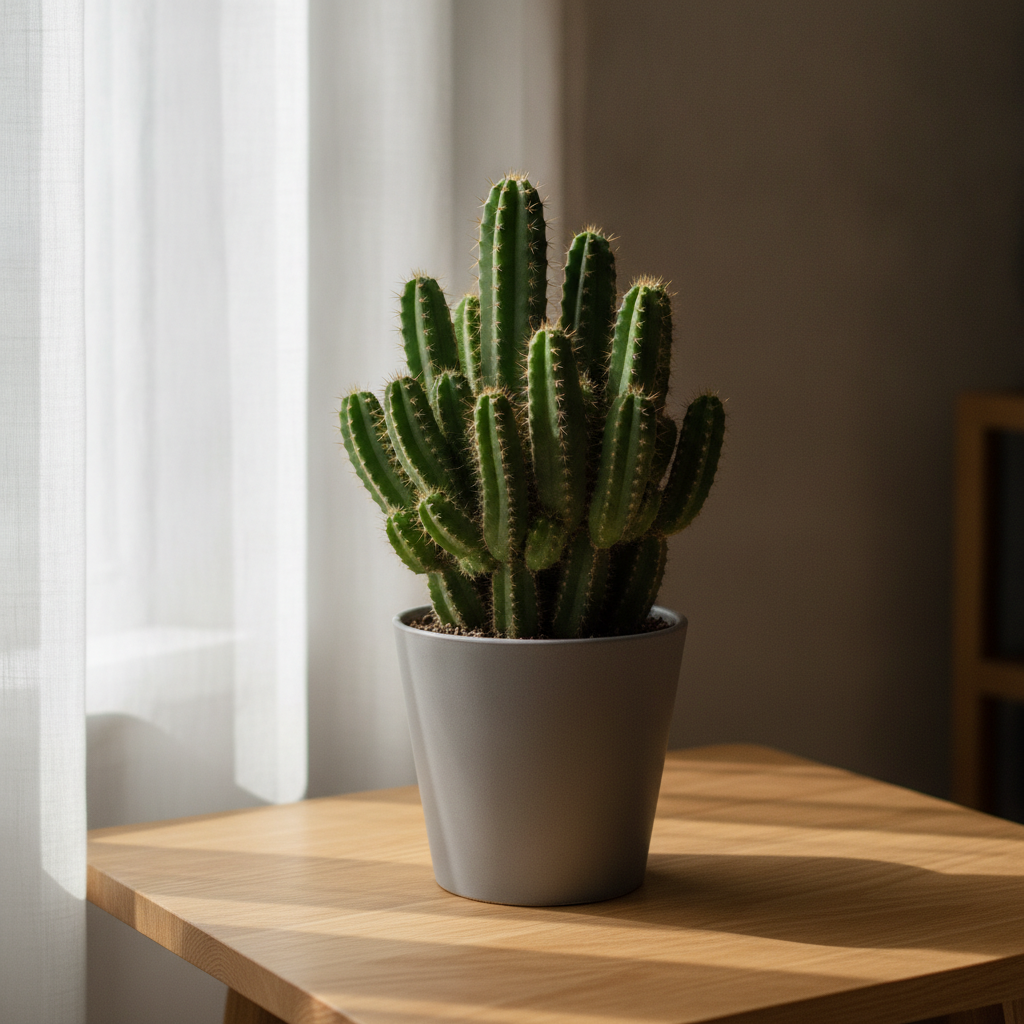
Few houseplants earn their name as literally as the fairy castle cactus. With its many vertical green columns rising to different heights, each one studded with woolly tufts and short pale spines, the plant really does resemble the turrets and battlements of a tiny fortress. It is a cultivated form of Acanthocereus tetragonus, a branching, ribbed cactus native to the warm lowlands stretching from the southern United States through Mexico, Central America and into northern South America and the Caribbean. In the wild the species grows into a sprawling, scrambling giant, but the compact form sold as the fairy castle cactus stays small, slow and sculptural, which is exactly why it has become a fixture on bright windowsills and desks.
As houseplants go, this is one of the most forgiving you can own, provided you understand one thing: it would always rather be too dry than too wet. The fairy castle cactus is built for neglect and undone by kindness, since the most common way to lose one is through overwatering. This guide walks through everything that separates a cactus that merely survives on a shelf from one that slowly fills out into a dense, characterful cluster of columns: how much light it really wants, how to water it without rotting the roots, the gritty soil it depends on, when and how little to feed it, how to multiply it from cuttings, and how to head off the handful of pests that bother it.
Contents
- Quick Reference
- Why Fairy Castle Cactus Makes a Great Houseplant
- Light Requirements
- Watering & Humidity
- Soil, Potting & Repotting
- Fertilising
- Propagation
- Pests & Diseases
- Popular Varieties
- Frequently Asked Questions
Quick Reference: Fairy Castle Cactus at a Glance
| Light | Bright light, including several hours of gentle direct sun; tolerates bright indirect light but grows leggy in low light |
| Watering | Only when the soil is completely dry, roughly every 2 to 3 weeks in summer and once a month or less in winter |
| Temperature | 18 to 29 degrees Celsius (64 to 84 degrees Fahrenheit); keep above 10 degrees Celsius (50 degrees Fahrenheit) |
| Humidity | Low to average household humidity; no extra moisture needed |
| Fertiliser | A dilute, low-nitrogen cactus feed once or twice across the growing season |
| Toxicity | Not known to be toxic to cats, dogs or humans, but the spines can injure curious pets and children |
Why Fairy Castle Cactus Makes a Great Houseplant
The appeal of this plant starts with its silhouette. Instead of a single stem, the fairy castle cactus produces a cluster of upright columns that branch and multiply over time, each topped off at its own height so the whole plant reads as a miniature skyline. Every column carries five distinct ribs lined with small areoles, the woolly cushions from which the short spines emerge, and the overall effect is architectural in a way that few small plants manage. It works as a sculptural single specimen and equally well grouped with other succulents and cacti.
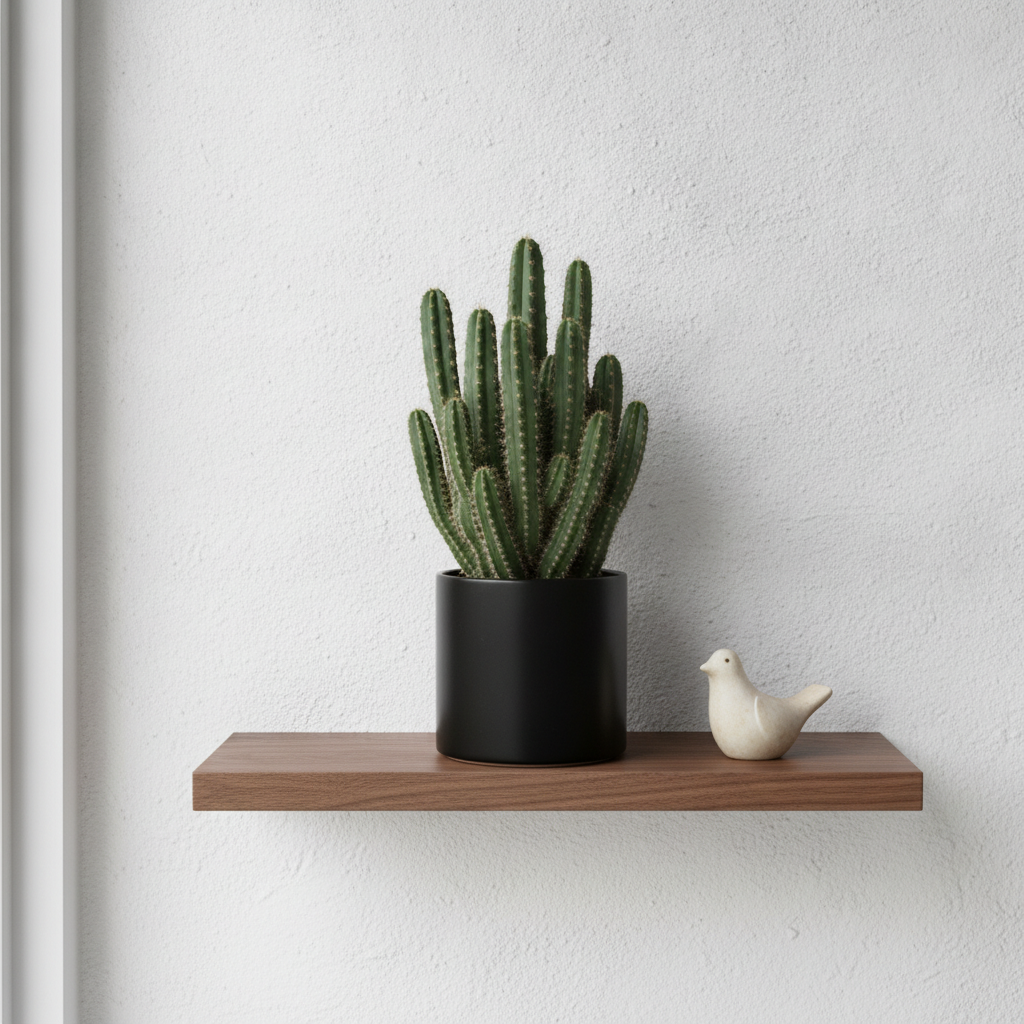
Beyond looks, it is the low-maintenance temperament that wins people over. This is a plant that genuinely prefers to be left alone, making it ideal for beginners, frequent travellers and anyone whose windowsills tend to be busy rather than fussed over. It stores water in its thick stems, shrugs off the occasional missed watering, and grows slowly enough that it rarely outgrows its spot or needs repotting more than once every few years. The trade-off for that easy nature is patience: it adds height gradually, often only a few centimetres in a season, so it is a plant to enjoy as it is rather than one to rush along.
Important — Toxicity: The fairy castle cactus is not listed as toxic to cats, dogs or people, so an accidental nibble is unlikely to poison a pet. The real hazard is physical: the spines, though short, are sharp enough to lodge in paws, noses and fingers. Place the plant where pets and small children cannot brush against it, and handle it with folded paper or gloves.
Light Requirements
Light is the single biggest factor in keeping a fairy castle cactus looking like a castle rather than a row of pale, stretched poles. As a desert-adapted plant, it wants a generous, bright position and will happily take several hours of direct sun, particularly the gentler light of morning. The brighter the spot, the more compact and richly green the columns stay, and the better the chance of seeing the plant fill out with new side branches.
The ideal placement is on or very close to a bright windowsill where the plant catches direct sun for part of the day and strong, unobstructed daylight for the rest. A south-facing or west-facing window suits it well in most homes. It will survive in merely bright indirect light, but survival and thriving are different things here: in dimmer spots the columns elongate, the spacing between areoles widens, and the plant takes on a thin, drawn-out look that never fully recovers.

Light Levels Explained
The terms used on plant labels can be vague, so it helps to translate them into rough light levels and real locations in the home. The table below sets out how a fairy castle cactus responds across the range.
| Light Category | Approx. Level | Typical Location | Outcome |
|---|---|---|---|
| Direct sun | Over 50,000 lux | On a south or west windowsill | Compact, well-coloured growth; best results once acclimatised |
| Bright indirect | 10,000 to 20,000 lux | Just back from a sunny window | Healthy but slightly slower; acceptable long term |
| Medium | 5,000 to 10,000 lux | Middle of a bright room | Noticeable stretching over months |
| Low | Under 5,000 lux | Interior wall, north corner | Etiolation, weak pale columns, decline |
| Very low | Under 1,000 lux | Hallway or windowless room | Not viable; plant fails |
Window Orientation and Placement
South-facing window: The best choice in the northern hemisphere, offering long hours of bright light and direct sun. Acclimatise the plant gradually to avoid scorching, but once settled it will be at its most compact and colourful here.
East-facing window: A reliable spot. The plant receives gentle direct sun in the morning followed by bright light all day, which suits it well with little risk of scorch.
West-facing window: Good, with strong afternoon sun that the plant generally enjoys once acclimatised. Watch for excessive heat behind glass on the hottest summer days.
North-facing window: The weakest option. There is usually not enough light to keep growth compact, and over time the plant will stretch. If a north window is all you have, plan to supplement with a grow light.
Pro Tip — Rotate for Even Growth: Cacti grow towards their light source, so a plant left in one position will lean and develop lopsided. Give the pot a quarter turn each time you water to keep the cluster of columns growing evenly upright.
How Light Affects Shape and Colour
In a fairy castle cactus, light translates directly into form. Strong light keeps the columns short, stout and a deep, even green, with the ribs well defined and the areoles closely spaced. Insufficient light produces etiolation, the technical term for the pale, stretched growth that appears when a plant reaches for a distant light source. Etiolated growth is permanent, so prevention matters far more than cure: once a column has stretched thin and pale, it stays that way, and the only real remedy is to start fresh from a healthy cutting.
Warning — Direct Sunlight: Although this cactus loves sun, a plant that has been living in a dim shop or a shaded corner can scorch badly if moved straight into intense direct sun. Sunscald shows up as bleached white or brown patches that never green up again. Always move a plant into brighter conditions over a week or two, lengthening its exposure a little each day.
Artificial Lighting
Where natural light falls short, a full-spectrum LED grow light is an effective stand-in and is often essential through the darkest winter months in higher latitudes. Position the light around 20 to 30 centimetres (8 to 12 inches) above the plant and run it for roughly 10 to 12 hours a day. Because the fairy castle cactus is slow-growing, even a modest desk grow light is usually enough to hold growth compact and prevent the winter stretch that plagues cacti kept on dim sills.
Seasonal Adjustments
Light levels indoors fall dramatically between summer and winter, and the plant’s needs shift with them. In spring and summer, move the cactus into your brightest position to fuel the active growing season. As autumn closes in and daylight shortens, the plant naturally slows almost to a halt; this is normal and healthy. Keep it in the brightest available spot through winter, and resist the temptation to compensate for slow growth with extra water, which the plant cannot use while it is dormant.
Watering & Humidity
If there is one skill that determines whether your fairy castle cactus lives a long life or a short one, it is watering. This is a true desert plant that stores moisture in its fleshy stems and is adapted to long dry spells punctuated by occasional downpours. Indoors, that translates into a simple rule: water thoroughly, then wait until the soil is bone dry before watering again. Far more of these cacti die from too much water than from too little.

When to Water
Forget any fixed schedule and judge by the soil instead. Push a finger or a wooden skewer right to the bottom of the pot; if there is any trace of moisture or cool dampness, wait. Only when the entire volume of soil has dried out should you water again. In the warmth of summer this might mean watering every two to three weeks, while in winter it can stretch to once a month or even longer.
Several factors change how fast the soil dries, including pot size and material, the grittiness of the mix, the temperature and how much light the plant receives. Rather than counting days, learn to read these cues together. A small plant in a porous terracotta pot on a hot sunny sill will dry out far quicker than a larger one in a glazed pot in a cooler room, so the same plant can need very different intervals at different times of year.
Pro Tip — The Winter Rest: From late autumn through to early spring, cut watering right back. A cactus kept cool and nearly dry over winter is far healthier than one watered on its summer routine, and a genuine cool, dry rest is what occasionally coaxes mature plants of this species towards flowering.
How to Water Correctly
- Check that the soil is completely dry all the way through before you begin.
- Water at the soil surface using a narrow-spout can, keeping water off the columns and out of the crevices between them.
- Add water steadily until it runs freely from the drainage holes, which ensures the whole root ball is moistened.
- Let the pot drain fully, and never leave it standing in a saucer of water.
- Tip away any water that collects in the saucer after a few minutes.
- Then leave the plant strictly alone until the soil is bone dry once more.
Signs of Overwatering vs. Underwatering
| Symptom | Overwatering | Underwatering |
|---|---|---|
| Stem colour | Yellowing, then translucent or brown | Dull, greyish-green |
| Stem texture | Soft, mushy, sometimes oozing | Wrinkled, shrunken, slightly puckered |
| Soil | Stays wet for days, may smell sour | Bone dry, pulling away from the pot |
| Roots | Blackened, slimy, rotting | Dry but intact and pale |
| Stem base | Browning and collapse at the soil line | Firm, simply thinner than usual |
Warning — Root Rot: Soft, brown or mushy patches, especially at the base, are the hallmark of root rot from overwatering, and it is the most common killer of this plant. Act fast: unpot the cactus, cut away all soft and discoloured tissue with a clean blade, let the cuts callus for several days, and replant the firm, healthy portion in fresh dry mix. A column that has gone soft from the inside often cannot be saved, but a healthy cutting taken from above the rot usually can.
Humidity Requirements
This is one care factor you can almost entirely ignore. The fairy castle cactus is perfectly content in the low to average humidity of a typical home and has no need for misting, pebble trays or humidifiers. In fact, damp, stagnant air does it no favours.
If anything, the risk runs the other way. High humidity combined with poor air movement encourages fungal problems and makes rot more likely, so a bathroom or a crowded, muggy corner is the wrong home for it. Good airflow around the plant is worth far more to its health than any attempt to raise humidity.
There is no need to take any active steps to increase humidity for this plant. Dry household air, even the parched conditions near a radiator in winter, suits it fine, and a position with gentle air circulation will keep the columns healthy and dry between waterings.
Water Quality
Tap water is generally fine for a fairy castle cactus, which is far less fussy about water quality than many tropical houseplants. If your tap water is very hard, mineral salts can build up over time and leave white crusting on the soil and pot, so occasional watering with rainwater or filtered water helps. Room-temperature water is gentler on the roots than cold water straight from the tap.
Soil, Potting & Repotting
The soil under a fairy castle cactus is not just a growing medium; it is the main defence against the overwatering that kills these plants. The whole strategy is to use a mix so free-draining that water rushes through and the roots dry quickly, mimicking the sandy, rocky ground of the plant’s native habitat. Ordinary houseplant compost holds far too much moisture and is a recipe for rot.

Ideal Soil Composition
A good cactus mix is roughly half organic matter and half coarse mineral grit. The organic part holds a little moisture and nutrition, while the mineral part creates the large air pockets and fast drainage the roots depend on. You can buy a ready-made cactus and succulent compost, but most are improved by stirring in extra grit such as pumice or perlite.
| Component | Proportion | Function |
|---|---|---|
| Cactus or general potting compost | Around 50 percent | Holds modest moisture and nutrients |
| Pumice or coarse perlite | Around 25 percent | Creates air pockets and lasting drainage |
| Coarse horticultural sand or grit | Around 25 percent | Adds weight and speeds drainage |
The fairy castle cactus is not particular about pH and does well in the slightly acidic to neutral range that most cactus composts naturally fall into, roughly 6.0 to 7.0. There is no need to test or adjust pH for this plant; getting the drainage right matters far more.
Pro Tip — Quick Mix Recipe: For a reliable home blend, combine two parts cactus compost, one part pumice or perlite and one part coarse grit or sharp sand. Squeeze a handful when moist: it should crumble apart rather than hold together in a ball. If it clumps, add more grit.
Choosing the Right Pot
The pot is part of the drainage system, so it deserves as much thought as the soil. For a slow, shallow-rooted cactus like this one, a snug pot is far better than a roomy one, because a large volume of soil stays wet for too long around a small root system.
Drainage holes are non-negotiable. Never plant a fairy castle cactus in a pot without drainage. Without an exit, water sits at the bottom and roots rot within days. If you love a decorative cover pot that has no holes, keep the cactus in a plain plastic nursery pot inside it and lift it out to water.
Pot material: Terracotta is the ideal choice. Its porous walls wick moisture out of the soil and let it evaporate, helping the mix dry quickly and giving you a real margin for error on watering. Glazed ceramic and plastic both work but hold moisture longer, so be even more cautious with the watering can if you use them.
Pot size: Choose a pot only slightly larger than the root ball, with around 2 centimetres (about an inch) of space around the sides. When you do move up a size, go up just one increment rather than overpotting into something much bigger.
When to Repot
Because it grows so slowly, the fairy castle cactus needs repotting only infrequently, typically once every two to four years. Signs that it is time include roots creeping out of the drainage holes, the plant becoming top-heavy and unstable, or soil that has broken down and no longer drains freely. The best time to repot is in spring, at the start of the growing season, when the plant can recover quickly. Always let the soil dry out first and repot a dry plant, never a freshly watered one.
How to Repot: Step-by-Step
- Wait until the soil is fully dry, then protect your hands with folded newspaper, thick gloves or kitchen tongs to handle the spiny plant.
- Gently ease the cactus out of its pot, supporting the base rather than gripping the columns.
- Brush away the old soil from the roots and inspect them, trimming any that are black, soft or rotten with a clean blade.
- Add a layer of fresh gritty mix to the base of the new pot, then set the plant in at the same depth it sat before.
- Fill around the root ball with more mix, firming gently so the plant stands upright without being packed tight.
- Resist watering immediately; wait around a week so any damaged roots can callus over before they meet moisture.
- After that first week, resume normal watering once the soil is dry.
Warning — Transplant Shock: Watering straight after repotting is the classic mistake. Freshly disturbed roots almost always have small tears, and moisture entering those wounds invites rot. The dry week before the first watering is the most important part of the whole process, so do not skip it.
Fertilising
Fairy castle cactus is a light feeder by nature, adapted to poor, lean soils where nutrients are scarce. It does not need much help to grow, and the most common fertilising error is giving too much rather than too little. A small amount of feed during the active months is plenty.
Feeding does have its place, though. Potting mix is gradually depleted by watering and slow growth, and a modest seasonal feed replaces what is lost, supporting healthy new columns and good colour. The key is restraint: dilute, infrequent and only while the plant is in growth.
Understanding Plant Nutrients
Fertilisers are labelled with three numbers, the NPK ratio, standing for nitrogen, phosphorus and potassium. For cacti, a feed lower in nitrogen and relatively higher in potassium is preferable, because too much nitrogen forces soft, fast growth that is weak and prone to rot. The table below summarises the main nutrients and what their shortage looks like.
| Nutrient | Symbol | Primary Function | Deficiency Symptoms |
|---|---|---|---|
| Nitrogen | N | Drives green growth | Pale, slow, stunted columns |
| Phosphorus | P | Root development and flowering | Weak roots, poor establishment |
| Potassium | K | Overall vigour and stress resistance | Soft growth, low disease resistance |
| Calcium | Ca | Cell-wall strength | Distorted, weak new growth |
| Magnesium | Mg | Core of chlorophyll | Yellowing on older stems |
| Iron | Fe | Chlorophyll production | Yellowing on newest growth |
Types of Fertiliser
Liquid fertilisers: A liquid cactus feed diluted in water is the easiest way to control dose. It is taken up quickly and is simple to apply during a normal watering, which makes it the most popular choice for this plant.
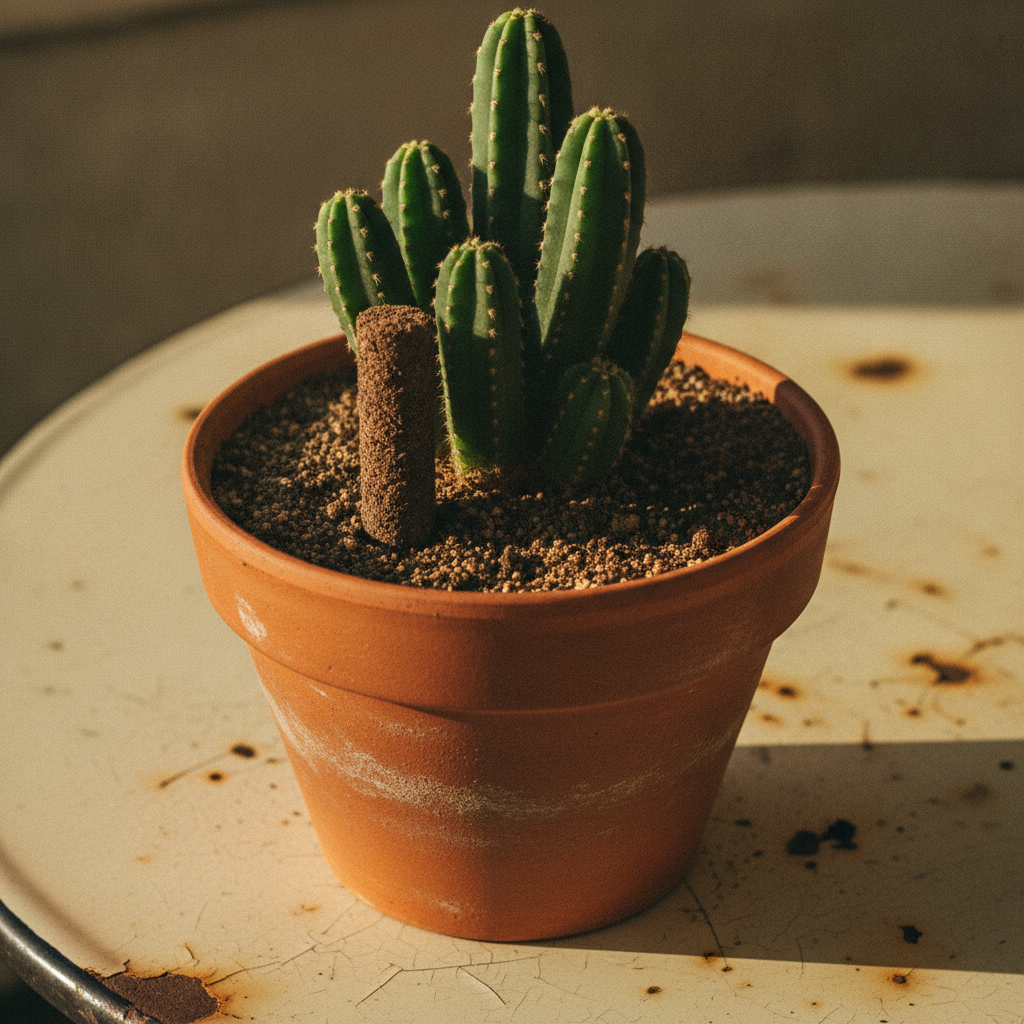
Slow-release granular: Granules and feeding sticks release nutrients gradually over weeks or months. They are convenient and low-effort, though they give you less precise control, so use them at the lower end of the recommended rate for a light feeder like this.
Organic fertilisers: Gentle organic options such as diluted worm-casting tea feed slowly and are very unlikely to scorch the roots. They release nutrients more slowly than synthetic feeds, which suits the cactus’s modest appetite.
Feeding Schedule
Feed only during the spring and summer growing season, and only once or twice across the whole period. A single dilute feed in late spring and another in midsummer is ample for most plants. Never fertilise in autumn or winter, when the plant is resting and cannot use the nutrients, and never feed a plant whose soil is bone dry, as concentrated feed on dry roots can burn them.
Pro Tip — Half Strength is Plenty: Always dilute cactus fertiliser to half the strength stated on the label, or even weaker. With a plant this slow and undemanding, a gentle, diluted feed gives all the benefit with none of the risk of fertiliser burn or forced, floppy growth.
How to Fertilise
- Water the plant lightly a day before feeding so the roots are not bone dry when the feed goes on.
- Dilute a cactus fertiliser to half the recommended strength, or less.
- Apply the diluted feed to the soil during a normal watering, letting it drain through fully.
- Wipe up any feed that splashes onto the columns, and return to plain water for the next watering.
Warning — Salt Build-Up: Over-fertilising leaves mineral salts in the soil that show as a white crust and can burn the roots, causing brown, scorched-looking tissue. If you see crusting, flush the pot thoroughly with plain water until it runs clear from the drainage holes, and ease off the feeding.
Propagation
One of the quiet joys of the fairy castle cactus is how readily it multiplies. Because the plant branches naturally into many separate columns, each one is a potential new plant, and propagation is simply a matter of removing a branch and rooting it. It is an easy, high-success project that also gives you spares to share or to replace any column lost to rot.
The most reliable method is taking stem cuttings from the branching columns, and a closely related approach is potting up the offsets the plant produces around its base. Both rely on the same principle that defines cactus propagation: let the cut surface dry and callus before it ever touches soil or moisture.

Understanding Branches and Offsets
Each column of a fairy castle cactus can root and grow independently once separated from the parent. The plant also pushes out small offsets, or pups, low down on the cluster. Both branches and offsets carry the dormant ability to form roots from their cut or basal surface, which is why this cactus is so easy to multiply. The one rule that cannot be broken is the callusing step: a fresh wound placed straight into damp soil almost always rots instead of rooting.
Stem Cuttings: Step-by-Step
Taking a branch cutting is the classic way to propagate this plant and works best in spring or summer when growth is active.
- Choose a healthy, well-formed column or branch and, wearing gloves, cut it cleanly at the base with a sterilised sharp knife.
- Set the cutting aside in a dry, shaded spot for five to seven days, or until the cut end forms a dry, firm callus.
- Fill a small pot with dry, gritty cactus mix and stand the calloused cutting upright on the surface, burying just the very base.
- Leave the cutting completely dry for a few days more, then begin watering very sparingly, only once the mix has fully dried.
- Keep the pot in bright, indirect light and be patient; roots usually form within two to six weeks.
- Once the cutting resists a gentle tug, it has rooted and can be treated as a normal plant.
Pro Tip — Let It Callus: The single biggest cause of failed cactus cuttings is impatience. Giving the cut end a full week to dry into a hard callus before it meets any soil or water is what separates a rooting cutting from a rotting one. When in doubt, wait an extra day or two.
Dividing Offsets: Step-by-Step
If your plant has produced offsets around its base, separating them is even simpler than taking a cutting, because they may already have tiny roots.
- Gently remove the parent plant from its pot so you can see where the offsets join the base.
- Detach an offset by hand or with a clean knife, keeping any roots it has already formed intact.
- If you had to cut it, let the wound callus for several days; if it came away with roots, you can pot it up sooner.
- Plant the offset in its own small pot of gritty mix at the same depth it grew before.
- Wait a few days, then water sparingly and keep it in bright light while it establishes.
Troubleshooting Propagation
| Problem | Likely Cause | Solution |
|---|---|---|
| Cutting turns soft and brown | Planted before callusing, or kept too wet | Discard and restart, allowing a full callus and drier conditions |
| No roots after many weeks | Too cold, too dark, or taken in winter | Move somewhere warmer and brighter; propagate in the growing season |
| Cutting shrivels badly | Excessively dry for too long after rooting should have begun | Give a light watering once the base has calloused |
| Cutting falls over | Top-heavy and not yet rooted | Support it upright with a small stake or surrounding grit |
Pests & Diseases
A healthy fairy castle cactus growing in bright light and dry soil is a remarkably trouble-free plant, and most problems trace back to overwatering rather than to pests arriving uninvited. Still, a few sap-sucking insects do target cacti indoors, and they are easiest to deal with when caught early.
The ribbed, crevice-filled structure of this cactus gives pests plenty of places to hide, so regular inspection matters. Get into the habit of looking closely between the columns and around the areoles every week or two, ideally with a magnifying glass, since the earliest infestations are tiny and easy to miss.

Common Pests
Mealybugs (Pseudococcidae)
Mealybugs are the most frequent pest of this cactus, appearing as small, soft, white cottony blobs tucked into the crevices between columns and around the areoles. They suck sap and weaken the plant, leaving a sticky residue behind.
Treatment: Dab each insect directly with a cotton bud dipped in isopropyl alcohol, which kills them on contact. For heavier infestations, treat the whole plant with a horticultural soap or neem-oil spray and repeat weekly until clear.
Scale Insects (Diaspididae)
Scale appear as small, flat or domed brown bumps stuck firmly to the stems. They do not move once settled and can be mistaken for part of the plant, but they steadily drain its sap.
Treatment: Scrape or rub them off gently with an alcohol-soaked cloth or cotton bud, then follow up with neem oil or horticultural soap to catch any crawlers you missed.
Spider Mites (Tetranychus urticae)
Spider mites thrive in hot, dry conditions and can be hard to see, but the fine webbing they spin between the columns and the faint stippled, bronzed look on the stems give them away.
Treatment: Rinse the plant with a firm spray of water, then treat with neem oil or a dedicated miticide, repeating every few days to break their fast breeding cycle.
Fungus Gnats (Sciaridae)
Small black flies hovering around the pot are fungus gnats, whose larvae live in consistently damp soil. They are more a symptom than a serious pest, signalling that the soil is being kept too wet for a cactus.
Treatment: Let the soil dry out completely, which alone usually ends the problem, and use yellow sticky traps to catch the adults. Correcting the watering routine is the real fix.
Common Diseases
Root and Stem Rot (Fusarium and Pythium spp.)
By far the most serious threat to this plant, rot is caused by fungi and water moulds that take hold in waterlogged soil. It shows as soft, brown, mushy tissue, usually starting at the base and spreading upward, often with a foul smell.
Treatment: Cut away every trace of soft tissue with a sterile blade until only firm, healthy growth remains, let it callus, and replant in fresh dry mix. If the rot has reached the core, take a healthy cutting from the top and start over. Prevention through careful watering is far easier than cure.
Fungal Spotting (various fungi)
Damp, stagnant air can lead to small brown or black spots and corky patches on the stems. These are cosmetic at first but can spread if conditions stay humid and still.
Treatment: Improve air circulation, reduce humidity and keep water off the columns. Badly marked sections can be removed, and a copper-based fungicide will check persistent spotting.
Pest and Disease Summary
| Pest / Disease | Identification | Treatment |
|---|---|---|
| Mealybugs | White cottony tufts in crevices | Alcohol on a cotton bud; neem oil |
| Scale | Brown immovable bumps on stems | Scrape off; neem oil or soap |
| Spider mites | Fine webbing, stippled bronzing | Rinse; neem oil or miticide |
| Fungus gnats | Small black flies around the pot | Dry the soil; sticky traps |
| Root and stem rot | Soft brown mushy tissue, bad smell | Cut to healthy tissue; replant dry |
| Fungal spotting | Brown or black corky spots | Improve airflow; copper fungicide |
Prevention Strategies
The best defence is simply good culture. A fairy castle cactus grown in bright light, gritty soil and a pot with drainage, watered only when bone dry, is rarely troubled by anything. Most pests and all rot exploit weakness, and the weakness they exploit most often is soggy soil, so disciplined watering quietly prevents the majority of problems.
It also pays to quarantine new plants for a couple of weeks before they join your collection, since pests usually arrive as hitchhikers on a new purchase. Inspect any newcomer closely, keep it apart at first, and treat any pests before introducing it to your other plants.
Pro Tip — Inspect at Watering Time: Tie your pest checks to your watering routine. Each time you water, take a moment to look between the columns and around the areoles. Catching a few mealybugs early, when a single cotton bud will deal with them, is far easier than tackling an infestation that has spread through the whole plant.
Popular Varieties
The fairy castle cactus is itself a cultivated form of Acanthocereus tetragonus, a species better known in the wild as the night-blooming cereus, barbed-wire cactus or triangle cactus. The compact, many-branched plant sold under the fairy castle name is a slow-growing selection prized for its turret-like shape, and a handful of related forms turn up in shops.
It is worth being aware that some plants sold as fairy castle cactus are not what they seem. Brightly coloured red, orange or yellow specimens are usually either grafted novelties or, more often, ordinary green plants topped with dyed straw flowers glued on to imitate blooms. Knowing the genuine forms helps you choose a plant that will keep growing naturally.
| Variety | Appearance | Light Needs | Growth Rate | Availability |
|---|---|---|---|---|
| Fairy Castle (green form) | Classic branching green five-ribbed columns | Bright, some direct sun | Slow | Very common |
| Variegated Fairy Castle | Cream and yellow streaking on green columns | Bright, gentle direct sun | Very slow | Uncommon |
| Crested (cristate) form | Fan-shaped, wavy fused growth | Bright, some direct sun | Slow | Rare collector item |
| Wild A. tetragonus | Large sprawling three to five-ribbed stems | Full sun | Vigorous | Specialist growers |
| Faux-flowered specimens | Green plant with dyed straw flowers attached | As green form | Slow | Common in shops |
Featured Varieties
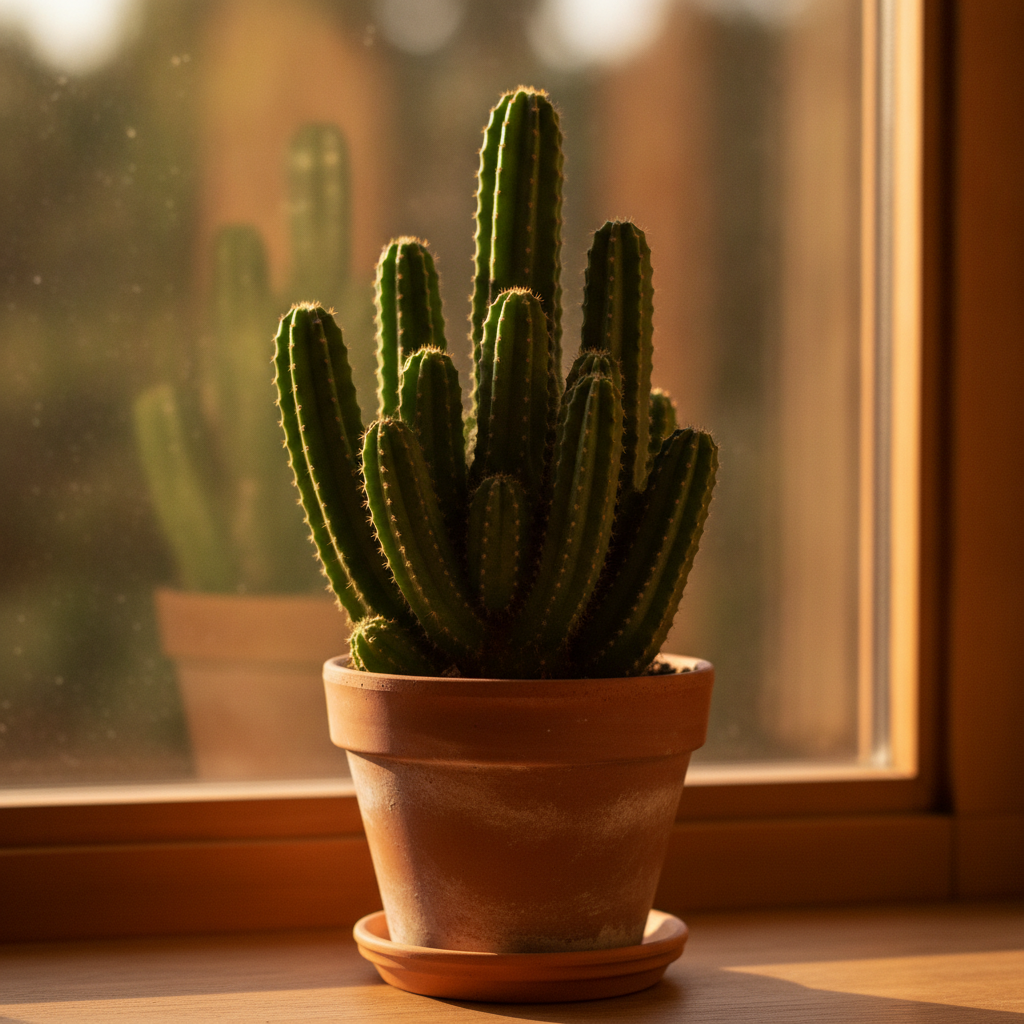
Fairy Castle (Green Form)
The standard and most widely sold form, with bright green, densely branching columns that build into the classic castle silhouette over time. Reliable, hardy and the best choice for a first cactus.

Variegated Fairy Castle
A scarcer form in which the green columns are marbled with cream and pale yellow. The reduced chlorophyll makes it grow even more slowly and prefer slightly softer light, but the colouring is striking.
Variety Profiles in Detail
Crested Fairy Castle (Acanthocereus tetragonus f. cristata)
Occasionally a growing point mutates and grows in a fan or brain-like wave instead of a normal column, producing a crested or cristate form. These are sought after by collectors for their sculptural oddity. They need the same care as the green form but should be watched even more carefully for moisture trapped in their folds.
Wild Night-Blooming Cereus (Acanthocereus tetragonus)
The unselected wild species is a very different plant from the tidy fairy castle: a large, sprawling, sometimes climbing cactus with long three to five-ribbed stems that, when mature, produces big, fragrant white flowers that open at night. It is far too vigorous for most windowsills but explains the flowering potential hidden in the compact form.
Choosing the Right Variety for Your Space
For almost everyone, the standard green fairy castle cactus is the right pick: it is widely available, inexpensive, tough and grows into the characterful clustered shape the plant is loved for. Choose a variegated or crested form only if you enjoy a slower, slightly more demanding plant and can give it the bright, stable conditions it needs. Whichever you choose, look past any glued-on straw flowers to the plant beneath, and pick a specimen with firm, evenly green columns and no soft or discoloured patches at the base.
Frequently Asked Questions
Why does my fairy castle cactus have a colourful flower on top that looks fake?
Because it almost certainly is fake. Many fairy castle cacti are sold with a brightly dyed straw flower glued to the top to make them more eye-catching at the point of sale. The flower is not part of the plant and will eventually fall off or look tatty. You can gently remove it without harming the cactus, which will carry on growing perfectly well underneath.
Will my fairy castle cactus ever flower?
Genuine flowering is rare in the compact fairy castle form grown indoors. The parent species can produce large white nocturnal flowers when mature, but the cultivated form seldom does so in a pot. A long, cool, dry winter rest gives the best chance, though most owners enjoy this plant for its shape rather than expecting blooms.
How fast does a fairy castle cactus grow?
Slowly. In good light it might add only a few centimetres of new growth in a season, gradually sending up fresh columns and side branches over the years. This slow pace is part of its appeal, as it rarely outgrows its spot and needs repotting only every few years.
Why is one of my columns turning brown and mushy?
Soft brown tissue is the classic sign of rot from overwatering. Cut away all the affected tissue with a clean blade until only firm green growth remains, let the cut callus for several days, and review your watering. If the rot has reached the base, take a healthy cutting from higher up and root it to save the plant.
My cactus is growing tall and thin. What went wrong?
That stretched, pale growth is etiolation, caused by too little light. The plant is reaching for a brighter source. Move it to your sunniest window or add a grow light. The existing stretched growth will not thicken up again, but new growth in good light will be compact, and you can always propagate a cutting for a fresh, dense plant.
Is the fairy castle cactus safe around pets and children?
It is not known to be toxic if nibbled, so it is not considered a poisoning risk to cats, dogs or children. The genuine hazard is the spines, which are sharp enough to hurt. Keep it out of reach of curious pets and small children, and handle it with care.
How often should I water in winter?
Much less than in summer, often just once a month or even less. Through the cooler, darker months the plant is dormant and uses very little water, so it should be kept nearly dry. Only water if the soil has been completely dry for a good while and the columns look slightly slack.
Can I grow a fairy castle cactus from a single cutting?
Yes, and it is the easiest way to propagate one. Cut a healthy column at the base, let the cut end dry and callus for about a week, then stand it in dry gritty mix and water only sparingly once it has settled. Roots typically form within a few weeks, after which it grows on as an independent plant.
Does it need a special pot?
It needs a pot with drainage holes above all else, and ideally a terracotta one. Terracotta is porous and helps the soil dry quickly between waterings, which is exactly what this rot-prone plant wants. A snug pot only slightly larger than the roots is better than a large one that stays wet.






