
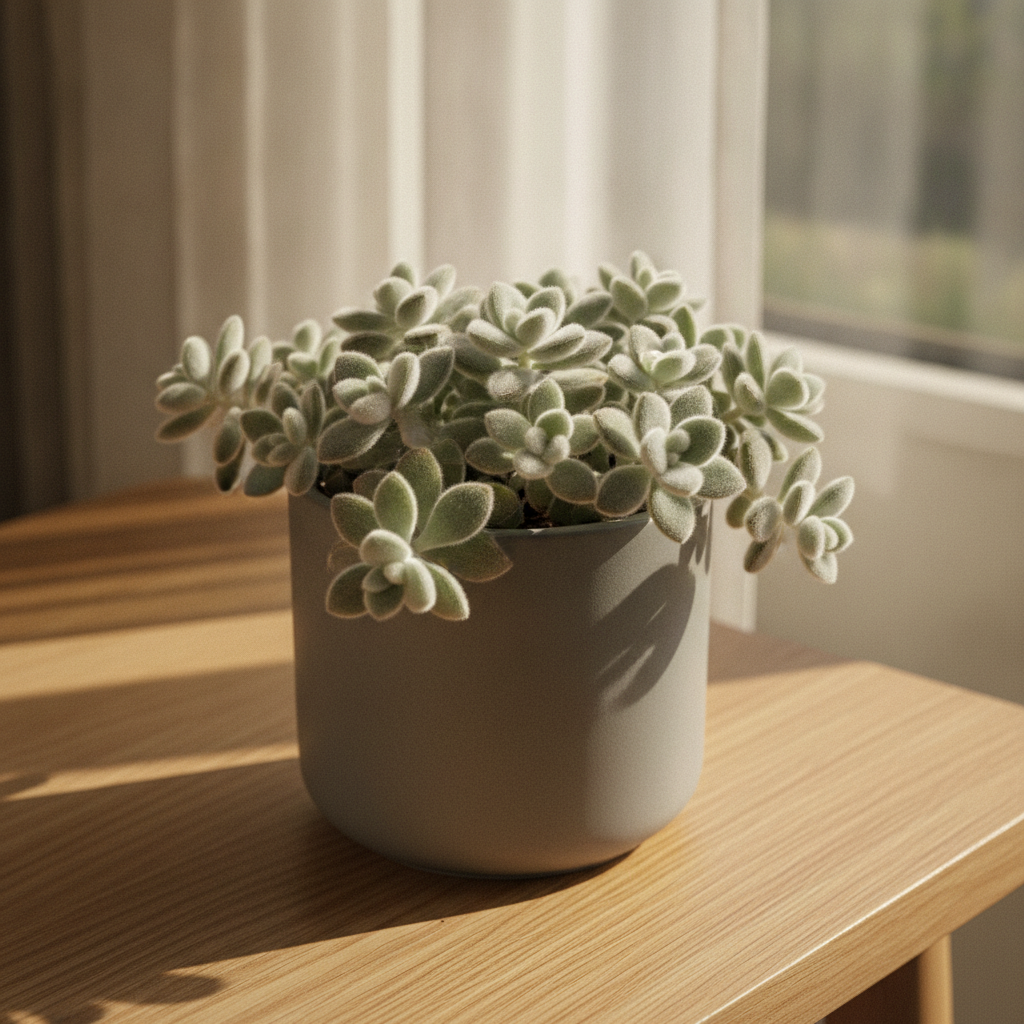
Few succulents look quite as touchable as the panda succulent. Densely wrapped in fine white wool, Kalanchoe eriophylla wears a coat of silvery felt so thick that the green of its leaves barely shows through, earning it the affectionate nickname of the snow white panda plant. Native to the rocky highlands of central Madagascar, this compact, slow-growing succulent forms low rosettes of plump oval leaves on short stems, each one frosted with trichomes that protect it from intense mountain sun and conserve precious moisture. It belongs to the same felted group as the better-known panda plant (Kalanchoe tomentosa), but it is smaller, whiter and altogether more cloud-like.
The panda succulent has a reputation as one of the more forgiving fuzzy succulents, and that reputation is largely deserved. It asks for very little: strong light, a gritty mix that drains in seconds, and a grower who can resist the urge to water too often. The gap between merely keeping it alive and watching it flourish into a dense, gleaming mound comes down to a handful of details, most of them about restraint. This guide walks through every aspect of its care, from reading its light needs to watering around those water-sensitive felted leaves, repotting, feeding, propagation and the pests that like to hide in all that fuzz.
Contents
- Quick Reference
- Why the Panda Succulent Makes a Rewarding Houseplant
- Light Requirements
- Watering & Humidity
- Soil, Potting & Repotting
- Fertilising
- Propagation
- Pests & Diseases
- Popular Varieties
- Frequently Asked Questions
Quick Reference: Panda Succulent at a Glance
| Light | Bright light to several hours of direct sun; a south or west window is ideal indoors |
| Watering | Sparingly. Let the mix dry out completely, then water from below; roughly every 2 to 3 weeks in summer, monthly or less in winter |
| Temperature | 18 to 27 degrees Celsius (64 to 81 Fahrenheit). Keep above 10 degrees Celsius (50 Fahrenheit); not frost hardy |
| Humidity | Low. Prefers dry air; high humidity encourages rot in the felted leaves |
| Fertiliser | A dilute, low-nitrogen succulent feed two or three times across spring and summer only |
| Toxicity | Toxic to cats and dogs; mildly toxic to humans if eaten. Keep away from pets |
Why the Panda Succulent Makes a Rewarding Houseplant
The appeal of the panda succulent starts with its texture. The entire plant is sheathed in dense white hairs, called trichomes, that give the leaves a frosted, almost icy finish and a soft, suede-like feel. In its native Madagascar these hairs are a survival adaptation, scattering harsh sunlight and slowing water loss in an exposed, rocky habitat. Indoors they simply make for one of the most distinctive small succulents you can grow, a plant that reads as silver-white from across the room and rewards a closer look with intricate, woolly detail.
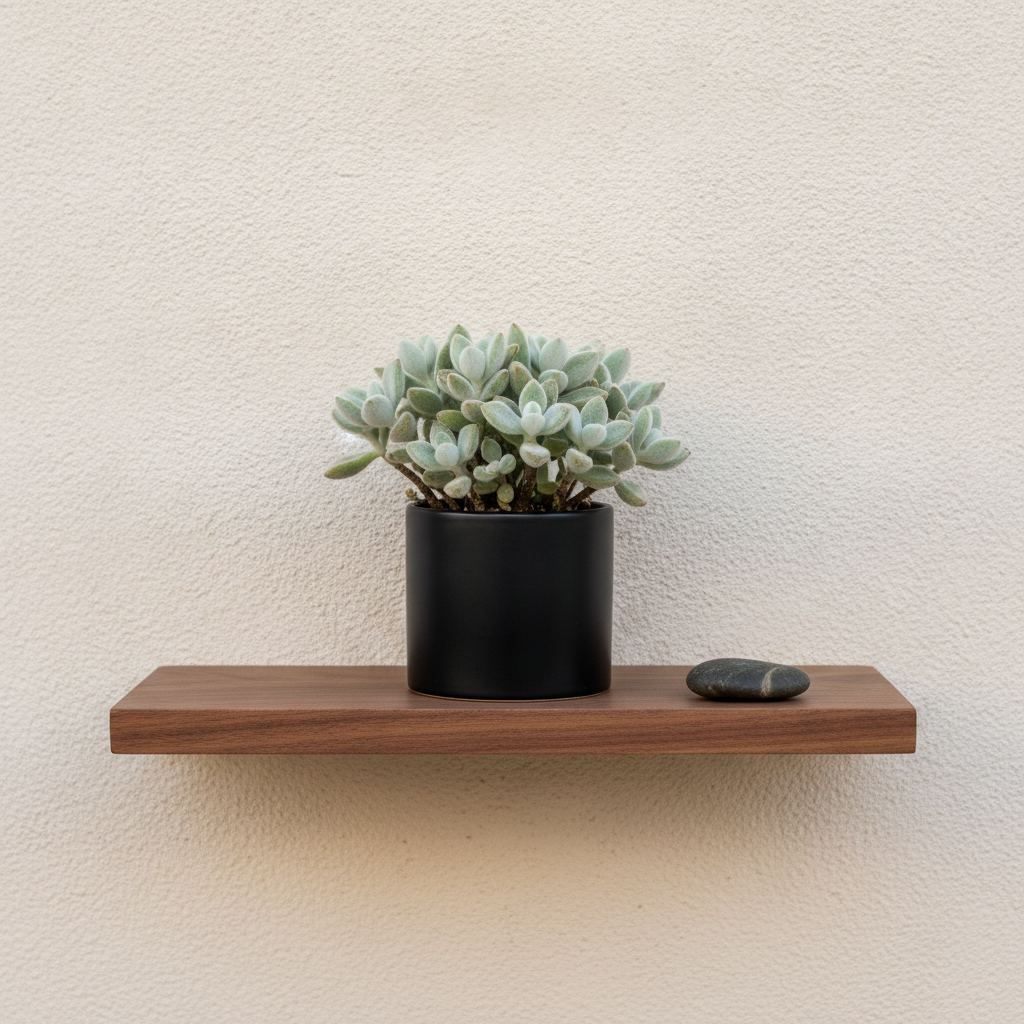
Beyond looks, it is genuinely low-maintenance. As a true succulent it stores water in its thick leaves, so it tolerates neglect far better than it tolerates fussing. It stays small, rarely exceeding 15 to 20 centimetres (6 to 8 inches) in height and spread, which means it never demands a bigger pot or a sunnier corner the way a fast-growing tropical might. It is happy in the dry indoor air that makes ferns and calatheas sulk, and it slips neatly into a windowsill collection alongside echeverias, haworthias and other compact succulents. For anyone who wants a plant with real character but little upkeep, it is an excellent choice.
Important — Toxicity: Like all kalanchoes, the panda succulent contains bufadienolide compounds that are toxic to cats and dogs and can cause vomiting, drooling and, rarely, heart-rhythm problems if eaten in quantity. It is also mildly irritating to humans if ingested. Site it well out of reach of curious pets and children, and wash your hands after handling cuttings.
Light Requirements
Light is the single most important factor in keeping a panda succulent looking its best. This is a high-light plant by nature, adapted to open, sun-drenched slopes, and indoors it wants as much brightness as you can give it. In good light the rosettes stay tight and compact, the felt develops its brightest silver-white sheen, and the leaf margins may flush a subtle reddish-brown. In poor light the plant does the opposite of thriving, even if it survives for months.
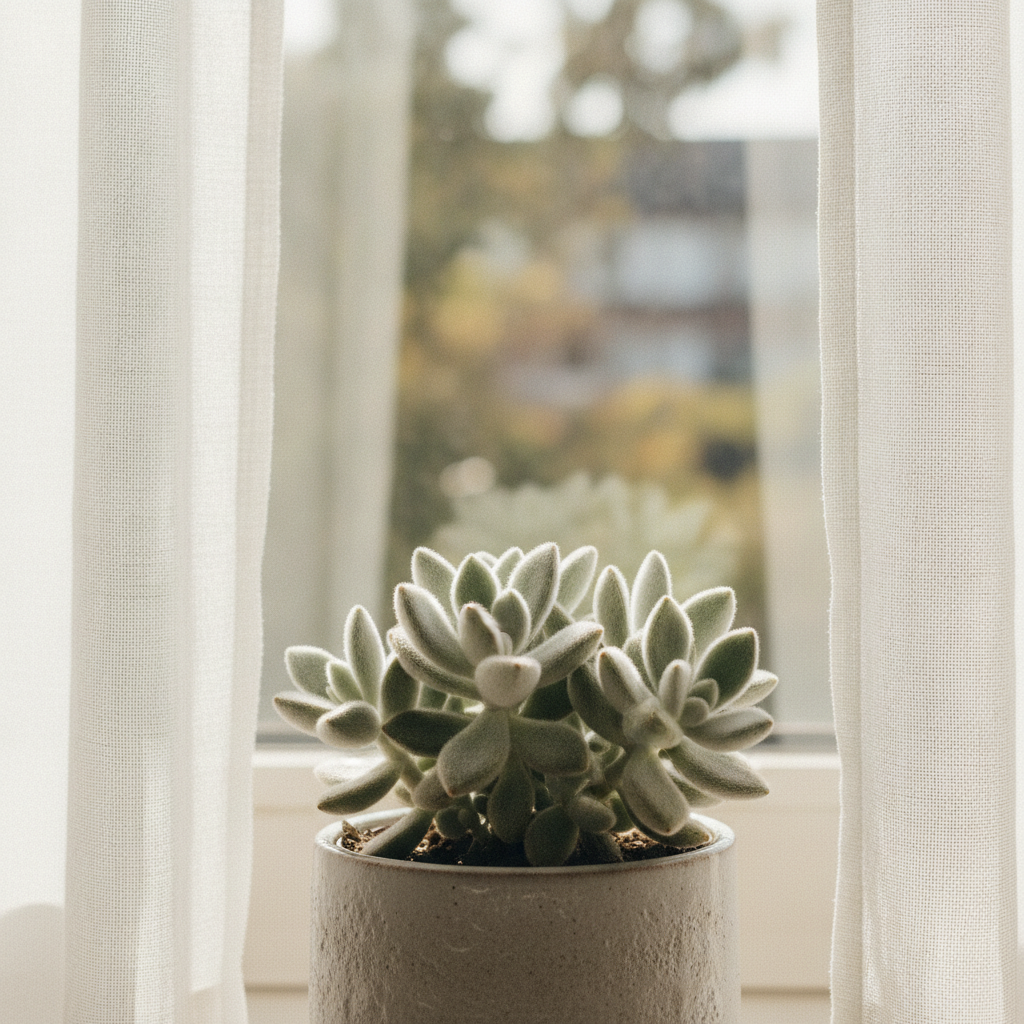
The ideal indoor position is directly in or very close to a bright window, with several hours of direct sun each day. Unlike many tender houseplants, the felted leaves give this succulent real protection against strong light, so a few hours of morning or late-afternoon sun will not scorch it once it is acclimatised. Aim to give it the brightest spot you have rather than worrying about shielding it.
Light Levels Explained
Indoor light is far dimmer than most people assume, and a spot that feels bright to the eye can be surprisingly weak for a sun-loving succulent. The table below sets out the broad light categories and how the panda succulent responds to each.
| Light Category | Approx. Level | Typical Location | Outcome |
|---|---|---|---|
| Direct sun | Over 50,000 lux | On a south or west sill, in the sun | Ideal; tightest, whitest growth and possible leaf blush |
| Bright indirect | 10,000 to 25,000 lux | Just back from a sunny window | Good; healthy but slightly looser growth |
| Medium | 2,000 to 10,000 lux | A north window or mid-room | Tolerated short term; stretching begins |
| Low | 500 to 2,000 lux | Several metres from a window | Poor; etiolation, weak felt, eventual decline |
| Very low | Under 500 lux | Interior corner, hallway | Unsuitable; the plant will slowly die |
Window Orientation and Placement
South-facing window: The best choice in the northern hemisphere. A south sill delivers the long hours of bright, direct light this succulent craves and keeps growth compact and well coloured. Sit it right on the glass.
West-facing window: An excellent second option. Strong afternoon sun suits the plant well, though the heat that builds behind west glass on summer afternoons means you should make sure the soil never bakes bone dry for weeks on end.
East-facing window: Workable. Gentle morning sun followed by bright light for the rest of the day keeps the plant reasonably happy, although you may see slightly looser growth than in a south window.
North-facing window: Generally too dim for the long term. The plant will hang on but tends to stretch and lose its silver brilliance. If a north window is all you have, plan to supplement with a grow light.
Pro Tip — Rotate for Even Growth: Give the pot a quarter turn every week or two so each side gets its share of the light. Succulents lean noticeably towards their brightest source, and regular rotation keeps the rosette symmetrical rather than one-sided.
How Light Affects Colour and Form
The panda succulent is a living light meter. When it receives enough sun, the leaves sit close together in a dense rosette and the felt looks crisp and bright, sometimes with warm bronze tones along the edges. When light is short, the plant stretches towards the window, spacing its leaves further apart on lengthening stems and producing thinner, greener, less woolly growth. This stretching, known as etiolation, cannot be reversed: the elongated stems stay elongated. The only fix is to move the plant into stronger light to keep new growth compact, then propagate the tidiest rosettes if the old growth becomes leggy.
Warning — Sudden Sun Exposure: Even though the felt protects against bright light, a plant grown in dim conditions can still scorch if moved abruptly into full summer sun. Acclimatise it over a week or two, increasing exposure gradually, especially if you move it outdoors for the warmer months.
Artificial Lighting
If your home simply lacks a bright enough window, the panda succulent responds well to a full-spectrum LED grow light. Position the light 15 to 30 centimetres (6 to 12 inches) above the plant and run it for 10 to 12 hours a day to mimic the long, intense light it would get on a sunny sill. A grow light is also useful through the darker winter months in higher latitudes, where natural light alone is often too weak to prevent stretching.
Seasonal Adjustments
Light intensity swings dramatically with the seasons indoors. In summer you may need to ensure the plant is not the only thing baking against hot glass, while in winter you should move it to the brightest available window and clean the panes so it captures every photon. Growth slows or stops in the short days of winter, which is normal and nothing to correct; resist the temptation to compensate with extra water, as the combination of low light and damp soil is the fastest route to rot.
Watering & Humidity
Watering is where most panda succulents are won or lost. As a drought-adapted plant that stores water in its leaves, it is built to endure long dry spells and is acutely vulnerable to staying wet. The guiding principle could not be simpler: when in doubt, do not water. A panda succulent recovers quickly from thirst but rarely survives sustained overwatering.
When to Water
Water only when the potting mix has dried out completely, from the surface right down to the bottom of the pot. In a bright spot during the growing season this usually means watering roughly every two to three weeks, but treat that figure as a loose guide rather than a schedule. Pot size, light, temperature and the time of year all change how fast the mix dries, so check the plant rather than the calendar.
The most reliable test is to lift the pot. A dry pot is conspicuously light; a pot that still holds water feels heavy. With a little practice the difference becomes obvious, and a quick heft of the pot tells you more than any moisture meter. You can also gently feel the lowest leaves: when they begin to look slightly less plump and feel a touch softer, the plant is using its reserves and is ready for a drink. In winter, when growth halts, stretch the intervals out to once a month or even less.
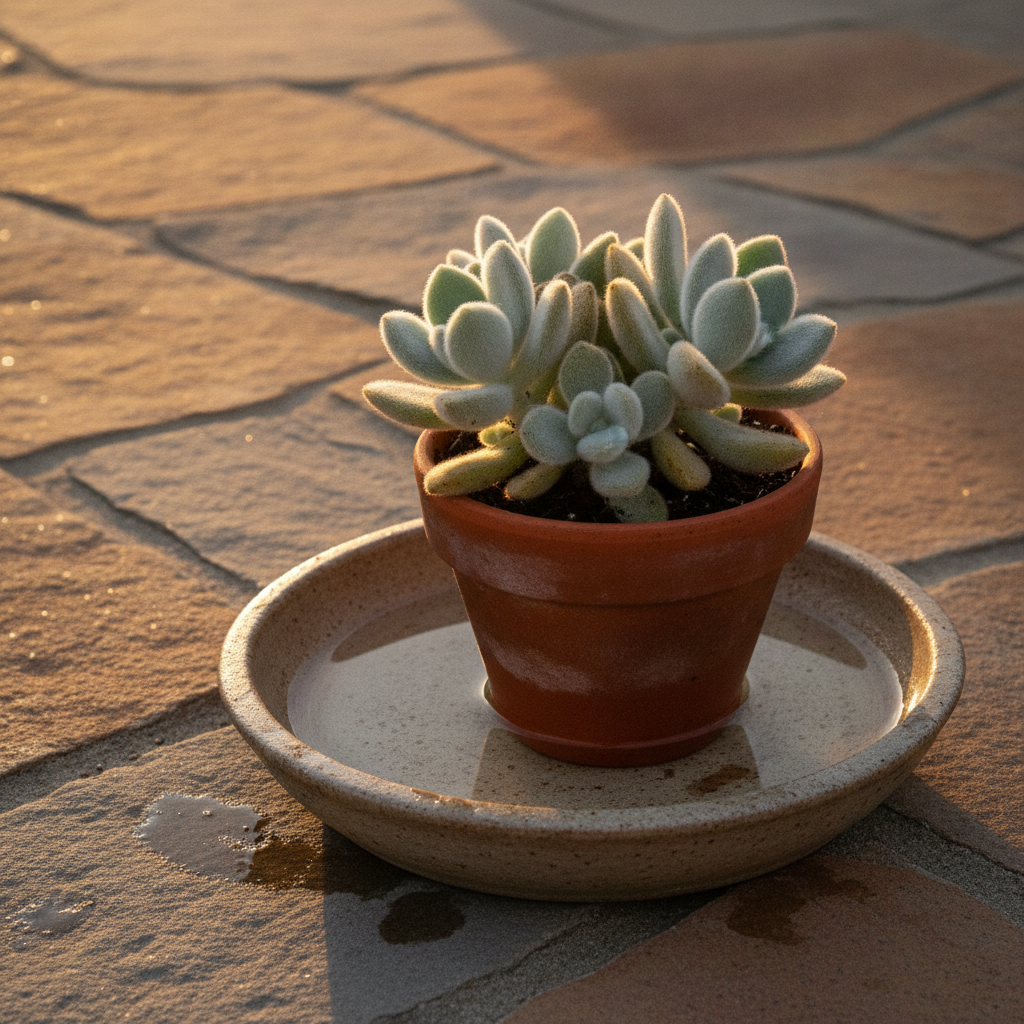
Pro Tip — Keep the Felt Dry: Water sitting on the woolly leaves can lodge in the trichomes, leaving marks and creating a damp pocket where rot takes hold. Always water at the soil line or, better still, from below, and never mist a panda succulent.
How to Water Correctly
- Confirm the mix is fully dry by lifting the pot and checking its weight.
- Stand the pot in a shallow dish of room-temperature water, or water carefully at the soil surface, keeping moisture off the leaves.
- If bottom-watering, let the pot sit for 10 to 20 minutes so the mix wicks up moisture until the surface feels damp.
- Remove the pot and let it drain completely; never leave it standing in water.
- Tip away any water left in the saucer so the roots are not sitting wet.
- Wait until the mix is bone dry again before the next watering.
Signs of Overwatering vs. Underwatering
| Symptom | Overwatering | Underwatering |
|---|---|---|
| Leaf colour | Yellowing, translucent or blackened leaves | Leaves dull and slightly faded |
| Leaf texture | Soft, mushy, water-soaked to the touch | Thin, wrinkled, softly deflated |
| Soil | Stays damp for many days, may smell sour | Bone dry, pulling away from the pot edge |
| Roots | Brown, black and slimy | Dry but firm and pale |
| Stem base | Darkening or collapsing at soil level | Firm, simply slow to grow |
Warning — Root Rot: A mushy, blackening stem base is the hallmark of advanced root rot and is usually fatal once it reaches the crown. At the first sign, lift the plant, cut away every soft, discoloured root and any affected leaves with a clean blade, let the wounds callus for a day or two, and replant the healthy remainder in fresh, dry, gritty mix.
Humidity Requirements
This is a rare houseplant that actively prefers dry air. The ordinary humidity of a centrally heated home, often between 30 and 50 percent, suits it perfectly, and it needs no help in this department whatsoever.
High humidity is, if anything, a hazard. Damp, still air around the felted leaves encourages fungal spotting and slows the soil’s drying, tipping the balance towards rot. If you grow the panda succulent in a humid bathroom or a crowded, poorly ventilated terrarium, expect trouble.
Rather than raising humidity, focus on air movement. A gently circulating breeze, from an open window in mild weather or a small fan, helps the leaves and soil dry quickly after watering and keeps fungal problems at bay. Good airflow is one of the most underrated tools in succulent care.
Water Quality
The panda succulent is not fussy about water quality, and ordinary tap water is fine in most areas. Because it is watered so infrequently and from below, mineral build-up is rarely an issue. If your water is very hard and you notice pale crusting on the soil surface over time, flushing the mix thoroughly once or twice a year, or using filtered or rainwater, will keep things tidy. Room-temperature water is gentler on the roots than cold water straight from the tap.
Soil, Potting & Repotting
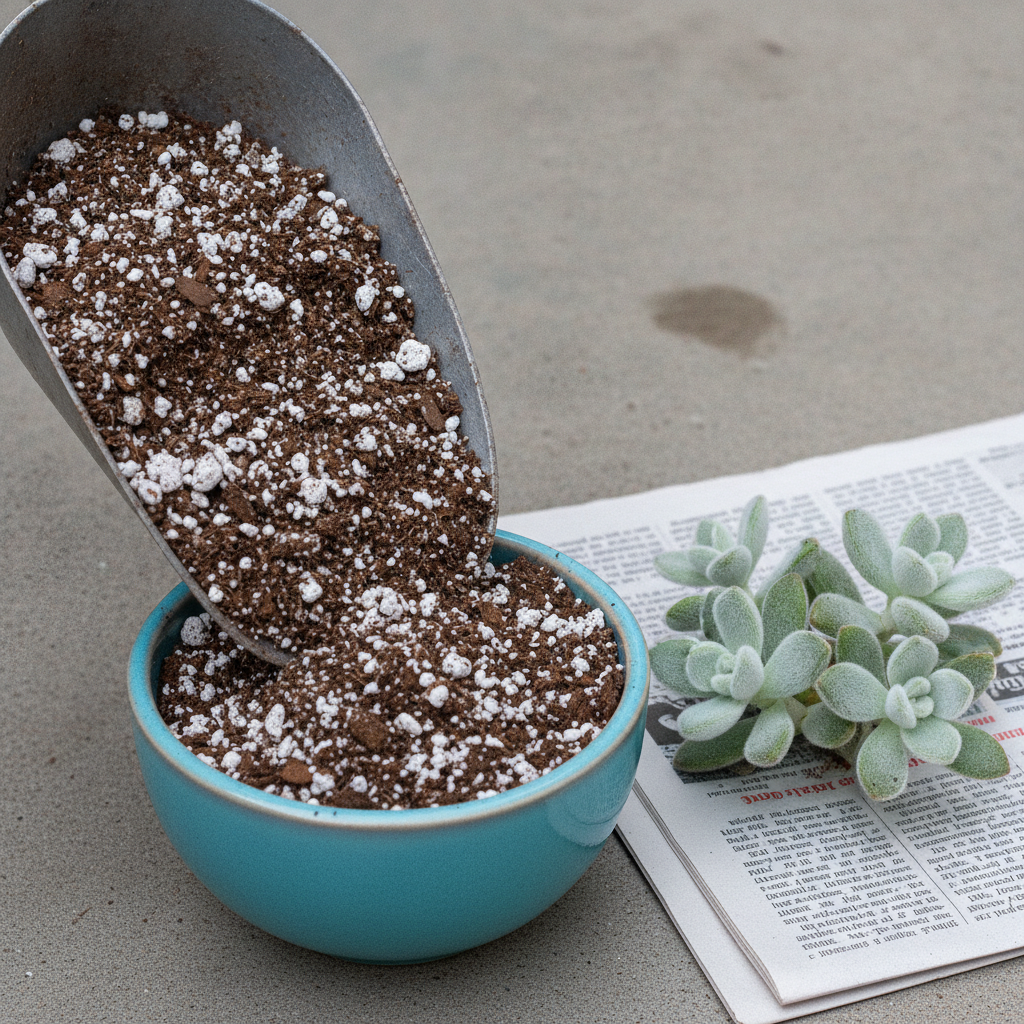
Get the soil right and you have solved most of the watering problem before it starts. The panda succulent needs a mix that drains almost instantly and holds very little moisture, because its roots will not tolerate sitting in dampness. An ordinary houseplant compost, designed to stay moist, is exactly wrong for this plant and is a common cause of slow decline.
Ideal Soil Composition
The aim is a free-draining, gritty medium that anchors the plant and feeds it lightly while letting water rush straight through. A good starting point is a proprietary cactus and succulent compost opened up with extra mineral grit. Roughly half organic material and half coarse grit gives the structure these roots want.
| Component | Proportion | Function |
|---|---|---|
| Cactus and succulent compost | 50 percent | Base structure and light nutrition |
| Pumice or coarse perlite | 30 percent | Aeration and rapid drainage |
| Coarse horticultural sand or fine grit | 20 percent | Weight, drainage and mineral content |
The panda succulent is relaxed about pH and grows well in anything from slightly acidic to slightly alkaline, broadly between 6.0 and 7.5. With a balanced gritty mix you will be comfortably within that range and need not test or adjust it.
Pro Tip — Quick Mix Recipe: No specialist succulent compost to hand? Combine two parts of any general peat-free houseplant compost with two parts pumice or perlite and one part coarse sand. The result drains far better than bagged compost alone and keeps a panda succulent perfectly happy.
Choosing the Right Pot
Pot choice has a direct effect on how often your plant teeters towards overwatering. Because the panda succulent is small and slow, it does not need much room, and a snug pot that dries quickly is far safer than a generous one that stays damp.
Drainage holes are non-negotiable. Never plant a panda succulent in a pot without a drainage hole. Without an exit for excess water, the mix stays saturated at the base and rot is all but guaranteed. If you love a decorative cover pot, keep the plant in a plastic nursery pot with holes and lift it out to water.
Pot material: Unglazed terracotta is the ideal choice. Its porous walls draw moisture out of the soil and let it evaporate, helping the mix dry faster between waterings. Glazed ceramic and plastic both work but hold moisture longer, so you will need to water even more cautiously in them.
Pot size: Choose a pot only a centimetre or two wider than the rosette. A large volume of mix around a small root system stays wet for too long. When you do pot up, step up by just one modest size at a time.
When to Repot
The panda succulent grows slowly and is content to stay in the same pot for two or three years. Repot only when it has clearly outgrown its container, when roots emerge from the drainage holes, or when the old mix has broken down and no longer drains freely. The best time is spring, at the start of the active growing season, so the plant can settle in while conditions are favourable. Always repot into dry mix and wait several days before the first watering, giving any disturbed roots time to heal.
How to Repot: Step-by-Step
- Water lightly a few days beforehand so the root ball holds together, then let it dry; do not repot a freshly soaked plant.
- Ease the plant out by squeezing a flexible pot or sliding a knife around a rigid one, supporting the rosette gently to avoid bruising the felt.
- Crumble away most of the old mix and inspect the roots, trimming any that are brown, soft or dead with a clean blade.
- Set the plant in fresh dry gritty mix at the same depth it sat before, never burying the lower leaves.
- Firm the mix lightly around the roots so the plant is stable but the soil is not compacted.
- Top-dress with a thin layer of grit if you like, which keeps the base of the plant dry and looks neat.
- Wait three to seven days, then resume normal watering.
Warning — Transplant Shock: A repotted panda succulent may look a little limp for a week or two as its roots re-establish. Resist the urge to water it more to perk it up; in dry mix the roots heal cleanly, whereas early watering into disturbed roots invites rot. Patience is the cure here.
Fertilising
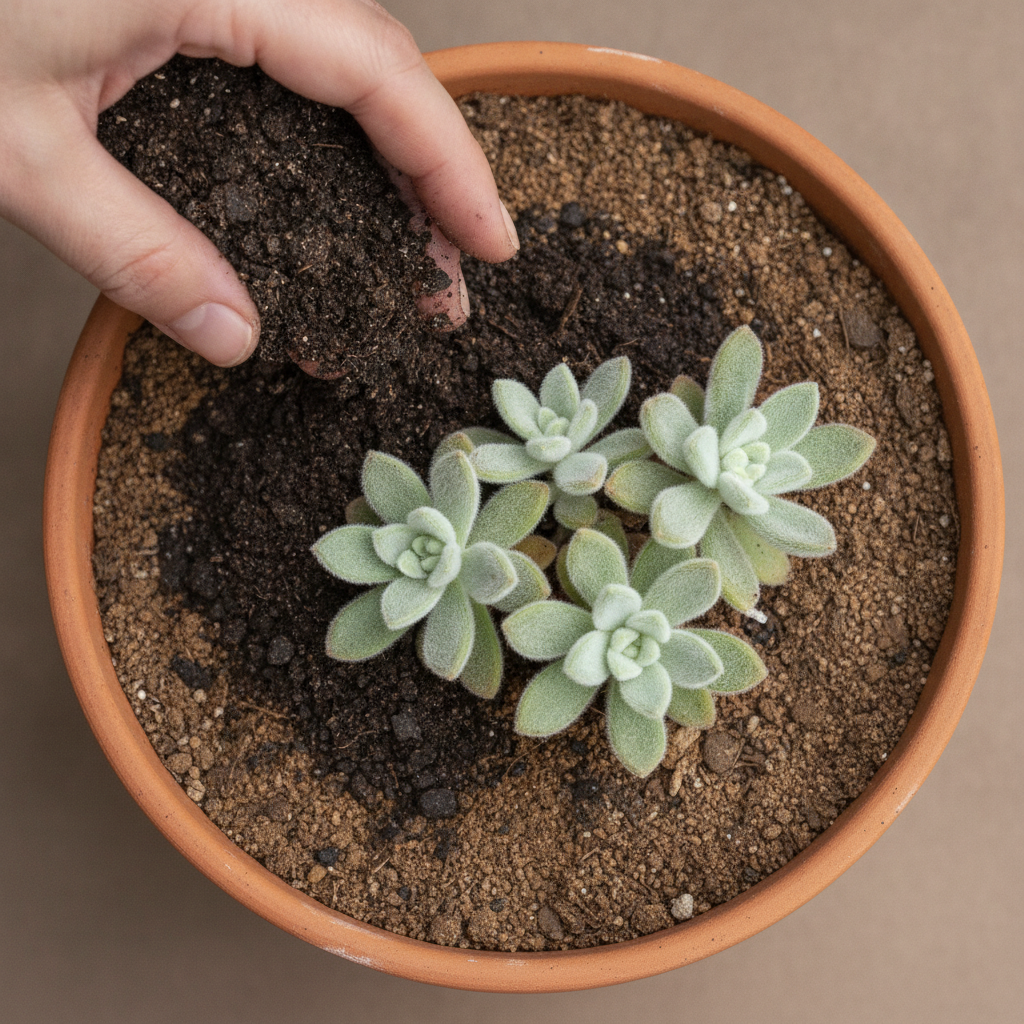
The panda succulent is a famously light feeder. In the wild it grows in poor, mineral soils and has no use for the rich diet many leafy houseplants enjoy. A small amount of fertiliser during the growing season supports steady growth and good colour, but overfeeding does far more harm than going without.
Too much nitrogen in particular pushes soft, fast, leggy growth that loses the dense, compact form and bright felt that make this plant worth growing. The goal is a gentle top-up, not a feast.
Understanding Plant Nutrients
Fertilisers are labelled with an NPK ratio showing the percentages of nitrogen, phosphorus and potassium, the three nutrients plants use in the greatest quantity. For a succulent you want a feed where nitrogen is no higher than the other two, or a product formulated specifically for cacti and succulents. The table below summarises the key nutrients and the signs of deficiency, although a well-cared-for panda succulent rarely shows any.
| Nutrient | Symbol | Primary Function | Deficiency Symptoms |
|---|---|---|---|
| Nitrogen | N | Leaf and stem growth | Pale, slow, undersized new growth |
| Phosphorus | P | Root development and flowering | Weak roots, poor flowering |
| Potassium | K | Overall vigour and stress resistance | Yellowing or browning leaf edges |
| Calcium | Ca | Cell wall strength | Distorted, weak new growth |
| Magnesium | Mg | Chlorophyll production | Yellowing between leaf veins |
| Iron | Fe | Chlorophyll and enzyme function | Pale young leaves with green veins |
Types of Fertiliser
Liquid fertilisers: The easiest option for a succulent. Choose a balanced or low-nitrogen feed, or a dedicated succulent formula, and dilute it to half or even a quarter of the recommended strength before applying to already-moist soil.
Slow-release granular: A few granules of a low-strength slow-release feed mixed into the soil at repotting time will gently nourish the plant across the whole season. Use sparingly, as it is easy to overdo.
Organic fertilisers: A very light top-dressing of worm castings is a gentle, forgiving way to feed, releasing a small amount of nutrition slowly with each watering and carrying little risk of burning the roots.
Feeding Schedule
Feed only during the active growing season of spring and summer, and even then only two or three times across the whole period. A dilute feed once a month from late spring to midsummer is plenty. Stop entirely in autumn and winter, when the plant is resting and cannot use the nutrients; feeding a dormant succulent simply leaves unused salts to accumulate in the soil.
Pro Tip — Less Is More: If you are unsure whether to feed, do not. A panda succulent will live happily for years on the trace nutrients in its mix and the occasional repot. Far more of these plants are spoiled by overfeeding than are ever held back by hunger.
How to Fertilise
- Dilute a balanced or low-nitrogen feed to half strength or less.
- Water with plain water first if the mix is bone dry, so the feed never hits parched roots directly.
- Apply the diluted solution at the soil line, keeping it off the felted leaves.
- Let the pot drain fully and discard any run-off from the saucer.
- Flush the mix with plain water every few months to wash out any accumulated salts.
Warning — Salt Build-Up: A white crust on the soil or pale, scorched leaf tips signals a build-up of fertiliser salts. Correct it by flushing the pot thoroughly with plenty of plain water until it runs freely from the drainage holes, then ease off the feeding.
Propagation
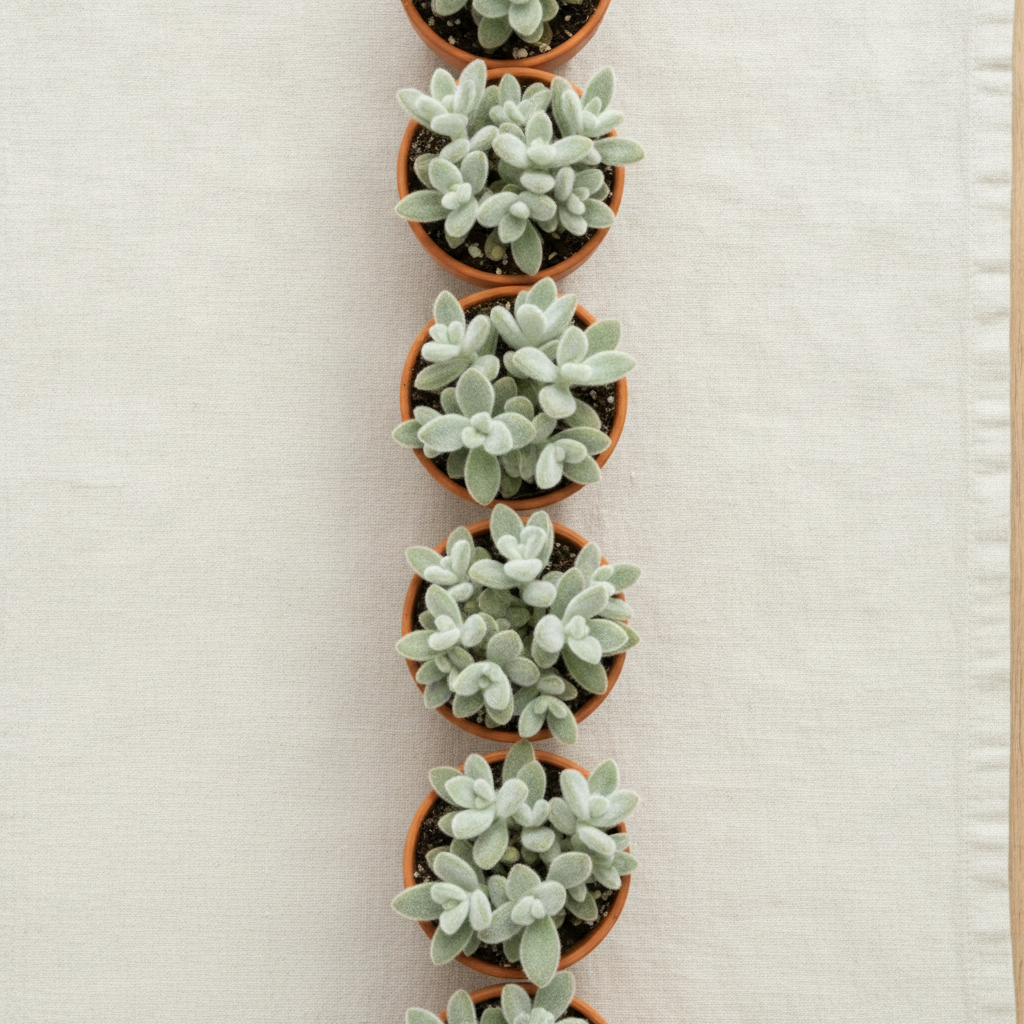
One of the quiet pleasures of growing a panda succulent is how readily it multiplies. Like many kalanchoes it can be propagated from individual leaves as well as from the offsets and rooted rosettes it produces over time, so a single plant can become a windowsill full with very little effort.
Propagation is best attempted in spring or summer, when warmth and light drive quick, reliable rooting. The two most dependable methods are leaf propagation and separating offsets, and both reward patience far more than fuss.
Understanding Leaves and Offsets
Each plump, felted leaf carries dormant cells at its base capable of forming both roots and a new rosette, which is what makes leaf propagation possible. Around the parent, meanwhile, the plant naturally throws up small offsets and side rosettes that already have their own emerging roots. Both routes give you a genetically identical copy of the parent, so the silver felt and compact habit carry through to the next generation.
Leaf Propagation: Step-by-Step
Leaf propagation is the classic kalanchoe method and produces a satisfying number of new plants from a single rosette. The key is a clean break and a patient, dry start.
- Gently twist a healthy, plump leaf from the stem, taking the whole leaf cleanly with its base intact; a partial leaf will not root.
- Lay the leaf on a dry surface out of direct sun for two to three days until the broken end forms a dry callus.
- Set the calloused leaves on top of a tray of barely-moist gritty mix, base touching the surface, without burying them.
- Place the tray in bright, indirect light and mist the soil surface very lightly only every few days, keeping the leaves themselves dry.
- After a few weeks, tiny roots and a miniature rosette appear at the leaf base; let them grow on while the original leaf gradually shrivels and feeds them.
- Once each new rosette has its own roots and is a centimetre or so across, pot it up into its own small container and treat it as a mature plant.
Pro Tip — Take Several Leaves: Not every leaf will take, so start half a dozen at once rather than pinning your hopes on a single one. With a tray of leaves going at the same time, a few failures hardly matter and you end up with plenty of new plants.
Separating Offsets: Step-by-Step
If your plant has produced offsets or clustered into multiple rosettes, division is the fastest way to make new plants, since each offset already has a head start with its own roots.
- Slide the whole plant out of its pot and brush away the loose mix to expose where the offsets join the parent.
- Separate each offset by hand, or cut it free with a clean, sharp blade, making sure it keeps as many of its own roots as possible.
- Let any cut surfaces callus in a dry, shaded spot for a day or two.
- Pot each offset into its own small container of dry gritty mix at the depth it grew before.
- Wait several days, then begin watering sparingly, treating the young plant exactly as you would an adult.
Troubleshooting Propagation
| Problem | Likely Cause | Solution |
|---|---|---|
| Leaf shrivels with no roots | Leaf taken without its base, or kept too dry | Take whole leaves cleanly; barely moisten the mix |
| Leaf or offset turns mushy | Too much moisture before callusing or rooting | Allow a longer callus period; water far less |
| No roots after many weeks | Too cool or too dark | Move somewhere warm and bright; wait for warmer months |
| New rosette stays tiny | Insufficient light | Increase brightness once roots are established |
Pests & Diseases
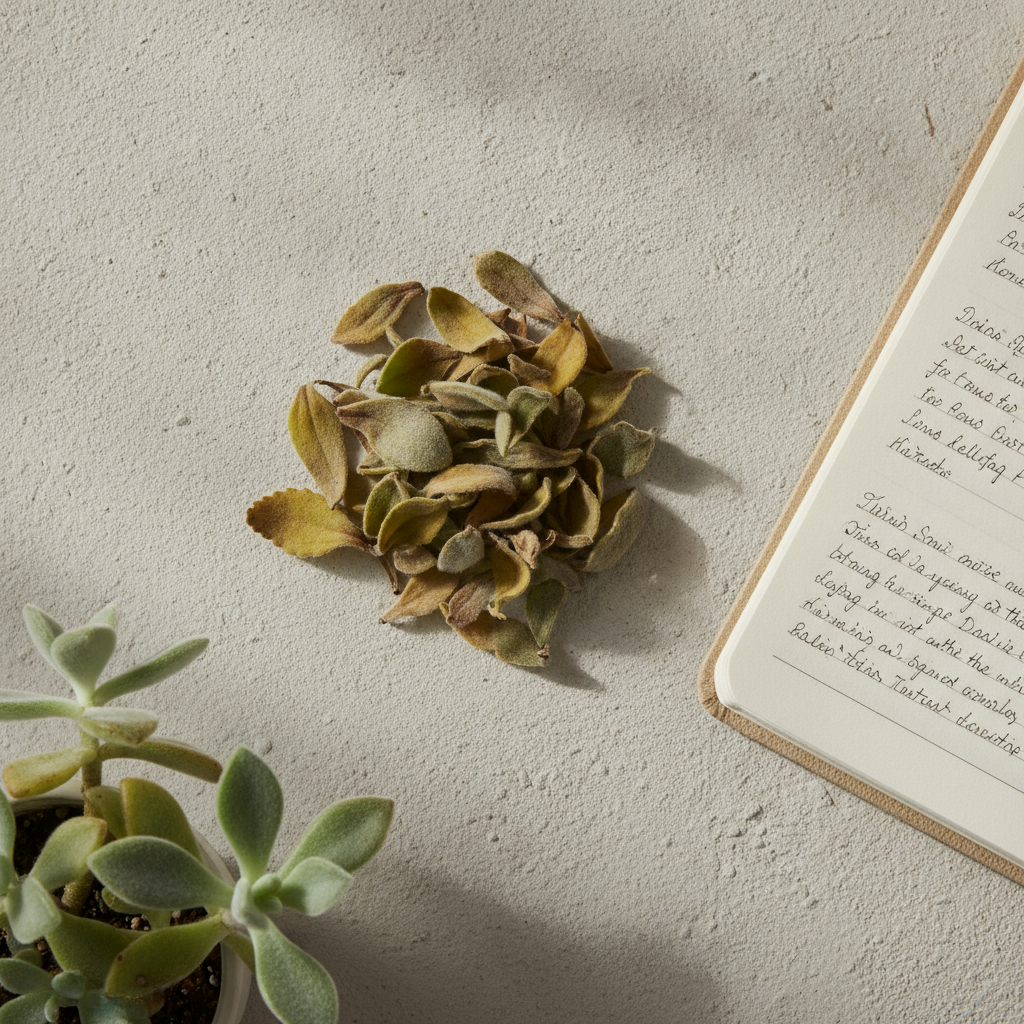
The panda succulent is a robust plant with few serious enemies, but its dense felt offers an inviting hiding place for small pests, and its intolerance of damp makes it prone to a handful of moisture-related diseases. Most problems are easy to head off with good light, careful watering and the occasional close inspection.
Because the woolly leaves can disguise the early stages of an infestation, it pays to look closely now and then, particularly into the crevices where leaves meet the stem. Catching a problem early makes it far simpler to resolve.
Common Pests
Mealybugs (Pseudococcidae)
Mealybugs are the number one pest of the panda succulent, and the felted leaves are practically designed to conceal them. They appear as small, white, cottony tufts tucked into leaf axils and along stems, where they suck sap and weaken the plant. Their own white fuzz blends maddeningly well with the trichomes, so look for tufts that move or cluster in the crevices.
Treatment: Dab each bug directly with a cotton bud dipped in isopropyl alcohol, which dissolves their protective coating on contact. For heavier infestations, treat the whole plant with a systemic succulent insecticide and repeat every week or two until no new bugs appear. Isolate the plant from your other succulents while you deal with it.
Aphids (Aphidoidea)
Aphids are more likely on new growth and on the flower stalks if your plant blooms. These small green, black or pinkish insects cluster on soft tissue, draining sap and leaving a sticky residue of honeydew behind. They multiply quickly but are easy to dislodge.
Treatment: Knock them back with a firm but careful rinse at the soil line, or wipe them away, then treat with insecticidal soap or a diluted neem solution applied to the soil and stems rather than soaking the felted leaves. Repeat until they are gone.
Scale (Coccoidea)
Scale insects show up as small, hard, brown bumps stuck firmly to stems and the undersides of leaves. Unlike mealybugs they barely move, and their waxy shells make them easy to overlook until a colony has established. They too feed on sap and slowly sap the plant’s vigour.
Treatment: Scrape or pick off individual scales with a fingernail or an alcohol-dipped cotton bud, then follow up with a systemic insecticide for any you have missed. Check regularly for several weeks, as the mobile young can re-establish.
Common Diseases
Root and Stem Rot (Fusarium and Pythium species)
By far the most serious threat to a panda succulent, rot is almost always the result of overwatering or a soil that holds too much moisture. It begins out of sight at the roots and works upward, showing as a softening, darkening stem base and leaves that yellow and collapse. Once the crown is affected the plant is usually beyond saving.
Treatment: Act fast. Lift the plant, cut away all soft, brown roots and any rotten tissue with a sterile blade, and salvage the firm, healthy top by letting it callus and rerooting it in fresh dry mix. Prevention through careful watering and gritty soil is far more reliable than any cure.
Leaf Spotting and Fungal Blemishes (various fungi)
Dark or brown spots on the felted leaves usually trace back to water lodging in the trichomes or to damp, stagnant air. The marks themselves are permanent on affected leaves, but the underlying problem is easily corrected and need not spread.
Treatment: Improve airflow, water from below to keep the leaves dry, and remove any badly marked leaves. New growth will come in clean once the conditions are right.
Pest and Disease Summary
| Pest / Disease | Identification | Treatment |
|---|---|---|
| Mealybugs | White cottony tufts in leaf axils | Alcohol dab; systemic insecticide |
| Aphids | Clusters on new growth and flower stalks | Rinse off; insecticidal soap or neem |
| Scale | Hard brown bumps on stems and leaves | Scrape off; systemic insecticide |
| Root and stem rot | Soft, blackening base; collapsing leaves | Cut out rot; reroot healthy top in dry mix |
| Leaf spotting | Dark blemishes on felted leaves | Improve airflow; water from below |
Prevention Strategies
Prevention with this plant comes down to getting the basics right. Strong light, a gritty fast-draining mix, infrequent watering from below and good air movement together eliminate the conditions that pests and diseases need. A healthy, well-grown panda succulent is remarkably resistant to trouble, and most problems are really symptoms of care that has drifted too wet or too dim.
Quarantine any new succulent for a couple of weeks before it joins your collection, since mealybugs and scale travel in on shop-bought plants more often than they arrive any other way. Inspect newcomers closely, and give your existing plants an occasional once-over so that anything that does slip through is caught while it is still a minor nuisance.
Pro Tip — Alcohol on Standby: Keep a small bottle of isopropyl alcohol and a pack of cotton buds with your plant supplies. For the mealybugs that inevitably hide in the felt, spotting one or two and dabbing them out on the day you see them prevents the slow, hard-to-clear infestations that take hold when they are left alone.
Popular Varieties
The panda succulent belongs to a small, charming group of felted kalanchoes from Madagascar, and much of the fun of growing one is appreciating where it sits among its woolly relatives. Kalanchoe eriophylla itself is grown almost entirely as the species, prized precisely for its intense, snow-white felt, but it is regularly sold alongside several near-relatives that share the same fuzzy charm.
Because the common name panda is shared across this group, it is easy to confuse one felted kalanchoe with another at the shop. The table and profiles below set out the species and its most frequently encountered cousins so you can tell what you are bringing home.
| Variety | Leaf Appearance | Light Needs | Growth Rate | Availability |
|---|---|---|---|---|
| Snow White Panda (species) | Small oval leaves in dense white felt | Bright to direct sun | Slow | Specialist growers |
| Panda Plant (K. tomentosa) | Larger grey-green leaves, brown-dotted edges | Bright to direct sun | Slow to moderate | Common |
| Chocolate Soldier | Narrow leaves with rich brown margins | Bright to direct sun | Slow to moderate | Common |
| Teddy Bear | Plump leaves in warm cinnamon-brown felt | Bright to direct sun | Slow | Fairly common |
| Felt Bush (K. beharensis) | Large triangular felted leaves, shrubby | Bright to direct sun | Moderate | Specialist growers |
Featured Varieties
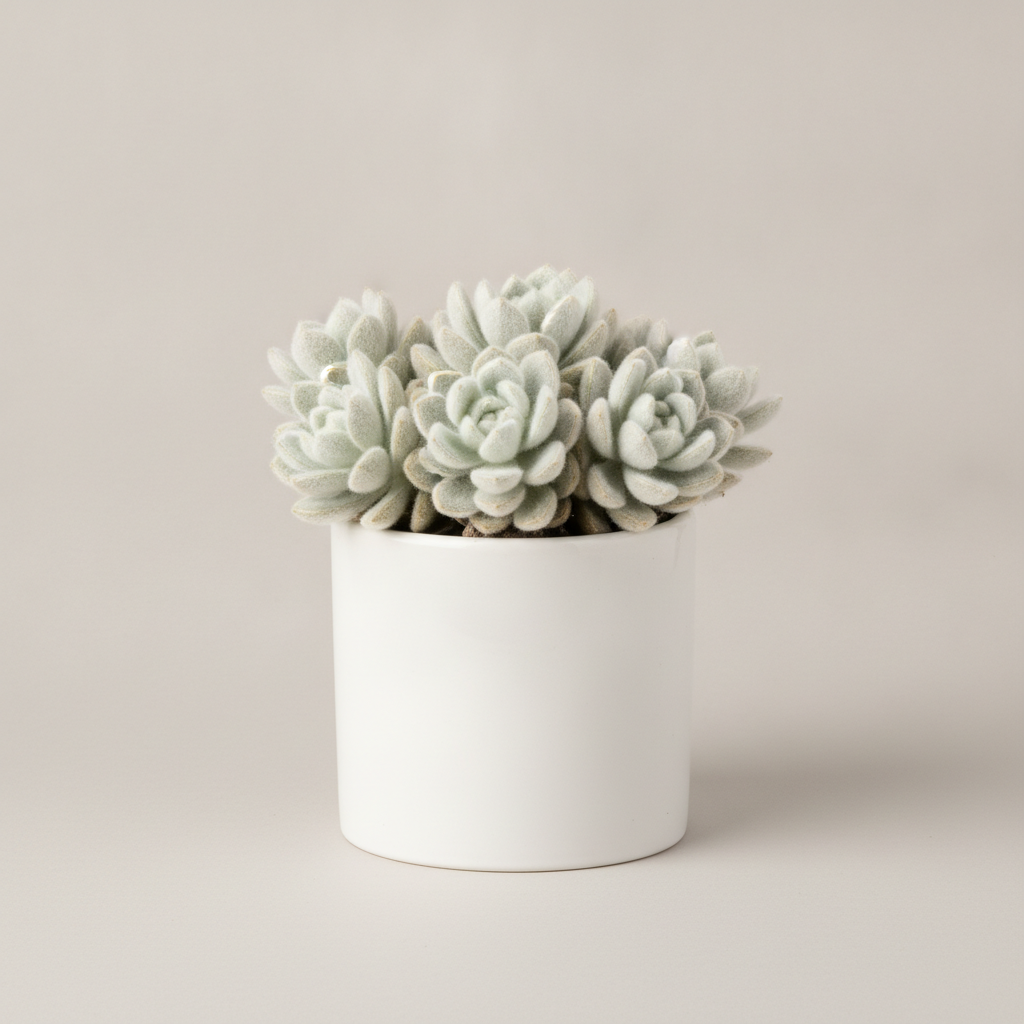
Snow White Panda (Species Form)
The true Kalanchoe eriophylla, with rounded leaves packed into low rosettes under a coat of brilliant white wool. It is the whitest and most compact of the felted kalanchoes and the one this guide describes.
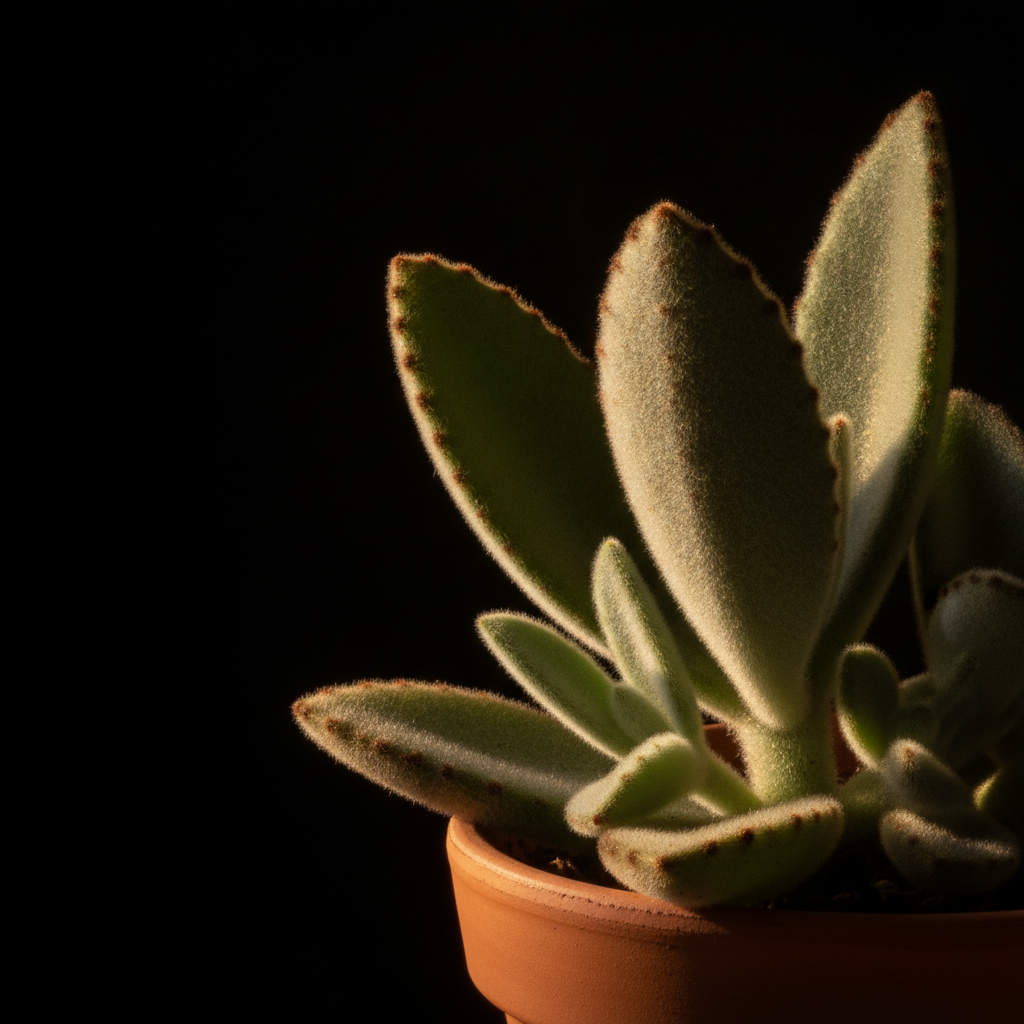
Panda Plant (Kalanchoe tomentosa)
The larger, more upright relative most people picture as the panda plant, with grey-green felted leaves edged in chocolate-brown dots. It shares identical care and is the variety most often confused with the snow white species.
Variety Profiles in Detail
Snow White Panda (Kalanchoe eriophylla)
The headline plant of this guide is among the most heavily felted of all succulents. Its small, almost spherical leaves are so densely coated in fine white hairs that the plant glows silver in bright light, and it stays low and compact, slowly mounding into a cushion rather than reaching upward. It is the connoisseur’s panda, less common in general shops but worth seeking out from specialist succulent growers.
Panda Plant (Kalanchoe tomentosa)
The familiar, widely sold panda plant grows taller and more shrubby, with elongated grey-green leaves trimmed in neat rows of rusty brown along their tips and edges. It is the easiest of the group to find and an excellent companion to the snow white species, asking for exactly the same bright light and lean, dry treatment.
Chocolate Soldier (Kalanchoe tomentosa cultivar)
A popular selection of the panda plant with narrower leaves and especially rich, dark brown margins that give it a more dramatic, two-tone look. Its care is identical, and it makes a striking contrast planted beside the pale, silvery snow white panda.
Felt Bush (Kalanchoe beharensis)
At the opposite end of the size range, the felt bush is the giant of the felted kalanchoes, capable of growing into a small shrub with large, sculptural, triangular leaves coated in soft bronze fuzz. It is far bigger than the panda succulent but shares the same love of sun and loathing of wet feet, making it a dramatic statement plant for those with the space.
Choosing the Right Variety for Your Space
For a small, sun-drenched windowsill, the snow white species and the classic panda plant are the natural choices, staying compact and undemanding while delivering all the felted charm anyone could want. If you have a bright corner with room to spare and fancy a bolder specimen, the felt bush brings the same texture on a much grander scale. Whichever you choose, the care is essentially the same across the group: give it the sunniest spot you have, plant it in gritty mix, water it rarely, and let its woolly leaves do the rest.
Frequently Asked Questions
Why is my panda succulent stretching out and losing its white colour?
This is etiolation, and it means the plant is not getting enough light. Stretched stems and thin, greener, less woolly leaves are its way of reaching for a brighter source. Move it to your sunniest window or add a grow light. The existing stretched growth will not tighten back up, but new growth will be compact and white once the light improves, and you can propagate the best rosettes to start fresh.
How often should I water a panda succulent?
Only when the mix has dried out completely, which in a bright spot usually works out to every two to three weeks in summer and as little as once a month or less in winter. Rather than following a fixed schedule, lift the pot to feel its weight and check that the soil is bone dry before watering. When unsure, wait; this plant tolerates drought far better than excess water.
Can I get the felted leaves wet?
It is best not to. Water trapped in the woolly trichomes can leave permanent marks and create a damp pocket where rot and fungal spotting begin. Water at the soil line or from below, and never mist the plant. If a leaf does get splashed, move the plant somewhere with good airflow so it dries quickly.
Is the panda succulent toxic to cats and dogs?
Yes. Like all kalanchoes it contains bufadienolide compounds that are toxic to cats and dogs and can cause vomiting, drooling and, in larger amounts, heart-rhythm disturbances. It is also mildly irritating to humans if eaten. Keep it well out of reach of pets and children, and contact a vet if an animal has eaten any part of it.
Why are the lower leaves of my plant shrivelling?
A few of the oldest, lowest leaves slowly shrivelling is normal as the plant ages and sheds them. If many leaves across the plant are wrinkling and softening at once, though, it is usually thirsty, so check whether the mix has been dry for too long and give it a thorough watering. If the shrivelled leaves are instead mushy and translucent, the cause is overwatering rather than drought.
Does the panda succulent flower indoors?
It can, though flowering is uncommon and unpredictable in the home. Mature, well-grown plants given plenty of sun may produce small, modest bell-shaped blooms, but most people grow this plant purely for its foliage. Do not be disappointed if it never flowers; the silvery felt is the real attraction.
What is the difference between Kalanchoe eriophylla and Kalanchoe tomentosa?
Both are felted panda kalanchoes, but Kalanchoe eriophylla, the snow white panda, is smaller, more compact and far whiter, with rounded leaves in low rosettes. Kalanchoe tomentosa, the classic panda plant, is larger and more upright, with elongated grey-green leaves edged in chocolate-brown dots. Their care is identical, so the choice is purely about looks.
Why is the base of my plant turning black and soft?
A blackening, soft stem base is root or stem rot, almost always caused by overwatering or a soil that holds too much moisture. Act quickly by removing the plant from its pot, cutting away all rotten tissue with a sterile blade, and rerooting the firm, healthy top in fresh dry gritty mix after letting it callus. In future, water less and make sure the mix drains fast.
Can I grow my panda succulent outdoors?
In a warm, frost-free climate it grows happily outdoors in a bright, sheltered spot with excellent drainage, kept out of prolonged rain so the leaves and soil never stay wet. In cooler regions move it outside only for the warm months, acclimatising it gradually to stronger light, and bring it in well before temperatures drop towards 10 degrees Celsius (50 Fahrenheit), as it is not frost hardy.
How big does a panda succulent get?
The snow white panda stays small and slow, generally reaching only about 15 to 20 centimetres (6 to 8 inches) across and tall over many years, slowly mounding into a low cushion of rosettes. Its compact, undemanding size is part of its appeal and means it rarely needs more than a small pot and a sunny sill.






