
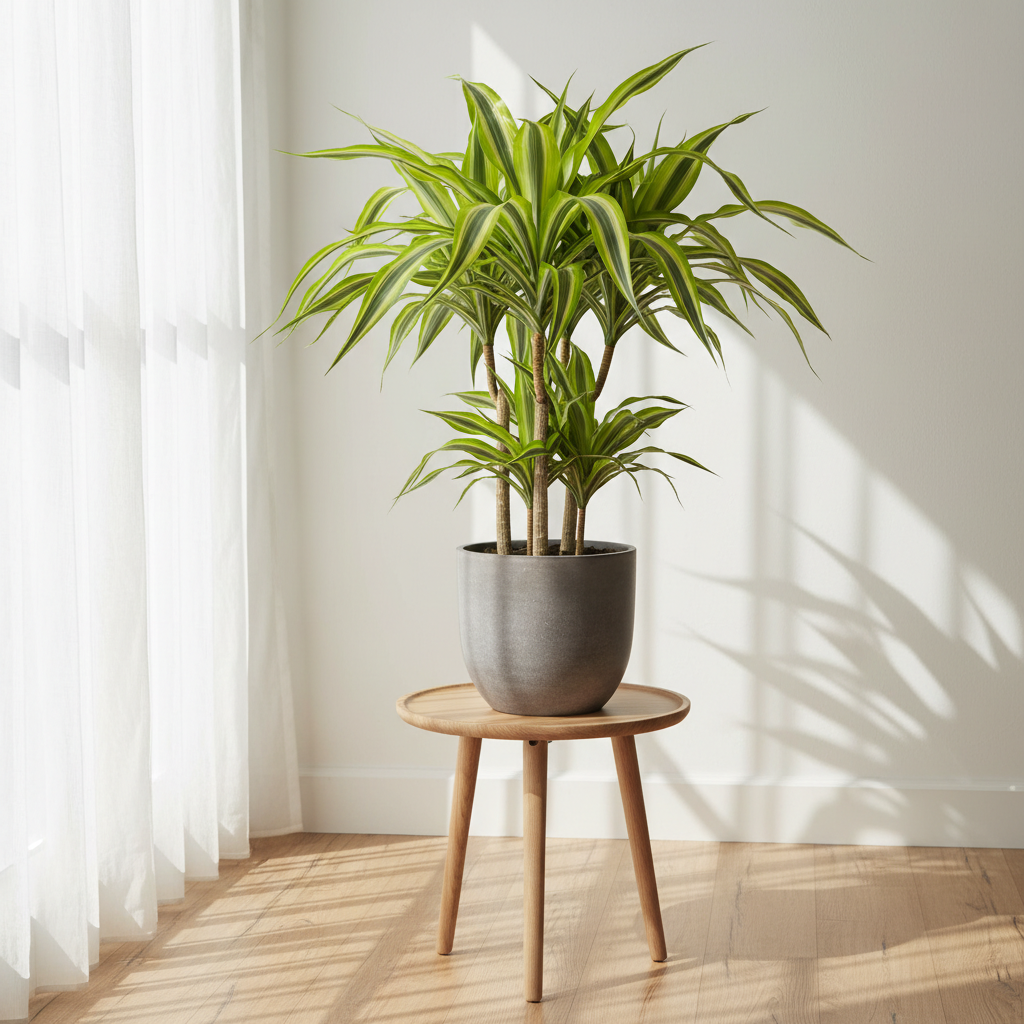
Few houseplants announce themselves as cheerfully as the Lemon Lime dracaena, a cultivar of Dracaena fragrans whose long, arching leaves are painted in electric bands of chartreuse, lime and soft grey-green. Sold under names such as Lemon Lime Dracaena and Striped Dracaena, it belongs to the same forgiving species as the classic corn plant, and it carries all of that plant’s easygoing nature while adding a jolt of colour that few green-on-green foliage plants can match. Native to the tropical woodlands of West and Central Africa, it grows there as an understorey shrub or small tree, which is precisely why it copes so gracefully with the dim, dry, centrally heated rooms most of us call home.
The Lemon Lime has earned a reputation as one of the most beginner-friendly variegated plants available, and that reputation is deserved. It tolerates low light, irregular watering and long gaps between feeds without dropping its good looks. Yet there is a clear gap between a plant that merely survives and one that genuinely thrives, with thick canes, dense crowns of glowing foliage and steady new growth. This guide walks through every element of its care, from reading light levels and judging when to water, through soil, feeding, propagation and pest control, so you can move your plant firmly into thriving territory.
Contents
- Quick Reference
- Why Lemon Lime Dracaena Makes a Great Houseplant
- Light Requirements
- Watering & Humidity
- Soil, Potting & Repotting
- Fertilising
- Propagation
- Pests & Diseases
- Popular Varieties
- Frequently Asked Questions
Quick Reference: Lemon Lime Dracaena at a Glance
| Light | Bright indirect light is ideal; tolerates medium and low light, though variegation dulls in the dimmest spots. No harsh direct sun. |
| Watering | Allow the top 3 to 5 cm (1 to 2 in) of soil to dry between waterings. Roughly every 7 to 14 days in growth, less in winter. |
| Temperature | 18 to 24 degrees C (65 to 75 degrees F). Avoid anything below 12 degrees C (54 degrees F) and cold draughts. |
| Humidity | Average household humidity (40 to 50 per cent) is fine. Appreciates 50 per cent or more but tolerates drier air. |
| Fertiliser | Balanced liquid feed at half strength once a month in spring and summer. None in autumn and winter. |
| Toxicity | Toxic to cats and dogs if eaten, due to saponins. Keep out of reach of pets and small children. |
Why Lemon Lime Dracaena Makes a Great Houseplant
The strongest argument for the Lemon Lime dracaena is the rare combination of striking colour and genuine durability. Most plants with vivid variegation demand bright light and careful watering to keep their patterns, but this dracaena holds its lime-and-grey stripes across a wide range of conditions and shrugs off the kind of inconsistent care that would defeat a calathea or a fittonia. It is a plant you can leave for a fortnight and return to find unbothered, which makes it a favourite for offices, rented flats and the homes of self-confessed serial plant-killers.

Beyond looks and resilience, the Lemon Lime earns its place through architecture and air. Mature plants form thick, woody canes topped with fountains of foliage, giving a room the vertical, tree-like presence that smaller leafy plants cannot. It grows slowly and predictably, so it rarely outgrows its spot in a hurry, and it features in NASA’s much-cited clean-air research, where dracaenas were noted for removing common indoor pollutants. While the real-world air-cleaning effect of a single pot is modest, the plant’s contribution to a calmer, greener interior is not in doubt.
Important — Toxicity: Like all dracaenas, the Lemon Lime contains saponins that are toxic to cats and dogs. Chewing the leaves can cause vomiting, drooling, loss of appetite and, in cats, dilated pupils. It is not considered seriously dangerous to humans but is best kept away from curious pets and toddlers who might nibble.
Light Requirements
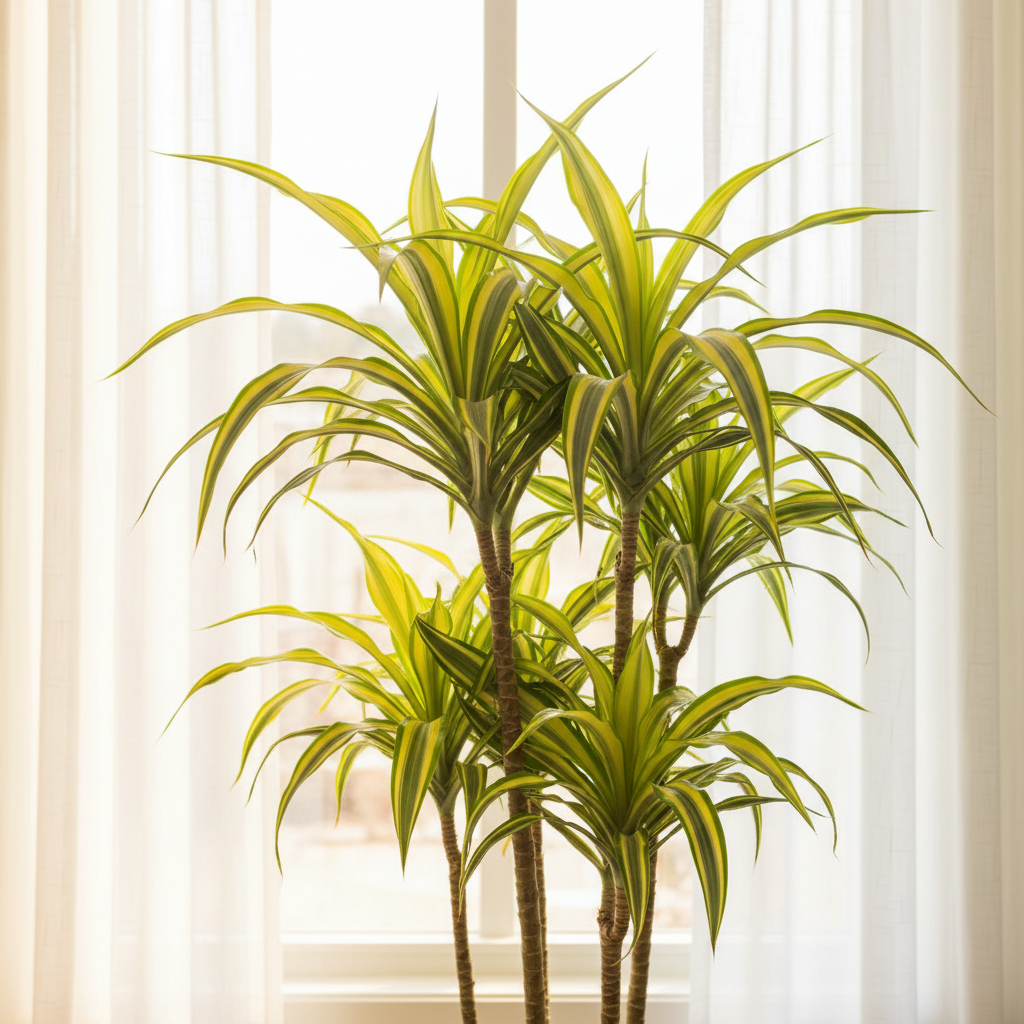
In its native African woodlands the Lemon Lime grows beneath a canopy of taller trees, bathed in dappled, filtered light rather than open sun. That heritage shapes everything about its preferences indoors. It is happiest in bright, indirect light, where the lime margins glow at their most saturated and the plant pushes out steady new growth, but it will hold its own in medium and even low light far better than most variegated species.
The ideal position is a few feet back from a bright window, or directly beside one that receives gentle morning or filtered light. In these conditions the central grey-green stripe stays crisp, the chartreuse edges stay vivid, and the leaves arch outward in a full, even crown rather than stretching awkwardly toward the nearest light source.
Light Levels Explained
Understanding how the Lemon Lime responds across the spectrum of indoor brightness makes placement far easier. The table below summarises the outcome you can expect in each light category.
| Light Category | Approx. Level | Typical Location | Outcome |
|---|---|---|---|
| Direct sun | Over 50,000 lux | On an unshaded south or west sill | Risk of bleaching and brown scorch patches; avoid |
| Bright indirect | 10,000 to 25,000 lux | Near an east window or back from a bright one | Best growth and most vivid variegation |
| Medium | 5,000 to 10,000 lux | Centre of a well-lit room | Good growth, slightly softer colour |
| Low | 1,000 to 5,000 lux | A north room or a few metres from a window | Survives well, slower growth, paler stripes |
| Very low | Under 1,000 lux | A hallway or interior office | Persists for months but weakens over time |
Window Orientation and Placement
South-facing window: Offers plenty of light but also the strongest midday sun. Set the plant a metre or more back, or filter the glass with a sheer curtain, to enjoy the brightness without scorching the foliage.
East-facing window: Close to ideal. The gentle morning sun is rarely strong enough to burn, and the bright indirect light through the rest of the day keeps growth steady and colour rich.
West-facing window: Workable, though the harsher afternoon sun can scorch leaves placed right against the glass. A little setback or a light curtain solves the problem.
North-facing window: Provides cool, even light with no risk of burning. Growth slows and variegation softens, but the Lemon Lime tolerates a north room better than almost any other striped foliage plant.
Pro Tip — Even Growth: Dracaenas lean noticeably toward their light source. Give the pot a quarter turn each time you water and the crown will stay balanced and full rather than developing a one-sided, reaching habit.
How Light Affects Variegation
The defining feature of this cultivar is its variegation, and light is the main lever that controls it. In bright indirect conditions the lime and chartreuse margins reach their fullest intensity, contrasting sharply with the grey-green centre. As light drops, the plant produces more chlorophyll to compensate, so new leaves emerge greener and the yellow edges narrow and dull. The change is gradual and entirely reversible, so moving a faded plant back toward brighter light will restore the colour on subsequent growth.
Warning — Direct Sunlight: Despite tolerating a wide range of light, the Lemon Lime is not built for hours of unfiltered sun. Prolonged direct exposure bleaches the lime margins to a sickly cream and burns dry, brown patches into the leaf surface that never recover. Filter strong light or move the plant back from the glass.
Artificial Lighting
The Lemon Lime adapts readily to artificial light, which is part of why it is such a stalwart of windowless offices. A standard full-spectrum LED grow light positioned 30 to 60 cm (12 to 24 in) above the crown, running for 10 to 12 hours a day, easily replaces a bright window. Even ordinary bright office lighting on for most of the working day is enough to keep a plant in good health, if not at its most vivid.
Seasonal Adjustments
Light indoors falls sharply between autumn and spring in temperate climates. As the days shorten, move the plant closer to its window to compensate for the weaker, lower sun, and clean the glass and the leaves so nothing blocks what light there is. Come spring, watch for signs of too much direct sun returning and shift the plant back to its summer position if the new light proves too intense.
Watering & Humidity
If there is one skill that separates a thriving Lemon Lime from a struggling one, it is watering judged by the soil rather than the calendar. This is a plant adapted to seasonal tropical woodlands where soil dries between rains, so it stores a little moisture in its thick canes and strongly prefers to dry out partway down before being watered again. Overwatering, not underwatering, is the most common cause of decline.
When to Water
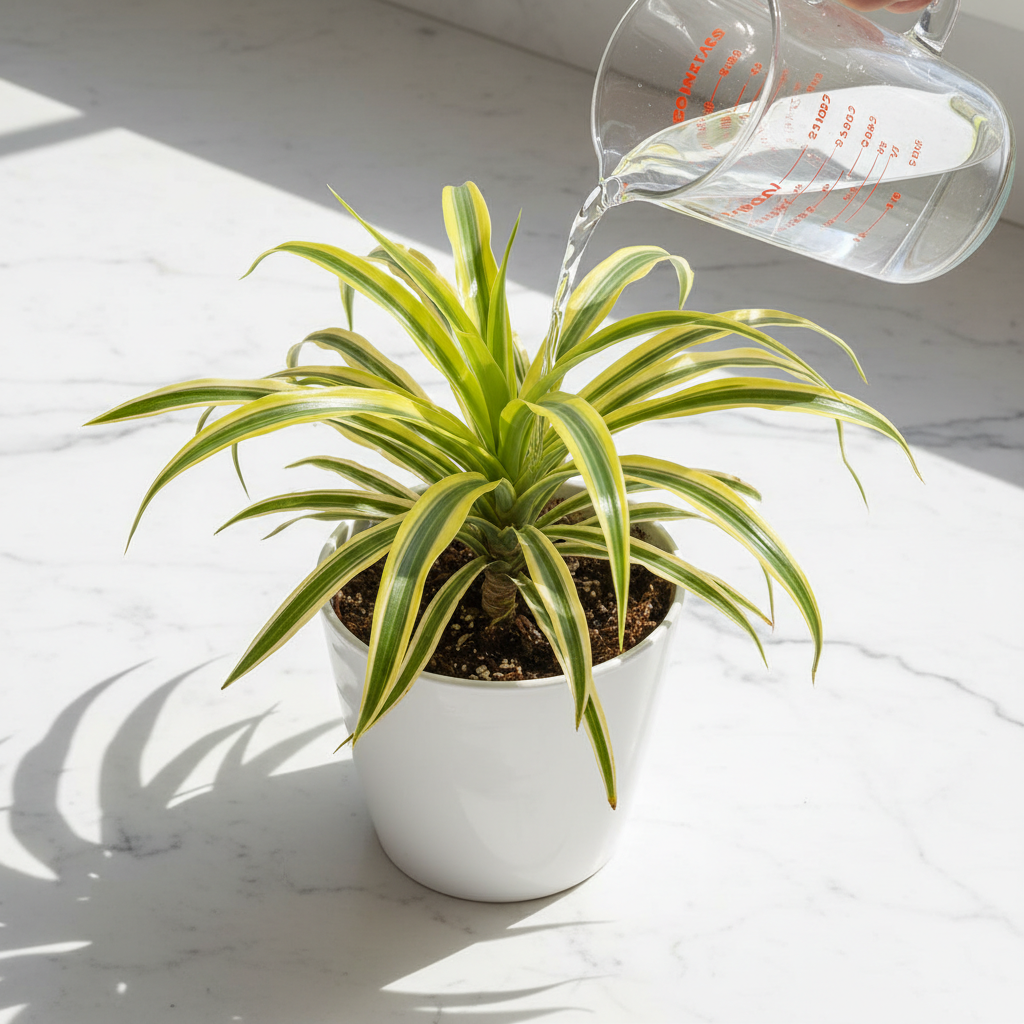
The reliable test is your finger. Push it into the soil to the second knuckle, and water only when the top 3 to 5 cm (1 to 2 in) feel dry. In a bright, warm room during the growing season this typically falls every 7 to 14 days, but the exact interval depends on pot size, light and temperature, so check the soil rather than trusting a fixed schedule.
In autumn and winter, growth slows and the soil stays damp for much longer, so stretch the interval considerably and let the plant approach dryness before watering. A Lemon Lime kept barely moist through a cool, dim winter is far healthier than one watered on its summer routine, which would leave the roots sitting cold and wet.
Pro Tip — Lift the Pot: Get to know the weight of your plant when freshly watered and again when it needs a drink. Lifting the pot becomes a faster, more reliable gauge of soil moisture than any schedule, especially for larger specimens in deep containers.
How to Water Correctly
- Check that the top few centimetres of soil are dry before you begin.
- Water slowly and evenly across the whole surface, not just one side.
- Continue until water flows freely from the drainage holes, ensuring the entire root ball is moistened.
- Let the pot drain fully for several minutes in a sink or on a tray.
- Tip away any water that collects in the saucer or cover pot so the roots never sit in it.
Signs of Overwatering vs. Underwatering
| Symptom | Overwatering | Underwatering |
|---|---|---|
| Leaf colour | Yellowing across whole leaves, often lower ones first | Pale, dull leaves with dry, crisp tips and edges |
| Leaf texture | Soft, limp, sometimes translucent | Dry, papery, curling inward |
| Soil | Stays wet for days, may smell sour | Bone dry, pulling away from the pot sides |
| Roots | Brown, mushy, foul-smelling | Dry and brittle but not rotten |
| Cane base | Soft or spongy near the soil line | Firm but the crown may wilt and droop |
Warning — Root Rot: A soft, blackening cane base and a sour smell from the soil signal advanced root rot, the most serious threat to this plant. Unpot it at once, cut away every mushy root and any rotten section of cane, and repot the firm remainder into fresh, dry, free-draining mix. Caught early, the plant often recovers.
Humidity Requirements
The Lemon Lime is comfortable in the average household humidity of 40 to 50 per cent, which is one more reason it suits ordinary homes so well. It appreciates a slightly more humid atmosphere of 50 per cent or above, where leaf tips stay greener and broader, but it does not demand it the way a fern or calathea would.
The most common humidity-related complaint is brown, crispy leaf tips. While very dry air contributes, in dracaenas this is more often caused by mineral build-up from tap water than by humidity alone, so do not assume your air is to blame before checking your watering and water quality.
If you do want to raise humidity, the most effective methods are grouping plants together so they share transpired moisture, standing the pot on a tray of pebbles topped up with water, or running a small humidifier nearby in winter when central heating dries the air. Misting offers only a brief, marginal lift and is not worth relying on.
Water Quality
Dracaenas are unusually sensitive to fluoride, chlorine and dissolved salts, all of which accumulate in the leaf tips and cause the characteristic brown, scorched margins. If your tap water is heavily treated and your plant suffers persistent tip burn, switch to rainwater, distilled water or tap water left to stand uncovered overnight so some of the chlorine dissipates. This single change resolves more dracaena tip problems than any humidity measure.
Soil, Potting & Repotting
The right soil does much of the watering work for you. Because the Lemon Lime hates sitting in moisture, the goal is a mix that holds enough water to keep the roots hydrated while draining quickly so excess passes straight through. A dense, water-retentive compost used straight from the bag is the wrong choice and a frequent cause of root rot.
Ideal Soil Composition
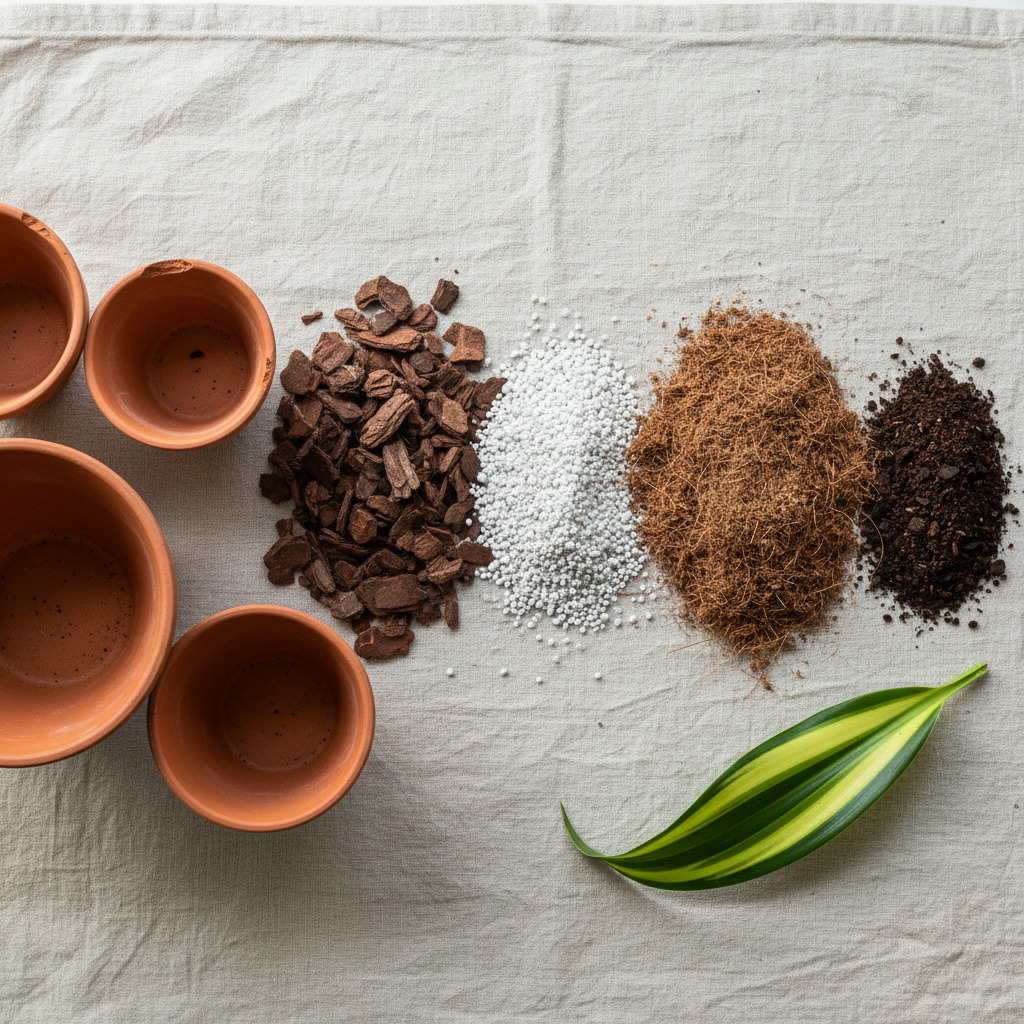
Start with a good general-purpose houseplant compost as the base, then lighten it with materials that open up the structure and improve drainage. The aim is a mix that feels loose and airy, never claggy, and that water runs through rather than pooling on top.
| Component | Proportion | Function |
|---|---|---|
| Houseplant compost | 60 per cent | Holds moisture and nutrients, provides body |
| Perlite or pumice | 20 per cent | Opens the mix for drainage and aeration |
| Orchid bark or coco coir | 20 per cent | Adds structure and prevents compaction |
The Lemon Lime prefers a slightly acidic to neutral soil with a pH between roughly 6.0 and 6.5, which most peat-free and standard houseplant composts fall within naturally, so there is rarely any need to adjust it.
Pro Tip — Quick Mix Recipe: For a fast, reliable blend, combine two handfuls of houseplant compost with one handful of perlite and one of orchid bark. It drains freely, resists compaction and suits every dracaena in your collection, not just the Lemon Lime.
Choosing the Right Pot
The container matters as much as the mix inside it. A well-chosen pot lets the soil dry at a healthy pace and gives the roots room without drowning them in surplus damp compost.
Drainage holes are non-negotiable. The Lemon Lime should never sit in a pot without drainage. If you love a decorative cover pot that has no holes, keep the plant in a plain plastic nursery pot inside it and lift that inner pot out to water, returning it only once it has drained completely.
Pot material: Terracotta is forgiving because its porous walls wick away excess moisture, which suits a plant prone to overwatering. Glazed ceramic and plastic hold water longer, so if you use them, lean toward a grittier mix and water a little more cautiously.
Pot size: Choose a pot only 2 to 4 cm (1 to 2 in) wider than the current root ball. An oversized pot holds a large reservoir of wet soil around the roots that dries too slowly, which is a direct invitation to rot.
When to Repot
The Lemon Lime is a slow grower that is perfectly content slightly root-bound, so it needs repotting only every two to three years. The signs that it is time are roots circling the inside of the pot or emerging from the drainage holes, water running straight through without wetting the soil, or growth stalling despite good care. Spring, at the start of the active season, is the best time to do it.
How to Repot: Step-by-Step
- Water the plant a day or two beforehand so the root ball holds together and slides out cleanly.
- Ease the plant from its pot, supporting the canes near the base rather than pulling on the foliage.
- Tease apart any tightly circling roots and trim away any that are soft, brown or rotten.
- Add a layer of fresh mix to the new pot, then set the plant so it sits at the same depth as before.
- Fill around the root ball with fresh mix, firming gently to remove large air pockets.
- Water thoroughly to settle the soil, then let the pot drain completely before returning it to its spot.
Warning — Transplant Shock: Expect a brief sulk after repotting, sometimes a little leaf droop or a paused growth. Keep the plant in stable, bright indirect light, resist the urge to overwater the fresh mix, and do not fertilise for four to six weeks while the disturbed roots recover.
Fertilising
The Lemon Lime is a light feeder, and that is a feature rather than a limitation. In the wild it grows in lean woodland soils, so it needs only modest, regular nutrition to keep its foliage dense and its colour bright. The greater risk is overfeeding, which builds up salts that scorch those sensitive leaf tips.
Feed only during the active growing season of spring and summer, and stop entirely through autumn and winter when the plant is resting. Fertiliser applied to a dormant, slow-growing dracaena is not taken up and simply accumulates in the soil as harmful salt.
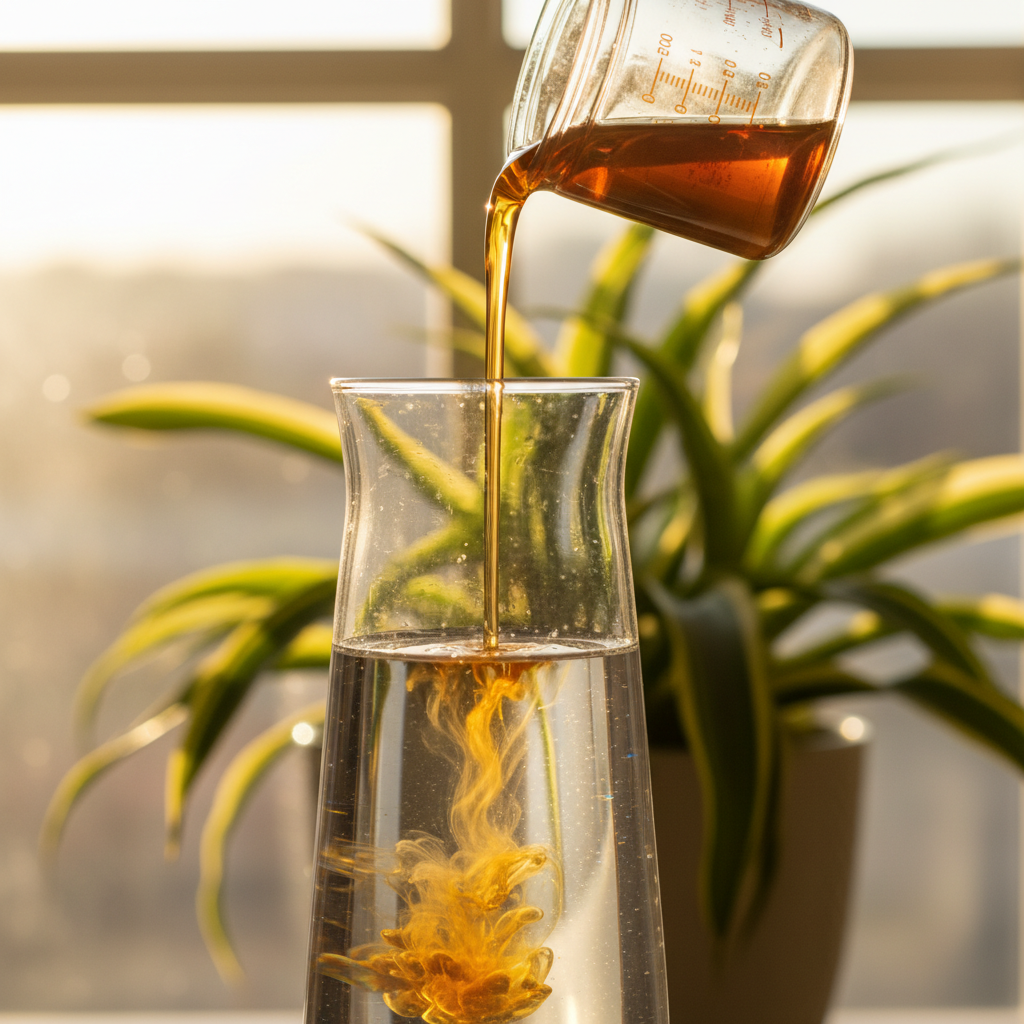
Understanding Plant Nutrients
A balanced fertiliser supplies the three macronutrients plants need in the largest amounts, nitrogen, phosphorus and potassium, shown on the bottle as the N-P-K ratio. For a foliage plant like the Lemon Lime, a balanced or slightly nitrogen-leaning feed keeps the leaves growing well. The table below outlines the key nutrients and what their absence looks like.
| Nutrient | Symbol | Primary Function | Deficiency Symptoms |
|---|---|---|---|
| Nitrogen | N | Drives leaf and stem growth and green colour | Older leaves yellow uniformly, growth slows |
| Phosphorus | P | Supports root growth and energy transfer | Stunted growth, dull or purplish foliage |
| Potassium | K | Regulates water use and overall vigour | Yellowing and browning at leaf edges |
| Magnesium | Mg | Central to chlorophyll and photosynthesis | Yellowing between the veins of older leaves |
| Iron | Fe | Needed to form chlorophyll in new growth | Yellowing between the veins of young leaves |
Types of Fertiliser
Liquid fertilisers: The easiest and most controllable option for this plant. Diluted into the watering can, they deliver nutrients evenly and let you dial the strength down, which suits the Lemon Lime’s modest appetite perfectly.
Slow-release granular: Convenient pellets that release nutrients gradually over months. They work well but offer less control over dosing, so use them sparingly and only at the start of the growing season.
Organic fertilisers: Worm castings, diluted seaweed and similar gentle feeds release nutrients slowly and improve soil life, with little risk of the salt build-up that synthetic feeds can cause. A good choice for cautious growers.
Feeding Schedule
A simple and safe routine is a balanced liquid feed at half the recommended strength once a month from spring through to the end of summer. That is enough to support steady growth and rich variegation without overwhelming the plant. Skip feeding entirely from autumn until growth resumes the following spring.
Pro Tip — Less Is More: When in doubt, underfeed. A Lemon Lime that is fed too little simply grows a touch more slowly, while one that is fed too much develops scorched tips and salt crusts on the soil that are far harder to put right.
How to Fertilise
- Water the plant lightly first if the soil is very dry, so the feed does not burn dry roots.
- Dilute the liquid fertiliser to half the strength stated on the label.
- Apply it evenly across the soil surface in place of a normal watering.
- Let any excess drain away, and never leave fertiliser solution standing in the saucer.
Warning — Salt Build-Up: A white crust on the soil surface or around the pot rim signals accumulated fertiliser salts. Flush the soil two or three times a year by running plenty of clean water through the pot until it drains freely, carrying the salts away and protecting those vulnerable leaf tips.
Propagation
Propagating a Lemon Lime is satisfyingly simple and, conveniently, it doubles as a way to rejuvenate a plant that has grown tall and leggy. Because dracaenas grow from a single cane, you can cut that cane into sections and root each one, turning one overgrown specimen into several bushy young plants.
The best time to propagate is spring or early summer, when warmth and lengthening days drive fast rooting. Both of the reliable methods, stem cuttings and tip cuttings, are straightforward and forgiving of small mistakes.
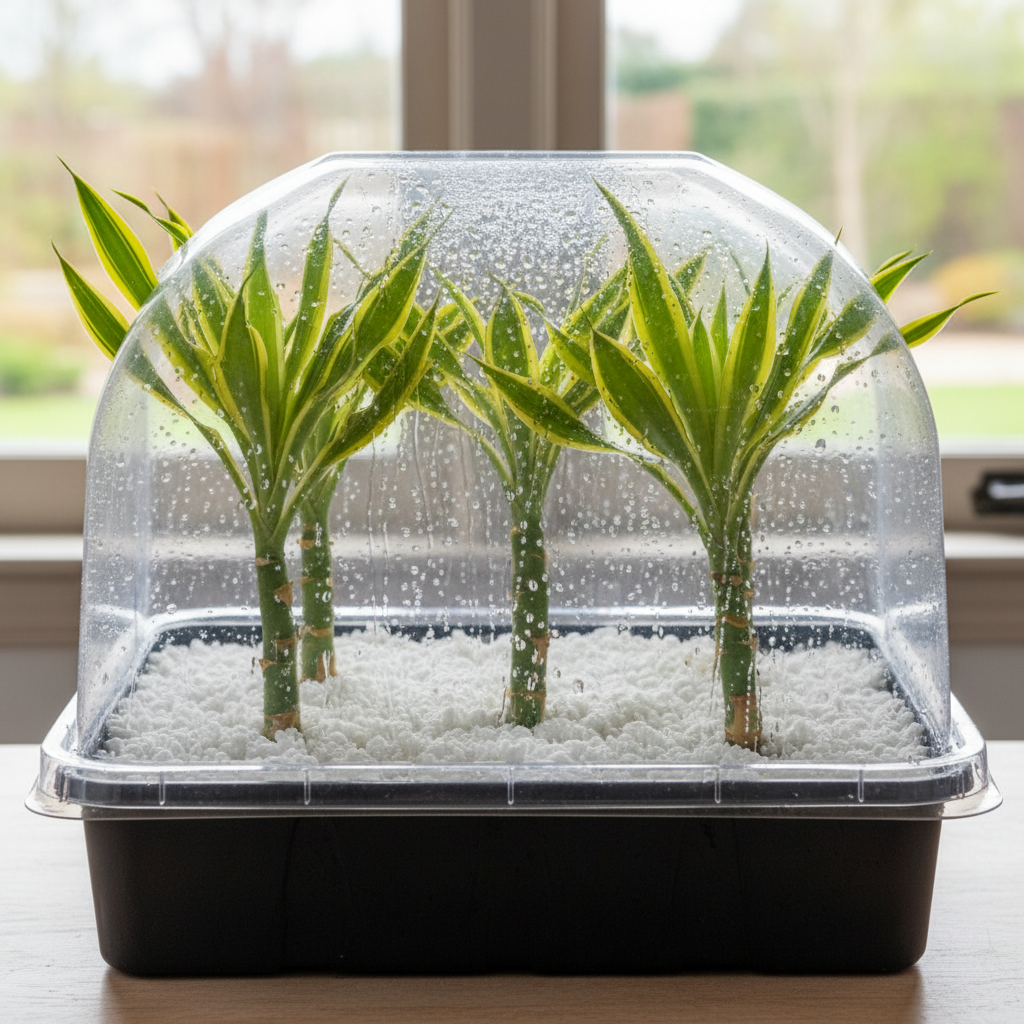
Understanding Canes and Growth Points
A dracaena cane carries dormant growth buds along its length, hidden beneath the bark. When you behead the plant, the parent cane sprouts new shoots from the buds just below the cut, while the removed top roots into a new plant. Knowing this, you can plan your cuts to shape both the parent and the offspring, and you will understand why a cut cane is not the end of a plant but the start of two.
Tip Cuttings: Step-by-Step
Tip cuttings use the leafy crown of the plant and are the fastest way to a presentable new specimen, since the cutting already carries foliage.
- Using clean, sharp secateurs, cut the top 10 to 15 cm (4 to 6 in) of a cane, just below a cluster of leaves.
- Remove the lowest leaves so a few centimetres of bare stem remain.
- Let the cut end callus over for an hour or two, then dip it in rooting hormone if you have it.
- Insert the bare stem into damp perlite or a free-draining mix, or stand it in a glass of water.
- Keep it warm and brightly but indirectly lit, refreshing the water or misting the medium to maintain humidity.
- Roots usually appear within three to six weeks; pot up once they reach a few centimetres long.
Pro Tip — Mind the Orientation: With cane cuttings it is easy to plant a section upside down, and a reversed cutting will never root. Mark the bottom end with an angled cut and the top with a straight cut as you go, so you always know which way is up.
Cane Cuttings: Step-by-Step
Cane cuttings use the bare, leafless sections of stem and are how growers turn one leggy plant into a batch of new ones.
- Cut the leafless cane into sections 8 to 15 cm (3 to 6 in) long, each with at least one or two visible growth nodes.
- Keep track of which end of each section was lower on the plant, as this is the end that must go into the medium.
- Allow the cut ends to callus for a day in a dry, shaded spot.
- Push the lower end a few centimetres into damp, free-draining mix, keeping the section upright.
- Place under a clear dome or loose bag to hold humidity, in warm, bright indirect light.
- New shoots emerge from the top nodes over several weeks as roots form below; pot on once growth is established.
Troubleshooting Propagation
| Problem | Likely Cause | Solution |
|---|---|---|
| Cutting rots at the base | Medium too wet or cut end not calloused | Use a barely damp medium and let cuts callus first |
| No roots after many weeks | Too cold, or cutting planted upside down | Provide warmth and confirm correct orientation |
| Cutting shrivels and dries | Air too dry or medium fully dried out | Raise humidity with a dome and keep the medium just moist |
| Shoots appear but no roots | Stored cane energy fuelling early growth | Be patient and keep conditions stable while roots catch up |
Pests & Diseases
The Lemon Lime is not especially prone to pests, but no houseplant is immune, and the dry indoor air of a heated home can tip the balance toward sap-sucking insects. Most problems are caught early and cleared up easily with regular inspection and prompt, simple treatment.
The single most useful habit is to look over your plant whenever you water, paying attention to the undersides of leaves and the leaf axils where pests like to hide. A problem spotted in its first week is far easier to deal with than an infestation that has had a month to spread.

Common Pests
Spider Mites (Tetranychus urticae)
The most likely pest on a dracaena in dry air. These tiny mites speckle the leaves with fine pale dots and spin delicate webbing in the leaf axils. Left unchecked, they bronze and weaken whole leaves.
Treatment: Rinse the foliage thoroughly, raise humidity, and treat with insecticidal soap or neem oil every few days until they are gone. Repeated treatment is essential to break their fast breeding cycle.
Mealybugs (Pseudococcus species)
Small white insects that look like specks of cotton wool, tucked into leaf joints and along the cane. They suck sap and leave a sticky residue that can lead to sooty mould.
Treatment: Dab each insect with a cotton bud dipped in diluted isopropyl alcohol, then follow up with neem oil to catch any survivors and newly hatched crawlers.
Scale (Coccidae family)
Brown, limpet-like bumps clinging to stems and the undersides of leaves. Scale insects are easy to miss because they sit still and look like part of the plant, yet they steadily drain its vigour.
Treatment: Scrape them off gently with a fingernail or an old toothbrush, then treat with neem oil or insecticidal soap to deal with the mobile young.
Common Diseases
Root Rot (Pythium and Fusarium species)
By far the most serious disease of the Lemon Lime, caused by waterlogged soil. The roots turn brown and mushy, the cane base softens, and the leaves yellow and collapse as the plant can no longer take up water.
Treatment: Unpot the plant, cut away all soft, dark roots and any rotten cane, and repot the firm remainder into fresh dry mix. Improve drainage and water more sparingly to prevent a recurrence.
Leaf Spot (various fungal and bacterial pathogens)
Brown or tan spots, sometimes ringed with yellow, that appear on the foliage in conditions that are too wet or poorly ventilated. It is unsightly but rarely fatal.
Treatment: Remove the affected leaves, avoid wetting the foliage when watering, improve air circulation, and let the soil dry appropriately between waterings.
Pest and Disease Summary
| Pest / Disease | Identification | Treatment |
|---|---|---|
| Spider mites | Fine speckling and webbing in dry air | Rinse, raise humidity, neem oil repeatedly |
| Mealybugs | White cottony specks in leaf joints | Alcohol swab plus neem oil follow-up |
| Scale | Brown limpet-like bumps on stems | Scrape off and treat with neem oil |
| Root rot | Mushy roots, soft cane, yellow collapse | Cut away rot, repot dry, water less |
| Leaf spot | Brown spots, sometimes yellow-ringed | Remove leaves, improve airflow, keep foliage dry |
Prevention Strategies
Prevention costs far less effort than cure. Keep the plant in good health with appropriate light and watering, because a vigorous plant resists pests and disease much better than a stressed one. Wipe the leaves occasionally to remove dust, which keeps the pores clear and lets you spot trouble early.
Always quarantine new plants for a couple of weeks before introducing them to your collection, since most infestations arrive on a newcomer. Avoid the overwatering that invites root rot and fungal spotting, and your Lemon Lime will rarely give you cause for concern.
Pro Tip — Neem as Routine: A light monthly spray of diluted neem oil on the leaves, including the undersides, works as a gentle preventative that deters the common sap-suckers before they ever take hold. Apply it in the evening, out of direct sun, to avoid leaf marking.
Popular Varieties
The Lemon Lime is itself one of many cultivars of Dracaena fragrans, a species that has given houseplant lovers a remarkable range of foliage from solid deep green to bold tricolour stripes. Knowing its relatives helps you place the Lemon Lime in context and choose companions that share its easy nature while offering contrasting colour.
All of the varieties below ask for essentially the same care, so a shelf of mixed Dracaena fragrans cultivars is one of the simplest ways to build a striking, low-maintenance collection.
| Variety | Leaf Appearance | Light Needs | Growth Rate | Availability |
|---|---|---|---|---|
| Lemon Lime | Chartreuse and lime margins, grey-green centre | Bright indirect to low | Slow to moderate | Common |
| Warneckii | White and grey-green vertical stripes | Bright indirect to medium | Slow | Common |
| Janet Craig | Solid glossy dark green | Bright indirect to low | Moderate | Very common |
| Massangeana (Corn Plant) | Green with a broad yellow central band | Bright indirect to medium | Moderate | Very common |
| Compacta | Short, dense whorls of dark green leaves | Bright indirect to low | Very slow | Occasional |
| Lemon Surprise | Twisting lime-edged leaves, more compact | Bright indirect | Slow | Occasional |
Featured Varieties
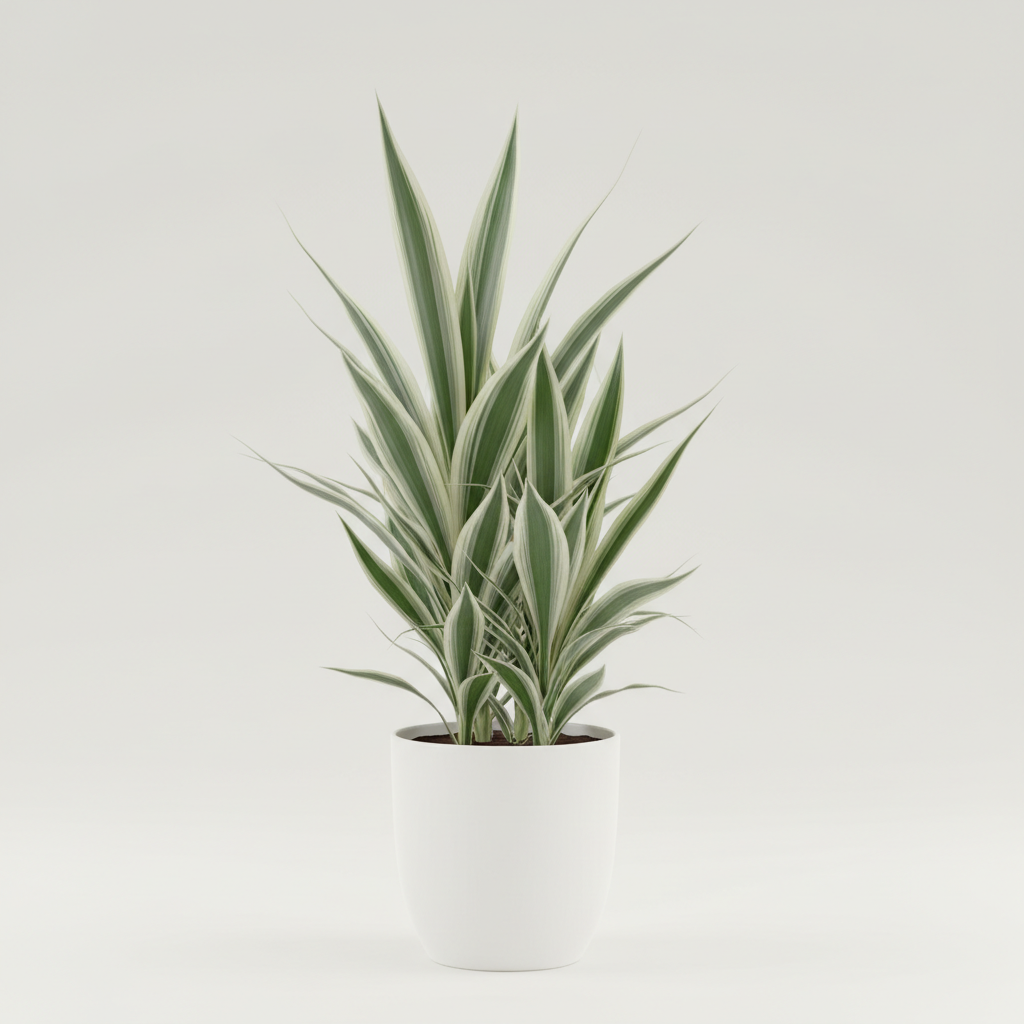
Warneckii
A cooler, more upright cousin whose sword-shaped leaves are striped in white and grey-green. It brings the same striped drama as the Lemon Lime in a crisper, more architectural palette.
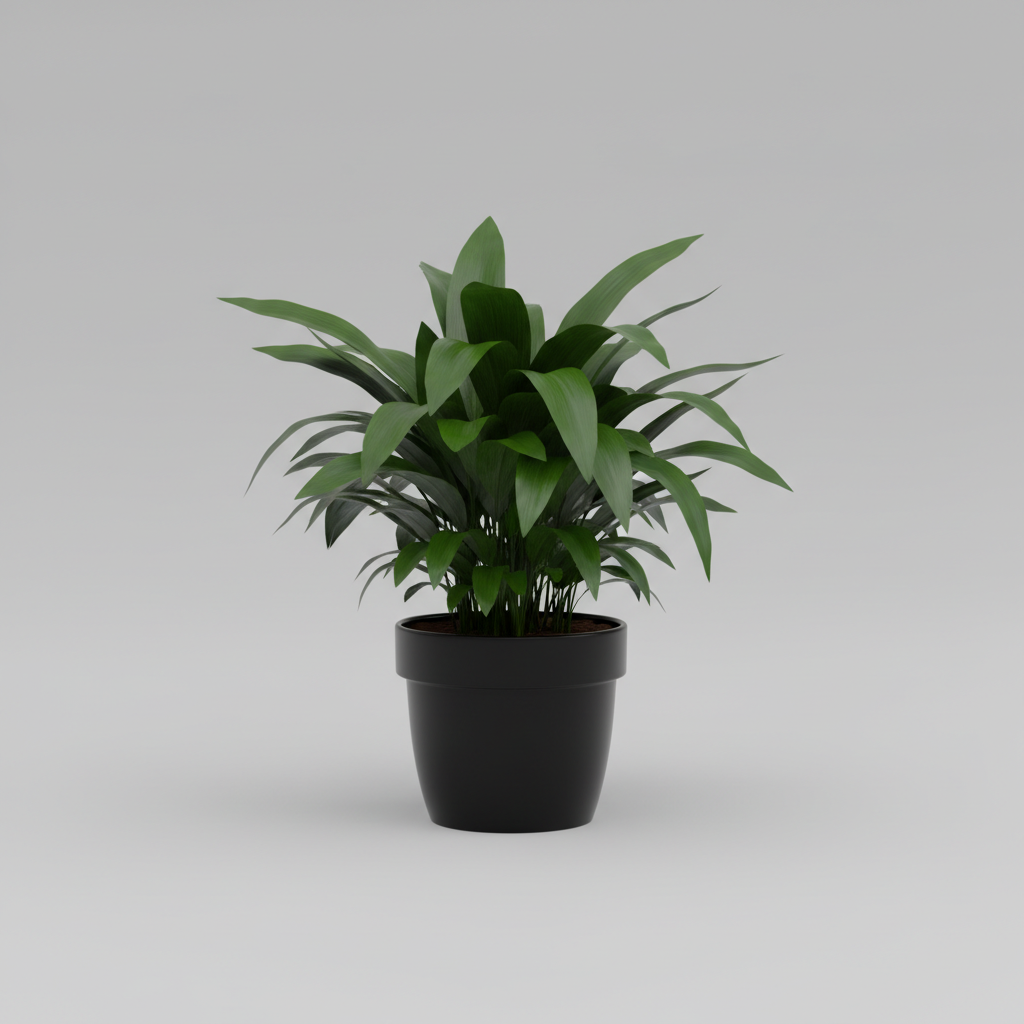
Janet Craig
The understated classic, with broad, glossy, solid dark-green leaves and no variegation at all. It is the toughest of the group and the most tolerant of low light, making it the perfect green foil to the Lemon Lime’s colour.
Variety Profiles in Detail
Warneckii (Dracaena fragrans ‘Warneckii’)
Warneckii grows more stiffly upright than the arching Lemon Lime, forming neat columns of foliage that suit a narrow corner. Its white-and-green striping reads as cool and modern rather than warm and zesty, and it shares the Lemon Lime’s fluoride sensitivity, so it benefits from the same care with water quality.
Janet Craig (Dracaena fragrans ‘Janet Craig’)
Perhaps the most forgiving dracaena of all, Janet Craig copes with deep shade, irregular watering and neglect that would test any other foliage plant. Its plain dark leaves lack the Lemon Lime’s flash but provide a calm, glossy backdrop and unbeatable durability for difficult spots.
Choosing the Right Variety for Your Space
If colour is your priority and you have at least bright indirect light, the Lemon Lime is the standout choice, with the Massangeana corn plant a warmer alternative. For the dimmest corners, lean on Janet Craig or Compacta, which hold their looks in low light better than the variegated cultivars. Because every one of these shares the same simple care routine, you can mix and match freely to suit the light in each room without complicating your watering can.
Frequently Asked Questions
Why are the tips of my Lemon Lime turning brown?
Brown, crispy tips on a dracaena are most often caused by fluoride, chlorine and salts in tap water, which accumulate in the leaf tips. Switch to rainwater, distilled water or water left to stand overnight, flush the soil a few times a year, and avoid overfeeding. Very dry air and inconsistent watering can add to the problem but are usually secondary to water quality.
How often should I water a Lemon Lime Dracaena?
Water when the top 3 to 5 cm (1 to 2 in) of soil have dried out, which in a warm, bright room usually falls every 7 to 14 days in the growing season and much less in winter. Always check the soil with your finger rather than following a fixed schedule, as light, warmth and pot size all change how fast it dries.
Is the Lemon Lime Dracaena toxic to cats and dogs?
Yes. Like all dracaenas it contains saponins that are toxic to cats and dogs, and chewing the leaves can cause vomiting, drooling and loss of appetite, with dilated pupils in cats. It is not regarded as seriously dangerous to people, but keep it out of reach of pets and small children.
Why is my Lemon Lime losing its yellow colour?
Fading variegation almost always means too little light. In dim conditions the plant makes more chlorophyll to capture what light there is, so new leaves emerge greener and the lime edges narrow. Move it to brighter indirect light and the colour will return on fresh growth, though existing leaves will not change back.
Can a Lemon Lime Dracaena live in low light?
It can. The Lemon Lime is one of the most low-light-tolerant variegated houseplants, which is why it thrives in offices and north-facing rooms. In low light it grows more slowly and its stripes soften, but it stays healthy. For the most vivid colour and steady growth, bright indirect light remains best.
Why are the lower leaves turning yellow and dropping?
Some shedding of the oldest, lowest leaves is normal as a dracaena grows and builds its bare cane, so a few yellowing lower leaves now and then are nothing to worry about. If many leaves yellow at once or the cane base feels soft, suspect overwatering and check the roots, as that points to rot rather than natural ageing.
How big does a Lemon Lime Dracaena grow indoors?
Indoors it typically reaches 1.5 to 1.8 metres (5 to 6 feet) over many years, growing slowly from a thickening cane. You can keep it shorter and bushier by cutting the top off at your preferred height, which prompts the parent cane to branch and gives you a cutting to root into a new plant.
Should I cut the brown tips off my Lemon Lime?
You can trim them for appearance. Use clean scissors and follow the natural leaf shape, leaving a thin margin of brown rather than cutting into healthy green tissue, which would only create a fresh brown edge. Trimming is cosmetic, so also address the underlying cause by improving water quality to stop new tips from browning.
Does the Lemon Lime Dracaena flower indoors?
Rarely. While Dracaena fragrans is famous in the wild for its intensely fragrant flower spikes, mature plants flower only occasionally indoors and the Lemon Lime is grown almost entirely for its foliage. If yours does bloom it is a happy bonus, not something to engineer or expect.
Why has my Lemon Lime stopped growing?
A pause in growth through autumn and winter is entirely normal, as the plant rests when light and warmth drop. If it stalls during spring and summer, check that it has enough light, that you are watering and feeding appropriately, and whether it has become severely root-bound and is due for a repot into fresh mix.






