
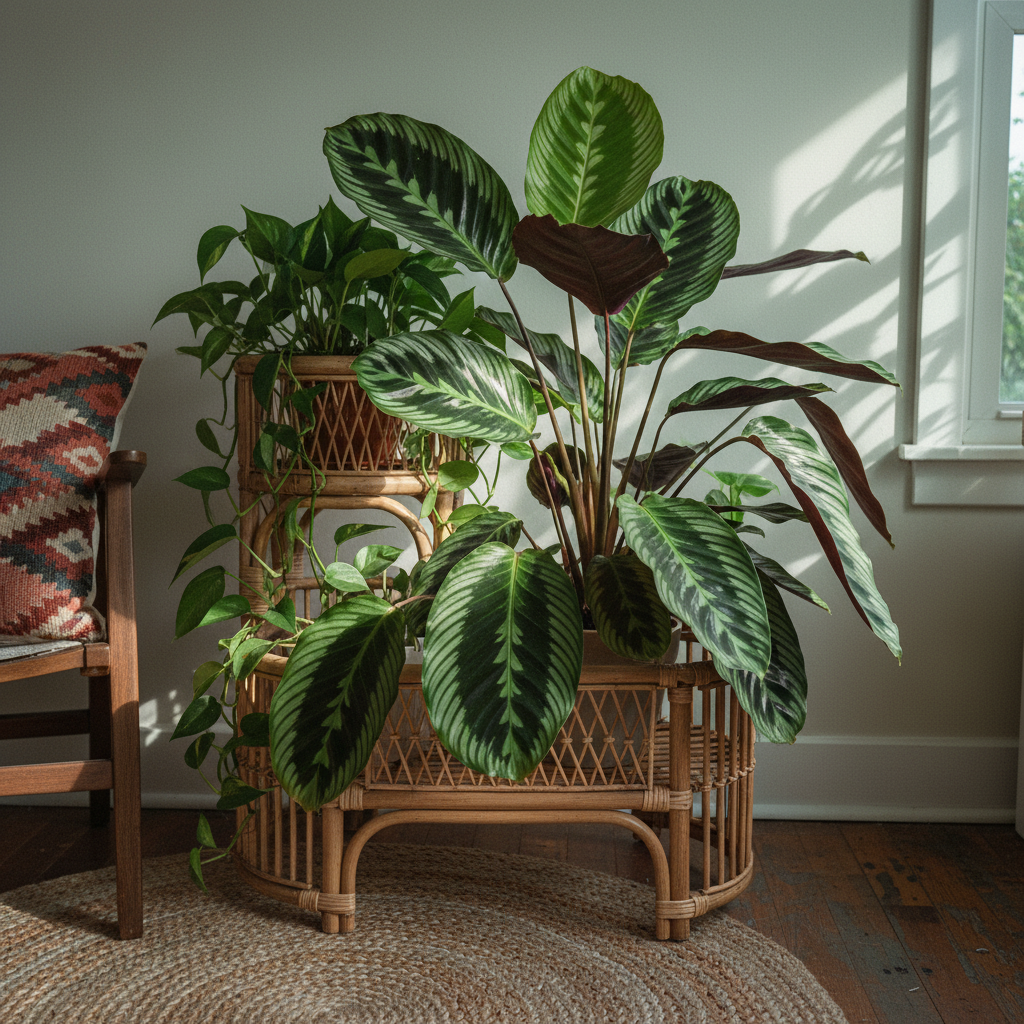
Few houseplants reward close inspection quite like the medallion calathea. Held against the light, each broad oval leaf reveals an intricate feathered pattern of pale and dark green radiating from the midrib, finished with a deep burgundy-purple reverse that flashes whenever the plant lifts its foliage at dusk. Botanically it is Goeppertia veitchiana, a species long sold under its former name Calathea veitchiana and still widely traded as the cultivar “Medallion”. It belongs to the Marantaceae, the prayer-plant family, and hails from the humid rainforest understorey of Ecuador, where it grows in dappled shade beneath a dense canopy.
That rainforest origin explains both the beauty and the reputation. The medallion calathea is widely regarded as one of the more demanding members of an already fussy genus, and keeping it merely alive is a very different matter from coaxing it to thrive. The difference comes down to a handful of variables this guide covers in detail: water quality, humidity, light, and consistency. Get those right and you will be rewarded with one of the most ornamental foliage plants you can grow indoors, and one that is reassuringly non-toxic to curious cats, dogs and children.
Contents
- Quick Reference
- Why Medallion Calathea Makes a Rewarding Houseplant
- Light Requirements
- Watering & Humidity
- Soil, Potting & Repotting
- Fertilising
- Propagation
- Pests & Diseases
- Popular Varieties
- Frequently Asked Questions
Quick Reference: Medallion Calathea at a Glance
| Light | Medium to bright indirect light; no direct sun |
| Watering | Keep evenly moist; water when the top 2 to 3 cm (1 in) is dry, ideally with rain or distilled water |
| Temperature | 18 to 27 degrees C (65 to 81 degrees F); never below 15 degrees C (59 degrees F) |
| Humidity | High, 60 percent or above |
| Fertiliser | Balanced feed at half strength, monthly during spring and summer |
| Toxicity | Non-toxic and pet-safe for cats, dogs and humans |
Why Medallion Calathea Makes a Rewarding Houseplant
The headline reason to grow this plant is, of course, the foliage. Mature leaves can reach 20 to 30 cm (8 to 12 in) long and are carried on slender upright stems that arch outward as the clump fills in, giving a tidy, rounded silhouette that suits a tabletop or plant stand rather than the floor. Each leaf is a small work of art, and because the species is grown purely for its leaves rather than for flowers, the display is constant year-round rather than fleeting.
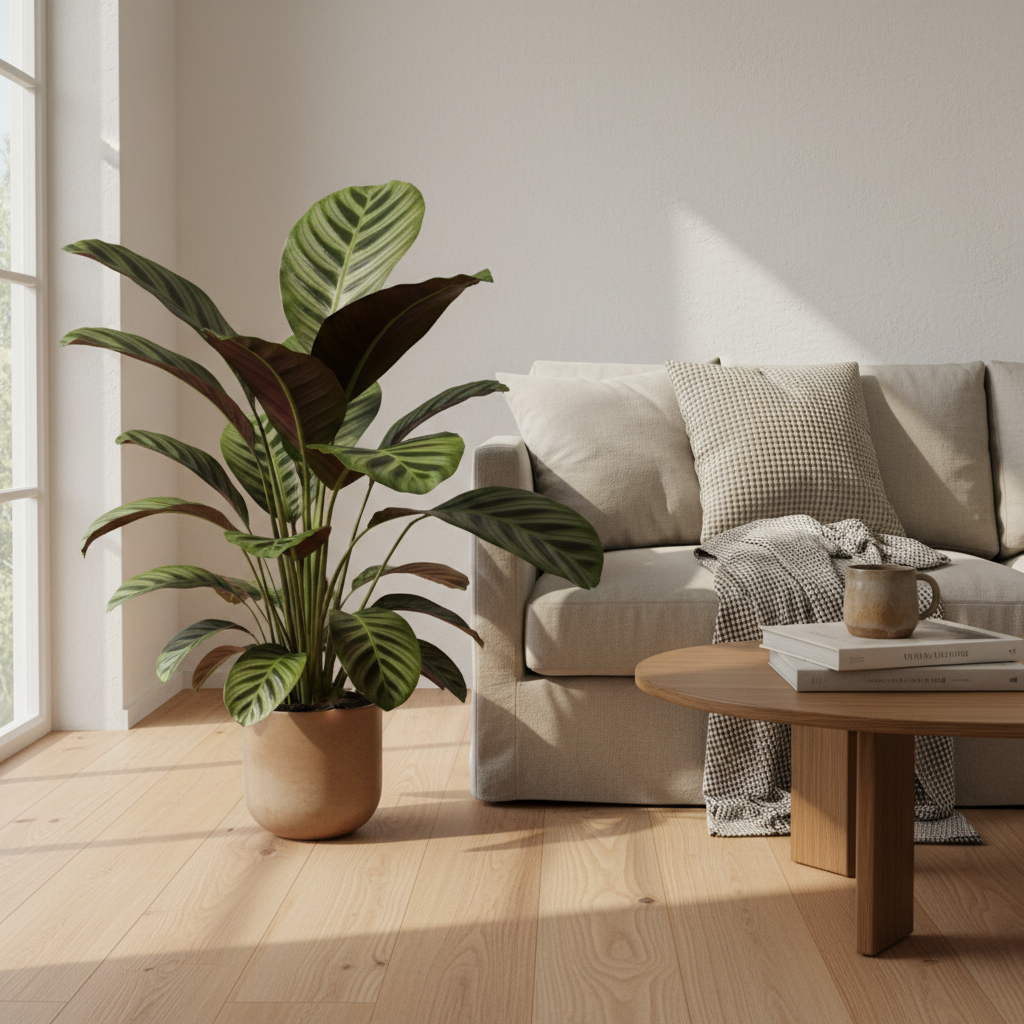
A second, less obvious pleasure is the plant’s daily rhythm. Like all members of the prayer-plant family, the medallion calathea is nyctinastic: it raises its leaves toward vertical each evening and lowers them again at first light, a movement driven by a swollen joint called the pulvinus at the base of each leaf. You can sometimes hear the faint rustle as the leaves shift in the evening. This living, responsive quality, combined with the plant’s complete safety around pets, makes it a favourite for homes where a fiddle leaf fig or a pothos trailing toxic sap would be a worry.
Important — Toxicity: The medallion calathea is recognised as non-toxic to cats, dogs and humans by the ASPCA and similar bodies. Pets are unlikely to come to harm if they nibble a leaf, though as with any plant, large quantities may cause mild stomach upset, so it is still best to discourage grazing.
Light Requirements
In its native Ecuadorian forest the medallion calathea lives on the shaded floor, receiving only the light that filters down through layers of taller vegetation. Replicating that dappled, indirect quality is the single most important thing you can do for its appearance. Too little light and growth stalls and the pattern fades; too much and the leaves bleach, scorch and curl.
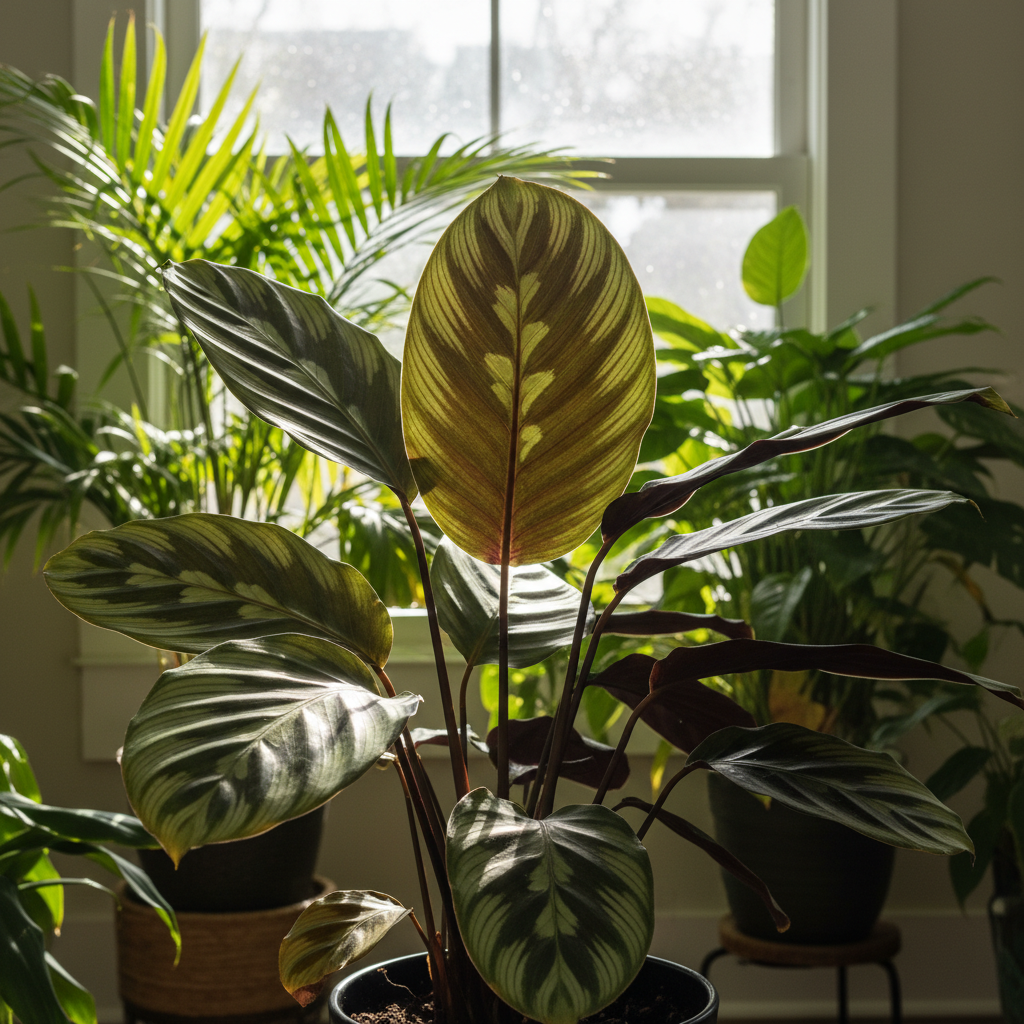
The sweet spot is medium to bright indirect light. A position a metre or two back from a bright window, or close to a window screened by a sheer curtain or by other plants, gives the gentle, diffused illumination this species was built for. The richer the markings you want to keep, the more consistent and moderate the light should be.
Light Levels Explained
The table below translates common indoor light descriptions into approximate measured levels and the likely outcome for a medallion calathea. Lux figures are a rough guide measured at the leaf surface around midday.
| Light Category | Approx. Level | Typical Location | Outcome |
|---|---|---|---|
| Direct sun | 30,000 lux and above | On an unscreened south or west sill | Avoid: scorched, bleached, curling leaves |
| Bright indirect | 10,000 to 20,000 lux | Near an east window or back from a bright one | Ideal: strong colour, steady growth |
| Medium | 5,000 to 10,000 lux | A metre or two into a bright room | Good: healthy but slightly slower |
| Low | 1,000 to 5,000 lux | Dim corner, north room interior | Tolerated briefly: weak, leggy growth, faded pattern |
| Very low | Below 1,000 lux | Windowless or deep interior | Unsuitable: decline over time |
Window Orientation and Placement
South-facing window: The brightest aspect in the northern hemisphere and usually too intense unless the plant is set well back or shielded by a sheer curtain. Direct midday sun through south glass will fade the pattern within days.
East-facing window: Often the best choice. The soft morning light is gentle enough to fall directly on the leaves for a short while without scorching, and the rest of the day delivers bright ambient light.
West-facing window: Workable, but the strong afternoon sun can be harsh in summer. Position the plant a little back from the glass or filter the light with a blind.
North-facing window: Gives even, gentle light that the plant tolerates well, though growth may slow in the darkest months and you may need to supplement during winter.
Pro Tip — Rotate for Even Growth: Calathea leaves orient toward their light source. Give the pot a quarter turn each time you water so the clump fills in evenly rather than leaning toward the window.
How Light Affects Leaf Pattern
The vivid contrast between the light and dark green bands, and the depth of the purple reverse, are at their strongest under steady bright indirect light. In light that is too low the new leaves emerge smaller, the markings appear washed out and the leaf-raising movement at night becomes sluggish. In light that is too strong the surface fades to a uniform pale green and the edges may crisp. Aim for consistency: an abrupt move from a dim spot to a bright one can shock the plant just as much as the wrong level itself.
Warning — Direct Sunlight: Even an hour of unfiltered midday sun can leave permanent bleached patches on a medallion calathea. Damaged areas do not recover, so prevention matters far more than cure. If you see leaves looking pale and dry in the centre, move the plant out of the sun immediately.
Artificial Lighting
The medallion calathea responds well to supplementary lighting, which makes it a good candidate for offices and darker rooms. A full-spectrum LED grow light positioned 30 to 45 cm (12 to 18 in) above the plant and run for 10 to 12 hours a day will keep growth steady through winter or in a windowless space. Because the species wants only moderate intensity, you do not need a powerful horticultural fixture; a modest desk-style grow light is usually plenty.
Seasonal Adjustments
As daylight shortens through autumn and winter, move the plant a little closer to its window or add supplementary light to compensate for the weaker, shorter days. In spring, ease it back gradually as the sun strengthens to avoid a sudden jump in intensity that could shock the foliage. A plant that summered happily a metre back from an east window may want to be slightly closer come December.
Watering & Humidity
Watering is where most medallion calatheas are won or lost. This is a plant that wants its soil to stay evenly, lightly moist at all times, never bone dry and never waterlogged. Both extremes show up quickly in the foliage, and the species is unusually fussy about what is in the water as well as how much of it there is.
When to Water
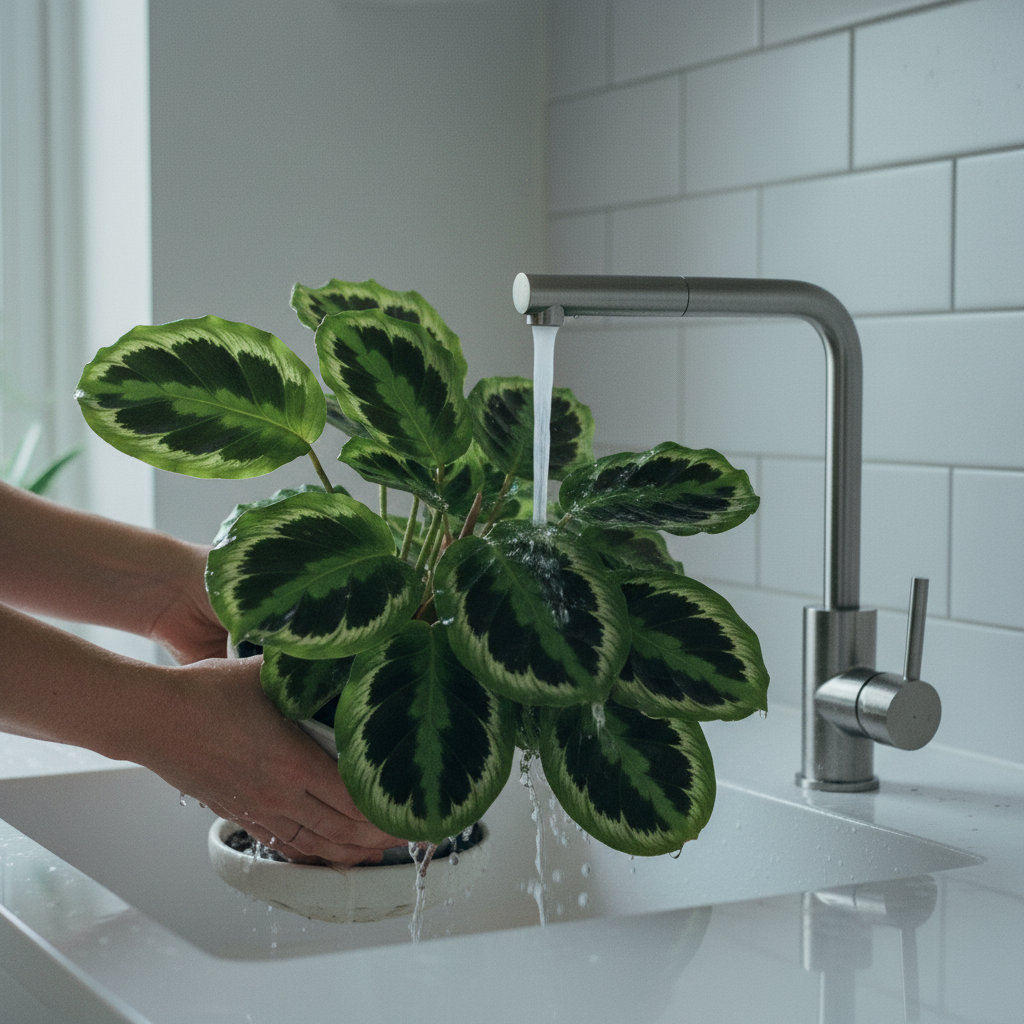
Check the top of the soil with a finger and water when the top 2 to 3 cm (about 1 in) has just dried out. The aim is to keep the deeper root zone consistently moist while letting only the surface dry slightly between waterings. In a warm, bright spot during summer this might mean watering twice a week; in winter it could be once every week or ten days. Let the plant and the weather set the pace rather than watering on a fixed calendar.
Tepid water is kinder than cold straight from the tap, which can shock the roots. Water in the morning where possible, so that any moisture on the leaves dries during the day and the plant is not left damp and cold overnight.
Pro Tip — Skip the Tap: Medallion calatheas are sensitive to fluoride, chlorine and dissolved minerals in hard tap water, which accumulate as brown, crispy leaf edges. Use rainwater, distilled water, or tap water left to stand uncovered for 24 hours so the chlorine can dissipate.
How to Water Correctly
- Check that the top 2 to 3 cm of soil has dried before watering.
- Use room-temperature rainwater, distilled water or dechlorinated tap water.
- Pour slowly and evenly over the soil surface until water runs freely from the drainage holes.
- Let the pot drain completely for several minutes.
- Empty the saucer or cache pot so the plant never sits in standing water.
- Return the plant to its spot and give the pot a quarter turn for even growth.
Signs of Overwatering vs. Underwatering
| Symptom | Overwatering | Underwatering |
|---|---|---|
| Leaf colour | Yellowing, often from the lower leaves up | Edges and tips brown and crisp |
| Leaf texture | Soft, limp, sometimes translucent | Dry, papery, curling inward |
| Soil | Stays wet for days, may smell sour | Pulls away from the pot edge, dusty dry |
| Roots | Brown, mushy, foul-smelling | Dry but firm and pale |
| Stem base | Soft, blackened, collapsing | Firm but the whole plant droops |
Warning — Root Rot: Persistent sogginess is the fastest way to kill this plant. If you notice yellowing lower leaves, a sour smell or a soft stem base, unpot at once, trim away any brown mushy roots with sterilised scissors, and repot into fresh, airy mix. Caught early, root rot is recoverable; left unchecked it spreads through the whole crown.
Humidity Requirements
If light is the most important factor for appearance, humidity is the most important for keeping the leaves intact. The medallion calathea evolved in air that rarely drops below 70 percent humidity, and indoor air, especially in heated or air-conditioned rooms, is far drier. Aim for at least 60 percent around the plant; the higher you can manage, the better the leaf edges will hold.
The classic symptom of low humidity is browning, crisping leaf margins, often accompanied by leaves that fail to unfurl cleanly. These signs overlap with hard-water damage, so if you are already using clean water and still see crispy edges, dry air is the likely culprit.
The most reliable way to raise humidity is a small room humidifier running near the plant, which is far more effective than misting. Grouping plants together, standing the pot on a tray of pebbles topped up with water (with the pot sitting on the pebbles, not in the water), or keeping the plant in a naturally humid room such as a bright bathroom all help. Misting offers only a brief lift and, done late in the day, can encourage fungal spots, so it is the weakest of the options.
Water Quality
It is worth repeating because it matters so much: water quality is a genuine make-or-break factor for this species. Fluoride in particular causes the necrotic brown tips that plague so many calatheas. If your tap water is hard or fluoridated and your plant’s edges keep browning despite good humidity and careful watering, switching to rainwater or distilled water is often the single change that turns things around.
Soil, Potting & Repotting
The right growing medium balances two competing demands: it must hold enough moisture to keep the roots evenly damp, yet drain and breathe freely enough to prevent the waterlogging that causes rot. A dense, water-retentive compost on its own will stay too wet, while a fast-draining cactus mix will dry out far too quickly for this thirsty species.
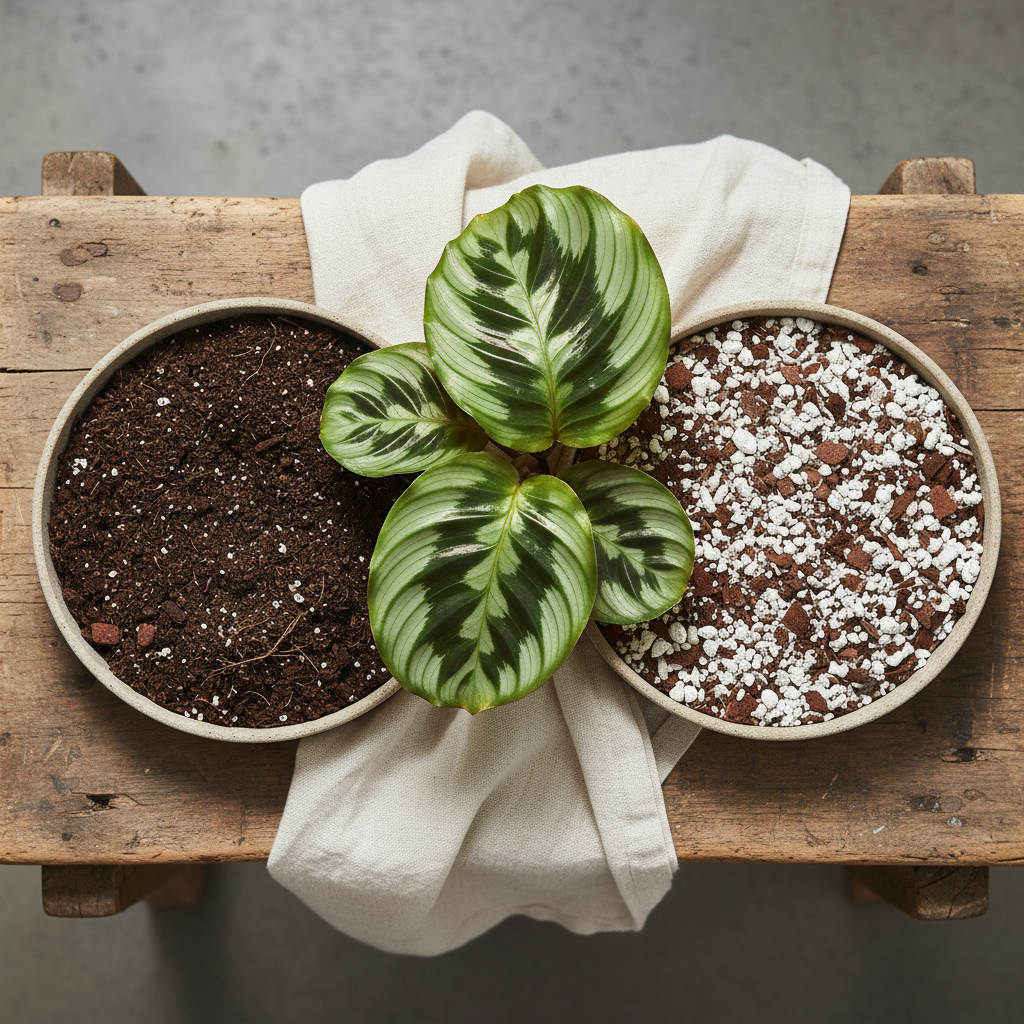
Ideal Soil Composition
A good medallion calathea mix is light and open while still spongy enough to retain moisture. The reliable approach is a peat-free or coco-coir base for water retention, opened up with perlite for drainage and a little fine bark for structure and air. A small amount of worm castings adds gentle nutrition.
| Component | Proportion | Function |
|---|---|---|
| Coco coir or peat-free compost | 50 percent | Holds moisture evenly without compacting |
| Perlite | 30 percent | Drainage and aeration, prevents waterlogging |
| Fine orchid bark | 15 percent | Adds structure and air pockets around roots |
| Worm castings | 5 percent | Slow, gentle source of nutrients |
The medallion calathea prefers a slightly acidic to neutral root zone, roughly pH 6.0 to 6.5. A coir-based mix sits naturally within this range, which is another reason it suits the plant better than a limey, alkaline compost.
Pro Tip — Quick Mix Recipe: If you want a simple shortcut, combine two parts good peat-free houseplant compost with one part perlite and one part fine bark. It is forgiving, widely available and close enough to ideal for almost every medallion calathea.
Choosing the Right Pot
Pot choice has a real effect on how often you water and how safe the roots are from rot. Because this plant likes consistent moisture, you do not want a pot that dries it out too aggressively, but drainage remains essential.
Drainage holes are non-negotiable. Whatever the material or style, the pot must have holes so excess water can escape. A decorative cache pot without drainage is fine as an outer cover, provided you lift the inner nursery pot out to water and let it drain fully before returning it.
Pot material: Plastic and glazed ceramic both hold moisture well and suit this plant nicely. Unglazed terracotta breathes and wicks moisture away quickly, which can leave the mix drying out faster than a medallion calathea would like, so if you love the terracotta look, expect to water more often.
Pot size: Choose a pot only 2 to 3 cm (1 in) wider than the current root ball. An oversized pot holds a large volume of wet soil that the roots cannot use quickly, which raises the risk of rot. This species actually grows best when slightly snug.
When to Repot
Medallion calatheas are not vigorous growers and only need repotting every one to two years, ideally in spring as growth resumes. Tell-tale signs that it is time include roots emerging from the drainage holes, water running straight through without wetting the mix, or the plant drying out noticeably faster than it used to. Repotting is also the perfect moment to divide a crowded clump, as covered in the propagation section below.
How to Repot: Step-by-Step
- Water the plant a day beforehand so the root ball is hydrated and slides out cleanly.
- Ease the plant from its pot, supporting the base of the stems, and gently tease apart the outer roots.
- Inspect the roots and trim away any that are brown, soft or rotten with sterilised scissors.
- Add a layer of fresh mix to the base of the new pot, only one size larger.
- Set the plant at the same depth it grew before and fill around it with fresh mix, firming gently to remove air gaps.
- Water thoroughly with clean water and let it drain completely.
- Return the plant to a warm, humid, brightly shaded spot and hold off on feeding for four to six weeks.
Warning — Transplant Shock: Calatheas can sulk dramatically after repotting, drooping and curling for a week or two even when everything has been done correctly. Resist the urge to overwater or fertilise in response. Keep conditions stable and warm, and the plant will usually recover on its own.
Fertilising
The medallion calathea is a light feeder, and far more plants are harmed by over-fertilising than by going hungry. A modest, regular feed through the growing season keeps the foliage rich and supports new leaf production without risking the salt build-up that scorches sensitive calathea roots.
Because the plant grows slowly and its roots react badly to concentrated nutrients, the guiding principle is little and often, always diluted well below the strength a stronger plant would tolerate.
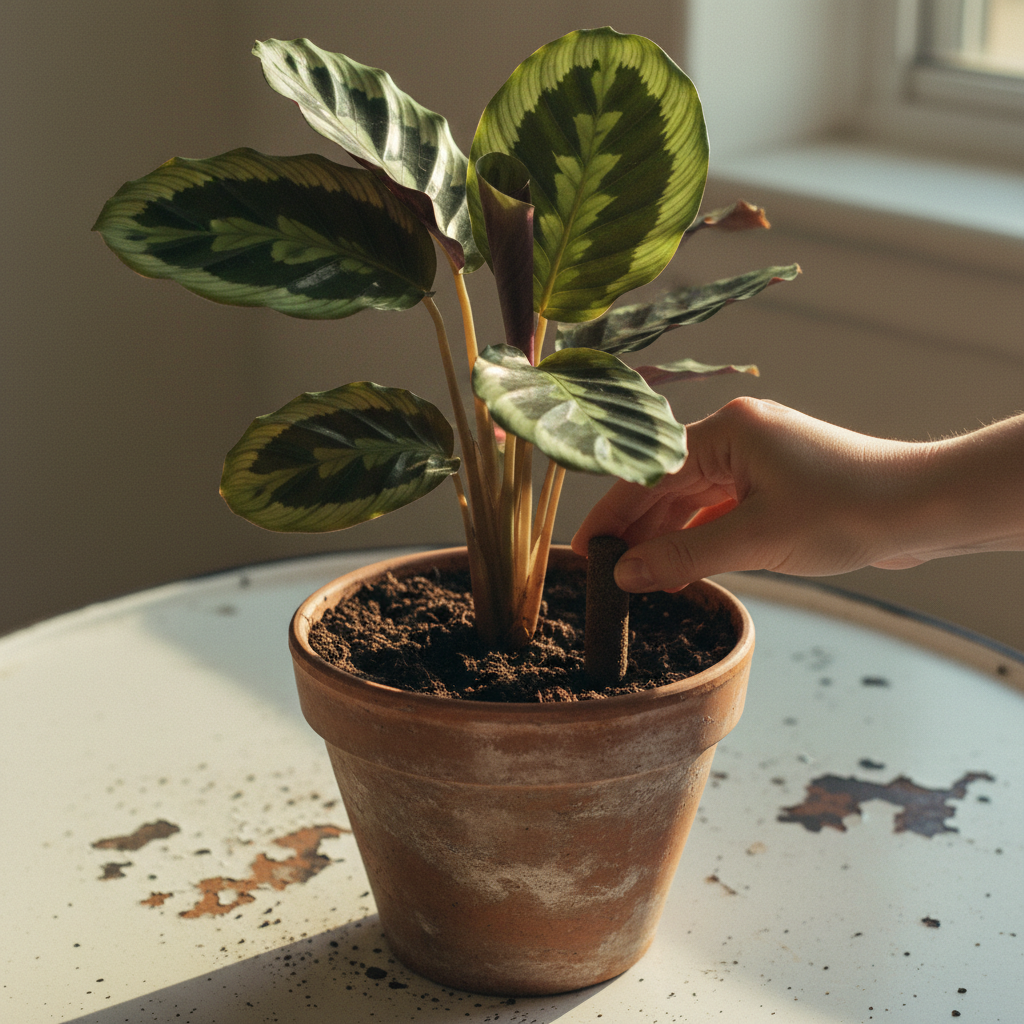
Understanding Plant Nutrients
Houseplant fertilisers are described by their N-P-K ratio, the proportion of nitrogen, phosphorus and potassium. For a foliage plant like the medallion calathea, a balanced formula with a slight emphasis on nitrogen supports the leafy growth that is the whole point of the plant. The table below summarises the main nutrients and what their absence looks like.
| Nutrient | Symbol | Primary Function | Deficiency Symptoms |
|---|---|---|---|
| Nitrogen | N | Leaf and stem growth, green colour | Pale, yellowing older leaves, slow growth |
| Phosphorus | P | Root development and energy transfer | Stunted growth, dull foliage |
| Potassium | K | Overall vigour and water regulation | Brown leaf edges, weak stems |
| Calcium | Ca | Cell-wall structure | Distorted, poorly formed new leaves |
| Magnesium | Mg | Core of the chlorophyll molecule | Yellowing between the veins |
| Iron | Fe | Chlorophyll production | Pale new leaves with green veins |
Types of Fertiliser
Liquid fertilisers: The easiest type to control for a calathea. Diluted to half or even quarter strength and applied with normal watering, they deliver a gentle, even dose and are simple to flush out if you overdo it.
Slow-release granular: Convenient but harder to regulate, since the prills keep releasing nutrients regardless of the plant’s needs. If you use them, choose a low dose and watch for any sign of leaf-edge burn.
Organic fertilisers: Worm castings, diluted seaweed or compost-based feeds release nutrients slowly and gently, which suits this sensitive species well and reduces the risk of salt build-up.
Feeding Schedule
Feed roughly once a month during the active growing season from spring through to early autumn, using a balanced houseplant feed at half the recommended strength. Stop feeding entirely in late autumn and winter, when growth naturally slows and unused fertiliser simply accumulates in the soil.
Pro Tip — Feed a Damp Pot: Always apply fertiliser to soil that is already slightly moist, never bone dry. Feeding a parched root ball concentrates the salts against thirsty roots and can scorch them, which shows up as brown leaf edges within days.
How to Fertilise
- Water the plant lightly first if the soil is dry, so the roots are not exposed to concentrated feed.
- Dilute a balanced liquid fertiliser to half strength in clean water.
- Apply evenly over the soil until it just begins to drain.
- Empty any runoff from the saucer so salts do not collect there.
- Every couple of months, flush the pot with plain water to wash out accumulated mineral salts.
Warning — Salt Build-Up: A white crust on the soil surface or pot rim, together with browning leaf edges, signals a build-up of fertiliser salts. Flush the pot thoroughly by running clean water through it several times, and cut back on feeding.
Propagation
Unlike vining houseplants that root readily from stem cuttings, the medallion calathea cannot be propagated from a leaf or a length of stem. It has no nodes along a trailing vine to root from; instead it grows as a clump from underground rhizomes, and the only reliable way to make new plants is to divide that clump.
This is good news in one respect: division produces fully formed, independent plants rather than fragile cuttings, and the best time to do it is when you are repotting anyway in spring. A healthy, established clump can usually be split into two or three new plants.
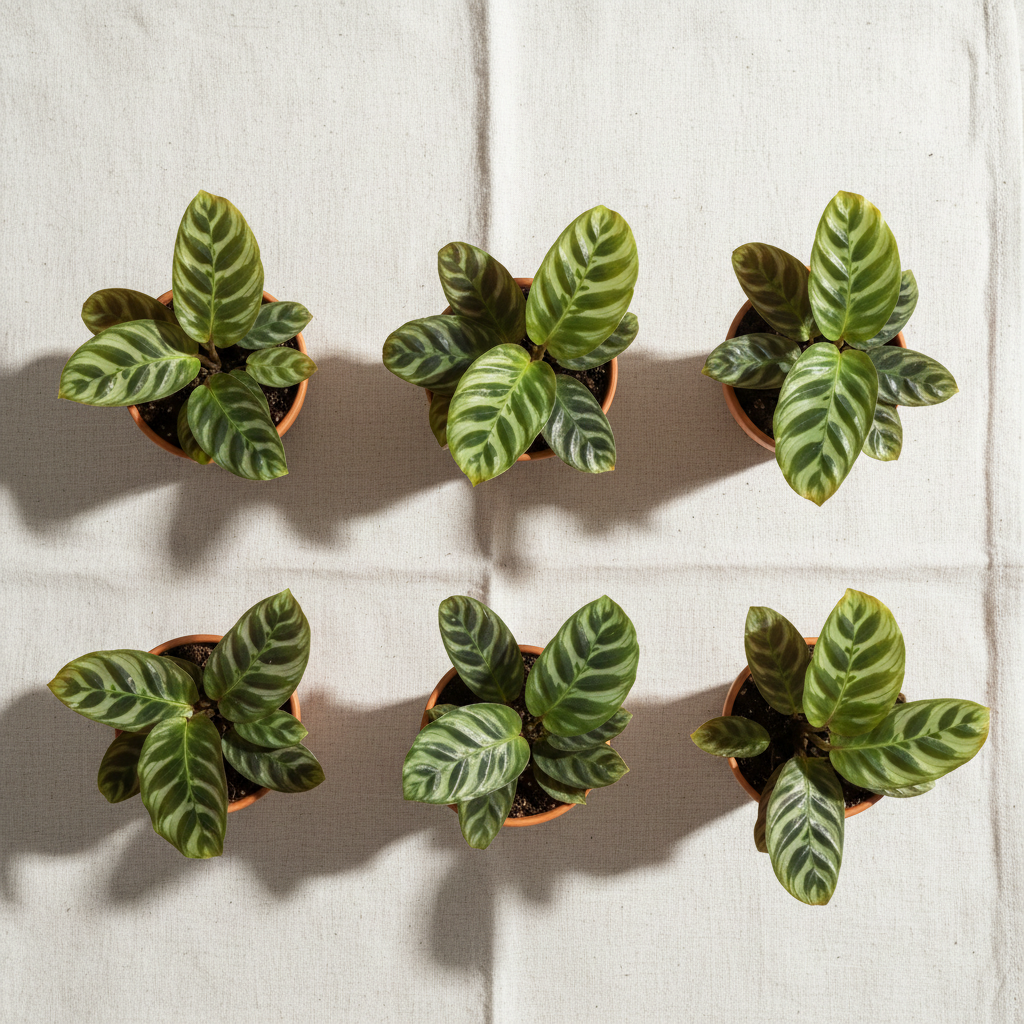
Understanding the Rhizome and Crown
Beneath the soil, the plant spreads via short rhizomes that send up clusters of leaves, each cluster forming a distinct crown with its own roots. When you lift the plant and shake off the soil, you can see these natural divisions. Separating the plant along these lines, so that every section keeps both a portion of healthy root and at least a few leaves, gives each new piece the best chance of establishing.
Division: Step-by-Step
Division is straightforward and has a high success rate when done gently at the right time of year. Work with clean hands and sterilised tools to avoid introducing disease.
- Water the plant the day before so the roots are hydrated and pliable.
- Lift the whole plant from its pot and gently shake or rinse away the soil to expose the root system.
- Identify natural clumps, each with its own roots and several leaves.
- Tease the sections apart by hand where possible, using a sterilised knife only where roots are tightly tangled.
- Pot each division into its own small pot of fresh, airy mix at the depth it grew before.
- Water in with clean, tepid water and let the pots drain.
- Place the divisions somewhere warm, humid and brightly shaded while they settle.
Pro Tip — Boost Humidity After Dividing: Freshly divided crowns lose water faster than they can take it up while their roots recover. Tenting each division loosely with a clear plastic bag or placing it in a propagator for a week or two keeps humidity high and dramatically improves establishment.
Aftercare for New Divisions
Expect the divisions to look sorry for themselves at first, with some drooping and perhaps a curled leaf or two. This is normal. Keep the mix lightly moist, the air humid and the light gentle, and avoid feeding until you see fresh growth, which usually signals that new roots have taken hold. From that point, treat each division as a mature plant.
Troubleshooting Propagation
| Problem | Likely Cause | Solution |
|---|---|---|
| Division wilts and does not recover | Too little root taken, or air too dry | Raise humidity, keep warm, ensure each piece has roots |
| Leaves yellow after splitting | Normal transplant shock or overwatering | Keep stable, water only when surface dries |
| Soft, blackening stem base | Rot from a wet mix or unsterile cut | Remove affected tissue, repot in fresh airy mix |
| No new growth for weeks | Roots still establishing, or season too cold | Be patient, keep warm and bright, hold off feeding |
Pests & Diseases
A healthy, well-cared-for medallion calathea is reasonably resistant to pests, but the very conditions that stress it, especially dry air, also make it vulnerable. The most common problems are sap-sucking insects that thrive when humidity drops, and fungal issues that follow from overwatering or persistently wet leaves.
Prevention is far easier than cure. Regularly inspecting the undersides of the leaves, where pests congregate, and keeping the plant in good conditions stops most infestations before they take hold.
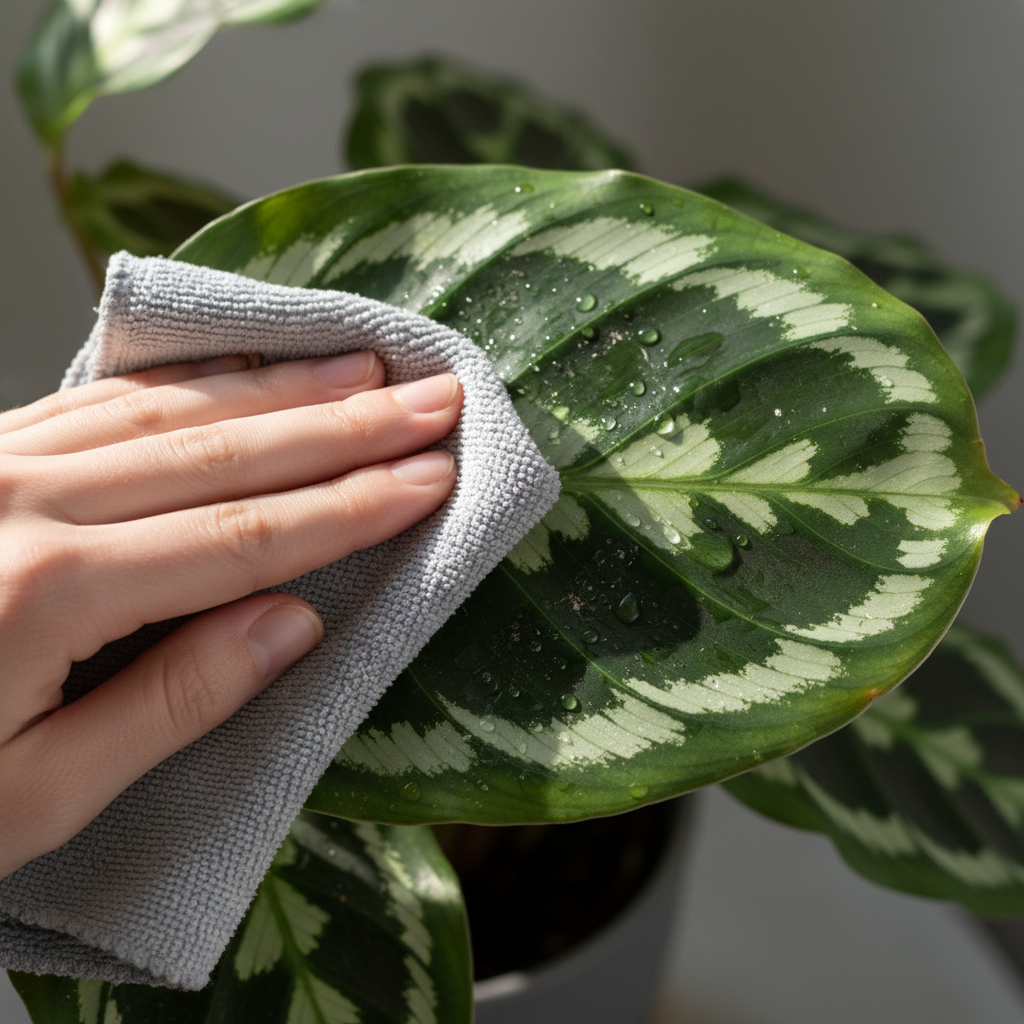
Common Pests
Spider Mites (Tetranychus urticae)
By far the most common enemy of the medallion calathea, spider mites flourish in dry air and are easy to miss until the damage is done. Look for fine pale stippling on the leaf surface, a faint dusty appearance, and tell-tale fine webbing in the leaf axils and along the undersides.
Treatment: Rinse the plant thoroughly under a gentle shower to dislodge the mites, then treat with insecticidal soap or neem oil, paying close attention to the leaf undersides. Repeat every five to seven days for several weeks, and raise the humidity, since mites struggle in moist air.
Thrips (Thrips tabaci)
Tiny, slender insects that rasp at the leaf surface, leaving silvery patches and small dark specks of excrement. Thrips can also distort new growth as it emerges.
Treatment: Isolate the plant, remove the worst-affected leaves, and treat with neem oil or insecticidal soap. Blue sticky traps help catch the adults and monitor whether the problem is under control.
Mealybugs (Pseudococcus longispinus)
Small, soft-bodied insects coated in a white, cottony wax that gather in leaf joints and along the stems, sucking sap and weakening the plant. They are slow-moving but reproduce quickly.
Treatment: Dab each mealybug directly with a cotton bud soaked in isopropyl alcohol, then follow up with neem oil or insecticidal soap. Check regularly, as eggs hidden in crevices can hatch and restart the cycle.
Common Diseases
Root Rot (Pythium and Phytophthora species)
The most serious disease of this plant, caused by waterlogged soil that suffocates the roots and lets fungal pathogens take hold. Symptoms include yellowing lower leaves, a soft collapsing stem base, and dark, mushy, foul-smelling roots.
Treatment: Act quickly. Unpot the plant, cut away all soft brown roots with sterilised scissors, and repot what remains into fresh, airy mix in a clean pot. Water sparingly until new growth shows that the plant has recovered.
Fungal Leaf Spot (Helminthosporium species)
Appears as small water-soaked spots that enlarge into brown lesions, often ringed with a yellow halo, usually where leaves stay wet for too long in still, humid air.
Treatment: Remove affected leaves, improve air circulation, and avoid wetting the foliage when watering. A copper-based fungicide can help in stubborn cases.
Pest and Disease Summary
| Pest / Disease | Identification | Treatment |
|---|---|---|
| Spider mites | Fine stippling, dusty look, webbing | Rinse, neem oil, raise humidity, repeat weekly |
| Thrips | Silvery patches, dark specks, distorted growth | Isolate, remove leaves, neem oil, sticky traps |
| Mealybugs | White cottony clusters in joints | Alcohol on a cotton bud, then neem oil |
| Root rot | Yellow lower leaves, soft base, mushy roots | Trim rotten roots, repot in fresh airy mix |
| Fungal leaf spot | Brown spots with yellow halos | Remove leaves, improve airflow, keep foliage dry |
Prevention Strategies
The best defence is a plant kept in the conditions it wants. Maintain high humidity to deter spider mites, water carefully to avoid the soggy soil that invites rot, and give the plant good air movement without putting it in a cold draught. Wiping the leaves every week or two keeps them dust-free and gives you a regular chance to catch problems early.
Always quarantine any new houseplant for a couple of weeks before placing it near your medallion calathea, as new arrivals are the most common way pests enter a collection. Inspect the undersides of the leaves whenever you water.
Pro Tip — Neem as Routine: A light neem oil spray applied every few weeks as a preventative, rather than only when pests appear, keeps spider mites and thrips from ever gaining a foothold. Apply in the evening or out of direct sun so the oil does not scorch the leaves.
Popular Varieties
The “medallion calathea” sold in shops is most often the cultivar Goeppertia veitchiana “Medallion”, but the name is used loosely across the trade, and the plant is frequently grouped and confused with its close relatives in the genus. Knowing how it relates to those lookalikes helps when you are shopping or comparing care notes.
The table below sets the true medallion alongside the relatives it is most often confused with, all of which share broadly similar care but differ in leaf appearance and availability.
| Variety | Leaf Appearance | Light Needs | Growth Rate | Availability |
|---|---|---|---|---|
| Medallion (G. veitchiana) | Rounded, feathered light-and-dark green, purple reverse | Bright indirect | Moderate | Common |
| Roseopicta “Dottie” | Near-black leaves with a bright pink halo | Bright indirect | Moderate | Common |
| Roseopicta “Rosy” | Dark green with a soft pink central blush | Bright indirect | Moderate | Common |
| Roseopicta “Medallion” form | Concentric green rings, purple reverse | Bright indirect | Moderate | Very common |
| Orbifolia (G. orbifolia) | Large round leaves, silvery-green stripes | Medium to bright indirect | Moderate | Common |
| White Fusion | Green, white and lilac variegation | Bright indirect | Slow | Less common |
Featured Varieties
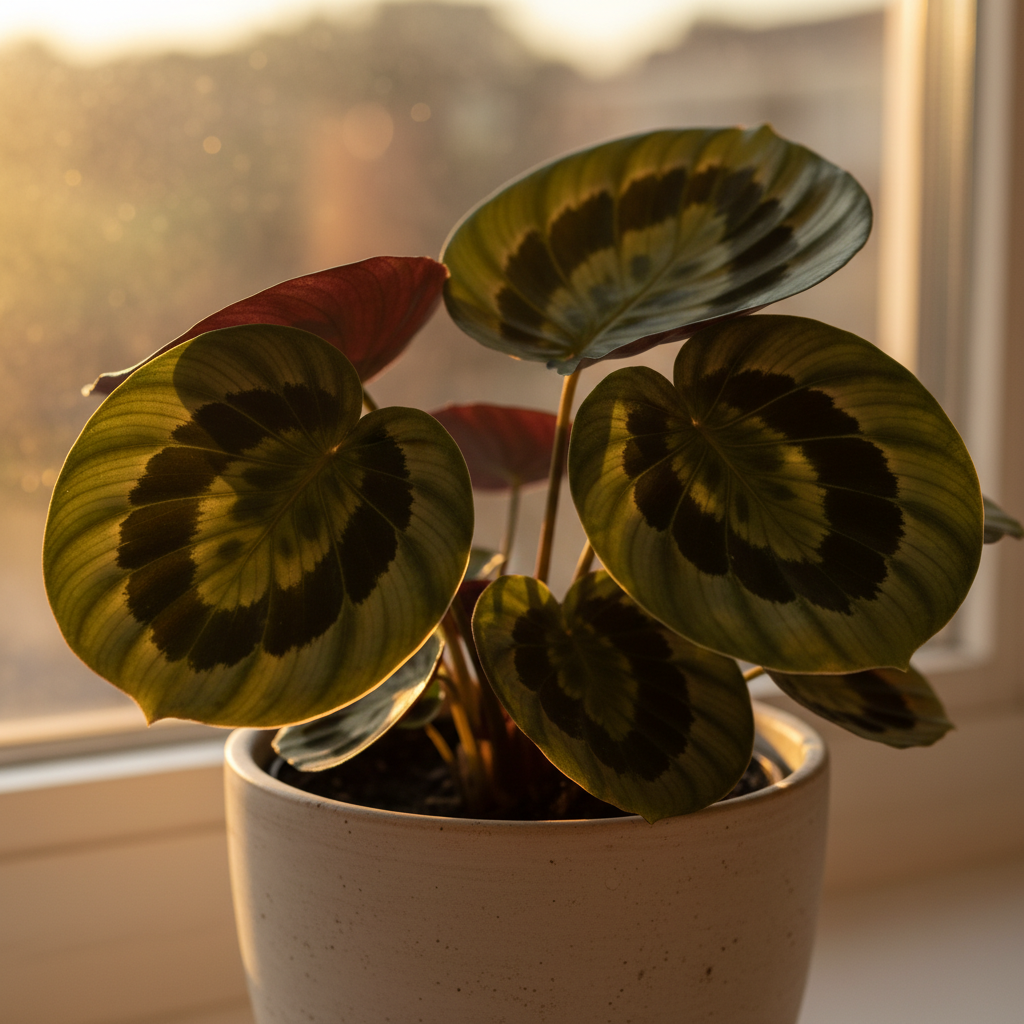
“Medallion”
The classic and most widely sold form, with rounded, almost circular leaves marked by concentric rings of light and dark green that give the cultivar its name, set off by a deep purple reverse.
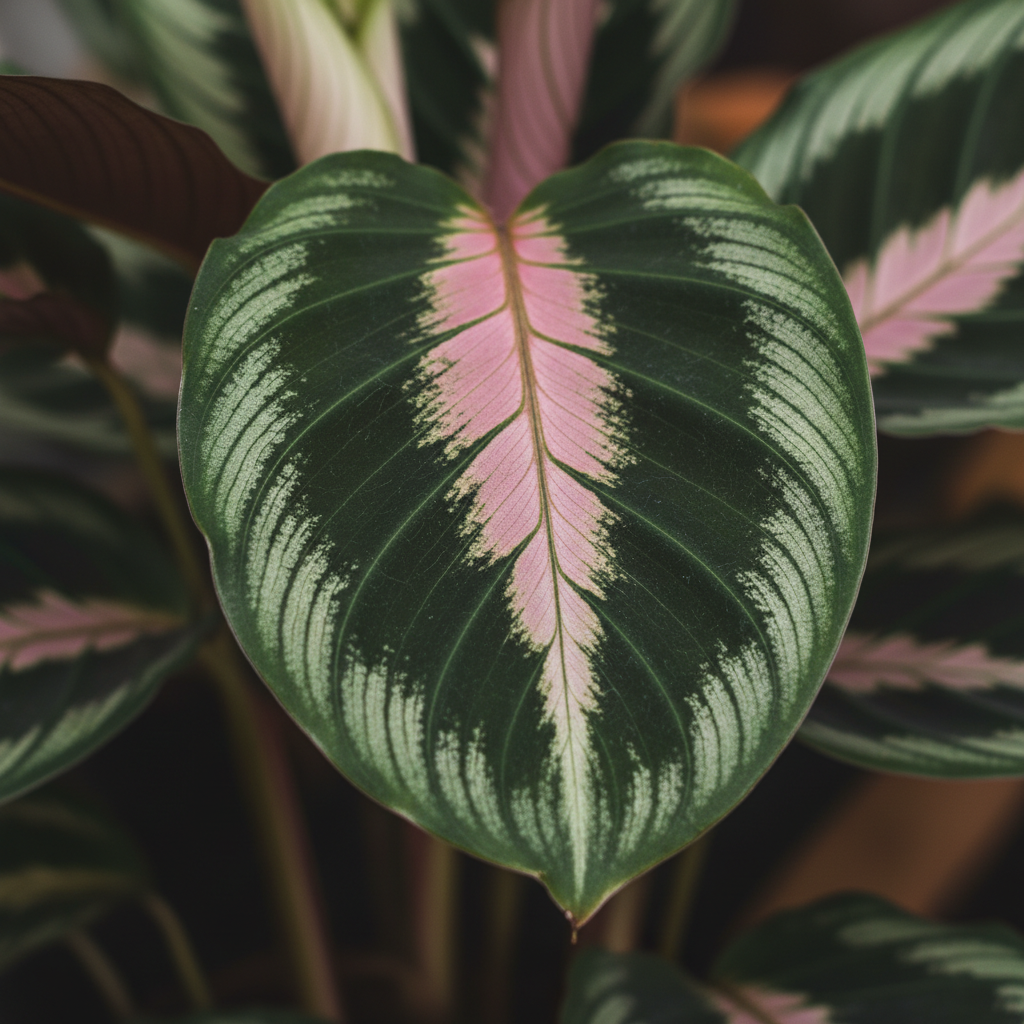
Roseopicta “Rosy”
A close relative often sold alongside the medallion, with dramatic dark green leaves washed by a broad, soft-pink central blush and pale feathered margins. Its care is essentially identical.
Variety Profiles in Detail
Medallion (Goeppertia veitchiana)
The true medallion is the most ornamental of the group, prized for the depth of contrast in its feathered banding and the rich burgundy underside that flashes as the leaves rise at night. It forms a neat, rounded clump and is the benchmark against which the others are judged.
Roseopicta “Dottie” (Goeppertia roseopicta)
One of the darkest calatheas, with leaves so deep a green they read as almost black, each ringed by a vivid magenta-pink halo. It is more dramatic and moodier than the medallion but shares the same exacting needs for humidity and clean water.
Orbifolia (Goeppertia orbifolia)
A larger-leaved relative grown for its broad, rounded foliage striped in silvery and mid-green. Slightly more forgiving of medium light than the medallion, it makes an excellent companion plant for the same growing conditions.
Choosing the Right Variety for Your Space
All of these plants want the same things, so the choice comes down to looks and to how much attention you can give. If you can provide consistently high humidity and clean water, the medallion and the darker roseopicta forms reward you with the most striking foliage. If your conditions are a little less controlled, the orbifolia is marginally more tolerant. Whatever you choose, remember that the care described throughout this guide applies almost identically across the group.
Frequently Asked Questions
Why are the leaf edges on my medallion calathea turning brown and crispy?
This is the most common complaint, and it usually comes down to one of two causes: low humidity or poor water quality. Minerals, fluoride and chlorine in hard tap water accumulate in the leaves and burn the edges, while dry indoor air does the same. Switch to rainwater or distilled water, raise the humidity to 60 percent or above, and new growth should come through clean.
Why are my plant’s leaves curling?
Curling leaves most often signal that the plant is too dry, either at the roots or in the air. Check whether the soil has dried out too far and whether humidity has dropped. Some leaf movement is also normal: calatheas curl and lift their leaves at night and relax them by day, so a little daily change is nothing to worry about.
Is the medallion calathea safe for cats and dogs?
Yes. It is recognised as non-toxic to cats, dogs and humans, which is one of the reasons it is such a popular choice for pet households. While it is always sensible to discourage pets from chewing on any plant, an accidental nibble will not poison them.
Why does my calathea move its leaves up and down?
This daily movement, called nyctinasty, is a hallmark of the prayer-plant family. The leaves rise toward vertical in the evening and lower again in the morning, driven by a swollen joint at the base of each leaf. It is a sign of a healthy plant and is thought to help the plant make the most of changing light.
How often should I water my medallion calathea?
There is no fixed schedule. Water when the top 2 to 3 cm of soil has just dried, which might mean twice a week in warm bright weather and once every week or so in winter. The goal is consistently, lightly moist soil, never soggy and never bone dry. Always use clean, room-temperature water.
Why is my medallion calathea drooping?
Drooping usually means a watering imbalance. A thirsty plant droops and perks up after watering; a waterlogged one droops with yellowing, soft leaves and needs the soil to dry and the roots checked for rot. Recent repotting can also cause temporary drooping that resolves on its own once the plant settles.
Can I propagate a medallion calathea from a leaf cutting?
No. Unlike many trailing houseplants, this species cannot root from a leaf or stem cutting because it lacks the nodes that those plants root from. The only reliable method is division, splitting an established clump into sections that each keep their own roots and leaves, ideally when you repot in spring.
Does the medallion calathea flower indoors?
It can produce small, inconspicuous flowers, but indoors this is uncommon and the blooms are insignificant compared with the foliage. This is a plant grown entirely for its leaves, so there is no need to chase flowers, and the ornamental value is constant all year regardless.






