
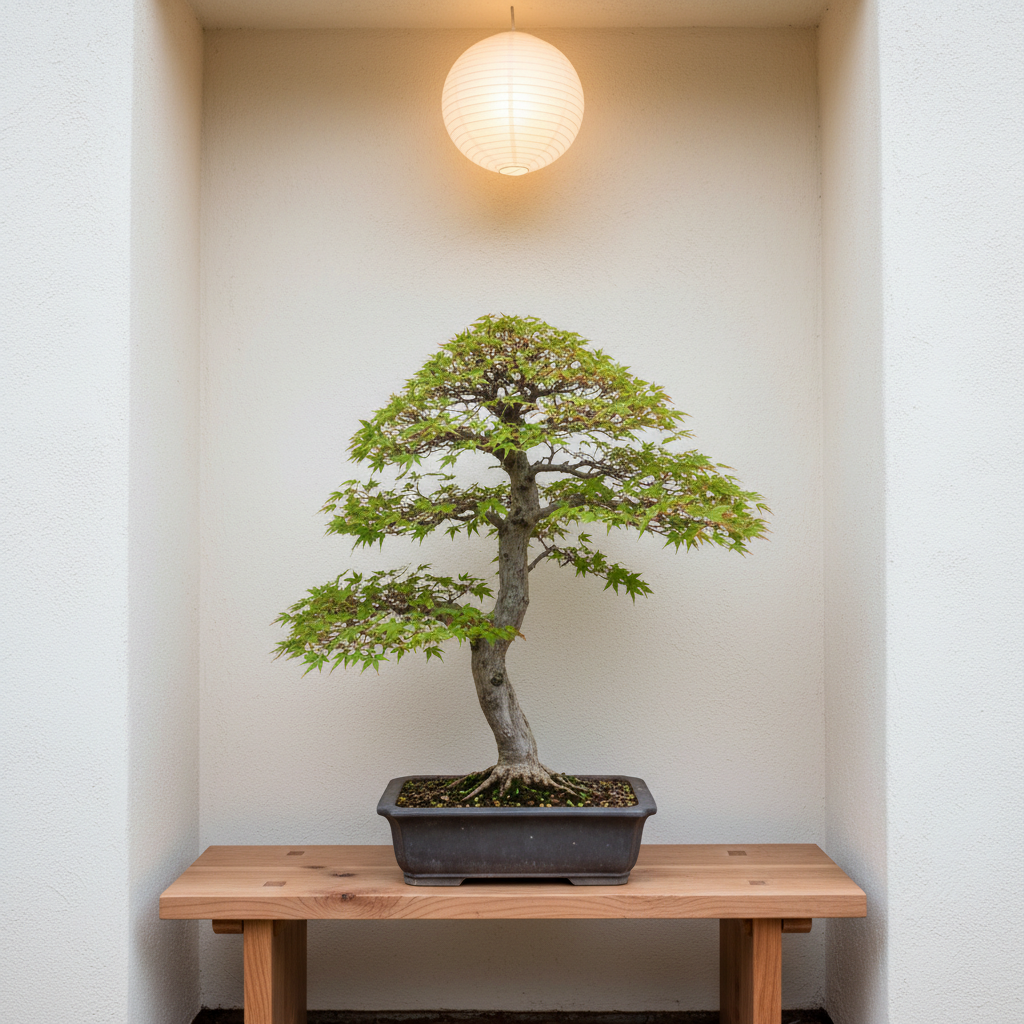
Few plants reward patience the way a bonsai maple does. Grown from the species Acer palmatum, native to the wooded hillsides of Japan, Korea and parts of China, it is not a single houseplant so much as a centuries-old horticultural tradition shrunk to the size of a tabletop. The common name covers any Japanese maple trained in the bonsai style, and the appeal is immediate: a finely tapered woody trunk, a delicate tracery of twigs, and small palmate leaves that flush red or coral in spring, settle to green in summer, then burn through gold, orange and scarlet before falling in autumn. A bonsai maple is a deciduous tree in miniature, and it keeps a tree’s calendar, losing its leaves every winter and resting until the days lengthen again.
That seasonal rhythm is the single most important thing to understand before you bring one home. Unlike the tropical foliage plants that fill most care guides, the bonsai maple is fundamentally an outdoor tree that tolerates only brief spells indoors. Treat it like a fern or a pothos, parked on a warm shelf year-round, and it will weaken and die within a season or two. Give it the cool air, bright light and genuine winter dormancy it evolved for, and a well-kept specimen can outlive the person who started it. This guide draws the line clearly between merely keeping a bonsai maple alive and actually helping it thrive, covering light, watering, soil, feeding, propagation, pests and the most rewarding cultivars to start with.
Contents
- Quick Reference
- Why the Bonsai Maple Makes a Rewarding Houseplant
- Light Requirements
- Watering & Humidity
- Soil, Potting & Repotting
- Fertilising
- Propagation
- Pests & Diseases
- Popular Varieties
- Frequently Asked Questions
Quick Reference: Bonsai Maple at a Glance
| Light | Bright light with gentle morning sun and afternoon shade; essentially an outdoor tree |
| Watering | Keep evenly moist, never bone dry; often daily in summer, much less in winter dormancy |
| Temperature | Thrives 15 to 24 degrees Celsius (59 to 75 degrees Fahrenheit) in growth; needs a cold winter rest near 0 to 10 degrees Celsius (32 to 50 degrees Fahrenheit) |
| Humidity | Moderate, 50 to 60 per cent; outdoor air is ideal |
| Fertiliser | Balanced feed every two to four weeks spring to late summer; none during dormancy |
| Toxicity | Japanese maple is not known to be toxic to cats, dogs or people; see the note below regarding horses |
Why the Bonsai Maple Makes a Rewarding Houseplant
The bonsai maple occupies a special place among cultivated plants because it is as much an art form as a living thing. The word bonsai means, roughly, “planted in a tray”, and the practice is the slow, deliberate shaping of an ordinary tree into a scaled-down portrait of an ancient one. Acer palmatum lends itself to this better than almost any other species: it backbuds readily, ramifies into ever-finer twigs when pruned, and carries naturally small leaves that shrink further under good technique. The result is a plant that genuinely improves with age and attention rather than simply growing larger, which is why mature specimens are handed down through families and change hands for considerable sums.
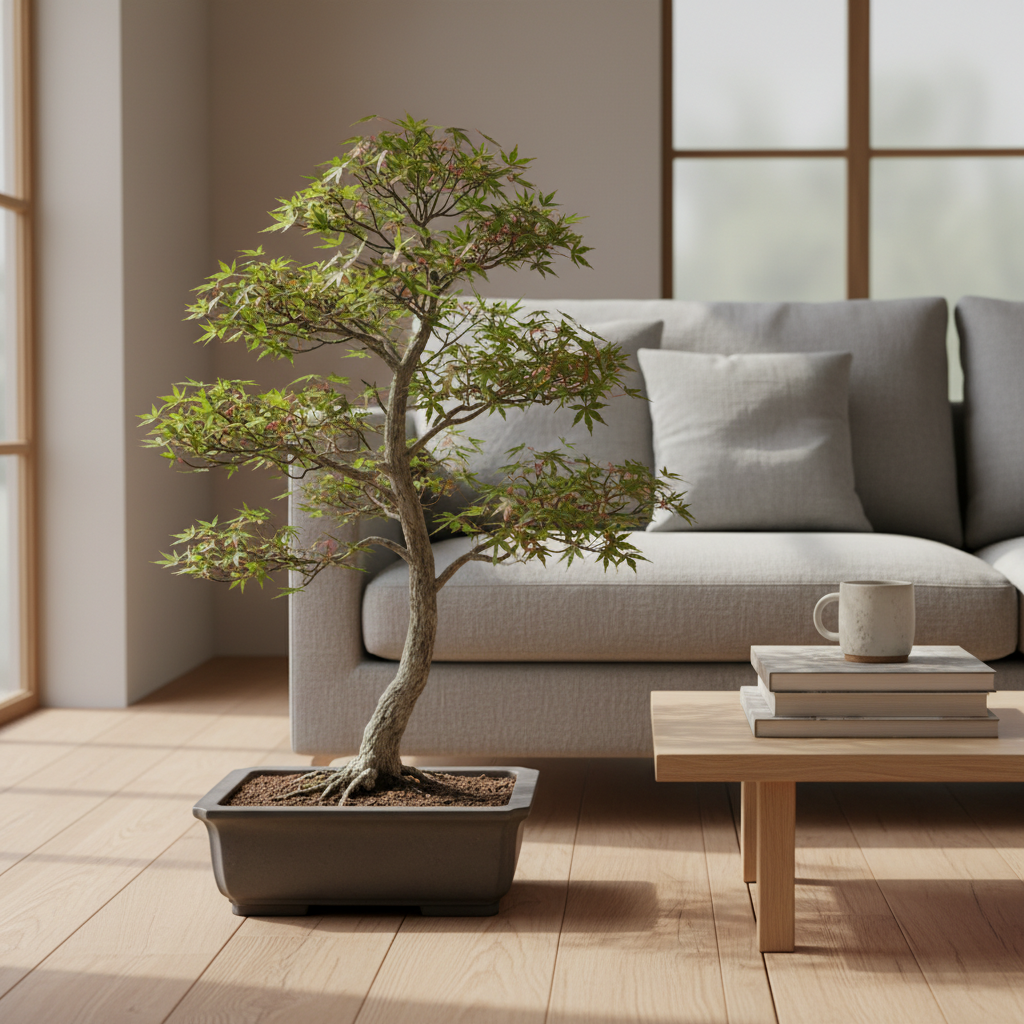
For the home grower, the draw is the seasonal theatre. A tropical plant offers a steady wall of green; a bonsai maple offers four distinct acts a year. Spring opens with new leaves that can emerge coral, crimson or lime depending on the cultivar. Summer settles the canopy into a cool, layered green that softens any room or balcony. Autumn is the showpiece, when the foliage turns through a spectrum of fire before dropping. Winter then reveals the bare architecture of the tree, the trunk line and branch structure that the grower has spent years refining. Honesty matters here, though: this is a more demanding plant than a snake plant or a ZZ plant. It needs daily attention in summer, a genuinely cold rest in winter, and a spot outdoors for most of the year. The reward for that effort is a relationship with a living sculpture, and for many people that trade is exactly the point.
Important — Toxicity: The Japanese maple (Acer palmatum) is not listed as toxic to cats, dogs or humans, and is considered a pet-safe choice among woody plants. One caveat worth knowing: wilted leaves of the unrelated red maple (Acer rubrum) are toxic to horses, so the broader maple genus carries a warning in equine circles. For an indoor or balcony bonsai maple kept away from grazing animals, there is no meaningful toxicity concern, though as with any plant you should discourage pets and small children from chewing the foliage.
Light Requirements
Light is where the bonsai maple parts company most sharply with conventional houseplants. As a temperate woodland tree, it is built to receive far more light than any indoor windowsill can supply, and the honest answer is that it belongs outside for the great majority of the year. A bonsai maple grown permanently indoors will etiolate, producing thin, overlong shoots and oversized pale leaves, and it will eventually decline. Think of indoor placement as a short guest appearance, a few days for display, rather than a home.
Outdoors, the ideal is generous bright light with gentle direct sun in the cooler parts of the day and shade during the fierce heat of mid-afternoon. Morning sun followed by dappled afternoon shade produces the most compact growth and the best leaf colour without scorching. Cultivars with red or finely cut leaves are especially prone to leaf burn in strong sun, so they want a little more shelter than the plain green forms, which can take more exposure.
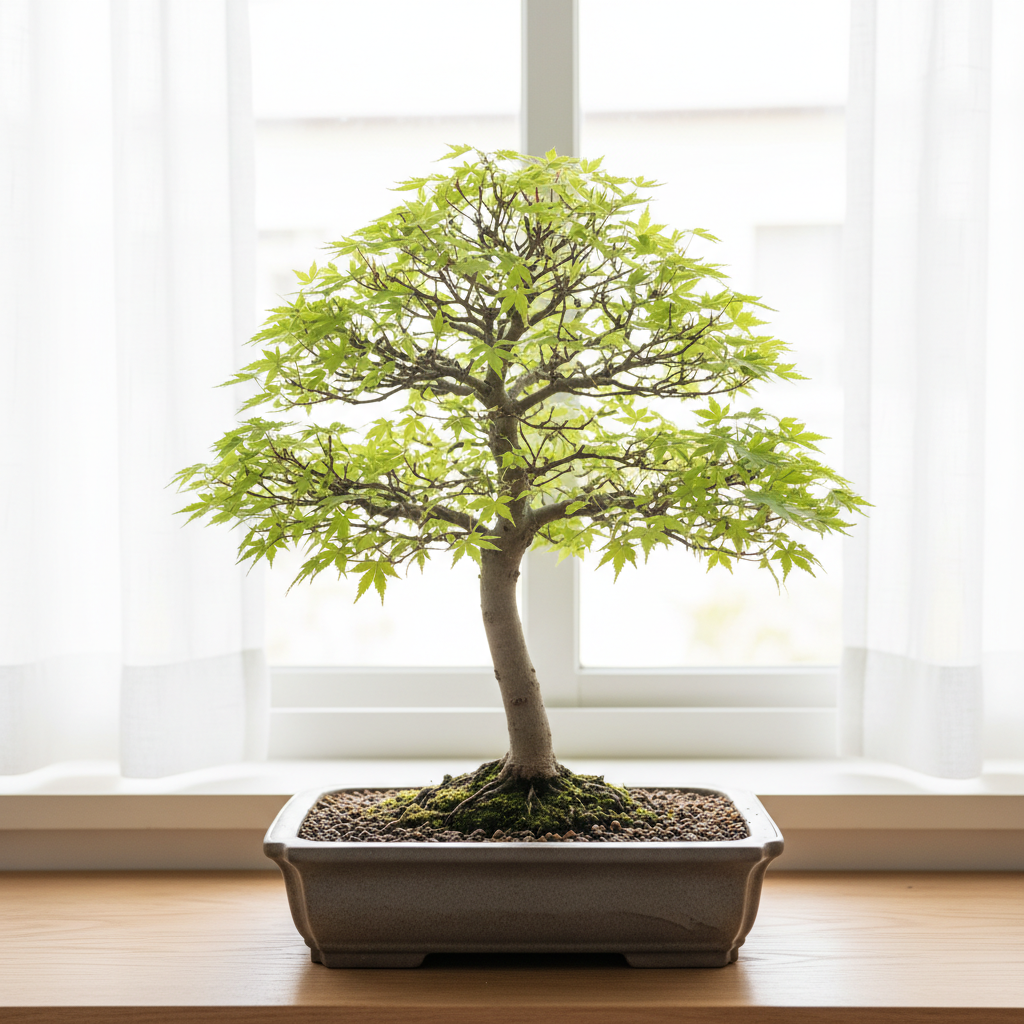
Light Levels Explained
Because the bonsai maple is a sun-loving tree rather than a shade-tolerant tropical, its light tiers run brighter than most houseplant charts. The table below frames the categories in terms of what each one means for a maple specifically.
| Light Category | Approx. Level | Typical Location | Outcome |
|---|---|---|---|
| Full sun | 50,000+ lux | Open balcony, unshaded garden | Good for green cultivars; risks scorch on red and dissected types in heat |
| Morning sun, afternoon shade | 20,000 to 40,000 lux | East-facing patio, lightly shaded terrace | Ideal for nearly all cultivars; best colour and compact growth |
| Bright dappled shade | 10,000 to 20,000 lux | Under high tree canopy, north terrace | Healthy but slightly looser growth; safe for delicate cultivars |
| Bright indoors | 2,000 to 10,000 lux | Directly at a sunny window | Tolerable for short display only; growth weakens over weeks |
| Low indoors | Under 2,000 lux | Room interior, away from windows | Unsuitable; rapid decline and leggy, pale growth |
Window Orientation and Placement
South-facing window: The brightest indoor option, and the only one suitable for even a temporary stay. Direct midday sun through glass can still overheat the foliage and the shallow pot, so filter it with a sheer curtain and watch for leaf crisping.
East-facing window: Gentle morning light here is kinder to the leaves, but the total daily light is usually too low to sustain a maple for more than a few days of display.
West-facing window: Strong afternoon sun combined with trapped indoor heat is a poor combination for a maple, encouraging scorch on one side and weak growth overall.
North-facing window: Too dim to support healthy growth at all. A maple left here will stretch toward the glass and steadily fade.
Pro Tip — The Balcony Rule: If you live in a flat with no garden, an outdoor windowsill, balcony or fire-escape ledge that receives morning sun is worth far more to a bonsai maple than the sunniest indoor position. Keep the tree outside and simply bring it in for a day or two when you want to enjoy it up close, then return it to the fresh air.
How Light Affects Leaf Colour
Light does more than power growth in a maple; it shapes the colour that makes the tree worth growing. The red pigments in cultivars such as Deshojo and Atropurpureum are produced more intensely in good light, so a red maple kept too shady will fade toward muddy green. At the same time, the brilliant autumn display depends on the contrast between warm sunny days and cool nights, conditions you only get outdoors. A maple sheltered indoors through autumn often skips the fireworks entirely and simply drops dull leaves. Bright, airy outdoor conditions are the price of the colour.
Warning — Direct Sunlight: Leaf scorch is the most common light problem on bonsai maples. It shows as brown, crisp margins and dead patches, usually on the side facing the strongest afternoon sun, and is made far worse by dry roots. Red-leaved and finely dissected cultivars burn most easily. If you see scorch, move the tree into afternoon shade and check that it is never going dry at the roots during hot spells.
Artificial Lighting
Grow lights can keep a maple ticking over indoors in an emergency, such as nursing a sick tree through a cold snap, but they are not a long-term substitute for the sun. A maple needs both high light intensity and the natural shortening of autumn days to trigger dormancy correctly, and a grow light running on a fixed schedule disrupts that signal. If you must use one, choose a strong full-spectrum LED, keep it close, and run it on a timer that mirrors the natural dayllength rather than a constant long day.
Seasonal Adjustments
A maple’s light needs shift with its leaves. Through spring and summer it wants maximum light short of scorching, so a position with morning sun and afternoon shade is perfect. As autumn arrives, leave it fully exposed to the cooling air and shortening days that drive colour and signal dormancy. Once the leaves drop, the bare tree needs no light to speak of and can rest in a sheltered, cold but frost-protected spot until buds swell again in spring.
Watering & Humidity
Watering is the daily discipline at the heart of bonsai maple care, and it is unforgiving in both directions. The shallow bonsai pot holds very little soil, so it dries out far faster than a deep houseplant container, yet the maple’s fine roots will rot if left standing in waterlogged mix. The goal is a substrate that is consistently moist, like a wrung-out sponge, and never either bone dry or sodden. Getting this right takes attention rather than a rigid schedule.
When to Water
Check the soil surface daily, and water when the top of the mix has just begun to dry but before it has dried out completely. In the heat of summer a maple in a small pot can need watering once in the morning and again in the evening, while in cool, overcast weather it may go a day or two between waterings. There is no fixed interval that works year-round; the tree, the weather and the pot size set the pace, and your finger pressed into the surface is the only reliable gauge.
Through winter dormancy the picture changes completely. A leafless tree uses very little water, so watering drops to perhaps once a week or less, just enough to stop the rootball drying out entirely. The roots are still alive and must not desiccate, but they also must not sit cold and wet, which invites rot. Err toward barely moist during the rest period and resume regular watering only as the buds begin to swell in spring.
Pro Tip — The Two-Finger Check: Before each watering, press two fingers lightly onto the soil surface and into the moss if present. If it feels cool and damp, wait; if it feels dry and the pot has become noticeably light when lifted, water thoroughly. With a week of doing this you will learn your tree’s rhythm far better than any calendar reminder could teach you.
How to Water Correctly
- Use a watering can with a fine rose, or a gentle hose attachment, so the stream does not wash out the surface soil or disturb the moss.
- Water the entire surface evenly, starting from one side and moving across, so every part of the rootball is wetted rather than just a central channel.
- Continue until water runs freely from the drainage holes, then pause and water a second time to be sure the whole mix is saturated.
- Let the excess drain away completely; never leave the pot standing in a saucer of water.
- In very hot weather, water in the early morning and again in the evening, avoiding the fierce midday sun when water can heat in the pot and stress the roots.
- Use rainwater or filtered water where possible, especially in hard-water areas, as maples prefer slightly acidic conditions.
Signs of Overwatering vs. Underwatering
| Symptom | Overwatering | Underwatering |
|---|---|---|
| Leaf colour | Yellowing, often from the inside out, with a dull cast | Margins browning and crisping while centres stay green |
| Leaf texture | Soft, limp, sometimes blackening at the edges | Dry, brittle, curling and papery |
| Soil | Constantly wet, sour smelling, slow to drain | Pulls away from the pot edge, hard and dusty |
| Roots | Brown, mushy, foul smelling when checked at repotting | Dry and shrivelled, fine feeder roots dead |
| Overall vigour | Buds fail to open, dieback of fine twigs | Sudden wilting and leaf drop in heat, twig tips die back |
Warning — Root Rot: A maple left in soggy, poorly draining soil will lose its fine roots to rot, and because the canopy is small the first visible sign is often sudden collapse: buds that fail in spring, or leaves that blacken and drop with no obvious cause. Prevention is far easier than cure. Use a sharply draining bonsai mix, never let the pot sit in standing water, and back off watering sharply during the dormant months.
Humidity Requirements
Compared with the watering regime, humidity is a minor concern for a bonsai maple. As a temperate tree it is comfortable in ordinary outdoor air across a broad range, and moderate humidity of roughly 50 to 60 per cent suits it well. Outdoors, natural air movement and humidity are almost always adequate, and you rarely need to think about it.
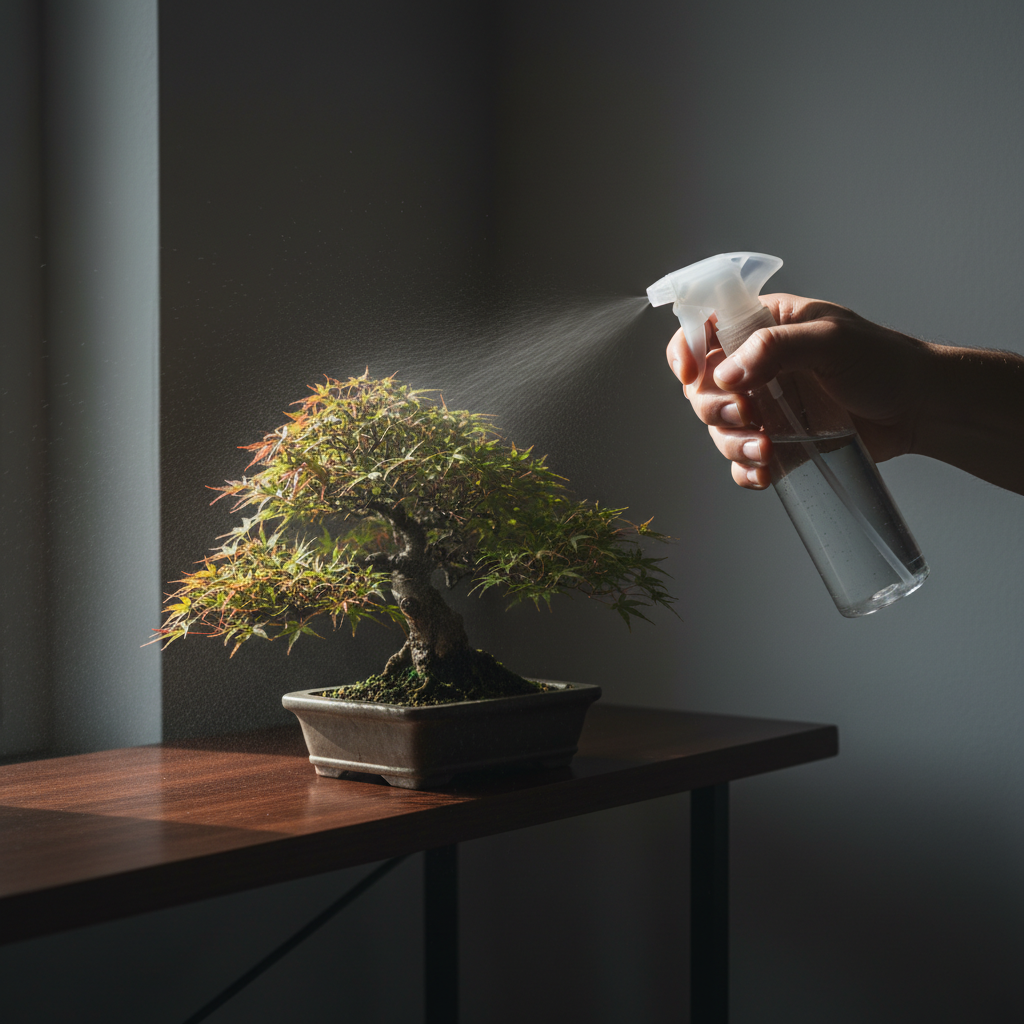
Problems with humidity tend to appear only when a maple is brought indoors, where dry, heated air can accelerate leaf-edge browning, particularly if the roots are also running dry. This is one more reason to keep indoor stays brief. If a tree must stay inside for a spell, a gentle misting of the foliage in the morning and a position away from radiators and heating vents will help offset the dry interior atmosphere.
Raising humidity for a maple is best done by improving its surroundings rather than fussing over the individual tree. Grouping it outdoors with other plants, standing it on a gravel-filled humidity tray during an indoor stay, and avoiding hot, stagnant corners all help. Do not rely on misting alone to make up for dry roots, which is the real cause of most leaf-edge damage.
Water Quality
Maples prefer slightly acidic conditions, and in hard-water areas the dissolved minerals in tap water can gradually raise the pH of the soil and leave chalky deposits that interfere with iron uptake, showing as paling between the leaf veins. Where you can, water with collected rainwater, which is naturally soft and slightly acidic and is ideal for maples. If only tap water is available, letting it stand overnight allows some chlorine to dissipate, and an occasional flush with rainwater or the periodic use of an ericaceous feed helps keep the root environment on the acid side the tree favours.
Soil, Potting & Repotting
The soil in a bonsai pot does a harder job than ordinary potting compost. It must hold enough moisture to carry a thirsty tree through a hot day, drain fast enough that the fine roots never suffocate, and provide the firm anchorage a small tree needs in a shallow container. Standard bagged houseplant compost fails on every count for a maple: it holds too much water, compacts into an airless mass, and rots roots. A proper bonsai substrate is built from coarse, granular components instead.
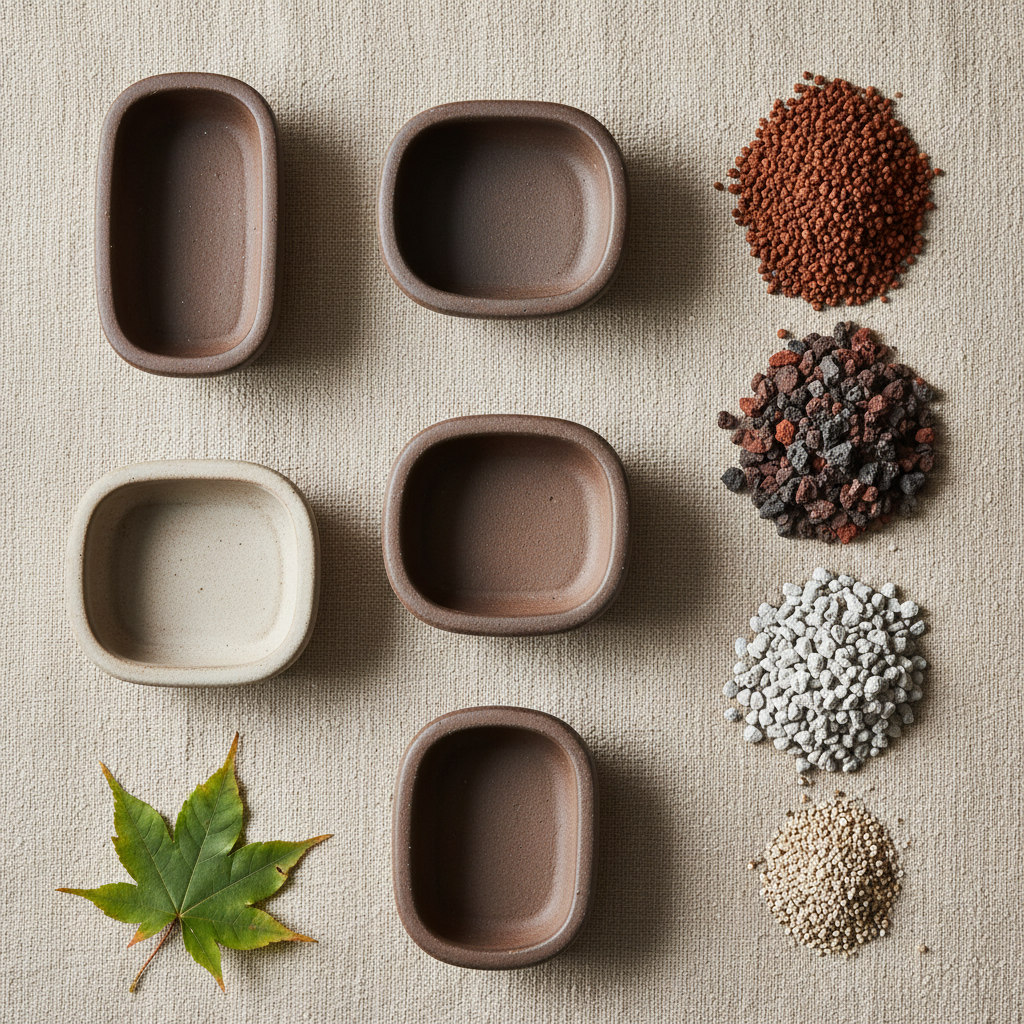
Ideal Soil Composition
The classic deciduous bonsai mix is built around akadama, a fired Japanese clay granule that holds moisture and nutrients while keeping its structure, blended with pumice for aeration and lava rock or grit for drainage and weight. A common starting ratio for a maple is roughly half akadama with the remainder split between pumice and lava rock, adjusted toward more akadama in dry climates and more pumice and grit in wet ones. The table below shows the role each component plays.
| Component | Proportion | Function |
|---|---|---|
| Akadama | Around 50 per cent | Holds moisture and nutrients, retains structure, encourages fine root division |
| Pumice | Around 25 per cent | Opens the mix for air, stores a little water, keeps the structure light |
| Lava rock or grit | Around 25 per cent | Sharpens drainage, adds weight and stability, never breaks down |
| Optional organic component | Up to 10 per cent | A little composted bark can add moisture retention in fast-drying conditions |
Maples favour a slightly acidic root environment, roughly pH 5.5 to 6.5. Akadama itself is mildly acidic, which suits them, and growers in very chalky areas sometimes add a portion of kanuma, an acidic pumice used for ericaceous plants, to keep the pH down. Avoid limestone-based grit, which pushes the soil alkaline and can lock up iron.
Pro Tip — Quick Mix Recipe: If you cannot source akadama, a serviceable maple mix can be made from two parts fine pumice or perlite, one part composted bark and one part horticultural grit, sieved to remove dust. It is not as refined as a traditional akadama blend, but it drains freely and will keep a maple healthy while you find better ingredients.
Choosing the Right Pot
The bonsai pot is part of the composition, not just a container, and for a maple it is usually a shallow, unglazed or softly glazed dish in a muted earth tone that complements the seasonal leaf colour. Beyond aesthetics, the pot must serve the roots, and a few practical points apply regardless of style.
Drainage holes are non-negotiable. A bonsai pot should have generous drainage holes, and most also have small wiring holes used to anchor the tree. Cover the drainage holes with plastic mesh to keep soil in while letting water out freely, and never use a pot without drainage for a living maple.
Pot material: Fired ceramic bonsai pots are the standard, prized for their durability and their frost resistance, which matters for a tree that lives outdoors year-round. Choose a stoneware pot rated as frost-proof if your winters are cold, as cheaper earthenware can crack when wet soil freezes.
Pot size: A bonsai pot is deliberately small relative to the tree, which is part of what restrains growth and refines the foliage. The depth is typically close to the diameter of the trunk base, with enough width to balance the canopy visually. A pot that is too large coarsens the tree and holds excess wet soil; the constrained root run is a feature, not a flaw.
When to Repot
Repotting is how a bonsai maple is kept healthy in its small pot, refreshing the soil and pruning back the roots so fine feeders can keep forming. A young, vigorous maple typically needs repotting every two years, while an older, slower specimen may go three to five years between repottings. The signs that a tree is ready include water sitting on the surface and draining slowly, roots circling the pot or pushing out of the drainage holes, and a general loss of vigour. The timing matters as much as the interval: repot in early spring, just as the buds begin to swell but before the leaves open, when the tree has the most energy to recover and the weather is mild.
How to Repot: Step-by-Step
- In early spring, gently work the tree out of its pot, easing a root hook or chopstick around the edge if it is tight.
- Use a rake or chopstick to comb out the outer and lower roots, teasing away roughly the outer third of the rootball and the old, spent soil clinging to it.
- With clean, sharp scissors, trim back the long, thick roots and any circling roots, keeping the mass of fine feeder roots that sit closer to the trunk.
- Prepare the clean pot with mesh over the drainage holes, an anchoring wire threaded through, and a thin layer of fresh free-draining mix.
- Position the tree, secure it firmly with the anchoring wire so it cannot rock, and work fresh mix in around the roots with a chopstick to eliminate air pockets.
- Water thoroughly until it runs clear from the drainage holes, then settle any moss or top-dressing back into place.
- Keep the freshly repotted tree in a sheltered, lightly shaded spot out of wind and strong sun for two to three weeks while new roots establish.
Warning — Transplant Shock: Repotting at the wrong time, especially in summer heat or autumn, or removing too much root at once, can throw a maple into severe shock from which it may not recover. Never bare-root and hard-prune the roots of a stressed or weak tree, keep root reduction modest on older specimens, and always follow a repot with a sheltered recovery period and no fertiliser until new growth appears.
Fertilising
A bonsai maple lives in a tiny volume of fast-draining soil that is repeatedly flushed with water, so the modest nutrient reserves it holds are quickly used up or washed out. Regular feeding through the growing season is therefore essential, not optional, to keep the tree healthy and its foliage well coloured. At the same time, a maple should never be pushed hard with high-nitrogen feed, which produces coarse, oversized leaves and long internodes that work against the refined look bonsai aims for.
The aim is steady, moderate nutrition that supports healthy growth without forcing it, timed to the tree’s seasonal cycle. Feeding begins as the leaves harden off in spring, continues through summer, tapers in late summer, and stops entirely once the tree heads into dormancy.
Understanding Plant Nutrients
Fertilisers are labelled with three numbers, the NPK ratio, giving the percentages of nitrogen, phosphorus and potassium. For a bonsai maple a balanced or slightly lower-nitrogen feed is ideal during the main season, switching to a lower-nitrogen, higher-potassium feed in late summer to harden growth for winter. Beyond the big three, maples are sensitive to iron availability, which is tied to soil pH. The table below summarises the key nutrients and what their absence looks like.
| Nutrient | Symbol | Primary Function | Deficiency Symptoms |
|---|---|---|---|
| Nitrogen | N | Drives leaf and shoot growth and green colour | Pale, uniformly yellowing older leaves, weak growth |
| Phosphorus | P | Supports root development and energy transfer | Dull foliage, poor root growth, reddish leaf undersides |
| Potassium | K | Hardens growth and improves cold and disease resistance | Browning, scorched leaf margins, weak stems |
| Calcium | Ca | Builds cell walls and supports new growth | Distorted young leaves, dieback of growing tips |
| Magnesium | Mg | Central to chlorophyll and photosynthesis | Yellowing between the veins of older leaves |
| Iron | Fe | Needed for chlorophyll formation | Yellowing between the veins of young leaves, often in alkaline soil |
Types of Fertiliser
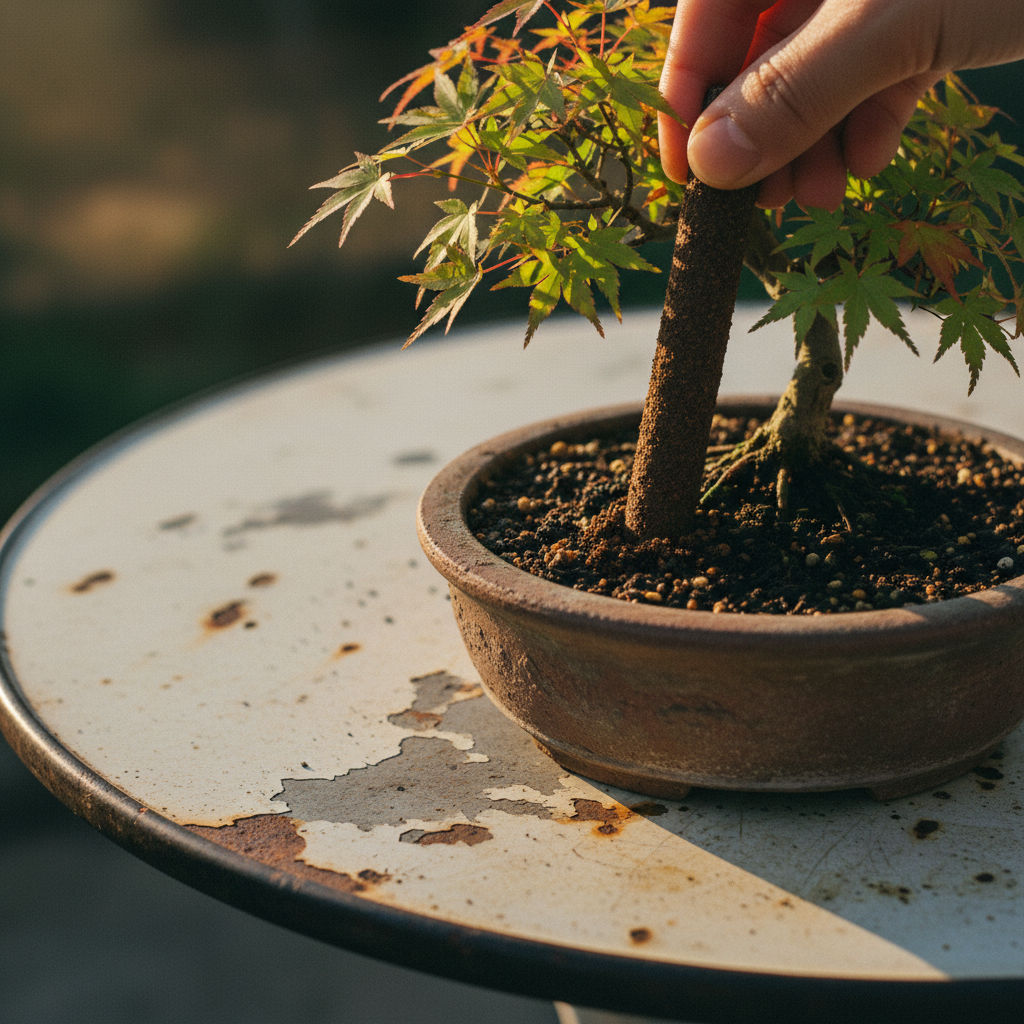
Liquid fertilisers: Diluted liquid feeds are easy to apply with watering and give precise control over strength and timing, which suits the bonsai approach of little and often. They are quickly available to the roots but also quickly washed out, so they need reapplying every couple of weeks through the season.
Slow-release granular: Coated slow-release prills scattered on the soil surface meter out nutrients over weeks or months and reduce the risk of overfeeding. They are convenient for a busy grower, though they offer less fine control than liquids over the exact timing of feeding.
Organic fertilisers: Traditional bonsai feeding leans on organic products such as rapeseed cake pellets or solid organic blocks placed on the soil, which release nutrients gently as they break down and build soil life. They are mild and forgiving, well suited to maples, and the slow release makes coarse growth far less likely than with strong synthetic feeds.
Feeding Schedule
Wait until the spring leaves have fully opened and hardened before the first feed, as fertilising the soft new flush can coarsen it. From late spring through summer, feed every two to four weeks with a balanced fertiliser at half the recommended strength, or keep solid organic feed in place and replace it as it breaks down. In late summer, switch to a low-nitrogen, higher-potassium feed to firm up the growth for winter, then stop feeding entirely once the leaves begin to colour and the tree moves toward dormancy. Do not feed a leafless, dormant maple, and do not feed a newly repotted tree until it is in active growth again.
Pro Tip — Feed Weak, Feed Often: With bonsai maples it is almost always better to underfeed than overfeed. Diluting liquid feed to half strength and applying it more frequently gives steadier growth, smaller leaves and better structure than occasional strong doses, which tend to produce a flush of coarse, oversized foliage that undoes years of refinement.
How to Fertilise
- Always feed onto moist soil, watering first if the mix is dry, to avoid scorching the roots with concentrated nutrients.
- For liquid feed, dilute to half the label strength and apply evenly across the soil surface until it just begins to drain.
- For solid organic feed, place the pellets or blocks on the soil surface, using fertiliser baskets if you want to stop birds and squirrels disturbing them.
- Keep fertiliser off the foliage and away from the trunk base, and water lightly afterwards to begin moving nutrients down to the roots.
- Pause feeding for a few weeks after any heavy pruning or repotting, resuming only once healthy new growth confirms the tree has recovered.
Warning — Salt Build-Up: Because a bonsai pot is small and feeding is frequent, mineral salts from fertiliser and hard water can accumulate in the soil and damage the fine roots, showing as scorched leaf margins and stalled growth. Flush the pot thoroughly with plenty of plain water every few weeks during the feeding season, and especially before the autumn rest, to wash accumulated salts out through the drainage holes.
Propagation
Propagating a bonsai maple is a longer game than rooting a cutting of a tropical vine, but it is deeply rewarding and, in the case of air layering, can produce a substantial tree with mature bark and a ready-made branch structure in a single season. Acer palmatum can be raised from seed, struck from softwood cuttings, or air layered, and named cultivars are usually grafted, a more advanced technique. For the home grower wanting an attractive bonsai relatively quickly, air layering is the standout method.
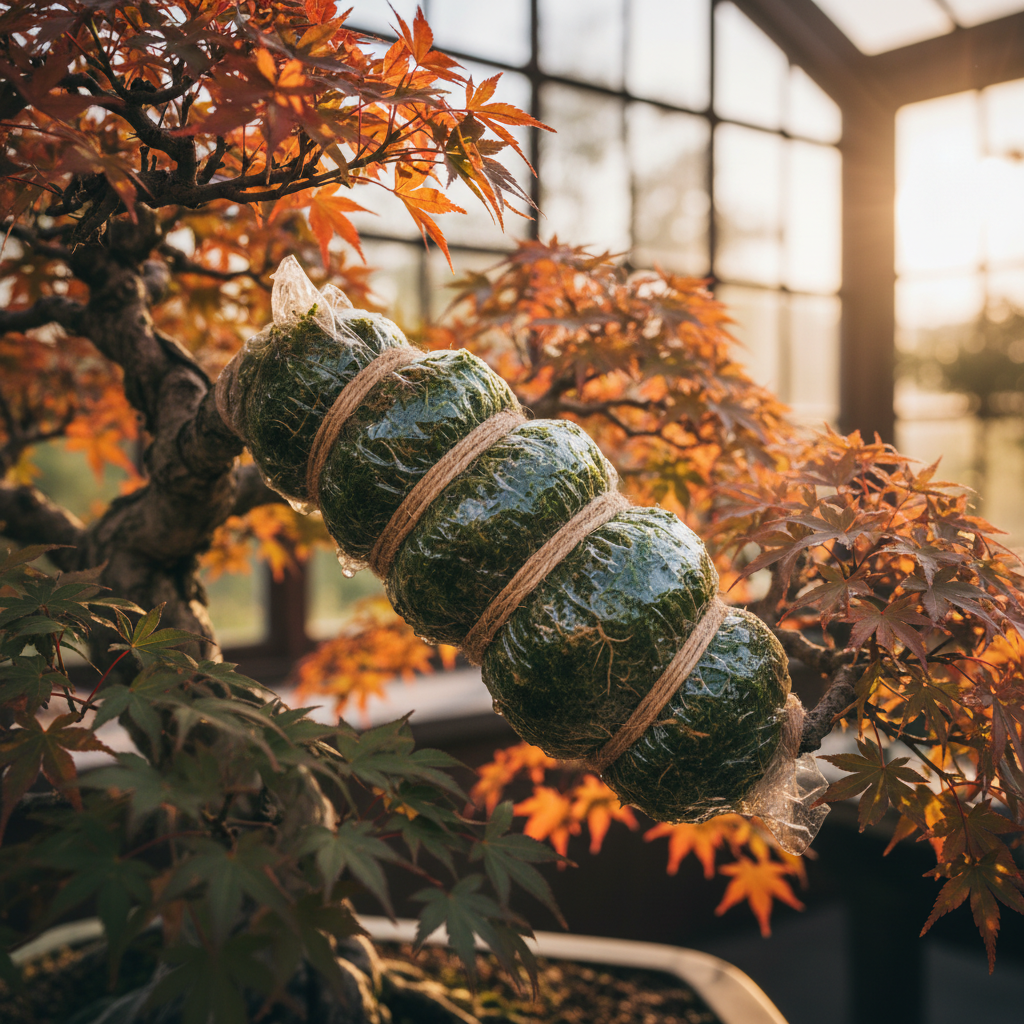
Air layering works by persuading a branch to grow its own roots while it is still attached to and fed by the parent tree, so there is no fragile rooting period during which a detached cutting can fail. It is especially valuable in bonsai because you can choose a branch that already has good movement, taper and bark, and turn it into an independent tree without raising one from scratch.
Understanding Nodes and the Cambium
Both cuttings and air layers rely on the maple’s ability to form new roots from the cambium, the thin layer of living tissue just beneath the bark that carries sugars down from the leaves. When you interrupt that downward flow, by removing a ring of bark in air layering or by wounding the base of a cutting, sugars and rooting hormones gather at the wound and stimulate root formation. Understanding this is the key to both methods: roots form where the energy from the leaves is blocked and pools, so the wound must be clean and complete enough to interrupt the cambium fully.
Air Layering: Step-by-Step
Air layering is best started in spring once the tree is in active growth, giving the whole season for roots to develop before the layer is separated. Choose a healthy branch with the thickness and character you want for a future tree.
- Select a vigorous branch and, at the chosen point, cut and peel away a complete ring of bark roughly one and a half times the branch’s width, exposing the pale wood beneath.
- Scrape the exposed wood clean to remove the last of the green cambium, which prevents the wound simply healing over and bridging the gap.
- Optionally dust the upper edge of the wound with rooting hormone to encourage faster root formation.
- Wrap a generous handful of pre-soaked sphagnum moss around the wound, enclosing it completely, then wrap clear film over the moss and tie it firmly above and below so it holds moisture and stays in place.
- Keep the moss damp through the season, opening and re-misting it if it begins to dry, and watch for white roots appearing against the film.
- Once the moss is well filled with roots, usually by late summer or autumn, cut the branch off just below the new root mass and pot it into free-draining bonsai mix.
- Protect the newly separated layer in a sheltered, shaded spot and keep it evenly moist while the young root system establishes.
Pro Tip — Don’t Rush the Separation: The most common air-layering failure is cutting the branch free too soon, before enough roots have formed to support it alone. Wait until you can see a dense network of roots filling the moss against the film, not just a few thin strands. A layer left a few weeks longer is far more likely to survive than one separated early.
Softwood Cuttings: Step-by-Step
Cuttings are less reliable than air layering for maples and the resulting plants are small, but the method is simple and costs nothing, and a tray of cuttings can yield several young plants to train. Take softwood cuttings in early summer from the current season’s growth, while it is still flexible but beginning to firm.
- Cut healthy shoots about eight to ten centimetres (three to four inches) long, just below a node, using clean, sharp scissors.
- Remove the lower leaves and cut the remaining leaves in half to reduce water loss while the cutting has no roots.
- Dip the cut base in rooting hormone, which noticeably improves the strike rate with maples.
- Insert the cuttings into a tray of damp, free-draining mix such as perlite and fine bark, firming gently around each one.
- Cover the tray with a clear humidity dome or place it in a propagator out of direct sun, keeping the mix moist and the air humid.
- Be patient: rooting can take many weeks, and any cuttings that strike should be left undisturbed until well rooted, then potted on and protected through their first winter.
Troubleshooting Propagation
| Problem | Likely Cause | Solution |
|---|---|---|
| Air layer fails to root | Cambium left on the wound let it heal over; moss dried out | Scrape the wood fully clean, keep moss consistently damp, start in spring |
| Cuttings rot at the base | Mix too wet or not free-draining, dirty tools | Use sharp-draining mix, clean scissors, and avoid waterlogging |
| Cuttings wilt and die | Too much leaf area losing water before roots form | Reduce leaf area, raise humidity with a dome, shade from sun |
| Layer separated and then collapsed | Cut free before enough roots formed | Wait for a dense root mass, separate later, shelter after potting |
Pests & Diseases
A healthy bonsai maple grown outdoors in good conditions is reasonably resistant to trouble, but its concentrated foliage and confined roots mean that when problems do arrive they can do disproportionate damage, and they spread fast on a small tree. The most common pests are sap-suckers drawn to soft new growth, while the diseases that matter most are fungal, often tied to wet foliage, poor air movement or stressed roots.
The best defence is vigilance combined with good culture. Inspect the tree regularly, particularly the undersides of leaves and the soft shoot tips, and address any problem early while it is still small. A tree kept in the right light, watered correctly and not overfed is far less likely to be overwhelmed than a stressed one.
Common Pests
Aphids (Aphidoidea)
Aphids are the most frequent maple pest, clustering on the soft new shoots and leaf undersides in spring, where they suck sap, distort the tender growth and leave a sticky honeydew that sooty mould then colonises. On a maple their effect on the prized new foliage is especially unwelcome.
Treatment: Dislodge light infestations with a firm jet of water, or wipe them off by hand. For heavier attacks, spray with insecticidal soap or a diluted neem oil solution, repeating every few days, and encourage natural predators such as ladybirds outdoors.
Scale Insects (Coccoidea)
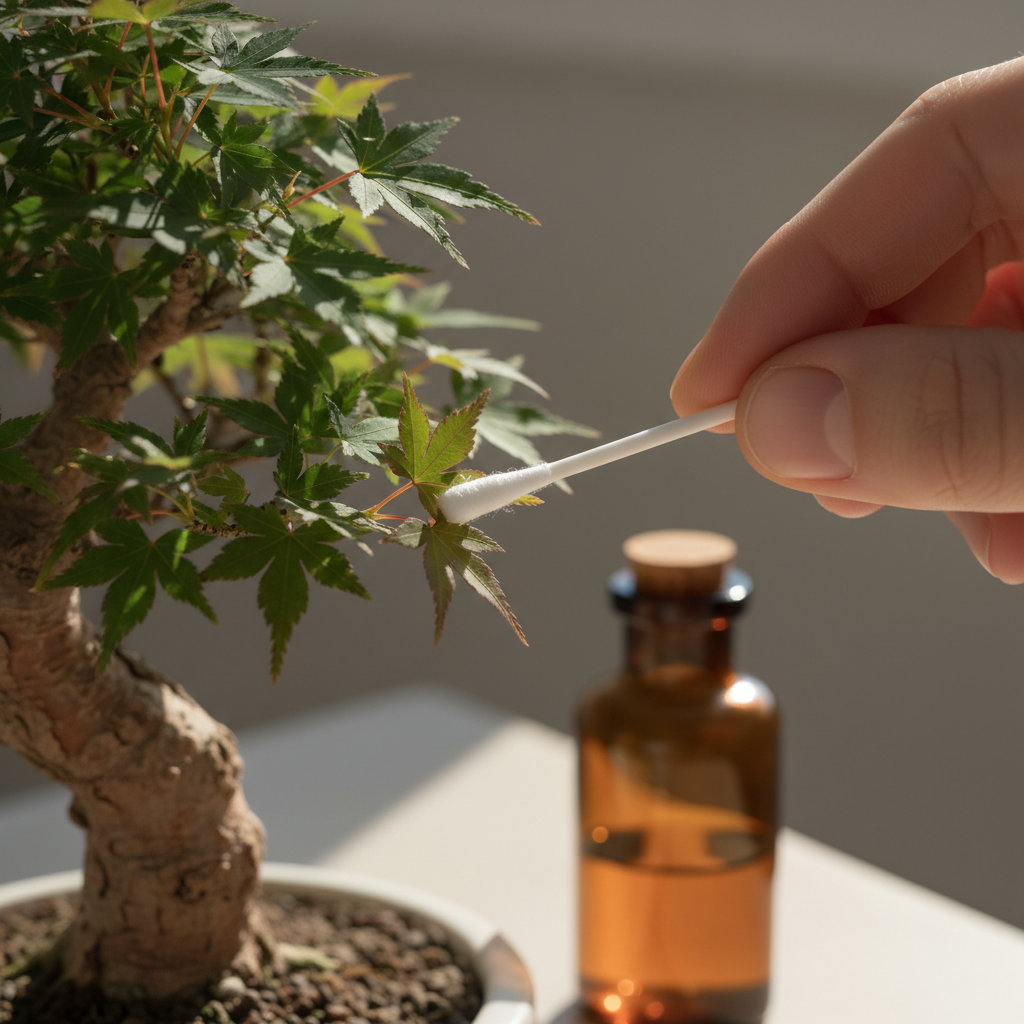
Scale insects appear as small, immobile brown or tan bumps along the stems and branch undersides, protected by a waxy shell that makes them easy to overlook until a colony is established. Like aphids they feed on sap and excrete honeydew, weakening the tree over time.
Treatment: Dab individual scales with a cotton bud dipped in isopropyl alcohol to break their protective coating, then treat the tree with horticultural oil to smother any survivors and newly hatched crawlers, repeating as needed.
Spider Mites (Tetranychus urticae)
Spider mites thrive in hot, dry conditions, which makes them most likely on a maple brought indoors or grown in a sheltered, stuffy spot. They stipple the leaves with fine pale dots and, in bad cases, spin fine webbing between the leaves and shoots while the foliage takes on a dull, bronzed look.
Treatment: Raise the humidity and move the tree into cooler, fresher air, as mites hate moisture and airflow. Rinse the foliage thoroughly, including the undersides, and treat persistent infestations with neem oil or a miticide, repeating to catch successive generations.
Common Diseases
Verticillium Wilt (Verticillium dahliae)
Verticillium wilt is the most serious disease of Japanese maples, a soil-borne fungus that invades through the roots and blocks the water-conducting tissue, causing whole branches to wilt and die back suddenly, often on one side of the tree, with dark staining visible in the wood when an affected branch is cut.
Treatment: There is no cure once a tree is infected. Prune out affected branches well below the staining with sterilised tools, feed and water carefully to support the tree’s own defences, and in severe cases discard the tree and its soil rather than risk spreading the fungus. Using fresh, sterile bonsai mix and avoiding root stress are the best preventives.
Powdery Mildew (Erysiphales)
Powdery mildew coats the leaves with a white, dusty film, usually in late summer when nights cool and air movement is poor. It rarely kills a maple but disfigures the foliage and weakens the tree if it recurs year after year.
Treatment: Improve air circulation around the tree, avoid wetting the foliage late in the day, and remove badly affected leaves. A fungicide or a dilute potassium bicarbonate spray will check a stubborn outbreak.
Leaf Scorch (physiological)
Although not strictly a disease, leaf scorch is so common on bonsai maples that it belongs here. It shows as brown, crisp leaf margins and is caused by the leaves losing water faster than the roots can supply it, typically from a combination of strong sun, hot wind and dry or salt-laden soil.
Treatment: Move the tree into afternoon shade, shelter it from drying wind, and above all keep the roots reliably moist during hot weather. Flushing the pot to clear accumulated salts also helps, as scorch is often worsened by a build-up of fertiliser salts.
Pest and Disease Summary
| Pest / Disease | Identification | Treatment |
|---|---|---|
| Aphids | Clusters of small soft insects on new shoots, sticky honeydew | Water jet, insecticidal soap or neem oil, encourage predators |
| Scale insects | Brown, waxy immobile bumps on stems and branch undersides | Alcohol on a cotton bud, then horticultural oil |
| Spider mites | Fine pale stippling, dull bronzed leaves, faint webbing | Raise humidity, rinse foliage, neem oil or miticide |
| Verticillium wilt | Sudden one-sided branch dieback, dark staining in the wood | No cure; prune out, sterilise tools, discard severe cases |
| Powdery mildew | White dusty film on leaves in late summer | Improve airflow, remove affected leaves, fungicide if needed |
| Leaf scorch | Brown crisp leaf margins after sun, wind or dry roots | Afternoon shade, steady moisture, flush salts from the pot |
Prevention Strategies
The single most effective thing you can do to keep a bonsai maple healthy is to grow it well: outdoors for most of the year, in bright but not scorching light, in free-draining soil kept evenly moist, and fed gently rather than forced. A tree grown in these conditions resists pests and diseases far better than one that is stressed by deep shade, soggy roots or heavy feeding. Good air movement is particularly important for preventing the fungal problems that plague crowded, stagnant growing spots.
Routine hygiene rounds out prevention. Clear fallen leaves and debris from the soil surface where pests and fungal spores overwinter, sterilise your cutting tools between trees, and quarantine any new plant for a few weeks before placing it among an established collection. Inspecting your tree closely each time you water turns pest control into a habit rather than a crisis, and catches almost every problem while it is still trivial to fix.
Pro Tip — Neem as a Routine: A fortnightly preventive spray of dilute neem oil through the growing season, applied in the cool of the evening and never in strong sun, deters aphids, mites and scale before they establish. Always test on a few leaves first, as some maples can be sensitive, and never spray a tree that is already heat-stressed or dry at the roots.
Popular Varieties
One of the joys of the bonsai maple is the sheer breadth of cultivars to choose from. Acer palmatum has given rise to hundreds of named selections, differing in leaf shape, colour, size and growth habit, and many of the most refined are perfectly suited to bonsai because of their naturally small leaves and dense, twiggy growth. A handful of cultivars have become bonsai classics, valued both for their beauty and for how readily they respond to training.
When choosing, weigh leaf size and colour against your conditions and your patience. Small-leaved, vigorous green cultivars are the most forgiving for beginners, while the brilliantly coloured red forms reward a little more care with protection from harsh sun. The table below compares some of the cultivars most often grown as bonsai.
| Variety | Leaf Appearance | Light Needs | Growth Rate | Availability |
|---|---|---|---|---|
| Deshojo | Brilliant scarlet new spring growth, maturing green | Morning sun, afternoon shade | Moderate | Common |
| Atropurpureum | Deep burgundy-purple all season | Bright with some sun for best colour | Moderate to vigorous | Very common |
| Shishigashira (Lion’s Head) | Crinkled, dense, dark green leaves on stiff growth | Sun-tolerant | Slow | Common |
| Arakawa | Green leaves on a trunk that develops rough, corky bark | Sun-tolerant | Moderate | Specialist |
| Kiyohime | Small green leaves, naturally low spreading habit | Morning sun, afternoon shade | Moderate, dwarf | Common |
| Katsura | Orange-yellow new growth turning green, gold in autumn | Bright, part shade | Moderate | Common |
| Seigen | Intensely pink-red spring foliage, fine and delicate | Afternoon shade essential | Slow | Specialist |
Featured Varieties
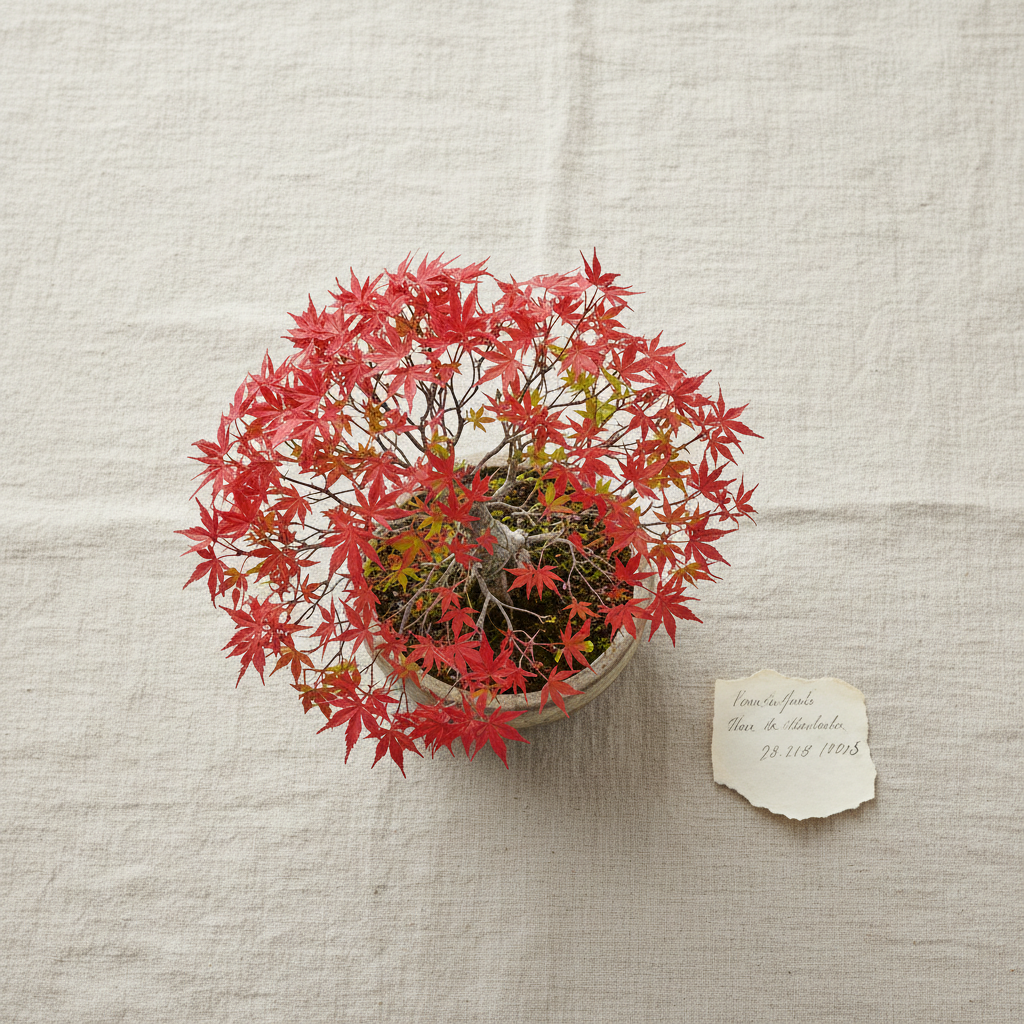
Deshojo
Perhaps the most celebrated maple for spring colour, Deshojo erupts in vivid scarlet as its leaves open, a display so intense it can light up a whole collection. The fiery flush settles to green through summer before a second show of autumn colour. Its small leaves and good ramification make it a bonsai favourite, though the brilliant new growth needs shelter from harsh afternoon sun to avoid scorching.
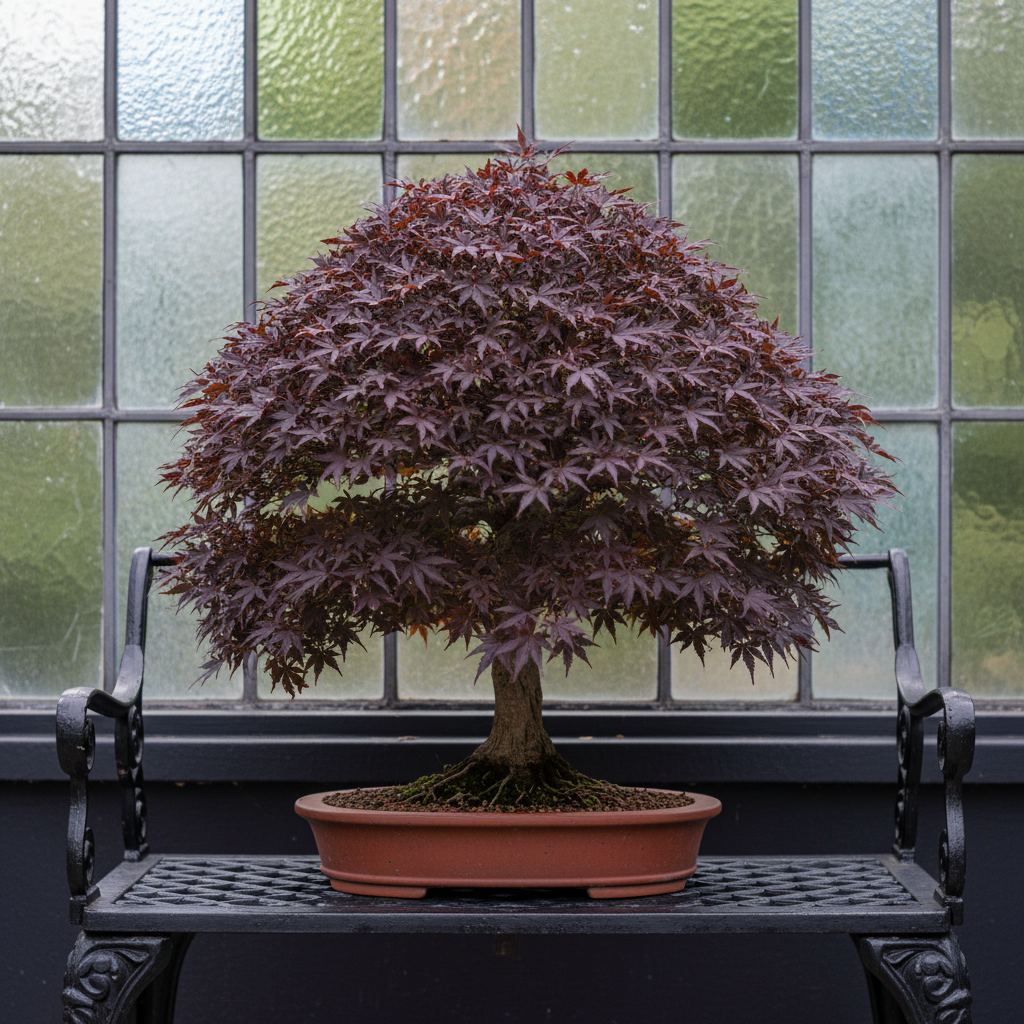
Atropurpureum
Where Deshojo dazzles in spring, Atropurpureum holds a deep burgundy-purple through the whole season, giving a bonsai a brooding, dramatic presence that contrasts beautifully with green companions. It is vigorous, widely available and relatively forgiving, making it an excellent choice for a grower who wants strong red colour without the fragility of the most delicate cultivars. Good light deepens the purple, while too much shade dulls it toward green.
Variety Profiles in Detail
Shishigashira (Acer palmatum ‘Shishigashira’)
Known as the Lion’s Head maple, Shishigashira carries densely packed, crinkled dark green leaves on short, stiff, upright growth, giving it a distinctive curly, congested look quite unlike the airy typical maple. It is slow-growing and sun-tolerant, develops good autumn colour late in the season, and its naturally compact habit makes it one of the easiest maples to keep refined as a bonsai.
Arakawa (Acer palmatum ‘Arakawa’)
Arakawa is grown less for its plain green leaves than for its trunk, which develops a rugged, corky, deeply fissured bark as it ages, lending even a young tree the look of a venerable old specimen. This rough-bark character, called arakawa in Japanese, is highly prized in bonsai, where the illusion of age is everything, and the cultivar rewards the patient grower with a trunk of real presence.
Kiyohime (Acer palmatum ‘Kiyohime’)
Kiyohime is a true dwarf with small green leaves and a naturally low, broad, spreading habit that lends itself to informal broom and spreading bonsai styles. Its modest vigour and fine twigging make it forgiving and quick to ramify, although its tendency to throw strong growth from the outer branches means the centre needs regular attention to stay full.
Choosing the Right Variety for Your Space
For a first bonsai maple, a vigorous green-leaved seedling or a robust cultivar such as Atropurpureum or Shishigashira is the wisest choice, forgiving of the inevitable early mistakes and tolerant of a sunnier position. If you have a sheltered spot with morning sun and afternoon shade, the spectacular red spring cultivars such as Deshojo and Seigen become an option, repaying the extra care with colour nothing else can match. Above all, match the cultivar to the light you can actually provide, since no amount of skill will keep a sun-loving green maple healthy in deep shade or stop a delicate red form scorching in blazing afternoon sun.
Frequently Asked Questions
Can I keep a bonsai maple indoors?
Not as a permanent home. A bonsai maple is a temperate deciduous tree that needs bright outdoor light, fresh moving air and a genuinely cold winter rest, none of which a heated indoor room provides. You can bring one inside for a day or two to enjoy it, but it should live outdoors on a balcony, terrace or in a garden for the great majority of the year. Kept permanently indoors it will weaken and usually die within a season or two.
Why are the leaf edges turning brown and crispy?
Brown, crisp leaf margins are leaf scorch, the most common complaint with bonsai maples. It happens when the leaves lose water faster than the roots can replace it, usually from strong sun, hot drying wind, dry roots, or a build-up of fertiliser salts in the pot. Move the tree into afternoon shade, shelter it from wind, keep the roots reliably moist in hot weather, and flush the pot occasionally to clear salts.
How often should I water my bonsai maple?
There is no fixed schedule. Check the soil daily and water when the surface has just begun to dry. In summer heat a maple in a shallow pot may need watering once or twice a day, while in cool weather it might need it only every other day, and during winter dormancy as little as once a week. Let the tree and the weather set the pace rather than watering by the calendar.
Does my bonsai maple really need a cold winter?
Yes. Like all temperate trees, the bonsai maple needs a period of cold dormancy each winter to rest and to set the buds for the following spring. Denied that cold rest, for example by keeping it in a warm room over winter, the tree becomes confused, exhausts itself, and declines. The roots in a shallow pot do need protection from hard, prolonged freezing, so a sheltered cold spot such as an unheated porch, a cold frame or against a house wall is ideal.
When and how should I prune it?
Structural pruning of larger branches is best done in late autumn or winter when the tree is dormant and the branch structure is visible, as maples bleed sap heavily if cut hard in early spring. Lighter maintenance pruning, pinching and trimming of new shoots to build fine ramification, is done through the growing season. Always use clean, sharp tools, and seal larger cuts to help them heal cleanly.
Why has my maple lost all its leaves?
If it is autumn or winter, this is completely normal: the bonsai maple is deciduous and drops its leaves every year, standing bare through its dormant rest before leafing out again in spring. If leaves drop suddenly in spring or summer, that is a warning sign, usually of dry roots, severe scorch, root rot from overwatering, or disease, and you should check the roots and recent care to find the cause.
How fast does a bonsai maple grow, and how long until it looks good?
Bonsai is a patient hobby. A maple grows at a moderate pace, and developing a convincing trunk, taper and fine branch structure is the work of years rather than months. Buying a partly developed tree, or using air layering to start with a branch that already has good character, shortens the wait considerably, but part of the reward of the bonsai maple is precisely that it improves slowly and steadily over a long time.
Is the bonsai maple safe around pets?
The Japanese maple is not listed as toxic to cats, dogs or humans, so it is considered a pet-safe woody plant. The main caveat applies to horses, which can be poisoned by the wilted leaves of the related red maple, not the Japanese maple itself. For a household bonsai kept away from grazing livestock there is no real toxicity concern, though it is always sensible to discourage pets from chewing any plant.






