
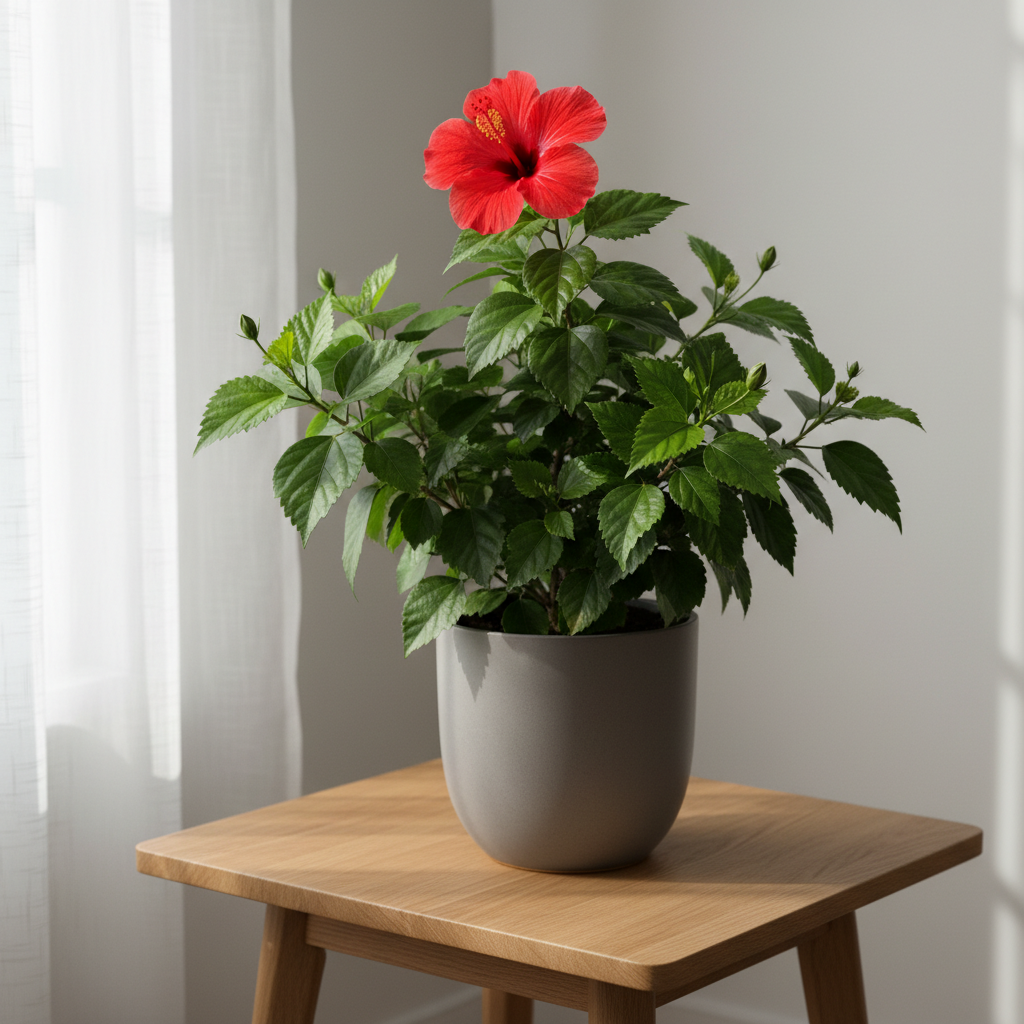
Few houseplants make a statement quite like a hibiscus in full bloom. The Chinese hibiscus, Hibiscus rosa-sinensis, is a woody evergreen shrub in the mallow family, Malvaceae, prized for its enormous trumpet-shaped flowers that can span 10 to 15 centimetres (4 to 6 inches) across. Although it has been cultivated for so many centuries that its precise wild origin is uncertain, it is firmly associated with tropical East Asia and the Pacific, where it grows outdoors year round and serves as the national flower of Malaysia and the state flower of Hawaii. Indoors it is often sold simply as tropical hibiscus, and you may also see it labelled as rose of China or shoeblack plant, the latter a nod to the old practice of using its crushed petals to polish footwear.
Hibiscus has a reputation for being demanding, but that reputation is only half deserved. Keeping the plant alive is straightforward; coaxing it into the relentless flowering that makes it worth growing is where the real skill lies. The gap between surviving and thriving comes down to light, water and feeding, and once you understand what this sun-loving shrub is actually asking for, a hibiscus on a bright windowsill can flower for months on end. This guide covers everything from daily watering rhythm to propagation and pest control, so you can move your plant from merely green to genuinely spectacular.
Contents
- Quick Reference
- Why Hibiscus Makes a Rewarding Houseplant
- Light Requirements
- Watering & Humidity
- Soil, Potting & Repotting
- Fertilising
- Propagation
- Pests & Diseases
- Popular Varieties
- Frequently Asked Questions
Quick Reference: Hibiscus at a Glance
| Light | Very bright; several hours of direct sun daily, ideally a south or west window |
| Watering | Keep evenly moist in growth; water when the top 2 to 3 cm (about 1 inch) of soil dries |
| Temperature | 18 to 30°C (64 to 86°F); protect from anything below 10°C (50°F) |
| Humidity | Moderate to high, 50 to 60 percent preferred |
| Fertiliser | Heavy feeder; high-potassium bloom feed every one to two weeks in the growing season |
| Toxicity | Generally considered non-toxic to cats, dogs and people; petals are even edible |
Why Hibiscus Makes a Rewarding Houseplant
The single best reason to grow Hibiscus rosa-sinensis indoors is the flowers. Each bloom lasts only a day or two, but a healthy, well-fed plant produces them in a near-constant succession from late spring through autumn, and a happy specimen kept warm and bright can flower sporadically even in winter. The blooms come in an extraordinary range of colours, from the classic fire-engine red through pink, apricot, yellow, white and bicoloured forms, many with a contrasting eye at the throat and the distinctive long staminal column that gives the genus its unmistakable silhouette.
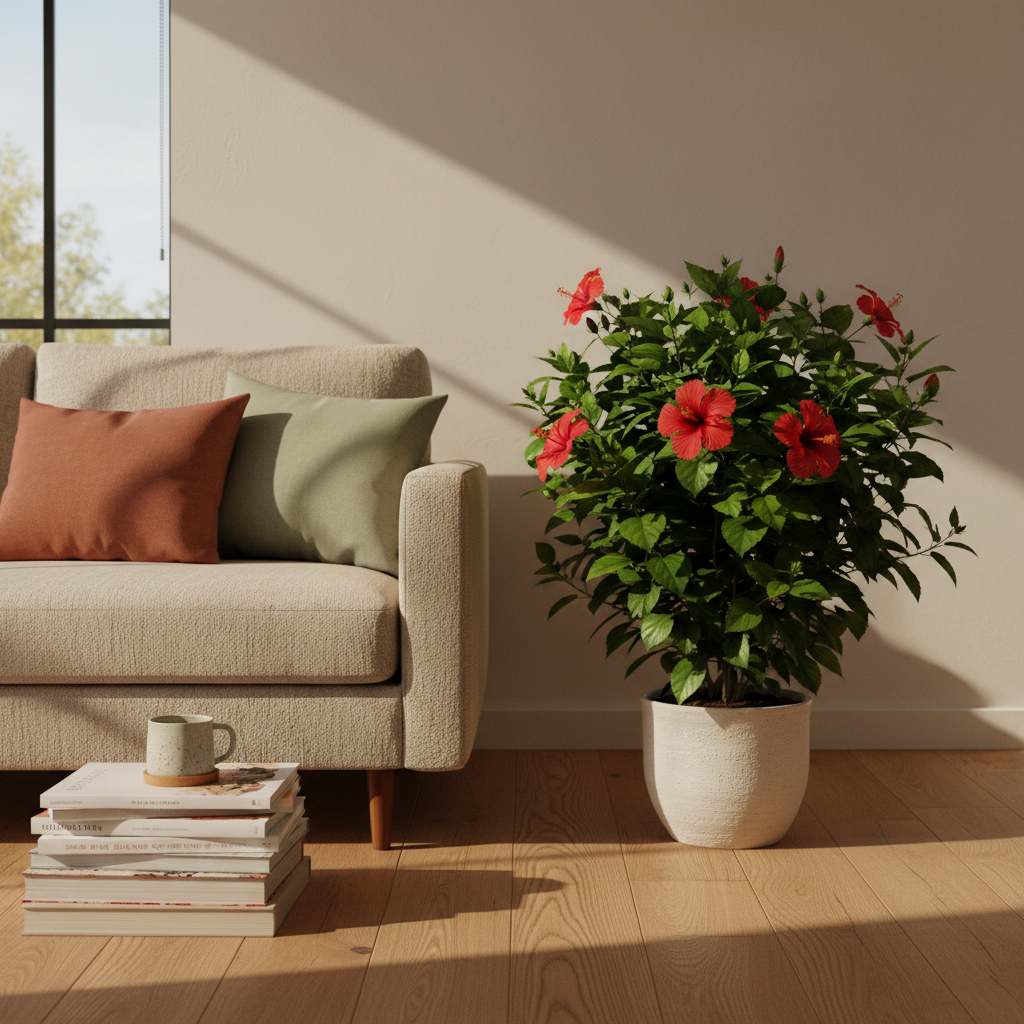
Beyond the flowers, hibiscus is a handsome plant in its own right, with glossy dark-green leaves carried on a naturally bushy, woody frame that responds well to pruning and can be trained as a shrub, a standard or even a small indoor tree. It grows quickly when conditions suit it, which makes it satisfying for gardeners who like to see visible progress, and it is forgiving of the occasional missed watering once established. It is also one of the few flowering houseplants that genuinely thrives in the hot, sunny spots that defeat most foliage plants, making it a natural choice for a bright conservatory, sunroom or south-facing windowsill.
Important — Toxicity: Chinese hibiscus is widely regarded as non-toxic to cats, dogs and humans, and the flowers of this species are used in herbal teas and as edible garnishes. That said, eating large amounts of any plant material can cause mild stomach upset in pets, so it is sensible to discourage nibbling. Do not confuse it with rose of Sharon (Hibiscus syriacus), a hardy garden relative that some sources list as mildly irritating to dogs.
Light Requirements
If there is one factor that decides whether your hibiscus flowers or simply sits there as a leafy green bush, it is light. This is a full-sun plant in its natural range, and indoors it needs the brightest position you can offer, with at least four to six hours of direct sunlight each day to bloom freely. A hibiscus kept in medium or low light will survive for a surprisingly long time, but it will stretch, produce sparse foliage and refuse to set buds, which is the most common reason owners conclude their plant is unhappy.
The ideal indoor spot is directly in front of an unobstructed south or west-facing window, or in a conservatory where light arrives from several directions. Outdoors in summer, a sunny patio or balcony is perfect, though plants moved outside should be acclimatised gradually over a week or two to avoid scorching leaves that grew under glass.
Light Levels Explained
It helps to understand how different light intensities translate into real positions in the home, and what each one means for a hibiscus specifically.
| Light Category | Approx. Level | Typical Location | Outcome |
|---|---|---|---|
| Direct sun | 20,000 lux and above | On a south or west windowsill, sunroom | Best flowering, compact growth |
| Bright indirect | 10,000 to 20,000 lux | Just back from a sunny window | Healthy foliage, modest blooming |
| Medium | 5,000 to 10,000 lux | An east window or a few metres from a bright one | Survives, leggy, few or no flowers |
| Low | 1,000 to 5,000 lux | North window, room interior | Slow decline, leaf drop, no blooms |
| Very low | Below 1,000 lux | Hallways, dim corners | Unsuitable; plant will fail |
Window Orientation and Placement
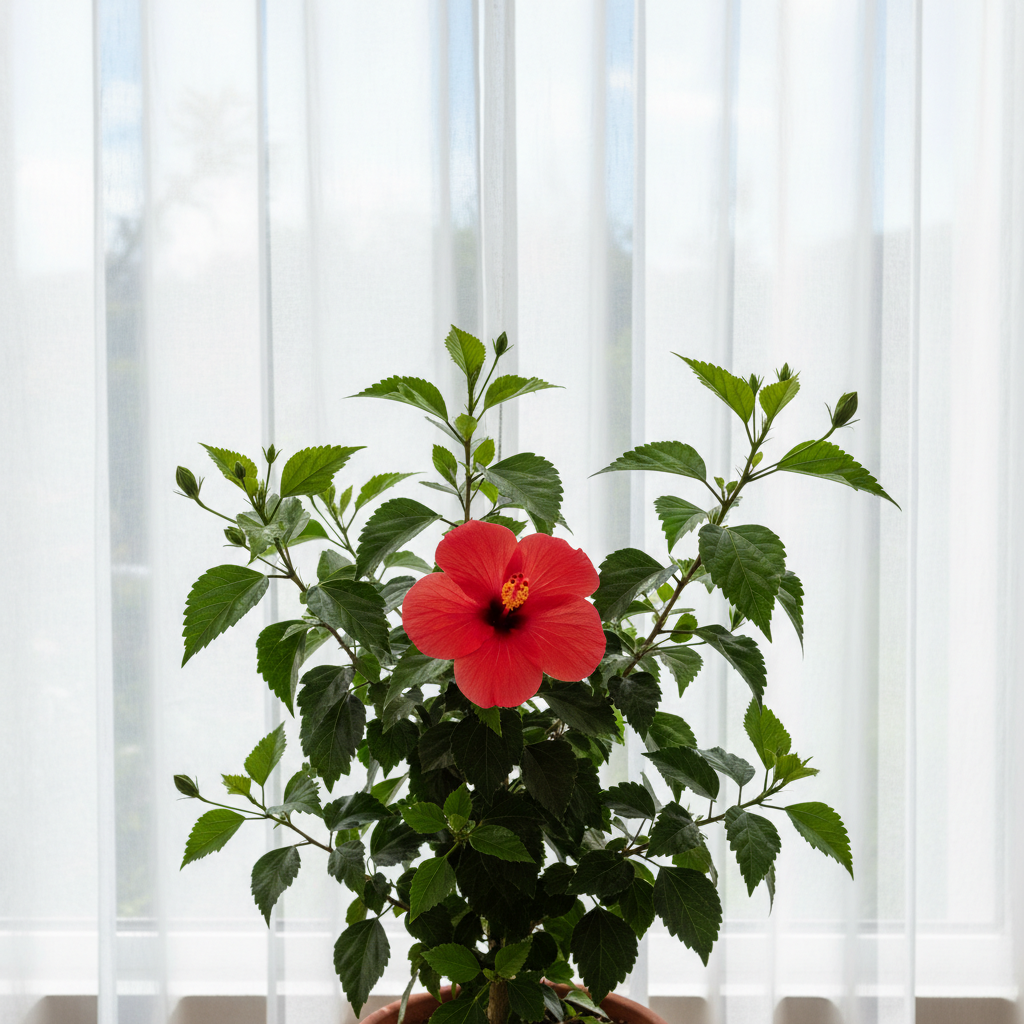
South-facing window: The premium position in the northern hemisphere, delivering the long hours of direct sun hibiscus craves. In the height of summer, very intense glass-magnified light can occasionally scorch leaves, so a thin voile curtain on the hottest afternoons is a sensible precaution.
West-facing window: An excellent second choice. Afternoon and evening sun is strong and warm, and hibiscus flowers beautifully here. Watch for heat building up against the glass on summer afternoons.
East-facing window: Gentle morning sun is pleasant but rarely enough on its own for prolific blooming. Plants will stay green and reasonably healthy but may flower only sparsely. Supplement with a grow light if this is your only option.
North-facing window: Too dim for hibiscus. The plant will limp along, drop leaves and almost certainly refuse to flower. Avoid unless you can add substantial artificial lighting.
Pro Tip — Rotate for an Even Shape: Hibiscus leans hard towards its light source. Give the pot a quarter turn every few days so the plant develops a balanced, bushy shape rather than growing lopsided towards the window.
How Light Affects Flowering
Hibiscus flower buds form only when the plant receives enough light energy to support them, so insufficient light is by far the most common cause of a leafy plant that never blooms. Bud production also responds to the changing seasons, slowing as days shorten in autumn and resuming as light intensity climbs in spring. If your plant grows lush green leaves but produces no buds, the answer is almost always more light before anything else.
Warning — Direct Sunlight: While hibiscus loves sun, foliage grown in lower light cannot suddenly tolerate intense direct rays. Moving a plant abruptly from a shaded spot into blazing summer sun, or out onto a patio, can bleach and scorch the leaves. Always step up light exposure gradually over one to two weeks.
Artificial Lighting
Where natural light falls short, a full-spectrum LED grow light can make the difference between a green plant and a flowering one. Position the light 20 to 30 centimetres (8 to 12 inches) above the canopy and run it for 12 to 14 hours a day during the growing season. Because hibiscus is such a high-light plant, weaker desk lamps and ordinary household bulbs will not meet its needs; a dedicated grow light rated for flowering plants is the only artificial option worth considering.
Seasonal Adjustments
As autumn light weakens, move your hibiscus to the brightest available window and clean the glass to maximise transmission. Growth and flowering naturally slow over winter, and that is normal; the goal in the dark months is simply to keep the plant healthy until spring. When the sun strengthens again, return the plant to its prime position and resume feeding, and you should see fresh buds within a few weeks.
Watering & Humidity
Hibiscus is a thirsty plant, especially when in active growth and flower. Unlike many houseplants that prefer to dry out substantially between waterings, a blooming hibiscus in a sunny window can use a remarkable amount of water on a hot day, and letting it dry out too far is a fast route to dropped buds and wilting. The trick is to keep the soil consistently moist without leaving the roots standing in water, which means watering often but always allowing excess to drain away freely.
When to Water
Check the soil daily in summer and water as soon as the top 2 to 3 centimetres (about 1 inch) feels dry to the touch. In the peak of the flowering season a vigorous plant in a sunny spot may need watering every day or two, while in a cooler position it may go three or four days between drinks.
In winter, when growth slows and the plant uses far less water, scale right back and let the top third of the pot dry before watering again. Overwatering a dormant hibiscus in cold, dim conditions is one of the easiest ways to rot the roots, so always let the plant, not the calendar, tell you when it is thirsty.
Pro Tip — Lift the Pot: The fastest way to judge thirst is to lift the pot. A pot that feels light is dry and ready for water; one that still feels heavy holds plenty of moisture. With a little practice this beats any moisture meter.
How to Water Correctly
- Check that the top 2 to 3 cm (about 1 inch) of soil has dried before watering.
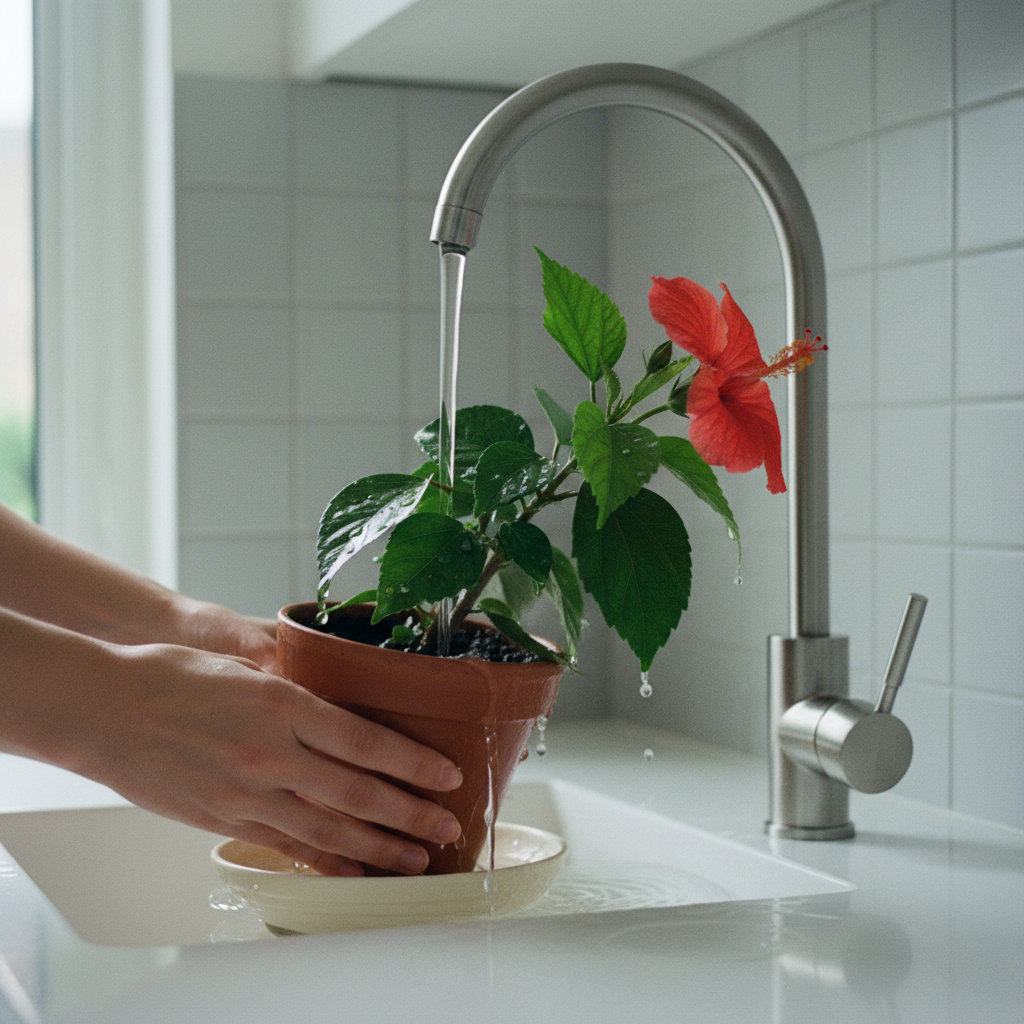
- Water slowly and evenly over the whole soil surface, using room-temperature water.
- Continue until water flows freely from the drainage holes, ensuring the entire root ball is moistened.
- Let the pot drain fully for several minutes.
- Tip away any water that collects in the saucer or cache pot so the roots never sit in it.
Signs of Overwatering vs. Underwatering
| Symptom | Overwatering | Underwatering |
|---|---|---|
| Leaf colour | Yellowing across the whole plant, often lower leaves first | Yellowing with dry, crisp edges |
| Leaf texture | Soft, limp, sometimes swollen | Dry, wilted, brittle when severe |
| Soil | Stays wet for days, may smell sour | Pulls away from the pot edge, bone dry |
| Buds and flowers | Buds yellow and drop before opening | Buds shrivel and drop, flowers fade fast |
| Roots | Brown, mushy, foul smelling | Dry and papery but usually still firm |
Warning — Root Rot: Persistently soggy soil starves the roots of oxygen and invites fungal rot, which is frequently fatal. If you notice a sour smell, blackened mushy roots and widespread yellowing, unpot the plant immediately, trim away all rotten roots with sterilised scissors and repot into fresh, free-draining mix.
Humidity Requirements
As a tropical plant, hibiscus appreciates moderate to high humidity of around 50 to 60 percent. Average household air is often drier than this, particularly in winter when central heating is running, and very dry air can contribute to bud drop and crispy leaf edges.
The clearest signs that the air is too dry are brown, brittle leaf tips, buds that fall before opening and an increase in pests such as spider mites, which flourish in arid conditions. None of these is caused by humidity alone, but low humidity often tips the balance.
To raise local humidity, stand the pot on a tray of damp pebbles, group it with other plants so they share transpired moisture, or run a small humidifier nearby in winter. Misting offers only a brief lift and can encourage fungal spots on the foliage, so it is the least reliable method for this species.
Water Quality
Hibiscus is reasonably tolerant of ordinary tap water, but in hard-water areas the mineral build-up over time can lead to nutrient lock-out and dull foliage. If your tap water is very hard or heavily chlorinated, using filtered water or collected rainwater will keep the plant at its best. Always let cold tap water reach room temperature before applying it, as a shock of icy water can cause buds to drop.
Soil, Potting & Repotting
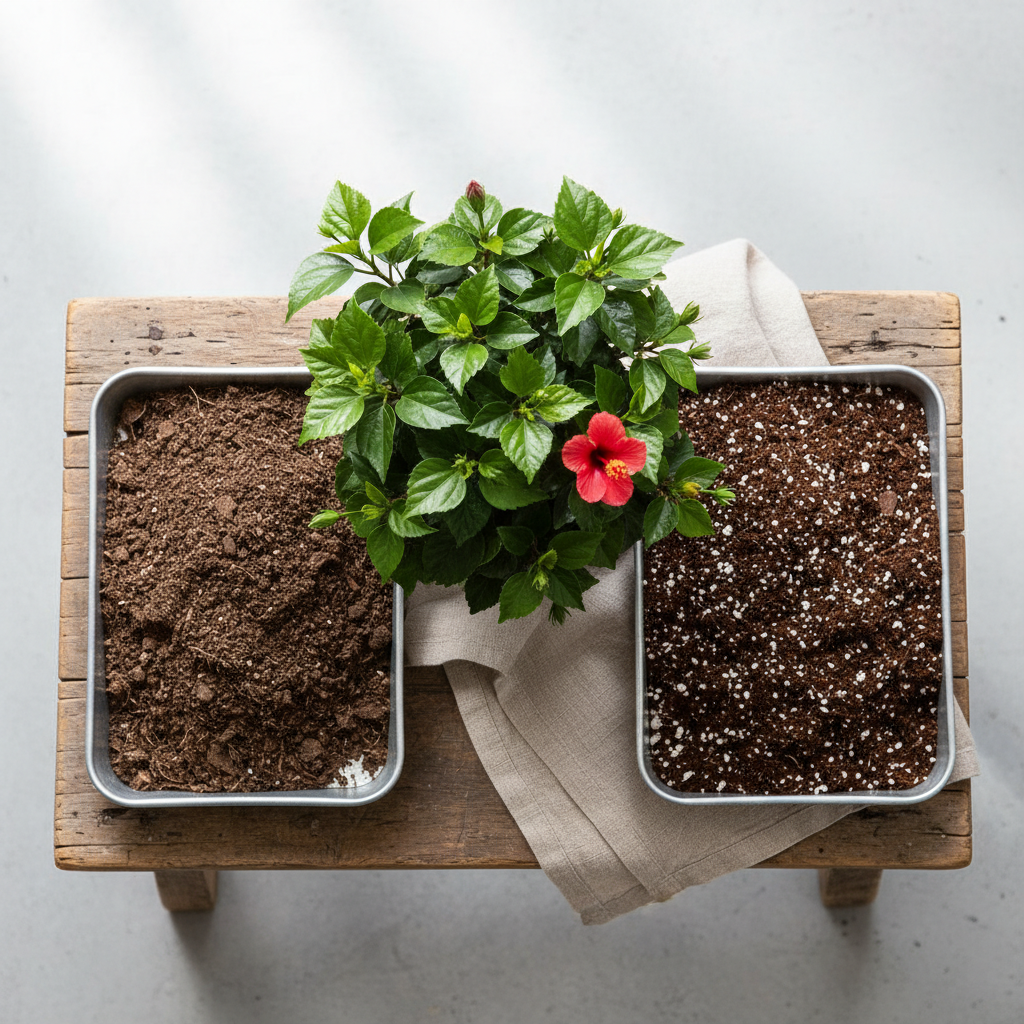
Hibiscus needs a soil that holds moisture well yet drains freely, a balance that keeps the thirsty roots supplied with water without ever leaving them waterlogged. A good-quality, loam-based potting compost forms an excellent base, opened up with grit or perlite to guarantee drainage.
Ideal Soil Composition
The aim is a rich but airy medium. Start with a loam-based or general-purpose peat-free compost for structure and nutrition, then add drainage material so excess water clears quickly. A little composted bark improves aeration and keeps the mix from compacting over the seasons.
| Component | Proportion | Function |
|---|---|---|
| Loam-based or quality peat-free compost | 60 percent | Holds moisture and nutrients, gives body |
| Perlite or horticultural grit | 25 percent | Ensures fast drainage and aeration |
| Composted bark or coir | 15 percent | Keeps the mix open and slow to compact |
Hibiscus prefers a slightly acidic to neutral soil, around pH 6.0 to 6.8, which suits most general composts well. Strongly alkaline conditions can trigger iron deficiency, seen as yellowing between the leaf veins, so in hard-water areas it is worth refreshing the top layer of compost each spring.
Pro Tip — Quick Mix Recipe: For a reliable hibiscus mix, combine four handfuls of peat-free multipurpose compost with two handfuls of perlite and one handful of composted bark. It holds water like the plant wants yet drains in seconds, which is exactly the balance a heavy drinker needs.
Choosing the Right Pot
Hibiscus actually flowers more freely when its roots are slightly restricted, so resist the urge to plant it in an oversized container. A pot only a little larger than the root ball encourages the plant to put energy into buds rather than endless root growth.
Drainage holes are non-negotiable. Given how often you water a hibiscus, a pot without holes will drown the roots within days. Always choose a container with generous drainage, and if you use a decorative cache pot, lift the inner pot out to empty any water that collects.
Pot material: Terracotta is excellent because its porous walls let the compost breathe and dry more evenly, reducing the risk of rot, though it does mean watering more often. Glazed ceramic and plastic hold moisture longer, which can be helpful in very sunny spots but demands a more careful eye on watering.
Pot size: When potting on, move up just one size, roughly 2 to 4 centimetres (1 to 2 inches) more in diameter. A jump that is too large leaves a mass of unused, soggy compost around the roots and invites rot.
When to Repot
Young, fast-growing hibiscus benefit from repotting every spring, while mature plants can be left for two or three years and simply top-dressed with fresh compost in the meantime. Tell-tale signs that a repot is overdue include roots emerging from the drainage holes, water running straight through without wetting the soil, and growth that has stalled despite good light and feeding. Always repot in spring as growth resumes, never in the depths of winter.
How to Repot: Step-by-Step
- Water the plant a day before repotting so the root ball holds together and the roots are hydrated.
- Ease the plant out by tipping the pot and supporting the base of the stems; never yank it by the top growth.
- Gently tease out any tightly circling roots and trim away anything brown, soft or rotten.
- Add a layer of fresh mix to the new pot so the plant will sit at the same depth as before.
- Centre the plant and backfill around the root ball with fresh compost, firming gently to remove air pockets.
- Water thoroughly to settle the soil, then return the plant to its bright spot.
Warning — Transplant Shock: Hibiscus can sulk after repotting and may drop a few buds or leaves. Keep it warm, brightly lit and evenly watered, but hold off on fertiliser for three to four weeks until you see fresh growth, as feeding stressed roots can do more harm than good.
Fertilising
Hibiscus is one of the hungriest flowering houseplants you can grow. Producing a continuous succession of large blooms demands a lot of energy and nutrients, and a plant that is starved will quickly stop flowering even when light and water are perfect. Regular feeding through the growing season is therefore not optional if you want a plant that performs.
The key is to match the feed to the plant’s needs. Hibiscus has a particular appetite for potassium, which drives flower production, and a moderate appetite for phosphorus. It is, however, sensitive to excess phosphorus, so the high-phosphorus bloom boosters sold for other plants are best avoided in favour of a balanced or high-potassium feed.
Understanding Plant Nutrients
Fertiliser labels show three main numbers, the N-P-K ratio, representing nitrogen, phosphorus and potassium. For hibiscus, a feed where the potassium figure is equal to or higher than the nitrogen figure, with phosphorus kept low, produces the best flowering. The plant also draws on secondary nutrients and trace elements, and deficiencies in these show up clearly in the leaves.
| Nutrient | Symbol | Primary Function | Deficiency Symptoms |
|---|---|---|---|
| Nitrogen | N | Leaf and stem growth, deep green colour | Pale, yellowing older leaves, weak growth |
| Phosphorus | P | Root development and energy transfer | Dull leaves, purplish tints, poor roots |
| Potassium | K | Flowering, water regulation, overall vigour | Scorched leaf edges, few or aborted buds |
| Magnesium | Mg | Core of the chlorophyll molecule | Yellowing between the veins of older leaves |
| Iron | Fe | Chlorophyll formation in new growth | Yellowing between veins of the youngest leaves |
Types of Fertiliser
Liquid fertilisers: The most practical choice for hibiscus, because you can feed little and often and adjust easily. A balanced or high-potassium liquid feed, or a dedicated tomato or rose food diluted as directed, suits the plant well and is taken up quickly.
Slow-release granular: Pelleted controlled-release feeds mixed into the compost give a steady background supply over several months and are a convenient backup. They are best combined with occasional liquid feeding during peak flowering for the heaviest bloomers.
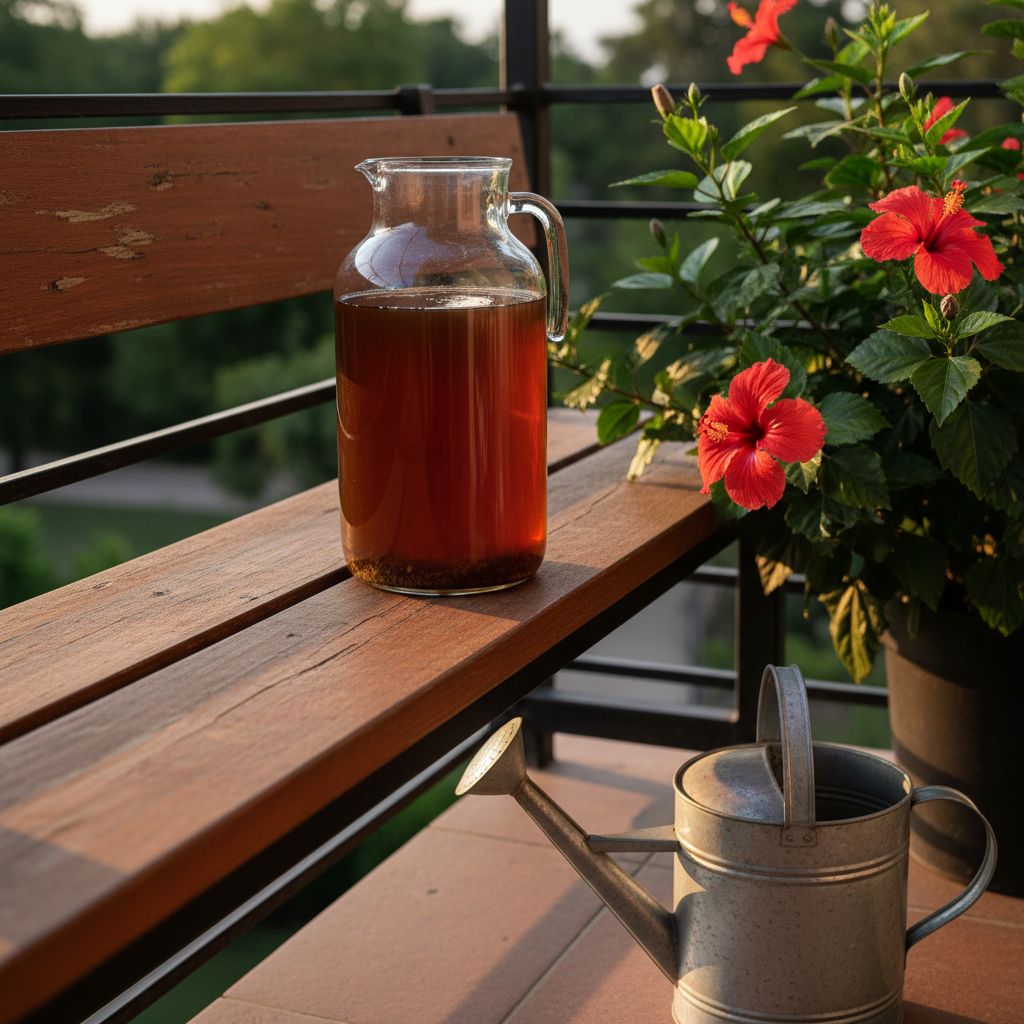
Organic fertilisers: Seaweed extract, worm castings and well-diluted compost tea feed the plant gently and improve soil life. They release nutrients more slowly, so heavy-flowering plants may still need a potassium-rich top-up at the height of the season.
Feeding Schedule
From spring through to early autumn, feed with a diluted liquid fertiliser every one to two weeks while the plant is in active growth and flower. As light fades in autumn, reduce feeding to once a month, then stop altogether through winter when the plant is resting. Resume in spring once new growth appears.
Pro Tip — Little and Often: Hibiscus responds far better to weak, frequent feeds than to occasional strong ones. Mixing the fertiliser at half the recommended strength but applying it twice as often gives a steady nutrient supply and avoids the salt build-up that strong doses leave behind.
How to Fertilise
- Water the plant lightly first if the soil is very dry, to protect the roots from concentrated feed.
- Dilute the fertiliser in water according to the label, erring on the weaker side.
- Apply evenly to the soil until it begins to drain from the bottom.
- Avoid splashing feed onto the leaves and flowers, which can mark them.
- Flush the pot with plain water every month or so to wash out accumulated salts.
Warning — Salt Build-Up: Frequent feeding leaves mineral salts in the soil, seen as a white crust on the surface or pot rim and as scorched leaf edges. Every few weeks, flush the pot by running plain water through it several times to dissolve and wash away the excess.
Propagation
Propagating hibiscus is a rewarding way to make new plants from a favourite specimen, and because named cultivars do not come true from seed, taking cuttings is the only reliable way to reproduce a particular flower colour or form. The most dependable method is stem cuttings, with air layering as a useful alternative for stubborn or woody material.
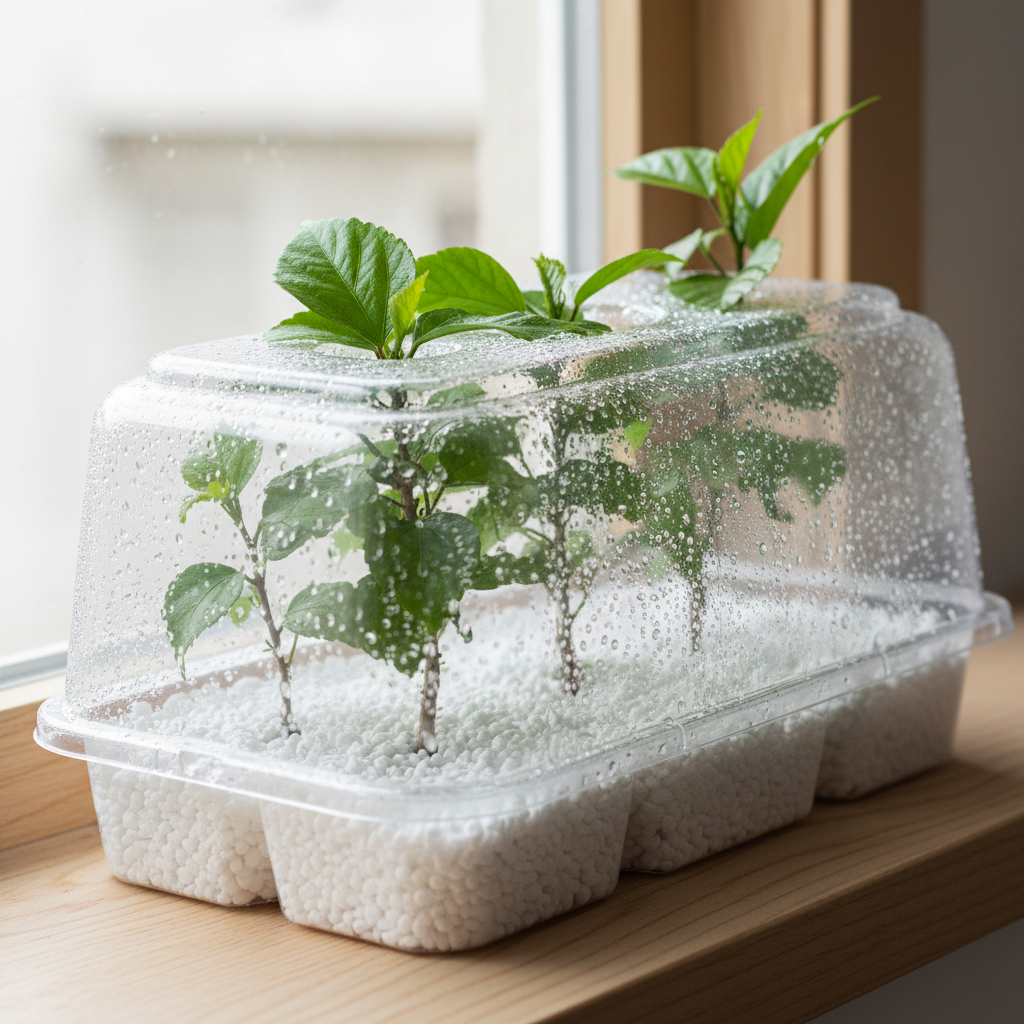
The best time to propagate is late spring or early summer, when the plant is growing strongly and cuttings root fastest. Warmth and humidity are the two ingredients that make the difference between success and a tray of rotted stems, so a propagator or a clear cover and a warm spot are well worth providing.
Understanding Stem Cuttings
Hibiscus roots from sections of stem that carry several leaf nodes, the points where leaves join the stem. Semi-ripe wood, taken from this season’s growth that has begun to firm up but is not yet fully woody, strikes most readily. Each cutting should be 10 to 15 centimetres (4 to 6 inches) long with a few nodes, since the new roots emerge from the buried node and the young shoots from the nodes above.
Stem Cuttings: Step-by-Step
This is the standard, high-success method and the one most growers rely on.
- Using clean, sharp secateurs, cut a 10 to 15 cm (4 to 6 inch) length of semi-ripe stem just below a node.
- Remove the lower leaves, leaving two or three at the top, and pinch out any flower buds so energy goes to rooting.
- Dip the cut end in rooting hormone to improve the strike rate, tapping off the excess.
- Insert the cutting into a pot of damp, free-draining mix such as equal parts perlite and compost, burying at least one node.
- Cover with a clear plastic bag or propagator lid to hold humidity, and place somewhere warm and bright but out of harsh direct sun.
- Keep the medium lightly moist and ventilate briefly every few days; roots usually form in six to eight weeks.
Pro Tip — Bottom Heat: Hibiscus cuttings root far faster with gentle warmth at the base. A heated propagation mat that keeps the medium at around 22 to 25°C (72 to 77°F) can cut rooting time dramatically and noticeably improves success.
Air Layering: Step-by-Step
Air layering encourages roots to form on a stem while it is still attached to the parent plant, which is ideal for thicker, woodier branches that are slow to root as cuttings.
- Choose a healthy, semi-woody stem and make a shallow upward cut or remove a thin ring of bark just below a node.
- Dust the wound with rooting hormone to speed things along.
- Wrap the area in a handful of damp sphagnum moss, enclosing the cut completely.
- Cover the moss with clear plastic film and seal both ends with twine or ties so it stays moist.
- Keep the moss damp and watch for roots developing inside the wrap over the following weeks.
- Once a good network of roots has formed, cut the stem off below the new roots and pot it up as an independent plant.
Troubleshooting Propagation
| Problem | Likely Cause | Solution |
|---|---|---|
| Cuttings rot at the base | Medium too wet or not free-draining | Use a grittier mix, water less, ventilate the cover |
| Cuttings wilt and shrivel | Too little humidity or too much direct sun | Keep covered, move to bright indirect light |
| No roots after many weeks | Too cold, or hardwood taken instead of semi-ripe | Provide bottom heat, retake from this season’s growth |
| Leaves drop from cutting | Stress or fluctuating conditions | Stabilise warmth and moisture; cuttings can still root leafless |
Pests & Diseases
For all its beauty, hibiscus is something of a magnet for sap-sucking insects, and its soft new growth and abundant buds are exactly what many pests seek out. The good news is that a vigorous, well-fed plant shrugs off minor infestations, and most problems are easily controlled if you catch them early.
The single most useful habit is regular inspection. Check the undersides of leaves, the tender new shoots and the developing buds every week or two, because spotting trouble before it spreads is half the battle. Isolate any new or affected plant to stop pests jumping to your wider collection.
Common Pests
Aphids (Aphis gossypii)
Small green, black or yellow insects that cluster on tender new shoots and flower buds, sucking sap and excreting sticky honeydew. Heavy infestations distort growth and cause buds to abort before they open.
Treatment: Blast them off with a firm spray of water, then treat with insecticidal soap or a diluted neem oil solution every few days until clear. Ladybirds and other natural predators help outdoors.
Whitefly (Trialeurodes vaporariorum)
Tiny white moth-like insects that rise in a cloud when the plant is disturbed and gather on the undersides of leaves. They are a persistent and very common hibiscus pest, weakening the plant and coating it in honeydew.
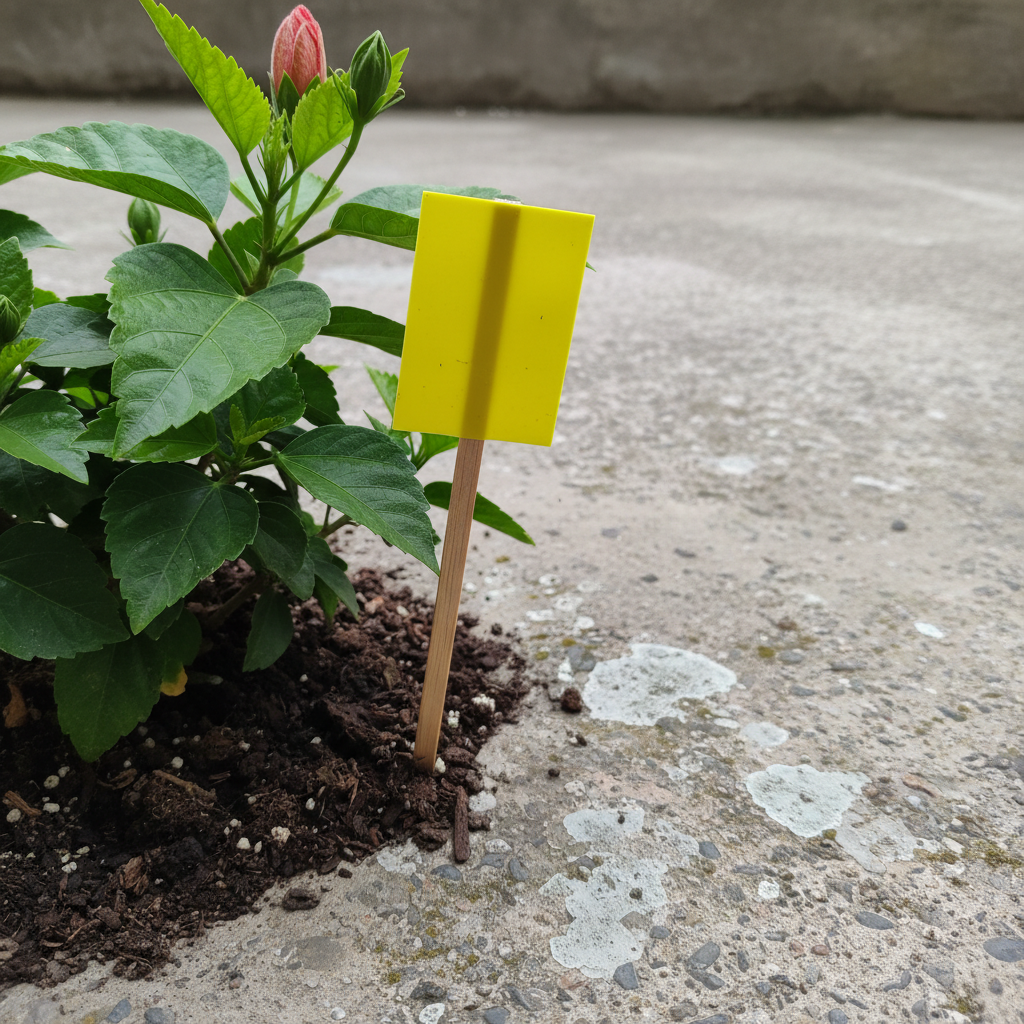
Treatment: Hang yellow sticky traps to catch the adults and spray the leaf undersides with insecticidal soap or neem oil repeatedly, since several treatments are needed to break the life cycle.
Spider mites (Tetranychus urticae)
Microscopic mites that thrive in hot, dry air, stippling the leaves with fine pale dots and spinning delicate webbing in severe cases. Leaves take on a dull, bronzed look and may drop.
Treatment: Raise humidity, rinse the foliage thoroughly including the undersides, and apply neem oil or a miticide. Persistent attention is needed as mites breed rapidly in warmth.
Mealybugs (Pseudococcus longispinus)
Soft, white, cottony insects that hide in leaf axils and along stems, draining sap and leaving sticky residue and sooty mould behind. They breed slowly but are tenacious once established.
Treatment: Dab individual bugs with a cotton bud dipped in isopropyl alcohol, then follow up with insecticidal soap or neem oil across the whole plant to catch the young crawlers.
Common Diseases
Root rot (Phytophthora and Pythium species)
The most serious threat to indoor hibiscus, caused by waterlogged soil and poor drainage. Roots turn brown and mushy, the lower leaves yellow and the whole plant wilts even though the soil is wet.
Treatment: Unpot the plant, cut away all rotten roots, and repot into fresh free-draining mix in a clean pot. Reduce watering sharply and improve drainage to prevent a recurrence.
Leaf chlorosis (nutritional disorder)
Not a true disease but a common physiological problem in hibiscus, showing as yellowing leaves with green veins. It usually stems from iron or magnesium deficiency, often linked to alkaline soil, cold roots or overwatering.
Treatment: Correct the underlying cause by improving drainage and warmth, then apply a balanced feed with chelated iron and magnesium to green the foliage back up.
Pest and Disease Summary
| Pest / Disease | Identification | Treatment |
|---|---|---|
| Aphids | Clusters on buds and shoots, sticky honeydew | Rinse off, insecticidal soap or neem oil |
| Whitefly | White flies rising from leaf undersides | Sticky traps, repeated soap or neem sprays |
| Spider mites | Fine stippling and webbing, dry air | Raise humidity, rinse, neem or miticide |
| Mealybugs | White cottony clumps in axils | Alcohol swab, then soap or neem oil |
| Root rot | Mushy brown roots, wilting in wet soil | Trim roots, repot, water less |
| Leaf chlorosis | Yellow leaves with green veins | Improve drainage, feed with iron and magnesium |
Prevention Strategies
Prevention beats cure every time. A hibiscus grown in good light, fed regularly and watered correctly is naturally more resistant to pests and disease, so getting the basics right is your first line of defence. Keep the foliage clean and uncrowded, allow air to circulate around the plant, and remove fallen leaves and spent flowers promptly so pests and fungi have nowhere to settle.
Quarantine every new plant for a couple of weeks before introducing it to the rest of your collection, and inspect plants whenever you water. Catching an infestation while it is confined to a single shoot makes control quick and easy, whereas a problem left for a month can spread through a whole windowsill.
Pro Tip — Neem Oil Routine: A fortnightly preventative spray of diluted neem oil on the leaf undersides during the growing season keeps the most common sap-suckers at bay. Apply it in the evening or out of direct sun to avoid leaf scorch, and never spray open flowers.
Popular Varieties
Centuries of cultivation and modern hybridising have given Hibiscus rosa-sinensis a staggering range of named cultivars, with new ones appearing every year. They differ in flower colour and form, from single blooms to fully double rosettes, and in habit, from compact bushes to vigorous shrubs, as well as in the colour of their foliage.
For indoor growing it pays to choose a cultivar suited to container life and your available light. The classic single-flowered reds are the most robust and free-flowering, while the elaborate fancy hybrids can be more temperamental and the variegated forms are grown as much for their leaves as their blooms.
| Variety | Flower / Leaf Appearance | Light Needs | Growth Rate | Availability |
|---|---|---|---|---|
| ‘Brilliant’ | Large single scarlet-red flowers, glossy green leaves | Very high | Vigorous | Very common |
| ‘Cooperi’ | Cream, pink and white variegated foliage, small red blooms | High | Compact, slow | Common |
| ‘The President’ | Deep rose-red single flowers with a darker eye | Very high | Vigorous | Common |
| ‘Fiesta’ | Orange-apricot flowers with a deep red throat | Very high | Moderate | Common |
| ‘Cajun’ series | Multicoloured, marbled and speckled large blooms | Very high | Moderate | Specialist |
| ‘Double Apricot’ | Fully double, ruffled apricot rosettes | Very high | Moderate | Specialist |
Featured Varieties
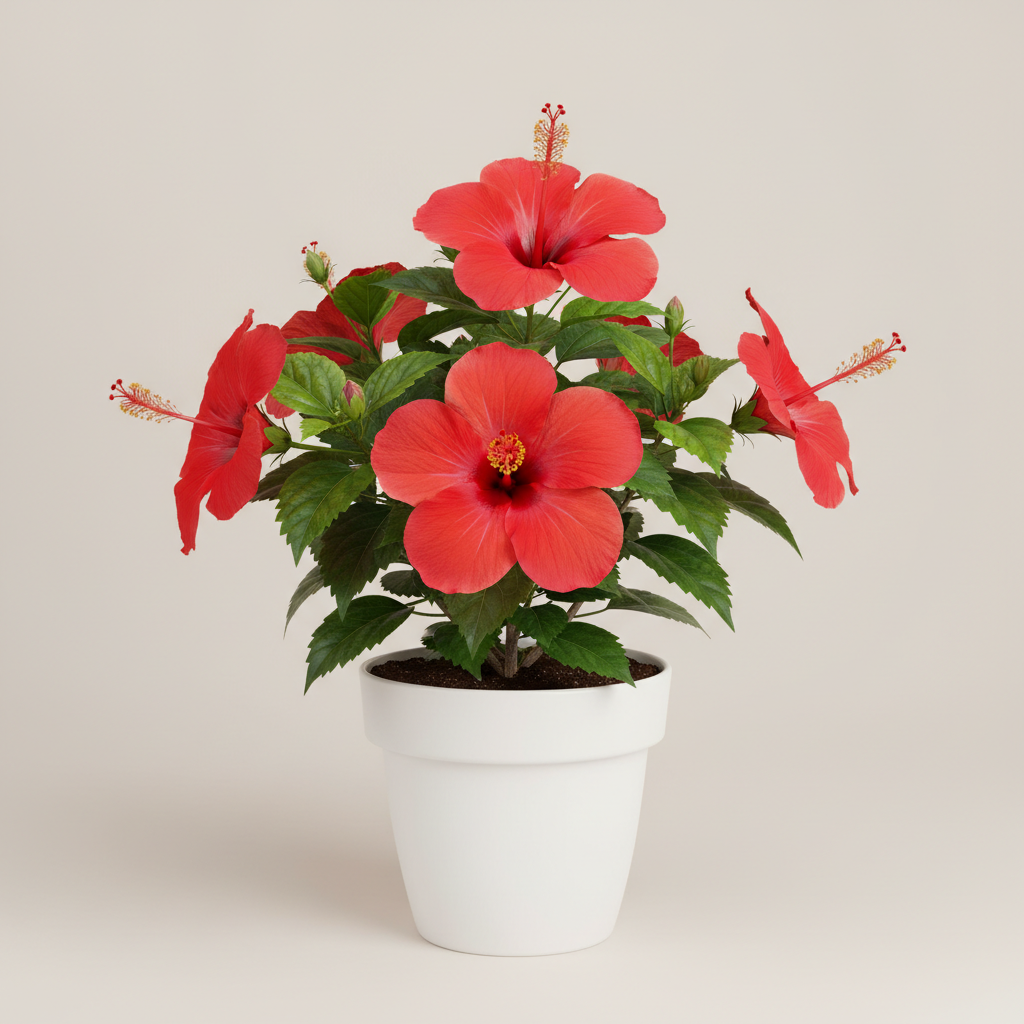
‘Brilliant’
Also sold as Hawaiian Red, this is the archetypal hibiscus: large, single, fire-engine-red flowers with a prominent golden-tipped staminal column, set against glossy dark-green leaves. It is the toughest and most reliable cultivar for beginners, flowering freely and growing vigorously in a bright spot.
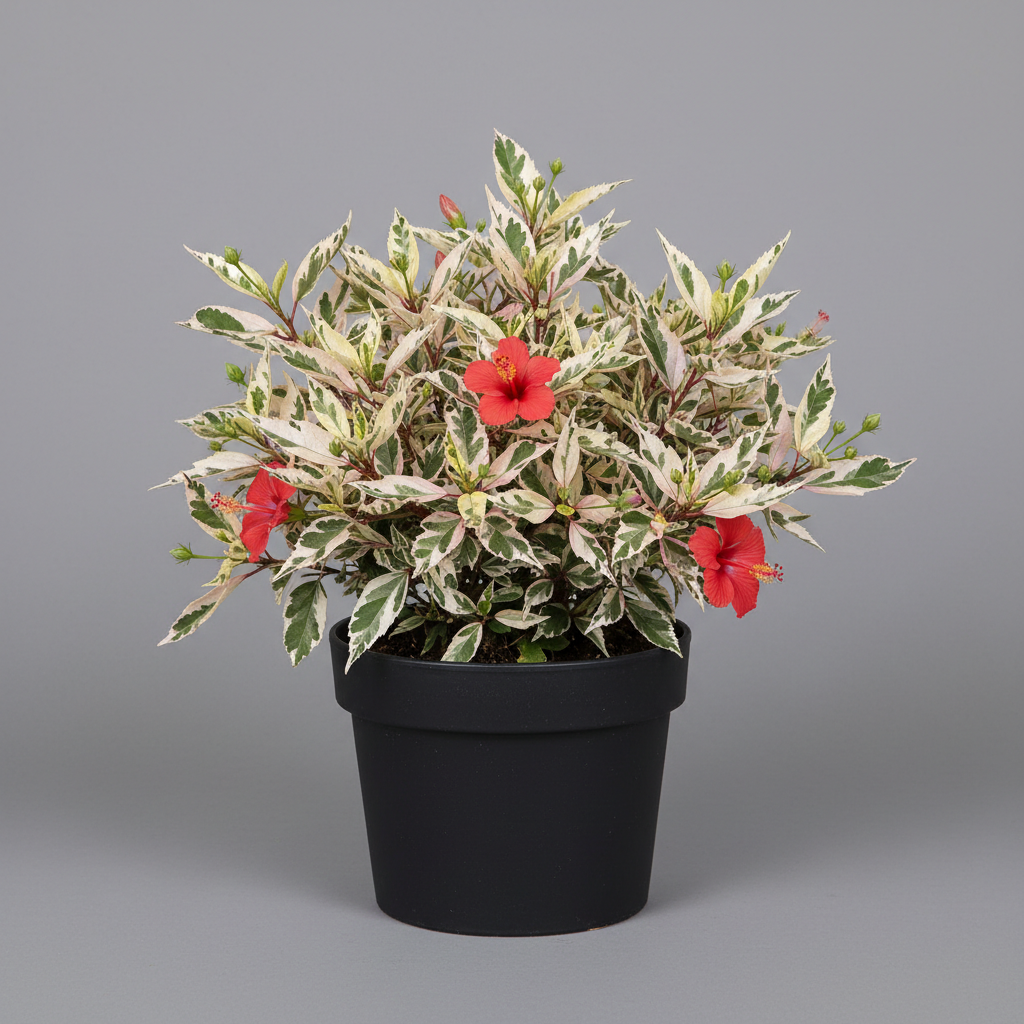
‘Cooperi’
A compact variegated form grown chiefly for its striking foliage, with narrow lance-shaped leaves splashed in cream, pink, olive and white. The single red flowers are smaller and less frequent, but the colourful leaves earn it a place even when it is not in bloom. It needs strong light to keep its variegation vivid.
Variety Profiles in Detail
‘The President’ (Hibiscus rosa-sinensis ‘The President’)
A long-standing favourite with large, deep rose-red single flowers marked by a darker central eye. Vigorous and dependable, it makes a substantial shrub and flowers prolifically given enough sun, which makes it a good step up for growers who have mastered the basics with ‘Brilliant’.
‘Fiesta’ (Hibiscus rosa-sinensis ‘Fiesta’)
One of the most popular warm-toned cultivars, bearing broad apricot to orange flowers with a fiery red throat and ruffled petal edges. It is moderately vigorous and well suited to container growing, rewarding a sunny windowsill with a long run of colourful blooms.
Choosing the Right Variety for Your Space
If you are new to hibiscus or your light is merely good rather than exceptional, start with a single-flowered red such as ‘Brilliant’ or ‘The President’, which are the most forgiving and free-flowering. If you have a blazingly bright conservatory and want something more unusual, the fancy multicoloured hybrids and double forms are worth the extra care. And if foliage interest matters as much as flowers, a variegated cultivar like ‘Cooperi’ earns its keep year round, provided you can give it the strong light its colourful leaves demand.
Frequently Asked Questions
Why won’t my hibiscus flower?
The most common reason is insufficient light, since hibiscus needs several hours of direct sun to set buds. After light, the usual culprits are underfeeding, as this hungry plant needs regular potassium-rich fertiliser, and inconsistent watering that causes buds to drop. Move the plant to your brightest window, feed every one to two weeks in the growing season and keep the soil evenly moist, and flowering usually follows.
Why are the buds dropping off before they open?
Bud drop is hibiscus’s classic stress signal, triggered by sudden changes in conditions. The usual causes are letting the plant dry out and then overwatering, draughts or temperature swings, a sudden move to a new location, very dry air, or a pest infestation. Keeping conditions stable, with steady watering, warmth and bright light, is the key to holding onto buds.
How often should I water my hibiscus?
There is no fixed schedule, because it depends on the season and conditions. In summer a flowering plant in full sun may need water every day or two, while in winter it may go several days or more. Water whenever the top 2 to 3 centimetres (about 1 inch) of soil has dried, and always let the excess drain away.
Is hibiscus safe around cats and dogs?
Chinese hibiscus, Hibiscus rosa-sinensis, is generally considered non-toxic to cats, dogs and people, and its flowers are even used in herbal teas. Eating a large quantity of any plant can cause mild stomach upset in pets, so discourage nibbling, but this is one of the safer flowering houseplants for a home with animals.
Can I grow hibiscus outdoors?
In a temperate climate, tropical hibiscus can spend the summer outside on a sunny patio or balcony, which it loves, but it is not frost hardy and must be brought indoors before temperatures fall below about 10°C (50°F). Acclimatise it gradually in both directions to avoid shocking the plant and triggering leaf or bud drop.
Should I prune my hibiscus, and when?
Yes, hibiscus responds very well to pruning, which keeps it bushy and encourages more flowering shoots. Prune in late winter or early spring before the main growth flush, cutting back leggy stems and shaping the plant. Because flowers form on new growth, a spring prune actually increases the number of blooms later in the season.
Why are the leaves turning yellow?
Yellow leaves have several possible causes. Widespread yellowing with soggy soil points to overwatering, while yellowing with green veins suggests an iron or magnesium deficiency, often in cold or alkaline conditions. A few lower leaves yellowing and dropping after a move or seasonal change is usually normal. Match the pattern to the cause and adjust watering, drainage or feeding accordingly.
How long do hibiscus flowers last?
Each individual flower is short-lived, typically lasting only one to two days before fading, which can surprise newcomers. The display, however, is continuous, as a healthy plant opens a fresh succession of blooms day after day throughout the growing season, so the plant always looks in flower even though no single bloom lasts long.
How big does an indoor hibiscus get?
In a container indoors, hibiscus typically reaches around 1 to 1.5 metres (3 to 5 feet) tall, though it can be kept smaller and bushier with regular pruning, or trained taller as a standard. Restricting the pot size and trimming the top growth keeps it to a manageable size for a windowsill or floor position.






