
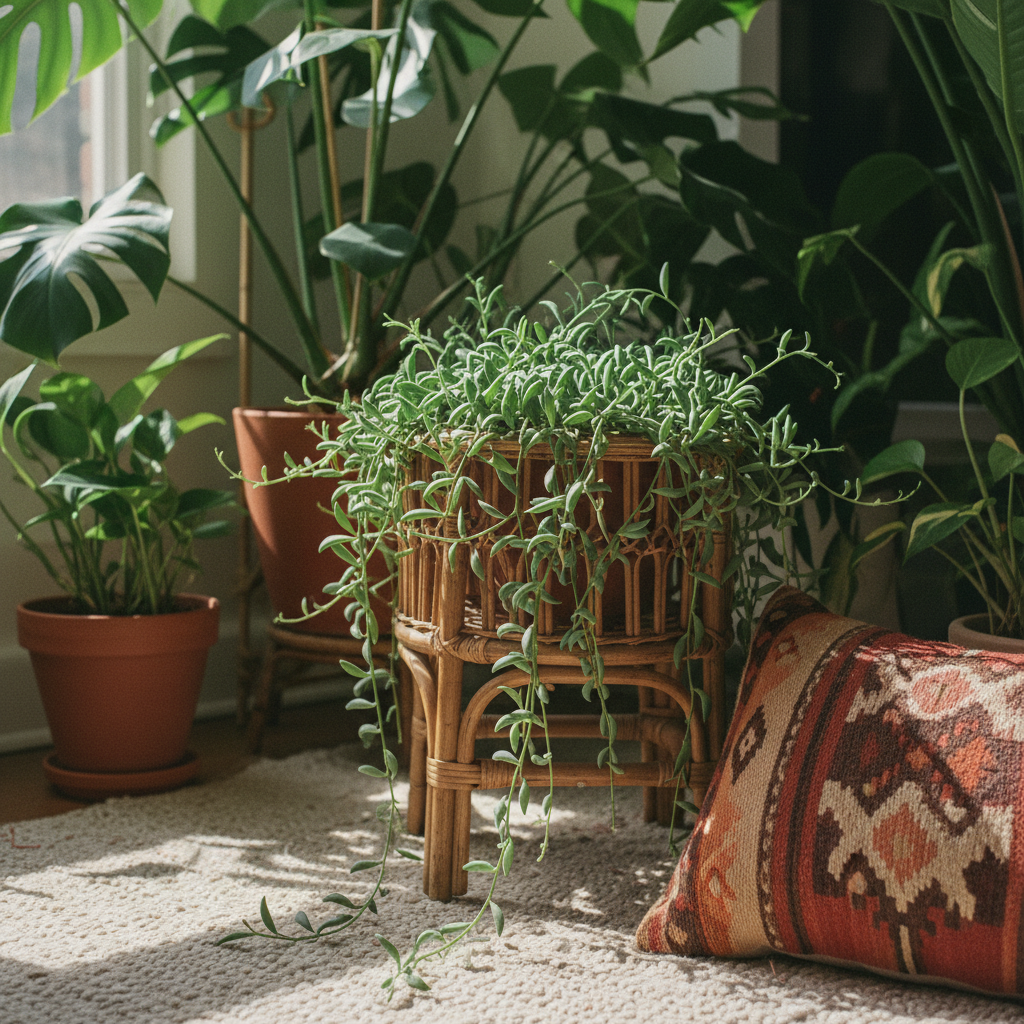
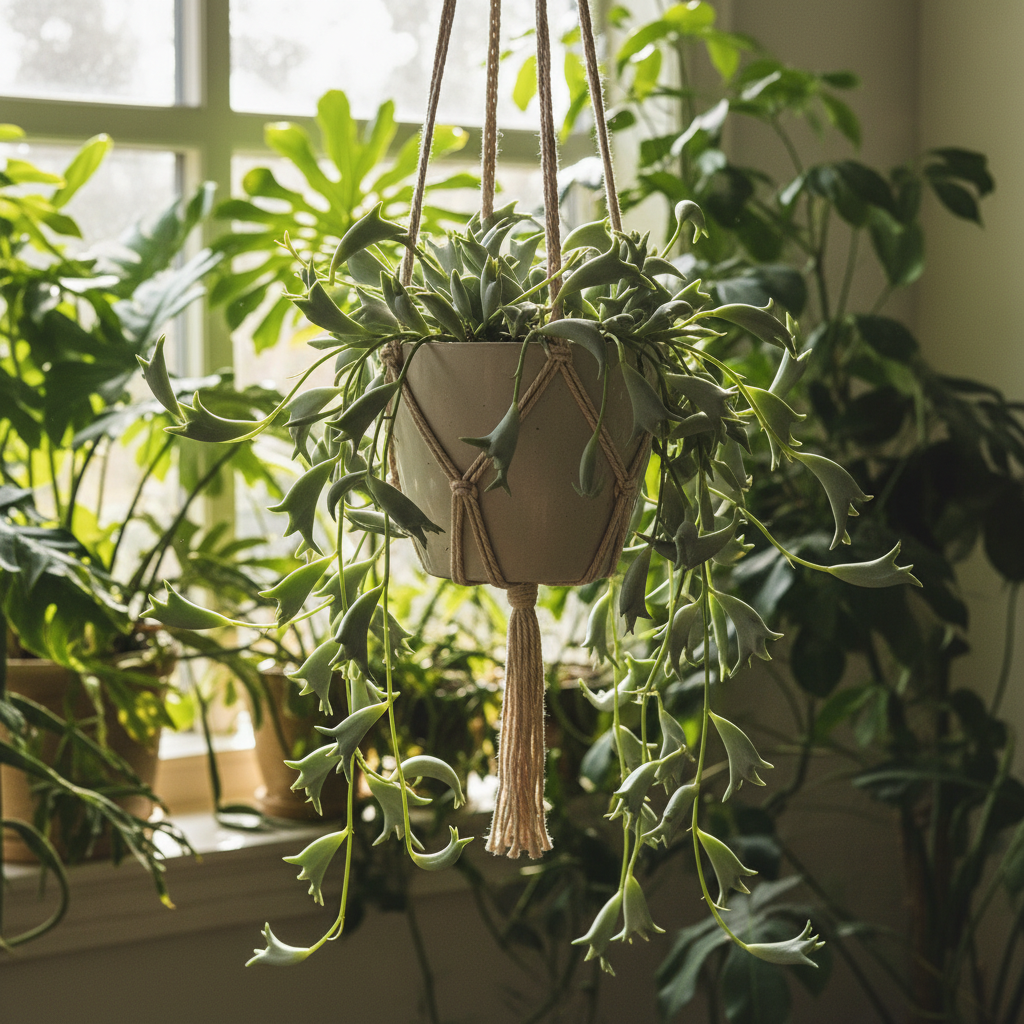
The String of Dolphins (Curio × peregrinus, formerly Senecio peregrinus) is one of the most theatrical of all trailing succulents, valued less for its size or speed than for the perfect little leaping-dolphin silhouette of every leaf. Each fleshy grey-green leaf curves like a dolphin breaching the surface, complete with a small pointed dorsal fin, and a healthy plant produces dozens of these along thin trailing stems that spill from a hanging pot or a high shelf. Also sold under the name Dolphin Necklace, the plant is a man-made hybrid between two members of the genus Curio: the upright Candle Plant (Curio articulatus) and the round-leaved String of Pearls (Curio rowleyanus). Both parents are South African dry-country plants, and the hybrid has inherited their love of bright light, sharp drainage and a dry rest between waterings.
String of Dolphins has a reputation for being temperamental, and that reputation is mostly earned by indoor gardeners treating it like a tropical houseplant rather than a succulent. The difference between a plant that merely survives, sulking and leggy with a few drooping fins, and one that thrives, spilling a metre (3 feet) of plump trailing stems across a wall, comes down to three things: enough light, almost dry soil between waterings, and a coarse mineral mix that drains in seconds. This guide walks through everything that contributes to the second outcome, from window choice and substrate ratios to the specific propagation method that gives near-100% take rate, and the early signs of mealybugs and rot you can stop with a cotton bud.
Contents
- Quick Reference
- Why String of Dolphins Makes a Striking Houseplant
- Light Requirements
- Watering & Humidity
- Soil, Potting & Repotting
- Fertilising
- Propagation
- Pests & Diseases
- Popular Varieties
- Frequently Asked Questions
Quick Reference: String of Dolphins at a Glance
| Light | Very bright indirect light with several hours of gentle direct sun; a sunny east or lightly filtered south window indoors. |
| Watering | Soak thoroughly, then let the mix dry out almost completely before watering again, typically every 10 to 18 days in summer and every 3 to 5 weeks in winter. |
| Temperature | 18 to 24 °C (64 to 75 °F) during active growth; tolerates a cool winter rest down to 7 °C (45 °F), keep above 4 °C (40 °F). |
| Humidity | Average household humidity of 30 to 50% is ideal; high humidity combined with damp soil causes rot. |
| Fertiliser | Diluted balanced liquid feed at quarter strength once a month from spring through early autumn; nothing in winter. |
| Toxicity | Mildly toxic to cats, dogs and humans if ingested due to alkaloid and saponin compounds; keep out of reach of curious pets and children. |
Why String of Dolphins Makes a Striking Houseplant
Few plants generate the same instant reaction as a well-grown String of Dolphins. The leaf shape is the entire point: each one is a tiny succulent sculpture of a dolphin caught mid-leap, the curved back arching over the stem and a small pointed lobe rising from the upper edge to mimic the dorsal fin. The leaves are arranged in pairs along thin, slightly woody stems, and because the stems are so light they cascade rather than tumble, draping in long elegant curtains rather than clumping in a heavy mass. This combination of recognisable shape and graceful habit makes the plant a strong design choice in spaces where you want a single piece to carry a corner without filling it with bulk.
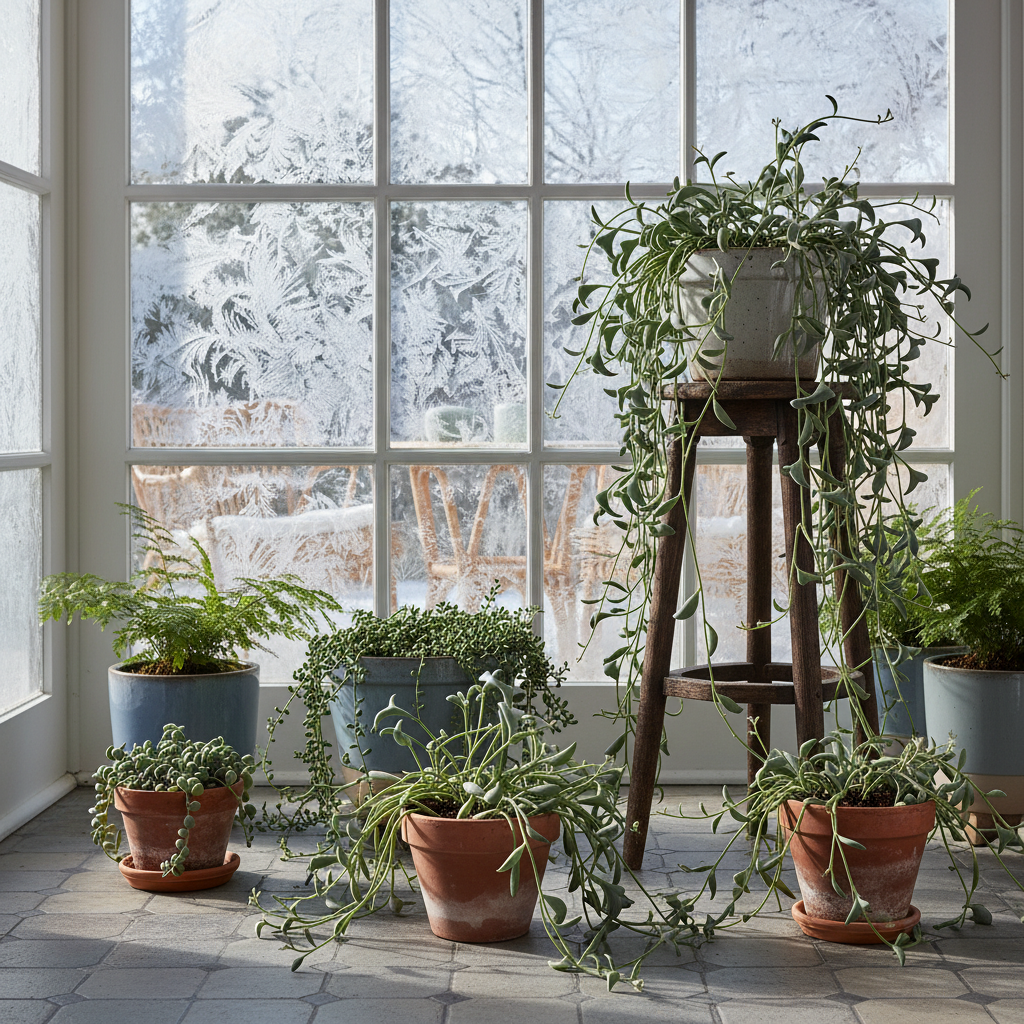
Practically, String of Dolphins is a hybrid of two genuinely tough South African parents, and it inherits a workable amount of resilience from both. It tolerates an occasional missed watering, recovers cleanly from a hard cut-back, and propagates almost on demand from stem cuttings, which means a single healthy plant can keep you supplied with replacements for any losses to rot or mealybugs. The plant is not, however, low-maintenance in the way a Pothos or Snake Plant is. It will not look its best in a dim corner, and it will not forgive a heavy potting mix. Read it as a succulent that happens to trail, not a trailing plant that happens to be succulent, and the rest of the care follows naturally.
Important — Toxicity: All parts of String of Dolphins contain pyrrolizidine alkaloids and small amounts of saponins, which can cause vomiting, drooling, lethargy and gastrointestinal irritation if chewed by cats, dogs or small children. Reactions are usually mild but unpleasant. Hang the plant well out of reach, and rinse hands after handling cuttings or sap.
Light Requirements
Light is the single most important factor for keeping String of Dolphins in good shape, and it is the variable most often misjudged by new owners. The plant evolved in open, exposed habitats where its parents face strong year-round sunshine, and although the hybrid is slightly more sun-shy than pure String of Pearls, it still needs more direct light than nearly any traditional tropical houseplant. Without it, the dolphin shape is the first thing to go: leaves stretch, the dorsal-fin notch fades, and the spacing between leaves on the stem grows long and loose. With enough light, leaves stay packed, plump and crisply shaped.
The ideal indoor position is a spot that receives several hours of gentle direct sun a day, balanced by bright indirect light for the rest of the daylight hours. A right-against-the-glass east window is the textbook spot in most homes. A south window works if you can soften midday summer sun with a sheer curtain or set the plant a hand’s-width back from the glass. Plants kept in only filtered light may survive for months but will gradually lose their compact form and stop producing the small white, cinnamon-scented flowers that mature specimens push out in autumn.
Light Levels Explained
The categories below are a useful shorthand for matching the plant to a real room. Lux readings come from a basic light meter or a phone app, measured at the leaves, not on a nearby surface. Aim for an average daytime reading in the bright-indirect band, with at least an hour or two crossing into direct sun.
| Light Category | Approx. Level | Typical Location | Outcome |
|---|---|---|---|
| Direct sun | 30,000 to 80,000 lux | Right against an unshaded south window in summer. | Best growth and leaf shape, but risk of sunscald in summer midday peak; soften with a sheer curtain. |
| Bright indirect | 10,000 to 25,000 lux | Within 30 cm of an east or filtered south window. | Ideal sustained position; compact dolphin-shaped leaves and steady trailing growth. |
| Medium | 2,500 to 8,000 lux | A metre back from a bright window, or beside a west window. | Plant survives but stems elongate, leaves lose their dorsal fin and spacing widens. |
| Low | 500 to 1,500 lux | Most interior rooms more than two metres from any window. | Slow decline; leaves shrivel, fade and drop, stems thin out and rot risk rises. |
| Very low | Below 500 lux | Hallways and rooms with only artificial overhead light. | Plant cannot survive long term; relocate or supplement with a grow light. |
Window Orientation and Placement
South-facing window: Strong winter and shoulder-season choice, but full summer midday sun can scorch the leaves, leaving translucent brown patches on the curved upper surface. Use a sheer curtain or set the plant 30 to 50 cm back from the glass during the hottest months.
East-facing window: The best year-round spot in most homes. Several hours of gentle morning sun keep the leaves compact, and the cooler afternoon indirect light avoids heat stress.
West-facing window: Workable, especially in cooler climates. Afternoon sun is stronger and hotter than morning sun, so monitor for scorch in summer and rotate the plant weekly so trailing stems get even light on both sides.
North-facing window: Generally too dim. A north window in the Northern Hemisphere receives no direct sun at all, and String of Dolphins kept there will stretch and thin within a couple of months. Either add a grow light or move to a brighter exposure.
Pro Tip — Acclimate Gradually: A plant moved from a shop or shaded greenhouse straight to a sunny south window can sunburn within a single afternoon. Move it in stages over 7 to 10 days, starting with an east window or a bright but indirect spot, before settling it into stronger light. The leaves will thicken and deepen in colour as they adjust.
How Light Affects Leaf Shape and Colour
The signature dolphin shape is not genetic in the simple sense; it is an expression of strong light on a juvenile leaf form. In low light, the same leaf elongates, the dorsal-fin notch flattens, and the silhouette starts to look more like the round-bead leaves of String of Pearls or, at the extreme, almost lance-shaped. The colour also drifts: a bright-light plant shows the slightly glaucous, cool grey-green tone that suits the species, sometimes with a hint of plum-purple on stressed leaves and stem tips in cooler weather, while a shaded plant turns a flatter, paler green and feels softer to the touch. If your dolphins have stopped looking like dolphins, the light is almost always the cause.
Warning — Direct Sunlight: Even though String of Dolphins enjoys direct light, intense unfiltered summer sun through unscreened glass can scorch the curved upper face of the leaves, where light is concentrated like a magnifier. Damage shows as pale tan blisters that turn translucent and then brown. The damaged leaves do not recover, although new growth comes back normal once the plant is shaded slightly.
Artificial Lighting
String of Dolphins responds very well to a good full-spectrum LED grow light, which makes it a strong candidate for windowless apartments or for winter top-up in cloudy climates. Aim for a fixture rated around 30 to 50 W of actual draw with a colour temperature in the 4,000 to 6,500 K range, positioned 25 to 40 cm above the plant. Run it for 12 to 14 hours a day during active growth, dropping to 8 to 10 hours in winter to preserve the natural dormancy. If the leaves stretch under the light, raise the fixture or move the plant closer; if they bleach pale, raise the fixture or shorten the daily run.
Seasonal Adjustments
In the Northern Hemisphere, light intensity at a typical windowsill drops by 60 to 80% between June and December. A plant that lived happily 50 cm back from a south window in summer often needs to be pressed right against the glass in winter to receive the same usable light. Move the plant towards the brightest available window from late autumn, rotate it a quarter-turn each week to keep growth even, and clean the glass once a month: dust and rain residue on a single pane can cost 10 to 15% of transmitted light.
Watering & Humidity
Watering kills more String of Dolphins than any pest, disease or light problem combined. The leaves act as small water reservoirs, the stems carry their own backup, and the root system is fine and shallow, evolved to absorb light rains quickly and then dry out for long stretches. The single most useful mental model is to treat the plant like a small cactus that also happens to drape: soak the soil deeply when you water, then leave it alone until it has gone almost completely dry, including in the centre of the rootball. Most failures are not from one bad soak but from a habit of small, frequent top-ups that keep the substrate constantly damp.
When to Water
The reliable cue is the weight of the pot rather than the appearance of the leaves. After a good soak, a 14 cm plastic nursery pot full of moist gritty mix feels noticeably heavy in the hand. As the substrate dries, the same pot becomes light enough to lift with a single finger; that is the moment to water again. In a typical bright spring or summer room, this cycle runs about every 10 to 14 days; in autumn it stretches to 14 to 21 days; and in winter it can be 3 to 5 weeks or longer if the plant is genuinely cool and resting.
You can confirm the weight test with a quick visual check on the leaves themselves. Plump, taut dolphin leaves with a slight sheen mean the plant is well-hydrated. Leaves that feel softer between thumb and finger, or that show the first hint of a deflated, dimpled surface near the trail tips, are telling you it is time to water. By contrast, leaves that look yellow, mushy or translucent are not asking for water; they are saying the plant has had too much and the roots are failing.
Pro Tip — The Skewer Test: Push a thin bamboo skewer all the way to the bottom of the pot and leave it for a minute. Pull it out and inspect: if it comes out clean and dry, water deeply; if soil clings to it or it comes out damp, wait at least another 3 to 5 days. This is more accurate than fingertip-into-soil for a deep pot of gritty mix, where the surface dries days before the centre.
How to Water Correctly
- Take the pot to a sink or tray so you can water freely without splashing the surroundings.
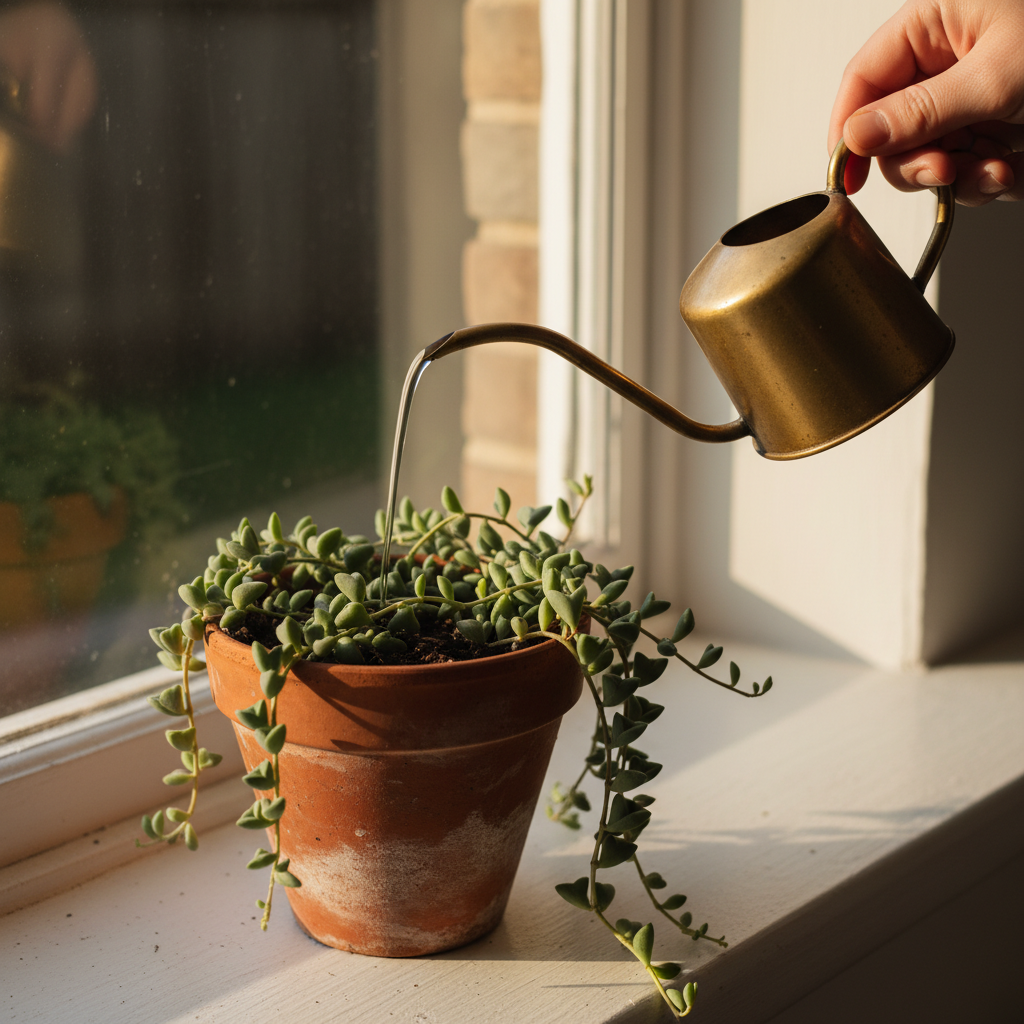
- Pour room-temperature water slowly onto the soil surface, keeping the stream close to the rim of the pot so foliage and stem joints stay dry.
- Continue until water runs steadily from the drainage holes, which means the rootball is fully rehydrated rather than just the top layer.
- Let the pot drain completely for at least 10 to 15 minutes; tilt it gently to release any pockets of standing water in the saucer or cache pot.
- Empty the saucer before returning the plant to its position so the roots are never sitting in water, and resist the urge to water again until the substrate is almost dry.
- If you grow the plant in a closed decorative pot without drainage, lift the inner nursery pot out for every watering rather than pouring directly into the outer container.
Signs of Overwatering vs. Underwatering
| Symptom | Overwatering | Underwatering |
|---|---|---|
| Leaf colour | Yellowing along the stem, leaves turning translucent or grey-brown. | Pale, dull green fading to silver-grey on the most exposed leaves. |
| Leaf texture | Soft, mushy, watery; leaves rupture easily under light pressure. | Wrinkled, deflated, dimpled along the curved upper surface but still firm. |
| Soil | Stays damp for more than two weeks, may smell sour or develop a mossy surface crust. | Pulls away from the pot wall, surface dust-dry; water initially runs around the rootball. |
| Roots | Brown, soft, hollow, easily detaching from healthy white root tissue when pulled. | Pale, papery, intact but visibly shrunken; recover quickly after a thorough soak. |
| Stem base | Mushy and dark at the soil line, sometimes collapsing into a black mark. | Firm but slightly thinner; whole trail may droop, recovers within hours of watering. |
Warning — Root Rot: Once the stem base turns black and soft, that section will not recover. The only reliable rescue is to cut the plant back to clean firm green tissue, take healthy stem-tip cuttings, and re-root them in fresh dry gritty mix rather than trying to nurse the existing pot back to health. Throw away the contaminated substrate and sterilise the pot before reusing it.
Humidity Requirements
String of Dolphins is unusual among popular houseplants in actively preferring dry air. Average household humidity of 30 to 50% suits it perfectly, and it grows happily in centrally heated living rooms that other plants find punishing. The leaves and stems already contain their own moisture supply, so the plant has no need for the humidity tray, glass cabinet or pebble tray that suits aroids and ferns.
The risk runs in the opposite direction. Humidity above 70%, especially when combined with damp soil and still air, sets up the exact conditions for fungal rot at the stem joints and crown. Bathrooms and conservatories that double as orchid cabinets are usually a poor home for String of Dolphins for this reason. If you cannot avoid a humid spot, compensate by improving airflow with a small fan, letting the substrate dry harder between waterings, and skipping any misting.
Do not mist the plant. Misting wets the curved upper surface of the leaves and pools water in the leaf axils, where it sits long enough to invite mealybugs and rot. If a leaf needs cleaning, wipe it carefully with a soft dry cloth or a barely damp microfibre, then leave it to air-dry.
Water Quality
The plant is moderately tolerant of tap water and is rarely fussy about minerals. In hard-water regions, the main concern is mineral build-up at the soil surface and at the leaf bases, which shows as a chalky white crust after a year or two. Letting tap water stand uncovered overnight before use dissipates chlorine and brings it to room temperature, which is more important than perfect purity. Once every three or four waterings, flush the pot with rain water or distilled water to wash accumulated salts through the drainage holes.
Soil, Potting & Repotting
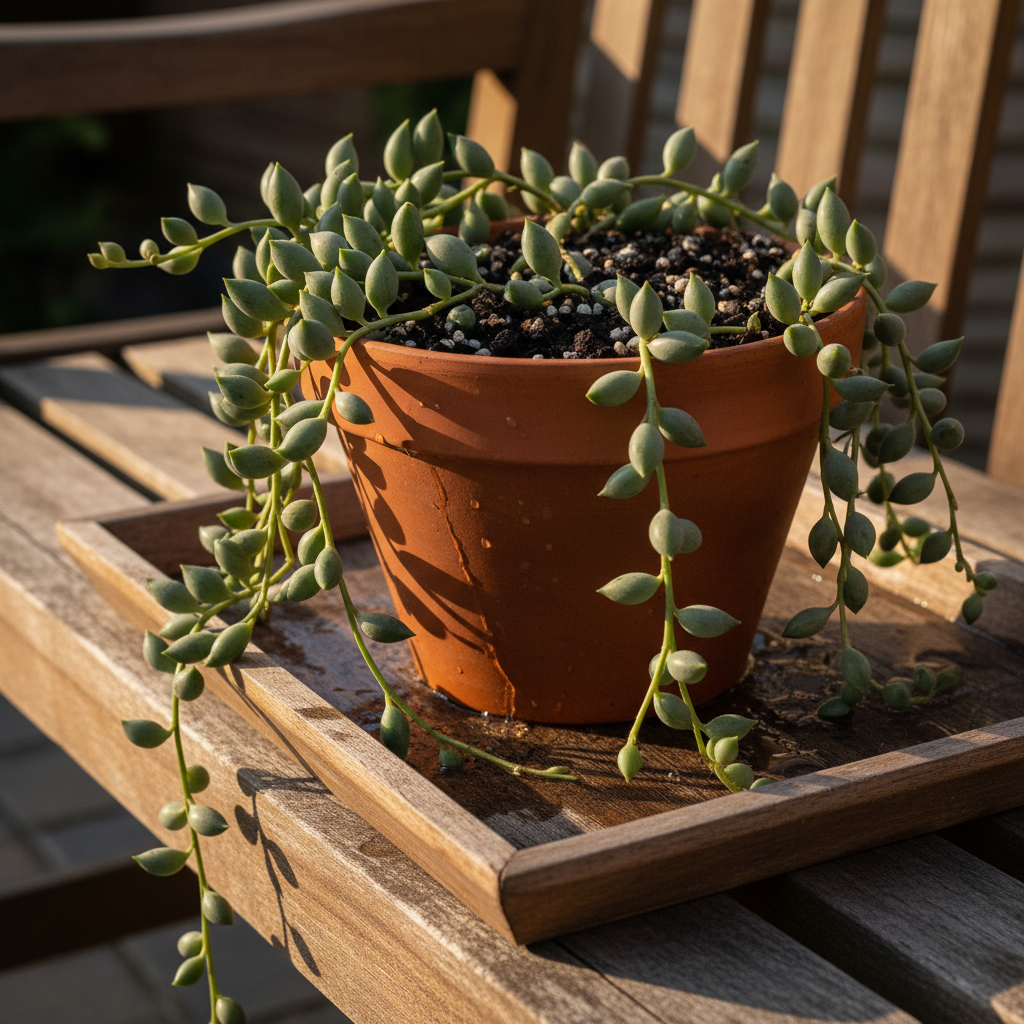
Substrate is the silent partner in a healthy String of Dolphins. The fine roots need plenty of air around them between waterings, and the gritty mineral mix that suits a small cactus suits this plant equally well. A bag of standard houseplant compost off the shelf, even one labelled “succulent and cactus”, is usually too peat-heavy and too water-retentive on its own; mixing in a generous amount of coarse grit transforms it into something the roots can breathe in.
Ideal Soil Composition
A good mix should look about half mineral, half organic when you tip it onto a tray. Water poured onto it should disappear within seconds, not pool on the surface, and the texture should crumble between your fingers rather than form a sticky lump. The proportions below are a forgiving starting point, and small variations matter less than getting the overall mineral content high enough.
| Component | Proportion | Function |
|---|---|---|
| Standard houseplant compost or peat-free multipurpose | 2 parts | Provides the small reservoir of moisture and base nutrients the roots need. |
| Coarse horticultural sand or fine 2 to 4 mm grit | 2 parts | Opens up the structure so water moves through quickly and roots get oxygen. |
| Perlite or pumice | 1 part | Adds lightweight aeration that lasts indefinitely without breaking down. |
| Optional: fine orchid bark or coir chip | 0.5 part | Holds a fraction more moisture without becoming compacted; useful in very dry rooms. |
The plant accepts a moderate pH range and grows well anywhere from slightly acidic (around pH 6.0) to neutral (pH 7.0). Most off-the-shelf mixes sit comfortably in this window once they have been opened up with grit. If you live in a very hard-water area and water from the tap, the substrate will drift slightly alkaline over a couple of years, which is one more reason to refresh the mix at every repot.
Pro Tip — Quick Mix Recipe: If you only want to buy one extra bag, combine 2 parts ordinary peat-free houseplant compost with 1 part perlite and 1 part horticultural grit. This three-ingredient mix drains fast enough for String of Dolphins, costs less than a branded succulent blend, and works equally well for the parent species and most other trailing succulents.
Choosing the Right Pot
Pot choice has more influence on String of Dolphins than on most houseplants, because the relationship between substrate volume, drying speed and watering rhythm is so direct. A pot that holds too much soil for the root system stays damp for far too long after a soak; a pot that is too small dries out before you have time to drink your morning coffee on a hot day. Match the pot to the plant rather than the other way around.
Drainage holes are non-negotiable. Without them, water collects invisibly in the bottom layer of substrate and stagnates around the roots. If you have a closed decorative ceramic pot you love, treat it as a cache pot, with the plant in a smaller plastic or terracotta nursery pot inside, and lift the inner pot out to water and drain.
Pot material: Terracotta is a strong choice because the porous walls wick moisture out of the substrate, hastening drying and forgiving small watering mistakes. Plastic and glazed ceramic both work, but require you to be more disciplined about waiting for the mix to dry. Hanging plastic baskets with built-in saucers are practical for trailing display, provided the saucer can be emptied easily.
Pot size: Choose a pot only one size larger than the rootball at every repot, typically a 12 to 16 cm pot for a young plant and 18 to 22 cm for a mature trailing specimen. The plant is shallow-rooted, so a wide and shallow pan suits it better than a tall narrow pot of the same volume.
When to Repot
Most String of Dolphins need repotting every two to three years, and only because the substrate has degraded and lost its open structure rather than because the roots have outgrown the pot. Reasons to repot include water running straight through the pot without wetting the substrate (a sign the rootball has pulled away from the pot wall), persistently slow drainage despite a coarse mix, visible mineral crust on the surface, or the first signs of stem-base rot that need urgent surgery. The best time is mid to late spring as the plant moves back into active growth.
How to Repot: Step-by-Step
- Stop watering at least 5 to 7 days before repotting so the rootball is dry, light and easy to handle without breaking trailing stems.
- Slide the plant out by inverting the pot and gently squeezing the sides; teasing it out roots-first preserves more of the fine root system.
- Crumble away the outer third of the old substrate with your fingers, inspecting the roots for any soft brown or black sections.
- Trim any rotten roots back to firm white tissue with sterilised scissors, dusting cut surfaces with cinnamon or sulphur powder if you have it.
- Half-fill the new pot with fresh gritty mix, settle the plant at the same depth it sat before, and fill in around the roots, tapping the pot to remove air pockets.
- Leave the freshly repotted plant unwatered in bright but slightly shaded light for a full week so any minor root wounds can callus over.
- Resume normal watering after the rest period, starting with a moderate soak rather than a heavy drench, and keep light gentle for another two weeks.
Warning — Transplant Shock: Watering a freshly repotted String of Dolphins immediately is one of the most common ways to kill it. Damp substrate plus disturbed roots is a fast route to rot. Trust the dry rest and let the roots heal before they meet water again.
Fertilising
String of Dolphins is a light feeder by houseplant standards. In the wild, the parent species grow on lean, gritty South African soils that hold few nutrients, and the hybrid expects the same. A weak, infrequent liquid feed during active growth is enough to keep the trailing stems extending and the flowers coming; anything stronger pushes soft, watery growth that loses the compact dolphin shape and attracts pests.
The biggest fertiliser mistake with this plant is treating it like a tropical foliage houseplant on a fortnightly full-strength schedule. Salts build up fast in a small pot of gritty mix, the roots scorch at the tips, and the plant signals the damage with crisp brown stem tips and dropping leaves. If you only remember one rule, make it this: when in doubt, feed less.
Understanding Plant Nutrients
All houseplant fertilisers carry three headline numbers, the N-P-K ratio, which describes the proportions of nitrogen (N), phosphorus (P) and potassium (K) in the bottle. A succulent suits a balanced or slightly low-nitrogen feed such as a 5-5-5 or 3-5-5; high-nitrogen lawn feeds (anything with a first number above 10) push too much soft leaf growth at the expense of the compact form you want. Trace elements such as calcium, magnesium and iron also matter, especially for keeping the leaves a clean green rather than fading to yellow.
| Nutrient | Symbol | Primary Function | Deficiency Symptoms |
|---|---|---|---|
| Nitrogen | N | Drives new stem and leaf growth, gives leaves their green colour. | Pale yellow-green older leaves, slow extension of new trails. |
| Phosphorus | P | Supports root development and flower production. | Weak root system, no autumn flowering on a mature plant. |
| Potassium | K | Regulates water movement, strengthens cell walls and stress tolerance. | Browning leaf tips and weak, floppy stems prone to splitting. |
| Calcium | Ca | Builds firm cell walls in new leaves. | Distorted new leaves at the trail tips, soft growing points. |
| Magnesium | Mg | Central atom of every chlorophyll molecule. | Pale yellow patches between veins on older leaves. |
| Iron | Fe | Helps produce chlorophyll, especially in young leaves. | New leaves emerge pale yellow with green veins. |
Types of Fertiliser
Liquid fertilisers: The easiest match for String of Dolphins. A balanced houseplant liquid feed (such as 5-5-5 or 3-5-3) diluted to a quarter of the label rate gives you fine control over each application and washes through the pot without lingering. Mix fresh on the day of use; old diluted feed can sour.
Slow-release granular: Workable but easy to overdo in a small pot. If you prefer the convenience, choose a low-strength formulation (such as Osmocote 14-14-14) at half the recommended dose, scattered lightly across the surface in early spring. One application a year is the maximum.
Organic fertilisers: Diluted worm casting tea, very dilute seaweed solution, and small surface top-dressings of worm castings all work well. They release nutrients slowly, support the soil biology, and rarely cause salt burn. Avoid anything with a strong smell, which tends to attract fungus gnats in an indoor setting.
Feeding Schedule
Feed once a month from early spring to early autumn, then stop entirely from mid-autumn through winter. In practice, this is four to six applications per year, no more. If the plant flowers in autumn, give it one weak phosphorus-leaning feed (such as a tomato food at quarter strength) as the buds form, then stop. During winter rest, the roots are barely active and any fertiliser applied simply accumulates as salt in the pot.
Pro Tip — Feed on Damp Soil: Never apply liquid fertiliser to a bone-dry pot. Water lightly the day before, or water the plant first with plain water, let it drain, and then apply the diluted feed. This stops the dry rootball from absorbing concentrated fertiliser directly and scorching the root tips.
How to Fertilise
- Wait until the substrate is just-damp from a recent watering, never bone-dry, so the feed disperses gently rather than concentrating around root tips.
- Mix the chosen fertiliser to quarter of the label-recommended strength in a clean watering can; for a 5 ml/L label rate, that is roughly 1.25 ml/L.
- Pour the diluted feed slowly over the soil surface, avoiding the leaves, until a small amount drains from the bottom of the pot.
- Empty the saucer immediately so the plant does not sit in fertiliser solution; this also flushes any excess salts straight out.
- Once a year, in midsummer, give the plant a generous plain-water flush — three to four times the pot volume poured through over a few minutes — to clear any built-up mineral residues from the substrate.
Warning — Salt Build-Up: Crusty white deposits at the soil surface or around the rim of the pot are a sign that fertiliser salts are accumulating faster than they are being washed through. Left in place, they damage the fine roots and stunt growth. Scrape the surface clear, flush the pot heavily with plain water, and pause feeding for a full month before resuming at a lower strength.
Propagation
String of Dolphins is one of the most rewarding houseplants to propagate. A single 10 to 15 cm stem cutting taken in late spring will root within two weeks and become a planted-up baby within a month, with success rates routinely above 90%. The plant has the same easy-rooting habit it inherits from String of Pearls, so there is no need for hormones, heat mats or specialist equipment. A clean pair of scissors, a glass of water or a pot of dry gritty mix, and a sunny windowsill are enough.
Beyond replacement plants, propagation is also the simplest way to keep a mature specimen looking full. Trailing succulents tend to thin at the centre over time as new growth pushes outwards along the existing stems. Cutting a few long trails back to a few centimetres above the soil and dropping the rooted cuttings back into the same pot restores the lush look from the top down within a single season.
Understanding the Node
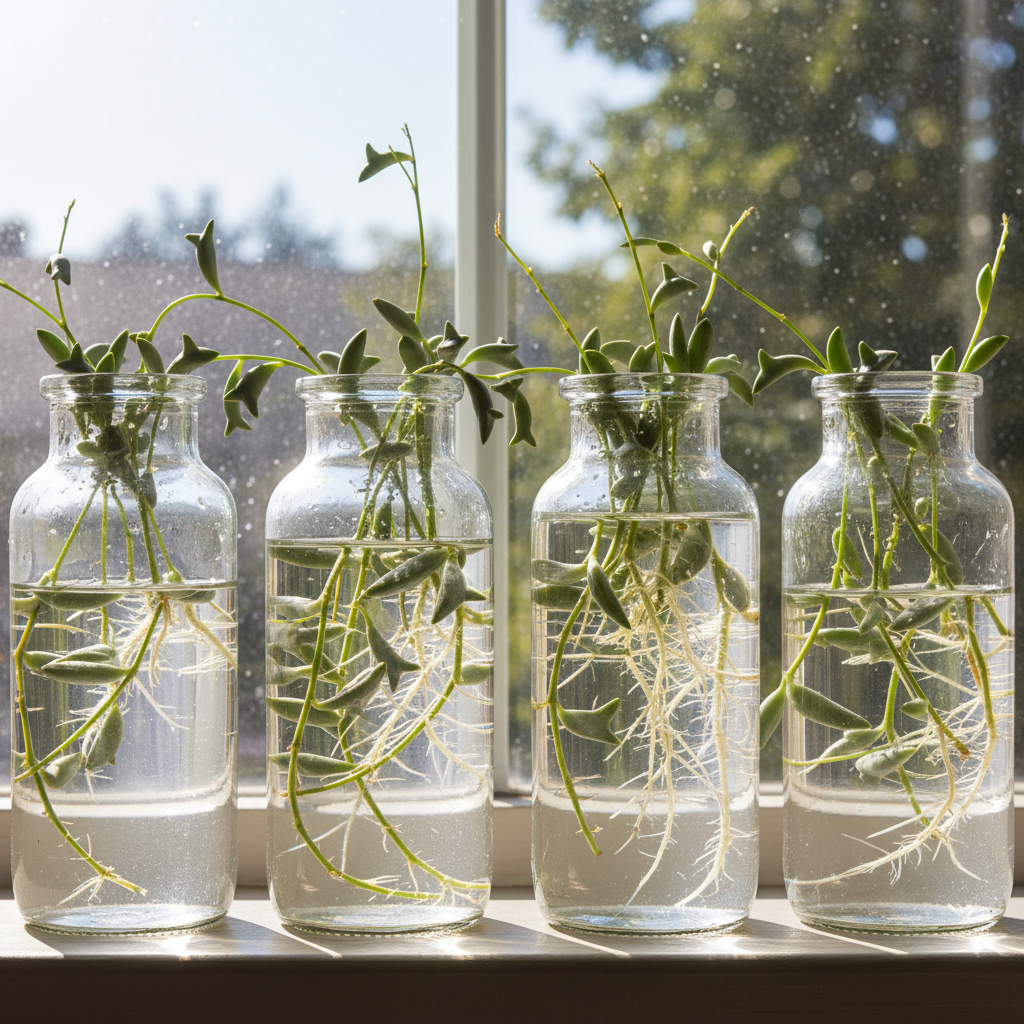
The node is the small swollen point on a String of Dolphins stem where a pair of leaves attaches. Every node carries a latent meristem capable of producing roots when stripped of its leaves and brought into contact with damp substrate or water. A successful cutting needs at least three nodes: one or two to root, and one or two above the surface to carry healthy leaves and resume growth. Cut roughly 1 cm below the lowest chosen node, and strip the leaves from any node that will sit below the water line or soil surface.
Water Propagation: Step-by-Step
Water propagation is the easiest and most visual method, and the one shown in the photograph above. The roots that develop in water are slightly thinner and more brittle than those grown in soil, but they transition cleanly when the cutting is potted up before the roots exceed about 3 cm long. This is the method most likely to give a beginner reliable success.
- Take 10 to 15 cm tip cuttings from a healthy stem in late spring or early summer, cutting just below a node with sterilised scissors.
- Strip the lower two pairs of leaves from each cutting, leaving 5 to 8 cm of bare stem with three or more exposed nodes.
- Let the cut ends air-dry on a paper towel for 24 to 48 hours so the wound calluses over and the risk of rot drops sharply.
- Place each cutting into a clear jar of room-temperature water so only the bare nodes are submerged and all leaves stay above the water line.
- Set the jar on a bright windowsill with gentle direct sun, and top up the water every 3 to 4 days to keep the level steady and well-oxygenated.
- Pot up into a small (8 to 10 cm) pot of fresh gritty mix once the new roots are 2 to 3 cm long, settling the cutting so the rooted nodes are just covered.
- Hold the freshly potted cutting in slightly shaded bright light for the first week, then water lightly, and treat it as a normal young plant from then on.
Pro Tip — Plant Cuttings Close Together: A single cutting in the centre of a pot looks sparse for the first six months. Plant 4 to 6 rooted cuttings around the rim of a 12 to 14 cm pot instead. They knit together quickly and produce a full, mature-looking trailing display within a single growing season.
Direct Soil Propagation: Step-by-Step
Direct soil propagation skips the water-to-soil transition and produces slightly sturdier roots from the outset, at the cost of being less visual. It works particularly well when you are taking a large number of cuttings to refill a thinning hanging basket.
- Take cuttings as above, strip the lower leaves, and let the cut ends callus for at least 48 hours in a dry shaded spot.
- Fill a shallow tray or small pot with just-damp gritty propagation mix (50% perlite or pumice, 50% peat-free compost works well).
- Lay the cuttings horizontally with the bare nodes pressed lightly into the surface, or insert them upright with the bare stem 1 to 2 cm deep.
- Place in bright indirect light, never direct sun on the bare stems, and resist the urge to water for the first 5 to 7 days.
- After the first week, mist the surface lightly every 3 to 4 days, just enough to keep the top centimetre of substrate barely damp, until roots establish.
- Tug gently after three weeks: resistance means roots have formed and the cuttings can be moved into normal succulent care, including their first proper soak.
Troubleshooting Propagation
| Problem | Likely Cause | Solution |
|---|---|---|
| Cutting end turns brown and mushy in water | Cut surface did not callus before going into water, or leaves are submerged. | Trim back to firm tissue, air-dry for 48 hours, restart with only the bare nodes below the water line. |
| Cuttings shrivel and dry in propagation mix | Substrate is too dry, light is too intense, or cutting was too short with too few nodes. | Mist lightly every few days, shift to brighter indirect rather than direct light, take longer cuttings with 3 to 4 nodes. |
| Roots form but never lengthen beyond a few millimetres | Water is stagnant or substrate is waterlogged and oxygen-poor. | Change water more often (every 3 days), or switch to a more open mix with more perlite or pumice. |
| Rooted cuttings stall after potting up | Watered too soon, substrate too heavy, or light too low after the move. | Hold off water for a week after potting, re-pot into gritty mix if necessary, move into brighter indirect light. |
Pests & Diseases
String of Dolphins is moderately resistant to most houseplant pests, helped by its waxy leaf surface and the open, breezy environment that suits its other care needs. When trouble does appear, it usually arrives via a new plant brought home from a nursery or via a stressed plant kept in poor conditions for too long. Checking new acquisitions in quarantine for two weeks before adding them to your collection prevents the most common introductions.
The single most useful pest-control habit with this plant is to inspect the stem joints regularly. The places where leaves meet stem are where mealybugs and aphids settle first, and where rot also tends to start. A quick look every time you water, focusing on the underside of the trailing stems and the leaf axils, catches almost every problem early enough to handle with a cotton bud rather than a full spray programme.
Common Pests
Mealybugs (Pseudococcus longispinus)
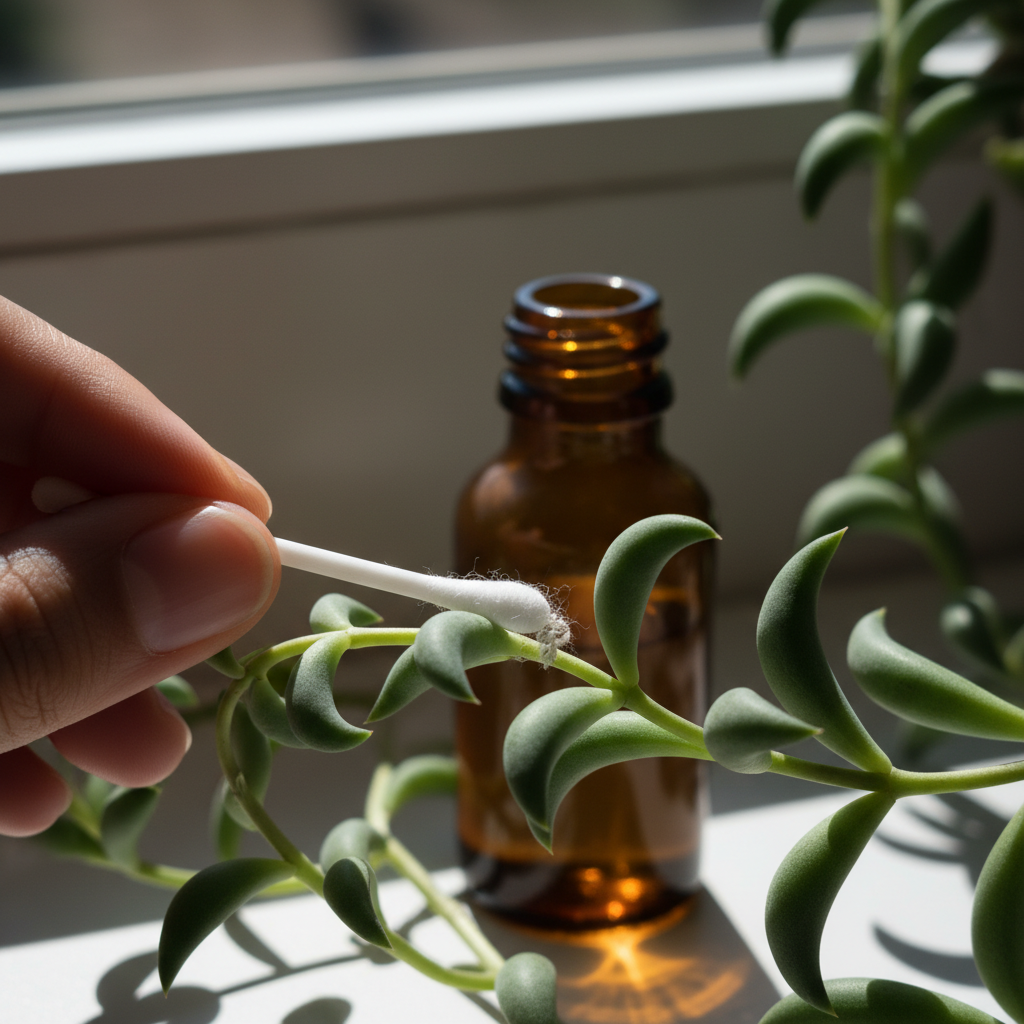
The most frequent pest on this plant by a wide margin. Mealybugs appear as small white cottony tufts wedged into leaf axils and along stem joints, where their soft bodies are protected from sprays. A heavy infestation makes the leaves sticky with honeydew and weakens the plant within weeks.
Treatment: For a light case, dab each insect directly with a cotton bud dipped in 70% isopropyl alcohol; the alcohol dissolves the protective coating and kills the insect on contact. For a heavier infestation, follow up with a fortnightly spray of horticultural soap or neem oil at label rate, repeated for three cycles to break the egg-hatch chain. Quarantine the plant away from others throughout treatment.
Aphids (Aphis gossypii)
Less common but occasionally present on soft new growth at the trail tips, especially in spring. Aphids appear as small green or grey-green clusters and excrete sticky honeydew that can attract sooty mould.
Treatment: Rinse the affected tips under a gentle stream of lukewarm water in a sink to dislodge most of the colony, then follow up with two applications of horticultural soap a week apart. Cut and discard any badly infested trails rather than nursing them back to health.
Fungus Gnats (Bradysia coprophila)
Small dark flies hovering around the soil surface usually mean the substrate is staying damp longer than it should. The adults are mostly a nuisance, but their larvae feed on fine roots and can weaken a small cutting or stressed plant.
Treatment: Let the substrate dry harder between waterings; the larvae cannot survive a dry pot. Place yellow sticky traps at the soil surface to catch adults, and consider a top-dressing of fine grit to physically block egg-laying. Avoid chemical drenches, which are rarely necessary at this scale.
Spider Mites (Tetranychus urticae)
Rare on String of Dolphins but possible in very hot, dry conditions or on stressed plants kept too close to heat sources. Look for a fine yellow stippling on the leaves and very thin webbing in the leaf axils.
Treatment: Increase airflow around the plant, move it away from heat sources, and rinse the foliage carefully under lukewarm water. Follow up with weekly applications of horticultural soap or neem oil for three weeks. Heavy infestations may require predatory mites or replacement of the plant from cuttings.
Common Diseases
Root Rot (Pythium and Phytophthora spp.)
The number one killer of String of Dolphins. Soil-borne water moulds attack the roots when the substrate stays damp for too long, especially in cool conditions. The first sign is yellowing leaves at the base of the trails, followed by collapse of the stem just above the soil line.
Treatment: Take healthy stem-tip cuttings immediately, treat the original plant as compromised, and start over with fresh dry substrate in a sterilised pot. No fungicide saves a plant whose stem base has already turned mushy.
Stem Rot (Fusarium oxysporum)
Closely related in symptoms to root rot, this fungal disease starts at a wound or stem joint and spreads along the stem rather than from the roots upwards. It shows as a brown or black soft patch that gradually consumes the trail.
Treatment: Cut the affected stem back to clean firm tissue with sterilised scissors, well below the visible damage, and discard the diseased section. Apply a light dusting of cinnamon or a commercial fungicide to the cut surface, and reduce watering frequency until the plant has stabilised.
Powdery Mildew (Sphaerotheca pannosa)
Uncommon on this plant, but possible in stagnant, humid conditions. Appears as a fine white dust on the upper surface of the leaves, eventually turning them yellow and brittle.
Treatment: Improve airflow, lower humidity, and treat with a milk-and-water spray (1 part milk to 9 parts water) or a sulphur-based fungicide every 7 to 10 days until clear. Remove and discard the most affected leaves.
Pest and Disease Summary
| Pest / Disease | Identification | Treatment |
|---|---|---|
| Mealybugs | White cottony tufts at leaf axils and stem joints, sticky residue. | Spot-dab with isopropyl alcohol, follow with neem oil or soap fortnightly. |
| Aphids | Soft green clusters on new growth, sticky honeydew. | Rinse under tap, follow with horticultural soap weekly for two cycles. |
| Fungus gnats | Small dark flies around damp soil, larvae in the top layer. | Let soil dry harder, top-dress with grit, use yellow sticky traps. |
| Spider mites | Fine yellow stippling, very thin webbing. | Rinse foliage, increase airflow, weekly soap or neem for three weeks. |
| Root rot | Yellow basal leaves, stem mushy at soil line, sour-smelling substrate. | Take cuttings, discard mother plant and substrate, sterilise pot. |
| Stem rot | Brown or black soft patch spreading along a stem. | Cut back to clean tissue, apply cinnamon or fungicide, reduce watering. |
| Powdery mildew | White dust on upper leaf surface. | Improve airflow, milk-and-water or sulphur spray weekly. |
Prevention Strategies
Prevention is more about steady habits than any specific product. Quarantine new plants for two to three weeks before placing them near your existing collection, inspect the leaf axils and stem joints every time you water, and remove fallen leaves from the soil surface promptly. A plant kept in good light, on a sensible drying cycle and in an open gritty mix is naturally less attractive to pests and far less vulnerable to fungal disease than a stressed plant in damp soil and dim conditions.
Tools matter too. Sterilise scissors and snips with isopropyl alcohol between cuts, especially when handling more than one plant in a session. Re-use of dirty potting tools is one of the easiest ways to carry root-rot pathogens or mealybug eggs from one pot to the next, and the cost of a quick wipe is minimal.
Pro Tip — Inspect at Bath Time: Every time you carry the plant to the sink for watering, take 30 seconds to flip the trailing stems and look at the underside and the leaf axils under a bright light. Most pest outbreaks are caught in this 30-second window, weeks before they would otherwise be visible from across the room.
Popular Varieties
Because String of Dolphins is itself a hybrid (Curio articulatus × Curio rowleyanus), the range of named cultivars is narrower than for most established houseplant species. The plant tends to be sold either as the straight species hybrid or as the variegated form, with occasional specialist selections offered by collector nurseries. The table below also lists the two parent species, which often share shelf space with String of Dolphins in plant shops and serve as natural points of comparison for a curious grower.
Beyond the named cultivars, there is meaningful variation between individual plants grown from cuttings of different mother stock. Some lines produce a more pronounced dorsal fin, others longer and more pickle-shaped leaves, others a tighter, more compact trail. If the precise dolphin silhouette matters to you, buy in person and pick the plant whose leaves are most clearly shaped, rather than ordering blind online.
| Variety | Leaf Appearance | Light Needs | Growth Rate | Availability |
|---|---|---|---|---|
| String of Dolphins (straight hybrid) | Cool grey-green dolphin-shaped leaves with a pronounced dorsal fin. | Very bright indirect with some direct sun. | Moderate; 15 to 30 cm per growing season. | Widely available in larger plant shops and online. |
| Variegated String of Dolphins | Dolphin-shaped leaves with irregular creamy-yellow margins, pink-blushed in strong light. | Bright indirect with gentle direct sun; can scorch faster than the green form. | Slower; 10 to 20 cm per growing season. | Less common; specialist nurseries and collector online sellers. |
| ‘Hippogriff’ (cultivar form) | Slightly larger, more curved leaves with an exaggerated dorsal lobe. | Same as the straight hybrid. | Moderate. | Occasional in specialist nurseries; often confused with regular stock. |
| Candle Plant (parent: Curio articulatus) | Upright fleshy pickle-shaped grey-green leaves with darker striations on jointed stems. | Very bright; full sun tolerated outdoors in mild climates. | Slow; deciduous in winter rest. | Specialist succulent nurseries. |
| String of Pearls (parent: Curio rowleyanus) | Round, pea-shaped translucent green leaves on very thin trailing stems. | Very bright with some direct sun. | Fast; can extend 1 m or more in one season. | Widely available; the most common Curio in shops. |
| String of Bananas (sister hybrid: Curio radicans) | Banana-shaped slightly curved fleshy green leaves on long trailing stems. | Bright indirect to direct sun. | Fast. | Common in plant shops; often mislabelled as String of Dolphins. |
Featured Varieties
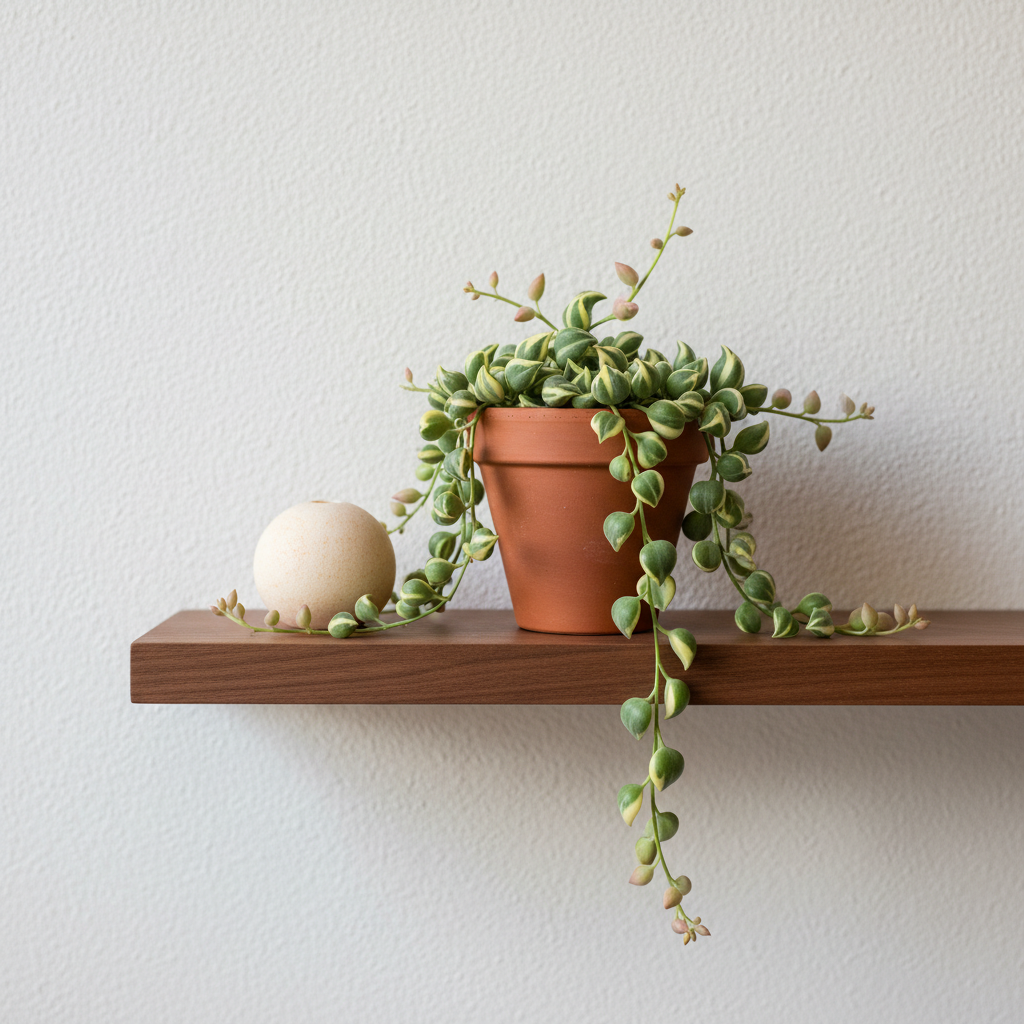
Variegated String of Dolphins
The collector’s pick. Each dolphin-shaped leaf carries irregular creamy-yellow streaks along the curved upper surface, with new growth often blushing rose-pink under strong light. Slightly less vigorous than the green form, and demands a touch more attention to light to keep the variegation stable. A genuinely beautiful plant when grown well.
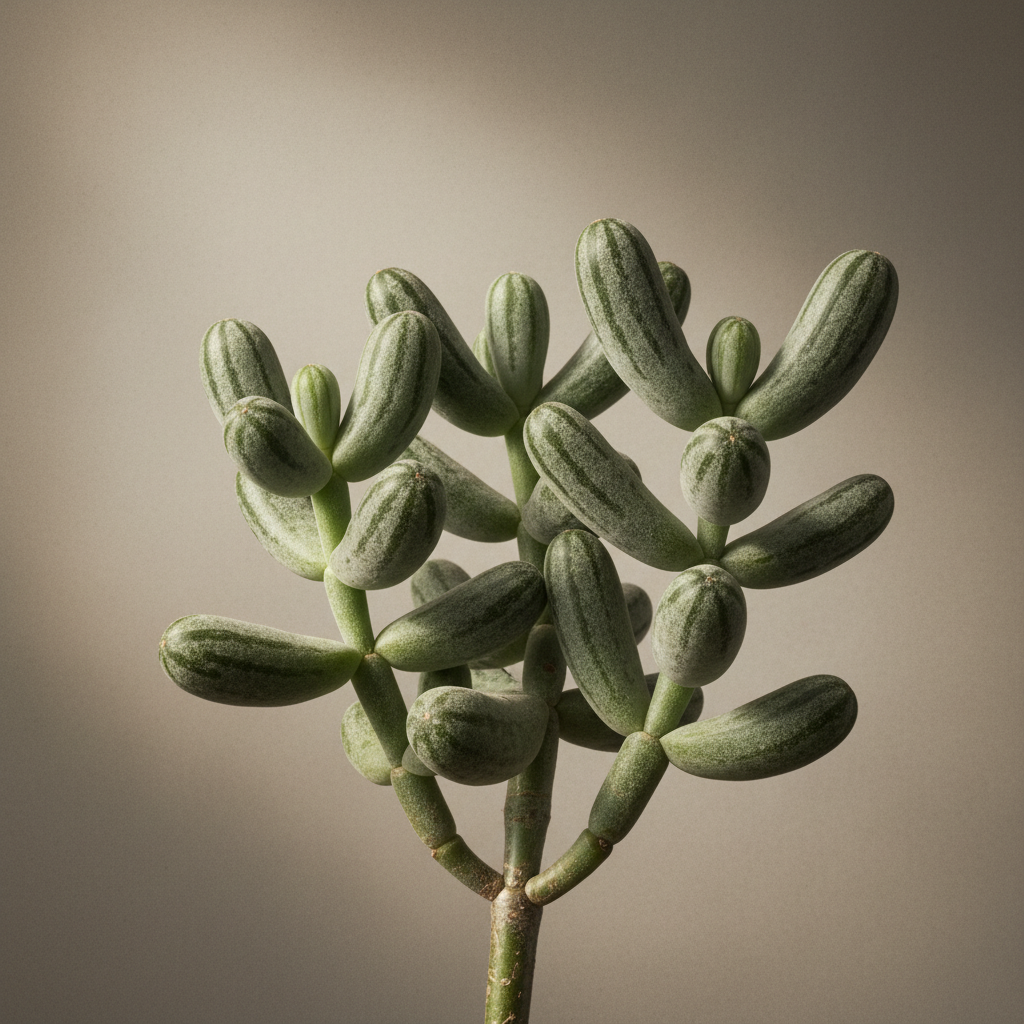
Candle Plant (Parent Species)
One of the two parents of the String of Dolphins hybrid, the Candle Plant (Curio articulatus) carries upright pickle-shaped grey-green leaves on jointed grey stems, dusted with a fine powdery bloom. A satisfying companion plant for collectors who want to see where the dolphin shape comes from: pair it with String of Pearls (the other parent) to spot the genetic midpoint in your hybrid.
Variety Profiles in Detail
Variegated String of Dolphins (Curio × peregrinus ‘Variegata’)
The variegated form is a chimeric mutation, which means the cream colouring sits in only one tissue layer of the leaf and can be unstable. Plants reverting fully to green do occasionally happen, especially in lower light; conversely, plants reverting to fully cream (so-called “albino” stems) will not photosynthesise and should be removed back to a variegated node. Keep light bright but slightly softer than for the green form, and avoid harsh midday summer sun, which can scorch the pale tissue faster than the green leaves around it. Watering and feeding are identical.
Candle Plant (Curio articulatus)
Almost the opposite habit of the trailing dolphins, the Candle Plant grows upright clusters of fleshy pickle-shaped leaves on grey jointed stems that look a little like small chains of segmented limbs. Deciduous in winter, it loses its leaves in the cool season and resprouts in spring. Same well-drained mineral mix, same dry-rest watering rhythm, slightly more tolerance for harsh light. Owning one alongside a String of Dolphins gives you a clear genetic family group.
String of Pearls (Curio rowleyanus)
The other parent and the better-known relative. String of Pearls carries small, perfectly round green leaves on hair-thin trailing stems and is significantly faster-growing than its hybrid offspring. It is also slightly more demanding: thinner leaves mean less water reserve, and a missed watering shows faster. Care needs are very similar, so if you can grow String of Dolphins, you can grow String of Pearls, just with a slightly tighter watering rhythm.
Choosing the Right Variety for Your Space
For most homes, the straight green hybrid is the easiest starting point: more vigorous than the variegated form, less demanding than String of Pearls, and forgiving of the occasional dry spell. Choose the variegated form if you already grow other succulents well and are happy to give it the bright stable light it needs. Add the Candle Plant or String of Pearls if you enjoy the idea of a small family group of related plants showing the visible inheritance of leaf shape, growth habit and resilience. All three share the same gritty mix, the same dry-rest watering schedule and the same light preferences, which makes the family easy to look after as a single small collection.
Frequently Asked Questions
Why are my String of Dolphins leaves losing their dolphin shape?
Almost always insufficient light. The dorsal-fin notch and the curved back are juvenile leaf traits expressed only under strong illumination. Move the plant to an east window or a filtered south window, give it several hours of gentle direct sun a day, and new leaves will return to their proper shape within a few weeks. Existing flattened leaves will not change but new growth will.
Is String of Dolphins toxic to cats and dogs?
Mildly. The sap contains pyrrolizidine alkaloids and saponins that can cause vomiting, drooling and gastrointestinal irritation if a pet chews on the leaves or stems. Reactions are typically mild and self-limiting, but distressing for the animal. Hang the plant out of reach, and contact a veterinarian if a pet ingests a significant amount.
How often should I water String of Dolphins?
Soak the pot thoroughly, then let the substrate go almost completely dry before watering again. In a bright spring or summer room this is roughly every 10 to 14 days; in winter rest it can stretch to 3 to 5 weeks or more. Trust the weight of the pot rather than a fixed calendar schedule.
Why are my dolphin leaves shrivelling?
Shrivelled, dimpled but still firm leaves usually mean the plant is thirsty, often after weeks of unintentional under-watering or a missed soak during summer heat. Soak the pot thoroughly in a sink, let it drain, and the leaves should plump back up within a day or two. If the leaves are mushy and translucent rather than wrinkled and firm, the cause is overwatering, not underwatering, and the plant needs urgent attention to the roots instead.
Does String of Dolphins flower?
Yes. Mature plants given enough light produce small white-cream brush-like flowers in autumn, sometimes with a faint cinnamon scent. Flowers are easy to miss because they form along the trailing stems among the dolphin leaves. A plant that never flowers is usually telling you the light is too low.
Can I grow String of Dolphins outdoors?
In USDA zones 10 and 11, yes, in a sheltered spot with morning sun and afternoon shade, in fast-draining sandy mineral soil. In colder climates it can spend the warm months on a balcony or terrace from late spring to early autumn, then come back indoors before night temperatures drop below 7 °C (45 °F). Acclimate gradually to outdoor light to avoid scorch.
How do I make my String of Dolphins fuller?
Take 8 to 12 stem cuttings from the existing plant in late spring, root them in water or directly in gritty mix, and plant them back into the same pot around the edges and into any bare areas at the centre. Within a single growing season the new cuttings knit with the original trails to give a dense, mature display.
Why is my String of Dolphins growing pickle-shaped leaves instead of dolphins?
Two possibilities. Either you actually have String of Bananas (Curio radicans), a sister hybrid that produces banana-shaped leaves and is regularly mislabelled in shops, or your plant is reverting towards the morphology of its Candle Plant parent under stress or low light. Inspect a few of the newest leaves under good light: a proper dolphin has a clear curved back and a small upward-pointing dorsal lobe. If those traits are absent on every new leaf, the plant is most likely a different species.
Why are my dolphin leaves turning purple?
A plum-purple blush on the leaves and stem tips, particularly on the outermost growth, is usually a stress response to strong light, cool nights or a long dry stretch. It is not harmful and many growers find it attractive. If the colour change is uniform across every leaf and looks more dull-grey than plum, the cause is more likely cold damage; move the plant somewhere warmer and check the substrate temperature is above 12 °C (54 °F).
How long does a String of Dolphins live?
Individual stems gradually decline after about 3 to 5 years, becoming woody at the base and less productive at the tips. The plant as a whole, however, can be kept going indefinitely by taking fresh cuttings every few years, rooting them, and replacing the older mother stock. A well-managed line of String of Dolphins propagations can outlive any single physical plant in the pot by decades.






