
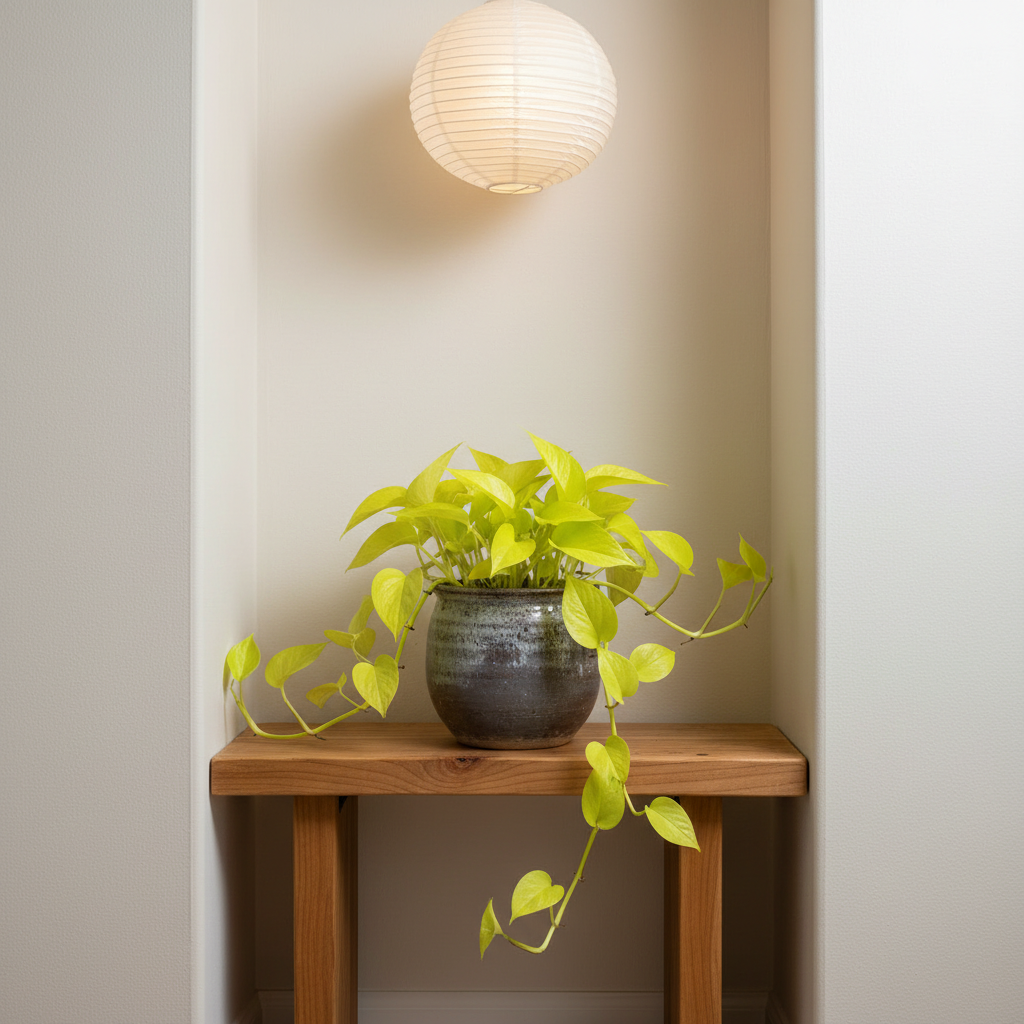
Neon Pothos (Epipremnum aureum ‘Neon’) is a luminous solid-coloured cultivar of the familiar golden pothos, distinguished by leaves that emerge a startling chartreuse-yellow and mature into a uniform lime-gold glow rather than developing the familiar variegated marbling. Like its parent species, it is a clambering aroid native to French Polynesia and naturalised across the tropics, where wild forms scramble up trees to several metres tall. As a houseplant it is grown almost exclusively in its juvenile vining form, producing tidy heart-shaped leaves about 5 to 10 centimetres (2 to 4 inches) long on slender trailing stems.
What sets the Neon cultivar apart is its colour, which is at its most intense on new growth and gradually settles into a soft uniform lime as leaves mature. The plant has the same legendary tolerance as the rest of the pothos family, but the Neon form is slightly more demanding when it comes to light: in dim conditions the leaves drift towards plain mid-green and lose much of the showy chartreuse glow that makes the cultivar worth growing in the first place. The difference between surviving and thriving with this plant comes down to a few specific habits around light, watering rhythm and pot ecology, all of which this guide covers in detail.
Contents
- Quick Reference
- Why Neon Pothos Makes an Excellent Houseplant
- Light Requirements
- Watering and Humidity
- Soil, Potting and Repotting
- Fertilising
- Propagation
- Pests and Diseases
- Popular Varieties
- Frequently Asked Questions
Quick Reference: Neon Pothos at a Glance
| Light | Bright indirect light preferred; tolerates medium light, but colour fades |
| Watering | Allow top 2 to 3 cm (1 inch) of soil to dry between waterings; typically every 7 to 10 days |
| Temperature | 18 to 27 degrees Celsius (65 to 80 degrees Fahrenheit); minimum 13 degrees Celsius (55 degrees Fahrenheit) |
| Humidity | Average household humidity (40 to 60 percent) is comfortable; tolerates lower |
| Fertiliser | Balanced liquid feed at half strength, monthly in spring and summer |
| Toxicity | Toxic to cats, dogs and humans if ingested; contains calcium oxalate crystals |
Why Neon Pothos Makes an Excellent Houseplant
Few houseplants offer the immediate visual punch of a healthy Neon Pothos. The colour reads as almost artificially bright against the muted greens of most foliage plants, which means a single specimen can lift the mood of a dim corner or pull together an otherwise neutral interior. Beyond aesthetics, Neon retains the broad trait that made golden pothos a global standard: it is genuinely difficult to kill. Light demands are modest, watering is forgiving, the plant tolerates household humidity and a wide temperature band, and it actively communicates distress before any real damage occurs. For a beginner, it is one of the most pedagogical houseplants in cultivation because cause and effect happen quickly and visibly.
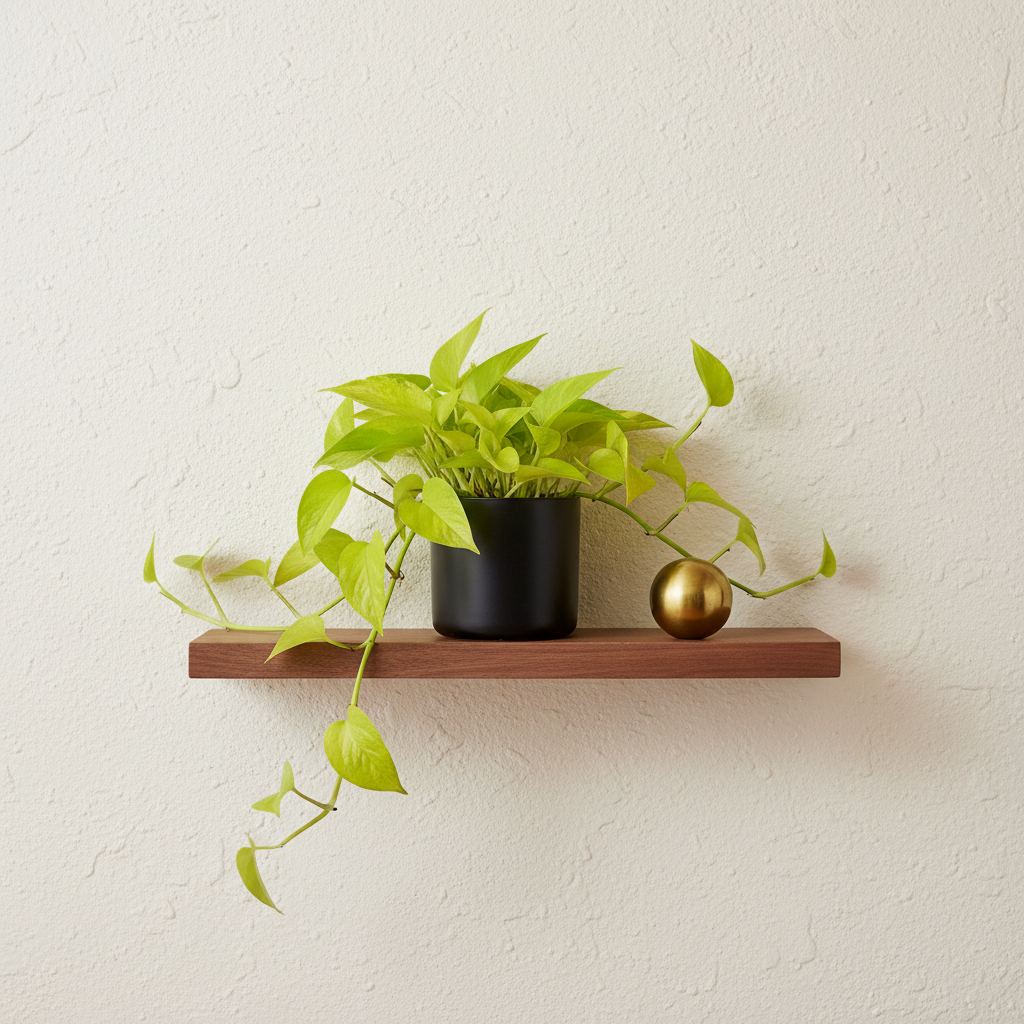
Practically, the plant also earns its place through behaviour rather than appearance. Vines lengthen quickly under reasonable conditions, producing usable cuttings within months and allowing growers to shape the plant by pinching back or training it along supports. A single small starter plant, kept well, will fill a hanging basket within a year and provide enough offspring to populate a window or share with friends. Few species in cultivation offer that combination of speed, forgiveness and visual reward without requiring expensive light setups or microclimate control.
Important — Toxicity: All parts of Neon Pothos contain insoluble calcium oxalate crystals. Chewed or ingested foliage can cause oral irritation, drooling, vomiting and difficulty swallowing in pets and humans. Keep trailing vines well out of reach of curious cats, dogs and young children, and wash hands after pruning sap-bleeding stems.
Light Requirements
Of all the pothos cultivars, Neon is the most light-sensitive in terms of cosmetic outcome. The plant itself will grow happily in conditions ranging from bright indirect light down to fairly dim corners, but the iconic chartreuse colour requires real light to express itself. In low light the new growth emerges noticeably greener, and over months an entire plant can drift towards an ordinary mid-green that is indistinguishable from a tired golden pothos.
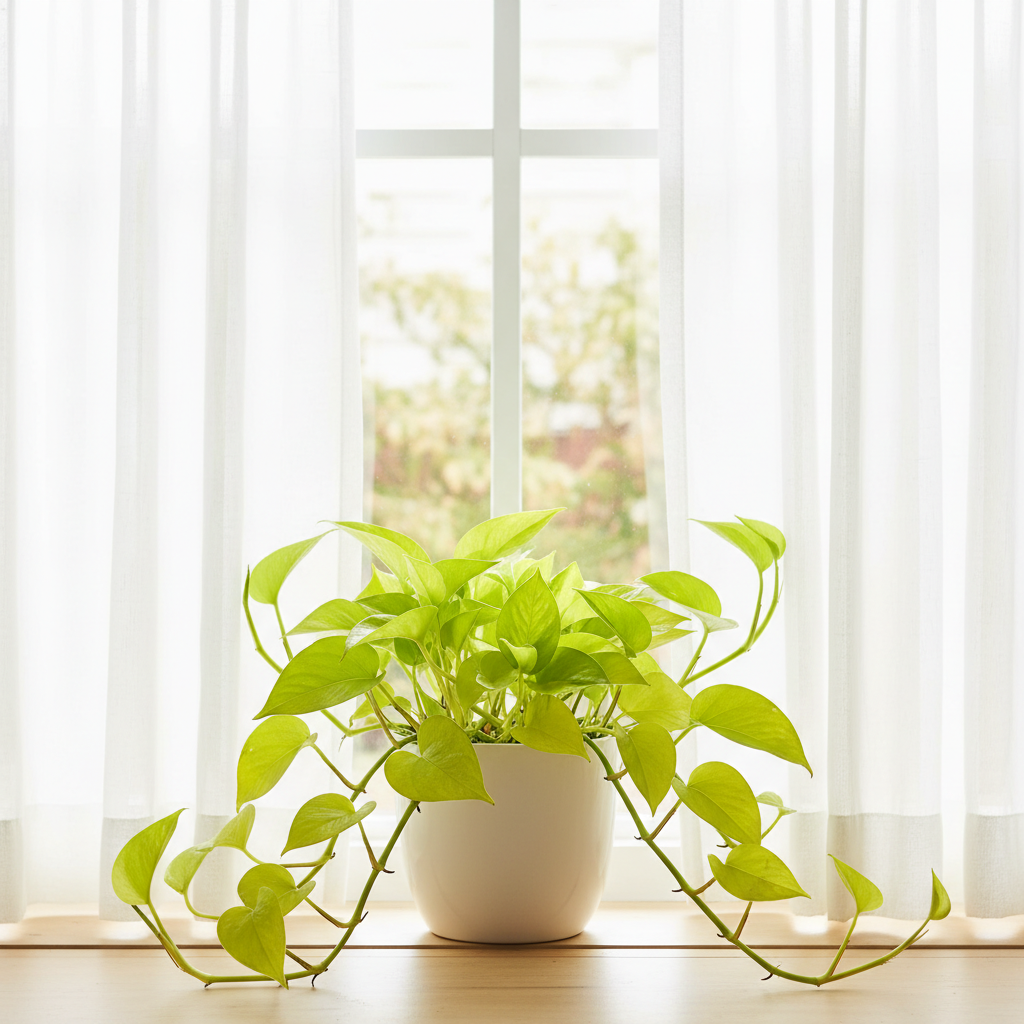
The ideal placement is within a metre or two (3 to 6 feet) of a bright window that receives diffuse daylight throughout the day but no prolonged direct sun. East-facing windows are excellent because morning sun is gentle enough to feed colour without scorching the foliage. South and west windows work beautifully if the plant sits slightly back from the glass or behind a sheer curtain. North-facing windows can sustain growth but rarely produce the colour the cultivar is grown for.
Light Levels Explained
The vocabulary around houseplant lighting can be confusing, so the table below maps the common descriptive categories onto approximate light intensity, typical room locations and the expected outcome for a Neon Pothos kept in each tier.
| Light Category | Approx. Level | Typical Location | Outcome |
|---|---|---|---|
| Direct sun | 20,000 to 100,000 lux | Touching a south or west window in summer | Risk of bleaching and crisped leaf edges within days |
| Bright indirect | 5,000 to 15,000 lux | Within a metre of a sunny window, slightly off-axis | Optimal: maximum chartreuse colour, fastest growth |
| Medium | 1,500 to 5,000 lux | Several metres from a window, well-lit room | Acceptable: growth continues, colour partly preserved |
| Low | 500 to 1,500 lux | Interior wall, distant from windows | Survives but new leaves are smaller, paler, greener |
| Very low | Below 500 lux | Windowless room, hallway, basement | Long-term decline, no useful colour expression |
Window Orientation and Placement
South-facing window: The most generous light source in the northern hemisphere. Place the plant a metre or so back from the glass, or use a sheer curtain to break the strongest midday rays. Direct contact with the glass on hot afternoons will scorch the foliage within hours, particularly on summer days when the sun reaches its highest angle.
East-facing window: Arguably the perfect location. Cool morning sun lasts several hours, the plant is in shadow by midday, and the temperature swing is moderate. New growth produced under east light typically displays the cleanest, most saturated chartreuse colour.
West-facing window: Strong afternoon light that can be harsher than morning sun because the surrounding air is warmer. Excellent for vigorous growth if the plant is set back slightly or filtered through a curtain. Watch for premature soil drying during summer.
North-facing window: Cool, even light that suits many shade-tolerant houseplants. Neon Pothos will survive happily here in a structural sense, but the cultivar’s defining colour will not develop fully. If a north window is the only option, supplementing with a small grow-light brings the colour back.
Pro Tip — The Five-Metre Test: If a healthy adult can comfortably read small print without turning on a lamp in the position where the Neon Pothos sits, the light is likely adequate for growth. If reading requires extra illumination, the location is probably too dim to maintain the cultivar’s signature colour.
How Light Affects Leaf Colour
The chartreuse pigment of Neon Pothos comes from a genetic reduction in chlorophyll production combined with elevated levels of yellow carotenoids. Because chlorophyll is what drives photosynthesis, the plant compensates for its reduced green pigment by producing more leaf surface area when light is plentiful, and by reverting towards greener leaves when it is not. Brighter light keeps carotenoid expression high and chlorophyll levels balanced for the cultivar’s characteristic glow; insufficient light pushes the plant to manufacture extra chlorophyll, dulling the yellow tones and edging the new growth back towards ordinary green.
Warning — Direct Sunlight: Unfiltered midday sun, especially behind a closed window where heat builds, can scorch Neon Pothos leaves to a translucent papery tan within a single afternoon. Damage cannot be reversed: affected leaves will not regreen and must be pruned for cosmetic recovery. Move the plant gradually if increasing light exposure, allowing two weeks for acclimatisation.
Artificial Lighting
Full-spectrum LED grow-lights are an excellent supplement for Neon Pothos kept in dim rooms, north-facing windows or windowless offices. A modest 20-watt panel positioned 30 to 60 centimetres (12 to 24 inches) above the foliage, running for 10 to 12 hours a day, replicates the effect of a bright indirect window position. White-light grow bulbs designed for foliage plants are visually pleasant in living spaces, whereas magenta-output horticultural panels offer better efficiency but a less appealing room atmosphere. Either works for this species.
Seasonal Adjustments
The intensity of natural light shifts dramatically across the year in temperate latitudes. In winter, a window position that was acceptable in summer may suddenly deliver less than half the usable light, and Neon Pothos placed there will produce paler, smaller leaves until spring. Moving the plant 30 to 60 centimetres (1 to 2 feet) closer to the glass between November and February usually compensates. Reverse the move in late spring as the sun climbs higher and the same window becomes too intense for unfiltered exposure.
Watering and Humidity
Neon Pothos is, like the rest of its species, considerably more tolerant of underwatering than of overwatering. The plant evolved as a tropical epiphyte and hemi-epiphyte, meaning its roots are accustomed to short, intense rain events followed by genuine drying. Replicating that rhythm indoors produces healthier plants than a fixed weekly schedule, and a single overzealous waterer is the most common cause of premature death in this cultivar.
When to Water
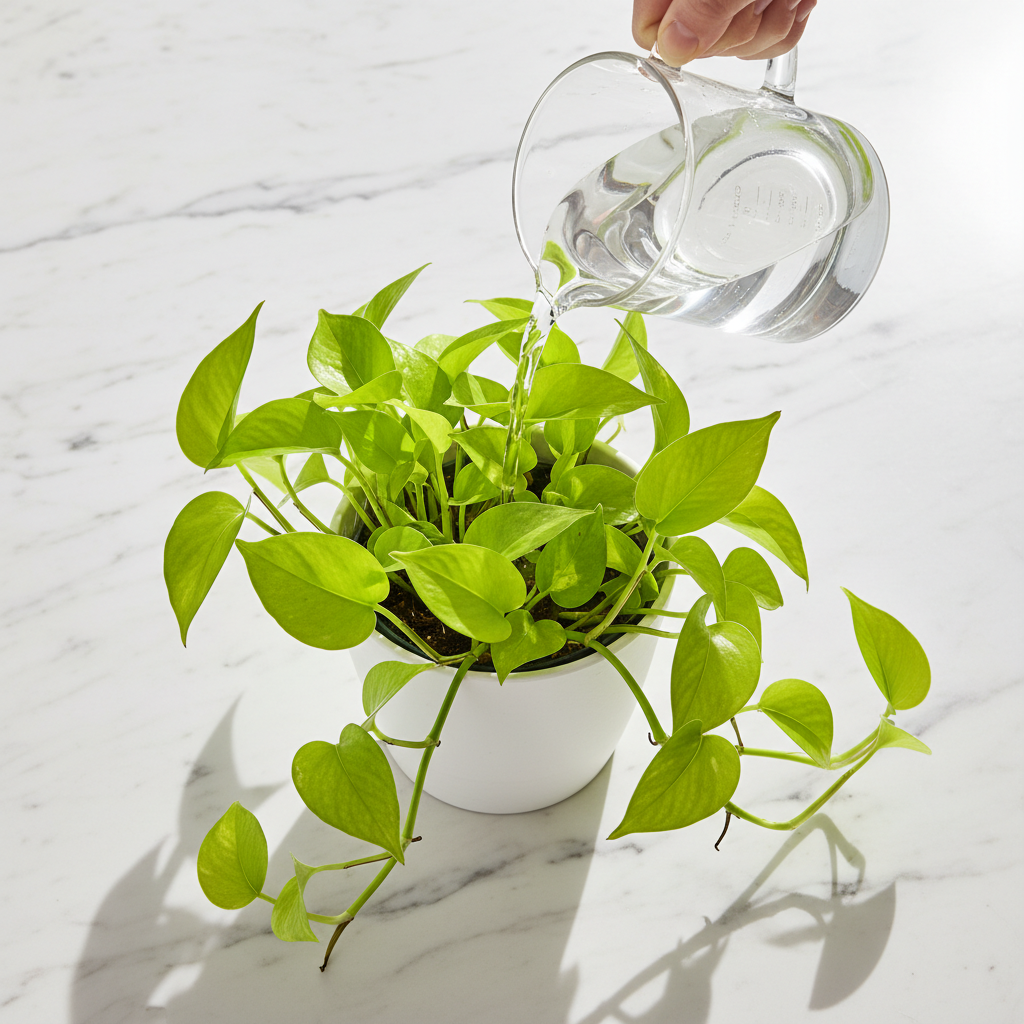
The reliable trigger for watering Neon Pothos is the dryness of the top 2 to 3 centimetres (1 inch) of soil. Push a finger into the surface and feel for moisture, or lift the pot to gauge its weight. A freshly watered pot feels heavy; one approaching the time for watering feels noticeably light. In a typical heated home this dry-to-wet cycle plays out every 7 to 10 days during the growing season and every 10 to 14 days in winter, but local conditions vary widely.
The plant also signals thirst with visible cues. Vines lose turgor and stems begin to soften before any leaf damage appears, and once watered the entire plant perks back up within a few hours. This is the cultivar’s most useful trait for nervous beginners: it asks for water clearly and recovers fully when given it, provided the cycle is not repeated indefinitely without correction.
Pro Tip — The Wooden Skewer Test: Push a thin wooden skewer or chopstick into the soil to the bottom of the pot, leave it for 30 seconds, then withdraw. If it emerges clean and dry, the entire root zone is ready for water. If clumps of damp soil cling to it, wait a few more days.
How to Water Correctly
- Lift the pot and confirm it feels light, or use the finger or skewer test to verify dryness.
- Move the plant to a sink, bath or outdoor space if practical, so excess water can drain freely.
- Pour room-temperature water slowly across the entire soil surface, working in a spiral from the edges to the centre.
- Continue until water runs clearly from the drainage holes at the base of the pot, which usually takes 20 to 60 seconds depending on pot size.
- Allow the pot to drain for at least 10 minutes before returning it to its decorative cachepot or saucer.
- Empty any standing water that collects in the saucer within an hour, never leaving the pot sitting in a pool.
Signs of Overwatering vs. Underwatering
| Symptom | Overwatering | Underwatering |
|---|---|---|
| Leaf colour | Yellowing that progresses from mature leaves outward | Pale yellowing of newer leaves, eventual crisping at tips |
| Leaf texture | Soft, limp, sometimes translucent or mushy at the base | Firm but thin, edges curling inward, papery to the touch |
| Soil | Persistently damp, sometimes with a sour smell or surface algae | Pulled away from the pot walls, dusty grey on top, hard to rewet |
| Roots | Brown or black, soft, fall apart when touched | Pale and brittle, dry but intact |
| Stem base | Blackening and softening at soil level, fungal smell | Slightly shrivelled but firm, recovers fully after watering |
Warning — Root Rot: If the stem base feels soft or smells sour, immediately unpot the plant, rinse the rootball in clean water, cut away any blackened roots with sterilised scissors, and repot into fresh dry potting mix. Withhold water for one week to allow callusing of cut surfaces, then resume conservative watering. Severely affected plants are often more easily saved as cuttings than as the original specimen.
Humidity Requirements
Neon Pothos is exceptionally tolerant of dry air. The cultivar will perform well in any room where humans are comfortable, with no need for misting, pebble trays or humidifiers in most climates. The relative humidity of a typical heated home in winter, often 30 to 40 percent, is on the dry side for an aroid but causes no real harm to this species. Levels between 40 and 60 percent are ideal.
The few visible humidity symptoms in this cultivar are subtle: leaf tips may develop a thin brown crisped edge when air is consistently below about 25 percent for weeks at a time, typically near radiators or wood-burning stoves in winter. Moving the plant a metre away from the heat source usually resolves the issue without any change to the surrounding humidity.
For growers who want to boost humidity anyway, the easiest method is grouping the Neon Pothos with several other houseplants. Each plant transpires through its leaves and the cluster creates its own microclimate of slightly higher humidity. A small ultrasonic humidifier set to release moisture during the morning hours is also effective and benefits other tropical plants kept in the same room.
Water Quality
Neon Pothos is far less sensitive to tap-water chemistry than fussier tropicals such as calathea or maranta. Standard chlorinated tap water is fine for most regions, although in areas with very hard water mineral deposits can accumulate on the soil surface and on leaf undersides over time. Allowing tap water to stand uncovered for 24 hours dissipates most chlorine, and rainwater or filtered water is preferable for growers who want pristine foliage. Soft water from a sodium-based domestic softener should be avoided, as accumulated sodium gradually damages roots.
Soil, Potting and Repotting
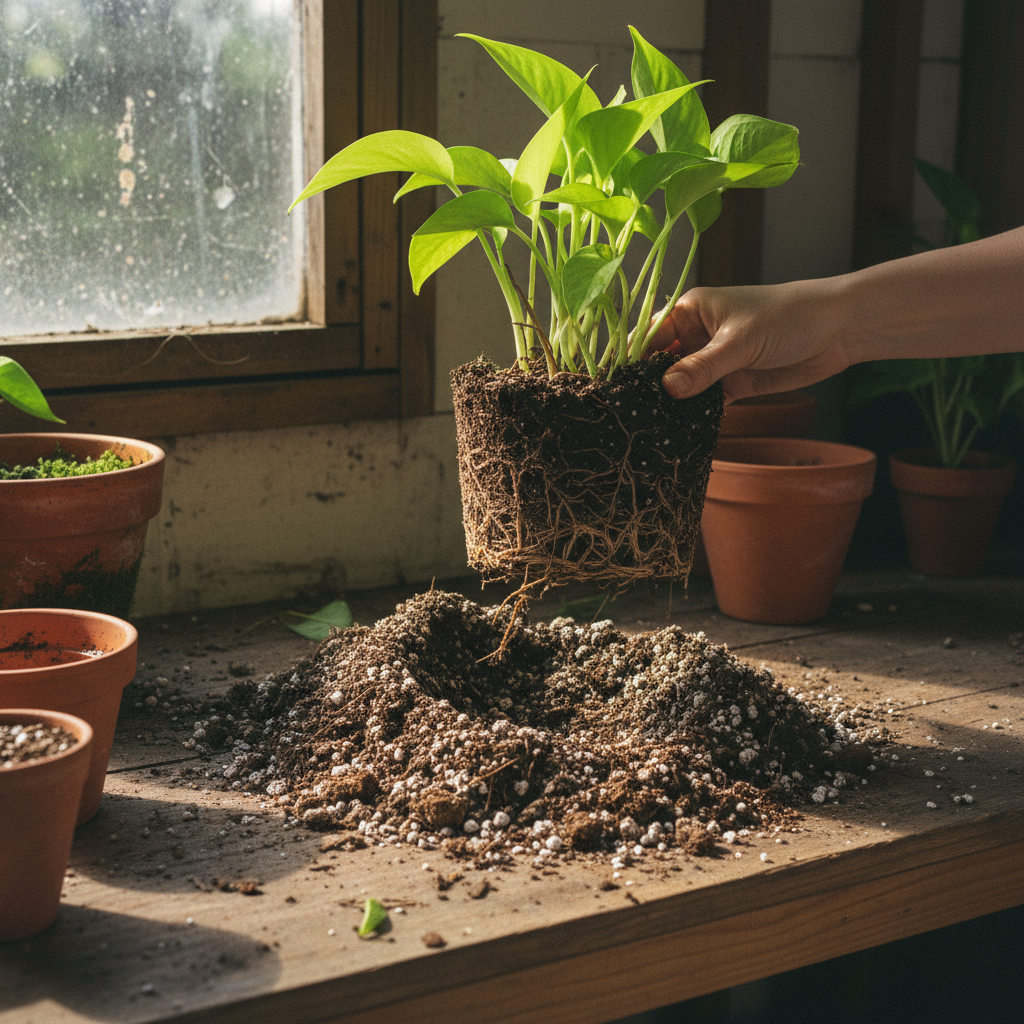
The right potting mix is more important to long-term success than the right watering schedule, because a fast-draining, well-aerated substrate makes overwatering nearly impossible. A dense, water-retentive soil, by contrast, will rot the roots even of a diligently observed plant if conditions cool or light drops. Neon Pothos, like other Epipremnum species, evolved with roots that cling to bark and litter rather than burrowing through wet soil, and replicating that loose airy environment in a pot dramatically extends the plant’s lifespan.
Ideal Soil Composition
The goal is a substrate that holds enough moisture to sustain the plant for several days yet drains within minutes after watering. Standard peat-based potting compost out of a bag tends to compact and stay wet for too long, so amending it heavily with chunky particles transforms an unsuitable base into something the plant will thrive in. The table below shows a balanced mix that suits the cultivar.
| Component | Proportion | Function |
|---|---|---|
| Quality general-purpose potting compost | 50 percent | Holds moisture and nutrients, provides body |
| Perlite or pumice | 25 percent | Maintains air pockets, prevents compaction |
| Orchid bark (small grade) | 15 percent | Adds chunky structure for root anchoring |
| Coconut coir or coco husk chips | 10 percent | Retains moisture without going waterlogged |
A slightly acidic to neutral pH suits the species well, in the range of 6.0 to 7.0. Most commercial potting composts fall comfortably within this range, and the addition of bark and coir nudges the mix slightly more acidic, which the plant prefers. Soils above pH 7.5 can lock out iron and trigger interveinal yellowing on new growth, a problem rare in indoor culture but worth recognising.
Pro Tip — Quick Mix Recipe: If sourcing all four ingredients feels excessive, a workable shortcut is two parts ordinary houseplant compost to one part perlite. This is not optimal but is reliably better than bagged compost alone and is the single easiest change a struggling Neon Pothos owner can make.
Choosing the Right Pot
The pot is part of the watering equation. A small pot dries out faster and is harder to overwater; a large pot holds moisture longer and is correspondingly more forgiving on busy weeks but less so on cool ones. Choosing pot size to match watering habits matters as much as choosing the right soil.
Drainage holes are non-negotiable. A pot without drainage will eventually drown the plant no matter how carefully water is measured, because excess moisture has nowhere to escape and the lower soil column becomes anaerobic. Decorative cachepots without holes can still be used as outer covers, with the plant kept in a plain plastic nursery pot inside and lifted out for watering.
Pot material: Terracotta is porous and breathes, drying out a little faster than glazed ceramic or plastic. This makes it forgiving for overzealous waterers but demanding for forgetful ones. Glazed ceramic and plastic retain moisture longer and suit growers who tend to underwater. Either material works for Neon Pothos provided drainage holes are present.
Pot size: Choose a pot only 2 to 3 centimetres (1 inch) larger in diameter than the existing rootball. Pothos prefer to be slightly snug in their pots and resent being moved into oversized containers, where the excess unrooted soil stays wet and quickly turns sour. Upgrading by a single pot size every two years is usually sufficient.
When to Repot
Neon Pothos is happiest when slightly root-bound, so repotting is rarely urgent. Typical signs that a move is overdue include roots emerging from the drainage holes, water running straight through the soil without being absorbed, a noticeable slowdown in growth despite good light and feeding, or the soil structure visibly collapsing into a peaty mush after two or three years. The best time for repotting is early to mid spring, when growth resumes and the plant recovers from disturbance quickly.
How to Repot: Step-by-Step
- Water the plant a day in advance so the rootball comes out cleanly and the roots are turgid.
- Tip the pot on its side and gently squeeze or tap the rim to release the rootball; tease it free without yanking on the stems.
- Loosen the outer surface of the rootball with fingertips, freeing any tightly wound roots and removing the top centimetre of spent soil.
- Trim any blackened, mushy or obviously dead roots with sterilised scissors; healthy roots are pale cream and firm.
- Place a shallow layer of fresh mix in the new pot, settle the plant so the soil line sits 1 to 2 centimetres (half an inch) below the rim, and fill around the rootball with the remaining mix, pressing gently to eliminate air pockets.
- Water thoroughly until liquid drains from the holes, then return the plant to its usual spot and avoid fertilising for at least four weeks while the roots re-establish.
Warning — Transplant Shock: A repotted Neon Pothos may droop or pause growth for a week or two while roots adjust. This is normal and not a cause for additional watering or feeding. Keep the plant in its accustomed light, hold off fertiliser for a month, and allow recovery to proceed naturally. Most specimens resume growth within three weeks.
Fertilising
Neon Pothos is a moderately hungry plant during its active growing season but goes effectively dormant when light levels drop in winter, so feeding follows the seasons rather than a fixed schedule. Underfed plants slow visibly and produce smaller, paler leaves; overfed plants accumulate damaging salts at the soil surface and along the pot walls, eventually scorching the root tips.
The general rule is to err on the side of less. Pothos tolerate skipped feedings far better than they tolerate excess, and a half-strength solution applied conservatively delivers steady gentle nutrition without risk of burn. There is no need for specialist aroid fertilisers; ordinary balanced houseplant feeds work perfectly.
Understanding Plant Nutrients
Fertiliser packaging displays a three-number ratio such as 10-10-10 or 20-10-20, representing the percentage by weight of three primary macronutrients. The table below summarises what each nutrient does for Neon Pothos and what its absence looks like on the plant.
| Nutrient | Symbol | Primary Function | Deficiency Symptoms |
|---|---|---|---|
| Nitrogen | N | Drives leaf and stem growth, supports chlorophyll production | Older leaves yellow uniformly, growth slows |
| Phosphorus | P | Supports root development and energy transfer | Stunted growth, dull greyish foliage |
| Potassium | K | Regulates water balance and overall vigour | Brown crisped leaf margins, weak stems |
| Calcium | Ca | Builds cell walls and supports new growth | Distorted new leaves, hooked or twisted growth tips |
| Magnesium | Mg | Central atom in the chlorophyll molecule | Interveinal yellowing of older leaves |
| Iron | Fe | Aids chlorophyll synthesis | Interveinal yellowing of newest leaves |
Types of Fertiliser
Liquid fertilisers: The most controllable option for indoor growing. A balanced formulation diluted to half the label strength and applied with regular watering provides steady nutrition. Liquid feeds also wash out easily if accidentally overdosed, simply by flushing the pot with plain water.
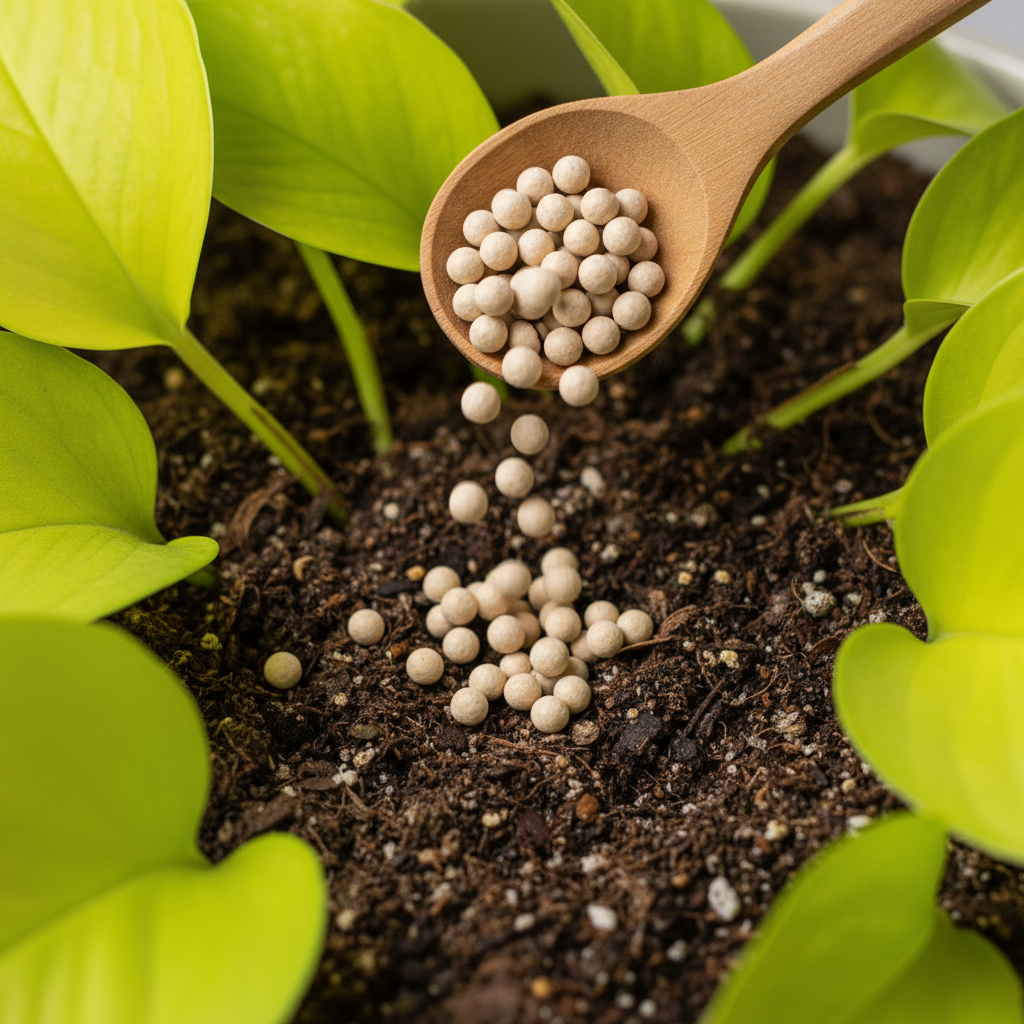
Slow-release granular: Prills or pellets scattered on the soil surface dissolve gradually over three to four months. This is the most hands-off option and suits forgetful feeders, but the release rate accelerates in warm rooms and can lead to inadvertent overfeeding in summer. Apply at the lower end of the recommended rate.
Organic fertilisers: Worm castings, dilute fish or seaweed emulsion, and compost teas all work well for Neon Pothos. They release nutrients more gently than synthetic feeds and improve soil microbiology, although they sometimes carry a noticeable odour for a day or two after application.
Feeding Schedule
From early spring through to early autumn, apply a balanced liquid feed at half strength once a month, or use a slow-release granular at half rate twice per year (early spring and midsummer). Suspend feeding from November through February, when the plant’s growth slows and unused fertiliser accumulates as salts in the soil. Resume gently in March as new growth appears at the vine tips.
Pro Tip — Half Strength, Twice as Often: Rather than applying a full-strength dose monthly, some growers prefer a quarter-strength dose every two weeks. This delivers more even nutrition without spikes, and the plant tends to produce slightly larger, more evenly coloured leaves over time.
How to Fertilise
- Water the plant the day before feeding so the soil is moist; never apply fertiliser to bone-dry soil, which causes root scorch.
- Mix the fertiliser into water at half the recommended dilution, stirring thoroughly to ensure the concentrate is evenly distributed.
- Pour the diluted solution slowly across the soil surface, allowing it to soak in evenly without pooling.
- Continue until a small amount drains from the bottom of the pot, which carries fresh nutrients through the entire root zone.
- Discard any excess that collects in the saucer to prevent salt buildup from re-entering the soil.
Warning — Salt Build-Up: White or yellow crusty deposits on the soil surface, around the pot rim, or at the drainage holes indicate accumulated fertiliser salts. Flush the pot thoroughly with plain water several times in a row, allowing it to drain completely between flushes, to leach the salts out. Repeat seasonally if deposits return.
Propagation
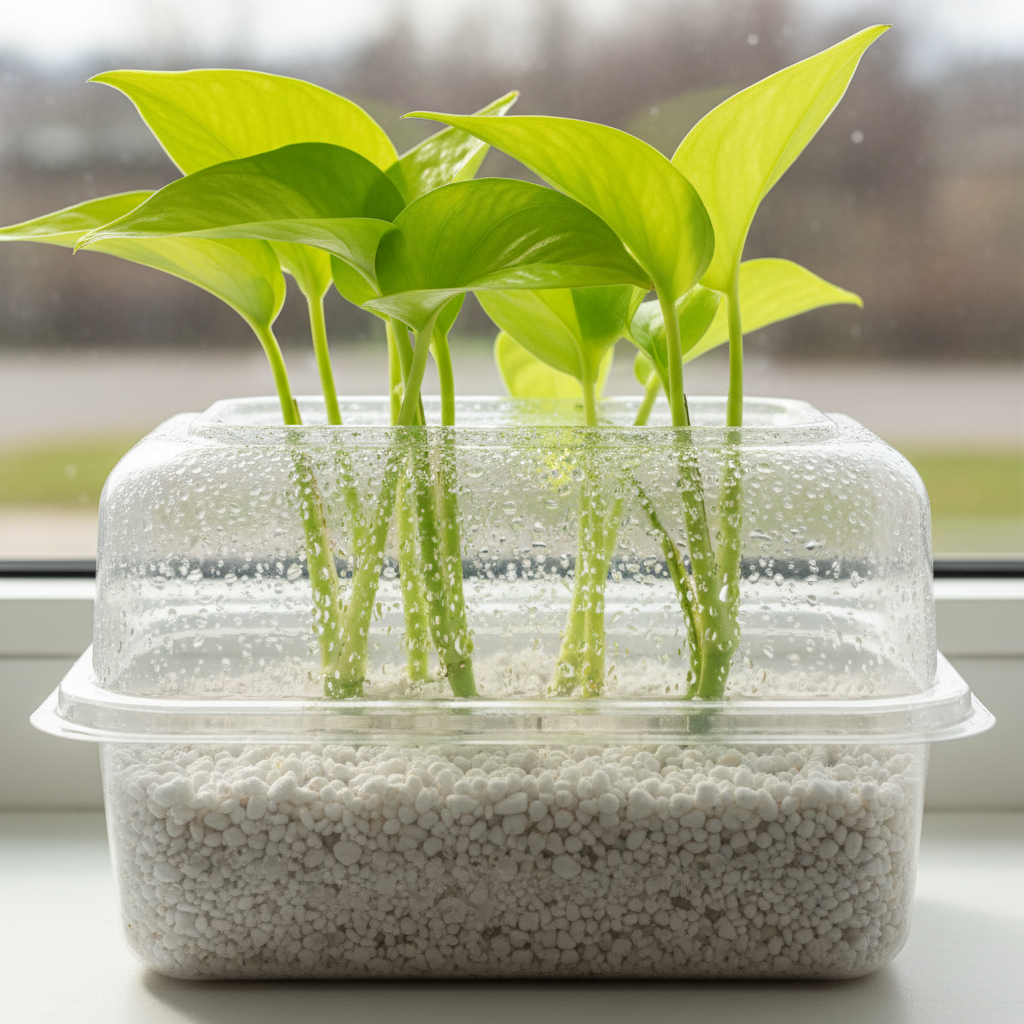
Few houseplants are easier to propagate than Neon Pothos. Stem cuttings root readily in water, sphagnum moss or moist perlite, and within weeks a single mature plant can yield enough offspring to fill a small windowsill. The cultivar’s chartreuse colour is genetically stable and passes faithfully to every cutting, so propagated plants look identical to the parent and grow with equal vigour.
Spring and early summer are the most productive months for propagation because warm soil and bright light accelerate root development. Cuttings taken in autumn or winter still root reliably but progress more slowly, sometimes taking twice as long to establish. There is no benefit to using rooting hormone with this species, which produces aerial roots readily without intervention.
Understanding Nodes and Aerial Roots
The slightly swollen joints along a pothos vine are nodes, and they are the engine of propagation. Each node carries the dormant cells that develop into both new leaves and new roots, often visible as small bumps or stubby brown nubs on the underside of the stem. Cuttings without a node will not root, while cuttings with even a single healthy node will produce a complete new plant. Identifying nodes correctly is the single most important skill for propagating this species.
Water Propagation: Step-by-Step
Water rooting is the easiest and most visually rewarding method, allowing growers to watch fresh roots develop through clear glass. Plants started in water sometimes take an extra week or two to acclimate when transferred to soil, but the success rate is exceptionally high.
- Select a healthy vine at least 20 centimetres (8 inches) long, with several mature leaves and clearly visible nodes.
- Cut just below a node using clean sharp scissors or secateurs, leaving 1 to 2 centimetres (half an inch) of stem below the node.
- Remove the leaf closest to the cut end so that at least one node will be submerged when the cutting is placed in water.
- Place the cutting in a clear glass jar of room-temperature water, ensuring the node is below the waterline and any remaining leaves are above it.
- Position the jar in bright indirect light and refresh the water every 5 to 7 days to maintain oxygen levels and prevent algal growth.
- White root threads appear from the node within 10 to 14 days; transfer to soil when several roots have reached 5 centimetres (2 inches) in length.
Pro Tip — Multi-Node Cuttings: A single vine cut into several short segments, each containing two nodes and a leaf, can produce four or five new plants from a single trimming. This is the most efficient way to scale up a small collection or create a bushy planting from one parent vine.
Sphagnum Moss Propagation: Step-by-Step
Rooting in damp sphagnum moss produces stronger root systems that adapt more readily to soil than water-grown roots, at the cost of being less visible to the grower. This method is preferred when the goal is a robust transplant rather than a display.
- Soak a handful of long-strand sphagnum moss in clean water for 30 minutes, then squeeze out the excess until it feels evenly damp but no longer drips.
- Prepare cuttings as for water propagation, with at least one exposed node.
- Fill a clear deli cup or plastic container with the damp moss, nestle the cuttings so the nodes are buried within the moss, and close the lid loosely to maintain humidity without sealing in stagnant air.
- Place the container in bright indirect light at room temperature, opening the lid briefly every two or three days to refresh the air inside.
- Check moisture weekly and mist lightly if the moss begins to dry; new roots appear within two to three weeks.
- Transplant into potting mix once roots are 3 to 5 centimetres (1 to 2 inches) long, gently teasing the moss away from the new roots rather than pulling them apart.
Troubleshooting Propagation
| Problem | Likely Cause | Solution |
|---|---|---|
| Cutting rots in water | Stagnant water, too many submerged leaves, or insufficient light | Refresh water more frequently, strip lower leaves, move to a brighter spot |
| No roots after a month | Cool ambient temperatures, very low light, or cutting taken without a node | Move to a warmer brighter location and verify a healthy node is submerged |
| Leaves yellow during rooting | Energy redirected to root production, or insufficient light | Normal in moderation; remove the worst affected leaves and increase light |
| Transplanted cutting wilts | Soil too dry or roots not yet adapted from water to soil | Keep soil consistently moist for the first two weeks, then return to normal watering |
Pests and Diseases
Neon Pothos is among the more pest-resistant houseplants in common cultivation, but its dense vining foliage offers good hiding places for small insects, and crowded plant collections can transfer infestations from neighbour to neighbour quickly. The lighter chartreuse colouration also makes some pests (especially light-coloured mealybugs) harder to spot than they would be on a green-leaved plant, so attentive observation pays off.
Disease pressure is low under sensible care. Most fungal and bacterial problems trace back to overwatering rather than airborne pathogens, and adjusting watering practice resolves them more reliably than chemical intervention. Inspecting new plants carefully before introducing them to an existing collection prevents most pest outbreaks before they begin.

Common Pests
Mealybugs (Pseudococcidae)
Small white cottony insects clustering in leaf axils and on the undersides of leaves, secreting sticky honeydew that attracts ants and sooty mould. They are the most common pest on Neon Pothos and reproduce rapidly in warm dry indoor conditions.
Treatment: Dab each visible insect with a cotton bud soaked in 70 percent isopropyl alcohol, killing it on contact. Follow with a spray of insecticidal soap or diluted neem oil across all leaf surfaces, repeating every 7 days for at least three cycles to catch newly hatched generations.
Spider Mites (Tetranychus urticae)
Almost invisible to the naked eye, these tiny arachnids leave fine pale stippling on leaf surfaces and produce delicate webbing in heavy infestations. They thrive in dry warm conditions, particularly near heating vents in winter.
Treatment: Rinse the entire plant under a strong stream of room-temperature water in the shower or kitchen sink to dislodge mites mechanically. Follow with neem oil or insecticidal soap, paying special attention to leaf undersides, and repeat at 5-day intervals for three rounds.
Scale Insects (Coccoidea)
Small brown or tan armoured bumps that attach to stems and the undersides of leaves along the midrib. They are easy to mistake for natural plant features and can persist undetected for weeks while populations build up.
Treatment: Scrape off visible scale gently with a fingernail or soft brush, then wipe the area with cotton dipped in 70 percent isopropyl alcohol. Treat the whole plant with horticultural oil or neem oil to smother crawlers, and repeat every 10 days for at least three cycles.
Fungus Gnats (Bradysia spp.)
Small dark flies hovering around the soil surface, with translucent larvae living in the top few centimetres of damp compost. Adults are harmless but the larvae can damage young roots in heavy infestations.
Treatment: Allow the top of the soil to dry more thoroughly between waterings, which interrupts the life cycle. Place yellow sticky traps to catch adults, and water with a diluted suspension of Bacillus thuringiensis israelensis (BTi) to kill larvae in the soil.
Common Diseases
Root Rot (Pythium and Phytophthora spp.)
The most common serious disease in indoor pothos, caused by water moulds that thrive in waterlogged soil. Symptoms include rapid leaf yellowing, soft black stem bases and a sour odour from the soil. Roots become dark, mushy and disintegrate when touched.
Treatment: Unpot the plant, rinse the rootball, cut away all blackened tissue with sterilised scissors and repot into fresh dry mix. Withhold water for one week and reduce subsequent watering. Severely affected plants are often better saved as cuttings from any unaffected vine sections.
Bacterial Leaf Spot (Pseudomonas cichorii)
Small water-soaked spots on leaves that develop yellow halos and progress to dark brown lesions. Often triggered by water sitting on foliage overnight or by overhead watering in cool conditions.
Treatment: Remove affected leaves and dispose of them. Improve air circulation around the plant, water at the soil only, and avoid wetting the foliage. Severe outbreaks may require a copper-based fungicide labelled for indoor use, applied as directed by the manufacturer.
Pest and Disease Summary
| Pest / Disease | Identification | Treatment |
|---|---|---|
| Mealybugs | White cottony clusters in leaf axils | Alcohol swabs, then insecticidal soap or neem oil at 7-day intervals |
| Spider mites | Fine pale stippling and webbing on leaves | Strong water rinse, then neem oil at 5-day intervals |
| Scale | Brown bumps on stems and leaf undersides | Manual removal plus horticultural oil at 10-day intervals |
| Fungus gnats | Small flies hovering above soil | Drier surface soil, sticky traps, BTi drench |
| Root rot | Soft blackened roots, sour soil smell | Unpot, trim, repot dry, withhold water |
| Bacterial leaf spot | Water-soaked spots with yellow halos | Remove affected leaves, improve airflow, water at soil level only |
Prevention Strategies
The most effective prevention is quarantine. Any newly acquired plant, even one from a reputable source, should spend two to four weeks isolated from the existing collection so that any latent pest infestations have time to declare themselves before spreading. A spare windowsill, bathroom or office desk works well as a temporary quarantine station.
Routine inspection is the second pillar. A brief weekly check of leaf undersides, leaf axils and the soil surface, ideally with a small handheld magnifier, catches almost every problem before it requires chemical intervention. Wiping leaves with a damp cloth once a month removes dust and disrupts the early stages of mite and scale infestation while also keeping foliage looking its best.
Pro Tip — Neem Oil Maintenance Spray: A monthly preventive spray of dilute neem oil (5 millilitres per litre of water with a drop of mild liquid soap as emulsifier) applied lightly to all foliage surfaces in the evening dramatically reduces pest establishment without harming the plant. Avoid spraying in direct sunlight or above 30 degrees Celsius (86 degrees Fahrenheit), as the oil can cause leaf burn under those conditions.
Popular Varieties
Neon Pothos is itself a named cultivar of Epipremnum aureum, so the “varieties” worth discussing are partly its own variegated sports and partly its sibling cultivars within the wider pothos family. Comparing Neon against other popular Epipremnum cultivars helps growers understand where it fits within the spectrum of available leaf colours, growth rates and care profiles.
The following table summarises the most widely available cultivars and sports related to or commonly confused with Neon Pothos. Care requirements are broadly similar across the group, but light tolerance and growth rate vary noticeably and are worth weighing when choosing between them.
| Variety | Leaf Appearance | Light Needs | Growth Rate | Availability |
|---|---|---|---|---|
| Neon | Solid chartreuse-yellow, uniform glow | Bright indirect | Fast | Common |
| Golden Pothos | Green with irregular yellow variegation | Bright to medium indirect | Fast | Very common |
| Marble Queen | Heavily streaked cream and green marbling | Bright indirect | Slower | Common |
| Lemon Meringue | Chartreuse with creamy ivory streaks and patches | Bright indirect | Moderate | Uncommon |
| Global Green | Two-tone green islands on lighter green base | Bright to medium indirect | Moderate | Uncommon |
| N’Joy | Compact crisp white-and-green sectoral variegation | Bright indirect | Slow | Common |
| Manjula | Wavy leaves with cream, green and silver patches | Bright indirect | Slow | Uncommon |
| Jessenia | Sage green with darker green marbling | Bright to medium indirect | Moderate | Common |
Featured Varieties
Lemon Meringue Pothos
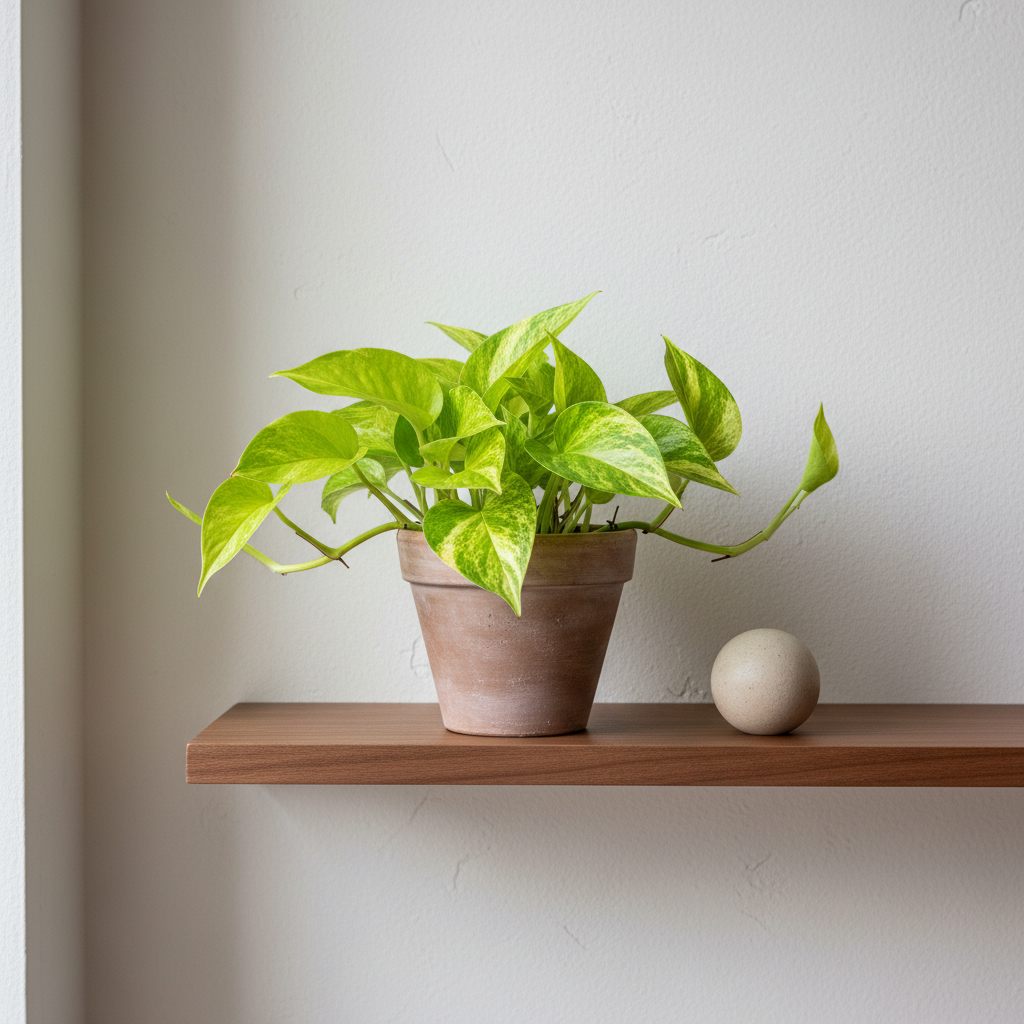
A rare variegated sport of Neon Pothos, Lemon Meringue keeps the chartreuse base colour of its parent and adds irregular creamy ivory streaks and patches across each leaf. The variegation is unstable, with new growth sometimes reverting to pure Neon under low light and re-emerging when bright conditions return. Slower growing than Neon but otherwise identical in care.
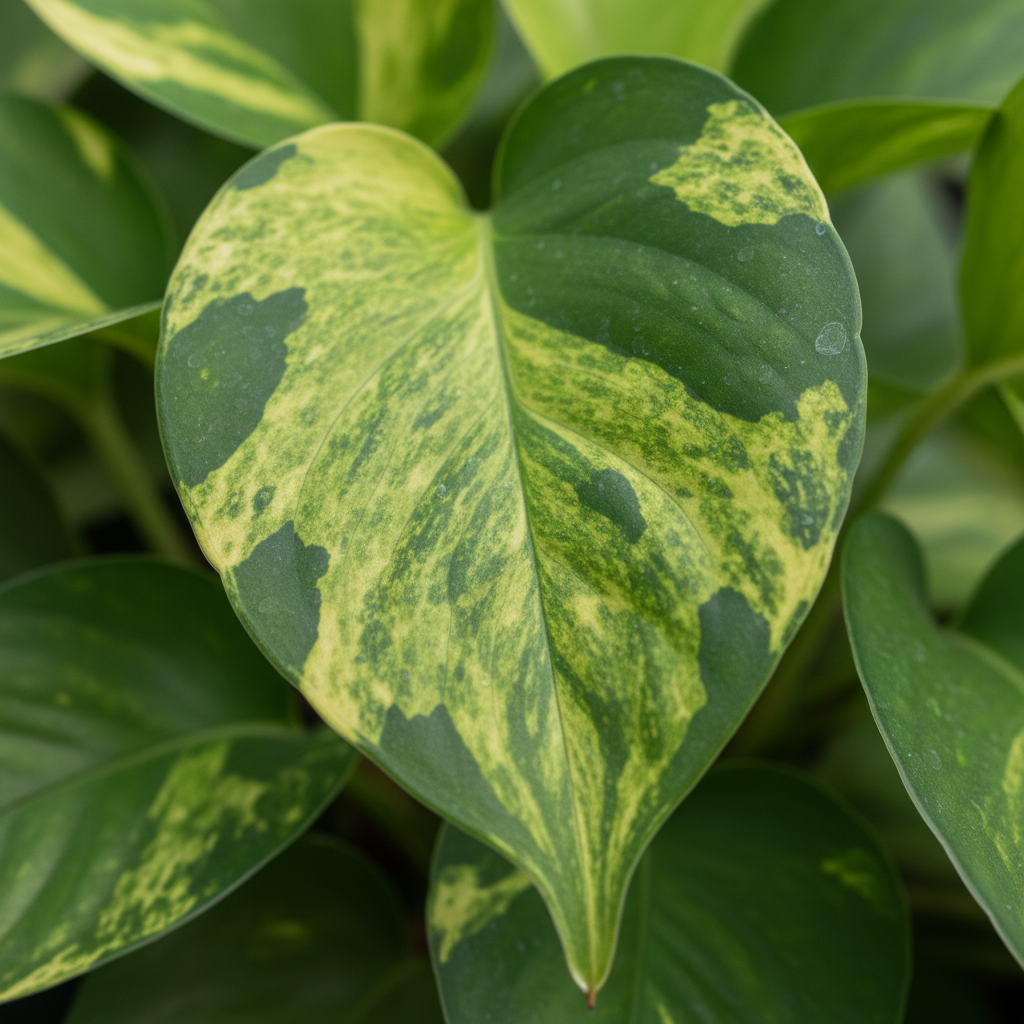
Global Green Pothos
A modern Epipremnum aureum cultivar with distinctive two-tone green variegation: darker forest-green islands set into a lighter spring-green base. Global Green provides a more subdued contrast to Neon’s saturated chartreuse and pairs well with it in mixed plantings or stylings. Growth rate is moderate and care matches Neon almost exactly.
Variety Profiles in Detail
Golden Pothos (Epipremnum aureum)
The original wild-type form and parent of Neon, with mid-green heart-shaped leaves splashed and marbled with butter-yellow variegation. Golden Pothos is the most widely grown houseplant of the genus and tolerates a broader range of conditions than the Neon sport, including dimmer light, while still growing vigorously.
Marble Queen Pothos (Epipremnum aureum ‘Marble Queen’)
A heavily variegated cultivar with leaves nearly half cream or ivory, marbled finely against a mid-green background. The reduced chlorophyll content makes Marble Queen markedly slower-growing than Neon, and it needs slightly more light to maintain its bright variegation. Spectacular when given a good location.
N’Joy Pothos (Epipremnum aureum ‘N’Joy’)
A compact patented cultivar with smaller leaves displaying crisp sectoral variegation: each leaf is partly clear cream and partly clear green, with sharp boundaries between the colour zones. Slower growing and tidier in habit than Neon, making it a popular choice for small spaces and shelf displays.
Manjula Pothos (Epipremnum aureum ‘Manjula’)
Another patented cultivar with broad wavy leaves displaying complex variegation in cream, green and silver. Manjula has the slowest growth rate of the popular pothos cultivars but produces some of the most striking individual leaves, and many growers consider it the most ornamental member of the group.
Jessenia Pothos (Epipremnum aureum ‘Jessenia’)
A subtle cultivar with sage-green leaves marbled with slightly darker green variegation, producing a low-contrast effect that reads as a richer textured version of plain green. Jessenia is more shade-tolerant than most of its siblings and is an underrated choice for slightly dim locations where Neon would lose colour.
Choosing the Right Variety for Your Space
Neon is the natural choice when colour is the priority and there is a bright window available, because no other pothos cultivar delivers the same uniform lime glow. For locations with weaker light, Golden or Jessenia will perform more reliably without their colour disappearing. Variegated cultivars such as Marble Queen, Manjula and N’Joy reward attentive care with spectacular foliage but punish neglect more visibly than Neon does. Combining two or three cultivars in adjacent pots creates a layered foliage display in which Neon serves as the bright focal point against more subdued companions.
Frequently Asked Questions
Why is my Neon Pothos turning green instead of staying chartreuse?
The most common cause is insufficient light. Neon Pothos produces extra chlorophyll to compensate when light is dim, which dulls the cultivar’s signature yellow glow. Moving the plant closer to a bright indirect light source for two to three weeks usually restores colour on new growth, although already-green leaves will not turn back.
How fast does Neon Pothos grow?
Under good conditions a healthy Neon Pothos extends each vine by 30 to 90 centimetres (1 to 3 feet) per growing season, producing a new leaf every one to two weeks. Growth slows dramatically in winter when light levels drop, then resumes vigorously in spring.
Is Neon Pothos safe for pets?
No. Like all pothos cultivars, Neon contains insoluble calcium oxalate crystals that cause oral irritation, drooling, vomiting and difficulty swallowing if chewed by cats, dogs or other pets. Hang vines well out of reach or choose a different species entirely if pets are likely to access the plant.
Why are the leaves on my Neon Pothos getting smaller?
Diminishing leaf size on new growth points typically indicates one of three problems: insufficient light, root-bound conditions or nutrient depletion. Check that the plant is in bright indirect light, lift it out of its pot to inspect whether roots are circling the rootball, and confirm that feeding has resumed in spring after the winter pause.
Can I grow Neon Pothos permanently in water?
Yes, although growth will be slower and leaf size smaller than in soil. Use a clear vessel of room-temperature water, change it every 7 to 10 days, and add a few drops of dilute liquid fertiliser at a quarter strength once a month. The plant will live indefinitely in water but will not match the vigour of a soil-grown specimen.
How long do Neon Pothos plants live?
Under attentive care, a Neon Pothos can live indefinitely. Because the plant is essentially a clonal vine that can be propagated endlessly from cuttings, the genetic line of a single specimen often persists across decades, with newer rooted cuttings replacing older woody sections as the plant ages.
Should I cut off the long bare vines on my Neon Pothos?
Yes, pruning encourages bushier growth and produces propagation material at the same time. Cut vines back to within a few centimetres of a healthy leaf, and root the cuttings to fill out the parent pot or start new plants. Long bare vines are typically a sign that the plant was kept in low light or was watered erratically while extending towards better conditions.
Why does my Neon Pothos have brown leaf tips?
Crisp brown tips usually indicate one of three things: very dry air near a heat source, accumulated fertiliser salts in the soil, or chronic underwatering. Move the plant away from heating vents, flush the pot with plain water to leach salts and check that the watering schedule reaches the dry-to-wet rhythm the plant prefers.
Can Neon Pothos climb if given a support?
Yes. Provided with a moss pole, coir pole or rough-surfaced support, Neon Pothos produces aerial roots that grip and climb. Climbing specimens develop noticeably larger leaves than trailing ones, occasionally reaching 15 to 20 centimetres (6 to 8 inches) across at maturity. The chartreuse colour appears even more vivid on the larger climbing leaves.
Will Neon Pothos clean indoor air?
Houseplants in general remove trace amounts of common indoor pollutants under laboratory conditions, but the densities required to measurably affect air quality in a normal room are far higher than most homes can accommodate. A Neon Pothos is a beautiful and beneficial addition to a space, but should be valued for its appearance and psychological benefits rather than as a primary air-purification tool.






