
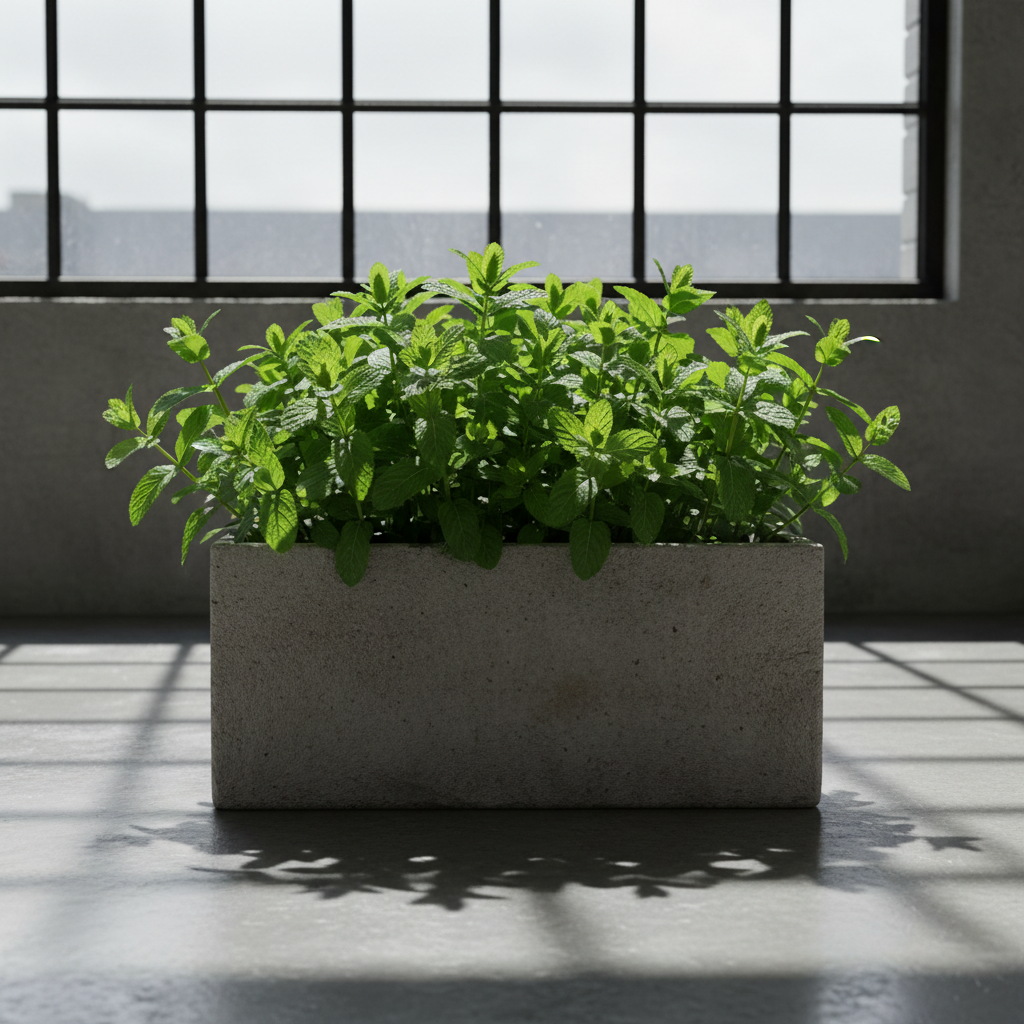
Few plants are more familiar to the kitchen window than mint. The name covers a whole sprawling family in the genus Mentha, but the species most often labelled simply “mint” and sold as a potted herb is Mentha spicata, commonly called spearmint. Native to a broad belt across Europe, North Africa and southwest Asia, mint has been cultivated for so long that genuinely wild populations are now hard to disentangle from naturalised escapes. It is a square-stemmed perennial in the deadnettle family (Lamiaceae), grown for its aromatic foliage rather than its modest pale-lilac flowers, and it earns its place on the windowsill because almost every part of it smells exactly like the sweet wrappers, toothpastes and summer drinks it has perfumed for centuries.
Mint has a reputation as one of the easiest herbs to keep, and that reputation is mostly deserved, with one important caveat. Outdoors, mint is famous for its thuggish, running rhizomes, which is why gardeners traditionally confine it to a buried bucket or a dedicated bed. Indoors, that vigour is mostly an advantage: a young plant can fill a generous pot within a season, tolerate occasional rough handling and bounce back from harvests that would set lavender or rosemary back for weeks. The catch is that a happy mint and a struggling mint look very different. A surviving plant is the leggy, pale-stemmed specimen sold in a supermarket sleeve, hanging on for a fortnight in low light. A thriving mint is dense, bushy, deeply scented and almost embarrassingly productive. This guide covers everything you need to nudge yours from the first state into the second, with separate sections on light, watering, soil, fertilising, propagation, pests and the most popular cultivars you are likely to meet.
Contents
- Quick Reference
- Why Mint Makes a Productive Houseplant
- Light Requirements
- Watering and Humidity
- Soil, Potting and Repotting
- Fertilising
- Propagation
- Pests and Diseases
- Popular Varieties
- Frequently Asked Questions
Quick Reference: Mint at a Glance
| Light | At least 4 to 6 hours of bright indirect light, ideally 2 to 4 hours of gentle direct sun on an east or south-east window. Grow lights work well when natural light is short. |
| Watering | Keep the mix evenly moist, never bone dry and never sodden. In a warm room expect to water roughly every 2 to 3 days; check by feel rather than calendar. |
| Temperature | Happy across normal indoor temperatures of 15 to 24 degrees Celsius (59 to 75 degrees Fahrenheit). Tolerates cooler conditions and a winter rest. Avoid prolonged temperatures above 27 degrees Celsius (81 degrees Fahrenheit) in stagnant air. |
| Humidity | Tolerant of average household humidity from 35 to 60 percent. Higher humidity is welcome, but only if airflow is good, otherwise mildew risk increases. |
| Fertiliser | A balanced liquid feed at quarter to half strength every 3 to 4 weeks during active growth, lighter or stopped over winter. Heavy feeding dilutes the essential oils and weakens flavour. |
| Toxicity | Non-toxic and culinary for humans. In small quantities mint is generally safe for cats and dogs but can cause stomach upset if eaten in volume. Essential oil concentrates are a different matter and should be kept out of reach. |
Why Mint Makes a Productive Houseplant
Most houseplant lists treat herbs as an afterthought, but mint is the rare crop that genuinely earns a long-term spot indoors. Its main selling points are speed, fragrance and forgiveness. Where rosemary takes years to develop a serious sprig, a healthy mint can be cut to a quarter of its size in the morning and still look full and presentable by the weekend. The leaves carry an obvious sweet-menthol scent the moment they are brushed, which is one of the simplest mood lifts a small flat can provide. And the plant is more tolerant of beginner mistakes than almost any other herb: a missed watering wilts it dramatically but rarely kills it, and a cold draught makes it sulk rather than collapse.
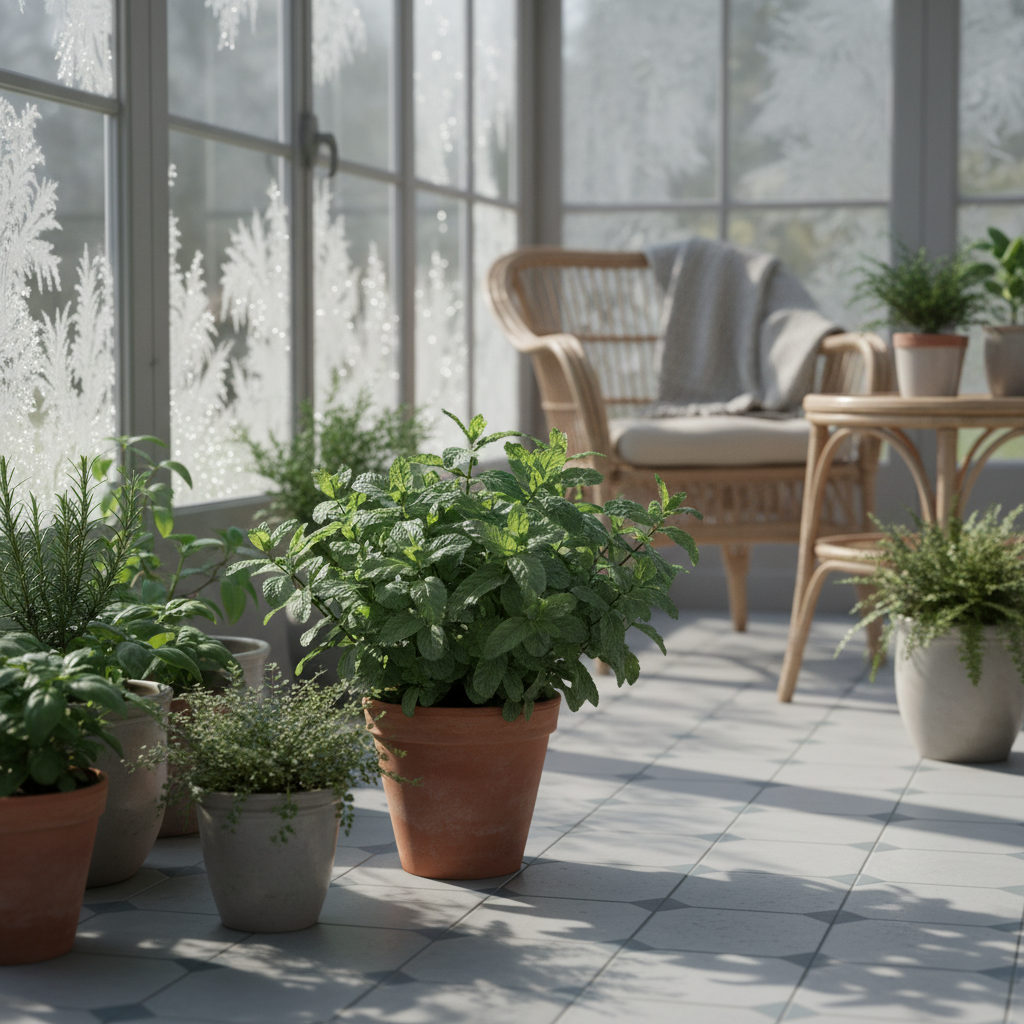
Botanically, mint belongs to a notoriously promiscuous genus. Species hybridise readily and gardeners have selected and renamed the offspring with abandon, so the plant you buy as Mentha spicata may carry traces of several relatives. For the cook this matters less than the look and smell of the leaves in your hand. What matters indoors is that all the common culinary mints share roughly the same care preferences: bright light, consistent moisture, a free-draining mix and frequent harvesting to keep the plant young.
One thing mint is not is a long-lived statement plant. Each individual stem is essentially an annual riser from a creeping rhizome below the soil. Without regular pruning, indoor mint tends to grow leggy, flower, set seed and decline. With regular cutting, the same plant can keep producing for years because every cut encourages new shoots from the base. In practical terms, the question is rarely whether your mint is dying. It is whether you are using it enough.
Pro Tip — Use it to keep it: A mint plant that is regularly harvested almost always outperforms one that is treated as decorative. If you do not cook with mint, pinch the tips back every week or two anyway. The plant interprets cutting as a signal to branch and bush out.
Light Requirements
Light is the single biggest variable separating a healthy indoor mint from a sad one. In the wild, mint grows in open damp meadows, ditches and streamsides where it receives full sun for at least part of the day. A windowsill plant does not need quite that much, but it does need considerably more light than most people instinctively give it. As a rule of thumb, aim for at least four to six hours of bright indirect light every day, with two to four hours of gentle direct sun if you can manage it.
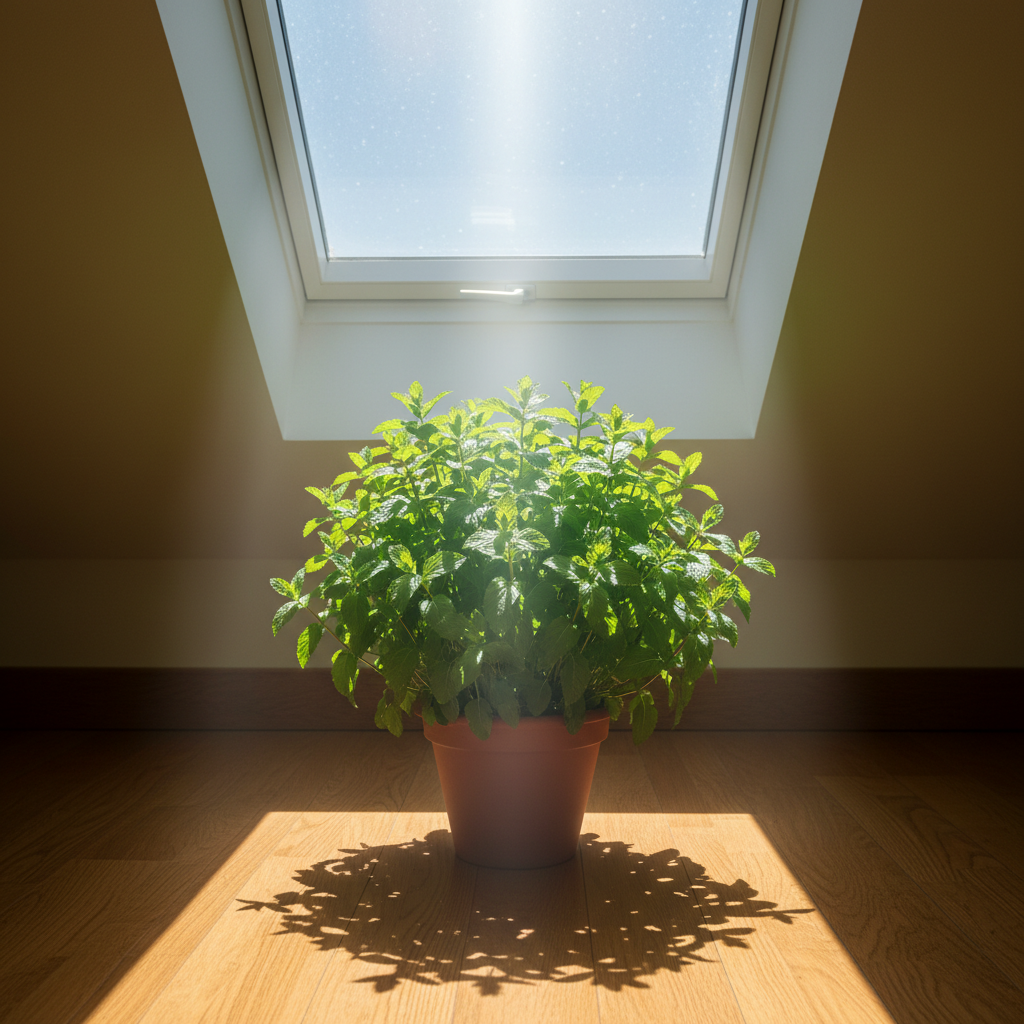
The best windows are east-facing for soft morning sun and south-east or south for stronger but still useful light. A pure north window in the northern hemisphere can work in summer but is usually too dim from autumn onwards, producing the classic leggy stems and pale, sparse leaves that make supermarket mint so disappointing within a fortnight of coming home. Western windows can work too, although hot late-afternoon glass in summer sometimes scorches the leaf edges. Move the pot back from the pane by 20 to 30 centimetres (8 to 12 inches) if you see browning on the side facing the sun.
The signs of insufficient light are unmistakable once you know them. Internodes, the gaps between pairs of leaves on the square stem, lengthen well beyond a centimetre or so, the stem leans towards the brightest available source and lower leaves yellow and drop. The whole plant takes on a thin, reaching look. Too much intense direct sun, especially through clean glass at midday in summer, can scorch the leaf surface to a papery brown patch, or simply bleach the green out of new growth. Mint is more tolerant of slight overexposure than of underexposure, however, so when in doubt err on the brighter side.
Through the dark months in temperate latitudes, supplementary lighting is genuinely useful for mint in a way that is overkill for most foliage plants. A simple full-spectrum LED grow light suspended 30 to 40 centimetres (12 to 16 inches) above the canopy, on a timer for roughly 12 to 14 hours per day, is enough to keep the plant compact, flavourful and productive from October to March. The investment is modest and the difference between a leggy winter mint and a stocky one under lights is dramatic.
Pro Tip — Rotate weekly: Give the pot a quarter turn every time you water. Mint leans hard towards the brightest side, and without rotation you end up with a one-sided plant whose back half is bare. A small habit, a much fuller shape.
Watering and Humidity
Mint likes its mix consistently moist, in keeping with its natural habitat near streams and damp meadows. That is not the same as wet, however, and an indoor mint sat permanently in a saucer of water rots its roots and crown within weeks. The goal is to keep the surface and the upper inch of the mix just damp to the touch at almost all times, with the occasional thorough soak that flushes salts through the pot and exits the drainage holes freely.
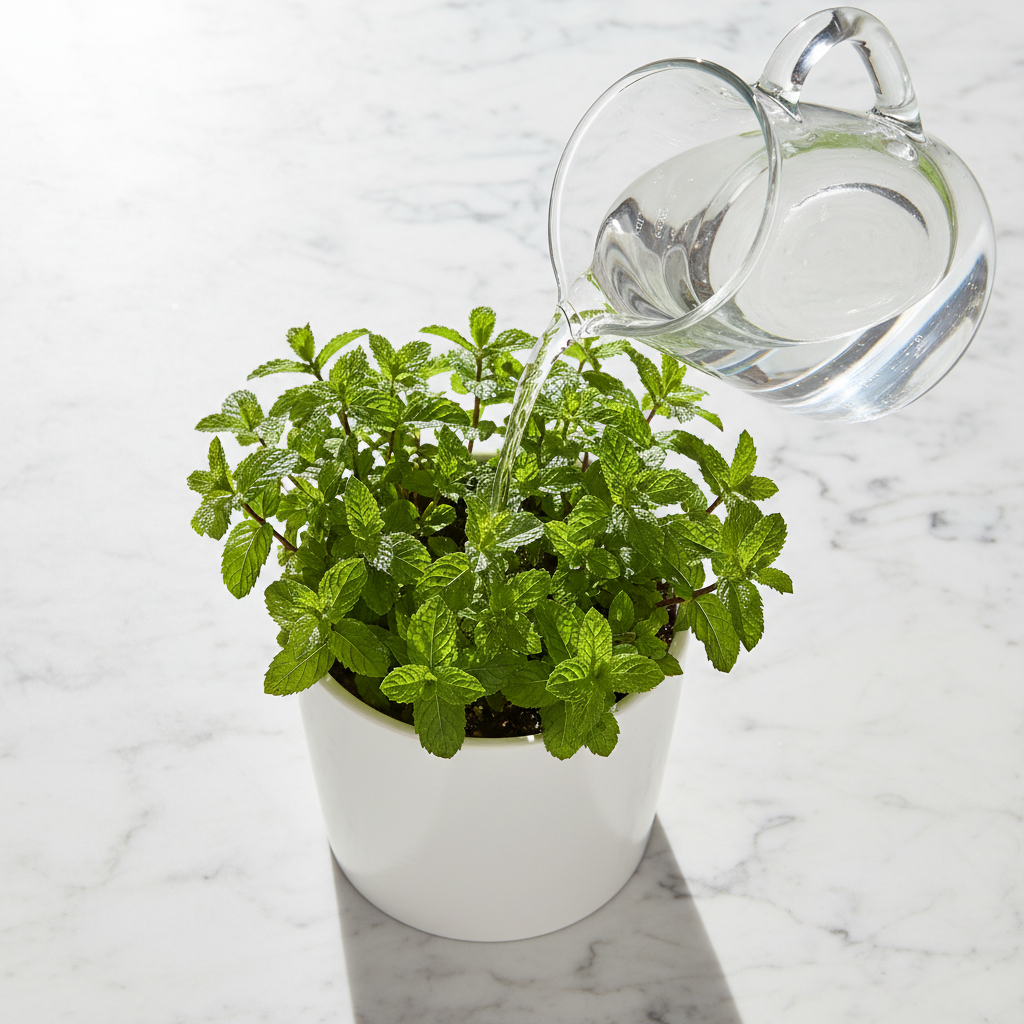
In practice, in a typical heated room at 18 to 22 degrees Celsius (65 to 72 degrees Fahrenheit) with reasonable light, an actively growing mint plant in a 13 to 15 centimetre (5 to 6 inch) pot will need watering roughly every two to three days. In peak summer on a sunny sill it can dry out daily. In a cool winter room under low light it may go four or five days between drinks. The intervals are guidance, not rules. Always check the actual moisture before you pour, either by pushing a finger 2 centimetres (about an inch) into the surface, by lifting the pot to feel its weight or by sliding a wooden skewer down to the base and looking at the moisture pattern when it comes out. A pot that feels surprisingly light or shows dry soil to its full depth needs water now. A pot that still feels heavy and shows damp soil throughout does not.
Always water the soil rather than the foliage. Mint’s slightly fuzzy leaves trap water, and droplets left sitting on the canopy in low light or stagnant air are the easiest invitation to powdery mildew or rust, the two diseases most likely to disfigure an indoor mint. If you do splash leaves while watering, run a quick draught of air past the plant by opening a window briefly, so the canopy dries within an hour.
The water itself does not have to be special. Mint is tolerant of typical hard tap water and even of moderate chlorine. If your local water is heavily softened with sodium-based exchangers, switch to filtered, rain or bottled spring water, because sodium accumulates around the roots and gradually scorches the leaf edges. Use water at roughly room temperature: ice-cold from the tap in winter is a small but unnecessary stress.
Humidity is rarely a limiting factor for indoor mint in temperate climates. Anything from a dry 35 percent up to a steamy 60 percent suits the plant well enough. Genuinely arid conditions, the sort you get a metre from a hot radiator in midwinter, can crisp the leaf edges, but that is more a question of moving the pot than running a humidifier. If you do live in a very dry environment, group the mint with other plants on a pebble tray and accept that you will need to water a little more often.
Warning — Drowning is the bigger risk: More indoor mint plants are killed by sitting in saucers of stagnant water than by underwatering. Empty the saucer 15 minutes after every thorough watering, and never leave a plastic nursery pot inside a decorative cachepot without checking the bottom for collected water.
Soil, Potting and Repotting
Mint is unfussy about substrate compared to a fiddly aroid, but it pays to start with the right kind of mix because it will live in that mix for a season or more. The ideal blend is moisture-retentive without being heavy, fertile but not aggressively rich, and well-aerated enough that water moves through it freely. A simple recipe is two parts good general-purpose peat-free houseplant compost, one part composted bark or coco coir for structure, and one part perlite or coarse horticultural sand for drainage. The result feels springy in the hand, holds together briefly when squeezed and then crumbles apart.
If you are not blending your own, any quality container compost labelled for vegetables or herbs is a fair starting point. Pure houseplant mixes designed for low-water tropicals tend to drain too sharply and dry out faster than mint enjoys, so dilute them with a generous handful of ordinary garden compost. Avoid pure peat or pure coir as either tends to swing from soggy to cement-dry, and avoid old, depleted compost reused from another container because mint is hungry enough to exhaust it quickly.
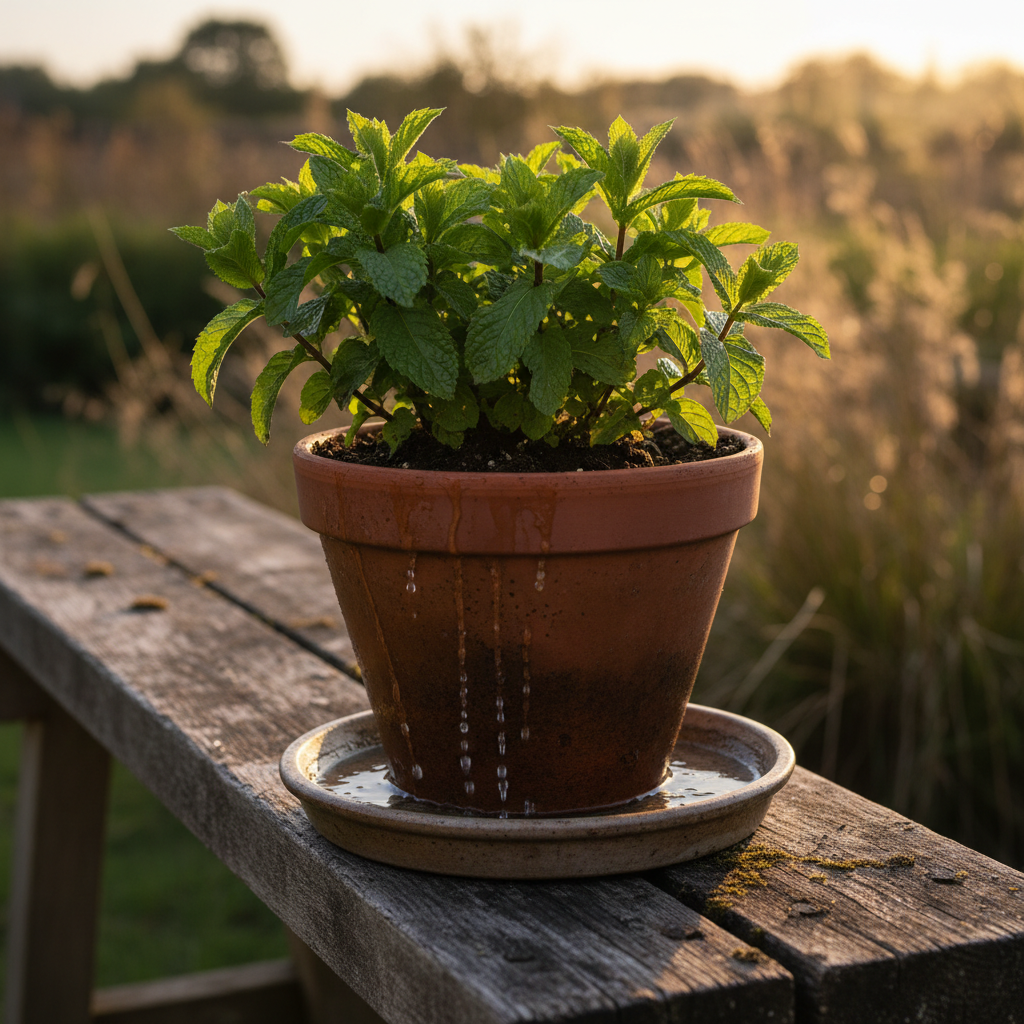
The pot matters more than the mix. Mint is a rhizomatous spreader, which means the plant fills the available horizontal space at the soil surface long before it runs out of depth. A wide, shallow container suits it far better than a tall narrow one. A pot 18 to 22 centimetres (7 to 9 inches) wide and roughly 15 centimetres (6 inches) deep is enough for a single thriving clump for a year or two. Drainage is non-negotiable: any container without holes in the base is unsuitable, no matter how often you promise yourself you will water cautiously.
Material is a matter of preference. Terracotta breathes and dries quickly, which suits people who tend to overwater but means more frequent top-ups in summer. Glazed ceramic and plastic hold moisture longer and stay cooler in direct sun, which makes overwatering slightly easier and underwatering slightly harder to manage. Either works. What matters is that the pot’s diameter is comfortably proportioned to the plant: too large, and the unused soil stays sodden between waterings.
Repot once a year, ideally in early spring as new growth begins from the base. After 12 months the rhizome network usually fills the pot, the mix is depleted and the lower leaves have started to thin. Slip the rootball out, shake off the loose old compost, and you will see a tangle of pale runners. This is also the natural moment to divide, splitting the clump into two or more pieces with a clean knife and replanting the freshest sections, with strong new shoots, into fresh mix. The discarded older centre often roots happily as cuttings if you cannot bear to compost it.
Pro Tip — Renew rather than upsize: Most indoor mints decline not because their pot is too small but because the soil is exhausted and the rhizomes have circled. A spring division back into roughly the same size pot with fresh compost almost always rejuvenates the plant better than potting it on into a larger one.
Fertilising
Mint is a moderate feeder by herb standards. It needs more nourishment than rosemary or thyme, which actively resent rich soil, but considerably less than a hungry fruiting tomato or a leafy chilli. The flavour question is the one that catches people out. Heavily fertilised mint can grow into a lush, deep-green clump that looks magnificent and tastes oddly hollow, because the plant has put its energy into producing leaf tissue at the expense of the essential oils that give the foliage its character. Lean, well-lit, lightly fed mint produces less leaf mass but considerably more aromatic punch per gram.
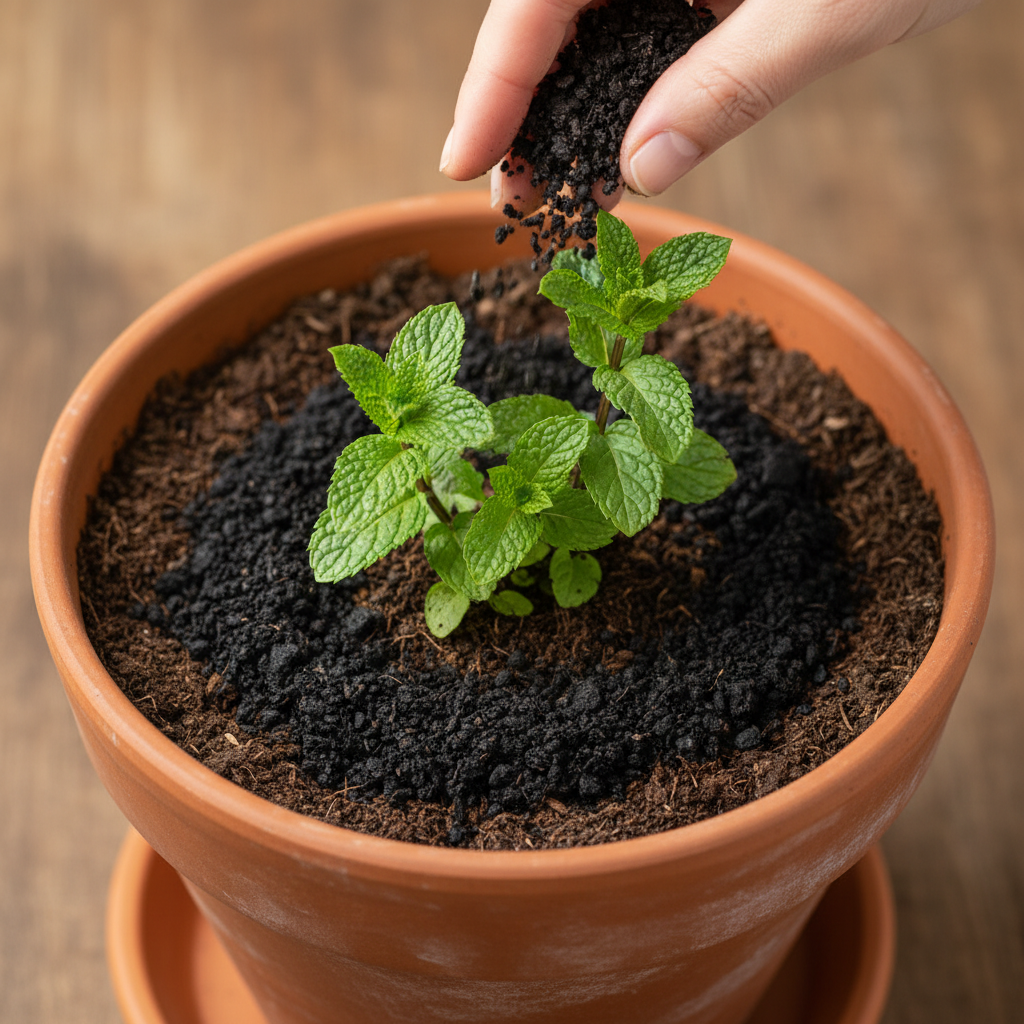
A reliable indoor regime is a balanced liquid feed at quarter to half the label-recommended strength, applied every three to four weeks during the active growing months from roughly March or April to September. The exact NPK ratio is less important than the dilution: a 5-5-5 or 7-7-7 organic feed is fine, as is a tomato or general houseplant feed cut to half strength. Always apply to already-moist soil, never to a dry rootball, to avoid scorching the fine feeder roots. Over winter, when growth slows under lower light and shorter days, taper feeding to roughly half that frequency or stop altogether until the plant resumes active growth in spring.
Organic top-dressings are an alternative or supplement to liquid feed. A thin layer of worm castings, perhaps half a centimetre (a quarter inch) deep, scratched gently into the surface in spring and again in midsummer, releases a slow trickle of nitrogen and trace elements with every watering. Composted poultry manure pellets work in the same way, though their smell can be intrusive indoors. Slow-release granular fertilisers are a third option, useful if you tend to forget regular liquid feeding, but they are slightly less forgiving in pots than in the open ground because high doses cannot be easily flushed out.
The signs of underfeeding in mint are predictable: older lower leaves yellow uniformly, new growth comes through paler and smaller than usual, and the plant settles into a slow plateau. The signs of overfeeding are subtler: very dark, slightly flabby leaves, soft thin stems prone to collapse and an unmistakable reduction in fragrance. If you ever pinch a leaf and notice it smells weaker than the last batch, ease off the feed before doing anything else.
Warning — Salt build-up in pots: Synthetic liquid feeds leave behind salts that gradually accumulate. Every two or three months, flush the pot by watering thoroughly with plain water until two or three pot-volumes have drained through. A crusty white ring around the inside of a terracotta pot is a clear cue that a flush is overdue.
Propagation
Mint is one of the easiest plants in cultivation to propagate, which is one reason it has spread so successfully wherever humans have carried it. The two methods worth knowing indoors are water rooting from stem cuttings and division of an established clump in spring. Both produce identical clones of the parent, which is the point: seed-grown mint is unreliable because the species hybridises freely, so the only way to guarantee the specific flavour profile of a named cultivar is vegetative propagation.
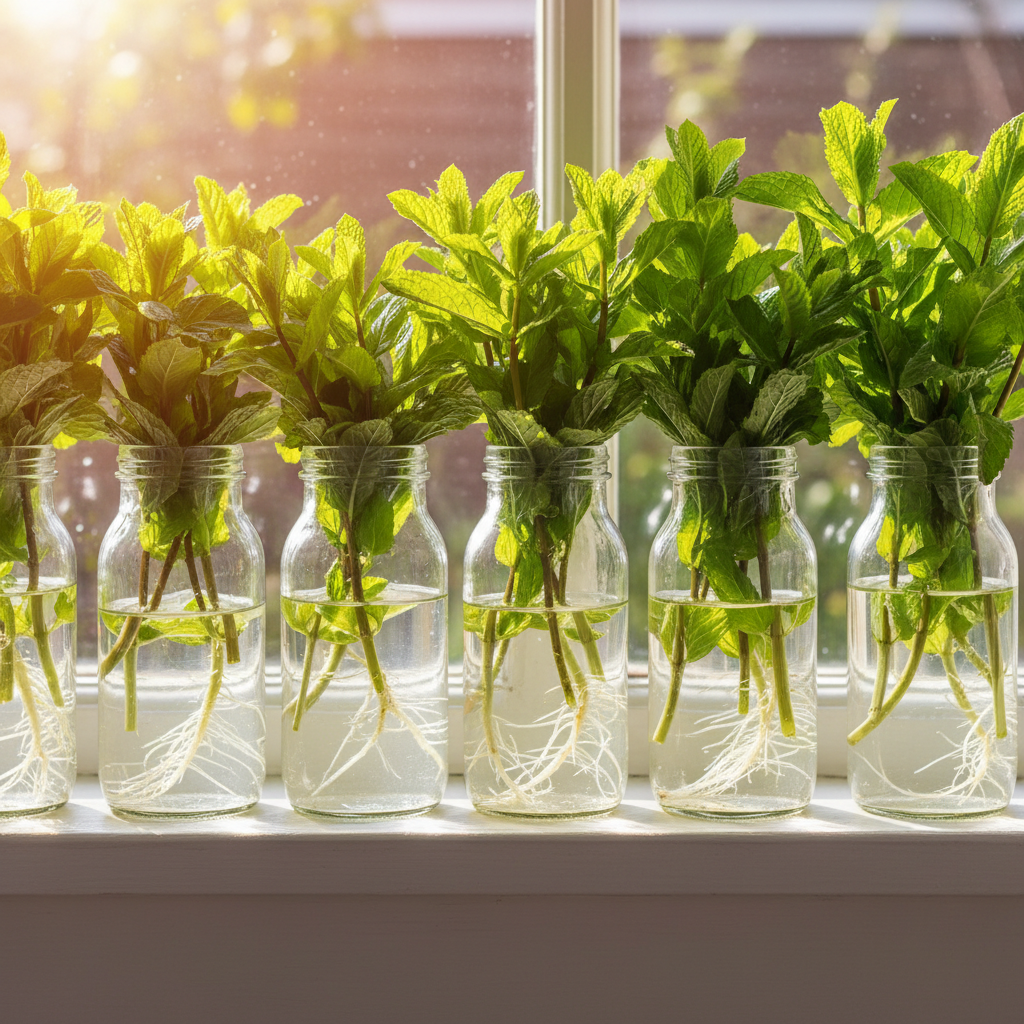
To root mint in water, the method that beginners almost always start with, follow these steps:
- Take cuttings from healthy, non-flowering stems roughly 10 to 12 centimetres (4 to 5 inches) long, using clean scissors or a sharp knife. Cut just below a leaf node, the slightly thicker point where leaves emerge from the stem.
- Strip the lower half of the cutting bare, leaving only the top two or three pairs of leaves. The exposed nodes are where new roots will form.
- Stand the cuttings in a clean glass jar or vase of room-temperature water, deep enough that the bare nodes are submerged but no leaves are touching the water.
- Place the jar on a bright windowsill out of harsh direct sun. Change the water every two to three days to keep it fresh and oxygenated.
- Within five to ten days you will see white roots emerging from the submerged nodes. Once the roots are two to four centimetres (about an inch) long, pot the cuttings into a small container of damp standard mix, three or four cuttings per 10 centimetre (4 inch) pot.
- Keep the new pot consistently moist and slightly shaded for the first week, then move it to its normal bright spot. Pinch out the growing tips after another fortnight to encourage branching.
The alternative method, division, is the right choice once your existing plant has filled its pot. In early spring, slide the entire rootball out of the pot and lay it on its side. With a clean serrated knife, slice the clump in half or quarters straight through the network of rhizomes, taking care that each section carries both new shoots and a healthy fan of roots. Replant the freshest sections into fresh mix and discard or compost the woody, exhausted centre. Each division should establish quickly and behave like a young plant for the rest of the season.
Direct soil propagation is also possible, skipping the water-rooting step. Push fresh cuttings, prepared as above, directly into a small pot of damp mix, water once and slip a clear plastic bag loosely over the top to maintain humidity. Most cuttings root in two to three weeks under this method. The trade-off is that you cannot see what is happening underground, so impatient propagators tend to prefer water rooting for the visual reassurance.
Pro Tip — Rotate your stock: Indoor mint declines noticeably after about two years. Take fresh water cuttings every spring, pot a few up and replace the parent clump when it begins to thin. You will always have a vigorous young plant on the sill.
Pests and Diseases
Mint’s volatile oils are a moderate natural defence, which is why a healthy plant rarely suffers serious pest pressure indoors. The problems that do appear are usually consequences of stress: low light, stagnant air, overwatering or an exhausted rootball. Treat the underlying conditions and most of the pests and diseases fade away within a fortnight or two.
The most common indoor pest of mint is the aphid, particularly the green peach aphid, which clusters on the soft tips of new growth and slowly distorts the unfurling leaves. A heavy infestation produces sticky honeydew on the lower leaves and a dusting of dark sooty mould that follows. Light populations rinse off with a strong jet of room-temperature water in the sink. Persistent ones respond to a weekly spray of insecticidal soap or 1 percent neem oil solution, applied to all leaf surfaces in the early evening when the plant is not in direct sun. Because mint is harvested and eaten, prefer plant-derived treatments such as soft soap, pyrethrum or neem over synthetic systemics, and rinse the harvested foliage well.
Spider mites are a less frequent but more damaging visitor, appearing in hot dry rooms in midsummer or near a radiator in winter. They are tiny, pale and easier to spot by their effects than themselves: a fine pale stippling on the upper leaf surface, a sandy texture if you rub a leaf between your fingers and, in advanced cases, faint webbing on the growing tips. Mites detest humidity and moving air, so a daily lukewarm shower in the sink for a week, followed by a spell in a brighter, less stuffy spot, usually resolves an early infestation without chemicals. Severe cases need neem applications at five-day intervals to break the life cycle.
Whitefly and thrips are less common indoors than out and rarely warrant aggressive intervention. Yellow sticky traps positioned just above the canopy catch adult whitefly and reduce egg-laying, while a regular wipe-down with a damp cloth removes thrips before populations build. Fungus gnats, the small dark flies that hop out of moist soil, are not strictly a mint pest but they thrive in the consistently damp mix that mint prefers. Letting the surface inch dry between waterings, adding a top layer of horticultural grit and using yellow sticky traps almost always brings their numbers down without further measures.
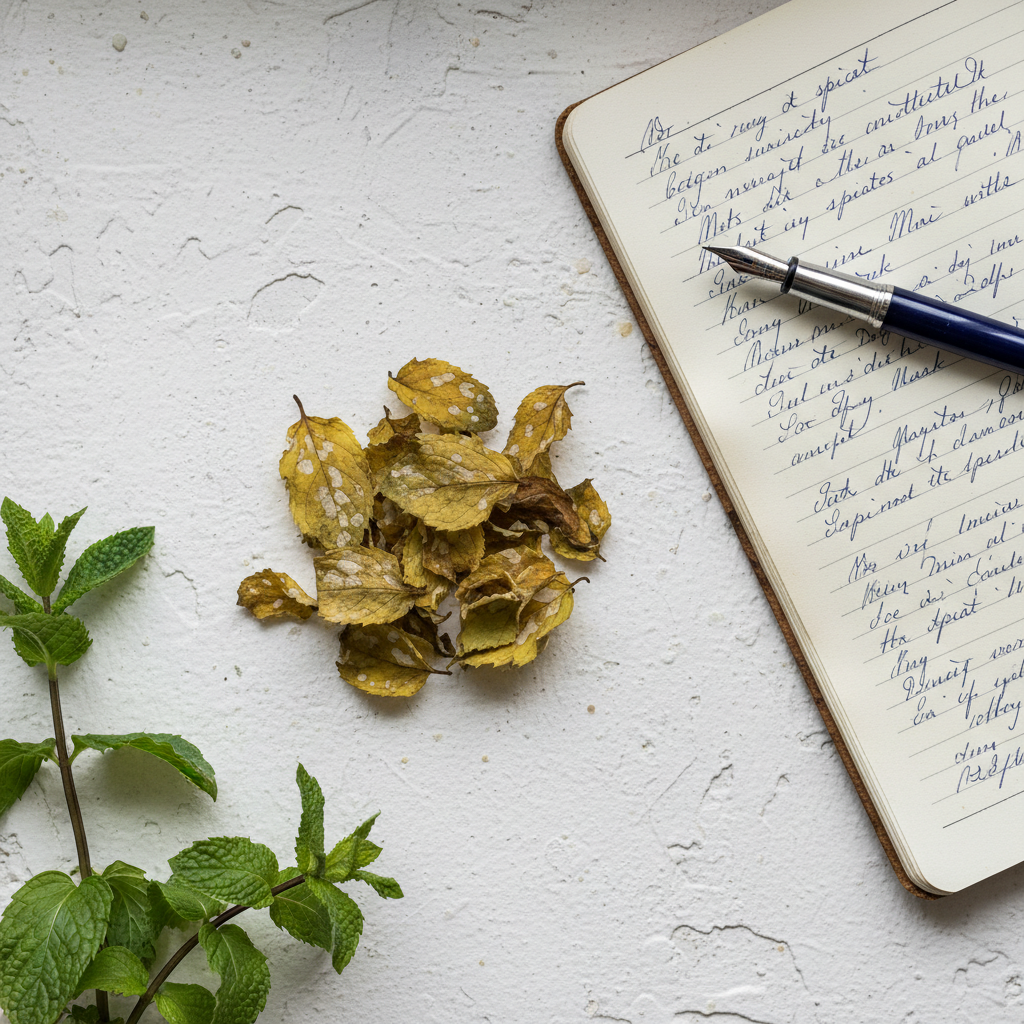
Diseases are a separate question. Two fungal infections are worth recognising. Powdery mildew shows as a white, dusty bloom on the upper leaf surface, often starting on the older shaded leaves and spreading upwards. It thrives in low light, high humidity and still air, which describes most indoor winter conditions perfectly. Improving airflow, harvesting heavily to thin the canopy and applying a 1 to 9 dilution of milk in water to affected leaves as a weekly spray usually arrests it. Mint rust is more serious: it appears as small bright-orange pustules on the undersides of leaves, with corresponding pale spots on the upper surface, and is essentially incurable once established. Mint rust is host-specific to the genus and can persist in the rhizomes, so a badly affected plant is best discarded, its soil disposed of away from other plants and its pot scrubbed before reuse.
Root rot is the other catastrophic problem, almost always caused by a saturated pot sat in a saucer of standing water. The first sign is wilting that does not improve after watering, because the roots have already died. By the time the stems collapse and the base feels mushy, the plant is rarely recoverable. The remedy is preventive: ensure your container has drainage, empty saucers promptly and use a free-draining mix.
Warning — Mint rust is a one-strike disease: If you confirm bright-orange pustules on the leaf undersides, do not try to save the plant. Bin it, sterilise the pot with a 10 percent bleach solution and start again from clean cuttings of a different parent. The spores spread readily to other mints.
Popular Varieties
The genus Mentha includes around two dozen accepted species and hundreds of named cultivars and chance hybrids. For the indoor grower, only a small handful really matter: forms of spearmint for general culinary use, peppermint and its scented variants for tea and dessert, and a few decorative oddities such as variegated apple mint. Below are two of the most rewarding for windowsill cultivation, both of which behave almost identically to the standard Mentha spicata covered in this guide.
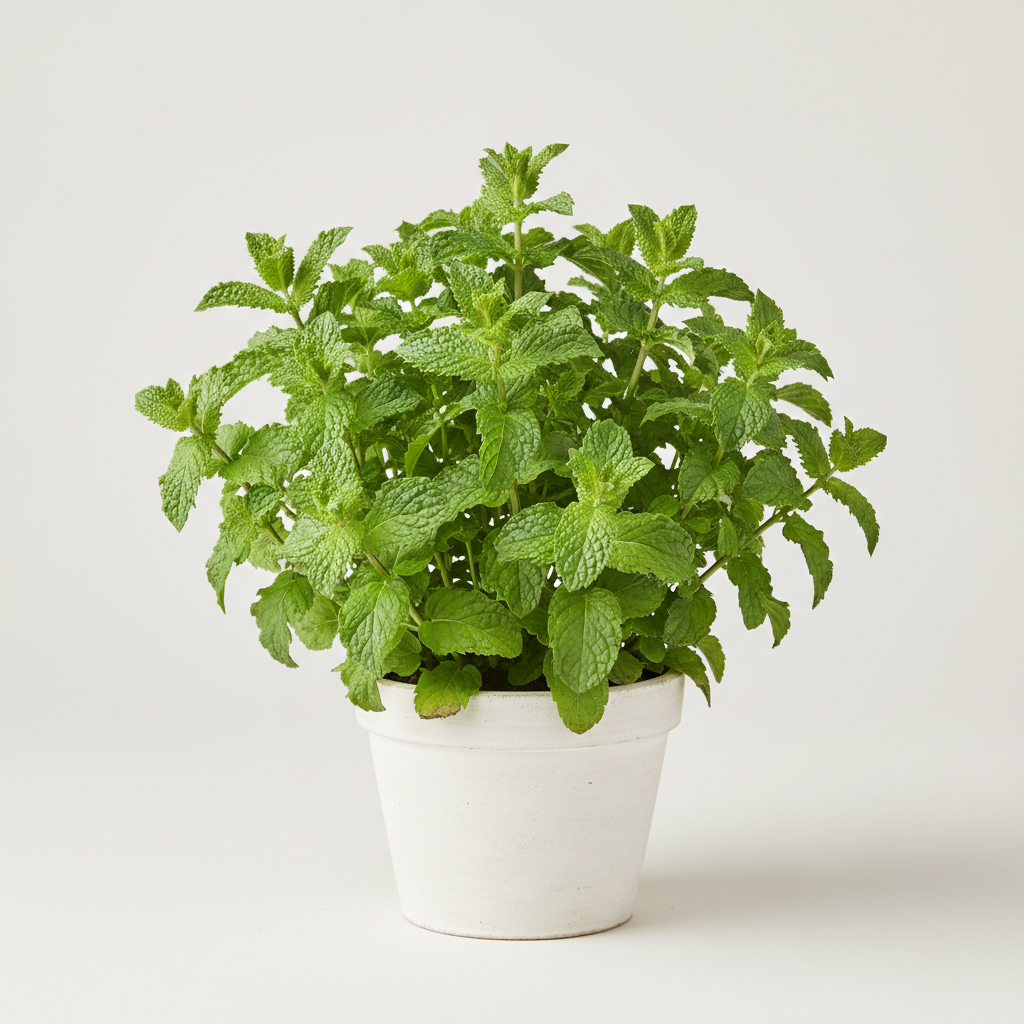
Moroccan Mint
Moroccan mint is a cultivar of Mentha spicata selected for its slightly crinkled, intensely bright green leaves and clean, sweet aroma. It is the mint of choice for traditional Maghrebi tea, where its high essential oil content stands up to long steeping with green tea and sugar. The growth habit is more upright and slightly more compact than common spearmint, which makes it well suited to a tidy windowsill pot. Care is identical to the species: bright light, evenly moist mix and regular harvesting. The leaves carry a noticeably sweeter, less peppery flavour than peppermint, which is why bartenders increasingly reach for it over standard spearmint in summer drinks.
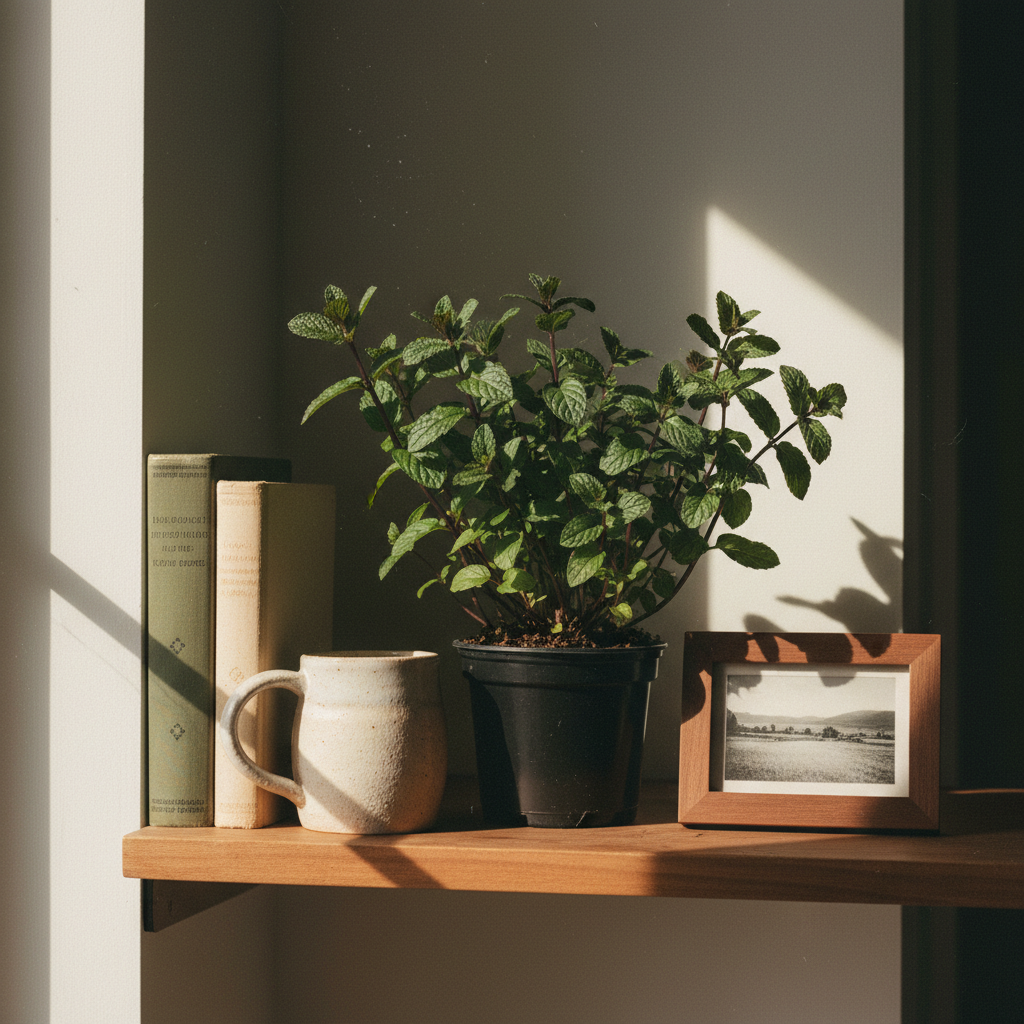
Chocolate Mint
Chocolate mint is a cultivar of peppermint, Mentha × piperita ‘Chocolate’, recognisable by its dark brown-tinged stems and smooth, slightly bronzed dark green leaves. Brush a leaf and the menthol punch of peppermint is layered with a distinct cocoa note, which is much more obvious in the fresh leaf than in dried form. It pairs unexpectedly well with desserts, hot chocolate and infused syrups, and the visual contrast of dark stems makes it a pleasant ornamental even when it is not being harvested. Indoors it shares peppermint’s slight preference for cooler nights and consistently moist mix, but it grows happily on the same windowsill as common spearmint and Moroccan mint.
Other varieties worth considering, although less common in supermarket pots, include apple mint (Mentha suaveolens) with its softly furred grey-green leaves and gentler fruity scent, the bold variegated form ‘Pineapple Mint’ (Mentha suaveolens ‘Variegata’) prized for its cream-edged foliage, and ginger mint (Mentha × gracilis ‘Variegata’), a sweet golden-streaked spearmint hybrid that lifts a mixed herb pot visually. All share the basic care requirements outlined here. Peppermint itself (Mentha × piperita) is also widely available and behaves identically to spearmint indoors, with a sharper, more menthol-forward flavour that suits tea and confectionery better than savoury cooking.
Frequently Asked Questions
Why is my supermarket mint dying within two weeks?
Supermarket mint is grown as a short-term harvest crop, usually with many seedlings crammed into a single small pot under intense glasshouse light and constant feeding. When you bring it home, the root system is already overcrowded and the plant is dependent on far more light than your kitchen provides. The cure is a quick rescue repot. Slide the rootball out, separate the dense mass into two or three smaller clumps with your fingers, pot each into fresh herb compost in a 12 to 15 centimetre (5 to 6 inch) pot, water in well and place on your brightest windowsill. Most supermarket mint that fails would have lived for years if it had been split and rehoused within the first week.
Can I grow mint from seed?
You can, but the result is unpredictable. Mints hybridise readily and the offspring of any open-pollinated seed are likely to be weaker, less aromatic and slower than the named clones available as plants or cuttings. Peppermint in particular is a sterile hybrid of watermint and spearmint and cannot be reliably grown from seed at all. For consistent flavour and habit, stick to cuttings or division of a known plant. If you do want to try seed, sow common spearmint or apple mint surface-pressed onto damp compost in spring, keep at 18 to 21 degrees Celsius (64 to 70 degrees Fahrenheit) and accept that germination is uneven.
My mint is flowering. Should I stop it?
For an indoor culinary plant, yes. Flowering signals the plant to divert energy from leaf production to seed, and the leaves take on a slightly bitter edge for the duration. Pinch out the developing flower spikes as soon as you see them, harvesting the upper third of every stem at the same time. The plant will respond with a fresh flush of bushy young growth within ten days. If you want pollinators to visit a balcony specimen in summer, let one pot flower and keep another regularly cut for kitchen use.
How do I keep mint productive over winter?
Two interventions make the biggest difference. The first is supplemental light: a single full-spectrum LED grow light suspended 30 centimetres (12 inches) above the plant on a 12 to 14 hour timer keeps growth compact and productive from October to March. The second is restraint with the watering can. Mint slows down significantly in cool low-light conditions, and the same routine that worked in July will rot the roots in January. Let the surface dry to the touch between drinks, keep the pot off cold tiled floors and feed only at half the summer frequency.
Is mint safe for cats and dogs?
The garden mints used in cooking, including spearmint, peppermint and their cultivars, are not classed as seriously toxic to cats or dogs, and small amounts are generally well tolerated. Larger quantities can cause vomiting, diarrhoea or general gastrointestinal upset, and concentrated essential oils are a different matter, with a much higher potential for harm if ingested or applied to the skin. Pennyroyal (Mentha pulegium), which is sometimes sold as an ornamental mint, is genuinely toxic and should not be kept around pets. If in doubt, place the plant out of reach and treat any persistent chewing as a vet’s question.
My mint smells weaker than the leaves I buy. What is wrong?
Three usual culprits, in this order: too little light, too much fertiliser and too few cuts. Volatile oils develop best in plants grown bright and fed lean, and concentrate in young leaves rather than mature ones. Move the plant to your brightest window, halve or skip the next two feeds, and harvest the top third of every stem to push fresh growth. Within a fortnight the new leaves should smell considerably stronger.
How long can a single indoor mint plant live?
Indefinitely in principle, because the rhizome keeps generating new shoots, but in practice indoor mints decline noticeably after two or three years as the soil exhausts, the rhizome network becomes congested and pest pressure accumulates. The simplest answer is to refresh the plant on a roughly annual cycle: divide and repot each spring, taking a handful of fresh cuttings at the same time, and you will always have vigorous mint without ever buying another. Treat the plant as a renewable colony rather than a single specimen.






