
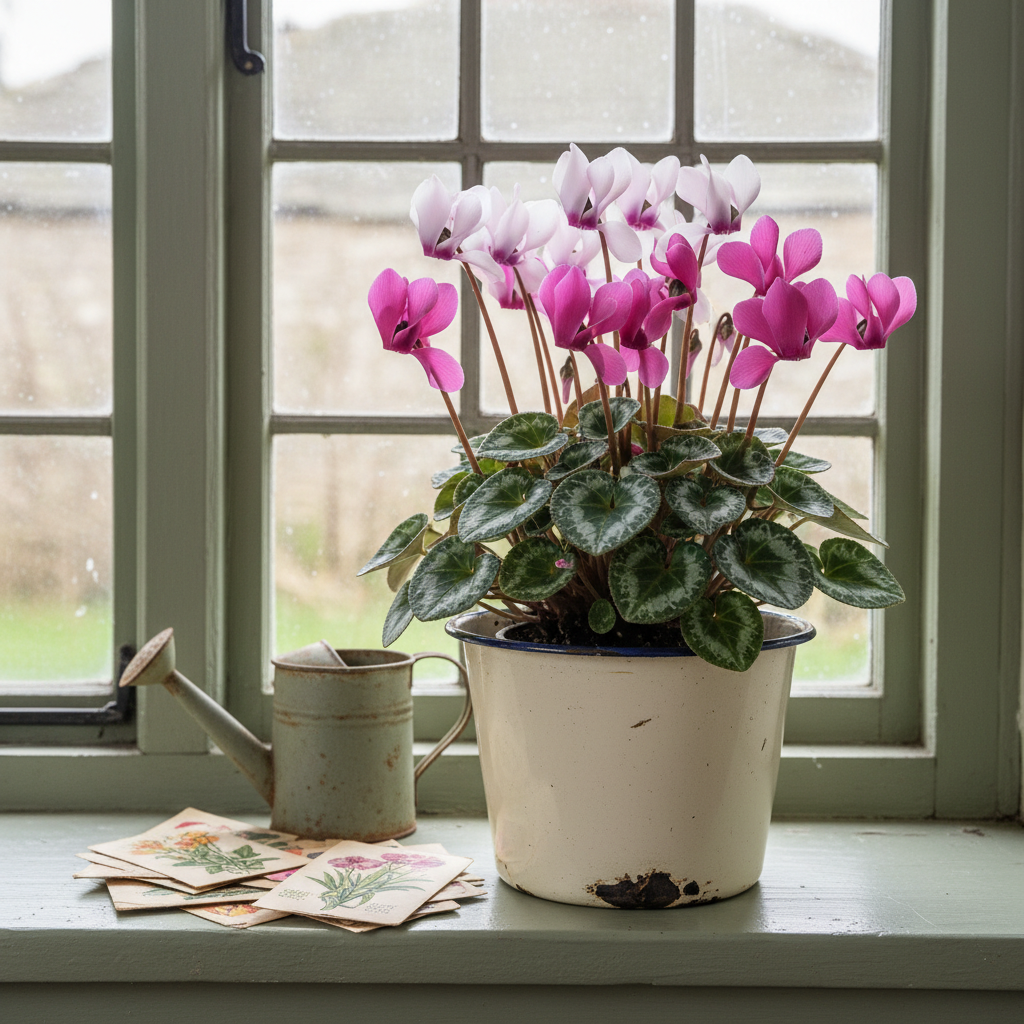
Cyclamen, properly Cyclamen persicum, is the florist’s winter showpiece — a low compact tuber-grown plant pushing out flushes of silver-marbled heart-shaped leaves and elegant butterfly-like flowers in white, pink, red, salmon and deep magenta on slender upright stems. Sometimes labelled Persian violet, Persian cyclamen or simply potted cyclamen, the species is native to the rocky woodland hillsides of the Eastern Mediterranean, from the Greek islands and Cyprus through Lebanon, Syria, Turkey, Israel, and across to Algeria and Tunisia. In its native range it carpets shaded forest floors with autumn and winter bloom, then disappears underground entirely through the hot dry summer.
That seasonal rhythm — a plant that wakes for the cool months and sleeps for the warm ones — is the single fact that determines whether a cyclamen succeeds or fails in cultivation. Supermarket cyclamen are sold in their thousands each autumn and most are quietly composted by spring, not because they are difficult plants but because they are kept too warm, watered too generously over the crown, and denied the summer dormancy they evolved to need. With the right cool windowsill, careful bottom-watering and a willingness to let the plant rest, the same tuber can flower reliably for ten or fifteen years and bulk up steadily into a substantial mound of bloom. This guide covers everything required to move a cyclamen from the supermarket shelf into long-term cultivation, with the small but important adjustments that separate a struggling plant from a thriving one.
Contents
- Quick Reference
- Why Cyclamen Makes a Rewarding Houseplant
- Light Requirements
- Watering and Humidity
- Soil, Potting and Repotting
- Fertilising
- Propagation
- Pests and Diseases
- Popular Varieties
- Frequently Asked Questions
Quick Reference: Cyclamen at a Glance
| Botanical name | Cyclamen persicum (Primulaceae family) |
| Light | Bright indirect light; cool morning sun is welcome, hot afternoon sun is not |
| Watering | Bottom-water when the top 2 cm of compost is dry; never wet the crown |
| Temperature | 13 to 18 °C (55 to 65 °F); stops flowering above 21 °C (70 °F) |
| Humidity | 40 to 60 per cent; tolerates ordinary indoor levels in cool rooms |
| Soil | Free-draining, peat-reduced potting compost with grit or perlite added |
| Fertiliser | Half-strength balanced liquid feed every 3 to 4 weeks during growth only |
| Flowering season | October to April in cool indoor conditions |
| Dormancy | Required summer rest from roughly May to August |
| Mature size | 20 to 30 cm tall (8 to 12 in), 25 to 40 cm wide (10 to 16 in) |
| Toxicity | Toxic to cats, dogs and humans; the tuber is the most poisonous part |
| Difficulty | Intermediate, mostly because of the temperature and dormancy requirements |
Why Cyclamen Makes a Rewarding Houseplant
Few houseplants reward attention to detail as visibly as cyclamen. The flowers are unlike anything else on a typical indoor plant shelf: five petals swept up and back over the bud as though caught in a draught, held high above the foliage on slender stems that quiver at the slightest breath of air. The foliage alone would justify the plant, with deep green heart-shaped leaves marked in silver, pewter, or pale jade in geometric patterns that vary from plant to plant. When in full bloom a well-grown specimen pushes out twenty to forty flowers at once and keeps producing them for four to six months at a stretch — a stamina record that almost no other flowering houseplant can match.
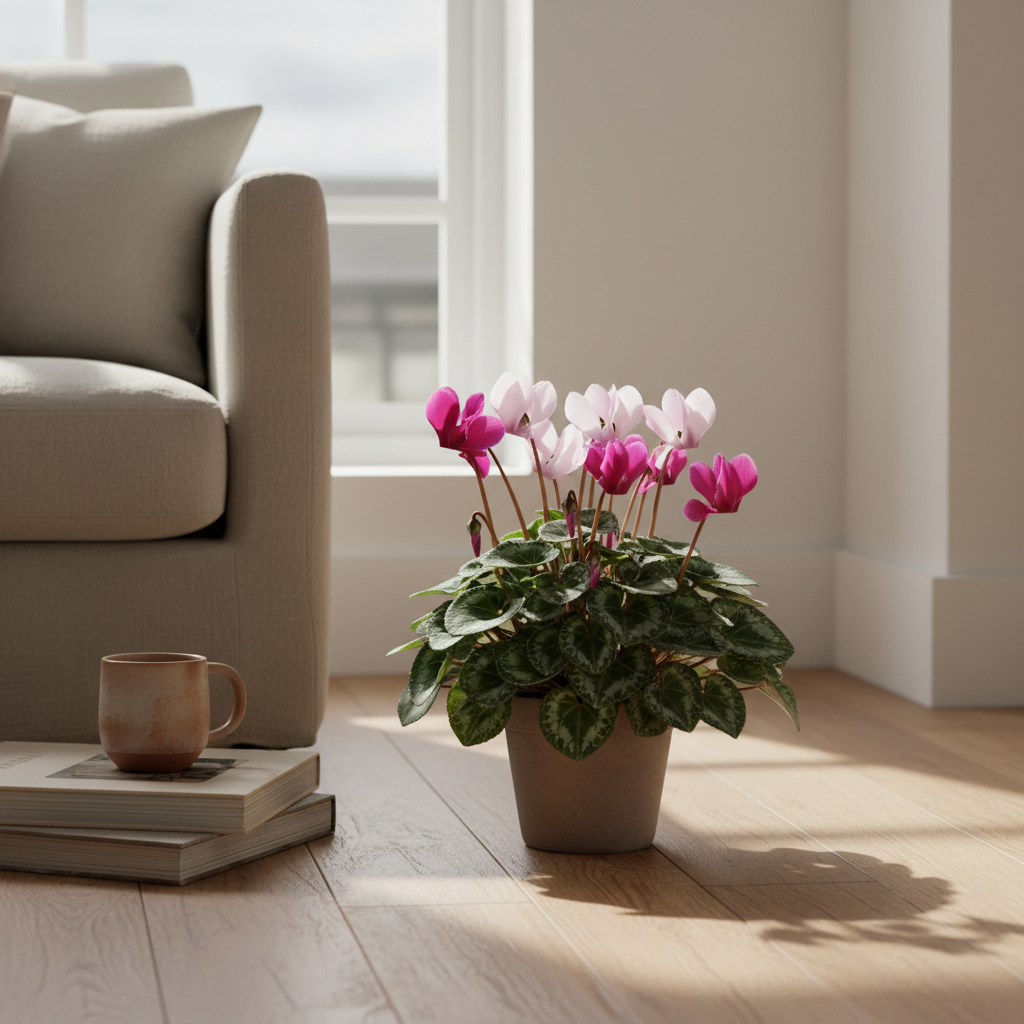
The plant suits a particular kind of growing environment: cool, bright, undemanding of high humidity. That makes it the natural choice for a north-facing bedroom, an unheated conservatory, a draughty entrance hall or a cool kitchen windowsill — exactly the spots where heat-loving aroids and tropical foliage plants sulk and drop leaves. Anyone whose home runs cooler than 18 °C in the winter months will find cyclamen one of the easiest flowering plants available; anyone whose home is heated to 22 °C and above will need to work harder to keep one alive.
The other unusual feature is the tuber. A cyclamen grows from a flattened disc-shaped corm that sits half-buried at the soil surface, slowly fattening each year as the plant stores energy for the next winter’s bloom. After three or four growing seasons a healthy tuber will be the size of a tennis ball and will push out a steadily larger flush of flowers each autumn. This is the underlying reason a cyclamen is worth keeping through dormancy rather than discarding: an established tuber outperforms a fresh nursery plant by a wide margin once it settles into a rhythm with the household.
Survive vs. thrive — Cyclamen: A new cyclamen will survive almost any cool bright spot for the first six to eight weeks of bloom regardless of how it is treated. To make it thrive across multiple seasons requires three things: a cool spot under 18 °C, watering from below so the crown stays dry, and a dry summer rest from May to August. Get those three right and the plant lasts a decade.
Light Requirements
Cyclamen evolved on rocky Mediterranean slopes under a sparse canopy of holm oak, pine and shrub maquis. The light reaching the corms is bright but rarely scorching — diffused by overhead leaves in summer and softened by the low winter sun. Indoors the closest analogue is bright indirect light: a position about 30 to 80 cm (1 to 2.5 ft) back from an east-facing or north-facing window, or directly on a south-facing windowsill where a sheer curtain breaks up the direct afternoon rays. The plant also tolerates direct morning sun from October through February when the sun is low, the air is cool and the rays cannot overheat the foliage.
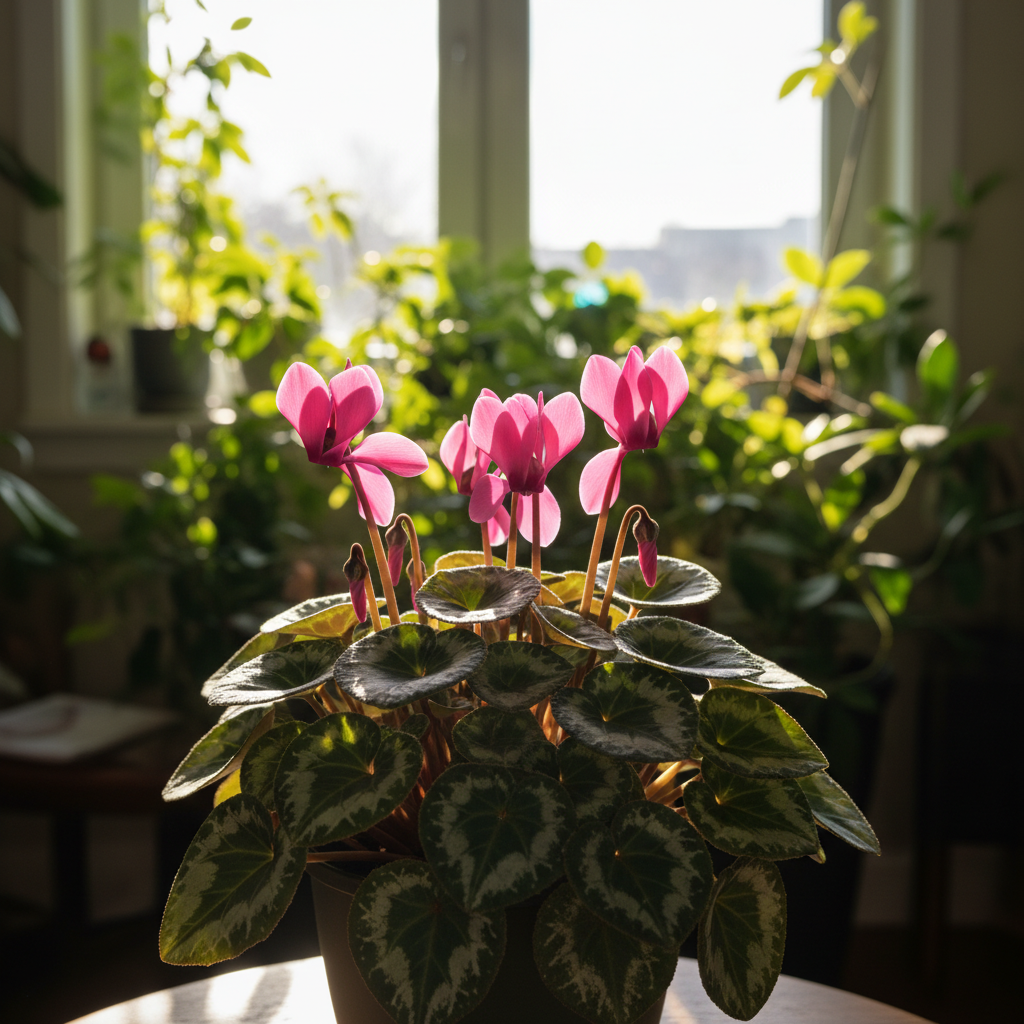
What the plant cannot tolerate is hot direct sun. A south-facing windowsill in late spring will heat the leaves to the point where they wilt within an hour, and repeated heat stress is one of the fastest ways to push a cyclamen into a premature, irreversible dormancy. The other extreme — a dim corner more than 2 m (6 ft) from any window — produces long pale leaf stalks, sparse flowering and frequent fungal trouble as the slower-drying compost stays damp around the crown. If buds form at the centre of the tuber but rot before they open it is almost always a sign that the position is too dim and too still.
In a typical Northern European home the simplest reliable position is an unheated bedroom or hallway window facing east or north, where temperatures drop to 12 to 16 °C overnight and rise to no more than 18 °C during the day. In a warm centrally-heated living room the plant survives but flowers are smaller, leaves yellow earlier, and the dormancy arrives in March rather than May. The colder and brighter the spot within the species’s tolerance, the longer the flowering season runs.
Pro Tip — Read the leaf stalks: The petioles tell the truth about light. Short, sturdy stalks holding leaves close to the tuber mean the light is right. Stalks stretching 15 cm (6 in) or more with leaves leaning toward a single window mean the plant is searching for more — move it closer to the glass or to a brighter window and rotate it a quarter turn every few days.
Watering and Humidity
Watering is where most cyclamen are quietly killed. The corm sits half-exposed at the soil surface, and the tightly-packed cluster of leaves and flower buds emerges from a small crown in the centre of that corm. Water poured from above runs straight into that crown, lingers between the leaf bases, and within a few warm days triggers crown rot — a soft black collapse that the plant cannot recover from. The first symptom is usually a sweet sour smell from the centre of the plant, followed within 48 hours by leaves wilting in unison and pulling loose at the base. By the time it is visible, the tuber is already lost.
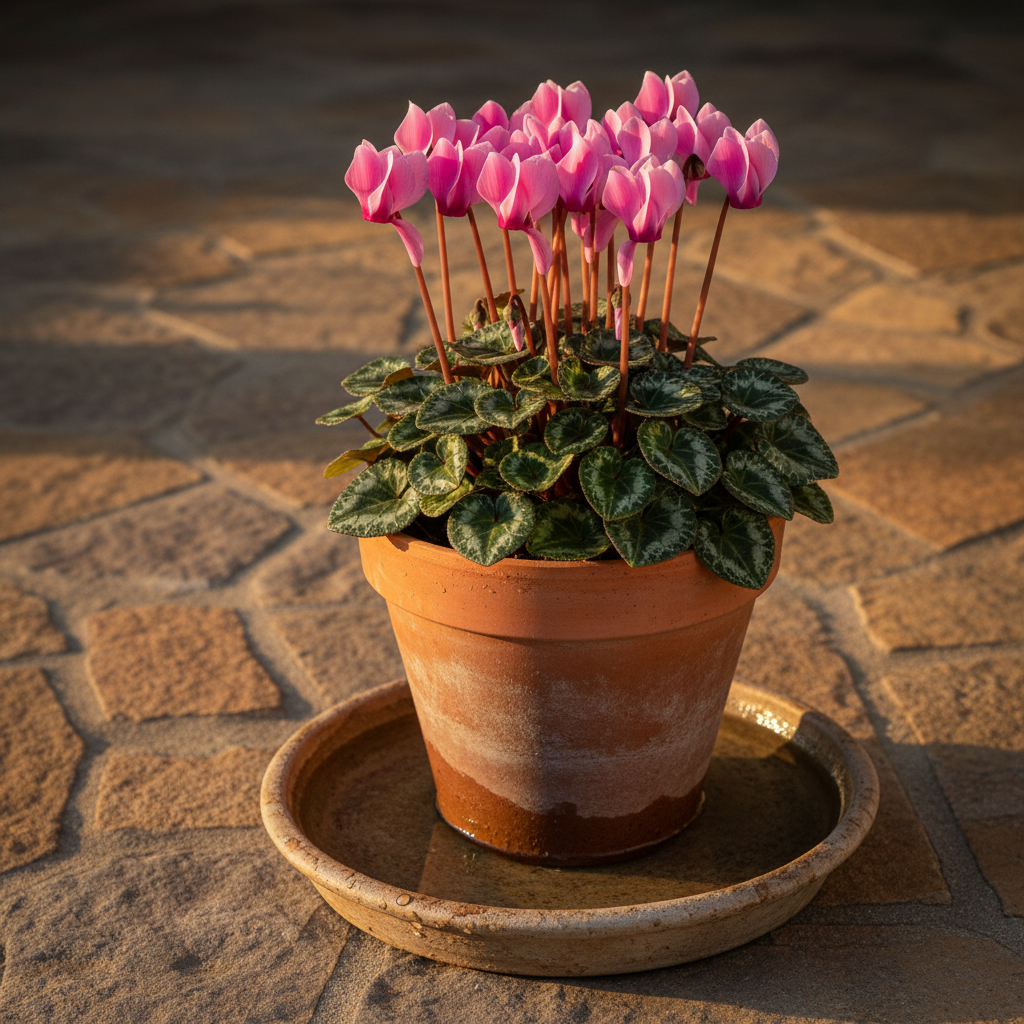
The reliable method is to bottom-water. Place the pot in a shallow saucer or dish containing 2 to 3 cm (about an inch) of room-temperature water for 15 to 20 minutes, then lift the pot out, let it drain completely, and tip away whatever water is left in the saucer. The compost wicks moisture upward through capillary action, the crown stays bone dry, and the upper soil surface remains slightly dry as a barrier against fungus gnats. Frequency depends on temperature and pot size but in a typical cool room a standard 12 cm (5 in) potted cyclamen needs bottom-watering once every five to seven days during active growth. Always check first by pressing a fingertip against the surface compost or by lifting the pot to feel its weight — if it is still heavy and the surface compost feels slightly cool, wait another day.
Some growers prefer to water from above using a long-spouted can, aiming the stream carefully at the soil edge furthest from the crown. This works if the watering is precise, but a single careless pour into the centre can finish the plant, so bottom-watering remains the safer default unless the pot is too large to lift comfortably. Either way, never let the pot sit in standing water for more than half an hour; cyclamen tolerates drying out far better than it tolerates a saturated tuber, and a permanently waterlogged corm rots almost as quickly as a wet crown.
Humidity is less critical than for tropical foliage plants. Cyclamen flowers and leaves are waxy enough to cope with 30 to 40 per cent relative humidity, which is what a centrally-heated home in winter typically provides. Anything above 50 per cent is welcome but not required. What the plant dislikes is misting: water sitting on the leaves and around the crown invites the same fungal problems as overhead watering. If supplementary humidity is needed for other plants in the same room, use a pebble tray or a cool-mist humidifier placed nearby rather than directly spraying the cyclamen itself.
Warning — Never mist a cyclamen: Misting wets the crown and the leaf bases, where water cannot evaporate quickly because the foliage is so densely clustered. Within two or three repeated mistings in a warm room the plant develops botrytis on the petioles and the crown rots from the inside out. Use a humidifier or a pebble tray if local humidity is needed, not a spray bottle.
Soil, Potting and Repotting
The substrate priorities for cyclamen are sharp drainage, slight aeration around the tuber, and a near-neutral to faintly alkaline pH around 6.5 to 7.0. The plant resents the heavy peat-based mixes used by some nurseries to bulk up display plants for the autumn season; those mixes hold water around the corm for too long and accelerate rot. A reliable home recipe is two parts good quality peat-free potting compost, one part horticultural grit or coarse perlite, and a small handful of garden lime or crushed eggshell stirred through the top third to keep the pH from drifting downward. A general houseplant compost will work in a pinch as long as 30 to 40 per cent extra grit is added.
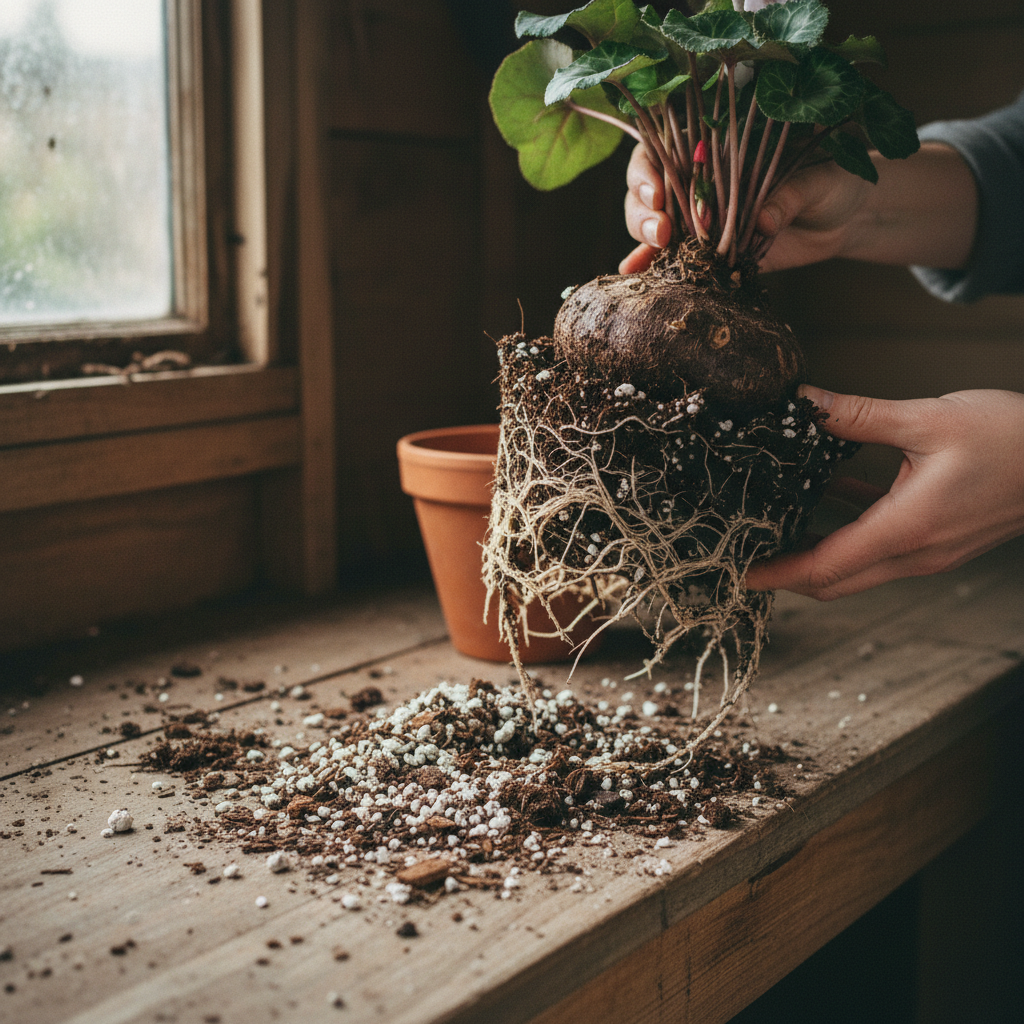
The pot itself should be only slightly larger than the tuber. A common error is to over-pot, on the assumption that the plant will appreciate the room — in fact a tuber surrounded by a large volume of damp compost is far more vulnerable to rot than one in a tight pot where the substrate dries quickly between waterings. For a tuber the size of a satsuma orange, a 12 to 14 cm (5 to 5.5 in) pot is right; for a tennis-ball-sized tuber, 16 to 18 cm (6 to 7 in). Always use a pot with at least one generous drainage hole; cyclamen sold in fully sealed decorative cachepots should be lifted out and dropped into a proper draining pot at the first opportunity.
Repotting is best done in late summer at the end of dormancy, just as the first new leaves begin to push from the crown. Tip the plant out, brush off the old compost down to firm fresh roots, trim any dead or mushy material with sterilised scissors, and re-seat the tuber in fresh mix with the top third to half of the corm sitting proud of the soil line. This is the single most important visual detail: a buried tuber rots, an exposed tuber thrives. Settle the compost firm around the roots without compacting it, water once from below, and return the plant to its cool position to resume growth.
Most cyclamen need repotting only every two to three years. Annual repotting is unnecessary and disturbs the root system; a yearly top-dressing — scraping off the top centimetre of old compost and replacing it with fresh mix mixed with a little slow-release fertiliser — is a better routine for the in-between years.
Fertilising
Cyclamen is a moderate feeder during active growth and a complete non-feeder during dormancy. The active season for fertilising runs from the moment new leaves begin to push in late summer through to the end of flowering in early spring — roughly September to March. During those months a balanced liquid feed at half the recommended strength every three to four weeks is plenty. A formulation slightly higher in potassium, such as a low-strength tomato feed at quarter strength, encourages stronger bud production and richer flower colour without pushing excessive leafy growth.
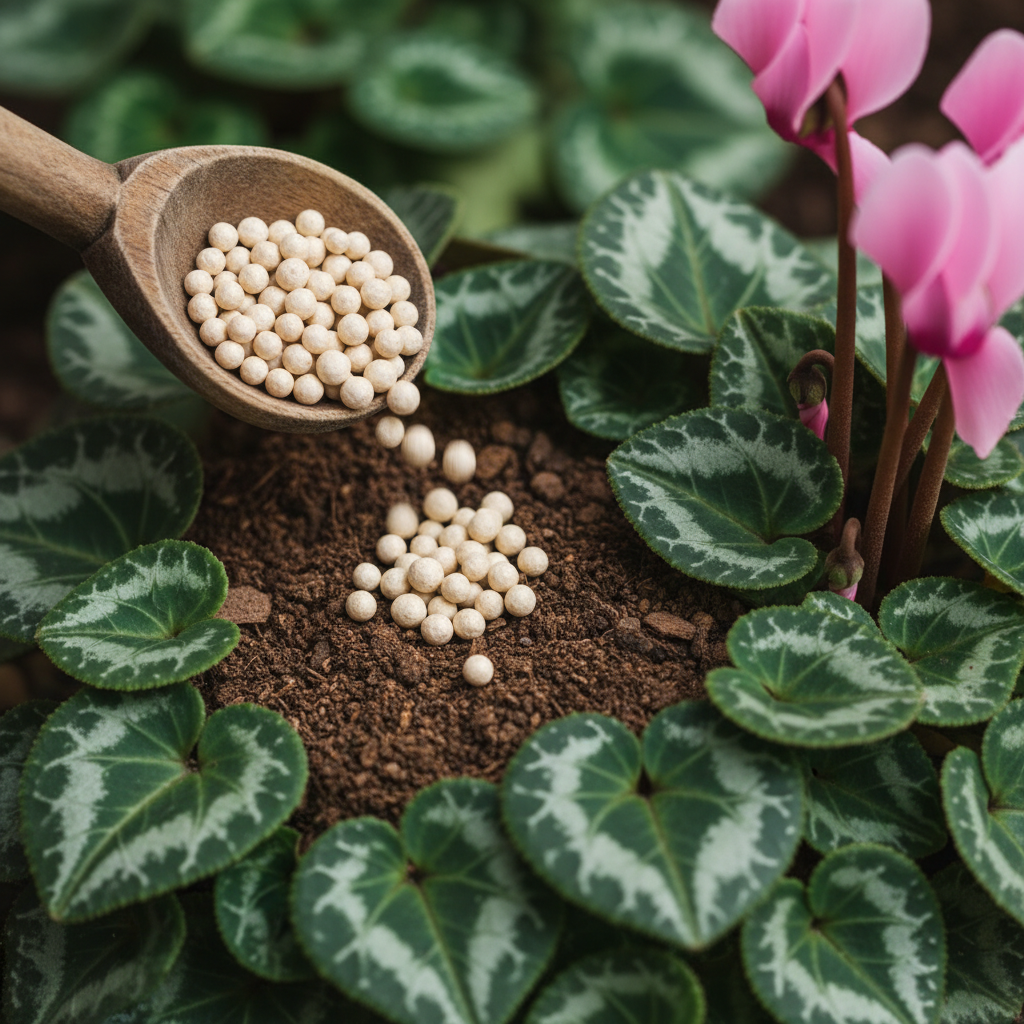
An alternative that suits forgetful waterers is to top-dress the soil surface with a small pinch of slow-release fertiliser prills in early autumn as new growth begins. A controlled-release product rated for six months delivers a low steady supply of nutrients across the entire flowering window without any further intervention. Whichever method is used, apply fertiliser only to compost that is already slightly damp from a previous bottom-watering — never to a bone-dry tuber, where the concentrated salts can burn fine root hairs.
From late spring through summer, when the plant is winding down toward dormancy, stop feeding entirely. A cyclamen pushed with fertiliser in late spring will keep trying to grow when it should be resting, exhaust the tuber, and either fail to bloom the following autumn or rot from the stress. Resume feeding only when fresh leaves appear after the summer rest.
Propagation
Cyclamen cannot be propagated from leaf or stem cuttings — the species lacks the meristem structure that lets aroids and tradescantias regrow from tissue, and a severed leaf simply rots. The two viable methods are growing from seed, which is slow but reliable, and dividing a mature tuber, which is fast but carries a real risk of losing the parent plant. Most home growers stick with seed; commercial growers use tissue culture for named cultivars.
Growing from seed
Fresh seed germinates more reliably than older packeted stock, and any flower allowed to set seed on an indoor plant will eventually produce a small round capsule on a coiled stem that pulls down toward the soil as it ripens. Once the capsule splits and reveals the sticky brown seeds inside, sow them within a few weeks for best results. The process is straightforward in steps:
- Soak the seeds in lukewarm water for 12 to 24 hours to soften the seed coat.
- Fill a small pot or seed tray with a 50:50 mix of moistened peat-free seed compost and perlite.
- Sow seeds 1 cm (0.4 in) apart and cover with a thin layer of fine vermiculite — light inhibits germination.
- Place the tray inside a clear plastic bag or propagator and keep at 15 to 18 °C (59 to 65 °F) in a dark cupboard.
- Germination takes four to eight weeks; once seedlings emerge, move into bright indirect light and remove the cover.
- Prick out into individual 7 cm (2.75 in) pots when the first true leaf is fully formed, taking care not to disturb the developing miniature tuber.
From sowing to first flowering takes 12 to 15 months, which is why few growers raise their own from seed unless they enjoy the long view. The compensation is that home-grown cyclamen are remarkably robust compared with the forced supermarket stock, and seedlings come true enough from species seed that the colour mix will resemble the parent generation.
Dividing a mature tuber
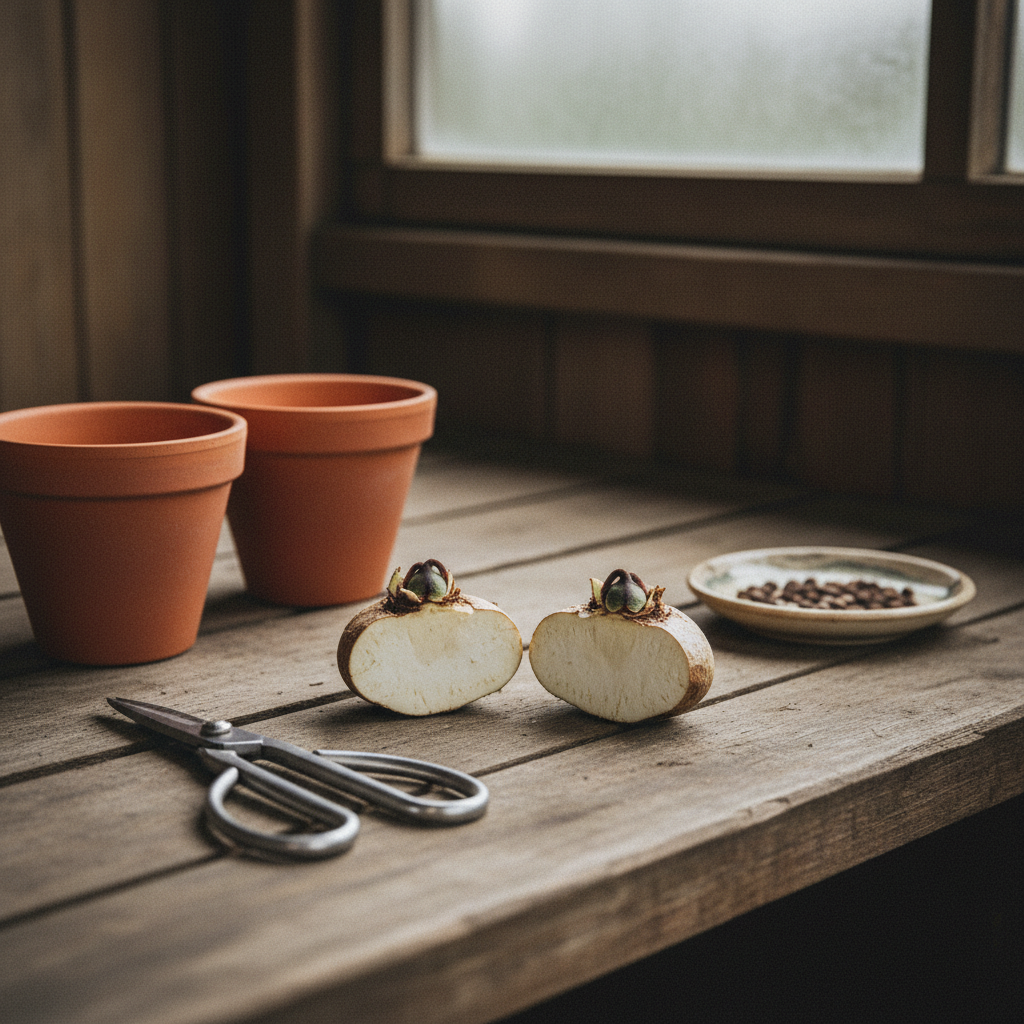
Tuber division is only worth attempting on a corm at least four or five years old that has produced two or more distinct growth crowns. Wait until the end of summer dormancy and lift the tuber. Using a clean, sterilised knife, cut downward through the corm so that each piece carries a clearly visible crown with at least one bud, dust the cut surfaces with sulphur powder or cinnamon to discourage infection, and leave the pieces to dry in a shaded place for 24 hours so that a callus forms across the cut. Then pot each piece individually into a tight free-draining mix and keep barely moist until growth resumes.
The risk is that a cut tuber may rot before it callouses, especially in a humid room. Even with clean cuts and careful aftercare, expect a 30 to 50 per cent failure rate. For most growers it is more sensible to keep a healthy tuber whole, accept that one plant means one plant, and use seed-grown stock to expand a collection.
Pests and Diseases
Cyclamen is troubled by a specific set of issues, most of them related to humidity, watering and the cool damp conditions it actually prefers. The most damaging single pest carries the plant’s name: the cyclamen mite, a microscopic arachnid that lives between the leaf bases and inside emerging buds. Affected plants show distorted twisted new leaves, deformed buds that fail to open, and a general crumpled appearance at the centre of the crown. The mites are too small to see with the naked eye, so diagnosis comes from the damage pattern. Treatment is difficult: badly infested plants are best discarded to protect the rest of the collection, and milder cases can be improved by isolating the plant, raising humidity briefly to disrupt the mites, and applying a horticultural soap-based miticide labelled for tarsonemid mites.

Fungus gnats are the second most common nuisance. Small dark flies hover around the soil surface and lay eggs in the upper compost layer, where the larvae feed on organic matter and occasionally on fine root hairs. They thrive in compost kept consistently damp at the surface, which is the opposite of the bottom-watering regime that cyclamen prefers, so consistent bottom-watering largely prevents them in the first place. If a population builds up, a yellow sticky card pushed into the pot catches the adults, and a top-dressing of horticultural sand or fine grit interrupts the egg-laying cycle.
Vine weevils, where they occur, are an outdoor pest that occasionally hitchhikes in on autumn cyclamen sold from outdoor nursery displays. The white C-shaped larvae feed on the roots and can hollow out a tuber from below within a few weeks. Suspect vine weevil when an otherwise healthy plant suddenly wilts and the tuber lifts loose from the compost. Biological control with parasitic nematodes drenched into the soil in late summer is the most reliable treatment for indoor cyclamen.
Aphids and spider mites appear occasionally, usually when the plant is grown in a warm room with low humidity rather than the cool bright spot it prefers. Both respond well to a thorough rinse under a gentle cool tap (covering the soil surface to keep the tuber dry), followed by a weekly application of insecticidal soap until the population collapses.
Diseases
The two diseases worth understanding are botrytis grey mould and the family of crown and root rots caused by Fusarium, Pythium and Erwinia. Botrytis appears as a fuzzy grey growth on faded flowers and damaged leaves; it spreads in cool damp still air and is encouraged by overcrowded foliage. Prevention is straightforward: pluck off spent flowers and yellowing leaves by twisting the stalk at the base rather than cutting it, remove fallen petals from the soil surface, and keep some air movement around the plant. A small oscillating fan running on the lowest setting at a distance of a couple of metres makes a measurable difference.
Crown and root rot are usually fatal once visible. Prevention rests entirely on the watering and potting fundamentals already covered: keep the crown dry, never let the compost stay saturated, never bury the tuber. A cyclamen showing the first sign of soft brown collapse at the crown can occasionally be saved by lifting it out, cutting away all soft tissue, dusting with sulphur and re-potting into a sterile mix, but the success rate is low and most affected plants are best composted before the spores spread to neighbours.
Pro Tip — Twist, do not cut: When removing a spent flower or yellowed leaf, grip the stalk at its base where it meets the tuber and twist sharply with a quick rolling motion. The stalk pops cleanly away from the crown without leaving a stub. Cutting with scissors leaves a wet stub that rots in place and provides an entry point for botrytis.
Popular Varieties
The florist cyclamen sold each autumn is overwhelmingly Cyclamen persicum bred and selected for compact habit, large flowers and reliable winter performance under glasshouse production. Two further species are sometimes offered as houseplants — Cyclamen hederifolium and Cyclamen coum — but these are properly hardy garden plants that struggle in warm centrally-heated rooms and are better grown in pots outside or in a cold frame. Within C. persicum, breeding has split the species into a few main commercial series, each with a distinctive habit and flowering style.
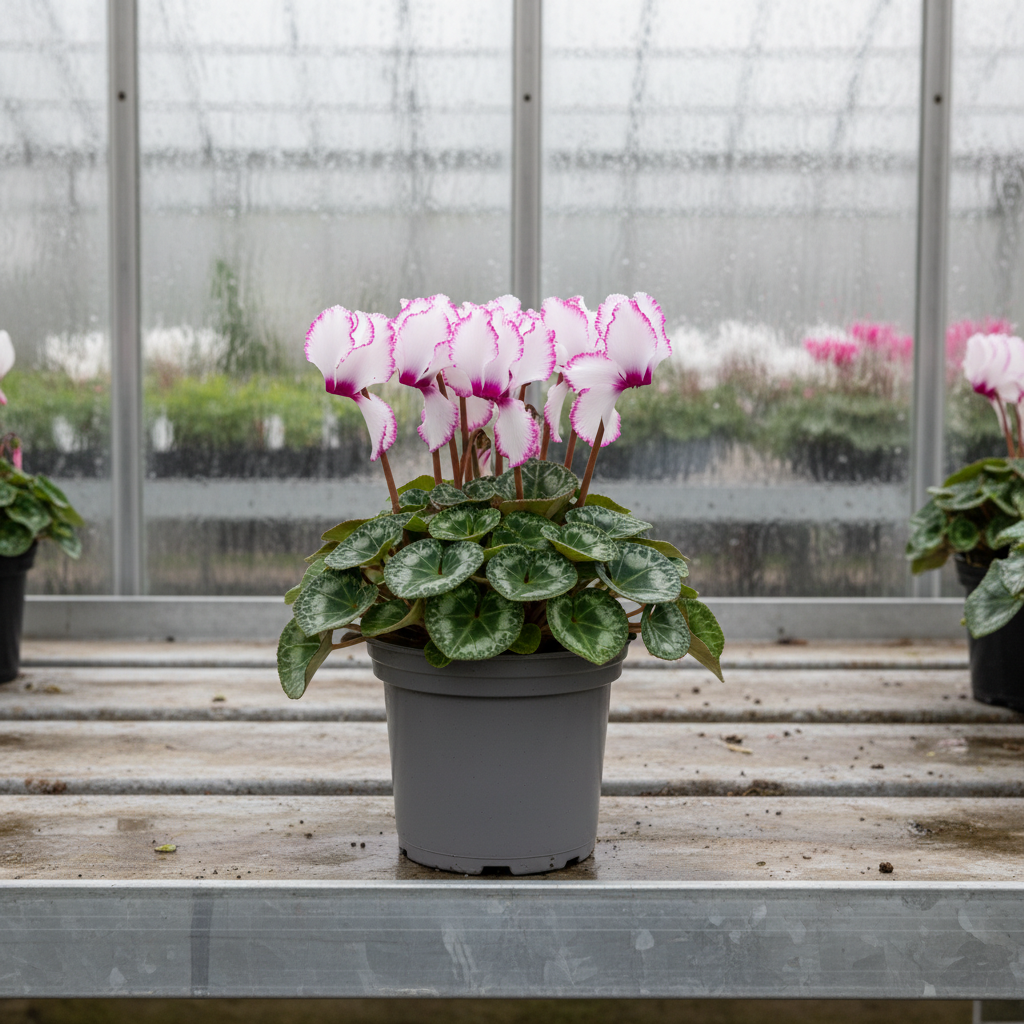
Victoria series is the classic bicolour cyclamen, with ruffled white petals edged in a bright crimson-pink picotee that looks as though it has been hand-painted. The series is a medium-sized cultivar at around 20 cm (8 in) tall in flower, blooms from late October into March, and copies almost any colour scheme. The silver-marbled foliage is dense and tidy, making Victoria a popular choice for table-top displays where the plant is viewed from above.
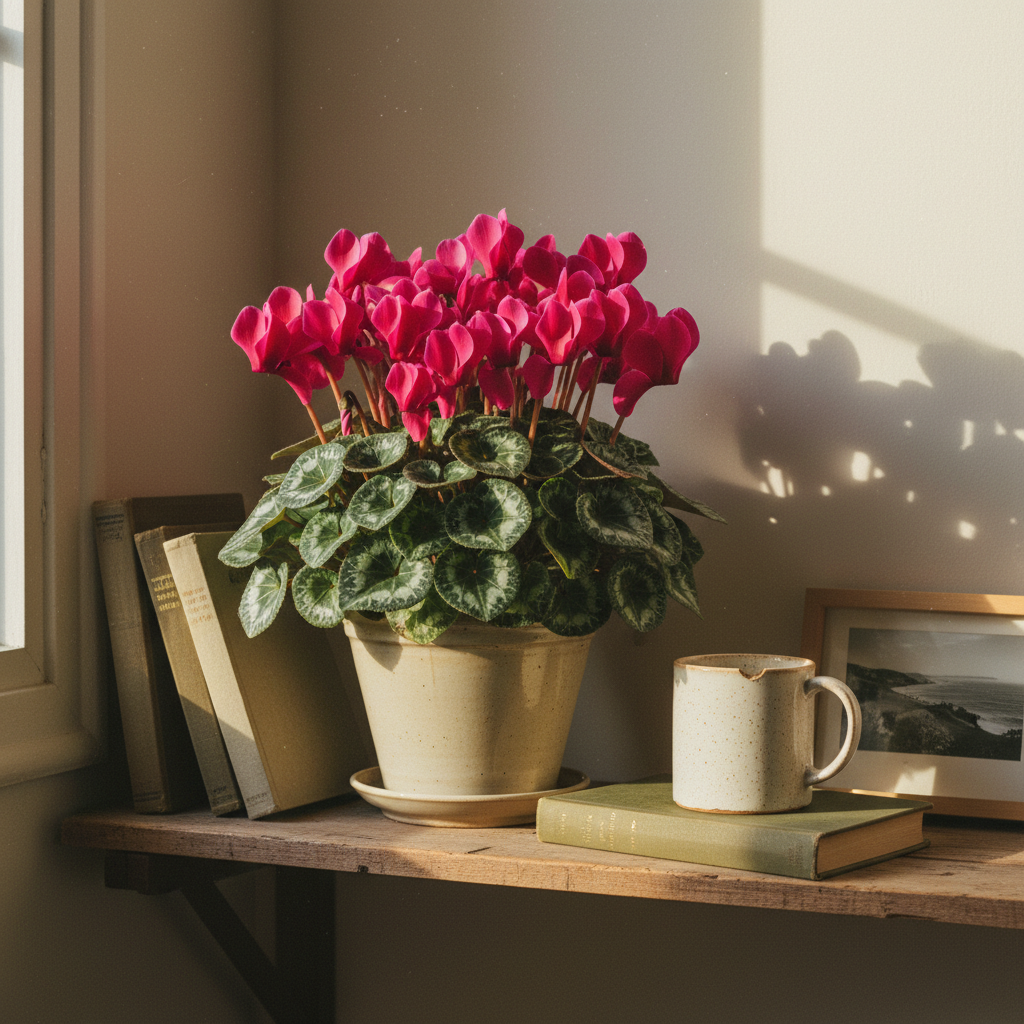
Halios series is the large-flowered French-bred line, with broad rounded petals up to 5 cm (2 in) across in deep saturated magenta, pure white, salmon-pink and crimson. The plants stand a little taller than Victoria at 25 to 30 cm (10 to 12 in), with sturdier stems that hold the flowers well clear of the foliage. Halios is the right choice when a single specimen plant has to fill a focal-point pot in a hallway or front room.
Several other named series are worth seeking out. Miracle series is a small-flowered miniature cyclamen reaching only 12 to 15 cm (5 to 6 in), ideal for windowsills and grouped plantings. Latinia series offers semi-trailing varieties that drape gently over the edge of a pot, useful in raised displays. Concerto is the most heat-tolerant commercial series, holding up better than most in rooms that occasionally rise above 20 °C. Picasso series features doubled and fringed flowers in pastel pinks and corals for a softer painterly effect, while Friller series has heavily frilled and waved petals that give each bloom a baroque silhouette.
For collectors interested in the species rather than the commercial hybrids, the unselected Cyclamen persicum from the eastern Mediterranean has smaller white or pale pink fragrant flowers and is far more refined and graceful than any modern cultivar, though it flowers a little later in the winter and the plants are harder to source.
Frequently Asked Questions
Why are my cyclamen’s leaves turning yellow?
The most likely cause is that the plant is too warm. Cyclamen begins to senesce at around 20 °C (68 °F) and accelerates rapidly above that — leaves yellow, flowers fade fast, and the plant slips into an early dormancy. Move it to the coolest bright position available, reduce watering to match the slower growth, and reassess in two weeks. If the temperature is already correct, check for overwatering (soft yellow leaves with mushy stalks) or for the plant entering its natural summer dormancy, which is perfectly normal from April onwards.
My cyclamen has stopped flowering. Is it dying?
Almost certainly not. A flowering cycle of four to six months is normal, after which the plant naturally enters dormancy from late spring through summer. Stop watering, move the dormant tuber to a cool dry shaded spot, and resume watering and feeding in late August when the first new leaves push from the crown. A tuber that has rested properly produces a stronger flush of blooms each successive year.
How do I trigger and manage summer dormancy?
Dormancy starts itself: from April or May the flowers slow and the leaves yellow even with perfect care. As leaves yellow, gradually reduce watering until the compost is barely moist, then stop watering entirely once the last leaves have shrivelled. Lift the pot to a cool shaded position — an unheated north-facing room, a covered porch, or a shaded shelf in a shed — and leave it dry through June, July and most of August. In late August, return the pot to a bright cool spot, water once thoroughly from below, and growth restarts within two to four weeks.
Is cyclamen safe around pets?
No. All parts of the plant contain saponins, particularly cyclamine concentrated in the tuber, which are toxic to cats, dogs, rabbits, horses and small mammals. Ingestion causes drooling, vomiting, diarrhoea and in severe cases cardiac arrhythmia. The leaves and flowers are bitter enough that animals rarely eat much, but the tuber is the real danger — if a curious dog excavates a pot and chews the corm, contact a vet immediately. Households with pets that climb or chew should display cyclamen well out of reach, or skip the plant entirely.
Should I deadhead spent flowers?
Yes — and the technique matters. Grip the flower stem at its base where it joins the tuber and twist sharply with a rolling motion until it pops free. Do not cut with scissors, which leaves a wet stub at the crown that becomes a port of entry for botrytis. Removing spent flowers and yellowing leaves promptly keeps the plant blooming for longer, since unproductive stems no longer compete for the tuber’s energy reserves.
Why are the flower buds rotting before they open?
This is a classic botrytis problem caused by damp still air around the crown, frequently combined with overhead watering. Improve airflow with a small fan running at a low setting nearby, switch entirely to bottom-watering, and twist out any visibly rotting buds and surrounding spent foliage. Apply a fungicidal dust labelled for grey mould if the problem persists. The aim is dry foliage, dry crown, gently moving cool air.
Can a cyclamen be grown outside?
Cyclamen persicum itself is not winter-hardy outdoors in most temperate climates — it tolerates light frost at most and will be killed by a hard freeze. The hardy species Cyclamen hederifolium (autumn-flowering, ivy-leaved) and Cyclamen coum (winter and early spring flowering) are both excellent for shaded garden corners and beneath deciduous shrubs in zones 5 to 8, where they naturalise readily. If a centrally-heated home cannot accommodate C. persicum‘s cool requirements, consider growing the hardy species outdoors instead.
How long can one tuber live?
With consistent care, fifteen to twenty years is realistic, and exceptional specimens in cool conservatories have been recorded at over forty. Each year the tuber thickens and broadens, and the flower display grows correspondingly larger. A well-grown ten-year-old cyclamen can produce sixty or more flowers at once on a tuber the size of a small dessert plate — a far more impressive plant than the freshly-forced supermarket specimen and the reason cyclamen rewards the patient grower.






