
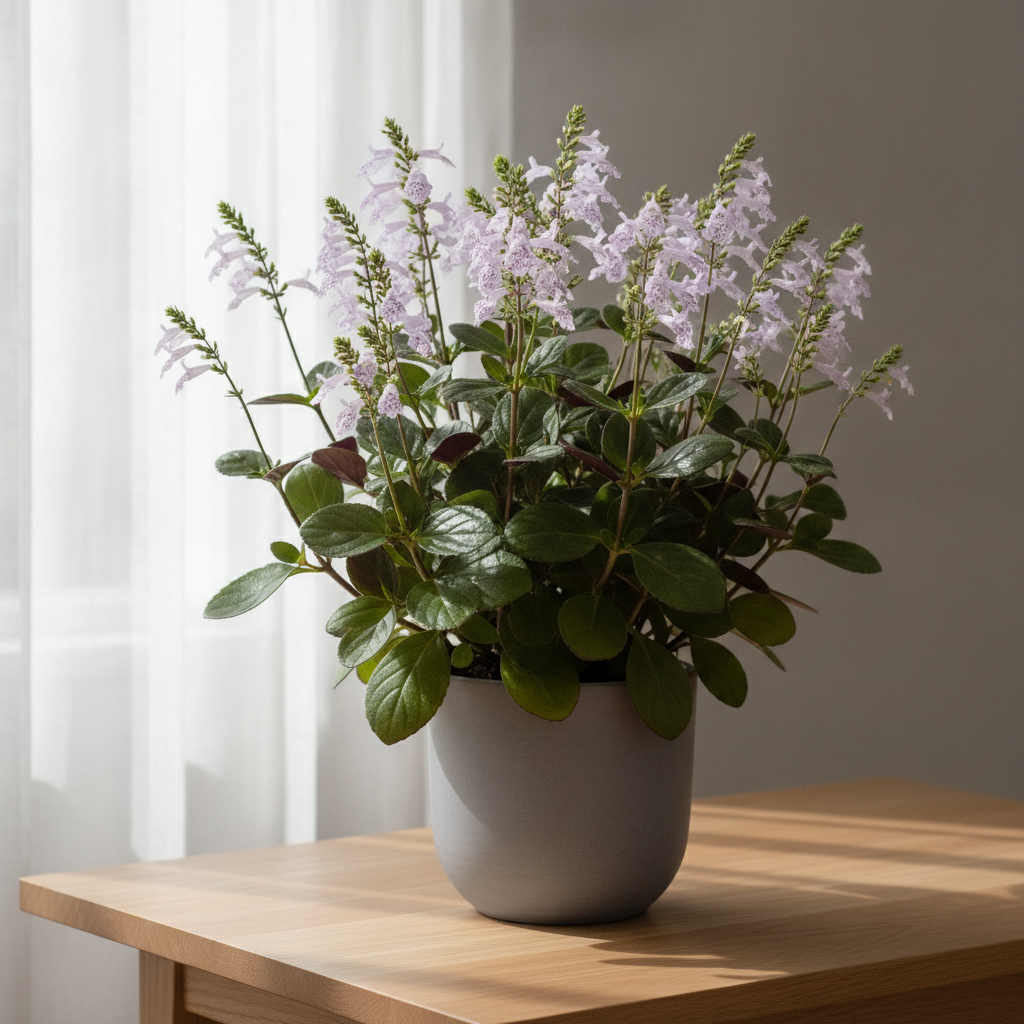
Few houseplants earn their keep quite like Mona Lavender. A relatively modern hybrid, Plectranthus ‘Mona Lavender’ was bred at the Kirstenbosch National Botanical Garden in South Africa and released to gardeners around the turn of the millennium, a deliberate cross between Plectranthus saccatus and a related highland species. It belongs to the mint family, Lamiaceae, which explains its softly aromatic foliage and its willingness to root from almost any cutting you care to take. The plant forms a neat, upright mound of glossy dark green leaves with striking deep purple undersides, and from the shortening days of autumn through into spring it throws up slender spikes of pale lavender tubular flowers, each upper lip freckled with darker violet spots.
Its reputation is that of an easy, rewarding plant, and that reputation is largely deserved. Mona Lavender asks for little more than decent light, steady moisture and a feed during its growing season, yet the gap between a plant that merely survives and one that truly thrives is wider than most people expect. A neglected specimen limps along as a leggy tangle of stems with a handful of sad blooms; a well tended one becomes a floriferous, richly coloured centrepiece that flowers when almost everything else has stopped. This guide walks through every aspect of its care, from reading its light needs to understanding the day-length trigger behind those celebrated winter flowers.
Contents
- Quick Reference
- Why Mona Lavender Makes a Rewarding Houseplant
- Light Requirements
- Watering & Humidity
- Soil, Potting & Repotting
- Fertilising
- Propagation
- Pests & Diseases
- Popular Varieties
- Frequently Asked Questions
Quick Reference: Mona Lavender at a Glance
| Light | Bright, indirect light with a little gentle morning sun; more light means more flowers |
| Watering | Keep evenly moist in growth, letting the top 2 to 3 cm (1 in) dry between waterings |
| Temperature | 15 to 24 degrees C (59 to 75 degrees F); protect from anything below 10 degrees C (50 degrees F) |
| Humidity | Average household humidity of 40 to 60 percent is fine; tolerant of drier air |
| Fertiliser | Balanced liquid feed every 2 to 4 weeks during active growth |
| Toxicity | Generally regarded as non-toxic to cats and dogs, though nibbling may cause mild stomach upset |
Why Mona Lavender Makes a Rewarding Houseplant
The great appeal of Mona Lavender is timing. Most flowering houseplants perform in spring and summer, then sulk through the darker months exactly when a bright bloom would be most welcome. Mona Lavender does the opposite. It is a short-day plant, meaning its flowering is triggered by lengthening nights, so its main flush arrives from autumn into early spring. Combined with foliage that is handsome in its own right, the glossy green upper surfaces contrasting with the aubergine-purple beneath, it earns a place near a window all year and then rewards you with colour just as the garden goes quiet.
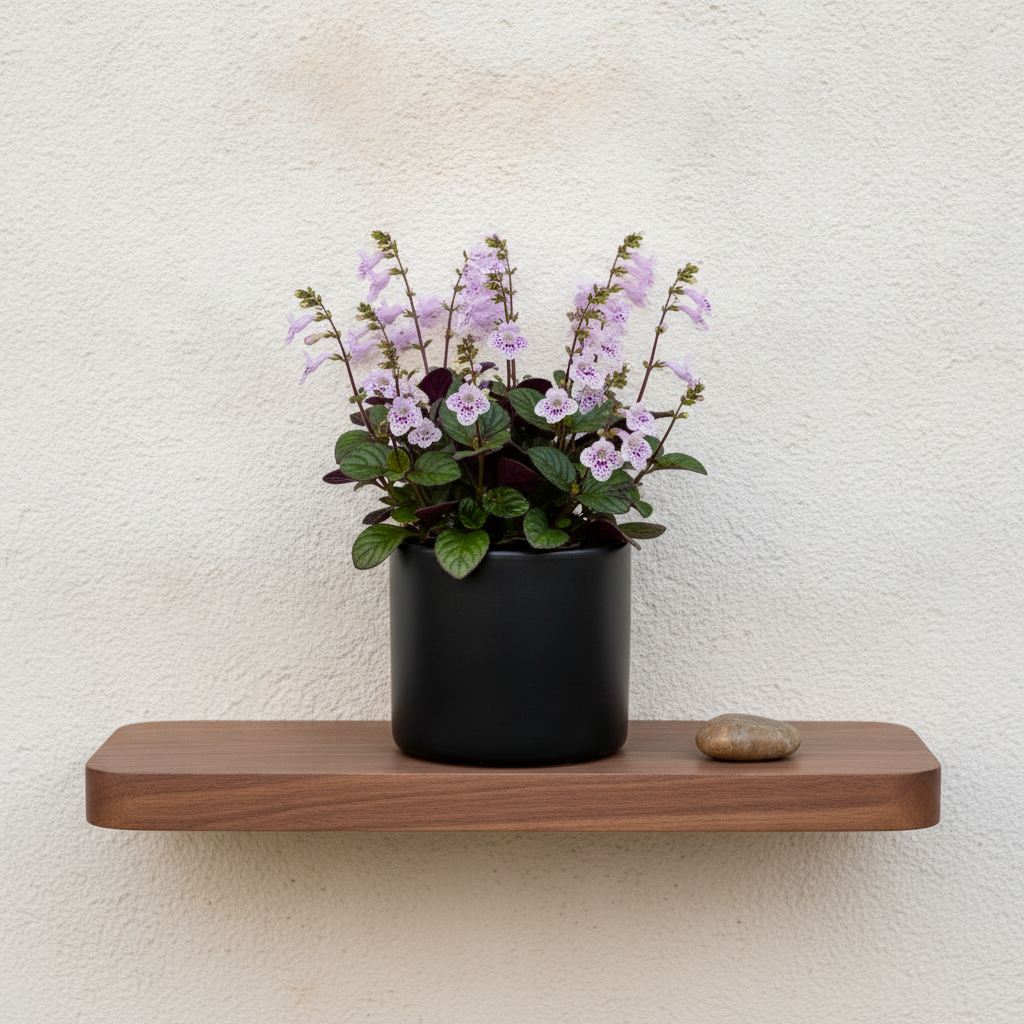
It is also forgiving of the beginner’s learning curve. The semi-succulent stems store a little water, so an occasional missed watering rarely proves fatal, and because the plant roots so readily from cuttings there is always an easy insurance policy against a specimen that grows tired or leggy. Many growers simply treat Mona Lavender as a plant to renew every year or two, taking fresh cuttings each spring and discarding the woody old parent. That habit keeps a collection looking its best and costs nothing beyond a jar of water and a little patience.
Important — Toxicity: Plectranthus species, including Mona Lavender, are generally listed as non-toxic to cats, dogs and humans, and the genus includes culinary relatives such as Cuban oregano. Even so, no houseplant is meant to be eaten, and a curious pet that chews the aromatic leaves may experience mild drooling or an upset stomach. Keep plants out of reach of animals prone to grazing, and contact a vet if a large quantity is consumed.
Light Requirements
Light is the single biggest lever you can pull with Mona Lavender, because it governs both how compact the plant stays and how generously it flowers. In its native highland habitat it grows in bright, sheltered positions with dappled overhead cover, so indoors it wants plenty of light without the full ferocity of unfiltered afternoon sun. Give it too little and the plant stretches, the leaves space out along elongating stems, the purple undersides fade towards green, and flowering all but stops.
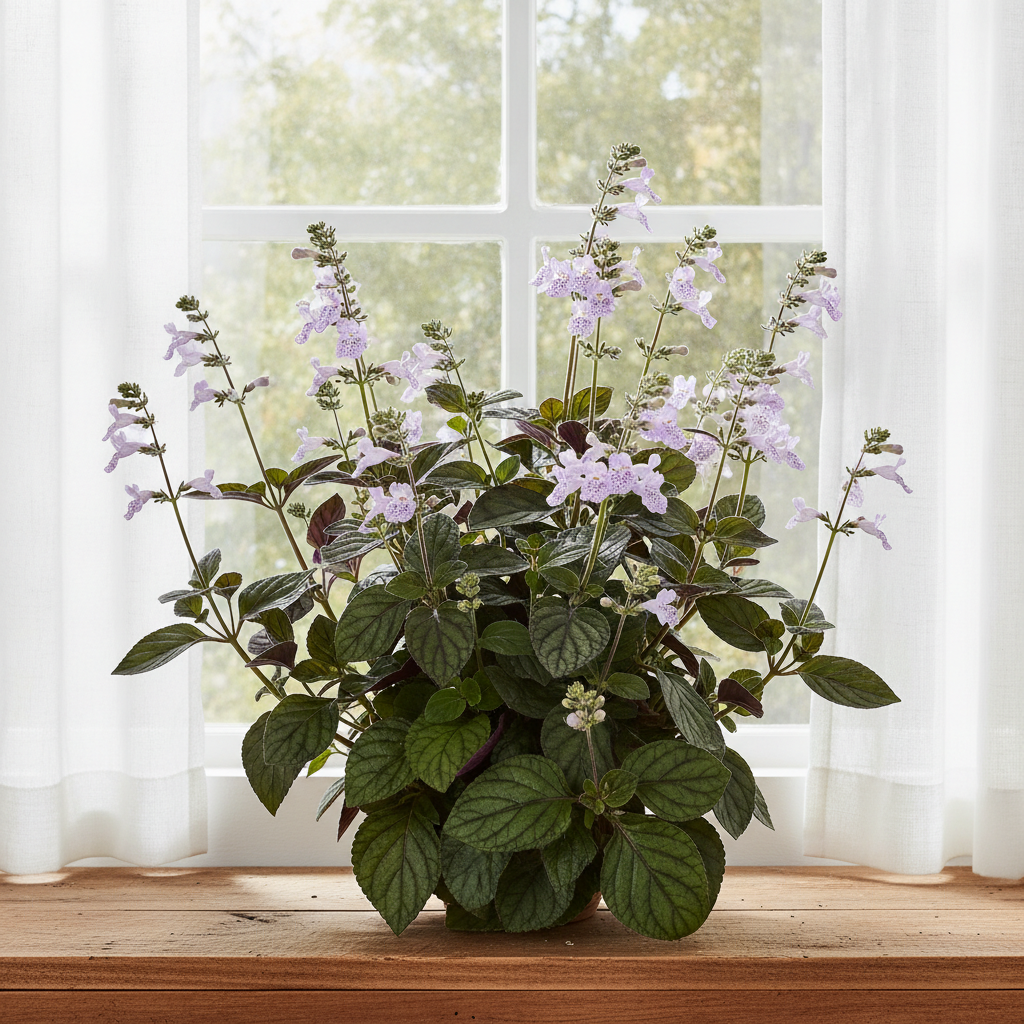
The ideal is bright, indirect light for most of the day with perhaps an hour or two of soft, direct morning sun. A position just back from an east-facing window, or beside a south-facing one screened by a sheer curtain, produces the sturdiest growth and the deepest leaf colour. Under these conditions the plant stays dense and mounded, and it has the energy reserves to push out flower spike after flower spike through the cooler months.
Light Levels Explained
Houseplant light is often described in vague terms, so it helps to anchor the categories to rough measurements and to the outcome you can expect from Mona Lavender in each. The table below sets out the practical picture.
| Light Category | Approx. Level | Typical Location | Outcome |
|---|---|---|---|
| Direct sun | Over 50,000 lux | Unshaded south or west sill in summer | Risk of scorched, bleached leaves; only gentle morning sun is safe |
| Bright indirect | 10,000 to 25,000 lux | Just back from a bright window, or behind a sheer curtain | Ideal: compact habit, deep colour, abundant flowering |
| Medium | 5,000 to 10,000 lux | A metre or two from a bright window | Acceptable growth but fewer flowers and slightly looser habit |
| Low | 1,000 to 5,000 lux | North window or interior wall | Leggy, stretched stems, faded purple, little or no bloom |
| Very low | Under 1,000 lux | Deep corner or windowless room | Steady decline; not sustainable long term |
Window Orientation and Placement
South-facing window: Excellent in autumn and winter when the sun sits low and weak, and the plant can often sit right on the sill. In summer, pull it back a little or diffuse the midday light with a voile curtain to avoid scorching.
East-facing window: Arguably the sweet spot. Gentle morning sun followed by bright ambient light for the rest of the day suits Mona Lavender perfectly and rarely causes scorch.
West-facing window: Good, but the afternoon sun is stronger and hotter than the morning equivalent, so a light screen during the peak summer hours protects the foliage.
North-facing window: Usable in the brightest part of summer but generally too dim for good flowering, especially in winter. Expect stretching and pale colour unless you supplement with a grow light.
Pro Tip — Turn for Even Growth: Mona Lavender leans noticeably towards its light source. Give the pot a quarter turn every time you water so the plant grows evenly on all sides rather than developing a bare, sparse back.
How Light Affects Colour and Flowering
The purple leaf reverse and the intensity of the flower colour are both light-dependent. In strong, bright conditions the anthocyanin pigments that produce the purple develop fully, giving the plant its trademark two-tone look and richly saturated blooms. In dim light the plant diverts its limited energy into simply reaching for more light, stems elongate, leaf undersides drift towards a muddy green, and flower production falls away. If your Mona Lavender looks pale and stretched, more light is almost always the answer.
Warning — Direct Sunlight: Although the plant loves brightness, harsh unfiltered summer sun through glass can act like a magnifying lens and leave pale, papery scorch patches on the leaves. These burns do not recover, so introduce any increase in direct sun gradually over a week or two.
Artificial Lighting
Mona Lavender responds well to a full-spectrum LED grow light, which can rescue an otherwise dim spot or extend growing potential through a dark winter. A light positioned 20 to 30 cm (8 to 12 in) above the canopy and run for around 12 hours a day keeps foliage compact and coloured. There is, however, an important twist unique to this plant: because it flowers in response to long nights, artificial light in the evening can disrupt its bloom cycle. If you want the classic autumn and winter display, keep the plant in a room that goes genuinely dark at night rather than under a lamp that burns late.
Seasonal Adjustments
As the sun weakens through autumn, move the plant closer to the glass to keep light levels up, and clean the window and the leaves so nothing steals precious brightness. Come spring and summer, when the sun climbs higher and burns hotter, ease the plant back from the hottest sills or add a sheer screen. Watching how the plant holds its colour and habit is the best guide: dense and deeply coloured means the light is right, loose and pale means it needs more.
Watering & Humidity
Mona Lavender sits in an interesting middle ground when it comes to water. Its semi-succulent stems give it a little drought tolerance, so it is far more forgiving than a fern, yet it is nothing like as tough as a true succulent and will wilt dramatically if allowed to bake bone dry. The aim during active growth is consistent, moderate moisture: damp but never waterlogged, and never left standing in a saucer of water.
When to Water
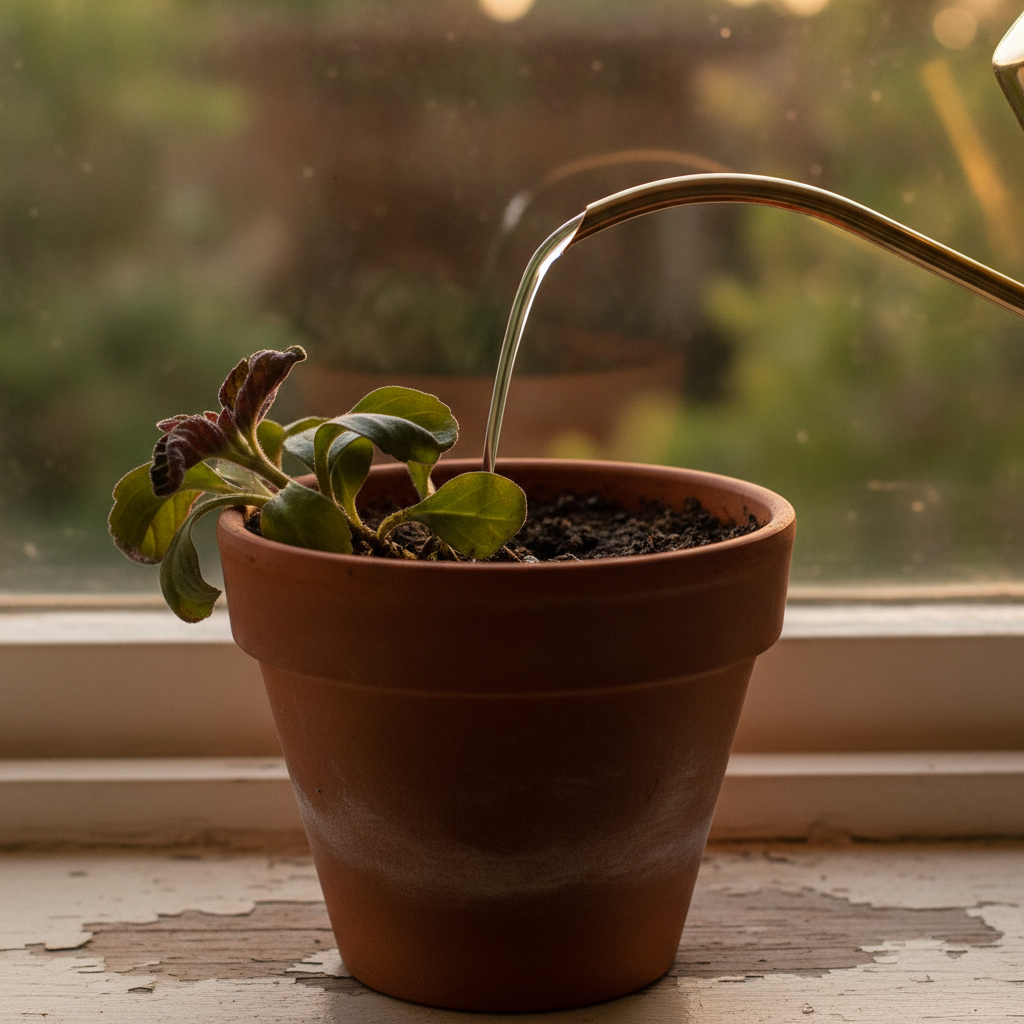
The most reliable method is to check the soil rather than watering on a fixed calendar. Push a finger into the mix, and when the top 2 to 3 cm (about 1 in) feels dry it is time to water again. In a bright, warm position during spring and summer this often means watering once or twice a week, while in the cooler, darker months the plant uses far less and the interval stretches considerably.
A wilting Mona Lavender with dry soil is telling you it went too long without a drink, and it will usually perk up within hours of watering. A wilting plant with wet soil is a very different and more worrying signal, pointing towards root rot rather than thirst. Learning to read those two situations correctly is one of the most useful skills you can develop with this plant.
Pro Tip — Lift the Pot: Get to know the weight of the pot when freshly watered and again when it is ready for more. Lifting it becomes a quick, accurate moisture check that works even when the surface looks misleading.
How to Water Correctly
- Check that the top 2 to 3 cm of soil has dried before you begin.
- Water at the soil surface, directing the flow around the base rather than over the foliage and flowers.
- Continue until water runs freely from the drainage holes, ensuring the whole root ball is moistened.
- Let the pot drain completely for several minutes.
- Tip away any water that collects in the saucer or cache pot so the roots never sit in it.
- Wait until the surface dries again before repeating rather than watering to a schedule.
Signs of Overwatering vs. Underwatering
| Symptom | Overwatering | Underwatering |
|---|---|---|
| Leaf colour | Yellowing, often starting with lower leaves | Dull, slightly greyed green |
| Leaf texture | Soft, limp, sometimes translucent | Thin, crisp and wilted, edges browning |
| Soil | Stays wet for days, may smell sour | Dry, pulling away from the pot sides |
| Roots | Brown, mushy, foul-smelling | Dry and papery but generally intact |
| Stem base | Blackening, soft and collapsing | Firm, only the tips wilting |
Warning — Root Rot: Overwatering is the most common way to kill a Mona Lavender. Soggy, airless soil suffocates the roots and invites rot that quickly spreads to the stem base. If you catch it early, unpot the plant, cut away any brown mushy roots, and repot into fresh, free-draining mix. If the base of the plant has already turned soft and black, take healthy tip cuttings straight away to save the variety.
Humidity Requirements
One of the quiet virtues of Mona Lavender is that it does not fuss over humidity. Ordinary household levels of 40 to 60 percent suit it well, and it copes with the drier air of a centrally heated room far better than tropical foliage plants such as calatheas or ferns. This makes it a genuinely low-maintenance choice for a living room or bedroom.
Problems only tend to appear in very dry conditions, for example right beside a radiator, where you might see occasional crisping at the leaf edges. Even then the plant is more likely to be reacting to heat and dry soil than to low humidity itself, so the first fix is usually to move it away from the direct heat source.
If your home is unusually dry and you want to give the plant a boost, grouping it with other plants or standing the pot on a tray of damp pebbles lifts the local humidity gently. Avoid heavy misting, however, as water sitting on the soft, hairy foliage and in the crowded flower spikes can encourage fungal problems such as botrytis.
Water Quality
Mona Lavender is not especially sensitive to water quality and tolerates ordinary tap water in most areas. In regions with very hard water, minerals can build up in the soil over time, so an occasional flush with rainwater or the periodic leaching described in the fertilising section keeps things sweet. Letting tap water stand for a few hours before use also allows some chlorine to dissipate and brings it to room temperature, which the roots prefer to a cold shock.
Soil, Potting & Repotting
Because root rot is the chief threat to this plant, the potting mix matters enormously. Mona Lavender wants a medium that holds enough moisture to keep it steadily hydrated during growth, yet drains freely enough that excess water runs straight through and air can reach the roots. A dense, water-retentive compost used straight from the bag is a recipe for trouble.
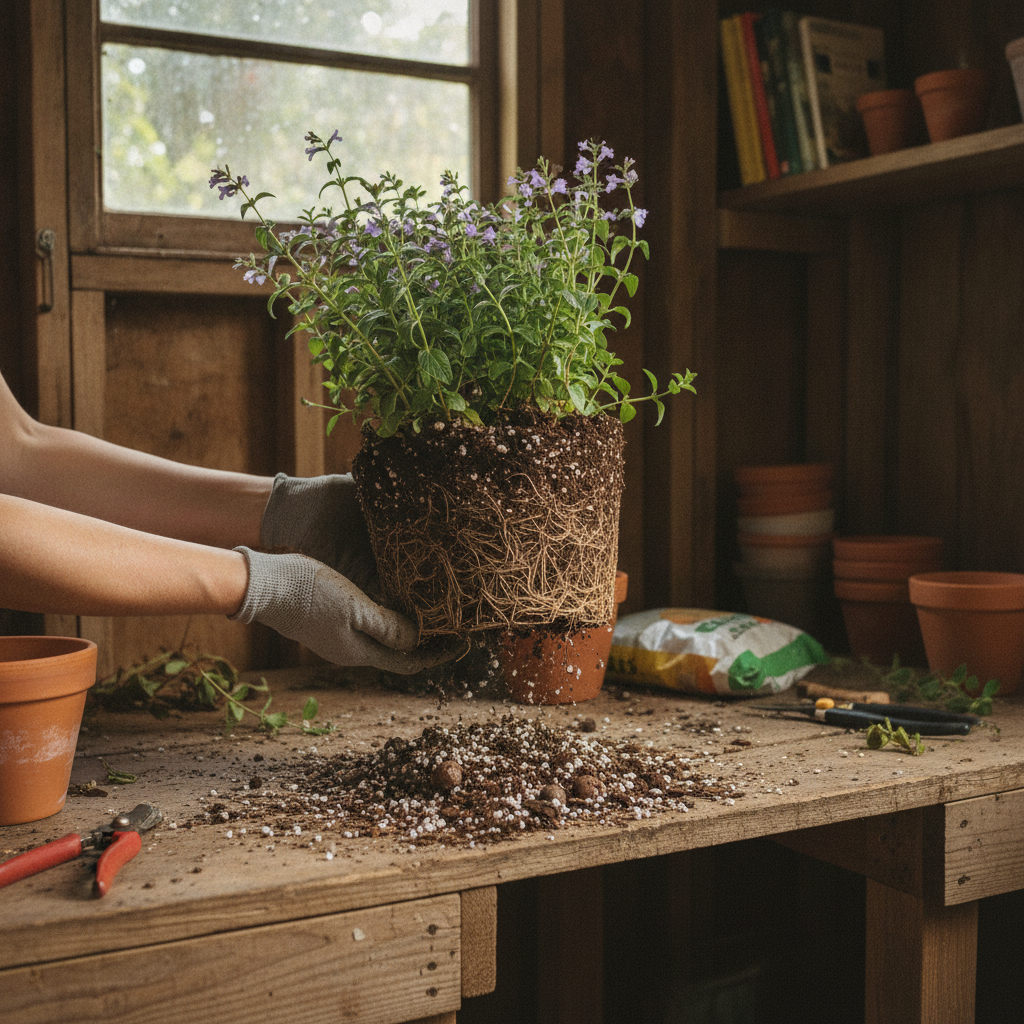
Ideal Soil Composition
A good starting point is a quality peat-free houseplant compost lightened generously with drainage material. The compost provides moisture retention and nutrients, while added perlite or grit opens up the structure so the mix never turns to sludge. A little fine bark improves aeration further and mimics the loose, organic-rich soils the plant enjoys in the wild.
| Component | Proportion | Function |
|---|---|---|
| Peat-free houseplant compost | Around 60 percent | Holds moisture and supplies nutrients |
| Perlite or horticultural grit | Around 25 percent | Opens the mix for drainage and aeration |
| Fine orchid or composted bark | Around 15 percent | Adds structure and prevents compaction |
Mona Lavender is not fussy about pH and does well in the slightly acidic to neutral range of roughly 6.0 to 7.0 that most standard houseplant composts naturally provide. There is no need to test or adjust it under normal circumstances.
Pro Tip — Quick Mix Recipe: For a fast, reliable blend, combine three handfuls of peat-free houseplant compost with one handful of perlite and half a handful of fine bark. It drains well, stays airy, and suits Mona Lavender straight away.
Choosing the Right Pot
The container you choose has a direct effect on how easy the plant is to keep happy, influencing drainage, how quickly the soil dries, and how stable the top-heavy, flowering plant remains.
Drainage holes are non-negotiable. Whatever pot you pick, it must have holes in the base. A decorative cache pot without drainage can be used as an outer sleeve, but only if you lift the inner pot out to water and drain, or the roots will end up standing in a hidden reservoir.
Pot material: Terracotta is an excellent choice because its porous walls wick away excess moisture and make overwatering harder, a real advantage for a rot-prone plant. Glazed ceramic and plastic hold moisture longer, which can be useful in a very warm, bright spot but demands a more careful watering hand.
Pot size: Move up only one size at a time, choosing a pot around 2 to 4 cm (1 to 2 in) wider than the last. An oversized pot holds a large volume of slow-drying soil around a small root ball, which is exactly the waterlogged situation that leads to rot.
When to Repot
Mona Lavender grows quickly but is often not kept for many years, so repotting is a relatively occasional job. Expect to move a young, vigorous plant into a slightly larger pot once a year, and an established one every couple of years or when roots begin to emerge from the drainage holes and the plant dries out unusually fast. The best time is spring, as growth accelerates and the plant can recover briskly. Many growers skip repotting altogether and simply start again from spring cuttings, which sidesteps the question entirely.
How to Repot: Step-by-Step
- Water the plant a day beforehand so the root ball holds together and the plant is not stressed.
- Slide the plant out by tipping the pot and supporting the base of the stems, rather than pulling on the top growth.
- Gently tease away some of the old, spent soil and inspect the roots, trimming off any that are brown, soft or rotten.
- Add a layer of fresh, free-draining mix to the base of the new pot.
- Position the plant at the same depth it sat before and fill around the root ball, firming lightly to remove large air pockets.
- Water thoroughly and allow the pot to drain completely.
- Return it to bright, indirect light and hold off on feeding for a few weeks while new roots establish.
Warning — Transplant Shock: A little wilting or a pause in growth after repotting is normal. Resist the urge to compensate by overwatering, which only adds stress to disturbed roots. Keep the plant in stable, bright conditions, water only when the surface dries, and let it settle at its own pace.
Fertilising
Mona Lavender is a fast, hungry grower during its active season and a generous bloomer, so it appreciates regular feeding to fuel both leaf and flower production. Fertiliser is not a cure-all, and it cannot compensate for poor light or bad watering, but paired with those fundamentals it makes the difference between a modest plant and a lush, floriferous one.
The key is to feed while the plant is growing and to ease off when it is resting. Overfeeding a dormant or slow plant simply leaves unused salts to accumulate in the soil, where they can scorch the roots, so matching your feeding to the plant’s rhythm is more important than any particular product.
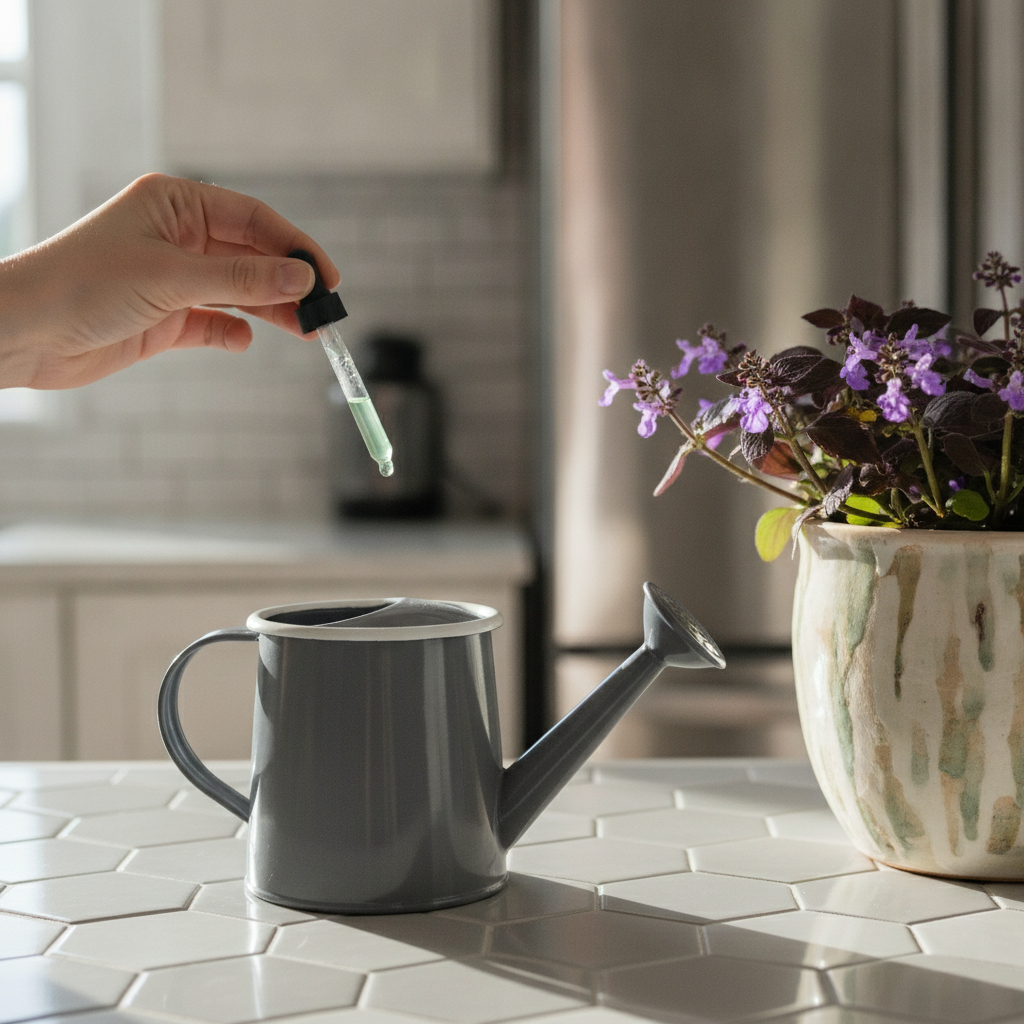
Understanding Plant Nutrients
Fertilisers are labelled with an NPK ratio, standing for nitrogen, phosphorus and potassium, the three nutrients plants use in the largest quantities. Nitrogen drives leafy growth, phosphorus supports roots and flowering, and potassium underpins overall vigour and bloom quality. A balanced feed covers all bases for foliage and flowers alike, while a formula slightly higher in potassium can gently encourage a heavier flush. Alongside these, plants need smaller amounts of secondary nutrients and trace elements, summarised below.
| Nutrient | Symbol | Primary Function | Deficiency Symptoms |
|---|---|---|---|
| Nitrogen | N | Leaf and stem growth, green colour | Pale, yellowing older leaves and slow growth |
| Phosphorus | P | Root development and flowering | Poor blooming, dull or purpling foliage |
| Potassium | K | Overall vigour and flower quality | Browning leaf edges and weak stems |
| Calcium | Ca | Cell wall strength | Distorted new growth and weak tips |
| Magnesium | Mg | Core of the chlorophyll molecule | Yellowing between the veins of older leaves |
| Iron | Fe | Chlorophyll production | Yellowing between the veins of new leaves |
Types of Fertiliser
Liquid fertilisers: The most convenient choice for Mona Lavender, mixed into the watering can and applied during growth. They act quickly, are easy to dilute to the strength you want, and give you precise control over how much and how often the plant is fed.
Slow-release granular: Pellets mixed into the soil or scattered on the surface release nutrients gradually over months. They are low effort but offer less control, and they keep feeding even when the plant would rather rest, so use them cautiously with a plant that has a distinct off-season.
Organic fertilisers: Worm castings, seaweed extract and similar options feed gently and improve the soil life as they work. They tend to be milder, which makes them forgiving, though they release nutrients more slowly and less predictably than synthetic feeds.
Feeding Schedule
Through the main growing period, feed with a balanced liquid fertiliser at half the recommended strength every two to four weeks. As the plant comes into heavy flower you can switch to a bloom-oriented feed slightly higher in potassium to support the display. When growth slows in the depths of winter, or after the main flowering flush finishes, reduce feeding to once a month or stop altogether until the plant picks up again.
Pro Tip — Feed at Half Strength: It is far safer to underfeed than to overfeed. Diluting liquid feed to half the label rate and applying it a little more often gives steady nutrition without the risk of root-scorching salt build-up.
How to Fertilise
- Water the plant lightly first if the soil is very dry, so feed is never applied to parched roots.
- Dilute the liquid fertiliser to half the recommended strength in your watering can.
- Apply it evenly to the soil until it drains a little from the base.
- Avoid splashing feed onto the foliage and flowers, where it can mark or burn.
- Return to plain water for the following watering, then feed again on schedule.
Warning — Salt Build-Up: White crusting on the soil surface or around the pot rim signals a build-up of fertiliser salts. Flush the pot every couple of months by running plenty of plain water through it until it drains freely, which washes the excess away before it damages the roots.
Propagation
If there is one thing Mona Lavender does effortlessly, it is propagate. As a member of the mint family it roots from stem cuttings with almost embarrassing ease, and because plants naturally grow leggy and woody with age, taking cuttings is not just a way to multiply your stock but the standard method of keeping a fresh, compact specimen going year after year.
Spring and early summer are the most productive times to take cuttings, when the plant is growing strongly and light levels are rising, but in practice you can root Mona Lavender at almost any time of year given a warm, bright spot. Softwood tip cuttings root fastest and make the bushiest new plants.
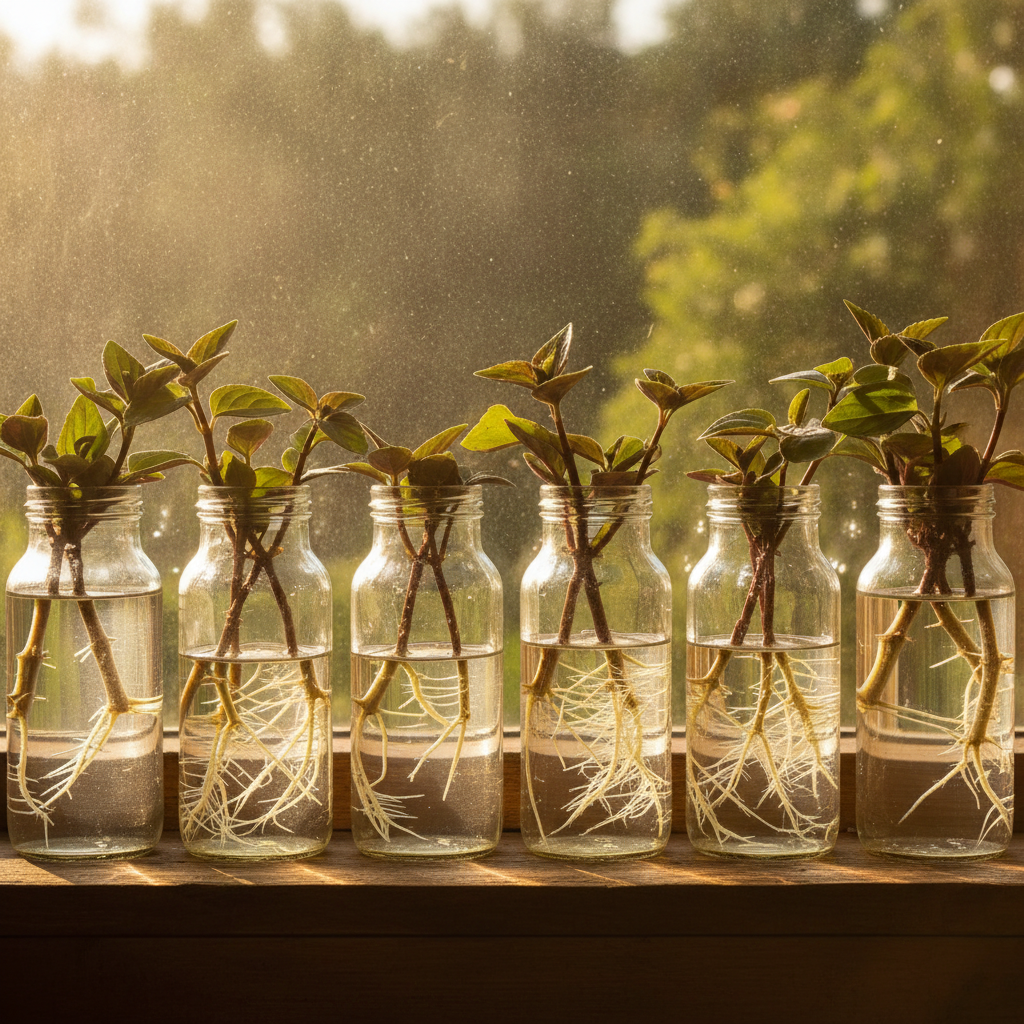
Understanding Nodes
The secret to successful cuttings lies in the node, the slightly swollen point on the stem where leaves and side shoots emerge. This is where the plant concentrates the cells capable of producing new roots. Every cutting you take must include at least one node below the water or soil line, because roots form there and nowhere else. Strip the leaves from the lowest node so it sits cleanly in the rooting medium rather than rotting beneath the surface.
Water Propagation: Step-by-Step
Rooting in water is the simplest method and lets you watch progress unfold, which makes it especially satisfying for beginners.
- Choose a healthy, non-flowering shoot and cut a 10 to 12 cm (4 to 5 in) tip just below a node with clean scissors.
- Remove the leaves from the lower third of the cutting, leaving two or three at the top.
- Stand the cutting in a glass of clean, room-temperature water so at least one bare node is submerged.
- Place it in bright, indirect light and refresh the water every few days to keep it clear and oxygenated.
- Watch for white roots emerging from the nodes, usually within one to two weeks.
- Once the roots reach 3 to 5 cm (1 to 2 in), pot the cutting into a small container of free-draining mix and keep it lightly moist as it adjusts.
Pro Tip — Pot a Cluster: Root three or four cuttings together and pot them into the same container. They knit into a full, bushy plant far faster than a single cutting ever would, giving you a display-worthy specimen in a matter of weeks.
Soil Propagation: Step-by-Step
Rooting directly in soil skips the transplant step and often produces sturdier plants, since the roots never have to adapt from water to compost.
- Take a tip cutting of 10 to 12 cm (4 to 5 in) just below a node, as for water propagation.
- Strip the lower leaves and, if you like, dip the cut end in rooting hormone to speed things along.
- Insert the cutting into a small pot of moist, free-draining mix so the bare node is buried.
- Firm the soil gently around the stem and water lightly to settle it.
- Cover loosely with a clear bag or propagator to hold humidity, keeping it out of direct sun and airing it occasionally.
- After two to three weeks, a gentle tug that meets resistance shows roots have formed, at which point you can remove the cover and grow the plant on normally.
Troubleshooting Propagation
| Problem | Likely Cause | Solution |
|---|---|---|
| Cutting rots at the base | Stagnant water or soggy soil, no node clearance | Refresh water often, strip lower leaves, use a free-draining mix |
| No roots after several weeks | Too cold, too dark, or a flowering shoot used | Move somewhere warmer and brighter, take non-flowering tips |
| Cutting wilts badly | Too many leaves losing water before roots form | Reduce leaf count and raise humidity with a cover |
| Roots form but plant stalls after potting | Transplant shock or overwatering the young roots | Keep lightly moist, bright and stable, and be patient |
Pests & Diseases
Mona Lavender is a robust plant, but its soft, aromatic foliage does attract a handful of the usual houseplant pests, and its dislike of soggy conditions makes a few fungal diseases worth watching for. The good news is that a healthy, well grown plant shrugs off most problems, and early intervention deals with the rest before they take hold.
The best defence is regular observation. Look over your plant whenever you water, paying particular attention to the undersides of leaves and the crowded bases of the flower spikes, which are exactly the sheltered spots pests prefer. Catching an infestation while it is small turns a potential crisis into a five-minute job.
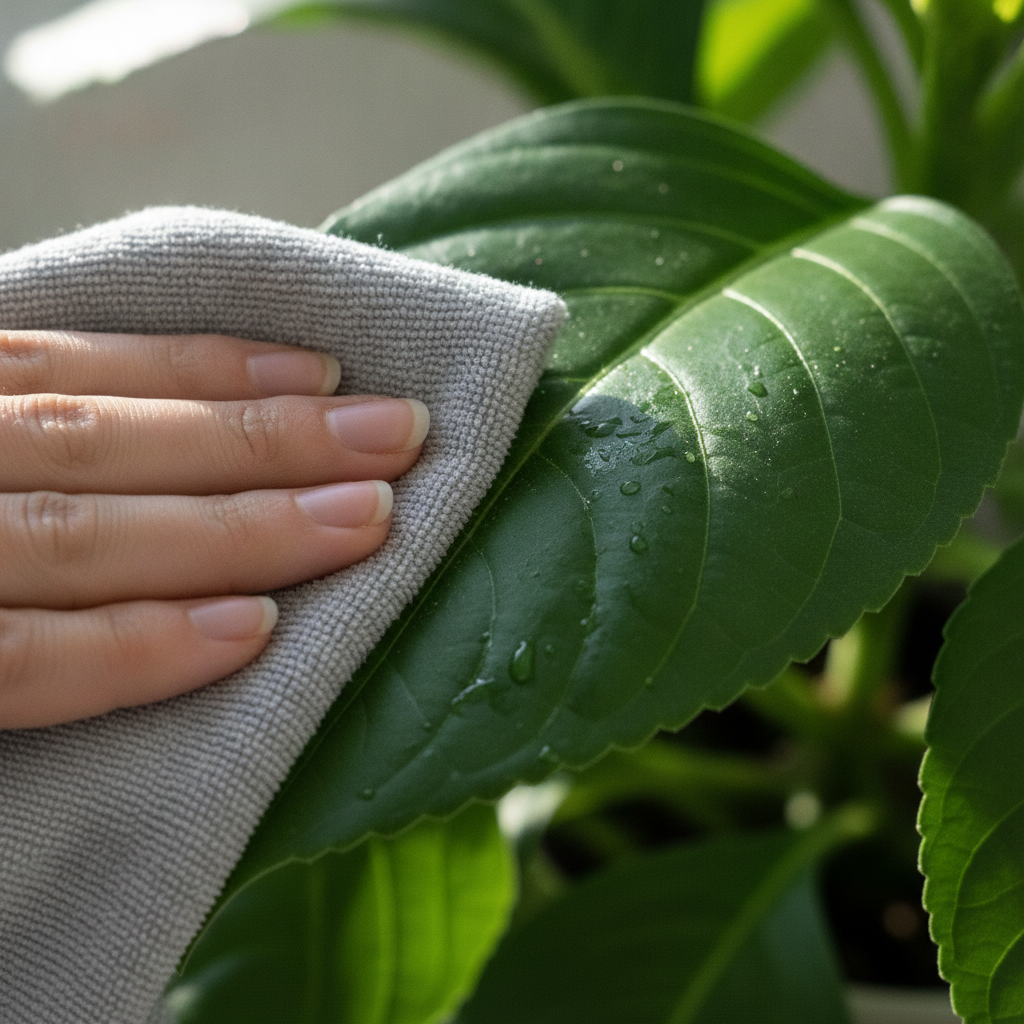
Common Pests
Whitefly (Trialeurodes vaporariorum)
Whitefly are a particular nuisance on Plectranthus and can multiply fast. These tiny white winged insects gather on leaf undersides and rise in a little cloud when the plant is disturbed. They suck sap, weaken growth and excrete sticky honeydew that encourages sooty mould.
Treatment: Hang yellow sticky traps to catch the adults, and spray the undersides of the leaves with insecticidal soap or a diluted neem oil solution every few days until the population collapses. Isolate the plant while you treat it, since whitefly spread easily to neighbours.
Mealybugs (Pseudococcus species)
Mealybugs appear as small, white, cottony blobs tucked into leaf joints and along stems. They too feed on sap and produce honeydew, and left unchecked they sap the vigour of the plant and distort new growth.
Treatment: Dab each insect directly with a cotton bud dipped in isopropyl alcohol, which kills it on contact. Follow up with insecticidal soap over the whole plant, and repeat weekly until no new mealybugs appear.
Aphids (Aphis species)
Aphids cluster on the soft new tips and flower buds, which are among the most tender parts of a fast-growing Mona Lavender. They cause puckered, distorted growth and, like the other sap-suckers, leave sticky honeydew behind.
Treatment: A firm rinse under a tap dislodges most of them. For heavier infestations, treat with insecticidal soap or neem oil, concentrating on the growing tips and buds where they gather.
Common Diseases
Root Rot (Pythium and Phytophthora species)
By far the most serious disease of Mona Lavender, root rot follows persistently wet, airless soil. The first signs are yellowing, wilting foliage despite damp soil, and a softening, blackening stem base. Left too long it is fatal.
Treatment: Unpot the plant, cut away all brown, mushy roots, and repot into fresh, free-draining mix in a clean pot. Water sparingly afterwards. If the base has already collapsed, salvage the plant by rooting healthy tip cuttings and discarding the rest.
Powdery Mildew (Erysiphe species)
Powdery mildew shows as a dusty white coating on leaves, favoured by stagnant air, crowding and cool, damp conditions. It disfigures the foliage and, if severe, weakens the plant.
Treatment: Improve air circulation, remove badly affected leaves, and avoid wetting the foliage. A fungicidal spray, or a home remedy of diluted potassium bicarbonate, controls persistent outbreaks.
Grey Mould (Botrytis cinerea)
Botrytis, or grey mould, appears as a fuzzy greyish-brown growth, typically on faded flowers and damaged tissue in humid, poorly ventilated conditions. The dense flower spikes of Mona Lavender are a favourite target as blooms age.
Treatment: Remove spent flowers and affected tissue promptly, improve airflow, and reduce humidity around the plant. Avoid misting and keep water off the foliage to deny the fungus the moisture it needs.
Pest and Disease Summary
| Pest / Disease | Identification | Treatment |
|---|---|---|
| Whitefly | Tiny white flies rising from leaf undersides | Sticky traps, insecticidal soap or neem, repeated |
| Mealybugs | White cottony blobs in leaf joints | Alcohol on a cotton bud, then insecticidal soap |
| Aphids | Clusters on new tips and buds | Rinse off, then insecticidal soap or neem |
| Root rot | Wilting in wet soil, black soft stem base | Trim rotten roots, repot dry, take cuttings if severe |
| Powdery mildew | Dusty white coating on leaves | Improve airflow, remove leaves, fungicide |
| Grey mould | Fuzzy grey growth on old flowers | Remove affected parts, cut humidity, improve airflow |
Prevention Strategies
Prevention is far easier than cure, and with Mona Lavender it comes down to good basic culture. A plant grown in bright light, watered correctly and given room for air to move around it is naturally resilient. Most disease problems trace straight back to overwatering or stagnant, crowded conditions, so getting those fundamentals right removes the majority of risks before they arise.
Quarantine any new plant for a couple of weeks before it joins your collection, remove faded flowers and yellowing leaves promptly so they cannot harbour mould or pests, and give the plant enough space that air circulates freely around the foliage. These small habits keep problems rare and minor.
Pro Tip — Neem as Routine: A light preventative spray of diluted neem oil once a month, applied to the leaf undersides in the evening out of direct sun, deters whitefly and other sap-suckers before they establish. It is gentler and cheaper than tackling a full infestation later.
Popular Varieties
Mona Lavender is itself a named cultivar rather than a wild species, the standout result of a deliberate breeding programme, and its success inspired a wave of related selections and similar Plectranthus hybrids. These share the same easy nature and free-flowering habit while offering variations in flower colour, size and form.
Alongside the flowering ornamentals, the wider genus includes several familiar relatives worth knowing, from the trailing Swedish ivy grown purely for its foliage to the culinary Cuban oregano. Whatever the selection, the care described in this guide applies with only minor adjustments.
| Variety | Leaf Appearance | Light Needs | Growth Rate | Availability |
|---|---|---|---|---|
| Mona Lavender | Glossy dark green, deep purple reverse | Bright indirect | Fast | Common |
| Velvet Elvis | Dark green with purple reverse, dense habit | Bright indirect | Fast | Increasingly common |
| Cape Angels series | Mid to dark green, scalloped | Bright indirect | Fast | Seasonal |
| Plectranthus ecklonii | Large soft green, toothed | Bright indirect to part sun | Vigorous | Specialist |
| Swedish ivy (P. verticillatus) | Round, glossy green, trailing | Bright indirect | Fast | Common |
| Cuban oregano (P. amboinicus) | Thick, fuzzy, aromatic grey-green | Bright, some direct sun | Fast | Common |
Featured Varieties
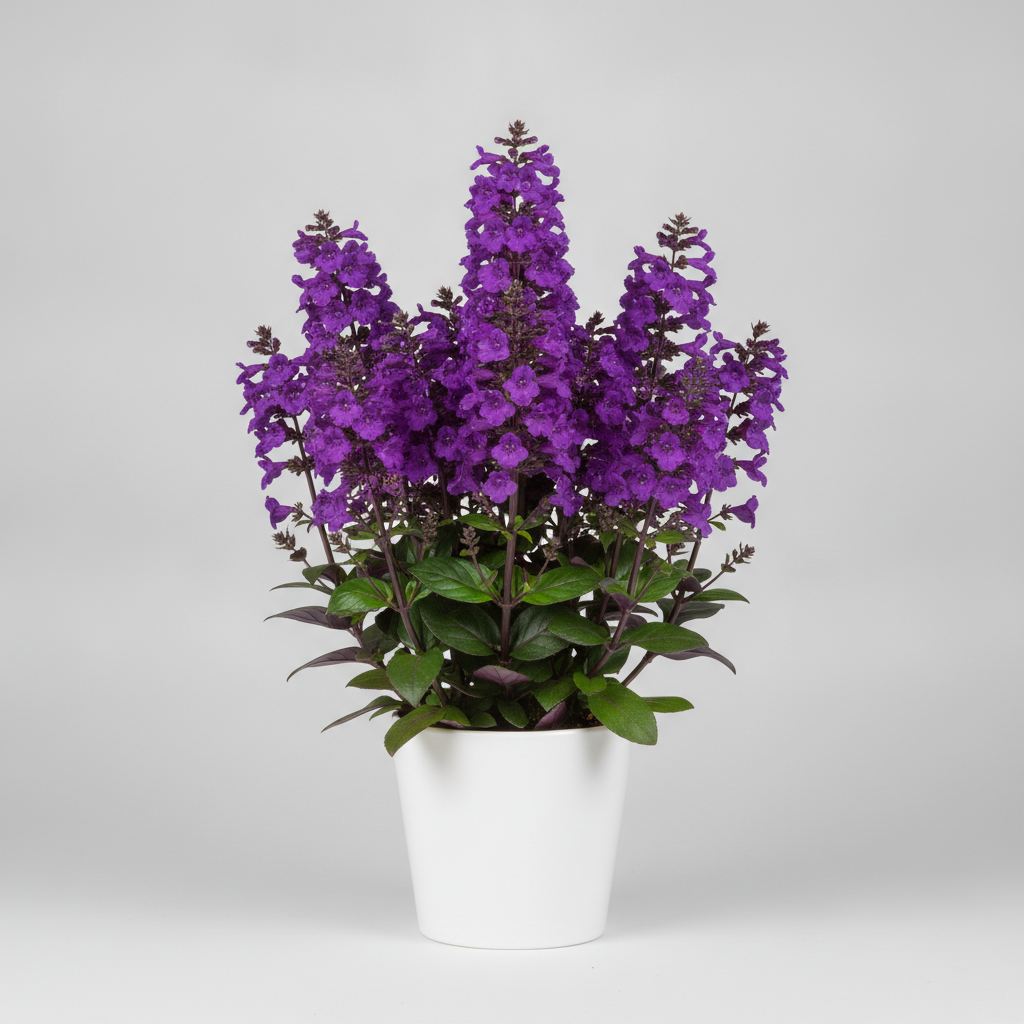
Velvet Elvis
An improved selection in the Mona Lavender mould, Velvet Elvis carries larger, deeper violet-purple flowers on a dense, compact plant. The bolder blooms make it a striking choice where the softer lavender of the original might be lost.
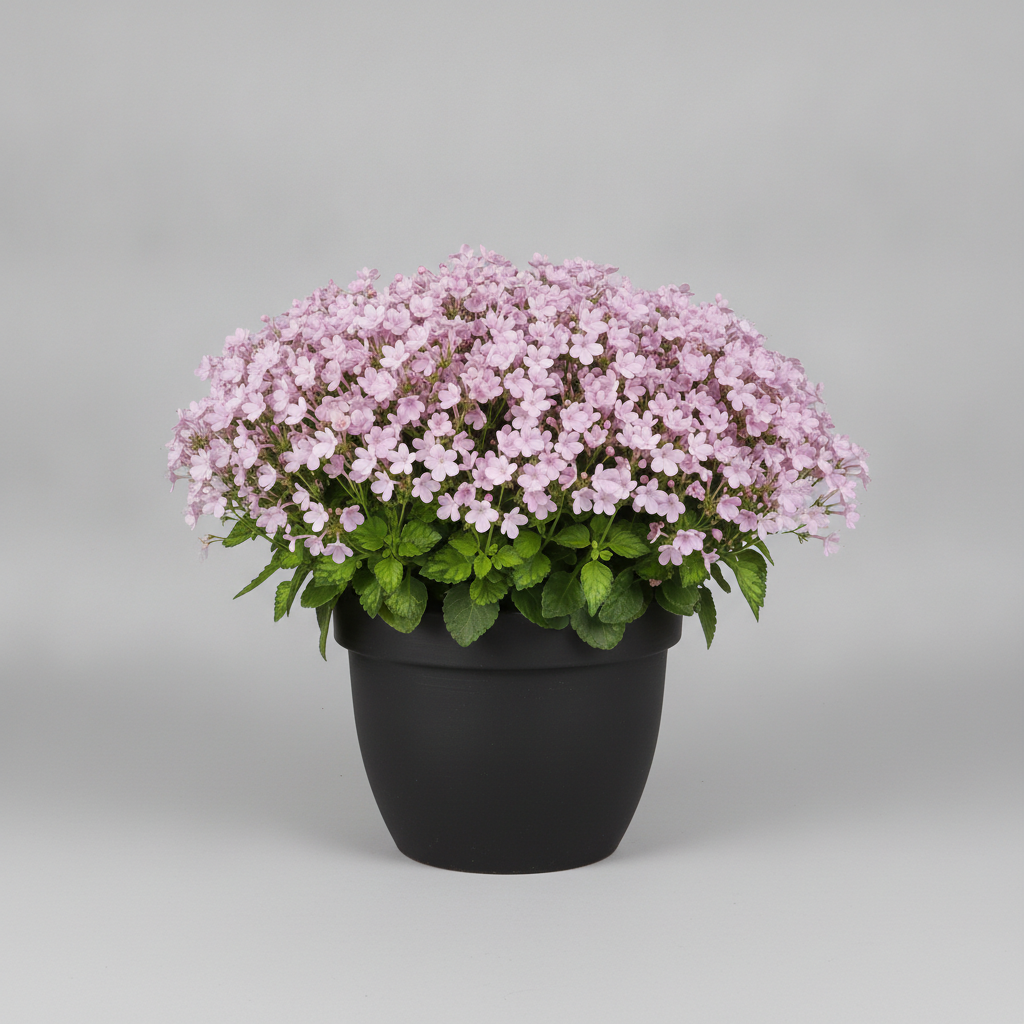
Cape Angels Pink
Part of a colourful series bred from the same lineage, Cape Angels Pink offers softer pale pink to lilac blooms on a neat, mounding, bushy plant. It brings a gentler palette while keeping all the easy-going habits of Mona Lavender.
Variety Profiles in Detail
Velvet Elvis (Plectranthus ‘Velvet Elvis’)
Velvet Elvis was developed to push the flower colour and size of the original further. Its spikes carry larger, more richly pigmented violet blooms, and the plant tends to stay slightly denser and more compact. Care is identical to Mona Lavender, and the two make handsome companions when grown side by side for a graded range of purples.
Cape Angels Pink (Plectranthus ‘Cape Angels Pink’)
The Cape Angels series extends the palette into pinks and paler lilacs. Cape Angels Pink forms a tidy, rounded plant smothered in soft pink flowers during the same autumn-to-spring window, and it responds to exactly the same light, water and feeding regime. It is often sold seasonally as a flowering pot plant.
Swedish Ivy (Plectranthus verticillatus)
A trailing cousin grown chiefly for its cascade of round, glossy green leaves rather than its modest flowers, Swedish ivy is a classic hanging-basket plant. It shares the family’s ease and rapid growth and roots just as readily from cuttings, making it a low-effort companion to the showier flowering forms.
Choosing the Right Variety for Your Space
For a bright windowsill that goes dark at night, the flowering forms, Mona Lavender, Velvet Elvis and the Cape Angels series, deliver colour through the dullest months and are the obvious choice. If you want a trailing plant for a shelf or hanging basket, Swedish ivy fits the bill, while the aromatic Cuban oregano bridges the gap between houseplant and kitchen herb. All of them thrive on the same simple routine, so you can build a varied little Plectranthus collection without complicating your care.
Frequently Asked Questions
Why is my Mona Lavender not flowering?
The two usual culprits are too little light and interrupted darkness. Mona Lavender is a short-day plant that flowers in response to long, uninterrupted nights, so a plant kept in a dim spot, or one exposed to lamplight through the evening, may never trigger. Give it bright, indirect light during the day and genuine darkness at night through autumn and winter, and blooms should follow.
Why has my plant become leggy and sparse?
Legginess is almost always a sign of insufficient light, with the plant stretching towards the nearest source. Move it somewhere brighter, and pinch back the long stems to encourage bushier growth. Because Mona Lavender naturally grows woody with age, many growers simply take fresh cuttings each spring and start over rather than trying to rejuvenate an old plant.
Should I pinch or prune my Mona Lavender?
Yes. Pinching out the growing tips of a young plant encourages it to branch and form a fuller, bushier shape, and removing spent flower spikes keeps it tidy and can prompt further blooming. A harder cut back after the main flowering flush, combined with good light, helps rejuvenate a plant that has begun to sprawl.
Is Mona Lavender an indoor or outdoor plant?
It can be both. In frost-free climates it makes an excellent bedding or container plant outdoors, but it is not hardy and will not survive freezing temperatures. In cooler regions it is grown as a houseplant, or moved outside for the summer and brought back in before the first frosts. Keep it above 10 degrees C (50 degrees F) to be safe.
How long does a Mona Lavender plant live?
Treated as a permanent houseplant it is relatively short-lived, tending to grow woody and less attractive after a year or two. Rather than a drawback, this is simply an invitation to propagate: because cuttings root so easily, most growers keep the plant going indefinitely by renewing it from fresh cuttings every spring, always having a young, vigorous specimen on the go.
Is Mona Lavender safe around pets?
Plectranthus species are generally regarded as non-toxic to cats and dogs, and the genus even includes edible culinary herbs. That said, no houseplant is intended to be eaten, and a pet that chews the aromatic leaves may suffer mild drooling or a stomach upset. Keep the plant out of reach of determined grazers and consult a vet if a pet eats a significant amount.
Why are the leaves losing their purple colour?
The rich purple leaf reverse depends on bright light to develop fully. In dim conditions the plant produces less of the pigment responsible and the undersides fade towards green, often alongside stretched, leggy growth. More light restores both the colour and the compact habit over time.
How often should I repot?
A vigorous young plant benefits from moving up a pot size once a year in spring, while an established one needs it only every couple of years, or when roots appear at the drainage holes and the soil dries very quickly. Since many people renew the plant from cuttings instead, frequent repotting is often unnecessary.






