
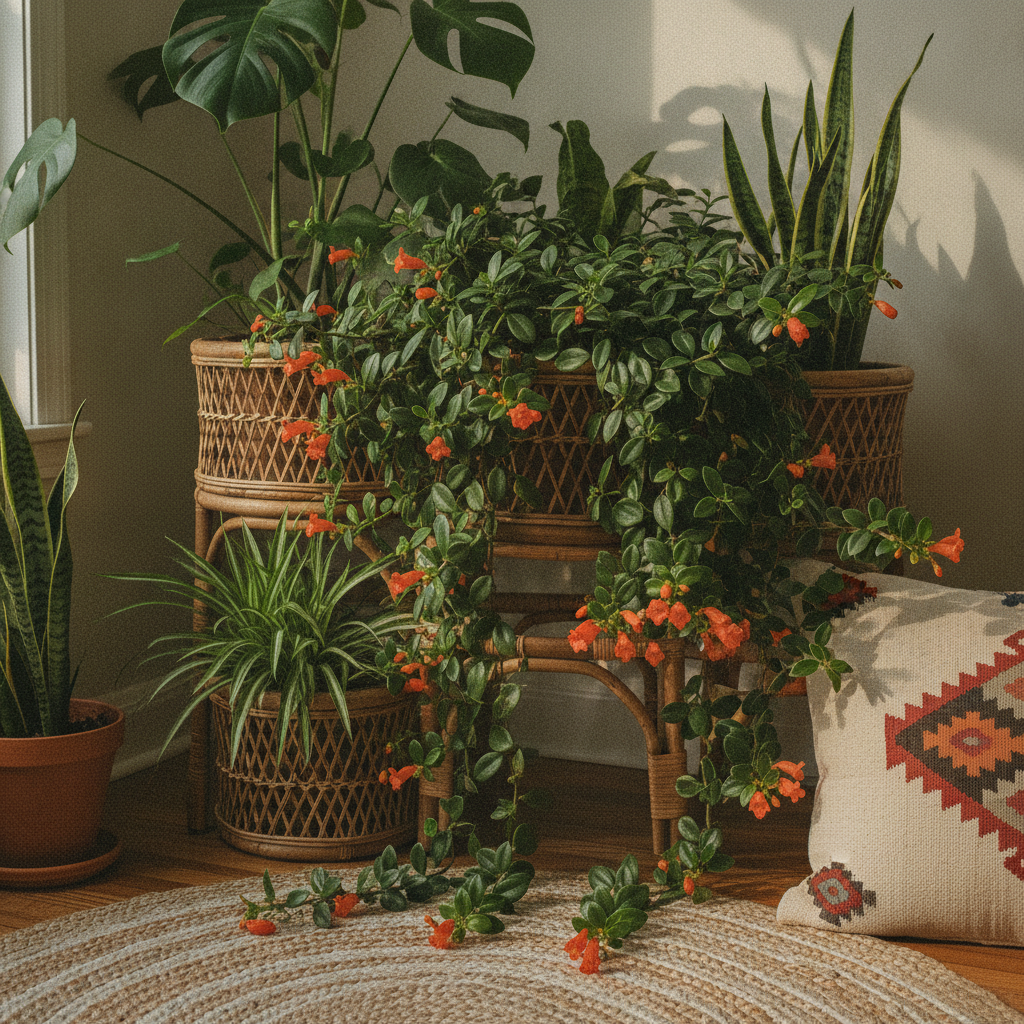
Few trailing houseplants earn their common name quite as literally as the goldfish vine. Botanically Nematanthus gregarius, a member of the African violet family Gesneriaceae, it produces dozens of small, pouched, orange-red flowers that bulge in the middle and pinch at the mouth, so that a well-grown plant in bloom looks as though a shoal of tiny goldfish has been caught mid-leap among the foliage. It is also sold as the goldfish plant, the goldfish basket plant, the guppy plant and, confusingly, under the old name Nematanthus gregarius was once lumped with the closely related Hypocyrta. Native to the humid coastal rainforests of south-eastern Brazil, it grows there as an epiphyte, perching on tree branches with its wiry stems cascading downward.
That epiphytic, trailing habit is the key to understanding it. This is a plant built for hanging baskets and high shelves, where its glossy, almost succulent leaves and near-constant flowers can spill over the edge. It has a reputation as a relatively forgiving flowering houseplant, more tolerant of neglect than its delicate blooms suggest, yet the gap between a goldfish vine that merely survives and one that truly thrives is wide. A struggling plant hangs on as a thin, leggy tangle with the occasional lonely flower; a thriving one becomes a dense, weeping cascade in bloom for much of the year. This guide covers everything that sits between those two outcomes, from light and watering through to soil, feeding, propagation and pests.
Contents
- Quick Reference
- Why Goldfish Vine Makes a Rewarding Houseplant
- Light Requirements
- Watering & Humidity
- Soil, Potting & Repotting
- Fertilising
- Propagation
- Pests & Diseases
- Popular Varieties
- Frequently Asked Questions
Quick Reference: Goldfish Vine at a Glance
| Light | Bright, indirect light with a little gentle morning sun; essential for flowering |
| Watering | Keep lightly moist in growth, letting the top 2 to 3cm (1in) dry; reduce in winter |
| Temperature | 18 to 27°C (65 to 81°F); avoid below 13°C (55°F) |
| Humidity | Moderate to high, ideally 50 per cent or more |
| Fertiliser | Balanced or bloom feed at half strength every 2 weeks in spring and summer |
| Toxicity | Non-toxic to cats, dogs and humans |
Why Goldfish Vine Makes a Rewarding Houseplant
The goldfish vine occupies an unusual niche among flowering houseplants: it blooms readily indoors, over a very long season, without demanding the cool winter rest or specialist conditions that many flowering species insist on. Given a bright position and steady care, a mature plant can carry flowers from late winter through to autumn, and sometimes beyond. The blooms themselves are small, rarely more than 2.5cm (1in) long, but they appear in profusion along the trailing stems, and their vivid orange stands out beautifully against the deep green, waxy foliage.
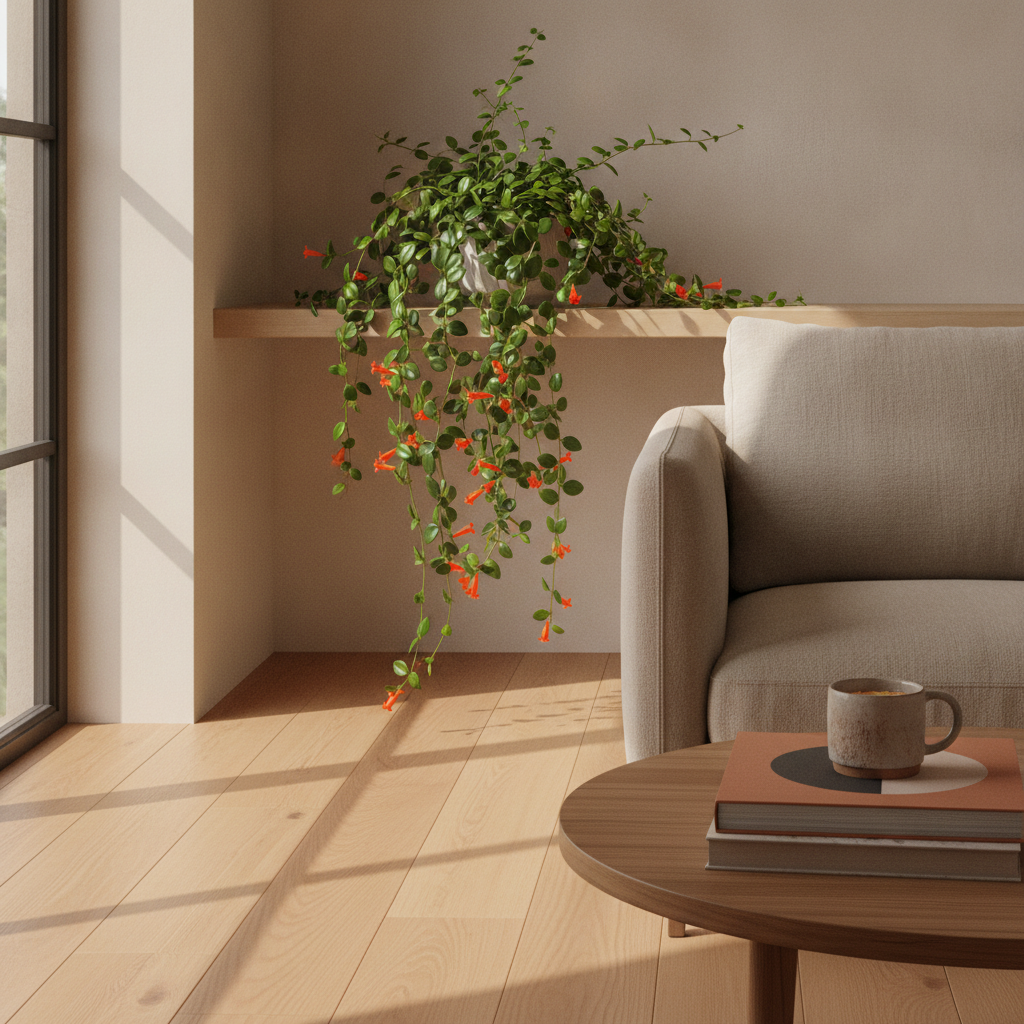
Beyond the flowers, the plant is genuinely easy-going compared with its Gesneriad relatives. The thick, slightly fleshy leaves store a little water, so it copes with the occasional missed watering better than a fern or a calathea would. It roots almost embarrassingly easily from cuttings, so a single plant can quickly become several. And because it naturally trails, it solves the perennial houseplant question of what to put on a high shelf or in a hanging position, filling vertical space with living colour rather than yet another upright pot. For anyone who wants blooms indoors but has been burned by fussier species, it is one of the most reliable entry points into flowering houseplants.
Important — Toxicity: The goldfish vine is considered non-toxic to cats, dogs and humans, and is not listed among plants of concern by the ASPCA. This makes it a sensible choice for homes with curious pets or children. As with any plant, nibbling on the foliage may still cause mild stomach upset simply because it is not a food, so it is best kept out of reach of determined chewers.
Light Requirements
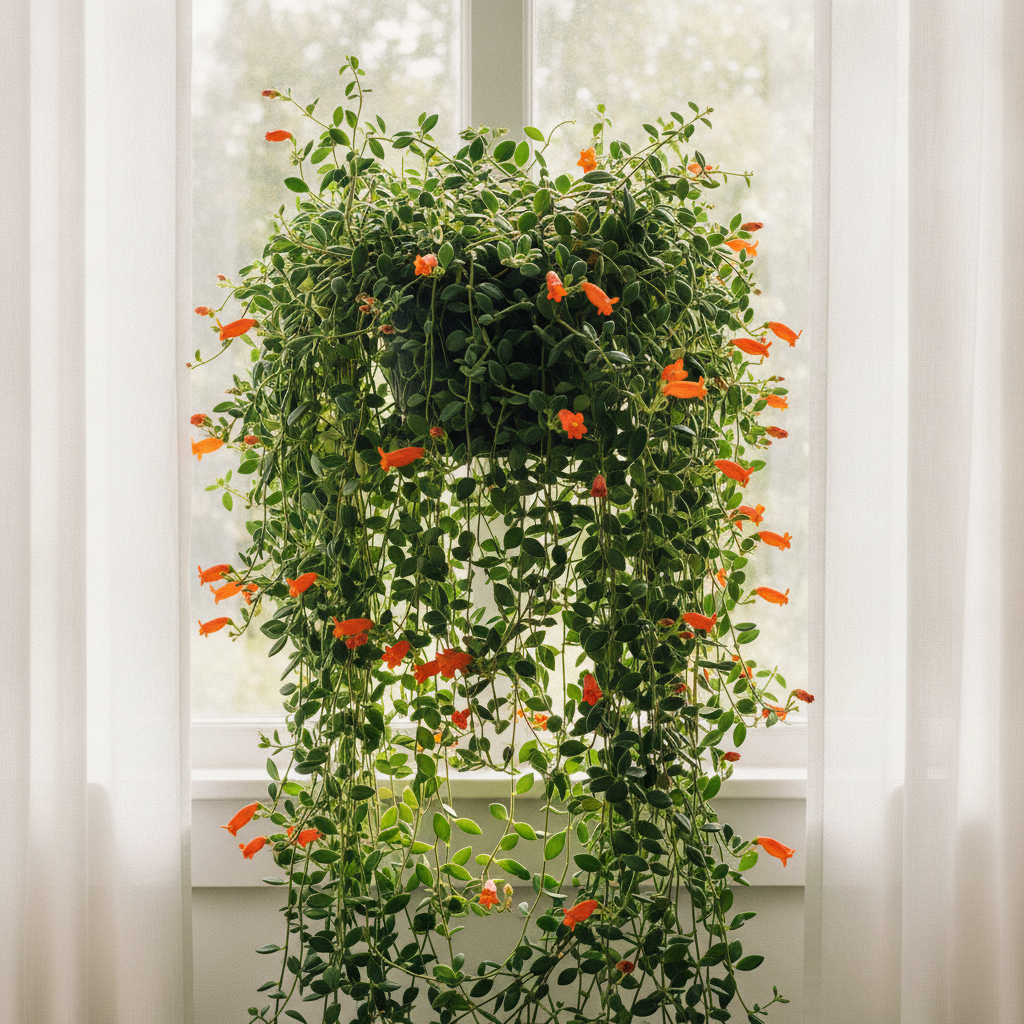
Light is the single most important factor in whether a goldfish vine flowers, and it is where most disappointing plants go wrong. In the wild the plant grows as an epiphyte in the dappled canopy of Brazilian rainforest, receiving bright but filtered light for much of the day. Indoors it wants the equivalent: plenty of brightness, but softened rather than the full glare of unobstructed midday sun.
The ideal is a position that is bright enough to cast a soft-edged shadow for most of the day, with perhaps an hour or two of gentle direct sun in the early morning. That level of light fuels the flower production the plant is grown for. In a dim corner it will survive and keep its leaves, but it will stretch, the internodes will lengthen, and flowering will dwindle to almost nothing. If your plant is all foliage and no flowers, insufficient light is the first thing to correct.
Light Levels Explained
Understanding roughly how much light different positions in a home provide makes it far easier to place the plant well. The values below are approximate, measured in lux, and are meant as a guide to relative brightness rather than precise thresholds.
| Light Category | Approx. Level | Typical Location | Outcome |
|---|---|---|---|
| Direct sun | 50,000 lux and above | On a south-facing sill in summer | Risk of scorched, faded leaves and dried flowers |
| Bright indirect | 10,000 to 25,000 lux | Near an east window or just back from a bright one | Ideal; strong growth and abundant flowering |
| Medium | 5,000 to 10,000 lux | A metre or two from a bright window | Healthy foliage, moderate flowering |
| Low | 1,000 to 5,000 lux | A dim corner or north-facing room | Leggy growth, few or no flowers |
| Very low | Below 1,000 lux | Interior wall away from windows | Slow decline; not suitable long term |
Window Orientation and Placement
South-facing window: Very bright, and often too intense directly on the glass in summer. Set the plant back a metre (3ft) or diffuse the light with a sheer curtain. In winter, when the sun is weaker and lower, a south window can be an excellent spot right at the sill.
East-facing window: Often the best choice. The plant receives soft, cool morning sun followed by bright indirect light for the rest of the day, which suits its rainforest-canopy preferences almost exactly.
West-facing window: A good option, offering bright light and some warm afternoon sun. Watch for overheating behind glass on hot afternoons, and pull the plant back slightly if the leaves feel hot to the touch.
North-facing window: Usually too dim for good flowering, though the plant will hold its foliage. If a north window is all you have, consider supplementing with a grow light to coax out blooms.
Pro Tip — Rotate for Even Growth: Give the pot a quarter turn each time you water. Trailing stems reach towards the light and a plant left facing one way becomes lopsided, with bare stems on the shaded side. Regular rotation keeps the cascade full all the way around.
How Light Affects Flowering
Unlike variegated foliage plants, where light governs leaf colour, the goldfish vine channels light almost directly into flowers. Bright, consistent light triggers the plant to set buds along the stems, so the difference between a shaded and a well-lit plant is measured in blooms rather than leaf markings. Increasing light gradually over a couple of weeks, rather than moving the plant suddenly into a much brighter spot, is the reliable way to lift a shy bloomer into flower without shocking it.
Warning — Direct Sunlight: Prolonged, unfiltered midday sun through glass can scorch the waxy leaves, leaving bleached or brown patches that never recover, and can shrivel open flowers within hours. If you want to move a plant from a shaded spot into full sun, acclimatise it over ten to fourteen days to avoid burning the foliage.
Artificial Lighting
The goldfish vine responds well to supplemental lighting, which makes it a good candidate for rooms short on natural brightness. A full-spectrum LED grow light positioned 30 to 45cm (12 to 18in) above the plant, run for twelve to fourteen hours a day, provides enough energy to sustain flowering through dark winter months. Because the plant trails, a light angled to reach the whole cascade, rather than only the crown, gives the most even results.
Seasonal Adjustments
Light levels indoors fall sharply between summer and winter, and the goldfish vine notices. In the darker months, move the plant closer to its window, or into a brighter one, to keep it ticking over. As the days lengthen again in spring, watch for scorch as the strengthening sun reaches further into the room, and be ready to pull the plant back or add a sheer screen. Matching your care to the season keeps the plant in balance rather than lurching between too little and too much light.
Watering & Humidity
Watering a goldfish vine is a balancing act between its two natures. As an epiphyte it dislikes sitting in soggy compost, yet its thin trailing stems and abundant leaves lose water steadily, so it does not tolerate the long droughts a true succulent shrugs off. The aim is compost that stays lightly and evenly moist during active growth, never waterlogged and never bone dry.
When to Water
Water when the top 2 to 3cm (about 1in) of compost has dried but the layer beneath is still faintly moist. The simplest test is your finger: push it into the surface, and if it comes out with no compost clinging and feels dry, it is time to water. During the warm, bright months of active growth this may mean watering once or twice a week; the exact frequency depends on your light, warmth and pot size, so test rather than water on a fixed schedule.
In winter, as growth slows and light fades, the plant uses far less water. Let a little more of the compost dry between waterings, but do not allow the rootball to dry out completely, which causes leaf drop. The thick leaves are a useful gauge: when they start to look slightly less plump and firm, the plant is ready for a drink.
Pro Tip — Lukewarm Water: Goldfish vines resent cold water on their roots, which can cause a check to growth and even leaf spotting. Use water at room temperature, and let tap water stand for a few hours so it warms and any chlorine dissipates before it reaches the plant.
How to Water Correctly
- Check the compost first, watering only once the top 2 to 3cm (1in) has dried.
- Water at the compost surface, taking care to avoid constantly wetting the crown and open flowers.
- Add water steadily until it runs freely from the drainage holes, which ensures the whole rootball is moistened.
- Let the pot drain fully for several minutes so no excess collects at the base.
- Empty the saucer or cache-pot; never leave the plant standing in a reservoir of water.
- Wait until the surface has dried again before repeating, rather than topping up little and often.
Signs of Overwatering vs. Underwatering
| Symptom | Overwatering | Underwatering |
|---|---|---|
| Leaf colour | Yellowing, often lower leaves first | Dull, then browning at the tips and edges |
| Leaf texture | Soft, limp, sometimes translucent | Thin, wrinkled, less plump than usual |
| Leaf drop | Green leaves fall while still soft | Crisp leaves drop after wilting |
| Compost | Stays wet for days, may smell sour | Dries out fast and pulls from the pot edge |
| Stem base | Dark, mushy, may collapse | Firm but dry, stems shrivel slowly |
Warning — Root Rot: The most common way to kill a goldfish vine is by keeping it too wet. Compost that never dries starves the roots of air and invites fungal rot, which spreads upward into the stems. If you find soft, blackened roots when checking the plant, cut away every affected part, repot into fresh airy compost, and water sparingly until new growth signals recovery.
Humidity Requirements
As a rainforest native the goldfish vine prefers humidity above the level of most centrally heated homes. It is happiest at 50 per cent relative humidity or more, though it adapts to average household air better than many of its Gesneriad cousins thanks to those waxy, moisture-retaining leaves. Very dry air, particularly near radiators in winter, is the main humidity-related problem you will encounter.
When the air is too dry, leaf edges may brown, flower buds can drop before opening, and the plant becomes more attractive to spider mites. These are the early warnings to watch for, especially through the heating season.
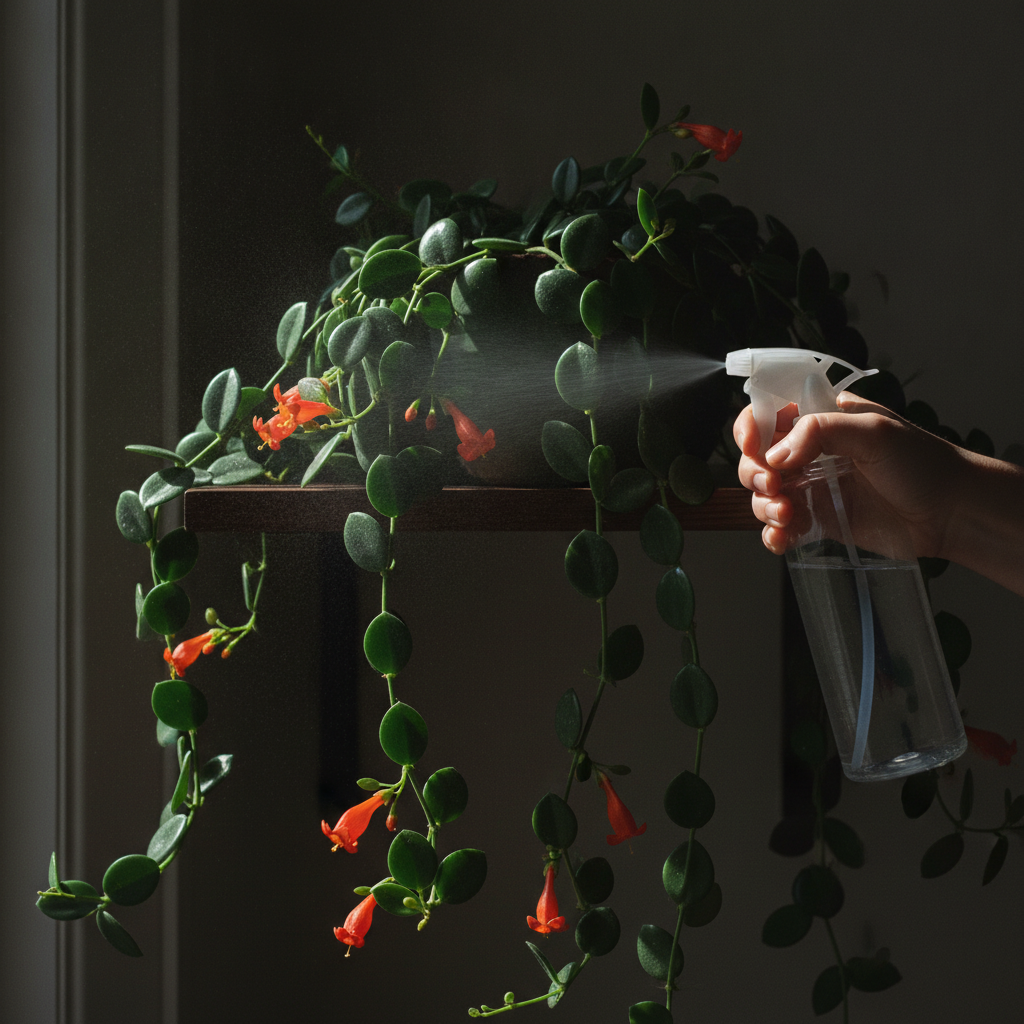
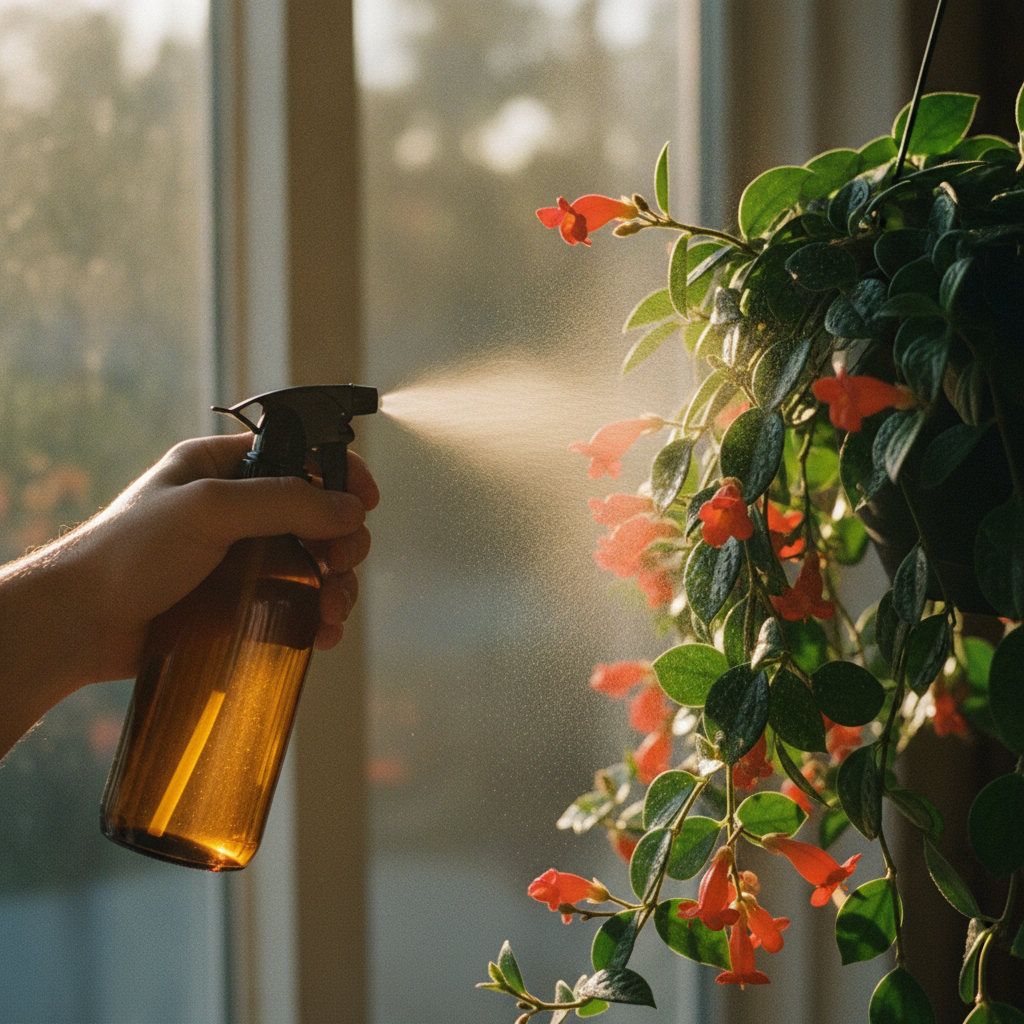
Raising humidity is straightforward. Grouping plants together creates a moister microclimate, and standing the pot on a tray of damp pebbles, with the pot base clear of the water, lifts local humidity without wetting the roots. A humidifier is the most effective option in a very dry room. Light misting can help in the short term, but avoid soaking open flowers, which can mark and rot if kept wet.
Water Quality
Goldfish vines are moderately sensitive to the minerals and chlorine in hard tap water, which over time can build up as leaf-tip browning and a crust on the compost surface. Where your water is very hard, using filtered water, cooled boiled water or collected rainwater keeps the foliage cleaner and the roots happier. If tap water is your only option, letting it stand overnight before use allows chlorine to disperse and brings it to a gentler room temperature.
Soil, Potting & Repotting
Because it grows on tree branches in the wild rather than in the ground, the goldfish vine needs a potting mix that mimics the loose, fast-draining, airy material that collects around epiphyte roots. A heavy, water-retentive compost suffocates the roots and is the surest route to rot. Light and open is the guiding principle.
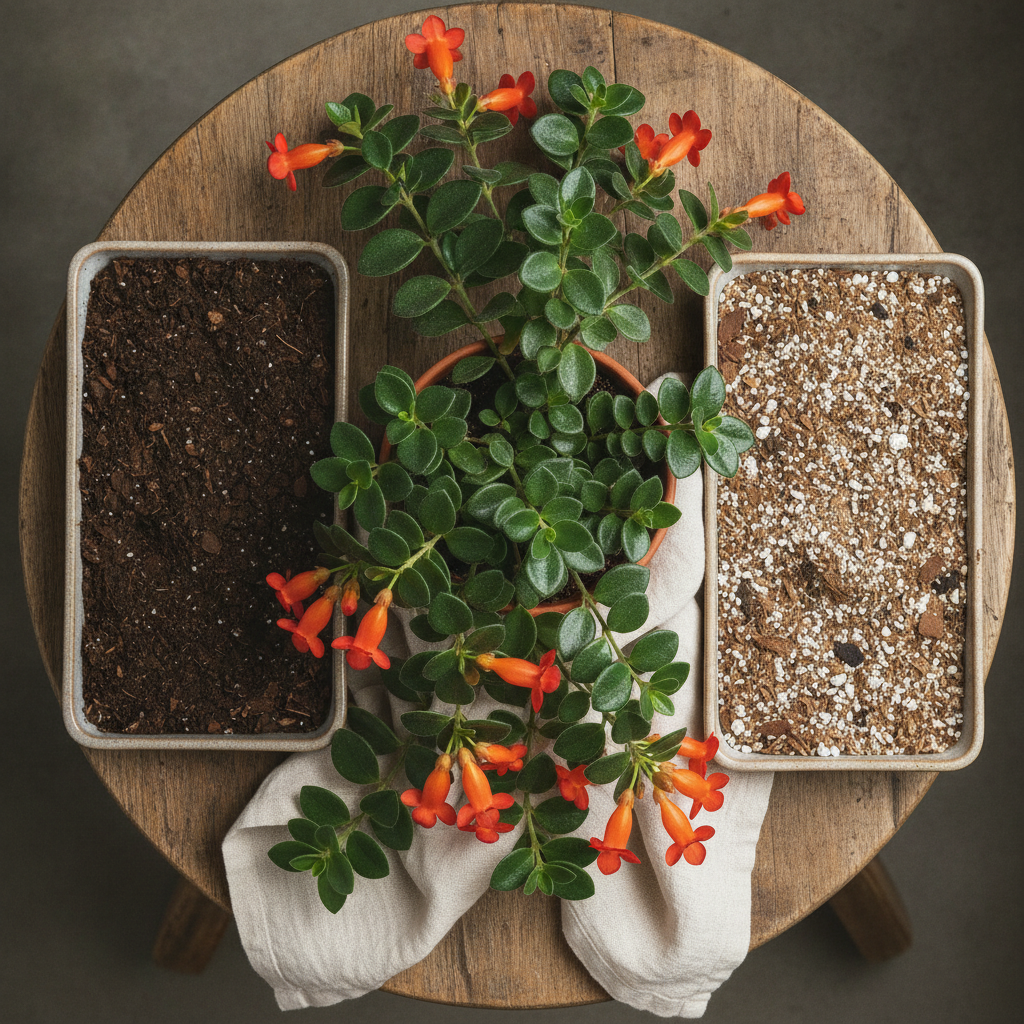
Ideal Soil Composition
A good goldfish vine mix drains freely yet holds a little moisture, and stays open enough for air to reach the roots. You can build one from a peat-free base such as coir or a quality houseplant compost, lightened generously with perlite and a handful of fine orchid bark. The bark in particular recreates the chunky, epiphytic root run the plant evolved for.
| Component | Proportion | Function |
|---|---|---|
| Coir or peat-free houseplant compost | 50 per cent | Holds moisture and provides body and nutrients |
| Perlite | 30 per cent | Opens the mix for drainage and aeration |
| Fine orchid bark | 20 per cent | Adds chunky structure and mimics epiphytic conditions |
The plant prefers a slightly acidic to neutral compost, roughly pH 6.0 to 7.0, which most peat-free and coir-based mixes fall within naturally. There is no need to test or adjust pH for the average houseplant grower; simply avoid heavy, alkaline garden soils.
Pro Tip — Quick Mix Recipe: For a fast, reliable blend, combine two handfuls of houseplant compost, one handful of perlite and one handful of fine orchid bark. It drains in seconds when watered yet stays lightly moist for days, which is exactly what a goldfish vine wants.
Choosing the Right Pot
Pot choice affects how quickly the compost dries and how healthy the roots stay. Because the goldfish vine trails, a hanging pot or a raised position is ideal, and the container should suit both the plant’s modest root system and its need for good drainage.
Drainage holes are non-negotiable. Whatever the material or style, the pot must have holes at the base. Without them water collects unseen at the bottom and the roots rot. Decorative cache-pots are fine as an outer cover, provided you lift the inner pot out to water and drain, and never let it sit in collected water.
Pot material: Plastic and glazed ceramic retain moisture longer and suit the plant’s preference for lightly moist compost, making them a good default for hanging displays where they also keep the weight down. Unglazed terracotta breathes and dries faster, which can help heavy-handed waterers but means more frequent watering in warm rooms.
Pot size: The goldfish vine actually flowers better when slightly pot-bound, so resist the urge to over-pot. Choose a container only 2 to 3cm (1in) wider than the current one when moving up, and no larger. A pot that is too big holds a reservoir of wet compost the small root system cannot use, and that excess moisture invites rot.
When to Repot
Expect to repot every two to three years, or when roots begin to grow from the drainage holes and the plant dries out unusually fast after watering. Spring, as growth resumes, is the best time. Because slight crowding encourages flowering, many growers refresh the top few centimetres of compost each spring and only move up a pot size when the plant is clearly congested, rather than repotting on a rigid schedule.
How to Repot: Step-by-Step
- Water the plant a day beforehand so the rootball holds together and slides out cleanly.
- Ease the plant from its pot by supporting the crown and tipping it, rather than pulling on the stems.
- Tease away loose old compost from around the roots and inspect them, trimming any that are soft, dark or dead.
- Add a layer of fresh airy mix to a pot only slightly larger, then position the plant at its previous depth.
- Fill around the rootball with compost, firming gently so there are no large air pockets but the mix stays loose.
- Water thoroughly, let it drain fully, and return the plant to bright indirect light.
- Hold off feeding for four to six weeks while the roots settle into the fresh compost.
Warning — Transplant Shock: A goldfish vine may sulk for a week or two after repotting, dropping a few leaves or pausing its growth. Resist the temptation to fix this with extra water or feed, which only stresses recovering roots. Keep conditions stable, water lightly, and let the plant re-establish at its own pace.
Fertilising
A goldfish vine in flower is working hard, and steady feeding through the growing season keeps the display going and the foliage rich green. The plant is not a heavy feeder, however, and its fine roots are easily burned by strong fertiliser, so the watchword is little and often at reduced strength rather than occasional heavy doses.
Feeding is seasonal. Through spring and summer, when the plant is actively growing and blooming, regular dilute feed pays off in more flowers. In autumn and winter, as growth slows, feeding should taper off almost entirely, since fertiliser the plant cannot use simply accumulates as damaging salts in the compost.
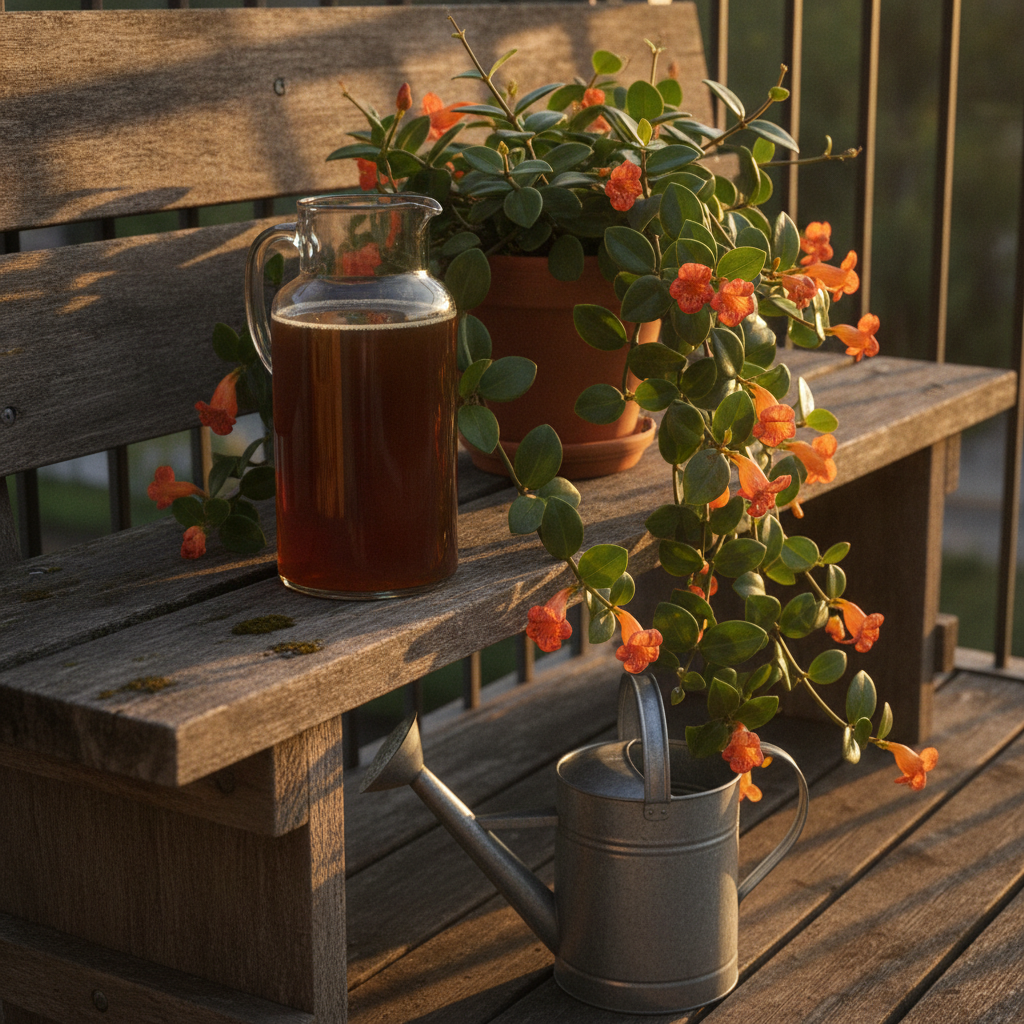
Understanding Plant Nutrients
Fertilisers are labelled with an NPK ratio, the proportions of nitrogen, phosphorus and potassium they contain. Nitrogen drives leafy growth, phosphorus supports roots and flowering, and potassium underpins overall vigour and bloom quality. For a flowering plant like the goldfish vine, a balanced feed works well for general growth, while a formula slightly higher in potassium and phosphorus can encourage heavier flowering. Beyond the big three, several secondary nutrients matter too, as the table shows.
| Nutrient | Symbol | Primary Function | Deficiency Symptoms |
|---|---|---|---|
| Nitrogen | N | Leaf and stem growth | Pale, yellowing older leaves; weak growth |
| Phosphorus | P | Root development and flowering | Poor blooming, dull foliage, stunted roots |
| Potassium | K | Overall vigour and flower quality | Browning leaf edges, few flowers |
| Calcium | Ca | Cell wall strength | Distorted new leaves, weak stems |
| Magnesium | Mg | Core of the chlorophyll molecule | Yellowing between the veins of older leaves |
| Iron | Fe | Chlorophyll production | Yellowing between veins on new leaves |
Types of Fertiliser
Liquid fertilisers: The easiest choice for a goldfish vine, mixed into the watering can and applied at half the recommended strength. They act quickly and let you match feeding to growth, ramping up in spring and stopping in autumn. A balanced houseplant feed or a flowering-plant formula both work well.
Slow-release granular: Coated pellets that release nutrients gradually over several months, stirred into the compost or scattered on the surface in spring. Convenient for those who forget to feed, though they offer less control and can over-supply a plant that prefers a light diet.
Organic fertilisers: Options such as worm-castings, seaweed extract or diluted compost tea feed gently and improve the compost, with little risk of burning the roots. They release nutrients more slowly and unevenly, so pair them with steady watering for best effect.
Feeding Schedule
Through spring and summer, feed roughly every two weeks with a balanced or bloom-focused liquid fertiliser at half strength. As light fades in autumn, reduce to once a month, then stop altogether over winter while the plant rests. Resume in early spring as new growth appears. This rhythm mirrors the plant’s own cycle and avoids feeding it when it cannot make use of the nutrients.
Pro Tip — Half Strength Always: Goldfish vine roots are fine and easily scorched, so mix feed at half the dose on the label even during peak growth. Regular weak feeding produces steadier results and far fewer problems than occasional full-strength doses, which can burn the roots and brown the leaf edges.
How to Fertilise
- Water the plant lightly first if the compost is dry, so feed never hits parched roots.
- Mix the fertiliser to half the recommended strength in room-temperature water.
- Apply to the compost until it moistens evenly, avoiding splashing the feed onto leaves and flowers.
- Let any excess drain away and empty the saucer so salts do not concentrate at the base.
- Every month or two, flush the pot with plain water to wash out accumulated mineral salts.
Warning — Salt Build-Up: A white crust on the compost or around the pot rim is a sign of accumulated fertiliser salts, which brown the leaf tips and stress the roots. Flush the pot occasionally by running plain water through it until it drains freely from the base, and always empty the saucer afterwards.
Propagation
Propagation is one of the goldfish vine’s great pleasures, because it roots so willingly from cuttings that even a first attempt usually succeeds. It is also the way to keep an ageing plant looking its best: older specimens tend to go bare at the base, and starting fresh plants from young stem tips lets you replace a leggy parent with a full, bushy replacement.
The best time to take cuttings is spring or early summer, when the plant is in active growth and cuttings root fastest. Material trimmed during routine pinching and tidying is ideal, so propagation and pruning naturally go hand in hand.
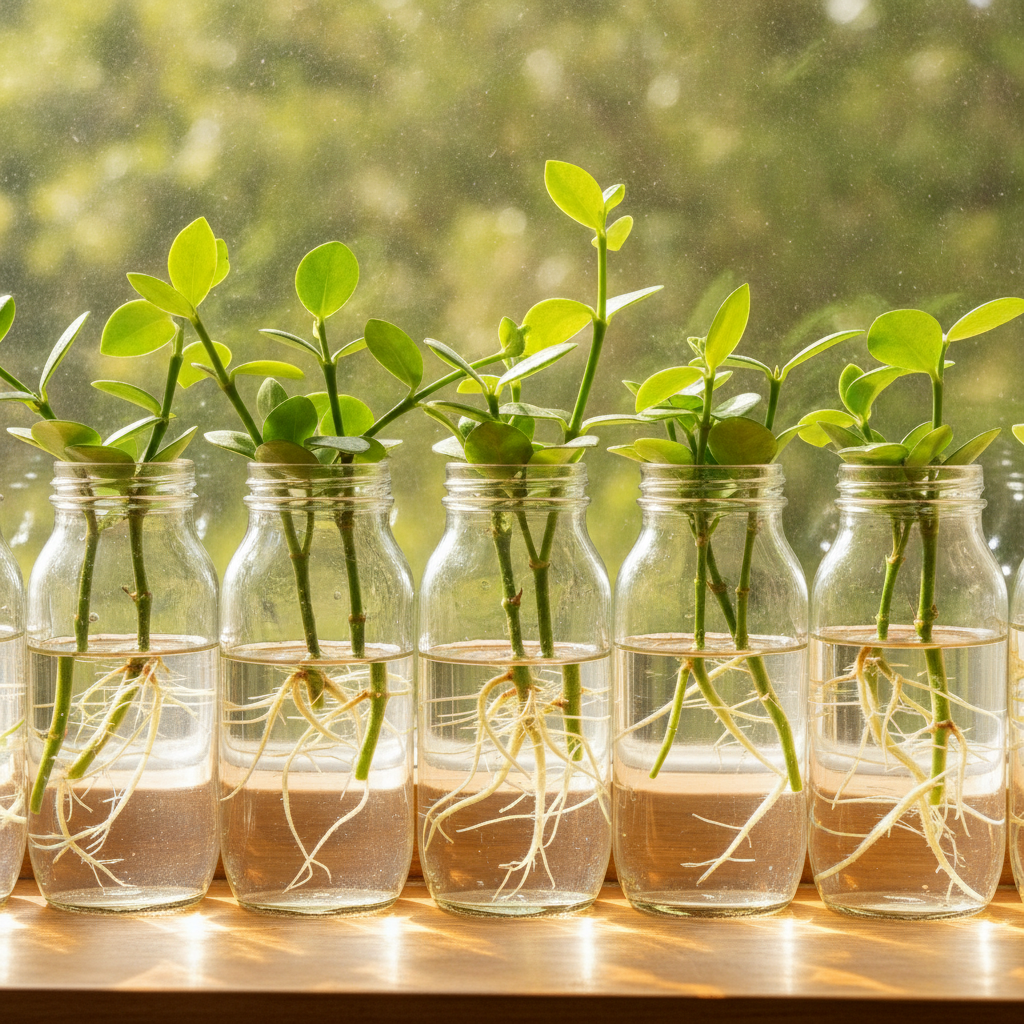
Understanding Nodes and Stem Tips
A node is the point on a stem where leaves emerge, and it is here that new roots form. A successful cutting is simply a healthy stem tip a few centimetres long with several nodes, the lowest of which is stripped of leaves and buried in water or compost. Because the goldfish vine produces roots readily along its trailing stems, almost any vigorous tip will strike, provided it has at least two or three nodes to work with.
Water Propagation: Step-by-Step
Rooting in water is the most visible and beginner-friendly method, letting you watch the roots develop before potting up.
- Cut a healthy stem tip 8 to 10cm (3 to 4in) long, just below a node, using clean scissors.
- Strip the leaves from the lowest one or two nodes, leaving the upper leaves intact.
- Stand the cutting in a small glass of room-temperature water so the bare nodes are submerged but the leaves stay dry.
- Place it in bright indirect light and refresh the water every few days to keep it clear.
- Once roots reach 2 to 3cm (1in) long, usually within two to four weeks, pot the cutting into airy compost.
- Keep the newly potted cutting lightly moist for its first couple of weeks while it adjusts to soil.
Pro Tip — Pot Several Together: For a full, showy plant fast, root several cuttings at once and pot three to five of them together into a single container. A cluster of young cuttings fills out into a dense, well-branched plant far more quickly than a single stem ever could.
Soil Propagation: Step-by-Step
Rooting directly in compost skips the transplant stage and often produces sturdier roots suited to soil from the start.
- Take a stem tip as above and strip the lowest leaves to expose two nodes.
- Dip the cut end in rooting hormone if you have it, though the goldfish vine usually roots well without.
- Insert the bare nodes into a small pot of moist, airy propagation mix and firm gently.
- Cover loosely with a clear bag or propagator lid to hold humidity, keeping the cover off the leaves.
- Set in bright indirect light and keep the mix lightly moist but never soggy.
- After three to four weeks, a gentle tug that meets resistance shows roots have formed and the cover can come off.
Troubleshooting Propagation
| Problem | Likely Cause | Solution |
|---|---|---|
| Cutting rots in water | Water left stale, or a leaf submerged and decaying | Change the water often and keep all leaves above the surface |
| No roots after a month | Too cool, too dark, or a weak cutting | Move to a warmer, brighter spot and use vigorous new growth |
| Cutting wilts in soil | Mix too dry or humidity too low | Keep lightly moist and cover to raise humidity while rooting |
| Roots form but growth stalls | Potted on too soon or into too rich a mix | Wait for sturdy roots and pot into a light, airy compost |
Pests & Diseases
A healthy, well-grown goldfish vine is reasonably resistant to pests, but no houseplant is immune, and the dense trailing foliage can hide early infestations if you do not look. The most common attackers are the usual sap-suckers of the indoor garden, drawn to soft new growth and stressed plants in particular.
Prevention beats cure, and the single best habit is regular inspection. Turn a few stems over each time you water and check the leaf undersides and the crown, where trouble usually starts. Catching a problem in its first days makes it far easier to clear than a colony that has spread through the whole plant.
Common Pests
Aphids (Aphidoidea)
Small green, black or pinkish insects that cluster on soft new shoots and flower buds, sucking sap and leaving a sticky honeydew. They are especially fond of the tender growth a flowering goldfish vine produces, and heavy infestations distort buds and stunt young stems.
Treatment: Rinse them off under a gentle stream of lukewarm water, then spray with insecticidal soap or a diluted neem-oil solution, repeating every week until clear. Check flower buds carefully, where they like to hide.
Spider Mites (Tetranychus urticae)
Tiny sap-sucking mites that thrive in warm, dry air, leaving fine pale stippling on the leaves and, in bad cases, delicate webbing between stems. They are one of the most likely pests to appear when household humidity drops through the heating season.
Treatment: Raise humidity, wipe the foliage, and treat with neem oil or a miticide, covering the leaf undersides thoroughly. Repeat treatments are needed to break the fast breeding cycle.
Mealybugs (Pseudococcidae)
Slow-moving insects that look like small tufts of white cotton wool, tucked into leaf axils and along stems. They feed on sap and secrete honeydew, and their waxy coating makes them stubborn to shift.
Treatment: Dab each one with a cotton bud dipped in surgical spirit, then follow up with neem oil or insecticidal soap across the whole plant. Inspect weekly, as survivors quickly rebuild the colony.
Common Diseases
Root Rot (Pythium and Phytophthora)
The most serious threat to a goldfish vine, caused by compost kept too wet for too long. The roots turn soft, brown and mushy, and the damage shows above ground as yellowing, wilting foliage that does not respond to watering.
Treatment: Unpot the plant, cut away all soft and blackened roots, and repot into fresh airy compost in a clean pot. Water sparingly afterwards and improve drainage to prevent a recurrence.
Botrytis (Botrytis cinerea)
A grey, fuzzy mould that appears on flowers, buds and leaves in cool, damp, still air, often after water has sat on the blooms. It rots the affected tissue and spreads readily in crowded, poorly ventilated conditions.
Treatment: Remove and dispose of every affected part, improve air circulation, and avoid wetting the flowers when watering. Reducing humidity around the blooms and spacing plants apart usually halts its spread.
Pest and Disease Summary
| Pest / Disease | Identification | Treatment |
|---|---|---|
| Aphids | Clusters on new shoots and buds, sticky honeydew | Rinse off, then insecticidal soap or neem oil weekly |
| Spider mites | Pale stippling and fine webbing, worse in dry air | Raise humidity and treat with neem oil or miticide |
| Mealybugs | White cottony tufts in leaf axils and along stems | Surgical spirit on a cotton bud, then neem oil |
| Root rot | Soft brown roots, yellowing and wilting top growth | Cut away rot, repot in fresh airy mix, water less |
| Botrytis | Grey fuzzy mould on damp flowers and leaves | Remove affected parts, improve airflow, keep blooms dry |
Prevention Strategies
Most pest and disease problems trace back to stress or poor conditions, so the healthiest goldfish vine is also the most resistant one. Right light, careful watering and good air movement together prevent the great majority of issues before they start. Keep the foliage clean, avoid the extremes of soggy compost and parched dry air, and remove spent flowers and fallen leaves that would otherwise harbour mould.
Quarantine matters too. Any new plant can carry pests that spread to the rest of your collection, so keep new arrivals apart for a couple of weeks and inspect them before moving them in alongside established plants. A little vigilance at the door saves a great deal of trouble later.
Pro Tip — Neem as Routine: A light monthly spray of diluted neem oil, applied in the evening out of direct sun and covering the leaf undersides, works as an effective preventative. It deters the common sap-suckers before they establish, and keeps the glossy foliage clean and healthy.
Popular Varieties
The goldfish vine has given rise to a handful of named cultivars, selected mostly for leaf form, variegation and flower colour. They share the same easy trailing habit and care needs, so choosing between them is largely a matter of looks. It is worth noting that several unrelated plants in the genus Columnea are also sold as goldfish plants, so check the botanical name if you want true Nematanthus gregarius.
The species itself, with its glossy green leaves and bright orange flowers, remains the most widely grown and the easiest to find. The cultivars below add variegation, deeper foliage or bolder flower markings for those wanting something a little different.
| Variety | Leaf Appearance | Light Needs | Growth Rate | Availability |
|---|---|---|---|---|
| Species (N. gregarius) | Small, glossy, deep green | Bright indirect | Moderate to fast | Common |
| ‘Variegata’ | Green edged and splashed cream-yellow | Bright indirect | Moderate | Occasional |
| ‘Tropicana’ | Deep green, glossy | Bright indirect | Moderate to fast | Occasional |
| ‘Black Gold’ | Very dark, almost black-green | Bright indirect | Moderate | Uncommon |
| ‘Christmas Holly’ | Small, dense, glossy green | Bright indirect | Compact | Uncommon |
| ‘San Remo’ | Green with a vigorous trailing habit | Bright indirect | Fast | Uncommon |
Featured Varieties
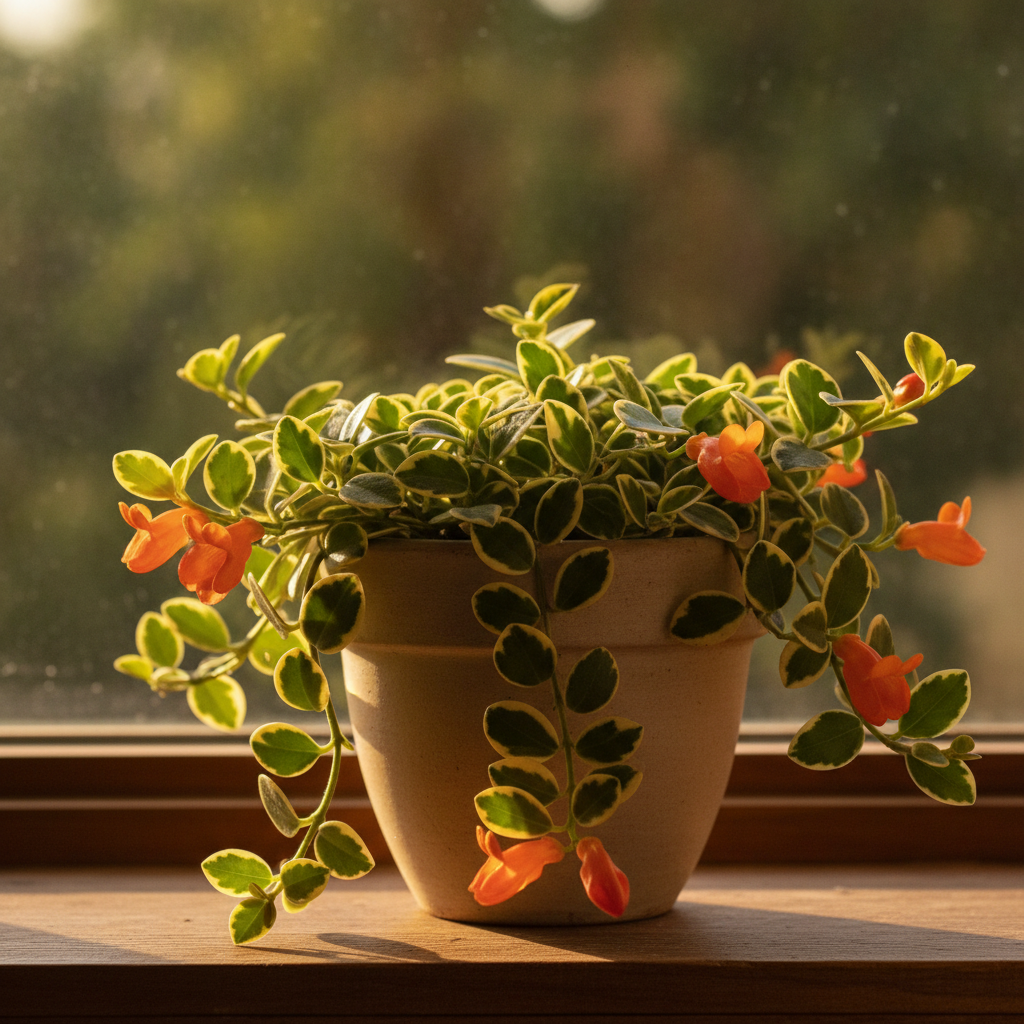
‘Variegata’
The showiest of the cultivars, its glossy leaves irregularly margined and splashed with creamy-yellow. The variegation lifts the whole plant, and the orange flowers stand out even more vividly against the two-tone foliage. It needs slightly brighter light than the plain species to keep its markings strong.
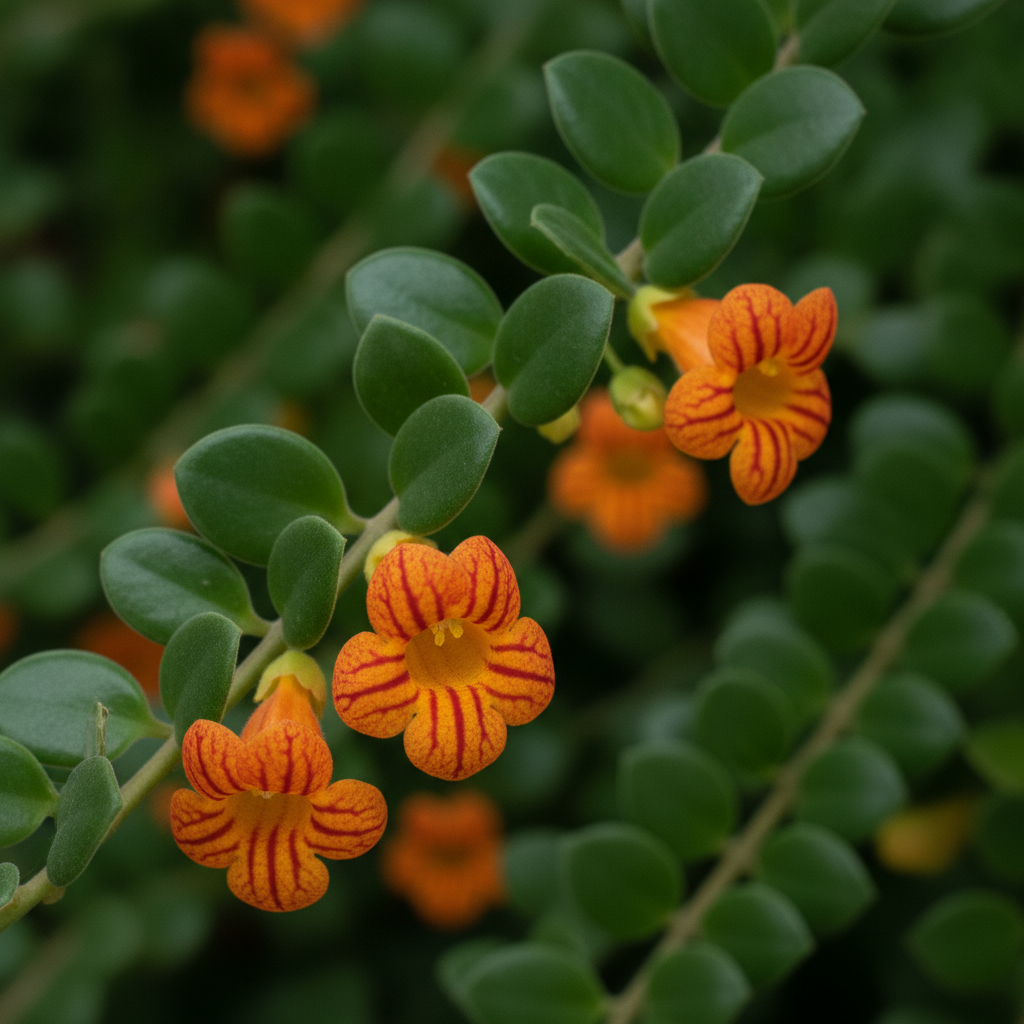
‘Tropicana’
Grown for its striking flowers, which are larger than the species and boldly striped and marbled with maroon-red over orange. Backed by deep green, glossy foliage on a vigorous trailing plant, it is one of the most eye-catching goldfish vines when in full bloom.
Variety Profiles in Detail
‘Black Gold’ (Nematanthus gregarius ‘Black Gold’)
Prized for its unusually dark foliage, so deep a green it can read as near-black in lower light, against which the orange flowers glow. It is a little slower and more compact than the species, and the dark leaves show their best colour in bright, even light.
‘Christmas Holly’ (Nematanthus gregarius ‘Christmas Holly’)
A dense, small-leaved cultivar with a neat, compact habit that suits smaller spaces and tabletop pots as well as hanging baskets. The tightly packed glossy leaves and free-flowering nature make it a tidy, well-behaved choice.
Choosing the Right Variety for Your Space
For a first goldfish vine, the plain species is the easiest to source and to grow, and it flowers as freely as any. If you have bright light and want more visual interest, ‘Variegata’ brings patterned foliage, while ‘Tropicana’ offers the boldest flowers. Where space is tight, the compact ‘Christmas Holly’ keeps the trailing charm in a smaller package. Whichever you choose, the care is the same, so let looks and availability guide the decision.
Frequently Asked Questions
Why is my goldfish vine not flowering?
Almost always the cause is too little light. The goldfish vine needs bright, indirect light to set flower buds, and in a dim spot it will grow leaves happily but bloom little or not at all. Move it closer to a bright window or add a grow light, feed it through the growing season with a bloom-focused feed, and allow it to become slightly pot-bound, which also encourages flowering.
Why is my goldfish vine dropping leaves?
Leaf drop usually signals a watering or temperature problem. Soft yellow leaves falling point to overwatering, while crisp leaves dropping after wilting suggest the rootball dried out too far. Sudden drops of many leaves often follow a cold draught, a chilly windowsill in winter or a sharp change in conditions. Steady watering and stable warmth generally settle it.
How often should I water a goldfish vine?
Water when the top 2 to 3cm (1in) of compost has dried, which in bright, warm conditions often means once or twice a week, and less in winter. Rather than following a fixed schedule, test the compost with your finger each time, since the right frequency depends on your light, warmth, pot and season.
Is the goldfish vine safe for cats and dogs?
Yes. Nematanthus gregarius is considered non-toxic to cats, dogs and humans, and does not appear on the ASPCA’s list of toxic plants. It is a sensible choice for pet households, though it is still wise to discourage pets from chewing the foliage, which can cause mild stomach upset simply because it is not food.
How do I make my goldfish vine bushier?
Pinch out the growing tips regularly during spring and summer. Removing the tip of a stem encourages it to branch from the nodes below, so frequent pinching produces a fuller, denser plant over time. The tips you remove root easily as cuttings, which can be potted back into the same container to thicken it further.
Why are the leaf tips turning brown?
Brown leaf tips usually mean the air is too dry, the compost has been allowed to dry out too far, or mineral salts have built up from hard water or over-feeding. Raise the humidity, keep watering more consistent, and flush the pot occasionally with plain water to wash out accumulated salts.
What temperature does a goldfish vine need?
It is happiest between 18 and 27°C (65 to 81°F), the range of a comfortable living room. Keep it above 13°C (55°F) and away from cold draughts, unheated porches and chilly winter windowsills, all of which can trigger leaf drop and check its growth.
Can I grow a goldfish vine in a hanging basket?
A hanging basket is arguably the ideal way to grow it. The trailing stems fall freely over the sides and the flowers are shown off at their best. Choose a basket with drainage, use a light airy compost, and remember that hanging positions dry out faster and often sit in warmer air near the ceiling, so check the watering a little more often.
Should I prune my goldfish vine?
Light pruning keeps it looking its best. Trim back over-long or bare stems in spring to encourage fresh branching, and pinch the tips through the growing season for density. Older plants that have gone leggy at the base respond well to harder cutting back, and the prunings make ready-made cuttings for starting new plants.






