
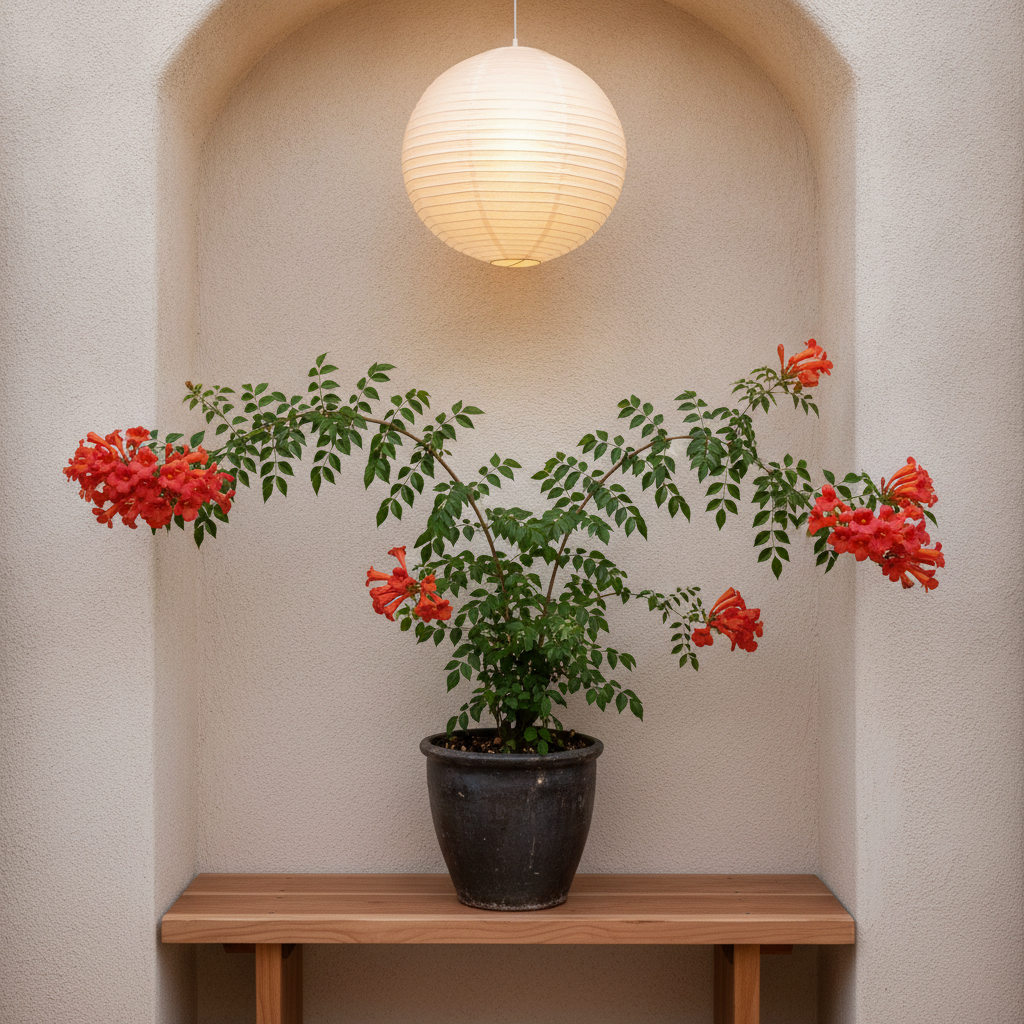
Few plants earn their keep as generously as Cape honeysuckle. Give Tecoma capensis a sunny corner and a little room to sprawl, and it answers with month after month of curved, tubular flowers in a shade of orange-red that seems to glow against its glossy dark foliage. Despite the common name, it is not a true honeysuckle at all, and understanding that distinction is the first step to keeping it happy. This guide walks through everything that separates a plant that merely survives from one that truly thrives, whether you grow it as a container specimen on a bright balcony or as a scrambling evergreen screen.
- Quick Reference
- Why Cape Honeysuckle Makes a Rewarding Plant
- Light
- Watering
- Soil
- Fertilising
- Propagation
- Pests and Problems
- Varieties
- Frequently Asked Questions
Quick Reference
The table below summarises the conditions Cape honeysuckle prefers. Treat these as the baseline, then read on for the reasoning behind each figure, because the difference between a leggy, sparse plant and a floriferous one usually comes down to light and pruning rather than any single number.
| Botanical name | Tecoma capensis (syn. Tecomaria capensis) |
| Common names | Cape honeysuckle, Cape figwort, fireflower |
| Family | Bignoniaceae |
| Native range | Southern Africa, from the Cape north to Mozambique |
| Plant type | Evergreen scrambling shrub or semi-climber |
| Mature size | 2 to 3 metres (6 to 10 feet) tall as a shrub, scrambling to 5 metres (16 feet) with support |
| Light | Full sun to bright, direct indoor light; at least 4 to 6 hours daily |
| Water | Moderate in the growing season, drought-tolerant once established |
| Soil | Fertile, free-draining loam; tolerant of poorer ground |
| Temperature | 18 to 30°C (64 to 86°F) ideal; frost-tender below about -3°C (27°F) |
| Humidity | Average; no special requirement |
| Fertiliser | Balanced or bloom-boosting feed monthly through spring and summer |
| Propagation | Semi-hardwood cuttings, layering, suckers, air layering, seed |
| Toxicity | Generally regarded as non-toxic to people and pets |
| Bloom season | Late spring to autumn, often year-round in warm climates |
Why Cape Honeysuckle Makes a Rewarding Plant
Cape honeysuckle belongs to the family Bignoniaceae, the same botanical clan as trumpet vine and jacaranda, and that lineage tells you almost everything about its temperament. It is a sun-loving, fast-growing, warm-climate plant built to flower prolifically and to recover quickly from hard pruning. In the wild it grows along forest margins and rocky slopes across southern Africa, scrambling over neighbouring shrubs and rooting wherever a trailing stem touches moist ground. That scrambling habit means it sits somewhere between a shrub and a climber: left alone it forms a dense, arching mound, but tied to a support it will happily climb a wall or trellis.

The flowers are the main event. Each bloom is a curved tube around 5 centimetres (2 inches) long, flaring into five short lobes, and they cluster at the tips of the stems in dense terminal sprays. The classic form is a vivid orange-red, though cultivated selections extend the range into gold, apricot and salmon. The tubular shape is no accident: in its native range the flowers are pollinated by sunbirds, and in gardens elsewhere they are a reliable magnet for hummingbirds, butterflies and bees. The glossy, pinnate leaves, made up of several small serrated leaflets arranged along each stalk, provide a deep green foil that stays evergreen wherever winters are mild.
The reason to grow it, then, is versatility backed by toughness. It can be a clipped hedge, a container feature, an espalier against a warm wall, or a loose informal screen, and it shrugs off heat, wind, coastal salt and poor soil that would defeat fussier plants. The trade-off is vigour. In frost-free regions such as parts of Australia and the southern United States it can naturalise and spread beyond where it is wanted, so container culture or regular pruning is the sensible approach for most growers.
Light
Light is the single biggest lever you have over how well Cape honeysuckle flowers. This is a full-sun plant to its core, and the amount of direct light it receives translates almost directly into the number of flower clusters it produces. Outdoors, aim for a position that gets at least six hours of unobstructed sun a day; in shadier spots the plant will still grow, often lushly, but it turns leafy and shy to bloom, stretching towards the light with long, bare stems.
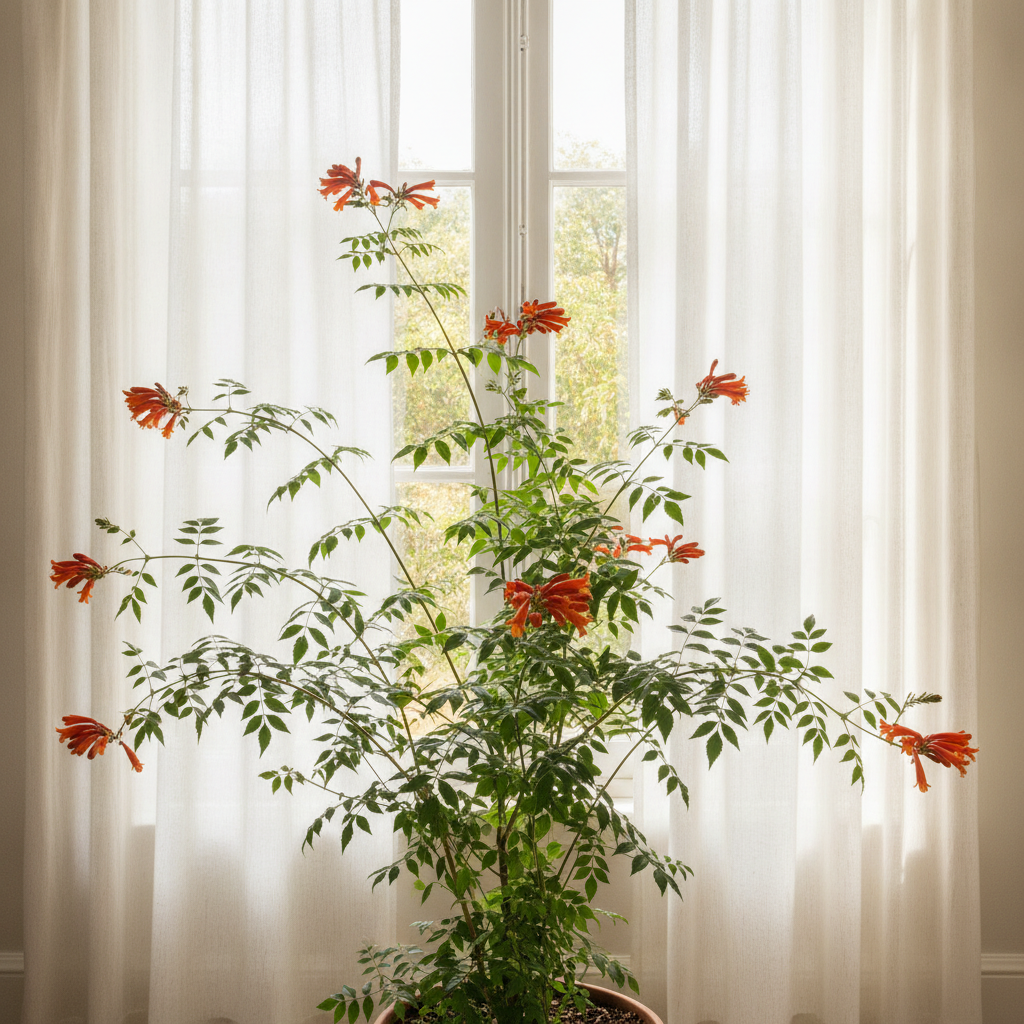
Grown indoors, the plant needs the brightest situation the home can offer, which usually means directly in front of a south-facing or west-facing window where it can catch several hours of genuine direct sun. An east window can work in a pinch, but a north-facing room will almost never provide enough energy for flowering. If your only bright spot is limited, consider supplementing with a full-spectrum grow light for a few hours each day, positioned close enough to make a real difference. Rotating the pot a quarter-turn every week keeps growth even and stops the plant leaning permanently towards the glass.
Pro Tip — Reading the light: If your Cape honeysuckle is growing steadily but simply refuses to flower, insufficient light is the most likely culprit before you reach for fertiliser. Move it somewhere brighter for a few weeks and watch the buds appear.
One caveat applies to plants that have been kept in low light and are then moved into full sun without transition. The foliage can scorch, showing bleached or brown patches, so acclimatise a shade-grown plant gradually over a week or two, increasing its sun exposure a little each day. A plant grown in good light from the start rarely has this problem and simply revels in the brightness.
Watering
Cape honeysuckle has a forgiving relationship with water, which is one of the reasons it suits gardeners who travel or forget. Once established, it is genuinely drought-tolerant, drawing on a robust root system to ride out dry spells that would wilt a more pampered plant. That said, the difference between survival and abundant flowering again comes down to consistency during the active growing season.

From spring through to autumn, aim to keep the soil evenly moist, watering thoroughly whenever the top two to three centimetres (about an inch) have dried out. Container plants dry faster than those in the ground and may need watering every few days in hot weather, so check by pushing a finger into the compost rather than relying on a schedule. When you do water, water deeply until it runs from the drainage holes, then let the excess drain away completely. The plant dislikes sitting in a saucer of standing water, and consistently soggy roots are the one condition it will not tolerate.
As temperatures fall in autumn and growth slows, reduce watering noticeably. Through winter the plant needs only enough moisture to keep it from drying out entirely, particularly if it is being kept cool and dormant. Overwatering in the cold months, when the roots are barely active, is the fastest route to root rot and yellowing leaves. Err on the side of dryness once the flowering season has passed.
Warning — Drainage first: Cape honeysuckle tolerates drought far better than it tolerates wet feet. Always plant in a container with drainage holes and never leave the pot standing in water, or you risk losing the roots to rot.
Soil
In its native habitat Cape honeysuckle grows in a wide range of ground, from sandy coastal soils to rocky slopes, and that adaptability carries into cultivation. It is not fussy about soil type and will grow in mediocre conditions, but it rewards a fertile, free-draining medium with stronger growth and better flowering. The non-negotiable requirement is drainage: whatever the base material, water must move through it freely rather than pooling around the roots.
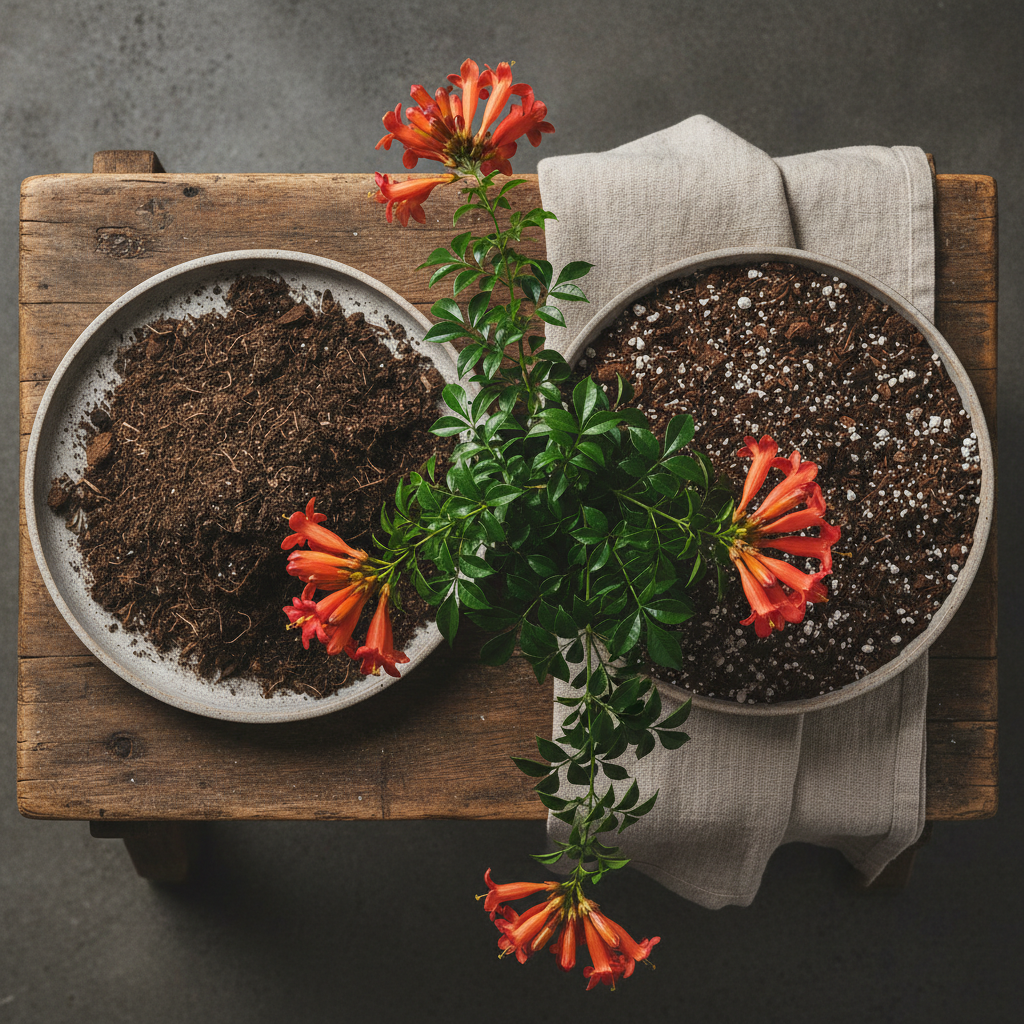
For container culture, a good general-purpose potting compost forms a fine base, lightened with roughly one part of grit, perlite or coarse sand to three parts compost to guarantee that water drains through readily. Adding a little well-rotted organic matter or a handful of composted bark improves both fertility and structure. The plant is comfortable across a broad pH range, from slightly acidic to slightly alkaline, so there is no need to chase a particular figure. In the open garden, dig in organic matter to enrich thin or sandy soils, and on heavy clay create a raised bed or mound to lift the crown above wet ground.
Repot container-grown plants every couple of years, or when roots begin to circle the pot and emerge from the drainage holes. Spring, just as growth resumes, is the ideal moment. Move up one pot size at a time rather than over-potting into a vast container, since a large volume of unused compost stays wet and works against the drainage the plant craves. Refreshing the top few centimetres of compost each spring, even in years you do not repot, keeps nutrition topped up.
Fertilising
A plant that flowers as generously as Cape honeysuckle appreciates regular feeding through its growing season to fuel all that bloom production. Because it is a vigorous grower, it draws steadily on the nutrients in its compost, and container plants in particular exhaust the available supply within a few weeks of potting or top-dressing.
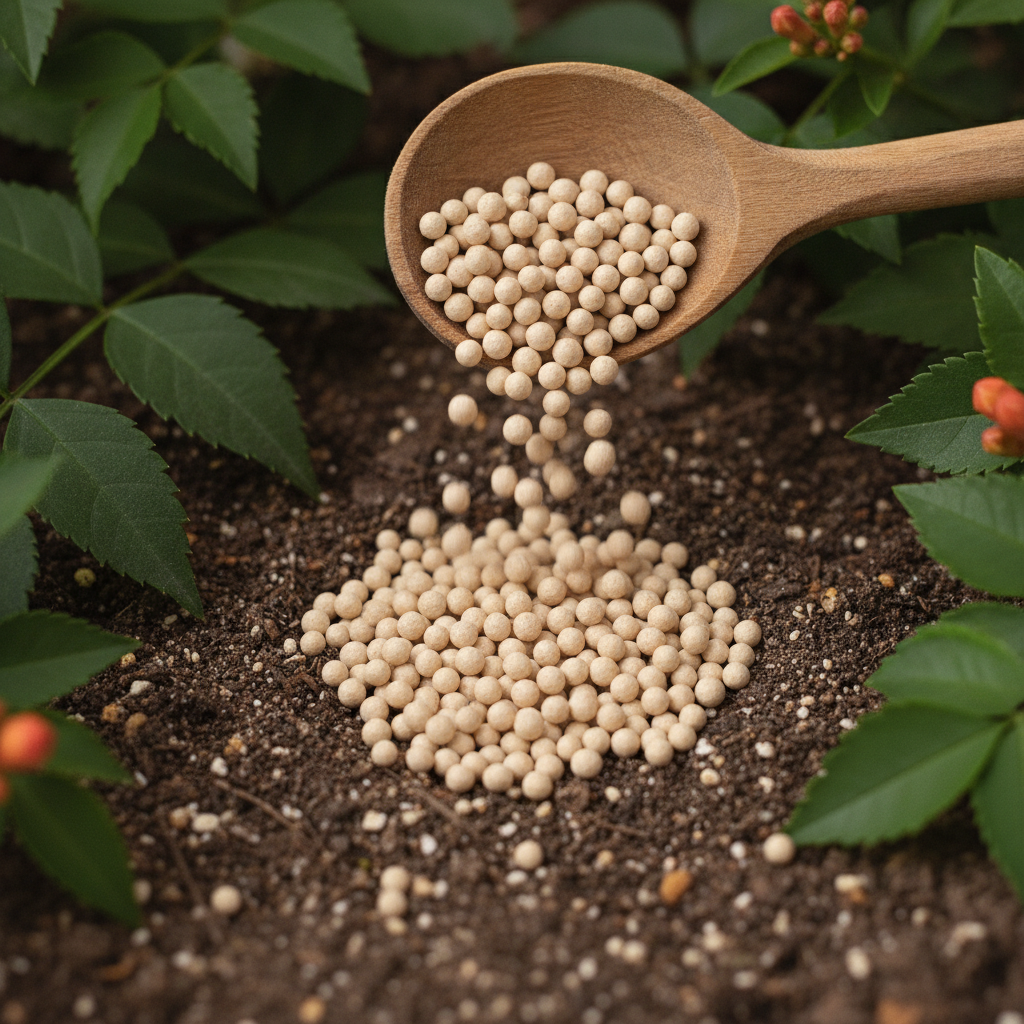
Through spring and summer, feed roughly once a month with a balanced liquid fertiliser, or switch to a formulation higher in potassium, such as a tomato or bloom feed, to encourage flowering rather than leafy growth. An alternative is to work a slow-release granular fertiliser into the surface of the compost at the start of the season, which meters out nutrition gradually and takes the guesswork out of timing. Whichever route you choose, always apply liquid feed to already-moist compost rather than dry soil, to avoid scorching the roots.
Ease off feeding entirely as autumn arrives and growth slows, and give nothing over winter while the plant rests. Resuming too early or feeding a dormant plant simply pushes weak, sappy growth that flops and attracts pests. If you notice pale, yellowing foliage during the growing season despite good light and watering, a nutrient shortfall is a likely cause and a balanced feed usually greens the plant up within a couple of weeks.
Pro Tip — Flowers over foliage: If your plant produces plenty of lush leaves but few flowers, switch from a high-nitrogen feed to one richer in potassium. Too much nitrogen favours foliage at the expense of blooms.
Propagation
Cape honeysuckle is one of the easier flowering shrubs to propagate, which suits its generous nature. It roots readily from cuttings, layers itself naturally wherever stems touch the ground, and can be increased from the suckers it throws up around the base. For most growers, semi-hardwood cuttings taken in summer are the simplest and most reliable method.
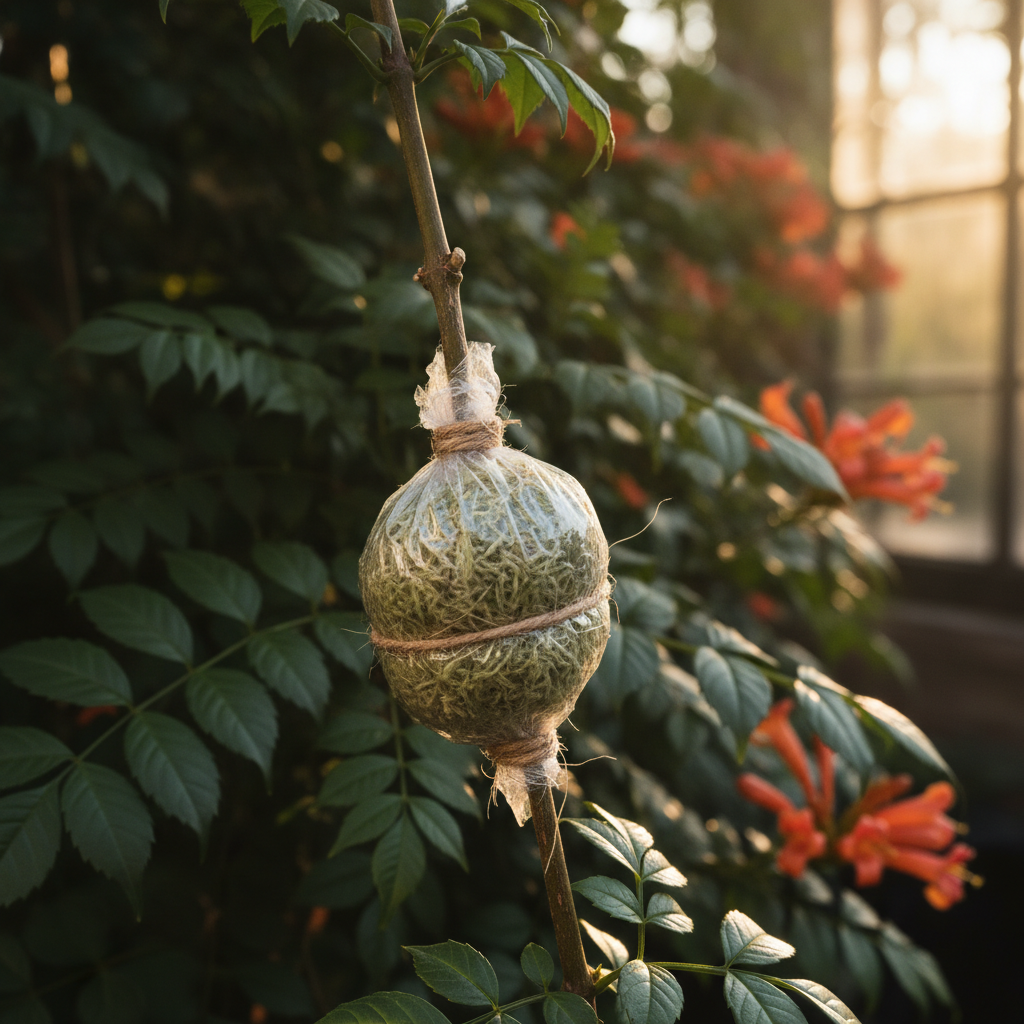
To take semi-hardwood cuttings, follow these steps:
- Choose a healthy, current-season stem that has begun to firm up but is not yet fully woody, and cut a section about 10 to 15 centimetres (4 to 6 inches) long just below a leaf node.
- Remove the lower leaves, leaving two or three at the top, and trim any soft, whippy tip growth.
- Dip the cut end in rooting hormone to speed things along, then insert it into a pot of moist, free-draining cutting compost.
- Keep the pot warm and in bright, indirect light, and maintain even moisture without letting the compost turn soggy. A clear cover helps hold humidity.
- Roots usually form within four to eight weeks; once new growth appears, pot the young plant on into its own container.
Layering is even simpler and exploits the plant’s own habit. Bend a low, flexible stem down to the soil, nick the underside where it makes contact, pin it in place, and cover that point with a little compost. Within a season it will root, and you can then sever it from the parent and lift it as a new plant. Air layering, shown above, achieves the same result higher up a stem by wrapping a wounded node in damp sphagnum moss and clear film, which is useful when no stem will reach the ground. Suckers that appear around the base can likewise be dug up with their roots intact and replanted.
Pests and Problems
By the standards of flowering shrubs, Cape honeysuckle is remarkably trouble-free, and a plant grown in good light with sensible watering rarely suffers seriously. The problems that do arise are mostly the familiar sap-sucking insects that find any stressed or crowded plant, and they are straightforward to manage if caught early.
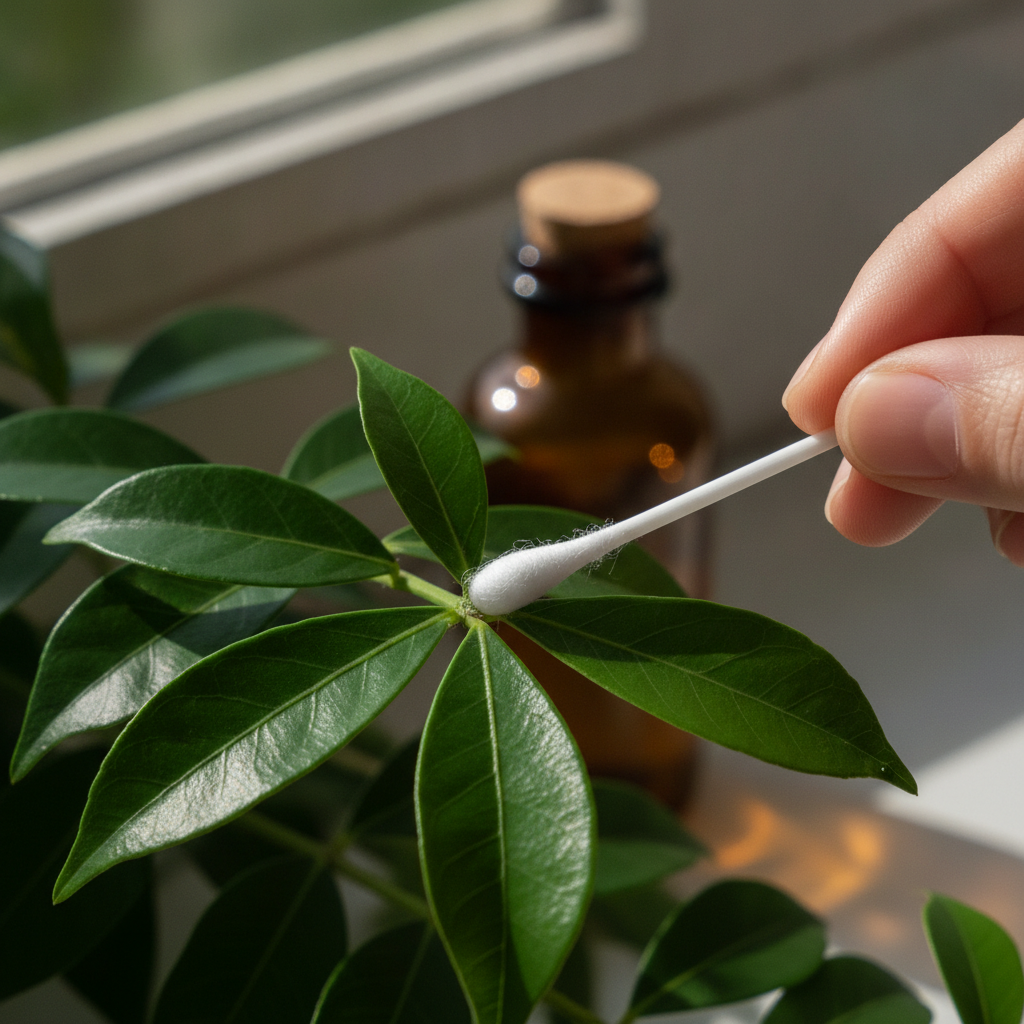
Aphids are the most common visitor, clustering on soft new growth and flower buds, where they can be dislodged with a firm jet of water or wiped away. Whitefly may gather on the undersides of leaves, rising in a cloud when the plant is disturbed, and spider mites can appear in hot, dry conditions, betraying themselves by fine webbing and a stippled, dusty look to the foliage. Mealybugs and scale insects occasionally settle in leaf axils and along stems as small waxy or shell-like bumps. For light infestations, dabbing the insects directly with a cotton bud dipped in isopropyl alcohol, or wiping the leaves with insecticidal soap, is usually enough; heavier outbreaks respond to a horticultural oil such as neem, applied to cover the undersides of the leaves.
Most other complaints trace back to culture rather than pests. Yellowing leaves and a limp, sad plant point to overwatering and poor drainage far more often than to disease. A refusal to flower almost always means too little light, sometimes compounded by an over-generous nitrogen feed. Leggy, bare stems are the plant’s response to shade and to going unpruned, both of which are easily corrected. Cape honeysuckle takes hard pruning without complaint, so cutting a straggly plant back by up to a third in late winter or early spring reinvigorates it and channels energy into fresh, flower-bearing growth.
Pro Tip — Prune to rejuvenate: An old, woody, flower-shy plant can be renovated by cutting it back hard in early spring. It resprouts vigorously from the base and flowers more freely on the new wood.
Varieties
The wild species is the familiar orange-red form, but breeders and growers have selected a handful of colour variants over the years that extend the palette while keeping the same easy temperament and glossy pinnate foliage. Two of the most widely grown are shown below.
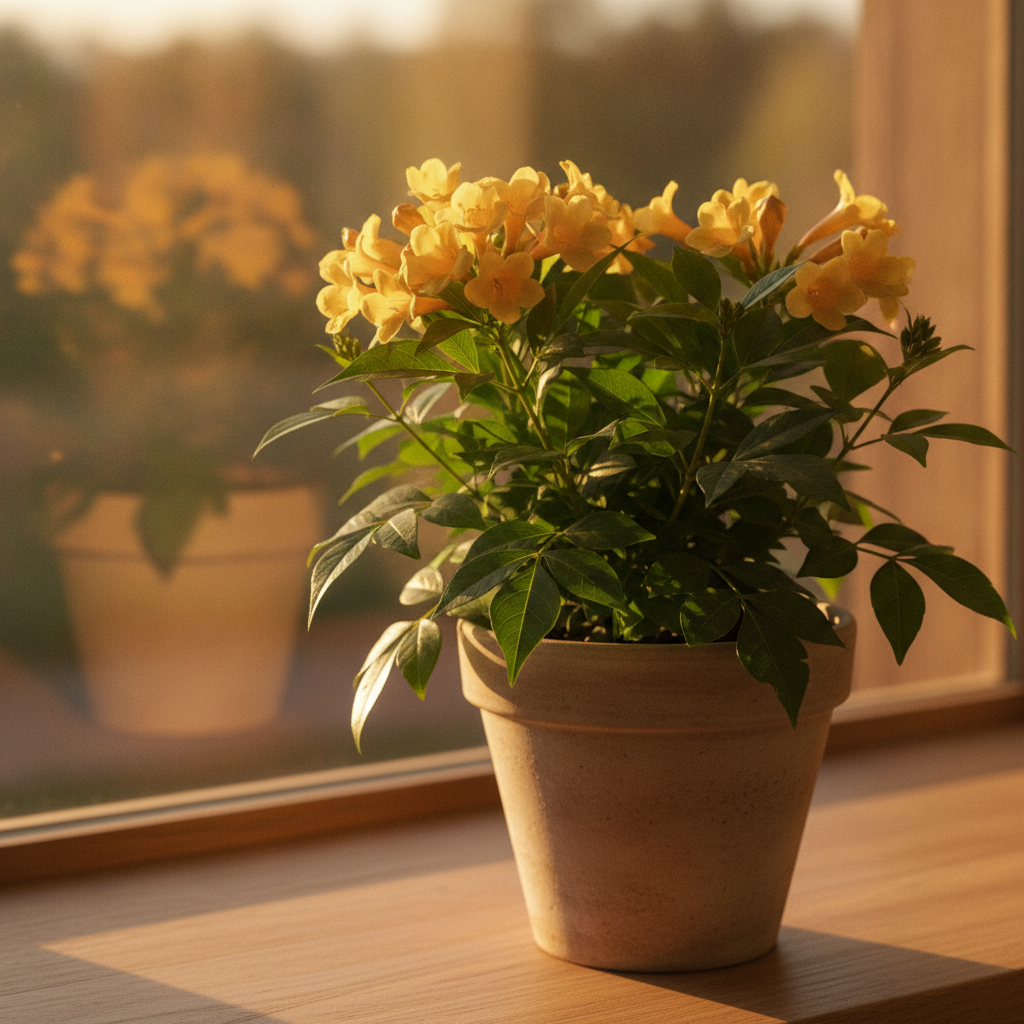
‘Aurea’ swaps the fiery orange of the species for clusters of soft, clear golden-yellow tubular flowers, set against the same deep green foliage. It tends to be a slightly less rampant grower than the orange form and brings a gentler, sunnier note to a planting, though it wants exactly the same full sun and free-draining conditions to bloom well.
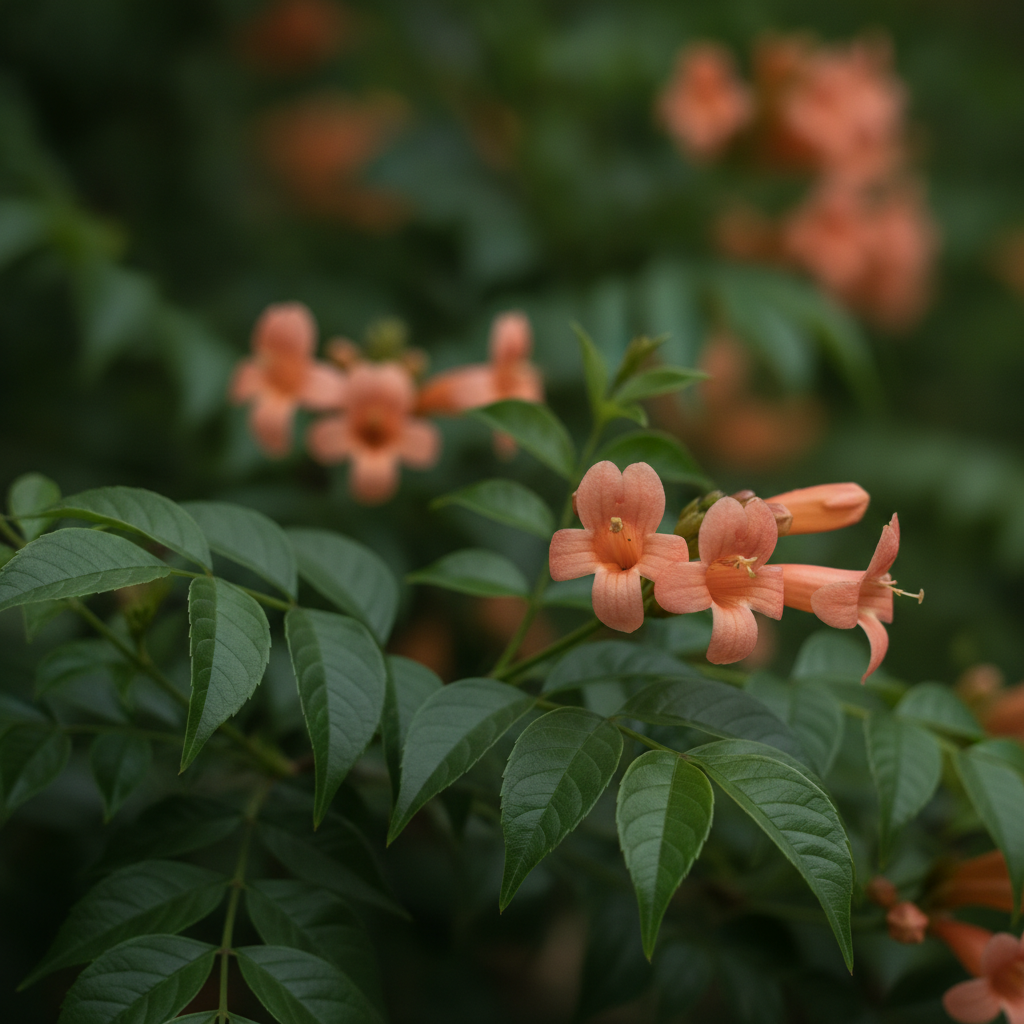
‘Apricot’ softens the colour into warm apricot and salmon tones, a muted alternative that blends more easily into pastel planting schemes. Like the species it flowers over a long season and responds to the same care, offering the same reliable draw for nectar-feeding birds and insects in a subtler shade.
Beyond these, you may encounter compact and dwarf selections bred for container growing and smaller gardens, which flower on a more restrained frame, as well as occasional deeper-red and lighter-orange forms. All share the same fundamental needs, so once you can grow one you can grow them all.
Frequently Asked Questions
Is Cape honeysuckle a true honeysuckle?
No. True honeysuckles belong to the genus Lonicera, whereas Cape honeysuckle is Tecoma capensis, a member of the family Bignoniaceae alongside trumpet vine and jacaranda. The common name reflects the tubular, nectar-rich flowers rather than any close botanical relationship.
Why won’t my Cape honeysuckle flower?
The usual reason is too little light, since the plant needs several hours of direct sun to bloom well. A close second is over-feeding with high-nitrogen fertiliser, which encourages leaves at the expense of flowers, and a third is simply not pruning, as flowers form best on vigorous new growth. Move it into brighter light, switch to a potassium-rich feed, and prune in early spring.
Can I grow Cape honeysuckle indoors?
Yes, provided you can give it a very bright spot with direct sun, such as a south-facing or west-facing window, and enough room to grow. It responds well to pruning, which keeps it to a manageable size indoors. Without strong light, though, it will grow leggy and reluctant to flower.
Is Cape honeysuckle toxic to pets?
It is generally regarded as non-toxic to people, cats and dogs, and it is not listed among the plants known to cause serious poisoning. Even so, it is not meant to be eaten, and nibbling any houseplant can cause mild stomach upset, so it is sensible to keep curious pets from chewing on it.
How big does Cape honeysuckle get?
As a free-standing shrub it typically reaches 2 to 3 metres (6 to 10 feet) tall and wide, but trained against a support it can scramble to 5 metres (16 feet) or more. It grows quickly and tolerates hard pruning, so its ultimate size is largely whatever you choose to maintain.
Does Cape honeysuckle attract birds?
Very much so. The tubular flowers are rich in nectar and evolved to be pollinated by sunbirds in southern Africa. In other regions they are a reliable draw for hummingbirds, butterflies and bees, which makes the plant a strong choice for a wildlife-friendly garden.






