
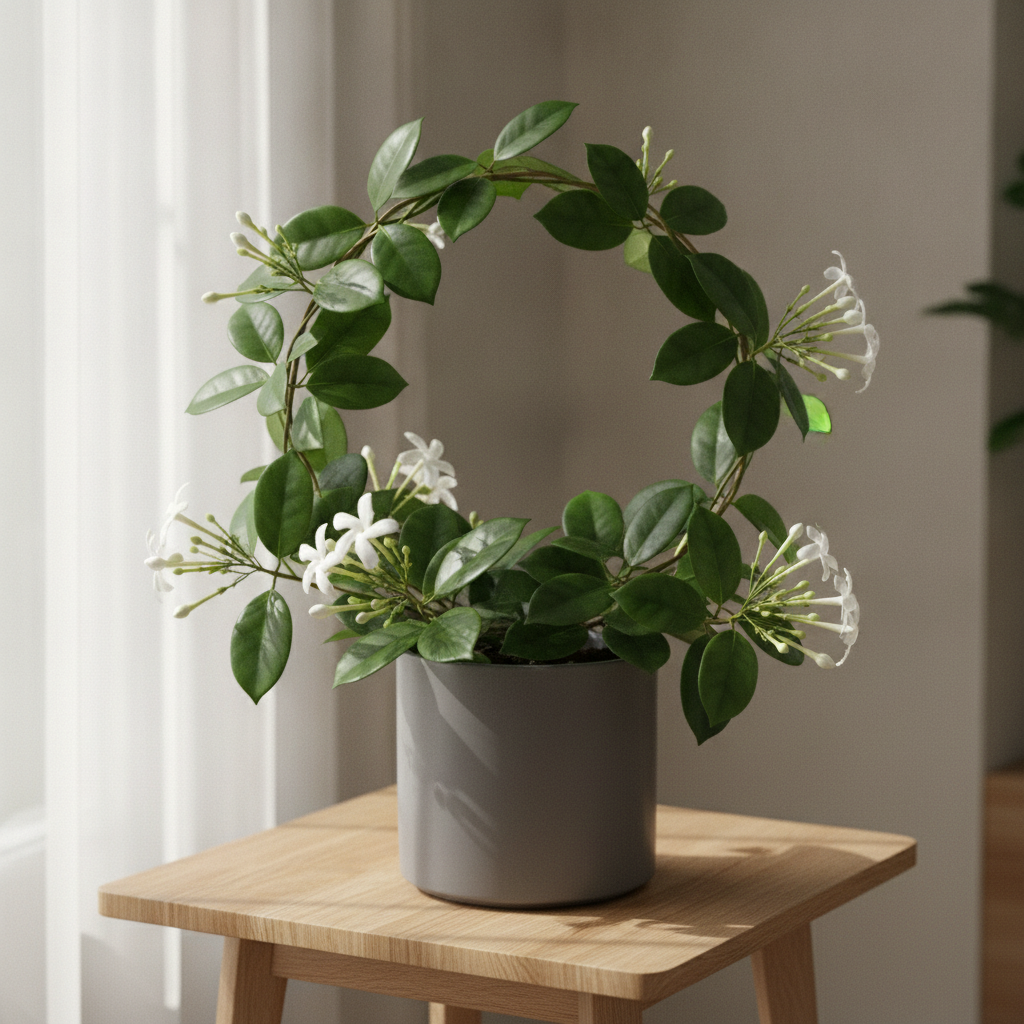
Few houseplants announce themselves by scent before sight, but Madagascar jasmine is one of them. Brush past a plant in full flower and the perfume, heady, sweet and faintly citrus, fills the room long before you notice the clusters of pure-white, waxy stars tucked among glossy leaves. Known botanically as Stephanotis floribunda and sometimes as bridal wreath, Hawaiian wedding flower or waxflower, this twining evergreen climber hails from the humid forests of Madagascar, where it scrambles through trees toward the light. Despite the common name, it is not a true jasmine at all but a member of the milkweed family, Apocynaceae, a relationship betrayed by its thick, milky sap and long, horn-shaped seed pods.
Madagascar jasmine has a reputation for being temperamental, and it is true that it asks more of its owner than a pothos or a snake plant. It wants good light, warmth in summer, a cool rest in winter and steady, attentive watering. Yet none of these demands is difficult once understood, and the reward, an established vine dripping with fragrant blooms from late spring into autumn, is out of all proportion to the effort. This guide walks through everything that separates a plant merely surviving on a windowsill from one thriving and flowering year after year, with particular attention to the two issues that frustrate most growers: reluctance to bloom and the sudden dropping of buds.
Contents
- Quick Reference
- Why Madagascar Jasmine Makes a Rewarding Houseplant
- Light Requirements
- Watering & Humidity
- Soil, Potting & Repotting
- Fertilising
- Propagation
- Pests & Diseases
- Popular Varieties
- Frequently Asked Questions
Quick Reference: Madagascar Jasmine at a Glance
| Light | Bright light with a few hours of gentle direct sun; the more light it receives, the more freely it flowers |
| Watering | Keep evenly moist from spring to autumn; allow the top few centimetres to dry between waterings in winter |
| Temperature | 18 to 25°C (64 to 77°F) in growth; a cool winter rest of 13 to 15°C (55 to 59°F) helps set flower buds |
| Humidity | Moderate to high, ideally 50 to 60 per cent |
| Fertiliser | High-potassium feed every two weeks through spring and summer |
| Toxicity | The milky sap can irritate skin and eyes; best kept away from curious pets and small children |
Why Madagascar Jasmine Makes a Rewarding Houseplant
The obvious appeal of Stephanotis floribunda is its fragrance, which is among the finest of any plant grown indoors. A single mature vine in flower can perfume an entire living room, and the scent is stronger in the evening, when the plant works to attract its natural pollinators. The flowers themselves are exquisite: tubular at the base and opening into five thick, waxy petals arranged in a perfect star, they last well both on the plant and cut. This durability, combined with their pristine colour, is why the species has been a staple of wedding bouquets for more than a century, lending it the common names bridal wreath and Hawaiian wedding flower.
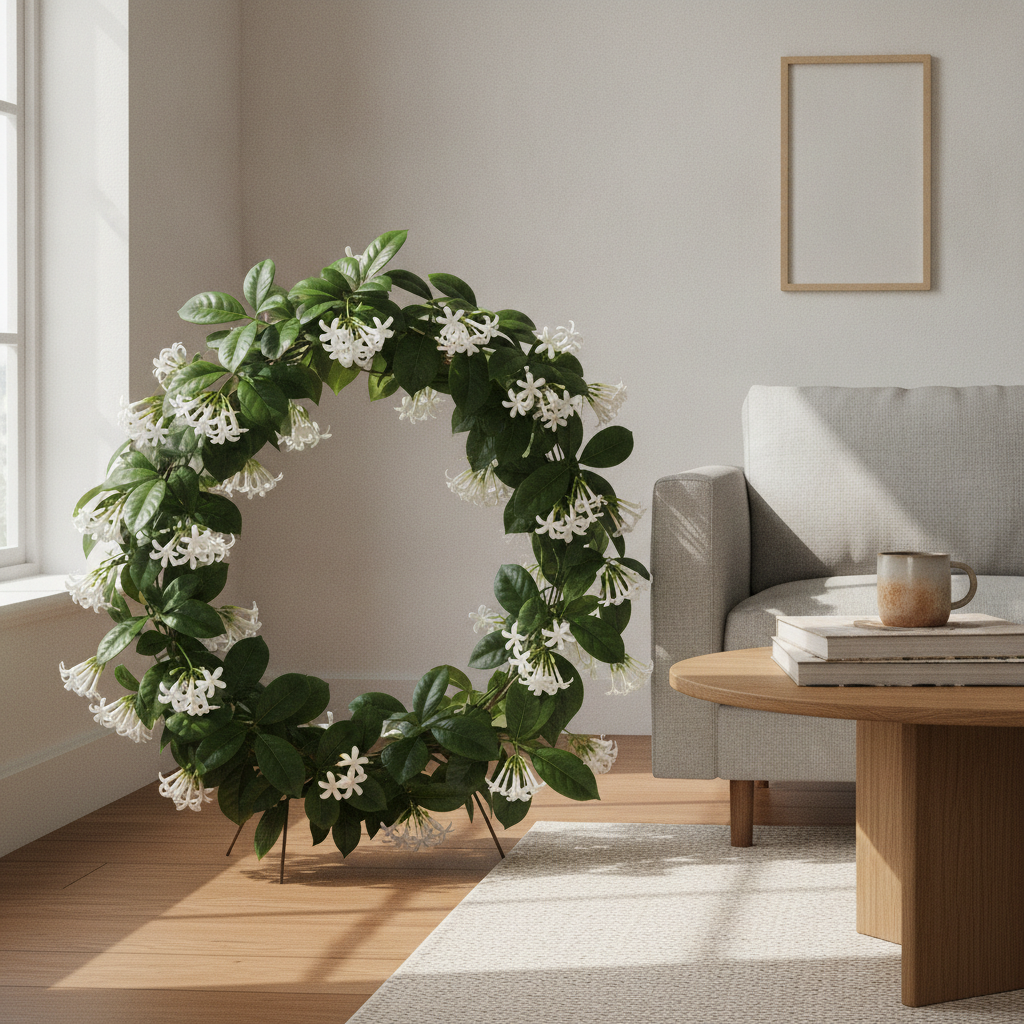
Beyond the blooms, the plant is handsome even out of flower. Its leaves are thick, leathery and deep glossy green, held in neat opposite pairs along stems that twine naturally around any support you provide. Trained onto a hoop, an obelisk or a wall-mounted trellis, a well-grown specimen becomes a piece of living architecture that earns its space year-round. It is also a long-lived plant; with reasonable care a Madagascar jasmine will thrive for a decade or more, flowering more generously as it matures. The honest caveat is that this is not a beginner’s plant to neglect. It rewards consistency and punishes sudden changes, so it suits a grower who enjoys paying a little attention rather than one seeking something entirely hands-off.
Important — Toxicity: Like other members of the milkweed family, Madagascar jasmine exudes a milky latex sap when stems or leaves are cut or broken. This sap can irritate skin and is especially unpleasant if it reaches the eyes, so wear gloves when pruning or taking cuttings and wash your hands afterwards. The plant is best positioned out of reach of pets and small children who might chew the foliage.
Light Requirements
Light is the single most important factor in whether a Madagascar jasmine flowers, and it is where most disappointed owners go wrong. In its native forests the plant climbs toward gaps in the canopy, so while it appreciates protection from the fiercest midday sun, it is fundamentally a high-light plant that will not bloom in a dim corner. A vine kept too dark may remain green and even put on modest growth, but it will stubbornly refuse to produce buds, leaving the grower to conclude the plant is difficult when it is merely underlit.
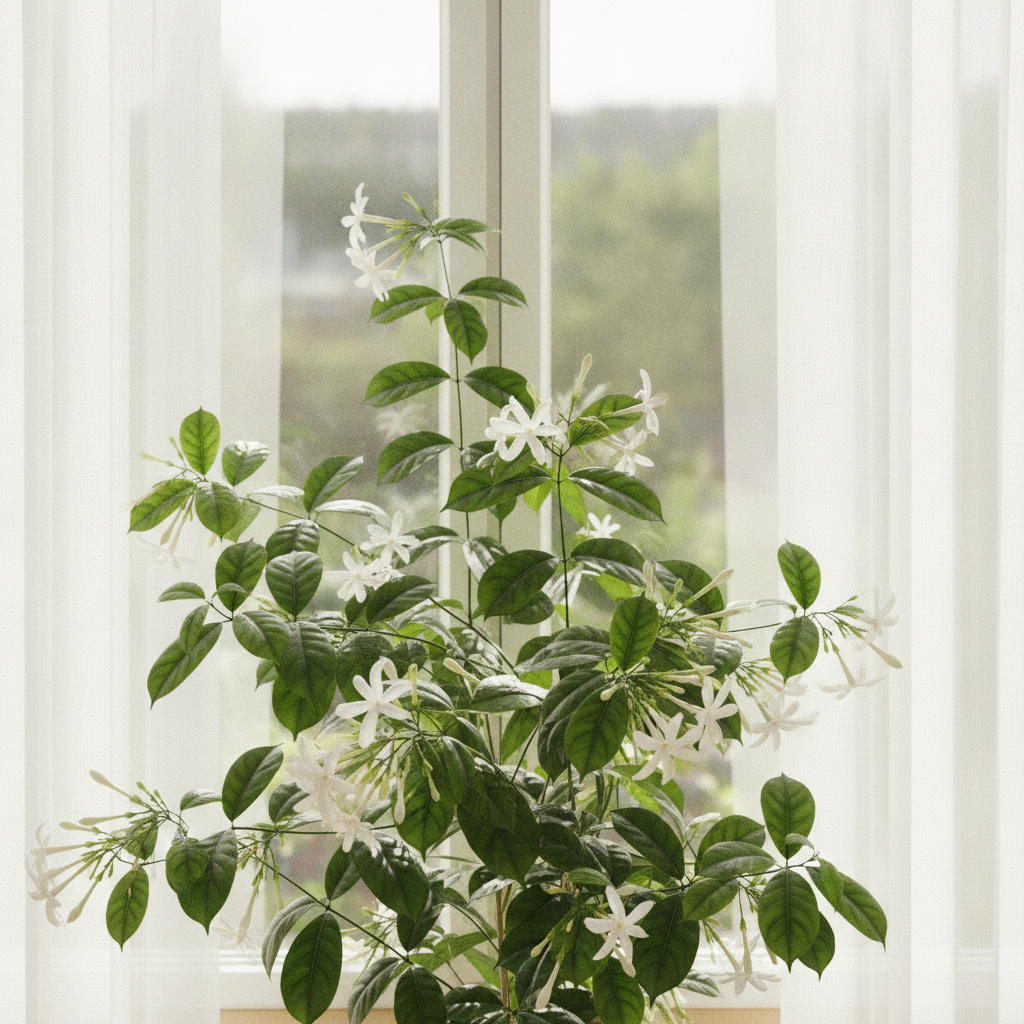
The ideal indoor position offers bright, largely indirect light for most of the day with a few hours of gentle direct sun, such as early morning or late afternoon. This mimics the dappled brightness of a forest edge and gives the plant the energy it needs to flower without scorching its leaves. Aim to place it within a metre or so of a bright window rather than deep in the room.
Light Levels Explained
Because “bright” means different things to different people, the table below translates the usual houseplant light categories into approximate levels and typical positions, along with what you can expect from a Madagascar jasmine in each.
| Light Category | Approx. Level | Typical Location | Outcome |
|---|---|---|---|
| Direct sun | 20,000 lux and above | On a south-facing sill in summer | Fine in morning or late sun; midday summer sun can scorch leaves |
| Bright indirect | 10,000 to 20,000 lux | Just back from a south or west window | Ideal; strong healthy growth and reliable flowering |
| Medium | 5,000 to 10,000 lux | An east window or a metre from a bright one | Good growth, flowering possible but less profuse |
| Low | 1,000 to 5,000 lux | North window or interior wall | Foliage survives but the plant rarely blooms |
| Very low | Below 1,000 lux | Hallway or far corner | Gradual decline; not suitable |
Window Orientation and Placement
South-facing window: An excellent choice for most of the year, offering the strong light that fuels flowering. In high summer, protect the plant from the harshest midday rays with a sheer curtain or by setting it a little back from the glass to prevent leaf scorch.
East-facing window: Often the sweet spot indoors. The plant receives bright, cool morning sun that it can use directly, followed by softer light for the rest of the day, a combination it tolerates without any risk of burning.
West-facing window: Also very suitable, giving bright afternoon light and a few hours of gentle direct sun. Watch for overheating behind glass on hot afternoons and provide light shading if the leaves feel warm to the touch.
North-facing window: Generally too dim to sustain flowering. The plant may hang on for a time, but growth will be weak and blooms unlikely. If a north aspect is your only option, supplement with a grow light.
Pro Tip — Turn for Even Growth, but Not When Budding: Rotating the pot a quarter-turn each week keeps a jasmine growing evenly toward the light rather than leaning. There is one crucial exception: once flower buds have formed, stop turning and moving the plant entirely, because Stephanotis is notorious for dropping buds when its orientation to the light suddenly changes.
How Light Affects Flowering
Unlike variegated foliage plants, where light governs leaf colour, in Madagascar jasmine light governs flowering above all else. The plant needs to accumulate a good store of energy through bright conditions in spring and summer to fund its flush of blooms. If a vine grows lush and green but never flowers, insufficient light is the most common culprit, usually in combination with too little potassium in the diet or the absence of a cool winter rest. Moving a shy plant into brighter conditions, short of harsh direct summer sun, is frequently all it takes to trigger the first buds.
Warning — Direct Sunlight: While Madagascar jasmine enjoys some direct sun, intense midday summer sun magnified through glass can bleach or scorch the leaves, leaving pale or crisp brown patches that do not recover. Introduce a plant to brighter light gradually over a week or two, and shade it during heatwaves.
Artificial Lighting
Where natural light is limited, a full-spectrum LED grow light can make the difference between a plant that only survives and one that flowers. Position the light around 30 centimetres (12 inches) above the foliage and run it for 12 to 14 hours a day during the growing season to supplement or replace weak window light. Grow lights are particularly useful through the dark months for keeping a plant in good condition, though flowering is best encouraged by the natural lengthening days of spring.
Seasonal Adjustments
Light levels indoors fall dramatically between summer and winter, so a position that is perfect in July may be too dim in December. Move the plant closer to the brightest available window as the days shorten, and clean the leaves occasionally so dust does not further reduce the light they capture. As spring returns and the sun climbs higher, ease the plant back to its summer position, reintroducing any direct sun gradually to avoid shocking foliage that has acclimatised to gentler winter light.
Watering & Humidity
Watering a Madagascar jasmine well is a matter of reading the seasons. During active growth from spring to autumn the plant is thirsty and wants to be kept consistently, evenly moist, never sodden and never bone dry. Through winter, when growth slows and the plant prefers cooler conditions, its water needs drop sharply and the compost should be allowed to dry out further between drinks. Matching your watering to this rhythm avoids the two most damaging mistakes: waterlogging the roots in winter and letting the plant parch in summer.
When to Water
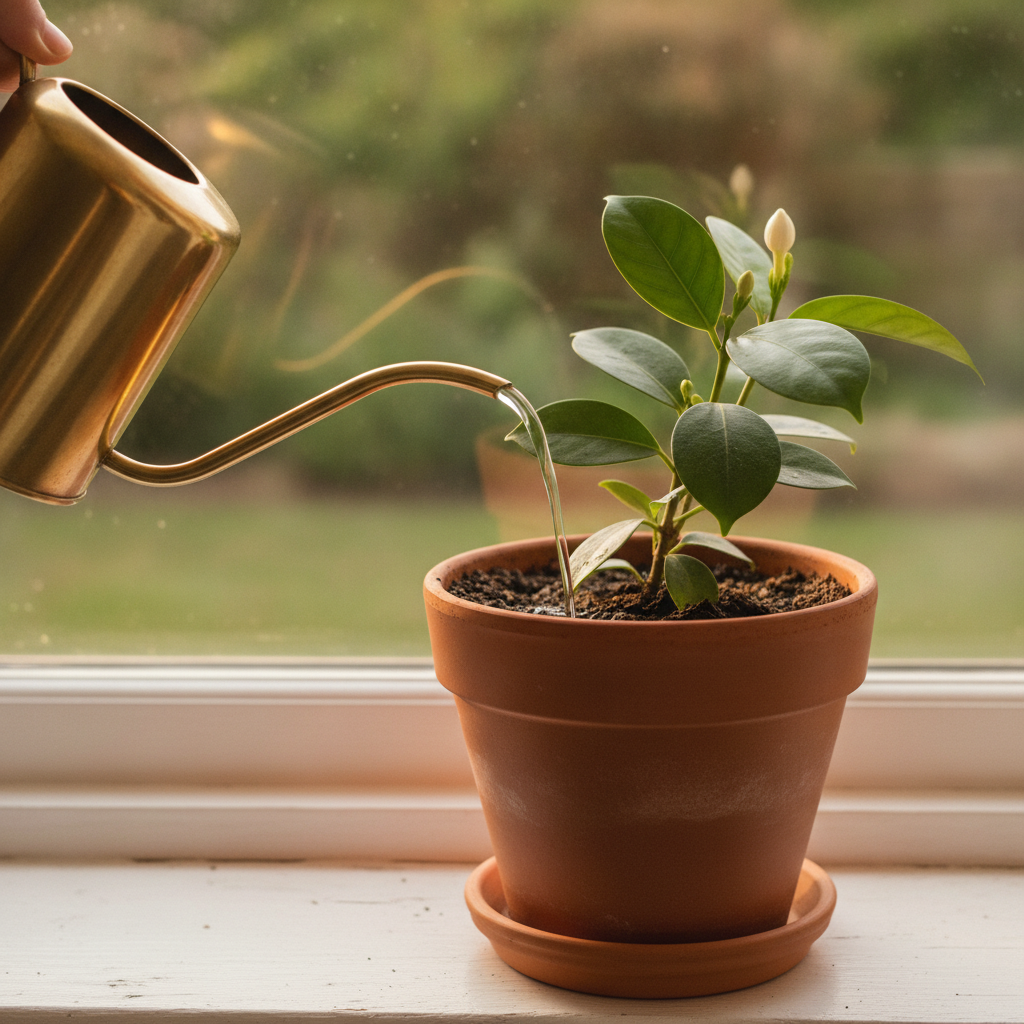
Rather than watering to a fixed schedule, check the compost with a finger. In the growing season, water when the top two to three centimetres (about an inch) feel just dry to the touch; the aim is a compost that stays lightly moist like a wrung-out sponge. Depending on warmth and light, this usually means watering roughly once or twice a week in summer.
In winter, wait until the top third of the pot has dried before watering, and then give only enough to moisten the rootball without leaving it wet. A plant resting at 13 to 15°C (55 to 59°F) may need water only every couple of weeks. Erring slightly on the dry side in the cold months is far safer than keeping the compost damp, which quickly invites root rot at low temperatures.
Pro Tip — Lift the Pot: With practice you can judge watering by weight. Lift the pot just after thorough watering to feel how heavy a fully hydrated plant is, then lift it again every few days. When it feels noticeably light, it is time to water. This simple habit removes most of the guesswork and prevents both extremes.
How to Water Correctly
- Check the compost first, watering only when the top layer has dried to the depth appropriate for the season.
- Use tepid, ideally soft or filtered water; cold water straight from the tap can shock the roots of this warmth-loving plant.
- Water steadily at the base of the plant, moving around the pot so the whole rootball is moistened evenly.
- Continue until water flows freely from the drainage holes, which ensures the entire root zone is reached.
- Let the pot drain fully for several minutes, then empty the saucer or cover pot so the roots never sit in standing water.
Signs of Overwatering vs. Underwatering
| Symptom | Overwatering | Underwatering |
|---|---|---|
| Leaf colour | Yellowing, often on lower leaves first | Dull, then browning at the tips and margins |
| Leaf texture | Soft, limp and sometimes translucent | Dry, crisp and curling inward |
| Soil | Stays wet for days, may smell sour | Pulls away from the pot sides, dries hard |
| Roots | Brown, mushy and foul-smelling | Dry and brittle but not rotten |
| Buds and flowers | Buds yellow and drop | Buds shrivel and fall before opening |
Warning — Root Rot: Root rot is the leading killer of Madagascar jasmine, caused by compost that stays saturated, especially in cool winter conditions. If you notice a sour smell, persistently wet soil and yellowing, wilting leaves, unpot the plant at once, trim away any brown mushy roots with clean scissors, and repot into fresh, free-draining compost, watering only sparingly until new growth shows.
Humidity Requirements
As a native of humid forests, Madagascar jasmine appreciates moisture in the air and does best at around 50 to 60 per cent relative humidity. Average centrally heated homes often fall well below this in winter, and very dry air can cause buds to abort and leaf edges to brown, so some effort to raise humidity pays off, particularly when the plant is budding.
Signs that the air is too dry include browning leaf tips, buds that fail to develop and a general lack of lustre in the foliage. These symptoms often appear alongside the effects of dry compost, so check both the air and the soil when diagnosing a struggling plant in winter.
The most reliable way to raise humidity is to group the plant with others and to stand the pot on a wide tray of damp pebbles, keeping the water level just below the pot base so the roots never sit in it. A room humidifier is the most effective option of all in a dry home. Occasional misting gives a brief lift but does little for lasting humidity, and misting open flowers should be avoided as it can mark the delicate petals.
Water Quality
Madagascar jasmine is moderately sensitive to the salts and minerals in hard tap water, which can accumulate in the compost over time and contribute to leaf-tip browning. Where possible, use rainwater, filtered water or tap water that has been left to stand overnight. Whatever you use, let it come to room temperature before applying, as this plant dislikes a cold shock to its warm roots.
Soil, Potting & Repotting
The right compost gives a Madagascar jasmine the balance it craves: enough moisture retention to keep the roots evenly hydrated in summer, and enough drainage to prevent the waterlogging it cannot abide. A rich but free-draining, slightly acidic mix suits it best, and getting this foundation right makes watering far more forgiving.
Ideal Soil Composition
A loam-based compost such as John Innes No. 2 or No. 3, opened up with grit and bark, gives the ideal combination of body, nutrition and drainage. If you prefer a peat-free multipurpose base, enrich it and improve its structure with the additions below. The goal is a mix that holds moisture without ever becoming heavy or sticky.
| Component | Proportion | Function |
|---|---|---|
| Loam-based or quality peat-free compost | 2 parts | Provides body, nutrients and steady moisture retention |
| Fine orchid bark or coco chips | 1 part | Opens the structure and creates air pockets around the roots |
| Perlite or horticultural grit | 1 part | Sharpens drainage and prevents compaction |
| Leaf mould or worm castings | Half part | Adds gentle, slow nutrition and beneficial organic matter |
Madagascar jasmine prefers a slightly acidic to neutral compost, roughly pH 6.0 to 6.5. Most quality potting mixes fall naturally within this range, so no special adjustment is usually needed, though watering with rainwater helps keep the compost from drifting alkaline over time in hard-water areas.
Pro Tip — Quick Mix Recipe: For a reliable blend, combine two handfuls of loam-based compost with one handful each of orchid bark and perlite, plus a small scoop of worm castings. It drains freely, holds enough moisture for summer growth and provides a nutritious base that supports flowering.
Choosing the Right Pot
Madagascar jasmine flowers more freely when its roots are slightly restricted, so resist the urge to give it a large pot. A container only marginally bigger than the current rootball keeps the plant a little snug, which encourages blooming rather than endless leafy growth.
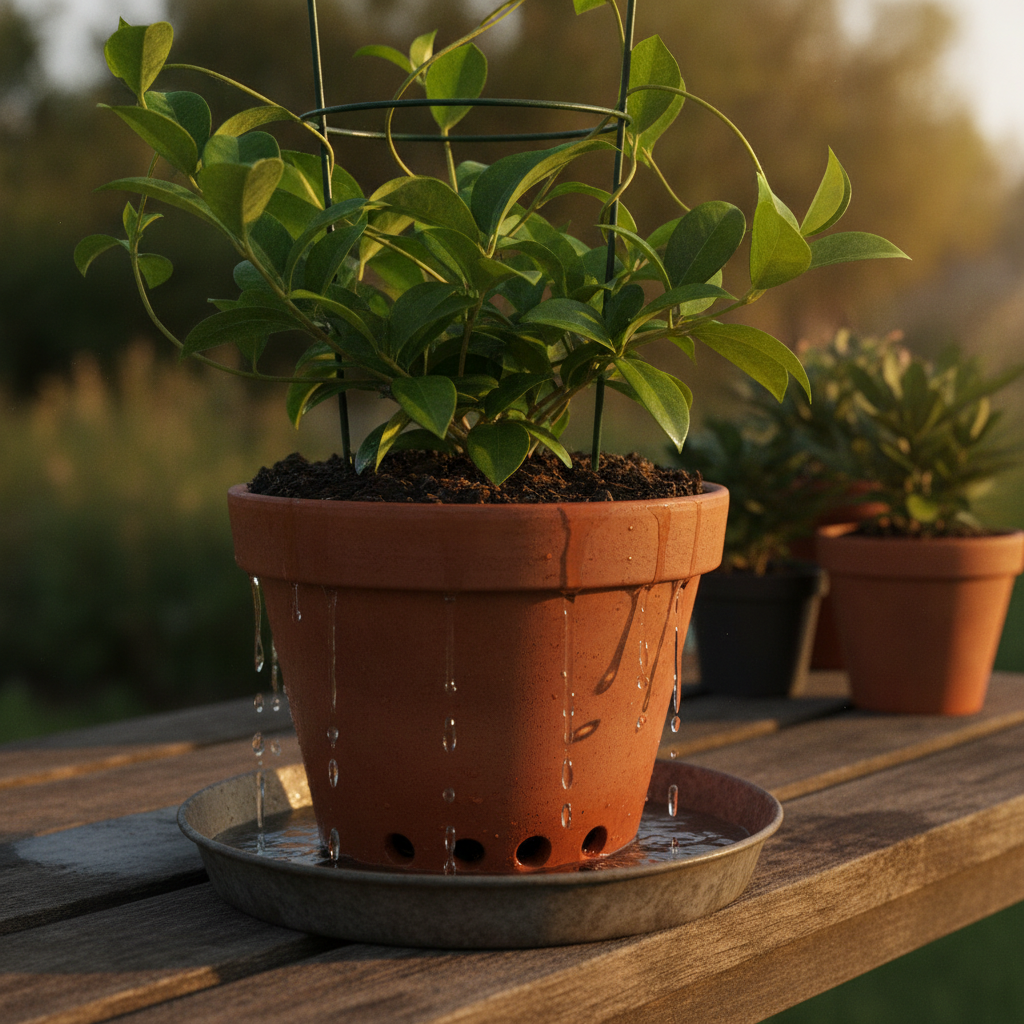
Drainage holes are non-negotiable. Whatever pot you choose must have generous drainage holes so excess water can escape. Without them, water collects invisibly at the base of the compost and rots the roots, no matter how carefully you water from above.
Pot material: Terracotta is an excellent choice because its porous walls allow the compost to breathe and dry more evenly, reducing the risk of overwatering. Glazed ceramic and plastic retain moisture longer, which can suit a grower who tends to underwater but demands more caution otherwise.
Pot size: When potting on, move up by only two to three centimetres (about an inch) in diameter at a time. An oversized pot holds a large volume of damp compost that the roots cannot use quickly, keeping the mix wet for too long and discouraging flowers.
When to Repot
Repot only when the plant is genuinely pot-bound, typically every two to three years, and always in spring before the flush of new growth. Signs it is ready include roots emerging from the drainage holes, water running straight through without wetting the compost, and a noticeable slowing of growth. In the years between repotting, refresh the top few centimetres of compost each spring to renew nutrients without disturbing the roots. Avoid repotting a plant that is in bud or flower, as the disturbance will almost certainly cause it to drop them.
How to Repot: Step-by-Step
- Water the plant a day beforehand so the rootball is moist and holds together during the move.
- Ease the plant from its pot by tipping it and supporting the base of the stems, rather than pulling on the vine.
- Gently tease out any tightly circling roots and inspect them, trimming away anything brown, soft or rotten.
- Add a layer of fresh compost to a pot only slightly larger, positioning the plant at the same depth as before.
- Fill around the rootball with fresh mix, firming gently to remove air gaps without compacting the compost.
- Reattach the stems to their support and water thoroughly, then keep the plant warm and out of harsh sun while it settles.
Warning — Transplant Shock: Madagascar jasmine resents root disturbance and may sulk for a few weeks after repotting, sometimes shedding a leaf or two. Keep conditions stable and warm, water carefully rather than heavily, and hold off feeding until you see fresh growth, which signals the roots have re-established.
Fertilising
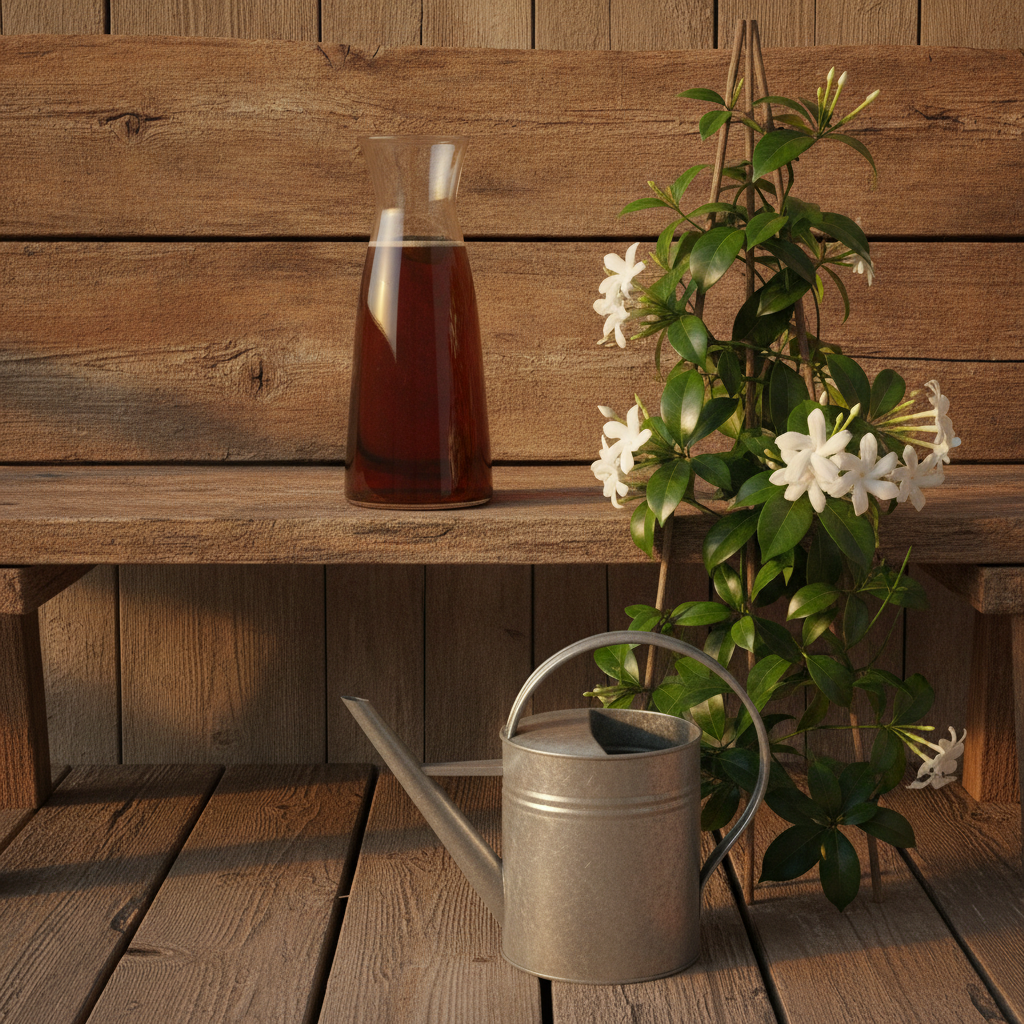
Feeding is where a Madagascar jasmine can be tipped from all leaves to abundant flowers. Because it grows and blooms vigorously through the warm months, the plant is a relatively hungry feeder in summer, but the type of fertiliser matters as much as the frequency. A feed too rich in nitrogen produces lush green growth at the expense of blooms, whereas one high in potassium actively promotes flowering.
The practical answer is to reach for a high-potassium feed, the same kind sold for tomatoes, once the plant is in active growth. This encourages the vine to channel its energy into buds and flowers rather than simply extending its stems, and it is one of the simplest changes a frustrated grower can make.
Understanding Plant Nutrients
Fertilisers are labelled with an NPK ratio showing the proportion of nitrogen, phosphorus and potassium they contain. For a flowering vine like Madagascar jasmine, potassium is the key to blooms, phosphorus supports root and flower development, and nitrogen should be present but not dominant. The table below summarises the main nutrients and what their deficiency looks like.
| Nutrient | Symbol | Primary Function | Deficiency Symptoms |
|---|---|---|---|
| Nitrogen | N | Leaf and stem growth | Pale, yellowing older leaves and stunted growth |
| Phosphorus | P | Root and flower development | Poor rooting, dull foliage, few flowers |
| Potassium | K | Flowering and overall vigour | Weak flowering, brown leaf edges, soft growth |
| Calcium | Ca | Cell-wall strength | Distorted new leaves and dying growing tips |
| Magnesium | Mg | Chlorophyll production | Yellowing between the veins of older leaves |
| Iron | Fe | Chlorophyll in new growth | Yellowing between veins on the youngest leaves |
Types of Fertiliser
Liquid fertilisers: The easiest and most responsive option for this plant. Diluted into the watering can, a high-potassium liquid feed is absorbed quickly and lets you match feeding precisely to the growing season, tapering off as autumn arrives.
Slow-release granular: Pellets mixed into the compost or scattered on the surface release nutrients gradually over months. Convenient, but choose a formulation aimed at flowering plants rather than a high-nitrogen foliage feed, or you may encourage leaves at the expense of blooms.
Organic fertilisers: Options such as diluted seaweed extract or worm-castings tea provide a gentle, balanced supply of nutrients along with trace elements. They act more slowly than synthetic feeds but are almost impossible to overdo and improve soil life over time.
Feeding Schedule
Feed every two weeks with a high-potassium liquid feed from the moment growth resumes in spring until flowering finishes in late summer or early autumn. As growth slows and the plant heads into its winter rest, stop feeding altogether; a dormant plant cannot use the nutrients, and unused fertiliser salts simply accumulate in the compost. Resume only when new growth appears the following spring.
Pro Tip — Feed at Half Strength, Twice as Often: Madagascar jasmine responds better to a steady supply of dilute feed than to occasional strong doses. Mixing the fertiliser at half the recommended strength and applying it more frequently gives even nutrition while greatly reducing the risk of root-scorching salt build-up.
How to Fertilise
- Water the plant lightly first if the compost is dry, so the feed never touches parched roots.
- Dilute a high-potassium liquid fertiliser to half the recommended strength in room-temperature water.
- Apply the solution to the compost, avoiding splashing the leaves and flowers.
- Every month or so, flush the pot with plain water to wash out accumulated salts.
Warning — Salt Build-Up: A white crust on the compost surface or around the pot rim signals a build-up of fertiliser salts, which can burn the roots and brown the leaf tips. Flush it away by watering thoroughly with plain water several times, letting each pass drain completely, and reduce how strongly or often you feed.
Propagation
Propagating Madagascar jasmine lets you raise new plants from a favourite specimen, though it calls for a little patience, as the cuttings root more slowly than many houseplants. The most reliable method by far is taking semi-ripe stem cuttings in early summer, ideally with a little bottom heat to speed things along.
Timing and warmth are everything. Cuttings taken from firm, current-season growth in the warmth of early summer root far more readily than soft spring shoots or hard winter wood, and consistent warmth at the base of the cutting dramatically improves the success rate.
Understanding Stem Nodes
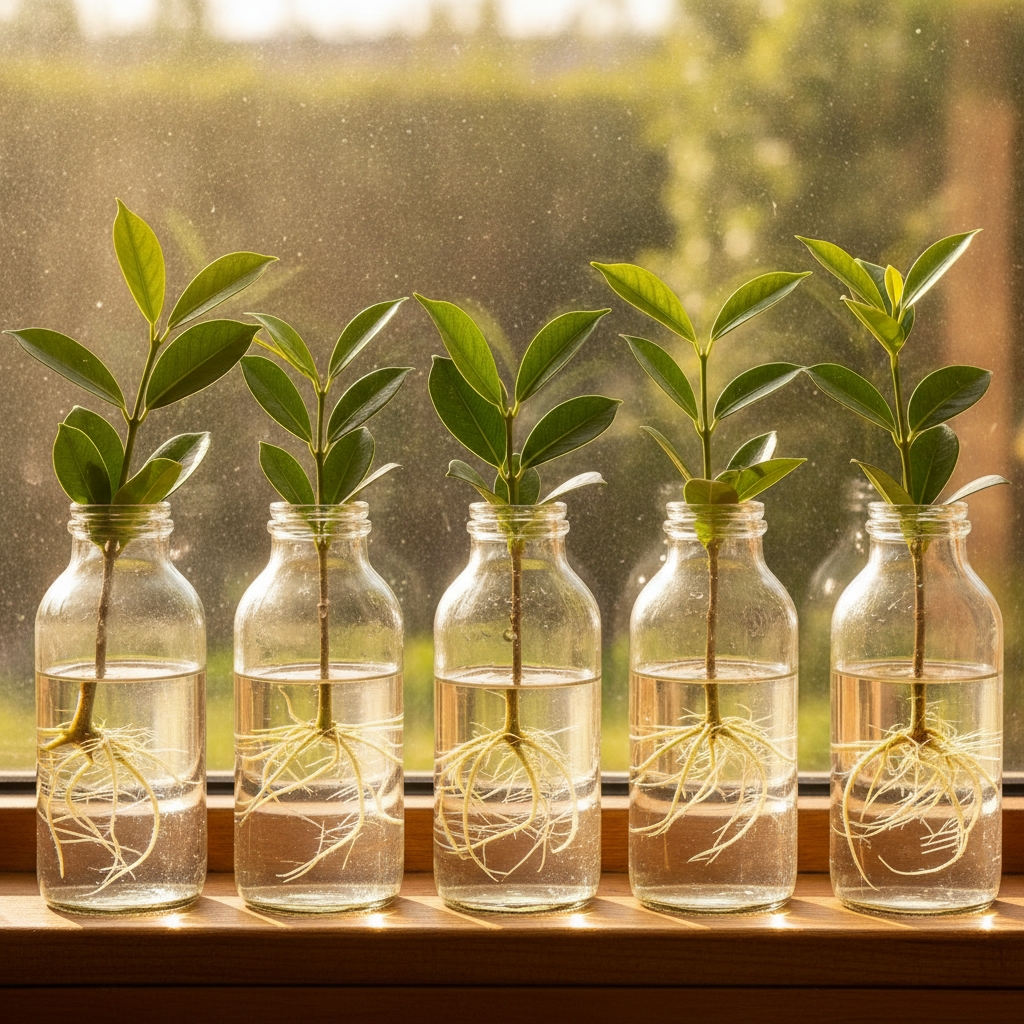
The key to rooting any vine cutting is the node, the slightly swollen point where a pair of leaves meets the stem. Nodes contain the dormant cells that give rise to new roots, so every cutting must include at least one, and preferably two. A cutting made just below a node, with the lower leaves removed, exposes this rooting zone to the compost or water where new roots will emerge.
Semi-Ripe Stem Cuttings in Compost: Step-by-Step
This is the traditional and most dependable method, rooting cuttings directly in a gritty propagating mix under warmth and humidity.
- In early summer, choose a healthy, non-flowering stem and cut a length of 10 to 15 centimetres (4 to 6 inches) with two or three pairs of leaves, cutting just below a node. Wear gloves, as the cut stem will weep milky sap.
- Remove the lowest pair of leaves and let the cut end dry for an hour so the sap seals, which reduces rotting.
- Dip the base in hormone rooting powder or gel to encourage rooting.
- Insert the cutting into a small pot of damp, gritty propagating mix so the lowest node sits below the surface.
- Cover with a clear bag or propagator lid to hold humidity, and keep at 20 to 24°C (68 to 75°F), ideally on a heated propagation mat, in bright but indirect light.
- Keep the mix lightly moist and ventilate briefly each day. Roots typically form over four to eight weeks, shown by fresh new growth; pot on once well rooted.
Pro Tip — Bottom Heat is the Secret: More than anything else, warmth at the base of the cutting determines success with Madagascar jasmine. A heated propagation mat set to around 22°C (72°F) can lift rooting rates dramatically compared with cuttings left on an ordinary windowsill, especially early or late in the season.
Rooting Cuttings in Water: Step-by-Step
Rooting in water is less reliable for this woody vine than for softer plants, but it lets you watch roots develop and can work well in the warmth of high summer.
- Take a cutting as above, with at least one clean node stripped of its lower leaves, and allow the cut end to dry briefly.
- Place it in a jar of room-temperature water so the bare node is submerged but the remaining leaves stay dry.
- Stand the jar in a warm, bright spot out of direct sun and refresh the water every few days to keep it oxygenated.
- Once roots reach three to five centimetres (one to two inches), pot the cutting into gritty compost, keeping it humid and warm while it adjusts to soil.
Troubleshooting Propagation
| Problem | Likely Cause | Solution |
|---|---|---|
| Cutting rots at the base | Too wet, too cold or sap not sealed | Use a grittier mix, provide bottom heat and let cuts dry before planting |
| No roots after many weeks | Insufficient warmth or a poor cutting | Add bottom heat and take fresh semi-ripe cuttings with sound nodes |
| Leaves shrivel and drop | Low humidity around the cutting | Cover with a propagator lid or bag and mist the air, not the leaves |
| Roots form but growth stalls after potting | Transplant shock or cold roots | Keep warm and humid, water sparingly and wait for new growth before feeding |
Pests & Diseases
A healthy, well-grown Madagascar jasmine is reasonably resistant to trouble, but its soft new growth and dense, twining stems can harbour sap-sucking pests, and mealybugs in particular are drawn to it. Most problems are far easier to control if caught early, so inspect the plant regularly, paying attention to leaf undersides and the sheltered junctions where leaves meet the stem.
Diseases are almost always a consequence of care rather than infection, with overwatering and poor air circulation at the root of most issues. Correcting the underlying conditions usually solves the problem more surely than any treatment applied to the symptoms.
Common Pests
Mealybugs (Pseudococcus species)
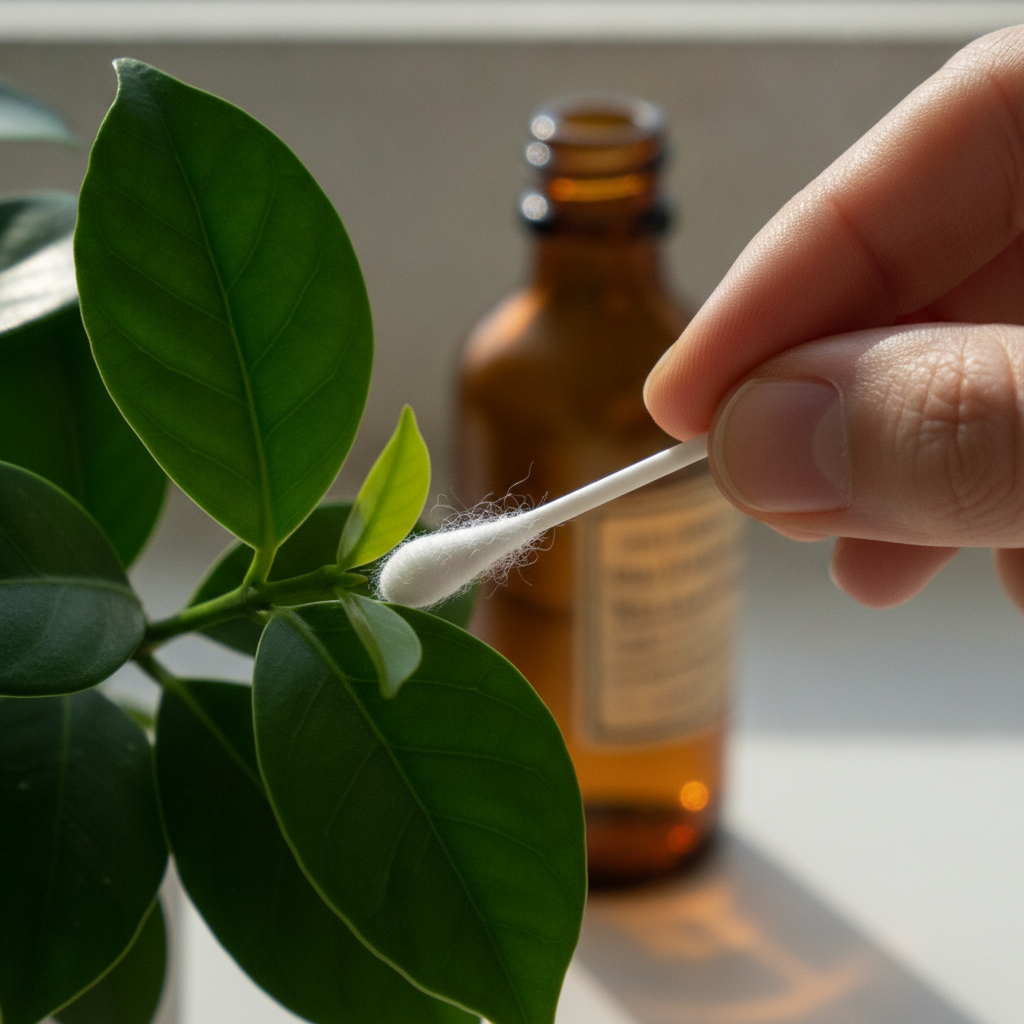
The most persistent pest of Madagascar jasmine, mealybugs appear as small, soft, white cottony blobs tucked into leaf axils and along stems. They suck sap, weaken the plant and excrete sticky honeydew that leads to sooty mould. Their waxy coating hides them and protects them, so they are easy to miss until numbers build.
Treatment: Dab each insect with a cotton bud dipped in isopropyl alcohol, which dissolves their protective wax on contact. For heavier infestations, wipe the plant down and follow with regular sprays of insecticidal soap or diluted neem oil until no new bugs appear, checking weekly as eggs hatch.
Scale Insects (Coccus species)
Scale appear as small, immobile brown or tan bumps clinging to stems and the undersides of leaves along the veins. Like mealybugs they feed on sap and produce honeydew, and their hard shells make them stubborn to shift once established.
Treatment: Scrape off what you can with a fingernail or an old toothbrush, then treat with neem oil or insecticidal soap, repeating every week or two. Systemic treatments can help with severe infestations that keep returning.
Aphids (Aphis species)
Aphids are tiny green, black or grey insects that cluster on soft new shoots and flower buds, distorting growth and, again, leaving sticky honeydew behind. They multiply quickly in warm conditions and are especially fond of the tender tips of a growing jasmine.
Treatment: Rinse them off with a firm spray of water, then treat with insecticidal soap or neem oil if they return. A few applications a few days apart usually clears them entirely.
Spider Mites (Tetranychus urticae)
Spider mites thrive in the hot, dry air of centrally heated rooms and are most likely to strike a jasmine in winter. Too small to see easily, they betray themselves by fine speckling or stippling on the leaves and, in bad cases, delicate webbing between stems.
Treatment: Raise the humidity, as mites hate moist air, and rinse or wipe the foliage to dislodge them. Treat persistent populations with neem oil or a miticide, covering the leaf undersides thoroughly.
Common Diseases
Root Rot (Pythium and Phytophthora species)
By far the most serious disease of Madagascar jasmine, root rot follows waterlogged compost, particularly in cool winter conditions. The roots turn brown and mushy, the plant wilts despite wet soil, and lower leaves yellow and fall. Left unchecked it is usually fatal.
Treatment: Act quickly by unpotting the plant, cutting away all soft, discoloured roots with clean scissors, and repotting into fresh free-draining compost. Water sparingly afterwards and correct the watering habits and drainage that caused it.
Sooty Mould (Capnodium species)
Sooty mould is a black, soot-like coating that grows on the sticky honeydew left by sap-sucking pests. It does not attack the plant directly but blocks light from the leaves and signals an underlying pest problem that needs addressing.
Treatment: Wipe the mould from the leaves with a damp cloth, then eliminate the pests producing the honeydew, without which the mould cannot return.
Pest and Disease Summary
| Pest / Disease | Identification | Treatment |
|---|---|---|
| Mealybugs | White cottony blobs in leaf axils and on stems | Alcohol on a cotton bud; insecticidal soap or neem oil |
| Scale | Brown immobile bumps on stems and leaf undersides | Scrape off; neem oil or insecticidal soap |
| Aphids | Clusters of tiny insects on new shoots and buds | Rinse off; insecticidal soap or neem oil |
| Spider mites | Fine leaf stippling and delicate webbing | Raise humidity; neem oil or miticide |
| Root rot | Wilting, yellowing and mushy brown roots | Trim rotten roots, repot, water sparingly |
| Sooty mould | Black soot-like film on leaves | Wipe off and eliminate the honeydew-producing pests |
Prevention Strategies
The best defence is a healthy plant grown in the right conditions, since vigorous growth shrugs off minor pest pressure that would overwhelm a weakened specimen. Inspect new leaves and stem junctions every week or two, and isolate any newly acquired plant for a couple of weeks before placing it near your jasmine, as new arrivals are the commonest way pests enter a collection.
Good air circulation, careful watering and clean, dust-free leaves all reduce the conditions pests and diseases need to take hold. Removing dead leaves and spent flowers promptly denies pests a hiding place and keeps fungal problems from gaining a foothold.
Pro Tip — Catch Mealybugs Early: Because mealybugs are the signature pest of this plant, a quick weekly glance into the leaf axils and along the stems is worth the effort. A single insect wiped away with alcohol today saves a full-blown infestation across the whole vine in a month’s time.
Popular Varieties
Madagascar jasmine is grown as a species far more often than as named cultivars, and much of the plant material sold is simply Stephanotis floribunda without a variety name. Even so, a handful of distinct forms circulate among enthusiasts and specialist nurseries, differing mainly in leaf markings and in how freely they flower.
Because the flowers themselves vary little between forms, all being that same waxy, fragrant white, the choice usually comes down to foliage and vigour. The table below summarises the forms you are most likely to encounter.
| Variety | Leaf Appearance | Light Needs | Growth Rate | Availability |
|---|---|---|---|---|
| Species (S. floribunda) | Glossy, plain dark green | Bright with some sun | Moderate | Common |
| ‘Alpine’ | Deep green, robust | Bright with some sun | Vigorous, free-flowering | Occasional |
| ‘Variegata’ | Green marbled with cream and pale yellow | Bright indirect | Slower | Uncommon |
| ‘Elvaston’ | Compact, neat foliage | Bright with some sun | Compact | Rare |
| Stephanotis grandiflora | Larger leaves and flower clusters | Bright with some sun | Vigorous | Rare, specialist |
Featured Varieties
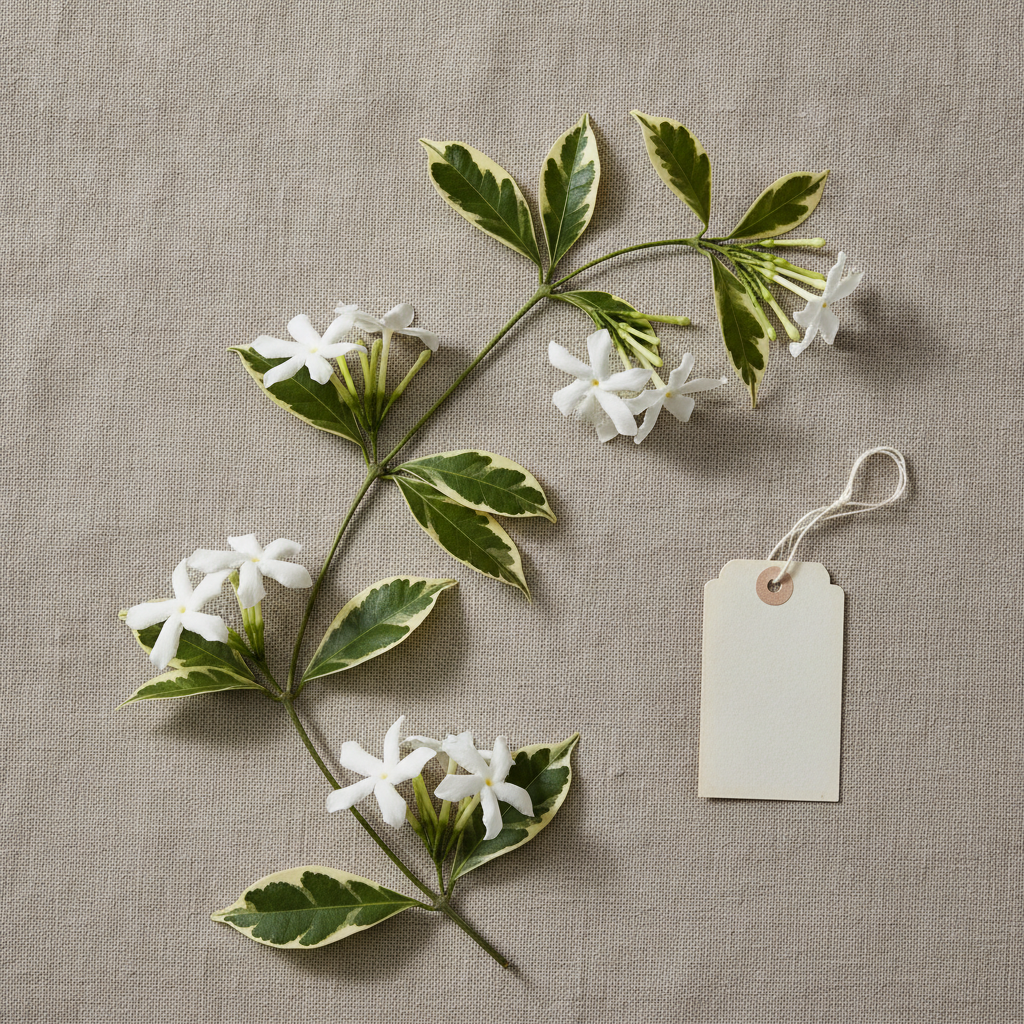
‘Variegata’
The variegated form trades some vigour for striking foliage, its glossy leaves marbled and edged in cream and pale yellow. It flowers just as fragrantly but grows more slowly and appreciates slightly softer light to keep the pale areas from scorching.
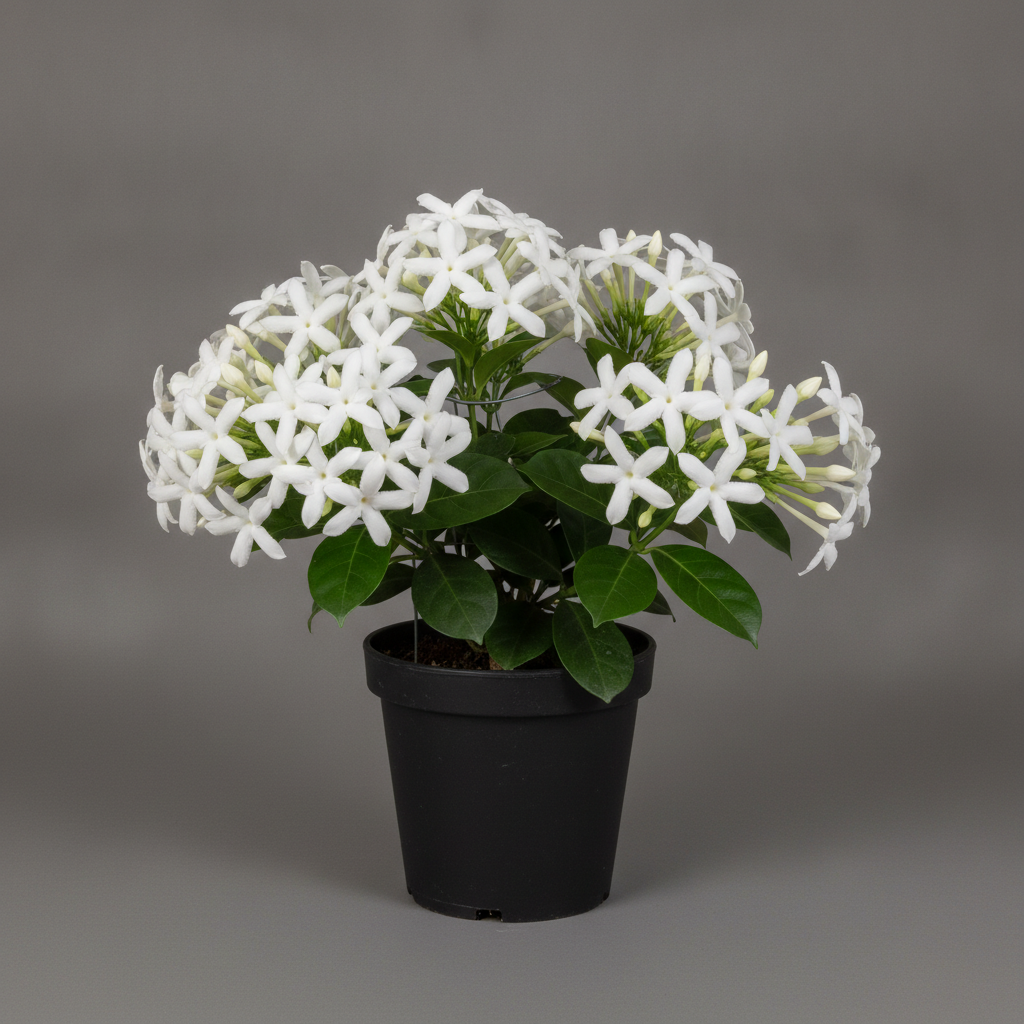
‘Alpine’
A vigorous, free-flowering selection prized for producing larger, more abundant clusters of pure-white blooms than the plain species. Its deep green, robust foliage and reliable flowering make it a favourite where a heavier show of scent is wanted.
Variety Profiles in Detail
Species Madagascar Jasmine (Stephanotis floribunda)
The wild species remains the plant most gardeners grow and the benchmark against which the others are judged. Its plain, glossy dark-green leaves set off the waxy white flowers beautifully, and it combines strong fragrance with dependable performance given bright light and a cool winter rest. For most growers, the unnamed species is both the easiest to find and entirely satisfying.
‘Alpine’ (Stephanotis floribunda ‘Alpine’)
Selected for its floriferous habit, ‘Alpine’ rewards the same care as the species with a noticeably heavier flush of blooms and sturdy, healthy foliage. It is the form to seek out if fragrance and flower quantity are your priority, though it is not always labelled as such in general retail.
‘Variegata’ (Stephanotis floribunda ‘Variegata’)
The variegated cultivar is grown as much for its patterned leaves as its flowers, bringing year-round interest even out of bloom. The cream and yellow marbling comes at the cost of slower growth and a little extra care with light, but it makes an elegant specimen for a bright, gently shaded position.
Choosing the Right Variety for Your Space
For most homes, the plain species or the free-flowering ‘Alpine’ are the best choices, offering maximum fragrance and reliable blooms in a bright spot. If you have a slightly less intense light source and want interest even between flowering flushes, the variegated form earns its place on foliage alone. Whichever you choose, provide a support to twine around, bright light and a cool winter rest, and any of these forms will reward you with the unmistakable scent that has made Madagascar jasmine a treasured plant for generations.
Frequently Asked Questions
Why won’t my Madagascar jasmine flower?
The usual reasons are too little light, the wrong feed and the lack of a cool winter rest. The plant needs bright light with some direct sun to build the energy for flowers, a high-potassium feed rather than a nitrogen-rich one, and a period at around 13 to 15°C (55 to 59°F) over winter to trigger bud formation. Keeping it slightly pot-bound also encourages blooming. Address all four and a reluctant plant will usually come into flower the following season.
Why are the flower buds dropping off before they open?
Bud drop is the classic complaint with this plant and is almost always caused by a sudden change in conditions. Moving or even rotating the plant once it is in bud, draughts, swings in temperature, and inconsistent watering can all cause it to shed buds. Once buds have formed, leave the plant exactly where it is, keep it evenly watered and out of draughts, and resist the urge to reposition it.
Is Madagascar jasmine poisonous to cats and dogs?
As a member of the milkweed family it contains a milky sap that can irritate skin and mouths, so it is prudent to treat it as mildly toxic and keep it out of reach of pets and children who might chew the leaves. If an animal does ingest part of the plant and shows signs of distress, contact a vet for advice.
How do I give my plant a winter rest?
From late autumn, move the plant to a cooler but still bright room kept at around 13 to 15°C (55 to 59°F), reduce watering so the compost dries more between drinks, and stop feeding entirely. This rest period is what sets the plant up to flower the following year, so it is well worth finding a suitable cool spot such as a spare bedroom or an enclosed porch.
Does Madagascar jasmine need support to climb?
Yes. It is a natural twining climber and grows best trained onto a hoop, trellis or obelisk that its stems can wind around. Guiding the new growth around the support as it extends keeps the plant tidy, encourages an even shape and displays the flowers to their best advantage.
When and how should I prune it?
Prune lightly in early spring before growth resumes, shortening overlong or tangled stems and removing any weak or dead growth to keep the plant shapely. Avoid heavy pruning during the growing season, as flowers form on new growth and over-enthusiastic cutting can reduce that year’s display. Always wear gloves, since pruning releases the irritant milky sap.
Why are the leaves turning yellow?
Yellowing leaves most often point to overwatering, especially if the compost is staying wet and the lower leaves are affected first. It can also result from cold, draughts or a nutrient shortage. Check that the pot drains freely and that you are letting the compost dry appropriately for the season, and ensure the plant is warm and fed through the growing months.
Can I grow Madagascar jasmine outdoors?
In temperate climates it is not hardy and must be grown as a houseplant or in a heated conservatory, as it will not survive frost. In summer it can be moved outside to a warm, sheltered, brightly lit spot once nights are reliably mild, which many growers find improves flowering, but it must come back indoors well before the first cold nights of autumn.
Is it the same as true jasmine?
No. Despite the shared common name and the similarly sweet fragrance, Madagascar jasmine (Stephanotis floribunda) belongs to the milkweed family and is unrelated to true jasmines in the genus Jasminum. The name reflects the perfume and white flowers rather than any botanical kinship.






