

The heartleaf philodendron (Philodendron hederaceum) is one of the most forgiving and quietly rewarding houseplants in cultivation. Native to the warm, humid forests of Central America, the Caribbean and parts of tropical South America, this slender vining aroid spends its life in nature scrambling up tree trunks and creeping along the forest floor, where its small heart-shaped leaves slip easily between branches and shafts of dappled light. Indoors that same easygoing habit translates into a plant happy to drape from a shelf, climb a moss pole or trail down from a hanging basket with very little intervention from the grower.
It is often confused with pothos (Epipremnum aureum), and the two share enough silhouette and culture to be planted in the same pot without complaint, but the heartleaf is the softer, more refined relative. Its leaves are thinner, the heart shape is more pronounced and the new growth often emerges with a coppery flush before settling into a deep glossy green. This guide is written for growers who want more than survival. Most heartleaf philodendrons will tolerate a surprising amount of neglect, but a plant given the right light, the right watering rhythm and a single annual repot will reward you with metres of cascading growth, glossy leaves and the steady production of new shoots that defines a truly thriving aroid.
Contents
- Quick Reference
- Why Heartleaf Philodendron Makes an Excellent Houseplant
- Light Requirements
- Watering & Humidity
- Soil, Potting & Repotting
- Fertilising
- Propagation
- Pests & Diseases
- Popular Varieties
- Frequently Asked Questions
Quick Reference: Heartleaf Philodendron at a Glance
| Light | Medium to bright indirect light; tolerates low light but grows slowly and produces smaller leaves |
| Watering | Water when the top 2 to 3 cm (1 inch) of soil is dry; roughly once a week in summer, every 10 to 14 days in winter |
| Temperature | 18 to 27 degrees Celsius (65 to 80 degrees Fahrenheit); avoid below 13 degrees Celsius (55 degrees Fahrenheit) |
| Humidity | Comfortable from 40 to 70 percent; thrives at 50 percent or higher |
| Fertiliser | Balanced liquid feed at half strength every 4 to 6 weeks during spring and summer |
| Toxicity | Toxic to cats, dogs and humans if chewed or swallowed; sap contains insoluble calcium oxalate crystals |
Why Heartleaf Philodendron Makes an Excellent Houseplant
Few houseplants combine reliability and elegance as effectively as the heartleaf philodendron. It has been a staple of indoor cultivation since the late nineteenth century, when European growers first brought trailing aroids back from the tropics, and it has remained popular because it refuses to be difficult. The plant accepts a wide range of light conditions, recovers gracefully from missed waterings, and produces new growth steadily through most of the year. Even in rooms with only a north-facing window or a corner of borrowed light, it will keep putting out small heart-shaped leaves at the tips of its vines.
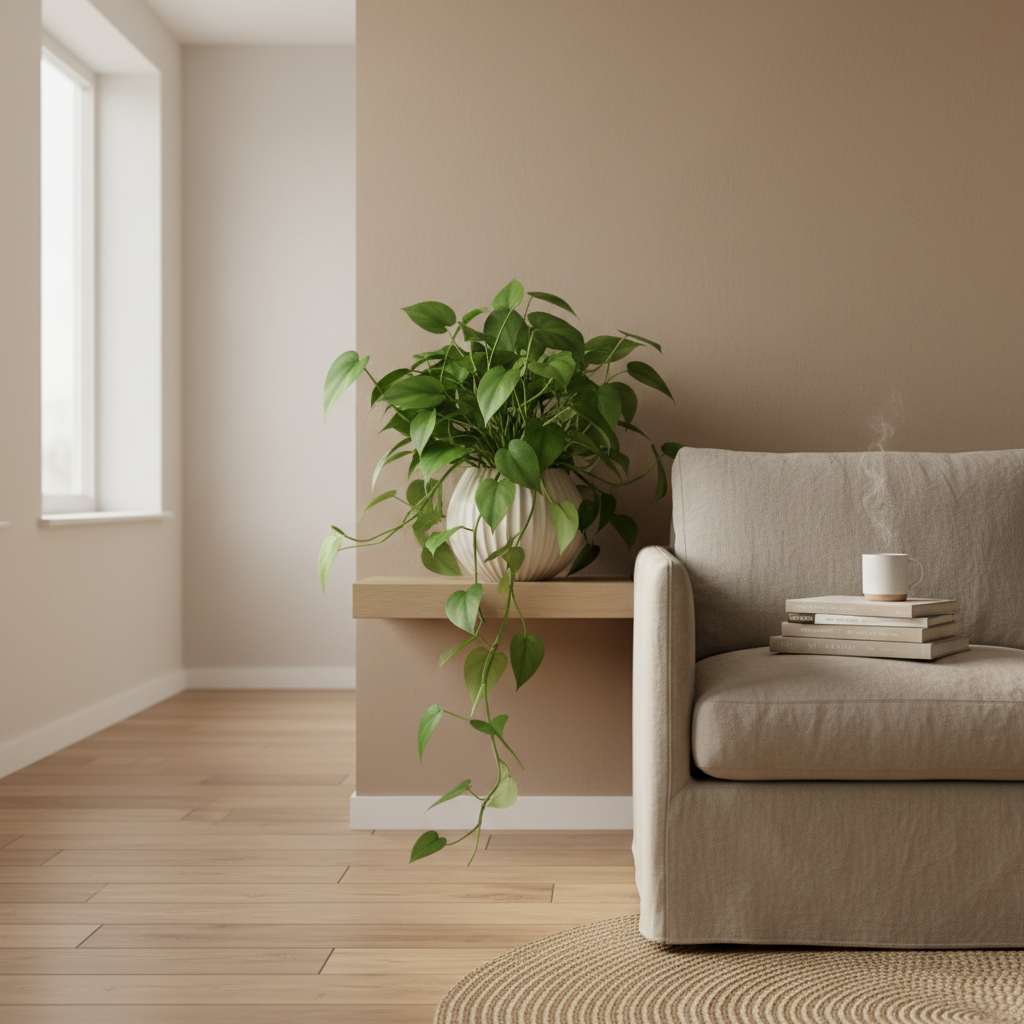
The heartleaf is also versatile in form. Left to trail, it produces long ropes of foliage that can reach two to three metres (6 to 10 feet) over several years. Trained up a moss pole or trellis, it climbs upward and develops larger, more leathery leaves as the aerial roots grip the support, mimicking its natural climbing habit. Pinched regularly, it bushes out into a dense mound suited to a tabletop. This adaptability, combined with low light tolerance, fast propagation and steady growth, is what has kept it on windowsills, in offices and in shopping centres for well over a century.
Important — Toxicity: All parts of the heartleaf philodendron contain insoluble calcium oxalate crystals. Chewing or swallowing the leaves can cause intense oral burning, drooling, vomiting and difficulty swallowing in cats, dogs and humans. Place the plant out of reach of curious pets and children, and wash your hands after handling cut stems, as the sap can irritate sensitive skin.
Light Requirements
In the wild, the heartleaf philodendron grows under the high canopy of tropical forest, where the light reaching its leaves has already been filtered through layers of taller vegetation. It is, in plant terms, a low-to-medium light specialist that is grateful for more illumination but never quite at home in full sun. Understanding this single fact is the foundation of growing a healthy specimen indoors.
The sweet spot for the heartleaf is bright indirect light: the kind found a metre or two back from an unobstructed east or west window, or filtered through a sheer curtain on a south exposure. Under those conditions the plant produces full-sized leaves, short internodes (the gaps between leaves) and a steady stream of new growth. It will continue to live in considerably less light, but the trade-off is slower growth, longer internodes that leave the vine looking sparse, and smaller leaves that lose much of the plant’s visual appeal.
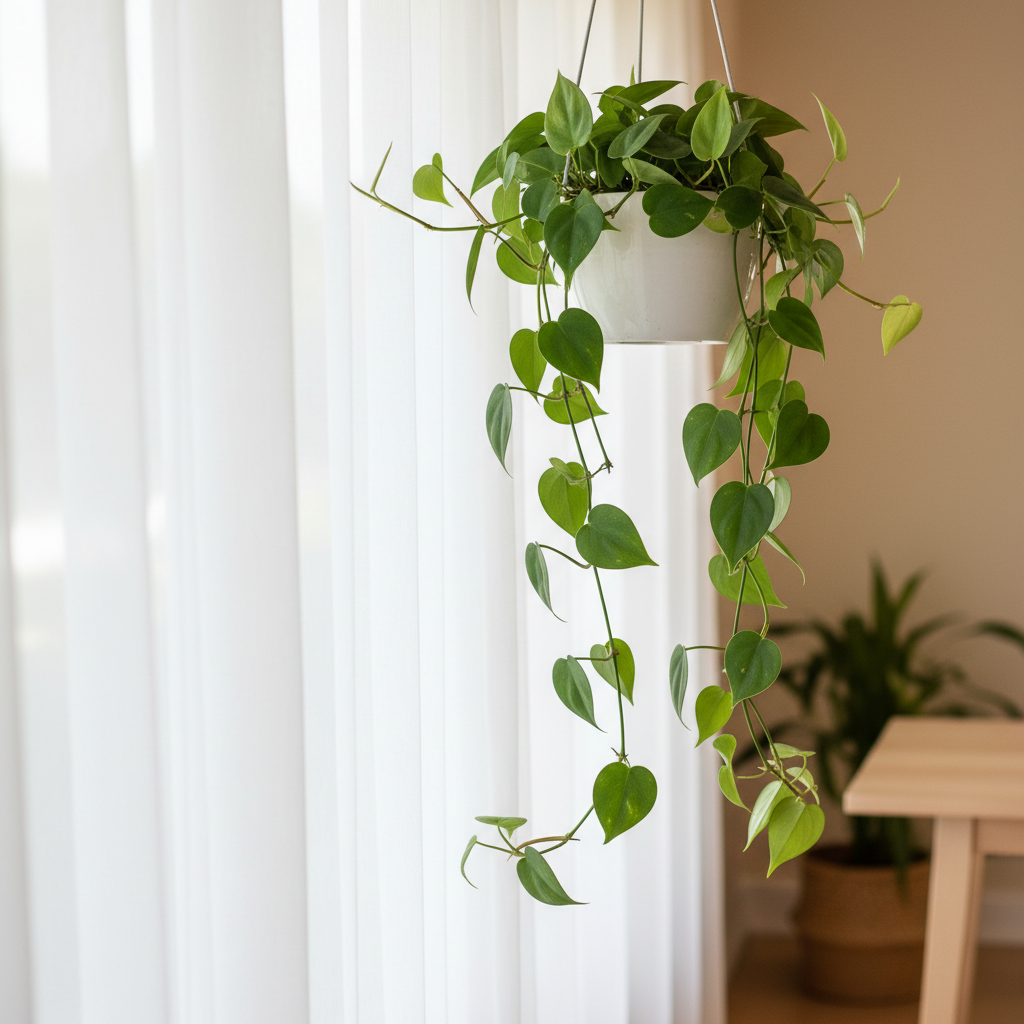
Light Levels Explained
Light intensity indoors is usually measured in lux, the unit of illumination falling on a surface. For context, a sunny midsummer afternoon outdoors delivers around 100,000 lux, while a dim hallway might register only 200 lux. The heartleaf philodendron grows across a wide span of this range, but the table below shows where each tier sits and what to expect at each level.
| Light Category | Approx. Level | Typical Location | Outcome |
|---|---|---|---|
| Direct sun | 30,000 lux and above | Right against a south or west window | Leaf scorch, bleaching, crisp brown edges |
| Bright indirect | 10,000 to 20,000 lux | 1 to 2 metres from a bright window, or behind a sheer curtain | Optimal growth, full leaves, rich colour |
| Medium | 2,500 to 10,000 lux | Across the room from a window, near a north-facing window | Steady but slower growth, slightly smaller leaves |
| Low | 500 to 2,500 lux | Hallway, interior wall, several metres from any window | Survival mode, long internodes, sparse foliage |
| Very low | Below 500 lux | Windowless room, dim office corner | Gradual decline, leaf loss, leggy stems |
Window Orientation and Placement
South-facing window: Place the plant at least 1.5 to 2 metres (5 to 7 feet) back from the glass, or use a sheer curtain to diffuse the strongest midday light. Direct south sun, especially in summer, will scorch the leaves within hours.
East-facing window: An excellent location. Gentle morning sun followed by bright ambient light through the rest of the day matches the heartleaf’s natural preferences. The plant can sit directly on the sill in most regions without burning.
West-facing window: Suitable, but watch for hot late-afternoon sun in summer. A position a metre back from the glass, or a sheer curtain, prevents leaf scorch while preserving good growth.
North-facing window: Workable, particularly in summer and in rooms with light walls that bounce ambient brightness around. Growth will be slower and leaves smaller, but the plant will remain healthy and attractive.
Pro Tip — Read the Internodes: The gap between leaves on a new vine is the single best indicator of whether your light level is right. Short, compact gaps with full-sized leaves mean the plant is happy. Long bare stretches with sparse leaves at the tip mean it is reaching for more light. Move it closer to a window or supplement with a grow lamp.
How Light Affects Leaf Colour and Variegation
The plain green form of the heartleaf is remarkably stable in any light, holding its deep glossy colour from medium light upward. Variegated cultivars such as Brasil, Lemon Lime and the silvery Silver Cloud are far more dependent on bright indirect light to keep their patterns intact. In low light the variegation shrinks back, new leaves revert toward solid green and the visual appeal of the cultivar gradually disappears. If you have invested in a variegated form, plan to give it the brightest indirect spot in the room.
Warning — Direct Sunlight: Two or three hours of direct summer sun, especially through south or west windows, is enough to bleach the leaves to a pale yellow-green and create brown crisp patches that never recover. Always diffuse, filter or set back the plant from harsh direct sun.
Artificial Lighting
The heartleaf is one of the easier plants to keep under artificial light. A full-spectrum LED grow lamp positioned 30 to 60 cm (12 to 24 inches) above the plant, running for 10 to 12 hours a day, easily replicates the bright indirect tier. Even modest office lighting will sustain the plant if used for at least 10 hours a day. In windowless rooms a simple clip-on grow light is enough to keep a vine healthy and to maintain the variegation in patterned cultivars.
Seasonal Adjustments
Indoor light levels drop by half or more between summer and midwinter at temperate latitudes. A spot that delivered bright indirect light in July may slip into low-light territory by December. Watch the new growth in autumn and winter. If internodes lengthen and leaves shrink, move the plant closer to a window, rotate it weekly to keep growth even, and consider supplementing with a small grow lamp for the darkest two or three months of the year.
Watering & Humidity
Watering is where most heartleaf philodendrons are made or lost. The plant is forgiving of the occasional missed week and resentful of a constantly wet pot. The principle to internalise is simple: the heartleaf likes a soak followed by a partial drying out. It does not like to sit in soggy soil, and it does not like to dry to a bone before the next drink either.
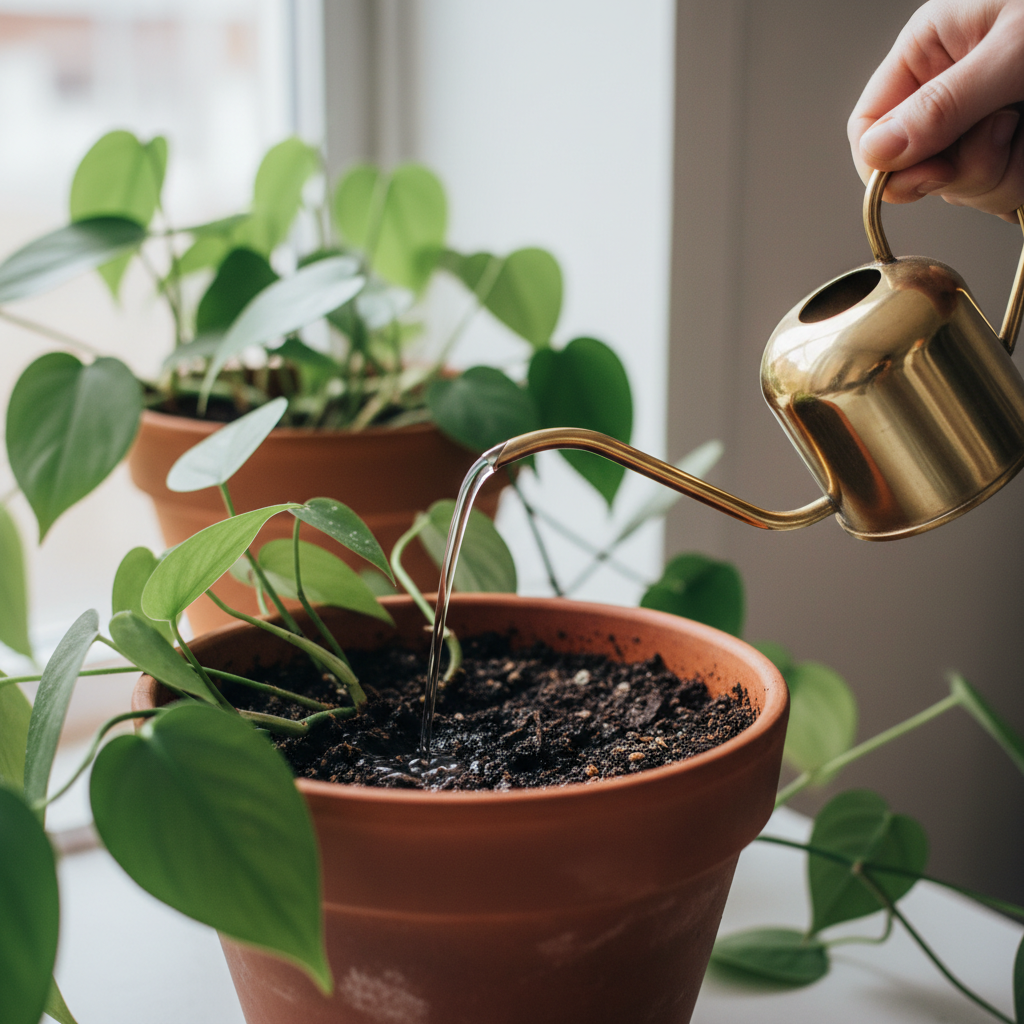
When to Water
The most reliable indicator is your finger. Push it into the soil up to the first knuckle. If the top 2 to 3 cm (about 1 inch) feels dry and the soil below is just slightly cool and barely moist, it is time to water. If the soil is still distinctly damp at the surface, wait another day or two and check again. Over the course of a year this usually translates to watering roughly once a week during the warm growing season and every 10 to 14 days during the cooler, darker months.
The actual interval depends on more than the calendar. A plant in a small terracotta pot in a sunny window may need water every four or five days in summer, while the same plant in a large plastic pot in a cool north-facing room may only need it once every two weeks. Light, temperature, humidity, pot material and pot size all play a part. Treat the once-a-week guideline as a starting point and let the soil moisture itself dictate the rhythm.
Pro Tip — Lift the Pot: Pick up the pot when the soil is freshly watered and again when you think it is ready for a drink. The difference in weight is striking, and after a few cycles you will be able to tell at a glance whether a plant needs water just by lifting it. This is far more reliable than any schedule.
How to Water Correctly
- Take the plant to a sink or place a tray beneath the pot to catch runoff.
- Pour room-temperature water slowly and evenly across the surface of the soil, working your way around the pot rather than dumping it in one spot.
- Keep watering until you see water running freely from the drainage holes at the base of the pot.
- Let the pot drain fully for at least 10 to 15 minutes before returning it to its decorative cover or saucer.
- Tip out any water collected in the saucer or outer pot. Standing water against the drainage holes is one of the fastest routes to root rot.
- Return the plant to its usual spot and wait for the top of the soil to dry partially before watering again.
Signs of Overwatering vs. Underwatering
| Symptom | Overwatering | Underwatering |
|---|---|---|
| Leaf colour | Yellowing of older leaves first, often several at once | Yellowing of leaf tips and edges, usually progressing slowly |
| Leaf texture | Soft, limp, sometimes translucent near the petiole | Thin, papery, curling inward, crisp at the edges |
| Soil | Persistently wet, dark, with a sour or musty smell | Pulls away from the sides of the pot, dust-dry to the touch |
| Roots | Brown or black, mushy, breaking apart easily | Pale and dry, brittle, still firm but thin |
| Stem base | Soft, sometimes black, may collapse when touched | Firm but shrivelled, lighter in colour |
Warning — Root Rot: Persistent overwatering is the leading cause of death in heartleaf philodendrons. Once the roots turn black and mushy and the smell of stagnant soil appears, the plant is in serious trouble. Unpot immediately, trim away all soft tissue with sterilised scissors, rinse the remaining roots, and repot in fresh dry mix. Hold off on watering for a week to give the cut surfaces time to callus.
Humidity Requirements
The heartleaf is more relaxed about humidity than many tropical aroids. It tolerates the 30 to 40 percent range typical of centrally heated homes in winter, and it is genuinely happy anywhere between 40 and 70 percent. Above 50 percent you may notice larger new leaves, glossier surfaces and faster aerial root development, but below 40 percent the plant will simply slow down rather than decline outright.
Trouble appears only at the extremes. Sustained humidity below 25 percent, common near radiators in winter, can cause crisp brown leaf tips and slow new growth to a crawl. Sustained humidity above 80 percent with poor airflow can encourage fungal leaf spots and powdery mildew. For most homes neither extreme is reached, and the plant takes care of itself.
If you want to raise humidity, group the heartleaf with other plants so they share transpired moisture, stand it on a wide tray of pebbles topped up with water (keeping the pot itself above the waterline) or run a small room humidifier for a few hours a day. Misting is largely cosmetic and provides only a brief, surface-level boost, so it is best treated as a leaf-cleaning routine rather than a humidity strategy.
Water Quality
Tap water is fine for almost all heartleaf philodendrons. The plant is not as sensitive to fluoride and chloramine as some of the thinner-leaved tropicals, but in hard-water areas mineral build-up on the surface of the soil and around the rim of the pot can develop over time. If you notice white crusty deposits or brown leaf tips that do not respond to better humidity, switch to filtered or rainwater for a few months and flush the soil thoroughly to reset the salt balance.
Soil, Potting & Repotting
Roots need a balance of moisture, air and structural support, and the right potting mix is what makes that balance possible. The heartleaf philodendron is an epiphytic vine in nature, with roots that creep along bark and litter rather than burrow into heavy soil, so it does best in a mix that is loose, well-aerated and free-draining rather than dense and water-retentive.
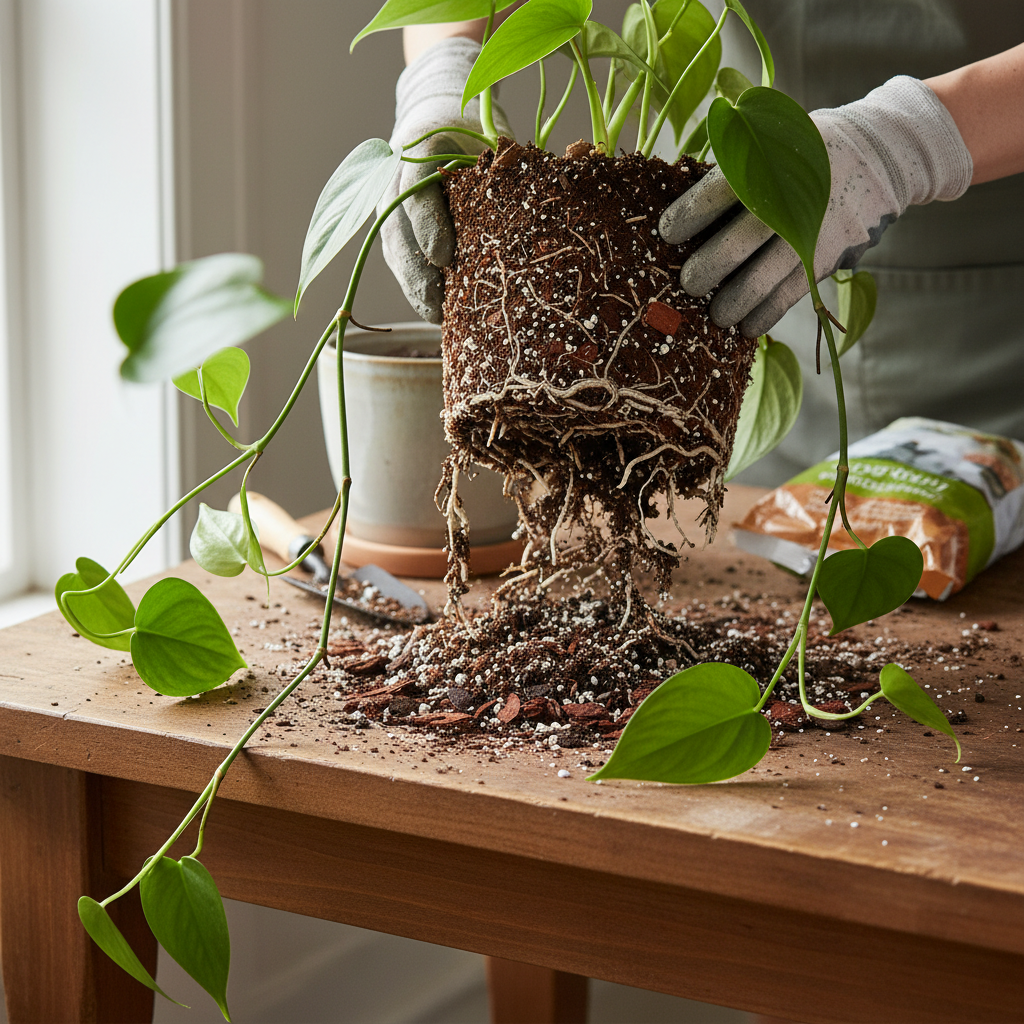
Ideal Soil Composition
A good heartleaf mix has plenty of air pockets, holds moisture briefly without staying soggy and feeds the roots gently with organic matter. Bagged houseplant compost on its own is usually too dense, so most growers amend it with chunky additives that open up the structure. The mix below is a reliable starting point that works well across most homes and watering habits.
| Component | Proportion | Function |
|---|---|---|
| Peat-free houseplant compost or coco coir-based mix | 50 percent | Holds moisture and provides gentle nutrition |
| Perlite or pumice | 25 percent | Opens up the structure, prevents compaction, improves drainage |
| Orchid bark (fine to medium) | 20 percent | Mimics the chunky organic debris around natural roots |
| Horticultural charcoal | 5 percent | Absorbs odours, helps keep the mix sweet between repotting |
The heartleaf is happy in a slightly acidic to neutral pH, between 5.5 and 7.0. Most bagged houseplant composts already sit comfortably in this range, so adjusting pH is rarely necessary. If you reuse old soil or notice persistently yellow new growth, a fresh batch of mix usually corrects any drift.
Pro Tip — Quick Mix Recipe: If you only want one ratio to remember, mix two parts peat-free houseplant compost, one part perlite and one part fine orchid bark by volume. This is loose enough for the roots to breathe, holds moisture long enough for an average weekly watering and suits almost every philodendron, monstera and pothos in your collection.
Choosing the Right Pot
The pot is part of the watering equation. A pot that is too large dries too slowly and increases the risk of rot, while a pot that is too small dries within a day or two and stresses the plant. For the heartleaf, choose a pot that is no more than 2 to 3 cm (1 inch) wider in diameter than the current root ball.
Drainage holes are non-negotiable. The heartleaf philodendron will not tolerate a pot with no way for excess water to escape. If you have fallen in love with a decorative pot that lacks drainage, use it as a cachepot: plant into a plain plastic nursery pot with drainage and slip it inside the decorative one, removing it for watering and returning it once the pot has drained fully.
Pot material: Terracotta is breathable and forgiving for over-eager waterers because it wicks moisture away from the soil. Glazed ceramic and plastic hold moisture longer, which suits drier homes and growers who prefer longer intervals between waterings. There is no wrong choice, only a choice that pairs well with your watering habits.
Pot size: Heartleaf philodendrons enjoy being slightly snug. They flower rarely indoors and put their energy into foliage and vine length, both of which are encouraged by a moderately full root system. Step up by one pot size at a time, typically every 18 to 24 months.
When to Repot
Most heartleaf philodendrons need repotting every 18 to 24 months. The clearest signs that it is time are roots circling visibly at the base of the pot or emerging from the drainage holes, water that runs straight through the pot without ever soaking in, and a plant that dries out within two or three days of watering. Late spring or early summer is the ideal window, when the plant is entering its active growing season and can recover quickly.
How to Repot: Step-by-Step
- Water the plant the day before repotting so the root ball is hydrated and slides out cleanly.
- Choose a new pot 2 to 3 cm (1 inch) wider than the current one, with drainage holes. Add a thin layer of fresh mix to the base.
- Gently tip the plant out by squeezing the sides of the old pot. Support the stem base with one hand and ease the root ball free.
- Tease away loose old soil from the outer roots and inspect for any black, mushy or hollow sections. Trim these off with sterilised scissors, cutting back to firm pale tissue.
- Place the plant into the new pot at the same depth it was growing before, then backfill around the sides with fresh mix, tapping the pot to settle the soil without compacting it.
- Water thoroughly to settle the mix and close any large air pockets, then let the pot drain completely.
- Return the plant to its usual spot, keep it out of direct sun for a week and resist the urge to water again until the top of the soil dries.
Warning — Transplant Shock: Expect a brief pause in growth and possibly the loss of one or two of the oldest leaves after repotting. This is normal as the roots re-establish. Do not fertilise for at least four weeks after repotting, and resist the temptation to water on a fixed schedule. Let the plant tell you when it is thirsty.
Fertilising
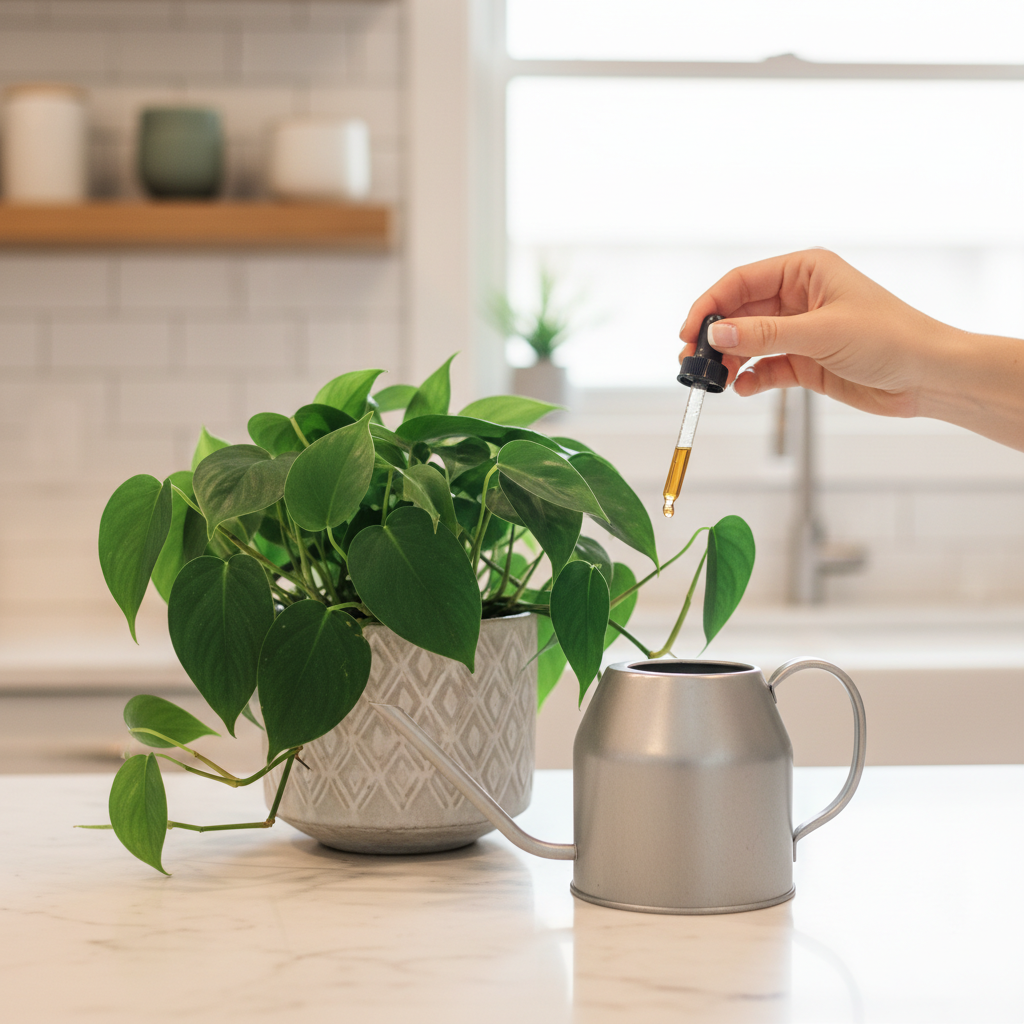
The heartleaf philodendron is not a heavy feeder, but it does benefit visibly from a light, regular nutrition routine during the warmer half of the year. The difference between an unfertilised plant and one fed correctly is rarely about survival and almost always about lushness: leaf size, the depth of green, and the rate at which new growth appears at the tips of the vines.
The opposite mistake, overfeeding, is more common and more damaging. Excess fertiliser raises the salt concentration in the soil, burns the fine roots and shows up as brown leaf tips and a salty crust on the soil surface. The guiding principle is simple: feed often but lightly.
Understanding Plant Nutrients
Plant fertilisers are labelled with three numbers called the NPK ratio, representing the percentages of nitrogen, phosphorus and potassium in the formula. These three macronutrients drive most growth, but a healthy plant also needs smaller amounts of calcium, magnesium and a handful of micronutrients to function properly. For a foliage plant like the heartleaf, a balanced or nitrogen-leaning ratio is ideal.
| Nutrient | Symbol | Primary Function | Deficiency Symptoms |
|---|---|---|---|
| Nitrogen | N | Drives leaf growth and rich green colour | Pale, yellowing older leaves, sluggish growth |
| Phosphorus | P | Supports root development and flowering | Weak roots, slow establishment after repotting |
| Potassium | K | Regulates water movement and overall vigour | Brown leaf margins, weak stems |
| Calcium | Ca | Builds strong cell walls and new tissue | Distorted new leaves, weak growing tips |
| Magnesium | Mg | Central atom of chlorophyll, essential for photosynthesis | Yellowing between the veins on older leaves |
| Iron | Fe | Helps form chlorophyll | Yellowing between the veins on the newest leaves |
Types of Fertiliser
Liquid fertilisers: The easiest option for indoor growers. A balanced 10-10-10 or slightly nitrogen-leaning formula such as 20-10-10, diluted to half the recommended strength and applied with regular watering, gives precise control over the dose. Liquid feed acts fast and is also the easiest to flush out if you overdo it.
Slow-release granular: Small coated pellets that release nutrients gradually over three to six months. Convenient for growers who would rather not think about feeding every few weeks, but the release rate is hard to control in hot summer weather. If you use granular feed, halve the dose recommended on the packet for the heartleaf.
Organic fertilisers: Worm castings stirred into the top inch of soil, dilute fish emulsion or seaweed extract all work well for foliage aroids. They feed gently, improve soil biology and rarely burn the roots. The trade-off is a slower, more diffuse effect compared with synthetic liquid feeds.
Feeding Schedule
Feed the heartleaf philodendron every four to six weeks from early spring through to late summer, when day length and warmth drive most of its growth. Skip feeding entirely from late autumn until early spring. In a heated, well-lit room a light winter feed once every two months is acceptable, but most plants are better off resting through the dark half of the year.
Pro Tip — Half Strength is Plenty: Almost every commercial houseplant fertiliser is formulated for hungry, fast-growing species. The heartleaf is neither. Halving the recommended dose, or even quartering it for sensitive cultivars like Micans, gives the plant everything it needs without risking salt build-up. When in doubt, less is more.
How to Fertilise
- Water the plant with plain water first if the soil is dry. Fertilising into bone-dry soil concentrates the salts against the roots.
- Mix the liquid fertiliser into a watering can at half the strength on the label, using room-temperature water.
- Pour the diluted solution evenly across the soil surface until it runs from the drainage holes, just as you would for a normal watering.
- Let the pot drain fully and tip out any liquid collected in the saucer.
- Resume normal watering until the next scheduled feed, four to six weeks later.
Warning — Salt Build-Up: Over time, even half-strength feeding can leave mineral salts in the mix. Once or twice a year, take the plant to a sink and flush the soil with plain water equivalent to two or three pot volumes, letting each round drain completely. This rinses out accumulated salts and resets the soil chemistry.
Propagation
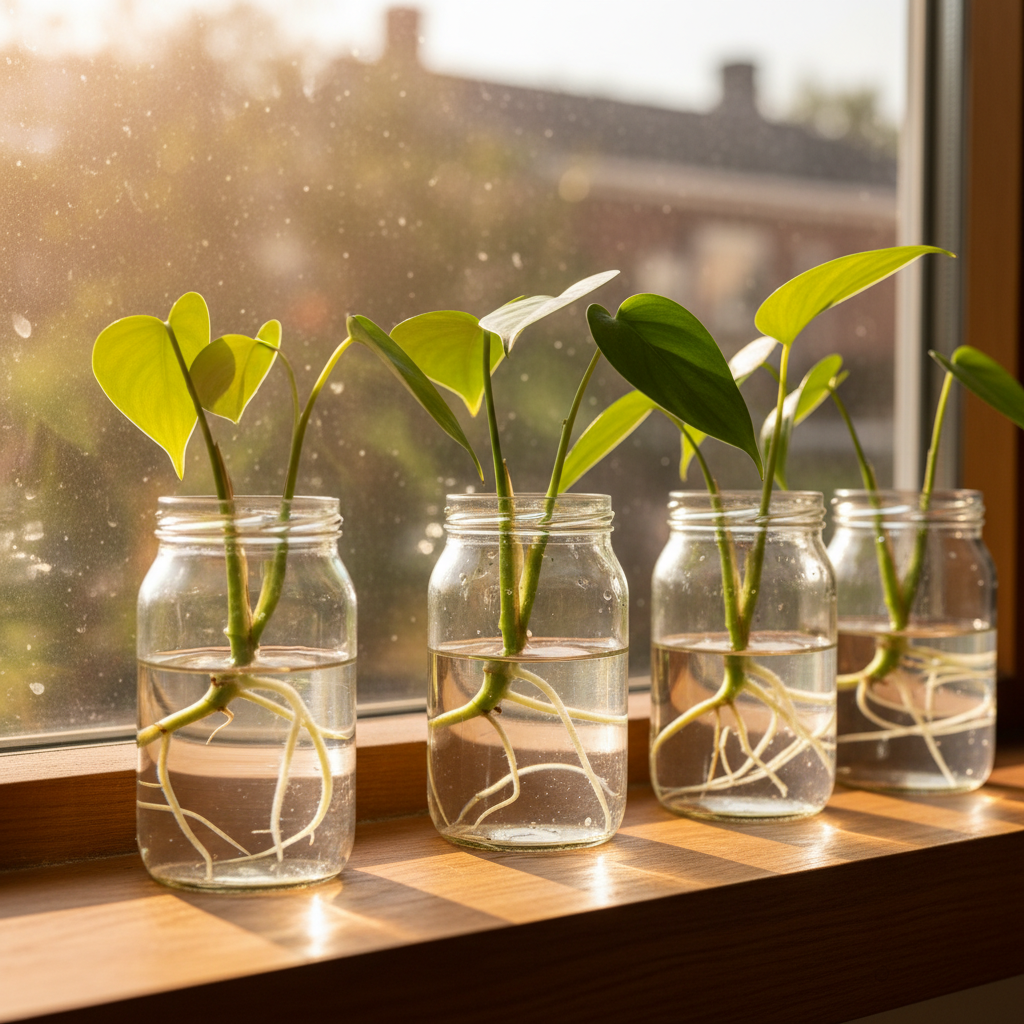
The heartleaf philodendron is one of the simplest plants in cultivation to propagate. Stem cuttings root reliably in water, in soil and in sphagnum moss, often within two to four weeks, and the success rate for an inexperienced grower can comfortably exceed 90 percent. This is why heartleaf cuttings have been passed between friends, neighbours and offices for generations.
The key is to take cuttings that include at least one node, the small bump along the stem where leaves and aerial roots emerge. Without a node there are no cells capable of producing new roots, no matter how long you leave the cutting in water. With a node, the rest is almost a formality.
Understanding Nodes
Run your fingers along a healthy vine and you will feel small swellings at regular intervals. Each swelling is a node, and each node is where a leaf, an aerial root or a side shoot can emerge. The stretches of stem between nodes are called internodes and have no rooting potential on their own. The aerial roots on a mature heartleaf, often visible as small brown nubs on the underside of the stem near each node, are the structures that will extend into new roots in water or moist substrate within days of being cut.
Water Propagation: Step-by-Step
Water propagation is the simplest method and lets you watch the roots form, which is encouraging for first-time propagators. It is also the gentlest on the parent plant because the cutting is small.
- Choose a healthy vine and identify a section with at least two nodes. Sterilise a pair of sharp scissors or a craft knife with rubbing alcohol.
- Cut about 1 cm (half an inch) below the lowest chosen node, taking a piece with two to four leaves.
- Remove any leaves that would sit underwater. Submerged leaves rot quickly and foul the jar.
- Place the cutting in a clear glass jar of room-temperature water, with at least one node fully submerged and the remaining leaves above the rim.
- Set the jar in bright indirect light, away from direct sun, and change the water every five to seven days.
- Roots typically appear within 10 to 14 days. When they reach 4 to 5 cm (1.5 to 2 inches) long, pot the cutting into your usual mix and water gently for the first week.
Pro Tip — Plant Several Cuttings Together: A single cutting becomes a single thin vine, but four or five cuttings potted into the same pot fill out into a lush, full plant within a few months. This is the standard nursery trick that explains why bought heartleafs look so much fuller than home-rooted ones, and it costs nothing to copy.
Soil Propagation: Step-by-Step
Soil propagation skips the transition from water roots to soil roots and produces a slightly tougher root system, but it requires more patience because you cannot see the progress. It works well for growers who want to root and pot in one motion.
- Take a two-node cutting as described for water propagation.
- Dip the cut end in rooting hormone powder if you have it. This is optional for the heartleaf but increases speed and uniformity.
- Push the lower node into a small pot of moist, freely draining mix, burying at least one node fully.
- Firm the soil gently and water lightly to settle the mix without saturating it.
- Place the pot in bright indirect light and cover loosely with a clear plastic bag to maintain humidity, opening it every couple of days for fresh air.
- After three to four weeks, give the cutting a gentle tug. Resistance means roots have formed and the bag can come off. Continue care as you would for a mature plant.
Troubleshooting Propagation
| Problem | Likely Cause | Solution |
|---|---|---|
| Cutting rots before rooting | Submerged leaves, stagnant water, dirty jar | Strip lower leaves, change water weekly, sterilise containers |
| No roots after a month | No node submerged, too little light, too cold | Confirm a node is below water, move to brighter light, keep above 18 degrees Celsius |
| Roots form but cutting wilts after potting | Sudden transition from water to dry soil | Pot when roots are 4 to 5 cm, keep slightly moist for two weeks, then resume normal care |
| Leaves yellow on the cutting | Stress from the cut, normal sacrifice of an older leaf | Leave the rest alone, new growth from the node will follow soon |
Pests & Diseases
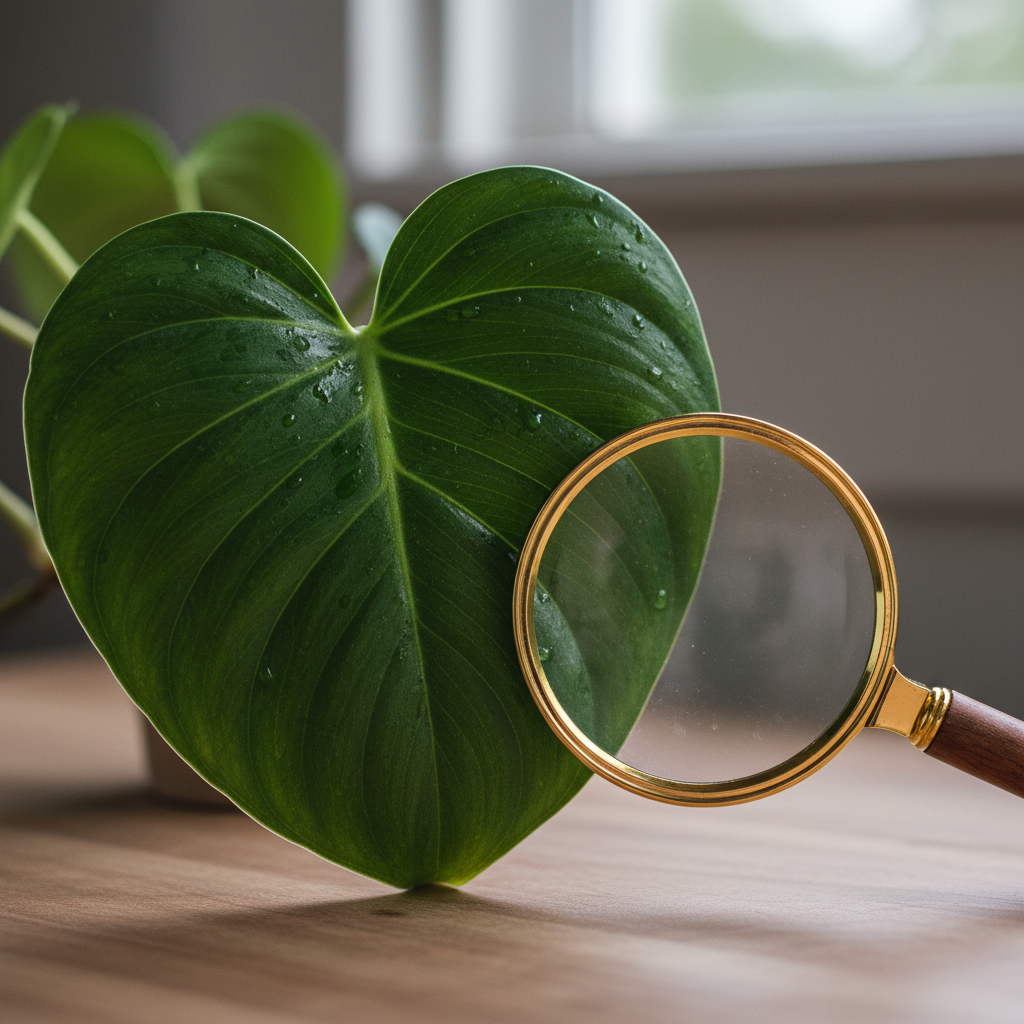
A well-cared-for heartleaf philodendron is rarely troubled by pests, but stressed plants and those kept too dry or too humid are vulnerable to the same handful of indoor pests that affect most foliage tropicals. The good news is that none of them are serious if caught early. The bad news is that they reproduce quickly indoors where there are no natural predators.
Most diseases on the heartleaf are caused by overwatering, poor airflow or a combination of the two. Fungal and bacterial problems can almost always be traced back to soil that stays wet too long or leaves that stay damp overnight. Adjust the cultural conditions first, treat the visible damage second.
Common Pests
Spider Mites (Tetranychus urticae)
Tiny eight-legged arachnids barely visible to the naked eye, spider mites thrive in dry indoor air. The first sign is a stippled, dusty look to the upper leaf surface and fine silky webbing in the leaf axils. Heartleafs near radiators or in winter rooms with very low humidity are most at risk.
Treatment: Rinse the entire plant in the shower with lukewarm water to physically dislodge the colony, then treat both leaf surfaces with insecticidal soap or a 1 percent neem oil solution every five to seven days for three rounds. Raise humidity above 50 percent to discourage re-infestation.
Mealybugs (Pseudococcus spp.)
Small, soft-bodied insects covered in a white waxy fluff, mealybugs cluster in the leaf joints, on the underside of leaves and around aerial roots. They suck sap and leave behind a sticky honeydew that often attracts sooty mould.
Treatment: Dab visible insects with a cotton bud dipped in 70 percent isopropyl alcohol, which kills on contact. Follow with a thorough spray of insecticidal soap, repeating weekly until no new insects appear for three consecutive checks. Inspect nearby plants, as mealybugs spread easily.
Thrips (Frankliniella spp.)
Slim, dark, fast-moving insects that scrape the leaf surface and leave behind silvery-grey patches with tiny black specks of frass. New leaves emerge distorted and pale. Thrips are increasingly common in indoor collections, partly because they hitchhike on newly bought plants.
Treatment: Quarantine the plant immediately. Wipe down affected leaves with insecticidal soap, then spray with a systemic insecticide labelled for thrips, repeating after seven to ten days. Sticky blue traps placed near the plant help monitor whether the population is still active.
Fungus Gnats (Bradysia spp.)
Small dark flies that hover above and around the soil surface. Adults are mainly a nuisance, but their larvae feed on fine roots and organic matter in damp soil and can stunt growth in young plants. They appear when the top of the soil stays wet for too long.
Treatment: Let the top 3 to 4 cm of soil dry out fully between waterings to break the breeding cycle. Yellow sticky traps catch adults, and a soil drench with a Bacillus thuringiensis israelensis product (available as mosquito-bit granules) kills larvae without harming the plant.
Common Diseases
Root Rot (Pythium and Phytophthora spp.)
The most common disease of the heartleaf and almost always the result of soggy soil. Symptoms include wilting despite damp soil, yellowing of lower leaves, a sour smell from the pot and dark mushy roots when the plant is unpotted.
Treatment: Unpot immediately, trim all soft black roots back to firm tissue, rinse the remainder, and repot in fresh dry mix in a smaller pot. Hold off on watering for seven to ten days, then resume cautious watering once the plant shows signs of recovery.
Bacterial Leaf Spot (Erwinia and Xanthomonas spp.)
Water-soaked, dark spots on the leaves, often with a yellow halo, that spread quickly in humid conditions with poor airflow. The spots may join together into larger patches and the affected leaves eventually drop.
Treatment: Remove affected leaves with sterilised scissors and discard them in the bin, not the compost. Improve airflow with a small fan and stop overhead watering or misting. Keep foliage dry, especially overnight. Copper-based fungicides can help in stubborn cases.
Powdery Mildew (Erysiphales)
A dusty white coating on the upper leaf surface, especially on plants with dense growth and poor air circulation. Rare on the heartleaf but possible in damp conservatories or bathrooms.
Treatment: Wipe affected leaves with a soft cloth dipped in a diluted solution of one part milk to nine parts water, or use a commercial sulphur-based fungicide. Improve airflow and reduce humidity slightly until the outbreak clears.
Pest and Disease Summary
| Pest / Disease | Identification | Treatment |
|---|---|---|
| Spider mites | Stippled leaves, fine webbing, dry indoor air | Shower, insecticidal soap or neem, raise humidity |
| Mealybugs | White cottony clusters in leaf joints, sticky honeydew | Alcohol swab, insecticidal soap, repeat weekly |
| Thrips | Silvery scars with black specks, distorted new leaves | Quarantine, systemic insecticide, sticky traps |
| Fungus gnats | Small flies around soil, larvae in damp top layer | Let soil surface dry, yellow traps, Bti drench |
| Root rot | Wilting, yellow lower leaves, sour soil smell | Trim soft roots, repot in dry mix, pause watering |
| Bacterial leaf spot | Dark water-soaked spots with yellow halos | Remove affected leaves, improve airflow, dry foliage |
| Powdery mildew | Dusty white coating on upper leaf surfaces | Milk spray or sulphur fungicide, improve airflow |
Prevention Strategies
Most pest and disease problems can be prevented with a handful of simple habits. Quarantine every new plant for two to three weeks in a separate room and inspect it carefully under both leaf surfaces before adding it to the rest of your collection. Wipe the leaves of established plants with a damp cloth once a month to remove dust and disturb any early pest colonies.
Keep airflow moving with a small fan in densely planted rooms, water at the soil surface rather than over the leaves, and resist the urge to overwater. Most heartleafs that look unwell are not under attack from outside; they are responding to a single repeated mistake from the grower, usually too much water.
Pro Tip — Neem Oil as Routine Maintenance: A monthly foliar spray of a 1 percent neem oil solution, applied to both sides of the leaves in the evening when no direct sun is on the plant, deters most soft-bodied pests before they can establish. It is also a mild fungal preventative. Apply once every four weeks during spring and summer, skipping winter when growth slows.
Popular Varieties
The plain green form of Philodendron hederaceum is the most widely sold and the easiest to care for, but breeders and collectors have produced a growing number of cultivars that bring different colours, leaf textures and variegation patterns to the species. All of them share the same fundamental care, with small adjustments around light requirements for the more strongly variegated forms.
The table below covers the cultivars you are most likely to encounter, ranked from the most common and forgiving to the rarer collectors’ forms that command higher prices and a little more attentiveness.
| Variety | Leaf Appearance | Light Needs | Growth Rate | Availability |
|---|---|---|---|---|
| Heartleaf (species) | Solid glossy deep green, classic heart shape | Medium to bright indirect | Fast | Very common |
| Brasil | Bright lime-green central stripe on emerald leaves | Bright indirect to maintain variegation | Fast | Common |
| Micans | Velvety bronze-burgundy, matte finish | Bright indirect, no direct sun | Moderate | Common |
| Lemon Lime (Aureum) | Solid chartreuse to neon green | Bright indirect, gentle morning sun | Fast | Common |
| Silver Cloud (Silver Stripe) | Silvery white stripes on dark green | Bright indirect | Moderate | Less common |
| Rio | Dense central silver and cream variegation | Bright indirect, stable conditions | Moderate | Less common |
| Variegata | Random green, white and cream sectoral variegation | Bright indirect, no direct sun | Slow | Rare |
| Gabby | White, cream and green marbling | Bright indirect | Slow | Rare |
Featured Varieties
Brasil
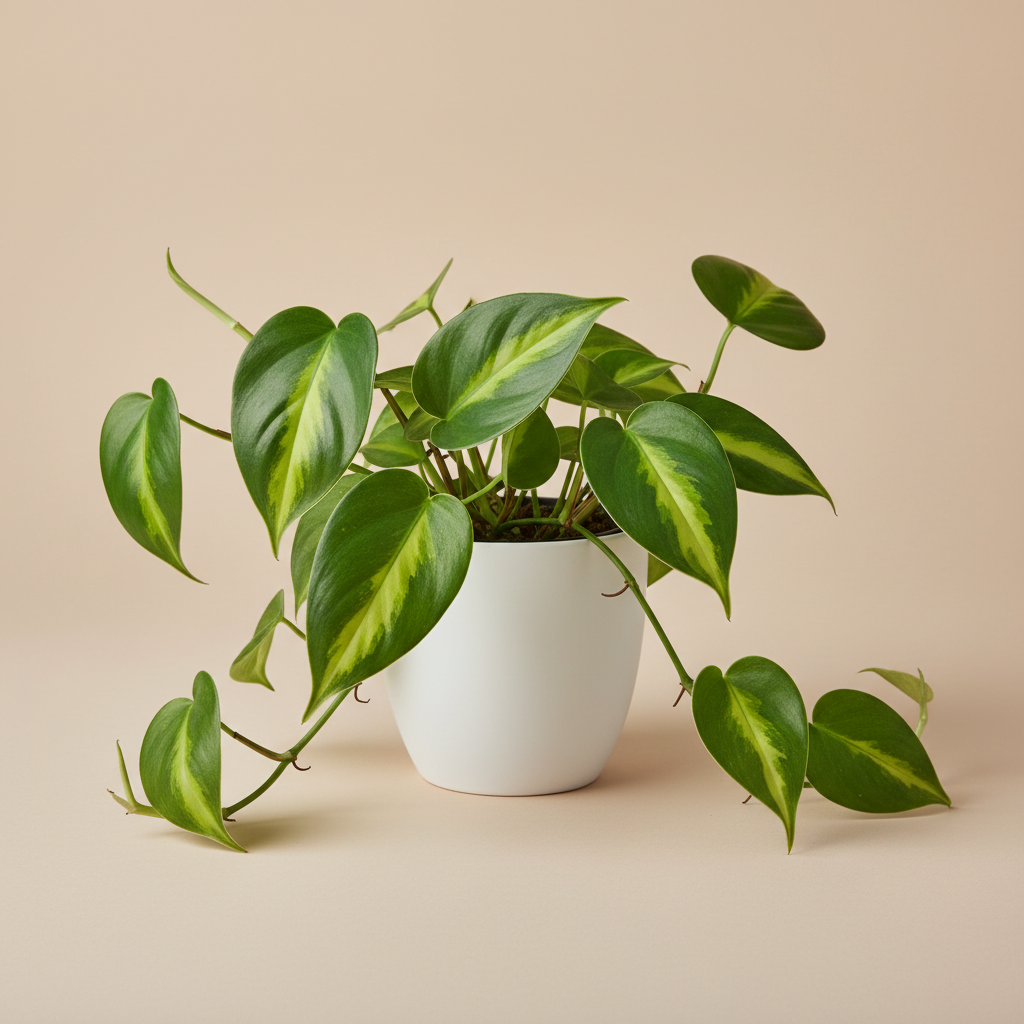
The most widely loved variegated heartleaf, Brasil shows a bright lime-green central stripe against a deep glossy emerald background. The variegation is stable enough for casual growers, and the cultivar tolerates the same light range as the species, though brighter indirect light keeps the contrast sharp.
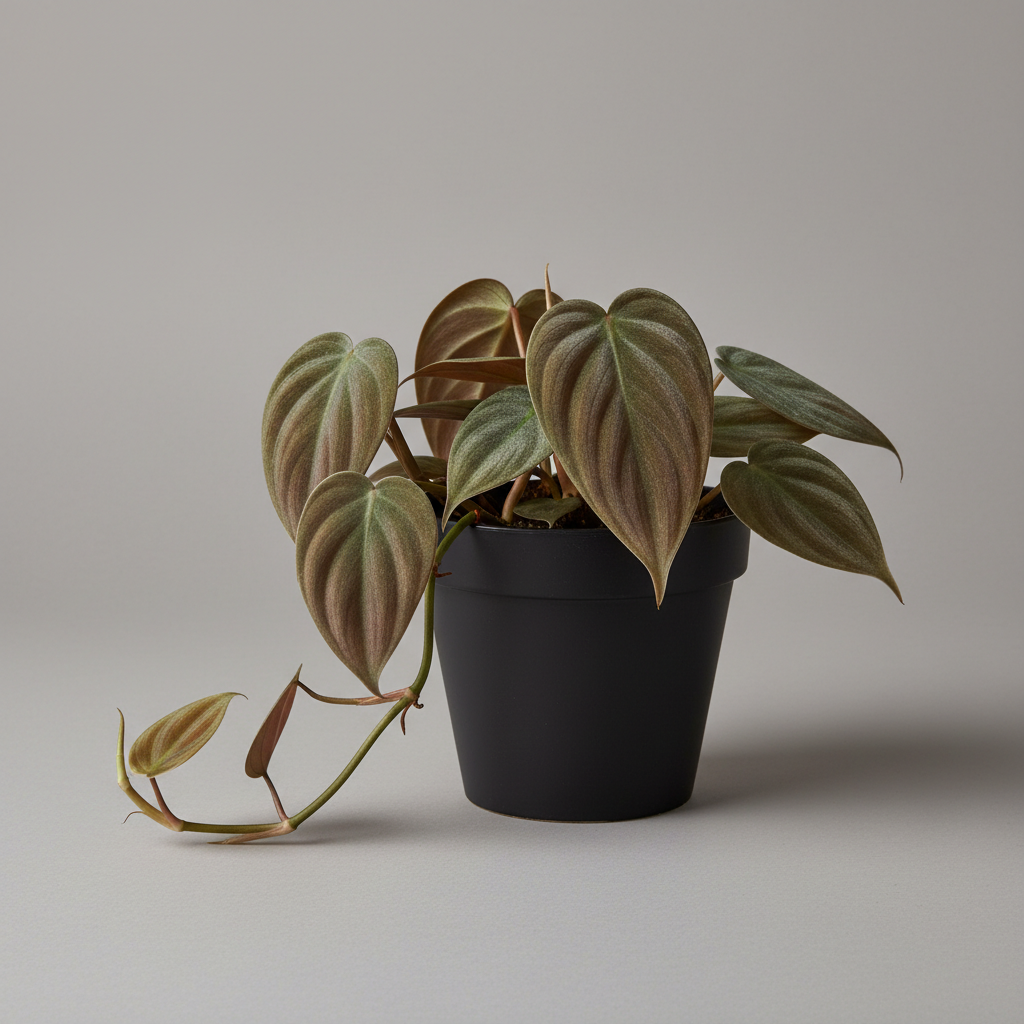
Micans
The botanically distinct variety hederaceum var. hederaceum, popularly known as Micans, has a soft matte finish and an iridescent bronze-to-burgundy sheen that shifts with the light. It prefers slightly higher humidity than the species and is a striking choice for a hanging planter in a bright bathroom or kitchen.
Variety Profiles in Detail
Lemon Lime (Philodendron hederaceum Aureum)
An eye-catching solid colour form with chartreuse to neon-green leaves that brighten any dim corner. New growth emerges almost yellow before settling into a warmer lime tone. Bright indirect light keeps the colour vivid; in lower light the leaves shift toward a plain mid-green and lose much of their punch.
Silver Cloud (Philodendron hederaceum Silver Stripe)
A subtler variegated form with thin silvery-white stripes running through dark green leaves. The variegation is genetic and stable, and the cultivar makes an excellent companion to Brasil in mixed planters. Slower-growing than the species, so it benefits from a snugger pot and lighter feeding.
Variegata (Philodendron hederaceum Variegata)
The rarest and most prized cultivar, with random sectoral variegation in green, white and cream that varies leaf to leaf. The white sections lack chlorophyll, so the cultivar is slower-growing and more demanding than the species. Bright indirect light, stable humidity and very careful watering are essential. Often propagated by node and traded at premium prices in collector circles.
Choosing the Right Variety for Your Space
For a first heartleaf or a low-maintenance addition to a shelf, the species or Brasil are the easiest choices and both forgive a lot. Micans rewards growers who can offer bright indirect light and a little extra humidity, while Lemon Lime brings a useful splash of bright colour to greener corners of a collection. Save the highly variegated Variegata or Rio for later, once you have a sense of how the heartleaf responds in your home and how much patience you have for slower growth.
Frequently Asked Questions
Is the heartleaf philodendron the same as pothos?
They are different plants from different genera. Pothos (Epipremnum aureum) and heartleaf philodendron (Philodendron hederaceum) look superficially similar and share the same trailing habit, but the heartleaf has thinner, softer, more pronounced heart-shaped leaves with smooth edges, while pothos leaves are slightly thicker, more rigid and often have a subtly waxy feel. Their care is almost interchangeable, which is one reason the two are routinely confused at garden centres.
Why is my heartleaf philodendron leggy with sparse leaves?
Legginess almost always means the plant is reaching for more light. Move it closer to a window, or add a small grow lamp, and pinch back the longest vines just above a node. The cuttings root easily in water, so you can plant them back into the pot to fill out the centre while the original vines regrow.
How fast does a heartleaf philodendron grow?
In bright indirect light with regular feeding, a healthy heartleaf produces 30 to 60 cm (1 to 2 feet) of new vine each year, sometimes more on a moss pole. In low light expect more modest growth of perhaps 15 to 25 cm (6 to 10 inches) annually, with smaller leaves at the tips.
Is the heartleaf philodendron safe for pets?
No. The leaves and sap contain insoluble calcium oxalate crystals, which cause intense oral burning, drooling and gastrointestinal upset if chewed by cats, dogs or small children. Place the plant on a high shelf or in a hanging basket where pets cannot reach the trailing vines, and call a vet or poison line immediately if ingestion is suspected.
Should I train it up a moss pole or let it trail?
Both work, but they produce visibly different plants. On a moss pole the heartleaf climbs upward, the aerial roots grip the moist surface, and the leaves grow noticeably larger and more leathery. Left to trail it produces longer vines with smaller, daintier leaves. Choose whichever look you prefer; the plant is happy with either.
Why are the lower leaves on my heartleaf turning yellow?
An occasional yellow lower leaf is normal as the plant sheds older foliage. A pattern of several yellow lower leaves at once usually points to overwatering or stagnant soil. Check the soil moisture and the drainage holes, ease back on watering, and consider repotting into a freer-draining mix if the problem persists.
Can I keep a heartleaf philodendron in a bathroom?
Yes, and many do exceptionally well in bathrooms. The naturally higher humidity, warm temperatures and steady airflow from showers suit the plant perfectly, provided the room has at least a small window or skylight that delivers some indirect light. The Micans cultivar in particular thrives in bright bathrooms.
My heartleaf has tiny brown bumps on the underside of the leaves. Are those pests?
Usually no. Small brown nubs along the stem at each node are aerial roots, which are normal and useful for propagation and for climbing. Pests such as scale insects look more like smooth round shields stuck firmly to the leaf surface and can be scraped off with a fingernail; aerial roots cannot. When in doubt, take a close photo and compare with reference images before treating.
Why is my Brasil reverting to plain green leaves?
Variegated leaves contain less chlorophyll and therefore produce less energy than fully green leaves. In low light, plants compensate by sending out leaves with more chlorophyll, which appear plain green. Move the plant to brighter indirect light and trim back any solid green sections just above a node, which encourages the variegated growing tips to take the lead.
How long does a heartleaf philodendron live as a houseplant?
With reasonable care, decades. Heartleaf philodendrons can outlast their owners, and the plant you bring home today, repotted every couple of years and propagated from when it grows leggy, can easily still be in the family in 20 or 30 years. Each cutting taken extends the life of the genetic individual indefinitely.






