
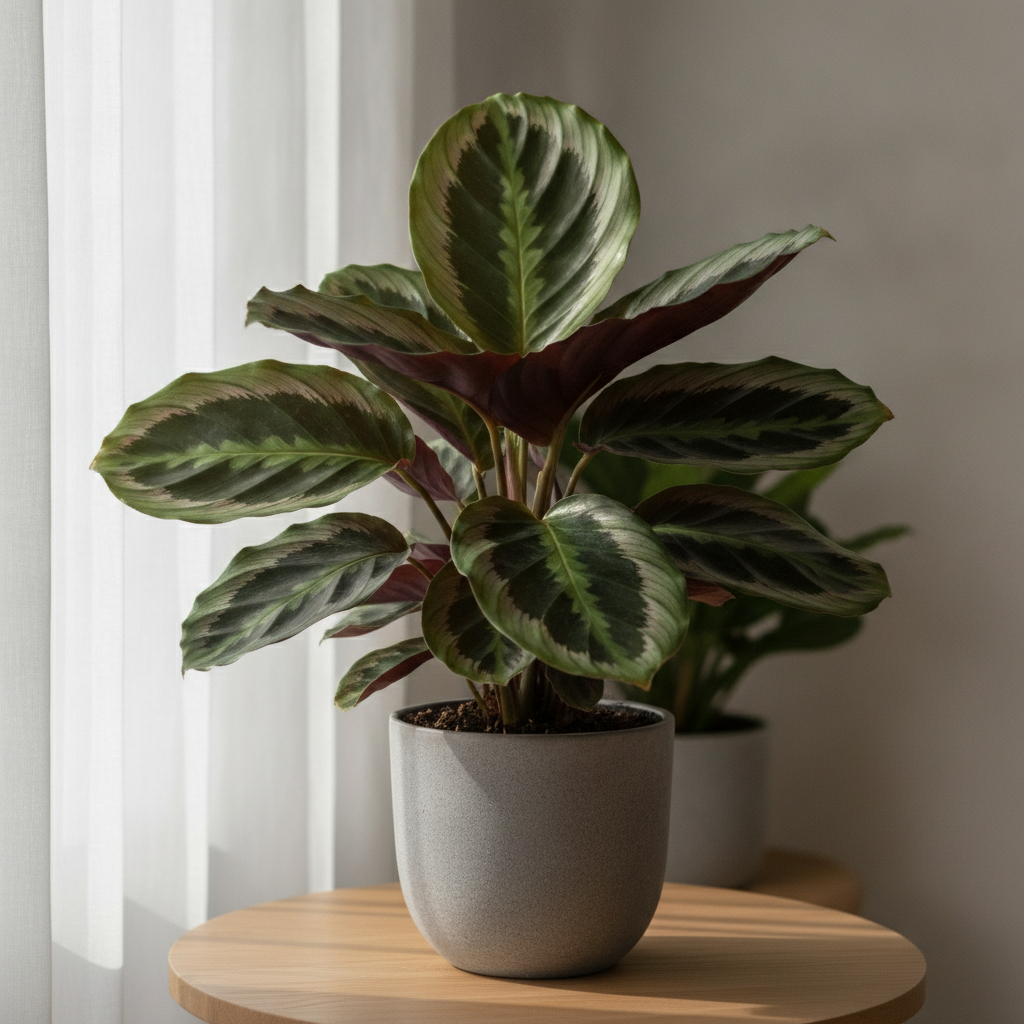
Few houseplants make a first impression quite like the Jungle Rose Calathea. Each broad, rounded leaf is painted from the midrib outward with feathery brushstrokes of rose-pink and silvery cream, set against deep forest green and backed by a burgundy-purple underside that glows when the light catches it. Known botanically as Goeppertia roseopicta (and still widely sold under its former name, Calathea roseopicta), this member of the prayer plant family earns its “rose-painted” nickname honestly, and its foliage is reason enough to give it a prominent spot.
A native of the shaded rainforest floor of northwestern Brazil, the Jungle Rose Calathea carries a reputation for being temperamental, and that reputation is not entirely undeserved. It responds quickly and visibly to conditions it dislikes, browning at the edges when the air is dry or the water is hard, and fading when the light is wrong. Yet almost everything it wants can be reduced to a short list: steady warmth, humidity, gentle indirect light, and clean water. This guide covers each of those in depth, along with feeding, potting, propagation and pest control, so you can move past merely keeping the plant alive and into the far more rewarding territory of watching it thrive.
Contents
- Quick Reference
- Why the Jungle Rose Calathea Makes a Rewarding Houseplant
- Light Requirements
- Watering & Humidity
- Soil, Potting & Repotting
- Fertilising
- Propagation
- Pests & Diseases
- Popular Varieties
- Frequently Asked Questions
Quick Reference: Jungle Rose Calathea at a Glance
| Light | Medium to bright indirect light; no direct sun |
| Watering | Keep soil evenly moist, never soggy; water when the top 2 to 3 cm (1 in) feels barely dry |
| Temperature | 18 to 27°C (65 to 80°F); avoid anything below 15°C (59°F) |
| Humidity | High, ideally 60% or more; struggles below 50% |
| Fertiliser | Balanced feed at half strength, monthly in spring and summer |
| Toxicity | Non-toxic and pet-safe to cats, dogs and humans |
Why the Jungle Rose Calathea Makes a Rewarding Houseplant
The most obvious reason to grow this plant is written across every leaf. Mature foliage can reach 15 to 20 cm (6 to 8 in) across, held on slender upright stems, and each leaf carries a painterly pattern that no two plants replicate exactly. Young leaves often emerge with the brightest pink feathering, which softens toward silver and cream as they age, so a healthy plant displays several tones at once. The undersides are a rich wine-purple, revealed dramatically each evening when the leaves lift.

That evening movement is the second great appeal. Like all members of the prayer plant family, Marantaceae, the Jungle Rose Calathea performs nyctinasty: a daily rhythm in which the leaves lower and open in the morning and rise, folding upward, at dusk. The motion is driven by a swollen joint called the pulvinus at the base of each leaf, and on a quiet evening you can sometimes hear the faint rustle as the leaves shift. It gives the plant a sense of being alive and responsive in a way few houseplants match. A further practical bonus is that the entire family is non-toxic, making it one of the safest statement plants to keep in a home with curious cats, dogs or small children.
Important — Toxicity: The Jungle Rose Calathea is considered non-toxic to cats, dogs and humans, and is listed as pet-safe by the ASPCA. While nibbling any houseplant can cause mild stomach upset, there are no toxic compounds of concern here, so this is a genuinely safe choice for pet households.
Light Requirements
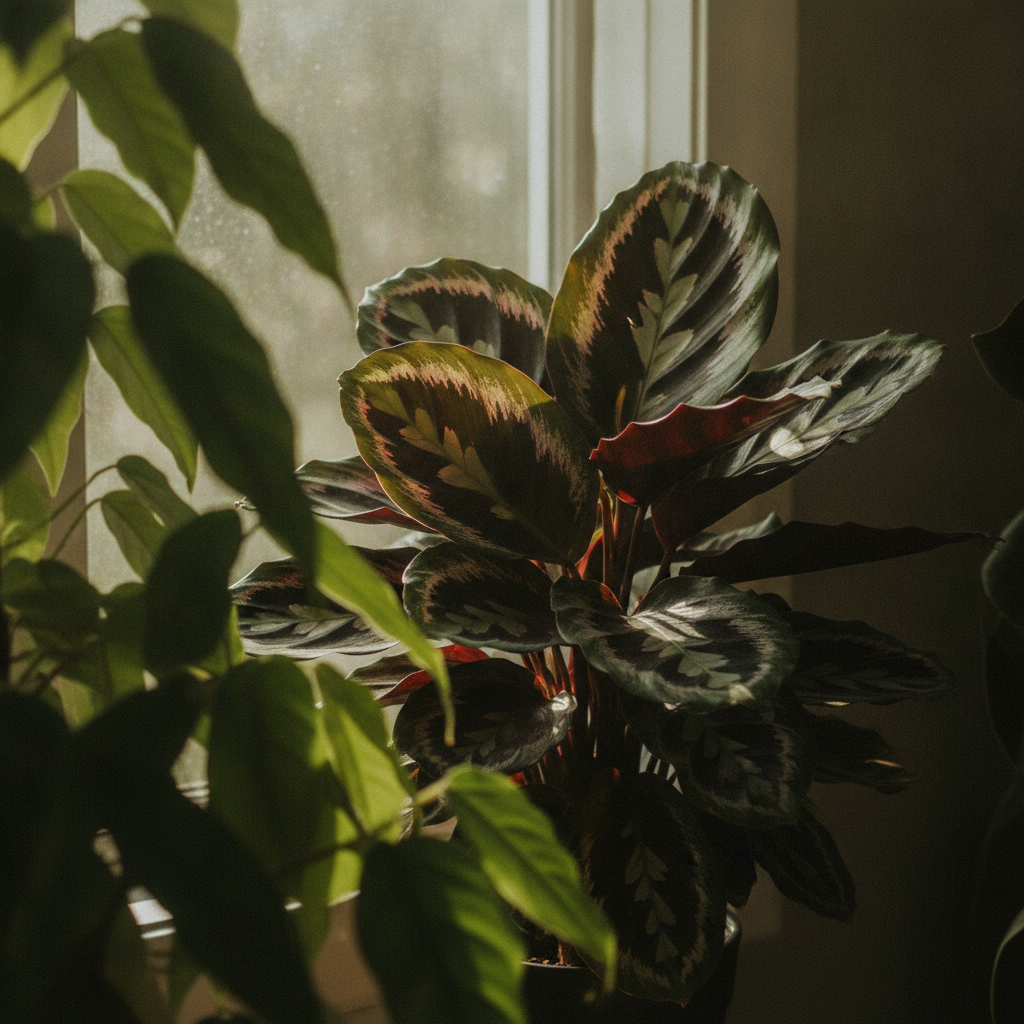
In its native habitat the Jungle Rose Calathea grows on the forest floor, shaded by the dense canopy above and receiving only the soft, filtered light that reaches the understory. Recreating that quality of light indoors is the single most important thing you can do for the plant’s appearance. It wants brightness without the direct rays that would scorch it in the wild, which in practical terms means medium to bright indirect light for most of the day.
Get this balance right and the plant rewards you with saturated colour and dense, well-spaced leaves. Get it wrong in either direction and the signs appear quickly: too much light bleaches the pink markings toward a washed-out pale green and can crisp the leaf surface, while too little slows growth to a crawl, dulls the contrast, and leaves the plant looking flat and lifeless.
Light Levels Explained
Because “bright indirect” means different things to different people, it helps to think in rough measured terms. The table below sets out how the Jungle Rose Calathea responds across the range of light levels you might find in a home.
| Light Category | Approx. Level | Typical Location | Outcome |
|---|---|---|---|
| Direct sun | Over 50,000 lux | On an unshaded south sill | Faded pattern, scorched, crispy patches |
| Bright indirect | 10,000 to 20,000 lux | A metre back from a bright window | Ideal: rich colour, steady growth |
| Medium indirect | 5,000 to 10,000 lux | Interior of a well-lit room | Good: slightly slower but healthy |
| Low light | 1,000 to 2,500 lux | North room, away from the window | Tolerated but sluggish, muted colour |
| Very low | Under 1,000 lux | Dim hallway or corner | Decline, leaf loss over time |
Window Orientation and Placement
South-facing window: The brightest and potentially most dangerous exposure for this plant. A south window can work well, but only if the plant is set back a metre or more, or the glass is fitted with a sheer curtain to diffuse the midday sun. Placed directly on a south sill, the leaves will bleach and burn.
East-facing window: Often the sweet spot. The gentle morning sun is rarely strong enough to harm the foliage, and the bright indirect light through the rest of the day suits the plant perfectly. If you have an east-facing window, place your Calathea on or near the sill.
West-facing window: Workable, with the same caution as a south exposure. The afternoon sun through a west window is strong and warm, so diffuse it with a curtain or move the plant back from the glass to avoid scorching.
North-facing window: A north window provides soft, even light with no risk of scorch, and many growers find their Calathea does well here. Colour may be a touch less intense than in an east window, and growth a little slower, but it is a safe and reliable position.
Pro Tip — Read the Leaves: Let the plant tell you whether the light is right. If the pink markings look pale and washed out, it is getting too much light, so move it further from the window. If new leaves are small, widely spaced and dull, it wants more light, so bring it closer. Adjust gradually over a week or two rather than all at once.
How Light Affects Leaf Colour
The pink and cream feathering that defines this plant is a pigment display, not a fixed trait, and it shifts with light. In good bright indirect conditions the contrast between the dark green margins and the rosy centres stays crisp and vivid. Under harsh direct sun the plant produces extra protective pigment and the delicate pinks bleach out, sometimes permanently on the affected leaves. In gloom the plant cannot fuel the display and the whole leaf drifts toward a uniform, tired green. Consistent, moderate brightness is what keeps the painting fresh.
Warning — Direct Sunlight: Even an hour of hot, direct midday sun can leave irreversible bleached or scorched patches on Calathea leaves. Damage often shows as pale, dry, tan areas that never recolour. When in doubt, err toward less light rather than more.
Artificial Lighting
The Jungle Rose Calathea takes very well to artificial light, which makes it a good candidate for rooms with few windows or for the darker months. A full-spectrum LED grow light positioned 30 to 45 cm (12 to 18 in) above the plant and run for 10 to 12 hours a day will comfortably meet its needs. Because it evolved under filtered light rather than blazing sun, it does not require the intense output that flowering or high-light plants demand, so a modest fixture is enough.
Seasonal Adjustments
Light levels indoors can fall by half or more between summer and midwinter, so a spot that was ideal in July may leave the plant starved in January. As the days shorten, move the Calathea closer to its window or supplement with a grow light, then ease it back in spring as the sun strengthens. Remember also that a summer position which was safely diffuse can become harsh as the sun angle changes, so re-check placement each season rather than setting and forgetting.
Watering & Humidity
Watering is where most people meet their match with this plant, because the Jungle Rose Calathea asks for something that sounds contradictory: soil that is consistently moist but never waterlogged, watered with liquid that is cleaner than what comes out of most taps. Master this one section and you have solved the majority of the plant’s demands.
When to Water
Aim to water when the top 2 to 3 cm (about 1 in) of the mix has just begun to dry, testing with a finger before you reach for the can. Unlike a succulent or a pothos, this plant does not want to dry out fully between waterings; letting the whole pot go bone dry will trigger crisping and curling that is slow to reverse. Equally, it must never sit in standing water, which quickly suffocates the fine roots.
In practice this usually means watering roughly once or twice a week in the warm growing months and every 10 to 14 days in winter, but treat those figures as starting points rather than a schedule. Light, warmth, pot size and season all change how fast the soil dries, so the finger test always overrules the calendar. A plant in a bright, warm room will drink far faster than the same plant in a cool, dim one.
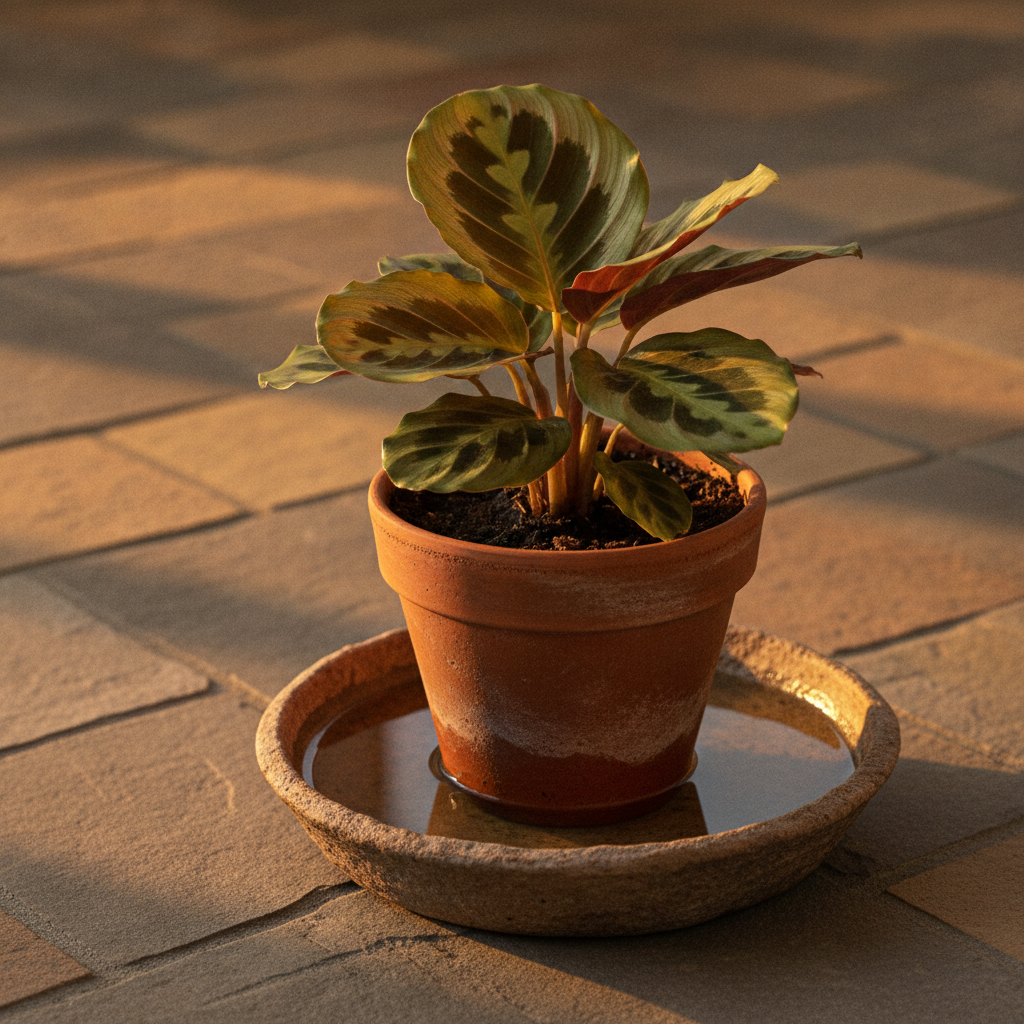
Pro Tip — Bottom Watering: To keep moisture even and the delicate crown dry, stand the pot in a tray of clean water for 15 to 20 minutes and let the soil wick up what it needs from below, then drain thoroughly. This encourages roots to grow downward and avoids the dry pockets that top watering can leave in a peaty mix.
How to Water Correctly
- Check the top few centimetres of soil with a finger; water only once it feels barely dry, not before.
- Use room-temperature filtered, distilled or rainwater rather than cold water straight from the tap.
- Water slowly and evenly across the surface, or bottom water in a tray, until moisture is distributed throughout.
- Let all excess drain freely from the base for several minutes.
- Empty the saucer or cover pot completely so the plant never sits in standing water.
- Return the plant to its spot and avoid watering again until the top layer has begun to dry.
Signs of Overwatering vs. Underwatering
| Symptom | Overwatering | Underwatering |
|---|---|---|
| Leaf colour | Yellowing, often starting with lower leaves | Browning and crisping at the edges |
| Leaf texture | Soft, limp, sometimes translucent | Dry, curled, papery |
| Soil | Stays wet for days, may smell sour | Pulls away from the pot, dries hard |
| Roots | Brown, mushy, foul-smelling | Dry, brittle, pale |
| Stem base | Soft or blackened at soil line | Firm but plant droops overall |
Warning — Root Rot: Persistently soggy soil is the fastest way to kill a Calathea. If you notice yellowing lower leaves, a sour smell, or mushy brown roots, unpot immediately, trim away all rotten tissue with sterile scissors, and repot into fresh, airy mix. Caught early, root rot is survivable; left unchecked, it is usually fatal.
Humidity Requirements
If light and water are the foundations, humidity is the finishing touch that separates a merely surviving Calathea from a flourishing one. Coming from a humid rainforest floor, the plant wants ambient humidity of 60% or higher, and it visibly resents the dry air of a centrally heated or air-conditioned room, where levels can drop below 30%.
The classic symptom of insufficient humidity is browning, crispy leaf edges and tips, sometimes accompanied by leaves that curl inward as the plant tries to reduce moisture loss. These signs often appear alongside water-quality damage, and the two can be hard to tell apart, but both point toward an environment that is too dry or too harsh for comfort.
To raise humidity reliably, a small room humidifier is by far the most effective tool and the one most seasoned Calathea growers depend on. Grouping plants together creates a more humid microclimate, and standing the pot on a wide tray of pebbles topped up with water (with the pot base sitting above the waterline, not in it) helps too. Bathrooms and kitchens with good light are naturally humid and often make excellent homes. Misting is popular but offers only a brief lift and, if overdone on foliage that stays wet, can encourage fungal spotting, so lean on a humidifier instead.
Water Quality
This plant is unusually sensitive to what is dissolved in its water. Fluoride, chlorine and the mineral salts common in hard tap water accumulate in the leaf tissue and show up as brown tips and edges over time. For this reason, filtered water, distilled water or collected rainwater is strongly preferred. If only tap water is available, leaving it to stand uncovered overnight allows some chlorine to dissipate, though it does nothing for fluoride or hardness. Many growers find that switching to clean water alone resolves a chronic brown-edge problem they had blamed on everything else.
Soil, Potting & Repotting
The right potting mix for a Jungle Rose Calathea walks a fine line: it must hold enough moisture to keep the roots consistently damp, yet drain and breathe well enough that water never lingers around them. A dense, water-logging soil invites the root rot the plant is so prone to, while a fast-draining cactus mix dries out far too quickly and leaves the foliage crisping.
Ideal Soil Composition
A good Calathea mix is built around a moisture-retentive base such as peat or coco coir, opened up with perlite for drainage and a little bark for structure and air. The goal is a spongy, springy medium that stays evenly damp without turning to mud.
| Component | Proportion | Function |
|---|---|---|
| Coco coir or peat | 50% | Retains moisture, holds the mix together |
| Perlite or pumice | 25% | Improves drainage and aeration |
| Fine orchid bark | 15% | Adds structure and air pockets |
| Worm castings or compost | 10% | Supplies gentle, slow nutrition |
The Jungle Rose Calathea prefers a slightly acidic root zone, in the range of about pH 6.0 to 6.5, which a coir or peat-based mix naturally provides. There is rarely any need to adjust pH deliberately; using the right ingredients takes care of it.
Pro Tip — Quick Mix Recipe: For a no-fuss blend, combine two parts coco coir, one part perlite and one part fine orchid bark, with a handful of worm castings stirred through. It holds moisture beautifully while still draining freely, and suits most prayer plants as well as this one.
Choosing the Right Pot
Pot choice has more influence on Calathea health than it first appears, because it governs how quickly the moisture-loving root ball dries out and whether excess water can escape.
Drainage holes are non-negotiable. Whatever pot you choose, it must have holes in the base. A decorative cover pot without drainage will trap water against the roots and cause rot within weeks, so if you love a particular cachepot, grow the plant in a plastic nursery pot inside it and lift it out to water.
Pot material: Plastic and glazed ceramic both hold moisture well and suit this plant’s love of steady dampness. Unglazed terracotta breathes and wicks water away quickly, which can be useful for over-enthusiastic waterers but means the soil dries faster and needs closer attention.
Pot size: Choose a pot only 2 to 3 cm (1 in) wider than the current root ball. An oversized pot holds a large volume of wet soil that the roots cannot use quickly, and that lingering moisture is a common trigger for rot. Snug is safer than spacious.
When to Repot
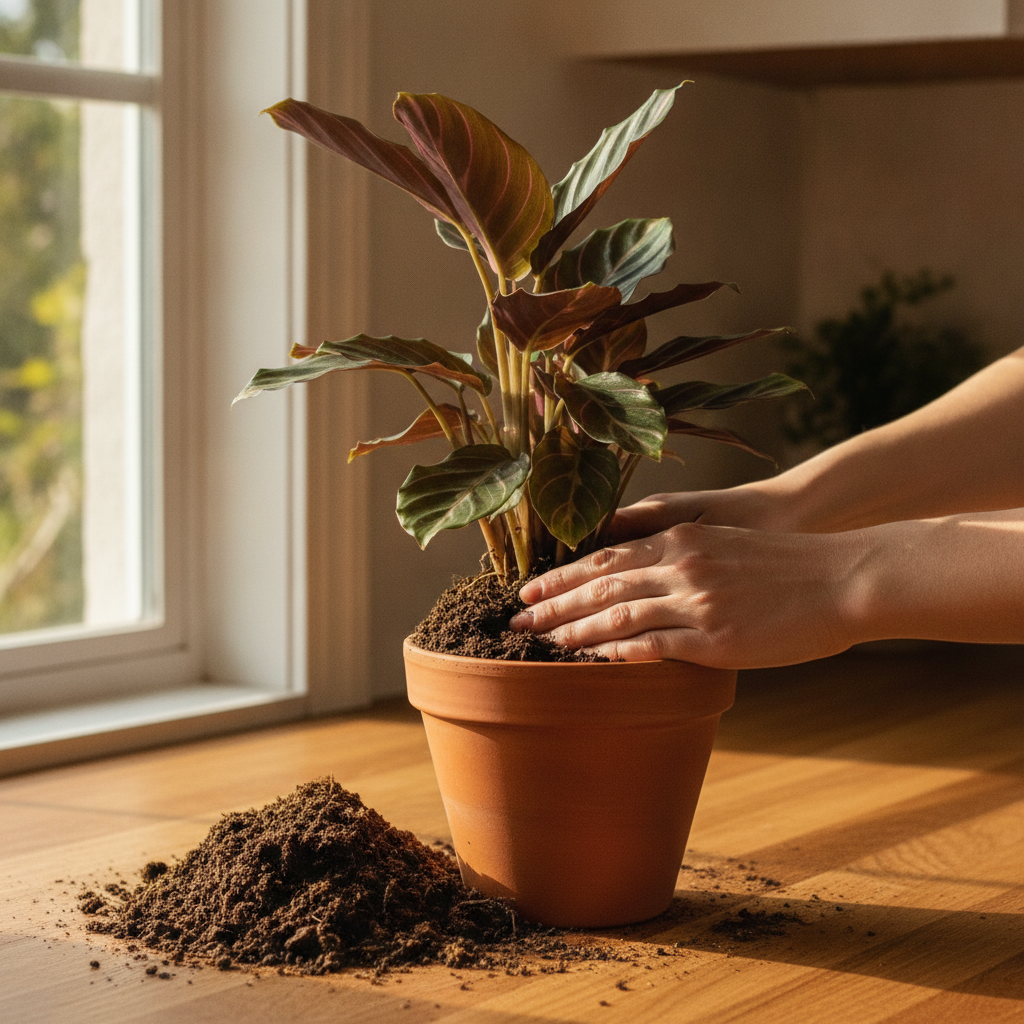
The Jungle Rose Calathea is a moderate grower and does not need frequent repotting; every one to two years is usually enough. Signs it is ready include roots emerging from the drainage holes, water running straight through without wetting the soil, or the plant drying out noticeably faster than it used to. Early spring, as growth resumes, is the best time to do it, giving the plant a full season to settle. Repotting is also the natural moment to refresh tired soil and to divide an overgrown clump.
How to Repot: Step-by-Step
- Water the plant a day before, so the root ball is hydrated and holds together.
- Ease the plant out by tipping the pot and supporting the base of the stems, rather than pulling on the foliage.
- Gently tease away the old, spent soil from around the roots and inspect for any dark, mushy sections.
- Trim off any rotten or dead roots with sterile scissors, leaving the healthy pale roots intact.
- Add a layer of fresh mix to the new pot, centre the plant at the same depth as before, and fill around it.
- Firm the soil gently to remove air pockets without compacting it hard.
- Water thoroughly with clean water and return the plant to a warm, humid, shaded spot to recover.
Warning — Transplant Shock: Calatheas dislike disturbance and often sulk after repotting, drooping or curling for a week or two. Keep humidity high, avoid fertilising until new growth appears, and resist the urge to water excessively while the plant re-establishes. Given patience, it will recover.
Fertilising
The Jungle Rose Calathea is a light feeder, and its main fertilising risk is not starvation but excess. The same sensitivity that makes it fussy about water quality makes it prone to fertiliser burn, so the guiding principle throughout is little and often, always dilute.
Fed correctly during the growing season, the plant produces steady new growth and holds its rich colour. Overfed, it develops scorched leaf edges and a crust of mineral salts on the soil surface, symptoms easily mistaken for the water and humidity problems discussed earlier.
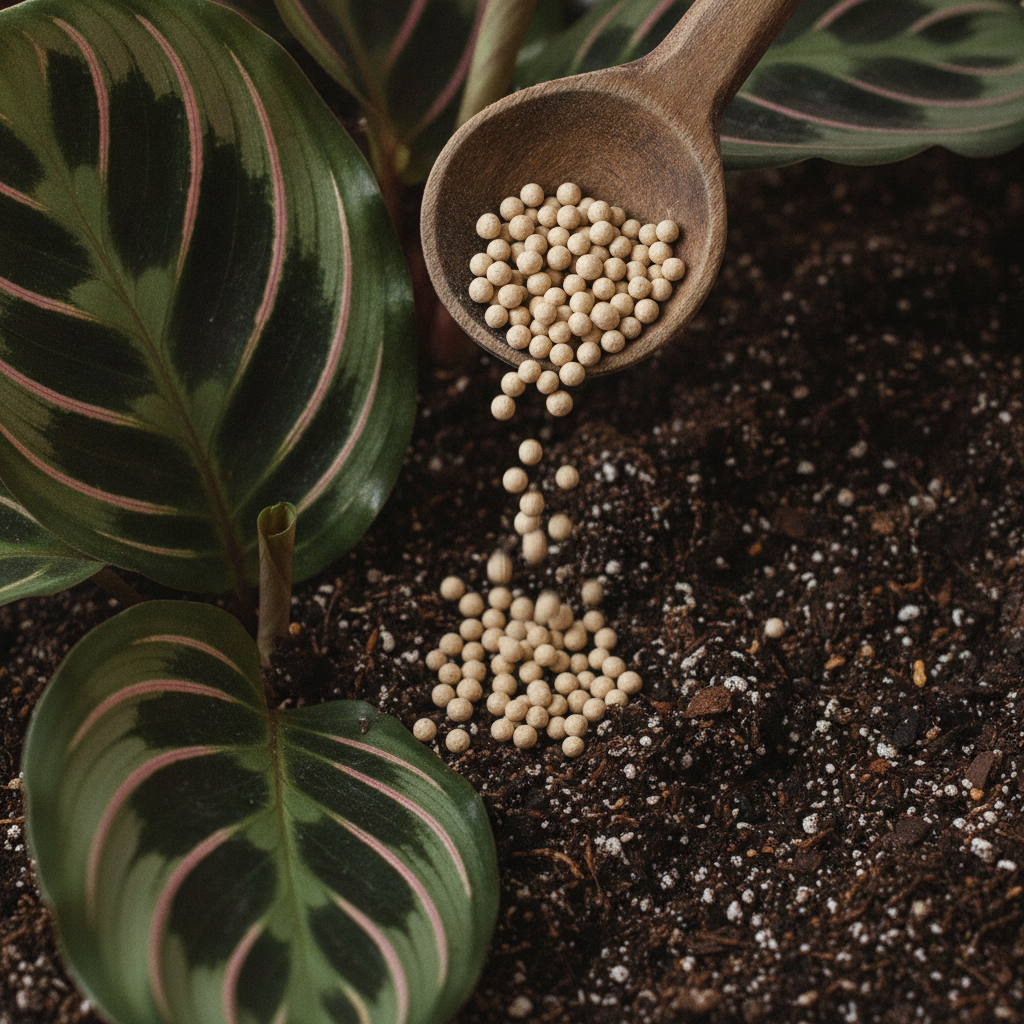
Understanding Plant Nutrients
Plant fertilisers are described by their ratio of the three main nutrients, nitrogen, phosphorus and potassium, printed as an NPK figure on the label. For a foliage plant like this one, a balanced ratio such as 10-10-10, or one slightly higher in nitrogen to support leaf growth, works well. The table below outlines the roles of the key nutrients and the deficiency symptoms to watch for.
| Nutrient | Symbol | Primary Function | Deficiency Symptoms |
|---|---|---|---|
| Nitrogen | N | Leaf and stem growth, green colour | Pale, yellowing older leaves; slow growth |
| Phosphorus | P | Root development and energy transfer | Dull leaves, weak roots, stunting |
| Potassium | K | Overall vigour and water regulation | Brown leaf edges, weak stems |
| Calcium | Ca | Cell wall strength, new growth | Distorted or hooked new leaves |
| Magnesium | Mg | Core of the chlorophyll molecule | Yellowing between leaf veins |
| Iron | Fe | Chlorophyll production in new leaves | Pale young leaves with green veins |
Types of Fertiliser
Liquid fertilisers: The easiest option to control and the one best suited to this plant. Diluted to half the recommended strength and applied with normal watering, a liquid feed gives you precise command over how much the plant receives, which is exactly what a sensitive Calathea needs.
Slow-release granular: Convenient but harder to regulate, as the prills release nutrients with warmth and moisture whether the plant wants them or not. If you use them, apply at half the label rate and keep a close eye on the leaf edges for signs of over-feeding.
Organic fertilisers: Worm castings, diluted compost tea and other gentle organic feeds are forgiving and release their nutrients slowly, which suits a plant that dislikes sudden strong doses. A thin top-dressing of worm castings in spring is an easy, low-risk way to feed.
Feeding Schedule
Feed roughly once a month during the active growing season of spring and summer, using a balanced liquid fertiliser at half strength. Stop feeding altogether in autumn and winter, when growth naturally slows and the plant cannot use the nutrients, so any surplus simply builds up as harmful salt in the soil. Resume in spring only once you see fresh new leaves emerging.
Pro Tip — Half Strength, Always: When it comes to feeding a Calathea, less genuinely is more. Mixing your fertiliser to half, or even a quarter, of the recommended concentration all but eliminates the risk of leaf burn while still supplying everything the plant needs to grow steadily.
How to Fertilise
- Water the plant lightly first, so the roots are damp and less likely to be burned by the feed.
- Dilute a balanced liquid fertiliser to half the recommended strength in clean water.
- Apply evenly to the soil, avoiding splashing the concentrated solution onto the leaves.
- Let any excess drain away, and never leave fertiliser-rich water standing in the saucer.
- Every couple of months, flush the pot with plenty of plain water to wash out accumulated salts.
Warning — Salt Build-Up: A white or yellowish crust on the soil surface or around the pot rim signals mineral salt accumulation from fertiliser or hard water. Flush the pot thoroughly with clean water until it runs freely from the base, and scale back feeding, as these salts scorch the sensitive roots and leaf edges.
Propagation
Propagating a Jungle Rose Calathea is refreshingly simple once you understand that it works quite differently from the vining plants people often cut and root in water. This is a clumping plant that grows from an underground rhizome, and it multiplies by division, not by cuttings.
That distinction matters, because a hopeful leaf or stem cutting placed in water will simply rot; there is no node along the stem from which new roots and shoots can form. Division, by contrast, is close to foolproof when done at the right time and gives you established, independent plants straight away.
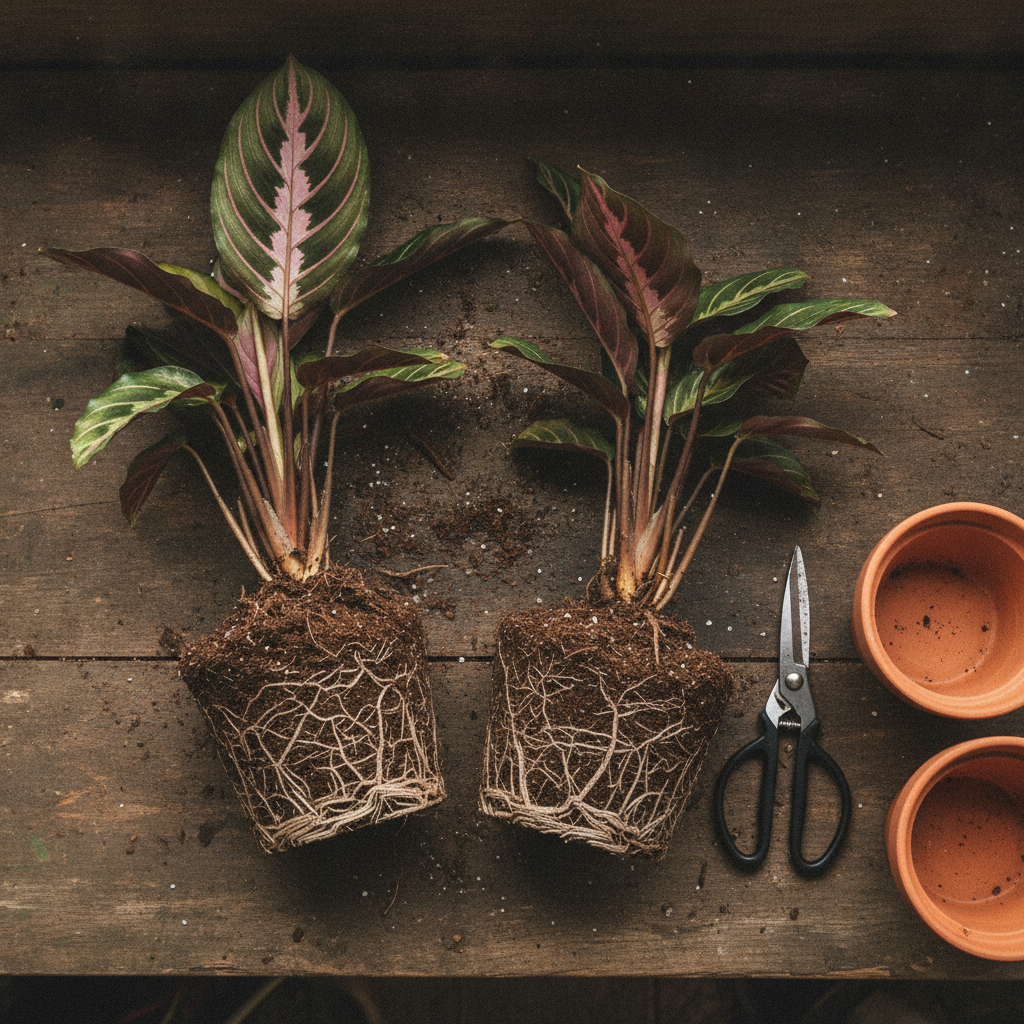
Understanding the Rhizome
Below the soil, the Jungle Rose Calathea grows from a rhizome, a thickened horizontal stem from which both the leaf stalks and the roots arise. As the plant matures it forms a dense clump of these growing points, and each section of rhizome that carries its own roots and at least one or two leaves is capable of becoming a complete new plant. Propagation is really just a matter of separating those natural divisions with care.
Division at Repotting: Step-by-Step
The best moment to divide is in spring, at the same time as repotting, when the plant is entering active growth and can recover quickly. Choose a plant that has grown into a full, multi-stemmed clump rather than a single small crown.
- Water the plant a day ahead, then slide it out of its pot and gently shake and tease away the loose soil.
- Look for natural clumps within the root ball, each with its own leaves and attached roots.
- Ease these sections apart with your fingers, using a clean, sharp knife only where the rhizome must be cut.
- Make sure every division keeps a healthy portion of roots and at least two leaves.
- Pot each division into its own small pot of fresh, moist Calathea mix at its original depth.
- Water in with clean water and place the new plants somewhere warm, shaded and humid.
Pro Tip — High Humidity After Division: Freshly divided Calatheas are stressed and lose water easily, so give them a humidity boost while they recover. A clear plastic bag loosely tented over the plant, or a spell inside a humid propagator, for the first week or two dramatically improves the odds of a smooth establishment.
Aftercare for Divisions: Step-by-Step
The weeks immediately after division are when new plants are won or lost. Steady, gentle conditions matter far more than any intervention.
- Keep the mix lightly and evenly moist, never soggy, while roots re-establish.
- Maintain warmth of 20 to 25°C (68 to 77°F) and high humidity around the plants.
- Site them in medium indirect light, out of any direct sun that would stress them further.
- Do not fertilise until you see clear signs of new growth, usually after a few weeks.
- Expect some drooping or curling at first, and be patient rather than overwatering to compensate.
Troubleshooting Propagation
| Problem | Likely Cause | Solution |
|---|---|---|
| Divisions wilt and collapse | Too few roots kept, or air too dry | Raise humidity, keep warm, be patient |
| Rotting at the base | Mix kept too wet after division | Ease off watering, improve drainage |
| No new growth for weeks | Normal shock, or conditions too cool | Warmth and time; avoid disturbing |
| Cuttings in water rot | Stem cuttings do not root; wrong method | Propagate only by division of the clump |
Pests & Diseases
A well-cared-for Jungle Rose Calathea is reasonably resilient, but the very conditions it loves, warmth and humidity, can also attract trouble, and the dry indoor air that stresses the plant makes it a magnet for one pest in particular. Vigilance is the best defence: caught early, almost every problem here is straightforward to treat.
Get into the habit of turning a few leaves over whenever you water, checking the undersides and the leaf axils where pests like to hide. The purple undersides of this plant make small pests slightly harder to spot, so a routine inspection is worthwhile.
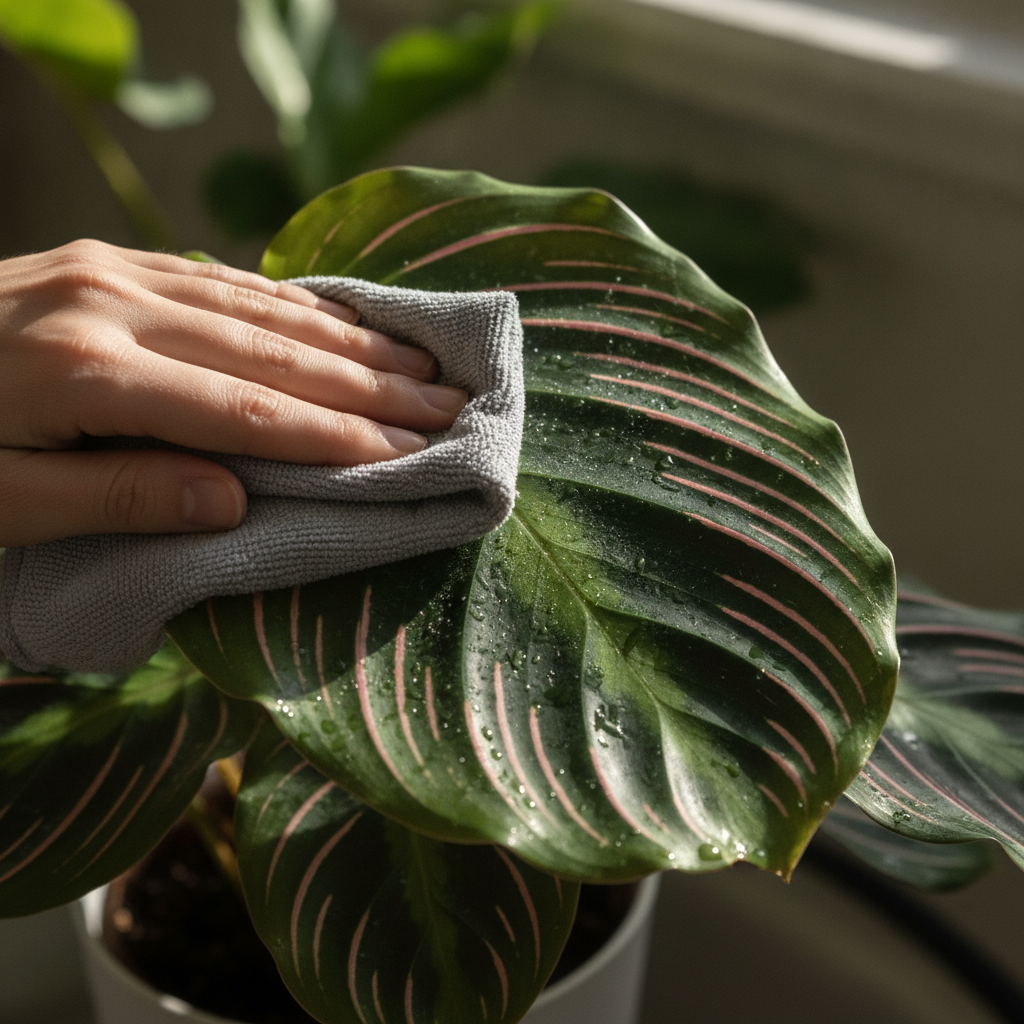
Common Pests
Spider Mites (Tetranychus urticae)
By far the most common enemy of this plant, spider mites thrive in exactly the dry air the Calathea hates. They are tiny, hard to see individually, and betray their presence with fine speckling or stippling on the leaves and delicate webbing in the leaf joints. A badly infested plant looks dusty and dull.
Treatment: Rinse the plant thoroughly, including the leaf undersides, then treat with insecticidal soap or neem oil every few days until clear. Crucially, raise the humidity, as maintaining a moist atmosphere is both the cure and the long-term prevention.
Mealybugs (Pseudococcidae)
Mealybugs appear as small, white, cottony tufts tucked into leaf axils and along stems. They feed on the plant’s sap, weakening it and leaving behind sticky honeydew that can turn into sooty mould.
Treatment: Dab each insect directly with a cotton bud dipped in isopropyl alcohol, then follow up with neem oil or insecticidal soap. Isolate the plant from your collection until the infestation is fully cleared.
Fungus Gnats (Sciaridae)
These small black flies are drawn to the consistently moist soil this plant requires. The adults are a harmless nuisance, but their larvae feed on organic matter and fine roots in the top layer of soil.
Treatment: Let the very top of the soil dry slightly between waterings, use yellow sticky traps to catch the adults, and consider a top layer of sand or a biological control containing beneficial nematodes for stubborn cases.
Common Diseases
Root Rot (Pythium and Phytophthora spp.)
The most serious disease risk, root rot is caused by fungal pathogens that flourish in waterlogged soil. It shows as yellowing, wilting foliage above ground and soft, brown, foul-smelling roots below.
Treatment: Unpot the plant, cut away all affected roots with sterile tools, and repot into fresh, airy mix in a clean pot. Prevention through careful watering and good drainage is far more reliable than any cure.
Leaf Spot (various fungal and bacterial pathogens)
Leaf spot appears as brown or black lesions, sometimes ringed with a yellow halo, and spreads most readily when foliage stays wet for long periods, for instance after heavy misting in still air.
Treatment: Remove affected leaves, improve air circulation, and keep water off the foliage. A copper-based fungicide can help stop persistent cases from spreading.
Pest and Disease Summary
| Pest / Disease | Identification | Treatment |
|---|---|---|
| Spider mites | Fine speckling, webbing, dusty look | Rinse, neem or soap, raise humidity |
| Mealybugs | White cottony tufts in axils | Alcohol swab, then neem oil |
| Fungus gnats | Small black flies over the soil | Dry topsoil, sticky traps, nematodes |
| Root rot | Yellowing leaves, mushy dark roots | Trim roots, repot, correct watering |
| Leaf spot | Brown or black lesions on leaves | Remove leaves, airflow, keep foliage dry |
Prevention Strategies
Prevention comes down to good routine husbandry. Keep humidity up to deter spider mites, water carefully to avoid rot, and wipe the leaves regularly both to remove dust and to give yourself a chance to catch pests early. A clean, uncluttered plant in the right conditions rarely suffers a serious outbreak.
Always quarantine new plants for a couple of weeks before introducing them to your collection, as bought-in pests are a frequent source of trouble. Remove dead leaves and debris from the soil surface promptly, and avoid the twin temptations of overwatering and overfeeding, both of which weaken the plant and invite problems.
Pro Tip — Neem as Routine: A light monthly spray of diluted neem oil over the leaves, especially the undersides, works as a gentle preventative that discourages spider mites and other sap-feeders before they can establish. Apply in the evening, out of direct light, to avoid leaf marking.
Popular Varieties
The Jungle Rose Calathea, Goeppertia roseopicta, is a species that has been bred and selected into a whole family of named cultivars, each playing on the same rose-painted theme in a different key. Some push the pink to vivid magenta, others soften it to blush or silver, and a few darken the green almost to black for maximum contrast.
Care is essentially identical across all of them, so choosing between varieties is purely a matter of which colouring appeals most and what is available near you. The table and profiles below cover the cultivars you are most likely to encounter.
| Variety | Leaf Appearance | Light Needs | Growth Rate | Availability |
|---|---|---|---|---|
| Rosy | Broad pink centre fading to cream, dark margin | Bright indirect | Moderate | Common |
| Dottie | Near-black leaves with magenta-pink outline | Bright indirect | Moderate | Common |
| Medallion | Round leaves, feathered light-green centre, purple back | Medium to bright indirect | Moderate | Very common |
| Corona | Silvery-green centre with a dark scalloped edge | Medium indirect | Moderate | Common |
| Princess | Pale centre with pink feathering, fine detail | Bright indirect | Slow to moderate | Occasional |
| Eclipse | Deep purple-green with dramatic pink margins | Bright indirect | Moderate | Occasional |
Featured Varieties
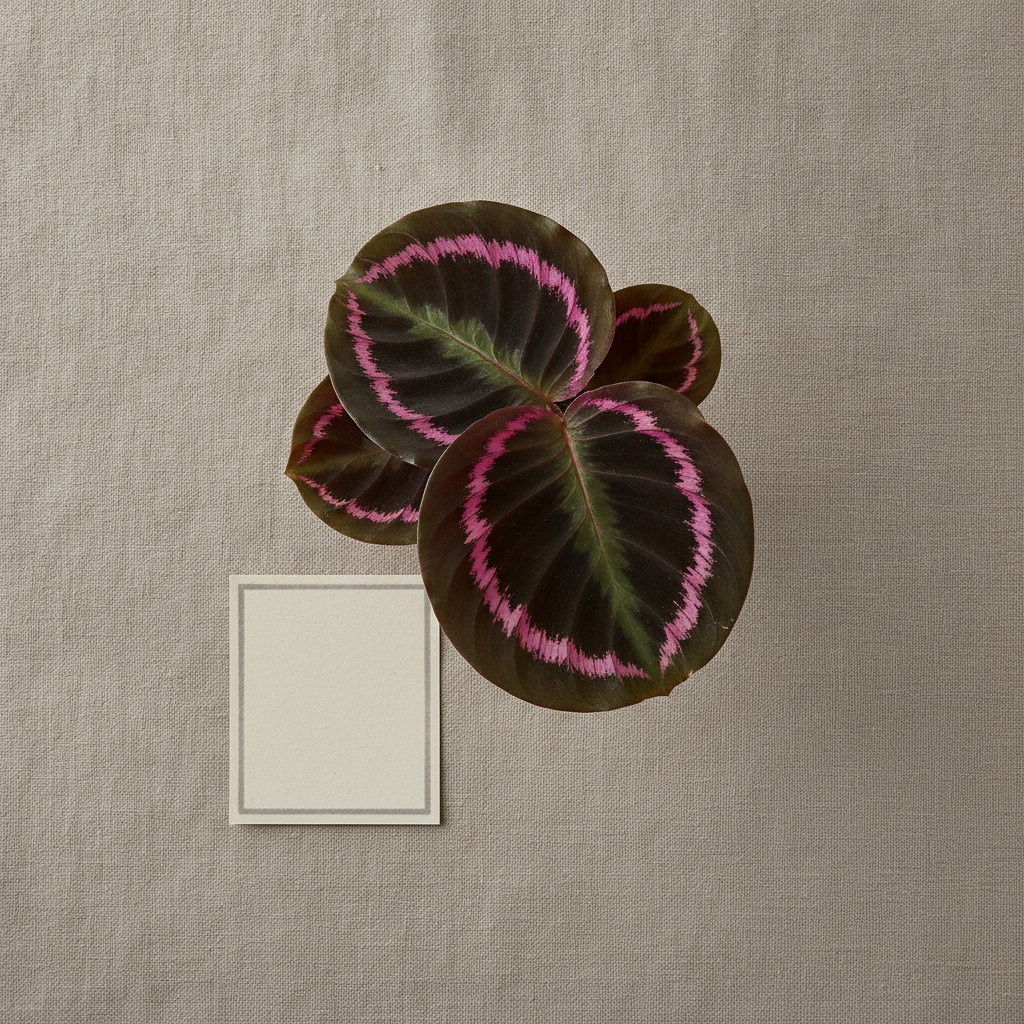
Dottie
The most dramatic of the group, Dottie carries deep, near-black purple-green leaves rimmed and feathered with vivid magenta-pink. The effect is bold and graphic, and the colour holds best in bright indirect light.
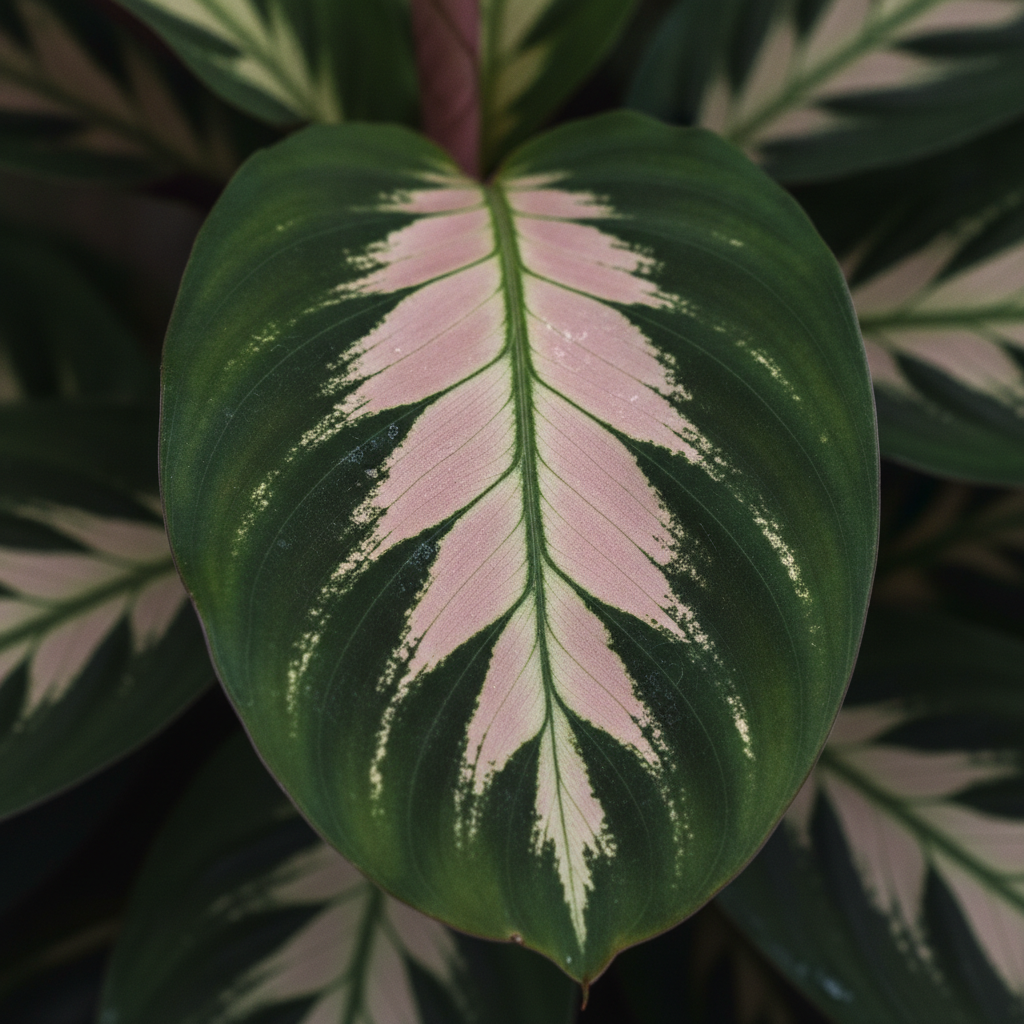
Rosy
Rosy is the soft, romantic counterpoint to Dottie, with broad blush-pink centres that mellow to creamy silver against a dark green border. It is one of the most sought-after and photogenic prayer plants in cultivation.
Variety Profiles in Detail
Rosy (Goeppertia roseopicta ‘Rosy’)
Perhaps the best-loved cultivar of the species, ‘Rosy’ produces large oval leaves washed with a wide brushstroke of soft pink through the centre that gradually pales to cream as the leaf ages, all framed by a dark green margin. New leaves emerge the pinkest, giving a healthy plant a beautiful gradient of tones. It is a moderate grower that rewards steady warmth, humidity and clean water.
Dottie (Goeppertia roseopicta ‘Dottie’)
‘Dottie’ takes the rose-painted concept to its most theatrical extreme, with foliage so darkly pigmented it can read as black, outlined by a thin, luminous ring of magenta-pink that traces the leaf edge and midrib. The contrast is stunning in person and makes Dottie a favourite for modern, moody interiors. It appreciates a slightly brighter position than average to keep the pink line saturated.
Medallion (Goeppertia roseopicta ‘Medallion’)
The classic and most widely sold form, ‘Medallion’ has almost perfectly round leaves patterned with a feathery, pale-green central plume over darker green, and rich purple undersides that flash as the leaves move. It is the variety many people picture when they think of a Calathea, and it makes an excellent introduction to the species.
Choosing the Right Variety for Your Space
Because their care is identical, the choice comes down to mood and setting. For a bold, contemporary statement, the near-black drama of ‘Dottie’ or ‘Eclipse’ is hard to beat. For a softer, more classic look, ‘Rosy’ and ‘Medallion’ bring gentle colour and elegant form. Whichever you pick, give it the warm, humid, gently lit conditions described in this guide and it will reward you with foliage that few other houseplants can rival.
Frequently Asked Questions
Why are the leaves of my Jungle Rose Calathea turning brown and crispy at the edges?
Brown, crispy edges are the plant’s most common complaint and almost always point to one of three things: air that is too dry, water that is too hard, or soil that has been allowed to dry out. Raise the humidity to 60% or more, switch to filtered, distilled or rainwater, and keep the soil evenly moist. In most cases addressing all three together clears the problem from new growth onward, though existing damage will not recolour.
Why are the leaves curling?
Curling leaves usually mean the plant is losing more water than it can take up, most often because the soil is too dry or the air is too arid. Check the moisture at the root zone and increase humidity. Some gentle curling in the evening is completely normal, however, as the plant folds its leaves upward as part of its natural prayer-plant rhythm.
Is the Jungle Rose Calathea safe for cats and dogs?
Yes. Like all members of the prayer plant family, it is non-toxic and considered pet-safe for cats and dogs, as well as for humans. It is one of the best choices of statement foliage plant for a household with pets, though as with any plant it is sensible to discourage nibbling to avoid mild stomach upset.
Why is my Calathea losing its pink colour?
Fading pink usually means the light is wrong. Too much direct sun bleaches the delicate pigments to a washed-out pale green, sometimes permanently, while too little light stops the plant fuelling the colour display and dulls everything toward flat green. Aim for consistent bright indirect light and the contrast should return in new leaves.
How often should I water it?
There is no fixed schedule, because it depends on light, warmth and season, but as a rough guide expect to water once or twice a week in spring and summer and every 10 to 14 days in winter. Always check first: water when the top 2 to 3 cm (1 in) of soil has just started to dry, and never let the plant sit in standing water.
Can I propagate it from a leaf or stem cutting?
No. Unlike vining houseplants, the Jungle Rose Calathea cannot be grown from a leaf or stem cutting, which will simply rot. It propagates only by division of the clump at the roots, ideally in spring when you repot. Split the plant into sections that each keep their own roots and a couple of leaves.
Why do the leaves move up and down?
This is a natural and healthy behaviour called nyctinasty. The plant raises and folds its leaves in the evening and lowers them again in the morning, driven by a small joint at the base of each leaf. It is one of the most charming features of prayer plants and a sign that your Calathea is content, not a cause for concern.
What humidity does it really need?
It does best at 60% humidity or above and starts to struggle below about 50%, which is drier than most heated or air-conditioned homes. A small room humidifier is the most dependable way to hit that target. Grouping plants and using a pebble tray help a little, but for a plant this sensitive a humidifier is the single best investment you can make.
Why are the lower leaves turning yellow?
The occasional old leaf yellowing and dying back at the base is natural ageing. If several lower leaves yellow at once and the soil stays wet, however, suspect overwatering and the early stages of root rot. Check the roots, ease off watering, and make sure the pot drains freely. Yellowing paired with soggy soil should always be taken seriously.






