
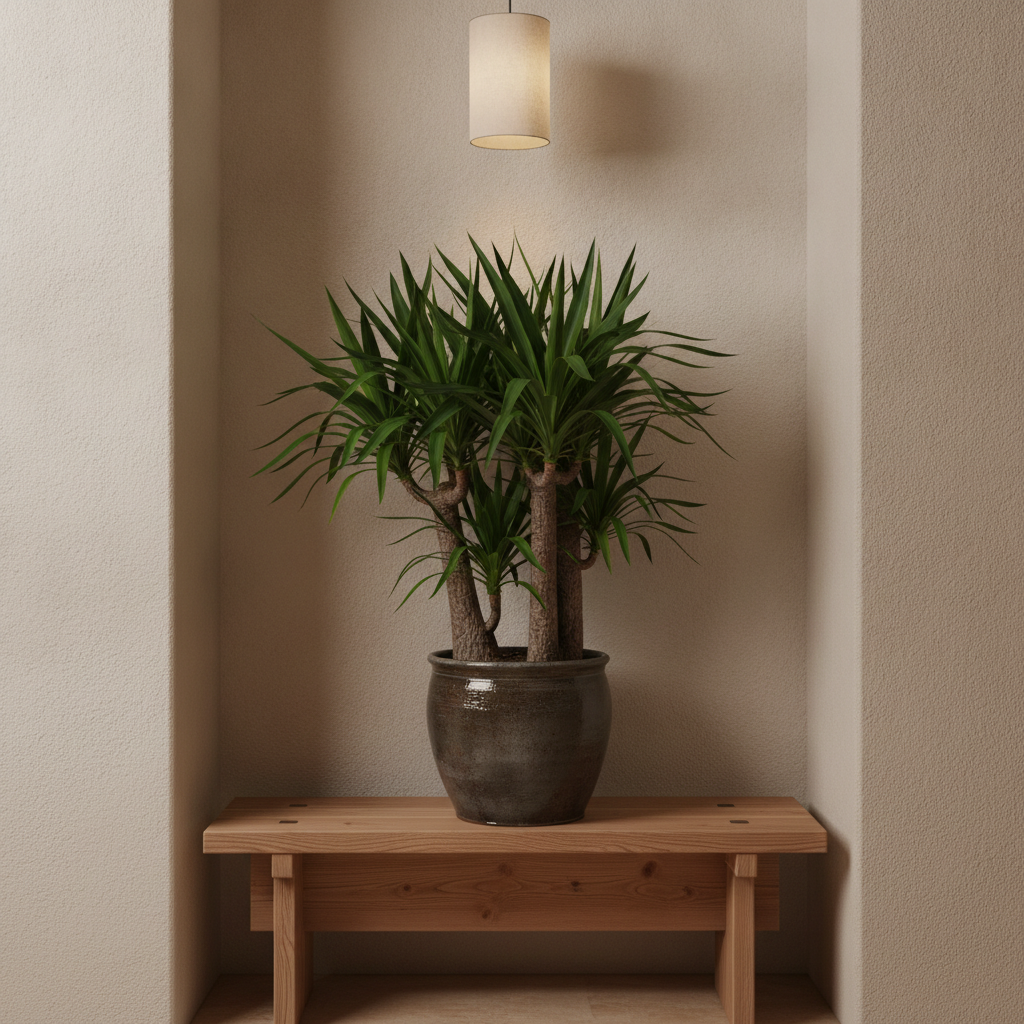
Few houseplants forgive neglect as gracefully as the spineless yucca. Sold as a stout woody cane crowned with fountains of soft, sword-shaped leaves, Yucca elephantipes (also catalogued as Yucca gigantea and Yucca guatemalensis) brings an unmistakably architectural, faintly tropical presence to a room while asking for almost nothing in return. Native to the dry woodlands and coastal lowlands of Mexico and Guatemala, it is the one yucca you can keep indoors without drawing blood, because its leaf tips are pliable rather than needle-sharp, which is exactly where the common name comes from.
That reputation for toughness is well earned, but there is a wide gap between a spineless yucca that merely survives in a shadowy corner and one that thrives into a sculptural specimen with dense, upright rosettes. This guide covers everything that closes that gap: how much light it genuinely needs, how to water a plant that resents wet feet, the gritty soil it prefers, when to feed, how to propagate from cane cuttings and basal offsets, and how to head off the handful of pests and rots that can undo an otherwise indestructible plant.
Contents
- Quick Reference
- Why Spineless Yucca Makes a Resilient Houseplant
- Light Requirements
- Watering & Humidity
- Soil, Potting & Repotting
- Fertilising
- Propagation
- Pests & Diseases
- Popular Varieties
- Frequently Asked Questions
Quick Reference: Spineless Yucca at a Glance
| Light | Bright light, including several hours of direct sun; bright indirect at minimum |
| Watering | Sparingly; let the top half of the pot dry out fully between waterings |
| Temperature | 18 to 27 C (64 to 81 F); tolerates brief dips to around 7 C (45 F) |
| Humidity | Undemanding; ordinary household humidity of 30 to 50% is fine |
| Fertiliser | Light feeder; balanced feed at half strength monthly in spring and summer |
| Toxicity | Mildly toxic to cats and dogs if eaten (saponins); keep out of reach of pets |
Why Spineless Yucca Makes a Resilient Houseplant
The spineless yucca is built for hardship. In its native range it endures long dry spells, poor stony soils and blazing sun, and that evolutionary toughness translates directly into a plant that shrugs off the two things that kill most houseplants: forgotten waterings and low humidity. Its swollen, woody stem, sometimes called an elephant’s foot for the way the base flares, is a built-in reservoir that lets the plant coast through weeks without water. For anyone who travels, forgets, or simply wants a large statement plant that will not sulk, it is one of the most dependable choices available.
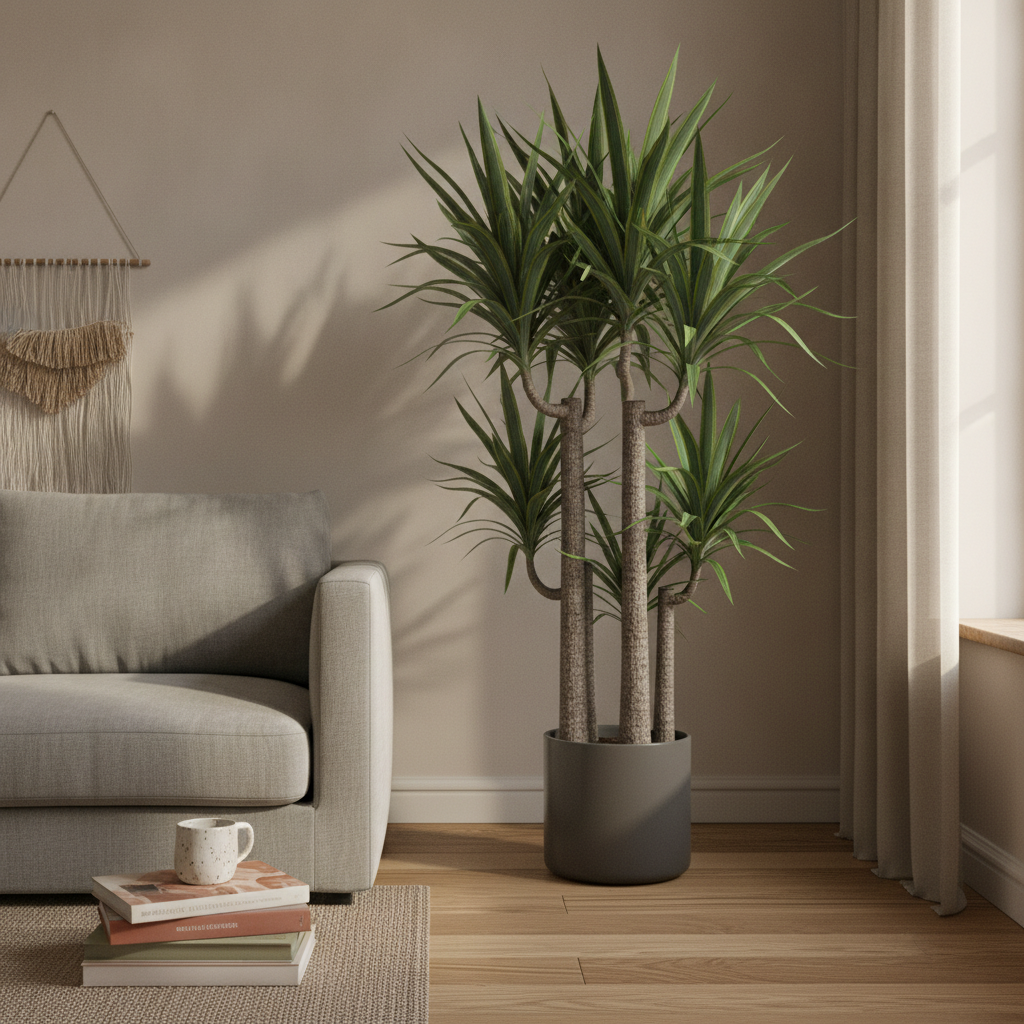
What sets it apart from its wild relatives is the leaves. Where a Spanish bayonet or Adam’s needle ends each blade in a rigid, skin-piercing spine, Yucca elephantipes tapers to a soft, flexible point, so it can be brushed past in a hallway or placed near a sofa without hazard. Indoors it typically settles at between 1.2 and 3 metres (4 to 10 feet) tall, growing slowly enough that a single specimen can hold a corner for many years before it outgrows the ceiling. Because it is usually sold as one or several canes of differing heights potted together, it delivers instant structure the day you bring it home rather than years of waiting.
Important — Toxicity: Although the leaves are physically harmless, spineless yucca contains saponins that are mildly toxic to cats and dogs if chewed or swallowed, and can cause drooling, vomiting or loss of appetite. It is not a plant to place where a determined nibbler can reach it. Humans are at low risk, but wash hands after handling cut stems and keep offcuts away from children.
Light Requirements
If there is one thing a spineless yucca genuinely demands, it is light. This is a sun plant at heart, and the single most common reason a healthy-looking specimen slowly declines indoors is a spot that is simply too dim. Give it the brightest position you have and it will reward you with tight, upright rosettes of firm leaves; starve it of light and it stretches, pales and softens.
The ideal placement is directly in front of, or immediately beside, a bright window where the plant receives at least a few hours of direct sun each day alongside long stretches of bright, unfiltered daylight. Unlike many tropical foliage plants, an established yucca tolerates and even relishes direct sun on its leaves, so a hot, south-facing window that would scorch a calathea suits it well once it has acclimatised.
Light Levels Explained
Gardeners talk loosely about “bright” and “low” light, so it helps to anchor those terms to rough illumination levels and to what each does to a spineless yucca over time.
| Light Category | Approx. Level | Typical Location | Outcome |
|---|---|---|---|
| Direct sun | 20,000 lux and above | On a south or west windowsill | Thrives; dense, firm, upright growth |
| Bright indirect | 10,000 to 20,000 lux | Beside a bright window | Good, steady growth; ideal for most homes |
| Medium | 5,000 to 10,000 lux | A few metres back from a window | Survives; growth slows, leaves loosen |
| Low | 1,000 to 5,000 lux | Interior wall, north-facing room | Declines slowly; stretched, weak canes |
| Very low | Below 1,000 lux | Hallway, windowless corner | Unsustainable; leaf loss and eventual rot |
Window Orientation and Placement
South-facing window: The best possible position in the northern hemisphere. A spineless yucca placed here receives the strong, sustained light it evolved for and will grow densely and hold its shape. Only newly bought plants moved suddenly from a shaded shop need a week or two of acclimatisation to avoid patchy bleaching.
East-facing window: A very good option. Gentle direct morning sun followed by bright light for the rest of the day keeps growth healthy without any risk of midday scorch. This is a safe default for most homes.
West-facing window: Also excellent. Afternoon sun is intense, and an acclimatised yucca handles it comfortably, producing sturdy leaves. Watch that the pot does not overheat behind glass on the hottest summer afternoons.
North-facing window: The weakest choice. A north window rarely supplies enough light for long-term health, and a yucca kept here will gradually etiolate. If a north room is your only option, plan to supplement with a grow-light.
Pro Tip — Rotate for Symmetry: Yucca rosettes lean noticeably toward their light source. Give the pot a quarter turn every week or two so all sides receive equal exposure and the plant grows straight rather than one-sided.
How Light Affects Growth Habit
Light does not change this plant’s colour so much as its posture. In strong light the leaves are shorter, thicker and held stiffly upward, and the spacing between them stays tight, giving that clean fountain shape. As light drops, the plant reaches for it: new leaves emerge longer, thinner and floppier, the gaps between them widen, and the whole rosette becomes loose and top-heavy. This stretching, known as etiolation, is not reversible on the leaves already formed, so the fix is always to improve light going forward rather than to wait for existing growth to recover.
Warning — Direct Sunlight: Tough as it is, a yucca that has spent months in dim light will scorch if moved straight into blazing sun. Sudden exposure bleaches leaves to pale, papery patches. Always acclimatise a plant over one to two weeks, increasing direct sun gradually.
Artificial Lighting
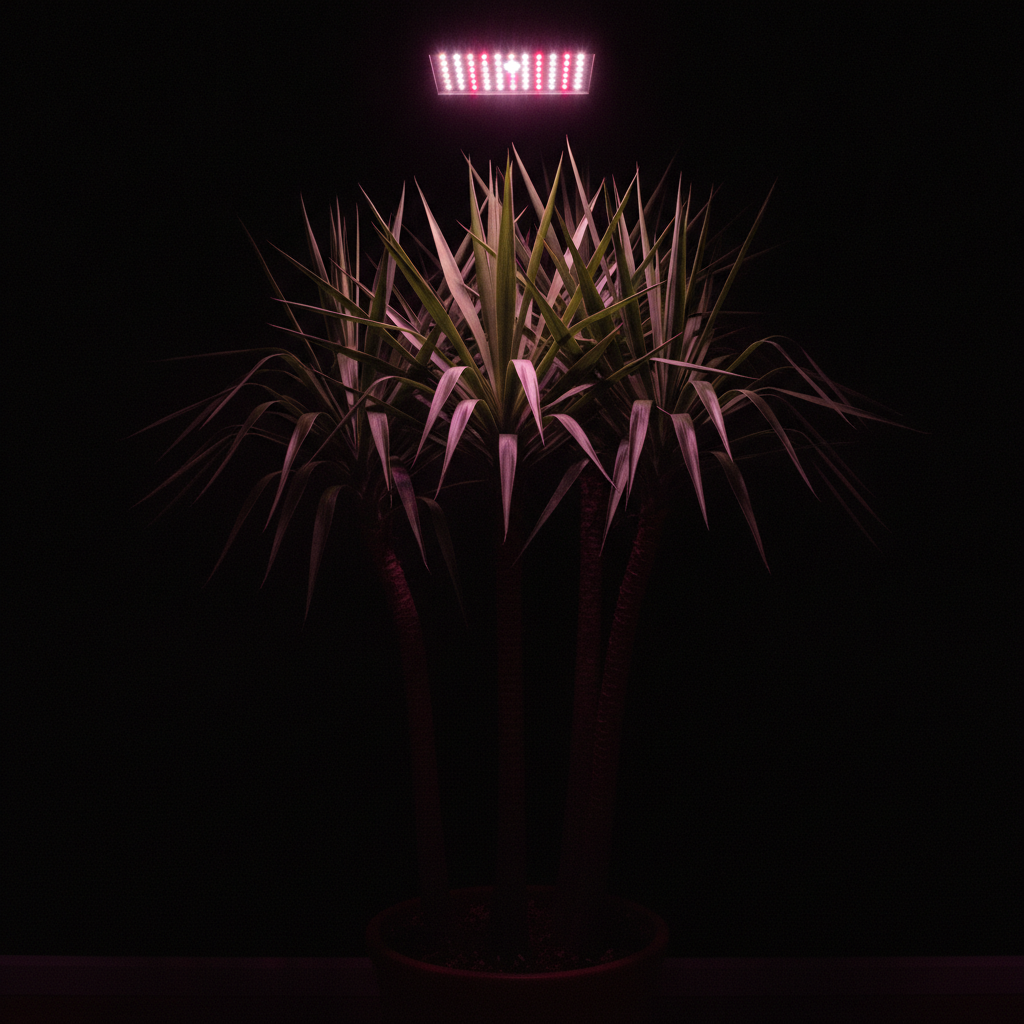
Because its light needs are so high, the spineless yucca is one of the houseplants most likely to benefit from a grow-light in darker homes or through northern winters. A full-spectrum LED positioned above the plant and run for 10 to 12 hours a day compensates well for a weak window and keeps rosettes compact. Aim the light directly down onto the crown from 30 to 60 centimetres (12 to 24 inches) away, and treat it as a supplement to, not a full replacement for, whatever daylight you can offer.
Seasonal Adjustments
Light indoors can fall by more than half between summer and midwinter, and a yucca notices. As days shorten, move the plant closer to its window, clean the glass, and accept that growth will slow or stop until spring. Reduce watering in step with the lower light, since a plant that is barely growing needs far less moisture. When the sun strengthens again in spring, reintroduce any summer-outdoor plant to bright conditions gradually to avoid shock.
Watering & Humidity
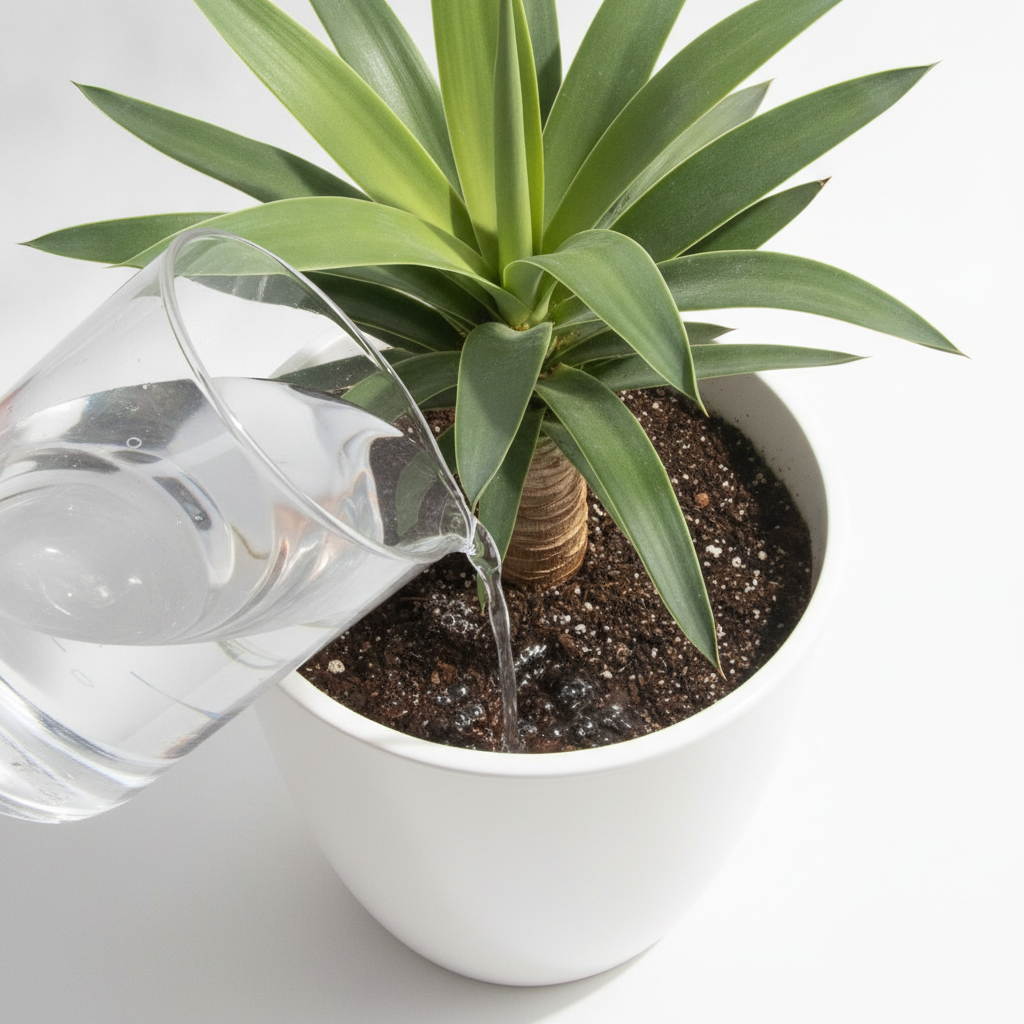
Watering is where good intentions most often kill a spineless yucca. This is a drought-adapted plant that stores water in its thick stem and roots, and it is far happier being kept too dry than too wet. The guiding principle is simple: water thoroughly, then wait until the soil is genuinely dry well down into the pot before watering again. When in doubt, leave it another few days.
When to Water
Rather than watering on a fixed schedule, check the soil. Push a finger or a wooden skewer several centimetres into the pot; if it comes out with damp soil clinging to it, wait. For a yucca, the top half of the pot should dry out completely before the next drink, and in the depths of winter you can let almost the entire pot dry. A moisture meter reading in the dry zone is your green light.
In practice this often means watering roughly every 10 to 14 days in the warm, bright months and as little as once every three to four weeks in winter, though the exact interval depends on pot size, light and warmth. A large plant in a bright, warm room drinks faster than a small one in a cool corner, so let the soil, not the calendar, make the decision.
Pro Tip — Underwater on Purpose: If you are unsure whether to water, don’t. A spineless yucca recovers quickly from a missed watering but only slowly, if at all, from sodden roots. Erring dry is always the safer mistake with this plant.
How to Water Correctly
- Check that the top half of the pot is dry before you begin.
- Move the plant to a sink or use a saucer to catch runoff.
- Pour water evenly over the soil surface, avoiding the crown of the canes.
- Continue until water runs freely from the drainage holes, wetting the whole root ball.
- Let the pot drain completely for several minutes.
- Empty the saucer so the plant never stands in leftover water.
Signs of Overwatering vs. Underwatering
| Symptom | Overwatering | Underwatering |
|---|---|---|
| Leaf colour | Yellowing, often starting low on the plant | Tips and margins browning and crisping |
| Leaf texture | Soft, limp, translucent | Dry, papery, curling |
| Soil | Stays wet for days, may smell sour | Bone dry, pulling away from the pot sides |
| Roots | Brown, mushy, foul-smelling | Dry but firm and pale |
| Stem base | Soft, spongy, darkening at the trunk | Firm, perhaps slightly shrunken |
Warning — Root and Stem Rot: A soft, darkening, spongy trunk base is the most serious symptom a yucca can show. It signals rot moving up from waterlogged roots and is frequently fatal. If you find it, unpot immediately, cut away all mushy tissue back to firm growth, dust with fungicide, and repot into dry, fresh, gritty mix. Prevention through sparse watering is far easier than cure.
Humidity Requirements
Here the spineless yucca is refreshingly easy: it does not care about humidity. Coming from dry, sunny habitats, it is perfectly content in the 30 to 50% relative humidity typical of most homes, and it needs no misting, pebble trays or humidifiers. If anything, it prefers drier air to the muggy conditions that suit ferns and calatheas.
Because dry air is rarely a problem, brown leaf tips on a yucca almost always point to something other than humidity, most often inconsistent watering, a build-up of fertiliser salts, or fluoride and chlorine in tap water. Rule those out before you reach for a mister that this plant does not want.
The one place humidity matters is airflow. Good air circulation around the plant helps the soil surface dry between waterings and discourages the fungal problems that thrive in stagnant, damp conditions, so a spot with gentle air movement is preferable to a sealed, still corner.
Water Quality
Yuccas are somewhat sensitive to the fluoride and chlorine found in many municipal water supplies, which can accumulate and show up as browning leaf tips over time. If your tap water is heavily treated and you notice persistent tip burn, switch to rainwater, distilled water, or tap water left to stand uncovered overnight so some of the chlorine dissipates. For most homes, however, ordinary tap water applied correctly and flushed through the pot causes no trouble.
Soil, Potting & Repotting
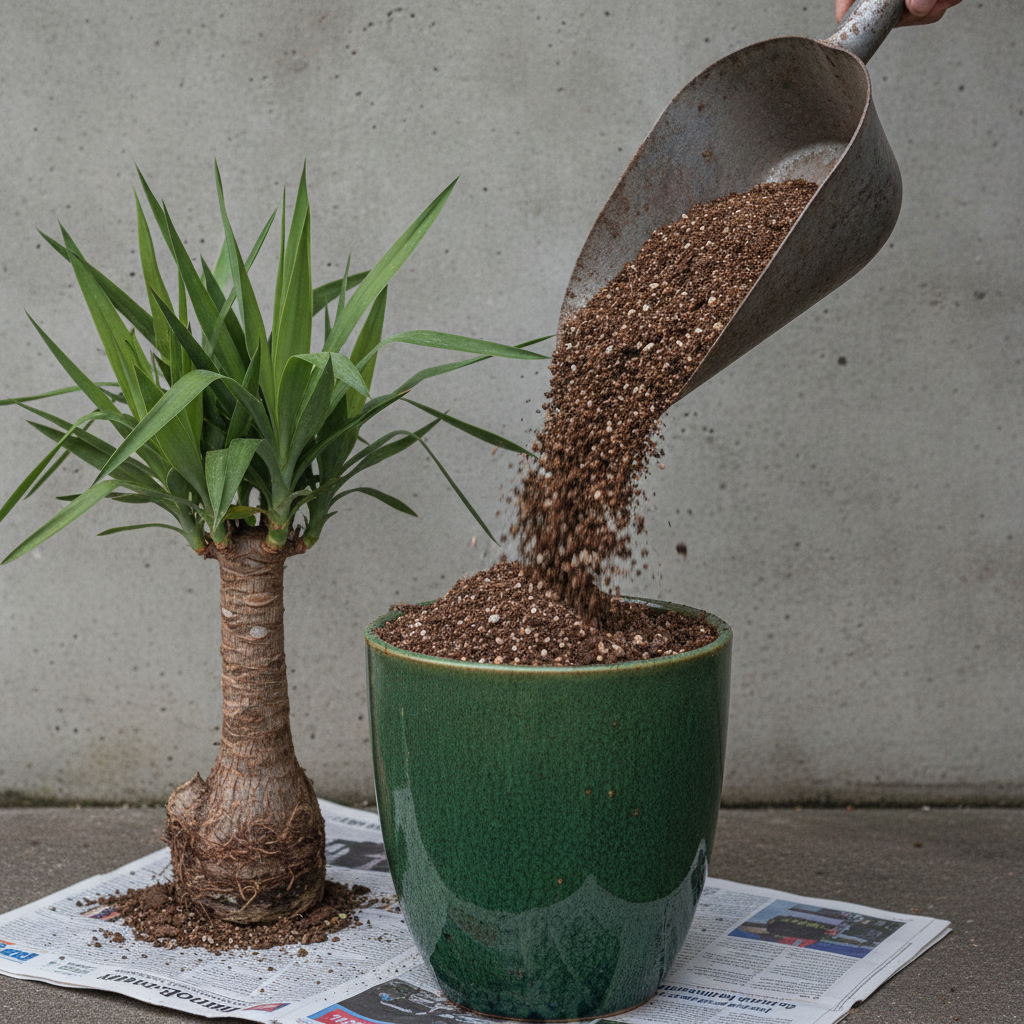
Everything about keeping a spineless yucca alive comes back to drainage, and that starts with the soil. This plant wants a gritty, open, fast-draining medium that lets water rush through and air reach the roots, never a dense, moisture-holding compost that stays wet for days. Get the mix right and half the battle against overwatering is already won.
Ideal Soil Composition
The simplest reliable approach is to start with a bag of cactus and succulent compost and open it up further with extra grit and perlite. The aim is a medium that holds just enough moisture to sustain the plant between deep waterings while draining sharply enough that the roots are never sitting in water.
| Component | Proportion | Function |
|---|---|---|
| Cactus or general potting compost | 50% | Base structure, nutrients and moisture retention |
| Coarse grit or horticultural sand | 25% | Rapid drainage and weight for stability |
| Perlite or pumice | 20% | Aeration and open pore space around roots |
| Fine bark or coir | 5% | Structure that resists compaction over time |
The spineless yucca is not fussy about pH, thriving anywhere from slightly acidic to neutral, roughly 6.0 to 7.5. A standard cactus mix already sits comfortably in that range, so there is no need to test or adjust it for a plant this tolerant.
Pro Tip — Quick Mix Recipe: No time to measure? Combine two parts cactus compost with one part perlite and one part coarse grit. That three-ingredient blend drains fast, stays open, and suits a yucca in almost any pot.
Choosing the Right Pot
A top-heavy plant on a slender cane needs a pot that anchors it as much as it houses the roots. Weight and stability matter here in a way they do not for most houseplants, so lean toward heavier materials and a base broad enough to stop the whole thing toppling.
Drainage holes are non-negotiable. Whatever pot you choose must have generous drainage holes. Given this plant’s intolerance of wet roots, a decorative pot without holes is an invitation to rot; if you love a particular cover pot, keep the yucca in a plain plastic nursery pot inside it and lift it out to water.
Pot material: Terracotta is close to ideal because it is porous, wicking moisture from the soil and drying it faster, while its weight guards against tipping. Heavy glazed ceramic works well too. Lightweight plastic is fine for the roots but may need weighting or a heavy cover pot to keep a tall specimen upright.
Pot size: Choose a pot only slightly larger than the root ball. Yuccas are slow growers that actually prefer to be a little snug, and an oversized pot holds a reservoir of damp soil the roots cannot use, which raises the risk of rot. Size up by a single pot diameter at a time.
When to Repot
Spineless yuccas are content to stay in the same pot for two to three years, and there is no need to rush them on. Repot only when roots grow thickly from the drainage holes, when the plant becomes unstable or the pot bulges, or when the old soil has broken down and no longer drains freely. Spring, as growth resumes, is the best time to do it.
How to Repot: Step-by-Step
- Water lightly a day beforehand so the root ball holds together, or repot dry to reduce rot risk.
- Ease the plant out by tipping the pot and supporting the canes, never pulling on the stems.
- Loosen the outer roots gently and brush away spent, crumbly old soil.
- Inspect the roots and trunk base, trimming any that are soft, brown or foul-smelling.
- Add a layer of fresh gritty mix to a clean pot only one size larger.
- Position the plant at its previous depth and fill around it, firming lightly to hold the canes steady.
- Wait several days before watering to let any disturbed roots callus over.
Warning — Transplant Shock: Do not water a freshly repotted yucca straight away. Damaged roots exposed to wet soil rot easily, and the plant copes far better if given a few dry days to seal any wounds before its first drink in the new pot.
Fertilising
A spineless yucca is a light feeder, and heavy fertilising does it more harm than good. In the wild it grows in lean soils and grows slowly, so its appetite for nutrients is modest. A gentle feed through the active season is plenty; the rest of the year it needs nothing at all.
Think of feeding as a top-up rather than a driver of growth. Light and water govern how well this plant does far more than fertiliser does, and the quickest way to damage a yucca with feed is to give it too much, which scorches roots and burns leaf tips. Restraint is the whole strategy.
Understanding Plant Nutrients
Fertiliser labels carry three numbers, the N-P-K ratio, showing the percentages of nitrogen, phosphorus and potassium. Nitrogen drives leafy growth, phosphorus supports roots and energy, and potassium underpins overall vigour and resilience. A balanced houseplant feed supplies these in even measure, along with the secondary nutrients and trace elements below.
| Nutrient | Symbol | Primary Function | Deficiency Symptoms |
|---|---|---|---|
| Nitrogen | N | Leaf and stem growth, green colour | Pale, yellowing older leaves; stalled growth |
| Phosphorus | P | Root development and energy transfer | Weak roots, dull or purplish leaves |
| Potassium | K | Overall vigour and stress tolerance | Yellowing or browning leaf margins |
| Calcium | Ca | Cell wall strength | Distorted or weak new growth |
| Magnesium | Mg | Core of the chlorophyll molecule | Yellowing between leaf veins |
| Iron | Fe | Chlorophyll production in new leaves | Pale young leaves with green veins |
Types of Fertiliser
Liquid fertilisers: The easiest choice for a yucca. A balanced liquid houseplant feed diluted to half the recommended strength and applied during watering gives precise control over how much the plant receives, and is simple to stop entirely in autumn.
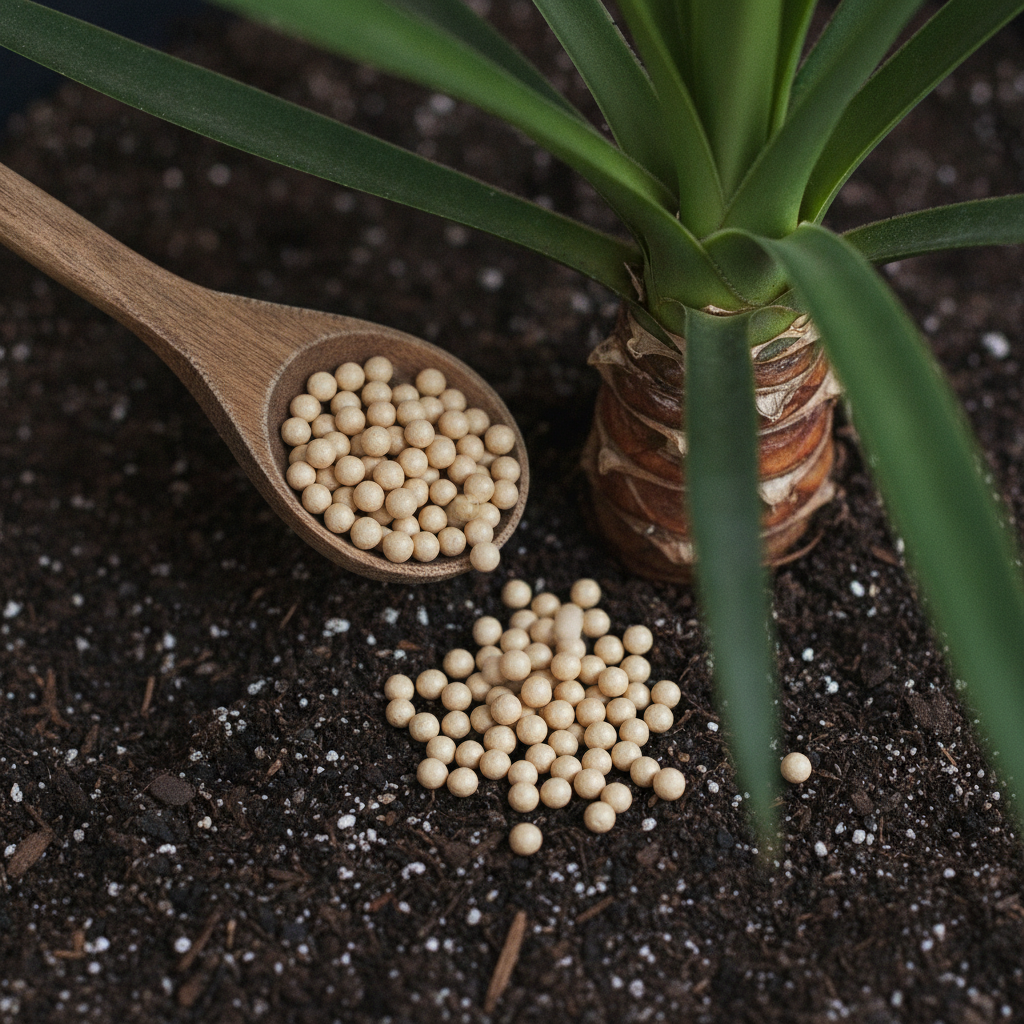
Slow-release granular: Prills mixed into the topsoil or scattered at the surface release nutrients gradually over several months. Convenient for those who prefer not to think about feeding, though you sacrifice some control; use a formulation intended for cacti or foliage plants and follow the lower end of the dosage.
Organic fertilisers: Worm castings, diluted seaweed extract or a gentle organic feed all work well and are difficult to overdo. They release slowly and improve soil life, making them a forgiving option for a plant that resents excess.
Feeding Schedule
Feed only during the active growing season, from spring through to late summer, roughly once a month at half strength. That amounts to just four to five feeds across the year. From autumn onward, as growth slows and light fades, stop feeding entirely; a dormant plant cannot use the nutrients, and unused salts simply build up in the soil.
Pro Tip — Half Strength, Every Time: Dilute feed to half the label rate as a standing rule for yuccas. They respond far better to a little and often than to a strong dose, and the weaker mix all but eliminates the risk of fertiliser burn.
How to Fertilise
- Water the plant lightly first so feed never hits dry roots.
- Dilute a balanced liquid fertiliser to half the recommended strength.
- Apply it evenly to the soil, keeping it off the leaves and crown.
- Let any excess drain fully from the pot.
- Every few months, flush the pot with plain water to wash out accumulated salts.
Warning — Salt Build-Up: A white crust on the soil or pot rim, or leaf tips that brown despite careful watering, usually signals a build-up of fertiliser salts. Flush the pot thoroughly with several times its volume of plain water, and ease back on feeding.
Propagation
Propagating a spineless yucca is remarkably straightforward, because the same toughness that makes it a good houseplant also makes its stems eager to root. Unlike trailing vines that root from leaf nodes in a glass of water, a yucca is multiplied from woody stem cuttings and from the offsets, or pups, that sprout around the base of an established plant.
The best time to propagate is spring or early summer, when the plant is in active growth and wounds heal quickly. Both methods below are reliable, and a mature specimen that has grown leggy is the perfect candidate, since cutting it back to propagate also rejuvenates the parent.
Understanding Canes and Offsets
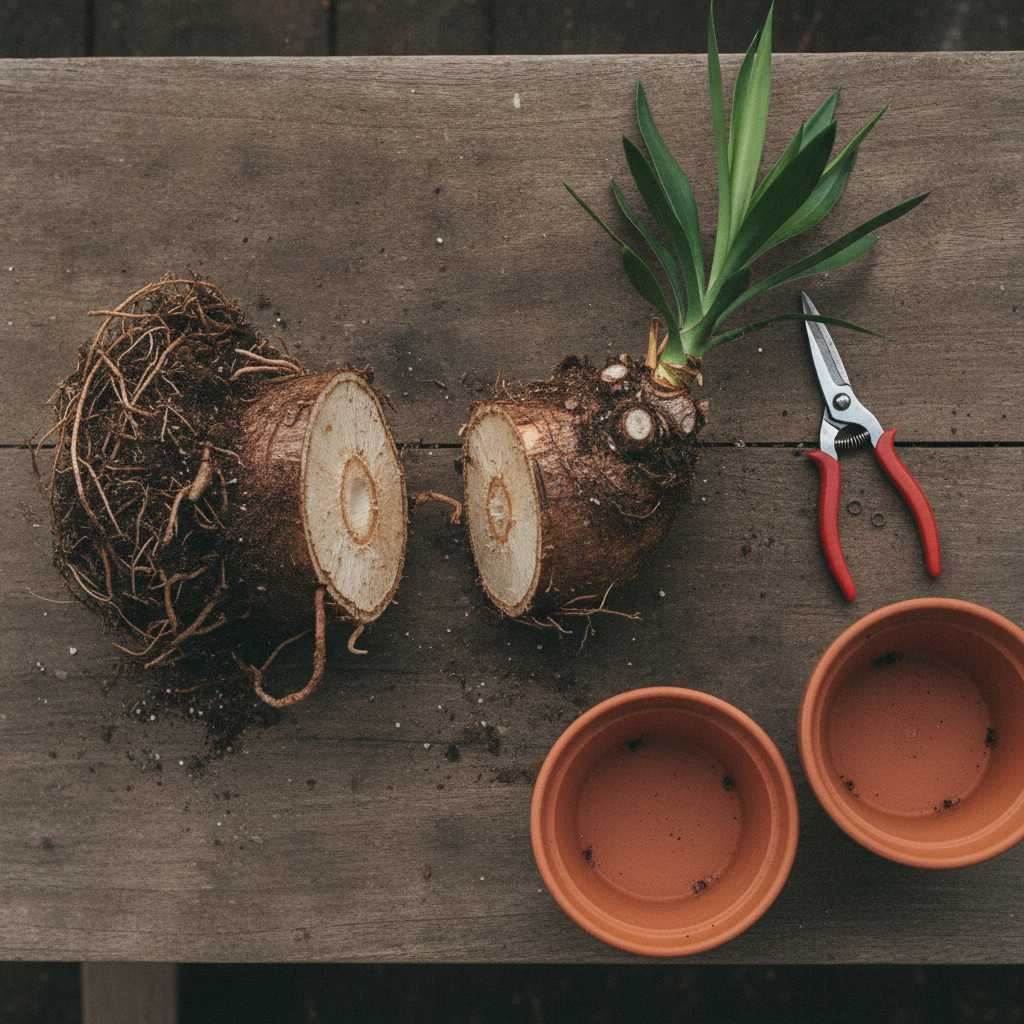
The key to yucca propagation is that its thick stem is packed with dormant buds and its base readily produces pups. A length of cut cane, given warmth and a dry callus period, will push new roots from its base and fresh shoots from the buds along its side. Meanwhile, the offsets that appear around a mature plant are essentially ready-made young plants that can be separated once they have their own roots. Both routes exploit the same underground reserves that let the plant survive drought.
Cane Cuttings: Step-by-Step
This is the classic method and the one used commercially to produce the potted canes sold in shops. It works best on a healthy, established stem at least a few centimetres thick.
- With a clean, sharp saw or knife, cut a section of cane 10 to 30 centimetres (4 to 12 inches) long, noting which end was uppermost.
- Leave the cutting in a warm, dry, shaded spot for several days to a week so the cut ends callus over.
- Optionally dip the lower end in rooting hormone to speed things along.
- Insert the lower end a few centimetres deep into a pot of barely moist, gritty cactus mix, keeping the original orientation.
- Place it somewhere warm and bright but out of harsh direct sun, and water only sparingly.
- Wait; roots form over several weeks to a couple of months, after which new leaf shoots appear along the cane.
Pro Tip — Mind the Orientation: A cane cutting will only sprout properly if planted the right way up. Mark the top with a dab of paint or a diagonal cut on the bottom before you separate it, because once it is a bare log both ends look alike.
Offset Division: Step-by-Step
If your plant has produced pups around its base, dividing them is the quickest way to a new specimen because they often already have roots of their own.
- Slide the whole plant out of its pot to expose the base and the offsets.
- Locate where each pup joins the parent and check for its own root system.
- Cut the offset away cleanly with a sterilised knife, keeping as many of its roots as possible.
- Let the cut surfaces dry for a day or two to callus.
- Pot each offset into its own small container of gritty mix and withhold water for a few days.
- Keep warm and bright, watering sparingly until new growth confirms the pup has established.
Troubleshooting Propagation
| Problem | Likely Cause | Solution |
|---|---|---|
| Cutting rots at the base | Planted while still wet, or soil kept too moist | Callus longer, use drier gritty mix, water minimally |
| No roots after months | Too cold, or cane planted upside down | Provide warmth; check orientation and re-set if reversed |
| Cane shrivels and dries out | Air too dry with no root uptake yet | Keep warm and lightly humid; be patient, some shrink is normal |
| Offset wilts after separation | Too few roots, or watered too soon | Keep humid and shaded; let it settle before normal watering |
Pests & Diseases
A well-grown spineless yucca is not especially troubled by pests, and its tough, leathery leaves deter many of the sap-suckers that plague softer plants. Most problems that do arise are self-inflicted through overwatering rather than infestation, and the fungal rots that follow wet soil are a far greater threat than any insect.
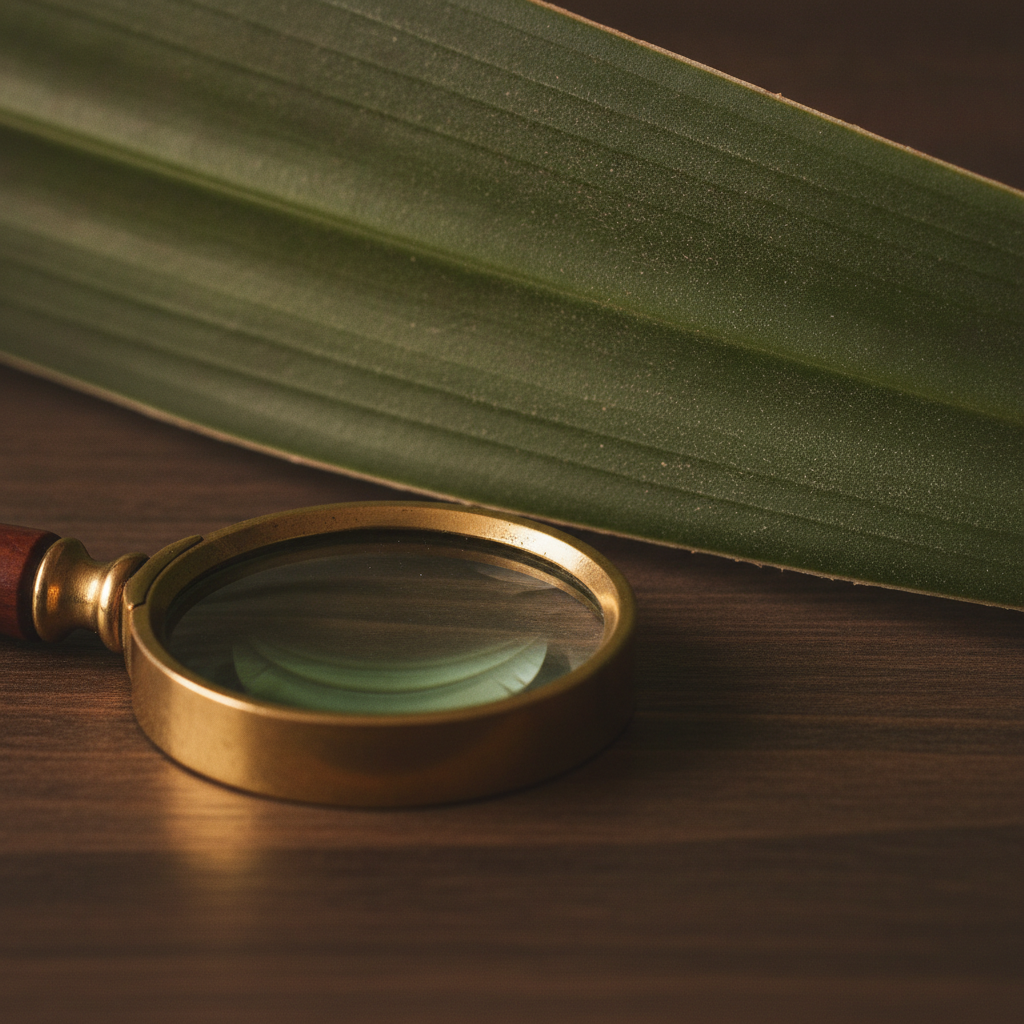
That said, no houseplant is entirely immune, and a stressed or dusty yucca in a stuffy room can pick up the usual suspects. Regular inspection, especially of the leaf axils and undersides where pests hide, catches trouble early while it is still easy to treat.
Common Pests
Scale Insects (Coccidae and relatives)
Scale are the most common yucca pest, appearing as small brown or tan bumps clustered along stems and the undersides of leaves. They are immobile once settled and suck sap, weakening the plant and leaving a sticky honeydew that invites sooty mould.
Treatment: Scrape or wipe off individual scales with a cotton bud dipped in isopropyl alcohol, then treat the whole plant with horticultural oil or insecticidal soap, repeating every one to two weeks until clear.
Mealybugs (Pseudococcidae)
Mealybugs show up as small white, cottony tufts tucked into leaf axils and the crown of the rosette. Like scale they feed on sap and excrete honeydew, and a heavy infestation can stunt new growth.
Treatment: Dab each cluster with an alcohol-soaked cotton bud, then follow with insecticidal soap or neem oil across the whole plant, paying attention to the hidden crevices where they breed.
Spider Mites (Tetranychus urticae)
Spider mites thrive in the warm, dry conditions a yucca enjoys, so they can occasionally take hold. Look for fine stippling or a dusty, faded look on the leaves and, in bad cases, delicate webbing between them.
Treatment: Rinse the foliage to knock populations down, then apply neem oil or a miticide. Improving airflow and wiping the leaves regularly makes the plant a less welcoming host.
Common Diseases
Root and Stem Rot (Phytophthora and Pythium)
By far the most serious threat to a spineless yucca, rot sets in when roots sit in wet soil. It shows as yellowing lower leaves, a softening trunk base and, in advanced cases, a foul smell and collapse of the whole plant.
Treatment: Act fast. Unpot the plant, cut away every soft, discoloured root and any mushy trunk tissue back to firm growth, dust the wounds with fungicide, and repot into dry, fresh, gritty mix. Then correct the watering habits that caused it.
Fungal Leaf Spot (Coniothyrium concentricum and others)
Leaf spot appears as brown or grey lesions, sometimes ringed with yellow, usually where water has sat on the foliage in still, humid air. It is unsightly but rarely fatal if addressed.
Treatment: Remove affected leaves, avoid wetting the foliage when watering, improve air circulation, and apply a copper-based fungicide if the spotting continues to spread.
Pest and Disease Summary
| Pest / Disease | Identification | Treatment |
|---|---|---|
| Scale insects | Brown bumps on stems and leaf undersides | Alcohol wipe, then horticultural oil or soap |
| Mealybugs | White cottony tufts in axils and crown | Alcohol dab, then neem or insecticidal soap |
| Spider mites | Fine stippling and faint webbing | Rinse, neem oil or miticide, improve airflow |
| Root and stem rot | Soft trunk base, yellowing, foul smell | Cut away rot, fungicide, repot dry, water less |
| Fungal leaf spot | Brown or grey lesions on leaves | Remove leaves, keep foliage dry, copper fungicide |
Prevention Strategies
Prevention with a yucca is mostly a matter of getting the basics right. Sparse watering into fast-draining soil heads off the rots that cause most fatalities, while bright light and good airflow keep the plant vigorous enough to resist pests. Dust the leaves occasionally so mites cannot establish unnoticed, and inspect any new plant carefully before it joins your collection.
Quarantine is worth the effort. Keep a newly bought plant apart from the rest of your collection for a couple of weeks and watch for pests emerging, since a single infested import can spread scale or mites through a whole windowsill before you notice.
Pro Tip — Neem as Routine: A light monthly spray of diluted neem oil during the growing season keeps scale, mealybugs and mites in check before they become an infestation. Apply in the evening or out of direct sun to avoid leaf burn.
Popular Varieties
Most spineless yuccas sold as houseplants are the plain green species, prized for their clean architectural lines, but a handful of cultivars add variegation or a more compact habit for smaller spaces. All share the same easy-going care, so choosing between them is largely a matter of looks and scale.
Because variegated forms carry less chlorophyll, they appreciate a touch more light to keep their colour bright, but their needs are otherwise identical to the species. Below are the varieties you are most likely to encounter.
| Variety | Leaf Appearance | Light Needs | Growth Rate | Availability |
|---|---|---|---|---|
| Species (green) | Solid deep green, soft arching blades | Bright | Slow to moderate | Very common |
| ‘Variegata’ | Green centre with creamy-yellow margins | Bright | Slow | Common |
| ‘Jewel’ | Bold creamy-white to yellow leaf edges | Bright | Slow | Occasional |
| ‘Puck’ | Compact green rosettes on a stout stem | Bright | Slow | Occasional |
| ‘Silver Star’ | Green blades with a silvery-grey cast | Bright | Slow | Uncommon |
Featured Varieties
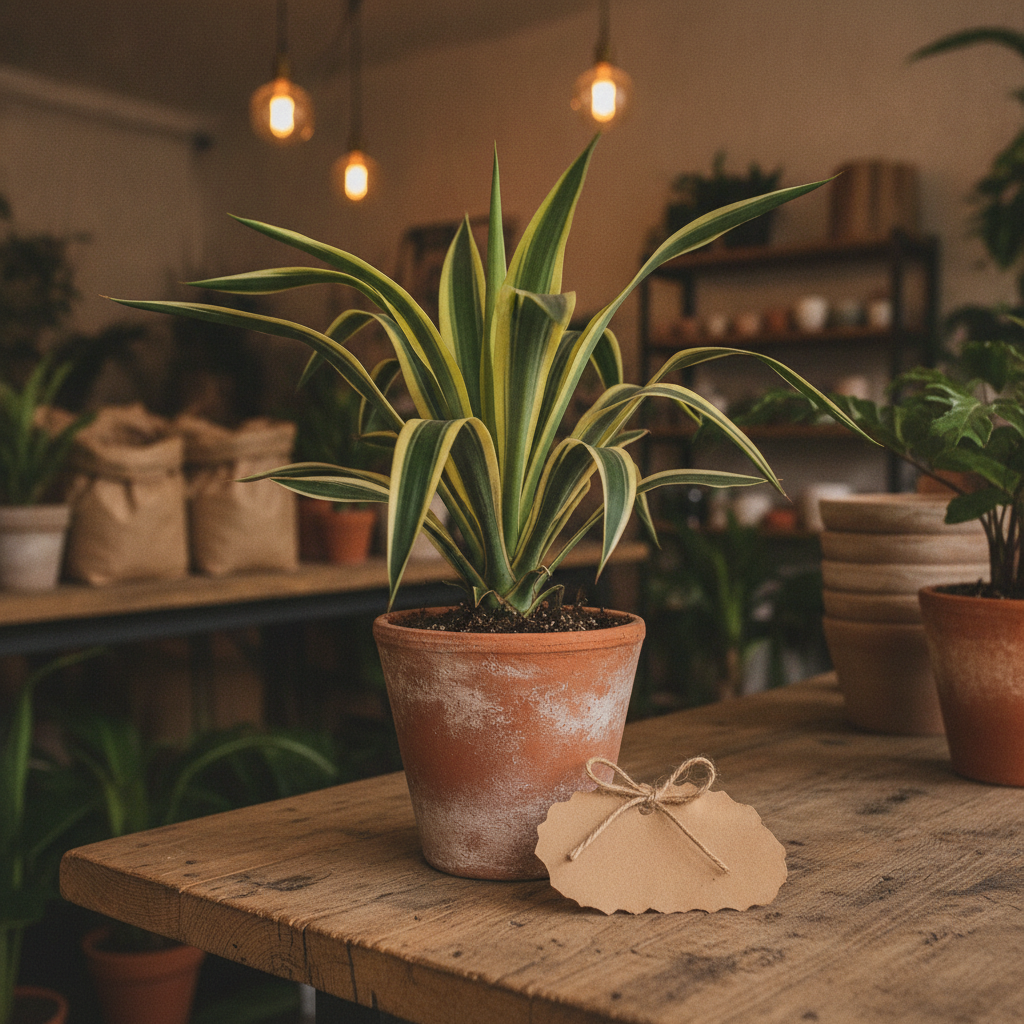
‘Variegata’
The most widely grown variegated form, its arching blades carry soft creamy-yellow margins framing a deep green centre, adding warmth and brightness while keeping the classic yucca silhouette.
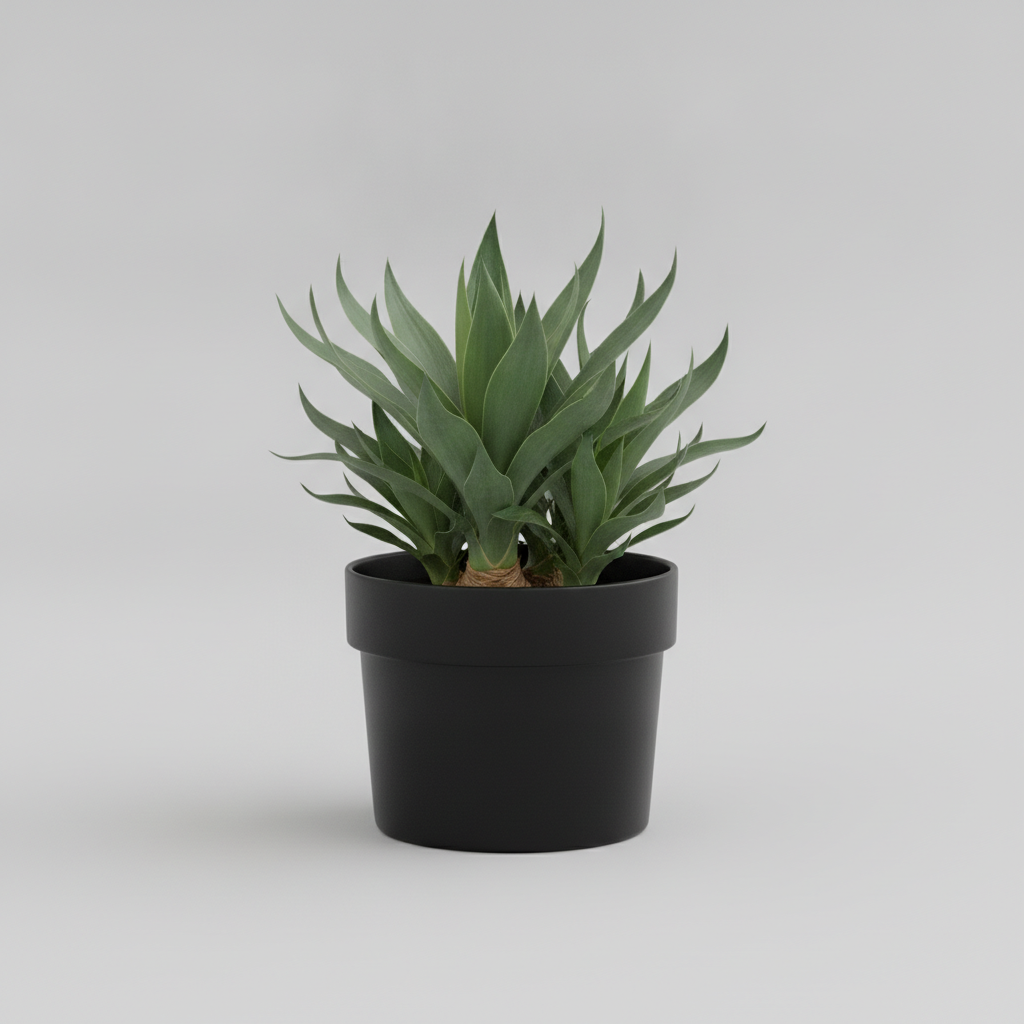
‘Puck’
A compact dwarf selection that forms denser, shorter rosettes of plain green leaves on a stout stem, making it a natural choice for a desk, shelf or a smaller room where a full-sized cane would overwhelm.
Variety Profiles in Detail
Species (Yucca elephantipes)
The plain green species is the plant most people picture: one or more thick, corky canes topped with fountains of soft, deep green, sword-shaped leaves. It is the toughest and most forgiving of the group, and its restraint is exactly what makes it such an effective architectural statement in a modern interior.
‘Jewel’ (Yucca elephantipes ‘Jewel’)
A boldly variegated cultivar with broad creamy-white to yellow bands along the leaf edges, giving it a brighter, more decorative look than ‘Variegata’. Like all variegated yuccas it wants the strongest light you can offer to keep the pale margins crisp rather than dull.
‘Silver Star’ (Yucca elephantipes ‘Silver Star’)
An uncommon selection whose green blades carry a distinctive silvery-grey overlay, lending a cooler, more muted tone than the vivid green species. It is grown for that subtle colouring and, being rarer, tends to command a higher price when it appears.
Choosing the Right Variety for Your Space
Let scale and light guide the choice. For a large, sunny room that can carry a bold vertical accent, the green species or a variegated ‘Variegata’ cane delivers maximum impact, while a compact ‘Puck’ suits desks, shelves and smaller rooms. If your brightest window is only moderately lit, favour the all-green species over the variegated forms, which need stronger light to stay vivid and can look tired in dimmer positions.
Frequently Asked Questions
Why are my spineless yucca’s leaves turning yellow?
Yellowing, particularly of the lower leaves, is most often a sign of overwatering. Check that the soil is drying out fully between waterings and that the pot drains freely; if the trunk base feels soft, suspect rot and act quickly. A little natural yellowing and shedding of the oldest leaves is normal as the plant grows.
Why are the leaf tips brown and crispy?
Brown tips usually stem from underwatering, a build-up of fertiliser salts, or fluoride and chlorine in tap water rather than low humidity. Water more thoroughly when the soil is dry, flush the pot occasionally to clear salts, and try rainwater or filtered water if your tap supply is heavily treated.
How often should I water a spineless yucca?
Roughly every 10 to 14 days in spring and summer, and as little as once every three to four weeks in winter, but always let the soil be your guide. The top half of the pot should dry out completely before you water again. When unsure, wait; this plant tolerates drought far better than wet feet.
Is the spineless yucca safe for cats and dogs?
Its leaves are physically safe because they lack the sharp spines of other yuccas, but the plant contains saponins that are mildly toxic to cats and dogs if eaten, potentially causing drooling, vomiting or lethargy. Keep it out of reach of pets that like to chew foliage.
My yucca has grown tall and leggy. Can I cut it back?
Yes. Spineless yuccas respond very well to being cut back, and doing so is the standard fix for a leggy, top-heavy plant. Saw the cane through at the height you want in spring; the parent will sprout new shoots below the cut, and the removed section can be used as a cane cutting to grow an entirely new plant.
Why is my yucca not growing?
Spineless yuccas are naturally slow growers, so modest progress is normal, but a complete stall usually points to insufficient light. Move the plant to your brightest window, and remember that growth pauses in winter and resumes in spring. As long as the leaves are firm and green, a resting plant is perfectly healthy.
Can a spineless yucca live outside?
In a warm, frost-free climate it can grow permanently outdoors in a sunny, well-drained spot. In cooler regions it is best treated as an indoor plant that can holiday outside over summer, brought back in before temperatures fall below about 7 C (45 F). Acclimatise it to stronger outdoor light gradually to prevent scorch.
Does the spineless yucca flower indoors?
Outdoors, mature plants produce tall spikes of creamy-white bell-shaped flowers, but indoor specimens rarely bloom because they seldom receive the intensity of light and the conditions needed to trigger flowering. Grow it for its bold foliage and sculptural form rather than in expectation of flowers.
What is the difference between spineless yucca and other yuccas?
The defining difference is the leaves. Yucca elephantipes has soft, flexible leaf tips, whereas species such as Yucca aloifolia or Yucca gloriosa end each blade in a rigid, sharp spine. That softness, together with its tree-like cane and swollen base, makes the spineless yucca the safest and most popular choice for growing indoors.






