
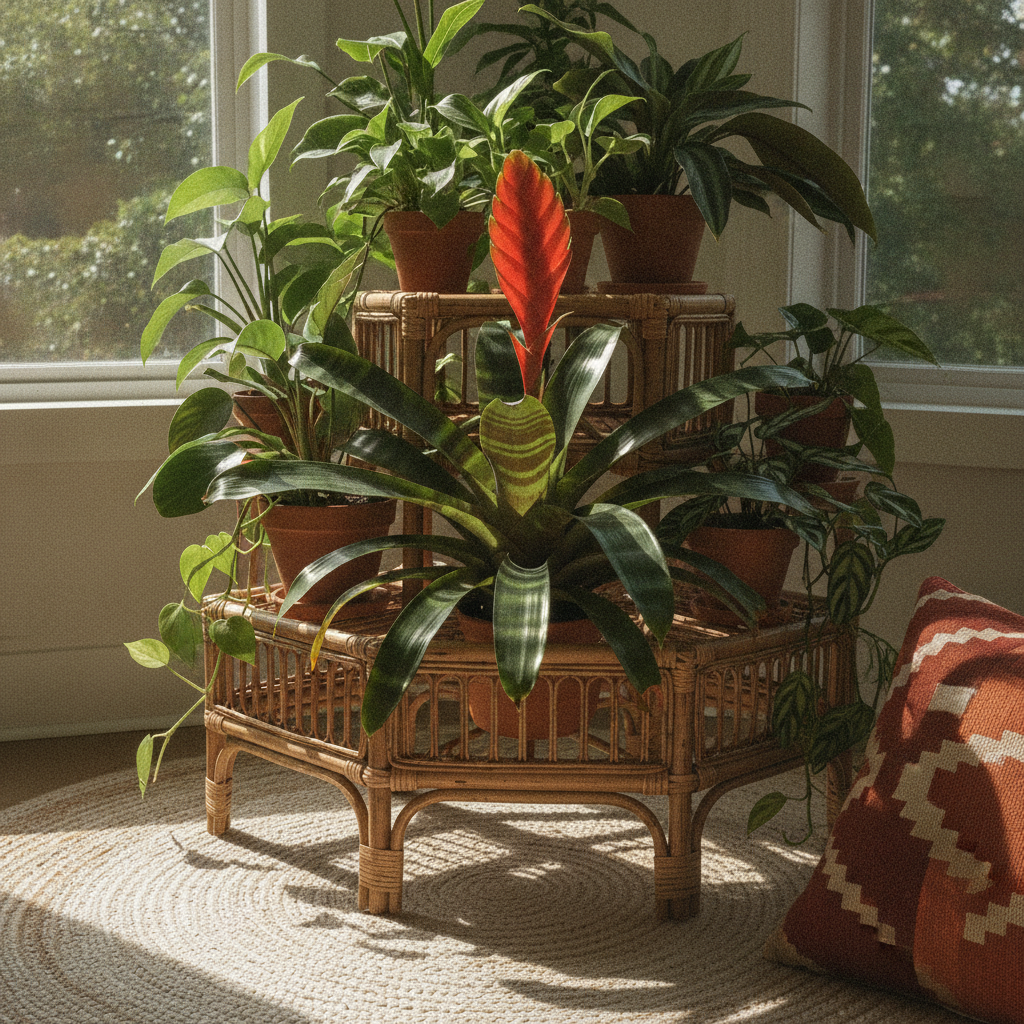
Few houseplants announce themselves as boldly as the Flaming Sword. Grown for decades as a living centrepiece, Vriesea splendens pairs a rosette of arching, zebra-banded leaves with a tall, flattened flower spike that glows a fierce red-orange, standing upright from the heart of the plant like a blade drawn from its scabbard. It belongs to the bromeliad family (Bromeliaceae) and hails from the humid lowland rainforests of eastern Venezuela, Trinidad, French Guiana and northern Brazil, where it grows as an epiphyte, perched on tree branches rather than rooted in the ground. The horizontal purple-brown cross-bands on its foliage have earned it the second common name of zebra bromeliad.
The Flaming Sword has a reputation for being fussy, but that reputation is largely undeserved. It is not difficult so much as different: it drinks from a central cup rather than through its roots, it resents ordinary potting soil, and each rosette flowers only once in its life before handing the baton to its offsets. Understand those three quirks and the plant is remarkably forgiving. This guide covers everything from reading its light needs to filling its tank correctly, feeding it without burning it, and raising the next generation from pups, so you can move beyond simply keeping a Flaming Sword alive to helping it genuinely thrive.
Contents
- Quick Reference
- Why Flaming Sword Makes a Striking Houseplant
- Light Requirements
- Watering & Humidity
- Soil, Potting & Repotting
- Fertilising
- Propagation
- Pests & Diseases
- Popular Varieties
- Frequently Asked Questions
Quick Reference: Flaming Sword at a Glance
| Light | Bright, indirect light; no direct midday sun |
| Watering | Keep the central cup topped up with clean water; keep the potting mix barely moist, never soggy |
| Temperature | 18 to 27°C (64 to 81°F); never below 13°C (55°F) |
| Humidity | High, ideally 60% or above |
| Fertiliser | Quarter-strength balanced feed, sparingly in spring and summer |
| Toxicity | Non-toxic to cats, dogs and humans |
Why Flaming Sword Makes a Striking Houseplant
The obvious draw is the flower. What looks like a single scarlet blade is in fact a flattened spike of tightly overlapping bracts, and it is these waxy bracts, not the small, short-lived yellow flowers peeping out between them, that supply the colour. Where most blooms fade within days, the sword of a Flaming Sword holds its intensity for two to four months, making it one of the longest-lasting displays you can bring indoors. Even out of flower, the foliage carries the plant: broad, smooth, strap-shaped leaves in deep green, ruled across with irregular bands of maroon and purple-brown that catch the light like watermarked silk.
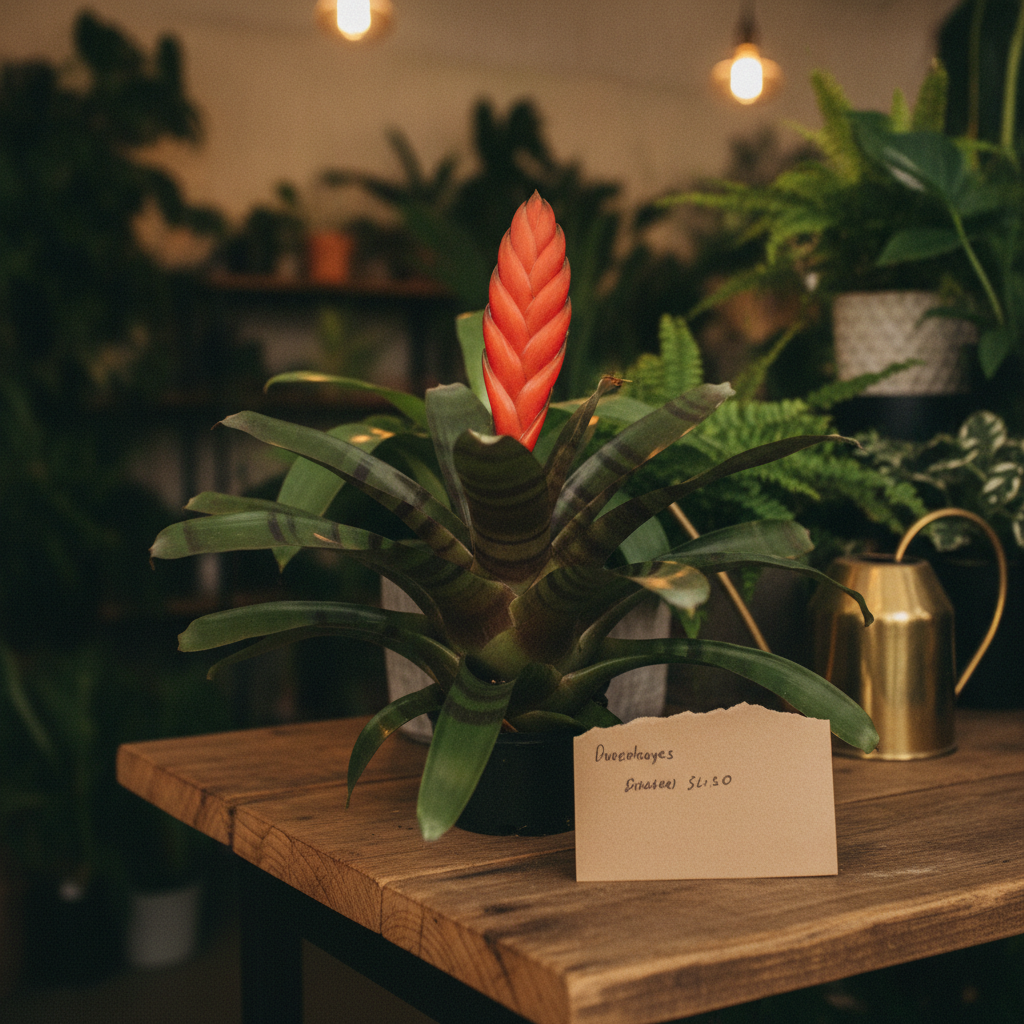
Beyond looks, the Flaming Sword suits modern homes because it stays compact, rarely exceeding 45 to 50cm (18 to 20in) across, and it copes with the medium light found several steps back from a window, where many flowering plants sulk. It is also refreshingly safe: unlike many dramatic tropicals, bromeliads carry no known toxins, so a curious cat or child brushing against the leaves is at no risk. The trade-off for all this is a short second act. Each rosette is monocarpic, meaning it flowers a single time and then declines slowly over the following year or two. That is not a failure of care; it is the plant’s natural life cycle, and it comes with a built-in reward in the form of pups.
Important — Toxicity: The Flaming Sword is considered non-toxic to cats, dogs and humans, and it does not appear on the ASPCA list of toxic plants. The leaf edges are smooth rather than spiny, so it is one of the safer statement plants for a home with pets or small children. As always, discourage nibbling, since any plant material can cause mild stomach upset if eaten in quantity.
Light Requirements
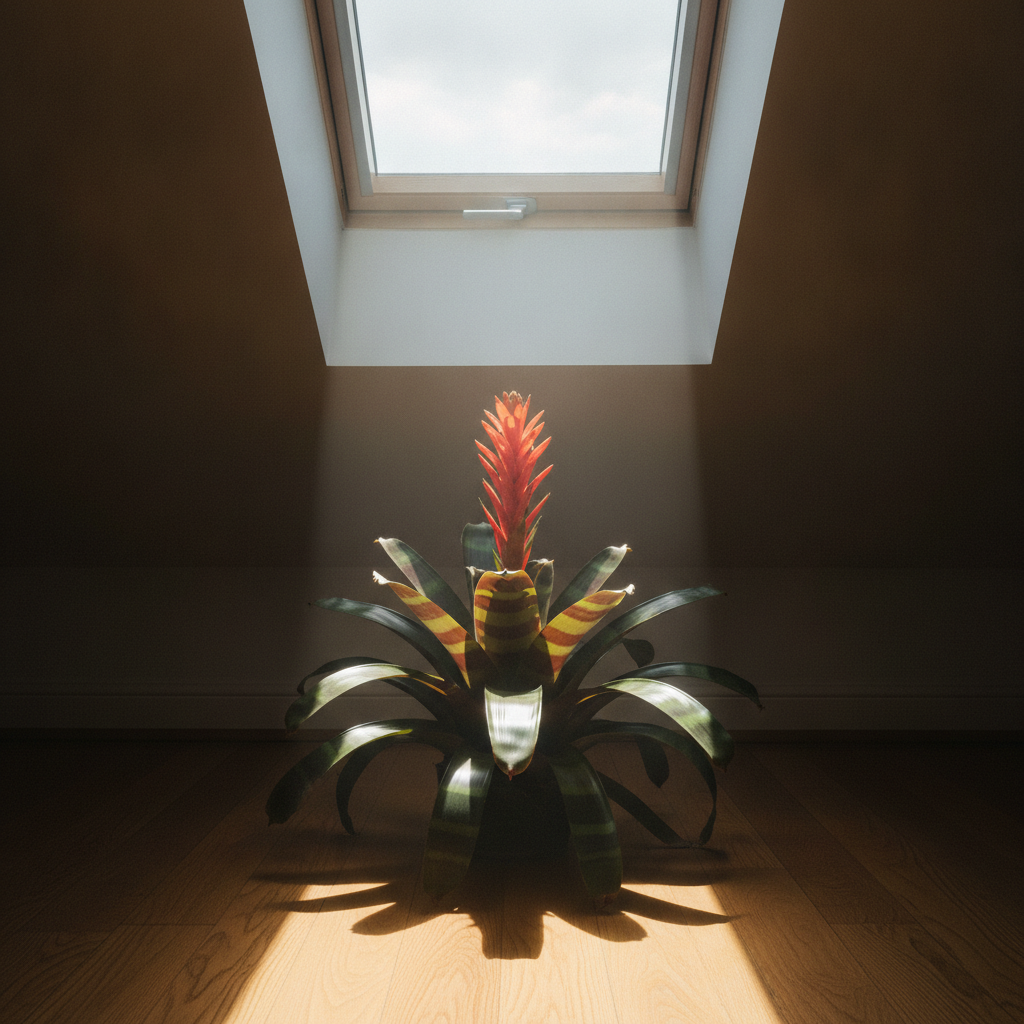
In the wild the Flaming Sword lives in the dappled understorey of the rainforest, clinging to branches where the canopy filters the sun into shifting patches of brightness. That origin is the key to lighting it indoors: it wants plenty of light, but almost never the raw, direct beam of the sun. Bright, indirect light is the sweet spot, the kind you find a metre or two back from an unobstructed window, or right beside a window screened by a sheer curtain.
Given the right level, the banding on the leaves stays crisp and high in contrast, the rosette holds its tidy vase shape, and a mature plant is far more likely to produce its coloured spike. Too little light and the leaves lengthen, thin out and lose their markings as the plant stretches toward the nearest source; a Flaming Sword that never colours up is very often simply a Flaming Sword kept too dark.
Light Levels Explained
Because light is measured in different ways, it helps to translate the categories most guides use into what they mean for this plant. The table below sets out the practical outcome you can expect from each level.
| Light Category | Approx. Level | Typical Location | Outcome |
|---|---|---|---|
| Direct sun | Over 50,000 lux | On a south-facing sill, unshaded | Leaves bleach and scorch; avoid |
| Bright indirect | 15,000 to 30,000 lux | Near an east or filtered south window | Ideal; strong banding, best chance of flowering |
| Medium | 8,000 to 15,000 lux | A metre or two into a bright room | Grows well, though flowering is less reliable |
| Low | 2,000 to 8,000 lux | Deep in a room or by a north window | Survives but stretches; banding fades |
| Very low | Under 2,000 lux | Interior corner, no natural light | Slow decline; not sustainable |
Window Orientation and Placement
South-facing window: The brightest aspect and potentially too strong. Set the plant back from the glass or diffuse the light with a sheer curtain so the midday sun never falls directly on the leaves.
East-facing window: Often the best choice. Gentle morning sun followed by bright ambient light for the rest of the day mirrors the plant’s natural rhythm closely.
West-facing window: Workable, but the harsher afternoon sun can be intense in summer, so a light curtain or a slight setback from the glass is wise.
North-facing window: The dimmest aspect. A Flaming Sword will hang on here but tends to grow leggy and pale, and it is unlikely to flower without supplementary light.
Pro Tip — Reading the Leaves: Let the plant tell you if the light is right. Tight, well-marked leaves held in a neat rosette mean it is happy. Long, floppy leaves that fade toward plain green are asking for more light, while any pale, bleached or scorched patches mean it is getting too much direct sun and should be moved back.
How Light Affects Leaf Colour and Flowering
The purple-brown banding that gives the zebra bromeliad its name is a light-dependent feature. In good bright light the pigment develops fully and the contrast is at its most dramatic; in shade the plant channels its energy into simply lengthening leaves to chase the light, and the markings wash out. Flowering, too, is closely tied to light. A rosette needs to reach maturity in bright conditions before it will bloom, and plants grown in dim rooms often reach old age without ever producing a spike.
Warning — Direct Sunlight: The smooth leaves of the Flaming Sword have little defence against strong direct sun, which can scorch them within a single afternoon. Sun damage shows as dry, bleached or brown patches that never recover, so introduce any plant moved to a brighter spot gradually over a week or two.
Artificial Lighting
Flaming Swords respond well to a full-spectrum LED grow light, which is a useful way to keep the banding strong and encourage flowering in a room that lacks a good window. Position the light 30 to 45cm (12 to 18in) above the rosette and run it for around 12 hours a day. Because the plant does not need intense light, a modest fixture is usually plenty, and it can be paired with natural light rather than replacing it entirely.
Seasonal Adjustments
As the days shorten through autumn and winter, light levels indoors can drop sharply, so it is worth moving the plant closer to the window for the darker months and then easing it back again in spring. A location that is perfect in June may be too dim in December, and a plant that loses its markings over winter will usually regain them once the light returns.
Watering & Humidity
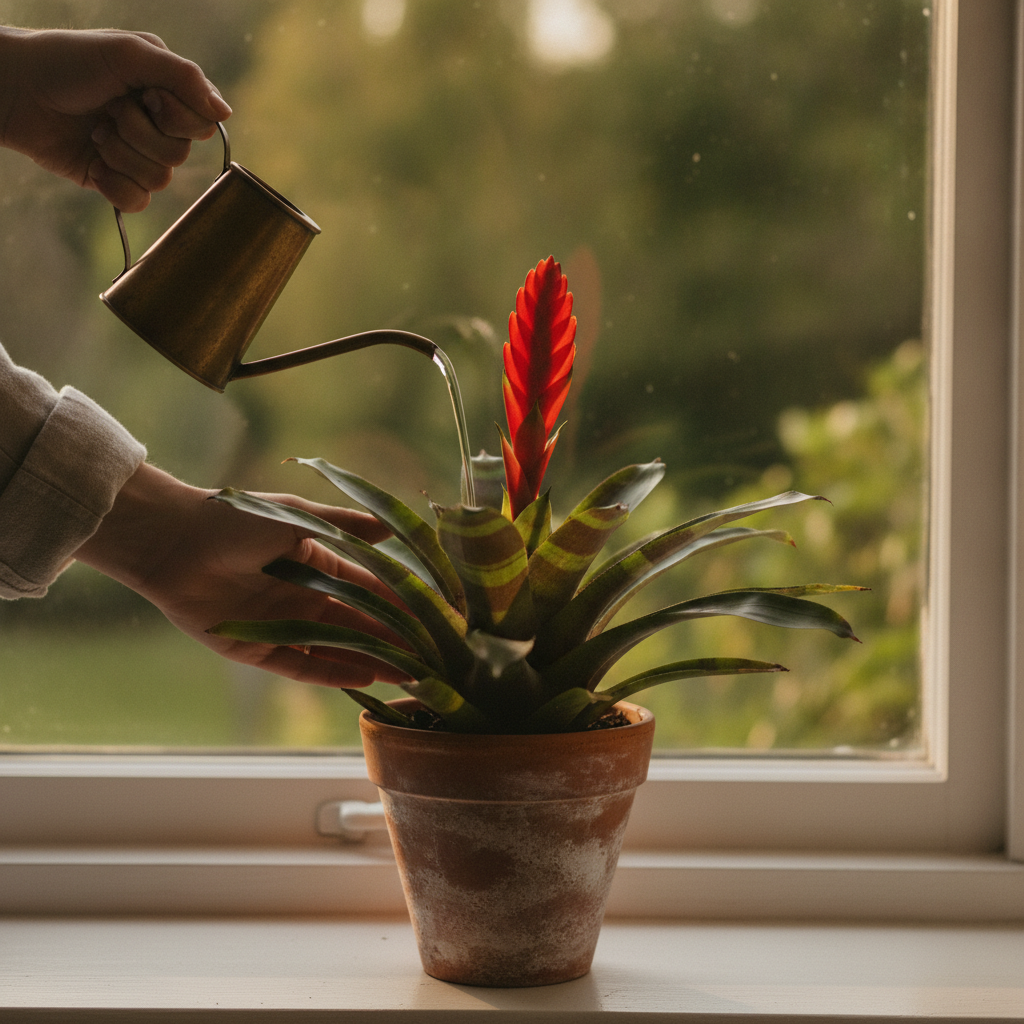
Watering is where the Flaming Sword parts company with almost every other houseplant, and where most people go wrong. As an epiphyte, it takes up the majority of its moisture not through its roots but through the central rosette, the overlapping leaf bases that form a watertight cup or tank at the heart of the plant. In the wild this reservoir catches rain and forest debris. Indoors, your job is to keep that cup topped up while keeping the potting mix on the dry side, the reverse of how you would treat most plants.
When to Water
Aim to keep the central cup about a quarter to halfway full with clean water at all times, checking it every few days. Because standing water can turn stagnant, empty and refresh it roughly once a week to keep it sweet, and be especially diligent about this in warm weather. The potting mix around the roots should be allowed to dry out most of the way between waterings; a light watering of the mix every one to two weeks is usually enough to keep the roots from desiccating.
The single most important rule is water quality. The Flaming Sword is sensitive to the minerals and chlorine in hard tap water, which build up in the sensitive tank and can mark or rot the leaf bases. Rainwater, distilled water or filtered water is far kinder, particularly for the central cup. If you can only use tap water, let it stand overnight so some of the chlorine can dissipate first.
Pro Tip — Flush the Tank: Every couple of weeks, tip the plant gently on its side to drain the old water from the cup, then refill it with fresh. This flushing prevents mineral salts and decaying matter from accumulating in the rosette, which is the most common cause of a foul smell or of the central leaves loosening and rotting.
How to Water Correctly
- Use clean, room-temperature rainwater, distilled or filtered water wherever possible.
- Pour water slowly into the central cup until it is a quarter to halfway full, taking care not to overflow it onto the surrounding mix.
- Once every week or two, drain the old water from the cup entirely and replace it with fresh to keep it from going stagnant.
- Separately, give the potting mix a light drink only when it has dried out most of the way, letting any excess run out of the drainage holes.
- In winter, reduce the frequency of watering the mix but keep a little water in the cup unless the room is cold, in which case keep the cup nearly empty to avoid rot.
Signs of Overwatering vs. Underwatering
| Symptom | Overwatering | Underwatering |
|---|---|---|
| Leaf colour | Yellowing, especially at the base | Dull, greyish or browning tips |
| Leaf texture | Soft, mushy leaf bases | Thin, curling or crispy leaves |
| Central cup | Stagnant, smelly water | Dry and empty for long spells |
| Roots | Blackened, slimy, foul-smelling | Dry, brittle and shrunken |
| Stem base | Rosette loosens and pulls away | Firm but dehydrated |
Warning — Root and Crown Rot: Soggy potting mix is deadly for an epiphyte adapted to airy tree bark. If the roots sit wet, they suffocate and rot, and the decay can spread up into the crown until the whole rosette collapses. Always err on the dry side with the soil, keep the moisture in the cup instead, and make sure the pot drains freely.
Humidity Requirements
Coming from tropical rainforest, the Flaming Sword loves humid air and is happiest at 60 per cent relative humidity or above. In a typical centrally heated home the air is often much drier than this, especially in winter, and the plant will let you know it is unhappy through its leaves.
The classic symptom of low humidity is browning, crispy leaf tips, sometimes accompanied by a general dullness to the foliage. These signs are easy to confuse with underwatering, so check the air as well as the cup before adjusting your routine.
Raising humidity is straightforward: group the plant with other tropicals so they share moisture, stand the pot on a tray of damp pebbles kept just below the base, mist the foliage a few times a week with soft water, or run a small humidifier nearby. A bright bathroom or kitchen, where humidity naturally runs higher, can be an ideal home for a Flaming Sword.
Water Quality
It is worth stressing again that this plant is fussier about what it drinks than how often. Fluoride, chlorine and dissolved minerals from hard tap water accumulate in the central tank and can cause brown spotting and leaf-base decay over time. Rainwater is the gold standard, distilled and filtered water are excellent alternatives, and softened water should be avoided altogether because of its high salt content.
Soil, Potting & Repotting
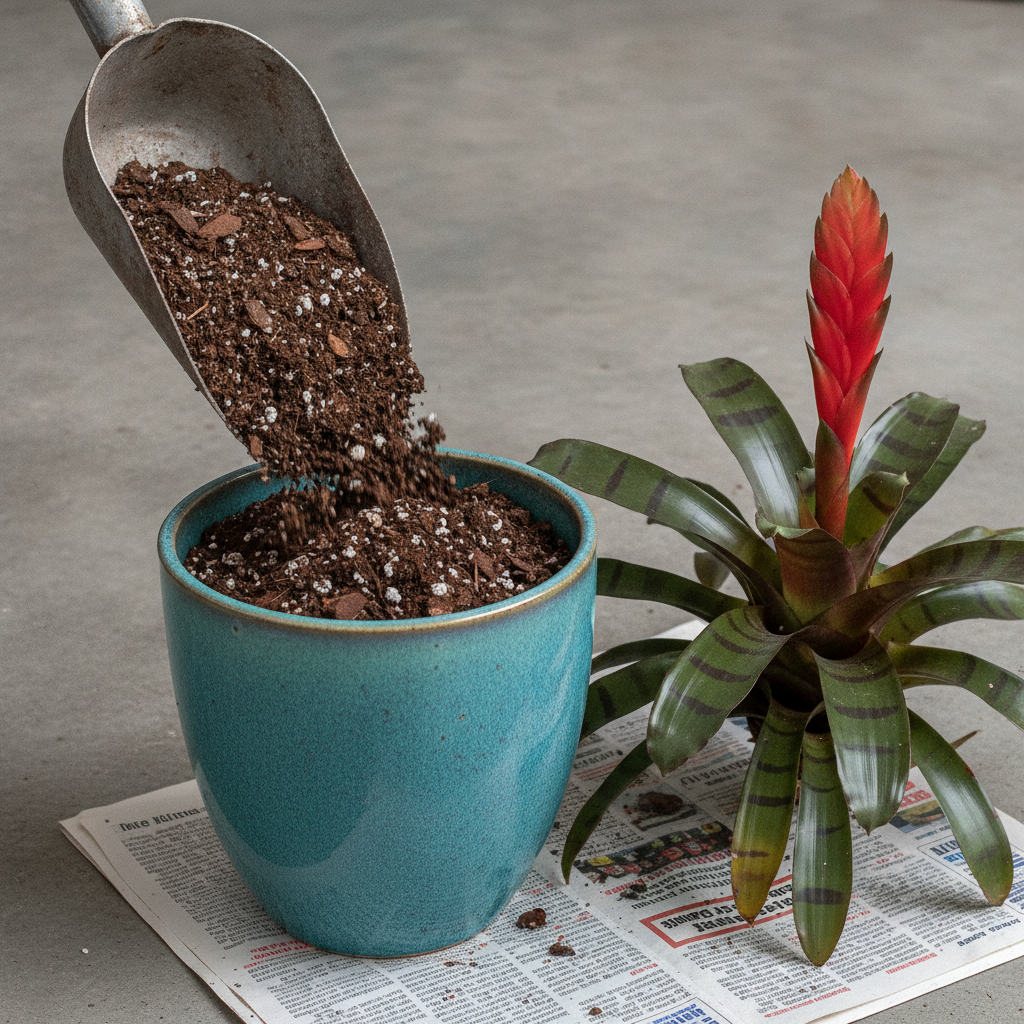
Because a Flaming Sword’s roots exist mainly to anchor it to a tree rather than to mine the ground for water, they demand an open, fast-draining medium and rot quickly in dense, water-retentive soil. Ordinary houseplant compost, used straight from the bag, holds far too much moisture around these delicate roots and is the fastest route to a failed plant.
Ideal Soil Composition
The goal is a mix that holds a little moisture but drains almost instantly and stays full of air pockets. A blend built around orchid bark works beautifully, loosened with perlite for drainage and a modest amount of coco coir or peat to hold just enough moisture. Many growers simply use a bagged orchid or bromeliad mix, which is formulated for exactly these conditions.
| Component | Proportion | Function |
|---|---|---|
| Orchid bark (fine to medium) | 50% | Provides structure and large air pockets, mimicking tree bark |
| Perlite or pumice | 30% | Guarantees sharp drainage and stops compaction |
| Coco coir or peat | 20% | Holds a little moisture and lends light body to the mix |
The Flaming Sword prefers a slightly acidic root zone, roughly pH 5.0 to 6.0, which the bark and coir in this blend naturally provide. There is no need to test or adjust the pH in practice; simply avoid adding lime or alkaline materials to the mix.
Pro Tip — Quick Mix Recipe: For an easy, reliable blend, combine two handfuls of orchid bark, one handful of perlite and one handful of coco coir. If you would rather not mix your own, a bagged orchid or bromeliad mix used straight from the packet is an excellent shortcut.
Choosing the Right Pot
Flaming Swords have small, shallow root systems and are naturally top-heavy once the spike appears, so pot choice is about stability and drainage as much as size. A pot that is a little heavy at the base helps counter the weight of the inflorescence.
Drainage holes are non-negotiable. Whatever pot you choose must have open drainage holes so water can never pool at the roots. A decorative cover pot is fine, but lift the plant out to water the mix, or tip out any water that collects in the bottom.
Pot material: Terracotta is a safe, breathable choice that wicks away excess moisture and adds ballast, though plastic and glazed ceramic work equally well provided the mix drains freely. A slightly wider, shallower pot suits the shallow roots better than a tall, narrow one.
Pot size: Keep the plant snug rather than generous. A pot only just large enough to hold the root ball is ideal, because a large volume of mix stays wet for too long and invites rot. Most Flaming Swords are happy in a 12 to 15cm (5 to 6in) pot for their whole life.
When to Repot
The good news is that Flaming Swords rarely need repotting. Their slow-growing roots seldom outgrow their container, and because each rosette lives only a few years, most plants stay in their original pot until they flower and decline. The main reasons to repot are to refresh tired, broken-down mix, or to move a nursery plant out of dense soil into a proper bark-based blend. When you do repot, do so in spring and disturb the roots as little as possible.
How to Repot: Step-by-Step
- Water the plant lightly a day ahead so the root ball holds together and slides out cleanly.
- Ease the plant from its pot, supporting the rosette from below rather than pulling on the leaves.
- Gently tease away the old, spent mix, keeping as many healthy anchoring roots intact as you can.
- Part-fill a clean pot only slightly larger than the last with fresh bark-based mix.
- Set the plant at the same depth it grew before, never burying the base of the rosette, and firm the mix lightly around the roots.
- Fill the central cup with clean water and keep the plant in bright, indirect light while it settles.
Warning — Transplant Shock: Never plant the rosette too deep. Burying the base of the leaves in damp mix is a common mistake that traps moisture against the crown and causes it to rot. The plant should sit so that the leaf bases are just at the surface, with the mix supporting the roots below.
Fertilising
Flaming Swords are among the lightest feeders in the houseplant world. In the rainforest they scrape a living from rain, dust and the slow breakdown of leaf litter, so they are adapted to very lean conditions and are easily harmed by too much fertiliser. When it comes to feeding this plant, less is genuinely more.
A dilute, balanced feed given occasionally through the growing season is all it needs, and many people grow a Flaming Sword to full flower having barely fed it at all. Overfeeding does far more damage than underfeeding, scorching the sensitive roots and marking the leaves.
Understanding Plant Nutrients
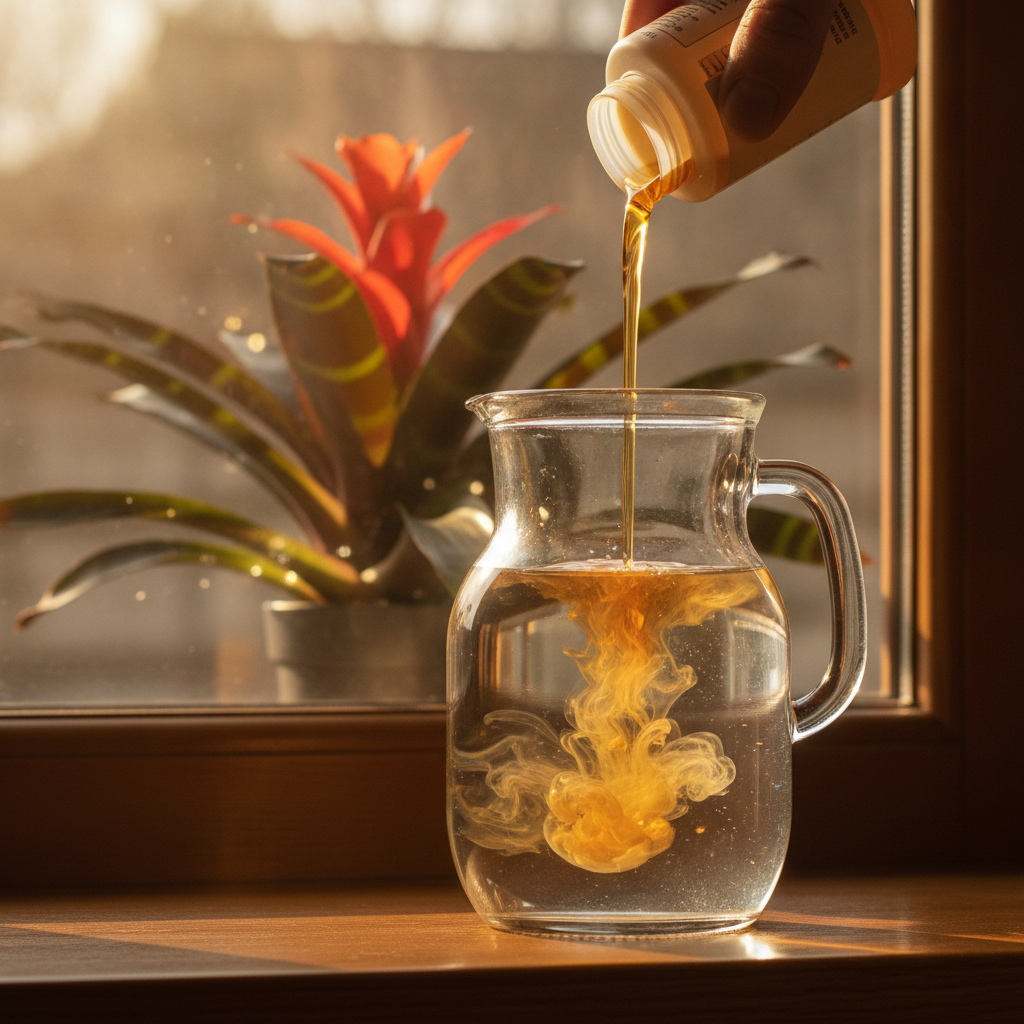
Fertilisers are labelled with an NPK ratio, standing for nitrogen, phosphorus and potassium, the three nutrients plants use in the largest amounts. A balanced formula supplies these in roughly equal measure, alongside smaller quantities of secondary nutrients and trace elements. Understanding what each does helps you read the plant’s signals.
| Nutrient | Symbol | Primary Function | Deficiency Symptoms |
|---|---|---|---|
| Nitrogen | N | Leaf growth and green colour | Pale, slow-growing foliage |
| Phosphorus | P | Roots and flower development | Weak roots, poor flowering |
| Potassium | K | Overall vigour and stress resistance | Yellowing leaf margins, brown edges |
| Calcium | Ca | Cell wall strength | Distorted new growth |
| Magnesium | Mg | Core of the chlorophyll molecule | Yellowing between leaf veins |
| Iron | Fe | Chlorophyll production | Pale new leaves with green veins |
Types of Fertiliser
Liquid fertilisers: The easiest option for a Flaming Sword, because you can dilute them precisely. A balanced houseplant feed diluted to a quarter of its recommended strength, applied to the mix or misted lightly onto the leaves, gives you full control over the dose.
Slow-release granular: Less suitable here. Granules release nutrients steadily regardless of the plant’s needs, which risks overfeeding such a lean grower, so they are best avoided or used at half the stated rate at most.
Organic fertilisers: Options such as a very dilute seaweed or worm-casting tea are gentle and forgiving, releasing nutrients slowly in a form the plant handles well, and they carry little risk of burning the roots.
Feeding Schedule
Feed only during the active growing season of spring and summer, and even then no more than once a month. Through autumn and winter, when growth slows right down, stop feeding altogether. A single monthly dose of quarter-strength balanced feed from roughly April to September is a sensible rhythm for most homes.
Pro Tip — Feed the Leaves, Not the Cup: Apply diluted fertiliser to the potting mix or as a light foliar mist rather than pouring it into the central tank. Concentrated feed sitting in the cup can burn the tender leaf bases, so keep the tank for clean water only.
How to Fertilise
- Mix a balanced liquid houseplant feed at a quarter of the recommended strength.
- Make sure the potting mix is already slightly moist, never bone dry, before you apply it.
- Pour the diluted feed onto the mix, or mist it lightly over the foliage, avoiding the central cup.
- Apply no more than once a month, and only during spring and summer.
- Every few weeks, water with plain clean water to flush any accumulated salts from the mix.
Warning — Salt Build-Up: Fertiliser salts accumulate in the mix over time and show up as browning leaf tips and a white crust on the surface or pot rim. Flush the mix thoroughly with clean water every month or two to wash these salts away and keep the roots healthy.
Propagation
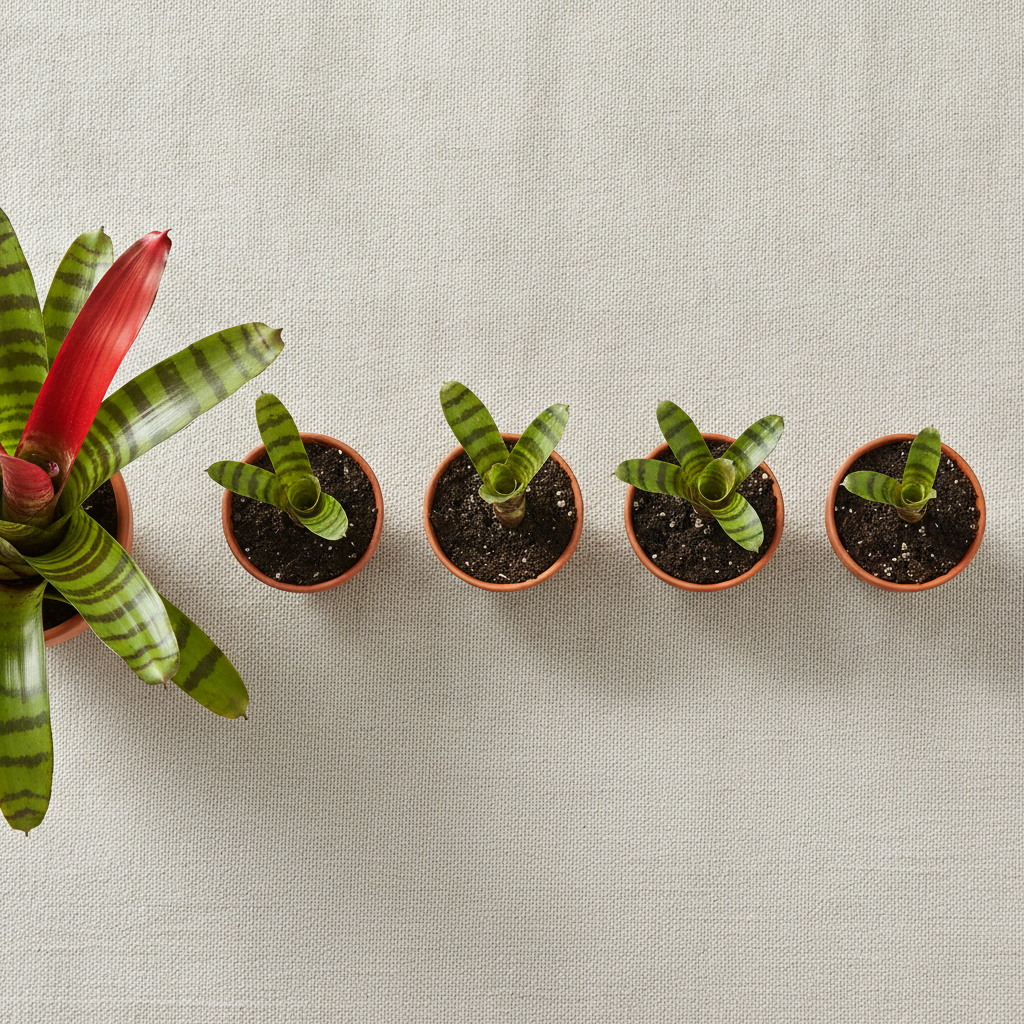
Propagation is not just possible with the Flaming Sword, it is essential if you want to keep the plant going, because the original rosette dies after flowering. The consolation is that just as the parent begins to fade, it produces offsets, known as pups, around its base, and each of these can grow into a full new plant that will in time flower in its own right.
Unlike many houseplants, a Flaming Sword cannot be grown from a leaf or stem cutting; the only reliable home method is separating these pups. It is an easy and rewarding process, and a single parent plant will often reward you with two or three offspring, effectively giving you a rolling supply of plants for years to come.
Understanding Pups and the Life Cycle
The life of a Flaming Sword follows a set arc. A rosette grows for several years, flowers once in a blaze of colour, and then, over the following year or two, slowly declines. During that decline it directs its remaining energy into producing pups at its base, small replicas of itself that draw on the parent until they are large enough to fend for themselves. Recognising this cycle takes the alarm out of watching the parent fade, since it is simply nature passing the torch.
Separating Pups: Step-by-Step
Wait until a pup is at least a third to a half the size of the parent and, ideally, has begun to form its own small roots. Separating a pup too early, before it can support itself, is the most common reason offsets fail.
- Choose a pup that is roughly one third to one half the size of the parent, with a few roots of its own if possible.
- Ease the whole plant out of its pot so you can see where the pup joins the parent.
- Using a clean, sharp knife, cut the pup away from the parent, keeping any roots it has already made.
- Let the cut surface dry and callus for a few hours to reduce the risk of rot.
- Pot the pup into a small container of moist, bark-based mix, planting it just deep enough to stand upright.
- Keep it warm, bright and humid, and support it by keeping a little water in its small central cup as it establishes.
Pro Tip — Patience Pays: There is no rush to separate pups. If you prefer, leave them attached and let the parent slowly die back around them, so the pups grow on undisturbed in the same pot. Removing the spent parent later gives you well-established young plants with minimal risk.
Growing On from Seed: Step-by-Step
Raising a Flaming Sword from seed is possible but slow and rarely worthwhile at home, since it can take four years or more to reach flowering size. It is included here mainly for the curious and for those hoping to cross varieties.
- Sow fresh seed on the surface of a fine, moist, sterile mix, since these seeds need light to germinate.
- Cover the container to hold in high humidity and keep it warm, around 24 to 27°C (75 to 81°F).
- Keep the surface lightly moist with soft water and be prepared to wait several weeks for germination.
- Grow the tiny seedlings on slowly, potting them up as they enlarge, and expect a long wait for the first flower.
Troubleshooting Propagation
| Problem | Likely Cause | Solution |
|---|---|---|
| Pup rots after separation | Cut removed too early or potted too wet | Wait until pups are larger and rooted; let the cut callus and use an airy mix |
| Pup fails to grow | Too little light or warmth | Move to a warm, bright spot and keep humidity high |
| Parent produces no pups | Plant has not yet flowered or is stressed | Be patient after flowering; keep care consistent |
| Pup wilts and dehydrates | Rootless offset cannot yet drink | Keep the small cup topped up and the air humid until roots form |
Pests & Diseases
The Flaming Sword is a fairly resilient plant, and most of the trouble it runs into is cultural rather than pest-driven, tracing back to overwatering or dry air. Even so, a few sap-sucking insects find their way onto bromeliads, and the warm, moist conditions the plant enjoys can occasionally favour fungal problems.
The best defence is vigilance. Check the plant over whenever you refresh the cup, paying attention to the leaf axils and undersides where pests like to hide, and act at the first sign of trouble while an infestation is still small and easy to clear.
Common Pests
Scale (Coccidae)
Scale are the most frequent pest of bromeliads, appearing as small, flat brown or tan discs stuck firmly to the leaves, often along the midrib and undersides. They suck sap and excrete sticky honeydew, which can lead to sooty mould. Heavy infestations sap the plant’s vigour and cause yellowing.
Treatment: Scrape or wipe the scales off with a cloth or a cotton bud dipped in diluted isopropyl alcohol, then treat the plant with horticultural or neem oil to catch the mobile young. Repeat every week or two until no new scales appear.
Mealybugs (Pseudococcidae)
Mealybugs look like tiny tufts of white cotton wool tucked into the leaf axils and the sheltered heart of the rosette. Like scale they feed on sap and produce honeydew, and they multiply quickly in the warm, humid conditions the plant prefers.
Treatment: Dab each cluster with a cotton bud soaked in diluted isopropyl alcohol to kill them on contact, then follow up with neem oil. Check the leaf bases carefully, as mealybugs hide deep in the rosette where they are easily missed.
Spider mites (Tetranychus urticae)
Spider mites are most likely when the air is too dry, the opposite of the plant’s preferred conditions. They are almost too small to see, but they leave fine speckling on the leaves and delicate webbing in the axils, and heavy feeding gives the foliage a dull, dusty look.
Treatment: Raise the humidity, which mites hate, and rinse the foliage thoroughly. Treat with neem oil or an insecticidal soap, repeating every few days, and keeping the plant well away from dry heat sources.
Common Diseases
Crown and root rot (Phytophthora and Pythium)
By far the most serious threat to a Flaming Sword, rot sets in when the mix stays waterlogged or when stagnant water is allowed to sit against the base of the crown. The leaf bases turn soft, brown and foul-smelling, and the central rosette can eventually pull free of the roots entirely.
Treatment: Rot is far easier to prevent than to cure. Keep the mix on the dry side, flush the cup regularly, and ensure free drainage. Once the crown has collapsed the parent cannot be saved, but any healthy pups can often be rescued and grown on.
Fungal leaf spot (various fungi)
Brown or black spots with yellow haloes can appear on the leaves in overly wet, stagnant conditions, especially where air movement is poor. The spots may spread and merge if the underlying dampness is not addressed.
Treatment: Remove the affected leaves with a clean blade, improve air circulation around the plant, and avoid wetting the foliage late in the day. A copper-based fungicide can help in stubborn cases.
Pest and Disease Summary
| Pest / Disease | Identification | Treatment |
|---|---|---|
| Scale | Flat brown discs on leaves; sticky honeydew | Wipe off, treat with neem or horticultural oil |
| Mealybugs | White cottony tufts in leaf axils | Dab with alcohol, follow with neem oil |
| Spider mites | Fine speckling and webbing in dry air | Raise humidity, rinse, treat with neem or soap |
| Crown and root rot | Soft, brown, smelly leaf bases | Prevent through dry mix and drainage; rescue pups |
| Fungal leaf spot | Brown or black spots with yellow haloes | Remove leaves, improve airflow, use fungicide |
Prevention Strategies
Prevention comes down to getting the basics right. A Flaming Sword grown in an airy mix, watered through its cup with clean water, given bright indirect light and reasonable air movement is rarely troubled by anything, because a plant kept in the conditions it wants has the vigour to shrug off minor problems.
Quarantine any new plant for a couple of weeks before introducing it to your collection, inspect your Flaming Sword whenever you refresh its water, and wipe the leaves occasionally to keep them clean and let you spot early signs of trouble. These small habits prevent the great majority of pest and disease outbreaks.
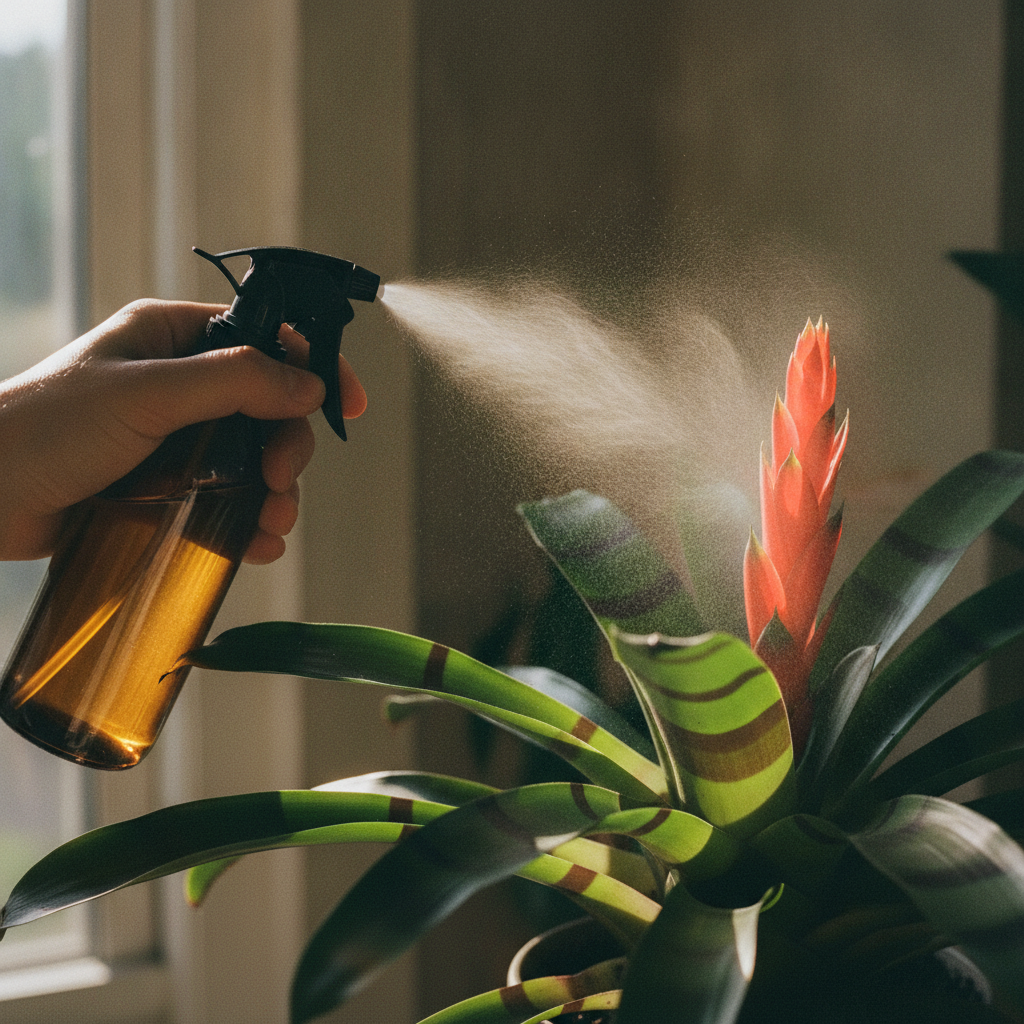
Pro Tip — Neem as First Response: Keep a bottle of neem oil to hand. Diluted according to the label and misted over the foliage in the evening, out of direct sun, it deals gently with scale, mealybugs and mites alike and doubles as a preventative when used every few weeks.
Popular Varieties
The name Flaming Sword is used both for the species Vriesea splendens itself and, loosely, for a wider group of sword-flowered vrieseas and their hybrids. The species remains the classic, prized for its bold zebra banding and single scarlet blade, but breeders have produced a range of selections and crosses that vary the leaf pattern, the colour of the spike and its shape.
When choosing, it helps to know whether you are after the strongly banded foliage of the true species or the branched, multi-coloured inflorescences of some hybrids, which trade a little of the zebra pattern for a showier flower. The table and profiles below cover the varieties you are most likely to meet.
| Variety | Leaf Appearance | Light Needs | Growth Rate | Availability |
|---|---|---|---|---|
| Vriesea splendens (species) | Bold dark cross-banding | Bright indirect | Slow | Common |
| V. splendens ‘Major’ | Larger, strongly banded | Bright indirect | Slow | Common |
| V. ‘Fireworks’ | Plain green leaves | Bright indirect | Slow | Occasional |
| V. ‘Christiane’ | Green, lightly marked | Bright indirect | Slow | Occasional |
| V. ‘Vulkana’ | Faint banding | Bright indirect | Slow | Occasional |
| V. ‘Era’ | Green, glossy | Bright indirect | Slow | Specialist |
Featured Varieties
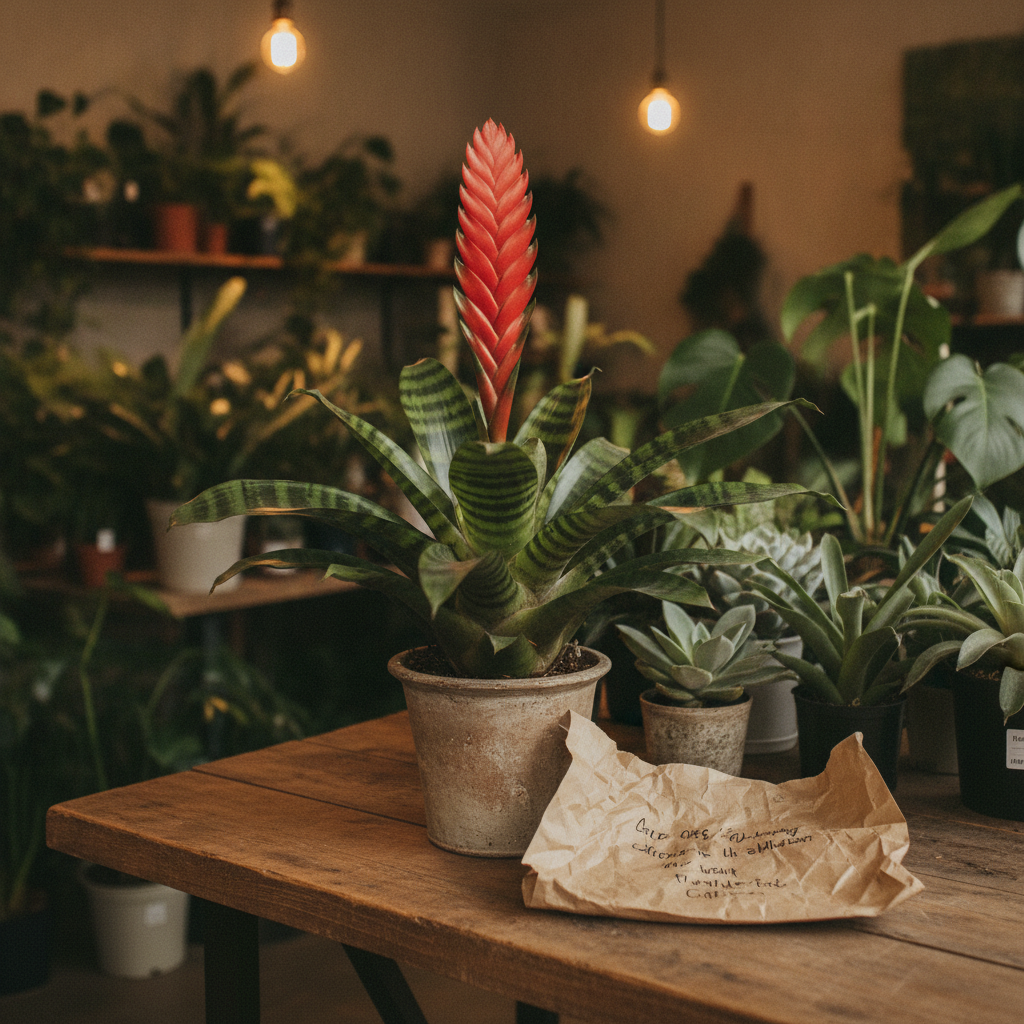
Vriesea splendens ‘Major’
A larger, more robust selection of the true species, ‘Major’ shows the boldest, most sharply contrasted banding of all, topped by a single tall, paddle-shaped sword in vivid scarlet. It is the variety most people picture when they think of a Flaming Sword.
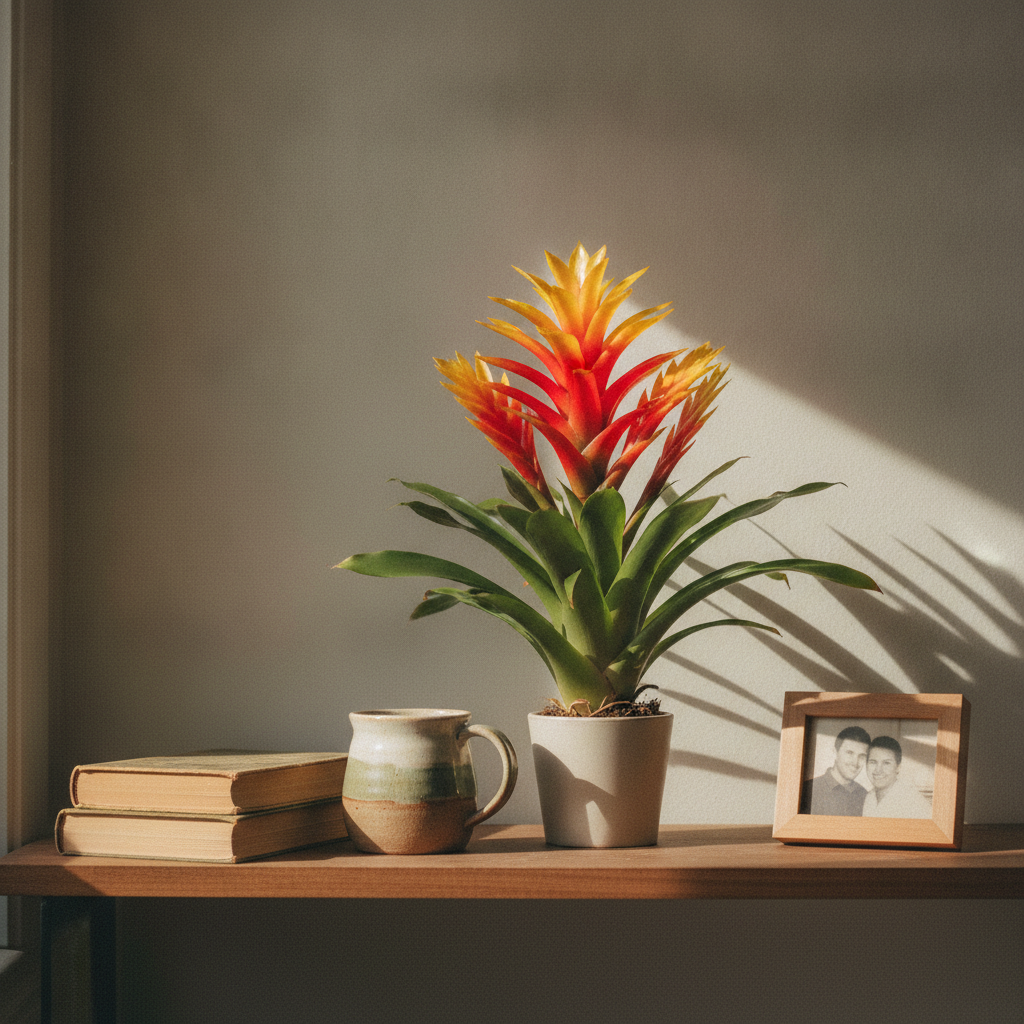
Vriesea ‘Fireworks’
A hybrid grown for its inflorescence rather than its foliage, ‘Fireworks’ carries a branched, multi-spike flower head, each arm red at the base and fading to golden-yellow at the tip, giving the effect of a burst of fireworks above plainer green leaves.
Variety Profiles in Detail
Vriesea splendens (Vriesea splendens)
The original zebra bromeliad and the benchmark against which the others are judged. Its dark green leaves are ruled with irregular purple-brown bands, and a mature rosette throws up a single flattened blade of overlapping red bracts that can stand well above the foliage. It is the most widely sold form and an excellent first bromeliad.
Vriesea ‘Christiane’ (Vriesea hybrid)
A softer, more compact hybrid with lightly marked green foliage and a slender red spike. It tends to stay a little smaller than the species, which makes it a good choice for a windowsill or a smaller space, though its banding is far less pronounced.
Vriesea ‘Vulkana’ (Vriesea hybrid)
Grown mainly for a deep, fiery red inflorescence, ‘Vulkana’ carries only faint banding on its leaves and puts its energy into the flower. It is a good pick if the sword itself, rather than the zebra foliage, is what draws you to the plant.
Choosing the Right Variety for Your Space
If it is the striking banded foliage you love, choose the true species or ‘Major’, which show the pattern at its best and look handsome even out of flower. If you are captivated instead by the flower, a hybrid such as ‘Fireworks’ or ‘Vulkana’ offers a bigger, more colourful spike at the cost of some leaf pattern. Whichever you pick, the care is identical, so let looks and the space you have available be your guide.
Frequently Asked Questions
Why is my Flaming Sword’s red flower turning brown?
This is almost always natural. The coloured sword lasts two to four months, but it does eventually fade and brown as it ages, which is the normal end of the flowering cycle. Once the spike is spent you can trim it off at the base. Its fading is also the signal that the plant will now begin producing pups.
Is the Flaming Sword safe for cats and dogs?
Yes. Bromeliads, including the Flaming Sword, are considered non-toxic to cats, dogs and humans, and the plant does not appear on the ASPCA list of toxic species. Its smooth, spineless leaves also make it physically safe around pets, though it is still best to discourage any nibbling.
Should I keep water in the central cup all the time?
Generally yes, keeping it a quarter to halfway full with clean water, but refresh it about once a week so it does not go stagnant. The main exception is in cold conditions, when standing water in the cup can encourage rot, so in an unheated or chilly room it is safer to keep the cup nearly empty.
My Flaming Sword is dying after flowering. Did I do something wrong?
Almost certainly not. Each rosette flowers only once and then naturally declines over the following year or two, regardless of how well it is cared for. This is the plant’s normal life cycle. Look for pups forming at the base and grow those on to continue the plant.
How can I get my Flaming Sword to flower?
The plant must first reach maturity in bright, indirect light, which is the single biggest factor. If a mature, well-grown plant still refuses to bloom, growers sometimes trigger flowering by sealing it in a clear bag with a ripe apple for a week or so; the ethylene gas the apple releases can prompt the plant to produce its spike.
Why are the leaf tips turning brown?
Brown, crispy leaf tips usually point to air that is too dry or to a build-up of minerals from hard tap water. Raise the humidity around the plant and switch to rainwater, distilled or filtered water, particularly in the central cup, and new growth should come through clean.
When and how do I separate the pups?
Wait until each pup is at least a third to a half the size of the parent and has ideally formed a few roots of its own. Cut it away with a clean, sharp knife, let the cut callus for a few hours, and pot it into a small container of airy, bark-based mix. Keep it warm, bright and humid while it establishes.
What kind of soil does a Flaming Sword need?
An open, fast-draining, bark-based mix rather than ordinary potting compost. A blend of orchid bark, perlite and a little coco coir works well, as does a bagged orchid or bromeliad mix. The key is that the roots, adapted to life on tree bark, must never sit in dense, waterlogged soil.
How big does a Flaming Sword get?
It stays compact, with the rosette reaching around 40 to 50cm (16 to 20in) across. The flower spike adds considerable height, standing up to 45 to 60cm (18 to 24in) above the leaves, so a flowering plant is taller than it is wide but still comfortably suited to a tabletop or shelf.






