
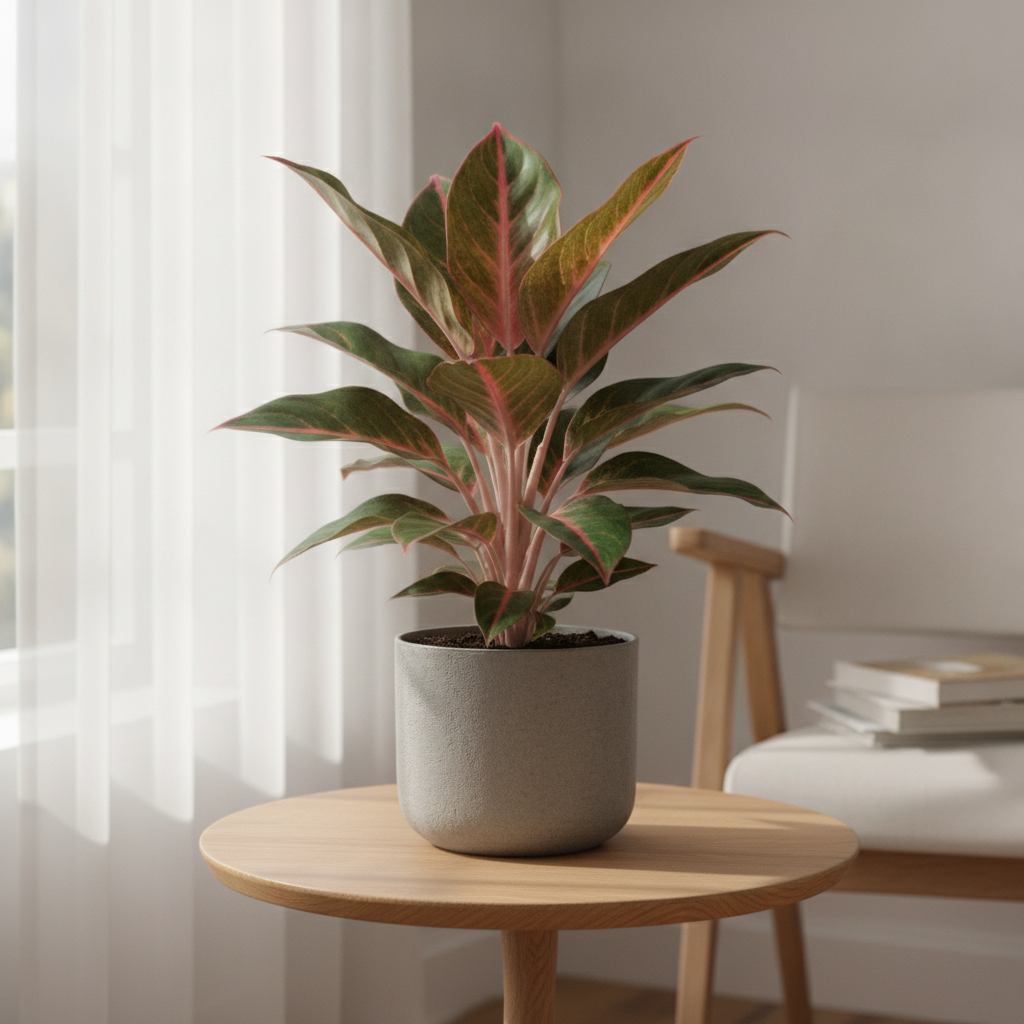
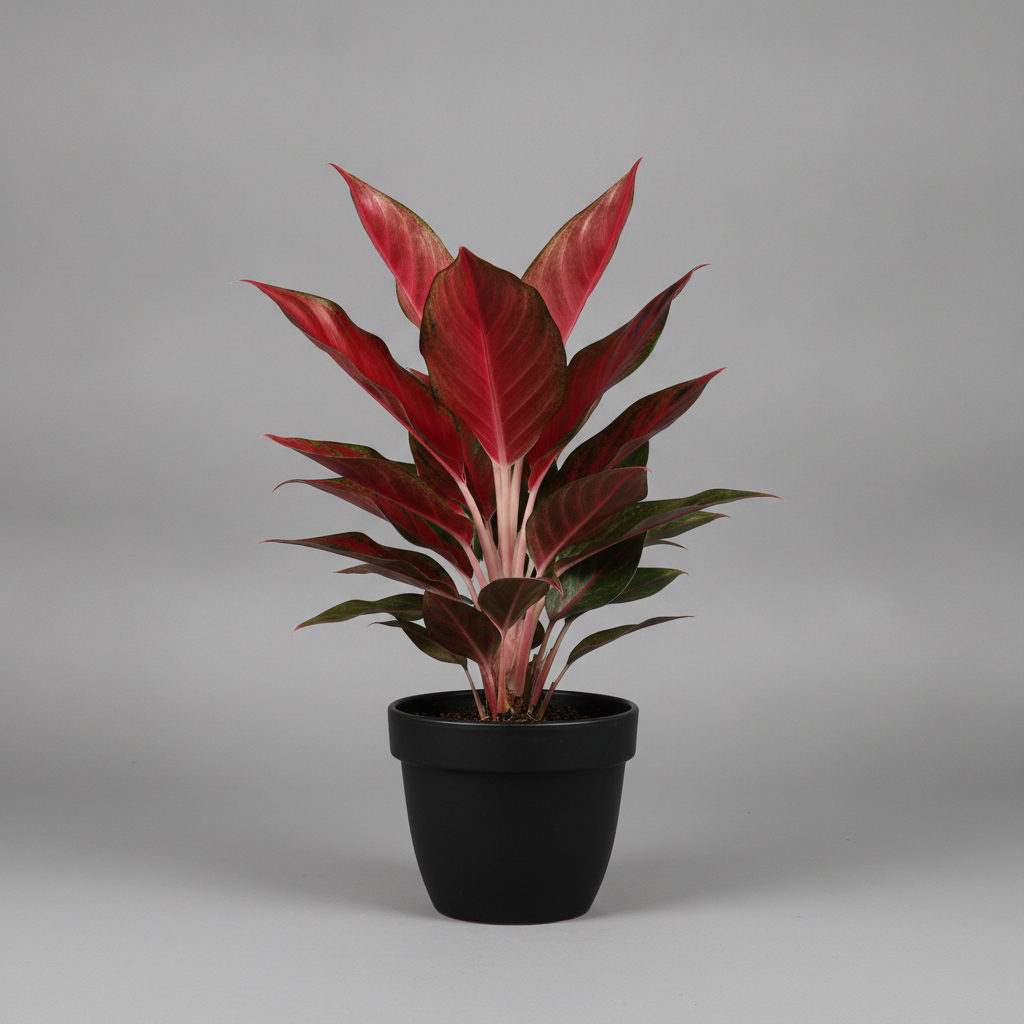
Few houseplants manage to look this dramatic while asking for so little. The Siam Aurora Aglaonema (Aglaonema ‘Siam Aurora’) carries broad, leathery green leaves edged and veined in vivid pink and red, a colour scheme that reads as tropical extravagance yet belongs to one of the most forgiving indoor plants you can own. Bred in Thailand from the wider Chinese evergreen group, it was selected precisely for this trait: rich pigment that holds up in the moderate light of an ordinary living room. Sometimes sold as Red Aglaonema, Red Siam or Red Chinese Evergreen, it has become a staple of shopping-centre planters and windowsill collections alike because it tolerates conditions that would sulk or collapse a fussier plant.
This guide covers everything that separates a Siam Aurora that merely survives from one that genuinely thrives, from reading its light needs and watering rhythm to soil, feeding, propagation and the handful of pests worth watching for. The plant is undemanding, but its colour is a direct report card on how well its basic needs are met, and small adjustments make a visible difference.
Quick Reference
Use the table below for the essentials at a glance. The sections that follow expand on each point, but this is the short version you can return to when a leaf looks off or you are deciding where to place a new plant.
- Quick Reference
- Why Grow the Siam Aurora Aglaonema
- Light
- Watering
- Soil
- Fertilising
- Propagation
- Pests and Problems
- Varieties and Related Cultivars
- Frequently Asked Questions
| Common names | Siam Aurora Aglaonema, Red Aglaonema, Red Siam, Red Chinese Evergreen |
| Botanical name | Aglaonema ‘Siam Aurora’ |
| Family | Araceae (the aroids) |
| Origin | Thai-bred hybrid; parent species native to tropical South East Asia |
| Light | Medium to bright indirect; tolerates low light but colour fades |
| Water | When the top 2 to 3 cm (1 in) of soil is dry, roughly every 7 to 10 days |
| Soil | Loose, well-draining aroid mix |
| Temperature | 18 to 27 C (64 to 81 F); keep above 15 C (59 F) |
| Humidity | Average home humidity is fine; 50 percent or more preferred |
| Feeding | Balanced diluted fertiliser monthly in spring and summer |
| Growth rate | Slow to moderate |
| Mature size | 50 to 90 cm (20 to 35 in) tall indoors |
| Toxicity | Toxic to pets and humans if chewed or swallowed |
Why Grow the Siam Aurora Aglaonema
The case for this plant rests on a rare combination: bold colour and genuine tolerance. Most heavily variegated or brightly pigmented houseplants demand strong light to hold their patterning, which usually restricts them to a narrow band of prime windowsill real estate. The Siam Aurora breaks that rule. Its red and pink pigmentation comes not from a lack of chlorophyll but from anthocyanins layered over a green base, so the leaf keeps enough photosynthetic capacity to cope with the medium light most homes actually offer. You get the look of something demanding with the constitution of something easy.

It belongs to the genus Aglaonema, a group of understorey plants from the humid forests of South East Asia where they grow in dappled shade beneath the canopy. That heritage explains much of their behaviour indoors: they are adapted to low, filtered light, steady warmth and consistent moisture rather than blazing sun and drought. ‘Siam Aurora’ itself is a cultivated hybrid, one of many colourful Aglaonemas developed by Thai breeders from the late twentieth century onward, when the genus was transformed from a plain green foliage plant into a palette of reds, pinks, silvers and creams. The result is a plant with a jungle constitution and a decorator’s colouring.
Beyond looks, it earns its place through resilience. It shrugs off the dry air of centrally heated rooms better than a calathea, forgives an erratic watering schedule better than a fern, and grows slowly enough that it rarely outgrows its spot or needs frequent repotting. For a beginner it is a confidence-builder; for an experienced grower it is a low-maintenance splash of colour for a shadier corner where little else will look this good. One genuine caution applies: like all aroids it contains calcium oxalate crystals, making it toxic to cats, dogs and children if the foliage is chewed, so place it out of reach of curious pets and toddlers.
Light
Light is where the survive-versus-thrive distinction shows most clearly on this plant, because light governs colour. The Siam Aurora will live in low light, but it will not stay vivid there. In dim conditions the plant survives by leaning on its green base, and new leaves emerge with muted, greener margins and less of the electric pink that made you want it. Give it more light and the reds deepen, the pink veining sharpens and the whole plant looks like the photographs that sold it.
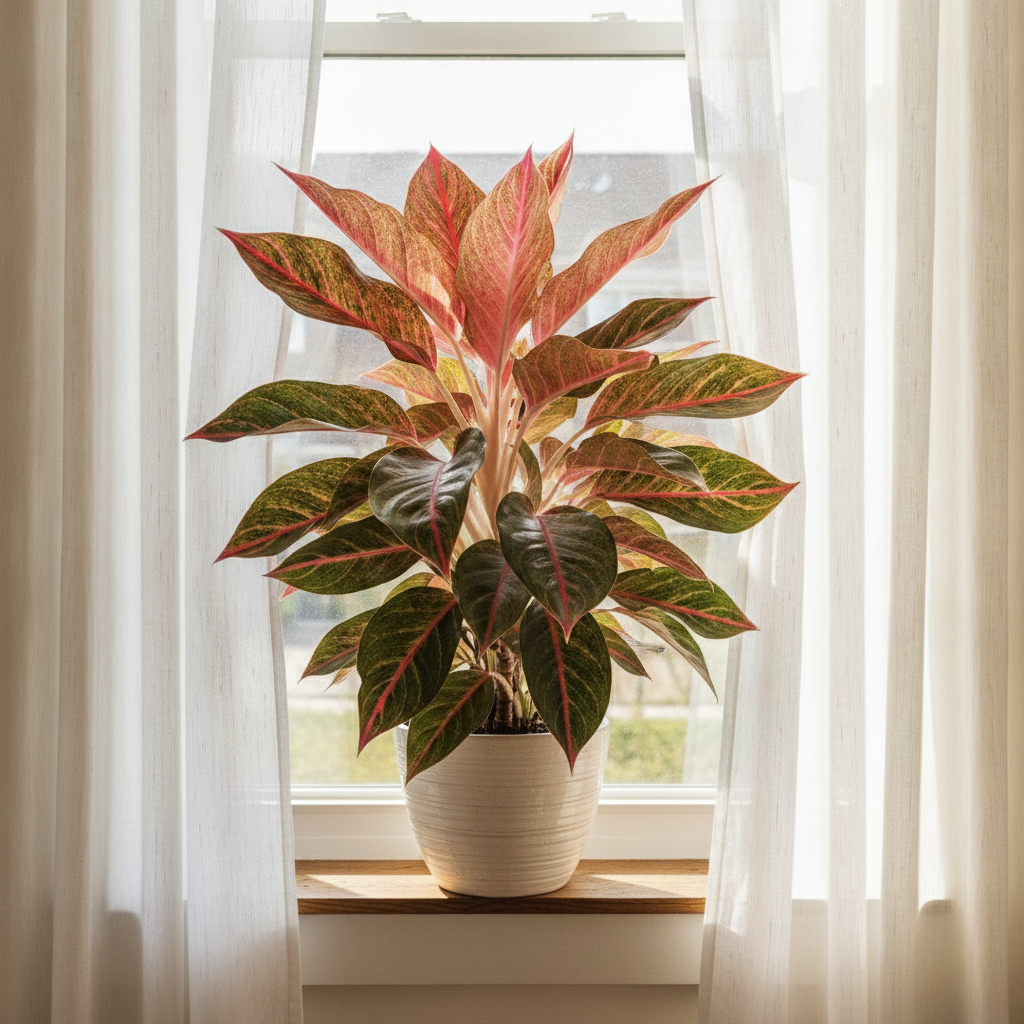
The sweet spot is medium to bright indirect light. An east-facing window that catches gentle morning sun, or a spot a metre or two back from a brighter south or west window, suits it well. Sheer curtains are useful for softening any direct beam. What it will not tolerate is prolonged harsh, direct sun through glass, particularly in the middle of the day, which bleaches the pigment and scorches the leaf into dry, papery patches. If you notice pale, washed-out new growth, the plant wants more light; if you see crispy bleached blotches, it wants less direct exposure.
Because the pigment fades gradually rather than suddenly, it is easy to miss a slow decline in a dim corner. Rotate the pot a quarter turn each week so all sides receive even light and the plant grows symmetrically rather than leaning toward the window. If your home is genuinely dark, the Siam Aurora will still be one of the better performers available, but consider a full-spectrum LED grow light to preserve the colour through the darker months.
Pro Tip — Reading the colour: Treat the newest leaves as a light meter. Bright, saturated red and pink margins mean the plant is happy; progressively greener, flatter new leaves mean it needs to move somewhere brighter.
Watering
Watering is the single most common way people harm this plant, and almost always through excess rather than neglect. The Siam Aurora stores a little moisture in its thick stems and fleshy roots, and it is far more tolerant of a missed watering than of sitting in wet soil. Overwatering, not drought, is what kills most Aglaonemas indoors.
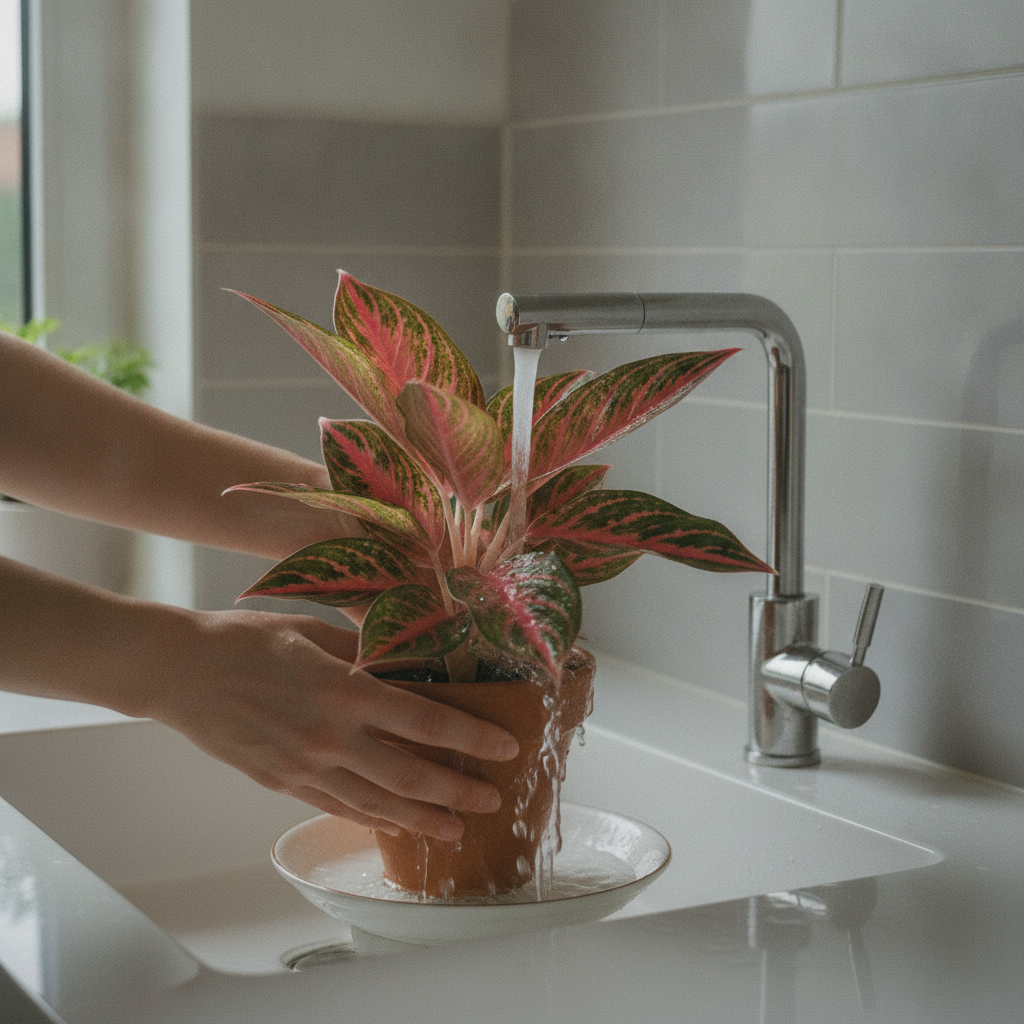
The reliable method is to water only when the top 2 to 3 cm (about 1 in) of soil has dried out. Push a finger into the mix; if it feels moist at the first knuckle, wait. When it is dry, water thoroughly and evenly until liquid drains freely from the bottom of the pot, which flushes the whole root ball and washes out accumulated mineral salts. Then tip away anything that collects in the saucer. Never leave the pot standing in water. In practice this works out to roughly once every 7 to 10 days in spring and summer, stretching to every 10 to 14 days or longer in the low light and cool of winter, but the finger test always beats the calendar.
Learn to read the leaves. Yellowing lower leaves and a general softness usually signal overwatering and the early stages of root rot, while drooping accompanied by dry soil and slightly curled or crisping edges points to underwatering. The plant recovers quickly from thirst but slowly, if at all, from rot, so when in doubt, wait a day. Aglaonemas can also be sensitive to the fluoride and chlorine in some tap water, which may show as brown leaf tips; if you see this, let tap water stand overnight before using it, or switch to filtered or rainwater.
Warning — Cold water shock: Water with room-temperature water. A tropical plant like this dislikes a cold soak straight from the tap, which can stress the roots and cause leaf spotting, especially in winter.
Soil
The right soil solves half of the watering problem before it starts. Because the Siam Aurora is so sensitive to soggy roots, its growing medium must drain quickly while still holding enough moisture to keep the plant hydrated between waterings. A dense, water-retentive mix that stays wet for days is the enemy; a loose, airy, chunky mix that lets excess water pass straight through is exactly right.
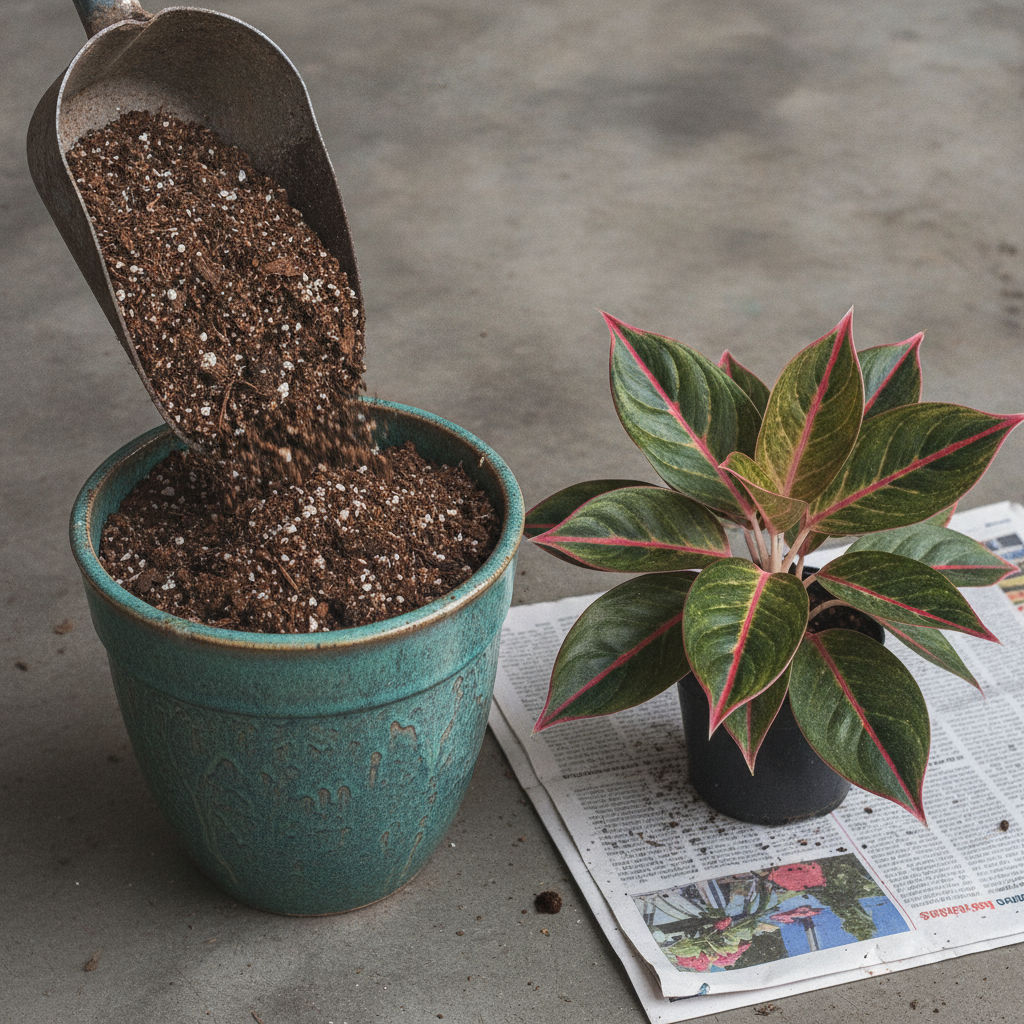
A good general recipe is roughly two parts quality peat-free potting compost or coco coir for moisture retention, one part perlite or pumice for aeration and drainage, and one part orchid bark to open up the structure and create air pockets around the roots. A handful of horticultural charcoal is a useful optional extra to keep the mix sweet. If you prefer to buy rather than blend, a bagged aroid or monstera mix works well straight from the bag, as does a standard houseplant compost lightened generously with perlite. The aim is a medium that feels loose and springy rather than heavy and claggy.
Whatever you plant it in, the pot must have drainage holes. A decorative cover pot without drainage is fine as an outer sleeve provided you lift the inner nursery pot out to water and let it drain fully before returning it. Repot only every two to three years, as this slow grower is quite happy being a little snug and dislikes being disturbed; the best sign it needs a larger home is roots creeping from the drainage holes or circling densely at the surface. When you do repot, move up just one pot size, as too large a pot holds too much wet soil around the roots and invites rot. Spring is the ideal time, giving the plant the active growing season to settle in.
Fertilising
The Siam Aurora is not a heavy feeder, and its slow growth means it needs far less fertiliser than fast-growing plants. A light, regular feed through the growing season keeps the foliage strong and the colour vivid, but the bigger risk here, as with water, is overdoing it. Excess fertiliser builds up as mineral salts in the soil and burns the roots, showing as brown, scorched leaf tips and margins.
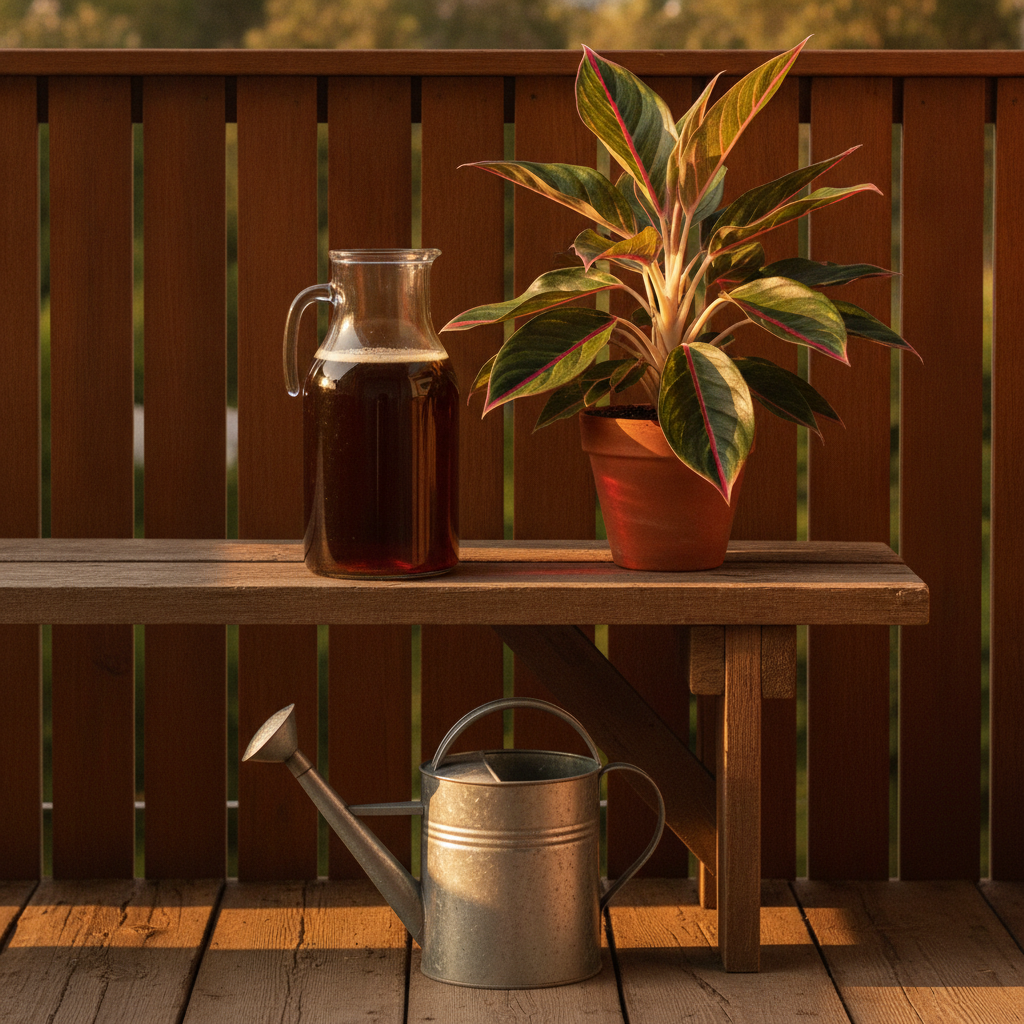
Feed once a month during spring and summer with a balanced liquid houseplant fertiliser diluted to half the strength recommended on the label. A balanced formulation, with roughly equal nitrogen, phosphorus and potassium, supports both leaf growth and colour. Always apply feed to already-moist soil rather than dry, since fertiliser on dry roots is far more likely to scorch them. Through autumn and winter, when growth naturally slows and light levels drop, stop feeding entirely and let the plant rest; resume in spring when you see fresh growth emerging.
If you have been feeding for a while and notice a crust of white mineral deposit on the soil surface or the pot rim, flush the soil thoroughly. Take the plant to a sink and run room-temperature water through the pot for a minute or two, letting it drain completely, to leach out the accumulated salts. This simple reset does more good than any additional feeding, and doing it once or twice a year keeps the root zone healthy.
Pro Tip — Less is more: When unsure, under-feed rather than over-feed. This plant grows slowly and stores reserves well, so a missed feed causes no harm, while a heavy hand leaves lasting brown-tipped damage.
Propagation
Propagating the Siam Aurora is straightforward, though its slow growth means patience is part of the process. Unlike trailing plants that root readily from a single leaf or node in a glass of water, Aglaonemas are clump-forming plants best multiplied by division, which is the most reliable method and gives you a fully formed new plant immediately.
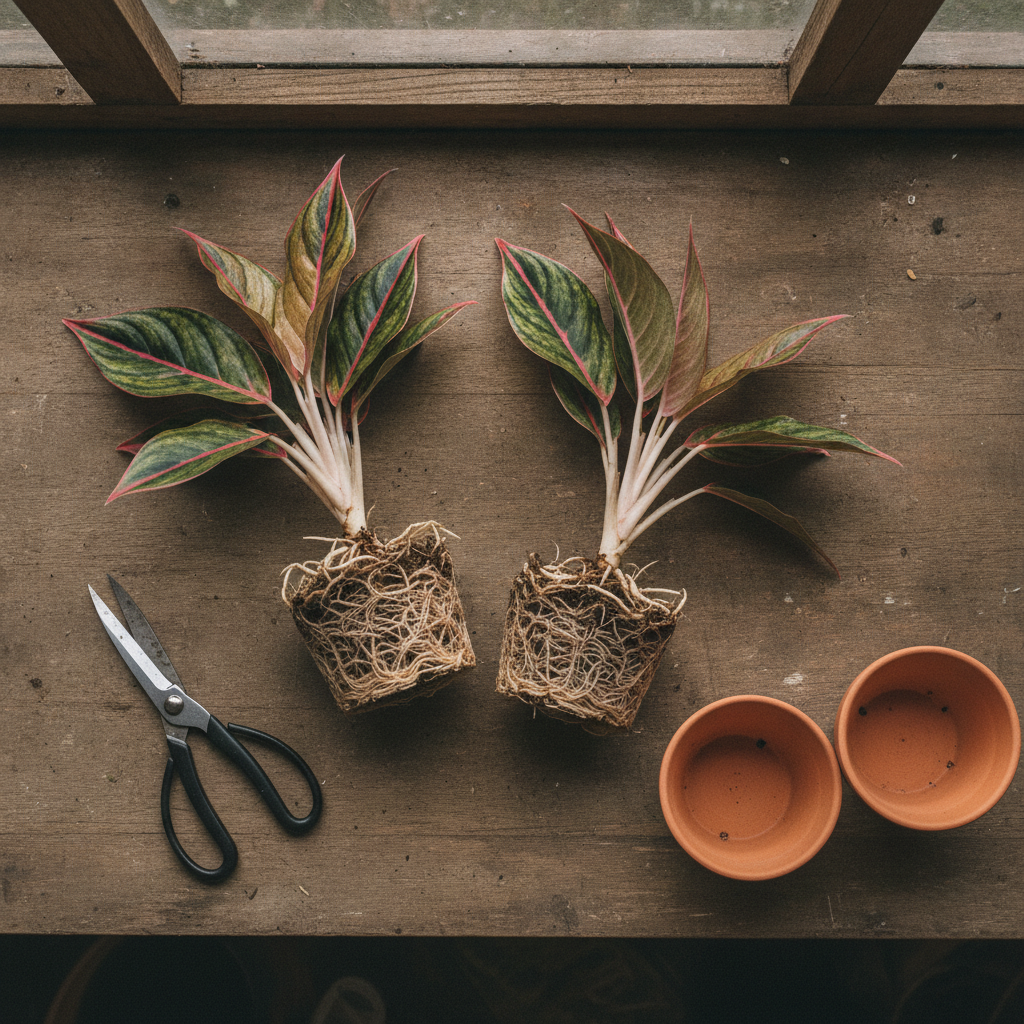
The best moment to divide is when you are repotting in spring, since the plant is already out of its pot and entering active growth. Work through the steps below without rushing, keeping as many roots intact on each division as you can.
- Water the plant a day beforehand so the root ball is hydrated and holds together, then slide it out of its pot.
- Gently tease away loose soil so you can see where the plant naturally separates into clumps, each with its own stems and a share of roots.
- Using clean, sharp secateurs or your hands, separate a clump that has at least a few healthy stems and a good portion of root attached. Avoid dividing into pieces too small to support themselves.
- Pot each division into its own container with fresh, well-draining aroid mix, at the same depth it was growing before.
- Water in lightly and place the new plants in warm, bright indirect light. Keep the soil just barely moist while they settle, and expect little visible growth for a few weeks as the roots re-establish.
Stem cuttings are also possible for more mature, cane-like plants. Cut a section of stem with a couple of leaf nodes, let the cut end callous for an hour or two, and root it in water or directly in moist perlite or soil, keeping it warm and humid until roots develop. This is slower and less certain than division, so treat it as a bonus method for using up healthy offcuts rather than your first choice. Whichever route you take, warmth is the key to success; cuttings and divisions root fastest at 21 to 25 C (70 to 77 F).
Pests and Problems
A healthy, well-sited Siam Aurora is not especially prone to pests, but stressed plants and dry indoor air can invite a few familiar troublemakers. Catching them early is far easier than clearing an established infestation, so inspect your plant, including the leaf undersides and the crevices where leaves meet stems, whenever you water.
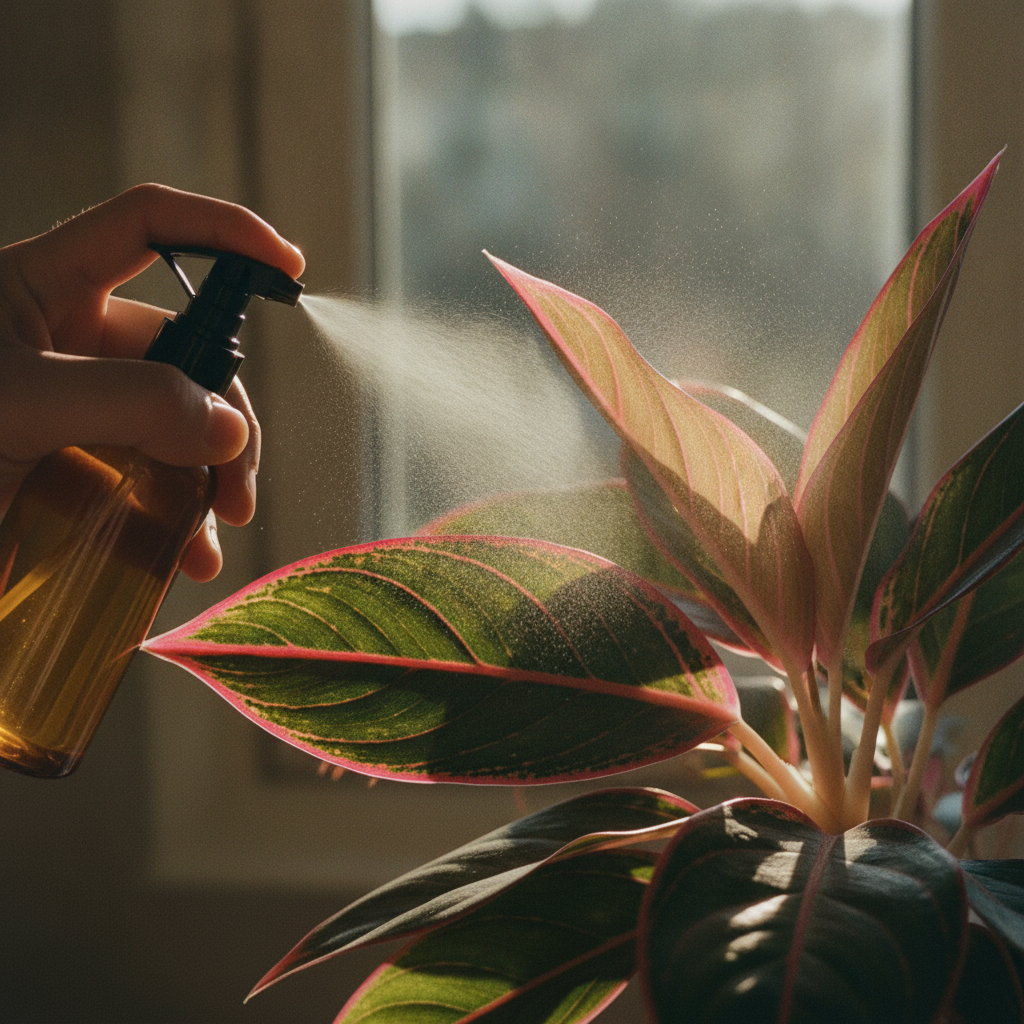
The usual suspects are sap-sucking insects. Spider mites appear in warm, dry conditions as fine stippling on the leaves and delicate webbing in the leaf joints. Mealybugs show up as small, white, cottony tufts tucked into crevices, while scale insects look like tiny brown limpets stuck along the stems and midribs. Aphids and fungus gnats are occasional visitors, the latter a sign that the soil is being kept too wet. For light infestations, wipe the pests away with a cloth or a cotton bud dipped in diluted isopropyl alcohol, then treat the whole plant with insecticidal soap or a neem oil spray, repeating every week or two until the problem clears. Raising humidity and keeping the foliage clean discourages spider mites in particular.
Most trouble with this plant, though, is not caused by pests but by care, and the symptoms are readable. Yellowing leaves most often mean overwatering; brown, crispy leaf tips point to dry air, mineral build-up from tap water or over-feeding; pale, faded colour signals too little light; and scorched, bleached patches mean too much direct sun. Root rot, the most serious problem, follows chronic overwatering and shows as a soft, mushy stem base and a plant that wilts despite wet soil. If you catch it, unpot the plant, cut away any blackened, slimy roots with sterile scissors, and repot into fresh, dry, well-draining mix, then water sparingly while it recovers.
Warning — Isolate new arrivals: Keep any new plant, or any plant showing pests, away from the rest of your collection until you are certain it is clean. A single unnoticed mealybug can spread across a shelf in weeks.
Varieties and Related Cultivars
‘Siam Aurora’ is one member of a large and colourful family of hybrid Aglaonemas, many of them Thai-bred and sharing its taste for red and pink pigment. If you fall for its colouring, several close relatives make natural companions, each with its own take on the red-and-green theme. The two below are among the most widely grown and are cared for in exactly the same way.
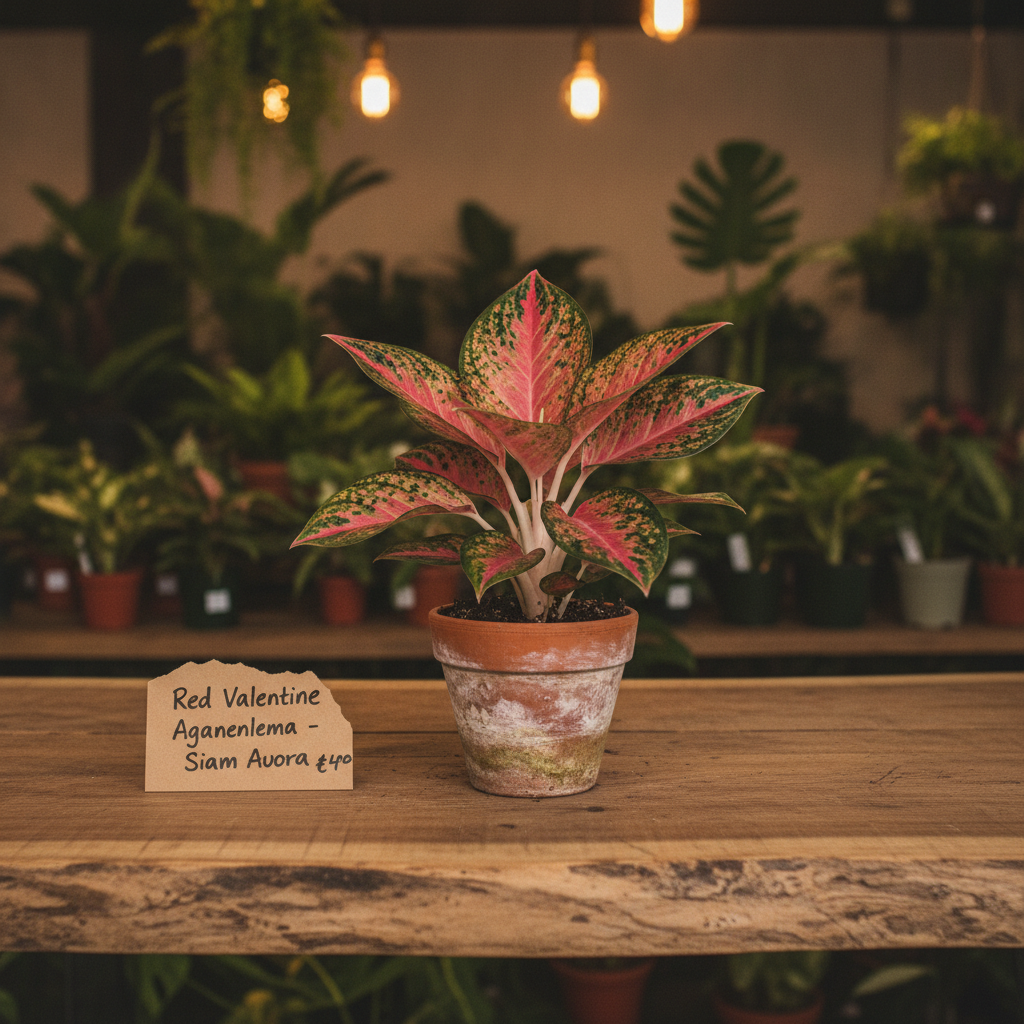
Red Valentine is a compact, bushy cultivar with rounded leaves heavily marbled in rose-pink, red and green rather than the clean margins of ‘Siam Aurora’. Its mottled, painterly patterning makes it a favourite for smaller spaces, and its dense, low habit suits a tabletop or shelf where a fuller silhouette is welcome.
Red Anjamani takes the red to its extreme, with broad leaves flushed almost entirely crimson and edged in only a narrow band of dark green. It is one of the boldest of all the red Aglaonemas and makes a striking specimen, though its heavier pigment means it appreciates slightly brighter indirect light to stay at its most saturated.
Other worthwhile relatives include the pink-splashed ‘Prosperity’, the silver-and-green classics such as ‘Silver Bay’ and ‘Maria’ for those who prefer a cooler palette, and the pink-veined ‘Pink Dalmatian’. All share the same easy-going nature, so building a small collection of contrasting colours is simple and rewarding.
Frequently Asked Questions
Why is my Siam Aurora losing its red and pink colour?
The most common cause is too little light. The red pigment depends on adequate brightness, so in a dim spot new leaves emerge greener and flatter. Move the plant to a position with more bright, indirect light, and the colour on fresh growth should intensify. Very old leaves naturally green up over time, which is normal.
How often should I water it?
Water when the top 2 to 3 cm (1 in) of soil feels dry, which usually falls around every 7 to 10 days in spring and summer and less often in winter. Always test the soil with a finger rather than watering on a fixed schedule, and err on the side of slightly too dry rather than too wet.
Is the Siam Aurora Aglaonema toxic to cats and dogs?
Yes. Like all Aglaonemas it contains insoluble calcium oxalate crystals, which are toxic to cats, dogs and humans if chewed or swallowed, causing mouth irritation, drooling and digestive upset. Keep it out of reach of pets and small children, and wash your hands after handling cut stems.
Why are the leaf tips turning brown?
Brown, crispy tips usually point to dry air, a build-up of minerals or fluoride from tap water, or over-feeding. Raise humidity, switch to filtered or stood water, flush the soil to clear salts, and ease off the fertiliser. Trim damaged tips with clean scissors for cosmetic tidiness.
How big does it get and how fast does it grow?
Indoors it typically reaches 50 to 90 cm (20 to 35 in) tall with a similar spread, growing slowly to moderately. Expect only a few new leaves per season, especially in lower light. Its unhurried pace is part of its appeal, as it rarely outgrows its spot or needs frequent repotting.
Can I grow it in low light?
It will tolerate low light better than almost any other colourful houseplant, which is a large part of its reputation. However, tolerating low light and thriving in it are different things: in dim conditions it survives but its signature colour fades. For the best of both, give it medium to bright indirect light.






