
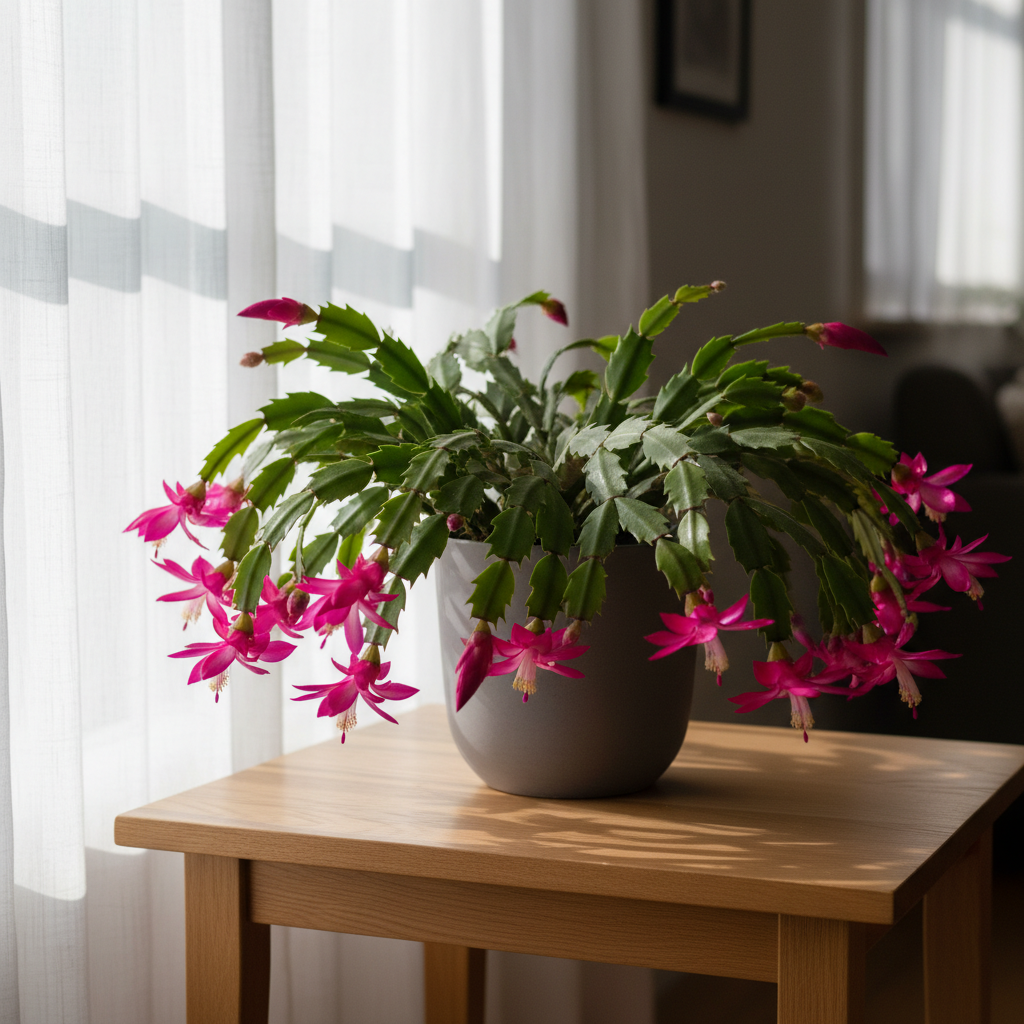
The Christmas cactus (Schlumbergera truncata) is one of the few houseplants that performs its showiest trick when nearly everything else has gone dormant for the year. A mature specimen will throw out dozens, sometimes hundreds, of tubular trumpet-shaped flowers in late autumn and early winter, just as the days shorten and the windowsill collection starts to look a little tired. The blooms cascade outward and downward from the tips of flat, jointed, glossy green stem segments, in shades that run the full warm spectrum from icy white through every register of pink, salmon, fuchsia, scarlet and, more rarely, into gold and lavender.
Despite the name, this is not a desert cactus. The species is native to the cool, shaded, intermittently soaking cloud forests of the Serra dos Órgãos mountains of southeastern Brazil, where its ancestors evolved as epiphytes, perching on tree branches and rocky outcrops rather than rooting in arid ground. That ecological backstory is the single most useful fact for caring for one indoors: a Christmas cactus is closer in temperament to an orchid than to a barrel cactus, and the most common failures, sudden bud drop, shrivelled segments, mushy stems, almost all trace back to people treating it like the desert plant it isn’t.
This guide covers everything needed to keep a Christmas cactus alive, and the slightly different routine needed to get it to bloom reliably year after year. The plant is genuinely tolerant of casual care once established, which is why so many specimens are handed down through families across multiple generations, but reliable winter flowering rewards a small amount of deliberate attention in the autumn. The difference between surviving and thriving comes down to four things: bright but filtered light, restrained watering with a real dry-down between drinks, a cool, dark autumn rest period, and a chunky, fast-draining mix that lets the epiphytic roots breathe.
Contents
- Quick Reference
- Why Christmas Cactus Makes a Rewarding Houseplant
- Light Requirements
- Watering and Humidity
- Soil, Potting and Repotting
- Fertilising
- Propagation
- Pests and Diseases
- Popular Varieties
- Frequently Asked Questions
Quick Reference: Christmas Cactus at a Glance
| Botanical name | Schlumbergera truncata (family Cactaceae) |
| Common names | Christmas cactus, holiday cactus, zygocactus, crab cactus |
| Native range | Coastal mountains of southeastern Brazil, growing epiphytically in humid cloud forest |
| Light | Bright indirect light year-round, with two to three hours of gentle morning sun tolerated and welcomed in winter |
| Watering | Water thoroughly when the top 2 to 3 cm (about 1 inch) of mix has dried; reduce dramatically in autumn and after flowering |
| Temperature | Growing season 18 to 24 °C (64 to 75 °F); 10 to 15 °C (50 to 59 °F) for six to eight weeks in autumn to set buds |
| Humidity | Prefers 50 to 60 percent; tolerates household humidity but flowers last longer in cooler, slightly damper air |
| Soil | Chunky, fast-draining cactus or orchid mix amended with extra perlite, pumice or fine orchid bark |
| Fertiliser | Balanced liquid feed at quarter to half strength every two to four weeks from spring to late summer; stop entirely in autumn |
| Repotting | Every three to four years, in spring after flowering, only when noticeably pot-bound |
| Mature size | 30 to 60 cm (12 to 24 inches) wide and 20 to 30 cm (8 to 12 inches) tall with arching, trailing habit |
| Growth rate | Slow to moderate; one or two flushes of new segments per year |
| Bloom season | Late autumn into mid-winter; in the Northern Hemisphere typically November to January |
| Toxicity | Non-toxic to cats, dogs and humans; one of very few cacti considered fully pet-safe |
| Lifespan | Routinely 20 to 30 years indoors; well-cared-for heirloom plants over 100 years old are documented |
Why Christmas Cactus Makes a Rewarding Houseplant
A Christmas cactus does something almost no other houseplant manages. It performs spectacularly out of season, blooming through the deepest, greyest weeks of the year, and it does so on a schedule reliable enough that gardeners on both sides of the Atlantic have spent generations associating particular cultivars with particular winter holidays. For anyone whose plant shelf goes visually flat between October and March, a healthy mature specimen in full bud is a transformational addition.
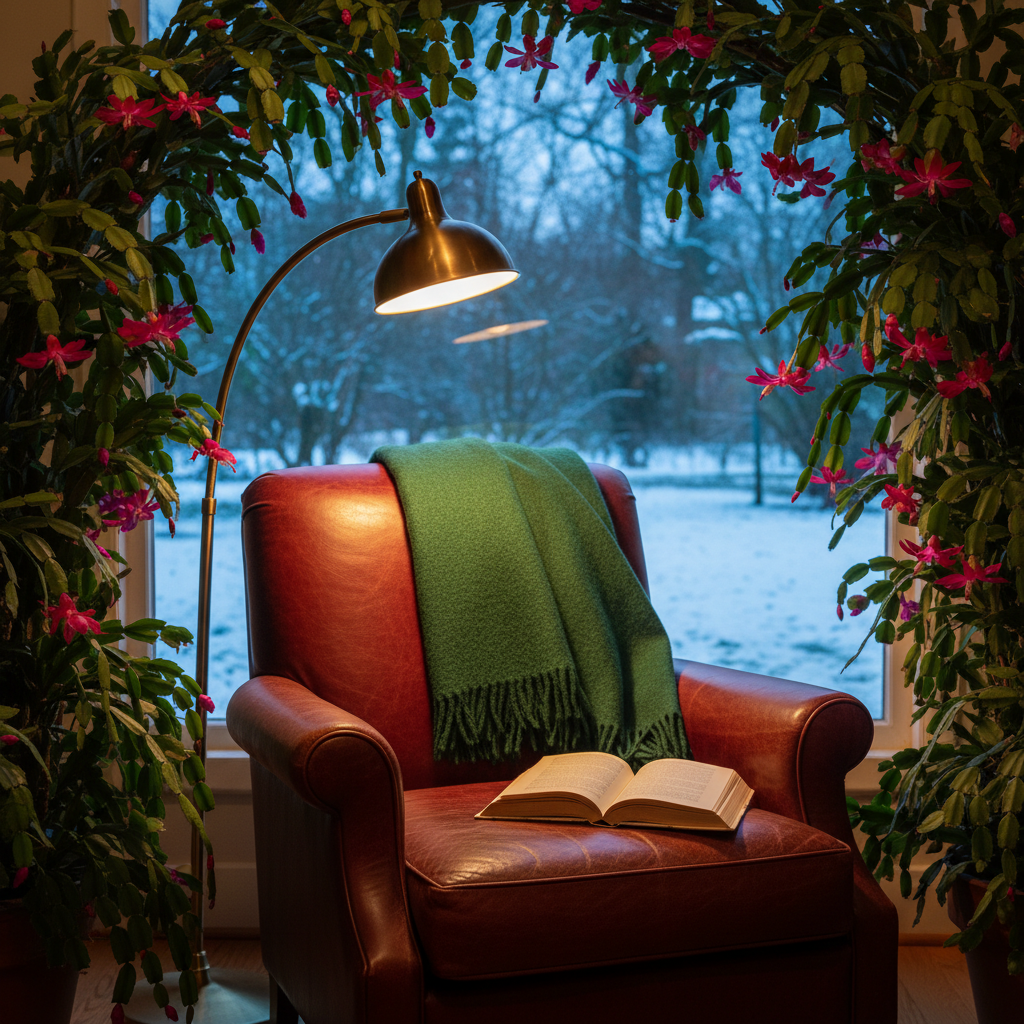
Beyond the seasonal showstopper of flowering, this is a forgiving plant in ways that suit busy households. Its epiphytic roots store water in the fleshy segments themselves, so a missed watering is rarely fatal; in fact, slightly underwatering tends to be safer than the alternative. It accepts the modest light levels found in most homes during winter, when sunshine itself is in short supply. It is genuinely non-toxic to cats and dogs, which sets it apart from almost every aroid, lily, palm and many succulents on the typical houseplant shelf. And it is long-lived to an unusual degree, with documented heirloom specimens that have been passed down through three or four generations of a single family.
The plant also has a slow, sculptural habit that fills space without dominating it. A specimen in a hanging planter or on a tall stand will eventually cascade in a graceful skirt of jointed segments, each new pad emerging from the tip of the one before it. That growth pattern means a single plant can be shaped over years, encouraged to fill outwards or trail downwards by trimming back specific segments. Pruning is forgiving: every segment removed is a potential cutting, and the parent rarely sulks afterwards.
Finally, there is the cultural weight a Christmas cactus carries. The plants commonly sold under this name today are usually Schlumbergera truncata, sometimes called the Thanksgiving cactus because it tends to bloom slightly earlier, and the true Christmas cactus (Schlumbergera × buckleyi) is a closely related hybrid with smoother-edged segments and slightly later bloom. The two are routinely confused at garden centres, but their care is essentially identical, so this guide applies to both. Whichever a household ends up with, it is the kind of plant that becomes part of family Christmas decoration, brought out, talked about and quietly looked forward to year after year.
Light Requirements
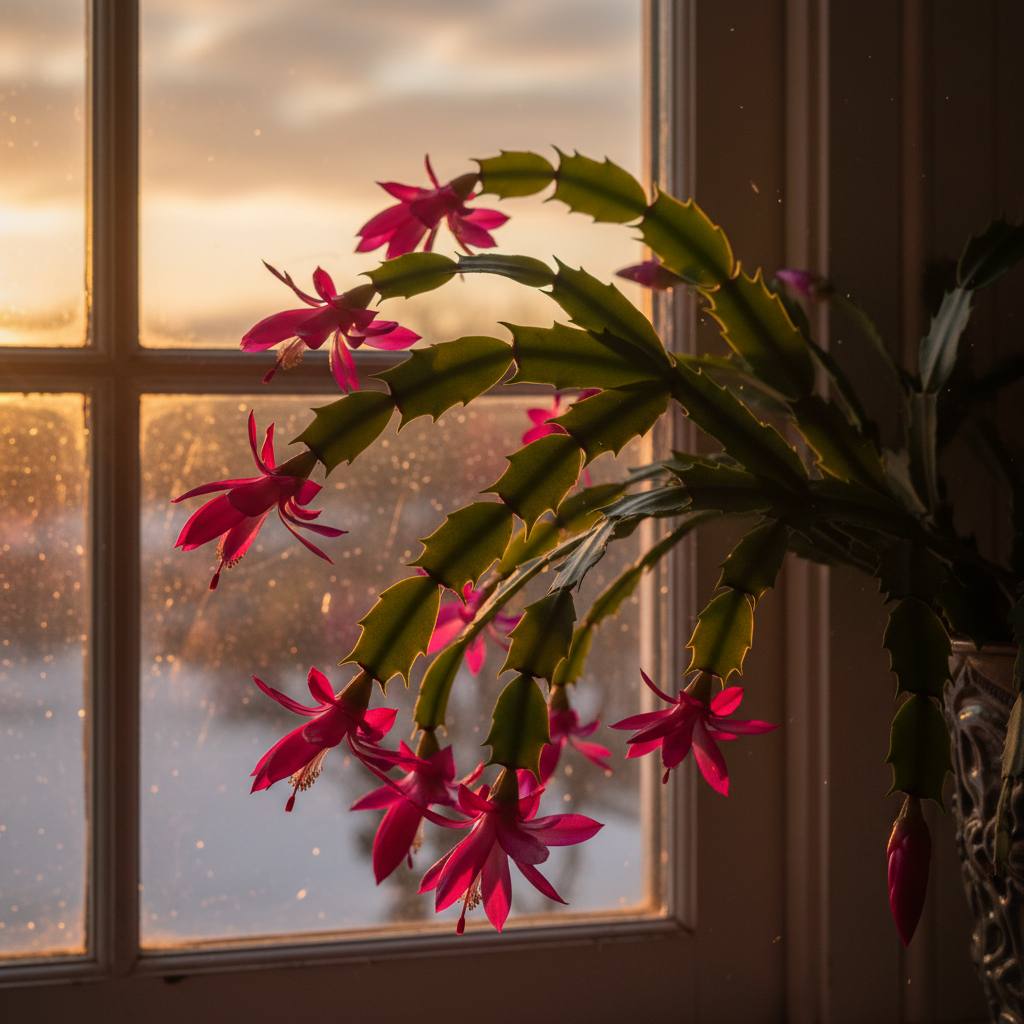
In its native Brazilian cloud forest, a Christmas cactus grows mostly under the canopy, anchored to mossy tree limbs or cool rock faces where direct sun is filtered through layers of leaves overhead. The light that reaches it is bright but rarely harsh, and it is intermittent rather than constant. Replicating that quality of light indoors is the single biggest lever on whether a plant simply persists or actively thrives and blooms.
How Much Light Is Right
The ideal year-round position is one that delivers bright indirect light for most of the day, with two to three hours of soft, low-angle direct sun in the early morning. An east-facing windowsill is close to perfect. A north-facing window also works in lighter, brighter rooms, though growth and flowering will be more restrained. South and west-facing windows are usable but only with a sheer curtain or with the plant set back at least 1 to 1.5 metres (3 to 5 feet) from the glass, because midday and late-afternoon direct sun in summer will scorch and bleach the segments.
Outdoors in summer, the same logic applies. A Christmas cactus can be moved to a shaded patio, balcony or under the dappled shade of a deciduous tree once night temperatures stay reliably above 10 °C (50 °F). Bright shade is the goal; never full sun. The plant typically responds to a summer outside with a strong flush of new segments and visibly deeper, glossier green colour, provided it is kept out of midday direct light.
Reading the Plant’s Light Signals
A Christmas cactus tells the owner clearly when its light situation is wrong. Too much direct sun produces a reddish or purple cast across the segment edges and tips, a sort of sunburn flush. In mild form this is harmless and even attractive, and it disappears once the plant is moved into softer light. In its extreme, the segments develop pale, papery, bleached patches that never recover; those segments are permanently damaged and may have to be removed.
Too little light is more insidious. The plant will not necessarily die back, but it will refuse to bloom, and new segments that do form will be elongated, weak, paler and noticeably soft compared to the firm, dense growth of a well-lit plant. Existing healthy segments may also lose their slight gloss. If a specimen has not bloomed for two or more years, increasing the light intensity should be the first intervention before anything else.
Pro Tip, Photoperiod Matters More Than Brightness: Christmas cacti are short-day plants. To set flower buds reliably, they need at least 12 to 14 hours of complete, uninterrupted darkness every night for six to eight weeks in autumn. A plant in an otherwise bright room can refuse to bloom if a lamp, television or streetlight breaks that nightly dark period. Move it to a cool spare room, a low-traffic hallway, or cover it with a box from early evening to morning during this window.
Watering and Humidity
Watering is where most well-intentioned care goes wrong. Because the plant has “cactus” in the name, many owners default to a strict desert-cactus routine, watering only when the entire pot is bone dry. Conversely, when buds form in autumn, panicked owners often start watering more frequently to “support the flowers”, and then watch the buds drop off two days later. Neither extreme matches what the plant actually wants.
When to Water
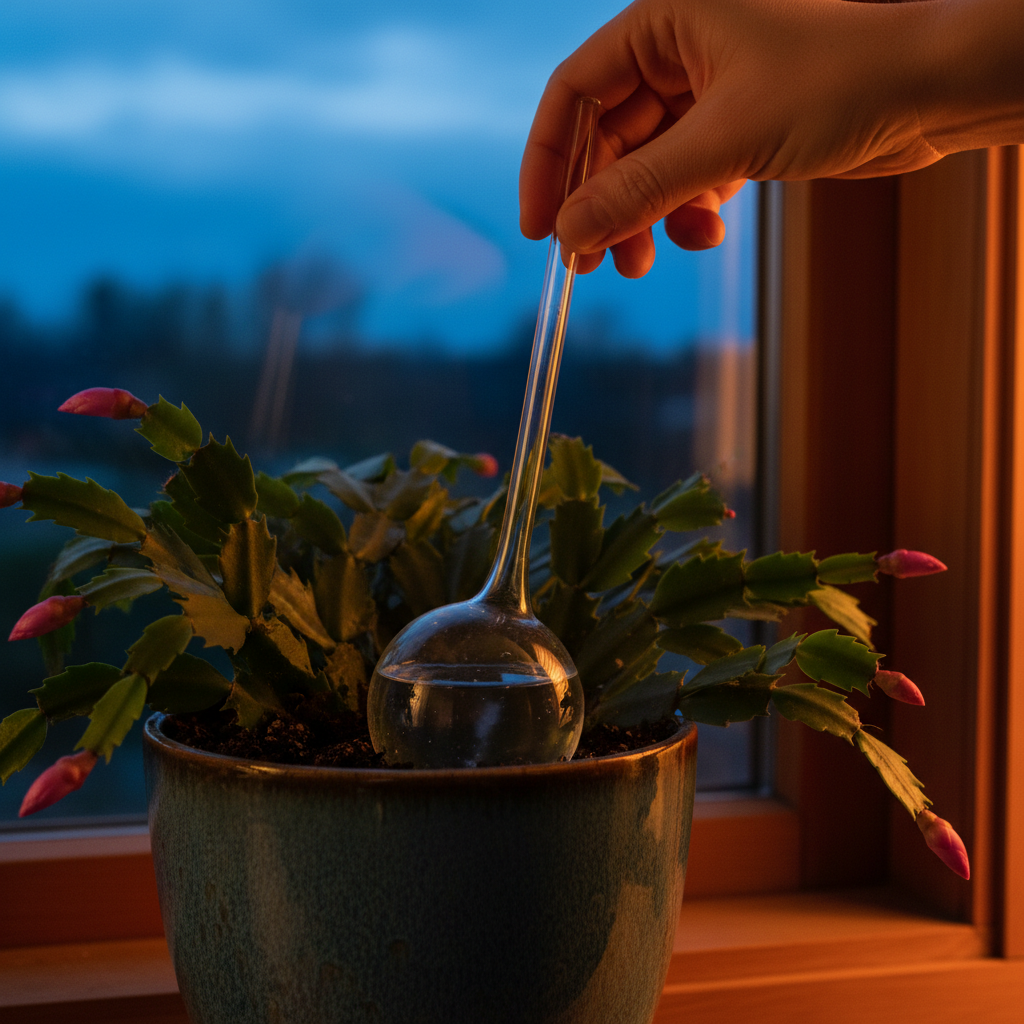
The right approach is to water thoroughly when the top 2 to 3 cm (roughly the first inch) of the potting mix has dried out, then let the rest of the root zone drink deeply before the next watering. During active growth in spring and summer, that typically means every seven to ten days in average household conditions. In autumn, as part of the deliberate cool-rest period, watering should be reduced to roughly every two to three weeks, just enough to prevent the segments from shrivelling. Once buds form and start to swell, return to a steadier rhythm and try not to let the plant either fully dry out or stand wet, because dramatic swings in moisture are the single most reliable way to make buds drop.
After flowering finishes, give the plant a four to six week recovery period of slightly drier soil before returning to normal spring watering. Through winter, in homes with central heating, soil dries faster than expected; through cool, damp shoulder seasons, it dries more slowly. Always check the soil with a finger or a wooden chopstick rather than relying on a calendar.
Pro Tip, The Chopstick Test: Push an unfinished wooden chopstick or a thin bamboo skewer all the way down into the pot and leave it for thirty seconds. Pull it out and feel it. If it comes out with damp soil clinging to the lower half, wait. If it comes out clean and dry to the touch from top to bottom, water. This is far more reliable than surface checks, particularly in chunky cactus mixes where the top dries faster than the core.
How to Water Correctly
- Use water that is at room temperature; cold water from the tap can shock the roots and trigger bud drop.
- Water at the soil surface, not over the segments, until water runs steadily from the drainage holes for several seconds.
- Let the pot drain fully on a rack or in the sink for at least ten minutes before returning it to its saucer or cachepot.
- Empty any standing water from the saucer or decorative outer pot within thirty minutes; the roots must never sit in liquid.
- Wipe up any drips around the rim where dust may have collected, and check the underside of segments briefly for early pest signs.
- Note the date so the next watering is genuinely needs-based and not a default reflex.
Signs of Overwatering vs Underwatering
| Symptom | Overwatering | Underwatering |
|---|---|---|
| Segment colour | Yellowing from the base outward; sometimes a sickly translucent look | Reddish-purple flush across the whole plant, especially at edges |
| Segment texture | Soft, limp, watery feel; segments may detach with a wet rotten base | Wrinkled, deflated, papery surface that recovers within a day or two of watering |
| Soil | Stays wet for more than a week; may develop a sour or musty smell | Pulls away from the pot edges; very lightweight when lifted |
| Roots | Brown, mushy, easy to break apart; black at the crown | Pale, dry but still firm; minimal new white tip growth |
| Bud behaviour | Buds turn brown and drop suddenly while still small | Buds shrivel and drop slowly while pale and matt-looking |
Warning, Root Rot: Soggy soil in a cool room is the most common killer of indoor Christmas cacti, particularly during the autumn rest period. If segments start to drop with blackened bases or the lower stem turns soft and dark, unpot the plant immediately, cut away every blackened root and any soft segment back to firm green tissue with a sterile blade, let the cuttings air-dry for 24 to 48 hours, and restart the plant from healthy cuttings in fresh dry mix. Trying to dry out an already-rotting plant in its existing pot rarely works.
Humidity Requirements
Coming from cloud forest, the Christmas cactus is more humidity-loving than its name suggests. It is comfortable in the 50 to 60 percent range and will accept the typical 35 to 45 percent of a centrally heated home without complaint, though flowers tend to drop earlier and leaves can develop fine brown tips when air is very dry. In a bathroom, kitchen or sunroom where ambient humidity is naturally higher, blooms last visibly longer and the plant feels firmer to the touch.
The clearest sign of humidity stress is shrivelled segment tips that do not recover after watering and a tendency for buds to abort just as they begin to swell. Grouping the plant with other foliage, setting the pot on a wide pebble tray with water below the pot base but not touching it, or running a small humidifier nearby during the bloom window are all effective ways to raise the local humidity by 10 to 15 percent. Misting is mostly ineffective in dry rooms because the moisture evaporates within minutes, and persistent misting of the segments can encourage fungal spotting on the flowers themselves.
Water Quality
Tap water is acceptable in most regions, but areas with very hard or heavily chlorinated water can produce a slow build-up of mineral salts in the mix that contribute to root tip dieback over time. Letting tap water stand uncovered for 24 hours dissipates most chlorine, and a once-yearly thorough flush, pouring two or three pot-volumes of fresh water slowly through the mix in the sink, prevents salt accumulation. Rainwater or distilled water are ideal where available, particularly for collectors keeping plants long-term for heirloom transfer.
Soil, Potting and Repotting
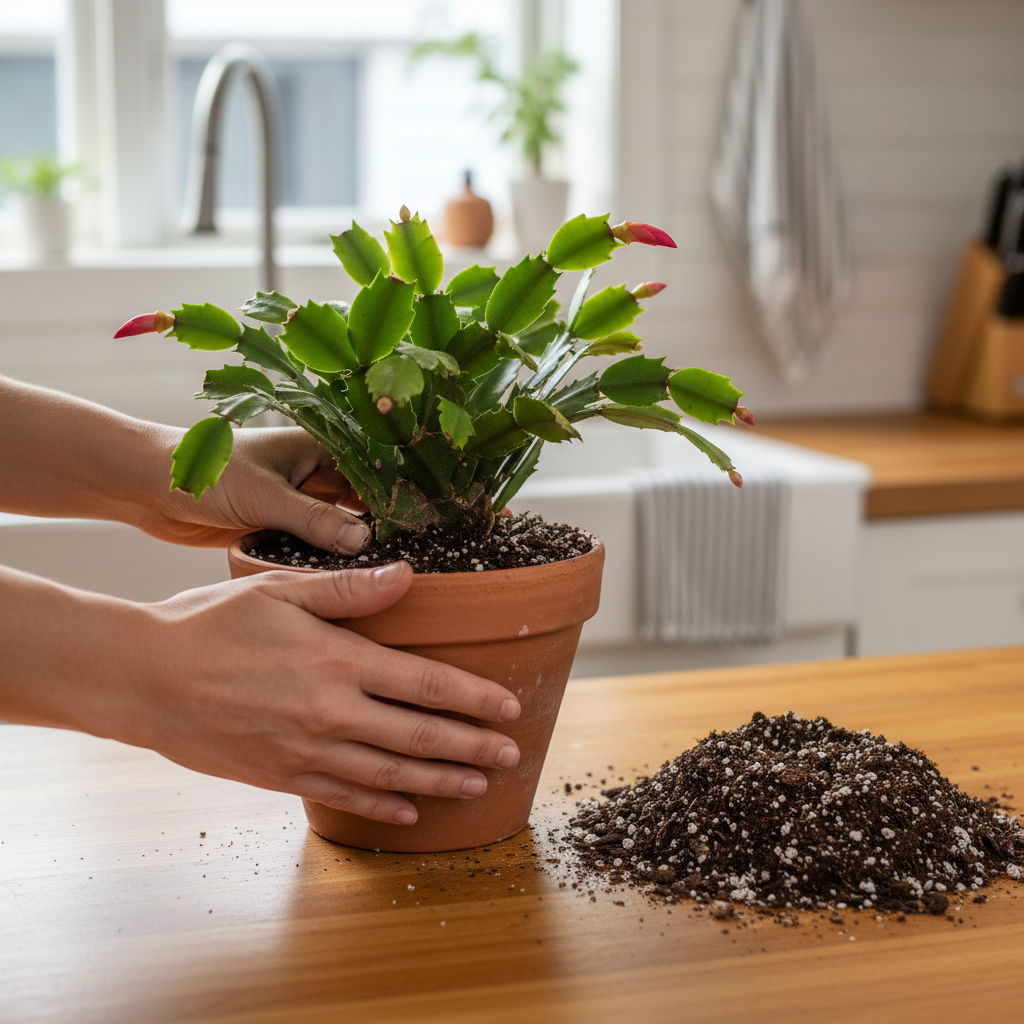
Because the species evolved as an epiphyte, its roots are adapted to a chunky, airy, fast-draining medium. They want to grip and breathe, not sit in a dense water-retentive substrate. Standard houseplant compost, used straight out of the bag, is a poor match and is the second-most-common cause of slow decline after overwatering.
The Right Soil Mix
A workable recipe is roughly two parts good-quality cactus or succulent mix, one part perlite or pumice for drainage, and one part fine orchid bark or coco husk chips for structure. The aim is a substrate that wets evenly when watered, drains within seconds rather than minutes, dries down gradually rather than crusting hard, and still has enough fine material to hold the roots in place. A useful field test is to pour water onto the mix in a pot and watch how it drains: ideal mix sees water exit the drainage holes within five to ten seconds of pouring. Slower drainage points to too much fine peat or compost; faster pure-flow drainage with no wetting indicates too much chunky material and not enough holding capacity.
Pre-bagged “cactus and succulent” mixes from garden centres are usually still too peat-heavy and benefit from being cut with extra perlite at roughly one part perlite to three parts mix. Pure orchid bark mixes are too open on their own and dry out faster than the plant can keep up with. Slightly acidic to neutral pH (around 5.5 to 6.5) suits the species best.
Choosing a Pot
Christmas cacti actively prefer being slightly pot-bound. A snug pot with the root ball nearly filling it tends to produce more flowers than a roomy pot with lots of empty mix around the roots, partly because epiphytic roots respond to confinement by switching effort towards reproduction, and partly because excess unused mix stays wet and invites rot. Choose a pot that is only one to two centimetres (roughly half an inch) wider than the current root ball on all sides.
Material matters. Unglazed terracotta breathes through its walls and helps the mix dry evenly, which suits this plant well; it is the safest choice for owners who tend toward heavy watering. Glazed ceramic and plastic both work but require slightly more restrained watering because they do not lose moisture through the sides. Whatever the material, the pot must have one or more substantial drainage holes; the species absolutely cannot tolerate sealed decorative pots used as primary containers. A decorative outer cachepot is fine, provided the inner pot can be lifted out to water and to drain.
When and How to Repot
Repotting is needed far less often than for fast-growing aroids. Every three to four years is typical, and only if roots are visibly circling the bottom of the pot, escaping through the drainage holes, or if the mix has broken down into a sour-smelling dense mass. The best moment is in spring, four to six weeks after the last flowers have dropped and new growth is just beginning to show at the segment tips. Repotting a plant in bud is almost guaranteed to cause those buds to abort.
- Withhold water for three to five days before repotting so the mix is slightly drier and the rootball lifts more cleanly.
- Gently tease the plant out, supporting the base. If the root ball resists, run a thin blade around the inner pot wall to release it.
- Tease away roughly one-third of the old mix from the outer edges of the rootball with fingers; trim any soft, brown or hollow roots back to firm tissue with sterile snips.
- Set a 2 to 3 cm (1 inch) base layer of fresh mix in the new pot, lower the plant in so the crown sits a finger’s width below the rim, and backfill around the sides.
- Press gently rather than packing hard; the goal is roots in contact with mix, not a compressed brick.
- Wait seven to ten days before the first watering after repotting, then water thoroughly. The delay lets disturbed roots callus over and prevents post-repotting rot.
Fertilising
Compared with hungry foliage plants, a Christmas cactus is a modest feeder, and overfeeding causes more problems than underfeeding. The principles are simple: feed lightly during active growth from spring to late summer, stop entirely once the autumn rest period begins, and resume gently after the spring recovery from flowering.
What Kind of Fertiliser to Use
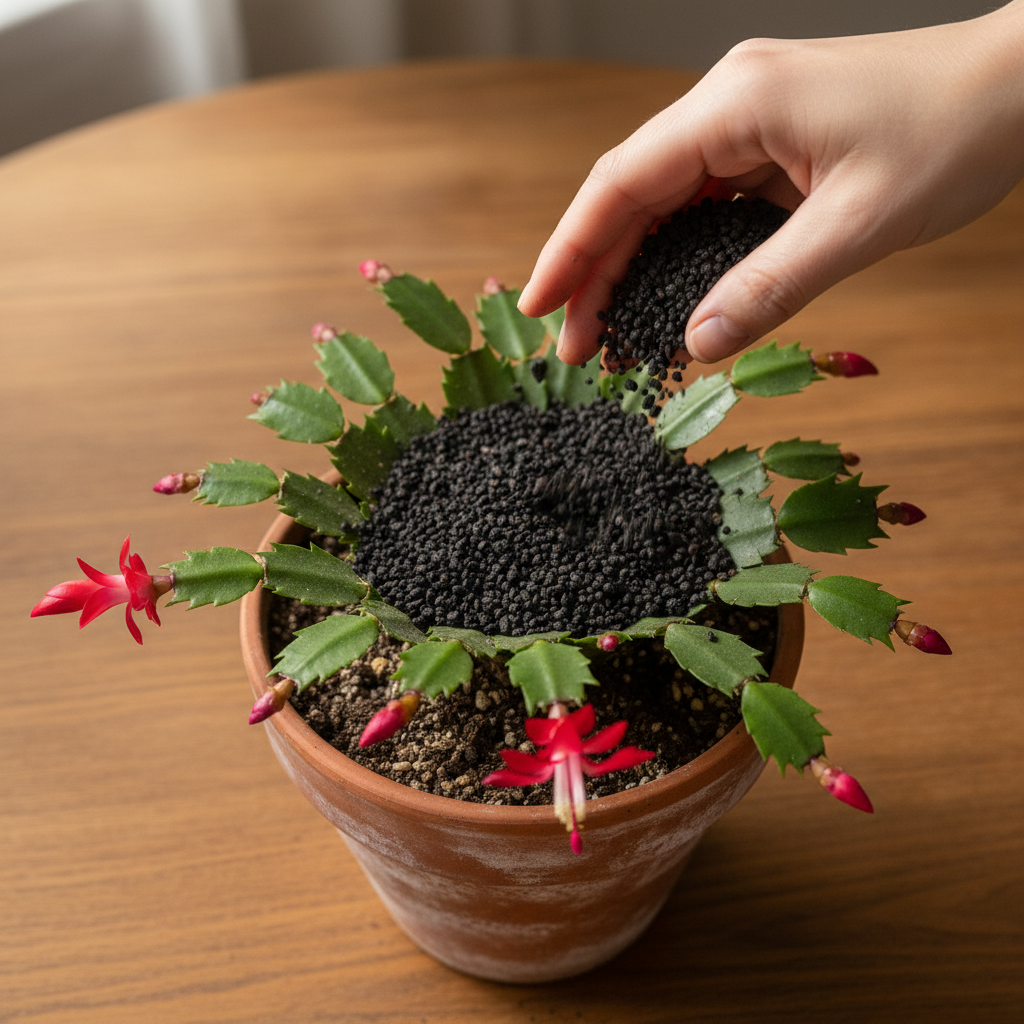
A balanced liquid houseplant fertiliser at a roughly 10-10-10 or 20-20-20 ratio (nitrogen-phosphorus-potassium) works well, diluted to quarter or half the label strength. From late summer into the bud-setting window, some growers switch to a slightly lower-nitrogen, higher-phosphorus and potassium formula such as a tomato or bloom feed, to encourage flowering rather than further leafy growth. Magnesium sulphate at one quarter teaspoon dissolved in a litre of water, applied once in mid-summer, can deepen the colour of the segments and is a cheap, well-tolerated supplement. Organic options work equally well: a top-dressing of worm castings every two to three months through the growing season provides steady gentle nutrition with no risk of fertiliser burn.
When and How Much to Feed
From the appearance of new growth in spring, usually six to eight weeks after the last flowers have dropped, through to the end of summer, feed at quarter to half strength every two to four weeks. Skip feeding entirely during the autumn rest period, roughly mid-September through to the moment buds visibly form; the plant is shifting hormonally toward flowering and any added nitrogen at this stage will push it back into leafy growth and suppress buds. Once buds are well-developed and beginning to colour, a single light feed at half strength can extend bloom and improve flower size, but holding off is also fine. After flowering finishes, give a four to six week rest with no feed before resuming the spring routine.
Signs of Fertiliser Problems
Overfertilised plants typically produce soft, weak, elongated new segments, refuse to bloom, and may show salt crusts on the soil surface or pot rim. Crispy brown segment tips can be a sign of fertiliser burn if they follow a strong feed, particularly with a dry rootball; always water lightly first and then feed, never feed into bone-dry soil. Underfed plants are paler than they should be, slow to grow, and may bloom poorly, but the signs are subtle and the safer bias for this species is always toward feeding less rather than more.
Propagation
Few houseplants are easier to propagate than a Christmas cactus, and the practice has a long sentimental tradition. Many of the heirloom specimens still circulating today began as a single segment broken off a great-grandparent’s plant decades ago and rooted in a jam jar. The two reliable methods are stem-segment cuttings in soil or moss, and rooting in water; both work, with soil and moss tending to produce slightly stronger root systems for the long term.
Stem Segment Cuttings (Most Reliable)
- In late spring or early summer, when the plant is actively growing, gently twist or pinch off a healthy section of stem that contains two to four connected segments. Use the natural joint as the breaking point; cuttings made mid-segment are less likely to root.
- Let the cuttings sit on a clean dry surface, out of direct sun, for one to three days to allow the cut end to callus over. This step is the single most important prevention against rot.
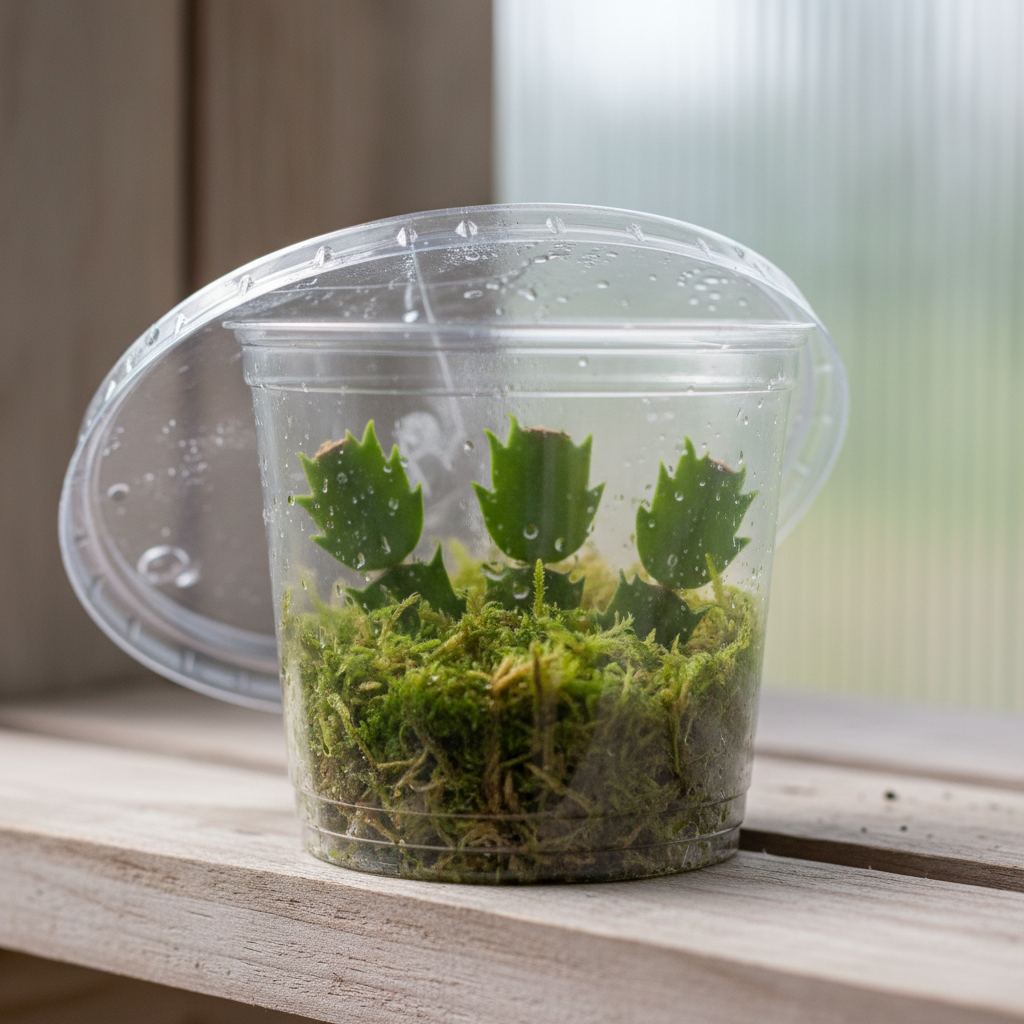
- Fill a small deli cup, seed tray or shallow pot with damp sphagnum moss, or with a 50:50 mix of perlite and fine cactus mix. Moisten until just damp, never soggy.
- Insert each cutting so that the lower segment is half-buried, ideally with a single visible joint sitting on the surface and the rest tucked into the medium. Multiple cuttings can share a single container.
- Cover loosely with a clear plastic dome, a deli-cup lid set ajar, or a clear bag held above the cuttings on sticks, to maintain humidity without trapping condensation directly on the segments.
- Place in bright indirect light at room temperature, 20 to 24 °C (68 to 75 °F). Lift the cover briefly every few days to refresh the air.
- Resist watering for the first week; from week two onward, mist or lightly water the moss to keep it just damp. Roots typically form within two to three weeks; a gentle tug after three weeks will confirm whether they have taken hold.
- Once roots are established and new tip growth begins to appear, pot each rooted cutting into a small individual pot with the regular soil mix and treat as a young plant.
Water Propagation
Water rooting is faster to set up and visually rewarding, though the resulting roots are slightly less robust when transitioning into soil. Use the same two to four segment cuttings, let them callus for 24 to 48 hours, then suspend each cutting in a small jar of room-temperature water so that only the lowest one or two millimetres of cut surface touches the water. White roots typically appear within ten to fourteen days. Once roots reach 2 to 3 cm (about an inch), pot the cutting into the regular mix and water sparingly for the first two weeks while the roots adapt to substrate.
From Seed
Growing from seed is biologically possible and how new cultivars are created, but it is slow and unrewarding for most home growers. Seedlings take three to five years to reach blooming size, and most home seed produced from open-pollinated houseplants will not breed true to the parent cultivar. Cuttings are almost always the better option for replicating a beloved plant.
Pests and Diseases
By houseplant standards, the Christmas cactus is moderately pest-resistant. Its thick, waxy, slightly tough segments are not the preferred food of most sap-suckers, which tend to gravitate toward thinner, lusher foliage on aroids and ferns nearby. The main vulnerabilities are mealybugs and fungus gnats, and on the disease side, root and stem rot driven by overwatering or poor airflow.
Common Pests
Mealybugs are the most frequent visitor, appearing as small cottony tufts at the joints between segments and at the soil line. Light infestations are managed by dabbing each tuft with a cotton bud dipped in 70 percent isopropyl alcohol, repeating every five to seven days for three weeks to break the life cycle. Heavier infestations respond well to a thorough rinse under tepid water followed by a neem-oil or insecticidal-soap spray applied to all surfaces, including the underside of every segment, twice weekly for two weeks.
Fungus gnats, small dark flies hovering around the soil, indicate that the surface is staying too wet for too long. They are mostly a symptom rather than a disease in their own right, but their larvae do nibble fine root tips and damage cuttings. Letting the soil surface dry more thoroughly between waterings, top-dressing with a thin layer of coarse sand or fine grit, and using yellow sticky traps to catch adults are the standard responses. Spider mites are uncommon on Christmas cacti but can appear during long, very dry winter spells; fine speckling on the segments and faint webbing in the joints are the telltale signs, and a good shower of water plus a humidifier nearby usually fixes the issue.
Common Diseases
Root and stem rot is the dominant disease threat. It almost always traces back to overwatering, poor drainage, or both, and is often catalysed by cool temperatures that slow the mix’s drying. The plant signals it by softening at the base, dropping otherwise healthy-looking segments at the joints, and developing a faint sour smell at the soil line. The response, as covered in the watering warning above, is decisive: unpot, cut back to firm green tissue, callus the cuttings, and restart in fresh dry mix.
Fungal leaf spotting can appear during very humid, still conditions, particularly if water is repeatedly splashed onto the segments. Small water-soaked spots that turn brown and slightly sunken are the typical pattern. Improving airflow, watering at the soil rather than over the top, and removing the worst-affected segments with a sterile blade is usually sufficient. Bacterial soft rot is rarer and faster-moving, producing a soft, slimy collapse of segments often accompanied by a strong smell. Affected segments must be removed cleanly back to healthy tissue immediately; severely affected plants are sometimes better restarted from a single clean cutting.
Routine Prevention
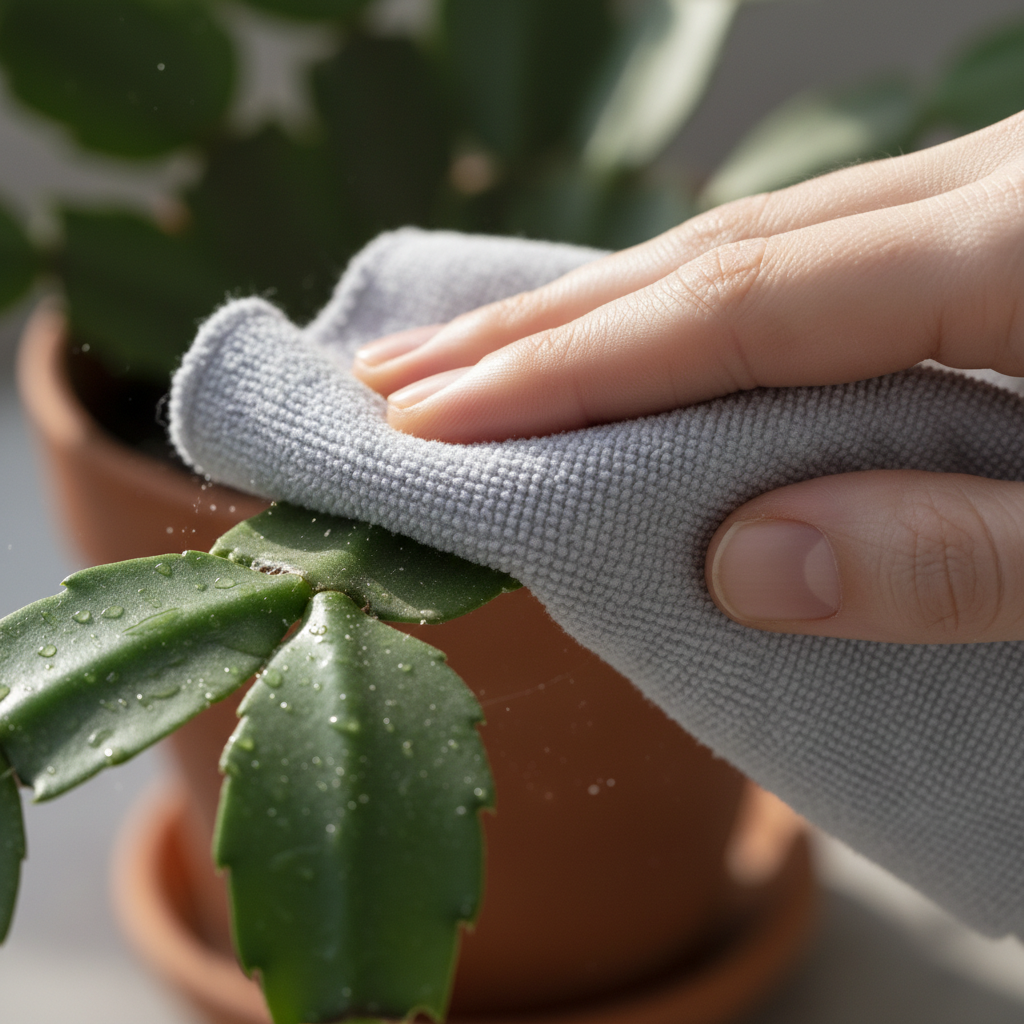
A few habits prevent the great majority of pest and disease problems: water only when the top of the mix has dried, never let the pot stand in water, give the plant good air movement, wipe the segments lightly with a damp cloth once a month to remove dust, and inspect the joints with a magnifier every few weeks during the growing season. New plants brought into the home should be kept in quarantine for two to three weeks before joining the main collection, which catches almost every imported infestation before it spreads.
Popular Varieties
The genus Schlumbergera has been intensively hybridised since the early nineteenth century, and the modern market offers a remarkable spread of flower colours and forms. Most plants sold simply as “Christmas cactus” or “holiday cactus” in supermarkets and garden centres belong to the Schlumbergera Truncata Group, a cluster of cultivars derived from S. truncata. The two featured below are widely available and represent two different visual extremes within the group.
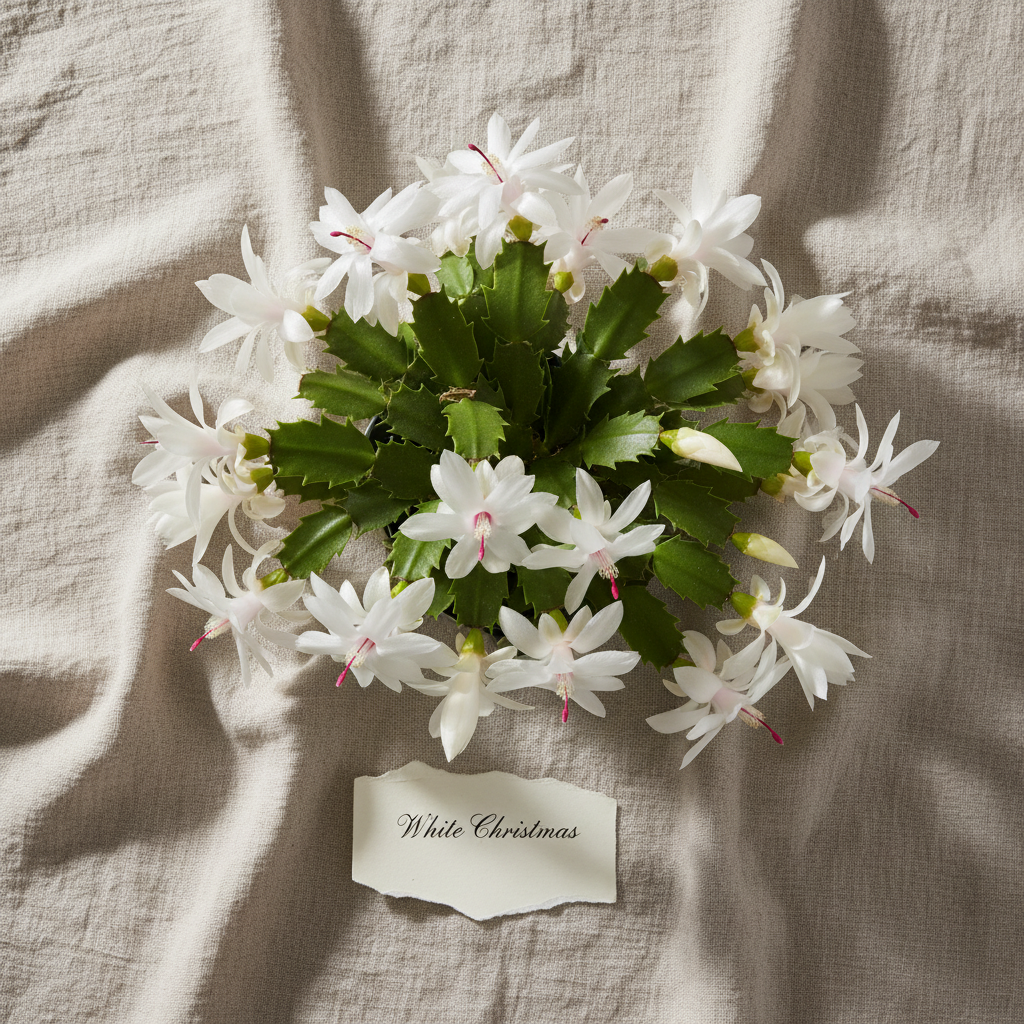
‘White Christmas’ opens to pure ivory-white tubular flowers with a delicate pink blush deep in the throat, a colour combination that reads almost luminous against the dark green segments. It is a popular choice for cooler-toned interiors and pairs unusually well with brass and pale wood. Bloom timing is slightly later than the saturated pink cultivars and tends to extend further into January in well-managed plants. Care is identical to the species.
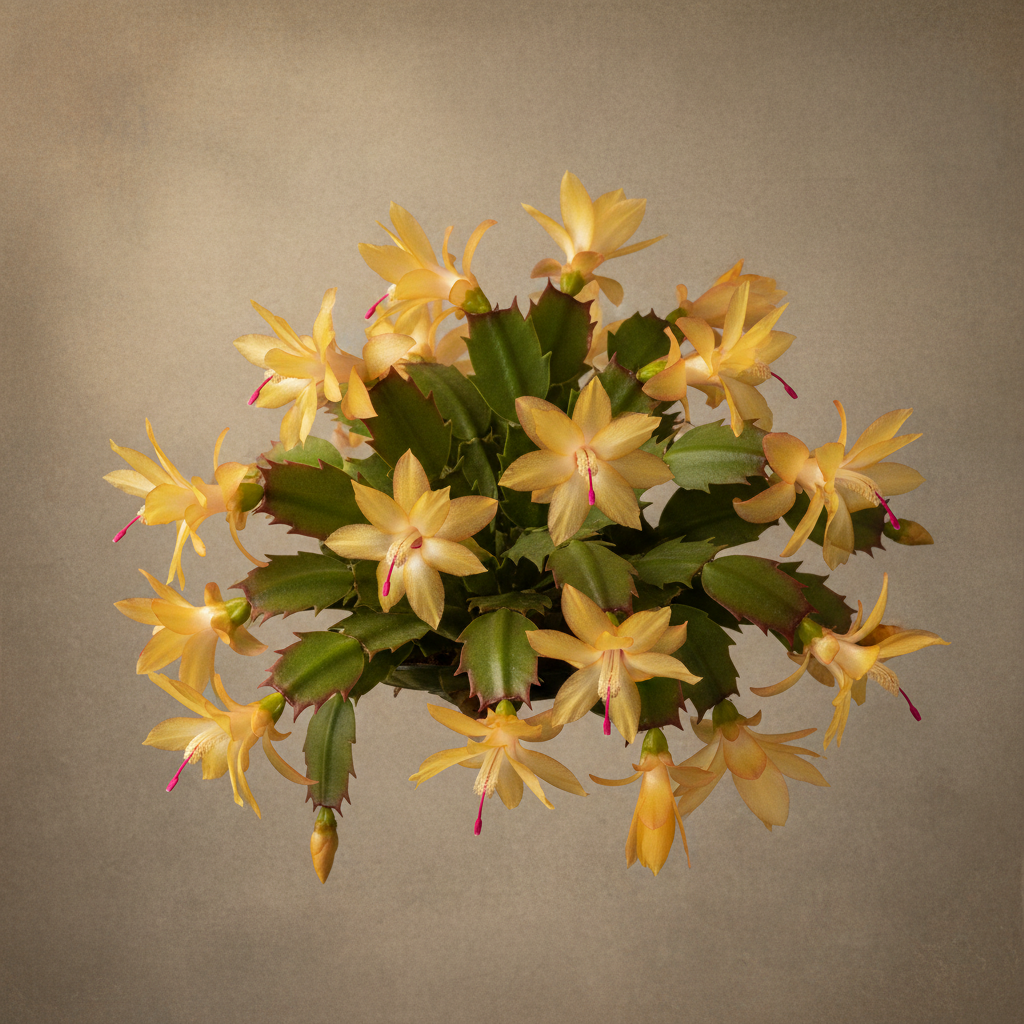
‘Gold Charm’ is one of the rarer yellow-flowered cultivars to make it into general circulation, producing warm gold blooms tinged with apricot at the petal edges and a soft cream throat. The segments often flush a deeper red along their margins in cooler conditions, giving the plant a striking warm-on-warm palette through the bloom period. Yellow cultivars in this genus tend to be slightly more light-hungry to keep their colour saturated, so a brighter east window is ideal.
Other Cultivars Worth Seeking Out
Beyond the two featured above, the Truncata Group includes ‘Christmas Flame’ with vivid orange-red flowers, ‘Madisto’ in warm magenta with paler edges, ‘Polka Dance’ with white blooms strikingly edged in deep pink, and ‘Madame Butterfly’ with bicolour pink-and-white blooms. Collectors interested in the original true Christmas cactus (Schlumbergera × buckleyi) should look for plants with smooth-edged, rounded segments rather than sharply pointed teeth; these are slightly less common in modern garden centres but still circulate widely among houseplant enthusiasts and tend to bloom a few weeks later, closer to the namesake holiday.
Frequently Asked Questions
Why won’t my Christmas cactus bloom?
The two reasons that account for the great majority of bloom failure are interrupted dark periods in autumn and insufficient light in summer. A Christmas cactus is a short-day plant and needs at least 12 to 14 hours of complete uninterrupted darkness every night for roughly six to eight weeks in autumn to trigger bud formation. A lamp coming on in the evening, a streetlight outside the window, or a television in the same room can be enough to suppress flowering. Move the plant for six weeks to a cool, dark, low-traffic room from mid-September to late October, then return it to its normal spot once buds are visible.
Why are my buds dropping before they open?
Bud drop is almost always caused by an environmental change once buds have formed. The classic triggers are moving the plant from one room to another, sudden swings in temperature (such as next to a radiator or a draughty door), inconsistent watering, very dry air, or rotating the pot. Once buds are visible, keep the plant in one stable position and resist the urge to fuss with it; sometimes the best thing for a Christmas cactus in bud is to be left almost completely alone.
Is the Christmas cactus toxic to pets?
No, and this is one of its considerable advantages. Schlumbergera truncata is listed as non-toxic to cats, dogs and humans by all major veterinary toxicity references. A cat that chews a segment may experience mild gastrointestinal upset purely from the fibrous plant material, but no toxic compounds are involved. This makes it one of the safer flowering plants to keep in households with curious pets.
My plant is leaning to one side, should I rotate it?
Rotate the pot a quarter turn every two to three weeks during active growth in spring and summer to keep the plant balanced. Stop rotating from late summer onward, once the autumn rest period begins, and absolutely do not rotate it once buds have formed; positional change is one of the classic causes of bud drop. After flowering, return to the normal rotation schedule.
What is the difference between a Christmas cactus and a Thanksgiving cactus?
The distinction is mostly botanical. The true Christmas cactus (Schlumbergera × buckleyi) has segments with rounded, scalloped edges and tends to bloom in late December and January. The Thanksgiving cactus (Schlumbergera truncata) has segments with two to four pointed teeth on each side and blooms slightly earlier, typically November to December. Most modern hybrids sold as “Christmas cactus” in the trade are actually Truncata Group plants, but their care is identical, and many growers happily call them all Christmas cactus regardless of strict botany.
Can I keep a Christmas cactus outside in summer?
Yes, and many plants flourish from a summer holiday outdoors. Wait until night temperatures stay reliably above 10 °C (50 °F), then move the plant to a fully shaded or dappled-shade spot, never full sun. Bring it back indoors before night temperatures drop below 10 °C in autumn, ideally as part of the deliberate cool-rest transition that initiates bud setting. Inspect carefully for pests before bringing the plant back inside.
How long can a Christmas cactus live?
Routinely 20 to 30 years with ordinary care, and significantly longer with attentive care. Multi-generational family plants over 50 years old are common, and well-documented specimens over 100 years old exist in botanical garden collections and private hands. It is one of the longest-lived flowering houseplants on the market, which is why it is so often passed from parent to child as cuttings.
Should I deadhead spent flowers?
Most flowers detach on their own once they finish, falling cleanly from the segment tip. Picking up dropped blooms from the soil surface promptly helps prevent botrytis or fungal growth on the wet plant material. If a spent flower is hanging on but clearly finished, a gentle twist removes it without damaging the segment behind. There is no need to make any deeper pruning cuts after flowering.






