
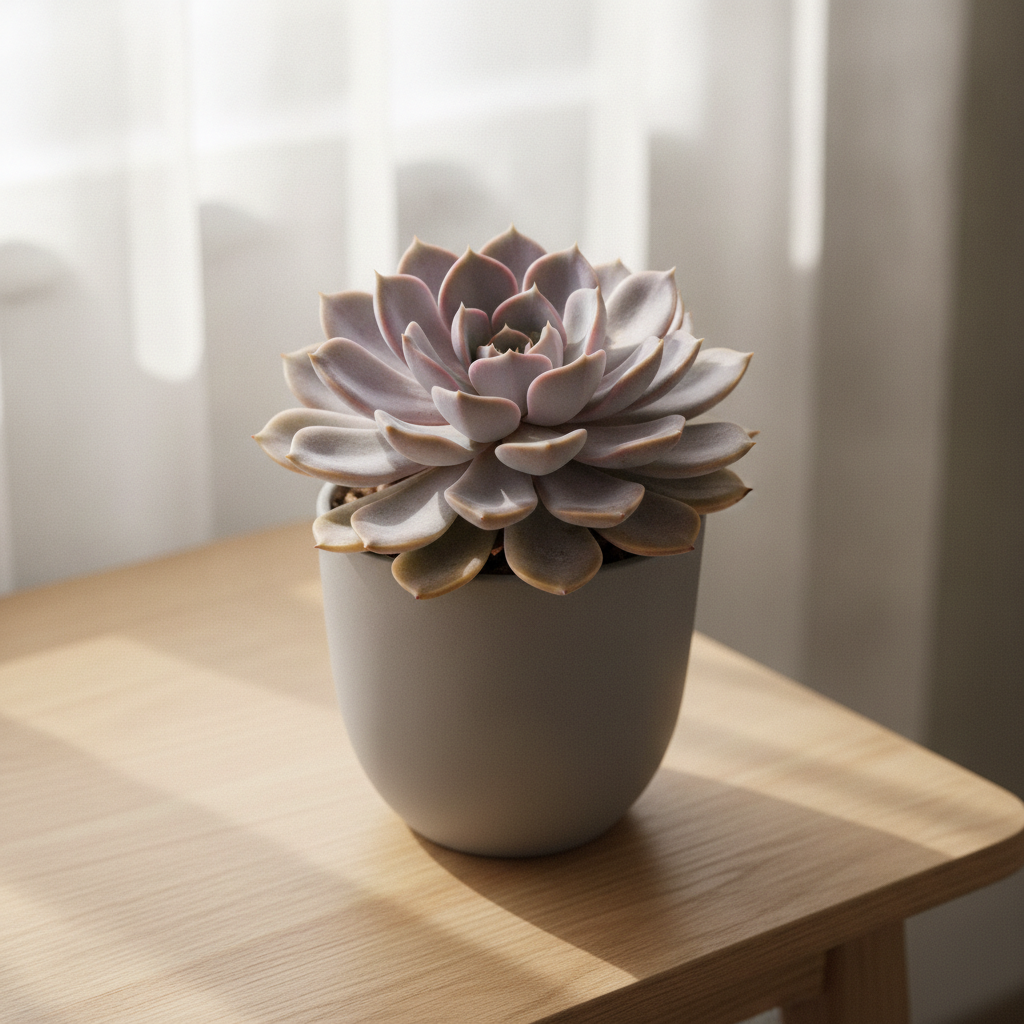
Few succulents earn a following on looks alone, but Perle von Nürnberg manages it with a rosette the colour of a stormy sunset. This is a hybrid Echeveria, raised in Germany in the 1930s by nurseryman Richard Graessner from a cross of Echeveria gibbiflora var. metallica and Echeveria elegans, and named for the Bavarian city of Nuremberg. Its broad, spoon-shaped leaves carry a dusty coating of natural wax that turns them lavender-pink, silver-grey and, in strong light, a smoky violet flushed with rose at the leaf tips.
The plant has a reputation as an easy, forgiving succulent, and that is fair as far as it goes. It will survive on a bright windowsill with little more than the occasional soaking. Thriving, though, is a different matter: keeping that famous colour saturated, the rosette tight and symmetrical, and the powdery bloom intact takes an understanding of how light, water and soil work together. This guide covers everything from the light levels that deepen its purple tones to the propagation methods that let you turn one rosette into a whole tray, along with the mistakes that flatten its colour or rot its roots.
Contents
- Quick Reference
- Why Perle von Nürnberg Makes a Rewarding Houseplant
- Light Requirements
- Watering & Humidity
- Soil, Potting & Repotting
- Fertilising
- Propagation
- Pests & Diseases
- Popular Varieties
- Frequently Asked Questions
Quick Reference: Perle von Nürnberg at a Glance
| Light | Very bright light with several hours of direct sun; a south or west window indoors, or gently acclimatised outdoor sun |
| Watering | Soak thoroughly, then let the soil dry out completely; roughly every 10 to 14 days in summer, far less in winter |
| Temperature | 18 to 27 C (64 to 81 F); tolerates brief dips to about 5 C (41 F) but is not frost hardy |
| Humidity | Low; ordinary dry room air is ideal and high humidity is a liability |
| Fertiliser | A dilute, low-nitrogen succulent feed once a month during the growing season only |
| Toxicity | Non-toxic to cats, dogs and humans; safe around pets and children |
Why Perle von Nürnberg Makes a Rewarding Houseplant
The obvious appeal is the colour. Where most rosette succulents settle for green or blue-grey, Perle von Nürnberg offers a shifting palette of pink, lavender and pewter that changes with the seasons and the light it receives. That colour comes from a fine, powdery layer of natural wax called farina, or pruinose bloom, which coats each leaf and gives the plant its soft, almost dusted appearance. In brighter, cooler conditions the pink and violet tones intensify into what growers call stress colour, a healthy response rather than a sign of trouble.
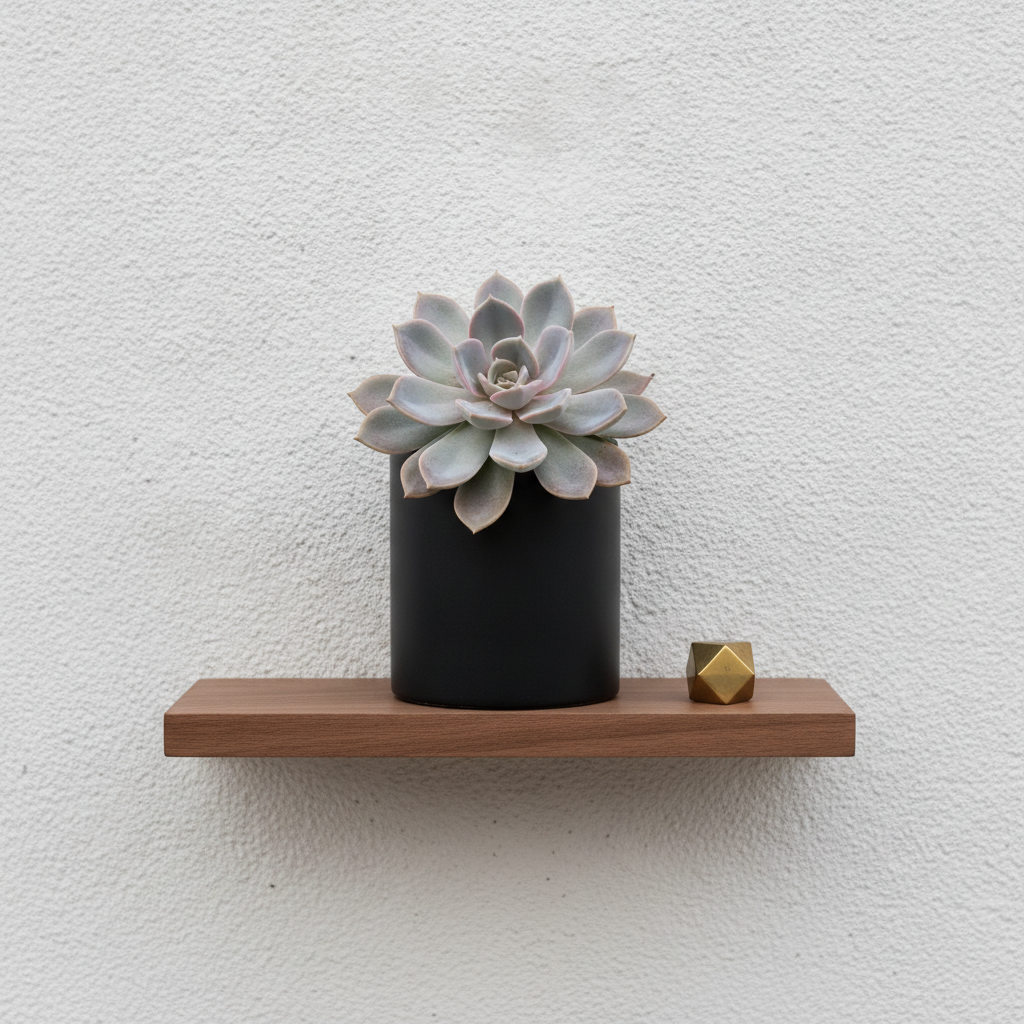
Beyond looks, it is a genuinely undemanding plant for anyone who can give it enough light. It stays compact, rarely exceeding 15 to 20 cm (6 to 8 in) across, so it suits windowsills, desks and small shelves where a larger plant would crowd. It stores water in its fleshy leaves, which means it forgives the occasional missed watering far more readily than it forgives overwatering. Mature plants reward good care with tall, arching flower stalks in spring and summer, lined with coral-pink bells tipped in yellow that draw the eye for weeks. For a beginner ready to move beyond the toughest foliage plants, it is an ideal introduction to the rhythms of succulent care.
Important — Toxicity: Perle von Nürnberg is not toxic to cats, dogs or people, and the wider Echeveria genus is listed as non-toxic by the ASPCA. It is a safe choice for homes with curious pets or small children, though as with any plant it is sensible to discourage nibbling, since fleshy leaves can still cause mild stomach upset if eaten in quantity.
Light Requirements
Light is the single most important factor in growing this plant well, and it is where most indoor specimens fall short. Perle von Nürnberg evolved from Mexican highland parents that grow in open, sun-drenched positions, and it needs a great deal of light to stay compact and colourful. Given too little, it does not die quickly, but it changes character entirely, and understanding that change is the key to keeping the rosette you fell for.
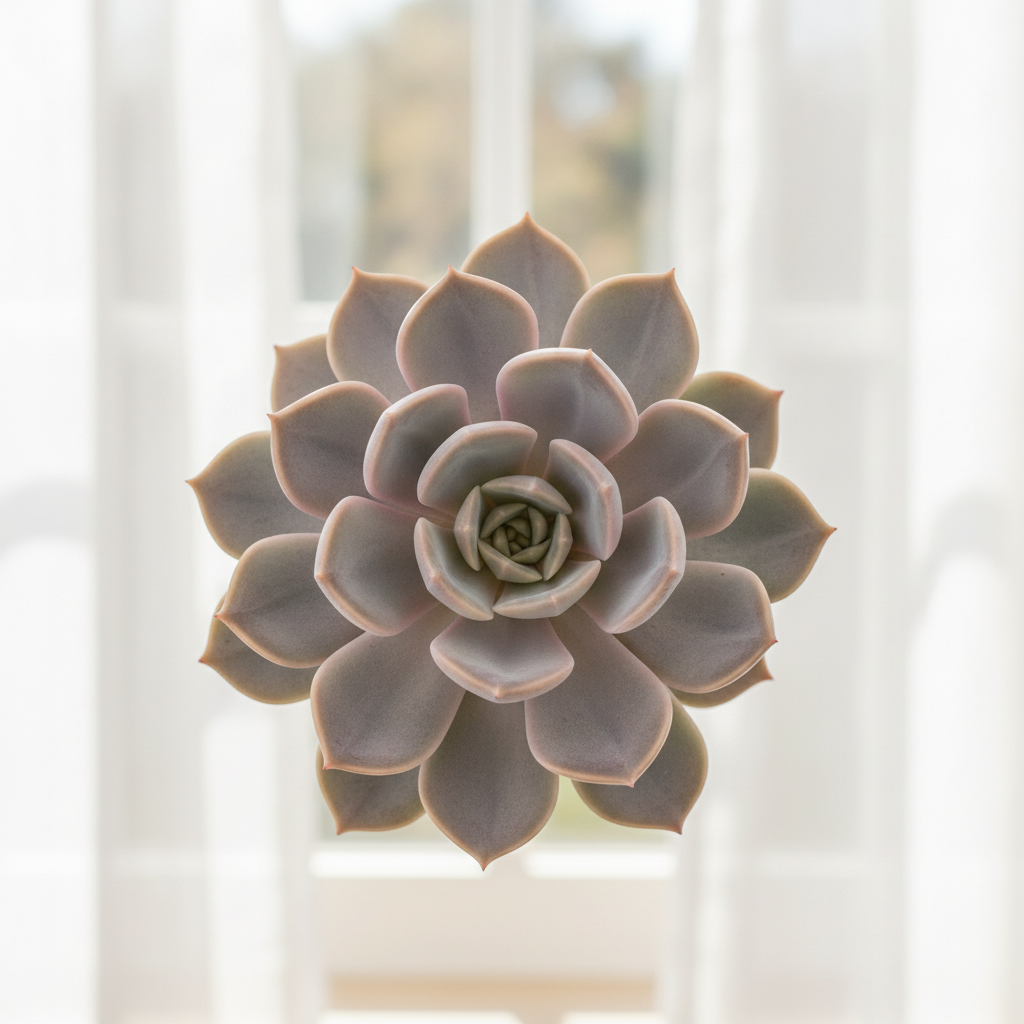
The ideal is bright light with at least four to six hours of direct sun each day. Indoors that means the closest possible position to a south or west-facing window, pressed right up against the glass rather than set back on a shelf. In these conditions the leaves stay short and cupped, the rosette holds its tight geometric form, and the pink and lavender colour deepens. Fall short of this and the plant will tell you plainly.
Light Levels Explained
Succulent light needs are often described loosely, so the table below translates the usual categories into practical outcomes for this particular plant. The single most useful skill you can develop is reading the rosette itself: a plant that is reaching, stretching or paling is asking for more light, no matter what a meter says.
| Light Category | Approx. Level | Typical Location | Outcome |
|---|---|---|---|
| Direct sun | Over 50,000 lux | On the sill of an unshaded south window, or outdoors | Best colour and form once acclimatised; risk of scald if the change is sudden |
| Bright indirect | 20,000 to 50,000 lux | Just beside a bright window | Healthy but colour softer and rosette a little looser |
| Medium | 10,000 to 20,000 lux | A metre or two back from a window | Noticeable stretching within weeks; green tones return |
| Low | 2,000 to 10,000 lux | A north window or a dim corner | Rapid etiolation, weak stem, loss of colour |
| Very low | Under 2,000 lux | Interior room with no direct window | Cannot be sustained; decline and eventual collapse |
Window Orientation and Placement
South-facing window: The best position in most homes, giving the long hours of direct sun this plant craves. In high summer, sheer curtains at midday can take the edge off the fiercest light while an unacclimatised plant adjusts.
West-facing window: An excellent second choice, delivering strong afternoon sun. The warmth of a west sill suits the plant well, though watch that the glass does not trap excessive heat on the hottest days.
East-facing window: Workable but marginal. Morning sun is gentler, so expect slightly looser growth and less intense colour than a south or west aspect would produce. Supplement with a grow light through the darker months.
North-facing window: Not enough on its own. A north window provides only soft, indirect light, and a Perle von Nürnberg placed here will stretch and fade within a month or two. If a north room is all you have, artificial light is essential.
Pro Tip — Rotate for Symmetry: Rosette succulents grow toward their light source, and a plant left in one position will slowly lean and lose its symmetry. Give the pot a quarter turn every few days to keep the rosette flat, even and facing upward.
How Light Affects Colour and Form
The most visible consequence of low light is etiolation, the process by which a starved rosette stretches upward, spacing its leaves along a lengthening stem in a desperate reach for brightness. An etiolated Perle von Nürnberg loses the very things that make it special: the tight rosette opens out, the leaves turn from lavender to plain green, and the stem becomes weak and leggy. This damage cannot be reversed on the affected growth; the stretched section stays stretched. The remedy is more light going forward, or beheading the rosette and re-rooting the compact top, a technique covered in the propagation section. Strong light does the opposite, drawing out the pink and violet stress colour and keeping the plant dense and low.
Warning — Direct Sunlight: Although this plant loves sun, a specimen grown in low light and then moved abruptly into full sun can scorch, developing permanent brown or bleached patches where the leaves burn. Always increase sun exposure gradually over one to two weeks, adding an hour or so of direct light every few days, so the farina and leaf tissue can adapt.
Artificial Lighting
Where natural light is limited, a full-spectrum LED grow light is a reliable substitute and can keep a rosette compact through a dark winter. Position the light around 15 to 30 cm (6 to 12 in) above the plant and run it for 10 to 12 hours a day. Because succulents need high intensity to stay tight, a weak decorative bulb will not do; look for a dedicated grow light rather than an ordinary household lamp. If the rosette begins to stretch even under a light, lower the fixture or extend the daily run time.
Seasonal Adjustments
Light levels swing dramatically between summer and winter, and the plant’s needs move with them. In the short, dim days of winter, move the plant to your brightest possible window and accept that a little colour may fade until spring. As the sun strengthens again, reintroduce direct exposure gradually to avoid shocking leaves that have grown accustomed to weaker winter light. Many growers see their best colour in autumn, when nights turn cool but days remain bright, a combination that pushes the pink and purple tones to their peak.
Watering & Humidity
If light is where people underdo it, water is where they overdo it. Perle von Nürnberg stores water in its plump leaves and evolved in a climate of long dry spells broken by heavy rain, so it is built to handle drought and thoroughly unequipped to sit in constant moisture. The guiding principle is simple: water generously, then not at all until the soil is bone dry. Getting the rhythm of that cycle right is the difference between a firm, healthy rosette and a mushy, collapsing one.
When to Water
Forget any fixed schedule and water according to the soil instead. Wait until the potting mix has dried out completely all the way through, then water. In a warm, bright spot during the growing season this might mean watering every 10 to 14 days, but the interval depends entirely on your light, pot and mix, so check rather than assume. Push a finger or a wooden skewer deep into the soil; if it comes out with any dampness or clinging grains, wait longer.
The leaves themselves are a useful gauge. A well-watered rosette feels firm and full, while a thirsty one softens slightly and the lowest leaves may start to look a little wrinkled or flatten toward the soil. That mild softness is your cue to water; a plump, rigid rosette needs nothing. In winter, when growth slows or stops, cut back sharply, watering perhaps once every three to five weeks and only enough to stop the plant shrivelling.
Pro Tip — Water the Soil, Not the Rosette: Water pooling in the centre of the rosette can trigger rot and, over time, wash away the powdery farina that gives the plant its colour. Direct water to the soil surface or bottom-water from a tray, and if the crown does get wet, tip the plant gently to drain it and let it dry in good airflow.
How to Water Correctly
- Confirm the soil is fully dry all the way to the bottom of the pot before you begin.
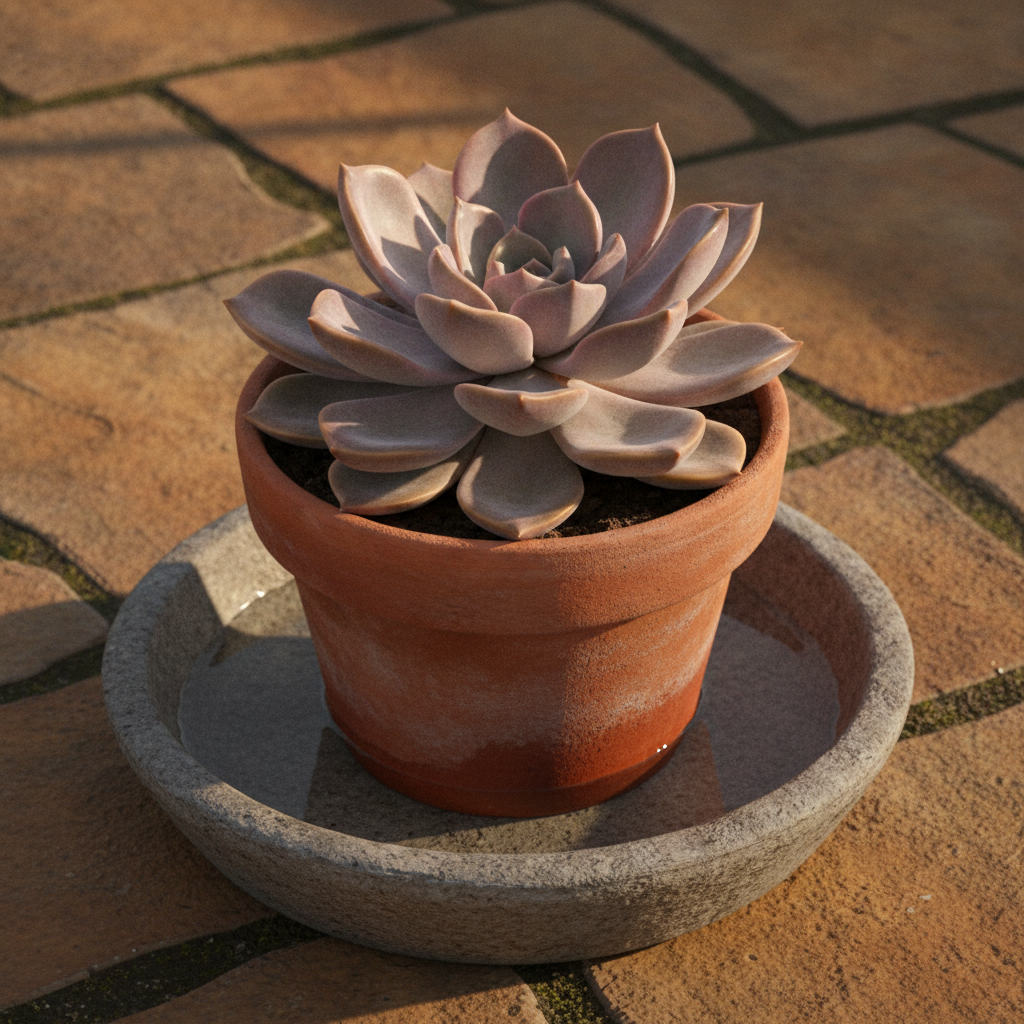
- Water the soil surface slowly and evenly, keeping the stream off the leaves, or stand the pot in a shallow dish of water to soak from below.
- Continue until water runs freely from the drainage holes, ensuring the entire root ball is wetted, not just the top layer.
- If bottom watering, remove the pot once the surface feels damp, usually after 10 to 20 minutes.
- Let the pot drain completely and never leave it standing in collected water.
- Wait until the mix is bone dry again before the next watering, however long that takes.
Signs of Overwatering vs. Underwatering
| Symptom | Overwatering | Underwatering |
|---|---|---|
| Leaf colour | Yellowing, translucent or blackening leaves | Colour holds but may dull slightly |
| Leaf texture | Soft, mushy, squishy to the touch | Thin, wrinkled, slightly deflated |
| Lower leaves | Rot and drop off from the base, sometimes with a foul smell | Shrivel and dry papery from the base, easily removed |
| Soil | Stays wet for many days, may smell sour | Dry throughout, sometimes pulling from the pot edge |
| Stem base | Brown, soft or black; the classic sign of rot | Firm and dry |
Warning — Root Rot: A soft, browning or blackening stem base is a succulent emergency and rarely recovers on its own. Act fast: pull the plant, cut away all rotten tissue until only firm green remains, let the wound callus in the air for a few days, and re-root the healthy top. A rescued cutting is far better than a lost plant, and by the time rot shows above the soil the roots are usually already gone.
Humidity Requirements
This is one of the rare houseplants where high humidity is unwelcome. Perle von Nürnberg thrives in the dry air of an ordinary heated home and actively dislikes the damp, still conditions that tropical foliage plants enjoy. Average indoor humidity of 30 to 50 percent is perfect, and the plant will happily tolerate even drier air.
Problems appear at the other end of the scale. In humid rooms or stagnant air, moisture lingers on and around the rosette, raising the risk of fungal rot, and the plant may struggle to transpire and firm up its leaves. If you grow it in a bathroom or a naturally humid climate, prioritise strong airflow and a very fast-draining mix to compensate.
Crucially, do not mist this plant. Misting achieves nothing useful for a succulent and does real harm here, settling water in the crown where it invites rot and gradually stripping the farina from the leaves. Everything this plant needs from the air, it already has in a normal dry room.
Water Quality
Perle von Nürnberg is not fussy about water quality and ordinary tap water suits it in most areas. If your water is very hard, minerals can leave pale deposits on the soil surface over time, though this is cosmetic rather than harmful. Where the plant is watered from above, softened rainwater keeps the leaves and farina cleaner, but for a bottom-watered succulent the point is largely moot. Room-temperature water is gentler on the roots than cold water straight from the tap.
Soil, Potting & Repotting
Soil is the quiet partner to watering, and the two cannot be considered separately. Even a careful waterer will struggle if the plant sits in a dense, moisture-holding mix, because the roots will stay wet long after the surface looks dry. The goal for Perle von Nürnberg is a gritty, open medium that drains almost instantly and holds very little water, mimicking the sharp, mineral soils of its native highlands.
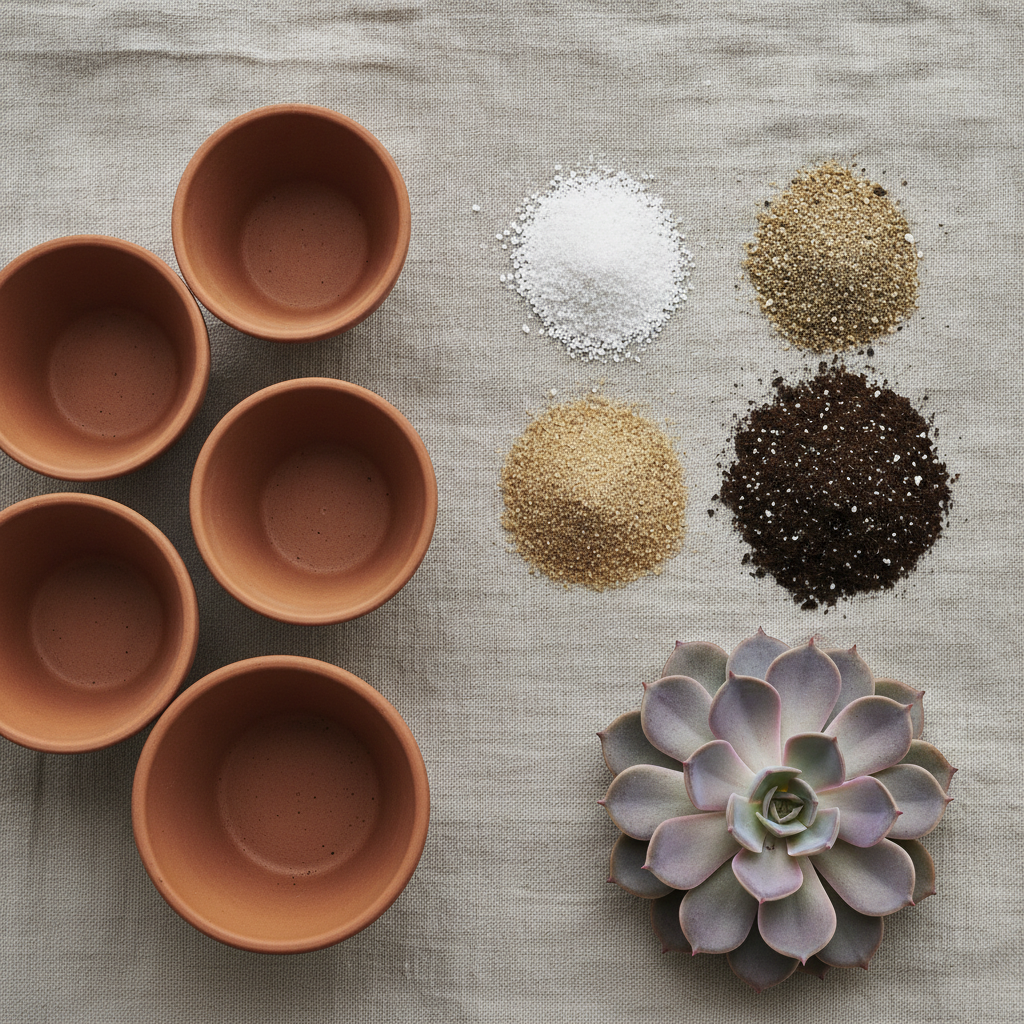
Ideal Soil Composition
A good mix is heavy on grit and light on organic matter. Ordinary houseplant compost holds far too much water on its own and should always be cut with generous amounts of mineral grit. Many growers aim for a blend that is at least half, and often more, coarse inorganic material, so that water races through and air reaches the roots between soakings.
| Component | Proportion | Function |
|---|---|---|
| Cactus or succulent compost | Around one third to one half | Provides structure and a modest reserve of nutrients and moisture |
| Pumice or perlite | Around one third | Opens the mix for drainage and air, holding almost no water |
| Coarse grit or sharp sand | Around one fifth | Adds weight and speeds drainage; avoid fine builder’s sand |
The plant is not demanding about pH, being comfortable across a slightly acidic to neutral range of roughly 6.0 to 7.0, which is where most commercial succulent mixes naturally sit. Far more important than pH is the physical structure of the mix; get the drainage right and the chemistry will look after itself.
Pro Tip — Quick Mix Recipe: For a reliable, no-fuss blend, combine two parts commercial cactus compost with one part pumice or perlite and one part coarse grit. Mix thoroughly, and if the result still looks dark and dense, add more grit until you can see plenty of pale mineral particles throughout.
Choosing the Right Pot
The pot is part of the drainage system, not just a container. A well-chosen pot works with your mix to keep the roots on the dry side, while a poor choice can undo all the effort you put into the soil.
Drainage holes are non-negotiable. Never plant a Perle von Nürnberg in a pot without a drainage hole, however attractive the vessel. Without an exit for excess water the roots will sit in the wet layer at the bottom and rot, no matter how careful your watering. If you love a decorative pot with no hole, use it as an outer cover and keep the plant in a plain nursery pot inside.
Pot material: Terracotta is ideal, because its porous walls draw moisture out of the soil and let it dry faster between waterings, which is exactly what this plant wants. Glazed ceramic and plastic hold moisture longer, so if you prefer them, lean even harder on a gritty mix and water more cautiously.
Pot size: Choose a pot only slightly larger than the rosette itself. A shallow, snug pot dries quickly and suits the plant’s modest root system, whereas an oversized pot holds a large volume of slow-drying soil around roots that cannot use it, inviting rot.
When to Repot
This is a slow-growing plant that dislikes disturbance, so repot only when there is good reason: when roots grow from the drainage holes, when the rosette has outgrown its pot, when offsets have crowded the container, or when the old soil has broken down and no longer drains freely. For most plants this means every two to three years. The best time is early in the growing season, spring or early summer, when the plant can recover quickly. Always repot into dry soil and wait several days before the first watering, giving any disturbed roots time to heal.
How to Repot: Step-by-Step
- Let the soil dry out fully first, which makes the root ball easier to remove and less prone to tearing.
- Ease the plant from its pot, supporting the rosette from below rather than pulling on the leaves.
- Gently crumble away the old soil from the roots and inspect them, trimming any that are black, mushy or clearly dead.
- Remove any lower leaves that have shrivelled, and separate offsets now if you wish to pot them on.
- Settle the plant into fresh dry mix at the same depth it sat before, firming lightly so it stands upright.
- Top-dress with a thin layer of grit if you like, both for looks and to keep the base of the rosette dry.
- Wait three to seven days before watering, then resume the normal soak-and-dry cycle.
Warning — Transplant Shock: Repotting into moist soil and watering straight away is the fastest route to rot, because any small wounds on the roots become entry points for infection while they are still open. Always repot dry and delay that first watering; the plant is perfectly happy to wait, and the pause lets damaged roots seal over safely.
Fertilising
Perle von Nürnberg is a light feeder that gets by on very little, and the most common fertilising mistake is simply doing too much. In the wild its ancestors grow in lean, mineral soils, so a modest, occasional feed during active growth is all it wants. Overfeeding produces soft, pale, oversized leaves that stretch the rosette and wash out its colour, the opposite of what most growers are hoping to achieve.
Think of fertiliser as an occasional supplement rather than a staple. A fresh, gritty mix already contains enough nutrients to carry the plant for its first season, and after that a light monthly feed through spring and summer more than covers its needs. Never feed a dormant plant in winter, and never feed a dry or stressed one.
Understanding Plant Nutrients
Fertilisers are labelled with an N-P-K ratio showing the proportion of nitrogen, phosphorus and potassium. For a succulent grown for its compact form and colour, you want a feed that is low in nitrogen relative to the other elements, since excess nitrogen drives exactly the soft, leggy growth you are trying to avoid. The table below outlines the main nutrients and what a shortage of each looks like.
| Nutrient | Symbol | Primary Function | Deficiency Symptoms |
|---|---|---|---|
| Nitrogen | N | Leaf and stem growth | Pale, stalled growth; keep it modest to protect form |
| Phosphorus | P | Root development and flowering | Poor rooting, few or no blooms |
| Potassium | K | Overall vigour and stress resistance | Weak growth, browning leaf edges |
| Calcium | Ca | Cell wall strength | Distorted new growth |
| Magnesium | Mg | Chlorophyll production | Yellowing between leaf veins |
| Iron | Fe | Chlorophyll and enzyme function | Yellowing of the youngest leaves |
Types of Fertiliser
Liquid fertilisers: The easiest option for a succulent, giving you full control over strength and timing. Choose a balanced or low-nitrogen feed, dilute it to half or a quarter of the recommended houseplant strength, and apply it to already-moist soil during the growing season.
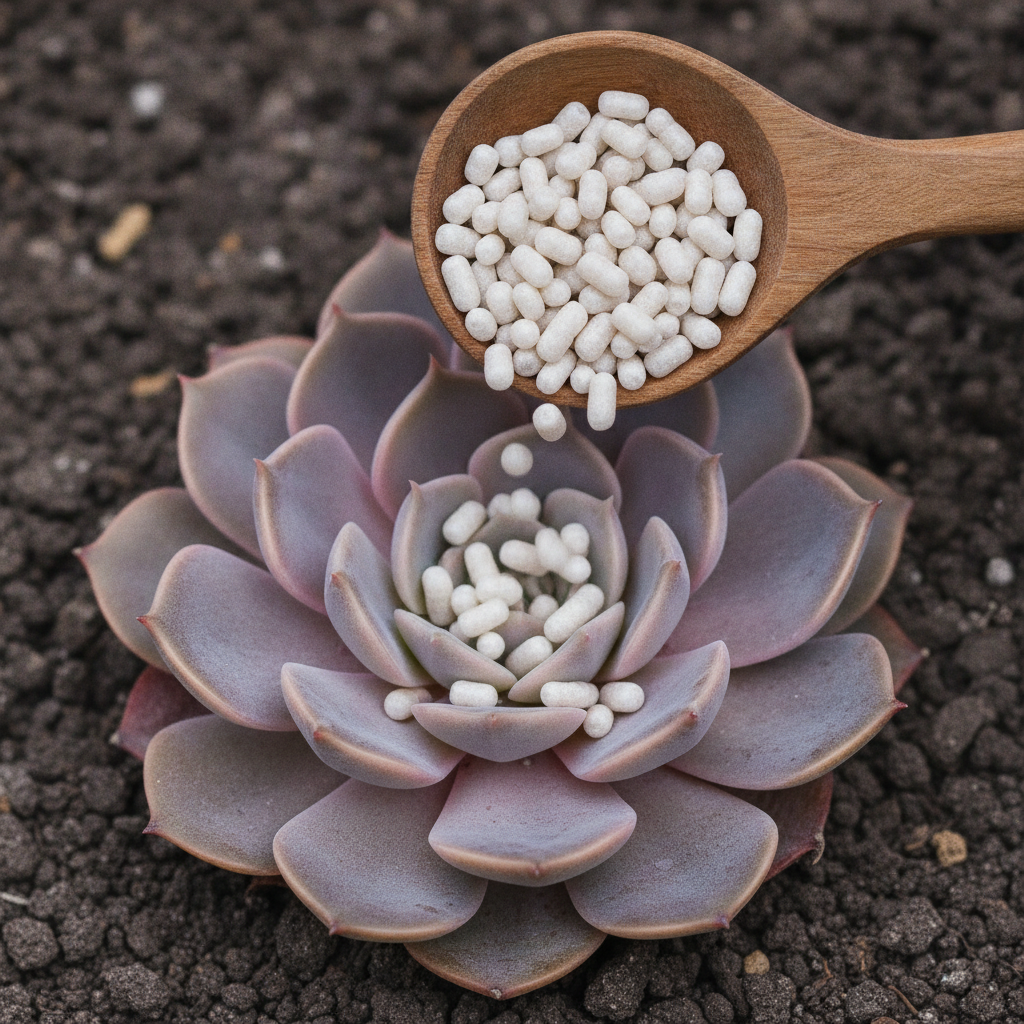
Slow-release granular: Convenient for those who would rather not remember a schedule, releasing a small trickle of nutrients over several months. Use a light hand, as these can easily oversupply a plant that wants so little, and scatter only a few prills over the soil surface.
Organic fertilisers: Gentle, low-strength options such as dilute worm-casting tea work well and are hard to overdo. They feed slowly and improve the life of the soil, though they act more subtly than a targeted mineral feed.
Feeding Schedule
Feed only during active growth, which for this plant means spring and summer, and perhaps into early autumn where the climate is mild. A single dilute feed once a month across those months is ample. Stop entirely in late autumn and winter, when the plant is resting and cannot use the nutrients, and any excess simply accumulates as harmful salts in the soil.
Pro Tip — Less Is More: When in doubt, feed less. A Perle von Nürnberg kept slightly lean stays compact, firm and richly coloured, while an overfed one turns loose, soft and green. You can always add a little more next month, but you cannot un-stretch a rosette that has been pushed too hard.
How to Fertilise
- Confirm it is the growing season and the plant is healthy and actively growing.
- Dilute a balanced or low-nitrogen fertiliser to a quarter or half of the usual houseplant strength.
- Water lightly first if the soil is completely dry, so the feed does not scorch dry roots.
- Apply the diluted solution to the soil, keeping it off the leaves and out of the crown.
- Resume the normal soak-and-dry watering cycle, and do not feed again for a month.
Warning — Salt Build-Up: Fertiliser salts accumulate in the soil over time and can show as a white crust on the surface or scorched, browning leaf tips. If you see this, flush the pot thoroughly with plain water to leach the salts out, let it drain and dry completely, and ease off on feeding thereafter.
Propagation
Propagating Perle von Nürnberg is one of the real pleasures of growing it. Like most echeverias, it multiplies readily from its own leaves and offsets, and a single plant can become a whole collection with patience and very little skill. Because it is a named hybrid, seed will not come true, so every method here is vegetative, producing exact clones of the parent rosette.
The three practical routes are leaf propagation, separating offsets and beheading. Leaf propagation is the classic succulent trick and the most productive; offsets give you ready-made small plants; and beheading doubles as a rescue for a stretched or rotting rosette. All work best in spring and summer, when warmth and light drive fast rooting.
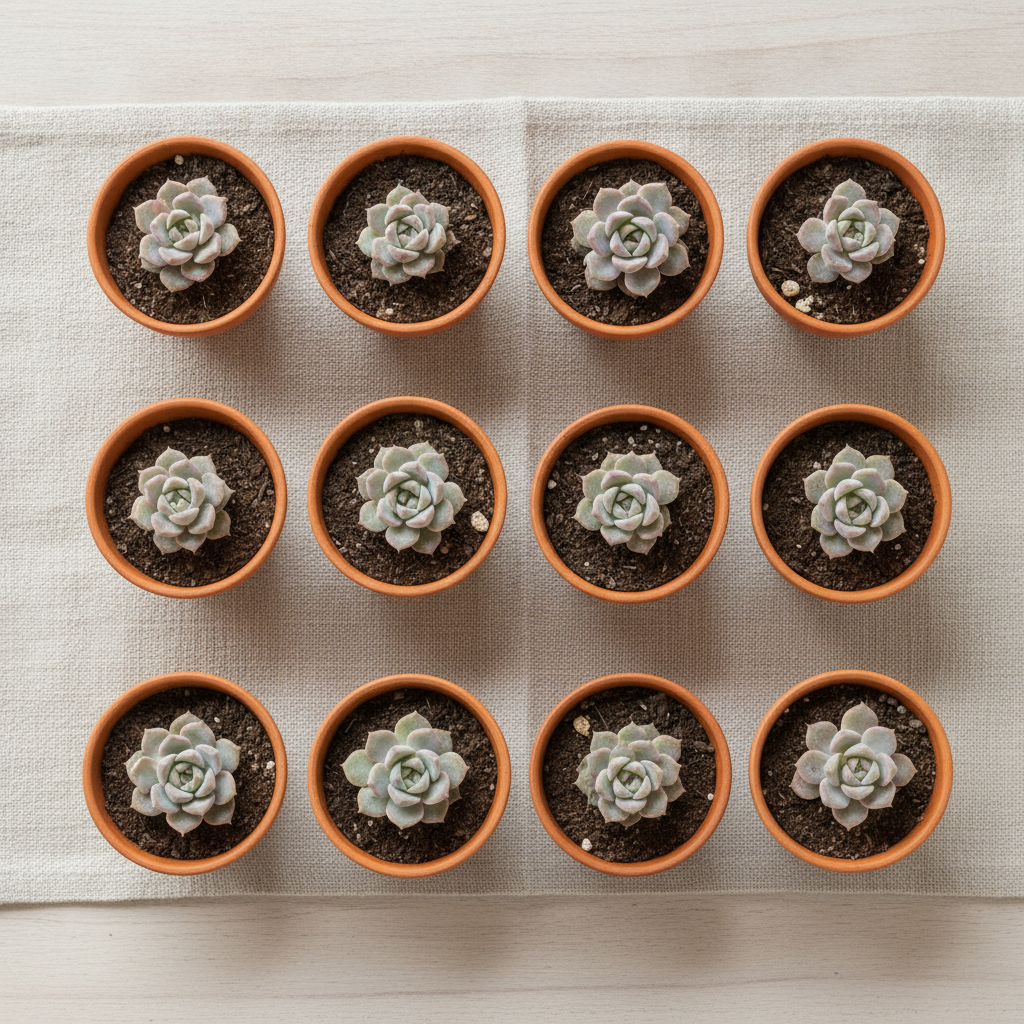
Understanding Leaves and Offsets
The secret to succulent propagation lies in where new growth comes from. A healthy leaf removed cleanly from the stem carries a bud of meristem tissue at its base, and from that point it can grow both roots and a tiny new rosette. Offsets, or pups, are baby rosettes the plant produces around its own base, already attached to the mother by a short stem and often with roots of their own. Knowing this, propagation becomes a matter of taking clean material and giving it warmth, light and restraint with water.
Leaf Propagation: Step-by-Step
This is the highest-yield method, letting you raise many plants from a single rosette. The one rule that decides success is cleanliness: each leaf must come away whole, with its base intact, or it will not grow.
- Choose plump, healthy leaves from the lower part of the rosette, avoiding any that are damaged or shrivelled.
- Gently wiggle each leaf side to side and pull it cleanly from the stem, keeping the base whole; a torn leaf will not root.
- Lay the leaves on a tray or on top of dry succulent mix, out of direct sun, and leave them for a few days until the cut ends callus over.
- Set the callused leaves on top of a tray of gritty mix, base end resting on the surface, in bright indirect light.
- Mist the soil surface only, lightly, every few days once roots appear, keeping the leaves themselves dry.
- Wait patiently as tiny roots and a miniature rosette emerge over several weeks; once the baby is established, the parent leaf will wither and can be removed.
Pro Tip — Take More Than You Need: Not every leaf will take, even with perfect technique, so start with more leaves than the number of plants you want. Removing several lower leaves at once does the parent no harm and greatly improves your odds of a good batch of babies.
Offsets and Beheading: Step-by-Step
Offsets are the quickest way to a full-sized plant, since they are already small rosettes. Beheading is a two-in-one technique: it produces a compact new plant from the top of a leggy or damaged specimen and encourages the remaining base to sprout fresh offsets.
- For offsets, wait until a pup is a reasonable size, then twist or cut it from the mother, keeping any roots it has already formed.
- For beheading, use a clean, sharp blade to cut through the stem an inch or two below a stretched or rot-free rosette.
- Set the offset or the cut rosette aside in a dry, shaded spot for several days until the wound calluses firmly.
- Place the callused piece on top of dry gritty mix, or nestle its base just into the surface so it stands upright.
- Begin light watering only once new roots have gripped the soil, then treat it as a normal young plant.
Troubleshooting Propagation
| Problem | Likely Cause | Solution |
|---|---|---|
| Leaves shrivel without rooting | Torn base, or air too dry with no soil contact | Use only cleanly removed whole leaves; rest them on soil and mist the surface lightly |
| Cuttings rot and turn mushy | Watered too soon or kept too wet | Let wounds callus fully and keep the mix nearly dry until roots form |
| Roots form but no new rosette | Too little light | Move to brighter indirect light to trigger a leaf bud |
| Everything stalls | Attempted in cold, dark winter months | Propagate in spring and summer when warmth and light drive growth |
Pests & Diseases
A healthy, well-grown Perle von Nürnberg is fairly resistant to trouble, and most problems that do arise trace back to overwatering rather than to any pest. Still, a handful of insects are drawn to its soft, sap-rich leaves, and the dense rosette can hide them from view, so regular inspection pays off.
The tight geometry that makes the plant beautiful also gives pests sheltered crevices to hide in, particularly the leaf axils at the centre of the rosette. Make a habit of looking closely at those tucked-away spots whenever you water, and deal with any invader early, while the population is small and easily beaten.
Common Pests
Mealybugs (Pseudococcus species)
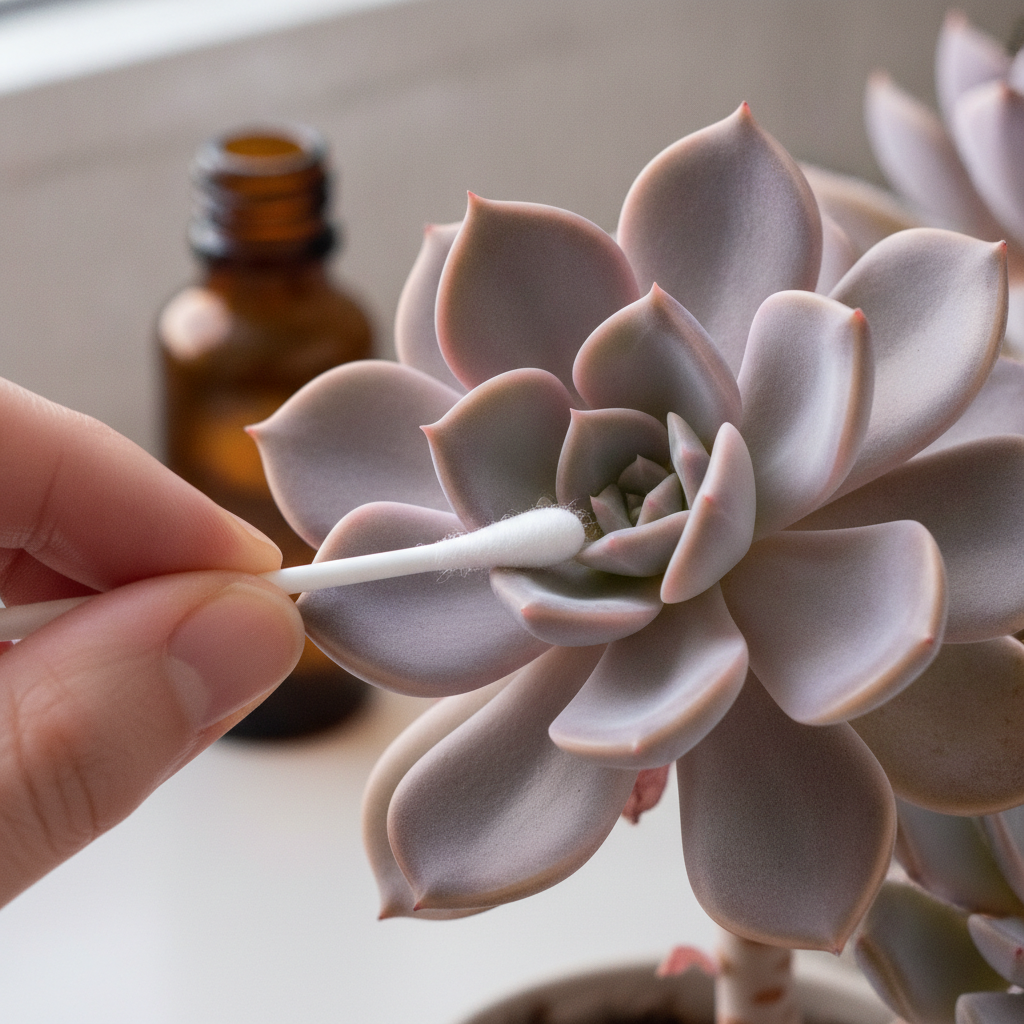
By far the most common pest of this plant, mealybugs appear as small, soft, white cottony blobs tucked into the leaf axils and the base of the rosette. They suck sap, weaken the plant and leave a sticky residue, and because they hide deep in the crown they are easy to miss until numbers build.
Treatment: Dab each insect directly with a cotton bud dipped in isopropyl alcohol, which kills it on contact. For a heavier infestation, treat the whole plant with a suitable insecticidal soap or diluted alcohol spray, and repeat every few days until no new bugs appear. Check nearby plants too, as mealybugs spread readily.
Aphids (Aphidoidea)
Aphids are less common on the leaves but love a flower stalk, clustering on the tender new growth of an emerging bloom spike. They are small, soft-bodied insects, often green, that distort growth and leave sticky honeydew behind.
Treatment: Rinse them off with a gentle stream of water, or treat with insecticidal soap. If they have swarmed a flower stalk you value, cutting the stalk off is often the simplest cure.
Fungus gnats (Sciaridae)
These small dark flies are a symptom rather than a true pest of the plant, and their presence almost always signals soil that is being kept too wet. The adults are harmless but annoying, while the larvae feed on organic matter and, occasionally, fine roots in constantly damp mix.
Treatment: Let the soil dry out fully, which alone breaks their breeding cycle, and switch to bottom watering. Yellow sticky traps catch the adults, and a layer of grit over the soil surface deters egg-laying.
Common Diseases
Root and stem rot (Fusarium and Pythium species)
This is the single greatest threat to the plant and the cause of most sudden losses. Brought on by overwatering, poor drainage or a wet crown, it turns the stem base and roots soft, brown and black, often before any sign shows at the surface. By the time upper leaves yellow and collapse, the damage below is usually advanced.
Treatment: There is no cure for rotted tissue, only removal. Cut back to firm, clean green growth, discard everything soft, let the healthy remainder callus, and re-root it as a fresh cutting. Prevention, through a gritty mix and a strict soak-and-dry routine, is the only real answer.
Powdery mildew and leaf spot (fungal)
Far less common, these fungal issues appear as a dusty white bloom or dark spots on the leaves, usually in humid, stagnant conditions or where water sits on the foliage. They are more disfiguring than deadly but can spread if ignored.
Treatment: Improve airflow, reduce humidity and keep the leaves dry. Remove badly affected leaves, and treat persistent cases with a fungicide suited to succulents. Do not confuse the natural powdery farina with mildew; farina is even, silvery and part of the plant, while mildew is patchy and sits on the surface.
Pest and Disease Summary
| Pest / Disease | Identification | Treatment |
|---|---|---|
| Mealybugs | White cottony clusters in leaf axils and crown | Dab with alcohol; insecticidal soap; repeat until clear |
| Aphids | Small soft insects on flower stalks and new growth | Rinse off or spray with insecticidal soap; cut affected stalks |
| Fungus gnats | Small dark flies around wet soil | Dry the soil, bottom water, use sticky traps and a grit top layer |
| Root and stem rot | Soft brown or black stem base; collapsing rosette | Cut to firm tissue, callus and re-root; improve drainage |
| Powdery mildew / leaf spot | White dusty bloom or dark spots on leaves | Improve airflow, keep dry, remove affected leaves, fungicide if needed |
Prevention Strategies
Almost every problem on this list is prevented by the same handful of habits. Grow the plant in strong light and a fast-draining mix, water only when the soil is fully dry, keep water out of the crown, and give it good airflow. A plant grown this way is firm, colourful and naturally resilient, with little that a pest or fungus can gain a foothold on.
Quarantine is the other key habit. Any new succulent brought into the home should be kept apart from your existing collection for a couple of weeks and inspected closely, since mealybugs in particular arrive as stowaways on shop-bought plants and spread quickly once settled in.
Pro Tip — Inspect at Watering Time: Tie your pest checks to your watering routine so they actually happen. Every time you water, spend a few seconds looking into the centre of the rosette and along the leaf axils, and you will catch mealybugs while they are still a two-minute job rather than a full-blown infestation.
Popular Varieties
Perle von Nürnberg is itself a cultivar, but it sits at the centre of a wide family of pastel, powder-coated echeverias, many of them its relatives or lookalikes. Collectors often grow several together for the way their overlapping pinks, blues and lavenders play off one another, and knowing the near neighbours helps you recognise what you are buying, since these plants are frequently mislabelled in shops.
The table gathers the classic Perle von Nürnberg alongside the cultivars most often compared or confused with it, followed by closer profiles of two standouts. All share the same basic care, so any of them will thrive under the regime described in this guide.
| Variety | Leaf Appearance | Light Needs | Growth Rate | Availability |
|---|---|---|---|---|
| Perle von Nürnberg | Dusty lavender-pink rosette with heavy farina | Very high | Slow | Very common |
| Perle von Nürnberg (variegated) | Same rosette streaked with cream and pale yellow | Very high | Very slow | Rare |
| Echeveria ‘Lola’ | Tighter powder-blue rosette with a pink blush | High | Slow | Common |
| Echeveria ‘Debbie’ | Bright lilac-pink leaves, more vivid than the Perle | Very high | Moderate | Common |
| Echeveria ‘Afterglow’ | Large pinkish-lavender rosette with coral edges | Very high | Moderate | Fairly common |
| Echeveria elegans | Compact pale blue-white rosette, a parent of the Perle | High | Slow | Very common |
| Echeveria ‘Chroma’ | Dark, iridescent purple-bronze leaves | Very high | Slow | Uncommon |
Featured Varieties
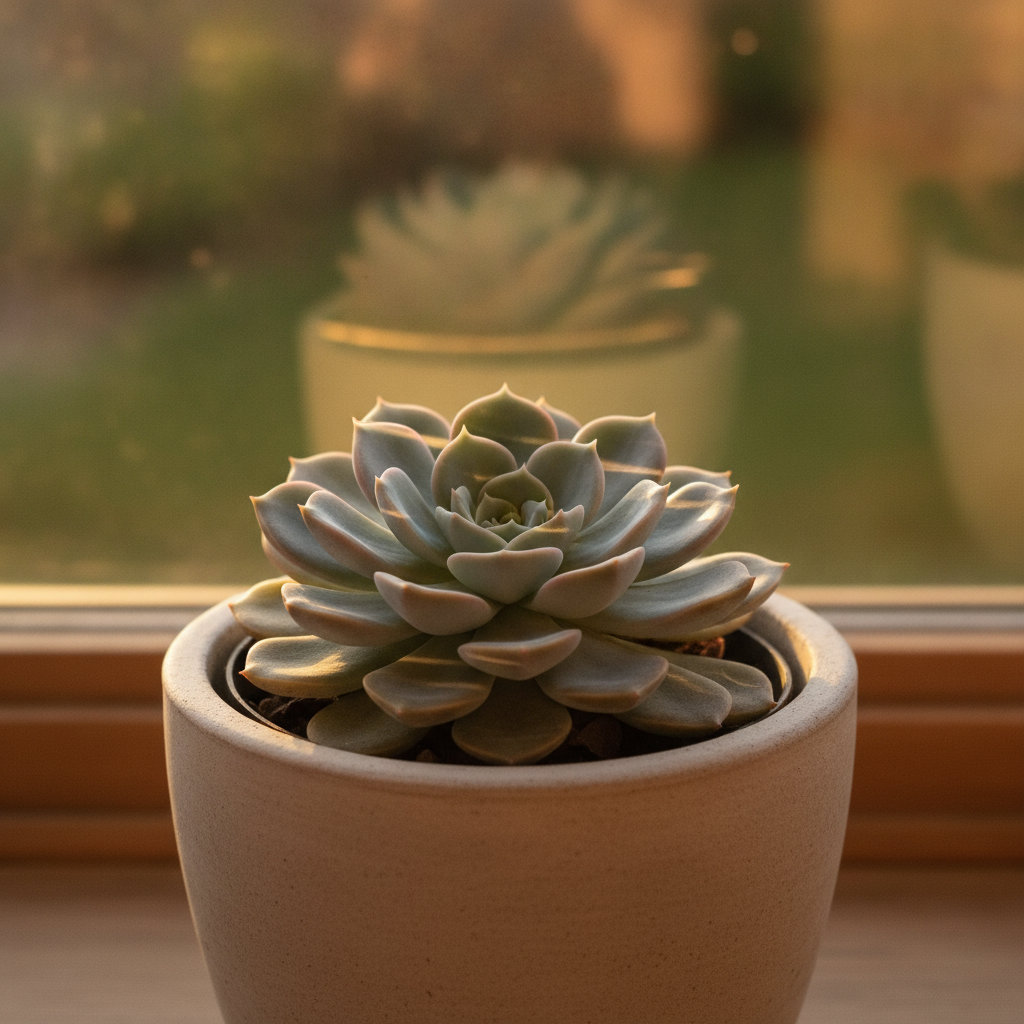
Echeveria ‘Lola’
A close relative that shares the Perle’s parentage, ‘Lola’ forms an exceptionally neat, tight rosette in soft powder-blue washed with pink. It is a little smaller and more symmetrical, and its heavy farina gives it an almost porcelain finish, making it a natural companion to Perle von Nürnberg on a bright sill.
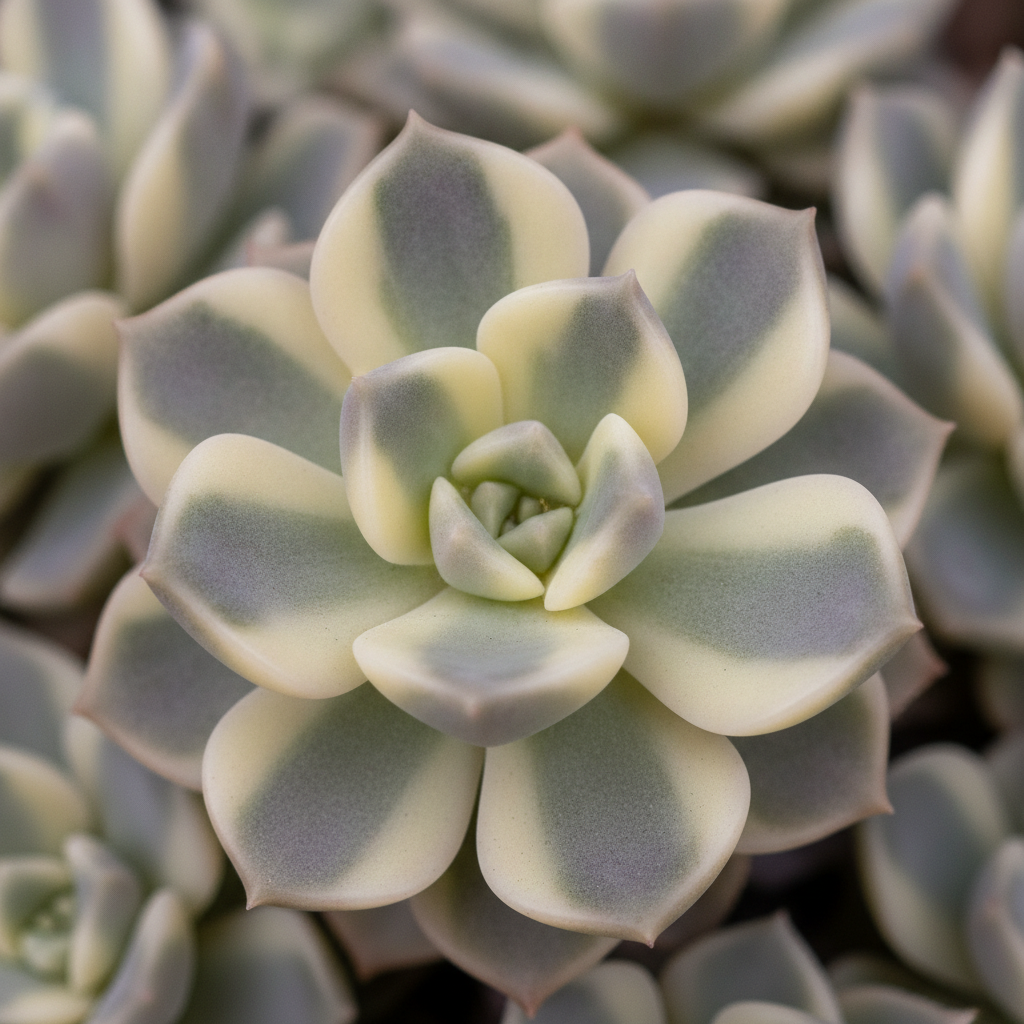
Variegated Perle von Nürnberg
A prized and uncommon sport in which the familiar lavender leaves are streaked and sectored with cream and pale yellow. The variegation reduces the plant’s chlorophyll, so it grows more slowly and needs strong light to hold both its colour and its form, but a well-marked specimen is one of the most sought-after echeverias around.
Variety Profiles in Detail
Echeveria ‘Debbie’ (Echeveria ‘Debbie’)
Often mistaken for a brighter Perle von Nürnberg, ‘Debbie’ pushes the pink into a vivid lilac that can glow almost fluorescent in strong light. It is a Graptoveria hybrid rather than a pure echeveria, slightly faster growing and a touch more forgiving, and it makes an easy, colourful stepping stone for anyone charmed by the Perle’s palette.
Echeveria elegans (Echeveria elegans)
One of the two parents behind Perle von Nürnberg, the Mexican snowball is a compact, pale blue-white rosette with translucent leaf margins. It is tougher and more offset-happy than its famous offspring, clustering readily into tidy mounds, and growing it alongside the Perle is a lovely way to see the hybrid’s lineage first-hand.
Choosing the Right Variety for Your Space
All of these plants ask for the same thing above all else: as much bright light as you can give them. If you have a blazing south or west window, almost any of them will thrive and colour up beautifully, so choose on looks alone. If your light is more modest, lean toward the tougher, more forgiving options such as Echeveria elegans or ‘Debbie’, and save the slow-growing variegated forms for a spot where the sun is genuinely strong. Whichever you pick, remember that these are collectors’ plants at heart, and half the pleasure lies in growing a small group and watching their colours shift together through the seasons.
Frequently Asked Questions
Why is my Perle von Nürnberg turning green and losing its purple colour?
Almost always this is a lack of light. The pink and lavender tones are stress colours that only develop under strong, bright conditions; in weaker light the plant reverts to plain green and often stretches at the same time. Move it to your brightest window or add a grow light, increasing the exposure gradually, and colour will return to the new growth over the following weeks.
Why is my plant stretching out and looking leggy?
A stretching, elongated rosette is etiolation, the classic sign of too little light. The plant is reaching for a brighter source, spacing its leaves along a lengthening stem. The stretched growth will not tighten up again, but you can fix the plant’s future by giving it much more light, and if the legginess is severe you can behead the compact top and re-root it for a fresh, tight rosette.
How often should I water it?
Water only when the soil has dried out completely, which in a bright, warm spot often works out to roughly every 10 to 14 days in summer and much less in winter. There is no fixed schedule that fits every home, though, so always check the soil rather than counting days, and when in doubt wait longer, because this plant handles drought far better than wet feet.
The powdery coating rubbed off where I touched it. Will it grow back?
The powdery layer is farina, a natural wax the plant produces, and once rubbed off a given leaf it does not regrow on that spot; the mark is usually permanent for the life of that leaf. New leaves emerge fully coated, however, so the plant renews its bloom as it grows. Handle it by the pot or the stem rather than the leaves to keep the rosette looking its best.
Is Perle von Nürnberg safe for cats and dogs?
Yes. Echeverias are listed as non-toxic to cats, dogs and humans, so this is a pet-safe choice. It is still wise to place it out of reach, both to protect the delicate farina from curious paws and because eating any plant in quantity can cause mild stomach upset, but there is no serious toxicity to worry about.
Why are the bottom leaves shrivelling and dying?
If the lowest leaves dry up, thin and shrivel gradually while the rest of the rosette looks firm and healthy, this is completely normal. The plant sheds its oldest leaves from the base as it grows, and you can simply remove the spent ones. Only worry if the lower leaves turn yellow, soft or translucent, which points to overwatering rather than natural ageing.
My plant is sending up a tall stalk. What is it and should I cut it off?
That arching stalk is a flower spike, a sign of a mature, happy plant. It will open into a row of coral-pink bells tipped with yellow over several weeks, usually in spring or summer. You can leave it to enjoy the display, or cut it off if you would rather the plant put its energy into the rosette; flowering does not harm the plant, though the spike may attract aphids while it is soft.
Can I grow Perle von Nürnberg outdoors?
In a warm, frost-free climate it makes a superb outdoor plant, colouring up magnificently in full sun with excellent drainage. It is not frost hardy, though, and will be damaged or killed by freezing temperatures, so in cooler regions grow it in a pot that can be moved under cover before the first frost, or keep it as an indoor plant on a bright sill year-round.
How big does it get, and how fast does it grow?
This is a compact, slow-growing succulent that typically reaches around 15 to 20 cm (6 to 8 in) across at maturity, forming a single low rosette. It takes its time, adding leaves steadily rather than dramatically, which is part of its appeal for small spaces. Given years and good care it may develop a short trunk and cluster with offsets, but it will never become a large plant.






