
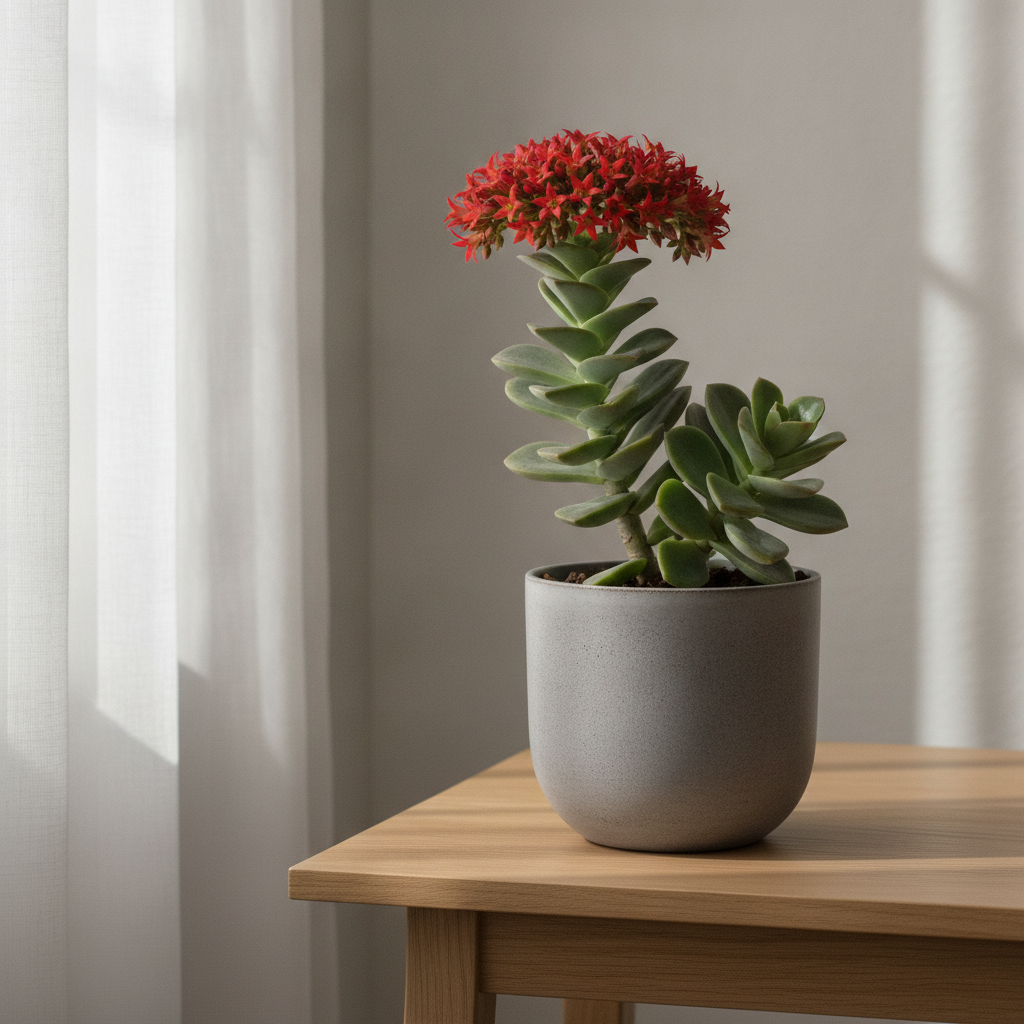
Few succulents announce themselves as boldly as the propeller plant. Its thick, blue-grey leaves are sickle-shaped and stacked in two opposing ranks that spiral slowly up the stem, each pair offset from the one below so the whole plant resembles a column of aircraft propellers frozen mid-turn. Known botanically as Crassula falcata, and increasingly under its currently accepted name Crassula perfoliata var. minor, it belongs to the vast Crassulaceae family and hails from the hot, rocky slopes of the Western Cape in South Africa. Gardeners know it by a scatter of vivid common names, including airplane plant, aeroplane propeller plant, sickle plant and scarlet paintbrush, the last of which nods to its most spectacular feature.
That feature arrives in summer, when a mature plant throws up a dense, flat-topped head of brilliant scarlet-red flowers that can last for weeks and carry a light, sweet scent. It is one of the showiest blooms in the entire succulent world, and it is the reason the propeller plant has been a windowsill favourite for well over a century. This guide covers everything you need to move your plant from merely surviving to genuinely thriving: how to read its light and water needs, the gritty soil it insists on, when and how to feed it, the easy ways to make more plants for free, and the handful of pests and diseases worth watching for. The propeller plant is forgiving of neglect but responds dramatically to good care, and the difference between the two shows up in leaf colour, compact form and, above all, whether it flowers.
Contents
- Quick Reference
- Why the Propeller Plant Makes a Rewarding Houseplant
- Light Requirements
- Watering & Humidity
- Soil, Potting & Repotting
- Fertilising
- Propagation
- Pests & Diseases
- Popular Varieties
- Frequently Asked Questions
Quick Reference: Propeller Plant at a Glance
| Light | Bright light to full sun; at least 4 to 6 hours of direct sun encourages compact growth and flowering. |
| Watering | Soak-and-dry. Water only when the soil is completely dry, roughly every 10 to 14 days in summer and monthly or less in winter. |
| Temperature | 18 to 24°C (64 to 75°F) is ideal. Keep above 10°C (50°F); the plant is not frost-hardy. |
| Humidity | Low to average, around 30 to 50%. Dislikes damp, stagnant air. |
| Fertiliser | Light feeder. A diluted, low-nitrogen succulent feed once a month in spring and summer only. |
| Toxicity | Generally regarded as non-toxic to cats and dogs, though nibbling may cause mild stomach upset. |
Why the Propeller Plant Makes a Rewarding Houseplant
The propeller plant earns its place on a sunny sill by doing something most succulents cannot: it combines genuinely sculptural foliage with a flower display bold enough to stop visitors in their tracks. Out of bloom, the plant is all architecture. The paired, keeled leaves are a soft dove-grey to blue-green, dusted with a fine waxy bloom called farina that protects them from the fierce Karoo sun, and they clasp the stem in a tidy geometric stack that looks deliberate and modern. This restrained, almost graphic form suits contemporary interiors as happily as it suits a traditional cottage windowsill, and because the plant stays compact, usually 30 to 60 centimetres (12 to 24 inches) tall in a pot, it never outgrows its welcome.
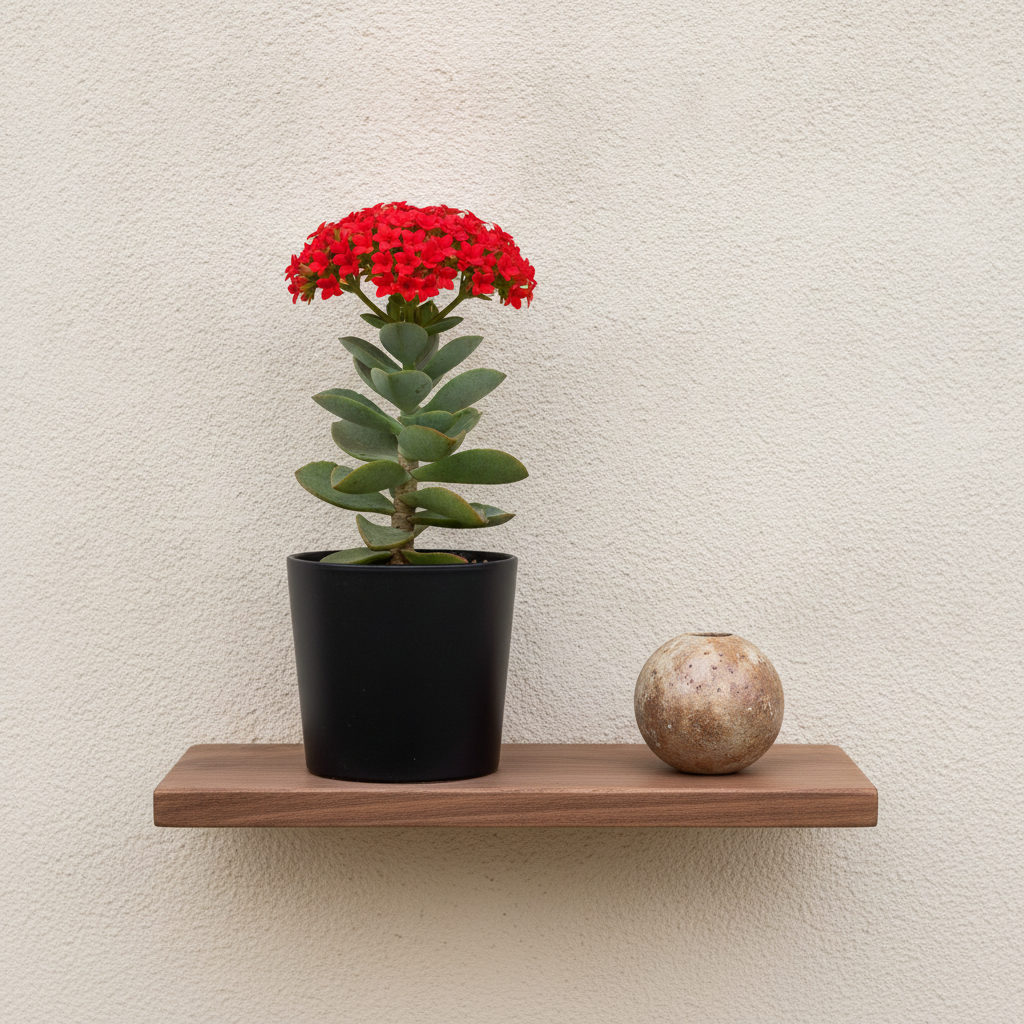
Then there is the payoff. Given enough light and a proper winter rest, a healthy propeller plant sends up a stout flowering stem in summer, topped by a broad, domed cluster of many small scarlet blooms. The colour is unusually saturated for a succulent, closer to a geranium or a paintbrush dipped in red than the pale pastels common to the group, and the flowers draw butterflies and bees when grown outdoors in warm weather. Add to this the plant’s tolerance of dry indoor air, its indifference to being slightly pot-bound, and its long life of many years from a single rooted leaf, and you have a succulent that rewards a beginner while still holding the interest of a seasoned collector.
Important — Toxicity: The propeller plant is generally listed as non-toxic to cats, dogs and humans, and it is not among the Crassula species flagged as dangerous. Even so, the fleshy leaves can cause mild vomiting or drooling if a determined pet chews them, so it is sensible to keep the plant out of easy reach. Note that the popular jade plant, Crassula ovata, is a different story and is considered toxic to pets, which makes correct identification worthwhile.
Light Requirements
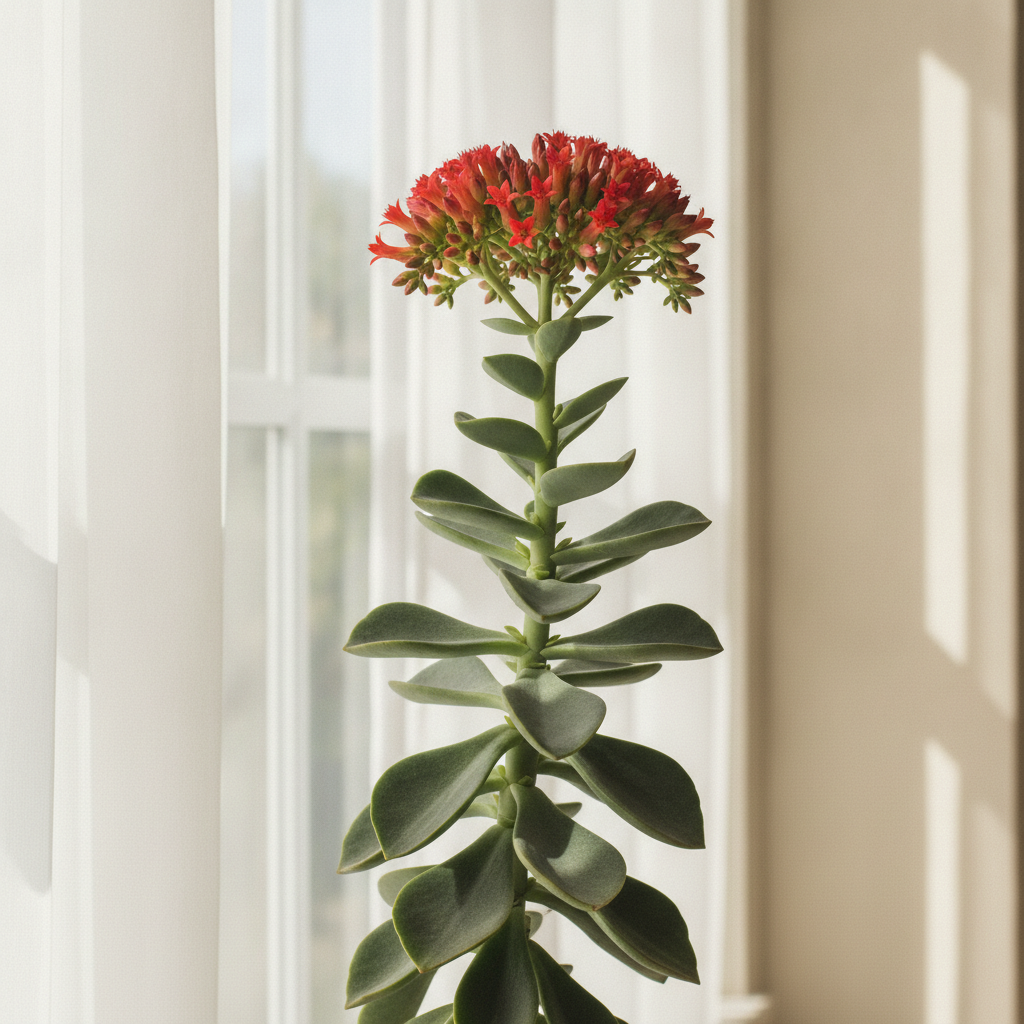
Light is the single most important factor in growing a good propeller plant, and it is where most indoor specimens fall short. This is a full-sun plant from a landscape of open, rocky slopes, and it wants as much direct light as a home can give it. In its native habitat it soaks up hours of unfiltered sunshine every day, and the compact, tightly stacked growth we admire is a direct product of that intensity.
Indoors, aim for a minimum of four to six hours of direct sun a day, supplemented by bright ambient light for the rest of the daylight hours. A windowsill is almost always better than a spot set back in the room. With enough light the leaves stay silvery and close-packed, the stems remain short and sturdy, and the plant builds the reserves it needs to flower. Deprived of light, it does the opposite, and the change is quick and unmistakable.
Light Levels Explained
Understanding how different light levels translate to indoor positions helps you place the plant with confidence. The categories below run from the brightest, unfiltered sun down to the dim corners where a propeller plant simply cannot survive long term.
| Light Category | Approx. Level | Typical Location | Outcome |
|---|---|---|---|
| Direct sun | Over 50,000 lux | On a south or west sill, unobstructed | Ideal; compact form, best colour, most likely to flower |
| Bright indirect | 20,000 to 50,000 lux | Just beside a bright window or behind a sheer curtain | Good; healthy growth but may stretch slightly and flower less |
| Medium | 10,000 to 20,000 lux | A metre or two back from a sunny window | Marginal; noticeable stretching, weak colour, rarely blooms |
| Low | 2,000 to 10,000 lux | North window or interior shelf | Poor; leggy, pale, prone to rot from slow drying |
| Very low | Under 2,000 lux | Hallway or windowless room | Unsustainable; steady decline and eventual loss |
Window Orientation and Placement
South-facing window: In the northern hemisphere this is the prime spot for a propeller plant. It delivers the longest and strongest run of direct sun, which is exactly what the plant craves. Place it right on the sill and it will reward you with tight, silvery growth.
East-facing window: Gentle morning sun followed by bright light for the rest of the day works well and carries little risk of scorch. Growth may be very slightly looser than in a south window, but this is a safe, productive position.
West-facing window: Strong afternoon sun suits the plant nicely and can rival a south window for flowering. Just make sure air can circulate, as west sills can trap heat behind glass on summer afternoons.
North-facing window: The weakest orientation and generally not enough on its own. A propeller plant here will etiolate, stretching pale and lanky as it reaches for light. If a north window is all you have, plan to supplement with a grow light.
Pro Tip — Rotate for Symmetry: Because the propeller plant leans hard toward its light source, give the pot a quarter turn every week or so. This keeps the stacked leaves growing evenly on all sides and prevents the plant from developing a permanent lopsided lean toward the window.
How Light Affects Colour and Form
The propeller plant is a living light meter. In strong sun the leaves take on their characteristic chalky blue-grey, sometimes flushing faintly bronze or pink at the tips under stress, and they pack together in a dense, orderly stack. Move the same plant into weaker light and within weeks the leaves turn a flatter, duller green, the spacing between pairs lengthens, and the stem grows soft and floppy. This stretching, known as etiolation, cannot be reversed on the affected growth, so the only cure is prevention: brighter light, or in stubborn cases, cutting the plant back and starting fresh cuttings in a sunnier spot.
Warning — Direct Sunlight: While the propeller plant loves sun, a specimen grown for months in low light cannot be moved straight into blazing midday sun without burning. Sudden exposure causes pale, papery scorch patches that never recover. Acclimatise a shade-grown plant over two to three weeks, increasing its sun exposure gradually.
Artificial Lighting
Where natural light is limited, a full-spectrum LED grow light is an excellent stand-in and can even coax flowering from a plant on a dim sill. Position the light 20 to 30 centimetres (8 to 12 inches) above the plant and run it for 10 to 12 hours a day to mimic a long summer. Because the propeller plant demands such high intensity, ordinary household bulbs are not enough; a dedicated horticultural fixture makes all the difference and is well worth it for anyone gardening in a north-facing home or through a dark winter.
Seasonal Adjustments
Light levels swing dramatically across the year, and the propeller plant notices. In summer, guard against overheating behind south-facing glass by ensuring good airflow. In winter, when the sun sits low and days are short, move the plant to the brightest available window and accept that growth will slow to a near halt. This winter lull is not a problem to fix but a natural rest, and it is precisely this cool, bright, dry period that primes the plant to flower the following summer.
Watering & Humidity
If light is what makes a propeller plant thrive, water is what most often kills it. Like all Crassulas, it stores moisture in its fleshy leaves and stems, which means it can go a long time between drinks and, crucially, resents sitting in damp soil. The golden rule is simple: when in doubt, do not water. A slightly thirsty propeller plant recovers in a day; an overwatered one rots from the roots up and may be beyond saving before you notice.
When to Water
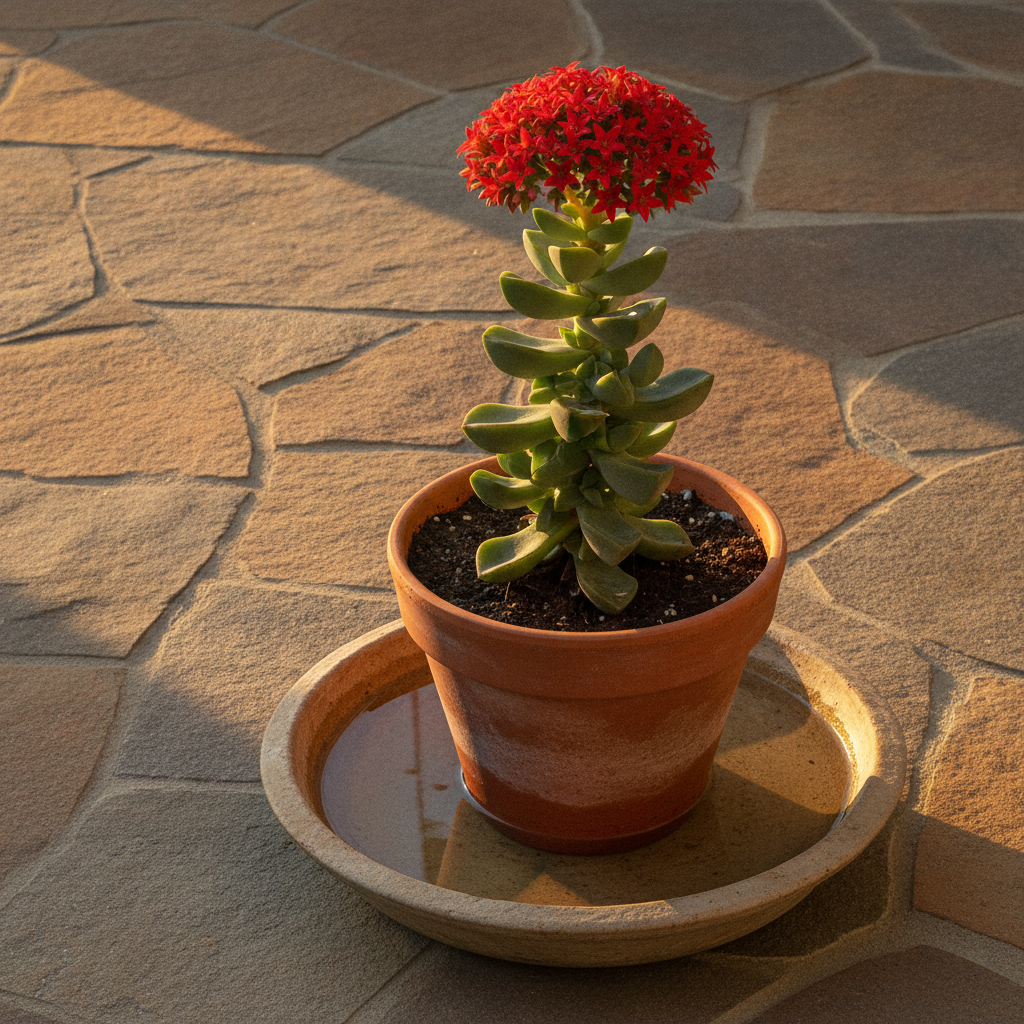
The propeller plant follows the classic succulent soak-and-dry rhythm. Wait until the potting mix has dried out completely, then water thoroughly, then wait again. The best gauge is the soil itself: push a finger or a wooden skewer several centimetres into the mix, and only water if it comes out bone dry. In a warm, sunny summer this might mean watering every 10 to 14 days, while in the cool of winter the same pot may need water only once a month, if that.
Resist the urge to water on a fixed schedule. Evaporation depends on light, warmth, pot material and season, so a calendar is a poor guide. Learn instead to read the plant and the pot. The leaves offer a second clue: plump, firm foliage means the plant is well hydrated and needs nothing, while leaves that feel slightly soft or look faintly wrinkled signal that a drink is due. A terracotta pot, which breathes and dries faster, makes this judgement easier and forgiving of the occasional heavy hand.
Pro Tip — Water the Soil, Not the Rosette: Aim the water at the compost and keep it out of the crown where the leaves meet the stem. Water trapped in that tight rosette, especially in cool or still conditions, invites rot and fungal spots. Bottom-watering, where the pot sits briefly in a dish of water, sidesteps the problem entirely.
How to Water Correctly
- Check that the potting mix is completely dry from the top down before you begin.
- Water slowly and generously at the soil surface, or stand the pot in a shallow dish of water, until moisture reaches all the roots.
- Let the excess drain freely from the drainage holes for several minutes.
- Tip away any water left standing in the saucer or cachepot so the roots never sit wet.
- Return the plant to its bright spot and do not water again until the mix is fully dry.
Signs of Overwatering vs. Underwatering
| Symptom | Overwatering | Underwatering |
|---|---|---|
| Leaf colour | Yellowing, translucent or blackening leaves | Duller grey-green, sometimes reddish at the tips |
| Leaf texture | Soft, mushy, water-soaked and swollen | Thin, wrinkled, slightly soft but not slimy |
| Soil | Stays damp for many days, may smell sour | Bone dry well beyond the normal drying time |
| Roots | Brown, black and mushy with a foul smell | Dry and papery but still firm and pale |
| Stem base | Soft, darkened and collapsing at soil level | Firm, though lower leaves may shrivel and drop |
Warning — Root Rot: Root rot is the leading cause of death in the propeller plant, and it moves fast. If the stem base turns soft and dark, act immediately: unpot the plant, cut away all rotten tissue with a clean blade, dust the wounds, and either re-root a healthy top cutting or salvage firm leaves. Waiting rarely works, because by the time upper leaves collapse the roots are usually gone.
Humidity Requirements
Humidity is refreshingly uncomplicated with this plant. Coming from a dry climate, the propeller plant is perfectly content in the low to average humidity of a typical home, somewhere between 30 and 50 percent. It has no need for misting, pebble trays or humidifiers, and in fact prefers dry air over damp.
Problems only arise at the humid extreme. In a steamy bathroom or a poorly ventilated room, high humidity combined with still air raises the risk of fungal spotting and rot, particularly if water lingers in the leaf rosette. If you notice soft brown blotches appearing on the foliage in muggy conditions, the fix is more airflow rather than any change to watering.
Good air circulation is the quiet hero of succulent care. A gently moving atmosphere helps the soil surface and leaves dry quickly after watering, discouraging the fungi and pests that thrive in stagnant corners. An open window on a mild day or a small fan running nearby does more for a propeller plant’s health than any amount of fussing over humidity readings.
Water Quality
The propeller plant is not fussy about water quality, but a few habits help. Room-temperature water is kinder to the roots than a shock of cold from the tap. In hard-water areas, mineral salts can build up on the soil surface and pot rim over time, so an occasional deep flush that runs plenty of water through the mix keeps deposits from accumulating. Rainwater or filtered water is a nice touch if you have it, though ordinary tap water left to stand for a few hours suits this tough plant perfectly well.
Soil, Potting & Repotting
Get the soil right and half the battle of succulent care is won. The propeller plant needs a fast-draining, gritty, mineral-rich mix that holds just enough moisture to sustain the roots between waterings and then dries out quickly. Ordinary houseplant compost, which stays wet for days, is a recipe for rot and should never be used on its own.
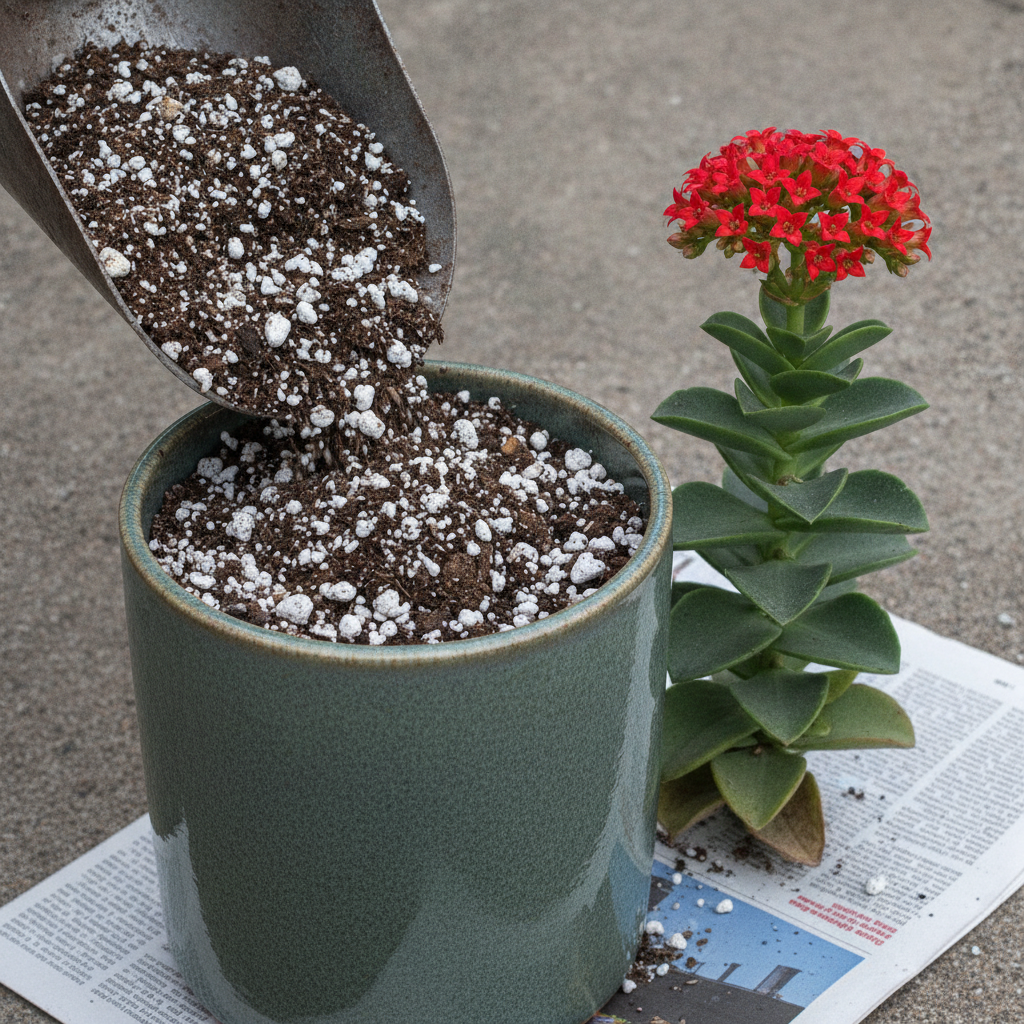
Ideal Soil Composition
The aim is a substrate that is roughly half mineral grit and half organic matter, giving the sharp drainage the roots demand while still offering a little water retention and nutrition. A good commercial cactus and succulent mix is a fine starting point, but most benefit from extra grit stirred in to open them up further. The table below breaks down a reliable home blend.
| Component | Proportion | Function |
|---|---|---|
| Cactus or general potting compost | Two parts | Holds a little moisture and provides light nutrition |
| Coarse sand or fine grit | One part | Adds weight and opens up the structure for drainage |
| Perlite or pumice | One part | Creates air pockets and speeds drying around the roots |
| Fine orchid bark (optional) | Half a part | Improves aeration and stops the mix compacting over time |
The propeller plant is not particular about pH and grows well in anything from slightly acidic to slightly alkaline, roughly 6.0 to 7.5. Far more important than pH is physical structure. A mix that crumbles freely and never turns to sludge will keep the roots healthy for years, whereas a dense, water-holding compost will slowly suffocate them no matter how carefully you water.
Pro Tip — Quick Mix Recipe: For a fast, foolproof blend, combine two handfuls of ordinary cactus compost with one handful of perlite and one handful of coarse horticultural grit. If you can squeeze a fistful and it falls apart the moment you open your hand, the drainage is right.
Choosing the Right Pot
The container matters almost as much as what goes in it. A well-chosen pot works with your watering to keep the roots healthy, while the wrong one fights you at every turn.
Drainage holes are non-negotiable. The propeller plant must never sit in standing water, so the pot needs at least one generous drainage hole. Decorative cachepots without holes are fine as an outer sleeve, but only if you lift the inner pot out to water and drain, then return it once it has stopped dripping.
Pot material: Unglazed terracotta is the ideal choice. Its porous walls wick moisture out of the soil and let it breathe, which helps the mix dry evenly and protects against overwatering. Glazed ceramic and plastic hold water longer, so if you use them, lean toward an even grittier mix and a lighter watering hand.
Pot size: Choose a pot only slightly larger than the root ball. The propeller plant has a modest root system and actually flowers better when a touch pot-bound. An oversized pot holds a large volume of slow-drying soil around roots that cannot use it, which is one of the surest routes to rot.
When to Repot
This is a slow-growing plant that dislikes disturbance, so repot only when it clearly needs it, usually every two to three years. Signs it is time include roots creeping from the drainage holes, the plant becoming top-heavy and unstable, or the old mix breaking down into a dense, water-retentive mush. The best moment is spring, at the start of the growing season, when the plant can recover quickly. Always repot into dry soil and wait several days before the first watering, giving any disturbed roots time to heal.
How to Repot: Step-by-Step
- Wait until the soil is dry, which makes the plant easier to slide out and gentler on the roots.
- Ease the plant from its pot and crumble the old mix away from the root ball with your fingers.
- Inspect the roots, trimming away any that are black, mushy or dead with a clean, sharp blade.
- Set the plant in a pot only slightly larger, at the same depth it grew before, and fill around it with fresh dry gritty mix.
- Firm the soil gently to remove air pockets, taking care not to bury the lower leaves or crown.
- Hold off on watering for five to seven days, then resume the normal soak-and-dry routine.
Warning — Transplant Shock: Watering immediately after repotting is a common mistake. Freshly cut or disturbed roots are vulnerable to infection, and wet soil against an open wound is exactly how rot takes hold. The few days of dry rest before watering are not optional; they are what lets the plant settle in safely.
Fertilising
The propeller plant is a light feeder, evolved to scrape a living from thin, nutrient-poor soils, so it needs far less fertiliser than a leafy tropical houseplant. A little feeding during the growing season supports healthy growth and encourages flowering, but too much does real harm, pushing soft, weak growth and risking chemical burn to the roots.
The guiding principle is restraint. Feed only when the plant is actively growing, in spring and summer, and always at a reduced strength. Through autumn and winter, when growth naturally halts, withhold fertiliser entirely and let the plant rest.
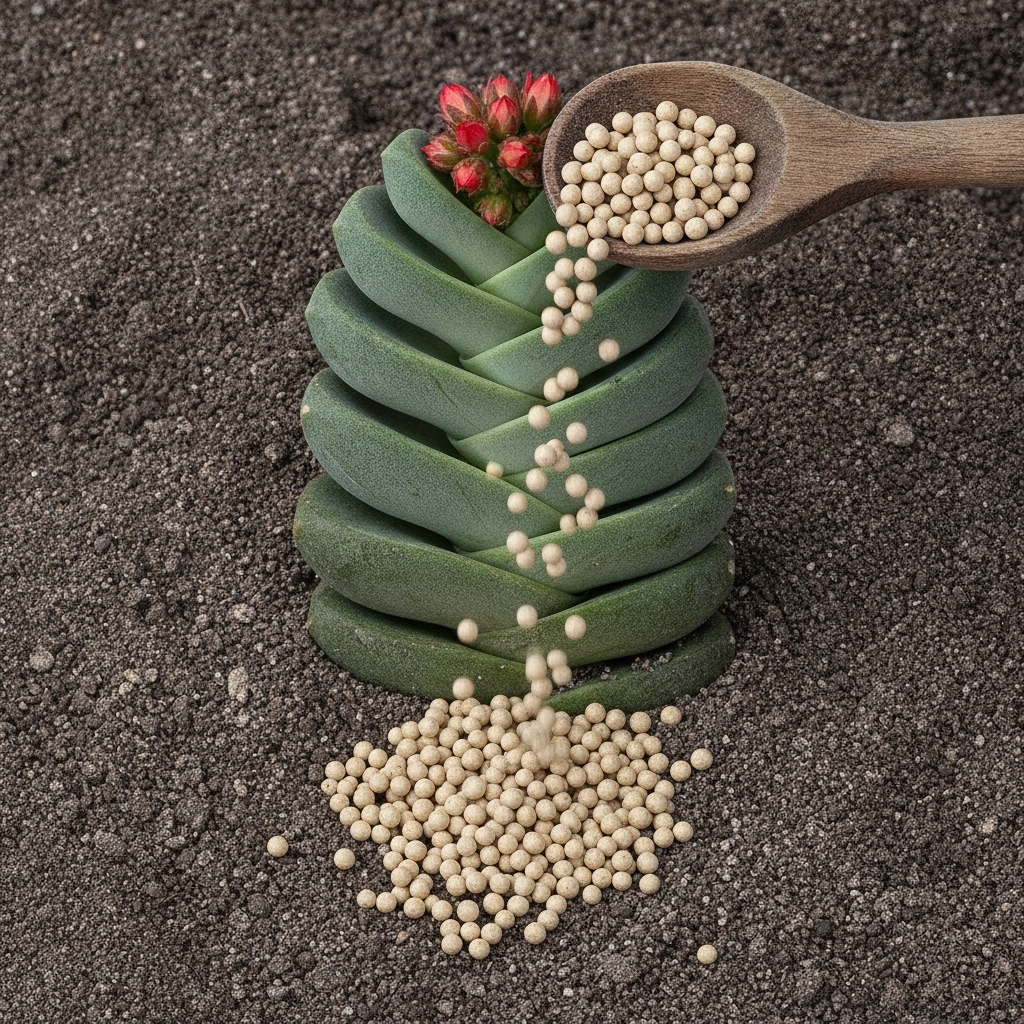
Understanding Plant Nutrients
Fertilisers are labelled with an NPK ratio, the proportions of nitrogen, phosphorus and potassium, the three nutrients plants use in the largest amounts. For succulents like the propeller plant, a balanced or slightly low-nitrogen formula is best, because excess nitrogen drives leggy, soft growth at the expense of the compact form and flowers you want. The table below outlines the key nutrients and the signs of their absence.
| Nutrient | Symbol | Primary Function | Deficiency Symptoms |
|---|---|---|---|
| Nitrogen | N | Drives leaf and stem growth | Pale, yellowing older leaves and stalled growth |
| Phosphorus | P | Supports roots and flowering | Poor blooming and weak root development |
| Potassium | K | Regulates water use and overall vigour | Yellowing leaf edges and browning tips |
| Calcium | Ca | Builds strong cell walls | Distorted new growth and weak leaf tips |
| Magnesium | Mg | Central to chlorophyll and photosynthesis | Yellowing between the veins of older leaves |
| Iron | Fe | Aids chlorophyll formation | Yellowing of the youngest leaves while veins stay green |
Types of Fertiliser
Liquid fertilisers: The easiest choice for succulents, liquid feeds are diluted in water and applied during normal watering. They act quickly and let you control the dose precisely, which suits a plant that wants only a weak, occasional feed. A purpose-made cactus and succulent liquid feed is ideal.
Slow-release granular: These pellets release nutrients gradually over several months as you water. They are convenient and low-effort, but harder to control, so use them sparingly and at half the recommended rate to avoid overfeeding this modest plant.
Organic fertilisers: Gentle options such as diluted worm-casting tea or a light top-dressing of worm castings feed slowly and are very hard to overdo. They improve the soil as they work and are a good fit for anyone who prefers a natural approach, though they act more slowly than synthetic feeds.
Feeding Schedule
A simple routine serves the propeller plant well. Feed once a month through spring and summer with a balanced succulent fertiliser diluted to half or even quarter strength, always applied to already-moist soil rather than a bone-dry root ball. Stop feeding entirely from early autumn through winter. A single feed in early spring as growth resumes, followed by two or three more across the warm months, is plenty for a full season.
Pro Tip — Less Is More: When it comes to feeding succulents, under-doing it always beats over-doing it. A propeller plant will grow happily for years on almost no fertiliser, but a single heavy feed can scorch its roots. If you are unsure, dilute further than the label suggests.
How to Fertilise
- Confirm the plant is in active growth, which means spring or summer, before feeding at all.
- Dilute a balanced succulent fertiliser to half strength or weaker in water.
- Water lightly first if the soil is completely dry, so the feed never hits parched roots directly.
- Apply the diluted solution to the soil, keeping it off the leaves and out of the rosette.
- Let any excess drain away, and do not feed again until the next month of the growing season.
Warning — Salt Build-Up: Over time, fertiliser salts can accumulate in the soil and appear as a white crust on the surface or pot rim. This build-up burns roots and stunts growth. Once or twice a year, flush the pot thoroughly with plain water, letting it run freely from the drainage holes to wash the salts away.
Propagation
One of the great pleasures of the propeller plant is how readily it multiplies. Like most Crassulas, it roots with almost comical ease from leaves, stem cuttings and the offsets that cluster around the base, so a single plant can become a windowsill full within a couple of seasons. Propagation is also the standard rescue plan when a plant has stretched in low light or begun to rot, since a healthy cutting simply resets the clock.
The best time to propagate is spring or early summer, when warmth and light drive fast rooting. The key across every method is patience with moisture: cuttings must be left to callus and kept on the dry side, because the same fleshy tissue that makes them so easy to root also makes them quick to rot if kept wet.
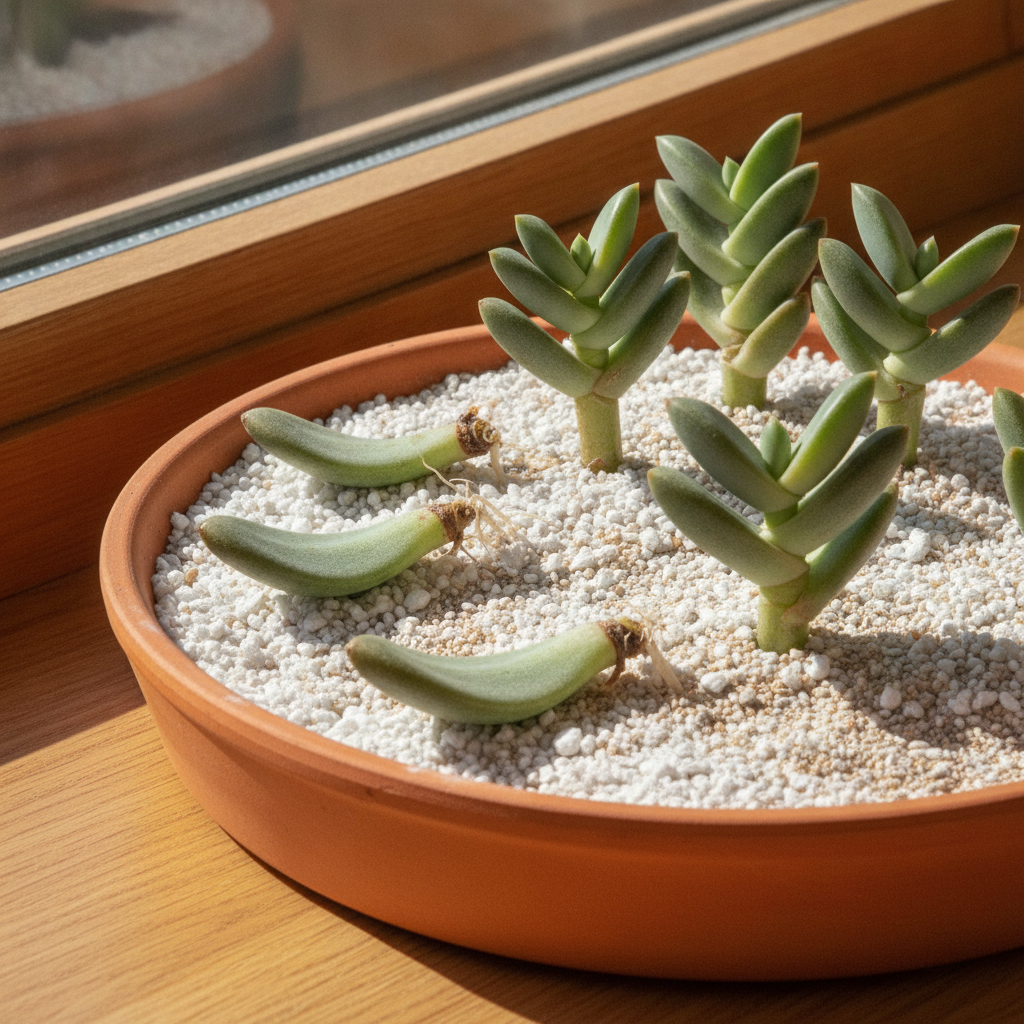
Understanding Leaves and Offsets
Success comes from understanding where new growth originates. A cleanly detached leaf carries a bud of dormant tissue at its base, and from that point it can grow both roots and a tiny new rosette, effectively cloning the parent. Offsets, meanwhile, are baby plants that the propeller plant produces around its own base, especially as the main rosette matures or after it flowers. These already have their own developing roots, which makes them the fastest and most reliable route to a new plant.
Leaf and Stem Cuttings: Step-by-Step
Cuttings are the classic method and the most abundant, since a single plant offers many leaves and any stem section can be used. This approach also tidies up a leggy plant and turns the removed growth into new specimens.
- Select a plump, healthy leaf and gently twist it off, or cut a section of stem with a clean, sharp blade, keeping the whole piece intact.
- Set the cutting aside in a dry, shaded spot for three to seven days until the cut end forms a dry callus.
- Lay leaves on top of, or insert stem cuttings shallowly into, a tray of barely moist gritty propagation mix.
- Keep the tray in bright, indirect light and mist only lightly every few days, never soaking the mix.
- Watch for fine pink roots and a tiny rosette to appear over the following weeks, then pot up once rooted.
Pro Tip — Let Them Callus: The single most important step is the drying period. Planting a fresh, wet-ended cutting straight into soil is the fastest way to lose it to rot. That dry callus over the wound is what allows roots to form cleanly, so never skip it, even if it feels counterintuitive.
Division of Offsets: Step-by-Step
When a plant has produced offsets around its base, dividing them is quicker and more certain than starting from a single leaf, because each pup already carries roots.
- Wait until the soil is dry, then lift the whole plant from its pot to expose the base and the offsets clustered around it.
- Gently tease each offset away from the parent, keeping as many of its own roots attached as possible.
- If an offset pulls away with no roots, treat it like a cutting and let it callus for a few days first.
- Pot each rooted offset into its own small container of dry gritty mix, at the depth it grew before.
- Wait about a week before the first light watering, then care for each new plant as normal.
Troubleshooting Propagation
| Problem | Likely Cause | Solution |
|---|---|---|
| Cutting turns black and mushy | Planted before callusing, or kept too wet | Discard it, and let future cuttings dry longer in a drier mix |
| Leaf shrivels with no roots | Too dry, or the leaf was damaged when removed | Mist a little more often and take clean, whole leaves |
| No roots after many weeks | Too cold or too dark to trigger growth | Move somewhere warmer and brighter and be patient |
| Roots form but rosette stalls | Normal early stage, or insufficient light | Give it time in bright light; the rosette follows the roots |
Pests & Diseases
A healthy, well-grown propeller plant is fairly resistant to trouble, and most problems trace back to conditions rather than bad luck. Overwatering and poor airflow open the door to the majority of pests and diseases, so the best defence is simply good culture: bright light, a gritty mix, careful watering and room for air to move.
That said, even the best-kept plant occasionally attracts a pest, and catching an infestation early makes it far easier to clear. Look the plant over whenever you water, paying special attention to the tight leaf axils where the foliage meets the stem, as this is where the most common pests like to hide.
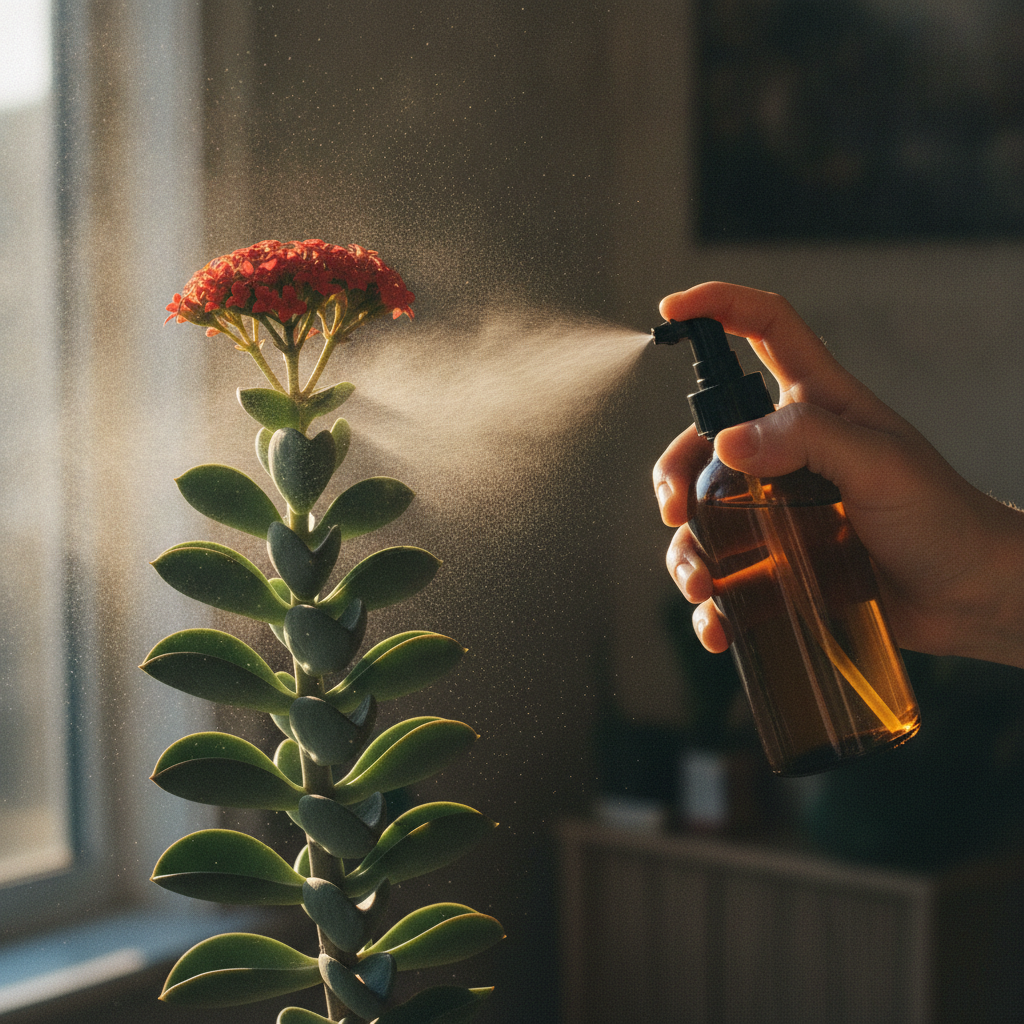
Common Pests
Mealybugs (Pseudococcidae)
Mealybugs are the number-one pest of the propeller plant, appearing as small, soft insects wrapped in a white, cottony fluff and tucked into the leaf axils and crown. They suck sap, weakening the plant and leaving behind sticky honeydew that can turn into sooty mould.
Treatment: Dab each insect directly with a cotton bud dipped in isopropyl alcohol, which dissolves their waxy coat on contact. For larger outbreaks, follow up with a neem oil or insecticidal soap spray every week until no new bugs appear, and isolate the plant from its neighbours meanwhile.
Aphids (Aphidoidea)
Aphids are most likely to appear on the tender flowering stems in summer, clustering in green, black or pink colonies to feed on the soft new growth and sap. Heavy infestations distort buds and can spoil a flower display before it opens.
Treatment: Knock them back with a firm spray of water, then treat with insecticidal soap or neem oil. Because aphids breed rapidly, repeat every few days until the colony is gone, checking the flower stalk closely each time.
Spider Mites (Tetranychus urticae)
These tiny arachnids thrive in warm, dry, dusty conditions and are hard to see until their fine webbing appears between the leaves. They cause faint pale stippling on the foliage as they feed, and a bad infestation drains the plant’s vigour.
Treatment: Rinse the plant to dislodge the mites and raise humidity slightly around it, since they hate moisture. Treat with neem oil or a miticide, and wipe the leaves to remove webbing and dust, which they favour.
Scale Insects (Coccoidea)
Scale shows up as small, hard brown bumps stuck fast to stems and leaves, each a sap-feeding insect under a protective shell. They are easy to overlook because they can resemble part of the plant itself, and they too excrete sticky honeydew.
Treatment: Scrape or pick off the visible scales, or lift them with an alcohol-dipped cotton bud, then apply neem oil to catch the mobile young. Repeat weekly and inspect carefully, as scale is persistent and easily missed.
Common Diseases
Root and Stem Rot (Pythium and Phytophthora)
By far the most serious threat, rot is caused by soil-borne organisms that take hold in cold, waterlogged conditions. It shows first as a softening and darkening at the stem base, then spreads upward as leaves yellow, blacken and collapse.
Treatment: There is no cure once rot is advanced, so act fast. Unpot the plant, cut away every trace of soft, discoloured tissue, and re-root a clean, firm top cutting in fresh dry mix. Prevention through careful watering and gritty soil is the only real solution.
Powdery Mildew (Erysiphales)
Powdery mildew appears as a dusty white coating on the leaves, most often in humid, stagnant conditions with poor airflow. While rarely fatal on a succulent, it disfigures the foliage and slows growth if left unchecked.
Treatment: Improve ventilation immediately and reduce humidity around the plant. Treat affected areas with a fungicide or a dilute solution of potassium bicarbonate, and remove any badly coated leaves to limit its spread.
Grey Mould (Botrytis cinerea)
This fuzzy grey fungus attacks soft or damaged tissue, especially spent flowers and any leaves holding water in the rosette. It spreads quickly in cool, damp, still air and can rot a flowering head almost overnight.
Treatment: Cut away and dispose of all affected tissue with clean tools, then increase airflow and keep water off the leaves and flowers. A general fungicide helps in stubborn cases, but ventilation is the real remedy.
Pest and Disease Summary
| Pest / Disease | Identification | Treatment |
|---|---|---|
| Mealybugs | White cottony fluff in leaf axils and crown | Alcohol on a cotton bud, then neem oil sprays |
| Aphids | Clusters on flower stems and soft new growth | Rinse off, then insecticidal soap or neem oil |
| Spider mites | Fine webbing and pale stippling on leaves | Rinse, raise humidity, apply neem oil or miticide |
| Scale | Hard brown bumps fixed to stems and leaves | Scrape off, dab with alcohol, treat with neem oil |
| Root and stem rot | Soft, blackening base and collapsing leaves | Cut away rot and re-root a clean cutting |
| Powdery mildew | Dusty white coating on the foliage | Improve airflow and apply a fungicide |
| Grey mould | Fuzzy grey growth on flowers and soft tissue | Remove affected parts and increase ventilation |
Prevention Strategies
Prevention with the propeller plant is really just good growing. The vast majority of problems begin with soil that stays too wet, so a gritty mix, a pot that drains, and disciplined soak-and-dry watering head off rot, mildew and grey mould before they can start. Bright light and moving air do the rest, keeping the plant sturdy and its surfaces dry.
Beyond conditions, a little vigilance goes a long way. Inspect the plant each time you water, quarantine any new arrivals for a couple of weeks before they join your collection, and clear away dead leaves and spent flowers where fungi and pests like to breed. Caught early, almost every problem on this list is easily solved.
Pro Tip — Isolate and Inspect: Whenever you bring home a new succulent, keep it well away from your others for two to three weeks and check it over closely. Mealybugs and scale often arrive hidden on new plants, and this simple quarantine stops one infested purchase from spreading through your whole windowsill.
Popular Varieties
The propeller plant belongs to a small, distinctive group within the huge Crassula genus, and it has lent its striking leaf shape and easy nature to several hybrids and close relatives. Some are grown for the same bold flowers, others for even more sculptural foliage, but all share the propeller plant’s love of sun and sharp drainage.
The species itself remains the most widely available and, for many, the most rewarding, but the hybrids below are well worth seeking out. Their care is essentially identical to the parent plant, so once you can grow a propeller plant you can grow the whole group.
| Variety | Leaf Appearance | Light Needs | Growth Rate | Availability |
|---|---|---|---|---|
| Propeller Plant (species) | Grey-green sickle leaves stacked in two ranks | Full sun | Slow | Common |
| Crassula ‘Morgan’s Beauty’ | Chalky grey rounded rosettes, pink flowers | Full sun | Slow | Frequent |
| Crassula ‘Morgan’s Pink’ | Compact grey leaves, soft pink blooms | Full sun | Slow | Occasional |
| Sickle Plant (C. perfoliata) | Longer, more spaced grey sickle leaves | Full sun | Moderate | Occasional |
| Variegated Propeller Plant | Sickle leaves streaked cream and green | Bright sun | Very slow | Rare |
| Crassula ‘Buddha’s Temple’ | Tightly stacked, columnar square towers | Full sun | Very slow | Collector |
Featured Varieties
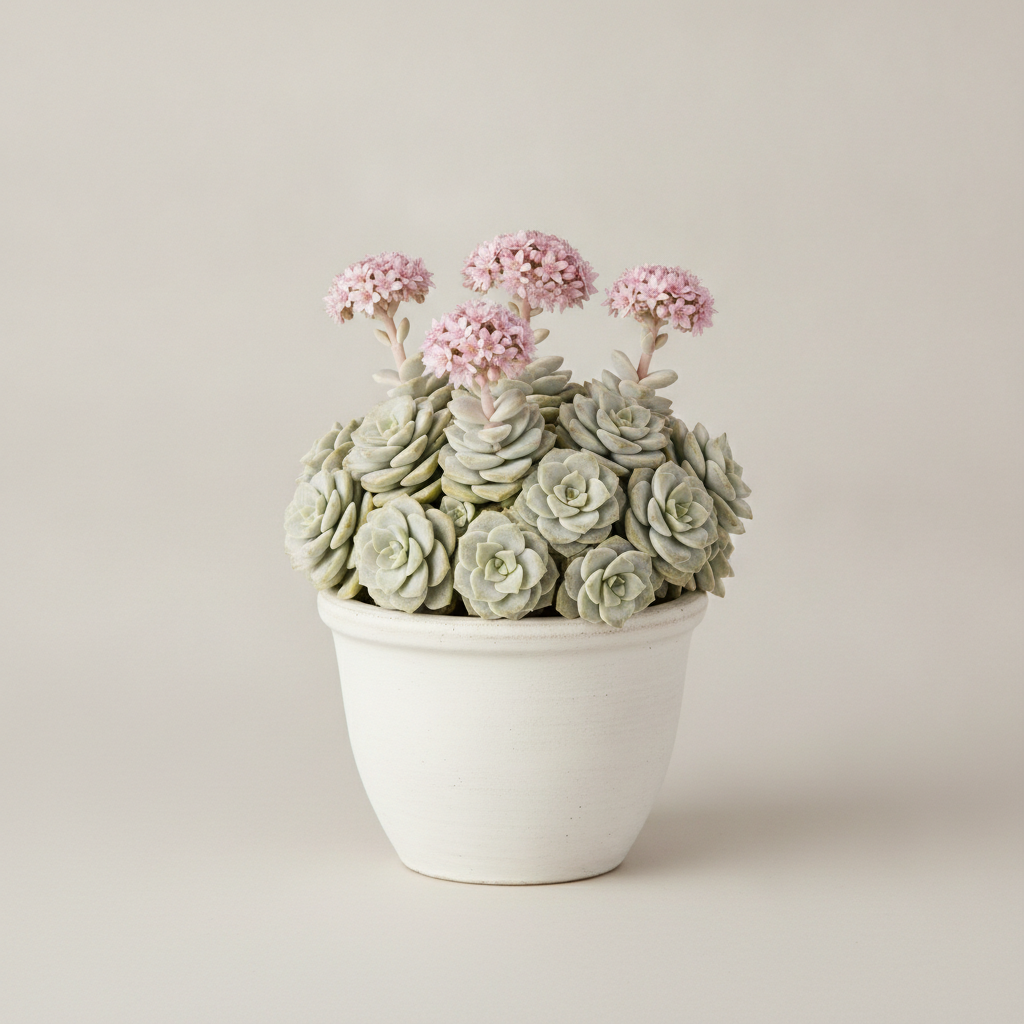
Crassula ‘Morgan’s Beauty’
A famous hybrid of the propeller plant, ‘Morgan’s Beauty’ forms dense, rounded rosettes of chalky grey-white leaves topped in summer with tight domed clusters of soft pink, sweetly scented flowers. It is more compact than the species and one of the most beautiful flowering succulents you can grow.
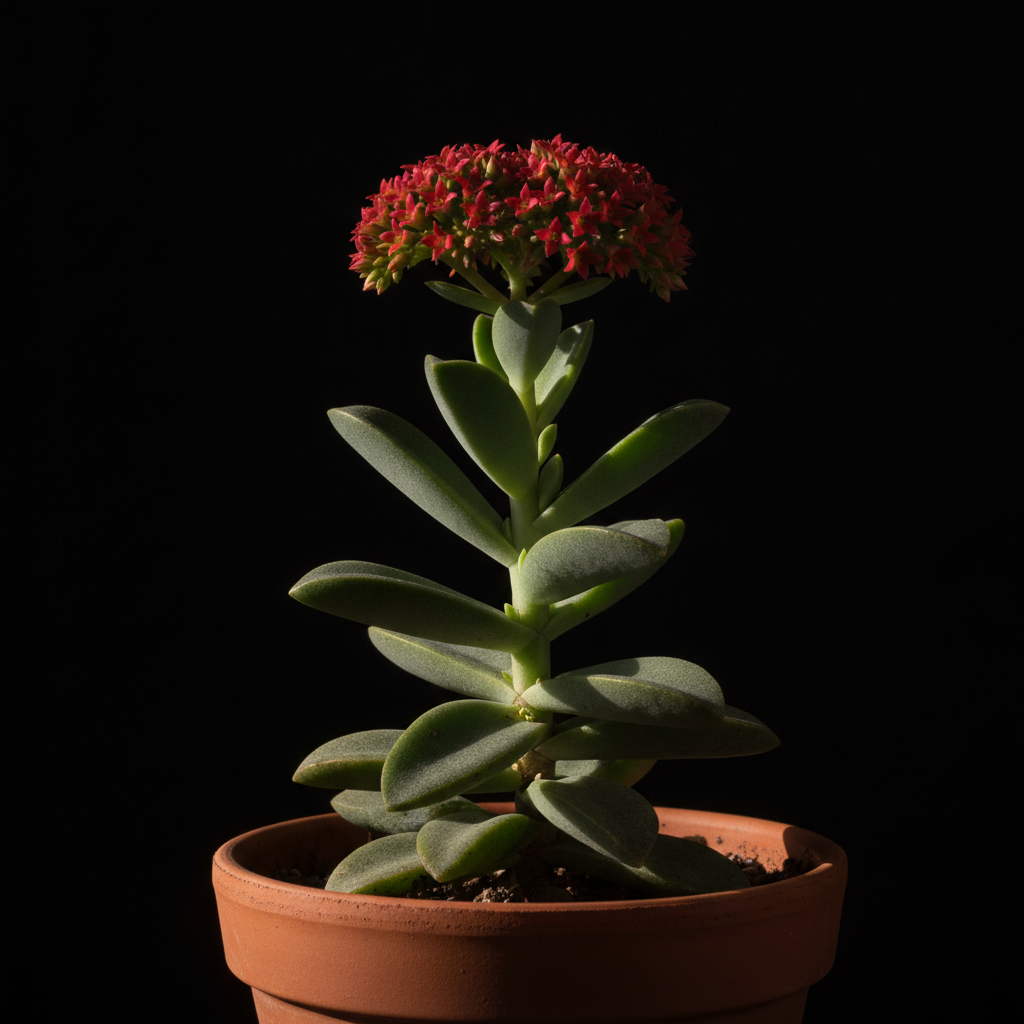
Sickle Plant (Crassula perfoliata)
The propeller plant’s larger, wilder relative, the sickle plant carries longer and more widely spaced grey-green sickle leaves up an upright stem. It produces the same flat heads of scarlet flowers in summer and makes a taller, more open specimen for a bright position.
Variety Profiles in Detail
Crassula ‘Morgan’s Beauty’ (Crassula falcata hybrid)
Bred by crossing Crassula falcata with Crassula mesembryanthemopsis, ‘Morgan’s Beauty’ takes the best of both parents: the bold flowers of the propeller plant and the tight, chalky rosette of its smaller partner. It stays low and neat, rarely exceeding 15 centimetres (6 inches), and its pink flower heads are unusually long-lasting. It wants the same full sun and gritty, dry soil as the species, and is slightly more sensitive to overwatering given its compact form.
Crassula ‘Morgan’s Pink’ (Crassula falcata hybrid)
A close sibling of ‘Morgan’s Beauty’, this selection is grown for its especially soft pink flowers set against pale, powdery grey foliage. It shares the same slow, compact habit and the same care requirements, and the two are sometimes sold interchangeably. Either makes a superb small flowering succulent for a sunny sill.
Sickle Plant (Crassula perfoliata)
The propeller plant is botanically a variety of this larger species, so the family resemblance is strong. The sickle plant grows taller and more upright, to 60 centimetres (24 inches) or more, with longer curved leaves spaced further apart along the stem. It carries the same brilliant red summer flowers and suits gardeners who want a bigger, more statuesque plant while keeping the identical easy care.
Crassula ‘Buddha’s Temple’ (Crassula pyramidalis × C. perfoliata var. minor)
A collector’s hybrid with the propeller plant in its parentage, ‘Buddha’s Temple’ is pure architecture. Its tightly folded, squared leaves stack into narrow grey-green columns that look like miniature pagodas, occasionally topped with small red or white flowers. It is very slow and demands even sharper drainage than the species, but it is one of the most eye-catching succulents a keen grower can own.
Choosing the Right Variety for Your Space
Choice comes down to space and appetite for a challenge. For a first propeller plant, or for the boldest flowers, the species and ‘Morgan’s Beauty’ are hard to beat and widely sold. If you want a taller, more dramatic plant, the sickle plant delivers the same blooms at a larger scale, while collectors chasing sculptural novelty will find endless interest in ‘Buddha’s Temple’. Every one of them, though, asks for the same three things: all the sun you can give, a fast-draining gritty mix, and a patient, sparing hand with the watering can.
Frequently Asked Questions
Why won’t my propeller plant flower?
Almost always the answer is light, and secondarily the lack of a cool winter rest. The propeller plant needs many hours of direct sun through the growing season to build the reserves for flowering, and a cooler, drier, bright winter period to trigger it. A plant kept warm and dim year-round will grow but seldom bloom. Move it to your sunniest window, feed lightly in summer, and let it rest cool and dry in winter, and flowers should follow.
How often should I water a propeller plant?
There is no fixed schedule; water only when the soil has dried out completely. In warm, sunny summer weather this often works out to every 10 to 14 days, while in winter it may be once a month or less. Always check the soil rather than the calendar, and when in doubt, wait. This plant tolerates drought far better than excess water.
Is the propeller plant toxic to cats and dogs?
The propeller plant is generally regarded as non-toxic and does not appear on the main lists of dangerous succulents. Nibbling could still cause mild stomach upset, so it is wise to keep it out of a pet’s reach. Do not confuse it with the jade plant, Crassula ovata, which is a different species and is considered toxic to cats and dogs.
What should I do after my propeller plant flowers?
Once the flower head fades, cut the spent stem back to its base with clean scissors to tidy the plant and remove a site where mould could take hold. The original rosette may slow or, in some cases, gradually die back after blooming, but by then it will usually have produced offsets around its base to carry on. Simply continue normal care and let those pups grow into the next generation.
Why are the leaves on my propeller plant wrinkling?
Slightly wrinkled, soft leaves usually mean the plant is thirsty and has drawn down its stored water, which a good soak will quickly reverse. If the lower leaves shrivel while the rest look plump, that is simply the plant shedding old growth and is nothing to worry about. Wrinkling combined with a soft, dark stem base, however, points to rot rather than drought, so check the roots before adding water.
My propeller plant is stretching and looks leggy. Can I fix it?
Stretching, or etiolation, is caused by too little light, and the elongated growth cannot be shrunk back. You can, however, restore a compact plant by beheading the stretched top, letting it callus, and re-rooting it in a much sunnier spot, where the new growth will stay tight. Moving the plant to brighter light also stops any further stretching on the remaining growth.
Can I grow a propeller plant outdoors?
Yes, in a warm, frost-free climate the propeller plant thrives outdoors in full sun and sharply drained soil, roughly USDA zones 9 to 11. It is not frost-hardy and must be protected below about 10°C (50°F), so in cooler regions grow it in a pot that can spend summer outside and come indoors before the first cold nights. Outdoor plants often flower especially well thanks to the abundant light.
How big does a propeller plant get?
Grown indoors in a pot, the propeller plant usually reaches around 30 to 60 centimetres (12 to 24 inches) tall, forming a compact clump over several years. It is a slow grower, so it stays manageable for a long time, and its modest root system means it rarely needs a large container. Regular removal of offsets keeps a single plant neat, while leaving them in place builds a fuller, clustered specimen.






