
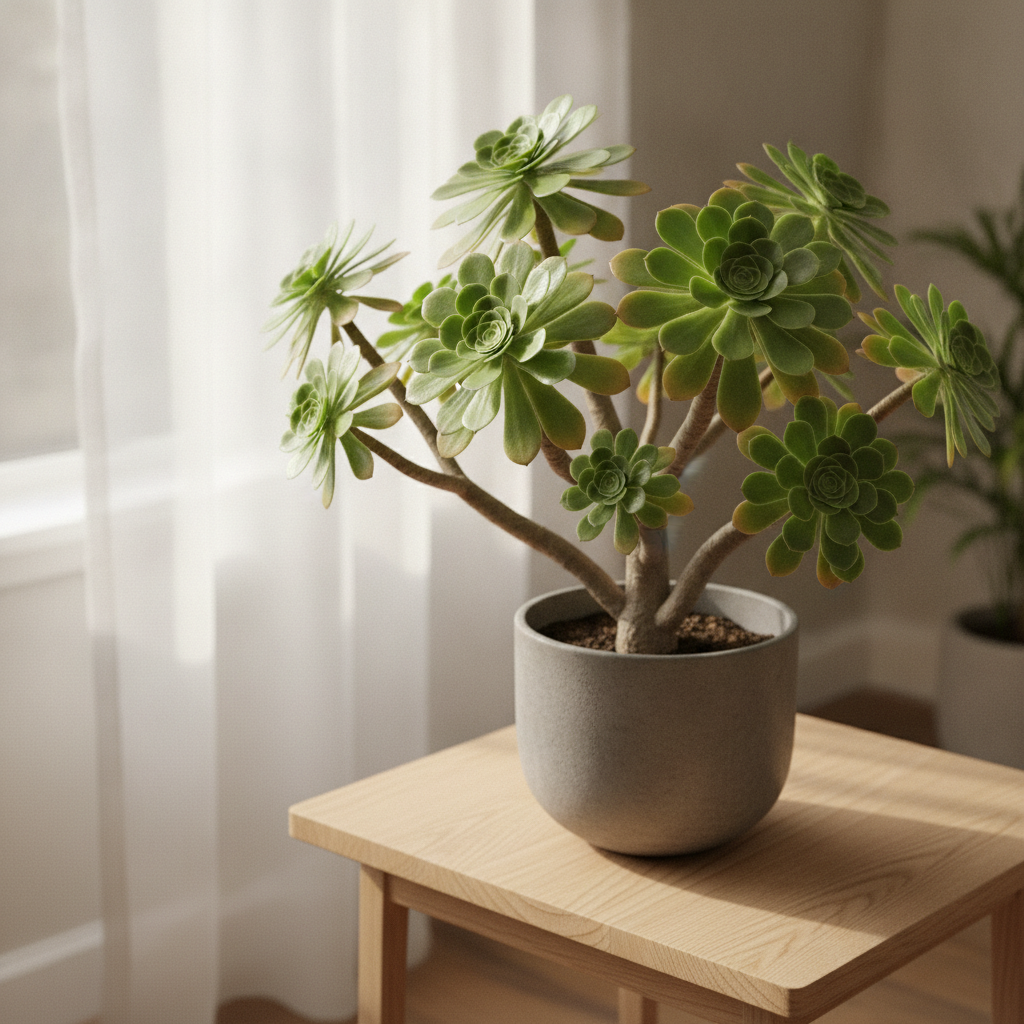
Few succulents look as deliberately composed as the pinwheel aeonium, whose glossy leaves radiate from a central point in flat, geometric rosettes that seem almost drawn rather than grown. Known botanically as Aeonium arboreum and often sold under the older common name tree houseleek, this branching succulent is native to the Canary Islands, where it clings to rocky slopes and coastal cliffs in a mild, Mediterranean-style climate of cool wet winters and hot dry summers. That origin explains almost everything about how it behaves indoors.
The pinwheel aeonium has a reputation as an easy, forgiving succulent, and for the most part that is deserved. It asks for bright light, a gritty pot of soil and restraint with the watering can. Where new owners go wrong is in treating it like a typical desert cactus, watering it hard in summer and letting it bake, when in fact it does most of its growing through the cooler half of the year. This guide covers the difference between a pinwheel aeonium that merely survives, holding on with shrivelled lower leaves and a leggy stem, and one that truly thrives, pushing out fat, symmetrical rosettes on a sculptural, well-branched frame.
Contents
- Quick Reference
- Why Pinwheel Aeonium Makes a Rewarding Houseplant
- Light Requirements
- Watering & Humidity
- Soil, Potting & Repotting
- Fertilising
- Propagation
- Pests & Diseases
- Popular Varieties
- Frequently Asked Questions
Quick Reference: Pinwheel Aeonium at a Glance
| Light | Very bright light with several hours of gentle direct sun; south or east window indoors |
| Watering | Water when the top few centimetres dry out during autumn to spring growth; keep nearly dry in summer dormancy |
| Temperature | 10 to 25 degrees C (50 to 77 degrees F); protect from frost, keep above 5 degrees C (41 degrees F) |
| Humidity | Average room humidity of 40 to 50 per cent; no misting required |
| Fertiliser | Dilute balanced feed once a month during active growth in autumn, winter and spring; none in summer |
| Toxicity | Generally considered non-toxic to cats and dogs, though the milky sap can irritate skin and stomachs |
Why Pinwheel Aeonium Makes a Rewarding Houseplant
The pinwheel aeonium earns its place on a sunny windowsill through a combination of architectural good looks and genuine resilience. Unlike the low, ground-hugging rosettes of many succulents, Aeonium arboreum grows upward on woody, branching stems, so a mature specimen reads almost like a miniature tree topped with green rosettes. Each rosette can reach 15 to 20 centimetres (6 to 8 inches) across, and a well-grown plant carries several of them at different heights, giving it a presence that few compact succulents can match.
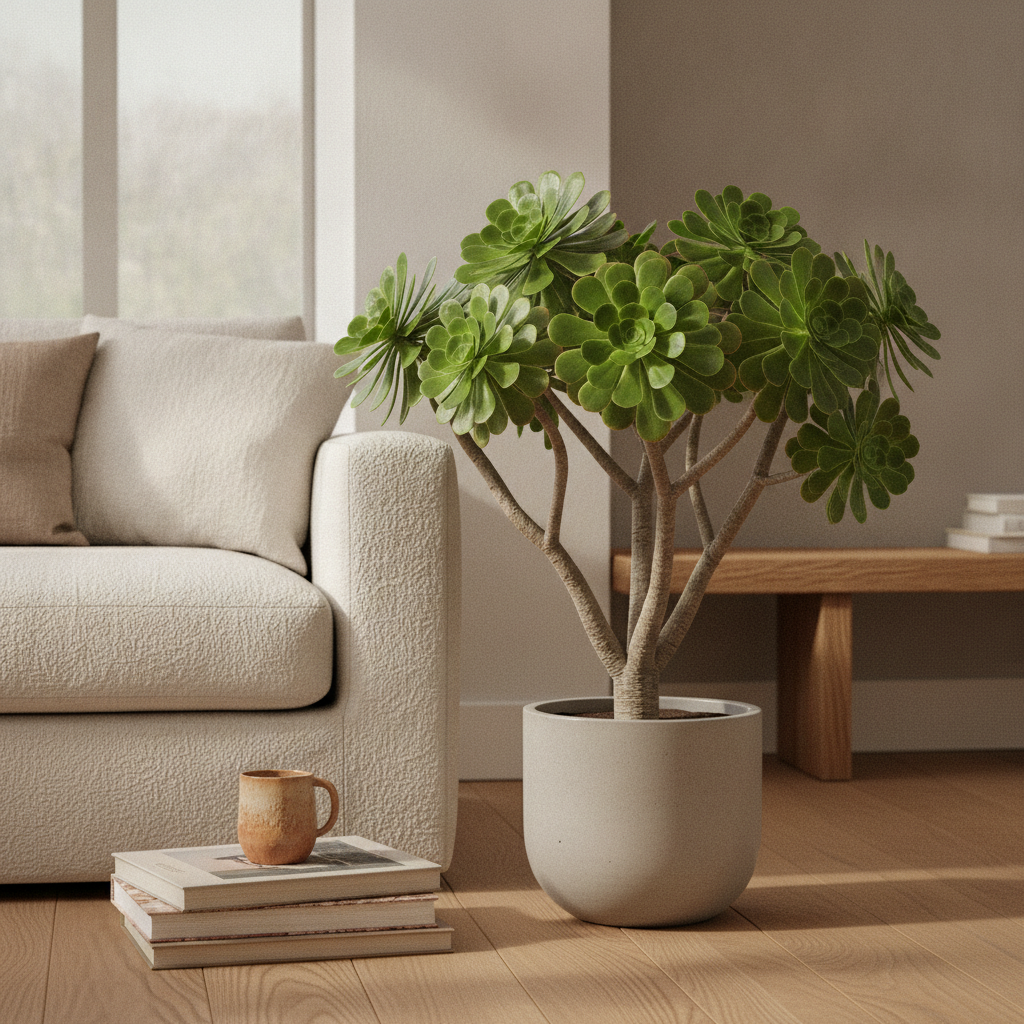
Its forgiving nature comes from being a true succulent that stores water in its fleshy leaves, meaning the occasional missed watering does no harm at all. The one habit that surprises newcomers is its growth calendar. Where most houseplants rest in winter, the pinwheel aeonium wakes up as temperatures cool in autumn and grows steadily through the darker months, then eases into dormancy through the heat of summer. Understanding this reversed rhythm is the single most useful thing you can learn about the plant, because it dictates when to water, when to feed and when to simply leave it alone.
Important — Toxicity: Aeoniums are generally regarded as non-toxic to cats and dogs and are not listed among the plants known to cause serious poisoning. That said, the milky sap of many succulents in this family can irritate skin, eyes and mouths, so it is sensible to keep curious pets and small children from chewing the leaves and to wash your hands after taking cuttings.
Light Requirements
Light is the make-or-break factor for a compact, well-coloured pinwheel aeonium. In its native Canary Islands it grows in open, sun-drenched positions, and it carries that appetite for brightness indoors. Give it the sunniest spot you have and it will reward you with tight rosettes and short internodes; starve it of light and it stretches, pales and loses the crisp pinwheel geometry that makes it worth growing.
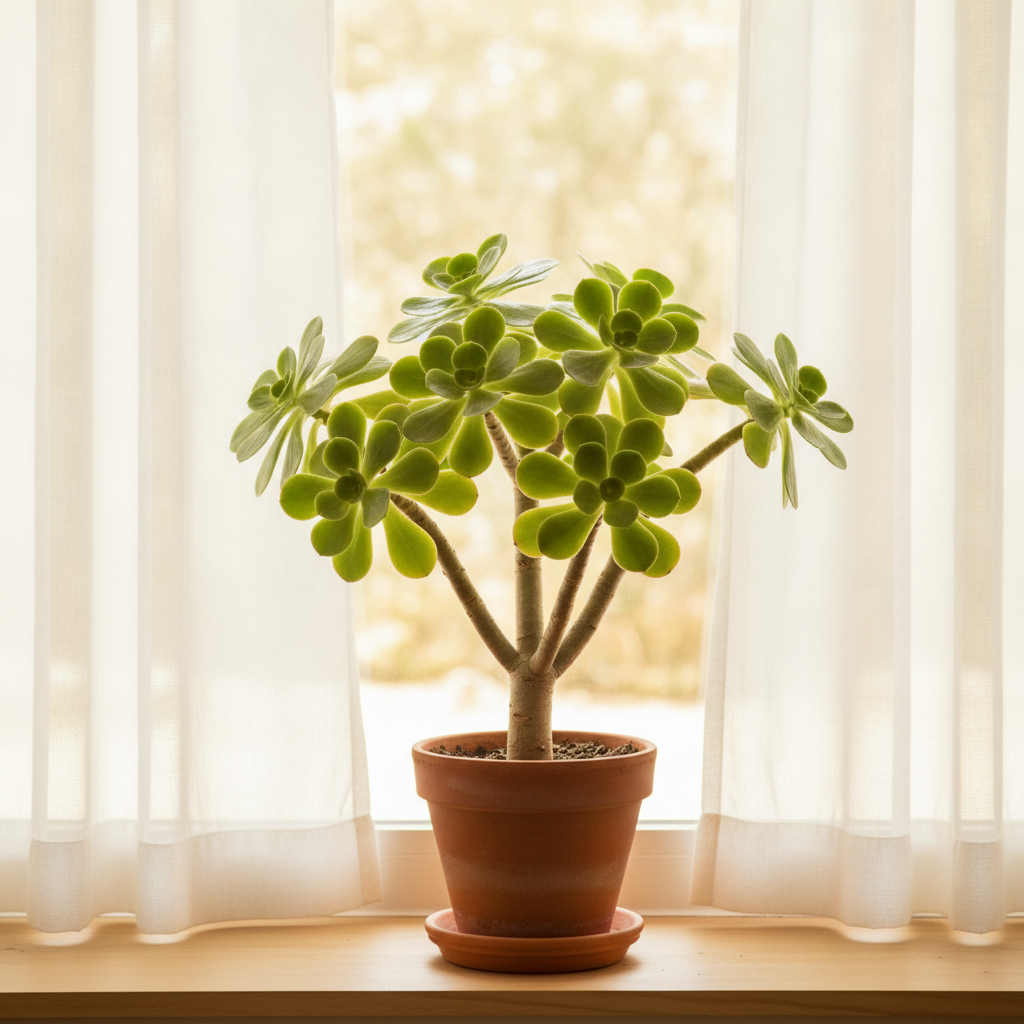
The ideal indoor position offers very bright light for most of the day with at least three to four hours of gentle direct sun, such as the light from an east-facing window or a lightly filtered south-facing one. Outdoors in summer it is happy in full sun in cooler climates, though in regions with fierce midday heat it appreciates a little afternoon shade to prevent scorching.
Light Levels Explained
Succulent light needs are easier to judge if you think in broad categories rather than exact numbers. The table below sets out how a pinwheel aeonium responds across the range you are likely to encounter in a home.
| Light Category | Approx. Level | Typical Location | Outcome |
|---|---|---|---|
| Direct sun | Over 50,000 lux | Unobstructed south or west window; outdoors | Excellent in cool weather; risk of scorch in intense summer heat |
| Bright with some direct sun | 20,000 to 50,000 lux | East window, or south with sheer curtain | Ideal; compact rosettes and strong colour |
| Bright indirect | 10,000 to 20,000 lux | Near a bright window, out of the sun beam | Acceptable; growth a little looser |
| Medium | 5,000 to 10,000 lux | A metre or two back from a window | Stretching begins; rosettes open up |
| Low | Under 5,000 lux | North window or interior room | Poor; leggy, pale and weak |
Window Orientation and Placement
South-facing window: The best choice in most homes, especially through autumn and winter when the sun sits low and its intensity is reduced. In high summer, a sheer curtain or a slight setback from the glass prevents the leaves from scorching during dormancy.
East-facing window: An excellent, low-risk option. The plant receives several hours of gentle morning sun, which is rarely strong enough to burn, followed by bright light for the rest of the day.
West-facing window: Workable, delivering strong afternoon sun. Watch for heat build-up behind glass on hot days and give a little shade if the leaves show signs of stress.
North-facing window: Generally too dim for a healthy pinwheel aeonium. Plants here almost always stretch and lose their shape, and a grow light becomes essential if this is your only option.
Pro Tip — Rotate for Symmetry: Aeoniums lean noticeably toward their light source. Give the pot a quarter turn every week or two so the branches grow evenly and the plant keeps its balanced, sculptural shape rather than reaching to one side.
How Light Affects Colour and Form
Light does more than keep the plant compact; it drives leaf colour, which matters enormously in the coloured cultivars. The species itself stays bright green, but purple and variegated forms only develop their richest tones under strong light. In bright sun the dark cultivars deepen almost to black and variegated forms flush with rose and cream, while in shade those same plants revert toward plain green. If your coloured aeonium looks disappointingly green, insufficient light is almost always the reason.
Warning — Direct Sunlight: A plant moved suddenly from indoors into full summer sun can suffer sunscald, showing as brown, papery patches on the upper leaf surfaces that never recover. Acclimatise gradually over two to three weeks, increasing exposure a little at a time, before leaving it in strong direct sun.
Artificial Lighting
Because the pinwheel aeonium grows through the low-light months, a full-spectrum LED grow light is often worthwhile even for windowsill plants. Position the light 20 to 30 centimetres (8 to 12 inches) above the rosettes and run it for 12 to 14 hours a day to supplement short winter days. A grow light is the only reliable way to keep the plant compact if bright natural light is simply not available.
Seasonal Adjustments
Follow the plant’s reversed calendar. Through autumn, winter and spring, place it in the brightest available spot to fuel active growth. In summer, when it slows or stops, the same intense light can stress a dormant plant, so a fraction more shade and a cooler position help it rest comfortably until growth resumes with the cooling weather.
Watering & Humidity
Watering a pinwheel aeonium correctly means matching the watering can to the plant’s growth cycle rather than the calendar you would use for a typical houseplant. It stores water in its fleshy leaves and dislikes sitting wet, so the guiding principle is to water thoroughly but only when the soil has genuinely dried, and to scale the frequency up and down with the seasons.
When to Water
During the active growing months from autumn through to spring, water when the top three to five centimetres (1 to 2 inches) of soil have dried out. In practice this often means watering roughly once a week to once a fortnight, depending on your pot size, light levels and room temperature. The leaves are a reliable gauge: plump, firm rosettes signal a well-hydrated plant, while slightly soft, inward-curling leaves show it is ready for a drink.
In summer the picture changes completely. As the plant enters dormancy it uses very little water, and its rosettes naturally close up and curl inward to conserve moisture, which is normal and not a sign of thirst. Water only enough to stop the plant shrivelling severely, perhaps once every three or four weeks, and never let it sit in soggy soil during this rest period.
Pro Tip — Read the Rosette: A summer aeonium folding its leaves tightly into a compact bud is resting, not dying. Resist the urge to rescue it with extra water. The rosette will open again on its own as cooler autumn weather returns and growth restarts.
How to Water Correctly
- Check the soil first by pushing a finger a few centimetres down; water only if it feels dry at that depth.
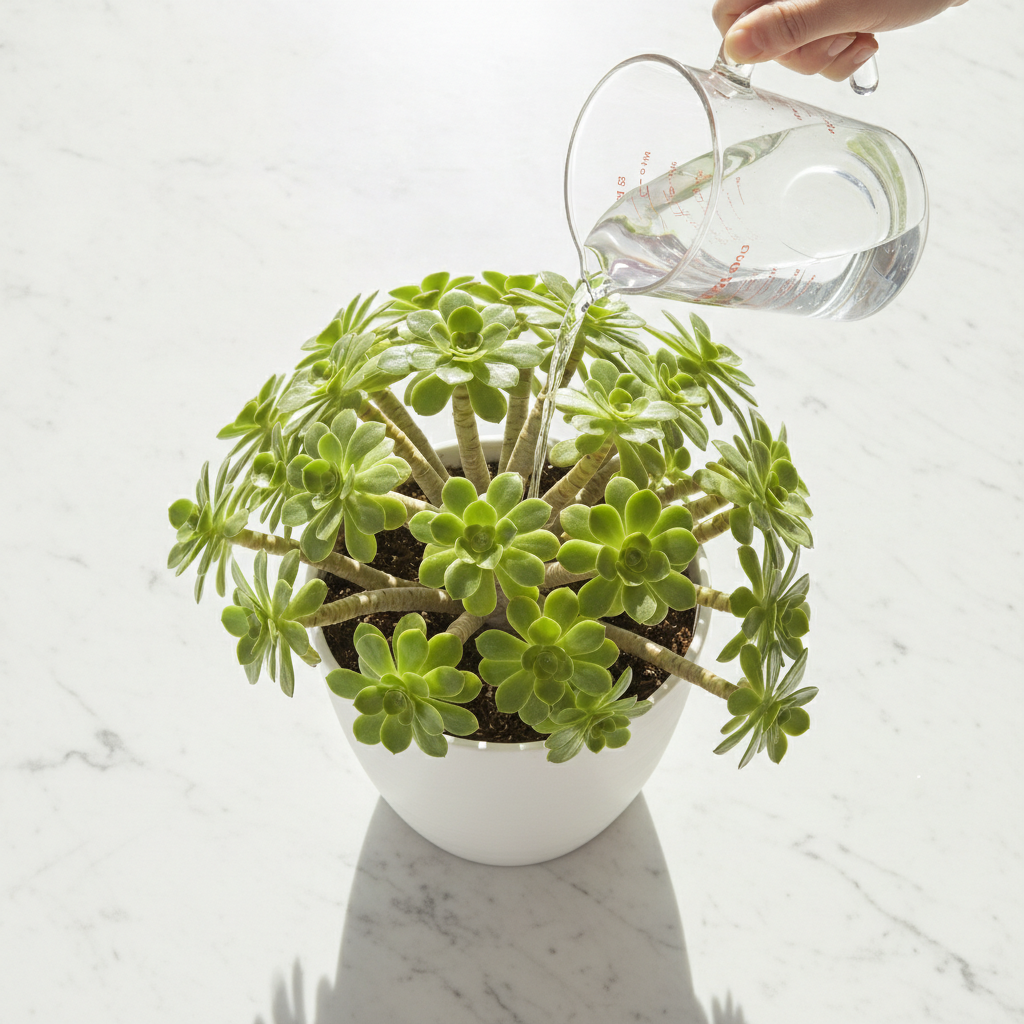
- Water at the base of the plant, aiming for the soil rather than the rosettes, since water pooling in the centre can cause rot.
- Apply water slowly and evenly until it runs freely from the drainage holes, wetting the entire root ball.
- Let the pot drain completely and empty any water that collects in the saucer or cover pot.
- Wait until the top few centimetres are dry again before the next watering, adjusting the interval with the season.
Signs of Overwatering vs. Underwatering
| Symptom | Overwatering | Underwatering |
|---|---|---|
| Leaf colour | Yellowing, translucent lower leaves | Dull, slightly faded green |
| Leaf texture | Soft, mushy, easily detached | Thin, wrinkled, curling inward |
| Soil | Stays wet for many days, may smell sour | Bone dry throughout, pulls from pot edge |
| Roots | Brown, slimy, breaking down | Dry but intact, pale and firm |
| Stem base | Blackening, soft and collapsing | Firm but perhaps a little shrunken |
Warning — Root Rot: Overwatering, especially during summer dormancy, is the leading cause of death for pinwheel aeoniums. A blackening, softening stem base is a sign that rot has taken hold. If you catch it early, cut well above the damage into healthy, firm tissue, let the cutting callus for a few days, and re-root it to save the plant.
Humidity Requirements
Humidity is refreshingly uncomplicated with this plant. Coming from breezy coastal cliffs, it is perfectly content in the average household range of 40 to 50 per cent and has no need for the raised humidity that tropical foliage plants crave.
In fact, high humidity combined with poor airflow works against it, encouraging fungal problems and rot in the crowded rosette centres. There is no need to watch for humidity-related symptoms in a normal home, and the plant will not develop the crispy leaf edges that signal dry-air stress in tropical species.
Do not mist a pinwheel aeonium. Water settling in the tightly packed rosettes is far more likely to cause rot than to benefit the plant. Good air circulation is more valuable than any attempt to raise humidity, so a spot with gentle air movement suits it well.
Water Quality
Pinwheel aeoniums are not fussy about water quality and tolerate ordinary tap water in most areas. If your water is very hard, you may see faint mineral spotting on the leaves over time, which is cosmetic and harmless. Where water is heavily softened or chlorinated, letting it stand overnight or using collected rainwater keeps the plant at its best, though this is a refinement rather than a requirement.
Soil, Potting & Repotting
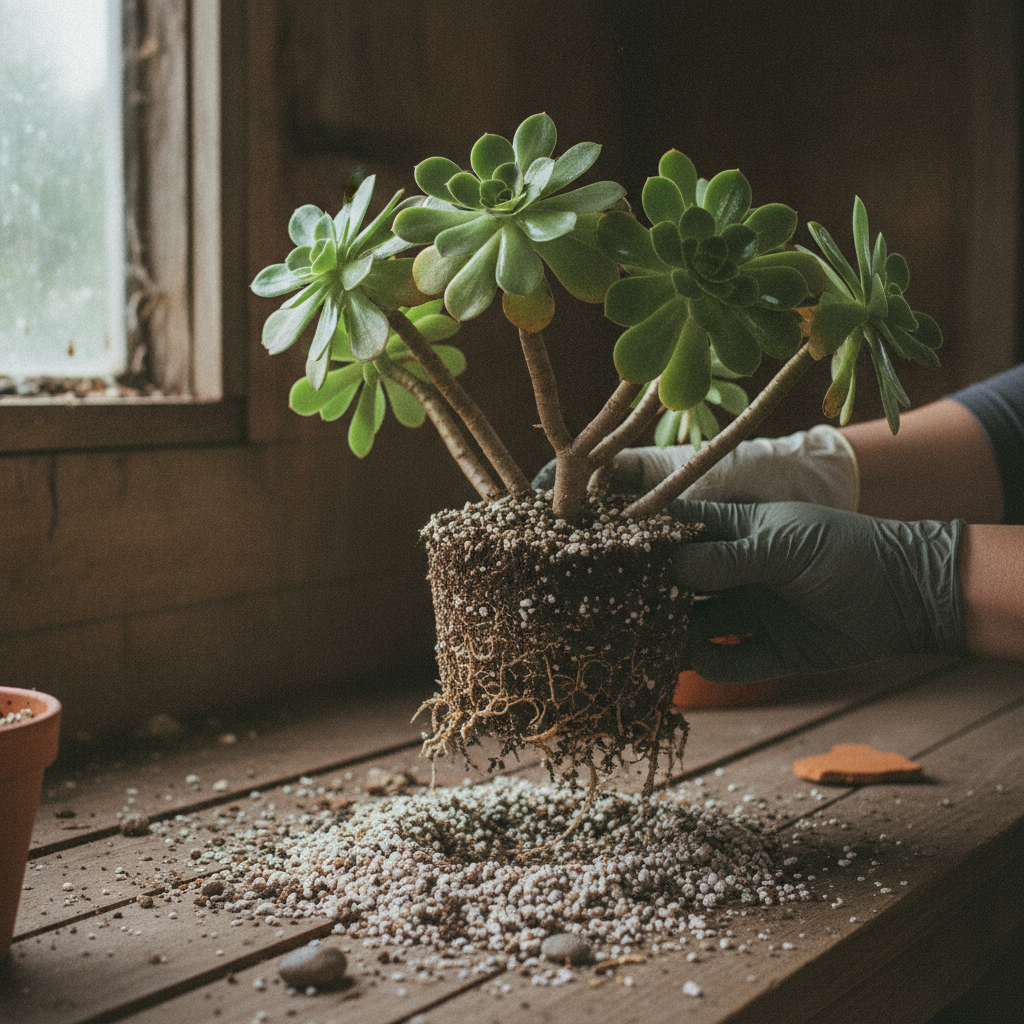
Everything about a pinwheel aeonium’s root health comes down to drainage. These plants evolved in fast-draining, gritty ground where water never lingers, and replicating that in the pot is the surest way to avoid rot. A dense, moisture-retentive mix is the fastest route to a dead aeonium.
Ideal Soil Composition
Start with a quality cactus and succulent compost and open it up further with additional grit. The aim is a mix that holds a little moisture for the roots to drink but sheds the rest almost immediately, so that the root ball is never waterlogged. Aeoniums have relatively shallow, fibrous roots that appreciate air as much as water.
| Component | Proportion | Function |
|---|---|---|
| Cactus and succulent compost | 50 per cent | Provides structure and modest moisture retention |
| Perlite or pumice | 30 per cent | Opens the mix and speeds drainage |
| Coarse horticultural grit or sand | 20 per cent | Adds weight and further improves airflow |
Aeoniums are relaxed about pH, thriving anywhere from slightly acidic to slightly alkaline, roughly 6.0 to 7.5. A standard succulent mix sits comfortably in this range, so there is no need to test or adjust the soil for a healthy plant.
Pro Tip — Quick Mix Recipe: For a reliable blend, combine two handfuls of cactus compost with one handful of perlite and one handful of coarse grit. If in doubt, err on the grittier side; a pinwheel aeonium copes far better with a mix that is too free-draining than one that holds too much water.
Choosing the Right Pot
The right container works with the soil to keep the roots healthy, and with a top-heavy branching plant it also has a stabilising job to do.
Drainage holes are non-negotiable. Never plant a pinwheel aeonium in a pot without drainage. Excess water must be able to escape freely, and any decorative cover pot should be emptied promptly after watering so the roots never stand in a reservoir.
Pot material: Terracotta is ideal because its porous walls wick moisture away and help the soil dry evenly, which suits a rot-prone succulent. A heavier terracotta or ceramic pot also counterbalances the weight of the branching rosettes, whereas a tall plant in a light plastic pot tips over easily.
Pot size: Choose a container only slightly larger than the root ball. An oversized pot holds a large volume of damp soil the small root system cannot use, and that lingering moisture invites rot. Aeoniums are quite happy growing a little snug.
When to Repot
Pinwheel aeoniums are slow enough that they need repotting only every two to three years, or when roots emerge from the drainage holes and the plant becomes unstable. The best time is early autumn, just as the plant is waking into its growing season and can quickly establish in fresh soil. Avoid repotting in the heat of summer dormancy, when disturbed roots are slow to recover.
How to Repot: Step-by-Step
- Let the soil dry out for a few days first, as a dry root ball slides out more cleanly and is less prone to damage.
- Support the base of the stems and ease the plant from its pot, teasing away as much old, spent soil as you can.
- Inspect the roots and trim off any that are brown, black or mushy with clean, sterilised scissors.
- Add a layer of fresh gritty mix to the base of a pot one size up, then position the plant at its previous depth.
- Fill around the roots with fresh mix, firming gently to remove air pockets and to steady the top-heavy stems.
- Wait about a week before watering, giving any disturbed or trimmed roots time to callus and reducing the risk of rot.
Warning — Transplant Shock: A repotted aeonium may drop a few lower leaves or look slightly sulky for a week or two as it settles in. This is normal. Keep it in bright light, hold off on watering until it has adjusted, and it will resume growth without lasting harm.
Fertilising
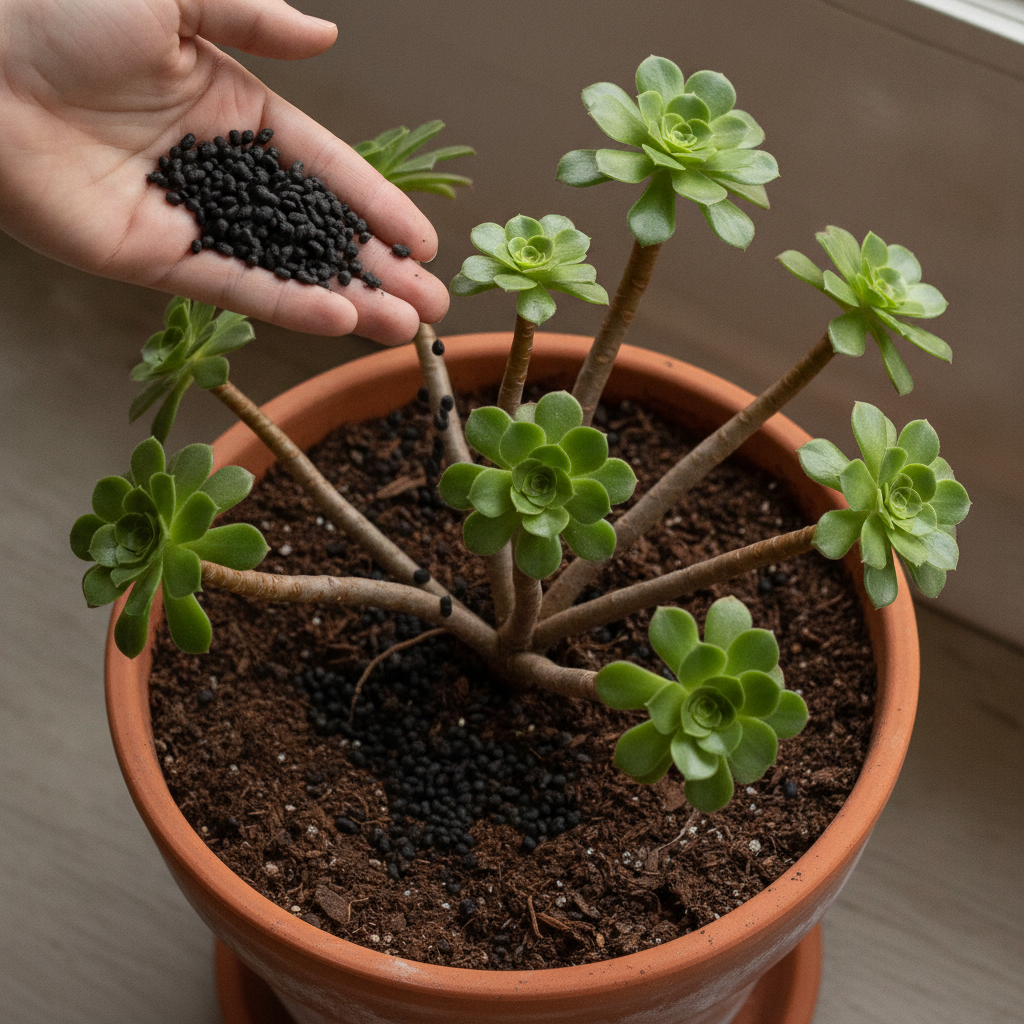
Pinwheel aeoniums are light feeders that get most of what they need from fresh soil and good light. A little supplementary feeding during active growth encourages fuller rosettes and stronger branching, but heavy feeding does more harm than good and produces soft, weak growth prone to pests and rot.
The golden rule is to feed only when the plant is actively growing. Because that growth happens in autumn, winter and spring, the fertilising schedule runs opposite to most houseplants, and feeding a dormant summer plant simply loads the soil with unused salts.
Understanding Plant Nutrients
Fertiliser labels carry three numbers, the NPK ratio, showing the percentages of nitrogen, phosphorus and potassium. For a succulent like the pinwheel aeonium, a balanced or slightly low-nitrogen feed is ideal, since too much nitrogen forces the lush, floppy growth that spoils the plant’s compact form.
| Nutrient | Symbol | Primary Function | Deficiency Symptoms |
|---|---|---|---|
| Nitrogen | N | Leaf and stem growth | Pale leaves, weak, stalled growth |
| Phosphorus | P | Root development and flowering | Poor roots, dull colour |
| Potassium | K | Overall vigour and stress tolerance | Yellow leaf margins, soft growth |
| Calcium | Ca | Cell wall strength | Distorted new rosette leaves |
| Magnesium | Mg | Chlorophyll production | Yellowing between leaf veins |
| Iron | Fe | Green pigment formation | Pale new growth in the rosette centre |
Types of Fertiliser
Liquid fertilisers: The easiest option for succulents, mixed into the watering can and applied during growth. Use a balanced houseplant or dedicated cactus feed diluted to half the recommended strength to avoid overfeeding.
Slow-release granular: A few granules worked into the soil surface at the start of the growing season release nutrients gradually. Convenient, though harder to control precisely, so use sparingly for a plant with such modest needs.
Organic fertilisers: Gentle options such as diluted worm-casting tea or a light top-dressing of worm castings feed slowly and are almost impossible to overdo, making them well suited to a plant that resents being pushed.
Feeding Schedule
Feed once a month with a half-strength balanced fertiliser through the active growing season, from early autumn to late spring. Stop feeding entirely in summer while the plant is dormant. This simple rhythm supplies enough nutrition for healthy rosettes without encouraging the soft, over-lush growth that heavy feeding brings.
Pro Tip — Less Is More: When it comes to feeding succulents, under-feeding is far safer than overfeeding. A slightly hungry pinwheel aeonium stays compact and colourful, while an over-fed one grows loose and green and becomes a magnet for aphids. If unsure, skip a feed.
How to Fertilise
- Confirm the plant is in active growth, during the cooler autumn-to-spring months rather than summer dormancy.
- Dilute a balanced liquid feed to half the strength stated on the label.
- Water with plain water first if the soil is very dry, to protect the roots from concentrated fertiliser salts.
- Apply the diluted feed evenly to the soil, avoiding splashing it into the rosette centres.
- Flush the pot with plain water every couple of months to wash out any accumulated salts.
Warning — Salt Build-Up: A white crust on the soil surface or around the pot rim signals a build-up of mineral salts from overfeeding or hard water. Left unchecked it scorches the roots. Flush the pot thoroughly with plain water and ease off the feeding to clear it.
Propagation
One of the great pleasures of growing a pinwheel aeonium is how readily it propagates. A single plant can become a whole collection with almost no effort, and taking cuttings is also the standard way to refresh a specimen that has grown tall and leggy over the years.
Aeoniums are propagated from stem cuttings and from the offset rosettes that appear along the branches, both of which root easily. Unlike many succulents, they do not reliably grow from single leaves, so stem and rosette cuttings are the methods to rely on.
Understanding Rosettes and Offsets
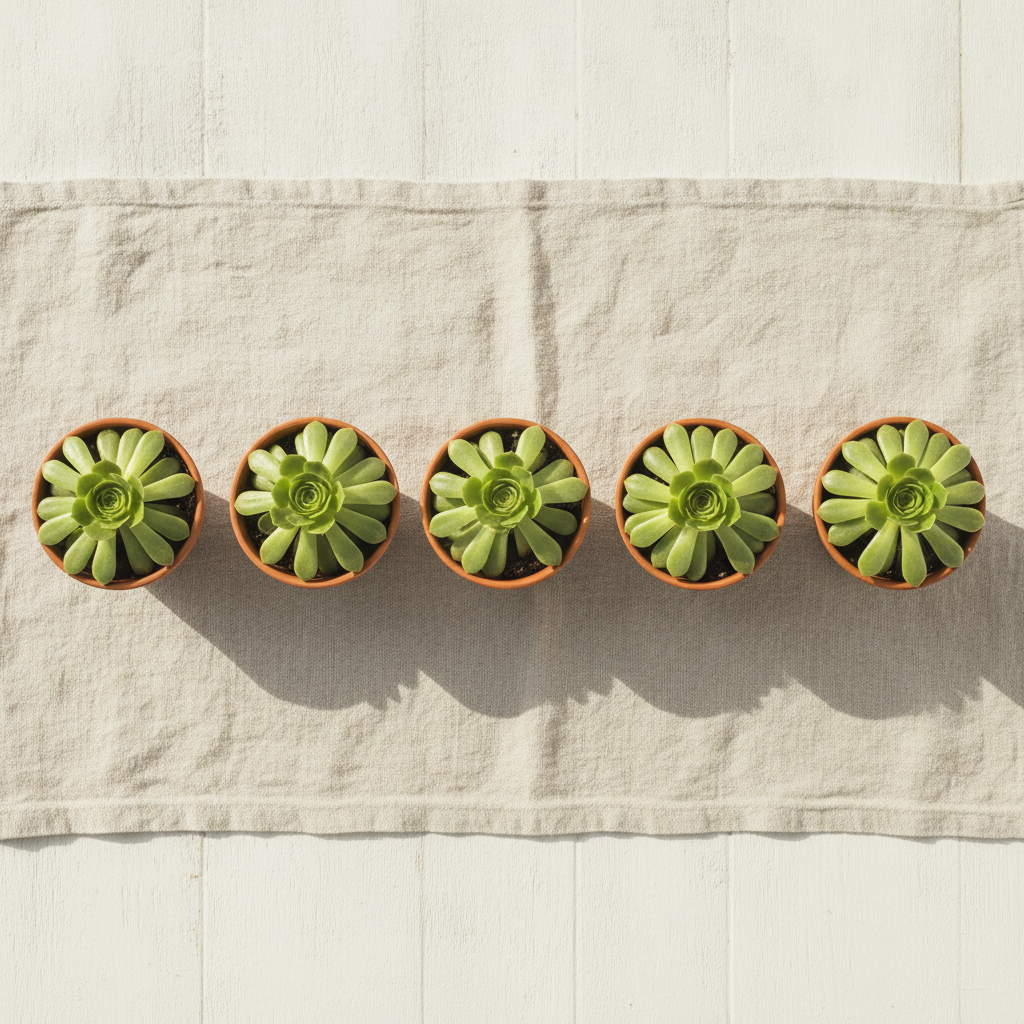
Each aeonium rosette sits at the tip of a stem, and as the plant matures it branches, producing new rosettes along and around the main stems. These side rosettes, or offsets, can be removed with a short length of stem and rooted as new plants. Because a rosette dies after it eventually flowers, keeping a supply of rooted cuttings on hand is also good insurance against losing an individual crown.
Stem and Rosette Cuttings: Step-by-Step
This is the quickest and most reliable method, best done in autumn or spring during active growth.
- Choose a healthy rosette and cut its stem cleanly with a sterilised, sharp knife, leaving 5 to 10 centimetres (2 to 4 inches) of stem attached.
- Remove the lowest few leaves to expose a short section of bare stem for planting.
- Set the cutting aside in a dry, shaded spot for two to three days so the cut end forms a dry callus.
- Insert the callused stem into a small pot of barely moist gritty succulent mix, deep enough to hold the rosette upright.
- Place it in bright indirect light and wait about a week before the first light watering.
- Water sparingly until roots form over the following few weeks, then treat it as a mature plant.
Pro Tip — Always Callus First: The single most important step is letting the cut end dry and callus before planting. Skipping it and pushing a fresh, moist cut straight into damp soil is the surest way to invite rot rather than roots.
Beheading a Leggy Plant: Step-by-Step
If your aeonium has stretched into a bare, straggly stem, beheading rejuvenates it and yields cuttings at the same time.
- Cut the rosette off the top of the leggy stem, keeping several centimetres of stem below the crown.
- Callus and re-root the top exactly as for a normal stem cutting.
- Keep the original stump potted and lightly watered; it will usually sprout several new rosettes from below the cut.
- Once the new rosettes are established, you have several plants where you started with one leggy specimen.
Troubleshooting Propagation
| Problem | Likely Cause | Solution |
|---|---|---|
| Cutting rots at the base | Planted before callusing, or soil too wet | Always callus for a few days; use a gritty mix and water sparingly |
| No roots after weeks | Too cold, too dark, or taken during dormancy | Provide bright warmth and propagate in autumn or spring |
| Rosette shrivels | Normal moisture loss before rooting | Be patient; a light watering once callused usually helps it recover |
| Leaf cutting fails | Aeoniums rarely grow from single leaves | Use stem or rosette cuttings instead |
Pests & Diseases
A healthy pinwheel aeonium in bright light and gritty soil is not especially prone to problems, but its cupped rosettes offer tucked-away hiding places that a few common pests exploit. Most troubles are easily managed if you catch them early, and the great majority of serious issues trace back to overwatering rather than to any pest.
Regular inspection is the best defence. Peer into the rosette centres and along the branch joints every week or two, since these sheltered spots are exactly where pests gather before they become a visible infestation.

Common Pests
Aphids (Aphidoidea)
Aphids are the classic aeonium pest and are strongly drawn to the soft new growth in the rosette centres, especially on plants that have been overfed. These tiny green, black or grey insects cluster on emerging leaves and flower stalks, sucking sap and leaving a sticky residue.
Treatment: Rinse them off with a firm jet of water, then treat with insecticidal soap or a diluted neem oil spray, repeating every few days until they are gone. Cutting back on nitrogen feeding reduces the soft growth they favour.
Mealybugs (Pseudococcidae)
Mealybugs appear as small white, cottony tufts wedged into leaf axils and rosette centres. They too suck sap, weakening the plant and leaving behind a sticky honeydew that can encourage sooty mould.
Treatment: Dab each insect directly with a cotton bud soaked in isopropyl alcohol, then follow up with neem oil or insecticidal soap. Isolate the affected plant, as mealybugs spread quickly between succulents.
Vine Weevil (Otiorhynchus sulcatus)
The real damage from vine weevil comes from its larvae, plump white grubs that live in the soil and eat the roots, often causing a plant to collapse suddenly with no obvious cause above ground. Adult weevils notch the leaf edges at night.
Treatment: Check the root ball when repotting and remove any grubs you find. A biological control of beneficial nematodes watered into the soil is the most effective way to deal with a larval infestation.
Common Diseases
Root and Stem Rot (Pythium and Phytophthora)
By far the most serious threat, rot sets in when the soil stays wet, particularly during summer dormancy. It shows first as a blackening, softening stem base, which then spreads upward and collapses the plant with alarming speed.
Treatment: There is no cure once tissue has rotted. Cut well above the damage into clean, firm, healthy stem, discard the affected material and root the healthy top as a cutting. Prevent recurrence with gritty soil, careful watering and a pot with good drainage.
Fungal Leaf Spot (various fungi)
Poor airflow combined with water sitting in the rosettes can lead to dark, sometimes sunken spots on the leaves. It is more disfiguring than deadly but signals that conditions are too damp and stagnant.
Treatment: Remove affected leaves, improve air circulation and keep water off the foliage. Watering at the soil rather than over the rosettes prevents most cases.
Pest and Disease Summary
| Pest / Disease | Identification | Treatment |
|---|---|---|
| Aphids | Clusters of tiny insects on new rosette growth | Rinse off, then insecticidal soap or neem oil |
| Mealybugs | White cottony tufts in leaf axils | Alcohol on a cotton bud, then neem oil |
| Vine weevil | Notched leaves; white grubs in the soil | Remove grubs; apply beneficial nematodes |
| Root and stem rot | Blackening, softening stem base | Cut into healthy tissue and re-root the top |
| Fungal leaf spot | Dark spots on damp, crowded leaves | Remove leaves; improve airflow, keep foliage dry |
Prevention Strategies
Prevention with aeoniums is largely about getting the basics right, since a plant grown hard and lean in bright light with sparing water is naturally more resistant. Avoid overfeeding, which produces the soft growth pests love, and give the plant space and air movement rather than crowding it among other plants.
Quarantine any new plant for a couple of weeks before it joins your collection, and inspect the rosette centres regularly. Catching a handful of aphids early is trivial; discovering a heavy infestation deep in the crown weeks later is a far bigger job.
Pro Tip — Neem as a Routine: A monthly preventive spray of diluted neem oil, applied in the evening to avoid leaf scorch, keeps most soft-bodied pests from ever gaining a foothold. Reach into the rosette centres and branch joints where pests like to hide.
Popular Varieties
Although the plain green species is handsome in its own right, Aeonium arboreum is best known through its coloured cultivars, which turn a simple rosette into something dramatic. The colour these forms develop depends heavily on light, so the brighter you grow them, the more striking they become.
The varieties below are the ones most often found in garden centres and succulent nurseries. All share the same easy care as the species, differing chiefly in leaf colour and, in a few cases, size and vigour.
| Variety | Leaf Appearance | Light Needs | Growth Rate | Availability |
|---|---|---|---|---|
| Species (green) | Glossy bright green rosettes | Very bright | Moderate | Common |
| Atropurpureum | Bronze to deep purple rosettes | Very bright, full sun for colour | Moderate | Common |
| Zwartkop | Near-black glossy rosettes | Full sun for darkest colour | Moderate to vigorous | Common |
| Variegatum | Cream, yellow and green stripes with rosy edges | Very bright, some shade from harsh sun | Slow to moderate | Occasional |
| Luteovariegatum | Green centres with broad yellow margins | Very bright | Slow | Occasional |
| Velour | Reddish-purple with green centres | Full sun | Moderate | Occasional |
Featured Varieties
Atropurpureum
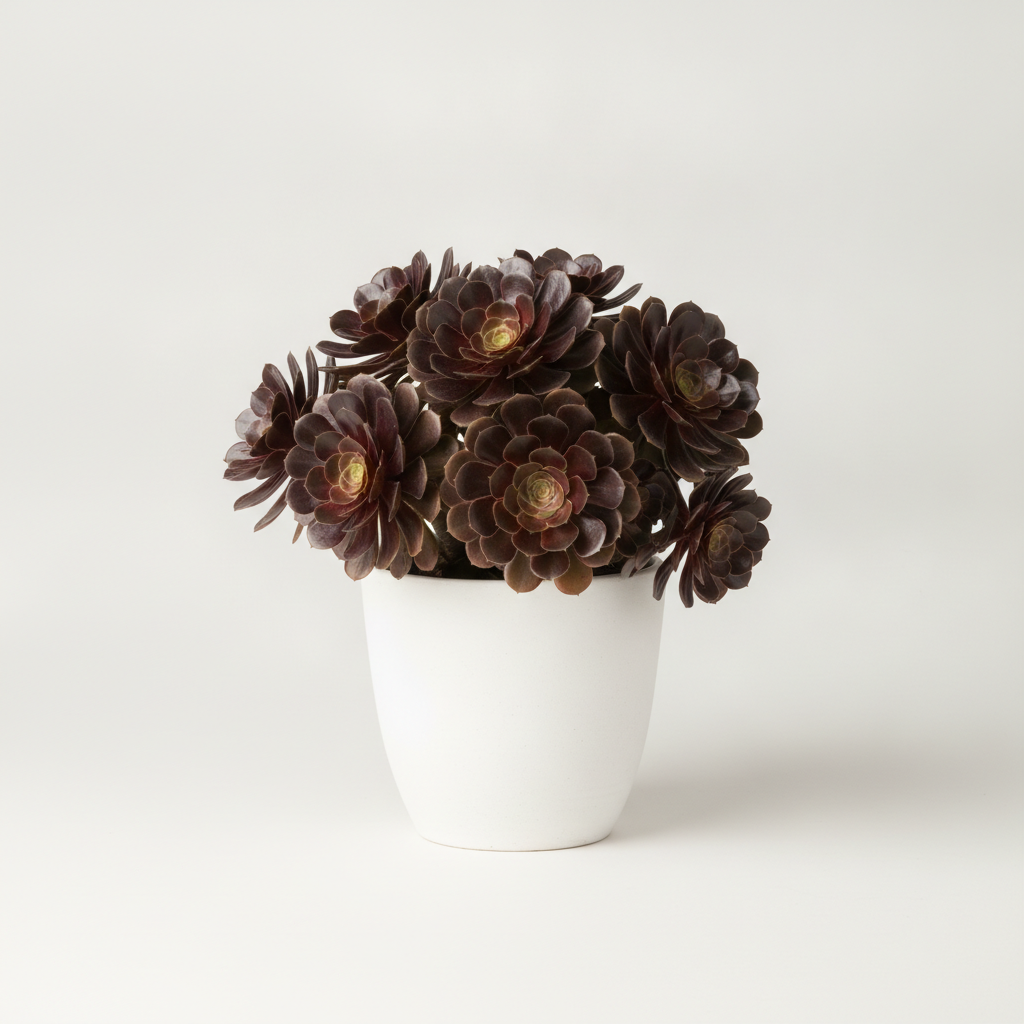
The best-known coloured form, with rosettes that flush from bronze to a deep, saturated purple in strong sun and fade toward green in shade. A robust, easy grower that brings instant drama to a sunny sill.
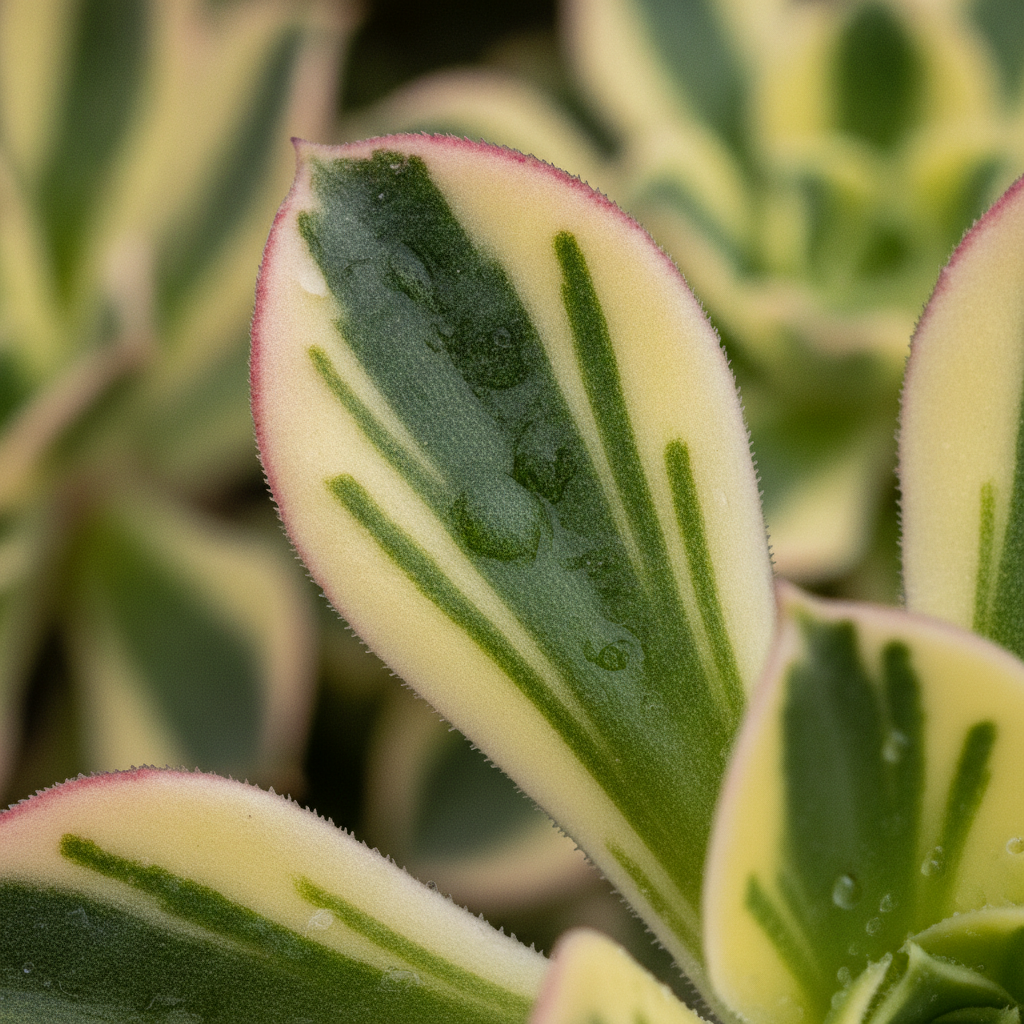
Variegatum
A softer, more painterly variety whose leaves are striped in cream, pale yellow and green, often with rosy pink edges in bright light. Slower and slightly more delicate than the green species, but exquisite up close.
Variety Profiles in Detail
Atropurpureum (Aeonium arboreum ‘Atropurpureum’)
This is the variety most people picture when they think of a purple aeonium. Grown in full sun it develops rich, wine-dark rosettes, while in weaker light it reverts to a bronzed green, making it a living light meter for its own position. It is as tough and forgiving as the plain species and roots just as readily from cuttings.
Zwartkop (Aeonium arboreum ‘Zwartkop’)
Often sold as the black rose aeonium, Zwartkop takes the purple colouring to its extreme, with glossy rosettes so dark they read as black against a bright background. It needs the strongest light of all the cultivars to hold that colour and is a vigorous, upright grower that makes a real statement.
Variegatum (Aeonium arboreum ‘Variegatum’)
The variegated form trades boldness for subtlety, with each leaf marbled in cream, yellow and green and often edged in pink where the sun touches it. Variegated tissue carries less chlorophyll, so it grows more slowly and appreciates protection from the harshest midday sun to prevent the pale areas from scorching.
Choosing the Right Variety for Your Space
Let your available light guide the choice. If you have a blazing south-facing sill, the dark cultivars such as Zwartkop and Atropurpureum will thank you with their deepest colours. For a bright but slightly gentler spot, the green species or the variegated form is a safer bet, since the variegated leaves can scorch in fierce sun. Whichever you choose, the care is identical, so many growers simply collect several and enjoy the contrast of green, purple and cream rosettes side by side.
Frequently Asked Questions
Why is my pinwheel aeonium closing up its leaves in summer?
This is completely normal. As temperatures climb the plant enters its natural summer dormancy and curls its rosettes tightly inward to conserve water. It is resting, not dying, and the rosettes will open out again as cooler autumn weather returns. Resist the urge to water more; extra moisture during dormancy is the main cause of rot.
Why has my aeonium grown tall and leggy with a bare stem?
Legginess is almost always caused by insufficient light. Reaching for a brighter source, the plant stretches its stem and drops lower leaves. Move it to your sunniest window, and to restore its looks, behead the leggy rosette, re-root the top and let the stump sprout fresh rosettes.
Is the pinwheel aeonium safe around pets?
Aeoniums are generally regarded as non-toxic to cats and dogs and are not listed among plants known to cause serious poisoning. Even so, the sap can irritate, and any plant material may cause a mild upset if eaten in quantity, so it is wise to keep pets from making a habit of nibbling the leaves.
How often should I water it?
There is no fixed schedule; water by checking the soil. During active growth in autumn, winter and spring, water thoroughly when the top few centimetres have dried, often every one to two weeks. In summer dormancy, cut right back to roughly once every three or four weeks, just enough to stop severe shrivelling.
Why are the lower leaves dropping off?
Some loss of the oldest, lowest leaves is a normal part of how aeoniums grow, gradually revealing the woody stem beneath the rosette. Rapid loss of many soft, yellowing leaves, however, points to overwatering, while shrivelled leaves dropping in summer are simply the plant conserving resources during dormancy.
My aeonium flowered and then died. What happened?
Individual aeonium rosettes are monocarpic, meaning a rosette dies after it produces its tall cone of flowers. This is natural and not a care failure. On a well-branched plant only the flowering rosette is lost while the others carry on, and taking cuttings beforehand ensures you never lose the plant entirely.
Can I grow a pinwheel aeonium outdoors?
Yes, in mild climates it makes a superb patio or garden plant and colours up beautifully in full sun. It is not frost hardy, though, so where winters drop below about 5 degrees C (41 degrees F) it should be grown in a pot that can be moved indoors or into a frost-free greenhouse for the cold months.
Why has my purple aeonium turned green?
Coloured cultivars need strong light to hold their dark or variegated tones. In insufficient light they produce more chlorophyll and revert toward green as a survival response. Move the plant into brighter light, ideally with some direct sun, and the richer colour will gradually return to the new growth.
How big does a pinwheel aeonium get?
Indoors, a mature plant typically reaches 60 centimetres to 1 metre (2 to 3 feet) tall over several years, branching into multiple rosettes each around 15 to 20 centimetres (6 to 8 inches) across. Growth is steady rather than fast, and pot size, light and pruning all influence the final dimensions.






