
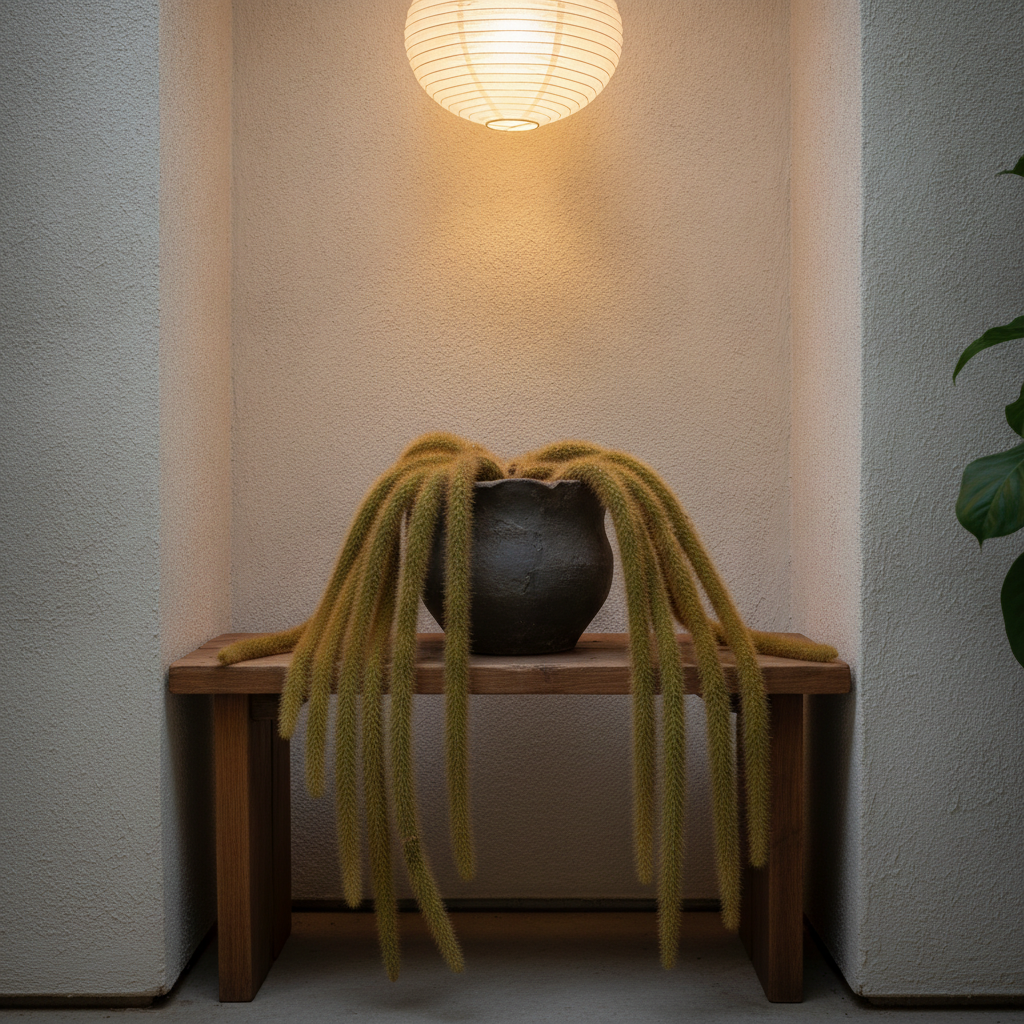
Few cacti look as improbable indoors as the golden rat tail cactus (Cleistocactus winteri), a plant that trades the stiff, upright silhouette most people expect from a cactus for long, soft, golden ropes that spill over the rim of a pot and keep on falling. Run a hand across the stems and there is another surprise waiting, because the dense gold spines that give the plant its warm halo are fine and bristly rather than sharp, closer to stiff fur than to armour. It is a cactus built for a shelf edge, a hanging basket or a raised stand, and one of the very few that rewards a beginner with both fast growth and large, showy flowers.
This guide walks through everything needed to keep Cleistocactus winteri not just alive but genuinely thriving, from the light and watering rhythm that produces those cascading tails to the cool winter rest that coaxes out its salmon-orange blooms. Whether the plant just came home from a nursery or has been sulking in a dim corner for a season, the sections below cover the full picture.
In This Guide
- Quick reference
- Why the golden rat tail cactus is such a good houseplant
- Light
- Watering
- Soil and potting
- Fertilising
- Propagation
- Pests and problems
- Varieties and relatives
- Frequently asked questions
Quick Reference
The table below is the fast summary for anyone who wants the essentials at a glance. Every point is expanded in the sections that follow, so treat this as a map rather than the whole territory.
| Common names | Golden rat tail cactus, golden rat’s tail, monkey tail cactus |
| Botanical name | Cleistocactus winteri (formerly Hildewintera aureispina, Winterocereus aureispinus) |
| Family | Cactaceae |
| Native range | Cliffs and rocky slopes of the Rio Grande canyons, Santa Cruz, Bolivia |
| Light | Bright light, including several hours of direct sun; the brightest window in the home |
| Water | Regularly in spring and summer once the mix is nearly dry; almost none in winter |
| Humidity | Undemanding; ordinary room humidity is fine |
| Temperature | 18 to 27 degrees Celsius (64 to 81 Fahrenheit) in growth; a cool winter rest of 8 to 12 degrees Celsius (46 to 54 Fahrenheit) |
| Soil | Gritty, sharply draining cactus mix |
| Feeding | Dilute low-nitrogen cactus feed monthly in the growing season |
| Growth habit | Trailing and pendant; stems to around 1 metre (3 feet) or more |
| Propagation | Stem cuttings; also seed |
| Toxicity | Non-toxic to cats and dogs; the fine spines are a mechanical irritant only |
| Difficulty | Easy; forgiving and fast-growing for a cactus |
Why the Golden Rat Tail Cactus Is Such a Good Houseplant
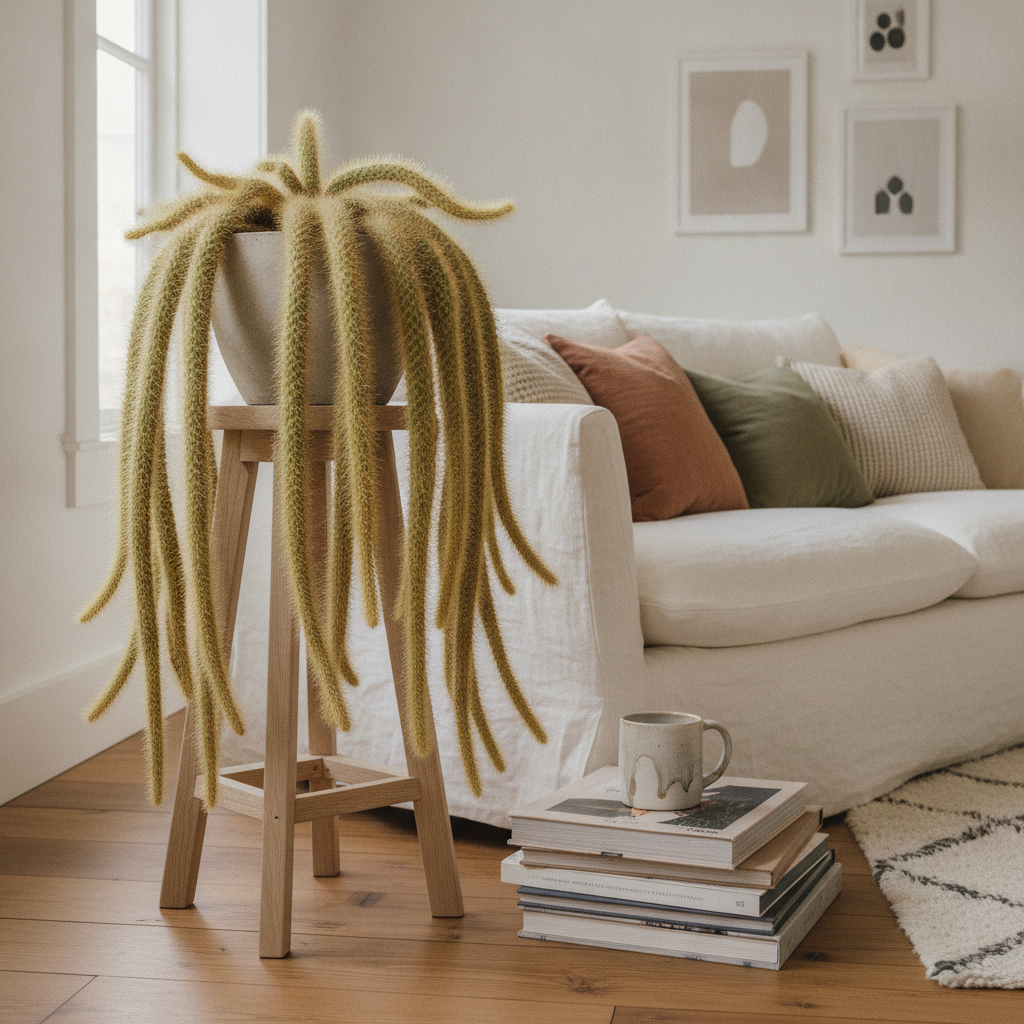
The golden rat tail cactus earns its place indoors on looks alone, but its real appeal is the gap between how exotic it appears and how little it asks. In the wild it clings to sun-baked Bolivian cliffs in the Rio Grande canyons, sending its stems trailing downward over rock faces where soil is thin and rain is occasional. That origin is the key to the whole plant. A cactus adapted to grip a vertical cliff and endure long dry spells is, almost by definition, a plant that tolerates the neglect and erratic watering of a busy household far better than most leafy houseplants ever could.
What distinguishes surviving from thriving here comes down to two things: light and rhythm. Give the plant a genuinely bright spot and a growing season of regular water followed by a cool, dry winter, and it grows quickly, thickens up, and in time produces its remarkable salmon-orange flowers. Deny it those things and it will simply persist, stems thinning and paling, spines losing their gold, never quite dying but never becoming the cascade of colour it can be. The good news is that the difference is easy to engineer in an ordinary home.
The trailing habit is the other reason to love it. Most cacti sold as houseplants are upright, slow and static, whereas Cleistocactus winteri is dynamic, growing several centimetres of new stem in a good month and eventually draping a metre or more of soft gold over the edge of a hanging basket. It fills the same design niche as a string of pearls or a trailing pothos, but with a texture nothing else can match. For anyone who wants the drama of a hanging plant without the thirst and fuss, this cactus is close to ideal.
Pro Tip — Handle with a light touch: The golden spines look soft and mostly are, but the fine bristles can detach and lodge in skin like tiny splinters. When repotting or taking cuttings, cradle the stems in a folded cloth or wear light gloves rather than gripping bare-handed.
Light
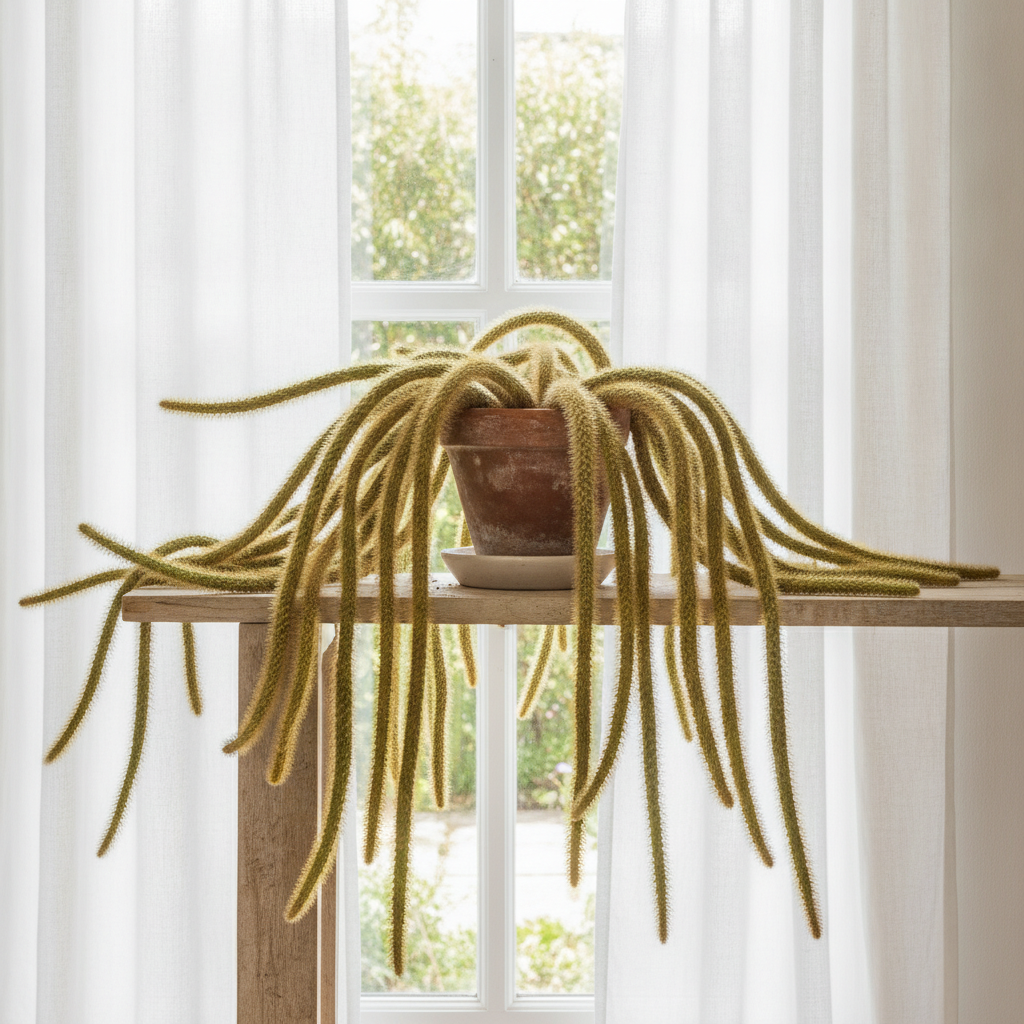
Light is where this plant is least forgiving, and it is the one area worth being slightly obsessive about. As a cliff-dwelling cactus from a sunny, high-altitude part of Bolivia, Cleistocactus winteri is built to soak up strong light. Indoors it wants the brightest position available, ideally a south or west-facing window where it receives at least four to six hours of direct sun each day. The spines are its clue: in good light they stay dense and richly gold, forming the warm halo the plant is grown for, whereas in poor light new growth comes through thin, pale and sparsely spined, and the stems stretch and weaken as they reach for the window.
There is a sensible limit. Behind glass, the intensity of summer midday sun can be magnified enough to scorch a plant that has not been gradually accustomed to it, showing up as bleached yellow or corky brown patches on the sun-facing side of the stems. A plant that has spent winter in lower light should be reintroduced to strong sun over a week or two rather than moved abruptly, and in the hottest climates a very light sheer curtain during the fiercest hours prevents scorching without meaningfully reducing growth. In temperate homes, though, the far more common mistake is too little light rather than too much.
Because the stems trail and lengthen toward the light, giving the pot a quarter turn every week or two keeps growth even all the way around instead of concentrated on the window side. If a bright enough window simply is not available, the plant responds well to a full-spectrum LED grow light run for ten to twelve hours a day, positioned close enough to keep new spines dense and gold.
Watering
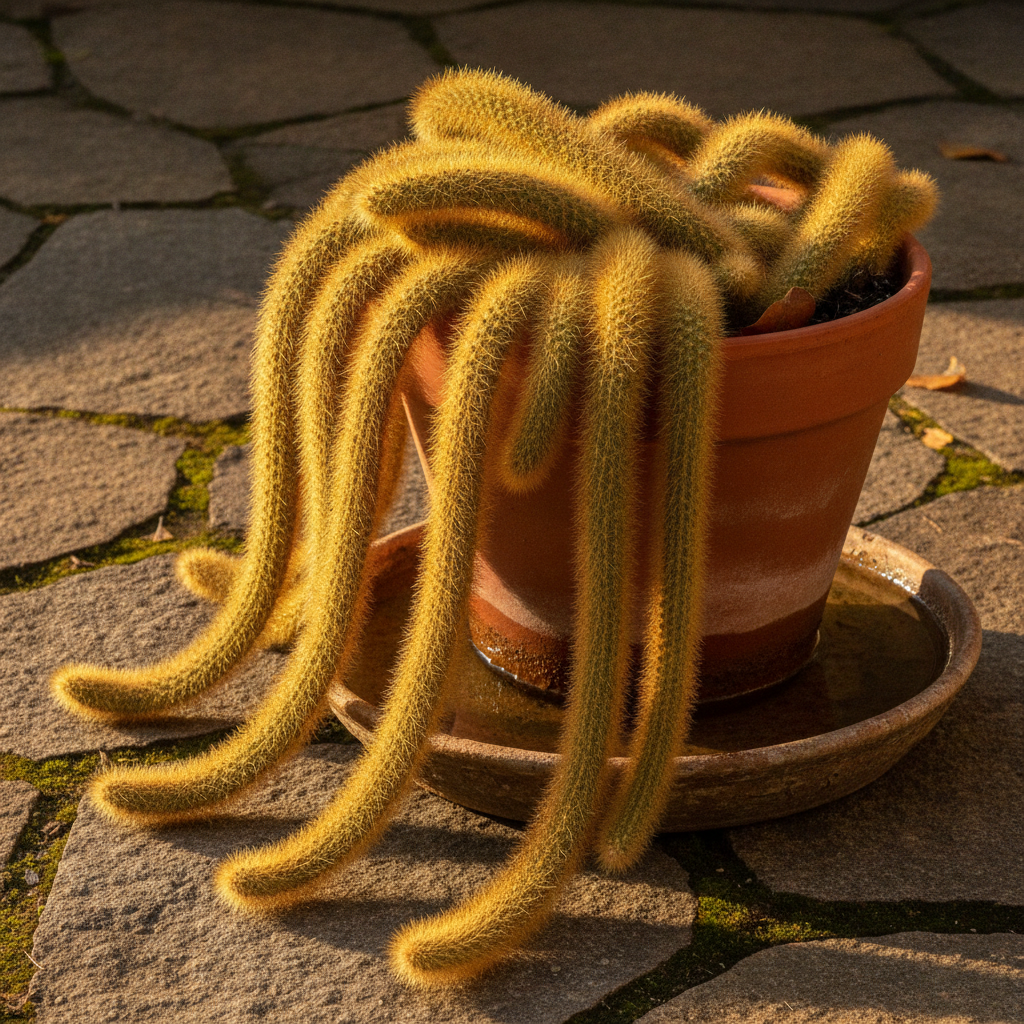
Watering a golden rat tail cactus is less about a fixed schedule and more about reading two things: the season and the dryness of the mix. During the active growing season of spring and summer this is a thirstier plant than its desert reputation suggests, because it is growing fast and flowering. Water it thoroughly whenever the potting mix has dried out almost completely, letting water run freely from the drainage holes so the entire root ball is soaked, then allow it to dry again before the next drink. In a warm, bright spot that might mean watering every seven to ten days, but the mix, not the calendar, is the true guide.
The single most important rule is that the plant must never sit in water. Roots that stay wet in a heavy, slow-draining mix are the fastest way to lose an otherwise indestructible cactus, because stagnant moisture invites rot that spreads up into the stems before there is any warning sign at the surface. This is why bottom watering suits it so well: standing the pot in a shallow dish of water for fifteen to twenty minutes lets the gritty mix wick up moisture from below, after which any excess is tipped away and the pot returned to its spot. Whatever the method, empty the saucer once the plant has finished draining.
Winter flips the routine entirely. From late autumn the plant enters a rest period, and watering should drop to almost nothing, perhaps a small drink once a month or even less if the plant is kept cool. This near-drought is not neglect but a deliberate trigger: the combination of cool temperatures and a dry root run through winter is what persuades a mature plant to set flower buds the following spring. Overwatering in the cold months is both the commonest cause of rot and the commonest reason a healthy-looking plant refuses to bloom.
Warning — Cold and wet is the fatal combination: A golden rat tail cactus will shrug off being too dry for weeks, but cold, soggy compost in winter can kill it in days. When in doubt during the cool months, wait longer before watering.
Soil and Potting
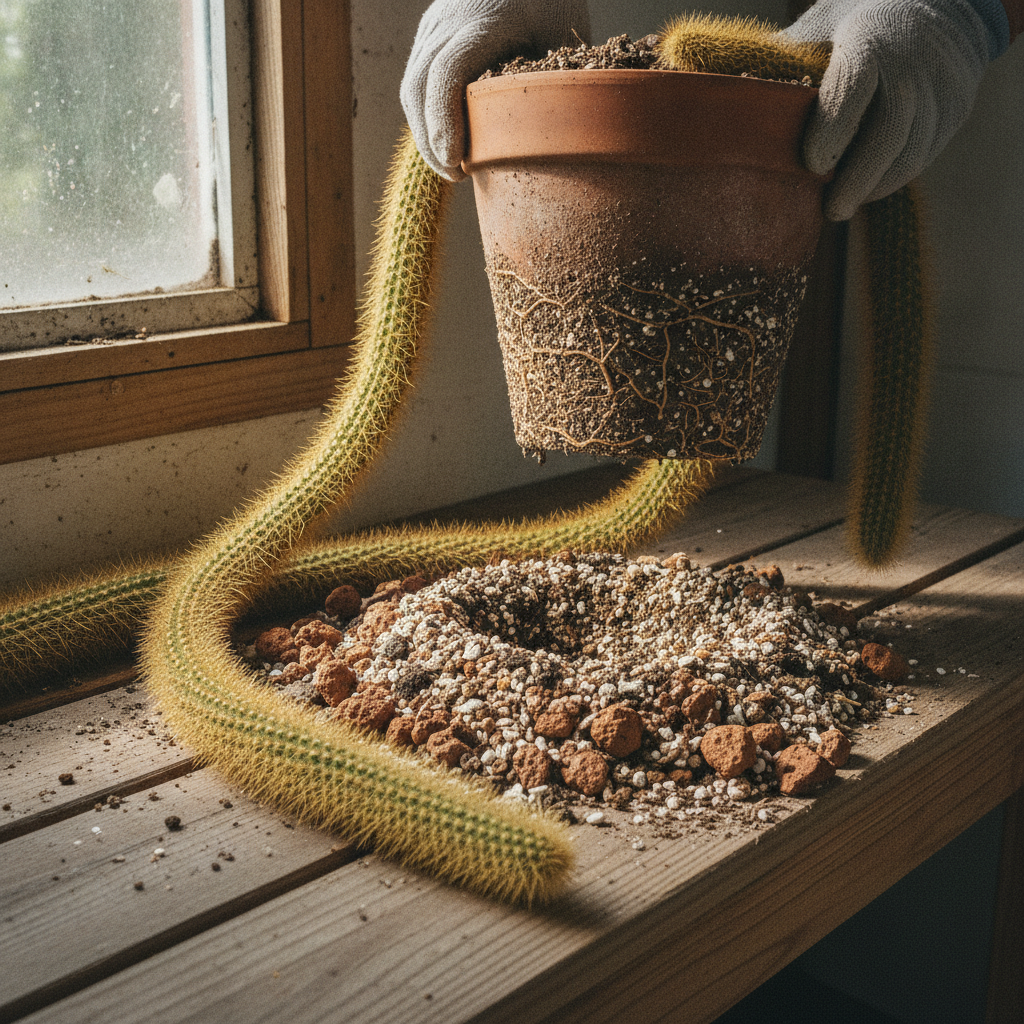
Everything about watering depends on the soil underneath it, so getting the mix right is what makes the rest of this plant easy. A golden rat tail cactus needs a sharply draining, gritty medium that holds a little moisture but never stays wet. A good starting point is roughly half a standard cactus or succulent compost and half coarse mineral grit such as pumice, perlite or coarse horticultural sand. The aim is a mix that water passes through quickly and air can reach, so the roots dry out between waterings rather than sitting in a damp sponge.
The pot matters as much as what goes in it. Drainage holes are essential, and a terracotta pot is a real advantage here because its porous walls let the compost breathe and dry more evenly than plastic, which forgives the occasional heavy hand with the watering can. Because the plant trails, a pot raised on a stand, set on a high shelf or hung in a basket lets the stems do what they are built to do; a heavier pot also helps counterbalance a large plant whose long stems can otherwise tip a lightweight container over.
Repotting is an occasional job rather than an annual one, needed every two to three years or when roots fill the pot and growth slows. Spring is the ideal time, at the start of the growing season. Handle the spiny stems with a folded cloth or a strip of newspaper wrapped around them, ease the plant out, tease away most of the old compost, and settle it into fresh gritty mix at the same depth it sat before. Then wait: leave a freshly repotted plant dry for about a week before the first watering, which gives any roots disturbed in the process time to callus over rather than rot.
Fertilising
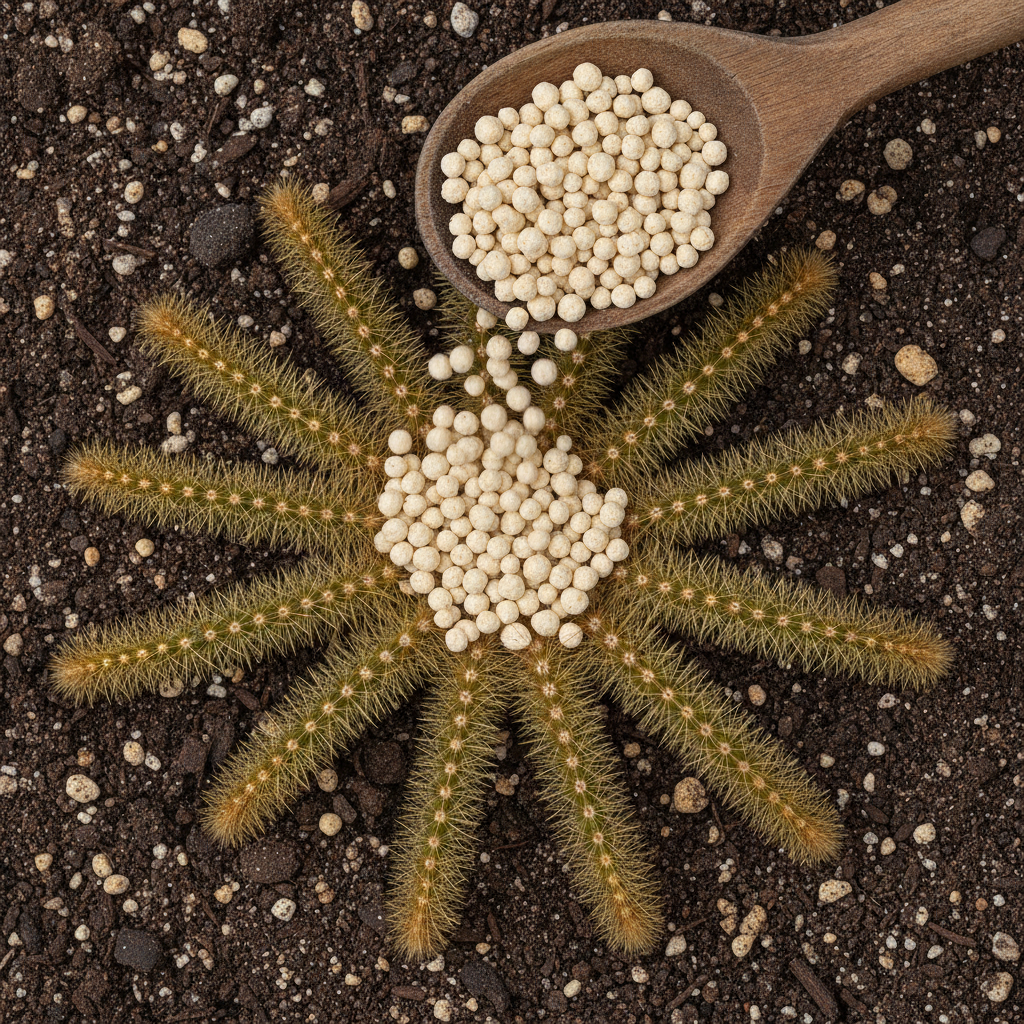
A golden rat tail cactus is not a heavy feeder, but because it grows fast and flowers freely for a cactus, a little feeding in the growing season makes a visible difference to both. The simplest approach is a purpose-made cactus and succulent fertiliser, which is formulated to be low in nitrogen and higher in potassium and phosphorus. That balance matters: too much nitrogen pushes soft, pale, weakly spined growth that flops and is prone to rot, whereas a low-nitrogen feed supports firm stems, good spine colour and flower production.
Feed only during spring and summer, roughly once a month, and always dilute to half the strength suggested on the label rather than following it literally. Apply the feed to compost that is already damp rather than bone dry, so the diluted solution reaches the roots evenly instead of running straight through and risking a concentrated dose against dry roots. A slow-release granular cactus feed scattered onto the surface in spring is an equally good, lower-effort alternative that releases gently over the season.
Stop feeding entirely from early autumn through winter. The plant is resting then, and fertiliser applied during the dormant period is not taken up; instead it can build up as salts in the compost and scorch the roots. Resuming in spring, as the days lengthen and new growth appears at the stem tips, is all the rhythm this plant needs.
Propagation
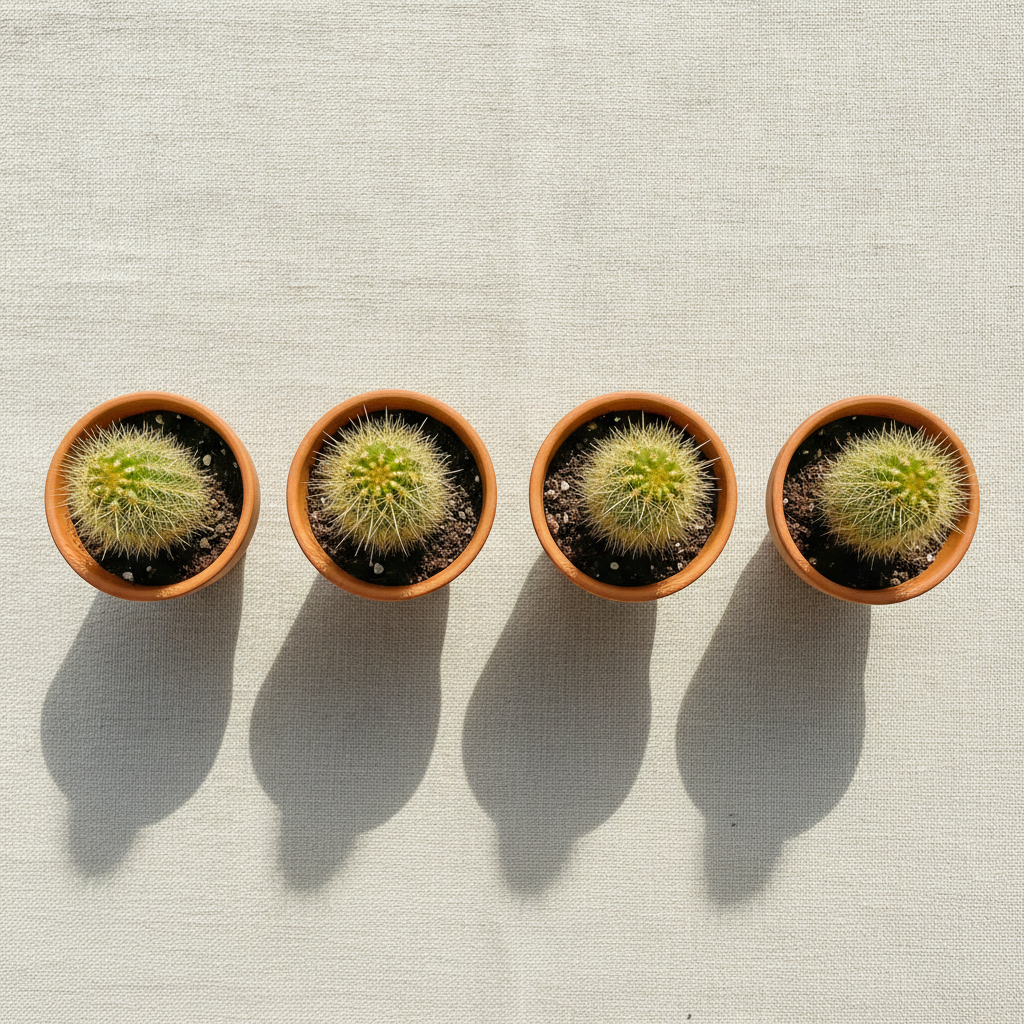
Propagating a golden rat tail cactus is refreshingly easy, and stem cuttings are by far the most reliable method. Because the plant is naturally branching and its stems root willingly, a single healthy plant can become several within a season, and taking cuttings doubles as a tidy way to shorten stems that have grown longer than the space allows. Spring and early summer, when the plant is in active growth, is the best time to take them.
- Choose a healthy stem and, using a clean sharp knife, cut off a section around 10 to 15 centimetres (4 to 6 inches) long. Wrap the stem in a cloth as you work so the spines do not lodge in your fingers.
- Set the cutting aside somewhere dry, warm and out of direct sun for several days to a week, until the cut end has dried and formed a firm callus. Planting a fresh, wet cut straight into soil is the surest way to rot it.
- Once calloused, insert the cut end a couple of centimetres deep into a small pot of the same gritty cactus mix used for the parent. It helps to lay the cutting so the base sits against the mix if the stem is too soft to stand upright.
- Keep the mix barely moist, not wet, and place the pot in bright, indirect light. Roots usually form within a few weeks.
- Give the cutting a gentle tug after three to four weeks; resistance means roots have taken hold, at which point it can be treated as a normal plant and moved into brighter light.
Growing from seed is also possible and is how new colour forms are sometimes raised, but it is slow and mainly of interest to collectors, since seedlings take years to reach flowering size. For almost everyone, cuttings are quicker, more reliable and produce a sizeable plant far sooner.
Pests and Problems
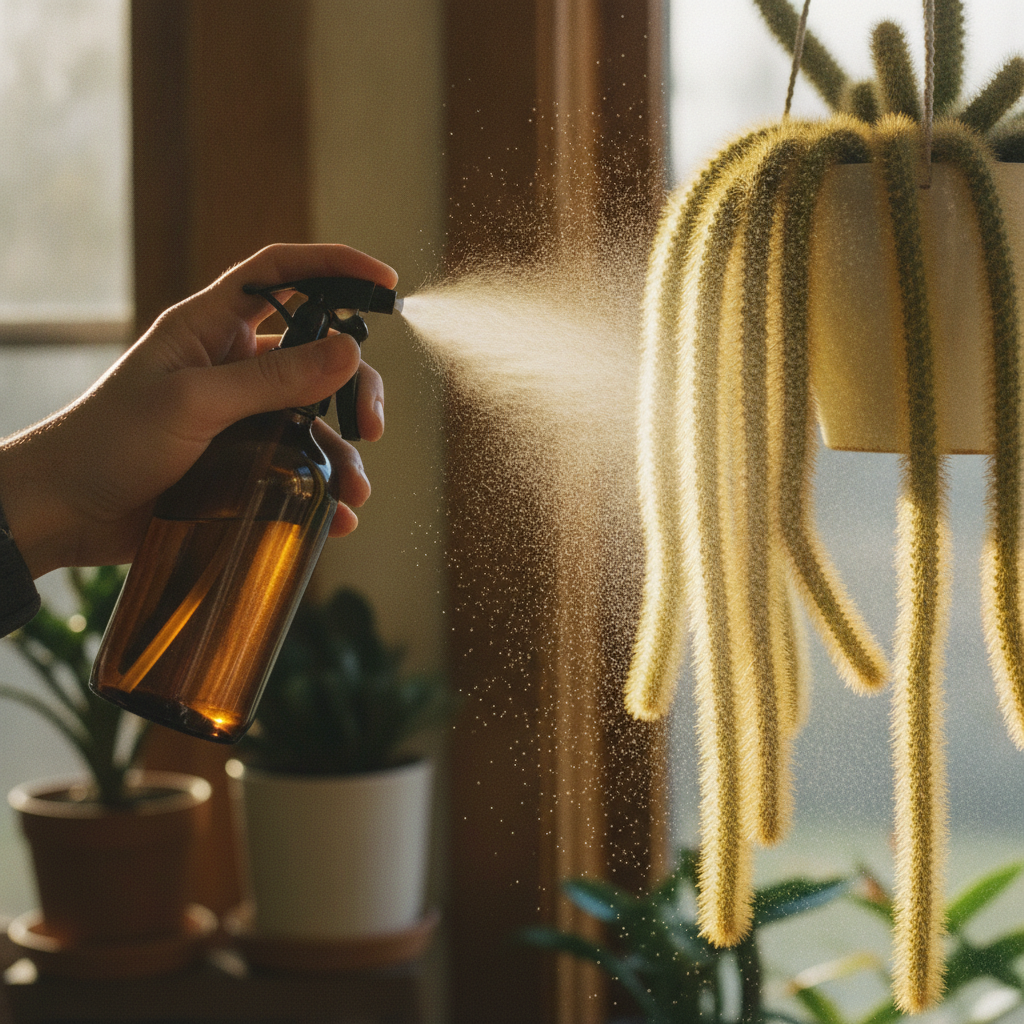
A golden rat tail cactus in good light and a gritty mix is a tough, largely trouble-free plant, and most of the problems it does run into are the gardener’s doing rather than an outside attack. By far the most serious is root and stem rot caused by overwatering, especially in winter. It shows up as stems turning soft, yellow-brown or blackened and mushy at the base or along a length, often starting out of sight below the surface. Caught early, the only cure is to cut well back into firm, healthy green tissue with a clean knife, discard the affected parts, let the wound callus and, if the plant is far gone, root a healthy cutting to start again while treating the parent as likely lost.
Among actual pests, mealybugs are the ones to watch for. These small, white, cottony insects tuck themselves down between the dense spines and in the crevices where stems meet, which makes them easy to miss until a colony has built up. Scale insects and spider mites turn up occasionally, the latter more likely in hot, dry, still air. Because the golden bristles hide intruders so well, the best defence is simply looking closely between the stems every so often rather than waiting for obvious damage.
For a light infestation, dabbing each mealybug with a cotton bud dipped in isopropyl alcohol lifts them off cleanly. For anything more widespread, a horticultural soap or a neem oil spray applied thoroughly, getting in among the stems where pests hide, and repeated every week or so until clear, will bring it under control. Isolate a newly affected plant from others while treating it. As for the plant’s own defences, remember that the fine spines are a mechanical irritant to skin: Cleistocactus winteri is listed as non-toxic to cats and dogs, so the concern with curious pets and children is the prickle, not poisoning.
Two non-pest complaints round out the list. Pale, thin, stretched new growth with sparse spines is a light problem, solved by moving the plant somewhere brighter. And a mature, healthy plant that stubbornly refuses to flower is almost always one that has been kept too warm and too well watered over winter; the fix is the cool, dry rest described in the watering section, without which the flower buds simply never form.
Varieties and Relatives
The golden rat tail cactus has a slightly tangled naming history and one very famous close relative, which is worth untangling because the two are constantly confused in shops and online. The plant most people mean by “golden rat tail” is the classic golden-spined form; its shaggier, softer cousin, the monkey’s tail, is the one that turns heads at collectors’ fairs.
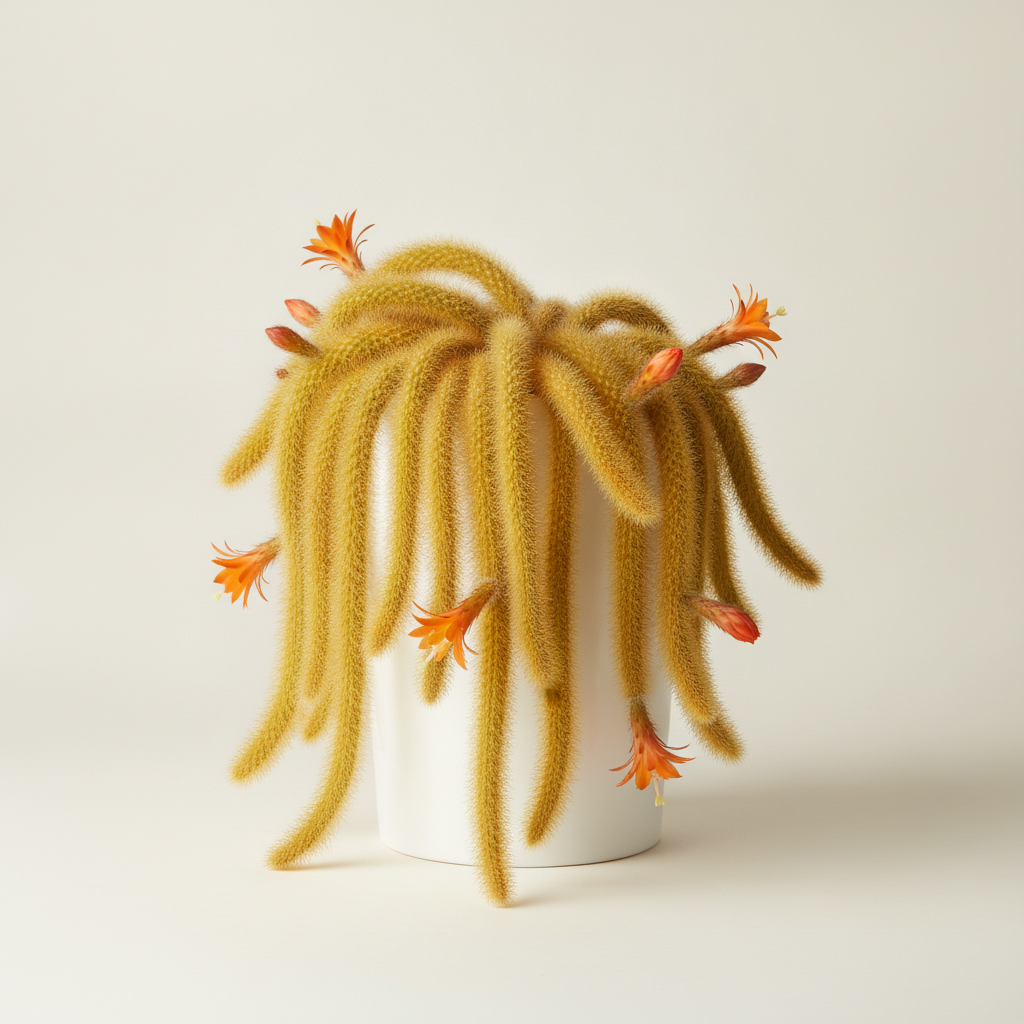
Golden Rat Tail (Cleistocactus winteri)
The species itself is the plant most often sold. Its slender, trailing stems are densely clothed in fine golden-yellow spines that give the whole plant a soft, glowing appearance, and mature specimens produce large salmon to orange funnel-shaped flowers in spring and early summer. It grows quickly for a cactus and flowers relatively young, which is a large part of its charm. Older names still seen on labels include Hildewintera aureispina and Winterocereus aureispinus, both referring to this same plant.
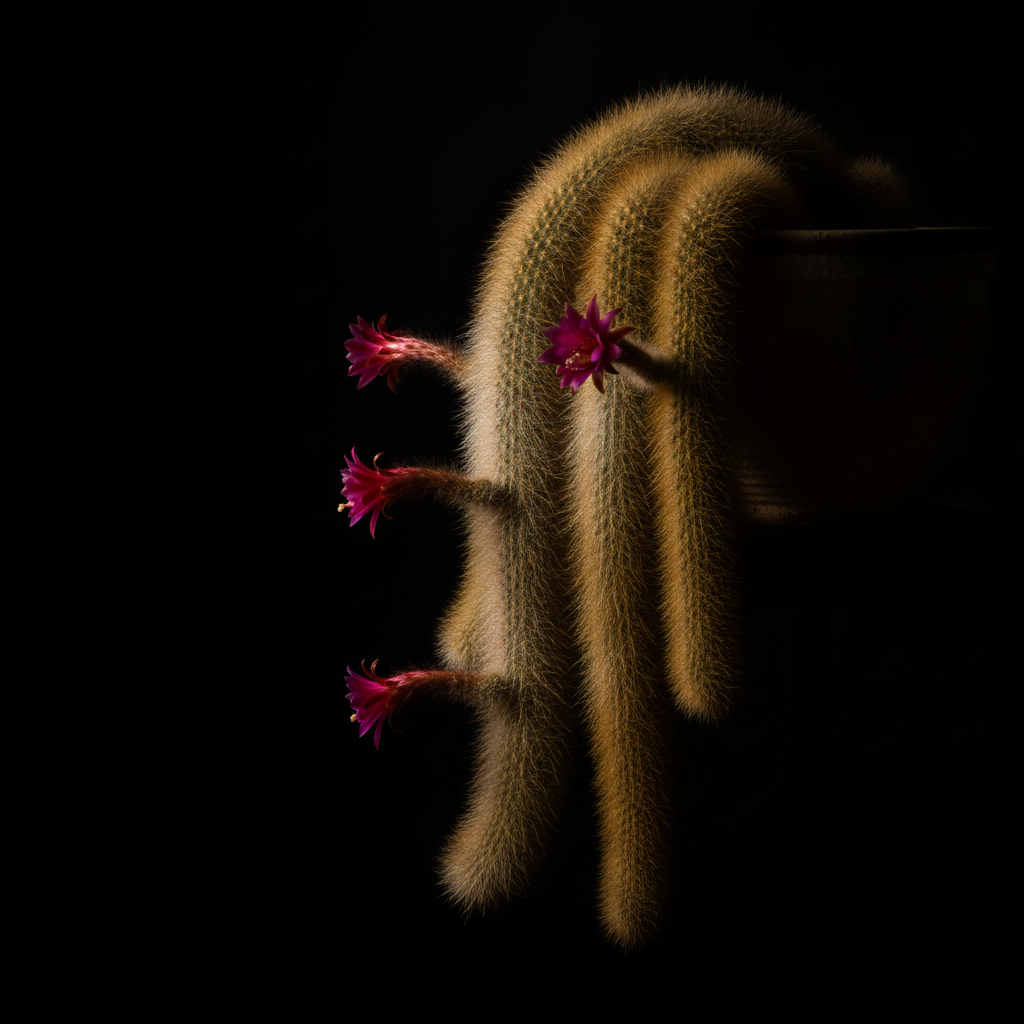
Monkey’s Tail (subsp. colademononis)
The monkey’s tail is a subspecies (sometimes treated as its own species, Cleistocactus colademononis) that takes the trailing habit to an extreme. Its stems grow longer, thicker and shaggier, cloaked in soft, hair-like white to pale gold spines that hang like fur, and it carries deep magenta-red flowers rather than orange. Care is essentially identical to the species, though its heavier stems make a sturdy hanging basket almost mandatory. It is the more sought-after of the two among collectors.
A genuine point of confusion is the name “rat tail cactus” used on its own, which properly belongs to a different plant, Disocactus flagelliformis, an unrelated trailing cactus with thinner stems and pink flowers. When shopping, the botanical name is the only reliable guide, so look for Cleistocactus winteri or one of its synonyms to be sure of getting the true golden rat tail.
Frequently Asked Questions
Why won’t my golden rat tail cactus flower?
The usual reason is a missing winter rest. To set flower buds, a mature plant needs a cool period of around 8 to 12 degrees Celsius (46 to 54 Fahrenheit) with almost no water from late autumn through winter, alongside plenty of bright light year-round. A plant kept warm and regularly watered all winter grows happily but rarely blooms. Age matters too, as very young plants simply have not reached flowering size yet.
Are the spines dangerous or sharp?
The dense golden spines are fine and bristly rather than the rigid needles of many cacti, so they will not stab like a barrel cactus. They can, however, detach and lodge in skin like tiny splinters, which is mildly irritating and fiddly to remove. Handling the stems with a folded cloth or light gloves when repotting or taking cuttings avoids the problem entirely.
Is the golden rat tail cactus safe around pets?
Yes, in terms of toxicity. Cleistocactus winteri is not known to be poisonous to cats or dogs, so a nibble will not cause chemical harm. The only real risk is physical, as the spines can prickle a curious pet’s mouth or paws, which is a good reason to hang or shelf the plant out of reach.
How fast does it grow and how long do the stems get?
Fast, by cactus standards. In a bright spot with good growing-season care it can add several centimetres of new stem in a strong month, and over a few years the stems can reach a metre (around 3 feet) or more, with the monkey’s tail form growing longer still. Regular light is the main driver of vigorous, dense growth.
My cactus is going soft and yellow at the base. What’s wrong?
Soft, yellowing or blackened mushy tissue is almost always rot from overwatering, particularly in cold conditions. Act quickly: cut back into firm, healthy green tissue with a clean blade, let the cut callus, and reduce watering sharply. If the base is too far gone, take a healthy cutting from an unaffected stem and start a fresh plant, as a calloused cutting roots easily and preserves the plant.
Can I grow it in a hanging basket?
A hanging basket is arguably the ideal home for it, since the trailing stems can cascade freely and show off the golden spines. Use a basket with drainage and a gritty, fast-draining mix, hang it in the brightest possible position, and remember that a large plant with long stems becomes surprisingly heavy, so a secure fixing matters.






