

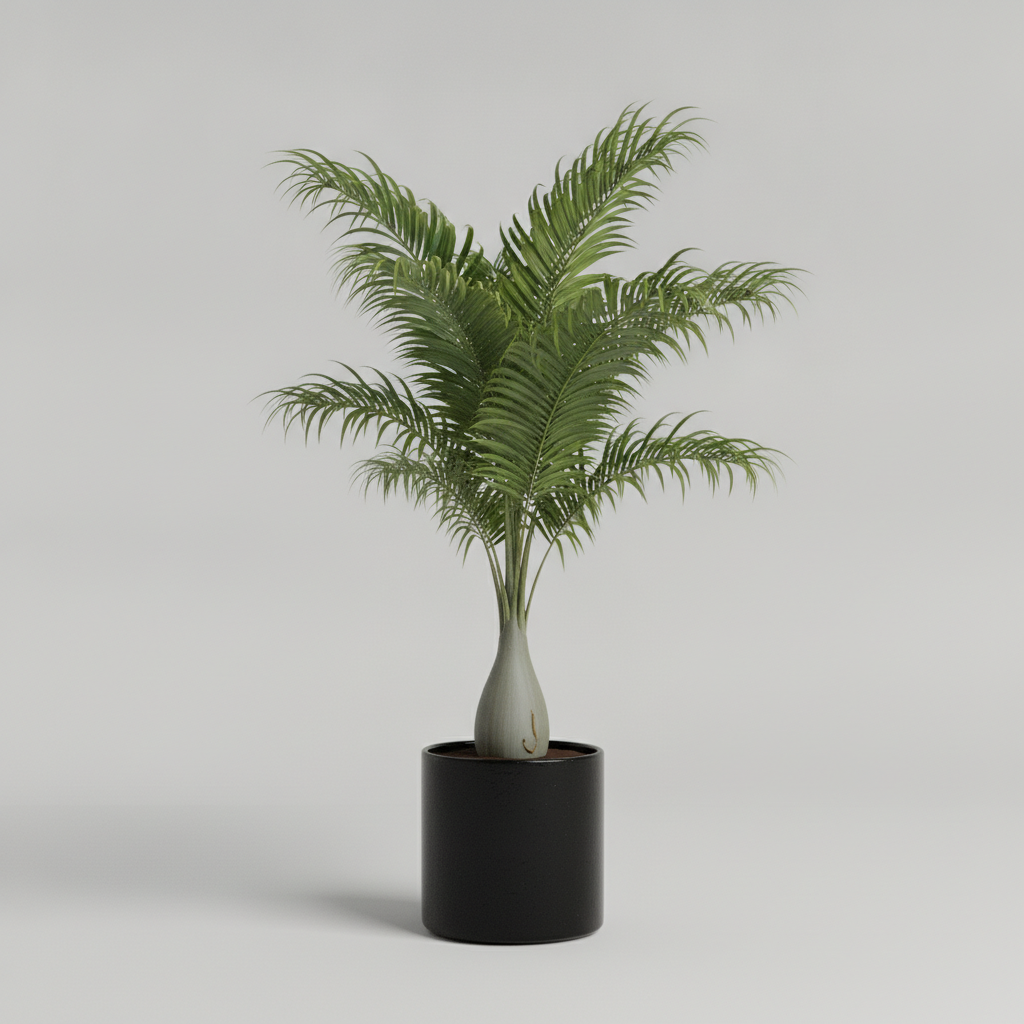
Few houseplants announce themselves quite like the bottle palm. Its common name is no exaggeration: a smooth, grey, dramatically swollen trunk really does taper upward like the neck of a glass bottle, crowned by a modest tuft of arching feather fronds. Known botanically as Hyophorbe lagenicaulis, the species belongs to the palm family Arecaceae and hails from Round Island, a tiny islet off the coast of Mauritius in the Mascarene archipelago of the Indian Ocean. There, in a windswept, sun-baked landscape of volcanic rock, it evolved the water-storing barrel of a trunk that gardeners now covet as living sculpture.
Reputations matter with palms, and the bottle palm has an unusually forgiving one. It is slow, tolerant of neglect, undemanding about humidity, and remarkably patient with the occasional missed watering, which makes it a rewarding choice for anyone who wants a bold architectural plant without a fussy maintenance calendar. That said, surviving and thriving are two different outcomes. A bottle palm left in a dim corner and watered on impulse will cling to life for years while looking tired and sparse; the same plant given strong light, sharp drainage, and a steady warm season will push out glossy new fronds and thicken into the showpiece it is meant to be. This guide covers everything that separates the two, from light and water to soil, feeding, propagation from seed, and the pests worth watching for.
Contents
- Quick Reference
- Why the Bottle Palm Makes a Sculptural Houseplant
- Light Requirements
- Watering & Humidity
- Soil, Potting & Repotting
- Fertilising
- Propagation
- Pests & Diseases
- Popular Varieties
- Frequently Asked Questions
Quick Reference: Bottle Palm at a Glance
| Light | Bright direct sun; the brightest window in the home, ideally south or west facing |
| Watering | Moderate in the growing season, sparing in winter; allow the top 3 to 5 cm (1 to 2 in) to dry out |
| Temperature | 18 to 29°C (64 to 84°F); protect from anything below 10°C (50°F) |
| Humidity | Tolerant of average indoor levels; comfortable at 40 to 60 percent |
| Fertiliser | Balanced palm feed with magnesium and manganese, spring through early autumn |
| Toxicity | Not known to be toxic to cats, dogs, or humans; see the note below |
Why the Bottle Palm Makes a Sculptural Houseplant
The appeal of Hyophorbe lagenicaulis starts and ends with its silhouette. Most palms grown indoors are prized for their foliage, a fountain of fronds spilling from an unremarkable stem. The bottle palm inverts that logic. Its crown is deliberately restrained, rarely holding more than four to eight fronds at once, so that all the visual weight falls on the extraordinary trunk. In a young plant that trunk can be almost comically rotund, a grey water tank barely taller than it is wide, and it is this exaggerated bottle shape that nurseries and collectors chase. As the palm matures the trunk gradually elongates and the bottle profile softens, but even a decades-old specimen keeps a distinctive bulge at the base that no other common houseplant palm can match.
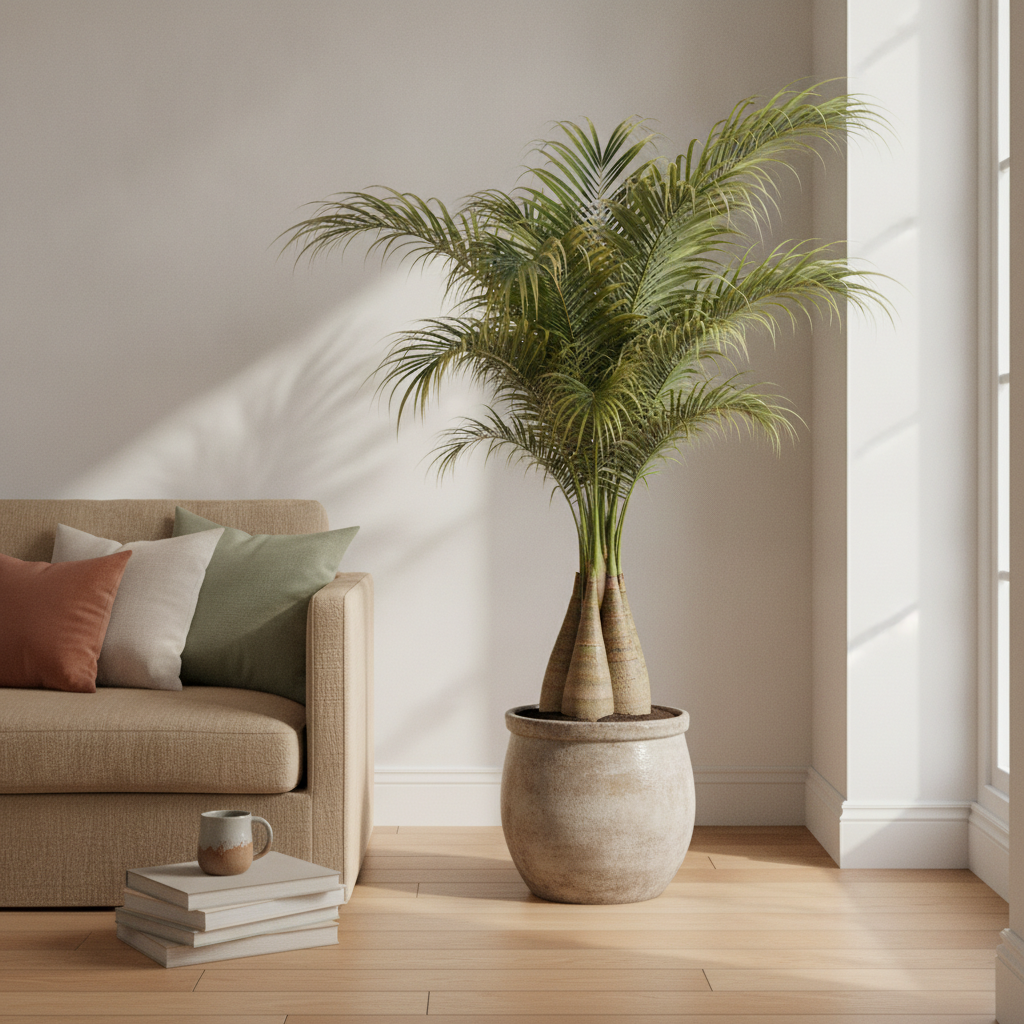
Beyond the looks, the bottle palm earns its place through sheer resilience. Round Island is a harsh home, hot, exposed, and often dry, and the plant carries that toughness indoors. It shrugs off the low humidity of centrally heated rooms, tolerates a degree of underwatering that would kill most tropical foliage, and asks for very little beyond good light and free-draining soil. Its slow growth, often cited as a drawback, is arguably a virtue in the home: a bottle palm bought at a comfortable size will hold that size for years, needing repotting only rarely and never threatening to outgrow a living room the way a fast palm might. It is worth remembering, too, that the species is critically endangered in the wild, with only a handful of mature individuals remaining on Round Island. Every cultivated plant is a small piece of conservation, and the nursery trade has become an important reservoir for a palm that has all but vanished from its native rock.
Important — Toxicity: The bottle palm is not listed as toxic to cats, dogs, or people, and true palms in the family Arecaceae are generally regarded as pet safe. Do not confuse it with the sago palm (Cycas revoluta), a superficially palm-like plant that is severely poisonous to animals. As with any houseplant, discourage pets and small children from chewing the fronds, since ingested plant fibre can still cause stomach upset.
Light Requirements
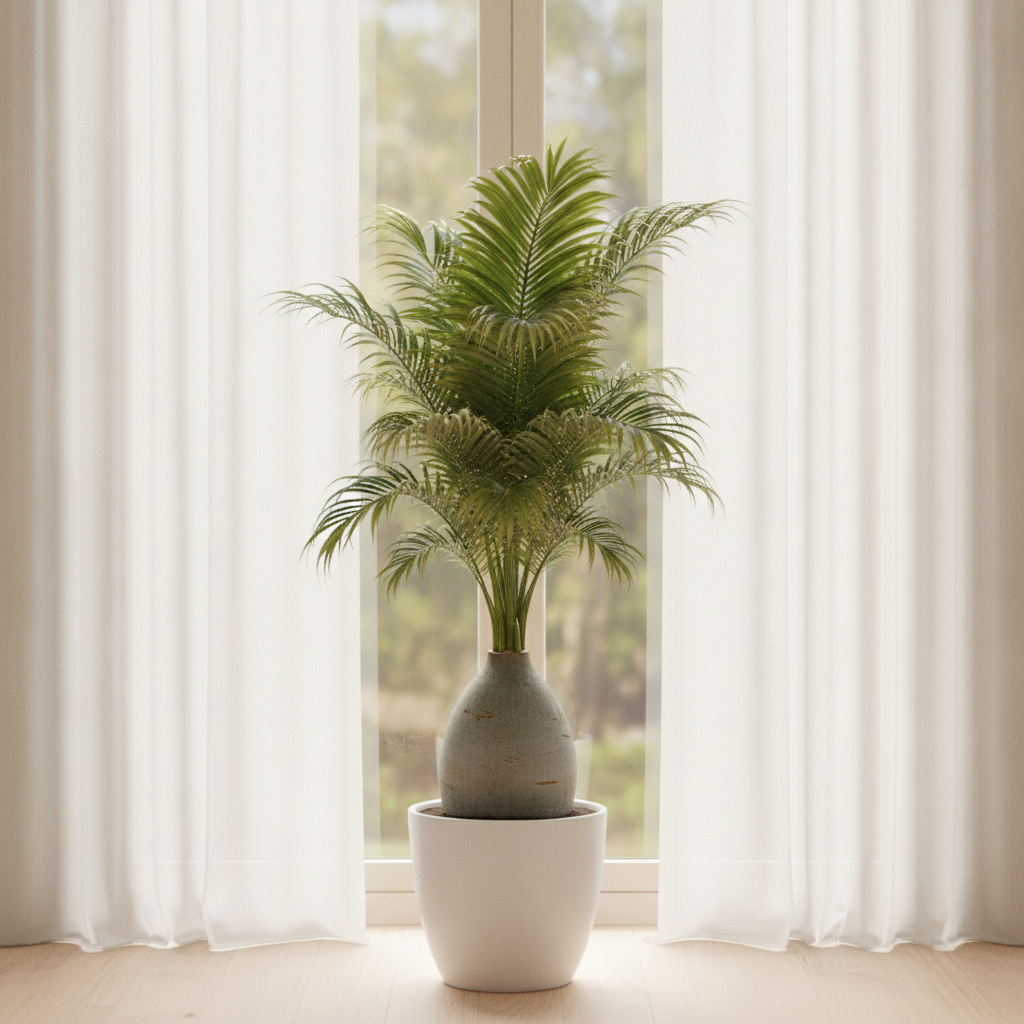
If there is one non-negotiable in bottle palm care, it is light. This is a full-sun species by nature, growing in the open on an exposed island with nothing to shade it, and it never truly forgets that heritage. Indoors it wants the very brightest position you can offer, and unlike many houseplant palms it welcomes several hours of direct sun on its leaves rather than merely tolerating bright indirect light.
The ideal spot is directly in front of, or immediately beside, an unobstructed south-facing or west-facing window where the plant catches strong midday and afternoon sun. In these conditions the fronds stay compact, deep green, and closely spaced, and the trunk thickens as it should. Move the same plant into medium light and the response is gradual but unmistakable: new fronds emerge longer, thinner, and further apart as the palm stretches toward the light, the rich colour fades to a paler yellow-green, and the prized bottle shape of the trunk develops slowly if at all. Low light is not a survival strategy for this species so much as a slow decline.
Light Levels Explained
Light indoors is far dimmer than most people assume, and the human eye is a poor judge of it because our pupils adjust automatically. The table below gives rough illuminance figures in lux to anchor the categories, along with the outcome you can expect from a bottle palm in each.
| Light Category | Approx. Level | Typical Location | Outcome |
|---|---|---|---|
| Direct sun | 20,000 lux and above | On the sill of a south or west window | Ideal; compact crown, thickening trunk, strong colour |
| Bright indirect | 10,000 to 20,000 lux | Just back from a sunny window | Good; steady growth, slightly looser crown |
| Medium | 5,000 to 10,000 lux | Middle of a bright room, east window | Slow; fronds stretch and pale, trunk barely swells |
| Low | 1,000 to 5,000 lux | Interior wall, north window | Poor; leggy, weak growth, gradual decline |
| Very low | Below 1,000 lux | Hallway, far from any window | Unsustainable; the plant slowly fails |
Window Orientation and Placement
South-facing window: The best position in most homes north of the equator. Place the palm right at the glass to give it maximum exposure. This is the single most reliable way to keep a bottle palm looking its best indoors.
West-facing window: An excellent second choice. The strong afternoon sun a west window delivers suits the plant well, and the extra warmth of late-day light is welcome during cooler months.
East-facing window: Workable but not optimal. Morning sun is gentler and shorter, so growth will be slower and the crown a little looser. Position the plant as close to the glass as possible to make the most of what light there is.
North-facing window: Generally too dim for a species this sun-hungry. A bottle palm here will survive for a time but steadily deteriorate, and supplementary lighting becomes almost essential.
Pro Tip — Rotate for Symmetry: Because the crown is small and the plant grows toward the light, a bottle palm left unturned will lean noticeably over a season. Give the pot a quarter turn every couple of weeks so that all sides of the crown receive equal light and the trunk stays upright and balanced.
How Light Affects Growth and Form
With a plant grown for its architecture, light does not just feed the palm, it shapes it. Strong light keeps the internodes short so that fronds cluster tightly and the crown reads as a neat rosette above the trunk. It also drives the trunk to store water and thicken, which is what produces the sought-after bottle profile. Inadequate light reverses both effects, giving an etiolated plant with a spindly, stretched crown and a trunk that never fills out. For the bottle palm, in other words, good light is not only about health but about the very feature that makes the plant worth growing.
Warning — Direct Sunlight: Although the bottle palm loves sun, a plant grown in low light and then moved abruptly into fierce direct sun can scorch, developing bleached or brown patches on the fronds. If you are increasing a plant’s light dramatically, do it over two to three weeks, extending exposure gradually so the foliage can acclimatise.
Artificial Lighting
In a dim home, or through a dark northern winter, a full-spectrum LED grow light can make the difference between stagnation and steady growth. Because the bottle palm demands high intensity, choose a reasonably powerful fixture and position it 30 to 45 cm (12 to 18 in) above the crown, running it for 10 to 12 hours a day on a timer. Supplementary light will not fully replicate a sunny windowsill, but it keeps a plant healthy through the darkest months and helps prevent the leggy growth that low winter light otherwise causes.
Seasonal Adjustments
Light levels indoors swing enormously between summer and winter, and the bottle palm’s needs shift with them. In the growing season a bright window rarely offers too much, but in a hot summer behind south-facing glass, watch for signs of overheating and scorching and pull the plant back slightly if the leaves show stress. Come winter, when the sun sits low and days are short, move the palm to the brightest available position, clean dust from the glass and the fronds, and accept that growth will slow or stop until spring. Matching your watering and feeding to this seasonal rhythm, generous in summer, minimal in winter, keeps the plant in step with the light it is actually receiving.
Watering & Humidity
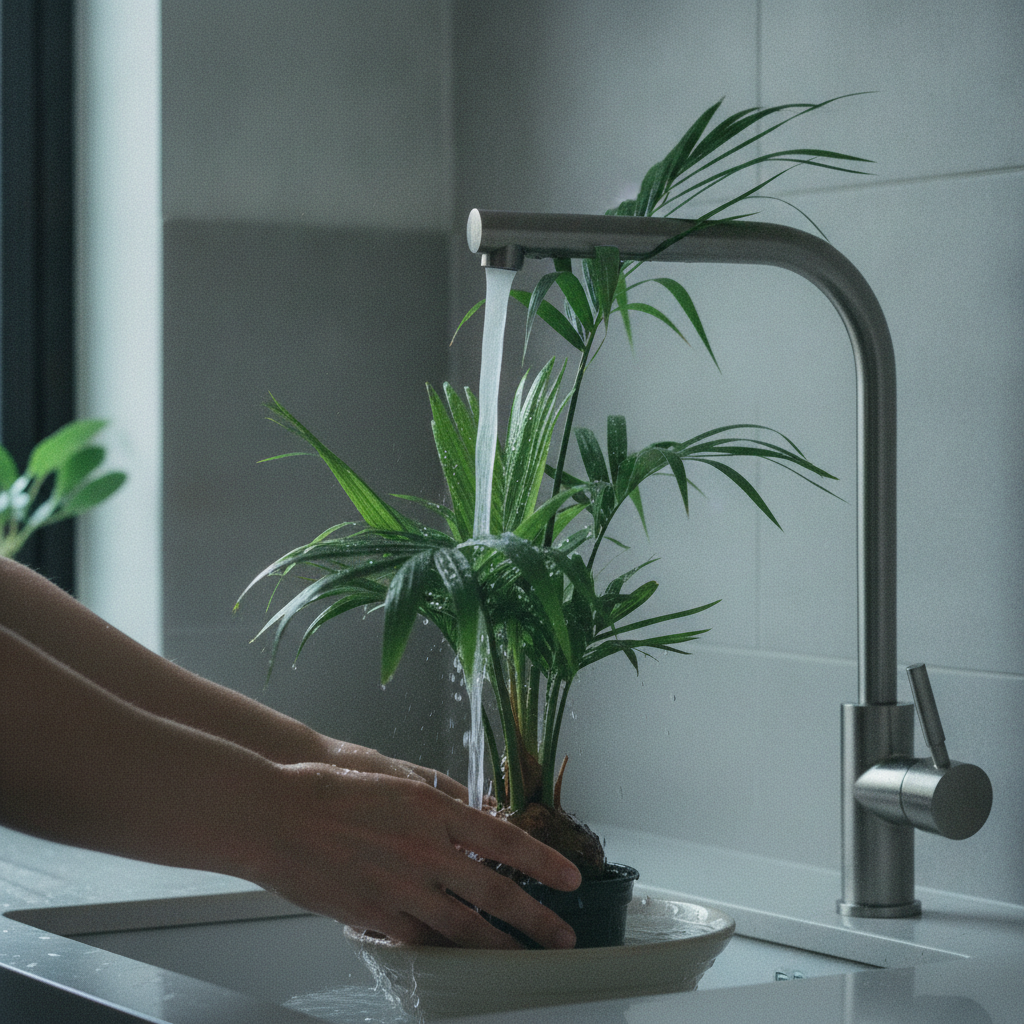
Watering is where most bottle palms are lost, and almost always through kindness rather than neglect. The swollen trunk is a water reservoir, an adaptation to a dry, unpredictable island climate, and it means the plant is built to endure drought far better than sogginess. The guiding principle is simple: water thoroughly, then wait. A bottle palm would far rather be a little too dry than a little too wet.
When to Water
Let the top 3 to 5 cm (1 to 2 in) of the mix dry out between waterings. The most reliable test is your finger: push it into the soil to the second knuckle, and if it comes out dry at that depth, it is time to water; if it still feels damp, wait a few more days. Lifting the pot works too, since a dry rootball is noticeably lighter than a freshly watered one, and after a few weeks you will judge the plant’s needs by weight alone.
Frequency depends heavily on season, light, and pot size, so treat any schedule as a starting point rather than a rule. In the warmth and strong light of summer a bottle palm in active growth might need watering once a week or so, while in the cool, dim depths of winter that can stretch to once every two to four weeks. Always let the plant and the soil tell you when to water rather than watering by the calendar.
Pro Tip — Trust the Trunk: A well-hydrated bottle palm has a firm, plump trunk. If the trunk begins to feel soft, wrinkled, or shrunken, the plant has drawn down its water reserves and is genuinely thirsty. This is a useful backstop, but do not wait for it every time; the goal is steady moderate watering, not repeated cycles of drought and rescue.
How to Water Correctly
- Check that the top few centimetres of soil are dry before you begin.
- Water slowly and evenly over the whole surface of the mix, not just one spot.
- Keep going until water runs freely from the drainage holes, which ensures the entire rootball is moistened.
- Let the pot drain completely for several minutes.
- Empty the saucer or cachepot so the roots never sit in standing water.
- Wait until the soil dries to the correct depth again before the next watering.
Signs of Overwatering vs. Underwatering
| Symptom | Overwatering | Underwatering |
|---|---|---|
| Frond colour | Yellowing across whole fronds, often lower ones first | Browning and crisping at the frond tips and edges |
| Frond texture | Soft, limp, sometimes translucent | Dry, brittle, papery |
| Soil | Stays wet for days, may smell sour | Bone dry, pulling away from the pot sides |
| Roots | Brown, mushy, foul smelling | Dry and wiry but usually still alive |
| Trunk base | Soft or spongy, a serious warning sign | Firm but may look slightly shrunken |
Warning — Root Rot: A soft or spongy trunk base combined with sour-smelling, waterlogged soil signals root rot, the most common killer of this species. Act at once: remove the plant from its pot, cut away any black, mushy roots with sterilised scissors, and repot into fresh, dry, free-draining mix. Withhold water until the plant shows signs of recovery. Prevention is far easier than cure, so err on the side of dry.
Humidity Requirements
Here the bottle palm is refreshingly easygoing. Coming from a breezy coastal island rather than a humid rainforest, it is perfectly content in the average humidity of a normal home, somewhere between 40 and 60 percent, and does not need the misting, pebble trays, or humidifiers that many tropical foliage plants demand.
Only in extremely dry conditions, such as a room with fierce central heating running all winter, might you see the frond tips brown slightly from low humidity. Even then the effect is usually cosmetic rather than dangerous, and it is easily distinguished from the more serious browning caused by drought or salt build-up, which tends to be more widespread.
If you do want to raise humidity a little for a plant showing dry tips, grouping it with other plants or standing the pot on a tray of damp pebbles is more than enough. There is no need to go further, and in fact excessive humidity combined with poor airflow can encourage fungal problems on a plant that prefers things on the drier side.
Water Quality
Bottle palms are not especially fussy about water, but like many palms they can be sensitive to the fluoride and chlorine in some tap supplies, which can contribute to leaf-tip browning over time. If your tap water is heavily treated, or very hard, letting it stand overnight before use lets some chlorine dissipate, and collected rainwater or filtered water is an easy upgrade. Always water with room-temperature water rather than cold, since a shock of cold water can stress the roots of a warmth-loving plant.
Soil, Potting & Repotting
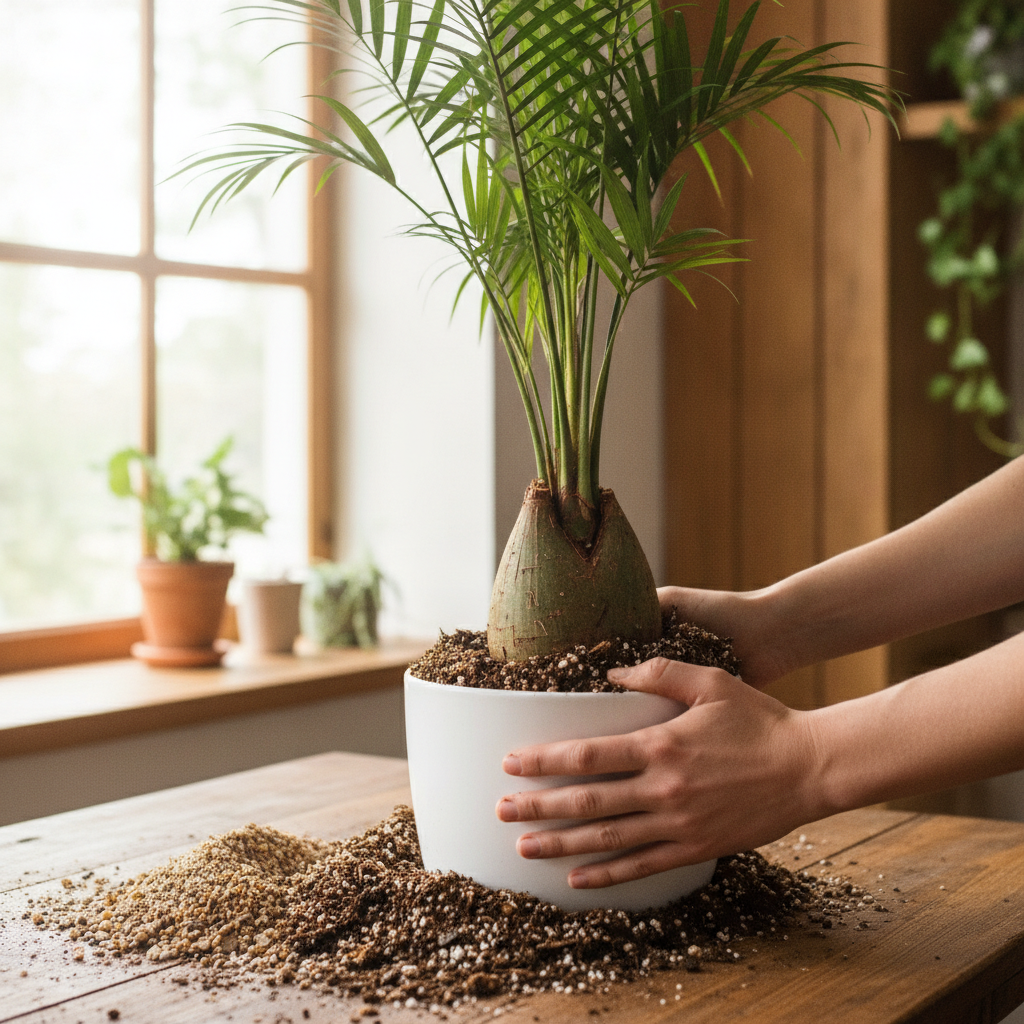
Given how easily the bottle palm succumbs to wet feet, the growing medium is a critical line of defence. The single most important quality is drainage. This is a plant adapted to gritty, fast-draining volcanic ground, and it will never be happy in a dense, moisture-retentive mix that stays soggy for days. Get the soil right and half the battle against overwatering is already won.
Ideal Soil Composition
A good bottle palm mix balances enough organic matter to hold a little moisture and nutrition against plenty of coarse mineral grit to guarantee sharp drainage and air around the roots. A dedicated palm or cactus compost makes an excellent base, amended generously with sand and perlite. The proportions below are a reliable starting point.
| Component | Proportion | Function |
|---|---|---|
| Palm or cactus compost | 2 parts | Base structure, moderate moisture and nutrient retention |
| Coarse horticultural sand or grit | 1 part | Weight, stability, and rapid drainage |
| Perlite or pumice | 1 part | Aeration and extra drainage, keeps the mix open |
The bottle palm prefers a mildly acidic to neutral soil, in the region of pH 6.0 to 7.0, which is where most proprietary composts naturally sit, so pH is rarely something you need to adjust deliberately. Far more important is that the finished mix feels open and gritty in the hand and that water runs through it quickly rather than pooling on top.
Pro Tip — Quick Mix Recipe: For a fuss-free blend, combine two handfuls of a bagged cactus and succulent compost with one handful of coarse sand and one handful of perlite. If in doubt, add more grit rather than less; you cannot really make the mix too free-draining for this species.
Choosing the Right Pot
The pot is more than a container for a plant this top-heavy in personality, and a few sensible choices make ongoing care much easier.
Drainage holes are non-negotiable. Whatever else you choose, the pot must have generous drainage holes so that excess water can escape freely. A decorative pot without holes is a slow death sentence for a bottle palm; if you love the look of a particular cachepot, plant into a plastic nursery pot that drains properly and slip it inside.
Pot material: Terracotta is an excellent match. Its porous walls wick moisture out of the soil and let it evaporate, which suits a plant that hates staying wet, and its weight gives useful ballast to a plant whose swollen trunk can make it top-heavy. Glazed ceramic and plastic work too, but with these you will need to be a little more disciplined about watering, since they hold moisture longer.
Pot size: Choose a pot only slightly larger than the rootball. The bottle palm actively enjoys being somewhat snug, and an oversized pot holds a large volume of slow-drying soil that invites root rot. Resist the urge to give the plant room to grow into; go up in modest increments instead.
When to Repot
One of the many conveniences of this palm is how seldom it needs repotting. Being both slow-growing and content when a little pot-bound, a bottle palm typically needs a fresh pot only once every three to four years, and sometimes less often than that. The signs that it is time are roots emerging from the drainage holes or circling the surface, water running straight through without wetting the soil, or a plant that has clearly stalled despite good care. The best time to repot is spring or early summer, at the start of the growing season, so the plant can recover quickly. Palms in general dislike root disturbance, so do not repot more often than necessary.
How to Repot: Step-by-Step
- Water the plant lightly a day or two beforehand so the rootball holds together, and prepare your fresh free-draining mix.
- Ease the palm out of its current pot by supporting the base of the trunk and gently tipping it, rather than pulling on the fronds.
- Inspect the roots and trim away any that are dark, soft, or rotten with sterilised scissors, leaving the healthy pale roots intact.
- Add a layer of fresh mix to the base of the new pot, then position the palm at the same depth it sat before, never burying the trunk deeper.
- Fill around the rootball with mix, firming gently to remove large air pockets while keeping the blend open and loose.
- Water lightly to settle the soil, then return the plant to its bright spot.
Warning — Transplant Shock: Palms resent having their roots disturbed and may sulk after repotting, pausing growth for a few weeks. Minimise the stress by keeping the rootball as intact as possible, avoiding any temptation to feed straight away, and holding off on heavy watering until you see new growth. Never bury the swollen base of the trunk below the soil line, as this invites rot at the very point that makes the plant special.
Fertilising
The bottle palm is a light feeder, in keeping with its slow, steady nature, but a measured feeding routine through the growing season noticeably improves frond colour and vigour. The aim is to support the plant’s modest appetite, not to force fast growth that this species is simply not built for.
Palms have particular nutritional quirks, and the bottle palm is no exception. It is prone to deficiencies in magnesium, manganese, and potassium, which show up as yellowing, spotting, or the distinctive weak, frizzled new growth that palm growers call frizzle top. For this reason a fertiliser formulated specifically for palms, one that includes these minor nutrients rather than just the headline nitrogen, phosphorus, and potassium, is a far better choice than a generic houseplant feed.
Understanding Plant Nutrients
Fertilisers are labelled with an NPK ratio giving the percentages of nitrogen, phosphorus, and potassium, the three nutrients plants use in the greatest quantity. Just as important for palms, though, are the secondary nutrients and trace elements, especially magnesium and manganese, whose absence produces the classic palm deficiencies. The table below summarises the roles these nutrients play and what their shortage looks like.
| Nutrient | Symbol | Primary Function | Deficiency Symptoms |
|---|---|---|---|
| Nitrogen | N | Leaf and frond growth, green colour | Overall pale, yellowing older fronds, slow growth |
| Phosphorus | P | Root development and energy transfer | Weak roots, stunted, dull growth |
| Potassium | K | Overall vigour and stress tolerance | Yellow or orange spotting on older fronds, tip necrosis |
| Magnesium | Mg | Core of the chlorophyll molecule | Broad yellow bands along the edges of older fronds |
| Manganese | Mn | Enzyme function in new growth | Frizzle top: weak, yellow, distorted new fronds |
| Iron | Fe | Chlorophyll formation in new growth | Yellowing of the youngest fronds with green veins |
Types of Fertiliser
Liquid fertilisers: Diluted in water and applied during normal watering, these give you precise control and are easily flushed if you overdo it. A balanced palm feed diluted to half the label strength is ideal, letting you match the dose to the plant’s light appetite.
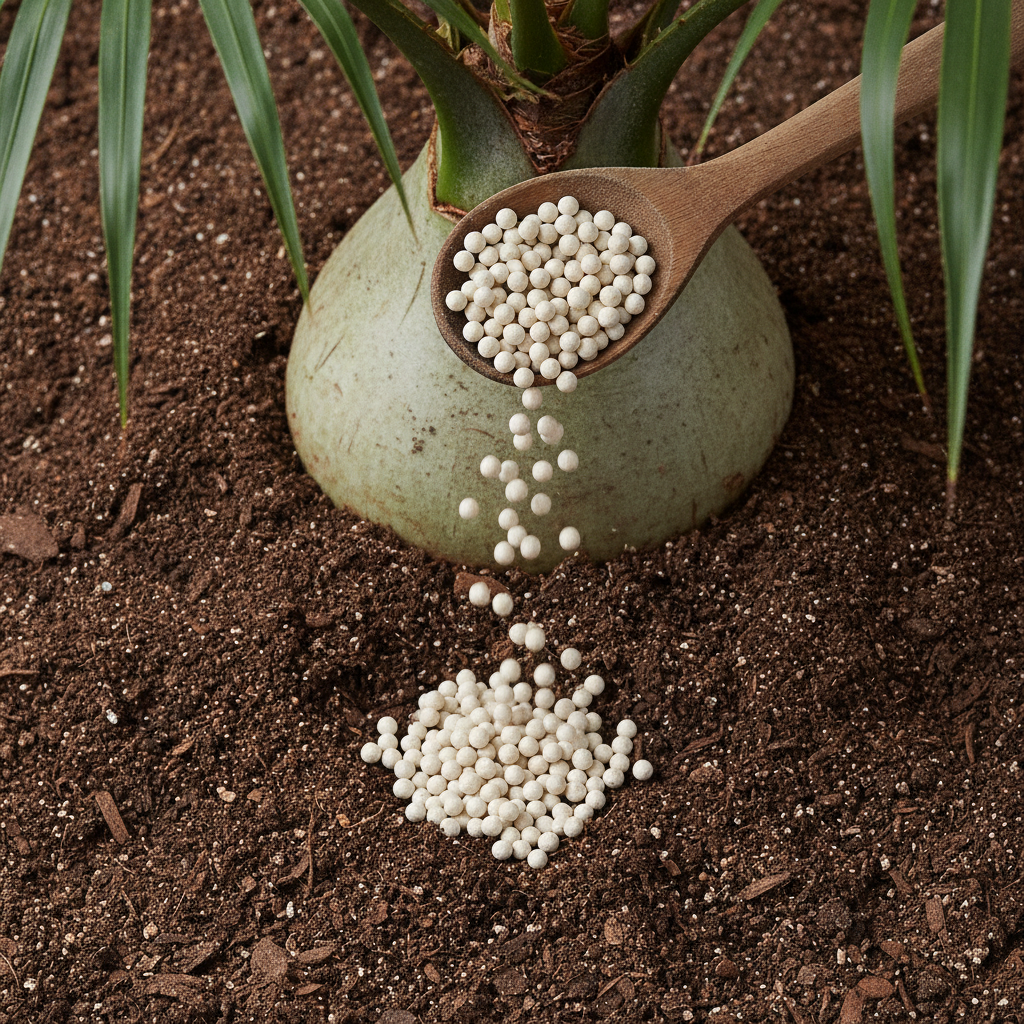
Slow-release granular: Coated prills scattered on the soil surface release nutrients gradually over several months, which suits a slow, undemanding palm perfectly. A single spring application of a palm-specific slow-release feed can cover much of the growing season with minimal effort.
Organic fertilisers: Worm castings, seaweed extract, and similar gentle organic feeds improve soil life and release nutrients slowly, with very little risk of burning the roots. They are a forgiving option, though you should still confirm the plant is getting the magnesium and manganese palms specifically need.
Feeding Schedule
Feed only during the active growing season, from spring through to early autumn. With a liquid feed, apply at half strength roughly once a month across this period; with a slow-release granular product, a single application in spring, perhaps repeated once in midsummer, is enough. Stop feeding altogether in late autumn and through winter, when the plant is barely growing and cannot use the nutrients. Feeding a dormant palm simply leaves unused fertiliser salts to accumulate in the soil.
Pro Tip — Less Is More: When it comes to feeding a bottle palm, underdoing it is always safer than overdoing it. This is a slow plant that cannot process large amounts of fertiliser, and excess feed scorches the roots and browns the frond tips faster than it helps. Half strength, applied sparingly, is the reliable rule.
How to Fertilise
- Make sure the soil is already moist, since feeding into bone-dry soil can burn the roots.
- Dilute a liquid palm feed to half the recommended strength, or measure out the correct dose of slow-release granules.
- Apply evenly, watering the diluted feed over the whole soil surface or scattering granules around the base, away from the trunk.
- Water through normally afterward to distribute the nutrients through the rootball.
- Every few months, flush the pot with plain water to wash out any accumulated fertiliser salts.
Warning — Salt Build-Up: Over time, mineral salts from fertiliser and hard water accumulate in the soil, appearing as a white crust on the surface or the pot rim and causing brown, burnt frond tips. Flush the pot thoroughly with plain water two or three times a year, letting it drain fully each time, to leach these salts away and keep the roots healthy.
Propagation
Propagation is the one area where the bottle palm asks for real patience, because there is only one way to do it: from seed. This is an honest limitation worth understanding before you try, since a great deal of misleading advice online implies otherwise.
Unlike many popular houseplants, the bottle palm cannot be multiplied from cuttings, division, or offsets. It is a solitary, single-stemmed palm that grows from a single central growing point, the meristem, at the top of the trunk. It produces no pups, no suckers, and no side shoots that could be separated, and a cut section of trunk or a severed frond will never root. If you want more bottle palms, seed is the only route, and it is how every nursery-grown plant begins life.
Understanding the Single Growing Point
It helps to understand why cuttings and division are impossible here. Palms like the bottle palm grow from one apical meristem at the crown, the sole source of all new fronds and trunk growth. There are no dormant buds along the trunk from which a new plant could arise, as there are on a philodendron stem or a spider plant runner. Damage that single growing point and the whole plant dies; there is no backup. This biology is exactly why seed is the only means of propagation, and also why you should never cut the top off a bottle palm hoping it will branch or resprout.
Growing from Seed: Step-by-Step
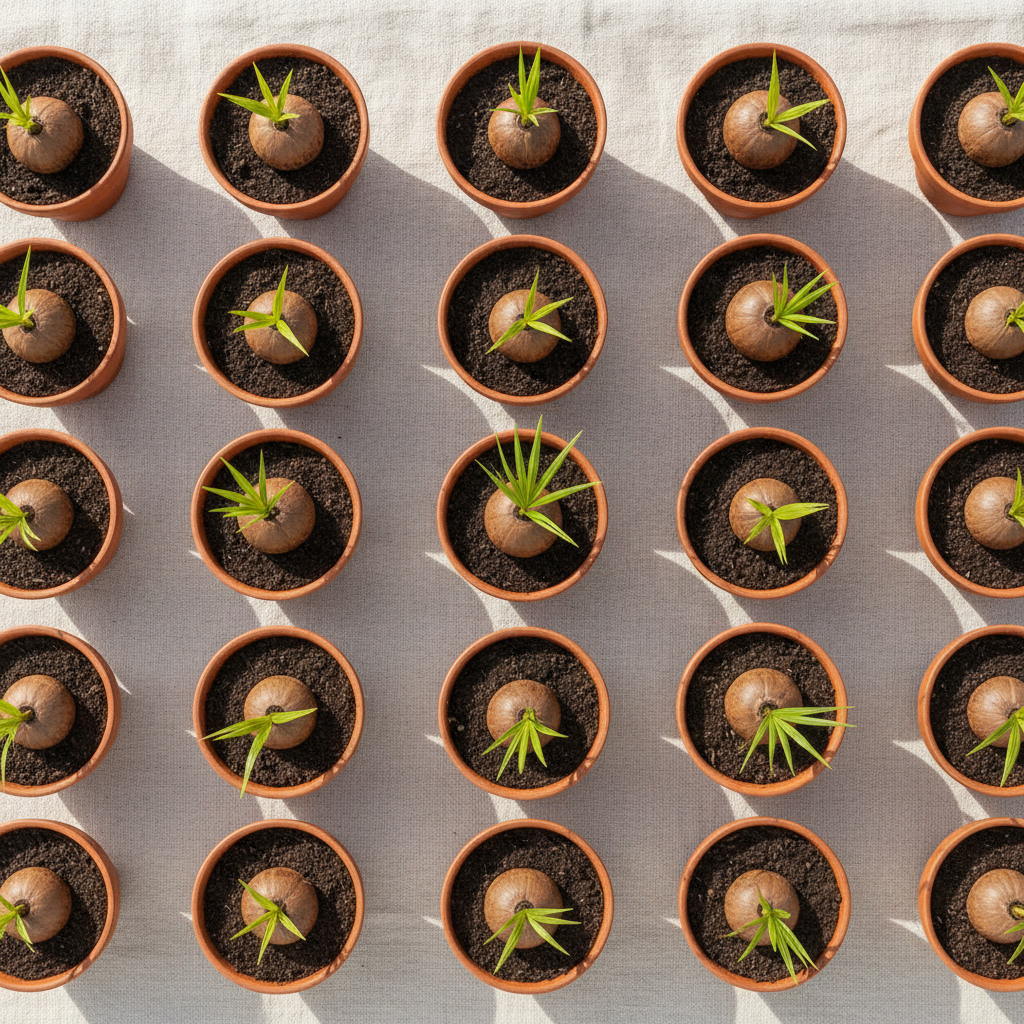
Raising a bottle palm from seed is straightforward in method but demands warmth and a good deal of patience. Fresh seed germinates far more reliably than old, so source it from a reputable supplier and sow as soon as you can.
- Soak the seeds in warm water for one to two days to soften the seed coat and rehydrate the embryo.
- Fill small pots or a tray with a moist, free-draining seed mix, such as equal parts compost and coarse sand or perlite.
- Sow each seed just below the surface, barely covered, and firm the mix gently around it.
- Place the pots somewhere consistently warm, ideally 27 to 32°C (81 to 90°F), as bottom heat from a propagator mat greatly improves success.
- Keep the mix lightly and evenly moist but never waterlogged, and maintain warmth and humidity, covering with a clear lid or bag if helpful.
- Wait. Germination is slow and uneven, often taking two to four months or longer, so do not give up on a tray that looks inactive.
- Once seedlings have a strong first leaf and a developing root system, pot them on individually into a standard free-draining palm mix.
Pro Tip — Warmth Is Everything: More than any other factor, consistent heat determines whether bottle palm seed germinates. Cool compost stalls the process indefinitely, so a heated propagator or a reliably warm windowsill above a radiator makes all the difference. Patience is equally essential; these seeds keep their own slow schedule.
Caring for Seedlings: Step-by-Step
Young bottle palms are more delicate than established ones and need a gentler hand for the first year or two while they build up size and their characteristic swollen base.
- Grow seedlings in bright but slightly filtered light at first, then increase exposure gradually as they strengthen.
- Keep the mix a touch more consistently moist than you would for an adult plant, but still never let it become soggy.
- Hold off on fertiliser until seedlings are well established, then feed only at quarter to half strength.
- Maintain warm temperatures year-round, protecting the young plants from cold draughts and sudden dips.
- Be patient with the trunk; the signature bottle shape develops only as the plant matures over several years.
Troubleshooting Propagation
| Problem | Likely Cause | Solution |
|---|---|---|
| Seeds fail to germinate | Old seed, or temperatures too low | Use fresh seed and provide steady bottom heat at 27 to 32°C |
| Seeds rot in the mix | Overwatering or poor drainage | Keep the mix only lightly moist and ensure it drains freely |
| Seedlings damp off and collapse | Fungal infection in wet, stagnant conditions | Improve airflow, reduce moisture, use clean sterile mix |
| Seedlings grow weak and pale | Insufficient light | Move to brighter light gradually without scorching them |
Pests & Diseases
The bottle palm is a tough, resilient plant with no special vulnerability to pests, and a healthy specimen in good light is rarely troubled. Most problems that do arise are the familiar indoor pests that opportunistically colonise any houseplant, particularly one that is stressed, dusty, or crowded among infested neighbours.
The best defence is vigilance. Inspect the fronds regularly, including their undersides and the axils where they meet the trunk, so that you catch any infestation while it is small and easily dealt with. The diseases that affect this palm are almost all a consequence of overwatering, which makes cultural care the front line of disease prevention.
Common Pests
Spider Mites (Tetranychus urticae)
The most likely pest on an indoor bottle palm, spider mites thrive in the warm, dry air the plant otherwise enjoys. They are tiny and hard to see, but their fine webbing between the leaflets and a stippled, dusty yellowing of the fronds give them away. Left unchecked they can weaken a plant considerably.
Treatment: Rinse the fronds thoroughly with water to knock down the population, then treat with insecticidal soap or neem oil, repeating every week or so until they are gone. Raising humidity slightly and keeping the foliage clean makes the plant a less inviting host.
Mealybugs (Pseudococcus species)
Mealybugs appear as small, soft, white cottony blobs tucked into the frond axils and along the leaf bases. They feed on the plant’s sap and excrete sticky honeydew, which can attract sooty mould, and a heavy infestation slowly saps the palm’s vigour.
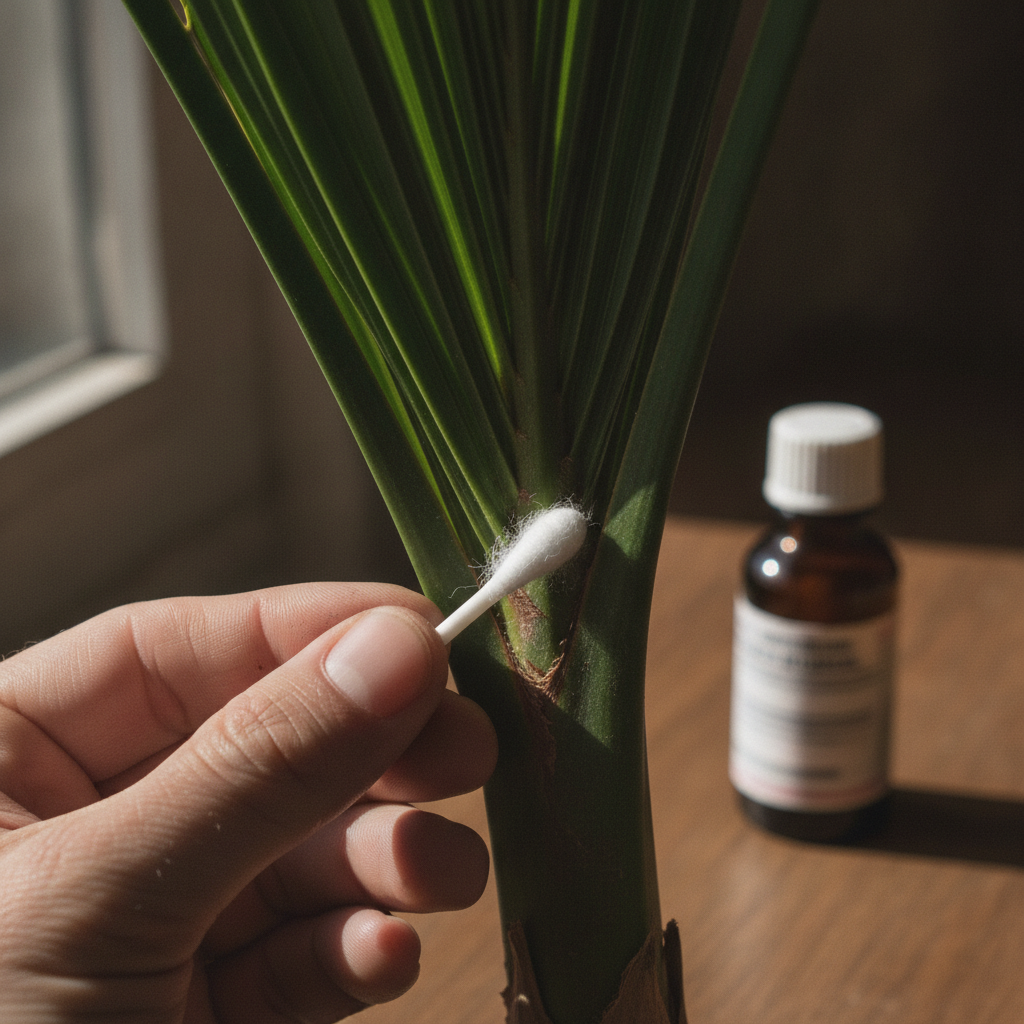
Treatment: Dab each mealybug directly with a cotton bud dipped in isopropyl alcohol, which kills them on contact. For larger outbreaks, follow up with insecticidal soap or neem oil, and isolate the plant from others until the problem is fully resolved.
Scale Insects (Coccidae family)
Scale insects look like small brown or tan bumps attached to the fronds and stems, and their hard waxy shells protect them from many sprays. Like mealybugs they suck sap and produce honeydew, and they can be stubborn to eradicate once established.
Treatment: Scrape off what you can by hand or with a soft brush, then treat with neem oil or horticultural oil to smother the remaining insects, repeating over several weeks. Persistence is key, as scale rarely yields to a single application.
Common Diseases
Root Rot (Pythium and Phytophthora species)
By far the most serious threat to a bottle palm, root rot is caused by fungal-like pathogens that flourish in waterlogged soil. It shows as yellowing, wilting fronds despite wet soil, a sour smell, and in advanced cases a softening of the trunk base. Once it takes hold it can kill a plant quickly.
Treatment: Unpot the plant, cut away all blackened, mushy roots with sterilised tools, and repot into fresh dry mix in a clean pot. Withhold water until recovery begins, and correct the underlying watering habits that caused it. Prevention through careful watering and sharp drainage is far more effective than any cure.
Leaf Spot (various fungal pathogens)
Fungal leaf spot produces small brown or black spots, sometimes with a yellow halo, scattered across the fronds. It is encouraged by persistently wet foliage, poor airflow, and overhead watering, and while usually cosmetic it can spread if conditions stay damp.
Treatment: Remove badly affected fronds, avoid wetting the foliage when watering, and improve air circulation around the plant. A copper-based or general fungicide can help in severe cases, but better cultural conditions usually resolve the problem on their own.
Pest and Disease Summary
| Pest / Disease | Identification | Treatment |
|---|---|---|
| Spider mites | Fine webbing, stippled yellow fronds | Rinse, then insecticidal soap or neem oil weekly |
| Mealybugs | White cottony masses in frond axils | Alcohol on a cotton bud, then neem oil |
| Scale insects | Brown waxy bumps on fronds and stems | Scrape off, then horticultural oil, repeated |
| Root rot | Wilting in wet soil, sour smell, soft base | Trim rotten roots, repot dry, correct watering |
| Leaf spot | Brown or black spots on fronds | Remove affected fronds, improve airflow |
Prevention Strategies
The overwhelming majority of bottle palm problems are prevented by two habits: watering correctly and keeping the plant in strong light. A palm grown hard in good conditions, watered only when it needs it, and planted in sharply draining soil is naturally robust and shrugs off most pests and pathogens without intervention.
Beyond that, a little routine care goes a long way. Wipe or rinse the fronds occasionally to remove dust and deny spider mites a foothold, inspect new plants carefully and quarantine them before introducing them to your collection, and give each plant enough space for air to move around it. Catching trouble early, when a single cotton bud can deal with it, is always easier than fighting an established infestation.
Pro Tip — Neem as Routine Defence: A monthly wipe-down of the fronds with a dilute neem oil solution during the growing season works as a gentle preventative, deterring spider mites, mealybugs, and scale before they can establish. It doubles as a way to clean dust off the leaves, which itself improves the plant’s health and its ability to photosynthesise.
Popular Varieties
The bottle palm is a distinct species rather than a plant with many named cultivars, so unlike a philodendron or a pothos there is no long roster of variegated forms to collect. What it does have is a small family of close relatives, all in the genus Hyophorbe and all native to the Mascarene Islands, which share the same swollen-trunk character and similar care. For a collector drawn to these sculptural palms, exploring the genus is the natural next step.
The two most likely to appear in cultivation alongside the bottle palm are the spindle palm and the champagne palm. The table and profiles below set the bottle palm in context among its kin, along with a note on how a young plant differs from a mature one, since that transformation catches many growers by surprise.
| Variety | Trunk Appearance | Light Needs | Growth Rate | Availability |
|---|---|---|---|---|
| Bottle Palm | Squat, rounded, bottle-shaped, swollen at the base | Full sun to bright | Very slow | Common |
| Spindle Palm | Taller, spindle-shaped, bulging at the middle | Full sun to bright | Slow | Common |
| Champagne Palm | Slender, subtly swollen low down, more upright | Full sun to bright | Slow to moderate | Uncommon |
| Young Bottle Palm | Exaggerated, almost spherical flask-like base | Bright, slightly filtered | Very slow | Common |
| Mature Bottle Palm | Elongated with a lingering basal bulge | Full sun | Very slow | Less common indoors |
Featured Varieties
Spindle Palm
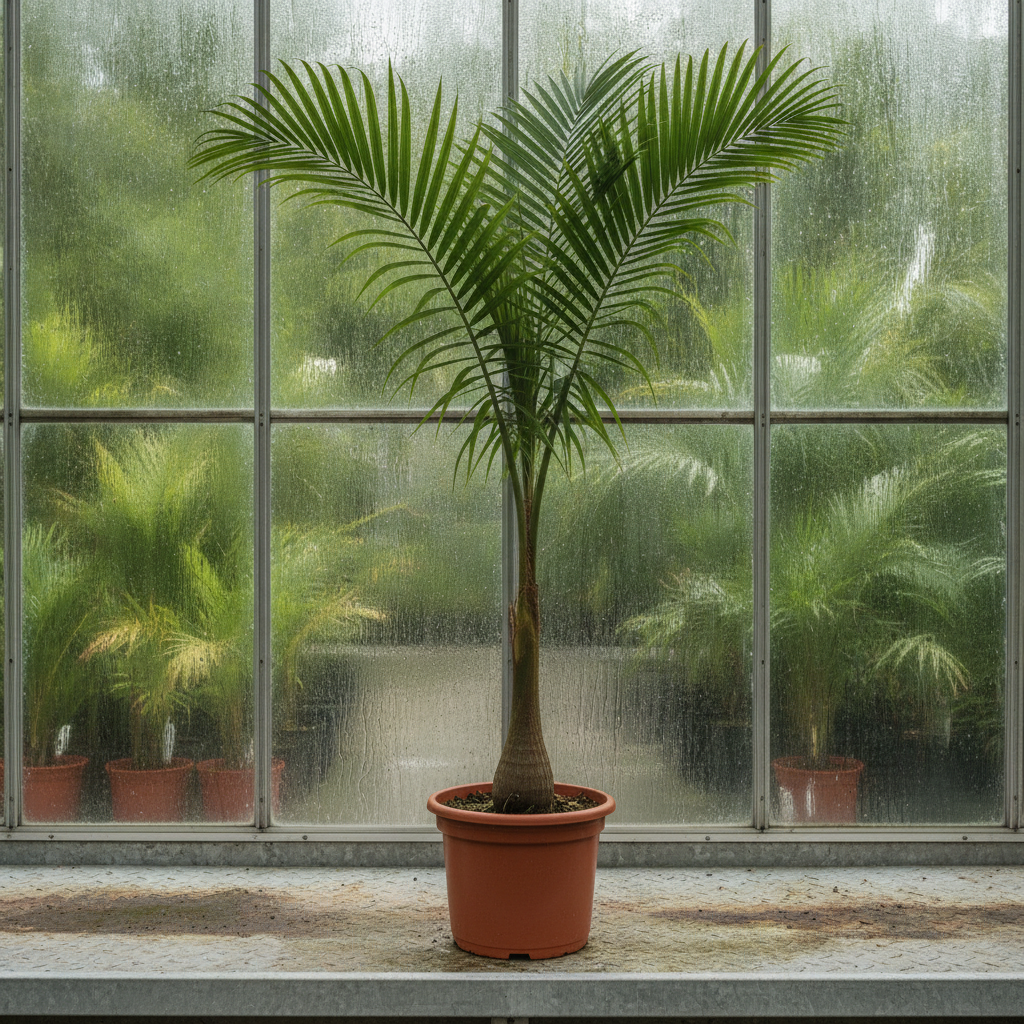
The closest relative in the trade, the spindle palm carries its swelling in the middle of a taller, more slender trunk rather than at the base, and it sports a prominent green crownshaft. Care is almost identical to the bottle palm, making the two natural companions.
Champagne Palm
A rarer cousin from Reunion, the champagne palm has a slimmer, more upright trunk with only a subtle swelling low down and a graceful crown of long arching fronds. It is a collector’s plant, prized for its elegance and its shared Mascarene heritage.
Variety Profiles in Detail
Spindle Palm (Hyophorbe verschaffeltii)
Native to Rodrigues Island, the spindle palm is the bottle palm’s most frequently grown relative and an easy substitute for anyone who cannot find the bottle palm itself. Its trunk swells at the midpoint into a smooth spindle before tapering again toward a distinct green crownshaft, and it grows taller and somewhat faster than the bottle palm while remaining slow by any normal standard. Its light, water, soil, and feeding needs match the bottle palm almost exactly, so the two can share a windowsill and a care routine without compromise.
Champagne Palm (Hyophorbe indica)
From the island of Reunion, the champagne palm, sometimes called the Palmiste Marron, is the most slender member of the group commonly seen in cultivation. Its trunk is narrower and more upright, with only a gentle swelling low down, and it can flush attractive reddish tones in its new growth. Rarer than the bottle and spindle palms, it appeals mainly to dedicated collectors, but it responds to the same warm, bright, free-draining conditions as its relatives.
Choosing the Right Variety for Your Space
Because every member of this group shares the same love of bright light and sharp drainage, the choice comes down to form and space rather than care. For the boldest, most sculptural statement in a compact footprint, the classic bottle palm is unbeatable, especially as a young plant with its exaggerated rounded base. If you have a little more vertical room and want a taller silhouette, the spindle palm delivers the same fascination in a more elongated shape. And for the collector chasing something less often seen, the champagne palm offers a slimmer, more refined variation on the theme. Whichever you choose, give it your sunniest window and a gritty mix, and it will reward you for years.
Frequently Asked Questions
Why is my bottle palm growing so slowly?
Slow growth is entirely normal for this species, which is one of the more leisurely palms in cultivation and may produce only a handful of new fronds in a year. As long as the plant looks healthy, with firm colour and a plump trunk, there is nothing to fix. If you want to encourage what growth it can manage, the answer is almost always more light, since inadequate light is the main thing that stalls an otherwise healthy bottle palm.
Why are the tips of my bottle palm’s fronds turning brown?
Brown frond tips have several possible causes. The most common are inconsistent watering, especially letting the plant become bone dry, and a build-up of mineral salts or fluoride from tap water and fertiliser. Very dry air can also brown the tips slightly. Review your watering to keep it steady, flush the pot with plain water to clear accumulated salts, and consider using filtered or rainwater if your tap supply is heavily treated.
Can I grow a bottle palm outdoors?
Only in a warm, frost-free climate, roughly USDA hardiness zones 10 and 11. The bottle palm has no tolerance for frost and suffers damage once temperatures fall below about 10°C (50°F). In cooler regions it is best grown as a houseplant or moved outdoors only for the warmest part of summer, then brought back inside well before the first cold nights of autumn.
How big does a bottle palm get indoors?
Indoors, and constrained by a pot, a bottle palm usually tops out around 1.2 to 1.8 metres (4 to 6 ft) over many years, and it reaches even that height very slowly. In its native habitat it can eventually grow to roughly 3 to 4 metres (10 to 13 ft), but such size is essentially never seen on a container-grown houseplant. Its slow pace and modest ultimate indoor size are a big part of its appeal.
Is the bottle palm safe for cats and dogs?
Yes, the bottle palm is not known to be toxic to cats or dogs, and true palms are generally considered pet safe. Take care, though, not to confuse it with the sago palm, which is a cycad rather than a true palm and is highly poisonous to pets. Even with a non-toxic plant, it is wise to discourage animals from chewing the fronds, as the fibre can cause mild digestive upset.
Can I propagate my bottle palm from a cutting?
No. The bottle palm grows from a single central growing point and produces no offsets, pups, or side shoots, so cuttings and division are impossible. Seed is the only way to propagate it. If you want more bottle palms, you will need to obtain fresh seed and germinate it in warm, humid conditions, accepting that the process is slow and requires patience.
Why is my bottle palm’s trunk getting soft?
A soft or spongy trunk is a serious warning sign, usually indicating rot brought on by overwatering. The swollen trunk should feel firm; when it turns soft, water has likely been sitting around the roots and base for too long. Check the roots for rot immediately, cut away any that are black and mushy, repot into fresh dry free-draining mix, and hold back on watering until the plant recovers. Prompt action offers the best chance of saving it.
How often should I repot my bottle palm?
Rarely. Because it is slow-growing and happy when slightly pot-bound, a bottle palm generally needs repotting only once every three to four years. Repot in spring or early summer when you see roots escaping the drainage holes or the plant clearly outgrowing its container, and move up just one pot size. Since palms dislike root disturbance, avoid repotting more often than necessary.
Why won’t my bottle palm develop its bottle shape?
The characteristic swollen base develops with maturity and, crucially, with strong light. A young plant grown in insufficient light will stretch and stay slender rather than filling out its trunk. Give the plant the brightest position you have, be patient through its slow development, and understand that the bottle shape is most pronounced in younger plants and gradually elongates as the palm ages over many years.
My bottle palm’s new growth is weak and yellow. What is wrong?
Weak, yellow, distorted new fronds are the classic symptom palm growers call frizzle top, and it usually points to a deficiency of manganese, sometimes alongside magnesium. Switch to a fertiliser formulated specifically for palms that includes these minor nutrients, feed appropriately through the growing season, and make sure the plant has enough light. Corrected early, the plant will push out healthy new growth once its nutrition is balanced.






