
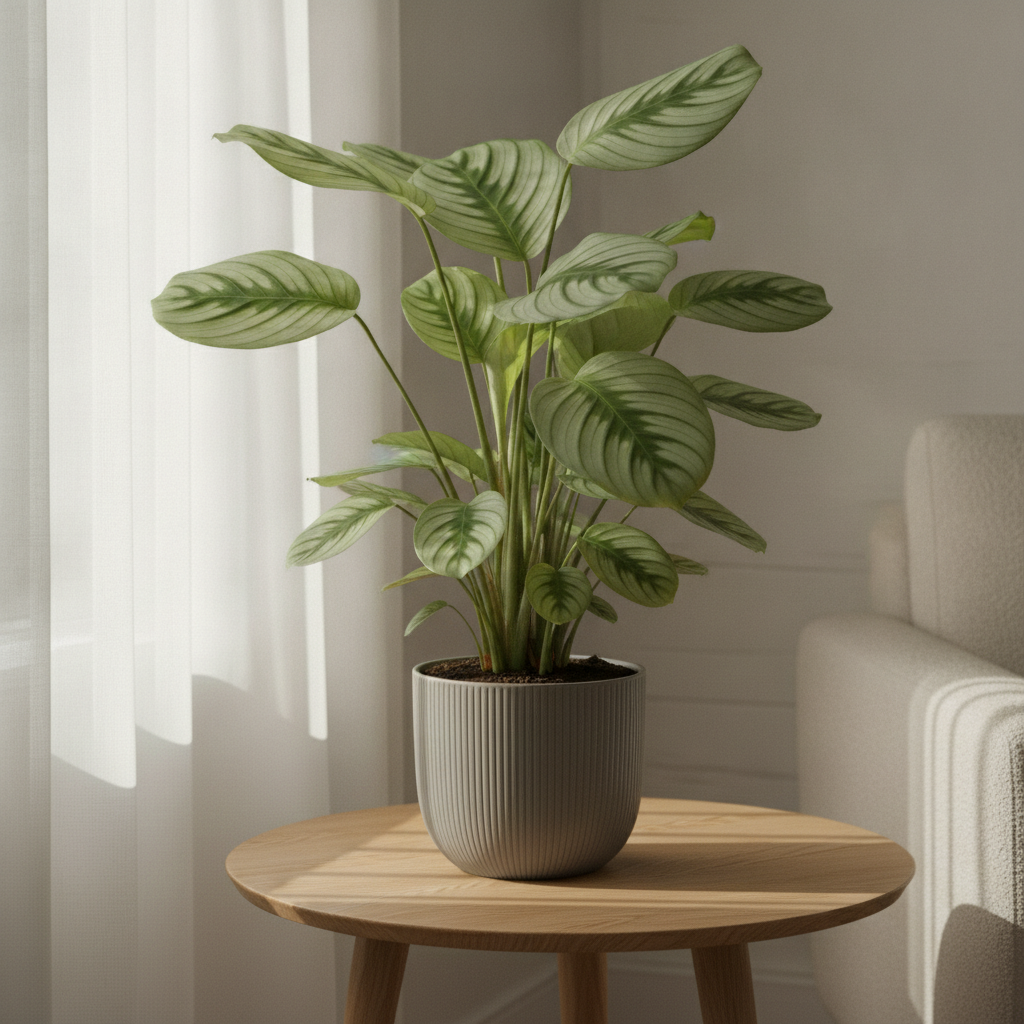
Few houseplants stop a room the way the prayer fern does. Despite the name it is not a fern at all but a member of the prayer plant family, sold as Goeppertia orbifolia (still widely labelled Calathea orbifolia), and its appeal is all in the leaf: broad, almost perfectly round blades the width of a spread hand, washed in pale silvery-green and ruled with fine darker stripes that radiate from the midrib like brushstrokes. It is the kind of plant people photograph before they water it. It is also, to be honest, a plant that asks something of you in return. Get its few non-negotiables right and it grows into a generous, architectural specimen; get careless with water quality or humidity and it will tell you, quickly and visibly, through crisping edges.
This guide walks through everything that separates a prayer fern that merely survives from one that genuinely thrives, from the exact light it wants to the water it refuses to tolerate. None of it is difficult once you understand the plant’s origins, and the reward is one of the most quietly spectacular leaves in cultivation.
Quick Reference
| Common name | Prayer fern, orbifolia calathea, round-leaf calathea |
| Botanical name | Goeppertia orbifolia (syn. Calathea orbifolia) |
| Family | Marantaceae (the prayer plant family) |
| Light | Bright, indirect light; no direct midday sun |
| Water | Keep evenly moist; use rain, distilled or filtered water |
| Humidity | High, ideally 60 percent or more |
| Temperature | 18 to 27 degrees C (64 to 81 degrees F) |
| Soil | Light, airy, moisture-retentive mix that still drains freely |
| Feeding | Dilute balanced feed monthly in spring and summer |
| Propagation | Division of the rhizome only |
| Mature size | Around 80 to 100 cm (32 to 39 in) tall and wide indoors |
| Toxicity | Non-toxic to cats, dogs and people |
| Difficulty | Moderate to demanding |
Why Grow the Prayer Fern as a Houseplant
The prayer fern earns its place through sheer presence. A single mature plant can carry a dozen or more of those saucer-sized leaves, each one held out on a long upright stalk, and because the silvery banding catches light differently through the day the whole plant seems to shift in tone from morning to evening. Unlike many statement foliage plants it stays relatively compact, spreading outward rather than climbing, which makes it a natural choice for a side table, a plant stand or a bright floor corner where a taller plant would feel top-heavy.
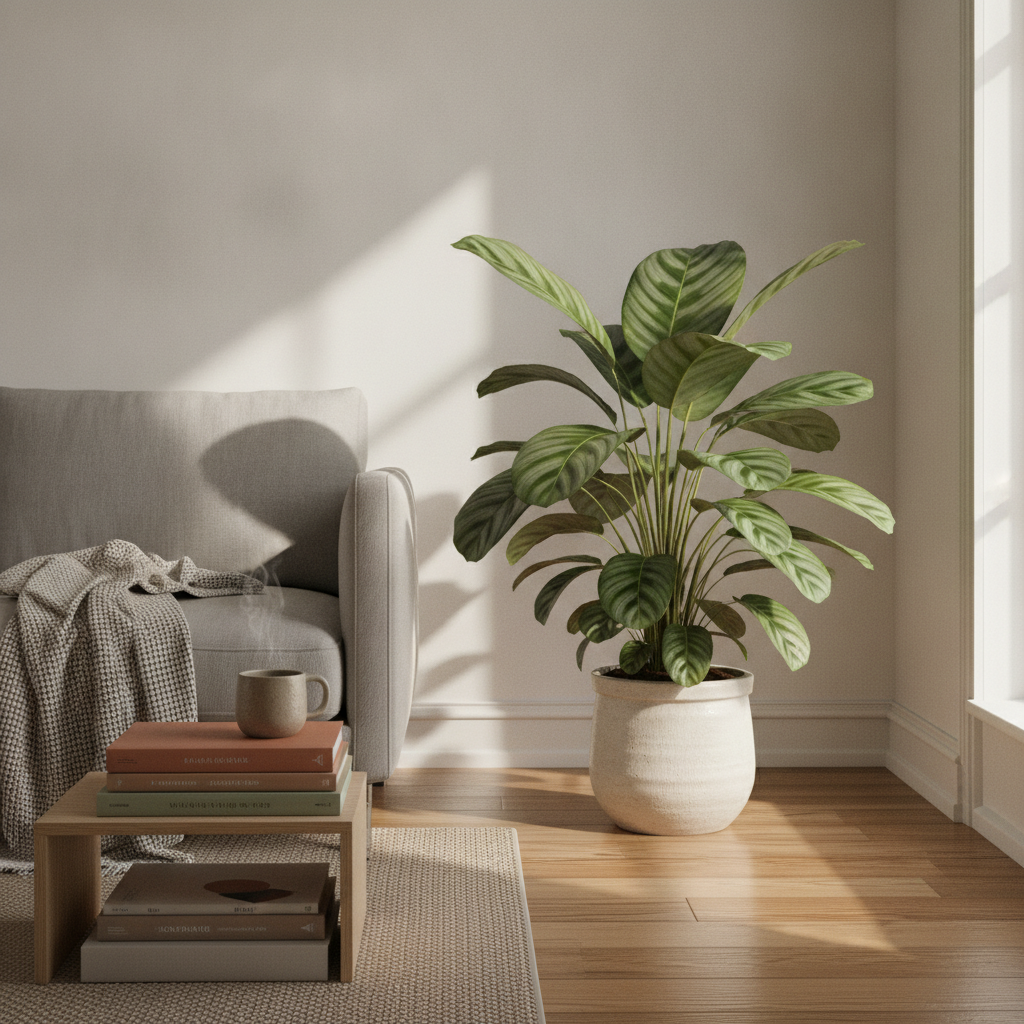
It comes originally from the humid understorey of eastern Bolivia, where it grows on the shaded forest floor beneath a dense canopy. Almost everything the plant needs from you is an attempt to recreate those conditions: warmth that never drops sharply, air that stays moist, dappled light rather than direct sun, and soil that is damp but never waterlogged. There is a genuine bonus for households with pets or small children, too. Like the rest of the Marantaceae, the prayer fern is non-toxic, so an exploratory nibble from a cat or dog is a mess rather than an emergency. It is one of the few truly showy foliage plants you can grow without a second thought about safety.
The trade-off is that this is not a beginner’s plant in the way a pothos or a snake plant is. It reacts to neglect and to tap water in ways that show on the leaves, and those big blades are unforgiving of mistakes because there is so much surface to brown. If you are ready to give it steady, attentive care, though, it repays the effort more visibly than almost anything else on the shelf.
Light
Think about where this plant lives in the wild and light becomes simple to get right. On the forest floor it never sees full sun; instead it catches bright, filtered light that has already passed through layers of canopy above. Indoors, the equivalent is a spot that feels brightly lit but where direct rays never actually land on the foliage. An east-facing window that delivers gentle morning light, or a position a metre or two back from a brighter south or west window, is close to ideal.
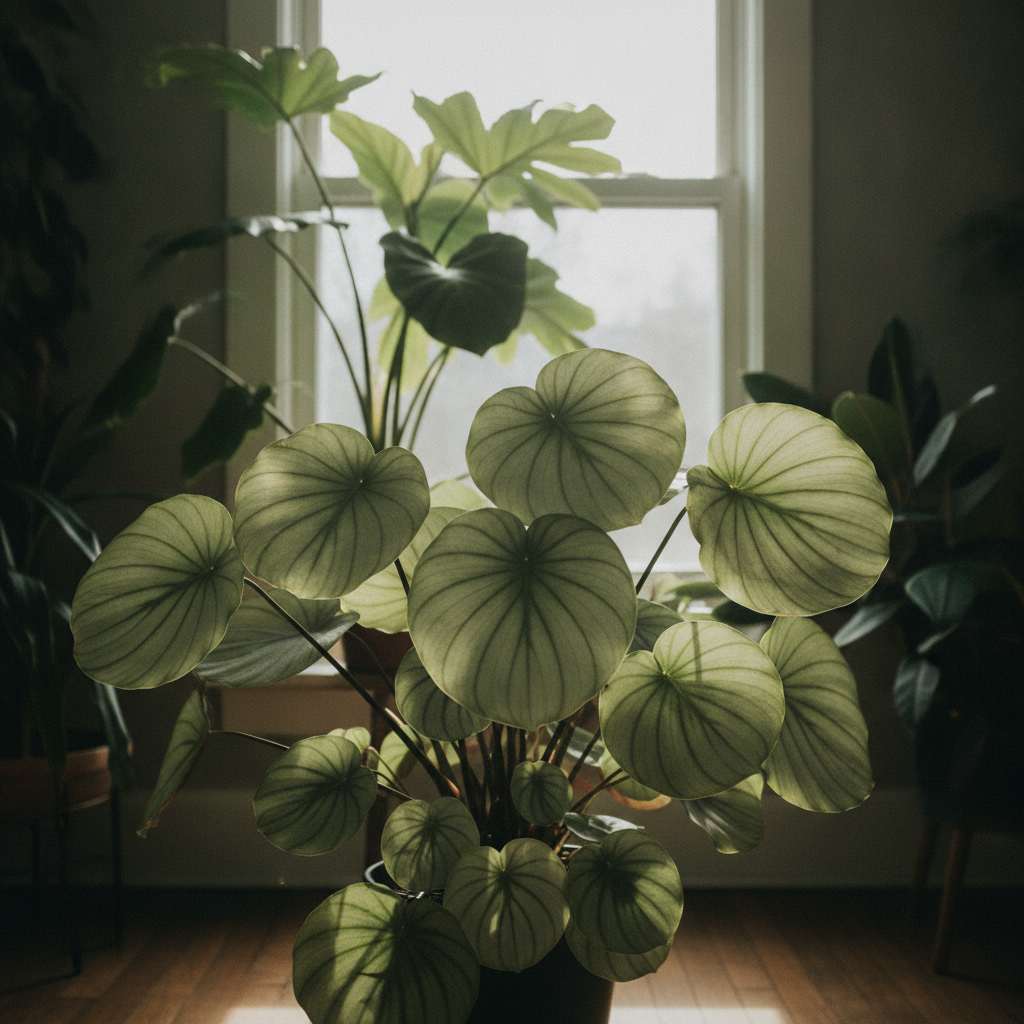
Direct sun is the single most common way people scorch this plant. Even an hour of harsh afternoon light falling directly on those broad leaves can bleach the silver markings to a washed-out grey and burn dry, papery patches into the surface that never recover. If you can see a hard-edged shadow cast by the plant on a sunny day, the light is too strong and it should be moved back or screened with a sheer curtain. On the other side of the scale, too little light is a slower problem but a real one: in a dim corner the plant stops producing new leaves, the existing ones lose some of their contrast, and growth becomes leggy as stalks stretch toward the nearest window.
Because the leaves orient themselves toward the light source, rotate the pot by a quarter turn every week or two to keep the plant growing evenly rather than leaning to one side. If your home is genuinely short of natural light, a modest full-spectrum grow light on a timer for ten to twelve hours a day will keep it healthy, positioned far enough away that it supplements rather than blasts the foliage.
Pro Tip — Read the evening leaves: Prayer plants raise and fold their leaves upward at night in a movement called nyctinasty, then lower them again by morning. A plant that folds up neatly each evening is generally a happy, well-lit plant. If the leaves stop moving, take it as an early sign that something in the light, water or warmth needs attention.
Watering
Watering is where the prayer fern separates itself from easier plants, and it does so on two fronts: how much you water, and what you water with. Start with the how much. This plant wants its soil kept consistently, lightly moist, never bone dry and never sodden. In practice that usually means watering when the top centimetre or two of the mix has just begun to dry, which in a warm bright room might be every four to seven days. Let it dry out completely and the leaf edges crisp within days; leave it standing in water and the fine roots rot just as fast. The target is a rung between those two failures, and the way to find it is to check with a finger rather than a schedule.
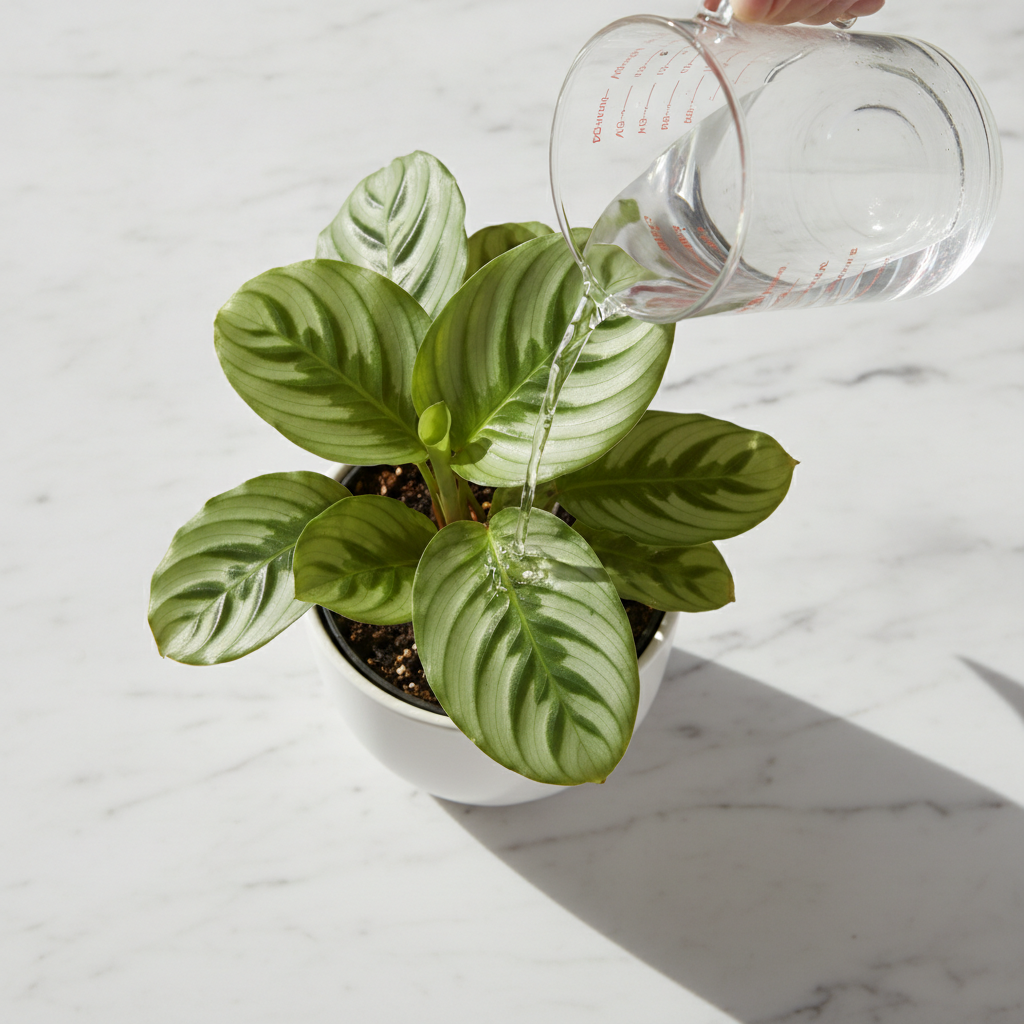
Now the part that catches almost everyone out: water quality. The prayer fern is genuinely sensitive to the fluoride, chlorine and dissolved salts found in most tap water, and it responds by browning along the leaf margins and tips. If your plant develops crispy brown edges despite good humidity and careful watering, hard tap water is the most likely culprit. The reliable fix is to switch to rainwater, distilled water or filtered water. If you must use tap water, leaving it to stand uncovered overnight lets some chlorine dissipate, though it does nothing for fluoride or mineral content, so it is only a partial help.
When you do water, water thoroughly. Take the plant to the sink, pour slowly and evenly across the surface until water runs freely from the drainage holes, and let it drain completely before returning it to its spot. This flushes accumulated salts through the soil and ensures the whole root ball is moistened rather than just the top. Never let the pot sit in a saucer of standing water, and tip away anything that collects underneath within a few minutes. In the cooler, darker months the plant uses far less water, so ease off and check the soil more often rather than watering out of habit.
Warning — Skip the softener: Do not use water from a domestic ion-exchange softener. It replaces hardness minerals with sodium, which builds up in the soil and damages the roots of sensitive plants like this one. Rain or distilled water is far safer.
Soil and Potting
The prayer fern needs a mix that pulls off a slightly contradictory trick: it has to hold moisture so the roots never dry out, yet it must also drain and breathe freely so they never suffocate or rot. A dense, water-retentive potting soil on its own will stay wet at the core and kill the plant slowly; a fast, gritty cactus mix will dry out far too quickly. The answer is a light, open, organic blend.
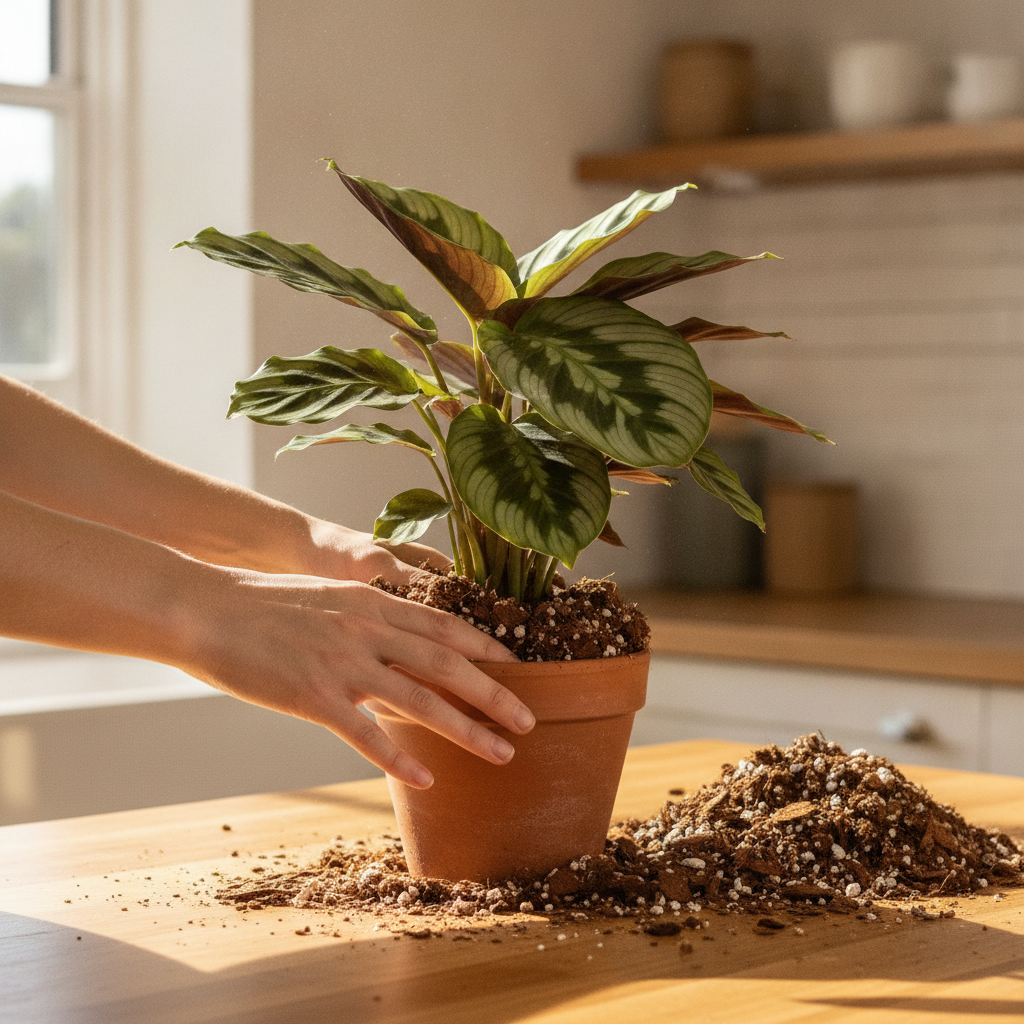
A dependable recipe is roughly two parts good quality peat-free houseplant compost or coco coir for moisture retention, one part perlite or fine bark for aeration and drainage, and a handful of worm castings for gentle nutrition. Many growers add a little orchid bark to keep the structure open over time. The aim is a mix that feels spongy and holds together damp, but that water runs through readily rather than pooling. Whatever you use, the pot must have drainage holes; a decorative cover pot with no way for water to escape is one of the fastest routes to root rot.
Repot roughly every one to two years, ideally in spring as growth picks up, moving only one size up so the plant is not swamped by a large volume of wet soil it cannot use. This is also the moment to refresh tired, compacted mix and to check the roots for any dark, mushy sections, which should be trimmed away with clean scissors. Prayer ferns do not mind being a little snug in their pots, so there is no need to rush them into oversized containers.
Fertilising
The prayer fern is not a heavy feeder, and more fertiliser is emphatically not better. Its fine roots are easily scorched by concentrated nutrient salts, the same salts that also contribute to brown leaf edges, so the guiding principle is little and often rather than occasional and strong. Through the active growing season of spring and summer, feed once a month with a balanced liquid houseplant fertiliser diluted to half the strength recommended on the label. That gentle, regular feed is enough to support steady new leaves without overwhelming the roots.
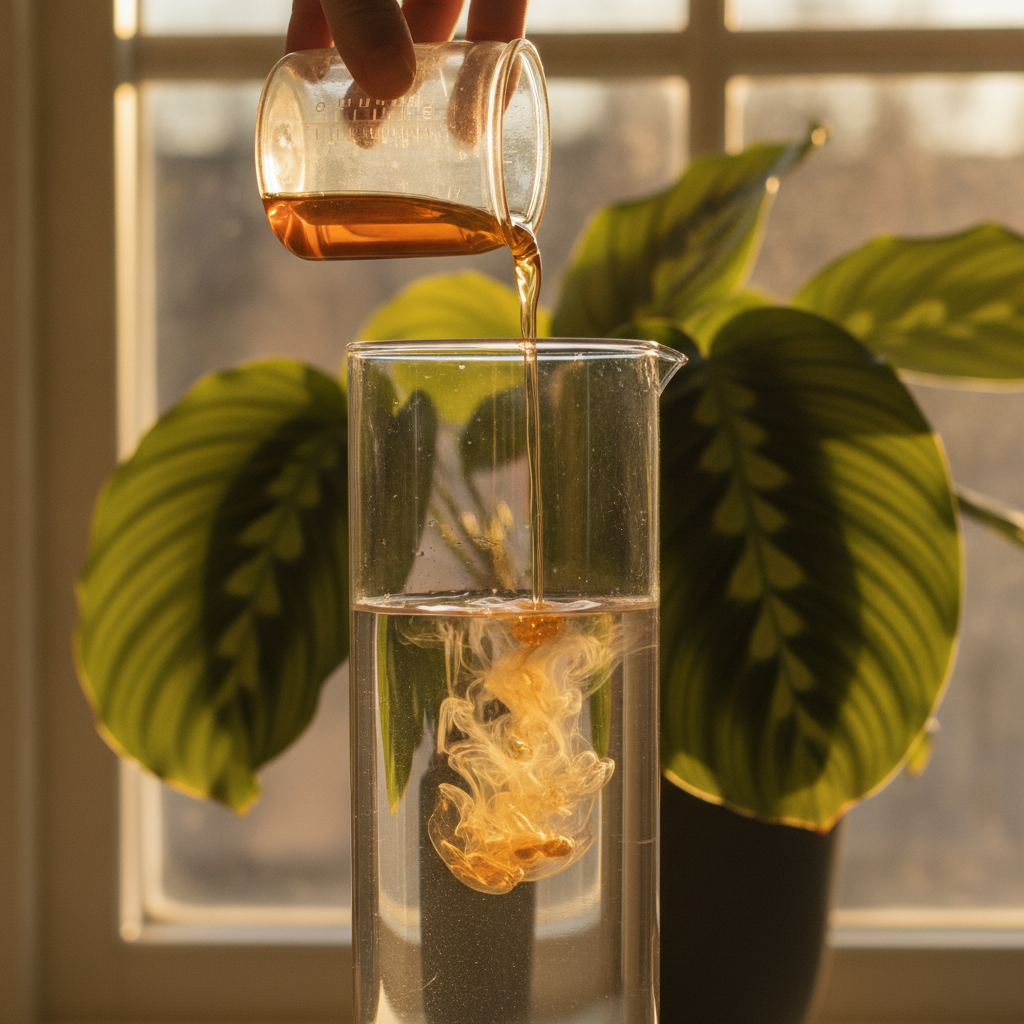
Always apply feed to soil that is already slightly damp rather than to a dry root ball, which helps the nutrients spread evenly and reduces the risk of root burn. In autumn and winter, when light levels fall and growth slows or stops, stop feeding altogether and resume only when you see fresh growth in spring. If you have been using tap water and suspect salt build-up, flushing the pot thoroughly with a few changes of clean water every couple of months clears accumulated minerals and keeps the growing medium sweet. Signs that you are overfeeding include a white crust on the soil surface, brown scorched leaf tips despite good watering, and unusually brittle foliage; if you see them, ease off and flush the soil.
Propagation
Here is where the prayer fern differs from the trailing plants people are used to rooting in a jar of water. It cannot be grown from a leaf or a stem cutting, because it has no vining stems with nodes to root from. It grows instead from a central underground rhizome, and the only reliable way to make more plants is division: separating that rhizome, with its attached clumps of leaves and roots, into smaller independent plants. The best time to do this is in spring, ideally combined with a scheduled repotting so the plant is only disturbed once.
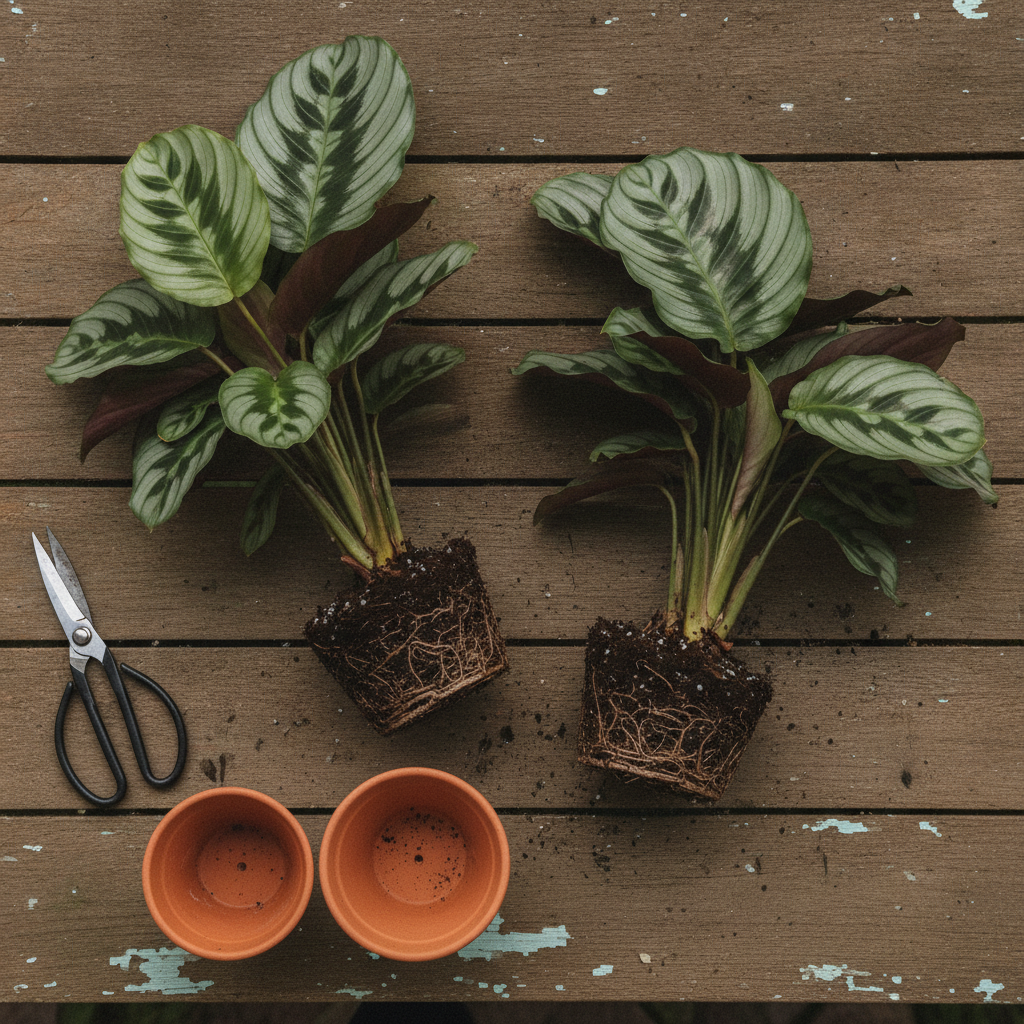
To divide a healthy, established plant, work through it patiently rather than forcing anything apart.
- Water the plant a day beforehand so it is well hydrated and less stressed by the disturbance.
- Ease the whole plant out of its pot and gently loosen the soil from around the root ball with your fingers so you can see where natural clumps separate.
- Identify a section that has both several healthy leaves and its own portion of roots attached to the rhizome. A division needs both to survive on its own.
- Tease that section away by hand where you can; where the rhizome will not part naturally, cut cleanly through it with sterilised scissors or a knife.
- Pot each new division into its own small container of the same light, airy mix, at the depth it sat before, and water it in with clean water.
- Keep the new plants somewhere warm, humid and out of direct sun while they settle. A clear cover or a spell in a more humid spot helps them recover.
Expect the divisions to sulk for a couple of weeks as they establish; some drooping and a pause in growth is normal. Keep the humidity up and resist the urge to feed until you see new leaves, which is the signal that fresh roots have taken hold. Because the plant only offsets slowly, avoid dividing too small or too often, as each piece needs enough of a root system to support those large, thirsty leaves.
Pests and Common Problems
Most of what goes wrong with a prayer fern is environmental rather than a pest, and the leaves are an honest diary of its care. Learning to read them is the fastest route to a healthy plant. Brown, crispy edges and tips are the classic complaint and usually point to low humidity, mineral-heavy tap water, or the soil drying out too far between waterings, often a combination. Curling leaves that do not relax by evening typically mean the plant is thirsty or the air is too dry. Yellowing leaves most often signal overwatering and soggy roots, while faded, washed-out markings suggest too much direct light.
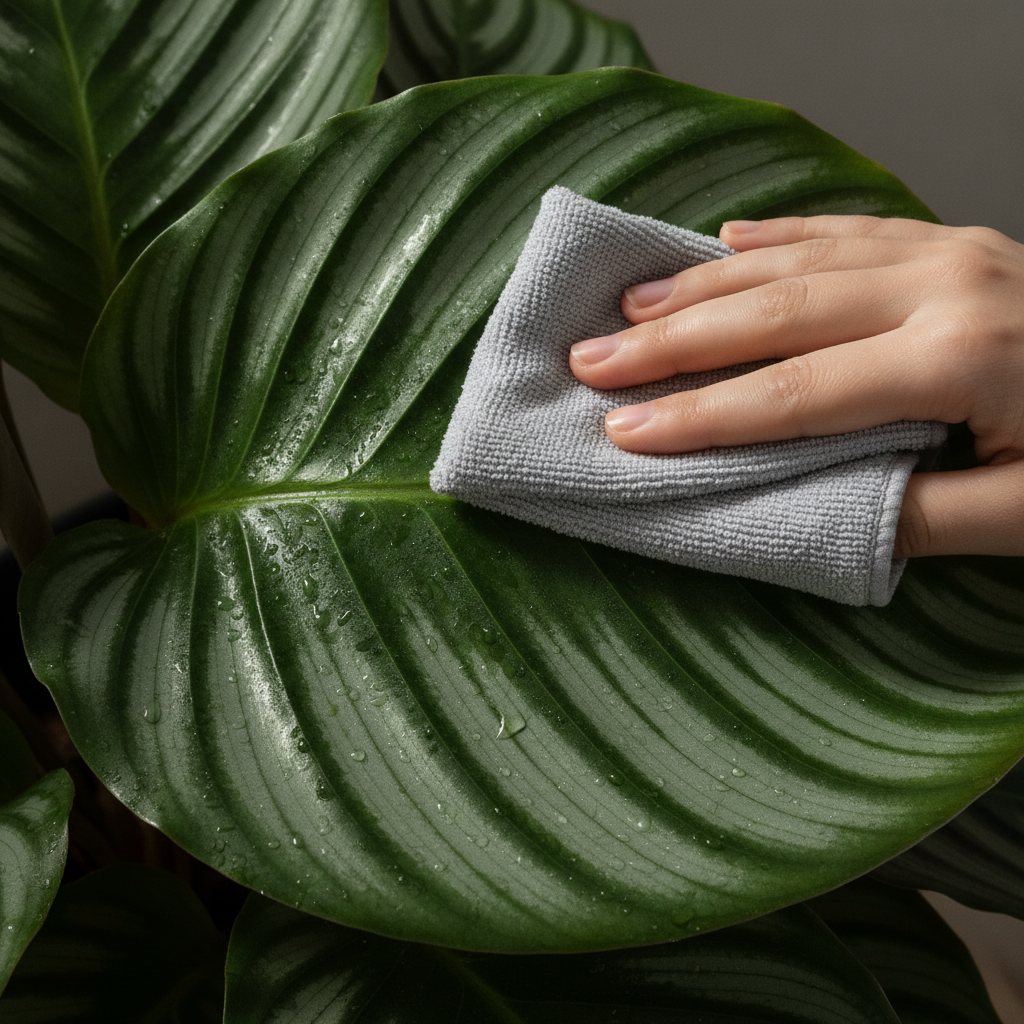
When actual pests do appear, they are drawn by the same dry conditions that stress the plant. Spider mites are the chief offender, thriving in warm, dry air and leaving fine webbing and pale stippling on the leaves, which is one more reason to keep humidity high. Thrips and mealybugs turn up occasionally too. Because there is so much leaf surface, inspect both sides regularly, particularly along the midrib and in the leaf axils where pests like to hide. Catching an infestation early makes it far easier to clear.
At the first sign of trouble, isolate the plant from its neighbours to stop pests spreading. Wipe the leaves down, rinse the foliage under a gentle shower, and treat with insecticidal soap or a diluted neem oil solution, repeating every week or so until the problem clears. Raising the humidity and keeping the leaves clean does as much preventive work as any spray. For the brown-edge problems, correcting the underlying cause, better water, steadier moisture and more humid air, prevents new damage, though existing brown patches will not turn green again. You can trim them off along the natural leaf line with clean scissors purely for appearance.
Pro Tip — Group for humidity: Prayer ferns love company. Clustering them with other humidity-loving plants raises the moisture in the air around all of them, and standing the pot on a wide tray of damp pebbles, with the pot base above the water line, gives a steady local lift in humidity that these plants genuinely appreciate.
Varieties and Related Plants
The prayer fern is grown almost entirely as the true species rather than as a range of named cultivars, and its beauty lies precisely in that consistent, unimproved leaf. What does vary is the stage and size at which you buy it. A young plant looks quite different from a mature specimen, and knowing what to expect helps you choose and helps you judge how yours is developing.
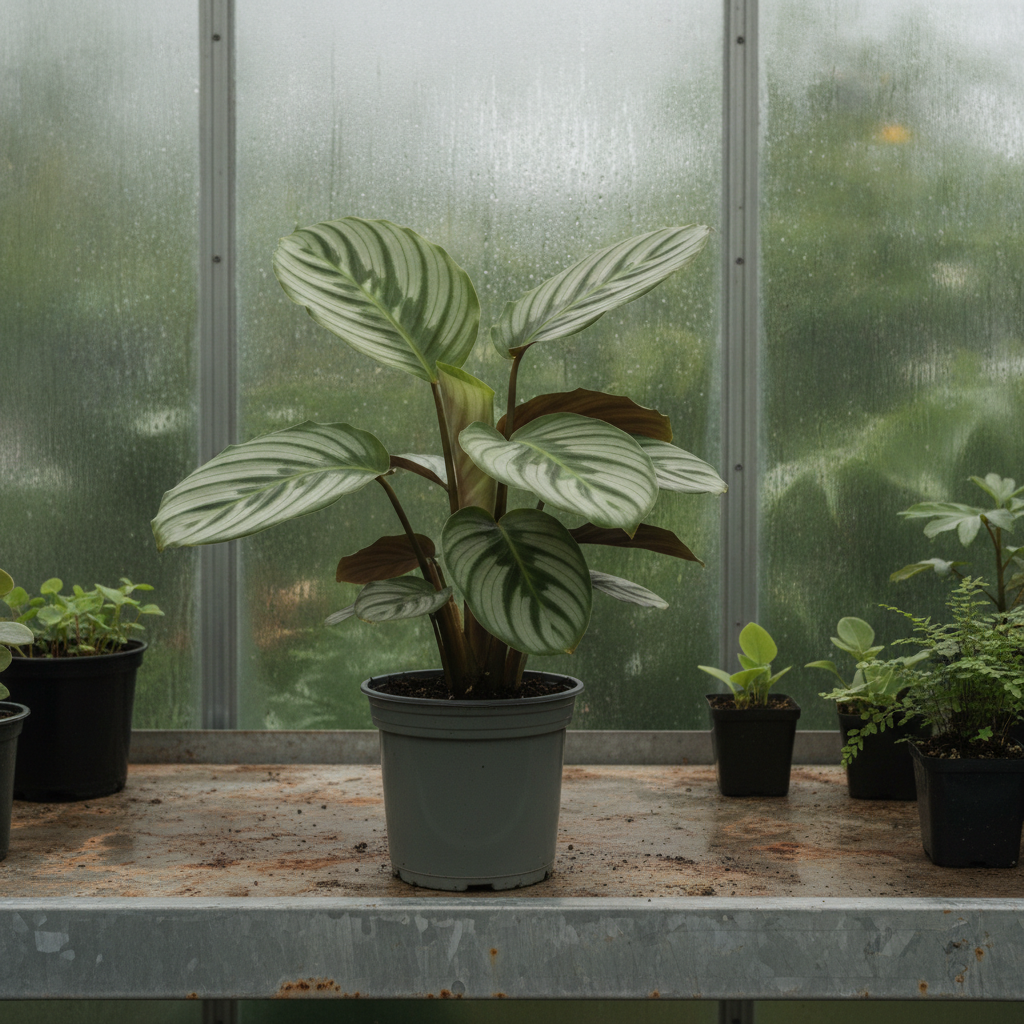
Standard mature orbifolia. This is the plant at its full glory: broad, near-circular leaves the size of a spread hand, silvery-green overall with strong, evenly spaced darker green bands running out to the margins. A well-grown plant carries many of these at once on long upright stalks, forming a rounded, generous clump. This is what you are working toward, and it takes a couple of years of steady care to build.
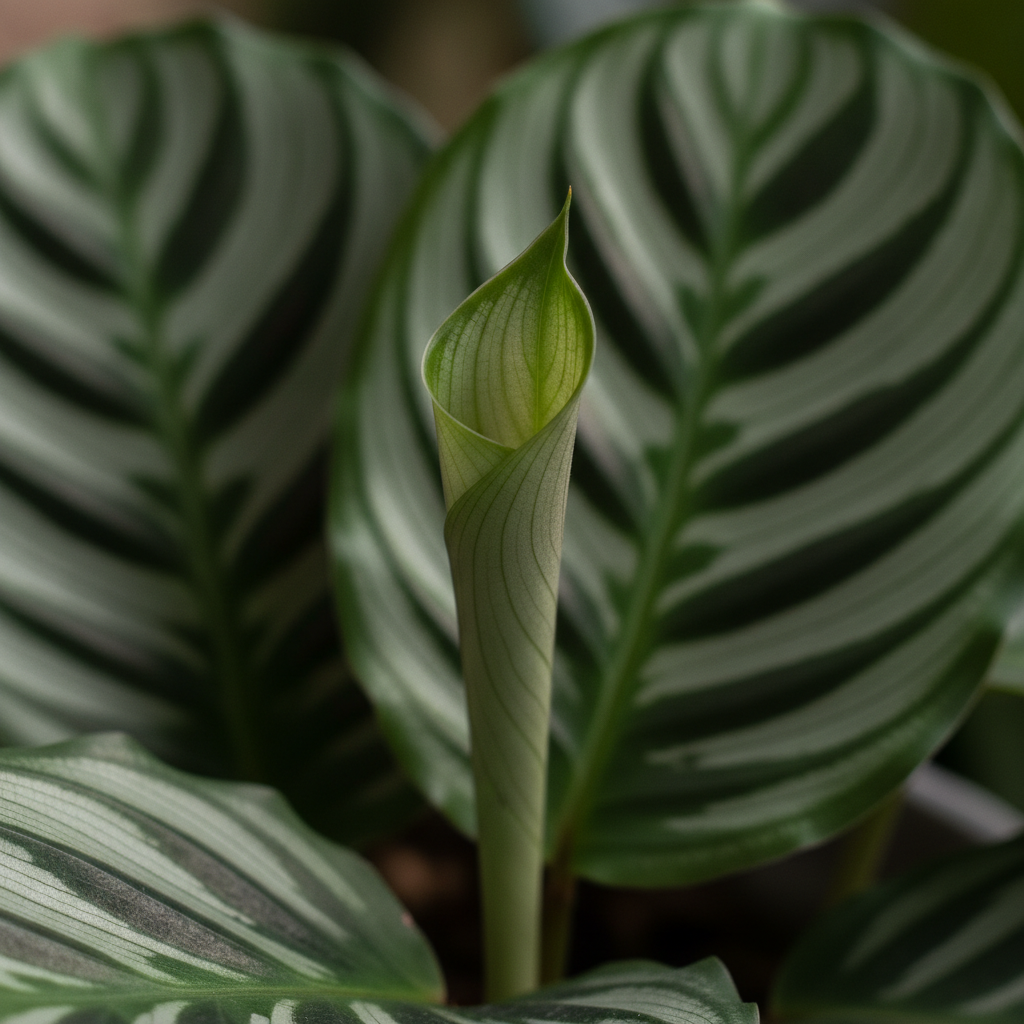
Young compact plants. Smaller specimens have leaves that are more modest in size but often show an especially crisp, tightly spaced silver stripe and a fresh, pale mint tone as each new leaf unfurls from a rolled tube. These plants are more affordable and adapt readily to a new home, and watching the leaves enlarge and spread as the plant matures is part of the pleasure of growing it.
If you enjoy the prayer fern you will find plenty of relatives to grow alongside it in the same family. Other members of the Goeppertia and Calathea group, along with true Maranta prayer plants and the boldly patterned Stromanthe, share the same love of warmth, humidity and clean water, so once you have the routine for one you can grow the whole tribe with confidence.
Frequently Asked Questions
Is the prayer fern actually a fern?
No. Despite the common name, it is not a fern and does not reproduce by spores. It belongs to the prayer plant family, Marantaceae, and its botanical name is Goeppertia orbifolia, still widely sold under the older name Calathea orbifolia. The “fern” in the common name is misleading, so treat it as a prayer plant, not a fern, when it comes to care.
Why are the leaf edges turning brown and crispy?
Brown, crisp edges are the most common problem and usually come down to one of three things, often together: minerals and fluoride in tap water, humidity that is too low, or soil that has dried out too far between waterings. Switch to rainwater, distilled or filtered water, raise the humidity around the plant, and keep the soil lightly and evenly moist. Correcting the cause prevents new damage, though existing brown areas will not recover and can be trimmed off for looks.
How much humidity does it really need?
A lot. The prayer fern comes from humid tropical forest and is happiest at around 60 percent relative humidity or more. Average living-room air, especially with heating running, is often far drier than that. Grouping it with other plants, standing it on a tray of damp pebbles, or running a small humidifier nearby all help. A bright, warm bathroom or kitchen can suit it well.
Can I propagate it from a leaf or a cutting?
No. It cannot be grown from a single leaf or a stem cutting because it has no rooting nodes on vining stems. The only reliable method is division, separating the underground rhizome into sections that each keep their own leaves and roots, ideally done in spring when you repot.
Is the prayer fern safe around cats and dogs?
Yes. Like other members of the prayer plant family, it is non-toxic to cats, dogs and people, so it is a safe choice for homes with curious pets or small children. It is still best to discourage nibbling, as any plant material can cause a mild stomach upset, but there is no toxic risk.
Why do the leaves move up and down during the day?
This is a natural behaviour called nyctinasty, shared across the prayer plant family and the reason for the “prayer” name. The leaves rise and fold upward in the evening and lower again in the morning, driven by changes in light. Healthy, active leaf movement is a good sign; if it stops, check that light, watering and warmth are all where they should be.






