
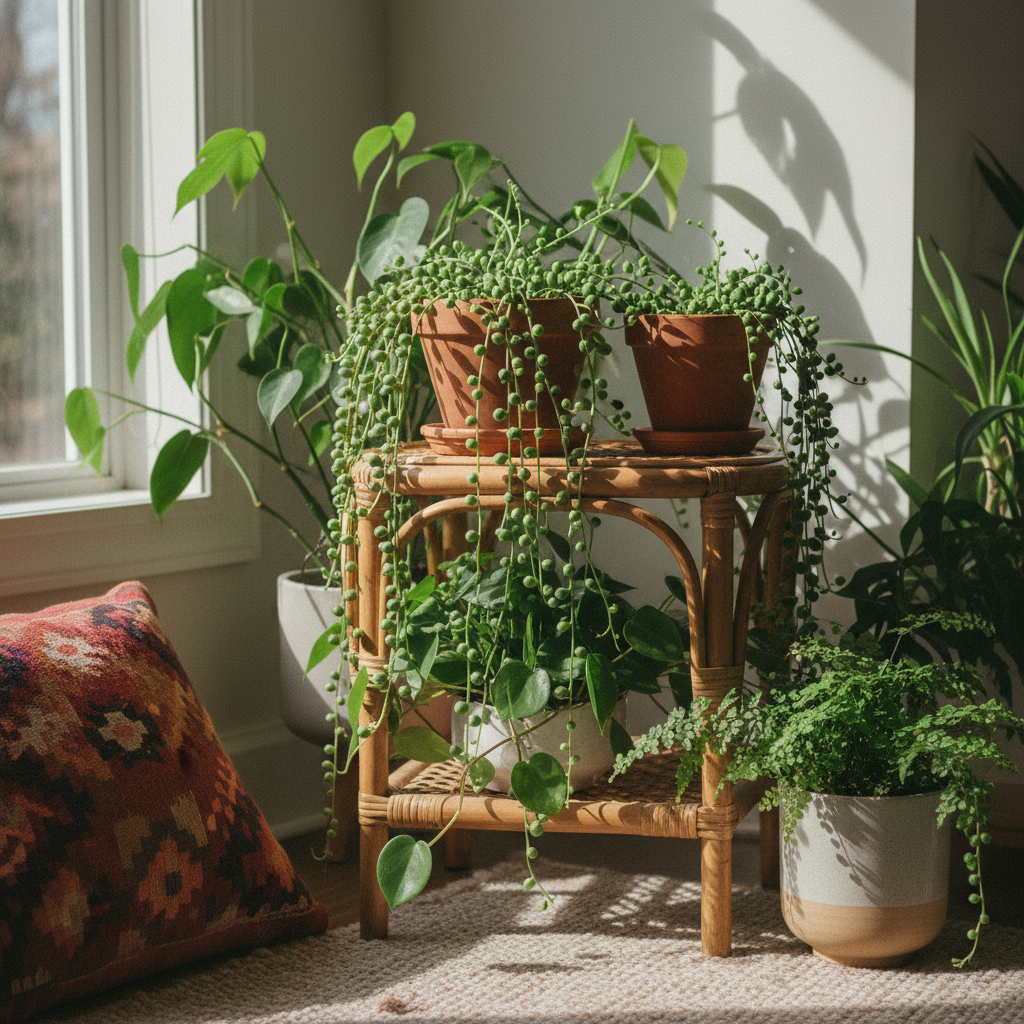
String of pearls is one of the most instantly recognisable trailing succulents in cultivation, prized for its long beaded strands of spherical, pea-sized leaves that spill from a pot like a strand of living jewellery. Botanically known as Curio rowleyanus, and still widely sold under its former name Senecio rowleyanus, the species hails from the rocky, semi-arid scrublands of south-western Africa, where its trailing stems wind across the ground in the dappled shade of larger shrubs. Each tiny leaf is a near-perfect sphere about six millimetres across, finished with a slim translucent stripe along one side. That stripe, called an epidermal window, lets light filter into the interior of the leaf and is the reason the plant can photosynthesise efficiently while exposing very little surface area to drying winds.
The reputation of string of pearls hovers in an odd place between easy and difficult. The plant itself is biologically forgiving in many respects: it stores water in those plump leaves, tolerates neglect, and asks very little in terms of feeding. Yet it sits on a knife edge when it comes to roots. Too much moisture for too long and the pearls collapse into a sodden, mushy heap. Too little light and the strands stretch into thin, sparse threads with leaves spaced like beads on an unraveling rosary. This guide covers the difference between merely keeping a string of pearls alive and growing it into the dense, cascading curtain that drew you to it in the first place — light, water, soil, feeding, propagation, pests, and the small handful of varieties worth seeking out.
Contents
- Quick Reference
- Why String of Pearls Makes a Striking Houseplant
- Light Requirements
- Watering and Humidity
- Soil, Potting and Repotting
- Fertilising
- Propagation
- Pests and Diseases
- Popular Varieties
- Frequently Asked Questions
Quick Reference: String of Pearls at a Glance
| Light | Bright indirect light with several hours of gentle direct sun; a south or east-facing window filtered by a sheer curtain is ideal. |
| Watering | Soak thoroughly, then allow the soil to dry completely. Roughly every 14 to 21 days in summer, every 4 to 6 weeks in winter. |
| Temperature | 18 to 24 °C (64 to 75 °F) in active growth; tolerates a cool winter rest down to about 10 °C (50 °F). Avoid below 4 °C (39 °F). |
| Humidity | Low to moderate, around 40 to 50 per cent. High humidity invites rot rather than helping the plant. |
| Fertiliser | Diluted balanced or cactus-formulated liquid feed at quarter to half strength, two or three times during spring and summer only. |
| Toxicity | Toxic to cats, dogs and humans if ingested; sap may irritate skin. Keep out of reach of pets and small children. |
Why String of Pearls Makes a Striking Houseplant
Few houseplants offer the immediate visual impact of a mature string of pearls. The strands can trail 60 to 90 centimetres (24 to 36 inches) from a hanging pot in a single growing season, and a well-grown specimen carries thousands of those tight, beaded leaves at once. Hung in a window, the spheres catch backlight through their translucent stripes and seem almost to glow. The plant adds something most houseplants cannot: a vertical, downward gesture that breaks up the relentless upward growth of most foliage plants and softens the architecture of a room.
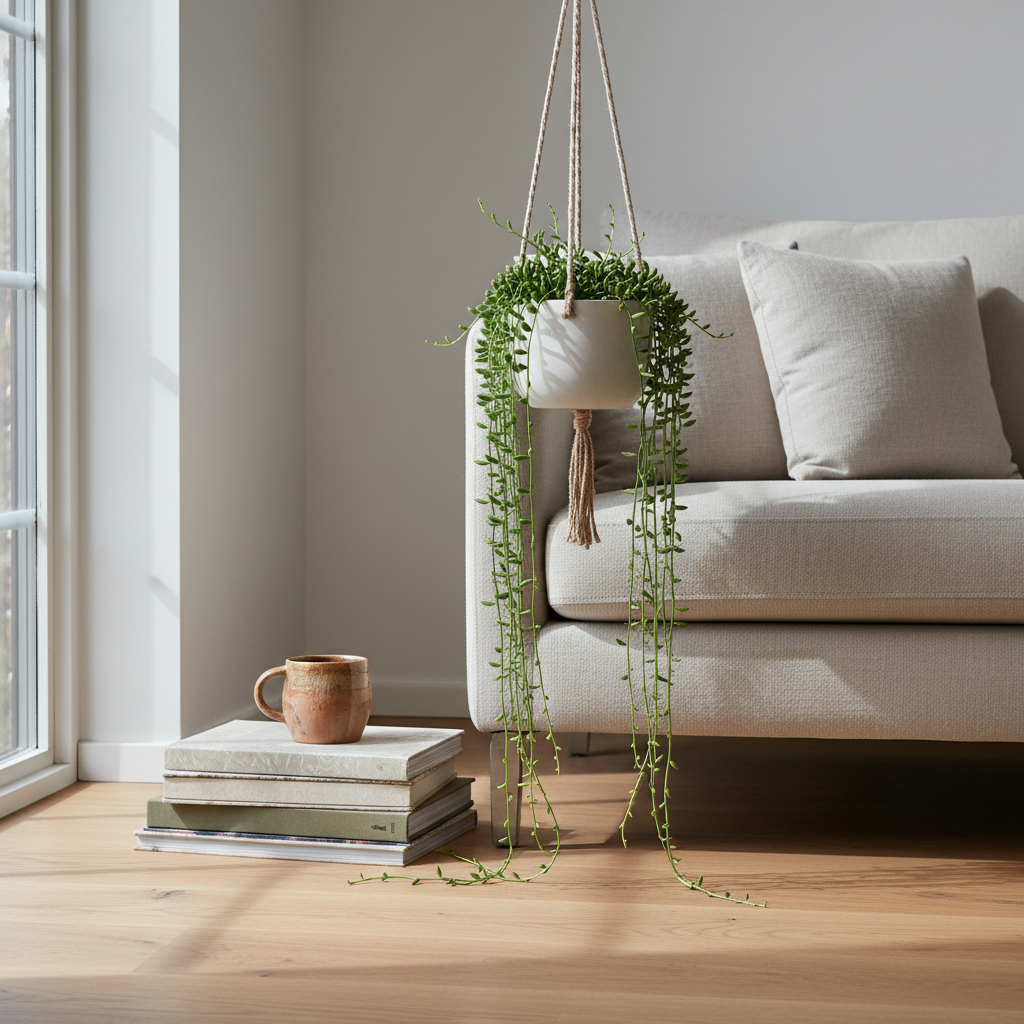
Beyond looks, the plant earns its place through practical virtues. It is a true xerophyte, evolved for survival in low-water environments, which means it tolerates the kind of forgetful watering that kills most tropical foliage. It is small in its rootball relative to the visible growth above, so it lives happily in shallow pots and on slim shelves where larger plants would never fit. It propagates with almost embarrassing ease from cuttings, so a single healthy mother plant becomes a continuous supply of gifts and replacements. And while it is decidedly not a pet-safe plant, the toxicity is low enough that a curious lick is unlikely to be fatal, although it is still serious enough that it should be displayed well out of reach.
Important — Toxicity: String of pearls contains pyrrolizidine alkaloids and irritant saponins. Ingestion causes vomiting, diarrhoea and drooling in cats and dogs, and similar gastrointestinal upset in humans. The milky sap can also irritate skin and eyes on contact. Place the plant where pets and children cannot reach the trailing strands, and wear gloves when taking cuttings.
Light Requirements
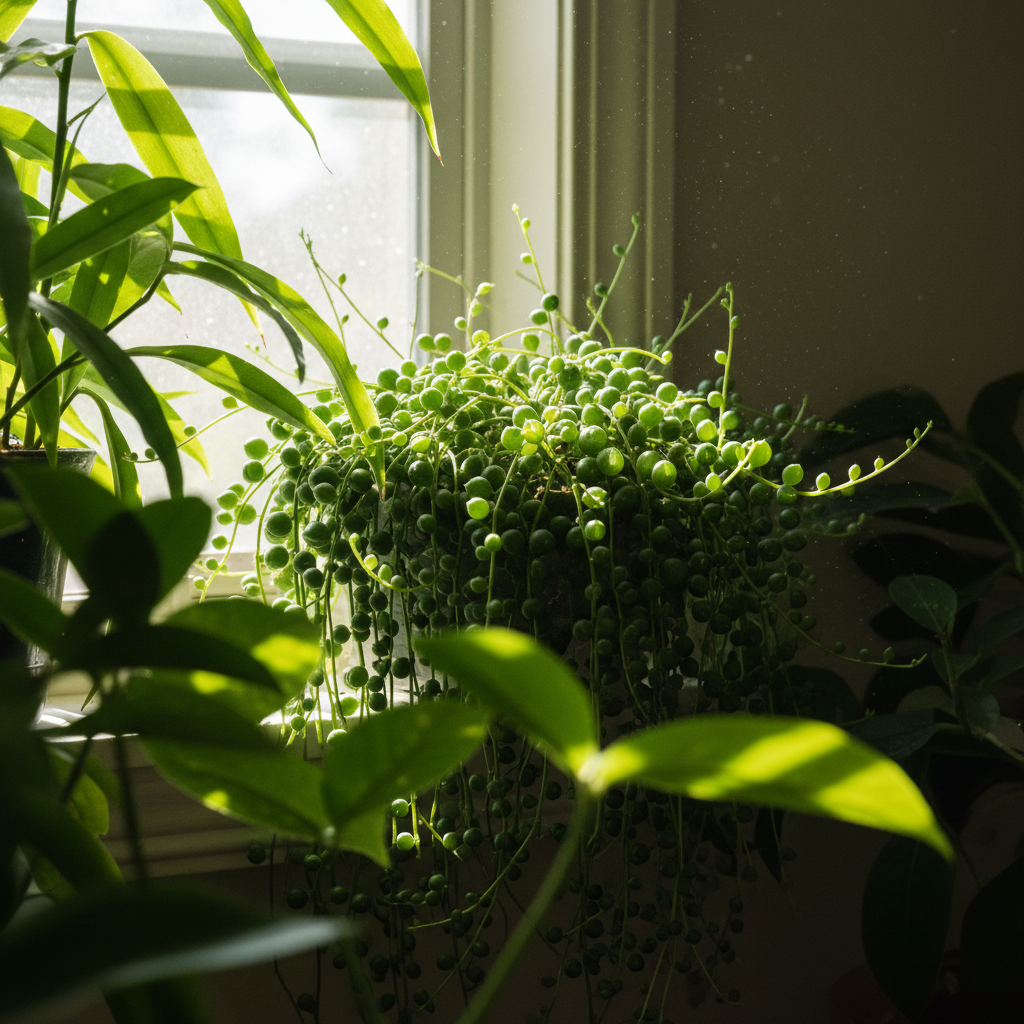
Light is the single most decisive factor in whether string of pearls thrives or merely persists. In its native habitat the plant scrambles along the ground in the partial shade of taller plants, receiving bright, filtered light for most of the day and direct sun only in shorter, gentler windows. Reproducing that pattern indoors is the secret to dense, tightly beaded strands. Give too little light and the strands stretch, the leaves space out, and the whole plant fades to a sickly pale green.
The ideal placement in most homes is within a metre of a bright window, behind a sheer curtain if midday sun is strong. A south-facing window in the Northern Hemisphere, or a north-facing one in the Southern, provides plenty of light when softened by a thin curtain. East-facing windows are excellent because the gentle morning sun never burns. West-facing windows can work but the harsh late afternoon light may scorch the upper pearls if the plant sits right against the glass.
Light Levels Explained
Houseplant lighting is often described in vague terms like “bright” or “low”, but real plants respond to measurable light intensity. The table below converts the usual jargon into approximate lux readings and typical positions in a home, with a note on what to expect from string of pearls at each level.
| Light Category | Approx. Level | Typical Location | Outcome |
|---|---|---|---|
| Direct sun | 50,000 to 100,000 lux | Unfiltered south window in summer | Risk of scorched, brown-spotted pearls without acclimation |
| Bright indirect | 10,000 to 25,000 lux | Filtered south, east or unobstructed west window | Dense, tightly beaded growth and possible cinnamon-scented blooms |
| Medium indirect | 2,000 to 10,000 lux | Two metres from a bright window | Slower growth, slightly longer spaces between leaves, no flowers |
| Low light | 500 to 2,000 lux | North window or interior wall | Etiolation — sparse, stretched strands with pale pearls |
| Very low | Below 500 lux | Bathroom, hallway, deep room | Decline within weeks; not survivable long-term |
Window Orientation and Placement
South-facing window: The strongest option in the Northern Hemisphere. Place the plant a short distance back from the glass, or hang a thin curtain to diffuse the midday rays. In the Southern Hemisphere this orientation is the gentlest.
East-facing window: Often the best all-round choice. The plant receives gentle direct sun in the morning, before temperatures and ultraviolet intensity peak, and bright indirect light through the rest of the day.
West-facing window: Workable but watch for late afternoon scorch in summer. If the sun strikes the plant directly between 14:00 and 18:00, set the pot back by 30 to 50 centimetres or filter the light.
North-facing window: Generally too dim in the Northern Hemisphere unless the window is large and unobstructed. The plant survives but rarely fills out densely. Supplemental light is often required.
Pro Tip — Acclimate Gradually: Moving a string of pearls from a shaded shop or shipping box straight onto a sunny windowsill can scorch the upper pearls in a single afternoon. Introduce stronger light over 10 to 14 days, starting with two or three hours of direct sun per day and increasing slowly.
How Light Affects Growth and Flowering
In strong indirect light with a few hours of direct sun, string of pearls produces tightly packed pearls with the leaves nearly touching along each strand. The colour is a rich, slightly bluish green. As light intensity falls, the spacing between pearls widens and the leaves themselves shrink, taking on a paler hue. In autumn and early winter, well-lit plants produce small white, brush-like flower heads with a notable cinnamon-vanilla fragrance. A plant kept in dim conditions year after year will rarely bloom, so failure to flower is usually a light problem rather than a feeding one.
Warning — Direct Sunlight: Unacclimated string of pearls placed in unfiltered summer sun can scorch within hours. Scorched pearls develop sunken brown patches that never recover and eventually drop. If you must rehome the plant from low light, do so over weeks, not days.
Artificial Lighting
Where natural light is unreliable, a full-spectrum LED grow light produces excellent results. Aim for 10,000 to 20,000 lux at the surface of the strands, with the lamp positioned 25 to 40 centimetres above the plant. Twelve to fourteen hours per day is plenty during the growing season; reduce to ten hours over winter to mimic shorter natural days and encourage a rest. Cheap clip-on LED panels work well for a single trailing plant; for larger collections a bar or panel suspended above a shelf is more practical.
Seasonal Adjustments
Winter light in temperate regions can drop by 60 to 80 per cent compared with summer, and string of pearls notices. Move the plant closer to the window from late autumn through early spring, removing any curtain that filtered summer sun. Rotate the pot a quarter turn each week so that all sides of the plant receive equal exposure and the strands do not bias toward one direction. In high summer in southerly latitudes, reverse the strategy and pull the plant back slightly from a hot window to avoid burn.
Watering and Humidity
If light is the most decisive factor in growth, water is the most decisive factor in survival. The pearls themselves are water-storage organs; each one is a tiny reservoir designed to carry the plant through extended drought. Overwatering is the single most common cause of death for this species, and the failure mode is fast and unattractive: pearls collapse into translucent yellow sacs, roots blacken, and an established plant can disintegrate in under a week. The good news is that the plant tells you exactly when it needs water if you know how to read it.
When to Water
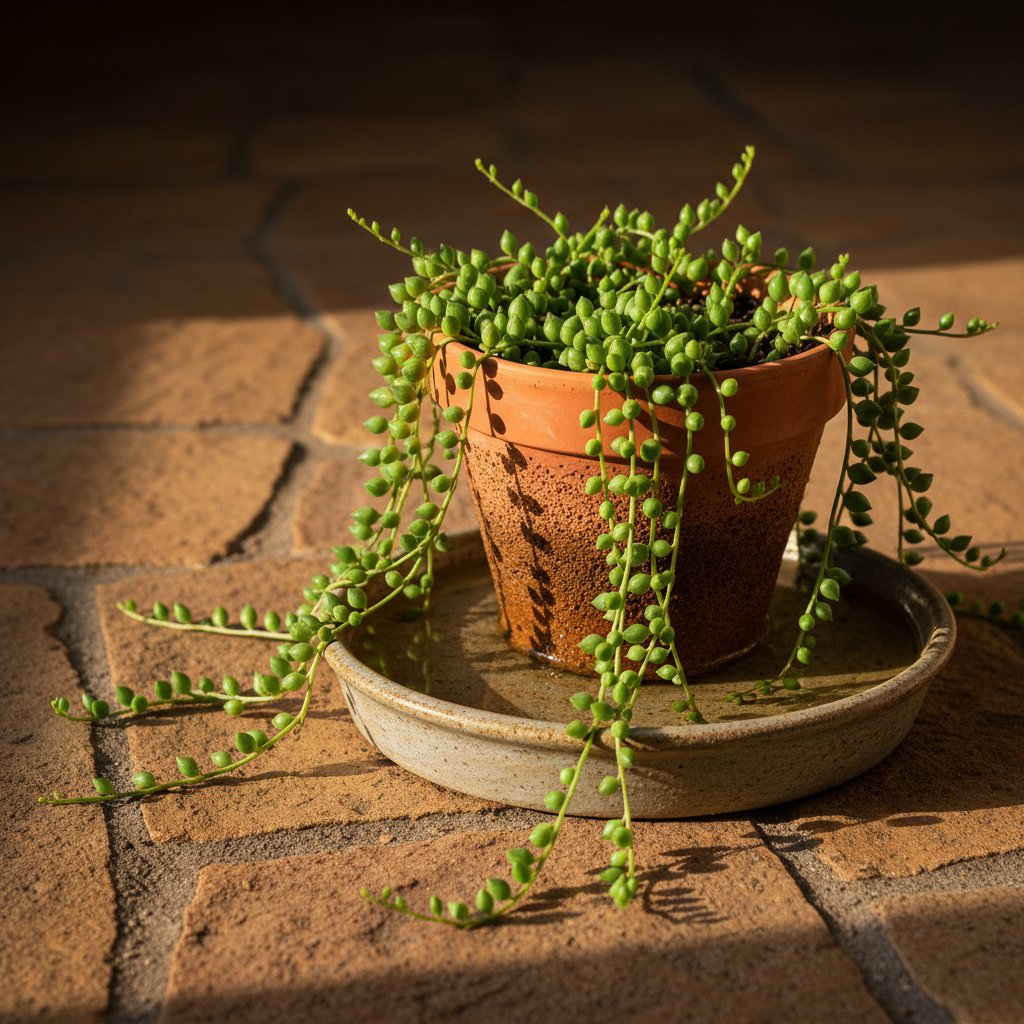
The textbook rule for string of pearls is “soak and dry”: water thoroughly, then let the soil dry out completely before watering again. In practice, the soil should feel bone dry to the touch at least 5 centimetres down before the next drink. In a typical centrally heated home this works out to roughly every 14 to 21 days in spring and summer, stretching to every 4 to 6 weeks in winter when growth slows and evaporation is lower.
The plant itself is a more reliable guide than the calendar. Healthy pearls are plump and firm with a slightly waxy bloom; when they begin to soften and develop a subtle, almost imperceptible flattening on one side, water is due. Wait until the pearls visibly wrinkle and shrink and you have left it too long, although the plant will rehydrate quickly once watered. Better slightly thirsty than slightly soggy — recovery from underwatering is straightforward, recovery from rot is usually a matter of salvaging cuttings.
Pro Tip — The Pearl Squeeze Test: Gently roll a single pearl between your thumb and forefinger. A well-hydrated pearl feels firm and almost grape-like. A pearl that squashes easily with mild pressure or feels papery to the touch signals that watering is overdue.
How to Water Correctly
- Confirm the soil is fully dry by inserting a wooden chopstick or skewer to the bottom of the pot. If it emerges clean and dry, water; if any soil clings to it, wait.
- Take the pot to a sink or bath and water slowly around the soil surface, avoiding the pearls and strands as far as possible. Continue until water runs freely from the drainage holes.
- Let the pot drain for 10 to 15 minutes. Tip it gently at the end to release any residual water trapped against the base.
- Return the plant to its display position only once the base has stopped dripping. A wet base sitting on furniture invites both mineral marks and lingering moisture beneath the pot.
- Do not water the saucer or outer cachepot. Always tip away any standing water within an hour, even if you have used the bottom-watering method.
- Record the date. A simple note on your phone removes the guesswork and helps you spot whether your watering interval is matching the plant’s actual needs across seasons.
Signs of Overwatering vs. Underwatering
| Symptom | Overwatering | Underwatering |
|---|---|---|
| Pearl appearance | Translucent, yellowing, ballooning then collapsing | Wrinkled, shrunken, slightly flattened on one side |
| Pearl texture | Soft and mushy, splits open when pressed | Soft but papery, springs back partially when pressed |
| Stems | Black or mushy at the soil line, may smell sour | Wiry but intact, slightly stiff |
| Soil | Stays wet for many days; surface may grow algae | Bone dry, pulls away from the edge of the pot |
| Roots | Black, slimy, falling apart on touch | Pale, dry, brittle but still attached |
Warning — Root Rot: Once root rot sets in, the plant rarely survives in its existing pot. Take healthy stem cuttings immediately, even just 10 centimetres of green strand each, and propagate them in fresh dry succulent mix. Discard the rotted rootball with its soil rather than reusing the pot without sterilising it.
Humidity Requirements
String of pearls is one of the few popular houseplants that actively dislikes high humidity. It comes from regions where the air is dry for most of the year and where extended damp on the leaf surface invites fungal trouble. Aim for 40 to 50 per cent relative humidity, which matches the ambient conditions of most homes outside of the rainy or heating extremes.
Symptoms of humidity that is too high are subtler than those of overwatering but follow a similar pattern: a fine grey or white powder may appear on the pearls (powdery mildew), or individual pearls develop soft black spots that spread. If you keep tropical plants nearby and run a humidifier for them, place the string of pearls in a separate, drier spot rather than splitting the difference.
If humidity is too low, the symptoms overlap with underwatering — slightly wrinkled pearls and slow growth. A short period below 30 per cent humidity is well tolerated, but extended winter heating with very dry air can be addressed simply by watering a few days sooner than usual. Misting is unhelpful and risks creating wet leaf surfaces that the plant cannot quickly dry.
Water Quality
String of pearls is moderately tolerant of tap water but appreciates softer, lower-mineral water where possible. In hard-water regions, build-up of calcium and magnesium salts in the soil over months can cause leaf-tip browning and a generally peaky look. Rainwater collected from a clean roof, distilled water, or simply tap water left to stand in an open jug for 24 hours all work well. Water temperature should be tepid; very cold water on warm soil can stress the roots.
Soil, Potting and Repotting
The phrase “well-draining” gets used so loosely in plant care that it almost loses meaning, but for string of pearls it has a precise definition. Water poured into the pot should run out the drainage holes within 30 seconds and the visible soil should not glisten with moisture afterwards. Anything that holds water like a sponge — dense peat, coir mixed with finely ground bark, generic indoor compost — will eventually kill this plant.
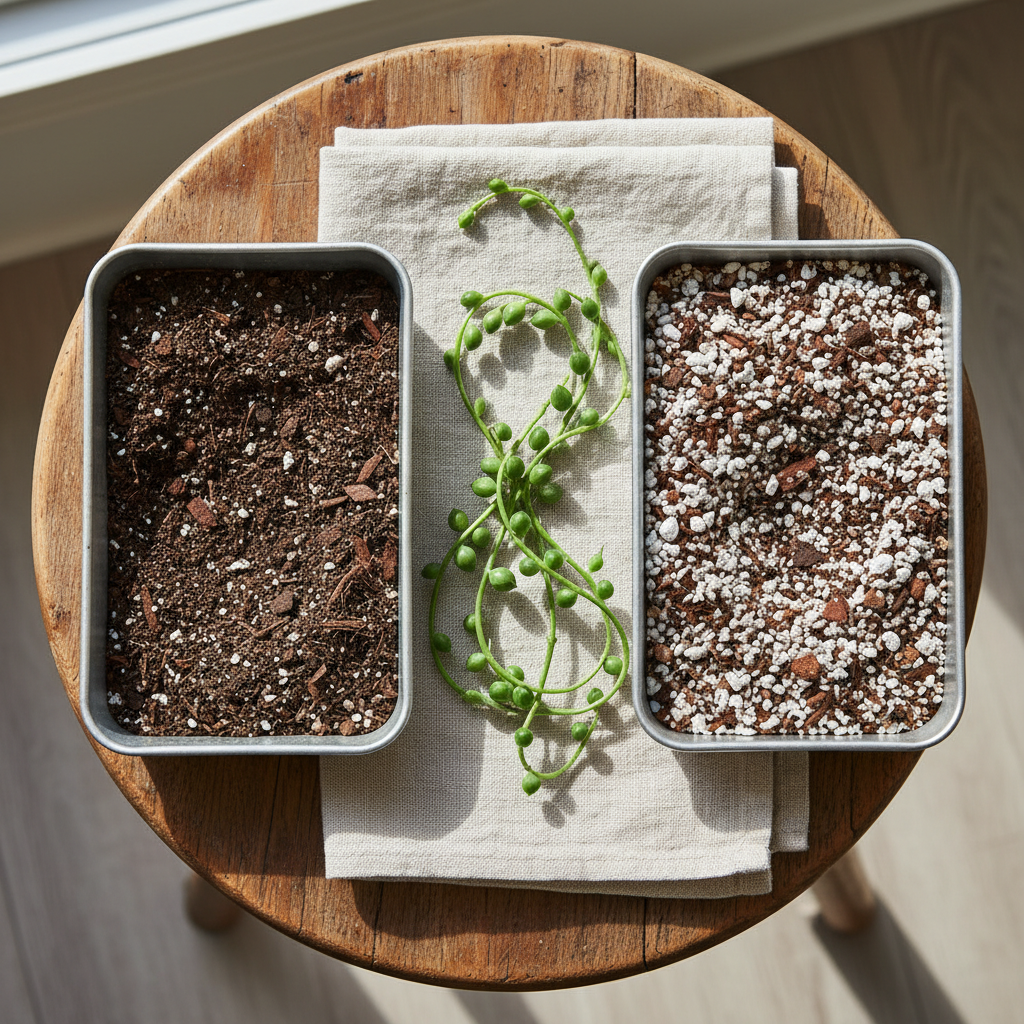
Ideal Soil Composition
A good substrate combines a small amount of moisture-holding organic matter with a large proportion of mineral, sharp-draining aggregate. The aim is to give the roots enough water for a brief drink after each watering, then to dry out completely within a few days. The proportions below produce a mix that meets that standard.
| Component | Proportion | Function |
|---|---|---|
| Cactus and succulent compost | 40 per cent | Base medium providing structure and minor nutrients |
| Pumice or 4 mm perlite | 30 per cent | Coarse aggregate that creates persistent air gaps |
| Horticultural grit or coarse sand | 20 per cent | Adds weight and speeds drainage further |
| Fine orchid bark | 10 per cent | Slow-decaying chunky organic matter for root anchoring |
String of pearls prefers a slightly acidic to neutral pH, somewhere between 6.0 and 7.0. Most commercial cactus mixes fall in this range, and the addition of bark gently nudges the pH down without further intervention. Avoid lime-rich or alkaline mixes intended for Mediterranean herbs.
Pro Tip — Quick Mix Recipe: If you do not want to mix four ingredients, a fast shortcut is to combine equal parts good-quality cactus compost and pumice or coarse perlite, then add a generous handful of fine orchid bark per litre of mix. It is not perfectly balanced but is far better than straight indoor compost.
Choosing the Right Pot
The pot matters almost as much as the soil. String of pearls has a small, shallow rootball compared with the mass of trailing growth above. A deep pot full of damp soil that the roots cannot reach is a recipe for rot. Shallow pots — wider than they are tall — match the natural root architecture, and pots with broad, open drainage holes dry out faster than narrow ones.
Drainage holes are non-negotiable. Decorative cachepots without holes are fine as outer covers, but never plant directly into them. If you fall in love with a closed ceramic, drill a hole or sit the inner growing pot inside it and lift it out to water.
Pot material: Terracotta is excellent for this plant. The porous walls allow moisture to evaporate from the sides as well as the surface, hastening the dry phase that the roots demand. Glazed ceramic and plastic both work, but watering intervals will be longer because the pot retains moisture. Hanging plastic pots are practical and lightweight, which matters once a mature specimen weighs several kilograms.
Pot size: Choose a pot that is barely larger than the rootball, ideally only 2 to 3 centimetres wider in diameter. The visual mass of the plant is in the trailing strands, not in the pot. An oversized container holds too much wet soil around the roots and slows the drying cycle dangerously.
When to Repot
String of pearls does not need frequent repotting. Every two to three years is generally enough, and the right time is spring, just as new growth begins. The clearest signs that repotting is overdue are roots emerging from the drainage holes, soil that has compacted into a hard plug that water beads off rather than soaking into, and a plant that dries out within a few days rather than a couple of weeks. Plants that simply have very long strands but a healthy pot do not need repotting; you can trim the strands instead.
How to Repot: Step-by-Step
- Water the plant lightly two or three days beforehand so the rootball holds together when lifted but is no longer fully damp.
- Prepare the new pot. Add a thin layer of fresh mix to the bottom — only enough so that the rootball will sit at the same height it did in the old pot.
- Gather the trailing strands into a loose coil on top of the soil surface and tip the pot gently. Slide the plant out by supporting the rootball, not by pulling the strands.
- Inspect the roots. Healthy roots are pale, fibrous and slightly elastic; dark, mushy or hollow roots should be trimmed off with sterilised scissors.
- Set the rootball into the new pot and fill the gaps with fresh mix, tapping the pot on the bench to settle the soil rather than packing it down with fingers.
- Do not water for 5 to 7 days. Repotted succulents need time for any small root tears to seal off before being introduced to moisture.
- Return to a bright but slightly less sunny position for the first week, then resume normal placement.
Warning — Transplant Shock: Some pearl drop in the first two weeks after repotting is normal. If half the strand defoliates or stems blacken near the soil, the plant has gone into rot rather than shock. Lift it, take cuttings from the healthy upper portions, and start again.
Fertilising
String of pearls is a notably light feeder. Adapted to nutrient-poor mineral soils in its native range, it grows perfectly well on a fraction of the fertiliser that tropical foliage plants demand. Overfeeding is more dangerous than underfeeding: excess salts in the substrate cause root burn, leaf drop and a sudden decline that looks alarmingly like overwatering.
A reasonable schedule is two to three diluted feeds across the entire growing season, from late spring to early autumn. Do not feed in winter, do not feed within a month of repotting, and do not feed a plant that is otherwise stressed or unwell.
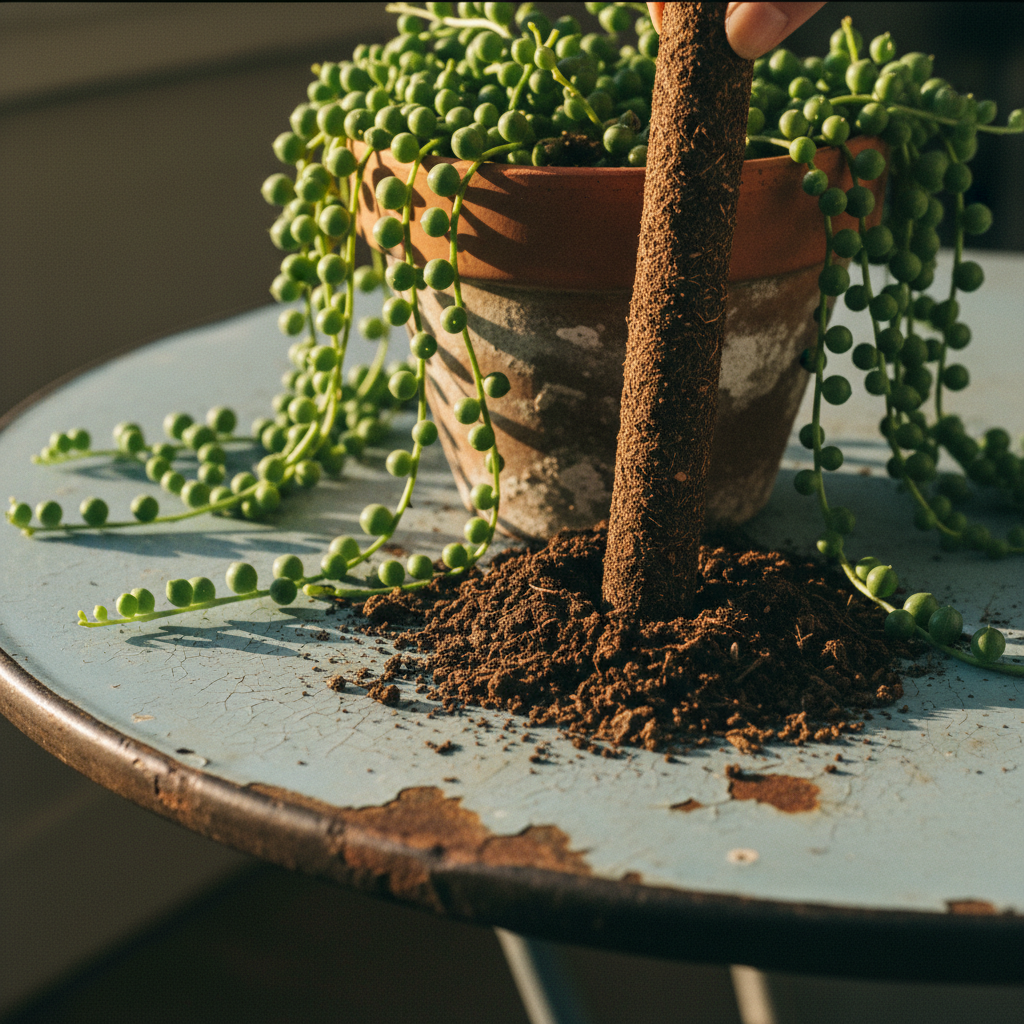
Understanding Plant Nutrients
Plant fertilisers are typically labelled with three numbers, the NPK ratio, representing nitrogen, phosphorus and potassium. For string of pearls a balanced or slightly nitrogen-light formula works best; high-nitrogen feeds produce soft, leggy growth that is more vulnerable to rot. The micronutrients matter more than the headline numbers suggest, and a complete cactus formulation usually includes them.
| Nutrient | Symbol | Primary Function | Deficiency Symptoms |
|---|---|---|---|
| Nitrogen | N | Drives leaf and stem growth, fuels chlorophyll production | Uniformly pale, yellow-green pearls; slow new strand growth |
| Phosphorus | P | Supports root development, energy transfer and flowering | Stunted root growth, reluctance to flower, dull leaf colour |
| Potassium | K | Regulates water balance, strengthens cell walls and disease resistance | Soft, easily damaged pearls; browning leaf tips |
| Calcium | Ca | Builds cell walls and supports root tip growth | Distorted new pearls, weak stems prone to snapping |
| Magnesium | Mg | Core component of chlorophyll molecule | Yellowing between leaf veins on older pearls |
| Iron | Fe | Enzyme co-factor in chlorophyll synthesis | Yellow new pearls with green-veined older pearls |
Types of Fertiliser
Liquid fertilisers: Diluted liquid feeds offer the most control and are easiest to dial down to the modest strength this plant prefers. Choose a balanced or cactus-specific formula and apply at a quarter to half the strength recommended on the bottle, never at full label dose.
Slow-release granular: Coated prills release nutrients gradually over three to six months. They are convenient but harder to dose precisely; use the lowest rate suggested for cacti and succulents and apply only at the start of the growing season.
Organic fertilisers: Worm castings, seaweed extract and diluted compost tea are gentle and forgiving options that release nutrients slowly. They are particularly useful if you tend to forget about feeding entirely, because the risk of overdosing is much lower than with synthetic concentrates.
Feeding Schedule
Begin feeding once active growth has resumed in mid to late spring. A light liquid feed every six to eight weeks through summer is more than adequate. Stop feeding by the start of autumn so that the plant enters its rest period without a flush of fresh, vulnerable growth. Resume only the following spring, even if the plant looks active during a mild winter.
Pro Tip — Half is Plenty: Halve whatever the bottle suggests, then halve it again the first time you feed a new plant. Look for visible growth response over the following few weeks before deciding whether to increase. Most string of pearls collections die overfed, not underfed.
How to Fertilise
- Water the plant with plain water a day before feeding. Dry roots burn far more easily on contact with fertiliser solution.
- Mix the fertiliser at a quarter to half the recommended strength in a clean jug. Use tepid water rather than cold.
- Pour slowly around the soil surface, taking care not to splash the pearls themselves. Drench the soil until a small amount of solution runs from the drainage holes.
- Drain fully, then return the plant to its usual position. Note the date so you can keep a consistent six to eight week rhythm.
- Every third or fourth watering, flush the pot through with plain water only to wash out any salt build-up that has accumulated in the substrate.
Warning — Salt Build-Up: A white crusty deposit on the soil surface or around the rim of the pot is a sign of fertiliser salts accumulating. Flush the pot with three times its volume of plain water and skip the next two scheduled feeds. Chronic salt build-up causes browning at the base of pearls along the strand.
Propagation
Propagation is one of the genuine joys of growing string of pearls. The plant roots readily from stem cuttings, often within a fortnight, and a healthy mother provides material for as many new plants as you can find space to grow. There are two reliable methods: rooting cuttings directly in soil, and rooting them first in water. Both work; the choice is mostly aesthetic.
Whichever route you choose, spring and early summer give the fastest results because the plant is in active growth. Cuttings taken in winter root much more slowly and are more prone to rotting before they take. Always take cuttings from healthy, firm strands; soft, yellowing or wrinkled material rarely succeeds.
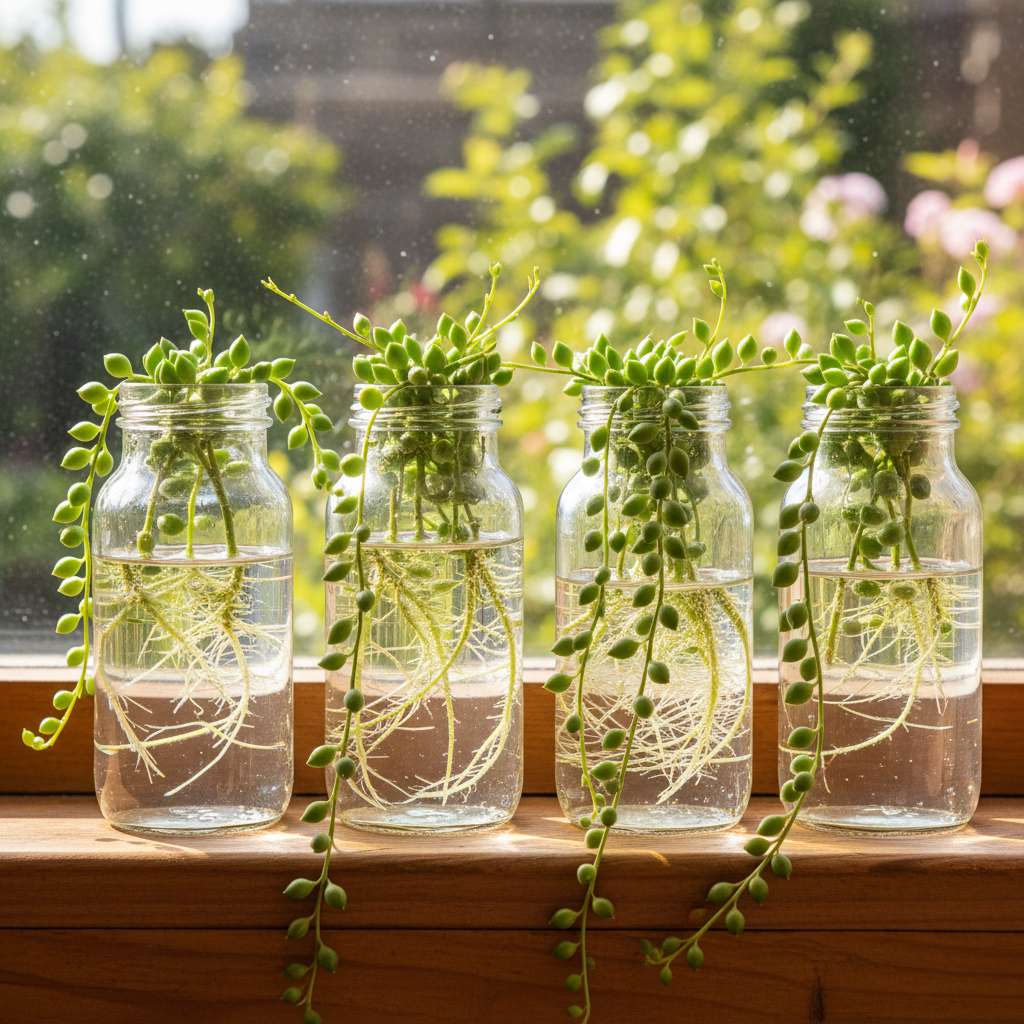
Understanding Nodes
The key structure to identify before taking cuttings is the node. A node is the point on the stem where a pearl is attached; you can see a tiny bump or scar at each point. New roots form from these nodes, so any cutting must include at least three or four. Sections of stem between nodes will not root and simply rot. Once you train your eye to recognise nodes, the rest of the process is essentially foolproof.
Soil Propagation: Step-by-Step
Soil propagation gives the bushiest end result, because you can lay several cuttings flat onto the soil in a single pot and they will all root from the contact points along the strand.
- Cut several healthy strands 10 to 15 centimetres long with clean, sterilised scissors. Cut just below a node at the bottom of each strand.
- Strip the pearls off the bottom two or three nodes of each cutting so that bare nodes will sit in contact with the soil.
- Lay the cuttings flat on the surface of slightly damp succulent mix in a shallow pot. The bare nodes should rest gently on the soil; do not bury them.
- Place a few pebbles or paper clips along the strands if needed to keep the nodes in contact with the soil while roots form.
- Set the pot in bright indirect light and mist the soil surface very lightly every three or four days. Do not soak.
- After two to three weeks, gently tug a strand. Resistance means roots have formed. From this point, water normally and let the soil dry out fully between waterings.
Pro Tip — Layer for Density: Lay five or six cuttings in a circular pattern across the soil surface in a single pot. Once rooted, the multiple strands grow simultaneously and produce a much fuller, faster display than a single cutting ever could.
Water Propagation: Step-by-Step
Water propagation is more visual — watching the roots emerge through clear glass is genuinely satisfying — and is reliable if the cuttings are not submerged too deeply.
- Take cuttings of 10 to 15 centimetres as before, stripping the bottom two or three nodes of their pearls.
- Fill a clean glass jar with room-temperature water and rest the cuttings over the rim so only the bare nodes sit in the water. The pearls themselves must stay dry.
- Change the water every five to seven days to prevent stagnation. A faint cloudy tint is fine; a sulphurous smell means the water needs replacing immediately.
- Roots typically appear within 10 to 14 days. Wait until they are at least 2 centimetres long before potting on.
- Move the rooted cuttings into a small pot of dry succulent mix, water lightly once, then resume the normal soak-and-dry routine.
- Expect a brief settling-in period of one to two weeks where the cuttings adjust from water roots to soil roots before resuming visible growth.
Troubleshooting Propagation
| Problem | Likely Cause | Solution |
|---|---|---|
| Cuttings blackening at the cut end | Cut surface not callused before contact with damp soil or water | Allow fresh cuttings to dry on a paper towel for 24 hours before placing |
| Pearls dropping from cuttings | Too much water or buried nodes | Strip the bottom nodes and place the strand on top of the soil, not buried |
| No roots after a month | Cool ambient temperature or low light | Move propagation tray to a warmer, brighter spot — at least 20 degrees Celsius |
| Mould on the soil surface | Soil too wet and air too still | Reduce misting frequency, improve airflow, replace the top layer of soil |
Pests and Diseases
String of pearls is not unusually pest-prone, but its dense beaded strands offer plenty of crevices where small insects can hide. The architecture of the plant means that any pest infestation goes undetected longer than on a broad-leaved plant, so weekly visual checks pay dividends. Run your eye along several strands and lift the canopy to inspect the stems near the soil line and the underside of the cascade.
Most problems are environmental rather than biological. Yellowing, dropping pearls or blackening stems point first to watering and light issues; outright pests are the second suspect, not the first. That said, three or four pests appear with enough regularity to be worth knowing on sight.
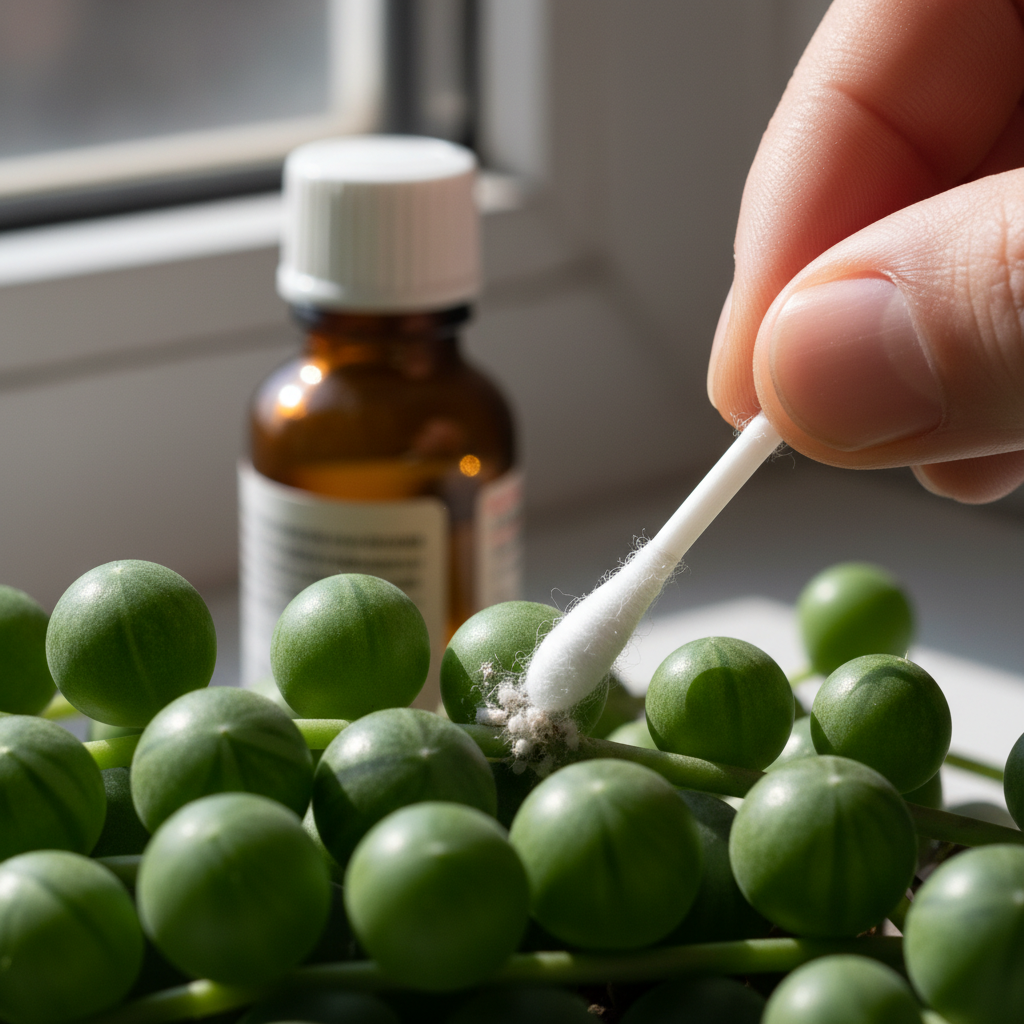
Common Pests
Mealybugs (Pseudococcus longispinus)
The most frequent pest of string of pearls by some distance. Mealybugs look like tiny tufts of white cotton wool tucked into the nodes between pearls and along the stem. They suck sap, produce sticky honeydew, and breed prolifically in the warm, dry conditions the plant favours.
Treatment: Dab each visible mealybug with a cotton bud dipped in 70 per cent isopropyl alcohol; the alcohol dissolves the protective waxy coating and kills the insect on contact. Inspect every few days for at least three weeks and re-treat any new arrivals. Heavy infestations may need a systemic insecticide drench, but spot-treatment usually wins.
Aphids (Aphis gossypii)
Less common than mealybugs but occasionally appearing on newer, softer growth tips. Aphids are small, pear-shaped insects in green, black or pink, clustering thickly on the youngest pearls. They also produce honeydew and weaken the plant by feeding on sap.
Treatment: Rinse the affected strands under a gentle tap, then spray with a dilute insecticidal soap. Repeat every five to seven days for three cycles. Encourage natural predators outdoors during summer if you move the plant out for the season.
Spider Mites (Tetranychus urticae)
Spider mites thrive in hot, dry indoor conditions and can move from neighbouring plants. They are too small to see clearly without a magnifier, but their signs are obvious: fine pale stippling on the pearls, faint webbing between strands, and a dusty appearance.
Treatment: Wipe the strands carefully with a damp cloth, then apply a neem oil or insecticidal soap spray, covering the undersides of the pearls. Repeat every five days for at least two weeks to break the lifecycle, since mites hatch from eggs that no contact spray can reach.
Scale Insects (Coccus hesperidum)
Soft brown or tan oval bumps stuck to stems and the larger pearls. Adult scale do not move and look more like a feature of the plant than an insect at first glance. They feed on sap and produce honeydew.
Treatment: Scrape off visible adults with a wooden cocktail stick, then treat with horticultural oil to suffocate the mobile crawler stage. Persistence matters; repeat every week for at least a month.
Common Diseases
Root Rot (Pythium and Rhizoctonia spp.)
By far the most damaging disease of string of pearls, caused almost exclusively by chronically wet soil and worsened by poor drainage. Symptoms include collapsing yellow pearls, blackening at the stem base, and a sour smell from the soil. By the time the strands look obviously sick, the rootball is usually beyond saving.
Treatment: Cut healthy stem material from above the affected area, treat as fresh cuttings, and discard the rotten rootball. Prevention through correct watering and gritty soil is the only reliable defence; once rot is visible, the original rootball will almost never recover.
Powdery Mildew (Erysiphe spp.)
A fungal disease that appears as a fine, dusty white coating on stems and pearls. Powdery mildew tends to develop in still, humid air with poor ventilation, particularly if the plant has been recently misted or splashed.
Treatment: Improve airflow immediately and stop overhead watering or misting. Spray with a 1:10 milk-to-water solution, or a proprietary fungicide for mildew, every five days until the white coating disappears.
Pest and Disease Summary
| Pest / Disease | Identification | Treatment |
|---|---|---|
| Mealybugs | White cottony tufts in nodes and along stems | Cotton bud with 70 per cent isopropyl alcohol |
| Aphids | Small green or black clusters on new growth | Rinse, then insecticidal soap every 5 to 7 days |
| Spider mites | Pale stippling, fine webs between strands | Damp cloth wipe, neem oil every 5 days for two weeks |
| Scale insects | Brown bumps stuck to stems | Scrape off, follow with horticultural oil weekly |
| Root rot | Collapsing yellow pearls, sour-smelling soil | Take cuttings; discard rotten rootball and soil |
| Powdery mildew | White dusty coating on pearls and stems | Improve airflow, dilute milk spray or fungicide |
Prevention Strategies
Most pest problems on string of pearls are imported, not generated in place. New plants, second-hand pots and cuttings from other collections are the usual entry routes. Quarantine new arrivals for three weeks in a separate room, inspect them weekly during that period, and only integrate them with the rest of your collection once they are clearly clean.
Beyond quarantine, prevention is a matter of conditions. A plant grown in good light with appropriate watering and clean foliage rarely succumbs. Wipe down the pot rim and saucer monthly, remove any fallen pearls promptly because they decompose and attract fungus gnats, and avoid crowding the plant against other susceptible species.
Pro Tip — Quarterly Neem Drench: Once every three months, water the plant with a dilute neem oil solution (5 millilitres per litre) and let it run through the soil. Neem acts as both a mild systemic insecticide and a soil drench against fungus gnat larvae, and is well tolerated by succulents at this strength.
Popular Varieties
The plant trade lumps several distinct species under the broad label “string of pearls” or “string of beads”. In strict botanical terms only Curio rowleyanus is the true string of pearls, but the closely related Curio herreanus and Curio radicans are often sold under the same common name with only a slight modifier. The varieties below cover both the true cultivars of C. rowleyanus and the most commonly confused sibling species.
Choosing a variety is largely an aesthetic decision. All of them share the same basic care requirements: bright indirect light, sharp drainage, and infrequent thorough watering. The variegated cultivars are slower growing and slightly more demanding of light to maintain their coloration, but otherwise no harder to keep alive than the plain green form.
| Variety | Leaf Appearance | Light Needs | Growth Rate | Availability |
|---|---|---|---|---|
| String of Pearls (species) | Round green pearls, 6 mm, with translucent stripe | Bright indirect, some direct sun | Moderate | Very common |
| Variegated String of Pearls | Pearls splashed cream, white, sometimes pink | Bright indirect, more light to keep colour | Slow | Uncommon, sought after |
| String of Tears (Curio herreanus) | Elongated tear-drop or lemon-shaped leaves | Bright indirect, similar to pearls | Moderate | Common |
| String of Bananas (Curio radicans) | Banana-curved fleshy leaves, slightly larger | Bright indirect to direct, tougher | Fast | Common |
| String of Watermelons (Curio herreanus form) | Larger striped leaves with watermelon-like markings | Bright indirect | Moderate | Less common |
| Curio articulatus (Candle Plant) | Sausage-like jointed stems, not a true trailer | Bright indirect to direct | Slow | Specialist |
Featured Varieties
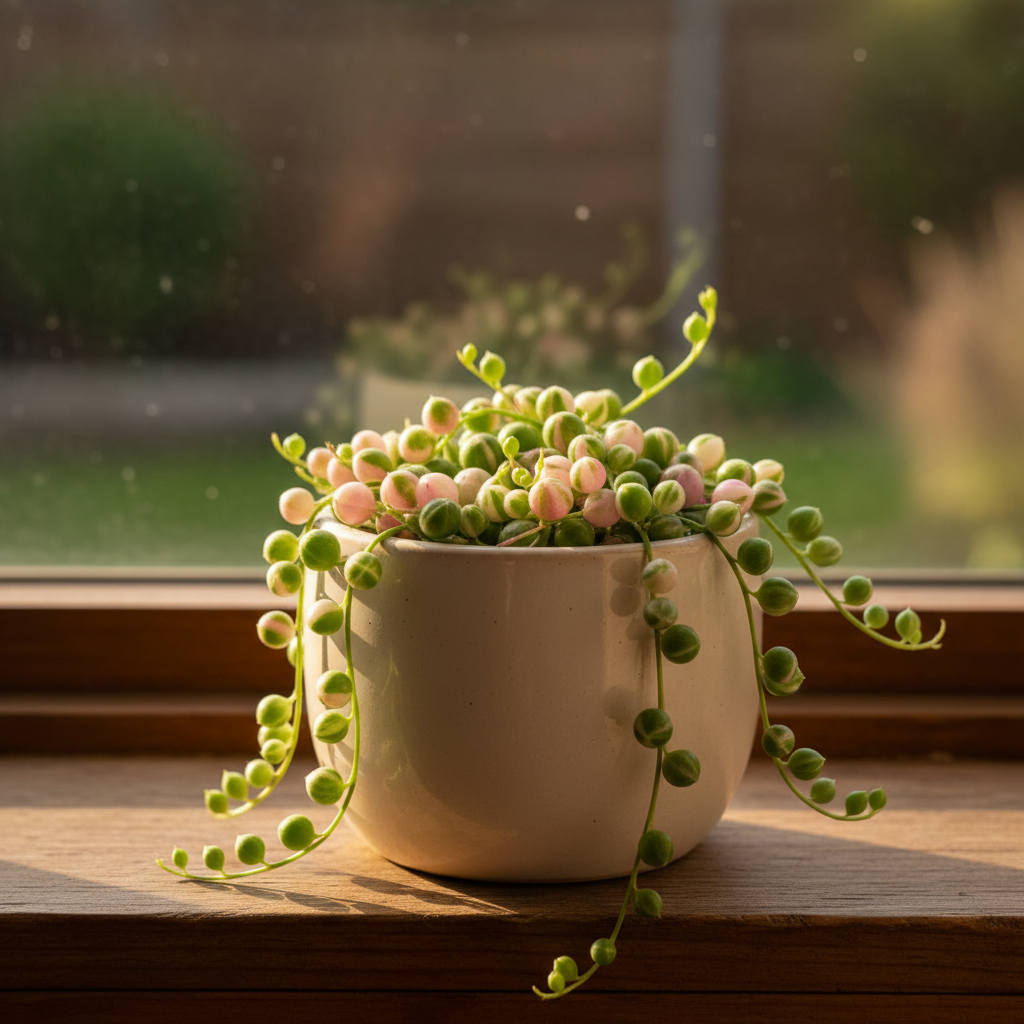
Variegated String of Pearls
The variegated form of Curio rowleyanus is one of the prize sports of the species, carrying creamy white and occasionally pink streaks across some of its pearls. Variegation patterns are unstable, meaning a single strand may carry pure green, fully cream and fully variegated pearls in quick succession. Bright filtered light keeps the variegation vivid; in dimmer conditions the plant tends to revert to green.
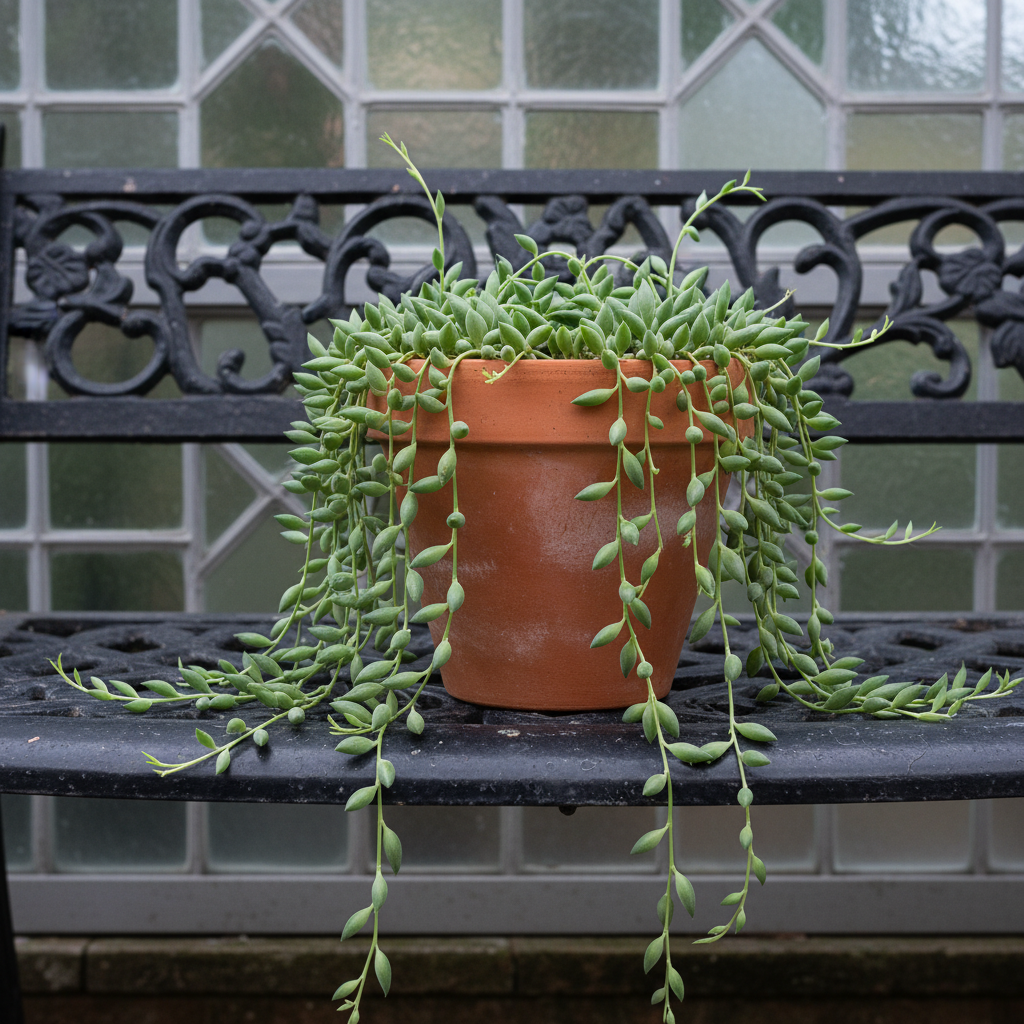
String of Tears (Curio herreanus)
Often confused with the true string of pearls, Curio herreanus carries elongated, tear-shaped leaves rather than perfect spheres. The leaves are slightly pointed at the tip and bear a more pronounced translucent stripe. Some forms are sold as “string of watermelons” for the subtle striping along the leaf. Care is functionally identical to C. rowleyanus, although the plant grows a little more vigorously and tolerates slightly brighter direct sun.
Variety Profiles in Detail
Variegated String of Pearls (Curio rowleyanus ‘Variegata’)
The variegated cultivar is highly sought after and consequently expensive. Its slower growth and tendency to revert mean that established mature plants are uncommon. Take cuttings only from strands that carry obvious variegation, since green-only stems will produce green-only offspring. Increased light brings out the pink tones; cooler temperatures intensify them further.
String of Tears (Curio herreanus)
A close relative routinely mislabelled in shops as string of pearls. The tear-shaped leaves are 12 to 15 millimetres long and slightly pointed, giving a softer, more elongated visual texture than the precise spheres of true string of pearls. The plant is slightly hardier and more vigorous, and often flowers more readily indoors. Care is identical.
String of Bananas (Curio radicans)
The toughest member of the trio. The leaves are noticeably banana-shaped and slightly larger, with a glossy, almost waxy surface. Curio radicans grows faster than either string of pearls or string of tears, tolerates more direct sun, and is the most forgiving of the three for beginners. Flowers are similar — small white tufts with a faint cinnamon scent.
String of Watermelons (Curio herreanus form)
A trade name for selected forms of Curio herreanus with larger, more striped leaves. The dark vertical stripes recall a watermelon rind, hence the common name. Less widely available than the standard tears form and slightly more cold-sensitive, but visually striking on a brightly lit shelf.
Choosing the Right Variety for Your Space
If your home offers bright but filtered light and you do not mind the slightly higher price, the variegated form makes an exceptional feature plant in a single ceramic pot. For a more robust display with less fuss, the standard species or string of bananas both produce dense, fast-growing trails in less ideal conditions. For a more unusual look, string of tears or string of watermelons offer the same general aesthetic with elongated leaves that catch the light differently. All four happily share a shelf, since their care requirements overlap almost completely.
Frequently Asked Questions
Why are my pearls shrivelling?
Shrivelled, slightly flattened pearls are almost always a sign of underwatering. The pearls are water reservoirs and will plump back up within a day or two of a thorough soak. If watering does not restore them, check the roots: extensive damage from previous overwatering can prevent the plant from drawing water back into the leaves even when soil moisture is plentiful.
Why are pearls falling off in large numbers?
Sudden, heavy pearl drop usually points to overwatering or the early stages of root rot, especially if the dropped pearls feel soft and translucent. Less commonly, a sharp temperature change, repotting shock, or a sudden move from low to high light will trigger drop. Investigate the soil and roots before doing anything else.
Do string of pearls bloom indoors?
Yes, given enough light. Mature plants produce small white, tufted flowers in late autumn and winter that smell of cinnamon and vanilla. A noticeable scent across the room is the usual giveaway. Lack of bloom is almost always a light problem; the plant simply does not have the energy reserves to flower in dim conditions.
Can I grow string of pearls in a closed terrarium?
No. Closed terrariums create the high-humidity, persistently damp conditions that string of pearls cannot tolerate. Even an open terrarium is risky unless airflow is strong and watering is sparing. The plant is better suited to a hanging pot or an open shelf where the air is dry and movement is constant.
How long do string of pearls live?
With good care, a string of pearls plant can live for five years or longer, though most home specimens decline after three to four years as the original strands age and individual stems lose vigour. Refreshing the plant with new cuttings rooted into the same pot every year or two keeps the display dense and effectively immortal.
Is string of pearls safe around pets?
No. The plant is toxic to cats, dogs and humans if ingested. The sap can also cause skin irritation. The trailing strands are particularly attractive to curious pets, so place the plant well out of reach. If a pet has chewed on the plant, contact a veterinarian; common symptoms include drooling, vomiting and diarrhoea.
Can I take string of pearls outdoors in summer?
Yes, in a sheltered, partly shaded spot with no direct midday sun. Outdoor conditions of bright filtered light and good airflow often produce the densest growth of the year. Acclimate over a fortnight by gradually increasing outdoor time. Bring the plant back indoors before night temperatures drop below 12 degrees Celsius (54 degrees Fahrenheit).
My pearls look pale and stretched — what is wrong?
Pale, stretched strands with widely spaced pearls are classic etiolation — the plant reaching for more light. The growth pattern itself cannot be reversed, but new growth will be tight and dark again once light levels improve. Trim the leggy sections back, root the cuttings, and place the resulting denser plant in a brighter position.
How often should I rotate the pot?
About once a week, by a quarter turn. Even with the most generous window, the side of the plant facing the light grows faster than the back, producing a one-sided look over time. Regular rotation keeps the strands evenly distributed and prevents the plant from leaning into the window.
Can I plant string of pearls together with other succulents?
Yes, provided the companions share its preference for sharp drainage and infrequent watering. Echeverias, sedums, kalanchoes and other trailing senecios all coexist happily. Avoid pairing with anything that prefers consistently moist soil — tropical foliage plants and succulents do not blend well in the same container.






