
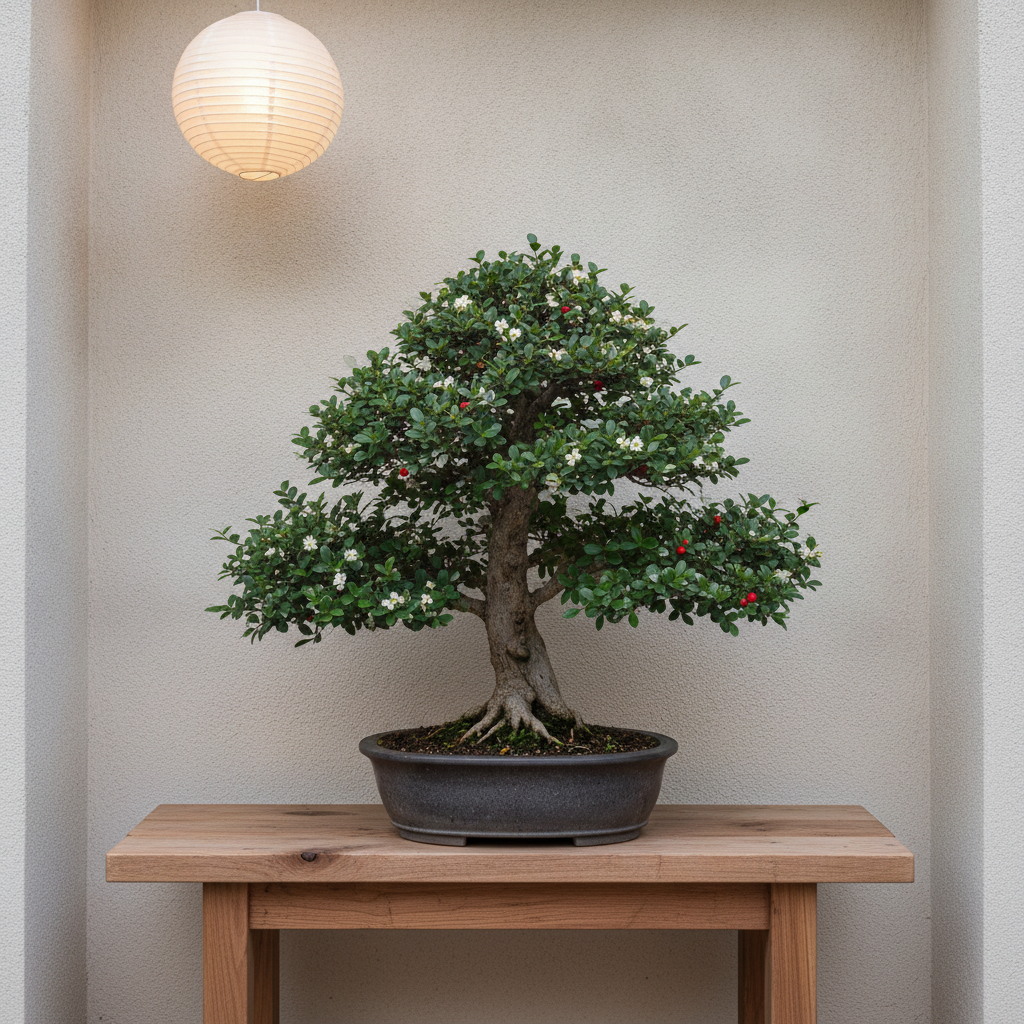
Few indoor trees pack as much detail into so small a canopy as the Fukien tea bonsai. Its leaves are barely the size of a fingernail, glossy and dark, dotted with fine pale flecks that give them a faint sandpaper feel, and among them appear tiny white flowers and, if the plant is happy, little berries that ripen from green to red. Botanically it is Ehretia microphylla, though most nurseries still sell it under its older name Carmona retusa or Carmona microphylla. It has been grown as bonsai in southern China for centuries, and its common name points straight to Fujian (Fukien) province, its traditional heartland.
This guide covers everything needed to keep one alive and, with a little patience, thriving: how much light it wants, how to read its fussy relationship with water, what soil suits it, when to feed, how to propagate it, and which pests tend to find it. The Fukien tea has a reputation as a tree that punishes neglect and rewards consistency, so understanding the difference between merely surviving and genuinely thriving matters more here than with almost any other beginner bonsai.
Quick Reference
| Botanical name | Ehretia microphylla (syn. Carmona retusa, Carmona microphylla) |
| Common names | Fukien tea, Fujian tea, Philippine tea tree, Carmona bonsai |
| Family | Boraginaceae |
| Origin | Southern China, Taiwan, Southeast Asia, northern Australia |
| Light | Bright light, including some direct sun; the brightest spot indoors |
| Watering | Keep evenly moist; never fully dry, never waterlogged |
| Soil | Free-draining, slightly acidic bonsai mix (akadama, pumice, bark) |
| Temperature | 18 to 26 degrees Celsius (64 to 79 Fahrenheit); keep above 12 degrees Celsius (54 Fahrenheit) |
| Humidity | Moderate to high; 50 per cent or more preferred |
| Feeding | Balanced feed every two to four weeks in growth |
| Propagation | Semi-hardwood cuttings, air layering, occasionally seed |
| Mature size (as bonsai) | Typically 15 to 50 centimetres (6 to 20 inches) tall |
| Toxicity | Not for consumption; keep away from pets and children |
| Difficulty | Intermediate; unforgiving of inconsistent watering and cold |
Why Grow a Fukien Tea as a Houseplant Bonsai
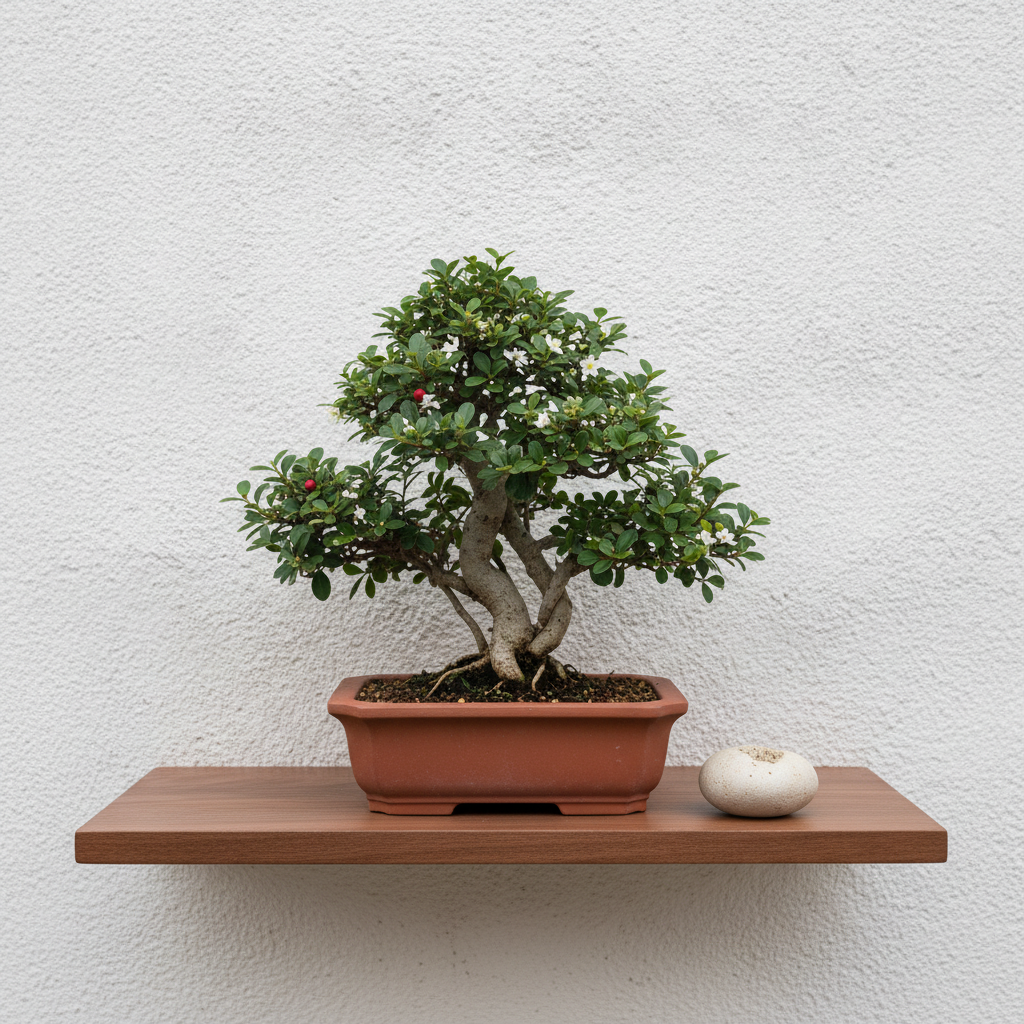
The appeal of the Fukien tea begins with scale. Its naturally tiny leaves mean that even a small specimen reads convincingly as a full-grown tree, which is precisely the illusion bonsai sets out to create. Larger-leaved species have to be grown into sizeable trees before the proportions look right, but a Fukien tea can achieve a mature, tree-like silhouette in a pot no bigger than a teacup. This makes it a favourite for shohin and mame bonsai, the smallest size classes, where every leaf counts.
Beyond the foliage, it offers something most indoor bonsai cannot: flowers and fruit almost year round. In good conditions the tree produces small, five-petalled white blooms scattered across the canopy, followed by berries that shift from green through to a coral red. The bark, meanwhile, develops a pale grey, gently fissured character with age, and the trunk thickens and gnarls in a way that suggests far greater age than the tree actually holds. Old specimens are sometimes styled with dramatic deadwood features, playing that aged bark against the fine green cloud of leaves above.
It is worth being honest about the trade-off. The Fukien tea is often sold as a beginner tree because it is cheap, widely available, and forgiving of hard pruning, but it is genuinely fussier than the hardy junipers or ficus that share the same shelves. It dislikes sudden change, resents cold draughts, and will drop leaves at the first sign of an inconsistent watering routine. Growers who enjoy paying close, regular attention tend to love it; those hoping for a tree they can ignore for a fortnight usually do not. Understanding that temperament up front is the single biggest factor in success.
Light
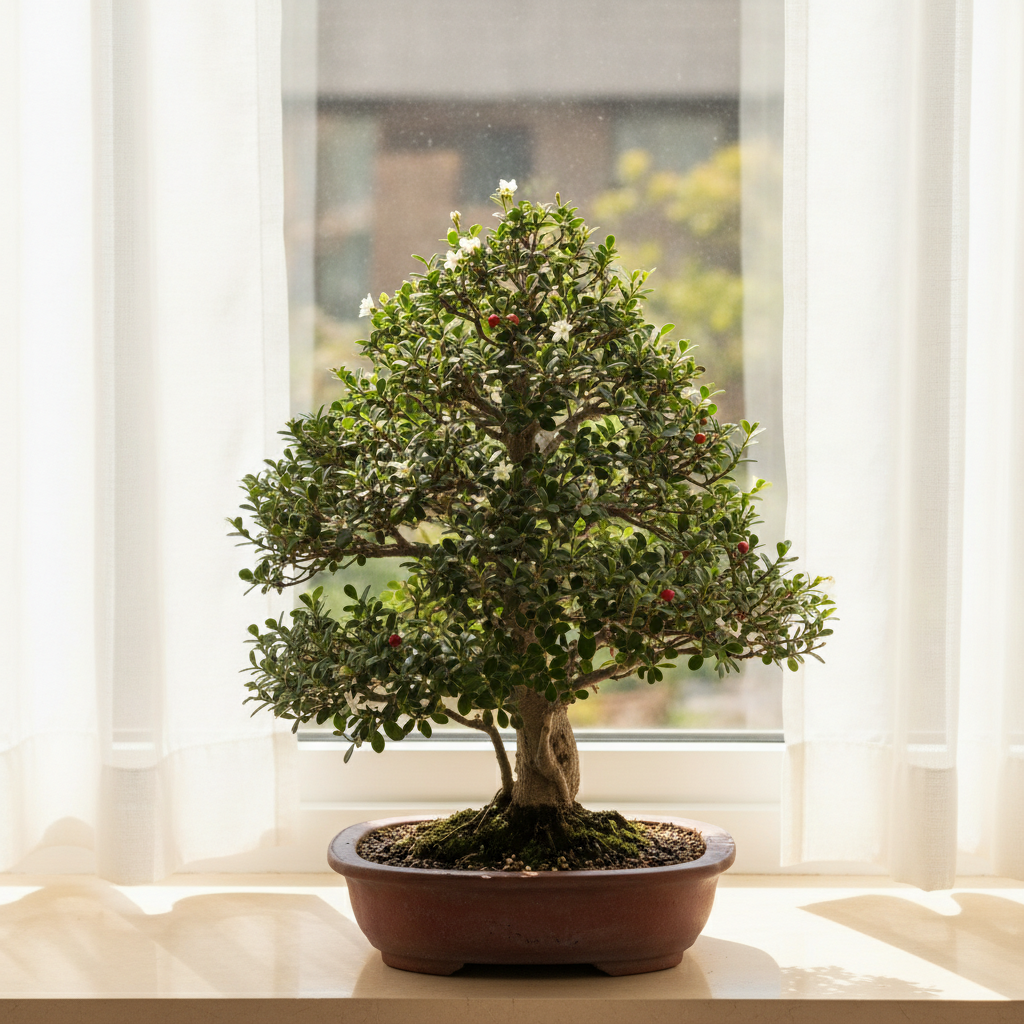
Light is where survival and thriving diverge most sharply. A Fukien tea can hold on for months in mediocre light, but it will not flower, its internodes will stretch, and its leaves will thin and pale as the canopy hunts for brightness. To thrive, it wants the brightest position the home can offer. A south-facing or west-facing window is ideal, and the tree will happily take some direct sun, particularly the gentler light of morning and late afternoon. In the strongest midday summer sun behind glass, a sheer curtain prevents the fine leaves from scorching, but short of that the general rule is that more light produces a denser, more compact, more floriferous tree.
Because this is a tropical evergreen rather than a temperate species, it does not need or want a cold winter dormancy, which means it keeps growing through the darker months and keeps demanding light through them too. Winter is when most indoor Fukien teas decline, simply because the light that was adequate in July becomes inadequate in December. Moving the tree to the very brightest available windowsill for winter, or supplementing with a full-spectrum LED grow light for ten to twelve hours a day, keeps growth steady and prevents the thin, leggy shoots that weak winter light produces.
Pro Tip — Rotate for symmetry: The Fukien tea grows noticeably towards its light source. Give the pot a quarter turn every few days so that the canopy fills out evenly on all sides rather than leaning permanently towards the window.
If the tree summers outdoors, which it appreciates once night temperatures are reliably above 15 degrees Celsius (59 Fahrenheit), acclimatise it gradually. Move it first to a shaded, sheltered spot for a week or two before easing it into brighter exposure, as leaves that developed indoors will burn if thrown straight into full outdoor sun.
Watering
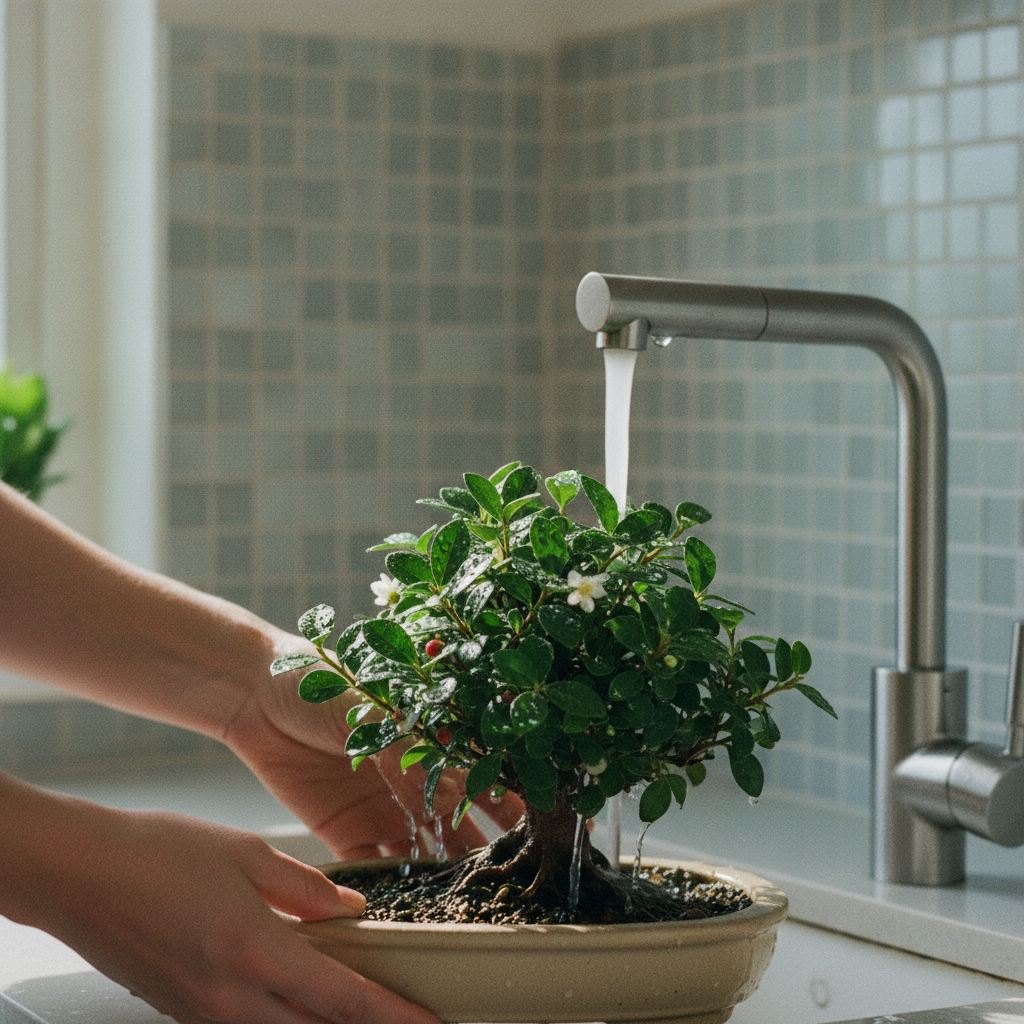
Watering is the skill that decides whether a Fukien tea lives or dies, and it is genuinely a balancing act rather than a routine. The tree wants its soil to stay evenly moist, never drying out completely and never sitting waterlogged. Both extremes provoke the same panicked response, a sudden shedding of leaves, which is why so many new owners find their tree defoliating and cannot tell whether they have watered too much or too little. The answer lies in checking the soil rather than the calendar.
The reliable method is to feel the surface of the soil daily. When the top few millimetres have just begun to dry but the mix below is still slightly damp, water thoroughly, letting water run freely from the drainage holes so the entire root ball is soaked. Then wait and check again. In a warm, bright summer position this may mean watering every day; in cooler, dimmer winter conditions it may stretch to every few days. Never let the pot dry out to the point where the soil pulls away from the sides, and never leave the pot standing in a saucer of water, as constantly soggy roots quickly rot in the shallow volume of a bonsai container.
Warning — Sudden leaf drop: A Fukien tea that abruptly loses leaves is almost always reacting to a watering swing, a cold draught, or a sudden move. Resist the urge to respond by watering more; check the soil first. Overwatering a stressed tree is the fastest way to lose it.
Water quality matters more for this species than for many. Fukien teas prefer slightly acidic conditions and can react badly to hard, heavily chlorinated tap water over time, showing leaf yellowing and general sulking. Where tap water is very hard, using filtered water, or rainwater collected outdoors, keeps the tree healthier. Room-temperature water is always kinder than cold water straight from the tap, which can shock tropical roots.
Humidity works alongside watering. As a tropical species the Fukien tea appreciates moisture in the air, and the dry atmosphere of a centrally heated room in winter is one of its most common stressors. Standing the pot on a humidity tray of damp gravel, grouping it with other plants, or running a small humidifier nearby all help to keep the fine leaves from crisping at the edges.
Soil and Repotting
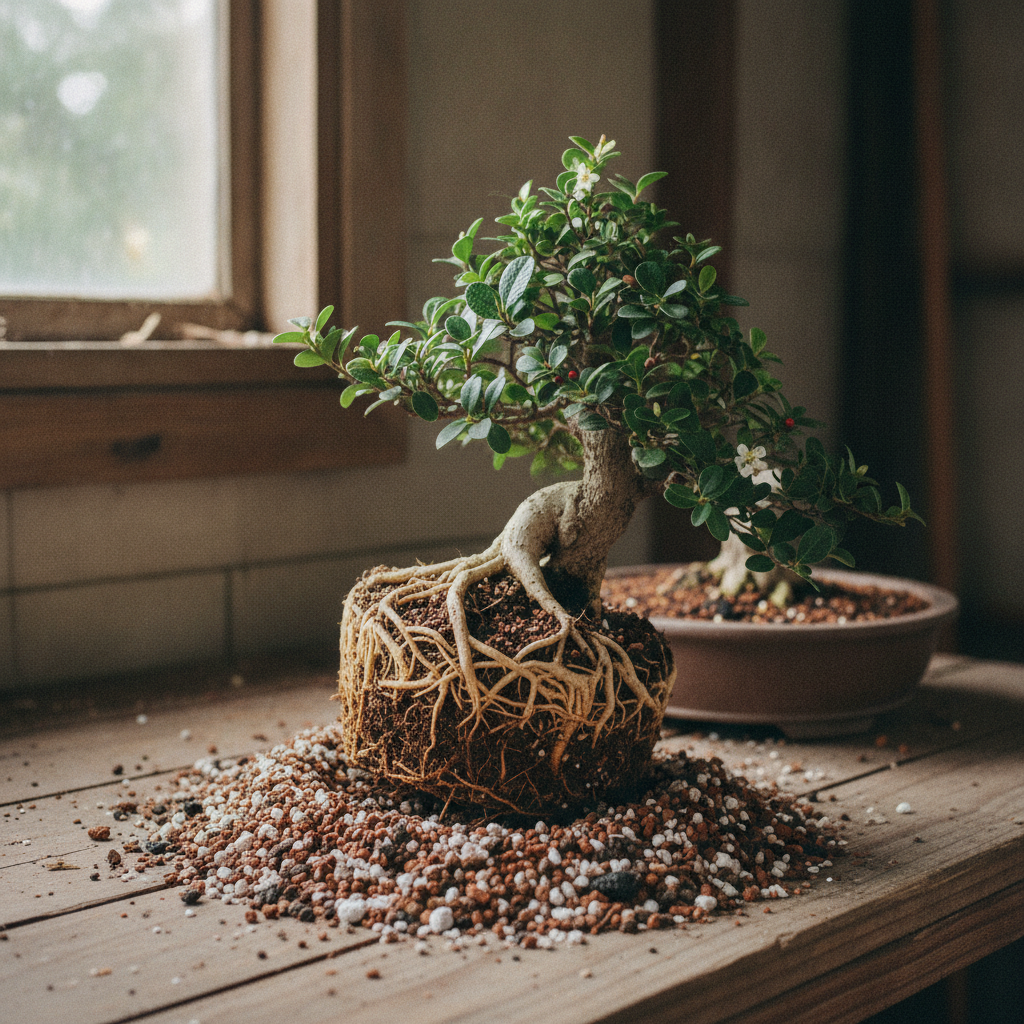
The right soil solves half of the watering problem before it starts. Because the Fukien tea wants consistent moisture without ever being waterlogged, it needs a mix that holds water yet drains and breathes freely. A classic bonsai substrate of akadama, pumice and fine bark or lava rock, in roughly equal parts, achieves exactly this: the akadama retains moisture and shows at a glance when it is drying, while the pumice and bark keep the mix open and full of air. A slightly acidic to neutral pH suits the species best. Ordinary bagged houseplant compost, by contrast, compacts and stays sodden in a shallow bonsai pot and is a common cause of root rot.
Repotting is best done in spring, as the tree moves into its strongest growth, though because it lacks a true dormancy a healthy Fukien tea can be repotted through the warmer months if handled gently. Young, vigorous trees generally need repotting every two years; older, more established specimens can go three or more years between repots. The signs that a repot is due are roots circling the base of the pot or emerging from the drainage holes, and water that suddenly runs straight through without soaking in.
The Fukien tea is more sensitive to root disturbance than tougher bonsai species, so a conservative approach pays off. When repotting, follow these steps:
- Ease the tree out of its pot and gently tease away the outer layer of old soil, working from the edges inward.
- Trim no more than about a third of the root mass, removing the thickest circling roots and any that are dark, soft or rotten.
- Position the tree in a clean pot over a layer of fresh, free-draining mix, spreading the roots outward.
- Work new substrate in around and between the roots with a chopstick to eliminate air pockets.
- Water thoroughly and settle the tree in a warm, bright but not scorching spot, keeping it slightly sheltered for two to three weeks while it recovers.
Hold off on feeding for three to four weeks after repotting, until fresh white root tips show the tree has re-established, as fertiliser on freshly cut roots does more harm than good.
Fertilising
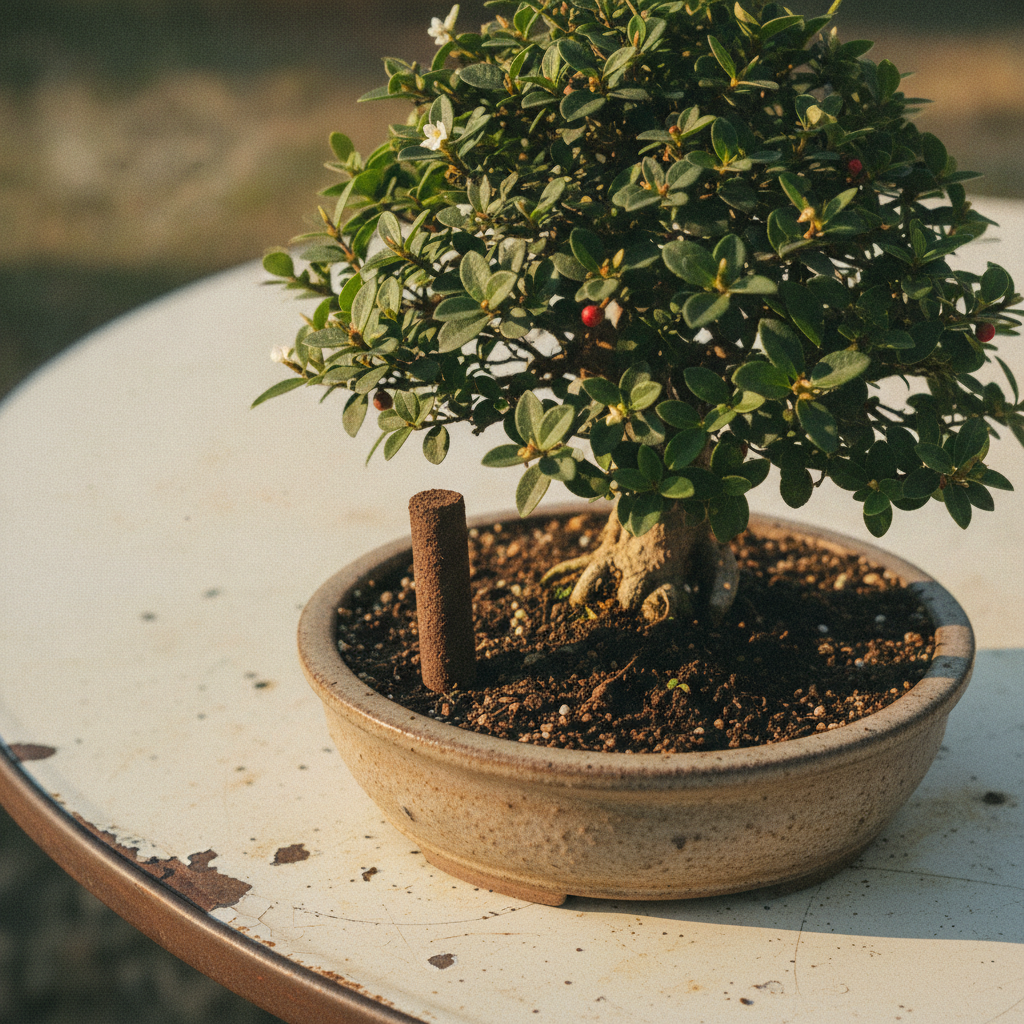
Because the Fukien tea grows more or less continuously rather than shutting down for winter, its feeding schedule is steadier than that of temperate bonsai. Through the main growing season, from spring into early autumn, a balanced fertiliser applied every two to four weeks keeps the canopy dense and supports the flowers and berries. A balanced formulation with roughly equal nitrogen, phosphorus and potassium suits general growth, and many growers rotate in a feed slightly higher in phosphorus and potassium during periods of flowering to support blooms and fruit.
The form of fertiliser is a matter of preference. Diluted liquid feed added to the watering can offers the most control and is easy to flush out if overdone. Slow-release organic pellets or fertiliser sticks pushed into the soil surface feed gently over several weeks and suit growers who prefer not to measure every week. Whichever route is chosen, the cardinal rule is to feed only a moist root ball, never a dry one, as fertiliser applied to dry roots can scorch them. Diluting liquid feed to half the recommended strength is a sensible safeguard against overfeeding this relatively small root system.
In the depths of winter, growth slows even for this evergreen, and feeding can be reduced to roughly monthly or paused entirely if the tree is clearly resting in low light. If the tree is kept actively growing under a grow light through winter, though, it will continue to use a light, regular feed. Yellowing older leaves during the growing season often signal that the tree is hungry or that its slightly acidic preference is not being met, and a gentle feed combined with softer water usually restores good colour.
Propagation
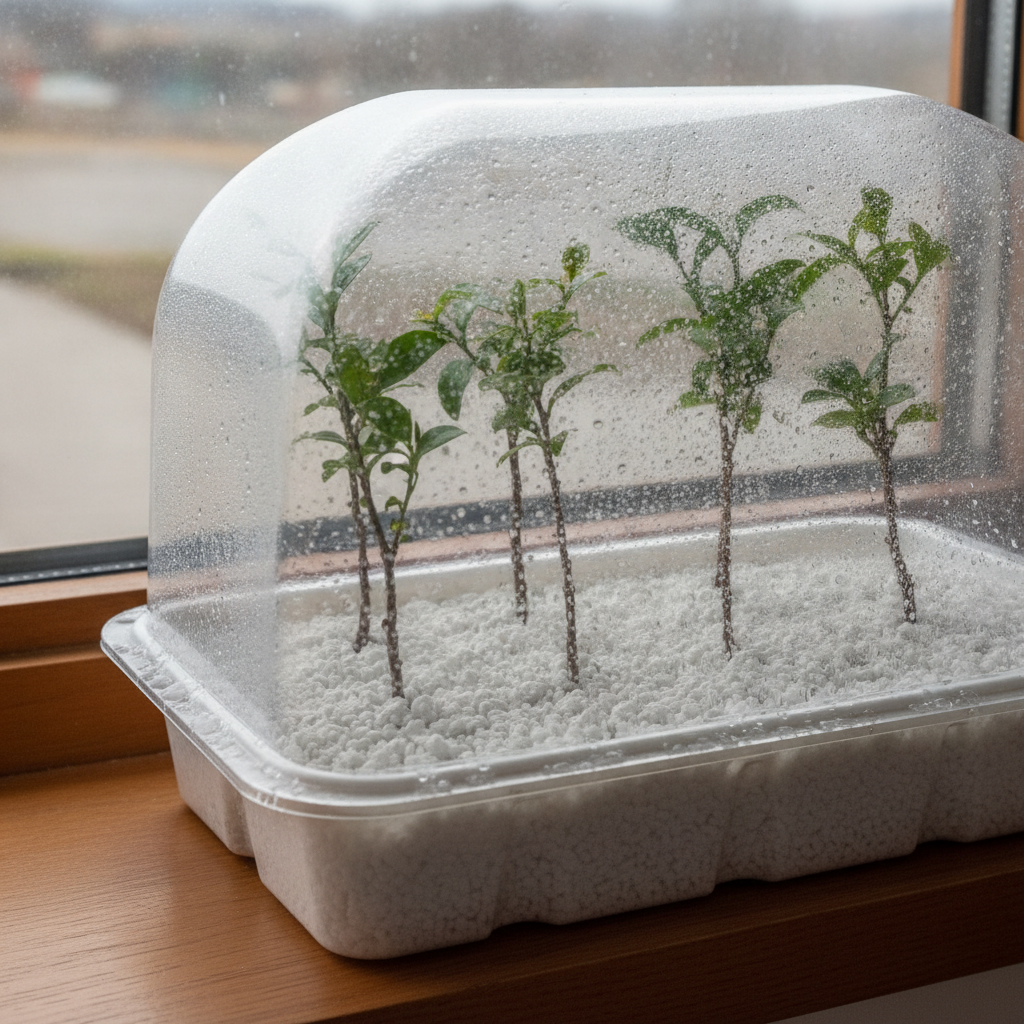
The Fukien tea is propagated most reliably from cuttings, though it tests the grower’s patience, as it roots more slowly and less willingly than many houseplants. Semi-hardwood cuttings, taken from stems that have begun to firm up but are not yet fully woody, give the best results, and late spring through summer is the ideal window because warmth and long days drive rooting. Take a cutting several centimetres long, remove the lower leaves, dip the cut end in rooting hormone, and insert it into a moist, free-draining medium such as a mix of perlite and fine bark.
Consistent warmth and humidity make all the difference. Covering the cuttings with a clear humidity dome, or placing the pot inside a loosely closed clear bag, holds moisture around the leaves while the roots form, and gentle bottom heat noticeably speeds the process. Keep the medium damp but not saturated, provide bright indirect light, and be prepared to wait several weeks to a couple of months for roots to establish. Not every cutting will take, so starting several at once improves the odds of ending up with a healthy young plant.
Air layering is an alternative worth knowing, particularly for producing a thicker, more advanced tree in less time than a cutting would need. A ring of bark is removed from a chosen branch, the wound wrapped in damp sphagnum moss and clear film, and roots are allowed to form in the moss before the new plant is severed and potted up. The tree can also be grown from its berries, whose seed will germinate in warm, moist conditions, though seed-grown plants are slow and are more the province of the patient enthusiast than the grower wanting a tree to style soon.
Pro Tip — Prune and propagate together: The Fukien tea responds well to regular trimming, which encourages the fine branching that makes it so attractive. Time a harder prune for early summer and use the healthiest offcuts as cuttings, so nothing goes to waste.
Pests and Problems

Indoors, where natural predators are absent and air is often dry, the Fukien tea attracts the usual cast of houseplant pests. Spider mites are the most common, thriving in warm dry air and betraying themselves with fine speckled stippling on the leaves and delicate webbing in the branch axils. Scale insects appear as small brown limpet-like bumps along the stems and leaf undersides, mealybugs as white cottony tufts in the crevices, and aphids and whitefly cluster on soft new growth. Because the tree’s leaves are so small, infestations can build unnoticed, so a regular close inspection, ideally with a magnifier, catches problems while they are still easy to treat.
Treatment starts gently and escalates only as needed. A firm rinse under a tap or shower dislodges many pests physically. For persistent infestations, a horticultural oil such as neem, or an insecticidal soap, applied thoroughly to both leaf surfaces and repeated every week or so until the problem clears, brings most outbreaks under control. Isolate an affected tree from other plants while treating it. Raising humidity is itself a preventative measure, as spider mites in particular struggle in a moister atmosphere.
Most of the trouble that afflicts a Fukien tea, though, is not a pest at all but a reaction to its conditions. The table below summarises the signals it sends and what usually lies behind them.
| Symptom | Likely cause | Remedy |
| Sudden leaf drop | Watering swing, cold draught, or a sudden move | Stabilise position and watering; check soil before adding water |
| Yellowing leaves | Overwatering, hard water, or hunger | Check drainage; switch to softer water; feed lightly |
| Leggy, stretched growth | Insufficient light | Move to the brightest window or add a grow light |
| Crispy leaf edges | Low humidity or under-watering | Raise humidity; keep soil evenly moist |
| Blackened roots, sour smell | Root rot from waterlogging | Repot into fresh free-draining mix; trim rotten roots |
| Speckled leaves and webbing | Spider mites | Rinse, treat with neem or soap, raise humidity |
Varieties
The Fukien tea is grown almost entirely as the wild species rather than as a range of named cultivars, and much of the variation seen in nurseries comes down to leaf size and the occasional variegated selection rather than formal cultivar names. Two forms in particular are worth seeking out.
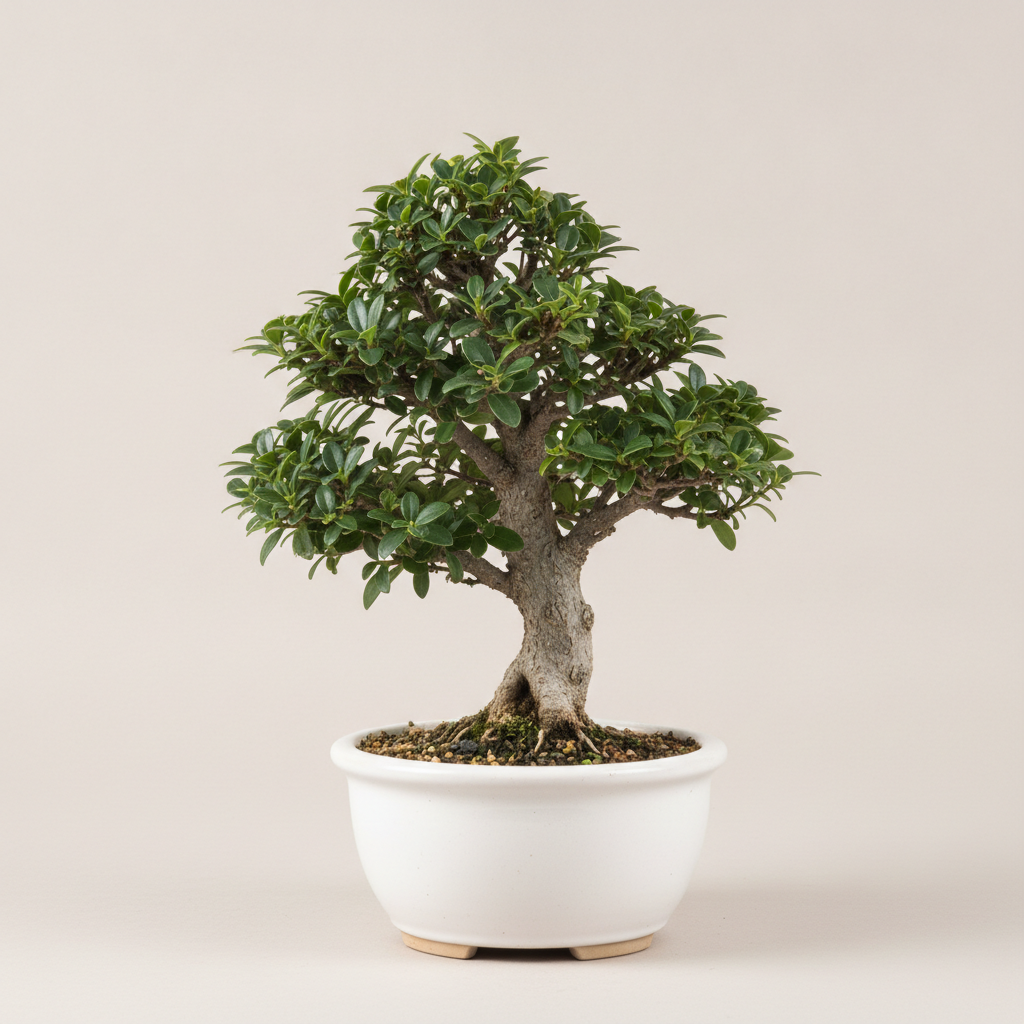
The small-leaf form carries especially fine, dense foliage, its glossy dark leaves even tinier than the ordinary species. This is the selection most prized for the smallest bonsai sizes, where its close ramification and minute leaves make a convincingly ancient tree in a pot that fits in the palm of a hand.
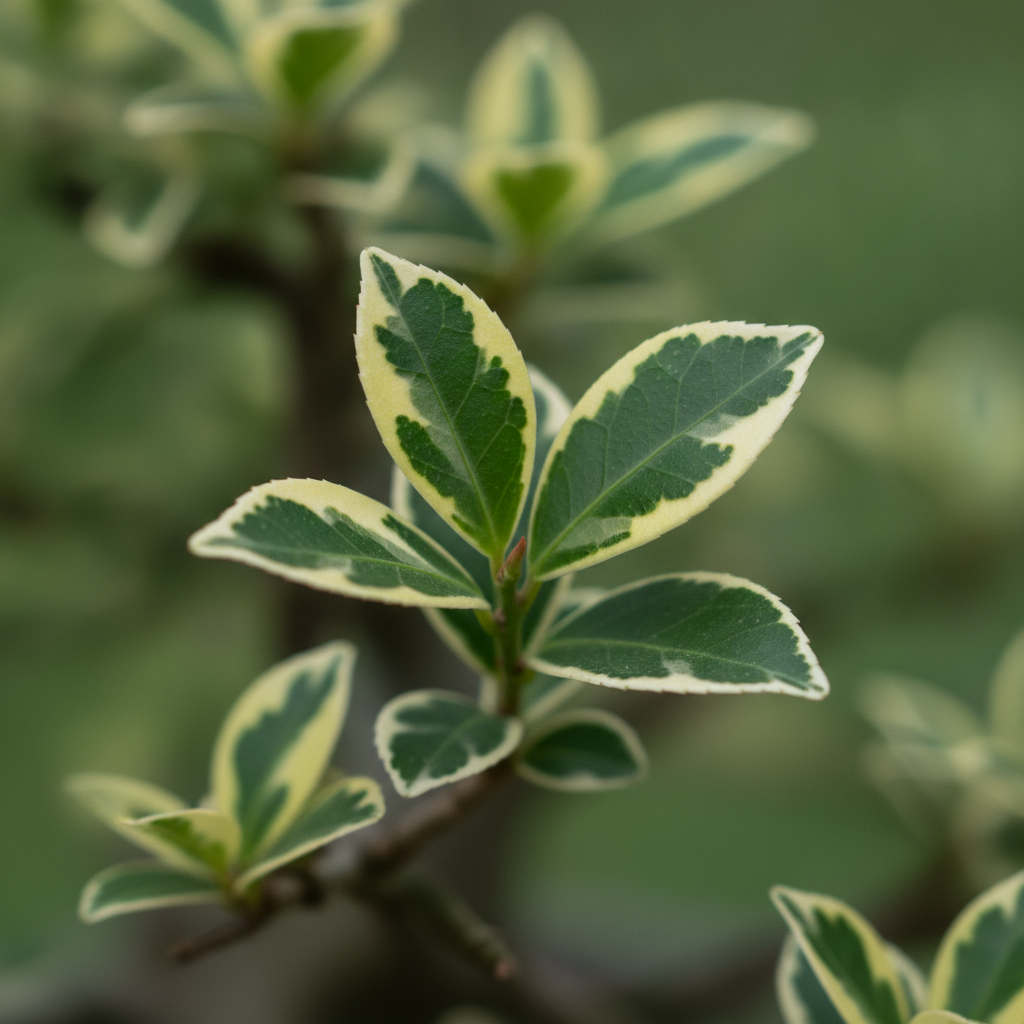
Variegated forms are occasionally offered, their dark leaves marbled and edged with creamy white. The variegation brings welcome brightness to the dense canopy, though these selections tend to be slightly less vigorous and want particularly good light to keep their markings crisp rather than fading to plain green.
Frequently Asked Questions
Why is my Fukien tea bonsai dropping its leaves?
Sudden leaf drop is the tree’s standard response to stress, most often an inconsistent watering routine, a cold draught, or a recent move to a new position. Check the soil before doing anything: if it is soggy, ease off and improve drainage; if it has dried right out, rehydrate gently. Then keep the tree in a stable, warm, bright spot and hold the conditions steady. New leaves usually return once the environment stops changing.
Is the Fukien tea a good bonsai for beginners?
It is often sold as a beginner tree because it is inexpensive, readily available and takes hard pruning well, but it is fussier than truly beginner-proof species such as ficus. Its demands for consistent moisture, warmth and bright light make it better suited to a beginner who enjoys attentive daily care than to someone wanting a low-maintenance tree. Many growers succeed with it as a first bonsai precisely because it teaches good habits.
Can a Fukien tea bonsai live outdoors?
In tropical and subtropical climates it can live outdoors year round. In temperate regions it is an indoor tree that benefits from a spell outside in summer once night temperatures stay above roughly 15 degrees Celsius (59 Fahrenheit), acclimatised gradually to brighter light. It must come back indoors well before autumn cold arrives, as it does not tolerate temperatures near or below freezing.
How often should I water it?
There is no fixed schedule; water according to the soil rather than the calendar. Check the surface daily and water thoroughly when the top few millimetres begin to dry while the mix below stays slightly damp. In warm, bright conditions this can mean daily watering, and in cool, dim winter conditions it may stretch to every few days. Never let the root ball dry out completely, and never leave the pot standing in water.
Is the Fukien tea toxic to pets?
It is not a plant to be eaten, and it is sensible to keep it out of reach of curious pets and children. While it is not among the most dangerously toxic houseplants, reliable toxicity data is limited, so caution is the wise approach. If a pet does chew on the tree and shows any sign of illness, contact a veterinarian.
Why won’t my Fukien tea flower?
Flowering is driven above all by light. A tree in merely adequate light will grow but rarely bloom, whereas one in a bright position, with some direct sun and steady feeding through the growing season, produces its small white flowers and red berries freely. If a healthy tree refuses to flower, the usual fix is simply more light, followed by a feed with a little extra phosphorus and potassium.






