
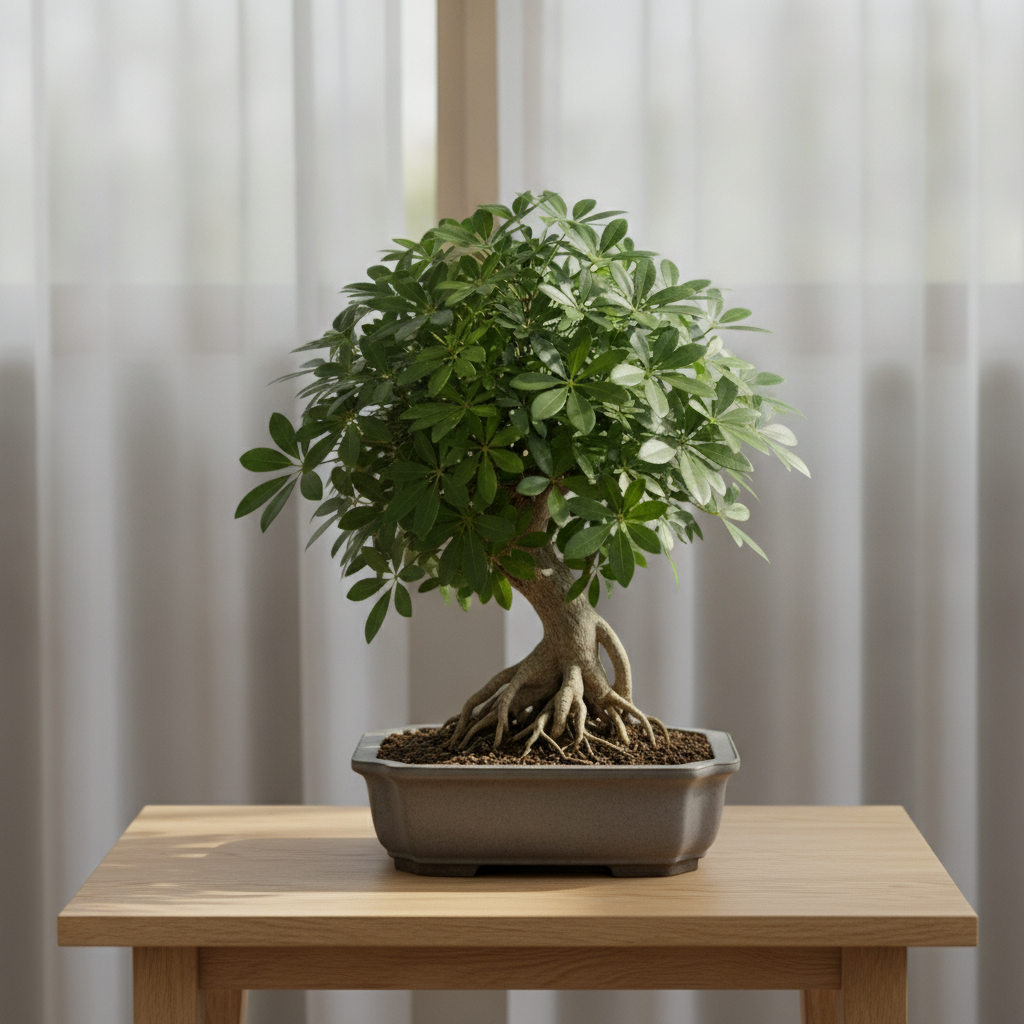
Few houseplants cross the line from ordinary foliage into living sculpture as willingly as the dwarf umbrella bonsai. Grown from Schefflera arboricola, a compact evergreen native to Taiwan and the Chinese island of Hainan, it carries the same glossy, finger-like leaflets that fan out from each stem tip like the ribs of a small umbrella, giving the plant both its common name and its unmistakable silhouette. Trained into a shallow pot, thickened at the base and encouraged to throw down curtains of aerial roots, it becomes one of the most approachable of all indoor bonsai subjects. Gardeners also know it as the dwarf umbrella tree, the Hawaiian umbrella tree, or simply umbrella plant.
Its reputation as a beginner’s bonsai is well earned. Unlike temperate species that demand a cold winter dormancy outdoors, the dwarf umbrella grows happily on a windowsill all year round, forgives the occasional missed watering, and back-buds readily on old wood so that heavy pruning is met with fresh growth rather than sulking. That forgiveness is exactly why it is a fine plant to learn on, yet there is a real difference between a specimen that merely survives on a shelf and one that thrives into a dense, characterful miniature tree. This guide covers everything that separates the two, from reading light and water correctly to soil, feeding, propagation, pests and the varieties worth seeking out.
Contents
- Quick Reference
- Why Dwarf Umbrella Bonsai Makes a Rewarding Houseplant
- Light Requirements
- Watering & Humidity
- Soil, Potting & Repotting
- Fertilising
- Propagation
- Pests & Diseases
- Popular Varieties
- Frequently Asked Questions
Quick Reference: Dwarf Umbrella Bonsai at a Glance
| Light | Bright, indirect light; tolerates medium light but growth slows and stems stretch |
| Watering | Keep lightly moist; let the top 2 to 3 cm (1 in) dry between waterings |
| Temperature | 15 to 24 degrees C (59 to 75 degrees F); keep above 10 degrees C (50 degrees F) |
| Humidity | Average room humidity is fine; higher humidity encourages aerial roots |
| Fertiliser | Balanced feed every 2 to 4 weeks in spring and summer, reduced in winter |
| Toxicity | Toxic to cats, dogs and humans if ingested; sap may irritate skin |
Why Dwarf Umbrella Bonsai Makes a Rewarding Houseplant
The appeal of the dwarf umbrella as a bonsai begins with its growth habit. In the wild, Schefflera arboricola is a scrambling shrub or small tree that reaches three to four metres (10 to 13 ft), often starting life as an epiphyte perched in the fork of a larger tree before sending roots to the ground. That epiphytic streak is what makes it so willing to produce aerial roots indoors, and skilled growers exploit it to create dramatic banyan-style trees where a canopy of foliage sits above a cage of descending roots. Even an untrained plant hints at this character, thickening at the base and layering its umbrella-shaped leaves into a naturally tree-like form.
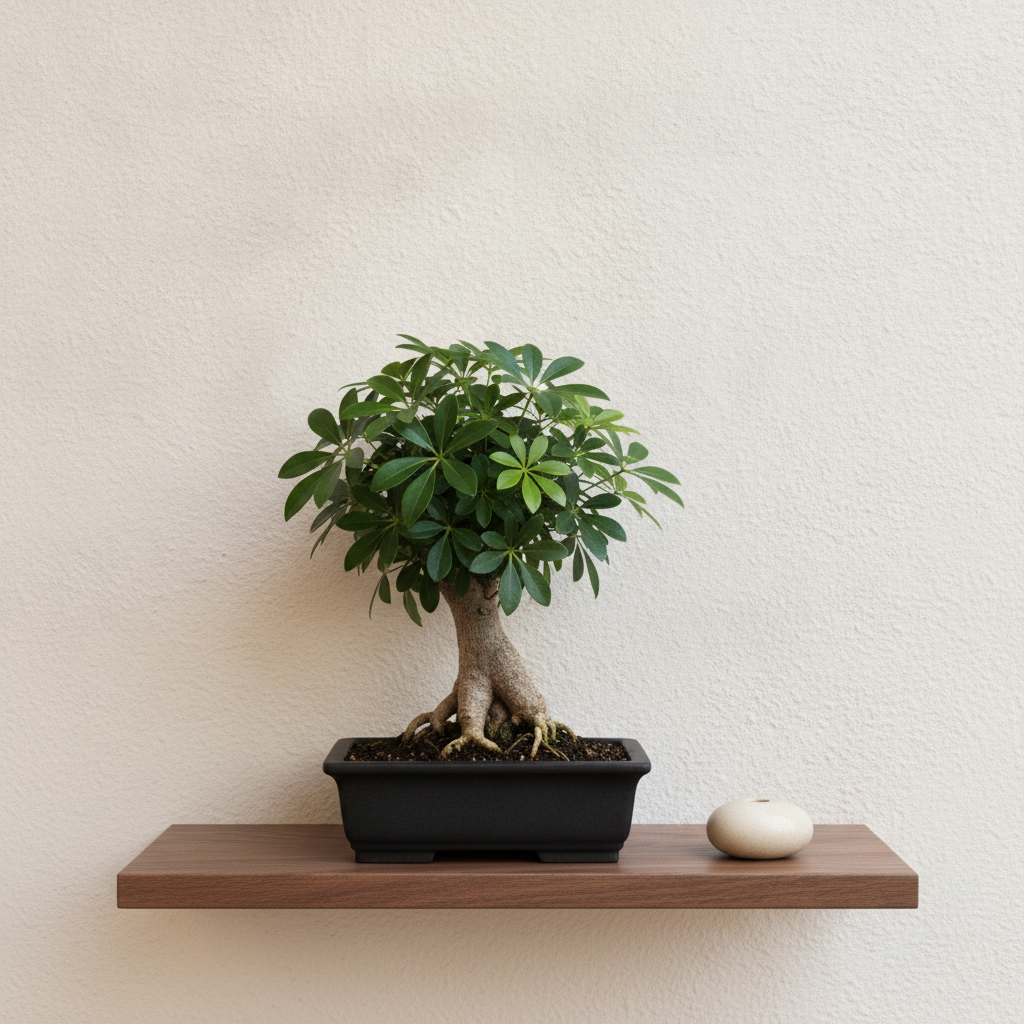
Beyond looks, it is the plant’s temperament that keeps it on beginner recommendation lists. It grows quickly, which means mistakes are corrected within a season rather than over years, and it responds to pruning by budding freely from the trunk and older branches, so a leggy plant can be cut back hard and rebuilt into a compact shape. It also tolerates the warm, relatively dry, low-light conditions of a typical home far better than most tropical bonsai. None of this makes it indestructible, but it does mean the learning curve is gentle and the feedback is fast, a combination that suits anyone taking their first steps into indoor bonsai.
Important — Toxicity: All parts of Schefflera arboricola contain insoluble calcium oxalate crystals. Chewing or swallowing the leaves can cause oral irritation, drooling, difficulty swallowing and vomiting in cats and dogs, and mouth and stomach irritation in people. The milky sap can also irritate sensitive skin. Keep the plant away from pets and small children, and wash your hands after pruning.
Light Requirements
Light is the single biggest factor in whether a dwarf umbrella bonsai stays compact and full or drifts into a thin, stretched version of itself. As a plant that naturally grows in the bright, dappled canopy of subtropical forests, it wants plenty of light without the fierce, unbroken sun of a south-facing sill in high summer. Get the level right and the leaflets stay small, close-set and deep green, which is exactly the look a bonsai grower is after.
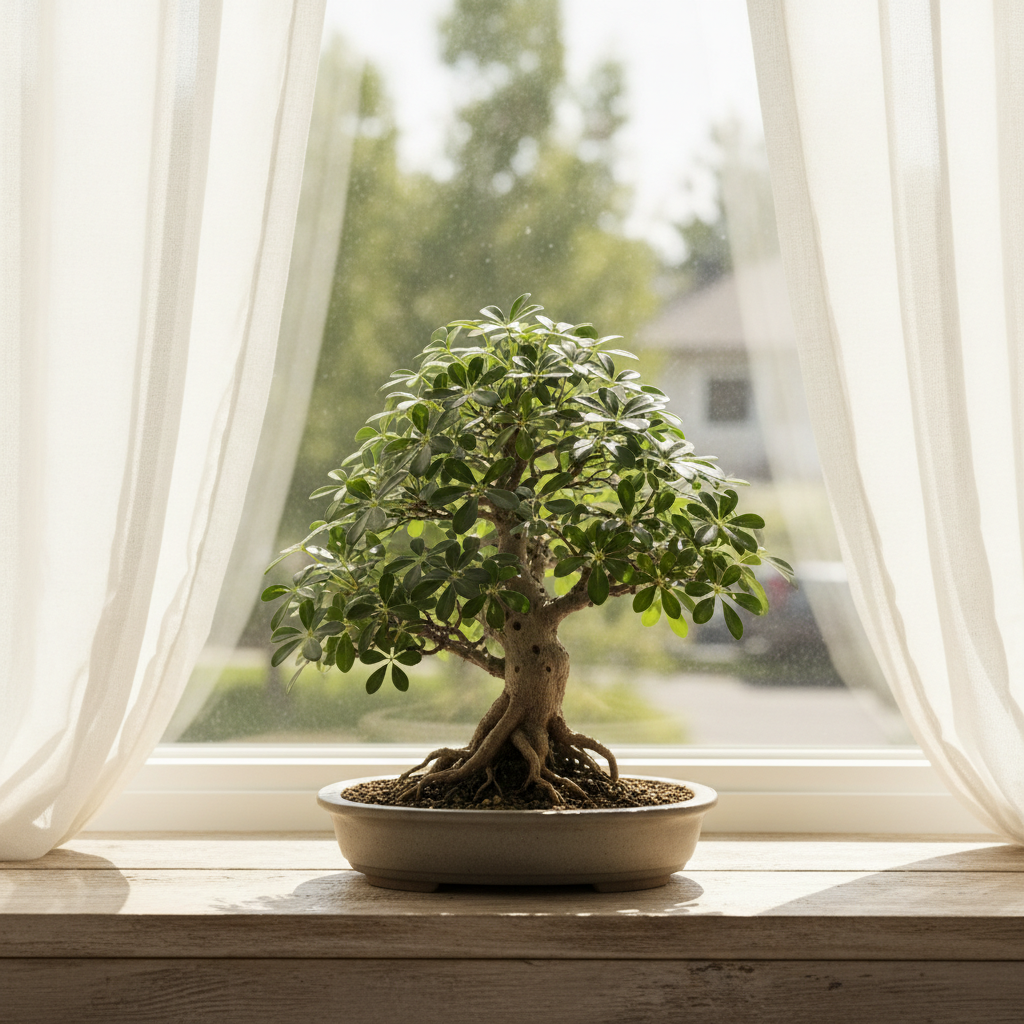
The ideal is bright, indirect light for most of the day, with perhaps an hour or two of gentle direct morning sun. In this range the plant produces short internodes, meaning the gaps between leaves stay tight and the canopy looks dense. Push it into deeper shade and the stems elongate as the plant reaches for light, the leaves grow larger and more widely spaced, and the whole tree loses the fine proportions that make a convincing miniature.
Light Levels Explained
Indoor light is far dimmer than most people assume, and the difference between a bright and a dim spot can be tenfold even when both look well lit to the eye. The table below sets out how the dwarf umbrella responds across the usual range of household light levels.
| Light Category | Approx. Level | Typical Location | Outcome |
|---|---|---|---|
| Direct sun | 20,000 lux and above | Right against a south window | Tolerated in morning; midday sun through glass can scorch leaves |
| Bright indirect | 10,000 to 20,000 lux | Near an east or filtered south window | Ideal; compact growth and rich colour |
| Medium | 5,000 to 10,000 lux | A metre or two back from a bright window | Acceptable; slower, slightly looser growth |
| Low | 1,000 to 5,000 lux | Interior wall, north-facing room | Survives but stretches; leaf drop over time |
| Very low | Below 1,000 lux | Windowless or dim corner | Decline; needs a grow light to persist |
Window Orientation and Placement
South-facing window: Offers the most light and can be excellent in winter, but in summer the midday sun through glass may be too intense at point-blank range. Set the plant back slightly or diffuse the light with a sheer curtain to avoid scorched patches on the leaves.
East-facing window: Often the sweet spot. Cool morning sun followed by bright indirect light for the rest of the day suits the dwarf umbrella perfectly and rarely causes scorch.
West-facing window: Good light overall, though the afternoon sun can be hot in summer. Watch for leaf temperature and pull the plant back a little during the warmest months.
North-facing window: The dimmest aspect. A dwarf umbrella will hold on here but tends to stretch and thin out. If a north window is all you have, consider adding a small grow light to keep the canopy dense.
Pro Tip — Rotate for Even Growth: Turn the pot a quarter of a rotation each time you water. Because the plant leans steadily toward the light, regular rotation keeps the canopy symmetrical and stops one side of the bonsai from becoming bare.
How Light Affects Leaf Size and Colour
For a bonsai grower, light is also a shaping tool. Higher light produces smaller leaves, which is precisely why plants destined for miniature work are kept as bright as possible. Variegated forms such as Gold Capella and Trinette need even more light than the plain green species to hold their markings, because the pale sections of each leaf contain little chlorophyll and contribute less energy. Starved of light, variegated plants often revert, throwing out all-green leaves that are more efficient but less ornamental.
Warning — Direct Sunlight: While the dwarf umbrella enjoys bright conditions, a plant moved suddenly from shade into full summer sun can develop bleached or brown scorch marks within days. Acclimatise it over a week or two, increasing exposure gradually, and avoid pressing the foliage against hot glass.
Artificial Lighting
The dwarf umbrella responds very well to supplementary lighting, which makes it a practical choice for homes with limited natural light. A full-spectrum LED grow light positioned 20 to 40 cm (8 to 16 in) above the canopy and run for 10 to 12 hours a day will keep growth compact through the darkest months. Because the plant is naturally dense, aim the light straight down so the interior of the canopy is not left in shadow.
Seasonal Adjustments
Light levels indoors can halve between summer and winter, even in the same spot, as the sun sits lower and days shorten. Move the plant closer to the window for the colder half of the year, clean the glass to maximise transmission, and be ready to reduce watering to match the slower winter growth. As spring returns and light strengthens, shift the plant back to its summer position to prevent scorch.
Watering & Humidity
Watering is where most dwarf umbrella bonsai run into trouble, not because the plant is fussy but because a shallow bonsai pot behaves very differently from a deep nursery container. The small volume of soil holds less water and dries faster, so the rhythm of watering has to be watched more closely than with the same plant in a standard pot. The goal is a substrate that stays lightly moist during active growth and never sits waterlogged.
When to Water
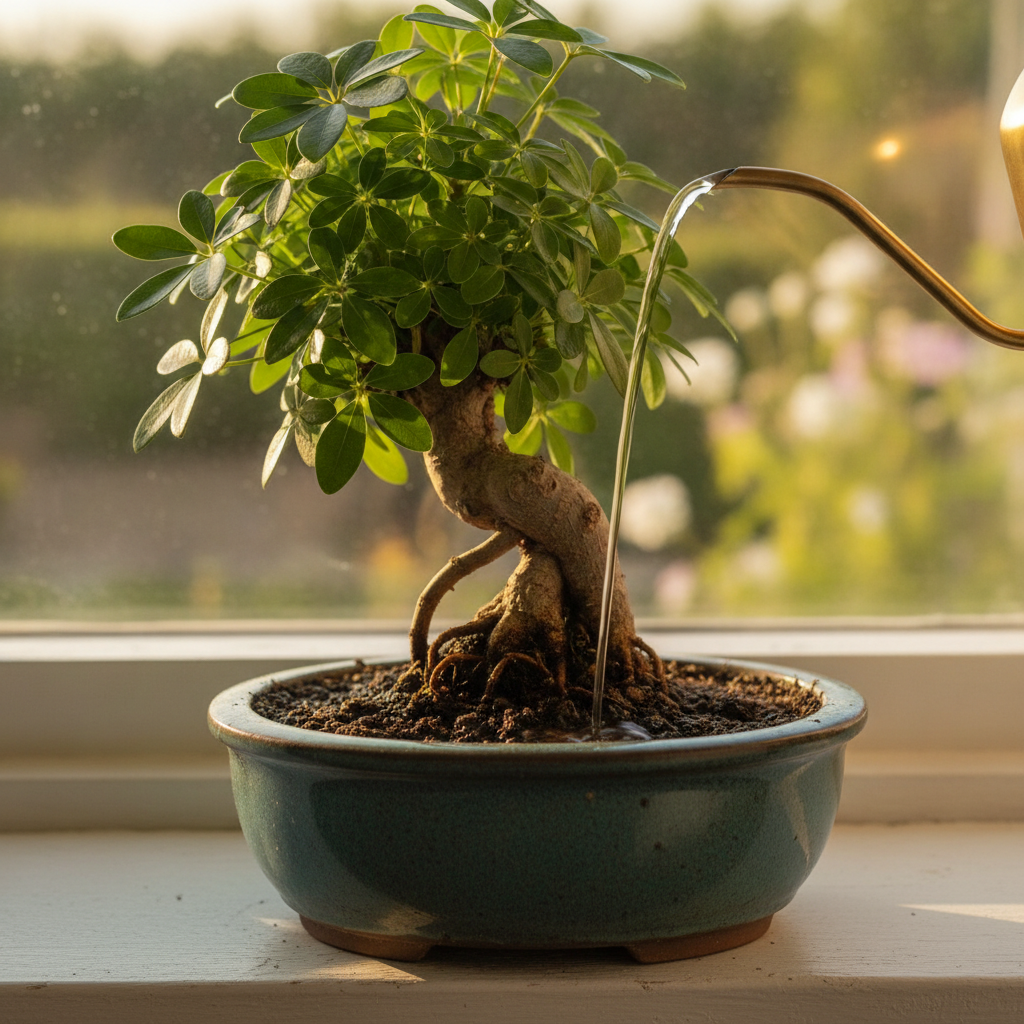
The most reliable guide is the soil itself. Push a finger into the top of the mix and water when the top 2 to 3 cm (1 in) feels dry but the layers below are still slightly damp. In a warm, bright room during summer this may mean watering every two or three days; in winter it could stretch to a week or more. Rather than watering on a fixed schedule, check the soil and let its condition make the decision.
The dwarf umbrella gives clear signals when the balance tips. Leaves that yellow and drop from the base, together with soil that stays wet for days, point to overwatering. A plant that suddenly sheds leaflets and feels light when lifted, with soil pulling away from the pot edge, has been allowed to dry out too far. Sudden leaf drop is the plant’s default response to stress of almost any kind, including cold draughts, so read it alongside the state of the soil rather than in isolation.
Pro Tip — Weigh the Pot: Lift the bonsai just after watering to learn how heavy a fully watered pot feels, then lift it again as it dries. With a little practice, weight becomes a faster and more accurate moisture gauge than any probe, especially in shallow bonsai containers.
How to Water Correctly
- Check that the top few centimetres of soil have dried before reaching for the watering can.
- Water gently at the soil surface, using a fine rose or long spout so you do not wash the mix out of a shallow pot.
- Continue until water runs freely from the drainage holes, which ensures the whole root ball is wetted, not just the top.
- Let the pot drain completely and never leave it standing in a full saucer.
- Tip away any water that collects in the drip tray after ten minutes.
- Wait until the surface dries again before the next watering rather than topping up little and often.
Signs of Overwatering vs. Underwatering
| Symptom | Overwatering | Underwatering |
|---|---|---|
| Leaf colour | Yellowing, often from the lower leaves first | Dull green fading to brown at the tips and edges |
| Leaf texture | Soft, limp, translucent | Dry, crisp, curling |
| Leaf drop | Whole leaflets drop while still green or yellow | Leaflets shrivel before dropping |
| Soil | Stays wet for days, may smell sour | Bone dry, shrinks away from the pot wall |
| Roots | Dark, soft, mushy, foul smelling | Dry and brittle but generally firm |
Warning — Root Rot: Persistently wet soil is the fastest way to kill a dwarf umbrella bonsai. Once roots turn black and slimy, the plant struggles to take up water and paradoxically wilts as though thirsty. If you suspect rot, lift the plant, trim away all soft roots with clean tools, and repot into fresh, free-draining mix.
Humidity Requirements
Compared with fussier tropical bonsai, the dwarf umbrella is relaxed about humidity and copes with the average home. It will, however, grow more lushly and produce more of its prized aerial roots when the air is moist, which is why enthusiasts aiming for a banyan style often grow their trees in a humid greenhouse or under a cover for part of the year.
In very dry air, particularly near winter heating, you may notice brown leaf tips and a higher risk of spider mites. These are the plant’s way of telling you the atmosphere has become too arid for comfort. Neither is serious in isolation, but both are worth heading off.
Raising humidity is straightforward. Stand the pot on a tray of damp pebbles, group it with other plants so they share the moisture they transpire, or run a small humidifier nearby during the driest months. Misting offers only a brief lift and can encourage fungal spots if the foliage stays wet, so it is the least effective of the options.
Water Quality
The dwarf umbrella is not especially sensitive to water quality and tolerates most tap water without complaint. In hard-water areas, mineral build-up can leave a pale crust on the soil surface over time, so an occasional watering with rainwater or filtered water helps flush salts through. Let cold tap water reach room temperature before use, as a shock of cold water on warm roots can trigger leaf drop.
Soil, Potting & Repotting
Soil does more work in a bonsai than in almost any other container plant. It has to anchor the tree in a shallow pot, hold enough moisture and nutrients between waterings, and yet drain freely enough that the roots never suffocate. For the dwarf umbrella, the balance leans toward drainage, because its greatest enemy is a soggy root ball.
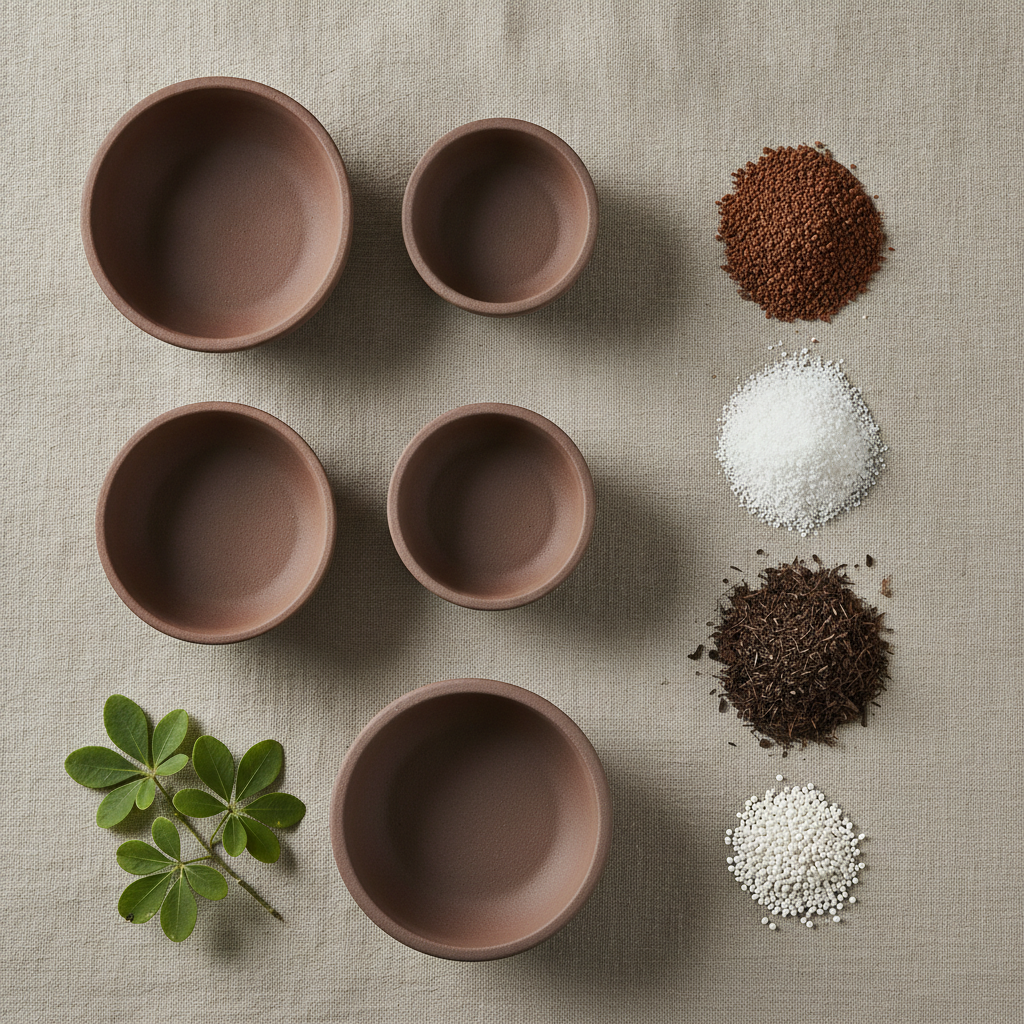
Ideal Soil Composition
A good mix for a dwarf umbrella bonsai combines an inorganic, structural component that holds its shape and keeps the mix open with a smaller organic fraction that retains moisture and feeds the roots. Many growers use a classic bonsai blend based on akadama, pumice and lava rock, adjusting the proportions of moisture-retentive bark or coir to suit how often they can water.
| Component | Proportion | Function |
|---|---|---|
| Akadama or fired clay | 40 to 50 per cent | Holds moisture and nutrients while keeping structure open |
| Pumice | 20 to 30 per cent | Adds air pockets and improves drainage |
| Lava rock or grit | 10 to 20 per cent | Provides weight, stability and sharp drainage |
| Fine bark or coir | 10 to 20 per cent | Retains moisture and supplies organic matter |
The dwarf umbrella prefers a slightly acidic to neutral soil, roughly pH 6.0 to 6.5, which most bonsai and general potting mixes fall within naturally. There is no need to test or adjust pH under normal conditions; the occasional flush with fresh water is enough to keep it in range.
Pro Tip — Quick Mix Recipe: If sourcing bonsai soil is difficult, a workable substitute is two parts good-quality houseplant compost to one part perlite and one part fine orchid bark. It drains well, holds enough moisture for a busy household, and costs a fraction of imported bonsai aggregates.
Choosing the Right Pot
Pot choice is both practical and aesthetic in bonsai. A shallow, wide container shows off the tree and the surface roots, but it holds little soil, so the shallower the pot, the more attentive the watering must be. Beginners often do well to start in a slightly deeper training pot and move to a classic shallow bonsai dish only once the watering rhythm is second nature.
Drainage holes are non-negotiable. Every pot must have generous drainage, and most bonsai pots also have wire holes for anchoring the tree. Cover the drainage holes with mesh to keep the mix in while letting water out freely.
Pot material: Traditional glazed and unglazed ceramic bonsai pots are ideal, being stable and breathable. Plastic training pots are lighter and retain moisture longer, which can be an advantage while a tree is developing.
Pot size: The pot should suit the tree, not the other way around. A pot roughly two-thirds the height of the tree and wide enough to balance the canopy looks right and gives the roots enough room without leaving large volumes of wet, unused soil.
When to Repot
A dwarf umbrella bonsai is a vigorous grower and typically needs repotting every two to three years, or when roots begin to circle the pot and emerge from the drainage holes. The best time is spring, as growth accelerates and the plant recovers quickly. Repotting also gives you the chance to prune the roots, refresh the soil and correct the tree’s position in the pot.
How to Repot: Step-by-Step
- Water the plant a day before so the root ball holds together and the roots are turgid.
- Ease the tree out of its pot and gently tease away the outer soil to expose the root mass.
- Trim back up to a third of the roots with clean, sharp scissors, removing any dark or mushy sections.
- Place fresh mesh over the drainage holes and add a layer of new bonsai soil to the pot.
- Position the tree, work fresh mix around and between the roots with a chopstick to remove air pockets, and firm gently.
- Water thoroughly until it runs clear from the base, then settle the plant in bright, indirect light out of direct sun.
- Hold off on feeding for three to four weeks while new roots establish.
Warning — Transplant Shock: Some leaf drop after repotting is normal as the plant balances its canopy against its reduced roots. Keep it warm, out of draughts and lightly watered, and avoid the temptation to fertilise or move it repeatedly. New growth usually appears within a few weeks.
Fertilising
Because a bonsai lives in a small volume of fast-draining soil, its roots exhaust the available nutrients quickly and rely on regular feeding to keep growing well. The dwarf umbrella is a hungry, fast grower by bonsai standards, so a steady supply of balanced nutrition through the growing season pays off in dense foliage and strong new shoots.
That said, more is not better. Over-feeding produces soft, oversized leaves and a build-up of mineral salts that can burn the roots. The aim is a light, consistent feed rather than occasional heavy doses.
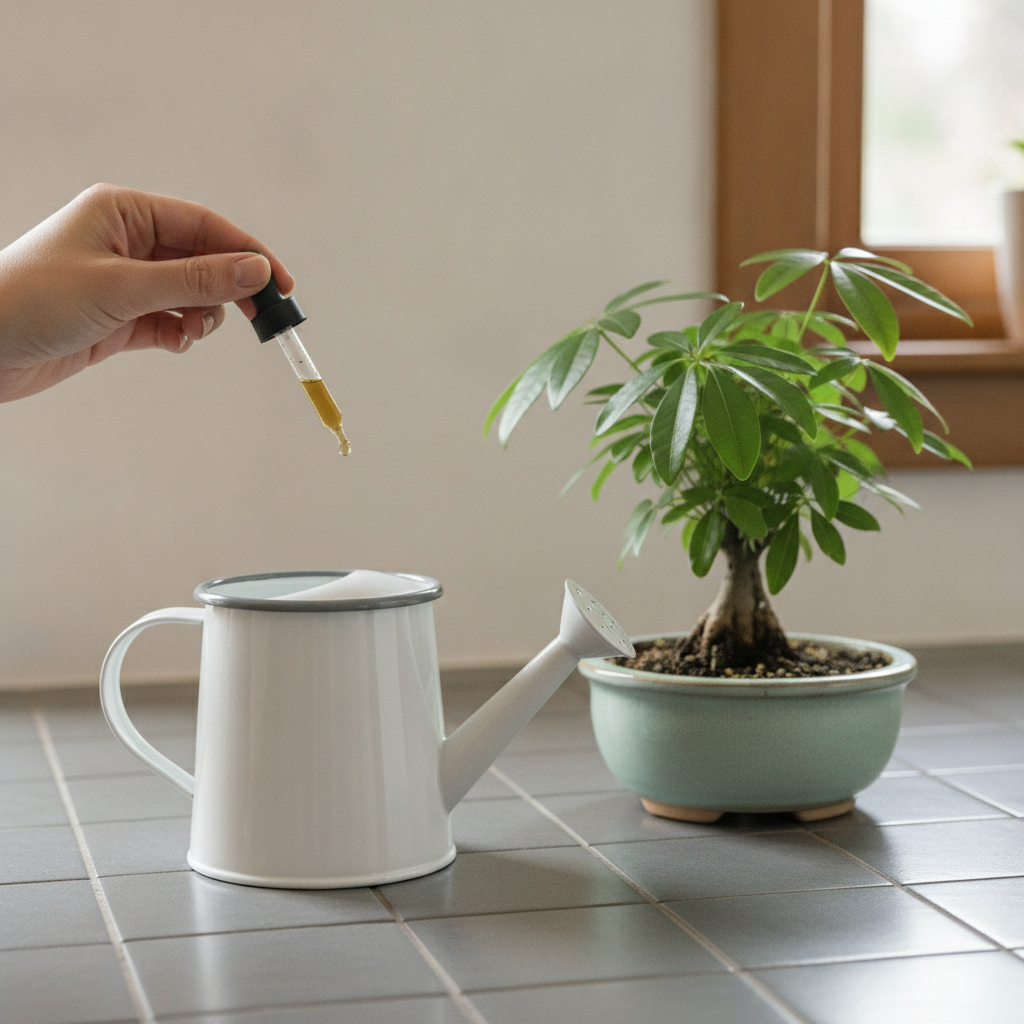
Understanding Plant Nutrients
Fertiliser labels carry three numbers, the NPK ratio, showing the percentages of nitrogen, phosphorus and potassium. A balanced ratio such as 10-10-10 suits the dwarf umbrella well, supporting leafy growth without pushing it too hard. Alongside these main nutrients, plants need smaller amounts of secondary and trace elements, and a deficiency in any of them shows up in the leaves.
| Nutrient | Symbol | Primary Function | Deficiency Symptoms |
|---|---|---|---|
| Nitrogen | N | Leafy growth and green colour | Pale, yellowing older leaves; slow growth |
| Phosphorus | P | Root development and energy transfer | Stunted growth, dull or purple-tinged leaves |
| Potassium | K | Overall vigour and stress resistance | Yellow or brown leaf edges |
| Calcium | Ca | Cell wall strength | Distorted new growth, weak shoots |
| Magnesium | Mg | Core of the chlorophyll molecule | Yellowing between the veins of older leaves |
| Iron | Fe | Chlorophyll production | Yellowing between the veins of new leaves |
Types of Fertiliser
Liquid fertilisers: Diluted liquid feeds are the easiest to control and the most popular choice for bonsai. They act quickly and let you adjust the strength and frequency to match the season, which is exactly the fine control a small tree benefits from.
Slow-release granular: Coated granules release nutrients gradually over several months and are convenient for busy growers, though they offer less precise control. Scatter them sparingly on the soil surface at the start of the growing season.
Organic fertilisers: Solid organic bonsai cakes, worm castings and seaweed feeds release nutrients slowly and gently, feed the soil life, and carry little risk of burning. They are a mainstay of traditional bonsai practice and suit the dwarf umbrella well.
Feeding Schedule
Through spring and summer, feed with a balanced liquid fertiliser at half the recommended strength every two to four weeks. As growth slows in autumn, reduce this to roughly once a month, and in the depths of winter feed sparingly or not at all if the plant is resting. A dwarf umbrella kept warm and brightly lit under a grow light may keep growing through winter, in which case a light monthly feed keeps it supported.
Pro Tip — Feed a Damp Root Ball: Always apply liquid feed to already moist soil, never to a bone-dry root ball. Fertiliser on dry roots concentrates the salts against them and can cause burn. Water first, then feed, or feed with your regular watering once the surface has begun to dry.
How to Fertilise
- Choose a balanced fertiliser and dilute it to half strength for routine feeding.
- Make sure the soil is already moist before applying.
- Pour the diluted feed evenly over the soil until it just begins to drain from the base.
- Avoid splashing concentrated feed onto the leaves, which can scorch them.
- Every couple of months, flush the pot with plain water to wash out accumulated salts.
Warning — Salt Build-Up: A white crust on the soil or around the pot rim signals a build-up of fertiliser salts. Left unchecked it browns leaf tips and stresses the roots. Flush the pot thoroughly with several changes of clean water, and ease back on the feeding rate.
Propagation
One of the quiet pleasures of growing a dwarf umbrella bonsai is how easily it propagates. The stems root readily, which means the material you remove during pruning need not be wasted, and a single parent plant can furnish several future bonsai. Two methods dominate: rooting stem cuttings and, for those wanting a thicker trunk quickly, air layering.
Spring and early summer are the best times, when the plant is growing strongly and cuttings root fastest. Take material from healthy, semi-ripe stems for the highest success rate.
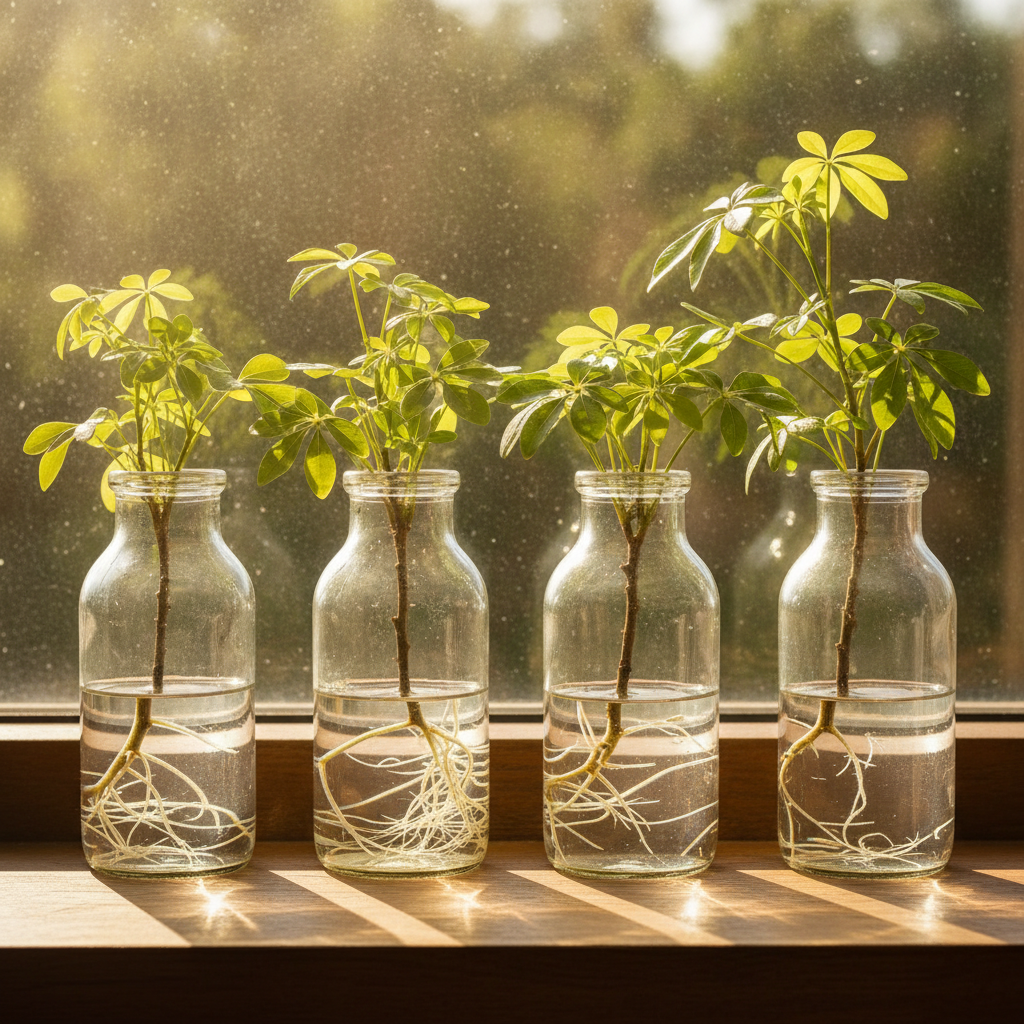
Understanding Nodes and Stem Cuttings
Roots and new shoots both emerge from nodes, the slightly swollen points on a stem where leaves attach. A cutting that includes at least one or two nodes has the sites it needs to form roots, which is why every successful cutting is measured by its nodes rather than its length. Understanding this makes it easy to judge where to cut and how much stem each new plant needs.
Stem Cuttings: Step-by-Step
Rooting stem cuttings is the simplest and most reliable method, and it works whether you root them in water or straight into a moist mix.
- Choose a healthy stem and cut a section 10 to 15 cm (4 to 6 in) long, just below a node, using clean, sharp secateurs.
- Remove the lower leaves, leaving two or three leaflet clusters at the top.
- Optionally dip the cut end in rooting hormone to speed things along.
- Place the cutting in a glass of water or insert it into a pot of moist, free-draining cutting mix.
- Keep it warm and in bright, indirect light, changing the water every few days if rooting in water.
- Once roots reach 3 to 5 cm (1 to 2 in), pot water-rooted cuttings into soil and grow them on.
Pro Tip — Root Several at Once: Because the dwarf umbrella roots so willingly, take several cuttings together. You can pot them up individually or plant a cluster in one pot to build a fuller, multi-trunk bonsai from the start.
Air Layering: Step-by-Step
Air layering produces a larger, ready-thickened plant with an established root system and is the method of choice for creating an instant trunk or salvaging the top of a leggy specimen.
- Select a healthy section of stem and remove a ring of bark about 1 cm (0.4 in) wide, or make an upward slanting cut and hold it open.
- Dust the wound with rooting hormone to encourage roots to form.
- Wrap the area in a ball of damp sphagnum moss.
- Enclose the moss in clear film and secure it top and bottom with twine or ties so it stays moist.
- Keep the moss damp and wait for roots to become visible through the film, usually within one to two months.
- Cut the stem off below the new roots and pot up the rooted layer as a new plant.
Troubleshooting Propagation
| Problem | Likely Cause | Solution |
|---|---|---|
| Cutting rots at the base | Water too stagnant or mix too wet | Change water often, or use a freer-draining cutting mix |
| No roots after weeks | Too cold or too little light | Move somewhere warm and bright; add gentle bottom heat |
| Leaves drop from the cutting | Moisture loss before roots form | Reduce leaf area and raise humidity with a cover |
| Air layer fails to root | Moss dried out or bark not fully ringed | Keep moss constantly damp; ensure the cambium is cleanly removed |
Pests & Diseases
A healthy, well-watered dwarf umbrella shrugs off most problems, but the warm, dry air of a centrally heated home can invite a handful of common pests. Catching them early makes all the difference, so it pays to look over the plant, including the undersides of the leaflets and the leaf axils, whenever you water.
Most infestations arrive on new plants or spread from neighbours, so quarantining new arrivals for a couple of weeks is one of the simplest preventive habits you can adopt.
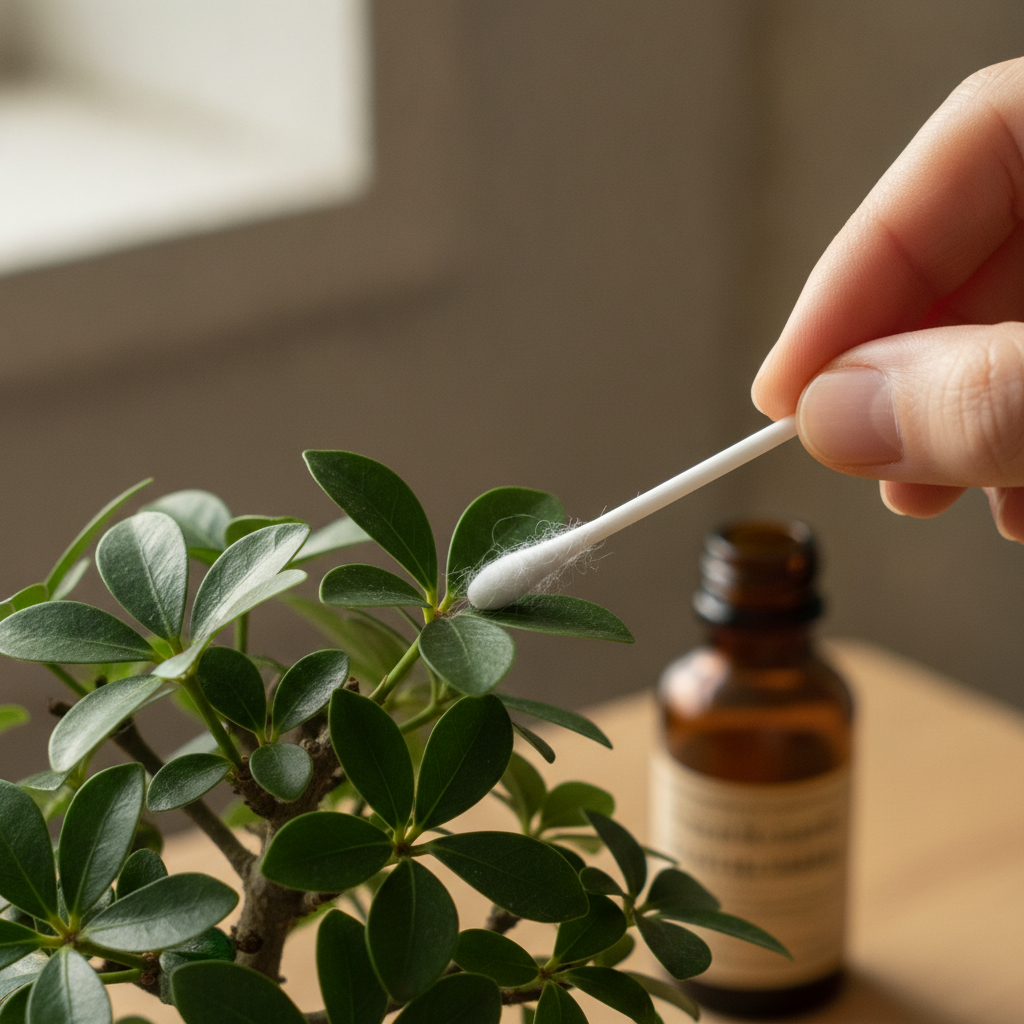
Common Pests
Spider Mites (Tetranychus urticae)
These tiny sap-suckers thrive in dry air and are the most frequent pest of indoor dwarf umbrellas. Look for fine stippling on the leaves, a dull bronzed appearance and delicate webbing in the leaf joints. Heavy infestations cause leaves to yellow and drop.
Treatment: Rinse the foliage in the shower, raise humidity, and treat with insecticidal soap or a miticide, repeating every few days to break the fast breeding cycle.
Scale (Coccus hesperidum)
Scale insects appear as small brown or tan bumps clinging to stems and the undersides of leaves. They feed on sap and excrete sticky honeydew, which in turn attracts sooty mould. The dwarf umbrella is a particular favourite of soft scale.
Treatment: Scrape or wipe them off with a cotton bud dipped in dilute isopropyl alcohol, then follow up with horticultural oil to smother any survivors.
Mealybugs (Pseudococcus longispinus)
Mealybugs look like small tufts of white cotton wool tucked into leaf axils and along stems. Like scale, they suck sap and produce honeydew, weakening the plant and disfiguring the foliage.
Treatment: Dab each insect with an alcohol-dipped cotton bud, then spray with insecticidal soap or neem oil and inspect weekly until they are gone.
Common Diseases
Root Rot (Pythium and Phytophthora species)
By far the most serious problem for this plant, root rot follows persistently waterlogged soil. The first signs above ground are yellowing leaves and unexplained wilting, while below the surface the roots turn dark, soft and foul smelling.
Treatment: Remove the plant from its pot, cut away all affected roots with sterile tools, and repot into fresh, free-draining mix. Water more sparingly thereafter and ensure the pot drains freely.
Leaf Spot (Alternaria species)
Fungal leaf spot shows as dark brown blotches, sometimes with a yellow halo, and is encouraged by wet foliage and poor air movement. It is rarely fatal but can spread if left unchecked.
Treatment: Remove affected leaves, avoid wetting the foliage when watering, improve air circulation, and apply a copper-based fungicide if the problem persists.
Pest and Disease Summary
| Pest / Disease | Identification | Treatment |
|---|---|---|
| Spider mites | Stippling, bronzing, fine webbing | Rinse, raise humidity, insecticidal soap or miticide |
| Scale | Brown bumps on stems and leaf undersides | Wipe with alcohol, then horticultural oil |
| Mealybugs | White cottony tufts in leaf axils | Alcohol swab, then neem or insecticidal soap |
| Root rot | Yellowing, wilting, dark mushy roots | Trim roots, repot in fresh mix, water less |
| Leaf spot | Dark blotches with yellow halos | Remove leaves, improve airflow, copper fungicide |
Prevention Strategies
The best defence is a plant grown in the right conditions. A dwarf umbrella that is correctly watered, adequately lit and not stressed by cold draughts is far more resistant to pests and disease than one struggling to cope. Good air movement, sensible spacing between plants and clean tools all reduce the chance of trouble taking hold.
Inspect regularly, wipe the leaves occasionally to keep them clean and free of dust, and isolate any new plant before introducing it to your collection. Small, early interventions almost always beat large, late ones.
Pro Tip — Neem as a Routine: A monthly wipe or light spray with dilute neem oil during the growing season deters most sap-sucking pests before they establish. Apply in the evening or out of direct sun to avoid marking the leaves, and test on a single leaf first.
Popular Varieties
While the plain green Schefflera arboricola is the classic bonsai subject, a number of variegated and compact cultivars have been selected over the years, each bringing its own colour and character. All share the same easy temperament, though the variegated forms need a little more light to keep their markings crisp.
It is worth noting that the closely related Schefflera actinophylla, the full-sized umbrella tree, has much larger leaves and is less suited to bonsai. For miniature work, stick to the dwarf species and its cultivars below.
| Variety | Leaf Appearance | Light Needs | Growth Rate | Availability |
|---|---|---|---|---|
| Green (species) | Glossy deep green leaflets | Bright indirect | Fast | Very common |
| Gold Capella | Green splashed with golden-yellow | Bright indirect to some sun | Fast | Common |
| Trinette | Cream and green variegation | Bright indirect to some sun | Moderate | Common |
| Janine | Marbled cream and light green | Bright indirect to some sun | Moderate | Occasional |
| Dazzle | Bright, heavily white-variegated | Bright indirect to some sun | Moderate | Occasional |
| Renate | Wavy-edged glossy green leaflets | Bright indirect | Fast | Occasional |
Featured Varieties
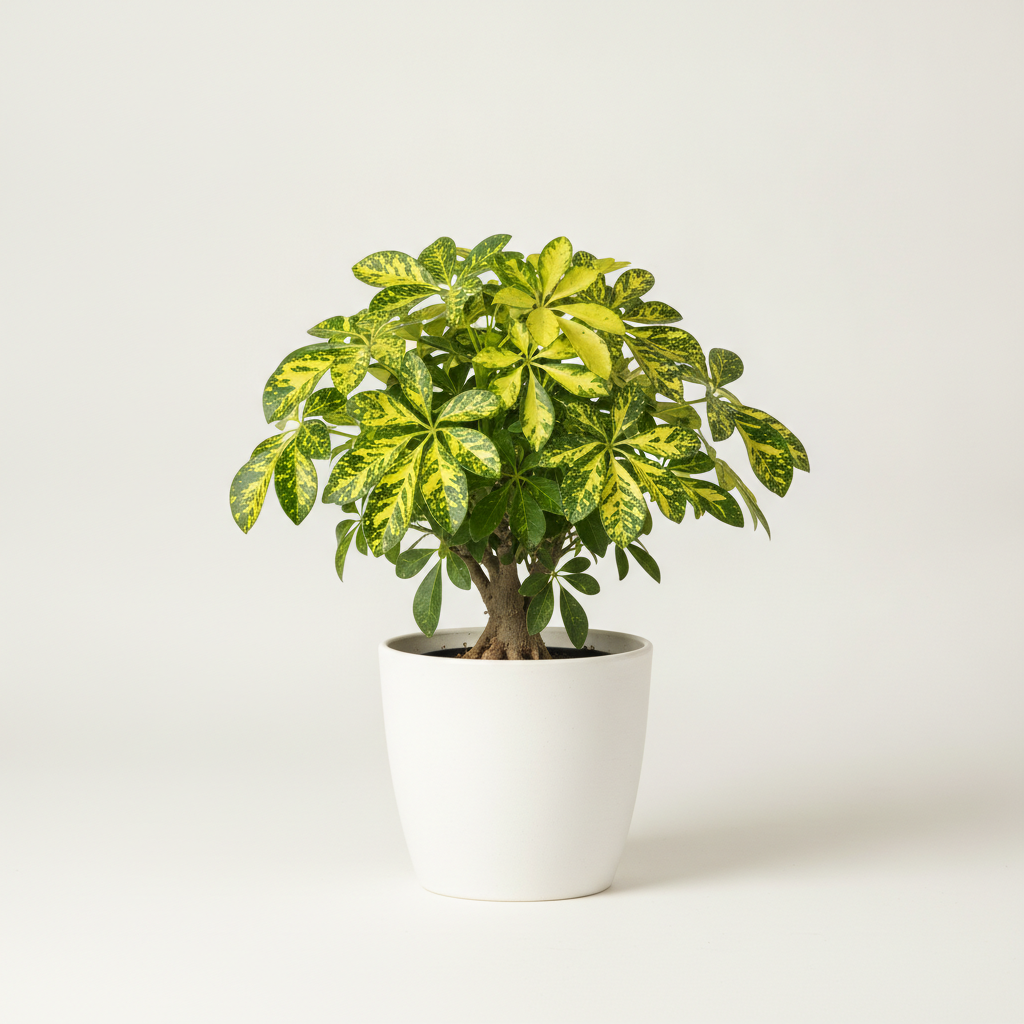
Gold Capella
The most widely grown variegated form, with glossy leaflets boldly splashed and marbled in golden-yellow against deep green. It brings warmth and light to a bonsai display and holds its colour best in bright conditions.
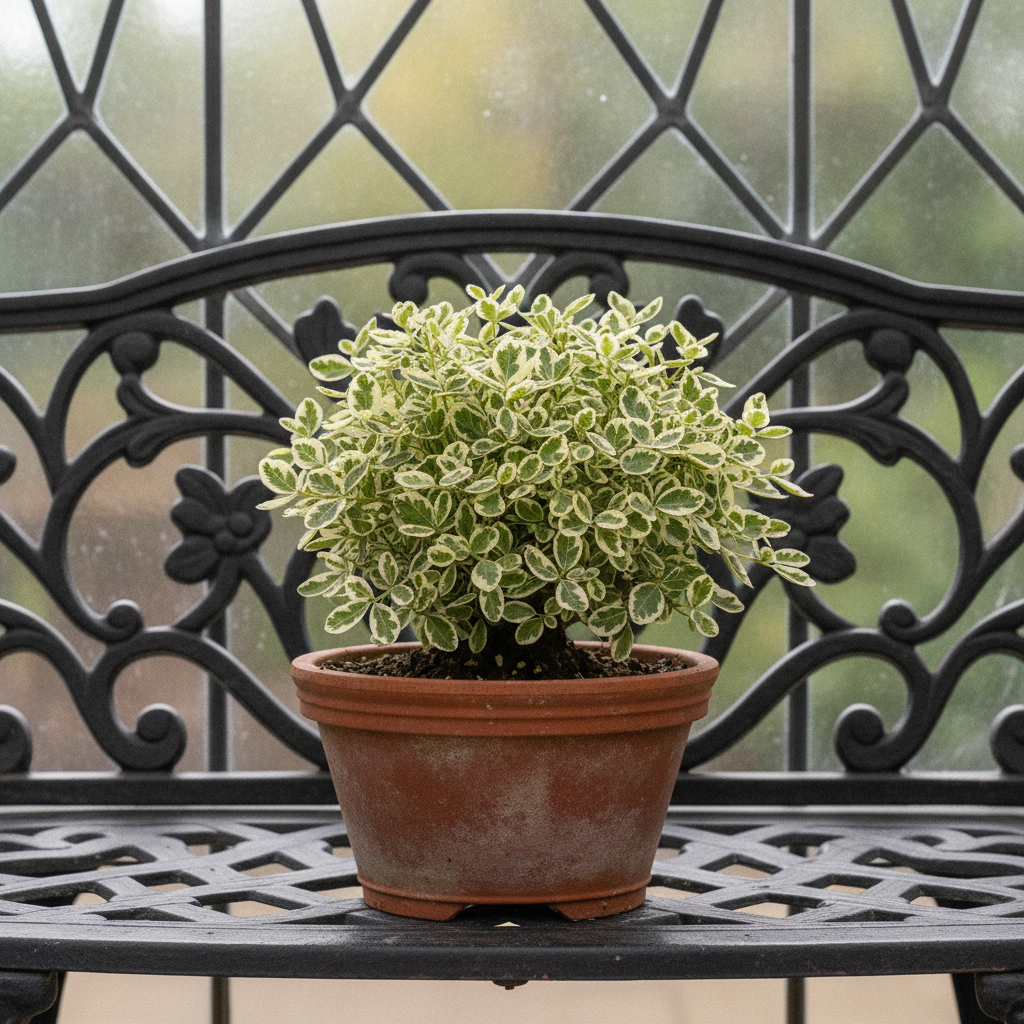
Trinette
A softer, cooler variegation of creamy white and pale green, giving a lighter, more delicate appearance. Slightly slower growing than Gold Capella, it makes an elegant, refined miniature tree.
Variety Profiles in Detail
Gold Capella (Schefflera arboricola ‘Gold Capella’)
Gold Capella is the workhorse variegated cultivar, vigorous and forgiving like the species but with striking gold marbling across the foliage. Because the yellow areas carry less chlorophyll, it needs generous light to grow strongly and keep its variegation, and it may revert to green in shade. Given good conditions it makes a bright, showy bonsai.
Trinette (Schefflera arboricola ‘Trinette’)
Trinette trades gold for a cooler cream-and-green palette that reads as more restrained and, to many eyes, more sophisticated. It is a touch less vigorous than Gold Capella, which can actually help in bonsai by keeping growth in check, but it shares the same need for bright light to hold clean variegation.
Choosing the Right Variety for Your Space
If your growing spot is only moderately lit, the plain green species is the safest and most rewarding choice, staying dense and dark without demanding strong sun. Where you can offer bright light or a good grow light, the variegated cultivars come into their own and add colour that plain green cannot. For a first bonsai, the green form remains the easiest to shape and keep looking its best.
Frequently Asked Questions
Why is my dwarf umbrella bonsai dropping leaves?
Leaf drop is the plant’s standard stress response and can follow overwatering, underwatering, a cold draught, a sudden move or a drop in light. Check the soil first: if it is soggy, ease off watering, and if it is bone dry, rehydrate gradually. Keep the plant warm, out of draughts and in stable bright light, and new growth usually follows.
How do I encourage aerial roots for a banyan style?
Aerial roots form most readily in warm, humid conditions. Growing the plant under a cover or in a humid greenhouse for part of the year, keeping temperatures up and the air moist, encourages roots to descend from the branches. Once they reach the soil and thicken, they can be trained into the dramatic root columns that make banyan-style Schefflera so distinctive.
Can I keep a dwarf umbrella bonsai outdoors?
It can spend the warm months outdoors in a bright, sheltered spot once temperatures are reliably above about 13 degrees C (55 degrees F), and often responds with strong growth. It is not frost hardy, however, so bring it back inside well before autumn nights turn cold. Acclimatise it gradually in both directions to avoid leaf drop.
How often should I prune it?
Because it grows quickly, a dwarf umbrella bonsai benefits from regular light pruning through the growing season to maintain its shape and build ramification. Pinch or trim back new shoots to a couple of leaves, and it will bud out below the cut. Harder structural pruning is best done in spring, when recovery is fastest.
Is the dwarf umbrella bonsai safe around pets?
No. Schefflera arboricola is toxic to cats and dogs due to insoluble calcium oxalate crystals, which cause oral irritation, drooling and vomiting if the plant is chewed. Keep it well out of reach of curious pets and children, and wash your hands after handling cut stems, as the sap can irritate skin.
Why are the leaves losing their variegation?
Variegated cultivars such as Gold Capella and Trinette revert to plain green when light is too low, because green leaves capture energy more efficiently. Move the plant somewhere brighter to preserve the markings, and prune out any fully green shoots promptly, as they tend to grow more vigorously and can gradually take over the plant.
How big will a dwarf umbrella bonsai get?
That is entirely up to you. Kept in a small bonsai pot and pruned regularly, it stays anywhere from 15 to 45 cm (6 to 18 in) tall, and the confined roots and trimming keep it miniature. Left in a larger pot and allowed to grow, the same plant would become a shrub of a metre or more, which is why pot size and pruning are the main levers of control.






