
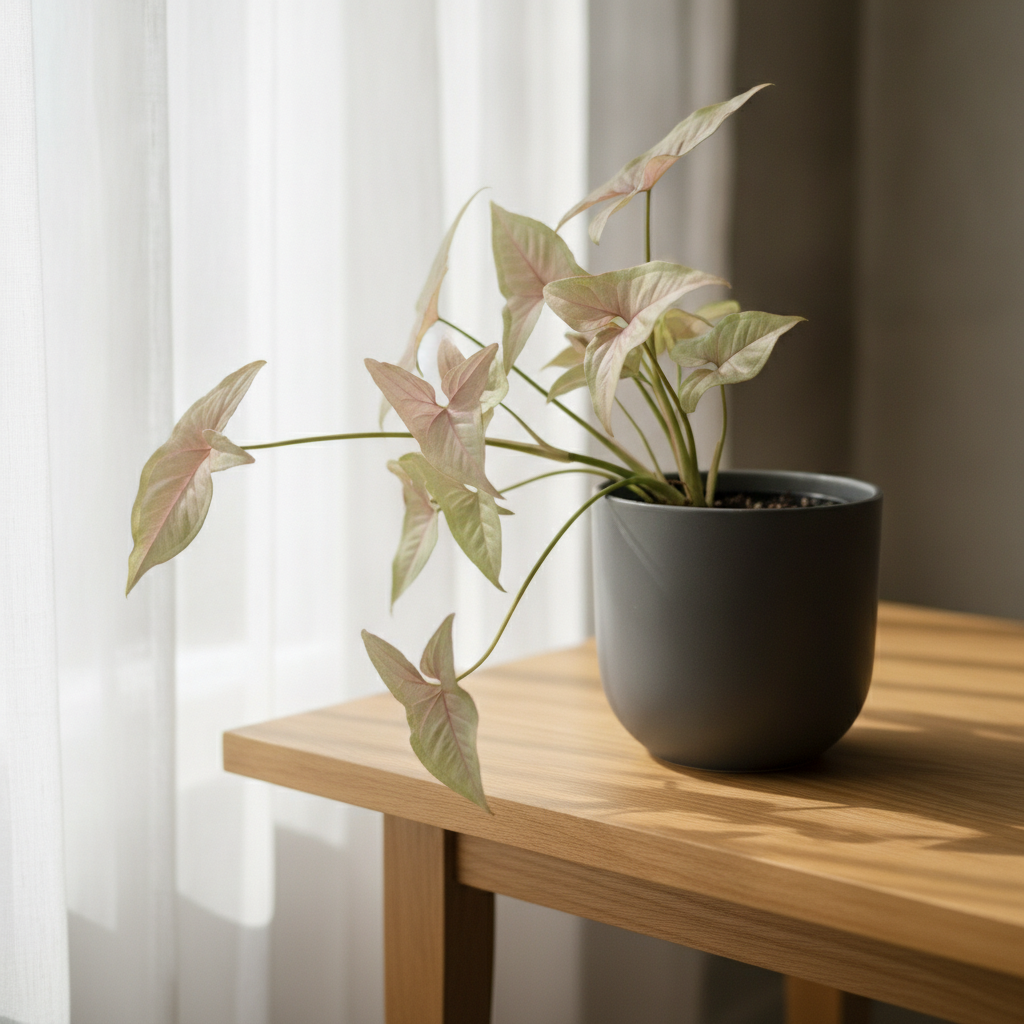
Few houseplants deliver a wash of soft colour as easily as the pink syngonium, a blush-toned form of Syngonium podophyllum known in most homes simply as the pink arrowhead plant. Native to the tropical forests of Central and South America, from Mexico down through Bolivia, it begins life as a low clump of neat arrow-shaped leaves and gradually reveals a climbing, trailing habit as it matures. The pink colouring, ranging from dusty rose to vivid bubblegum depending on the cultivar, has made it one of the most sought-after aroids of the past decade, and it remains far more forgiving than its designer looks suggest.
Its reputation is that of an easy, fast-growing plant, and that reputation is deserved. A pink syngonium will survive in a surprising range of conditions, tolerating average indoor light, ordinary potting compost and irregular watering without complaint. Yet there is a meaningful gap between a plant that survives and one that thrives, holding its pink pigment, pushing out fresh growth every few weeks and filling a pot with lush foliage. This guide walks through everything that closes that gap, from the specifics of light and water to propagation, pests and the growing family of named varieties.
Contents
- Quick Reference
- Why Pink Syngonium Makes a Rewarding Houseplant
- Light Requirements
- Watering & Humidity
- Soil, Potting & Repotting
- Fertilising
- Propagation
- Pests & Diseases
- Popular Varieties
- Frequently Asked Questions
Quick Reference: Pink Syngonium at a Glance
| Light | Bright, indirect light; the pink colour holds best in medium to bright indirect conditions, away from harsh direct sun |
| Watering | When the top 2 to 3 cm (1 inch) of compost feels dry, roughly every 5 to 9 days in growth |
| Temperature | 18 to 27 degrees Celsius (64 to 81 degrees Fahrenheit); avoid below 15 degrees Celsius (59 degrees Fahrenheit) |
| Humidity | Prefers 50 to 60 percent; tolerates average household air but grows lusher with more moisture |
| Fertiliser | Balanced liquid feed at half strength every 3 to 4 weeks in spring and summer |
| Toxicity | Toxic to cats, dogs and humans if chewed or swallowed; contains insoluble calcium oxalate crystals |
Why Pink Syngonium Makes a Rewarding Houseplant
The appeal of the pink syngonium starts with its colour, but its staying power as a houseplant comes from how obligingly it grows. It is genuinely fast, often producing a new leaf every one to two weeks through the warmer months, so a modest starter plant can fill out a pot within a single season. That pace makes it satisfying for beginners, who see visible progress quickly, and useful for anyone wanting to propagate and share. The plant also shifts form as it ages, beginning as a compact rosette of solid arrowhead leaves and, given something to climb, developing longer internodes and more lobed, mature foliage.

It is also remarkably adaptable to the realities of a home. Unlike its close relatives among the calatheas and marantas, the pink syngonium is not especially fussy about tap water, humidity or missed waterings, and it recovers well from the occasional lapse. This resilience, combined with its versatility as a tabletop plant, a hanging trailer or a climber trained up a moss pole, means one plant can suit almost any spot. The main thing that separates a thriving specimen from a merely surviving one is light, which governs both the vigour of new growth and the intensity of the prized pink pigment.
Important — Toxicity: All parts of the pink syngonium contain insoluble calcium oxalate crystals, which cause burning and swelling of the mouth, drooling and difficulty swallowing if chewed by pets or children. The sap can also irritate sensitive skin. Keep the plant out of reach of curious cats, dogs and toddlers, and consider wearing gloves when taking cuttings.
Light Requirements
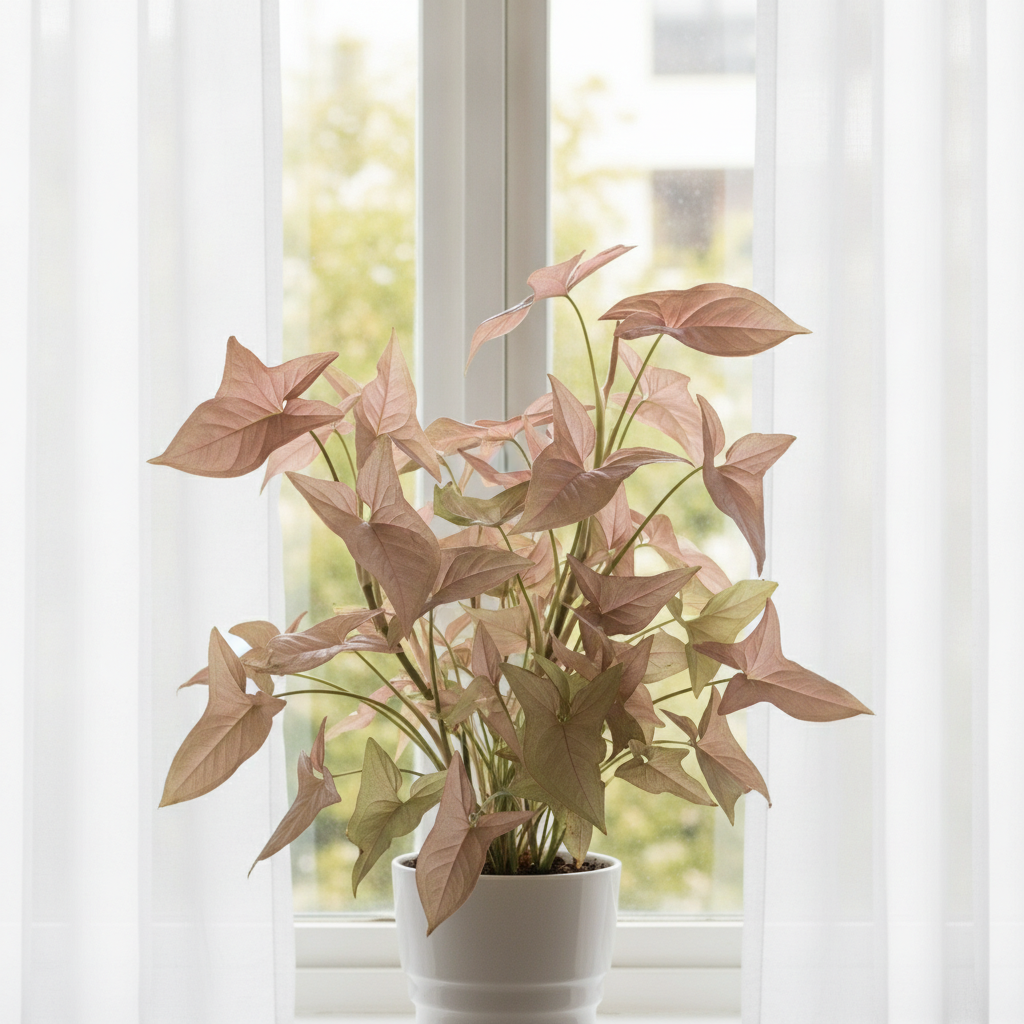
Light is the single most important factor in growing a good-looking pink syngonium, because it controls both how fast the plant grows and how much pink it holds. In its native understorey habitat the plant receives dappled, filtered light beneath a canopy, so it is adapted to bright conditions without direct tropical sun striking the leaves for hours at a time. Indoors, the sweet spot is bright, indirect light: enough brightness to keep colour saturated and growth compact, but shielded from the scorching midday beam that can bleach and burn the tender foliage.
Pink-variegated syngoniums are more light-hungry than their all-green cousins because their leaves contain less chlorophyll to power growth. Placed in dim corners they survive but sulk, producing smaller, greener, more widely spaced leaves as the plant reaches for light. Given generous indirect light, the same plant fills out densely and its new growth emerges a richer pink. The goal is to find the brightest position that still keeps direct sun off the leaves for most of the day.
Light Levels Explained
Understanding how indoor light categories translate to real placements helps you judge a spot before you commit a plant to it. The values below are approximate but give a useful sense of scale.
| Light Category | Approx. Level | Typical Location | Outcome |
|---|---|---|---|
| Direct sun | 20,000 lux and up | On an unshaded south or west sill | Risk of scorch and faded, bleached leaves |
| Bright indirect | 10,000 to 20,000 lux | Near an east window or behind a sheer curtain | Best colour and dense, vigorous growth |
| Medium | 5,000 to 10,000 lux | A metre or two back from a bright window | Good growth, colour slightly softer |
| Low | 1,000 to 5,000 lux | A north window or interior wall | Survives but leggy, greener, slow |
| Very low | Below 1,000 lux | A dim hallway or windowless room | Decline over time; not recommended |
Window Orientation and Placement
South-facing window: The brightest exposure in the northern hemisphere, and often too intense directly on the sill. Set the plant a little back from the glass, or diffuse the light with a sheer curtain, and a south window becomes one of the best positions for strong pink colour.
East-facing window: Arguably the ideal spot. Gentle morning sun is rarely strong enough to burn, and the bright indirect light for the rest of the day keeps growth compact and colourful. Most pink syngoniums thrive on or beside an east sill.
West-facing window: Bright afternoon light works well provided the harsher direct beams are filtered. Watch for scorch during summer heatwaves and pull the plant back or add a curtain if leaves begin to pale.
North-facing window: The dimmest exposure, workable but not optimal. Expect greener, more open growth and slower development. If a north window is your only option, consider supplementing with a grow light to preserve the pink.
Pro Tip — Rotate for Even Growth: Syngoniums lean noticeably toward their light source. Give the pot a quarter turn each time you water so every side receives its share and the plant grows symmetrically rather than sprawling toward the window.
How Light Affects Pink Colour
The pink pigment in these plants is not fixed; it responds to how much light the leaves receive. In bright indirect light the pink deepens and spreads, and new leaves can emerge almost entirely rose-toned. In low light the plant redirects its limited energy into producing more chlorophyll, so fresh growth comes out greener and the existing pink can fade. If your plant is losing its colour, the most common cause is simply too little light, and moving it somewhere brighter usually reverses the trend over a few growth cycles.
Warning — Direct Sunlight: While the plant needs plenty of light for good colour, prolonged direct sun scorches the delicate pink tissue, leaving crisp brown patches and washed-out, bleached areas that never recover. Increase light gradually and always keep the fierce midday sun off the leaves.
Artificial Lighting
Pink syngoniums respond very well to supplemental lighting, which makes them a good choice for homes short on natural light. A full-spectrum LED grow light positioned 30 to 45 cm (12 to 18 inches) above the plant and run for 10 to 12 hours a day will maintain strong colour and steady growth through the darkest months. Because the pigment is light-dependent, growers who struggle to keep the pink vivid often find that a modest grow light solves the problem entirely.
Seasonal Adjustments
Indoor light falls dramatically between summer and winter, both in intensity and day length. As autumn arrives, move the plant closer to its window or add supplemental lighting to compensate, and expect growth to slow regardless. In summer, keep an eye on intensified direct light through south and west windows, pulling the plant back or adding diffusion so the stronger sun does not scorch leaves that grew accustomed to gentler winter conditions.
Watering & Humidity
The pink syngonium likes consistent, moderate moisture, sitting comfortably between the thirsty ferns and the drought-tolerant succulents. It wants its compost to stay lightly moist but never waterlogged, and it prefers a rhythm of thorough watering followed by a partial dry-down. Getting this rhythm right is the second pillar of good care after light, and overwatering is the single most common way these plants are killed.
When to Water
Rather than watering on a fixed calendar, check the compost with your finger and water when the top 2 to 3 cm (about 1 inch) has dried out. In a bright spot during spring and summer this typically means watering every 5 to 9 days, but the interval stretches considerably in winter when growth slows and the compost stays wet longer. Pot size, material, temperature and light all shift the timing, so the feel of the soil is always a more reliable guide than the number of days.
The plant tells you when it is thirsty. A syngonium that has gone too dry droops and its leaves lose their firmness, then bounce back within hours of a good drink, which makes it quite forgiving of the occasional missed watering. What it forgives far less readily is standing in saturated compost, so when in doubt it is safer to wait an extra day than to water a pot that is still damp below the surface.
Pro Tip — Lift the Pot: Learn the weight of your plant right after a thorough watering and again when it needs water. A freshly watered pot is noticeably heavy and a dry one feels light, so a quick lift becomes an instant, mess-free moisture check once you know the difference.
How to Water Correctly
- Check that the top 2 to 3 cm (1 inch) of compost is dry before you begin.
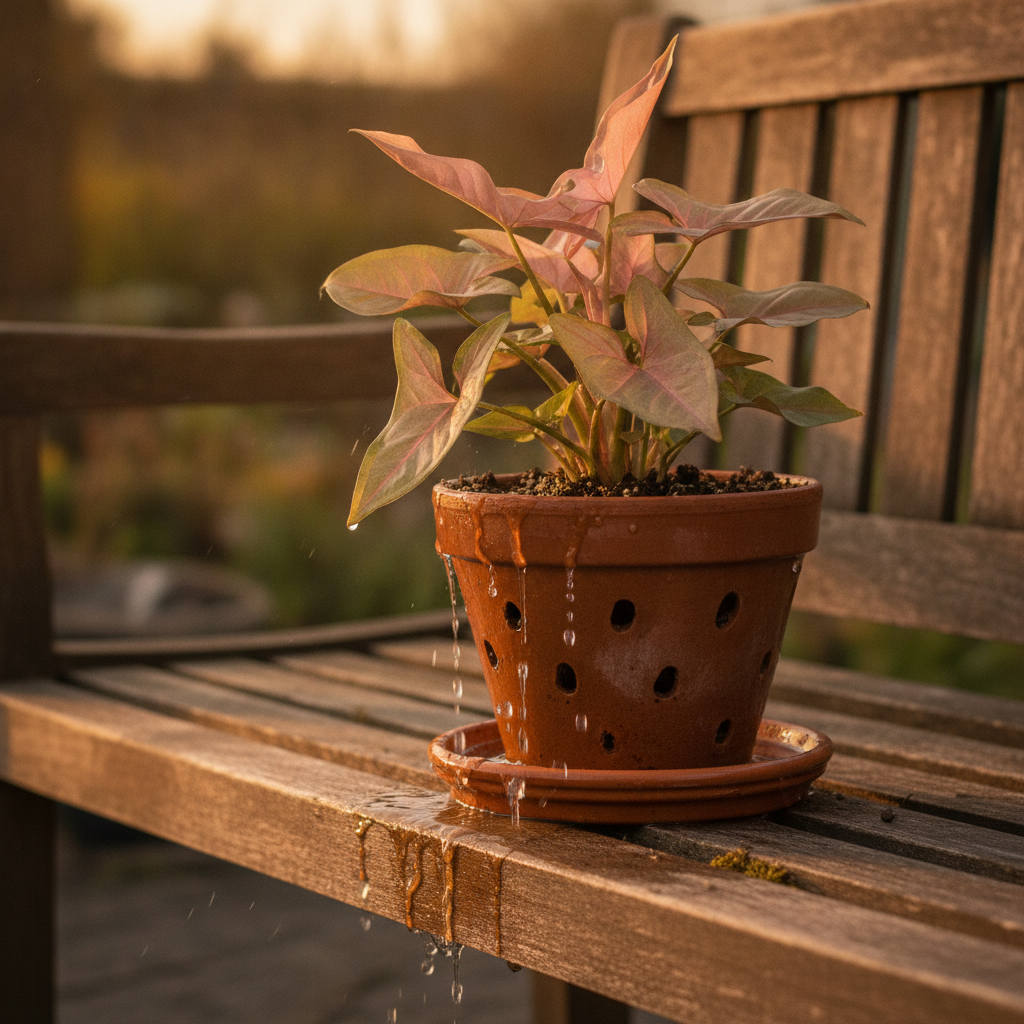
- Water slowly and evenly over the surface until liquid runs freely from the drainage holes.
- Let the pot drain completely for several minutes so no excess water is trapped at the base.
- Empty the saucer or cachepot; never leave the plant sitting in collected water.
- Return the plant to its spot and wait until the top layer dries again before the next watering.
Signs of Overwatering vs. Underwatering
| Symptom | Overwatering | Underwatering |
|---|---|---|
| Leaf colour | Yellowing, often several leaves at once | Browning, crisp leaf edges and tips |
| Leaf texture | Soft, limp, sometimes translucent | Dry, papery, curling inward |
| Soil | Constantly wet, may smell sour | Bone dry, pulling away from the pot sides |
| Roots | Brown, mushy, foul-smelling | Dry and brittle but generally intact |
| Overall | Wilting despite wet soil | Drooping that revives quickly after watering |
Warning — Root Rot: Persistent overwatering suffocates the roots and invites rot, which spreads fast and can kill an otherwise healthy plant. If you find brown, mushy, foul-smelling roots, unpot immediately, trim away all affected tissue with clean scissors, and repot into fresh, well-draining compost.
Humidity Requirements
As a tropical understorey plant the pink syngonium enjoys humidity in the range of 50 to 60 percent, though it is far more tolerant of dry air than its prayer-plant relatives. It will grow perfectly well in average household humidity, but higher moisture encourages larger leaves, faster growth and fewer crispy edges, so it rewards a little extra effort without demanding it.
The main sign that the air is too dry is browning and crisping along the leaf edges and tips, most noticeable in winter when central heating strips moisture from the room. This is cosmetic rather than dangerous, but if it bothers you it points to raising humidity around the plant.
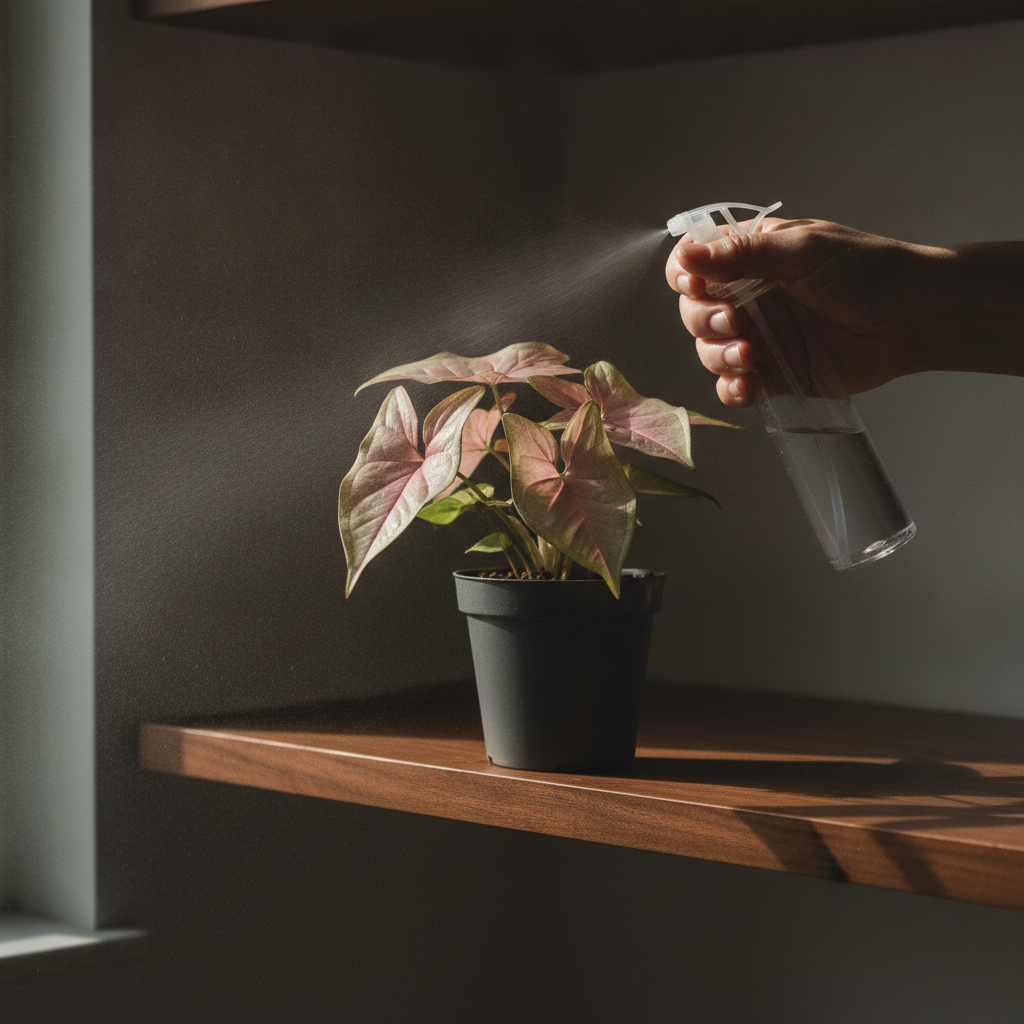
The most effective ways to raise humidity are grouping plants together so they share the moisture they transpire, standing the pot on a tray of damp pebbles kept topped up with water, or running a small room humidifier during the driest months. Misting offers only a brief lift and does little for sustained humidity, so it is the least reliable of the options.
Water Quality
One of the pink syngonium’s virtues is its indifference to water quality. It handles ordinary tap water without the leaf-tip burn that plagues fussier aroids, so there is usually no need for filtered or distilled water. If your supply is heavily chlorinated or very hard, letting the water stand overnight or using collected rainwater is a gentle refinement, but for most homes straight from the tap is entirely fine.
Soil, Potting & Repotting
The right growing medium underpins everything else, because it governs how water and air move around the roots. The pink syngonium wants a mix that holds enough moisture to stay lightly damp yet drains freely so the roots are never suffocated. As an aroid with fleshy roots adapted to loose forest floor litter, it does best in a chunky, airy blend rather than dense, water-retentive compost.
Ideal Soil Composition
A good syngonium mix starts with a quality peat-free houseplant compost as its moisture-holding base, then adds coarse material to open it up. The aim is a medium that feels loose and springy in the hand, holding together when moist but falling apart easily, with plenty of visible chunky particles to create air pockets around the roots.
| Component | Proportion | Function |
|---|---|---|
| Houseplant compost | 50 percent | Holds moisture and nutrients, the base of the mix |
| Orchid bark | 20 percent | Creates air pockets and structure for the roots |
| Perlite | 20 percent | Improves drainage and keeps the mix from compacting |
| Coco coir or worm castings | 10 percent | Adds gentle moisture retention and light nutrition |
The pink syngonium is not particular about pH but is happiest in the slightly acidic to neutral range of about 5.5 to 6.5, which most standard houseplant composts already provide. There is rarely any need to test or adjust pH for this plant.
Pro Tip — Quick Mix Recipe: For a fuss-free blend, combine two handfuls of houseplant compost with one handful of perlite and one handful of orchid bark. This roughly 2:1:1 ratio gives the moisture-retentive yet airy structure syngoniums love, using ingredients available at any garden centre.
Choosing the Right Pot
The container matters as much as what goes in it, because pot size, material and drainage all affect how quickly the compost dries and how healthy the roots stay.
Drainage holes are non-negotiable. Whatever pot you choose must have holes in the base so excess water can escape. Without them water pools at the bottom and root rot becomes almost inevitable, no matter how careful your watering. If you love a decorative pot with no holes, use it as a cachepot and keep the plant in a plain nursery pot inside it.
Pot material: Plastic and glazed ceramic retain moisture longer and suit the syngonium’s liking for consistent dampness, meaning less frequent watering. Terracotta breathes and dries faster, which can be helpful if you tend to overwater but means you will need to water more often.
Pot size: Choose a pot only 2 to 4 cm (1 to 2 inches) wider than the current root ball. Syngoniums actually flower and grow best when slightly snug, and an oversized pot holds a large volume of wet compost the roots cannot use, raising the risk of rot.
When to Repot
Given its fast growth, a pink syngonium usually needs repotting every one to two years. Tell-tale signs include roots emerging from the drainage holes or circling the surface, water running straight through without wetting the compost, and growth slowing despite good care. Spring and early summer are the best times, letting the plant recover in its active growing season.
How to Repot: Step-by-Step
- Water the plant a day beforehand so the root ball is hydrated and slides out cleanly.
- Ease the plant from its pot, supporting the base of the stems, and tease apart any tightly circling roots.
- Inspect the roots, trimming away anything brown, soft or rotten with clean scissors.
- Add a layer of fresh mix to a pot one size larger and position the plant at its previous depth.
- Fill around the root ball with fresh compost, firming gently to remove large air gaps.
- Water thoroughly, let it drain, and return the plant to bright indirect light.
Warning — Transplant Shock: A little drooping or a paused leaf or two in the days after repotting is normal as the plant adjusts. Do not overwater in an effort to help; keep conditions stable, hold off on feeding for a month, and let the roots settle before expecting new growth.
Fertilising
Because the pink syngonium grows so quickly, it draws steadily on the nutrients in its compost, which become depleted within a couple of months of potting. Regular feeding through the growing season replaces what the plant uses and keeps foliage lush, colour strong and growth continuous.
That said, syngoniums are light feeders by aroid standards and are easily over-fed. More fertiliser does not mean more growth, and excess simply accumulates in the compost as harmful salts. A modest, regular approach at reduced strength produces far better results than heavy feeding.
Understanding Plant Nutrients
Fertilisers are labelled with an NPK ratio showing the percentages of nitrogen, phosphorus and potassium, the three nutrients plants need in the largest quantities. A balanced feed such as 10-10-10, or a foliage-oriented one slightly higher in nitrogen, suits the leafy pink syngonium well. Alongside these, plants draw on secondary nutrients and micronutrients, and deficiencies in any of them show up in the leaves.
| Nutrient | Symbol | Primary Function | Deficiency Symptoms |
|---|---|---|---|
| Nitrogen | N | Leaf and stem growth, green pigment | Uniform yellowing of older leaves, weak growth |
| Phosphorus | P | Root development and energy transfer | Dull leaves, stunted roots, slow growth |
| Potassium | K | Overall vigour and water regulation | Yellow or brown leaf margins |
| Calcium | Ca | Cell wall structure | Distorted, weak new growth |
| Magnesium | Mg | Core of the chlorophyll molecule | Yellowing between the veins of older leaves |
| Iron | Fe | Chlorophyll production | Yellowing between veins of new leaves |
Types of Fertiliser
Liquid fertilisers: The most popular and controllable choice, diluted in water and applied during watering. They act quickly and let you scale back or pause feeding easily, which suits the syngonium’s modest appetite.
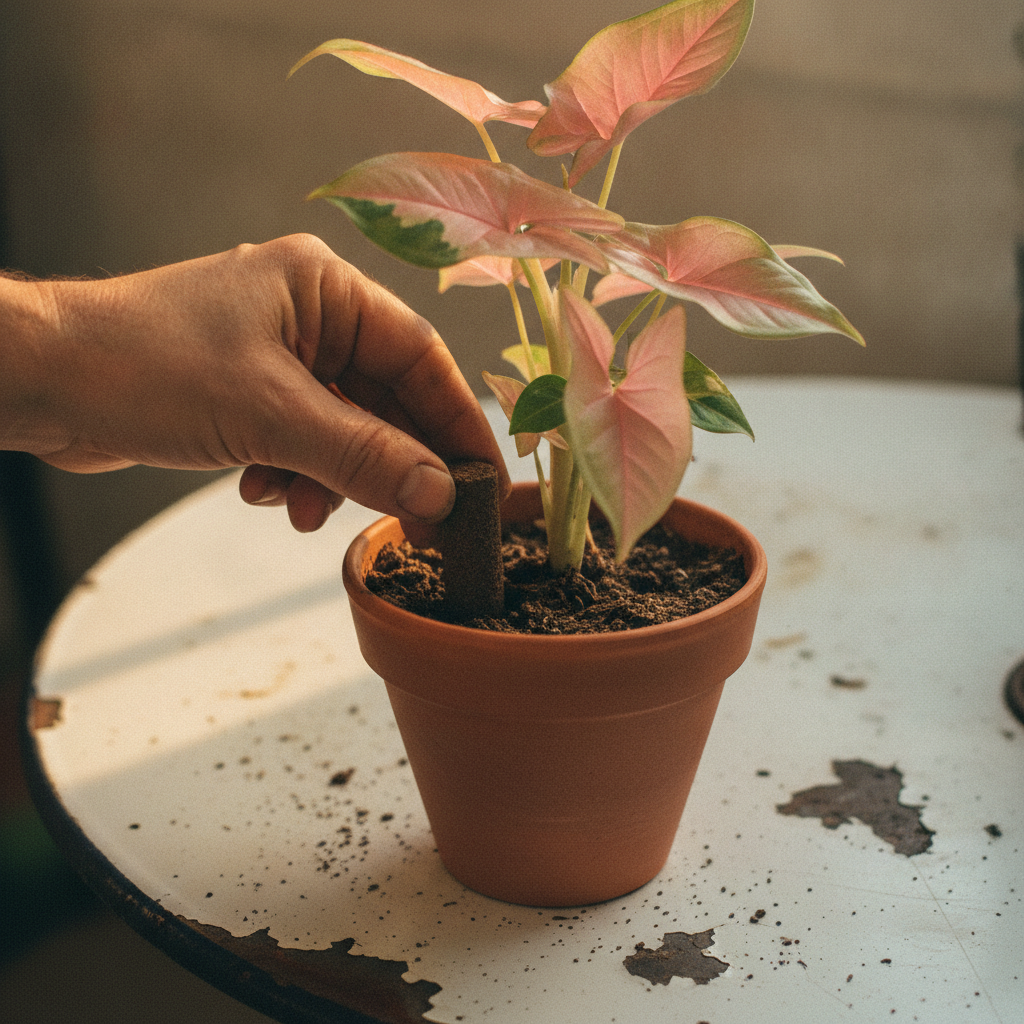
Slow-release granular: Coated prills or pushed-in sticks that release nutrients gradually over several months. Convenient for hands-off growers, though they offer less precise control over dose and timing.
Organic fertilisers: Worm castings, seaweed extract and similar gentle feeds nourish the plant while improving the soil biology. They are mild and very hard to over-apply, making them a safe option for the light-feeding syngonium.
Feeding Schedule
Feed every three to four weeks with a balanced liquid fertiliser at half the recommended strength through spring and summer, the plant’s active growing period. As growth slows in autumn, taper off, and stop feeding entirely through winter when the plant is resting and cannot use the extra nutrients. Resume in spring as new growth appears.
Pro Tip — Feed a Moist Pot: Always apply liquid fertiliser to compost that is already damp, never bone dry. Feeding into dry soil concentrates the salts against thirsty roots and can scorch them, so water lightly first or feed as part of your normal watering.
How to Fertilise
- Dilute a balanced liquid fertiliser to half the strength stated on the label.
- Make sure the compost is already moist from a recent watering.
- Pour the diluted feed evenly over the surface until it begins to drain.
- Discard any excess from the saucer so salts do not accumulate at the base.
- Repeat every three to four weeks during spring and summer only.
Warning — Salt Build-Up: Over time fertiliser salts accumulate in the compost and show up as a white crust on the surface or pot rim, along with brown leaf tips. Every couple of months, flush the pot by running plenty of plain water through it to leach out the excess.
Propagation
Propagating a pink syngonium is one of the easiest and most rewarding jobs in houseplant keeping. The plant roots readily from stem cuttings, so a single vigorous specimen can quickly become several, and the same cuttings you take to control legginess become new plants to keep or give away.
The best time to propagate is spring or summer, when the plant is growing actively and cuttings root fastest. Success rates are high enough that even complete beginners can expect roots within a couple of weeks, making this a perfect first propagation project.
Understanding Nodes
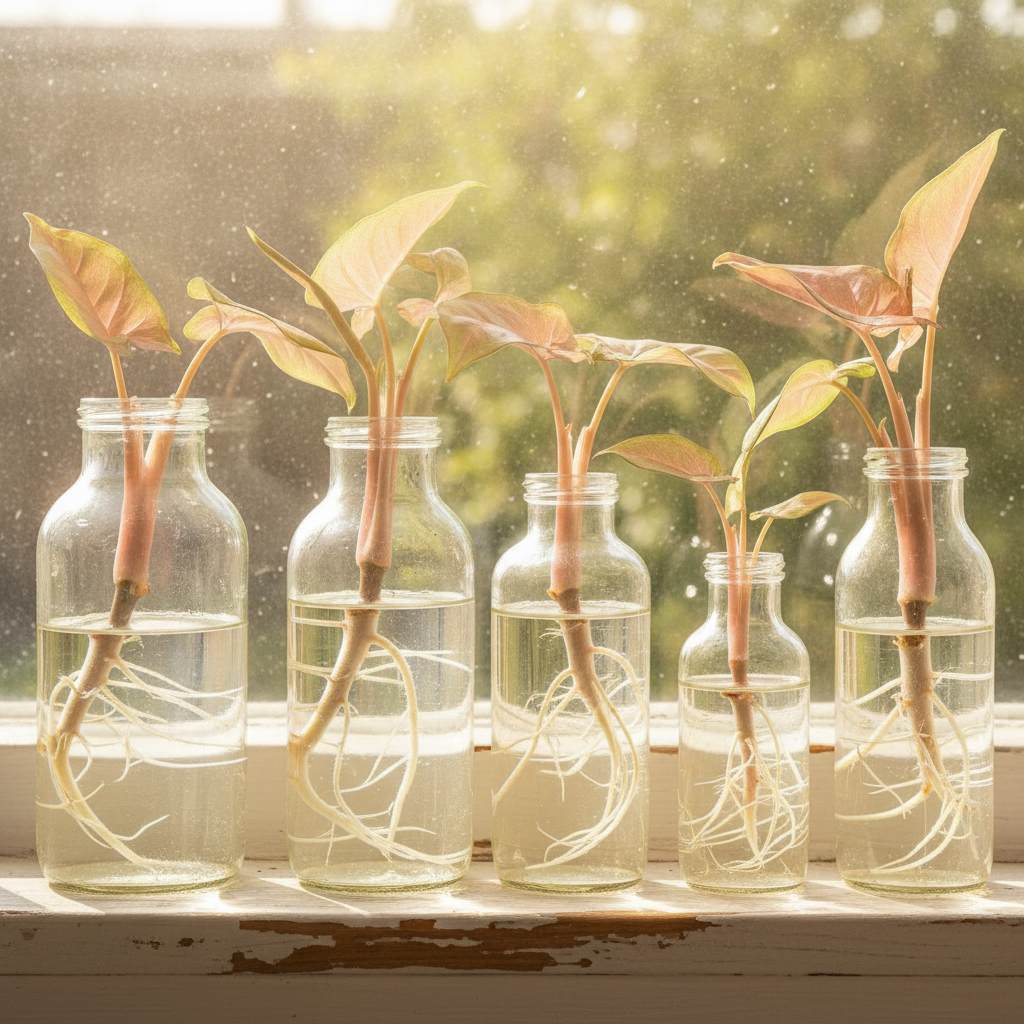
The key to propagating any syngonium is the node, the slightly swollen point on the stem where a leaf joins and where aerial roots often emerge. Every viable cutting must include at least one node, because this is where new roots and shoots develop. A leaf alone, without a node, will never root into a new plant. Look along the stem for these joints, frequently marked by small brown nubs of aerial root, before you make any cut.
Water Propagation: Step-by-Step
Rooting cuttings in water is the most popular method because it is simple and lets you watch the roots develop, which is both reassuring and satisfying.
- Choose a healthy stem and cut just below a node with clean, sharp scissors, keeping at least one leaf on the cutting.
- Remove any lower leaves that would sit below the waterline to prevent rot.
- Place the cutting in a clear glass of room-temperature water so the node is submerged but the remaining leaves stay dry.
- Set the glass in bright indirect light and refresh the water every few days to keep it clean and oxygenated.
- Once the new roots reach 3 to 5 cm (1 to 2 inches), usually within two to four weeks, pot the cutting into moist compost.
Pro Tip — Ease the Transition: Water roots differ from soil roots, so keep a freshly potted cutting a little more evenly moist than usual for its first two or three weeks. This helps the delicate new roots adapt to compost without drying out and stalling.
Soil Propagation: Step-by-Step
Rooting directly in compost skips the transplant step and often produces sturdier roots, at the cost of not being able to see progress.
- Take a node-bearing cutting as for water propagation and let the cut end dry for an hour.
- Optionally dip the cut end in rooting hormone to encourage faster rooting.
- Insert the node into a small pot of moist, airy propagation mix so it is buried but the leaves sit above the surface.
- Cover loosely with a clear bag or propagator lid to hold humidity, ventilating occasionally to prevent mould.
- Keep the mix lightly moist in bright indirect light; a gentle tug after three to four weeks that meets resistance confirms roots have formed.
Troubleshooting Propagation
| Problem | Likely Cause | Solution |
|---|---|---|
| Cutting rots in water | Leaves submerged or water left stale | Remove lower leaves and refresh the water every few days |
| No roots after a month | Low light or cold conditions | Move to a warmer, brighter spot and be patient |
| Cutting wilts in soil | Mix too dry or humidity too low | Keep lightly moist and tent with a clear bag |
| No node on the cutting | Only a leaf was taken | Recut to include a node; leaves alone cannot root |
Pests & Diseases
The pink syngonium is a robust plant that is not especially prone to pests, but like any houseplant it can occasionally be troubled by the usual sap-sucking insects, particularly when air is dry or a new plant brings hitchhikers into the home. Catching an infestation early makes it far easier to control.
The best defence is regular inspection. Whenever you water, take a moment to look over the leaves, especially their undersides and the points where leaves meet the stem, so any problem is caught while it is still small and easily dealt with.

Common Pests
Spider Mites (Tetranychus urticae)
Tiny sap-suckers that thrive in warm, dry air and cause fine yellow stippling on the leaves, often with delicate webbing between stems and along leaf undersides. Left unchecked they weaken the plant and cause leaves to dry and drop.
Treatment: Rinse the plant thoroughly, raise humidity, and treat with insecticidal soap or neem oil every five to seven days until the mites are gone. Isolate the plant to stop them spreading.
Mealybugs (Pseudococcus species)
Small white, cottony insects that cluster in leaf axils and along stems, sucking sap and excreting sticky honeydew. They reproduce quickly and can hide in the dense centre of a bushy syngonium.
Treatment: Dab each insect with a cotton bud dipped in isopropyl alcohol, then follow up with neem oil or insecticidal soap. Repeat weekly and check regularly, as stragglers often reappear.
Aphids (Aphidoidea)
Soft-bodied green, black or pink insects that gather on tender new growth, distorting fresh leaves and leaving sticky honeydew behind. Pink syngonium’s soft new shoots are exactly what they seek out.
Treatment: Blast them off with a firm spray of water, then treat with insecticidal soap or neem oil. Keep checking new growth, where they tend to return.
Common Diseases
Root Rot (Pythium and Phytophthora species)
By far the most serious threat to a pink syngonium, caused by fungal pathogens that flourish in waterlogged compost. Signs include yellowing, wilting leaves despite wet soil and soft, brown, foul-smelling roots.
Treatment: Unpot the plant, cut away all rotten roots with sterile scissors, and repot into fresh, well-draining compost. Correct the watering habits that caused it and reduce watering while the plant recovers.
Bacterial Leaf Spot (Xanthomonas species)
Water-soaked dark spots, sometimes ringed with yellow, that spread across the leaves in persistently wet, humid conditions or when water sits on the foliage.
Treatment: Remove affected leaves, improve air circulation, and avoid wetting the foliage when watering. Keep the plant a little drier and less crowded until it recovers.
Pest and Disease Summary
| Pest / Disease | Identification | Treatment |
|---|---|---|
| Spider mites | Yellow stippling and fine webbing | Rinse, raise humidity, neem oil or insecticidal soap |
| Mealybugs | White cottony clusters in leaf axils | Alcohol swab then neem oil, repeat weekly |
| Aphids | Clusters on new growth, sticky honeydew | Water spray then insecticidal soap |
| Root rot | Wilting in wet soil, mushy brown roots | Trim rotten roots, repot, correct watering |
| Bacterial leaf spot | Dark water-soaked spots with yellow halos | Remove leaves, improve airflow, keep foliage dry |
Prevention Strategies
Prevention is far easier than cure. Quarantine every new plant for a couple of weeks before it joins your collection, inspect regularly during watering, and keep the foliage clean by wiping the leaves occasionally, which removes dust and any early pests before they establish.
Good cultural conditions are the best protection of all. A plant grown in appropriate light, watered correctly and not stressed by extremes is naturally more resistant, while weakened plants in poor conditions are the ones pests and diseases target first.
Pro Tip — Neem as Routine Defence: A monthly preventive spray of diluted neem oil over the leaves, especially the undersides, deters most common pests before they take hold. Apply in the evening or out of direct sun so the treated leaves do not scorch.
Popular Varieties
Pink syngonium is not a single plant but a whole spectrum of cultivars of Syngonium podophyllum, ranging from barely-blushed greens to leaves that emerge almost entirely rose. The breeding of new pink forms has accelerated in recent years, and the choice can be delightfully bewildering.
The varieties below differ mainly in the intensity and pattern of their pink, and to a lesser degree in leaf shape and vigour. All share the same easy care, so choosing between them is largely a matter of the look you prefer and what your light can support, since the pinkest forms need the most light to stay colourful.
| Variety | Leaf Appearance | Light Needs | Growth Rate | Availability |
|---|---|---|---|---|
| Neon Robusta | Vivid bubblegum-pink arrowheads | Bright indirect | Fast | Common |
| Pink Allusion | Pale green flushed with rose, pink veins | Medium to bright | Moderate | Common |
| Berry Allusion | Green with pink veins and a coppery cast | Medium to bright | Moderate | Common |
| Pink Splash | Green speckled and splashed with pink | Bright indirect | Fast | Common |
| Strawberry Cream | Soft salmon-pink new growth | Bright indirect | Fast | Fairly common |
| Milk Confetti | Pale green freckled with fine pink dots | Bright indirect | Moderate | Less common |
| Red Spot Tricolor | Green, cream and deep pink variegation | Bright indirect | Moderate | Collector |
Featured Varieties
Neon Robusta
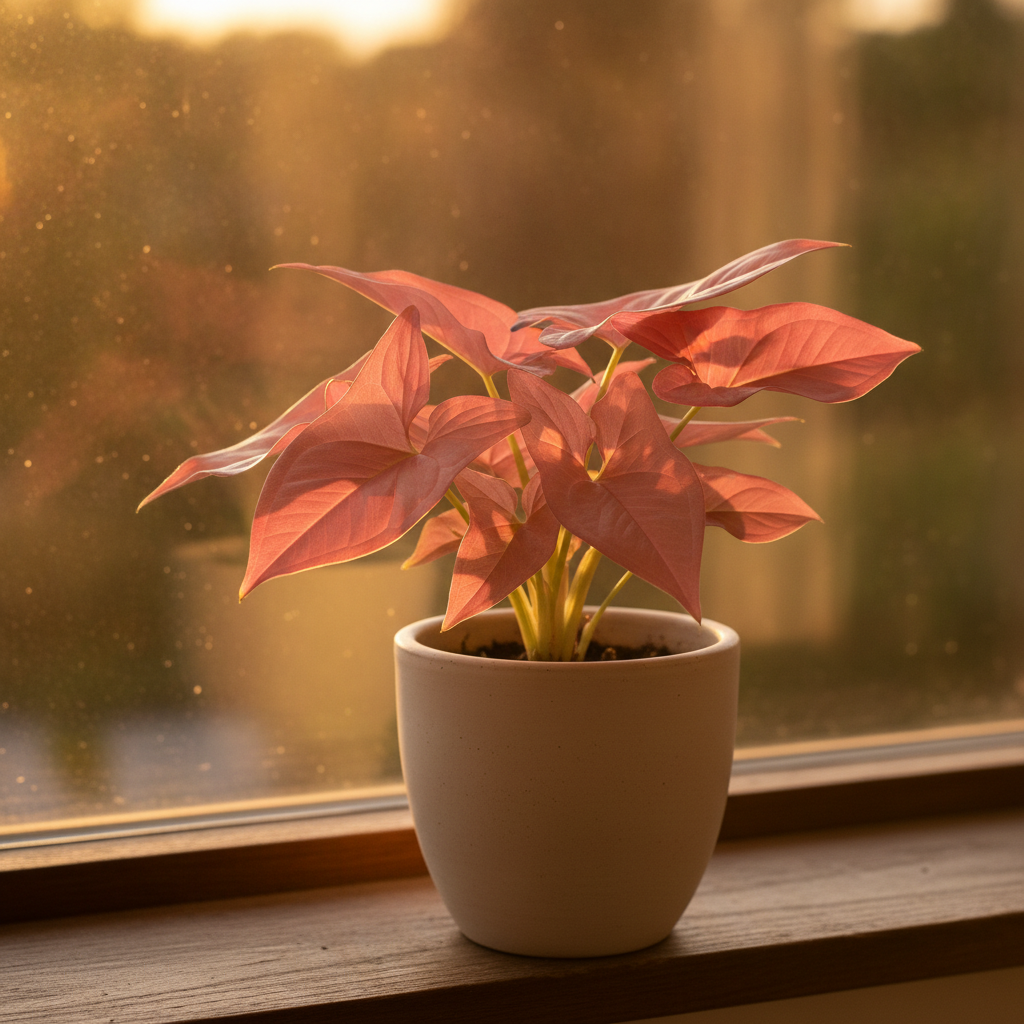
The most iconic pink syngonium, with vivid bubblegum-pink arrowhead leaves that deepen in bright indirect light. Fast, forgiving and widely available, it is the variety most people picture when they hear the name.
Pink Allusion
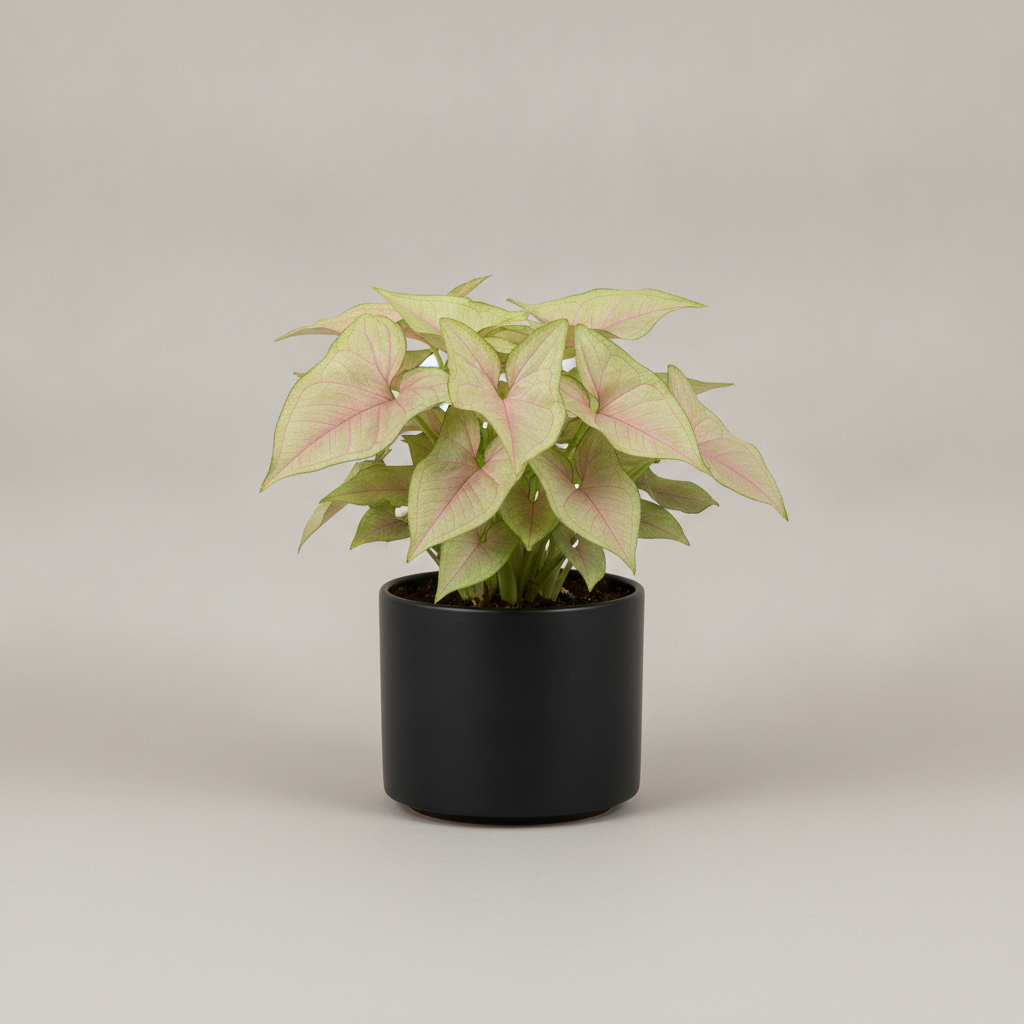
A softer, more subtle beauty with pale creamy-green leaves veined and flushed in gentle rose-pink. Its restrained colouring holds well in slightly lower light, making it the easiest pink form for average rooms.
Variety Profiles in Detail
Neon Robusta (Syngonium podophyllum ‘Neon Robusta’)
The benchmark pink syngonium, prized for the sheer saturation of its colour. New leaves can emerge almost solid pink and mature to a softer rose-green, and in good light the whole plant glows. It is vigorous to the point of needing regular pruning, and those trimmings root effortlessly, so a single Neon Robusta soon becomes many.
Pink Allusion (Syngonium podophyllum ‘Pink Allusion’)
Part of the Allusion series bred for compact, tidy growth, Pink Allusion pairs pale arrowhead leaves with delicate pink veins and a soft overall blush. Because its colour is gentler it copes better with medium light than the bolder pinks, and its neat habit suits smaller spaces and tabletops.
Red Spot Tricolor (Syngonium podophyllum ‘Red Spot Tricolor’)
A collector’s variety with striking three-tone leaves of green, cream and deep rose-pink, no two quite alike. Its variegation makes it a little slower and more demanding of bright light to keep the pink from reverting, but a well-grown specimen is among the most spectacular of all the pink syngoniums.
Choosing the Right Variety for Your Space
Match the variety to your light before your taste. If you have a bright east or filtered south window, the boldest pinks like Neon Robusta and Red Spot Tricolor will reward you with intense colour. In more average light, a softer form such as Pink Allusion or Berry Allusion will look better and stay healthier, holding what colour it has without the disappointment of fading. Whatever you choose, the care is the same, so the only real decision is which shade of pink you want to live with.
Frequently Asked Questions
Why is my pink syngonium losing its pink colour?
The most common reason is insufficient light. The pink pigment is light-dependent, so in dim conditions the plant produces greener leaves to maximise photosynthesis. Move it to a brighter spot with plenty of indirect light, or add a grow light, and new growth should return to a richer pink over the next few cycles.
Is the pink syngonium safe around pets?
No. Like all syngoniums it contains insoluble calcium oxalate crystals that are toxic to cats and dogs, causing mouth irritation, drooling and vomiting if chewed. Keep it well out of reach of pets, and contact a vet if you suspect your animal has eaten any.
How do I keep my syngonium bushy instead of leggy?
Regular pruning is the answer. Pinch or cut back long stems just above a node and the plant branches out below the cut, growing denser and fuller. Combined with good light, which keeps growth naturally compact, routine trimming keeps a syngonium bushy rather than trailing.
Why are the leaf tips turning brown?
Brown, crispy tips usually point to dry air or inconsistent watering, and sometimes to a build-up of fertiliser salts. Raise the humidity, keep the compost evenly and lightly moist rather than swinging between soaked and bone dry, and flush the pot occasionally to clear excess salts.
Can I train my pink syngonium to climb?
Yes, and it changes the plant noticeably. Given a moss pole or trellis to climb, a syngonium switches toward its mature form, producing larger, more lobed leaves and longer stems. Left to trail or kept trimmed, it holds its juvenile arrowhead shape. Both looks are attractive, so it comes down to preference.
How often should I repot a pink syngonium?
Because it grows quickly, expect to repot every one to two years, moving up just one pot size each time. Repot in spring or summer when you see roots emerging from the drainage holes or water running straight through, both signs the plant has outgrown its container.
Why are lower leaves turning yellow?
The occasional yellowing of an old lower leaf is normal ageing as the plant redirects resources to new growth. If several leaves yellow at once, however, suspect overwatering. Check that the compost is not constantly wet and that the pot drains freely, and let the top layer dry between waterings.
Does the pink syngonium flower indoors?
Rarely. Like many aroids it can produce a modest greenish spathe-and-spadix flower when mature and very happy, but it is grown almost entirely for its foliage and the blooms are unremarkable. There is no need to encourage flowering, and pinching off any spathes lets the plant put its energy into leaves.






