
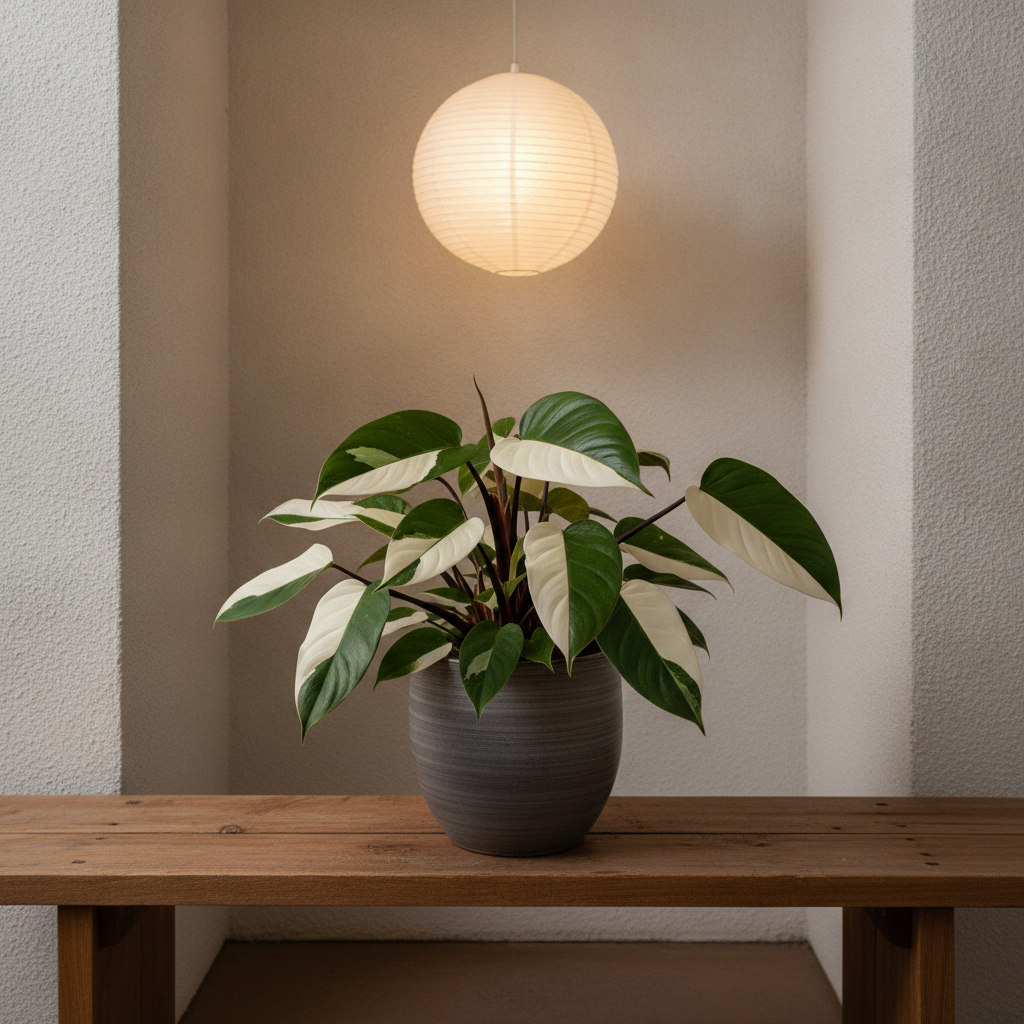
Few houseplants carry their name quite as well as the White Knight philodendron. A climbing aroid in the Philodendron erubescens complex, it pairs deep olive to near-black stems with glossy heart-shaped leaves that erupt in irregular blocks, half-moons and flecks of creamy white. The contrast between the dark maroon petioles and the pale variegation is what collectors chase, and it is also what makes the plant a little more demanding than its all-green relatives. Strip away the variegation and you have a tough, forgiving philodendron; add it back, and you have a plant that rewards attention to light, watering and stability with some of the most striking foliage available for an indoor wall or moss pole.
The good news is that the White Knight is not a fussy diva once you understand what the white tissue can and cannot do. The white sections contain little or no chlorophyll, so they cannot photosynthesise, which means the green parts of every leaf have to work harder to feed the whole plant. Everything in this guide flows from that single fact. Get the light, moisture and feeding right, and a White Knight will climb steadily, push out balanced new leaves and hold its variegation for years.
Quick Reference
| Botanical name | Philodendron erubescens ‘White Knight’ |
| Common names | White Knight philodendron, white variegated philodendron |
| Plant type | Evergreen climbing aroid |
| Mature size indoors | 1.5 to 3 metres (5 to 10 feet) tall on a support, leaves 15 to 25 cm (6 to 10 inches) long |
| Light | Bright indirect light, the more the better short of direct midday sun |
| Water | When the top 3 to 5 cm (1 to 2 inches) of mix is dry |
| Soil | Chunky, fast-draining aroid mix |
| Humidity | Prefers 60 percent or above, tolerates 50 percent |
| Temperature | 18 to 27 degrees Celsius (64 to 81 degrees Fahrenheit) |
| Feeding | Balanced dilute fertiliser monthly in the growing season |
| Toxicity | Toxic to pets and people if chewed, due to calcium oxalate crystals |
| Difficulty | Intermediate, mostly because of the variegation |
Why the White Knight Philodendron is a Coveted Houseplant
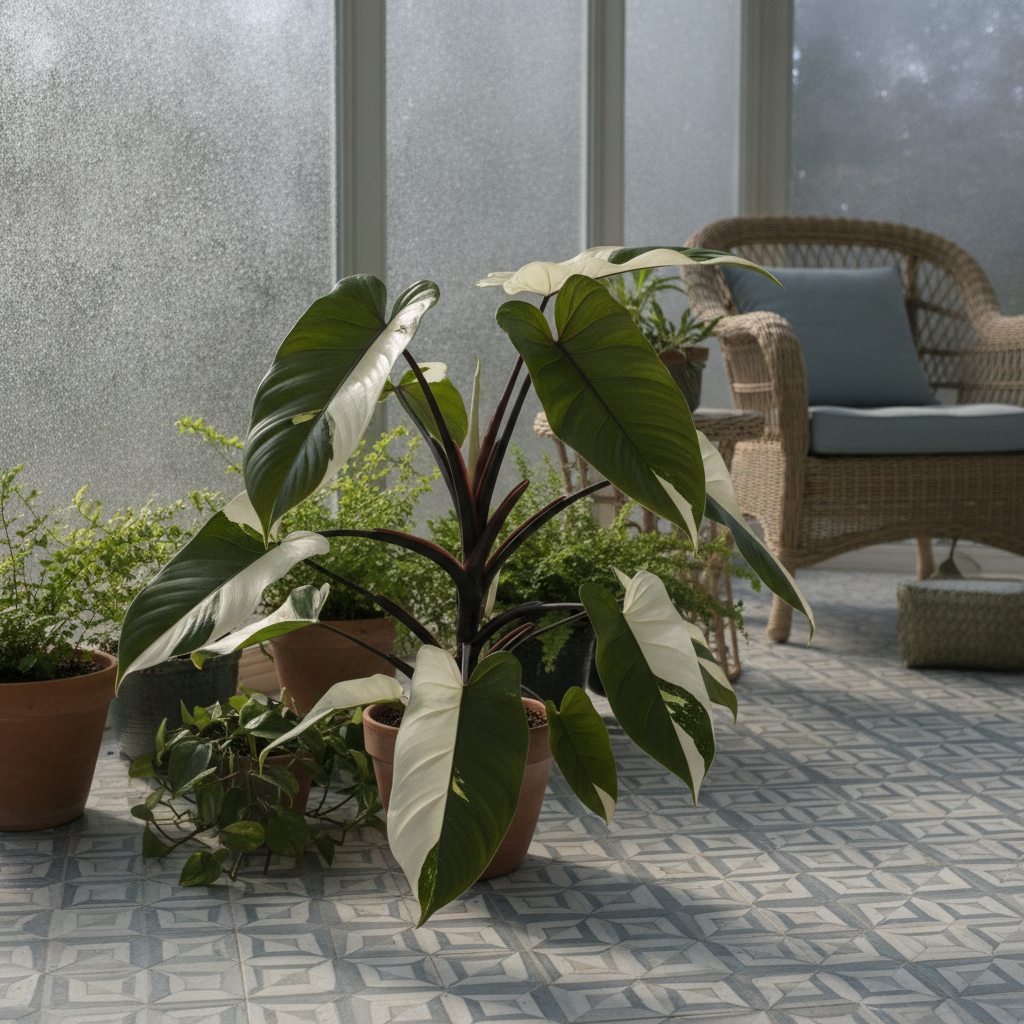
The White Knight belongs to a small group of white-variegated Philodendron erubescens cultivars that emerged from the same breeding lineage as the better-known Pink Princess. Where the Pink Princess flushes blush and bubblegum, the White Knight goes the other direction entirely, producing snowy sectors against dark, glossy leaves. Its signature feature, and the easiest way to tell it apart from its cousins, is the stem. A true White Knight carries dark maroon to chocolate-purple petioles and a dark growth point, a trait that separates it from the green-stemmed White Wizard and the speckled White Princess.
As a climber, the plant behaves like most of its relatives in the wild, scrambling up tree trunks with aerial roots and gradually producing larger leaves as it gains height. Indoors that same habit means a White Knight grown on a moss pole or trellis will reward you with bigger, better-variegated foliage over time, while one left to trail tends to stay smaller and can revert more readily. Understanding that the plant wants to climb is half the battle, because a supported philodendron is a more vigorous philodendron, and vigour is exactly what a variegated plant needs to keep producing leaves with enough green to sustain itself.
There is also a frank conversation to have about value and patience. White Knights grow more slowly than all-green philodendrons because so much of each leaf cannot photosynthesise. New leaves can emerge almost entirely white, which looks spectacular but cannot feed the plant, or almost entirely green, which is dull but vital. The art of keeping one is steering it toward that productive middle ground where most leaves carry a healthy balance of both. The reward for getting it right is a plant that genuinely improves year on year, which is rare and quietly addictive.
Pro Tip — Read the stem first: When buying, look past the leaves and check the petiole and growth point. Dark maroon stems point to a genuine White Knight, green stems suggest a White Wizard, and green stems with fine white speckling on the leaves suggest a White Princess. The three are often confused and priced very differently.
Light
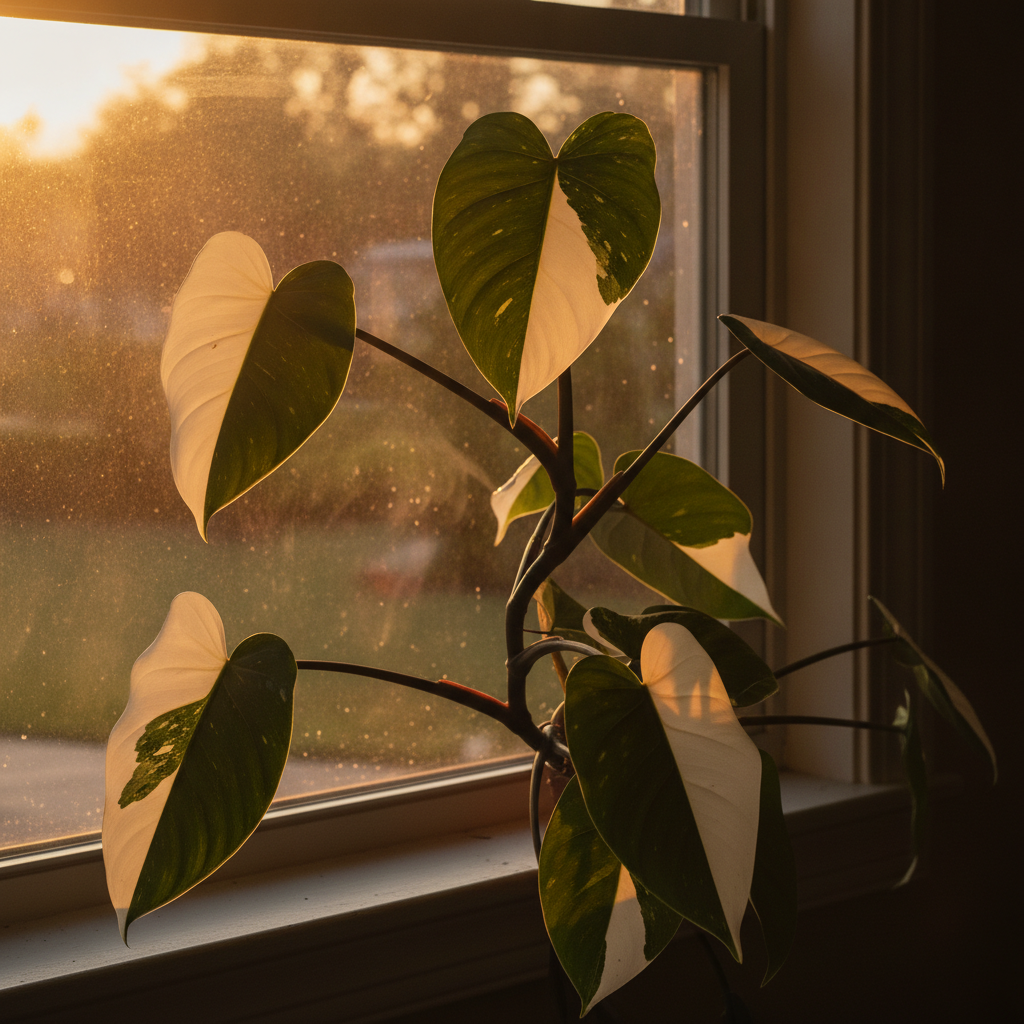
Light is the single most important factor for a White Knight, and it is where the difference between survive and thrive shows most clearly. A green philodendron can coast in a dim corner, but a heavily variegated one cannot, because its reduced photosynthetic surface needs more incoming light to compensate. Give the plant the brightest indirect position you can offer. An east-facing window with gentle morning sun, or a spot a metre or so back from a brighter south or west window, suits it almost perfectly. The aim is luminous, consistent light for most of the day without the harsh midday rays that can bleach and burn the white sections.
The white tissue is genuinely vulnerable to scorching because it has none of the protective pigments that green tissue uses to manage excess light. In strong direct sun those pale areas crisp to papery brown within a day or two, and once burned they do not recover. At the same time, too little light pushes the plant to favour green growth, since green leaves photosynthesise and the plant prioritises survival over decoration. In low light you will see new leaves emerge greener and greener, the variegation fading generation by generation. Finding the sweet spot of bright but filtered light is what keeps the balance attractive and stable.
If your home is naturally dim, a full-spectrum LED grow light is a reliable answer and not a compromise. Run it for ten to twelve hours a day, positioned close enough to be effective but far enough to avoid heat stress, and a White Knight will hold its variegation through the darkest winter months. Rotating the pot a quarter turn each week also helps, encouraging even growth on all sides rather than a plant that leans hard toward the window and grows lopsided.
Warning — Mind the midday sun: A few hours of soft morning light is welcome, but never leave a White Knight in unfiltered afternoon sun behind glass. The white sectors burn faster than you would expect, and the damage is permanent on that leaf.
Watering
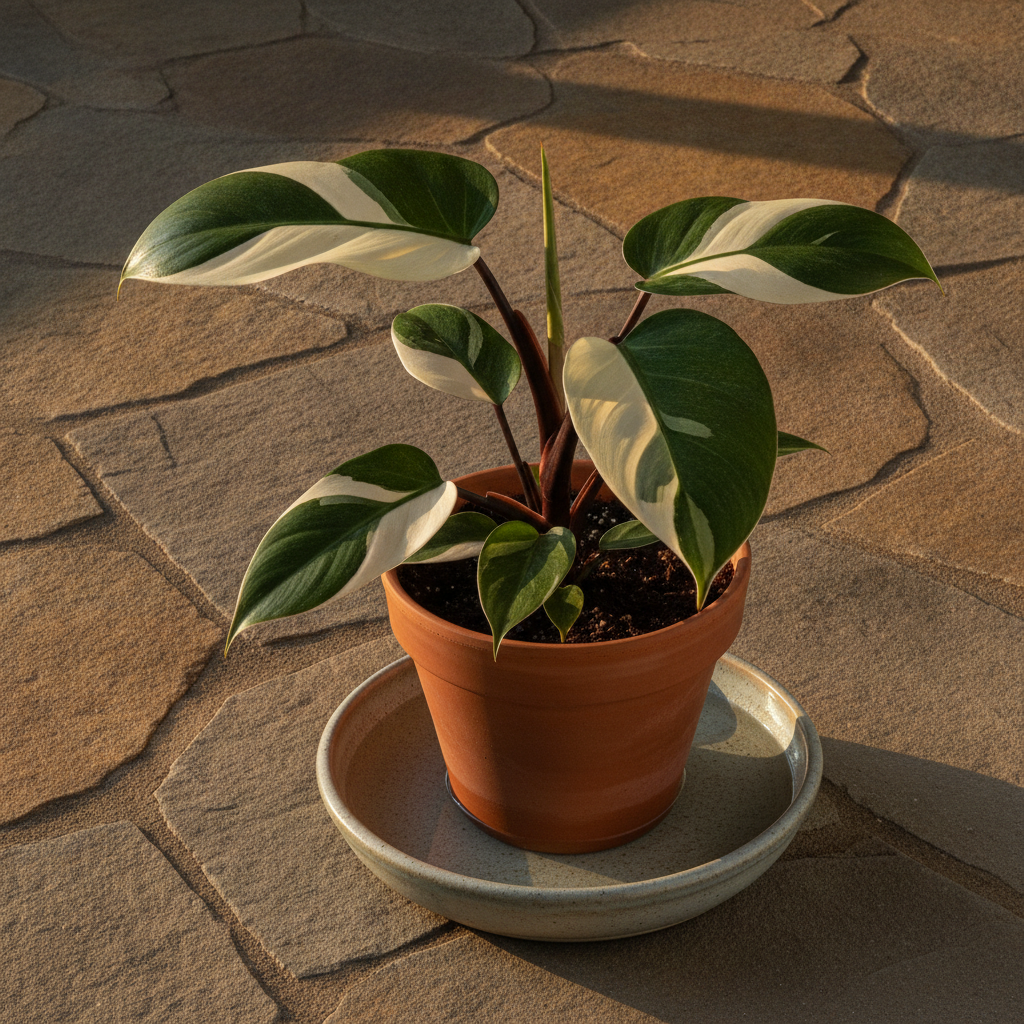
Watering a White Knight well is mostly about restraint and consistency. These philodendrons like their mix to stay lightly moist but never wet, and they resent sitting in saturated soil more than they resent a brief dry spell. The practical rule is to water when the top 3 to 5 cm (1 to 2 inches) of mix has dried out, which you can check with a finger or a wooden skewer pushed into the pot. When you do water, water thoroughly, letting it run freely from the drainage holes so the entire root ball is moistened and any accumulated salts are flushed through, then empty the saucer so the roots are never standing in water.
The variegation adds a wrinkle here too. Because a White Knight has less leaf surface actively transpiring, it draws water more slowly than a fully green plant of the same size, so the mix stays wet for longer. If you water on the same schedule you would use for a green philodendron, you risk keeping the roots too wet, and wet roots in a slow-drinking plant are the express route to root rot. Always go by the feel of the mix rather than the calendar, and lean toward slightly drier rather than wetter when you are unsure.
Water quality is worth a thought for a plant at this price point. White Knights are reasonably tolerant of tap water, but in hard-water areas the mineral build-up can show as crispy leaf edges over time. Letting tap water stand overnight, or using filtered or rainwater, sidesteps the problem. Lukewarm water is gentler on tropical roots than cold straight from the tap, and watering in the morning gives any splashed foliage time to dry before the cooler night, which discourages fungal problems.
Pro Tip — The lift test: Get to know the weight of the pot when freshly watered versus when dry. Lifting the pot becomes a faster, more reliable gauge of moisture than any fixed schedule, especially as light and temperature shift through the year.
Soil
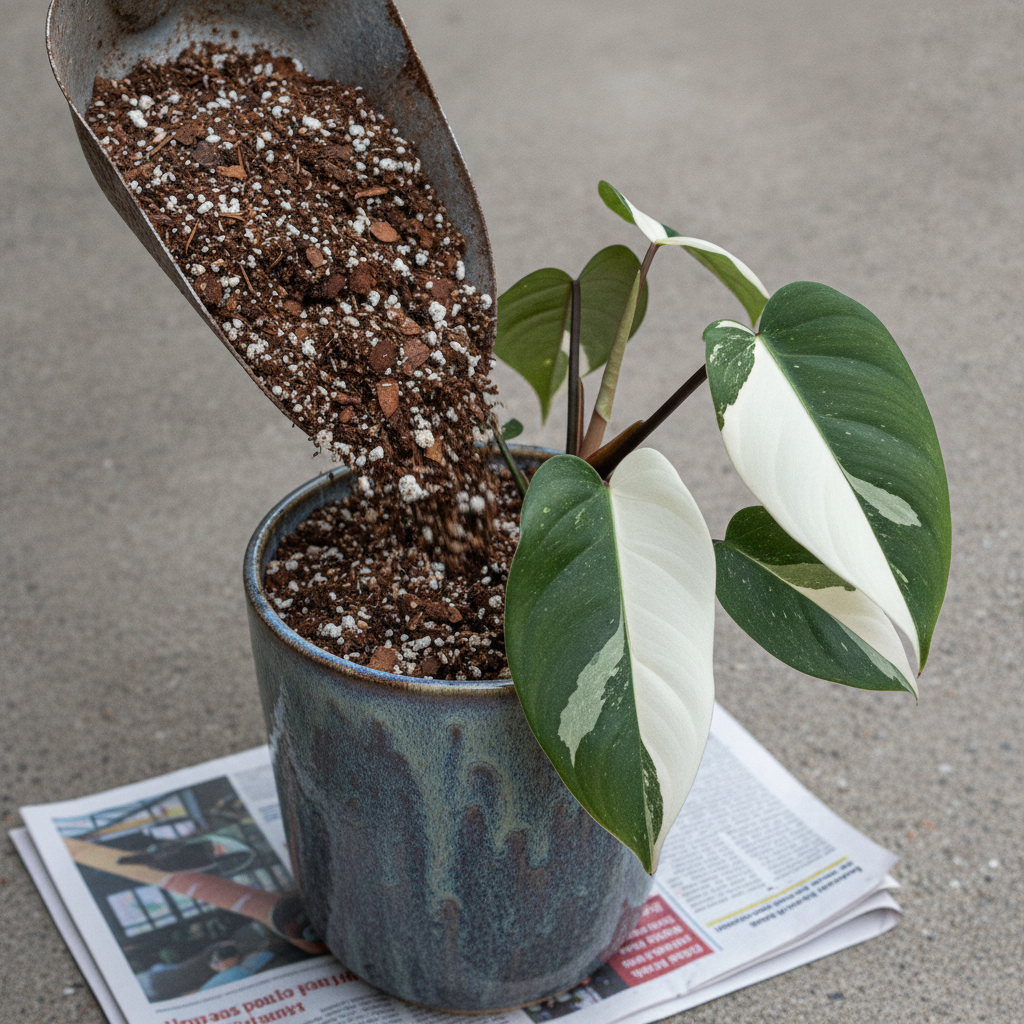
Like nearly all aroids, the White Knight grows naturally as a climber whose roots cling to bark and run through loose forest debris rather than dense ground soil. It wants a potting medium that mimics that, holding moisture while staying airy enough that the roots can breathe. A standard bagged houseplant compost on its own is too dense and stays wet too long, so the single most useful thing you can do for a White Knight is plant it in a proper chunky aroid mix. The classic blend is roughly equal parts orchid bark, perlite and coco coir or quality potting compost, with a handful of horticultural charcoal and worm castings added for structure and gentle nutrition.
That open structure does two jobs at once. The bark and perlite create air pockets so oxygen reaches the roots and excess water drains away quickly, which is the best insurance against rot in a slow-drinking variegated plant. At the same time the coir and compost hold enough moisture that the mix does not dry to dust between waterings. The result is a medium that stays evenly damp for a sensible length of time and then dries, rather than swinging between waterlogged and bone dry.
Always pot into a container with drainage holes, and choose a pot only slightly larger than the root ball when you size up, because an oversized pot holds a reservoir of wet mix the small root system cannot use. Terracotta is a forgiving choice for anyone inclined to overwater, since it breathes and wicks moisture from the sides, while a plastic or glazed pot retains more water and suits a drier hand. Repotting every one to two years in spring refreshes the mix as the bark breaks down and gives the roots room to keep climbing.
Pro Tip — Add a pole at potting time: Set a moss pole or coir support into the pot when you repot, not later. Sinking it in beside an established root ball risks tearing roots, whereas adding it early lets the plant grip as it grows and produce its largest, best-variegated leaves.
Fertilising
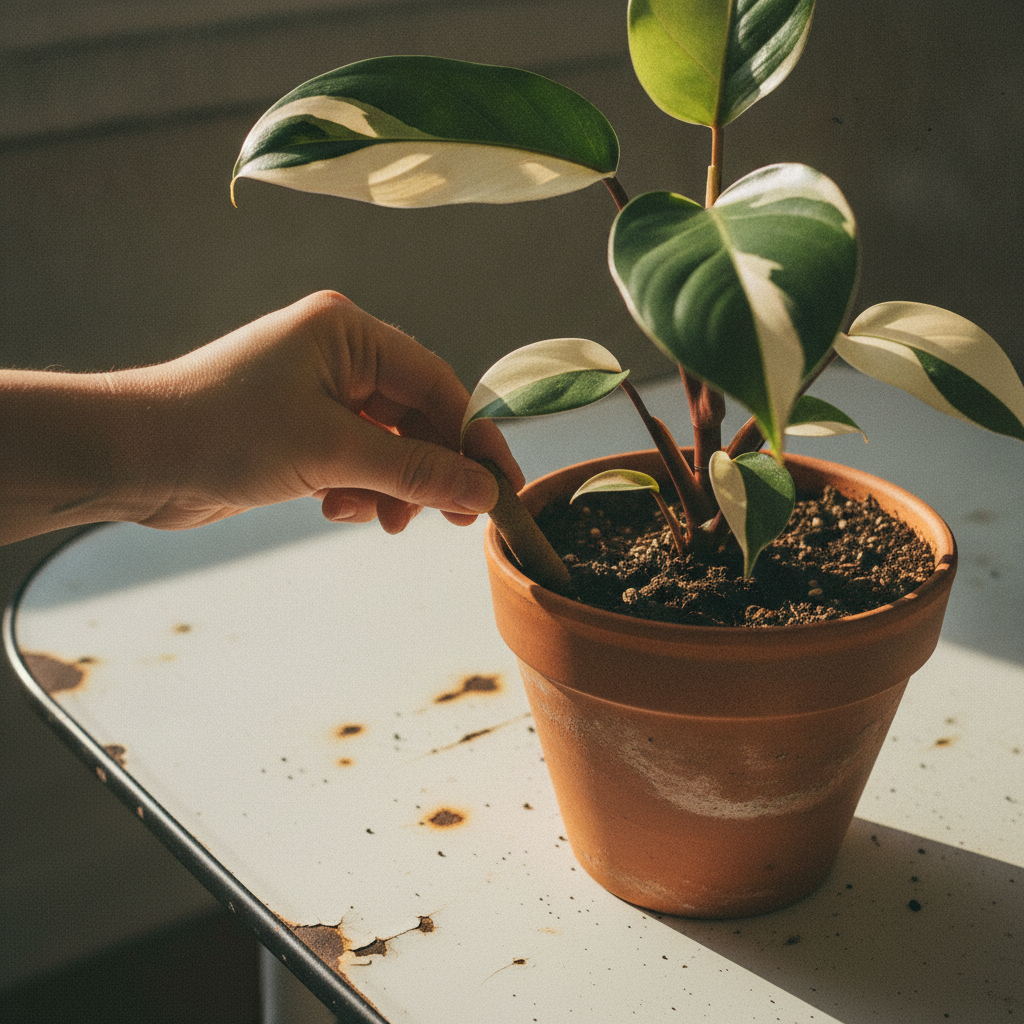
A White Knight is not a heavy feeder, but because it grows slowly and works hard to support its non-productive white tissue, steady gentle feeding helps it push out healthy leaves. Through the active growing season, roughly spring to early autumn, a balanced liquid fertiliser diluted to half the recommended strength and applied once a month is plenty. A formulation with a little extra nitrogen suits foliage plants, supporting leaf growth and good green colour, though anything labelled as a general houseplant feed will do the job when diluted well.
The cardinal rule with this plant is to feed lightly and never to overdo it. Variegated philodendrons are more sensitive to fertiliser salts than their green counterparts, partly because they take up nutrients more slowly, so excess feed accumulates in the mix and can scorch the roots and brown the leaf margins. If you ever see a white crust forming on the soil surface or around the pot rim, that is salt build-up, and the remedy is to flush the pot thoroughly with plain water and ease off the feeding. Always apply fertiliser to already-damp soil rather than dry mix, since feeding into a dry root ball concentrates the salts right where they can do damage.
In the shorter, darker days of late autumn and winter, growth naturally slows and the plant needs far less, so stop feeding or cut back to once over the whole season. Resume in spring when you see fresh growth, which signals the roots are active again and ready to make use of the nutrients. Slow-release pellets or fertiliser sticks are a convenient hands-off alternative for anyone who would rather not mix liquid feed, though they give you less control over dosage, so place them at the pot edge and use sparingly.
Propagation
The White Knight propagates from stem cuttings, and because it is a climbing philodendron rather than a clumping one, the whole process revolves around the node, the slightly swollen point on the stem where a leaf and aerial root emerge. A cutting with at least one healthy node will produce roots and eventually a new growth point, while a leaf with no node attached will never grow into a plant no matter how long you wait. This is the most important thing to understand before you reach for the secateurs.
For a variegated White Knight there is a second, equally important consideration. Each cutting will grow on according to the variegation it already carries, so a section that is mostly white will struggle to root and may never thrive because it cannot photosynthesise, while an all-green section will root vigorously but produce dull, unvariegated growth. The cuttings worth taking are those with a healthy balance of green and white, ideally including a node that sits on green or part-green tissue. Choosing the right cutting is the difference between a thriving variegated plant and a disappointment.
To take a cutting, follow these steps:
- Using clean, sharp secateurs or a sterilised blade, cut just below a node on a stem that carries a good balance of green and white tissue, including a leaf or two above the node.
- Let the cut end callus for an hour or two, then place the cutting in your chosen rooting medium, with the node submerged or buried and the leaves above the surface.
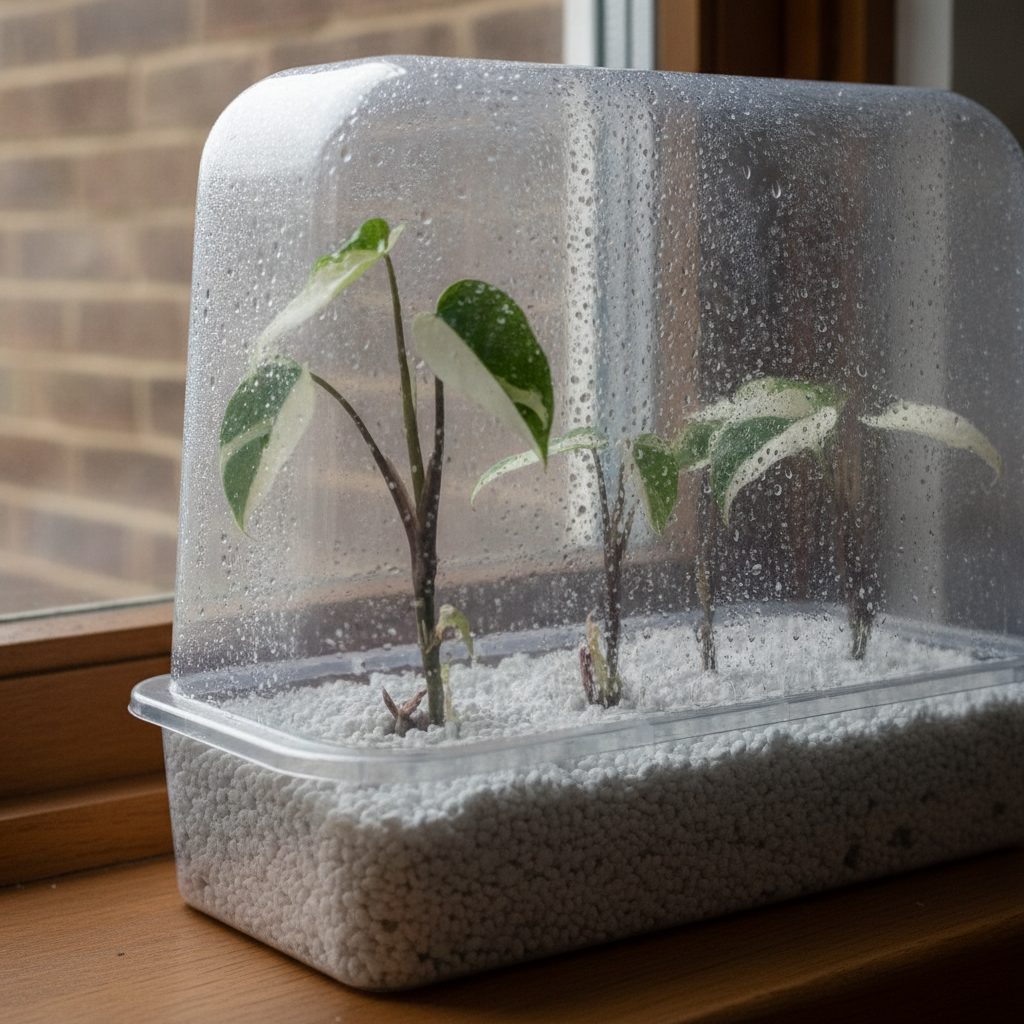
- For water rooting, use a glass of clean room-temperature water and change it every few days. For a more robust root system, root in damp sphagnum moss or perlite, which encourages stronger soil-ready roots.
- Keep the cutting warm, in bright indirect light, and under high humidity. A clear humidity dome or a loosely closed propagation box holds moisture around the cutting and speeds rooting.
- Once roots reach 3 to 5 cm (1 to 2 inches) long, after roughly four to eight weeks, pot the cutting into a small container of chunky aroid mix and keep it slightly more humid than usual while it settles.
Patience matters here more than with most houseplants. Variegated cuttings root more slowly than green ones because there is less photosynthetic tissue powering the process, so a cutting that seems to sit still for several weeks is often perfectly healthy and simply taking its time. As long as the stem stays firm and the leaves stay turgid, leave it be and resist the urge to keep pulling it out to inspect the roots.
Pro Tip — Cut above a green node to protect the parent: When you take a cutting, leave the mother plant with a node sitting on green or part-green tissue. That node will activate and the new growth will have the chlorophyll it needs, keeping the parent vigorous rather than forcing it to push an all-white shoot it cannot feed.
Pests and Problems
The White Knight is not especially pest-prone, but like all indoor aroids it can attract the usual sap-sucking culprits, and the most common by far are spider mites, mealybugs, thrips, scale and fungus gnats. Spider mites thrive in dry warm air and announce themselves with fine speckling on the leaves and faint webbing in the leaf axils. Mealybugs look like small tufts of white cotton tucked where leaf meets stem, which can be easy to overlook on a white-variegated plant, so look closely. Thrips cause silvery streaks and distorted new growth, scale appears as small immovable brown bumps along stems and leaf undersides, and fungus gnats are the little flies that hover around consistently overwet soil.
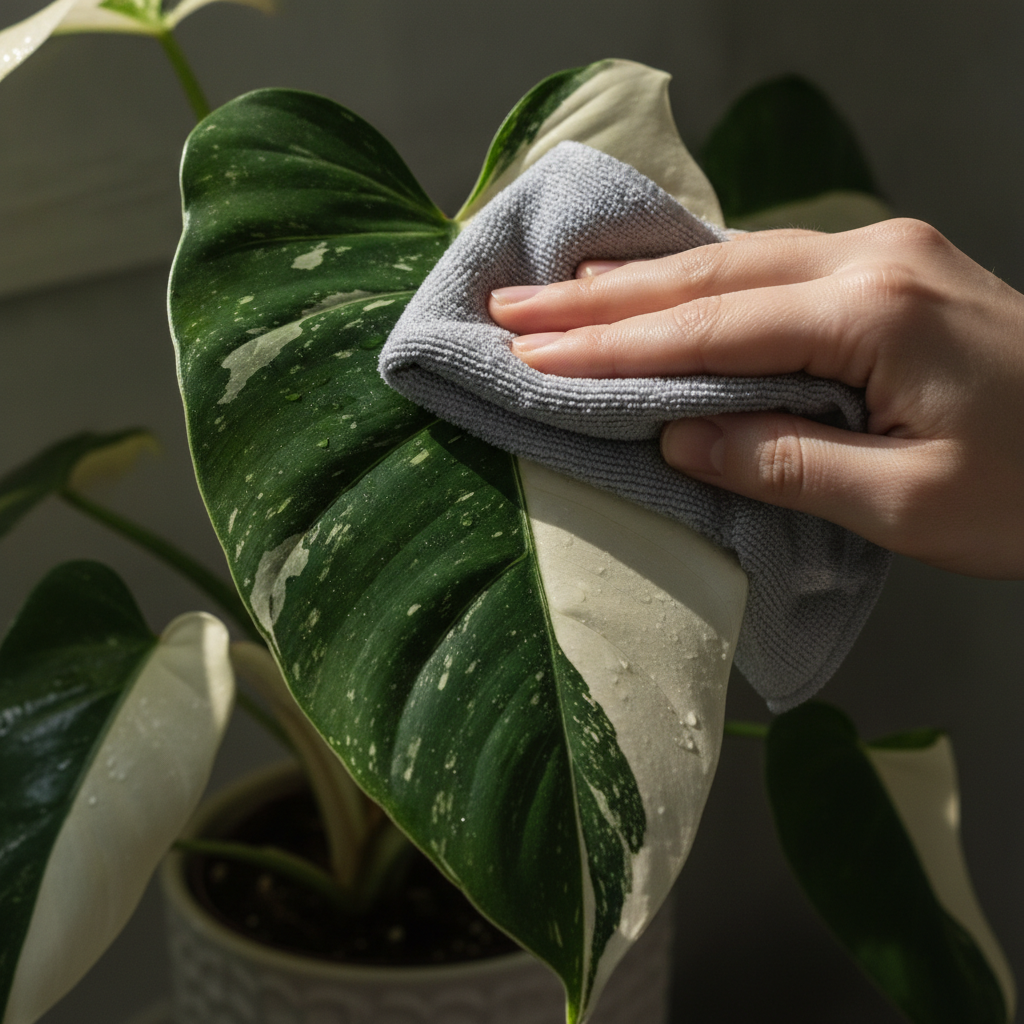
The best defence is routine observation, since catching an infestation early makes it trivial to clear and catching it late turns it into a campaign. Wipe the leaves every week or two with a damp cloth, which both keeps the foliage clean for better light capture and gives you a regular close look at the undersides and axils where pests hide. If you do find something, isolate the plant from your other houseplants straight away, wipe off what you can, and treat with insecticidal soap or a diluted neem oil solution, repeating every five to seven days until several treatments have passed with no sign of return. For fungus gnats, the answer is almost always to let the soil dry out more between waterings, since their larvae depend on persistently damp mix.
Beyond pests, the problems people meet with a White Knight are usually cultural and are best read as the plant communicating. Yellowing leaves most often signal overwatering and soggy roots, especially when the lower leaves go soft and the soil stays wet, so check the roots and let the mix dry further. Brown crispy patches on the white sections point to too much direct sun or low humidity, while brown leaf tips and edges generally mean dry air, inconsistent watering or salt build-up from over-feeding. The most disappointing problem, reversion to all-green leaves, is a light problem at heart, so the remedy is brighter indirect light and pruning back to a well-variegated node to encourage balanced growth to resume.
Warning — Toxic if eaten: Every part of the White Knight contains insoluble calcium oxalate crystals, which cause painful mouth and throat irritation, drooling and vomiting if chewed by pets or children. Keep it out of reach, and wash your hands after taking cuttings, as the sap can irritate sensitive skin.
Varieties and Similar Plants
The White Knight is one of a trio of white-variegated Philodendron erubescens cultivars that are constantly mistaken for one another, and knowing the differences saves both money and disappointment. The two it is most confused with are the White Princess and the White Wizard, and the quickest way to tell all three apart is to study the stems and the pattern of variegation rather than the white alone. The White Knight is defined by its dark maroon to purple-black petioles paired with bold sectoral white, the White Princess by its green stems and finer speckled variegation, and the White Wizard by its green stems carrying large solid blocks of white.
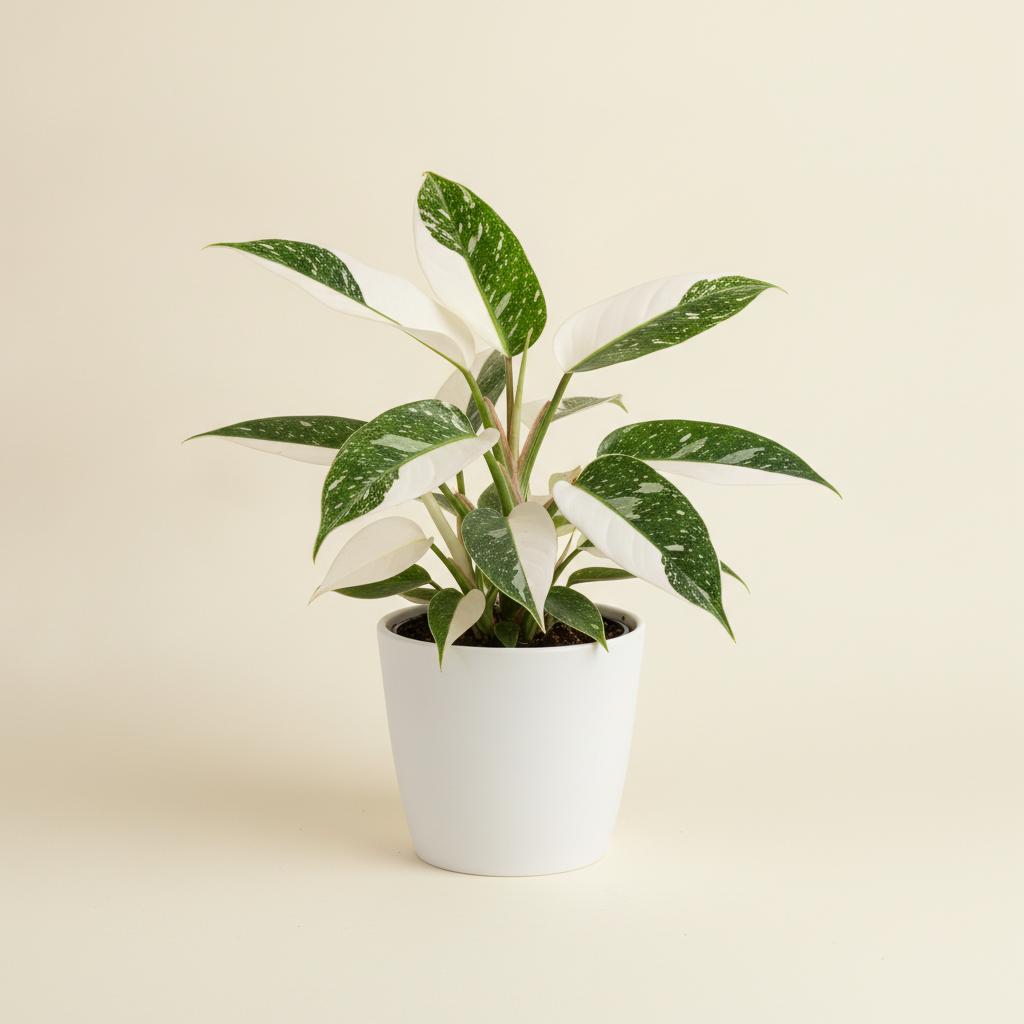
White Princess carries narrower, more lance-shaped leaves than the White Knight, scattered with crisp white speckles, streaks and the occasional half-white leaf. Its stems are green rather than maroon, though they often show fine pink or red flecking that adds to the confusion with the Pink Princess. It tends to be a slightly more compact, upright grower.
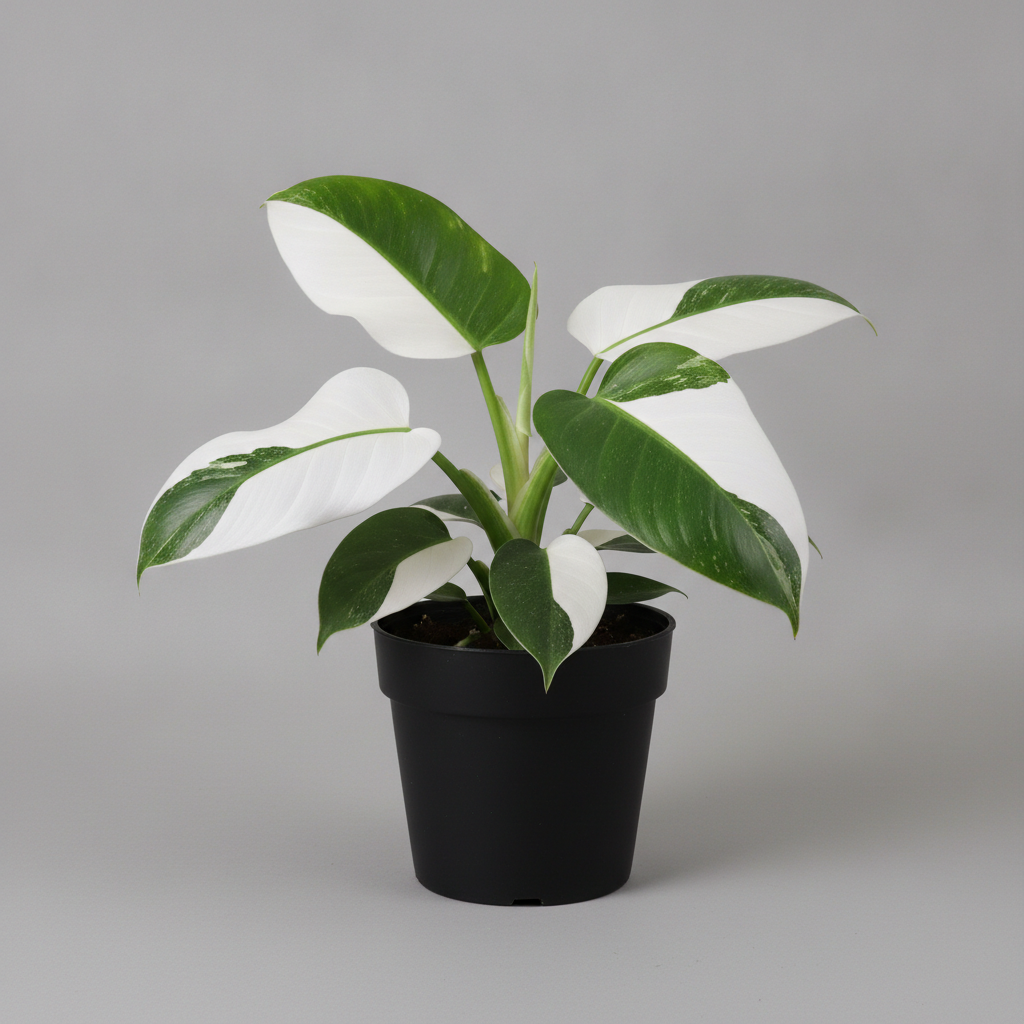
White Wizard has broader, rounder, more substantial leaves that carry large clean blocks of pure white variegation. Crucially its petioles are solid green with no maroon colouring, which is the single most reliable way to separate it from the White Knight. Many growers find the Wizard a touch more vigorous and a little more stable in its variegation.
Beyond these two close relatives, the wider Philodendron erubescens group includes the famous Pink Princess, with its blush and bubblegum variegation, and several green-and-yellow forms such as the Painted Lady and Prince of Orange that share the same easy-going climbing habit. If you love the look of the White Knight but want something less demanding, an all-green Philodendron erubescens or a hardy Philodendron hederaceum gives you the same growth style with none of the variegation worries. And if you want to push further into white-variegated aroids, the Monstera ‘Thai Constellation’ and various variegated Syngonium offer the same striking contrast with their own quirks of care.
Frequently Asked Questions
Why are my White Knight’s new leaves coming out all white?
An all-white leaf is beautiful but a liability, because white tissue cannot photosynthesise and so cannot feed the plant. A run of all-white leaves usually means the plant has produced a shoot from a node sitting on heavily variegated tissue. The fix is to prune back to a node with a healthy balance of green and white, which encourages the plant to grow on from a more productive point. Bright indirect light also helps steer future leaves toward a sustainable balance.
Why is my White Knight reverting to all-green leaves?
Reversion to green is almost always a response to insufficient light. When the plant cannot gather enough energy, it favours green tissue because green leaves photosynthesise and keep it alive. Move the plant to a brighter indirect spot or add a grow light, and prune back to a well-variegated node to prompt balanced growth. Some reversion is simply the plant’s instinct for survival, so a brighter position is the most reliable long-term answer.
How fast does a White Knight philodendron grow?
Slowly, by philodendron standards, precisely because so much of each leaf cannot photosynthesise. In good light with a moss pole to climb, expect a handful of new leaves over a growing season, with each new leaf tending to be larger than the last as the plant matures. Patience is part of the deal, and a supported, well-lit plant will always outpace one left to trail in a dim corner.
Is the White Knight philodendron toxic to cats and dogs?
Yes. Like all philodendrons it contains insoluble calcium oxalate crystals, which cause mouth and throat irritation, drooling, vomiting and difficulty swallowing if chewed by cats, dogs or curious children. It is best kept well out of reach, and you should wash your hands after handling cuttings since the sap can irritate sensitive skin.
Does a White Knight need a moss pole?
It does not strictly need one to survive, but it will perform far better with a support to climb. As a natural climber, the White Knight produces larger, better-variegated leaves when it can grip a moss pole or coir support and gain height. A trailing, unsupported plant tends to stay smaller and can revert more readily, so adding a pole is one of the simplest ways to improve the plant.
How do I increase humidity for my White Knight?
The plant is happiest at 60 percent humidity or above, though it tolerates around 50 percent. Grouping plants together, standing the pot on a tray of damp pebbles, or running a small humidifier nearby all help, with a humidifier being the most consistent. Avoid relying on misting, which raises humidity only briefly and can leave water sitting on the leaves, encouraging fungal spots on the delicate white tissue.






