

Few houseplants make an entrance quite like the Red Congo Philodendron. A robust, self-heading hybrid known botanically as Philodendron ‘Rojo Congo’, it produces broad, leathery leaves that emerge a deep coppery burgundy and mature into a glossy, almost lacquered green, each one held aloft on a thick wine-red stalk. Unlike the trailing heartleaf philodendrons that wind along shelves and trellises, this is an upright, architectural plant that forms a dense rosette from a central crown, giving it the presence of a small shrub rather than a vine. It is widely believed to be a cross involving Philodendron ‘Imperial Red’ and Philodendron tatei, bred for the interior-plant trade and now a fixture of garden centres, offices and hotel lobbies across the world.
The good news for nervous growers is that the Red Congo is genuinely forgiving. It descends from tropical American philodendrons that evolved on the shaded forest floor, so it copes with the moderate light and steady warmth of an ordinary living room far better than many fashionable aroids. That said, there is a meaningful gap between a Red Congo that merely survives, holding on to a handful of tired leaves, and one that thrives, pushing out one glossy red-to-green leaf after another and building into a full, multi-stemmed specimen. This guide covers everything that separates the two: light, watering, soil, feeding, propagation, pests and the most popular related varieties, with the practical detail you need to get each one right.
Contents
- Quick Reference
- Why the Red Congo Philodendron Makes an Excellent Houseplant
- Light Requirements
- Watering & Humidity
- Soil, Potting & Repotting
- Fertilising
- Propagation
- Pests & Diseases
- Popular Varieties
- Frequently Asked Questions
Quick Reference: Red Congo Philodendron at a Glance
| Light | Bright, indirect light; tolerates medium light but growth slows |
| Watering | When the top 2 to 5 cm (1 to 2 in) of soil is dry, roughly weekly in summer |
| Temperature | 18 to 29 degrees C (64 to 84 degrees F); avoid below 13 degrees C (55 degrees F) |
| Humidity | Prefers 50 to 60 percent; tolerates average household humidity |
| Fertiliser | Balanced feed monthly during spring and summer growth |
| Toxicity | Toxic to cats, dogs and humans if ingested (calcium oxalate crystals) |
Why the Red Congo Philodendron Makes an Excellent Houseplant
The Red Congo earns its popularity by combining drama with durability. Its colouring is the obvious draw: each new leaf unfurls in a rich burgundy that gradually deepens through bronze and copper before settling into a dark, high-gloss green, so a healthy plant always carries two or three tones at once. Because it is self-heading rather than climbing, it never needs a moss pole or trellis, and it holds a tidy, rounded silhouette that suits a floor pot beside a sofa or a wide plant stand in a bright corner. A mature specimen reaches around 0.6 to 1.2 metres (2 to 4 feet) tall and roughly as wide, filling a space without demanding constant pruning.

Beyond looks, it is one of the more tolerant aroids you can buy. It withstands the dry air and inconsistent light of centrally heated homes, shrugs off the occasional missed watering thanks to its thick stems and roots, and rarely sulks when moved between rooms. Its thick, waxy leaves also resist pests better than thinner-leaved cousins such as calatheas. For a beginner who wants a statement plant that will not collapse at the first mistake, or for an experienced grower who wants colour without fuss, the Red Congo sits in a genuinely useful sweet spot between forgiving and rewarding.
Important — Toxicity: Like all philodendrons, the Red Congo contains insoluble calcium oxalate crystals in its sap. Chewing or swallowing any part can cause intense burning of the mouth and throat, drooling, vomiting and swelling in cats, dogs and humans. Keep it out of reach of pets and small children, and wash your hands after handling cut stems or sap.
Light Requirements
Light is the single biggest lever you have over how full and how richly coloured your Red Congo becomes. In the wild, its philodendron ancestors grow in the dappled understorey of tropical forests, receiving bright but filtered light rather than direct sun. Indoors, that translates to a position with plenty of ambient brightness but no harsh midday rays falling straight onto the foliage.
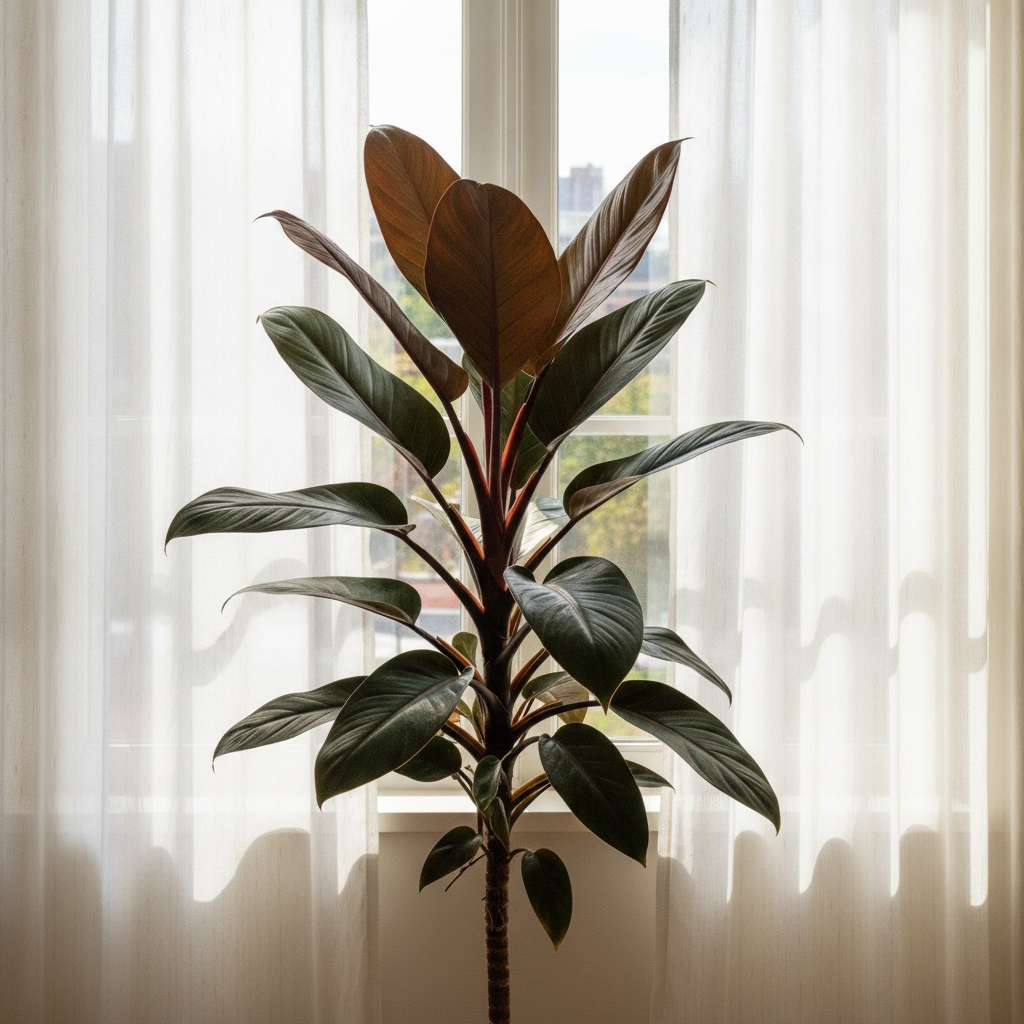
The ideal spot is a metre or two back from an unobstructed east or west window, or directly in a north window, where the plant receives several hours of bright, indirect light each day. In this light it produces compact, well-coloured leaves on short, sturdy petioles and steadily adds new growth. Too little light is the most common cause of a disappointing Red Congo: the new leaves come in smaller, the burgundy fades quickly to a flat green, the gaps between leaves stretch as the plant reaches for the window, and the lower leaves yellow and drop.
Light Levels Explained
Houseplant light is often described in vague terms, so it helps to anchor those words to rough measured values in lux. The table below shows how the Red Congo responds across the range it is likely to encounter indoors.
| Light Category | Approx. Level | Typical Location | Outcome |
|---|---|---|---|
| Direct sun | 20,000 lux and above | On a south windowsill, midday | Risk of scorch and bleached patches |
| Bright indirect | 10,000 to 20,000 lux | Near an east or west window | Best growth and colour |
| Medium | 5,000 to 10,000 lux | A few metres from a bright window | Slower but healthy growth |
| Low | 1,000 to 5,000 lux | Interior wall, north room | Survives, leggy, muted colour |
| Very low | Below 1,000 lux | Windowless room, deep corner | Gradual decline over time |
Window Orientation and Placement
South-facing window: The brightest option and the only one that risks scorch. Place the plant a couple of metres back, or filter the light with a sheer curtain, so the leaves never sit in direct midday sun.
East-facing window: An excellent choice. Gentle morning sun followed by bright ambient light for the rest of the day suits the Red Congo perfectly and rarely causes burning.
West-facing window: Also very good, though the stronger afternoon sun can be intense in summer. Setting the pot back a short distance from the glass keeps it comfortable.
North-facing window: Usable and safe from scorch, but the dimmest orientation. The plant will hold on here, yet you should expect slower growth and less vivid red on the emerging leaves.
Pro Tip — Rotate for Symmetry: Because the Red Congo grows as a rosette, it leans noticeably toward its light source. Give the pot a quarter turn every week or two so each side receives equal light and the plant develops an even, rounded shape rather than a one-sided lean.
How Light Affects Leaf Colour
The signature burgundy of a new Red Congo leaf is partly light dependent. In bright, indirect conditions the fresh growth holds its deep red tone for longer and the mature leaves take on a darker, more lustrous green. In dim corners the red is paler and fleeting, fading to green within days, and the overall plant looks flatter and less defined. If your plant has lost its colour, the remedy is almost always more light rather than any change to feeding or watering.
Warning — Direct Sunlight: Several hours of unfiltered direct sun, especially through south or west glass in summer, will bleach and scorch the leaves, leaving dry brown or pale patches that never recover. Acclimatise a plant gradually if you move it to a brighter spot, increasing exposure over a week or two.
Artificial Lighting
The Red Congo responds well to supplemental lighting, which makes it a reliable choice for offices and rooms with few windows. A full-spectrum LED grow light positioned 30 to 45 cm (12 to 18 in) above the plant and run for 10 to 12 hours a day will keep growth steady and colour respectable through dark winters. Ordinary warm-white room lighting is not strong enough to sustain it on its own, so treat a dedicated grow light as a genuine light source rather than a top-up.
Seasonal Adjustments
Light intensity indoors can fall by half or more between summer and midwinter. As the days shorten, move your Red Congo closer to its window to compensate, and clean the glass so it is not losing light to grime. In high summer, watch a south or west exposure for signs of stress and pull the plant back if the leaves begin to look washed out. Adjusting position with the seasons keeps the plant in its preferred bright-indirect band all year.
Watering & Humidity
Watering is where most Red Congo problems begin and end. The plant has thick, fleshy roots that hold moisture well and resent sitting in soggy soil, so the goal is to keep the mix lightly moist during active growth while allowing the top layer to dry between waterings. Get this rhythm right and the plant is almost indestructible; get it wrong, particularly by overwatering, and root rot can take hold quickly.
When to Water
Rather than watering on a fixed calendar, water by feel. Push a finger into the soil and water only when the top 2 to 5 cm (1 to 2 in) has dried out. In a bright, warm spot during spring and summer, that usually means watering about once a week, though the exact interval depends on your light, pot size and the dryness of your home.
In autumn and winter, when growth slows and light is weaker, the soil stays wet for much longer and the plant needs far less. Let it dry a little further between waterings during these months, often dropping to every ten days to two weeks. A cheap moisture meter or simply lifting the pot to feel its weight both work well: a recently watered pot is noticeably heavier than a dry one.
Pro Tip — Weigh the Pot: Lift the pot right after a thorough watering and again a week later. Learning the difference in weight between fully watered and ready-for-water is more reliable than any schedule, and it takes only a second once you know the feel.
How to Water Correctly
- Check that the top few centimetres of soil are dry before you begin.
- Water slowly and evenly across the whole surface, not just one side.
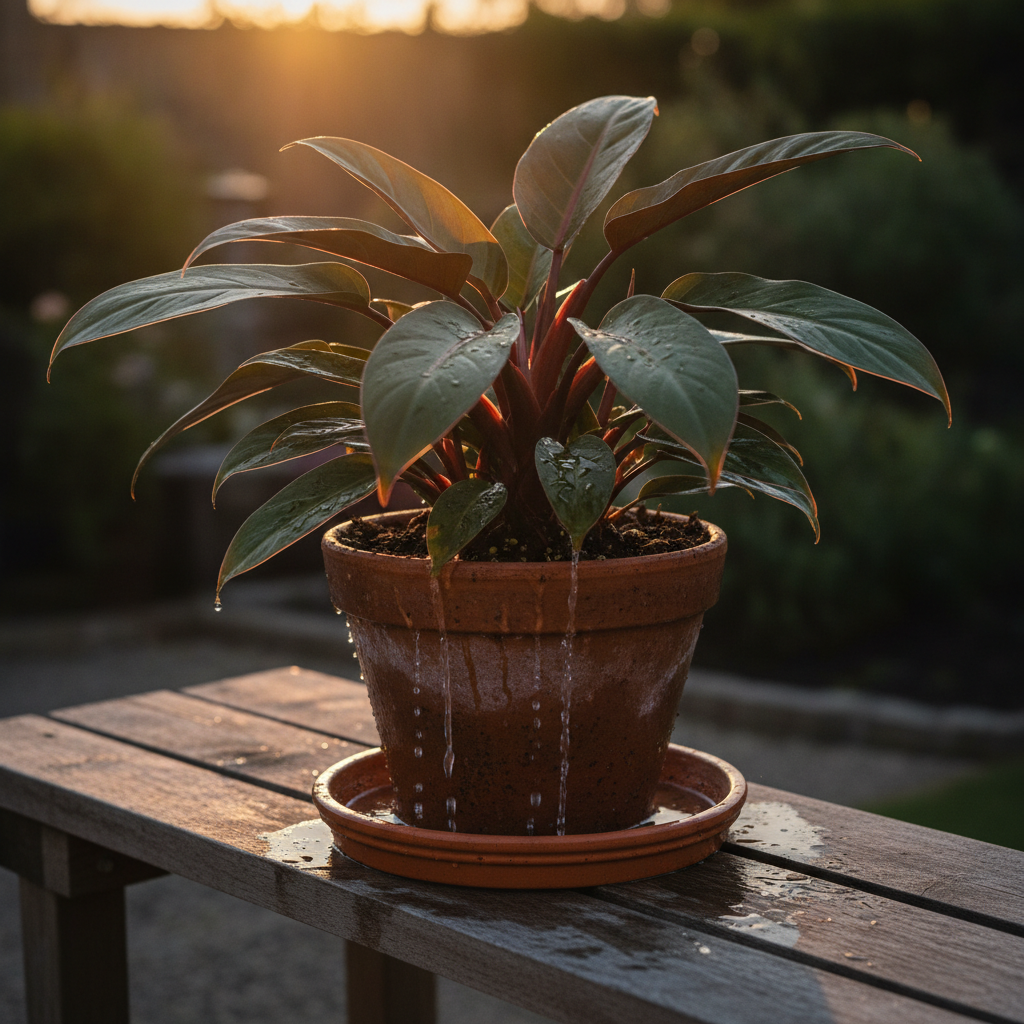
- Continue until water flows freely from the drainage holes, which ensures the entire root ball is moistened.
- Let the pot drain completely for several minutes.
- Tip away any water that collects in the saucer or cover pot so the roots never sit in it.
Signs of Overwatering vs. Underwatering
| Symptom | Overwatering | Underwatering |
|---|---|---|
| Leaf colour | Yellowing, often several leaves at once | Browning, crisp tips and edges |
| Leaf texture | Soft, limp, sometimes translucent | Dry, papery, curling inward |
| Soil | Stays wet for days, may smell sour | Pulls away from the pot, bone dry |
| Roots | Brown, mushy, foul smelling | Dry but firm and pale |
| Stem base | Soft and darkened at soil line | Firm, sometimes slightly shrivelled |
Warning — Root Rot: Persistent overwatering and poor drainage suffocate the roots and invite rot, the most common killer of indoor philodendrons. If the soil smells sour and the lower leaves yellow and wilt together, unpot the plant immediately, trim away any brown mushy roots with sterilised scissors and repot into fresh, well-draining mix.
Humidity Requirements
As a tropical plant, the Red Congo enjoys humidity in the 50 to 60 percent range, but it is far more tolerant of dry air than delicate aroids. Most homes sit between 30 and 50 percent, which the plant handles without complaint, though slightly higher humidity encourages larger leaves and crisper edges.
When the air is very dry, typically in winter when central heating is running, you may notice brown, crispy leaf tips or edges. This is a cosmetic stress signal rather than a serious problem, but it is worth addressing if it bothers you or becomes widespread.
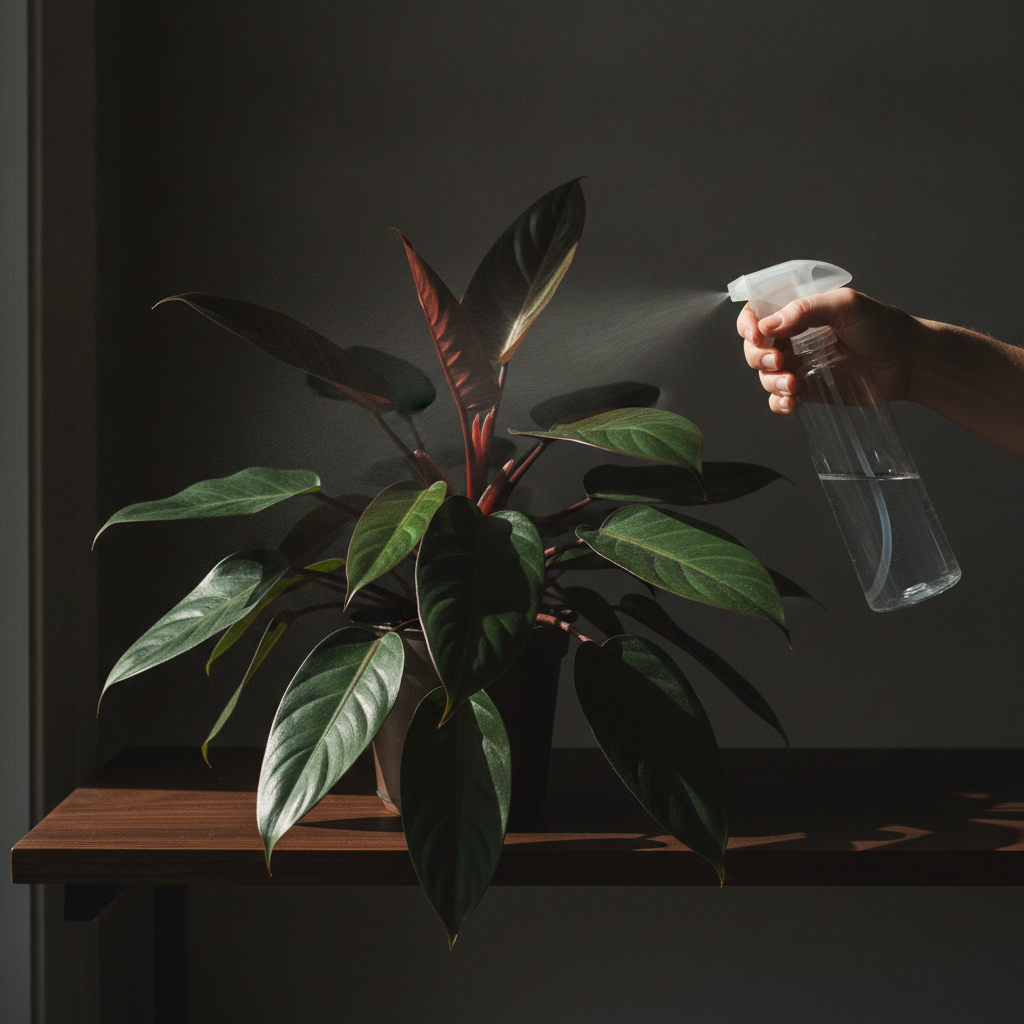
To raise humidity, group the plant with other houseplants so they share the moisture they transpire, stand the pot on a wide tray of pebbles topped up with water, or run a small humidifier nearby during the driest months. Misting offers only a brief lift and can encourage fungal spots on the dense foliage, so a humidifier or pebble tray is the better long-term solution.
Water Quality
The Red Congo is not especially fussy about water, but it appreciates room-temperature water and can be sensitive to a build-up of minerals and chlorine over time. If your tap water is heavily chlorinated, leaving it to stand uncovered overnight allows the chlorine to dissipate. In hard-water areas, occasional use of filtered or rainwater helps prevent the white mineral crust that can accumulate on the soil surface and pot rim.
Soil, Potting & Repotting
The right soil does more to prevent problems than almost any other factor. As an aroid with thick roots that need oxygen, the Red Congo demands a chunky, free-draining mix that holds some moisture but never stays waterlogged. A dense, peat-heavy compost straight from the bag compacts over time and is a frequent cause of root rot in this plant.
Ideal Soil Composition
Aim for a loose, airy blend built around a quality houseplant compost with generous additions to improve drainage and structure. The components below combine to give the balance of moisture retention and aeration the Red Congo wants.
| Component | Proportion | Function |
|---|---|---|
| Quality potting compost | 50 percent | Base nutrition and moisture retention |
| Orchid bark | 20 percent | Creates air pockets and mimics chunky forest litter |
| Perlite or pumice | 20 percent | Sharpens drainage and prevents compaction |
| Coco coir or worm castings | 10 percent | Holds gentle moisture and adds slow nutrition |
The Red Congo prefers a slightly acidic to neutral soil, with a pH of roughly 5.5 to 6.5, which is comfortably within the range of most standard composts. There is rarely any need to test or adjust pH for this plant under normal conditions.
Pro Tip — Quick Mix Recipe: For a fast, reliable blend, combine two handfuls of houseplant compost with one handful of orchid bark and one handful of perlite. The result should feel light and crumble apart in your hand rather than clumping into a wet ball.
Choosing the Right Pot
Pot choice has a direct effect on how often you can safely water and how stable the plant stays as it grows top-heavy. A Red Congo putting out broad leaves on a wide rosette benefits from a pot heavy enough to keep it from toppling.
Drainage holes are non-negotiable. Whatever pot you choose, it must have holes in the base so excess water can escape. Decorative cover pots without drainage are fine as outer sleeves, but only if you lift the inner pot out to water and drain it, then return it once it has stopped dripping.
Pot material: Terracotta breathes and wicks away excess moisture, which suits heavy-handed waterers, while glazed ceramic and plastic retain water longer and need more careful watering. A heavier ceramic or terracotta pot also provides useful ballast for a tall, leafy plant.
Pot size: Choose a pot only 2 to 5 cm (1 to 2 in) wider than the current root ball. An oversized pot holds a large volume of wet soil around comparatively few roots, which dramatically raises the risk of rot.
When to Repot
The Red Congo is a moderate grower and is happy to be slightly snug, so it typically needs repotting only every two to three years. Tell-tale signs that it is time include roots emerging from the drainage holes or circling the surface, water running straight through without soaking in, and growth slowing despite good light and feeding. Spring, at the start of the active growing season, is the best time to repot so the plant can recover quickly.
How to Repot: Step-by-Step
- Water the plant a day beforehand so the root ball holds together and the move is less stressful.
- Gently ease the plant out by tipping the pot and supporting the base of the stems, rather than pulling on the leaves.
- Tease apart any tightly circling roots and brush off some of the old, spent soil.
- Inspect the roots and trim away anything brown, soft or rotten with sterilised scissors.
- Add fresh mix to the new pot, set the plant at the same depth it grew before, and fill around the roots.
- Firm the soil gently to remove large air gaps, then water thoroughly and allow it to drain.
Warning — Transplant Shock: Expect a brief pause in growth and perhaps a drooping leaf or two for a week after repotting. Keep the plant in stable, bright-indirect light, resist the urge to fertilise straight away, and water only when the topsoil dries. The plant will settle on its own; over-fussing slows recovery.
Fertilising
Feeding is what turns a stable Red Congo into a fast, full one. Because it produces large leaves, the plant draws steadily on soil nutrients, and a potted plant exhausts what little its compost holds within a few months. A modest, regular feed during the growing season keeps new leaves coming in large and deeply coloured.
The key principle with the Red Congo, as with most aroids, is restraint. It is far easier to harm the plant by overfeeding than by underfeeding, because excess fertiliser salts accumulate in the soil and scorch the roots. Little and often, at diluted strength, beats heavy doses every time.
Understanding Plant Nutrients
Most fertilisers list three headline numbers, the NPK ratio, representing nitrogen, phosphorus and potassium. A balanced general houseplant feed suits the Red Congo well, supplying the nitrogen it needs for leafy growth alongside the other elements that support roots and overall health.
| Nutrient | Symbol | Primary Function | Deficiency Symptoms |
|---|---|---|---|
| Nitrogen | N | Leaf and stem growth, green colour | Pale, yellowing older leaves, stunted growth |
| Phosphorus | P | Root development and energy transfer | Weak roots, dull foliage, slow establishment |
| Potassium | K | Overall vigour and water regulation | Brown leaf edges, weak stems |
| Calcium | Ca | Cell wall strength and new growth | Distorted, weak emerging leaves |
| Magnesium | Mg | Core of the chlorophyll molecule | Yellowing between leaf veins |
| Iron | Fe | Chlorophyll production | Yellow new leaves with green veins |
Types of Fertiliser
Liquid fertilisers: The easiest option for precise control. Diluted into water and applied during the growing season, they give an immediate, even feed and let you skip a dose whenever the plant looks like it does not need it.
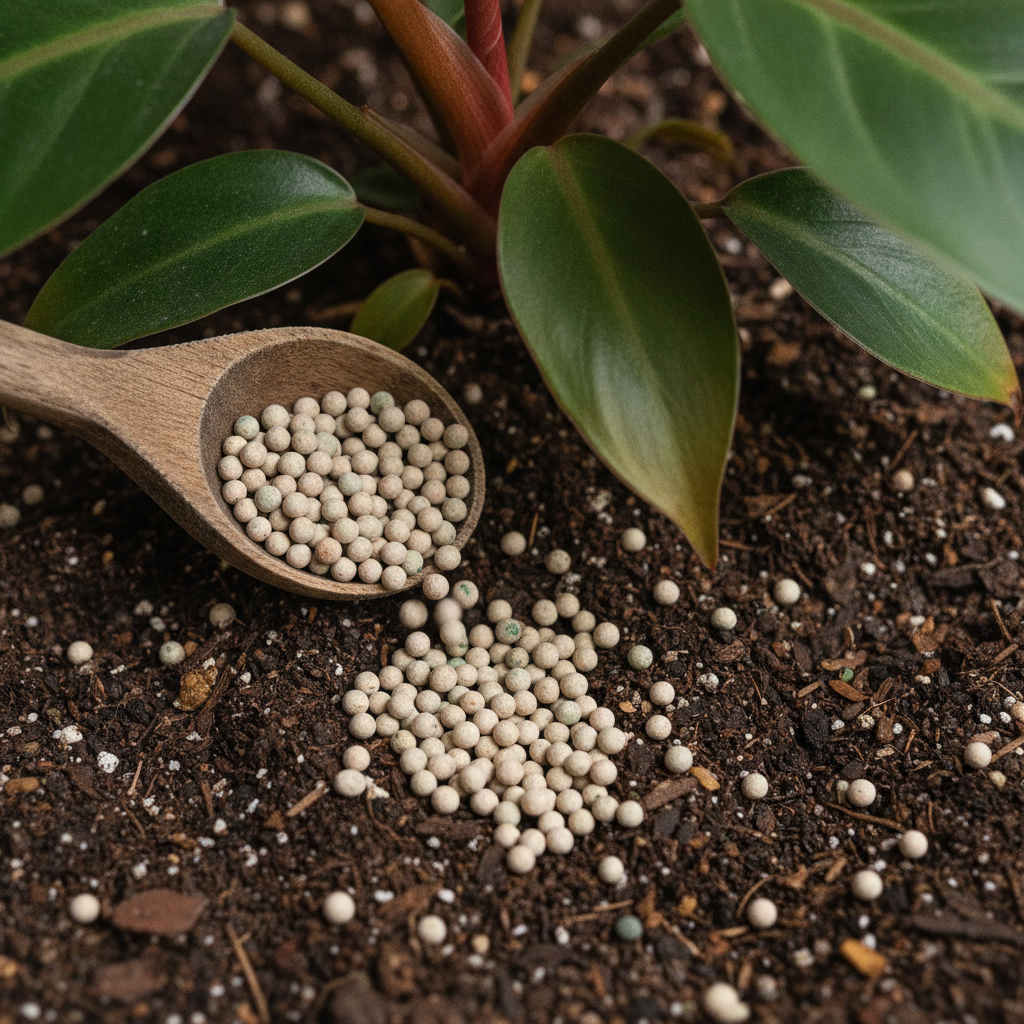
Slow-release granular: Pellets mixed into the topsoil that release nutrients gradually over several months. Convenient for hands-off growers, though they offer less control and can over-concentrate in a small pot during hot spells.
Organic fertilisers: Worm castings, diluted seaweed and similar feeds release nutrients gently and improve soil life. They are very hard to overdose and make a forgiving choice for the Red Congo, albeit with a slower visible response.
Feeding Schedule
Feed the Red Congo roughly once a month from spring through to late summer with a balanced liquid fertiliser diluted to half the recommended strength. As growth slows in autumn, taper the feeding off, and stop entirely through winter when the plant is resting. Resuming feeding only when new growth appears in spring keeps the plant from being fed while it cannot use the nutrients.
Pro Tip — Half Strength is Plenty: Mix liquid feed to half the dose printed on the bottle. Houseplant fertiliser instructions are generally pitched high, and a self-heading philodendron in a pot rarely needs full strength. Diluting protects the roots while still keeping new leaves large and well coloured.
How to Fertilise
- Water the plant lightly first, or feed straight after a normal watering, so fertiliser never hits bone-dry roots.
- Dilute liquid feed to half strength in a watering can.
- Apply evenly across the soil surface until it begins to drain from the base.
- Avoid splashing concentrated feed onto the leaves, which can leave marks.
- Flush the pot with plain water every couple of months to wash out any accumulated salts.
Warning — Salt Build-Up: A white crust on the soil surface or pot rim, along with brown, burnt leaf tips, points to fertiliser salts accumulating in the soil. Flush the pot thoroughly with plain water, letting it run through several times, and reduce how often you feed.
Propagation
Propagating the Red Congo is less straightforward than rooting a trailing philodendron from a single node, because this is a self-heading plant that grows from a central crown rather than along a vine. It does not produce the long, easily cut stems of a heartleaf or pothos, so the reliable methods are division of the crown and, where the plant has developed a visible trunk over years, stem cuttings or air layering.
Whatever method you use, propagate in spring or early summer when the plant is growing strongly, and work with clean, sharp, sterilised tools. The thick stems carry irritating sap, so wear gloves and keep cut surfaces away from skin and eyes.
Understanding the Crown and Offsets
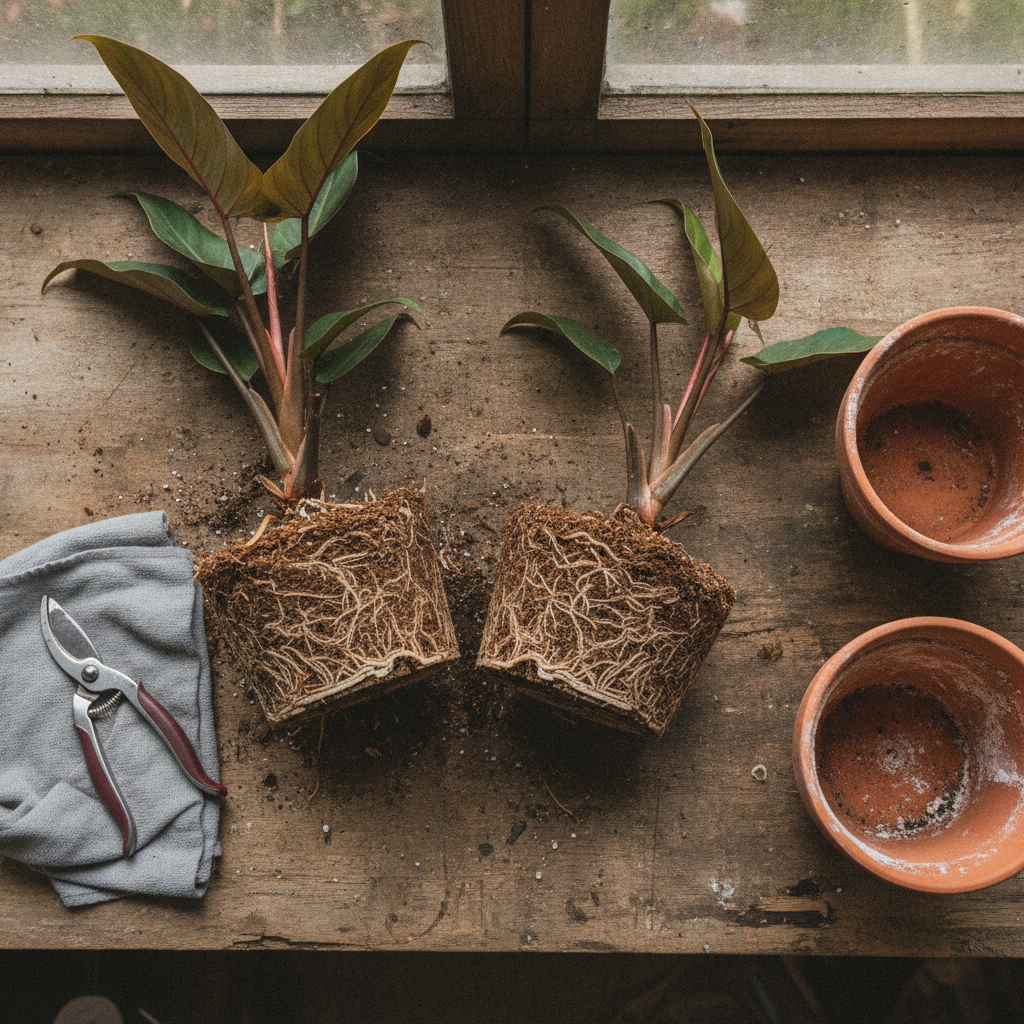
A mature Red Congo gradually develops multiple growing points, or crowns, around its base, and sometimes pushes up small offsets beside the main plant. Each crown has its own cluster of roots and can become an independent plant. Recognising these natural division points is the key to propagating successfully, because separating along them does the least damage and gives each piece the best chance of establishing.
Division: Step-by-Step
Division is the most dependable method and works best when combined with a routine spring repotting, since the plant is already out of its pot.
- Slide the whole plant out of its pot and gently brush the soil from the roots so you can see the separate crowns.
- Identify a crown or offset that has its own healthy roots attached.
- Tease the roots apart by hand where possible, using a sterilised knife only to cut through stubborn connections.
- Make sure each division keeps both a growing point and a fair share of roots.
- Pot each section into its own small pot of fresh aroid mix at the depth it grew before.
- Water in well and keep the divisions warm, humid and out of direct sun while they re-establish.
Pro Tip — Divide While Repotting: The least stressful time to divide is during a planned repot, when the root ball is already exposed. You disturb the plant only once, and each new division has fresh soil and space to grow straight away.
Stem Cuttings and Air Layering: Step-by-Step
Older plants that have grown a thick, visible trunk can be propagated from a stem section that carries a node, or by air layering to encourage roots before you cut. Air layering is the safer of the two because the new section roots while still attached to the parent.
- Locate a node on the trunk, the point where a leaf or aerial root emerges.
- For air layering, wrap that node in a ball of damp sphagnum moss and enclose it in clear film, securing both ends with twine.
- Keep the moss moist and wait several weeks until roots are clearly visible through the film.
- Cut just below the new root mass and pot the rooted section into fresh mix.
- For a direct cutting, take a trunk section with at least one node and several leaves, let the cut surface dry for an hour, then root it in moist mix under high humidity.
Troubleshooting Propagation
| Problem | Likely Cause | Solution |
|---|---|---|
| Division wilts badly | Too few roots, or too much leaf to support | Increase humidity, remove a leaf or two, keep warm |
| Cut surface rots | Kept too wet or not allowed to callous | Let cuttings dry an hour before potting, ease off water |
| No new roots forming | Cool temperatures or no node included | Keep at 22 to 26 degrees C and ensure a node is present |
| Slow to establish | Normal for a self-heading philodendron | Be patient; give weeks, keep conditions stable |
Pests & Diseases
The Red Congo’s thick, glossy leaves give it a natural advantage against many pests that plague softer-leaved houseplants, and a healthy, well-grown plant is rarely troubled. Even so, no indoor plant is immune, and the usual sap-sucking insects can move in, especially on a stressed plant or one newly brought home from a crowded nursery.
Prevention and early detection matter far more than any treatment. Inspect your plant regularly, particularly the undersides of leaves and the tight crevices where leaf stalks meet the crown, and isolate any new arrival for a couple of weeks before letting it join the rest of your collection.
Common Pests
Mealybugs (Pseudococcidae)
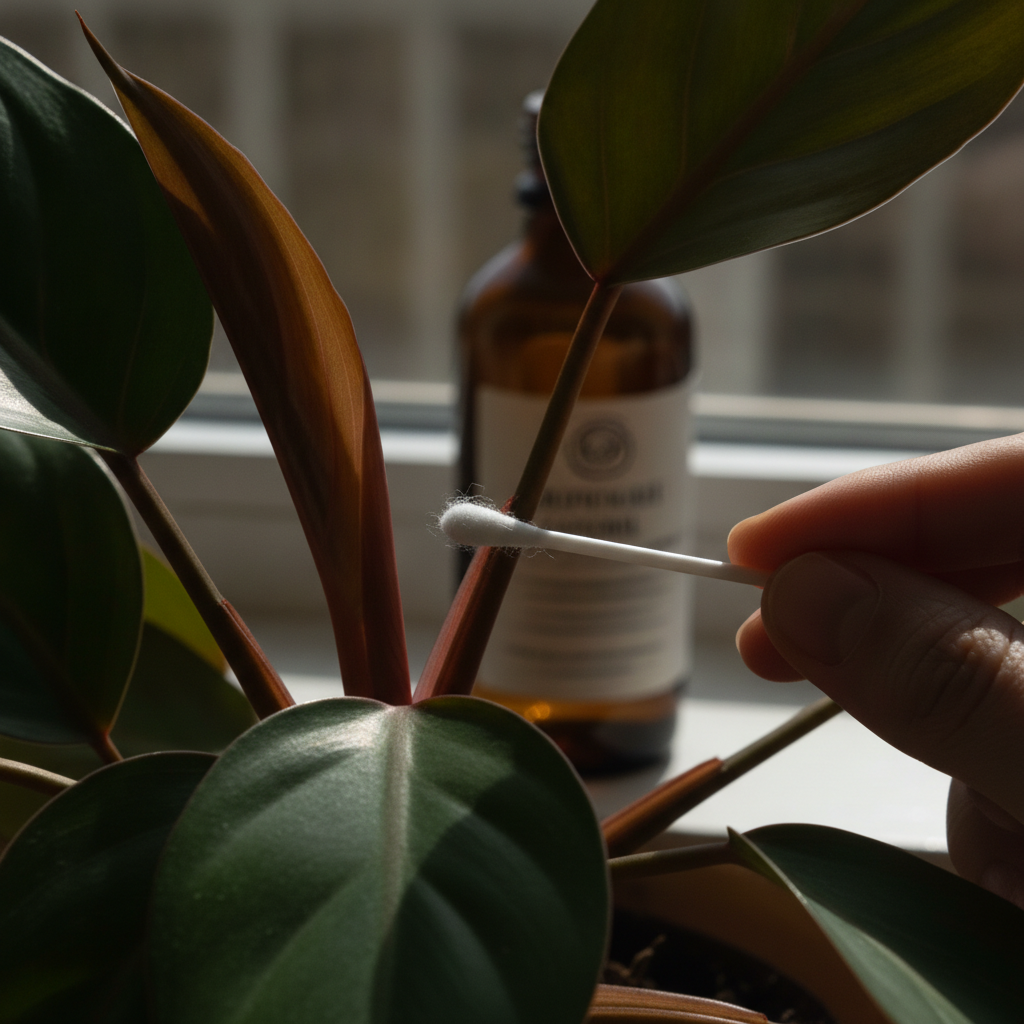
Small, soft insects that look like specks of white cotton wool, mealybugs cluster in leaf axils and along stems, sucking sap and weakening the plant. On a self-heading philodendron they love the sheltered crevices around the crown.
Treatment: Dab each insect with a cotton bud dipped in diluted isopropyl alcohol, then treat the whole plant with insecticidal soap or neem oil. Repeat weekly until no new bugs appear.
Spider Mites (Tetranychus urticae)
Tiny arachnids that thrive in hot, dry air, spider mites cause fine yellow stippling on the leaves and spin delicate webbing between stalks. They are most likely in winter when heating dries the air.
Treatment: Rinse the foliage thoroughly, raise humidity, and apply neem oil or a miticide to the undersides of leaves. Persistence over several weeks is needed to break their fast breeding cycle.
Scale (Coccoidea)
Scale insects appear as small brown or tan bumps stuck firmly to stems and the undersides of leaves. Under their waxy shells they feed on sap and excrete sticky honeydew that can lead to sooty mould.
Treatment: Scrape off what you can with a fingernail or cotton bud, then treat repeatedly with horticultural oil or insecticidal soap to catch the mobile young crawlers.
Fungus Gnats (Sciaridae)
Small black flies that hover around the soil, fungus gnats are more a nuisance than a danger, but their larvae feed on roots in consistently wet compost and signal that you are overwatering.
Treatment: Let the top of the soil dry out fully between waterings, use yellow sticky traps to catch the adults, and top-dress with a layer of grit to break their breeding cycle.
Common Diseases
Root Rot (Pythium and Phytophthora)
By far the most serious threat to the Red Congo, root rot sets in when soil stays waterlogged and fungal pathogens attack the suffocating roots. Above ground it shows as yellowing, wilting leaves and a soft, darkened stem base, despite the soil being wet.
Treatment: Unpot the plant, cut away all brown, mushy roots with sterilised scissors, and repot into fresh, free-draining mix in a clean pot. Water sparingly while the plant recovers and correct the overwatering that caused it.
Bacterial Leaf Spot (Xanthomonas and Erwinia)
This shows as dark, water-soaked spots on the leaves, often ringed with a yellow halo, which can spread quickly in warm, humid, poorly ventilated conditions or when foliage is repeatedly left wet.
Treatment: Remove affected leaves promptly, improve air circulation, and avoid wetting the foliage when watering. Keeping the leaves dry and the air moving is the best long-term defence.
Pest and Disease Summary
| Pest / Disease | Identification | Treatment |
|---|---|---|
| Mealybugs | White cottony clusters in crevices | Alcohol swab, then neem or insecticidal soap |
| Spider mites | Yellow stippling and fine webbing | Rinse, raise humidity, apply neem or miticide |
| Scale | Brown bumps on stems and leaf undersides | Scrape off, treat with horticultural oil |
| Fungus gnats | Small flies around damp soil | Dry out soil, sticky traps, grit top-dressing |
| Root rot | Yellowing leaves, soft stem, wet soil | Trim rotten roots, repot, water less |
| Bacterial leaf spot | Dark, haloed, water-soaked spots | Remove leaves, improve airflow, keep foliage dry |
Prevention Strategies
The most effective defence is a healthy plant in the right conditions. Correct light, careful watering and good air circulation keep the Red Congo vigorous enough to resist most problems before they start. Wiping the broad leaves with a damp cloth every few weeks not only keeps them glossy but also lets you spot early signs of trouble and removes the dust that mites and other pests hide in.
Quarantine is equally important. Always keep a newly bought plant separate from your collection for two to three weeks and check it over carefully, since most infestations arrive on new plants rather than appearing spontaneously. A quick inspection at watering time turns pest control into a matter of catching a handful of insects rather than rescuing an overrun plant.
Pro Tip — Wipe and Inspect: Make leaf cleaning a habit. Supporting each leaf from beneath and wiping the top with a soft, damp cloth keeps the foliage shining, improves the plant’s ability to photosynthesise, and gives you a regular close-up look at the spots where pests first take hold.
Popular Varieties
The Red Congo belongs to a family of self-heading philodendron hybrids bred for bold, colourful foliage and an upright, fuss-free habit. These cultivars share the same easygoing care but differ in the colour of their emerging leaves, from fiery orange to deep near-black, which makes collecting several an appealing way to build a varied display from plants that all want the same conditions.
The Red Congo itself is a patented hybrid, so it is sold under its trademarked name rather than being grown from seed at home. Its relatives below are widely available and easy to find at garden centres and specialist plant shops, each offering a different take on the rich, glossy self-heading look.
| Variety | Leaf Appearance | Light Needs | Growth Rate | Availability |
|---|---|---|---|---|
| Rojo Congo | Burgundy new leaves maturing to glossy green | Bright indirect | Moderate | Common |
| Imperial Red | Wine-red emerging leaves, deep green at maturity | Bright indirect | Moderate | Common |
| Imperial Green | Glossy green throughout, no red phase | Bright indirect | Moderate | Common |
| Prince of Orange | Coppery-orange new leaves ageing to green | Bright indirect | Moderate | Common |
| Black Cardinal | Bronze-black, almost burgundy leaves | Bright indirect | Slow to moderate | Occasional |
| Moonlight | Bright chartreuse-lime new growth | Bright indirect | Moderate | Common |
| McColley’s Finale | Red-orange new leaves deepening to green | Bright indirect | Moderate | Occasional |
Featured Varieties
Imperial Red
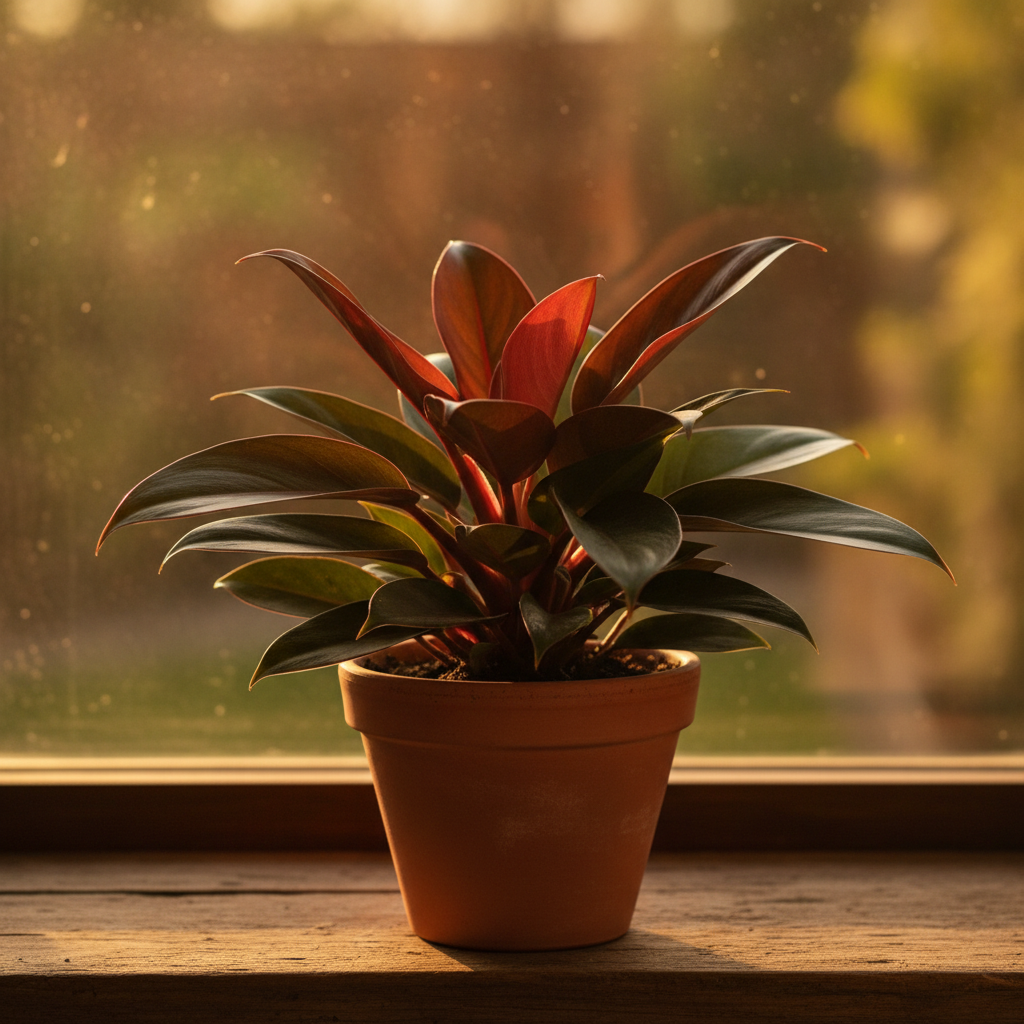
The closest relative to the Red Congo and likely one of its parents. Its broad leaves emerge a deep wine-red and settle into dark glossy green on a tight, self-heading rosette, giving a slightly more compact silhouette.

Prince of Orange
A spectacular colour-changer whose new leaves unfurl bright coppery orange before ageing through amber to green. A single plant carries the full spectrum at once, making it a favourite for those who want warmth rather than burgundy.
Variety Profiles in Detail
Imperial Red (Philodendron ‘Imperial Red’)
Imperial Red is the most direct comparison to the Red Congo and shares its parentage in the self-heading hybrid line. Its leaves are slightly more rounded and its overall form a touch more compact, but the colour journey from red to glossy green is almost identical. If you love the Red Congo’s look in a smaller package, this is the obvious companion.
Prince of Orange (Philodendron ‘Prince of Orange’)
Where the Red Congo trades in deep reds, Prince of Orange brings fire. Each new leaf opens a vivid coppery orange and slowly shifts through amber and bronze to mature green, so the plant always displays several warm shades together. Brighter light intensifies and prolongs the orange phase, making placement especially rewarding with this variety.
Black Cardinal (Philodendron ‘Black Cardinal’)
For the darkest drama, Black Cardinal produces leaves so deeply bronzed they appear almost black, emerging burgundy and settling into a sombre, glossy near-black green. It is a little slower and less common than the Red Congo, but its moody colouring makes it a striking counterpoint in a grouped display.
Choosing the Right Variety for Your Space
Because every self-heading philodendron in this group wants the same bright-indirect light, steady warmth and free-draining soil, your choice comes down almost entirely to colour and the brightness of your spot. Pick the Red Congo or Imperial Red for rich burgundy tones, Prince of Orange for warm coppery glow, Moonlight for fresh lime brightness in a darker corner, or Black Cardinal for dramatic depth. All deliver the same upright, undemanding habit, so you can mix several confidently knowing they will thrive side by side under one care routine.
Frequently Asked Questions
Why are my Red Congo’s new leaves not red?
The burgundy colour of new growth depends heavily on light. In dim conditions the red is paler and fades to green within days. Move the plant to a brighter, indirect spot and the next leaves should emerge with a deeper, longer-lasting red tone.
Why are the lower leaves on my Red Congo turning yellow?
An occasional yellowing lower leaf is normal ageing as the plant sheds its oldest foliage. Several leaves yellowing together, especially with wet soil, usually points to overwatering. Check that the soil is drying between waterings and that the pot drains freely.
Is the Red Congo Philodendron toxic to pets?
Yes. Like all philodendrons it contains insoluble calcium oxalate crystals that are toxic to cats, dogs and humans if chewed or swallowed, causing burning, drooling and swelling of the mouth and throat. Keep it out of reach of pets and children.
How big does a Red Congo Philodendron get indoors?
Indoors it typically reaches around 0.6 to 1.2 metres (2 to 4 feet) tall and roughly the same across, forming a full, rounded rosette. Its mature size makes it well suited to a floor pot rather than a shelf or windowsill.
How often should I water my Red Congo?
Water when the top 2 to 5 cm (1 to 2 in) of soil has dried, which is roughly weekly in spring and summer and noticeably less in winter. Always water by checking the soil rather than following a fixed schedule, as light, warmth and pot size all change the plant’s needs.
Does the Red Congo need a moss pole?
No. Unlike climbing philodendrons, the Red Congo is self-heading and grows upright from a central crown, so it never needs a moss pole or trellis. It supports itself naturally, though a heavier pot helps keep a large, leafy specimen stable.
Can I propagate a Red Congo from a single leaf?
No. A single leaf without a node and growing point will not form a new plant. The Red Congo is propagated by dividing the crown into sections that each carry roots, or by stem cuttings and air layering on older plants that have developed a trunk.
Why does my Red Congo have brown leaf tips?
Brown, crispy tips usually indicate dry air or a build-up of fertiliser salts in the soil. Raise the humidity with a pebble tray or humidifier, flush the pot occasionally with plain water, and avoid overfeeding to keep the leaf edges clean.
What is the difference between the Red Congo and Imperial Red?
They are closely related self-heading hybrids with very similar red-to-green foliage and identical care. The Red Congo tends to be slightly larger and more upright, while Imperial Red is a touch more compact with rounder leaves. Imperial Red is widely thought to be one of the Red Congo’s parents.






