
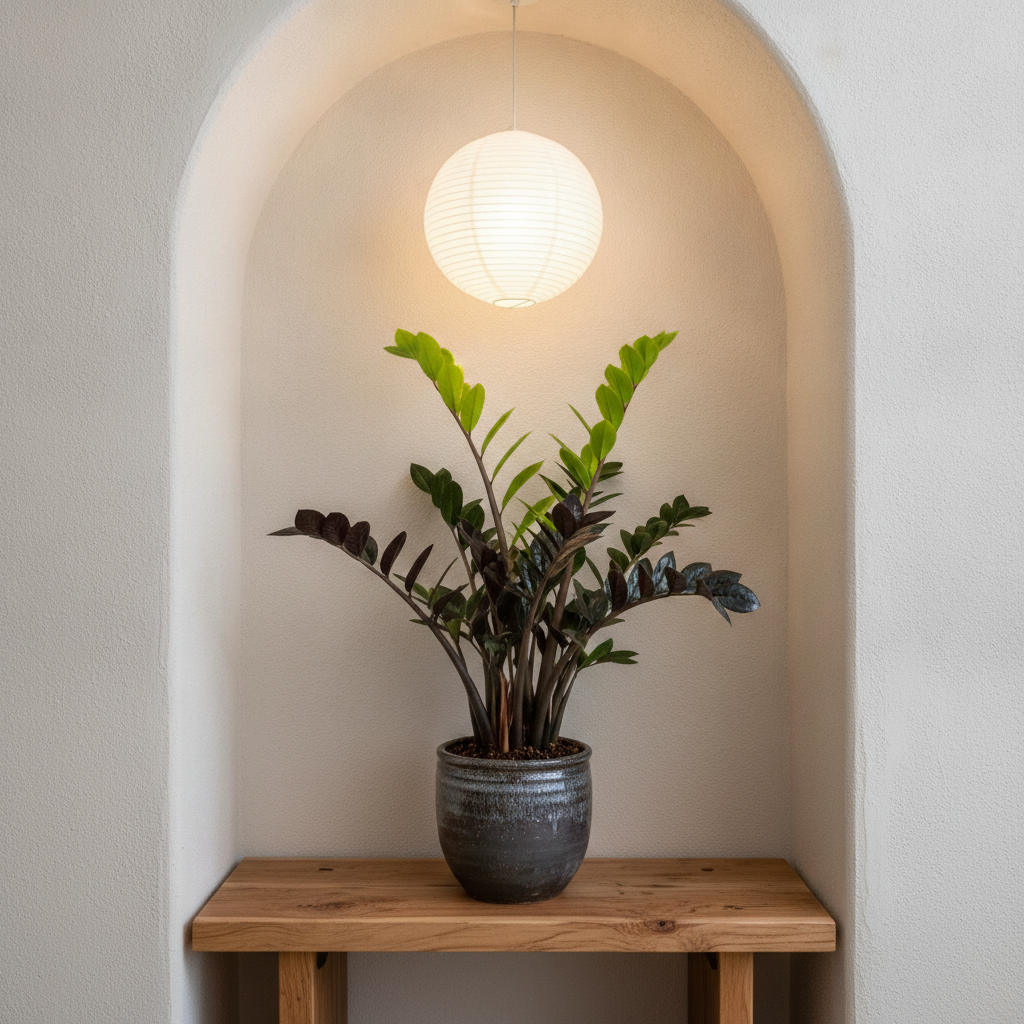
Few houseplants make a first impression quite like the Black ZZ Plant. New fronds unfurl a startling chartreuse green, then deepen over a few weeks into a glossy, purple-black that looks almost lacquered under a lamp. Zamioculcas zamiifolia ‘Raven’ takes everything that made the ordinary ZZ a beginner favourite, the near-indestructible constitution, the tolerance of neglect, the patience with low light, and wraps it in a colour that reads as pure drama. The result is a plant that asks for very little yet anchors a room like a piece of sculpture.
This guide covers everything you need to keep a Raven thriving rather than merely surviving, because there is a real difference between the two. A neglected ZZ will cling to life for months in a dim corner, but it will not give you that signature blackness, and it will not push out the steady flush of new stems that makes the plant feel alive. Get the light, the watering rhythm and the soil right, and you will be rewarded with one of the most striking and forgiving plants you can grow indoors.
Quick Reference
Use the table below as an at-a-glance summary, then read on for the detail behind each figure. The jump links take you straight to the section you need.
- Why the Black ZZ makes a good houseplant
- Light
- Watering
- Soil and potting
- Fertilising
- Propagation
- Pests and problems
- Varieties and relatives
- Frequently asked questions
| Common name | Black ZZ plant, Raven ZZ |
| Botanical name | Zamioculcas zamiifolia ‘Raven’ |
| Family | Araceae |
| Light | Bright indirect; tolerates low light |
| Water | Every 2 to 3 weeks; allow to dry fully |
| Soil | Free-draining cactus or aroid mix |
| Temperature | 18 to 26 degrees C (64 to 79 F) |
| Humidity | Average household; undemanding |
| Mature size | 60 to 90 cm (24 to 36 in) indoors |
| Toxicity | Toxic to pets and people if eaten |
| Difficulty | Very easy |
Why the Black ZZ Makes a Good Houseplant
The wider ZZ clan hails from the drought-prone grasslands and rocky forests of eastern Africa, from Kenya down to South Africa, where the dry season can run for months. To cope, the plant evolved fat underground rhizomes that swell with stored water, much like a potato, alongside thick, waxy leaflets that lose moisture only grudgingly. That ancestry is the whole reason a ZZ can sit forgotten on an office shelf and still look immaculate. The Raven cultivar, introduced commercially at the end of the 2010s, is a selected colour form of that same tough species, so it inherits every bit of the resilience while adding its theatrical dark foliage.

For most people the appeal comes down to three things. First, it is genuinely hard to kill, which makes it ideal for new plant owners, frequent travellers and anyone whose attention drifts. Second, it tolerates the kind of low and artificial light that defeats most decorative foliage, so it earns its place in hallways, bathrooms and north-facing rooms where little else will hold its colour. Third, that colour is simply unlike anything else on a typical plant shelf: the contrast between a brand-new lime-green stem and the mature black foliage beside it is the plant’s signature party trick, and it happens on its own with no special effort from you.
It is worth being clear-eyed about one trade-off. The Raven is a slower grower than the standard green ZZ, and the deep pigment it carries means it has slightly less chlorophyll working for it. In practice that means a touch more patience between new stems and a stronger preference for good light if you want the blackest possible leaves. None of this makes it difficult, it simply rewards a little attention with a much better-looking plant.
Pro Tip — Read the new growth: A healthy Raven tells you it is happy by pushing up fresh chartreuse stems from the centre of the pot. If you see those bright spears appearing through the year, your care routine is working. A long stretch with no new growth usually points to too little light rather than anything you are doing wrong with water.
Light
The single biggest lever you have over a Raven’s appearance is light. The plant will survive in low light, that is its famous reputation, but surviving and developing rich black foliage are not the same thing. In a dim corner the Raven slows almost to a standstill and its new growth often stalls while still green, never deepening to the dark tone you bought it for. Give it generous light and it grows faster, holds itself more compactly and turns out leaves of a far more intense, glossy black.
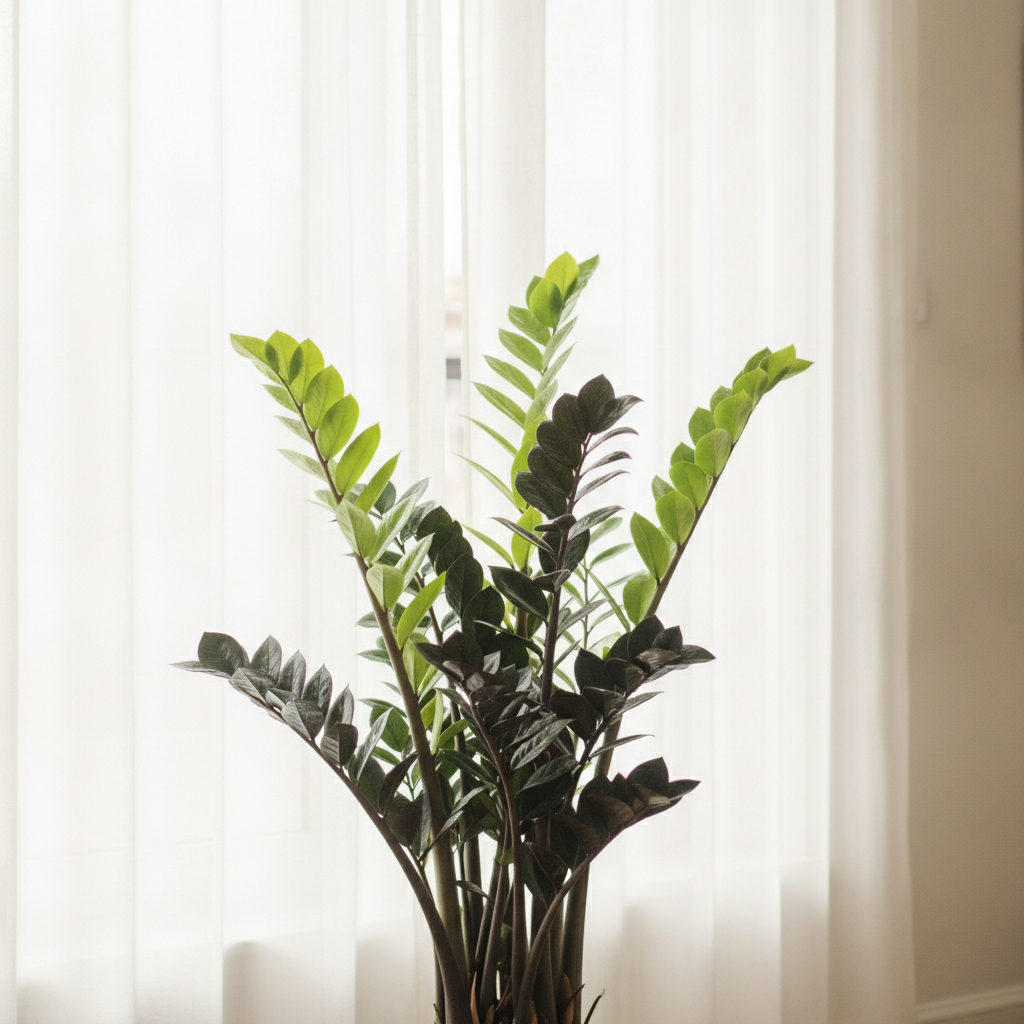
Aim for bright, indirect light: a spot a metre or two back from an east or west window, or close to a south-facing window softened by a sheer curtain, is ideal. The plant will happily take a couple of hours of gentle morning sun, but harsh, direct midday rays through unfiltered glass can scorch the waxy leaflets, leaving bleached or crisped patches that do not recover. If your only bright window gets fierce afternoon sun, pull the plant back from the glass or diffuse the light rather than placing it directly in the beam.
At the other end of the scale, the Raven is one of the few genuinely good performers under artificial light, which is why it does so well in offices. A standard LED or fluorescent ceiling fixture that stays on through the working day provides enough energy to keep it ticking over. If you are growing it in a room with almost no natural light, a small full-spectrum grow light on a timer will keep both growth and colour far better than relying on a dim corner alone. Wherever it sits, give the pot a quarter turn every couple of weeks so it grows evenly rather than leaning toward the light.
Warning — Green reversion: If your Raven’s new leaves are coming in green and staying that way, the cause is almost always insufficient light, not a fault with the plant. Move it somewhere brighter and the next flush should darken properly as it matures.
Watering
If light is the lever for beauty, watering is the lever for survival, and with a ZZ the overwhelming risk runs in one direction: too much. Those water-storing rhizomes mean the plant is built to ride out long dry spells, so it is far more forgiving of a missed watering than of a soggy pot. The vast majority of ailing ZZ plants are not thirsty, they are drowning, their rhizomes quietly rotting in mix that never gets the chance to dry.
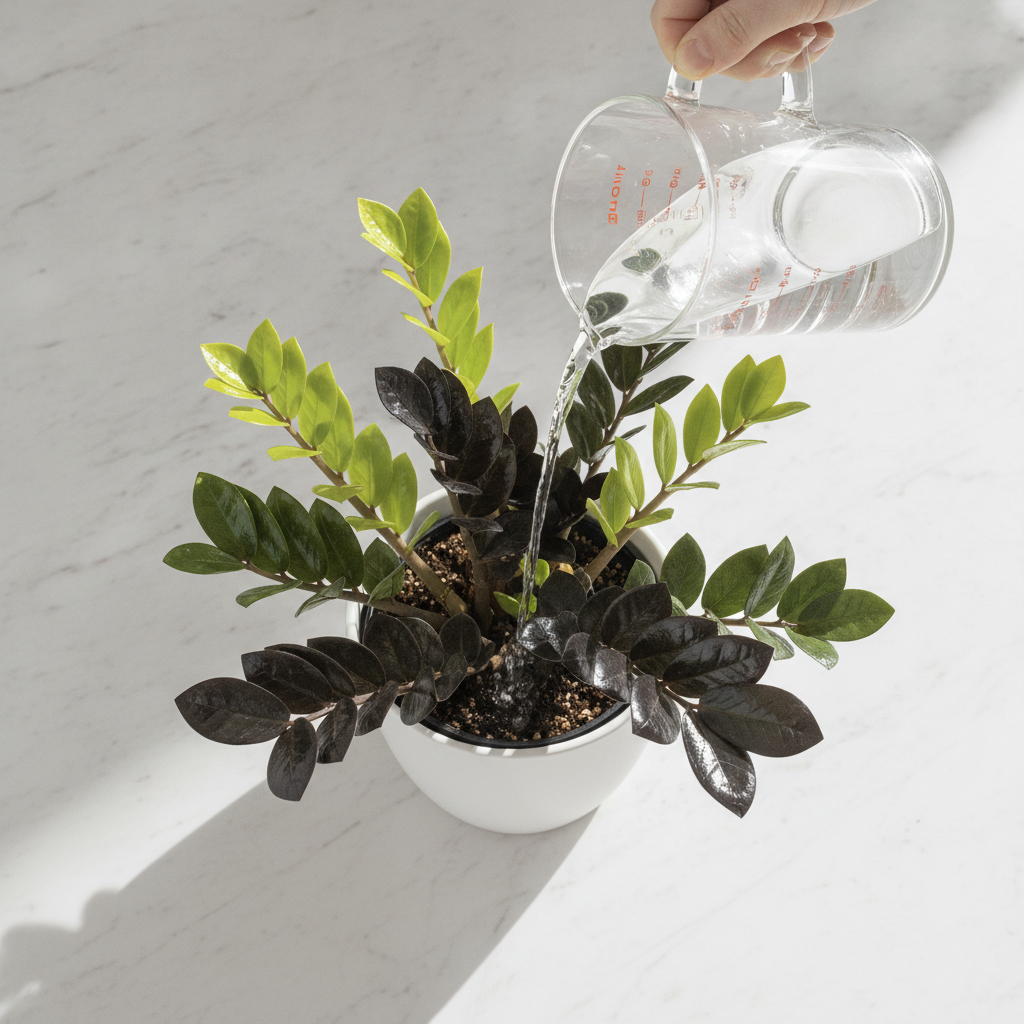
The right method is to water thoroughly but infrequently. When you do water, soak the soil completely until liquid runs from the drainage holes, then empty the saucer so the pot never stands in water. After that, wait. Allow the entire rootball to dry out before you even think about watering again. For most homes that works out to roughly once every two to three weeks in the brighter months, and noticeably less in winter, when a Raven can go a month or more between drinks. Rather than watering on a fixed schedule, check the soil: push a finger deep into the pot, or lift it to feel the weight, and only water when it is dry well down and the pot feels light.
Learn to read the leaves, too. A ZZ that needs water may show slightly wrinkled or curling leaflets, a gentle signal that the rhizomes are drawing down their reserves, and it will plump back up within a day of a good soak. Yellowing leaves, especially lower ones that turn soft and translucent, point the other way, toward overwatering and the early stages of rot. When in doubt, wait another few days; this is a plant that genuinely prefers to be under-watered than over-watered.
Pro Tip — The weight test: Lift the pot right after a thorough watering to learn how heavy “full” feels, then lift it again every week. When it feels noticeably light, it is time to water. This simple habit prevents more ZZ deaths than any moisture meter.
Soil and Potting
Because the enemy is excess moisture, drainage is the property that matters most in a Raven’s potting mix. The soil needs to hold just enough water to see the plant through, then let the rest run away freely so the rhizomes are never sitting wet. A dense, water-retentive compost straight from the bag is the wrong choice; it stays soggy in the middle long after the surface looks dry, and that hidden wet zone is exactly where rot begins.
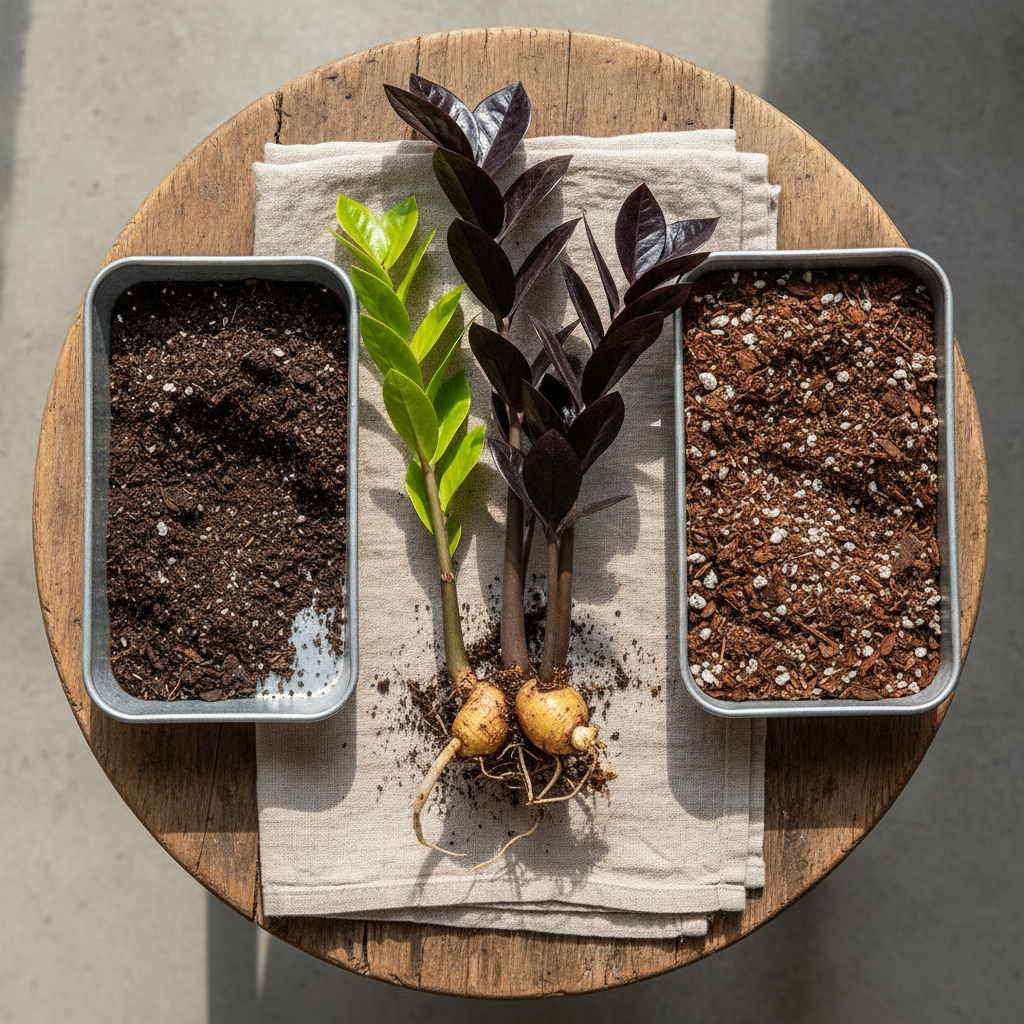
A reliable recipe is to take a quality houseplant or aroid compost and lighten it heavily with chunky, free-draining material: roughly two parts potting mix to one part perlite and one part orchid bark works well, with a handful of coarse grit or pumice if you tend to over-water. A bagged cactus and succulent mix amended with a little extra perlite is a perfectly good shortcut. The aim is a mix that feels open and airy in the hand, full of gaps for water to drain through and for air to reach the roots.
The pot itself should always have drainage holes, with no exceptions. Terracotta is a particularly forgiving choice because its porous walls wick away surplus moisture, though any pot with holes will do if you are disciplined about emptying the saucer. Raven ZZ plants are slow growers that are quite content to be a little snug, so there is no need to rush them into larger containers; repot only every two or three years, or when you can see rhizomes crowding the rim or pushing up against the pot walls. Move up just one pot size at a time, as a great volume of fresh, damp mix around a small rootball is itself a rot risk. Spring is the ideal time to repot, and it doubles as a good moment to divide a congested plant.
Fertilising
The Black ZZ is a light feeder, in keeping with its origins in poor, rocky soils, so a restrained hand with fertiliser serves it far better than enthusiasm. It will grow perfectly well with only occasional feeding, and over-fertilising does real harm: a build-up of mineral salts in the mix can scorch the rhizomes and brown the leaf tips, undoing exactly the clean, glossy look you are after.

During the active growing season, from spring through to early autumn, feed once a month at most with a balanced liquid houseplant fertiliser diluted to half the recommended strength. That cadence comfortably covers the plant’s modest needs. Through the darker months, when growth naturally slows or stops, withhold fertiliser entirely and simply let the plant rest; feeding a dormant plant only invites salt build-up because the roots are not actively taking the nutrients up. Always apply feed to already-moist soil rather than bone-dry mix, as fertiliser on dry roots is far more likely to burn them.
If you ever suspect you have overdone it, the remedy is straightforward: flush the pot by running plenty of plain water through the soil to wash out accumulated salts, then ease off the feeding. Given how slowly a Raven grows, you genuinely cannot force it to move faster with extra fertiliser; all you will achieve is chemical stress. Steady, sparing feeding is the whole story.
Propagation
Propagating a Raven is rewarding but demands patience, because this is a slow plant in every phase of its life. There are two reliable routes: division of the rhizomes, which is much the faster of the two, and leaf or stem cuttings, which are remarkable to watch but can take the best part of a year to produce a viable little plant. Worth noting before you start: because ‘Raven’ is a patented cultivar, propagation is fine for your own use and to share with friends, but propagating it for commercial sale is restricted.
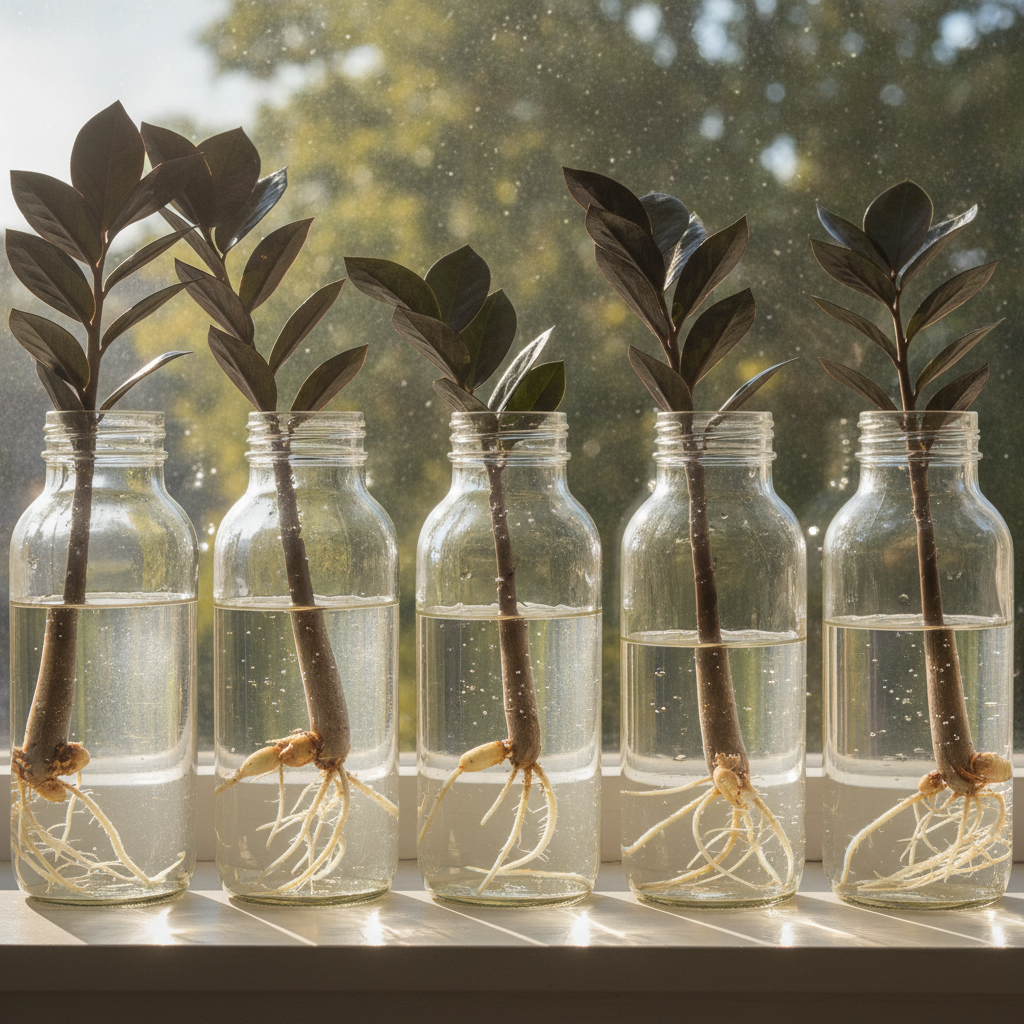
Division is the method to choose if you want results within a season. The best time is spring, ideally combined with a routine repot. To divide a Raven, follow these steps:
- Slide the whole plant out of its pot and gently brush away enough soil to expose the cluster of plump rhizomes at the base.
- Look for natural points where the clump separates into sections, each carrying at least one healthy rhizome and a few of its own stems.
- Tease the sections apart by hand where you can; where they refuse to part, cut cleanly through with a sterilised, sharp knife.
- Let any cut surfaces air-dry for a few hours so they callus over, which guards against rot once they are potted.
- Pot each division into its own container of free-draining mix, water lightly, and place it in bright indirect light.
Leaf and stem cuttings are the slow-burn alternative. Detach a healthy leaflet, or a whole stem cut into sections, and let the cut ends callus for a day. Then either stand them in a jar of clean water or insert them upright into damp, gritty mix, and put them somewhere warm and brightly lit. Over the following months a small rhizome will form at the base, and only after that does a new shoot appear. Change the water regularly if you root in water, and resist the urge to disturb the cuttings to check progress; this is a process measured in months, not weeks, and warmth is the biggest factor in success.
Pro Tip — Patience pays: A leaf cutting that looks like it is doing nothing on top may be quietly building a rhizome underground. As long as the cutting stays firm and green, leave it alone; many are discarded just weeks before they would have sprouted.
Pests and Problems
One of the quiet pleasures of growing a ZZ is how little trouble it attracts. The thick, waxy leaflets are an awkward target for most sap-sucking insects, so a Raven is far less pest-prone than thinner-leaved houseplants. That said, no plant is entirely immune, and the great majority of Raven problems are cultural rather than the work of insects, with overwatering at the root of nearly everything.

When pests do appear, the usual suspects are mealybugs, which show up as small white cottony tufts tucked into the joints where leaflets meet the stem, along with the occasional scale insect, presenting as flat brown bumps, or aphids on tender new growth. Fungus gnats, those tiny flies hovering around the pot, are not really a leaf pest at all; they breed in soil that is kept too damp, so their presence is a useful warning that you are watering too often. For mealybugs and scale, dab each one with a cotton bud dipped in diluted isopropyl alcohol, then wipe the leaves down; for a heavier infestation, treat with insecticidal soap or a neem-oil spray and repeat weekly until clear. Wiping the foliage now and then keeps it glossy and gives you a regular opportunity to catch trouble early.
The table below sorts the most common complaints by their likely cause, so you can match a symptom to its remedy. In nearly every case the fix involves easing off the watering can rather than reaching for a spray.
| Symptom | Likely cause | What to do |
| Lower leaves yellowing and soft | Overwatering, early root rot | Stop watering, let dry fully, check rhizomes for rot |
| New growth stays green, never blackens | Too little light | Move to a brighter, indirect spot |
| Leaflets wrinkled or curling | Under-watering | Give a thorough soak; they should plump up |
| Brown, crispy leaf tips | Fertiliser salt build-up or scorch | Flush the soil, reduce feeding |
| Mushy stems at the base | Rhizome rot from soggy soil | Unpot, cut away rot, repot in dry, gritty mix |
| Small flies around the pot | Fungus gnats in wet soil | Let soil dry; use sticky traps |
Warning — Toxicity: All parts of the ZZ plant contain calcium oxalate crystals, which are toxic to cats, dogs and people if chewed or swallowed and can irritate skin and eyes. The sap can sting bare hands, so wear gloves when dividing or pruning, wash up afterwards, and keep the plant out of reach of pets and small children.
Varieties and Relatives
The Black ZZ is one cultivar within a small but growing family of selected Zamioculcas forms, all sharing the same easy temperament but differing in colour, size and leaf shape. If you fall for the Raven, it is worth knowing its closest relatives, because they make excellent companions and share an identical care routine.
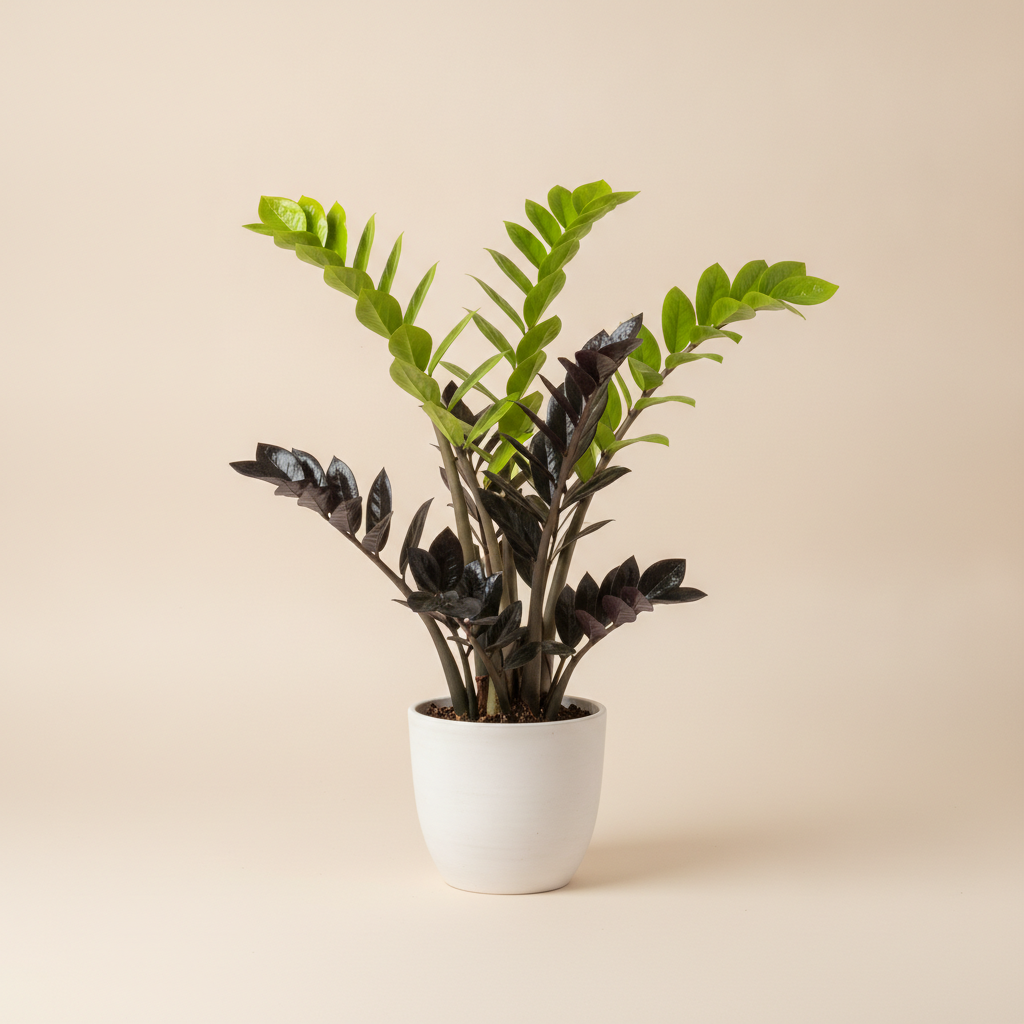
‘Raven’ is the cultivar this guide is built around, and the one that started the craze for dark ZZ plants. Its arching stems are lined with thick, glossy leaflets that emerge a bright lime-green and mature to a deep purple-black, giving every healthy plant a striking two-tone look as fresh growth sits alongside the older foliage. It is the darkest widely available ZZ and the benchmark against which the others are measured.
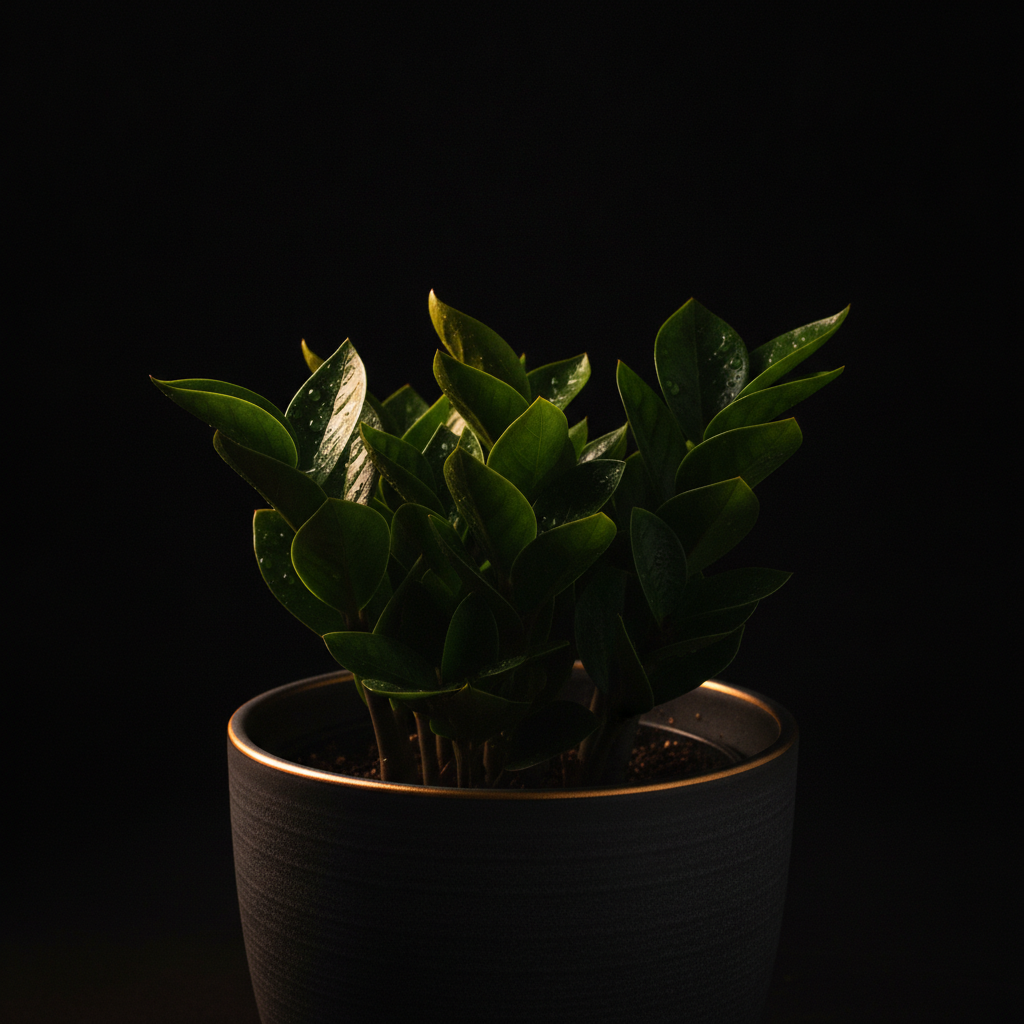
‘Zenzi’ is a dwarf cultivar with short, stout stems and densely overlapping dark-green leaflets that curl slightly inward, giving it a tidy, almost rosette-like silhouette. It stays far more compact than the species, rarely passing 40 cm, which makes it perfect for desks and crowded shelves. Its glossy foliage is a deep forest green rather than black, but it shares the Raven’s bulletproof constitution exactly.
Beyond these two, the familiar plain green Zamioculcas zamiifolia remains the fastest-growing and most affordable member of the group, an outstanding first houseplant in its own right. Collectors also seek out ‘Zamicro’, a naturally smaller, finer-leaved selection, and the rare variegated ZZ, whose foliage is splashed with cream and white, though the variegated form grows slowly and needs brighter light to hold its markings. Whichever you choose, the care described here applies across the board, so building a small collection of contrasting forms is an easy and satisfying way to grow your indoor jungle.
Frequently Asked Questions
Why is my Black ZZ growing back green instead of black?
This is the most common Raven question, and the answer is almost always light. New growth on a Raven naturally emerges green and only darkens as it matures, but in a dim spot it may never deepen at all. Move the plant somewhere with brighter indirect light and the next flush of leaves should mature to the proper glossy black.
How often should I water a Black ZZ plant?
Roughly every two to three weeks in the warmer months and less in winter, but the calendar matters less than the soil. Always let the entire rootball dry out before watering again, then soak it thoroughly and drain. When in doubt, wait, because a ZZ tolerates drought far better than wet feet.
Is the Black ZZ plant safe around pets and children?
No. Like all ZZ plants it contains calcium oxalate crystals that are toxic if eaten and can irritate skin, so keep it away from cats, dogs and young children, and wear gloves when handling cut stems or dividing it.
Why is my Raven ZZ so slow to grow?
Slow growth is normal for this cultivar; the Raven is naturally more leisurely than the green ZZ, partly because its dark pigment leaves it with less chlorophyll. Brighter light and the growing-season months will speed things up a little, but you cannot rush it with extra fertiliser, and trying will only stress the plant.
Can a Black ZZ really survive in low light?
It will survive, which is why it is recommended for offices and dim corners, but it will not thrive or develop its best colour there. Expect minimal growth and greener leaves in low light. For a plant that looks its dramatic best, bright indirect light is well worth providing.
The leaves are turning yellow. What is wrong?
Yellowing, soft lower leaves are the classic sign of overwatering and possible rhizome rot. Stop watering immediately, let the soil dry out completely, and if several stems are affected, unpot the plant to check the rhizomes; cut away any mushy, brown sections and repot into fresh, gritty, free-draining mix.






