
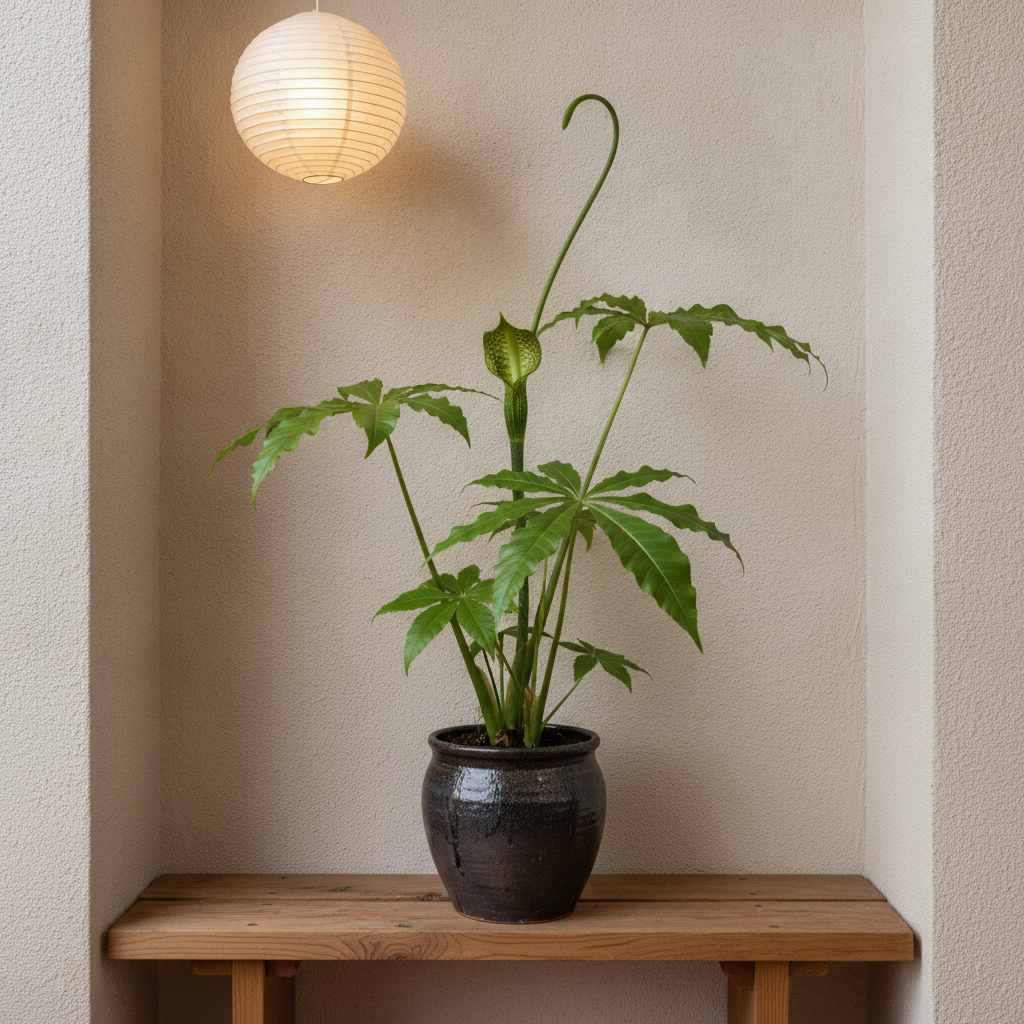
Few houseplants make an entrance quite like the Shepherd’s Crook. From a fat underground tuber rises a single mottled stalk topped with a parasol of leaflets, and from the centre emerges a hooded green flower whose tail-like tip arches up and curls over on itself like the crook of a shepherd’s staff. Botanists know it as Arisaema tortuosum, the species name referring to that twisting, sinuous spadix. Gardeners more often call it the whipcord cobra lily or simply the shepherd’s crook, and it belongs to the wider group of cobra lilies prized by collectors of unusual aroids.
Native to the Himalayas and the hill forests of the Indian subcontinent, from Nepal and northern India down to the Western Ghats, Arisaema tortuosum is a woodland geophyte that spends part of every year asleep beneath the soil. That dormancy is the single most important thing to understand about it, and the place most new growers go wrong. This guide covers everything from the light and watering it needs in active growth to the careful winter rest that keeps the tuber alive, along with potting, feeding, propagation and the pests to watch for. The difference between merely keeping a tuber alive and coaxing it into that spectacular annual display comes down to respecting its natural rhythm, and that is exactly what we will walk through.
Contents
- Quick Reference
- Why Shepherd’s Crook Makes a Rewarding Houseplant
- Light Requirements
- Watering & Humidity
- Soil, Potting & Repotting
- Fertilising
- Propagation
- Pests & Diseases
- Popular Varieties
- Frequently Asked Questions
Quick Reference: Shepherd’s Crook at a Glance
| Light | Bright, indirect light or dappled shade; protect from harsh midday sun |
| Watering | Keep evenly moist in active growth, then withhold almost entirely during winter dormancy |
| Temperature | 15 to 25 C (59 to 77 F) in growth; tolerates a cool dormant rest down to near freezing |
| Humidity | Moderate to high, around 50 to 70 percent |
| Fertiliser | Balanced feed every two to four weeks while in leaf; none when dormant |
| Toxicity | Toxic to cats, dogs and humans if ingested; contains calcium oxalate crystals |
Why Shepherd’s Crook Makes a Rewarding Houseplant
The appeal of Arisaema tortuosum is theatrical rather than tidy. This is not a plant that fills a corner with reliable evergreen foliage the way a pothos or a snake plant does. Instead it offers a dramatic seasonal performance: a dormant tuber that seems to do nothing for months, then a sudden surge of growth in spring, a single architectural leaf-and-flower structure that can reach well over a metre tall on a mature specimen, and the bizarre, unforgettable inflorescence with its arching spadix. For collectors of the unusual, that spectacle is worth the wait many times over.

It also carries a fascinating biological quirk that endears it to enthusiasts. Like many of its relatives, the Shepherd’s Crook is sequentially hermaphroditic, meaning an individual plant can change sex from one year to the next. Young or energy-depleted tubers tend to produce male flowers, while large, well-fed tubers switch to female and can set seed. That single fact turns ordinary cultivation into a genuine long-term project, because the better you grow the plant, the more its behaviour changes before your eyes. As a houseplant it rewards a grower who enjoys observation and the slow accumulation of skill, rather than instant gratification.
Important — Toxicity: Every part of Arisaema tortuosum contains needle-like calcium oxalate crystals called raphides. Chewing any part of the plant or its tuber can cause intense burning, swelling of the mouth and throat, drooling and difficulty swallowing in people and pets. Keep it well away from cats, dogs and curious children, and wear gloves when handling cut surfaces or dividing the tuber.
Light Requirements
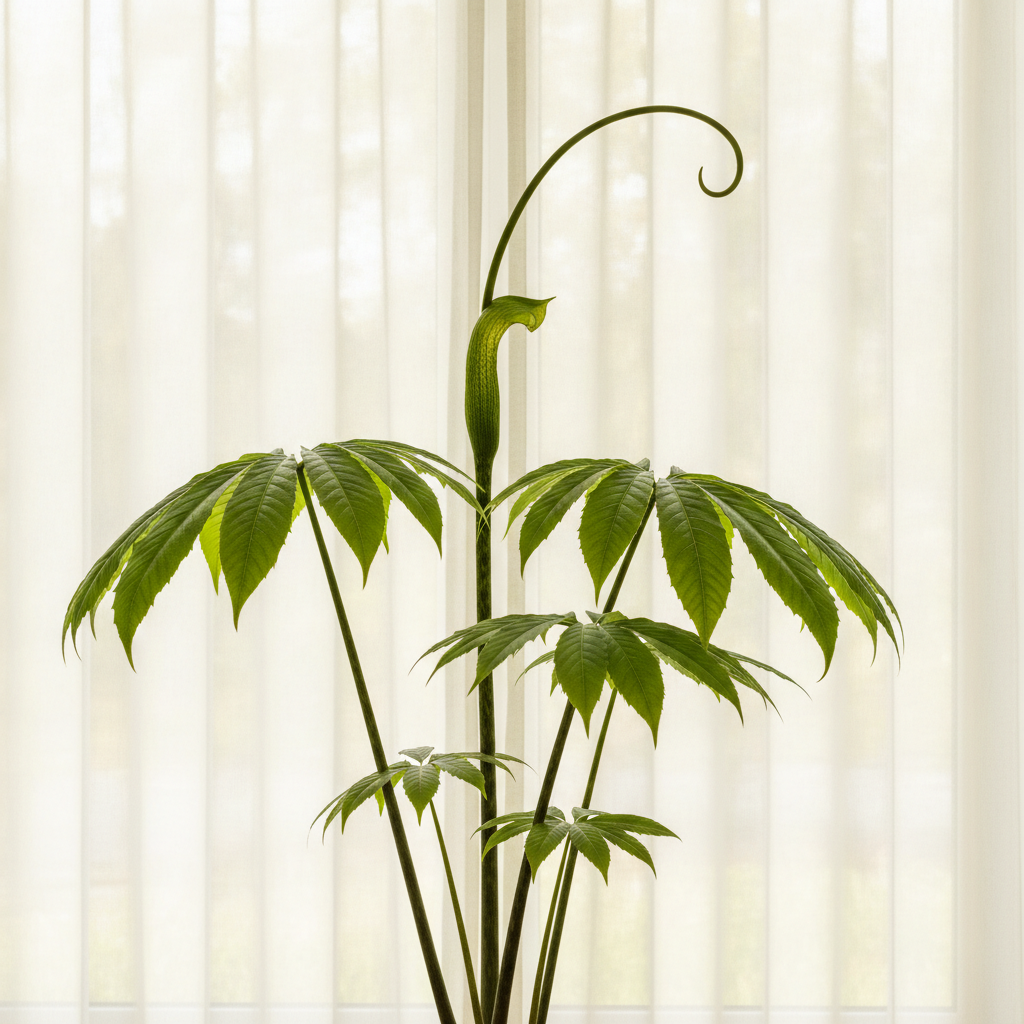
In the wild, Arisaema tortuosum grows on forest margins, in scrub and along grassy slopes where it receives broken, filtered light beneath taller vegetation. Translating that to indoor culture, the plant wants bright light that is largely indirect, with perhaps a little gentle morning sun. It is emphatically not a low-light plant during its growing season, but neither will it thank you for hours of fierce, unfiltered afternoon sun against a hot pane of glass.
The ideal spot is a position that stays bright all day without the leaf ever sitting in a harsh beam. A few steps back from a south or west window, or directly in an east window, usually does the job. Because the whole above-ground plant is essentially a single leaf and flower, that one structure has to capture all the energy the tuber needs to bulk up for next year, so do not stint on light while the plant is in active growth.
Light Levels Explained
Indoor light is far dimmer than most people assume, and the same window can deliver wildly different intensity depending on orientation, season and what sits outside. The table below sketches the broad categories and how the Shepherd’s Crook responds to each while it is in leaf.
| Light Category | Approx. Level | Typical Location | Outcome |
|---|---|---|---|
| Direct sun | Over 50,000 lux | On a south sill, full midday exposure | Risk of scorch and rapid drying; leaflets may bleach or crisp |
| Bright indirect | 10,000 to 25,000 lux | Near an east or curtain-filtered south window | Ideal; strong, well-coloured growth and good tuber gain |
| Medium | 5,000 to 10,000 lux | A metre or two back from a bright window | Acceptable; growth slightly taller and more drawn out |
| Low | 1,000 to 5,000 lux | North window or interior wall | Weak, stretched petiole; tuber loses energy over the season |
| Very low | Under 1,000 lux | Dim hallway, far from any window | Unsustainable in growth; plant declines |
Window Orientation and Placement
South-facing window: The brightest exposure in the northern hemisphere and capable of delivering more direct sun than this plant wants in summer. Use a sheer curtain to soften the light, or set the pot a short distance back so the foliage stays bright but out of the direct beam.
East-facing window: Often the sweet spot. Gentle morning sun followed by bright ambient light for the rest of the day suits the Shepherd’s Crook well and rarely causes scorch.
West-facing window: Workable, but the afternoon sun can be surprisingly fierce in summer. Watch for drying soil and consider light diffusion during the hottest months.
North-facing window: Generally too dim to sustain vigorous growth and a healthy gain in tuber size. If a north window is all you have, supplement with a grow light during the growing season.
Pro Tip — Rotate for Symmetry: Because the plant produces a single leaf structure that turns to face the light, give the pot a quarter turn every few days. This keeps the tall petiole growing upright rather than leaning, which matters a great deal on a specimen that can stand over a metre tall.
How Light Affects Growth and Flowering
Light does more than keep the foliage green. The energy the single leaf captures over a season is stored in the tuber, and the size of that tuber determines whether the plant flowers at all the following year and, remarkably, whether it produces male or female flowers. A plant grown in good light builds a larger tuber and is far more likely to reward you with the dramatic inflorescence and, eventually, the sex change to a seed-bearing female. Grown in shade, the tuber shrinks year on year, flowering ceases, and the plant gradually fades.
Warning — Direct Sunlight: Avoid moving a plant straight from indoor or dappled conditions into full sun. The large, thin leaflets scorch easily, developing pale bleached patches or crisp brown edges that will not recover. Acclimatise gradually over a week or two if you intend to give it a sunnier summer position.
Artificial Lighting
The Shepherd’s Crook responds well to supplementary lighting during its growing months, which is useful in homes without a bright window or in regions with weak spring light. A full-spectrum LED grow light positioned 30 to 45 cm (12 to 18 in) above the foliage and run for twelve to fourteen hours a day will support strong growth. There is no need to light a dormant tuber, since it has no leaves to feed and is resting underground regardless.
Seasonal Adjustments
This plant’s light needs are entirely seasonal. From the moment the shoot emerges in spring until the leaf begins to yellow in late summer or autumn, it wants its brightest sustainable position. Once it dies back, light becomes irrelevant: the dormant tuber can be stored in a cupboard, a cool shed or simply left in its pot in a dim corner. Resume bright placement only when new growth appears the following spring.
Watering & Humidity
Watering a Shepherd’s Crook is a tale of two seasons, and getting the rhythm right is the heart of growing it well. During active growth the tuber is thirsty and the plant likes consistently moist soil, but the instant the leaf begins to fade the watering can must be put away, because a dormant tuber sitting in damp compost is the single most common way these plants are lost to rot.

When to Water
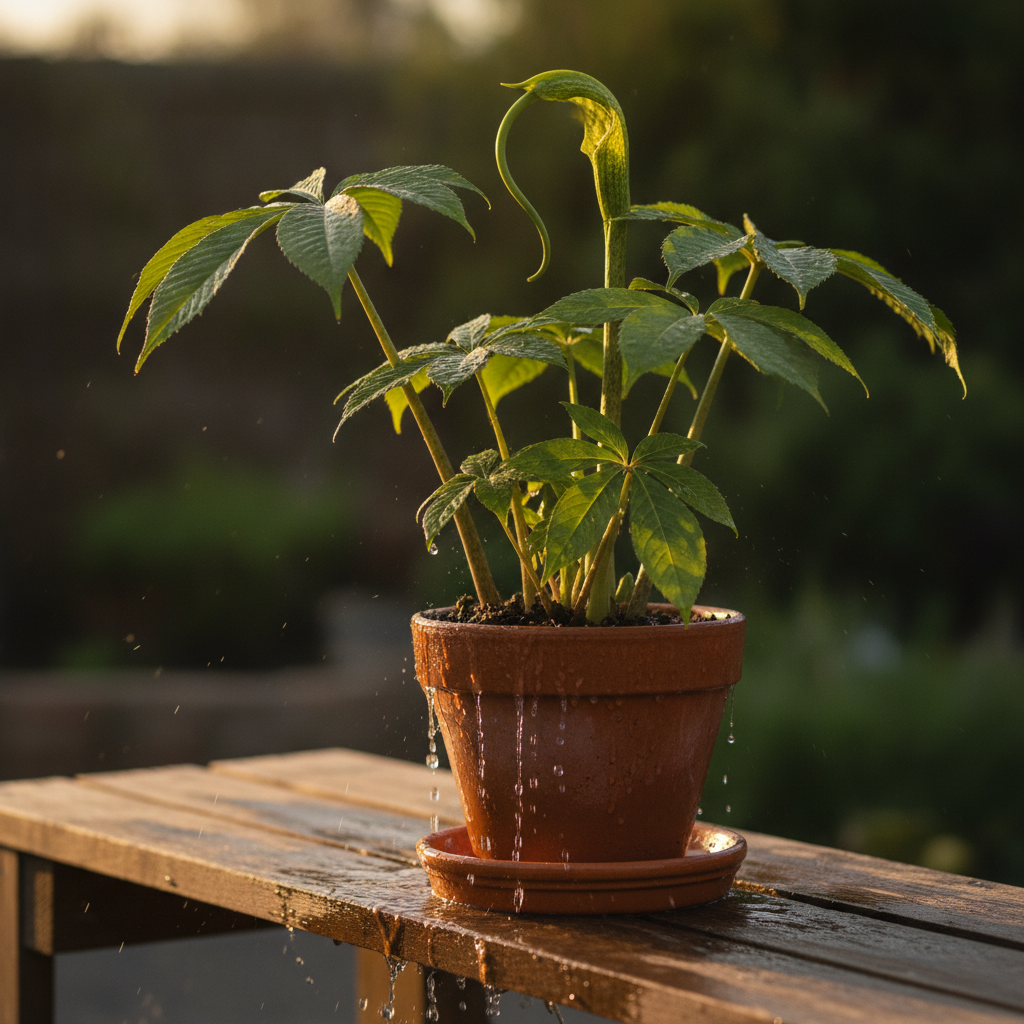
While the plant is in leaf, aim to keep the compost evenly moist, watering thoroughly once the top two to three centimetres feel barely damp and never letting the root zone dry out completely. In the warmth of summer growth, a vigorous specimen in a smaller pot may need watering every few days. The key sensation to learn is moist but never soggy: water should drain freely from the base and the pot should never stand in a full saucer.
As summer turns to autumn the leaf will begin to yellow and collapse. This is normal and healthy, not a sign of trouble. From the first hint of die-back, taper the watering off steadily, and once the foliage has gone completely, stop almost entirely. A fully dormant tuber needs only enough occasional moisture to stop it shrivelling to dust, which in a cool room is often nothing at all for weeks at a time. Resume normal watering only when a new shoot pushes through in spring.
Pro Tip — Read the Leaf, Not the Calendar: Do not water by a fixed schedule. Let the plant tell you which phase it is in. A green, expanding leaf means water generously; a yellowing or absent leaf means hold off. The plant’s appearance is a far more reliable guide than any weekly routine.
How to Water Correctly
- Check the compost first, feeling 2 to 3 cm (1 in) below the surface; only water in growth if it is approaching dryness.
- Use room-temperature water and apply it evenly across the surface until it runs freely from the drainage holes.
- Let the pot drain completely for several minutes before returning it to its display position.
- Empty any water that collects in the saucer or cover pot so the tuber never sits in standing moisture.
- As the season ends and the leaf yellows, reduce both the volume and frequency until you stop altogether for dormancy.
Signs of Overwatering vs. Underwatering
| Symptom | Overwatering | Underwatering |
|---|---|---|
| Leaf colour | Yellowing that arrives suddenly and out of season | Fading and browning starting at the leaflet tips and margins |
| Leaf texture | Soft, limp, translucent patches | Dry, papery, crisp edges |
| Soil | Stays wet for days, may smell sour | Pulls away from the pot edge, bone dry |
| Tuber | Soft, mushy, foul-smelling when lifted | Firm but shrunken and wrinkled |
| Stem base | Blackened, collapsing at soil level | Thin and weak but not discoloured |
Warning — Root Rot: A tuber left in cold, wet compost over winter will almost certainly rot. If you ever lift the tuber and find it soft or smelly in part, cut away the affected tissue with a sterile blade, dust the wounds with sulphur or cinnamon, and let it callus in dry air before storing or repotting in fresh, barely moist mix.
Humidity Requirements
Coming from cool, often misty hill forests, the Shepherd’s Crook appreciates moderate to high humidity while in leaf, somewhere in the region of 50 to 70 percent. Average household humidity is usually adequate, but very dry air, especially from central heating that overlaps with the plant’s late growth, can cause the leaflet edges to crisp.
The clearest symptom of air that is too dry is browning along the thin leaflet margins while the soil moisture is correct. Because the plant has only one leaf to lose, protecting it from desiccation matters more than with a bushier species that can shed a few leaves without consequence.
To raise humidity, group the plant with others, stand the pot on a tray of damp pebbles kept topped up with water, or run a small room humidifier nearby during the growing months. Misting offers only fleeting relief and is best avoided in still, cool air where lingering droplets can encourage fungal spotting.
Water Quality
Arisaema tortuosum is not especially fussy about water quality, but like most aroids it does best with water that is not heavily chlorinated or extremely hard. If your tap water is very hard or strongly chlorinated, leaving it to stand overnight, or using filtered or collected rainwater, will keep the foliage at its best and avoid the gradual build-up of mineral deposits in the compost.
Soil, Potting & Repotting
The right growing medium for a Shepherd’s Crook has to balance two things that sound contradictory: it must hold enough moisture to keep a thirsty leaf supplied through summer, yet drain so freely that the tuber is never left sitting in water. A loose, humus-rich but open mix achieves both, and getting this foundation right removes most of the risk that comes with growing tuberous aroids.
Ideal Soil Composition
A good starting point is a quality peat-free houseplant or potting compost opened up with generous amounts of grit and bark. The organic fraction supplies the moisture and nutrients the leaf demands, while the mineral and woody components create the air pockets and rapid drainage that keep the tuber safe. The aim is a mix that feels spongy and crumbly rather than dense and claggy.
| Component | Proportion | Function |
|---|---|---|
| Peat-free potting compost | About half | Holds moisture and nutrients through active growth |
| Composted bark or leaf mould | About a quarter | Adds structure, mimics woodland humus and improves aeration |
| Horticultural grit or coarse sand | About a sixth | Provides sharp drainage around the tuber |
| Perlite or pumice | The remainder | Keeps the mix open and prevents compaction over the season |
In terms of acidity, the Shepherd’s Crook is content in soil that is slightly acidic to neutral, broadly in the pH 6.0 to 7.0 range, which is exactly where a typical bark-and-compost woodland mix naturally sits. There is no need to test or adjust pH for ordinary cultivation.
Pro Tip — Quick Mix Recipe: For a reliable blend, combine two handfuls of peat-free compost, one of composted bark or leaf mould, and one of mixed grit and perlite. If in doubt, err on the side of more drainage; a slightly too open mix is easily corrected with more frequent watering, whereas a soggy one can quietly kill the tuber.
Choosing the Right Pot
Pot choice for a tuberous plant is a little different from a fibrous-rooted houseplant, because the container has to accommodate a tuber that sits below the surface and sends its roots and shoot from the top. Depth matters as much as width.
Drainage holes are non-negotiable. Never plant a Shepherd’s Crook in a pot without free drainage. Given how lethal standing water is to a dormant tuber, generous drainage holes are the most important feature any pot can have.
Pot material: Terracotta is an excellent choice because its porous walls let excess moisture evaporate, offering a useful safety margin against overwatering. Glazed ceramic and plastic both work too, but with them you must be more disciplined about not overwatering, since they hold moisture longer.
Pot size: Choose a pot that gives the tuber a few centimetres of compost on all sides and enough depth to plant it with several centimetres of mix above and below. A pot that is too large holds a reservoir of damp compost the roots cannot use, which raises the risk of rot, so size up only modestly as the tuber grows.
When to Repot
The natural time to repot is during dormancy, in late winter just before growth resumes, when the tuber can be handled cleanly without disturbing active roots or a fragile shoot. Most growers refresh the compost annually, since the tuber is lifted or inspected each year anyway, and this is also the moment to check the tuber’s health and separate any offsets. A mature, well-fed tuber will visibly outgrow its pot from one year to the next, which is a welcome sign that your care is working.
How to Repot: Step-by-Step
- Work during dormancy, ideally in late winter before the new shoot emerges.
- Tip the pot out and gently brush the old compost away from the dormant tuber, wearing gloves to avoid skin irritation from the sap.
- Inspect the tuber, removing any soft, dark or shrivelled areas with a sterile blade and dusting cuts with sulphur or cinnamon.
- Part-fill a clean pot with fresh, barely moist mix and position the tuber the right way up, with the growing point facing upward.
- Cover the tuber with several centimetres of mix, firming gently so there are no large air gaps but without compacting the compost.
- Water lightly once to settle the mix, then hold off further watering until the shoot is clearly under way.
Warning — Transplant Shock: Avoid repotting once the shoot is actively growing or the leaf is open, as disturbing the roots mid-season can set the plant back badly or cause it to abort the leaf for the year. If you miss the dormant window, it is better to leave the plant undisturbed until the next dormancy.
Fertilising
Feeding a Shepherd’s Crook is really an investment in next year’s display. Because the whole point of the growing season is to fatten the tuber, the nutrients you supply while the leaf is working are stored underground and spent on the following spring’s growth and flowering. A well-fed plant builds a bigger tuber, and a bigger tuber is what triggers flowering and, eventually, the shift to a seed-bearing female.
That said, this is not a heavy feeder by the standards of fast-growing foliage plants. A balanced, dilute liquid feed applied regularly through the active months is plenty, and over-feeding does more harm than good, particularly as the season winds down.

Understanding Plant Nutrients
Most fertilisers are labelled with an N-P-K ratio showing the proportion of nitrogen, phosphorus and potassium, the three nutrients plants need in the greatest quantity. Nitrogen drives leaf and stem growth, phosphorus supports roots and the development of storage organs like the tuber, and potassium underpins general vigour and the movement of sugars. A balanced ratio serves the Shepherd’s Crook well because it needs all three: lush leaf growth above ground and steady tuber development below.
| Nutrient | Symbol | Primary Function | Deficiency Symptoms |
|---|---|---|---|
| Nitrogen | N | Leaf and stem growth, green pigment | Pale, weak leaf and stunted growth |
| Phosphorus | P | Root and tuber development, energy transfer | Poor tuber gain, slow establishment |
| Potassium | K | Overall vigour, water regulation | Browning leaflet margins, weak constitution |
| Calcium | Ca | Cell wall strength | Distorted or weak new growth |
| Magnesium | Mg | Core of the chlorophyll molecule | Yellowing between the leaf veins |
| Iron | Fe | Chlorophyll formation | Pale young leaf tissue with green veins |
Types of Fertiliser
Liquid fertilisers: The easiest option for a seasonal plant. Diluted and applied with watering, they let you start feeding as the leaf expands and stop cleanly the moment growth ends, which is exactly the control this plant needs.
Slow-release granular: Convenient but less precise for a plant with a hard seasonal cut-off. If used, scratch a small amount into the surface at the start of growth only, never as the season closes, so nutrients are not still releasing into a dormant pot.
Organic fertilisers: Worm castings, diluted seaweed and gentle compost teas suit the Shepherd’s Crook nicely, feeding mildly and improving the living quality of the compost without the risk of a sudden salty overdose.
Feeding Schedule
Feed every two to four weeks at half the recommended strength from the point the leaf is fully open until it begins to yellow in late summer. As die-back starts, stop feeding entirely. Through the whole dormant period the tuber needs no nutrients at all, and feeding a resting tuber simply lets salts accumulate in the compost.
Pro Tip — Feed Weakly, Weekly: Rather than an occasional strong dose, many growers prefer a very dilute feed with most waterings through the active season. This even, gentle supply mirrors how a woodland plant takes up nutrients and avoids the spikes that can scorch roots.
How to Fertilise
- Wait until the leaf is fully expanded and the plant is in clear active growth before the first feed.
- Dilute a balanced fertiliser to half the label strength to avoid overloading the modest root system.
- Water with plain water first if the compost is very dry, then apply the feed so it spreads evenly without scorching roots.
- Repeat every two to four weeks through the growing season, easing off as the leaf starts to fade.
- Flush the pot with plain water occasionally to wash out any accumulated mineral salts.
Warning — Salt Build-Up: A white crust on the compost surface or pot rim signals fertiliser salts accumulating. Leach the pot by running plenty of plain water through it until it drains freely, and review whether you are feeding too strongly or too often.
Propagation
Unlike the trailing aroids that root from a snipped stem in a jar of water, the Shepherd’s Crook cannot be grown from cuttings. It has no creeping stem and no nodes to cut, so propagation works the way it does for tulips and other bulbous and tuberous plants: by separating the offsets the parent tuber produces, or more slowly by sowing seed from a female plant that has been pollinated.
Of the two, dividing offset tubers is far quicker and gives plants identical to the parent, while seed is a longer game that can take several years to reach flowering size but offers the satisfaction of raising a plant from scratch and the chance of variation.
Understanding the Tuber
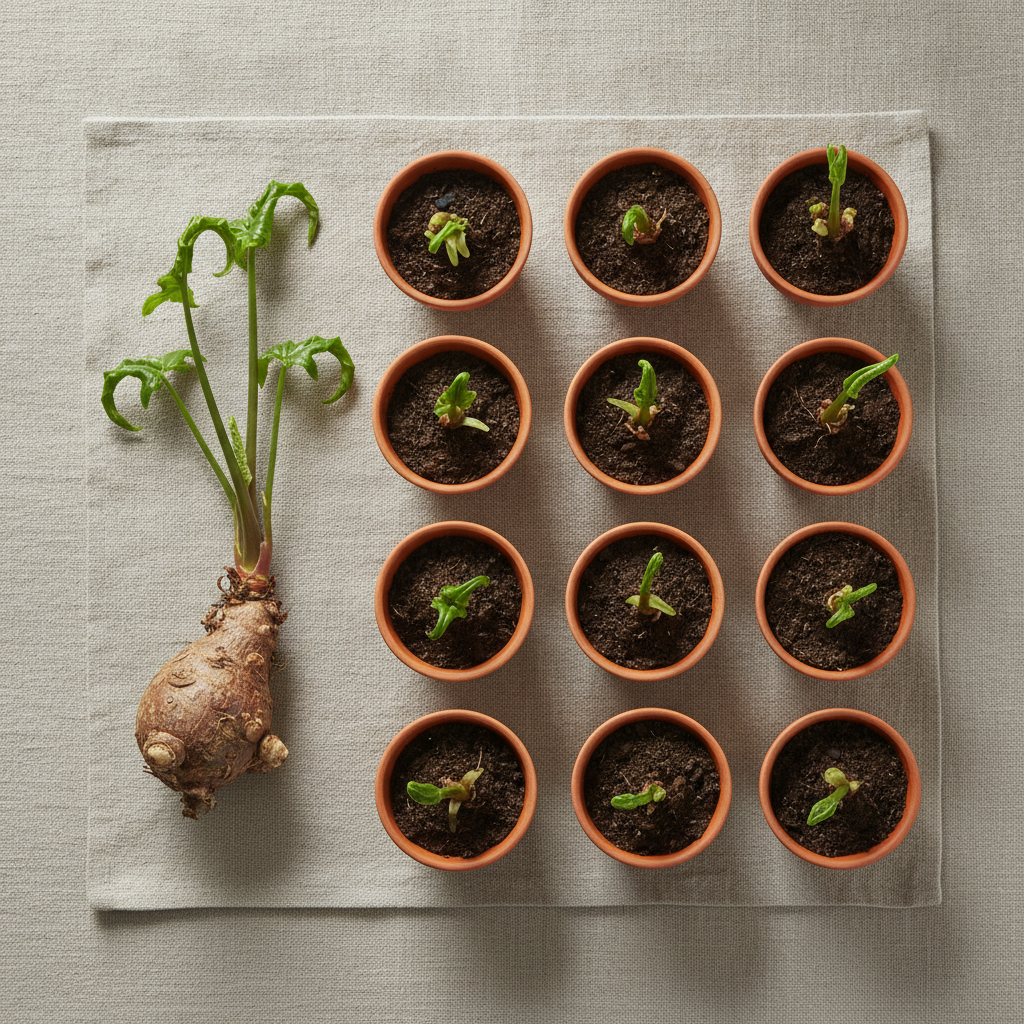
The tuber is the engine of the whole plant. This flattened, rounded storage organ holds the energy reserves that power each spring’s growth, and over time a healthy parent produces small daughter tubers, or offsets, around its edge. These offsets are genetically identical to the parent and are the basis of straightforward division. Understanding that everything radiates from this single underground structure explains both the plant’s seasonal behaviour and the way it is multiplied.
Dividing Offset Tubers: Step-by-Step
This is the reliable, fast method and the one most growers use. The work is done during dormancy when the tuber can be handled safely, and a single thriving plant will gradually build a small colony this way over a few years.
- In late winter dormancy, tip the plant out and clear the compost from the tuber, wearing gloves throughout.
- Look for firm daughter offsets attached around the parent and gently detach those that come away cleanly, leaving any that are still firmly joined for next year.
- Ensure each offset has its own growing point; dust any broken surfaces with sulphur or cinnamon and let them dry for a few hours to callus.
- Pot each offset individually in the same free-draining mix, covering it with a few centimetres of barely moist compost.
- Keep the new pots in a bright, cool spot and water only sparingly until shoots appear, then care for them as for adult plants.
Pro Tip — Patience with Small Offsets: The smallest offsets may produce only a leaf or two for the first season or even skip emerging entirely while they establish roots. This is normal. Keep them lightly cared for and they will gather strength and size up over subsequent years.
Growing from Seed: Step-by-Step
Seed is the long road, only possible when a mature female plant has been pollinated and ripens its cluster of bright berries. It demands patience but is the only way to raise large numbers of new plants and the route by which natural variation arises.
- Allow the berry cluster to ripen fully on a female plant, then clean the seeds out of the fleshy pulp, wearing gloves as the pulp is an irritant.
- Sow the cleaned seed promptly onto the surface of a moist, free-draining seed mix and cover only lightly.
- Keep the tray humid and cool to moderate in temperature; germination can be slow and erratic, sometimes taking many weeks.
- Grow the tiny seedlings on without disturbance, letting each build a small tuber through its first growing season.
- Allow the young tubers their natural dormancy and pot them on as they enlarge year by year until they reach flowering size, which may take several seasons.
Troubleshooting Propagation
| Problem | Likely Cause | Solution |
|---|---|---|
| Offset rots after potting | Mix too wet or wound not callused | Use a drier mix, let cuts dry first, water only sparingly until growth |
| Offset fails to sprout | Too small or still establishing roots | Be patient; keep cool and barely moist and wait for the next season |
| Seed does not germinate | Old seed or pulp left on, dried out | Sow fresh, fully cleaned seed promptly and keep consistently moist |
| Seedlings damp off | Stagnant, overly wet conditions | Improve airflow, ease back on water and use a sterile seed mix |
Pests & Diseases
For all its exotic looks, the Shepherd’s Crook is not particularly prone to pests, and a healthy plant in good conditions is largely trouble-free above ground. The greatest threats are not insects at all but the fungal and bacterial rots that follow overwatering, especially of the dormant tuber. Still, the same sap-sucking pests that trouble other houseplants will occasionally find their way onto the single large leaf, so a regular glance is worthwhile.
Because the plant offers only one leaf each year, any infestation has an outsized effect, draining the very foliage that is meant to be refilling the tuber. Catching problems early therefore matters more here than on a plant that can shrug off the loss of a few leaves.

Common Pests
Spider Mites (Tetranychus urticae)
Most likely to appear in hot, dry indoor air, spider mites are tiny and easily missed until fine webbing and a faint stippled bronzing of the leaf surface give them away. They sap the cells and quickly weaken the lone leaf.
Treatment: Raise humidity, rinse the foliage and treat with neem oil or an insecticidal soap, repeating every few days until the population is cleared.
Aphids (Aphidoidea)
Soft-bodied aphids cluster on tender new growth and the developing inflorescence, sucking sap and leaving a sticky honeydew that can encourage sooty mould. They reproduce rapidly in warm conditions.
Treatment: Dislodge them with a firm spray of water, then apply insecticidal soap or neem oil to the affected areas, checking the emerging flower closely.
Fungus Gnats (Bradysia species)
The damp, humus-rich compost this plant enjoys is exactly what fungus gnats breed in. The adults are a harmless nuisance, but their larvae feed on organic matter and fine roots in consistently wet soil.
Treatment: Let the surface dry between waterings, use yellow sticky traps for the adults, and a biological control or a layer of grit on the surface to break the breeding cycle.
Common Diseases
Tuber Rot (Various fungi and bacteria)
By far the most serious threat to a Shepherd’s Crook, tuber rot sets in when the dormant or recently potted tuber sits in cold, wet compost. The tuber turns soft, brown and foul-smelling, and once advanced it is usually fatal.
Treatment: Lift the tuber, cut away all affected tissue with a sterile blade, dust the wounds with sulphur or cinnamon, let them callus in dry air, and replant in fresh, barely moist, free-draining mix. Prevention through careful winter watering is far more effective than any cure.
Leaf Spot (Fungal pathogens)
Brown or black spots, sometimes with a yellow halo, can develop on the leaflets in still, humid air, especially where water has been left sitting on the foliage. Left unchecked the spots spread and merge.
Treatment: Improve air circulation, avoid wetting the leaf when watering, remove badly affected portions and treat with a suitable fungicide if it progresses.
Pest and Disease Summary
| Pest / Disease | Identification | Treatment |
|---|---|---|
| Spider mites | Fine webbing and stippled bronzing on the leaf | Raise humidity, rinse, neem oil or insecticidal soap |
| Aphids | Clusters on new growth and flower, sticky honeydew | Spray off, then insecticidal soap or neem oil |
| Fungus gnats | Small flies around damp compost | Dry the surface, sticky traps, grit top layer |
| Tuber rot | Soft, brown, smelly tuber | Cut out rot, dust, callus, replant dry; water less |
| Leaf spot | Brown or black spots on leaflets | Improve airflow, keep leaf dry, fungicide if needed |
Prevention Strategies
The best defence is simply correct culture. A free-draining mix, disciplined watering that respects the dormant rest, good light and decent air movement together prevent the great majority of problems before they start. The pests that do appear are far easier to manage on a vigorous, well-grown plant than on a stressed one.
Inspect the leaf, including its underside, whenever you water, and isolate any newly acquired plant for a couple of weeks before placing it among your collection. Most importantly, never let the tuber sit wet over winter, since the rots that follow are the one truly dangerous failing in this plant’s care.
Pro Tip — Neem as Routine Defence: A light, occasional application of neem oil to the foliage during the growing season, applied in the evening out of direct sun, deters the common sap-suckers before they establish and is gentle enough for the plant’s single leaf.
Popular Varieties
Unlike the heavily cultivated foliage aroids, Arisaema tortuosum is grown almost entirely as the wild species, and you will rarely see named cultivars offered for sale. What variation exists comes from the plant’s huge natural range across the Himalayas and Indian hills, which has produced regional forms differing in stature, in the mottling of the stalk and in the colour of the spathe.
Collectors also tend to grow the Shepherd’s Crook alongside its many cobra lily cousins in the genus Arisaema, so it is worth knowing both the natural forms of this species and a few of the related plants commonly grown beside it. The table and profiles below cover the most frequently encountered.
| Variety | Leaf Appearance | Light Needs | Growth Rate | Availability |
|---|---|---|---|---|
| Green Form | Green stalk, green spathe and spadix | Bright indirect | Moderate, seasonal | Common |
| Purple-Stem Form | Purple-mottled stalk, maroon-flushed spathe | Bright indirect | Moderate, seasonal | Occasional |
| Himalayan tall form | Very tall stalk, large leaf parasol | Bright indirect | Moderate, seasonal | Specialist |
| Western Ghats form | Shorter, sometimes earlier into growth | Bright indirect | Moderate, seasonal | Specialist |
| Arisaema speciosum | Trifoliate leaf, striped spathe (cousin) | Dappled shade | Moderate, seasonal | Specialist |
| Arisaema triphyllum | Jack-in-the-pulpit, hooded green-purple spathe (cousin) | Dappled shade | Moderate, seasonal | Common in temperate gardens |
Featured Varieties
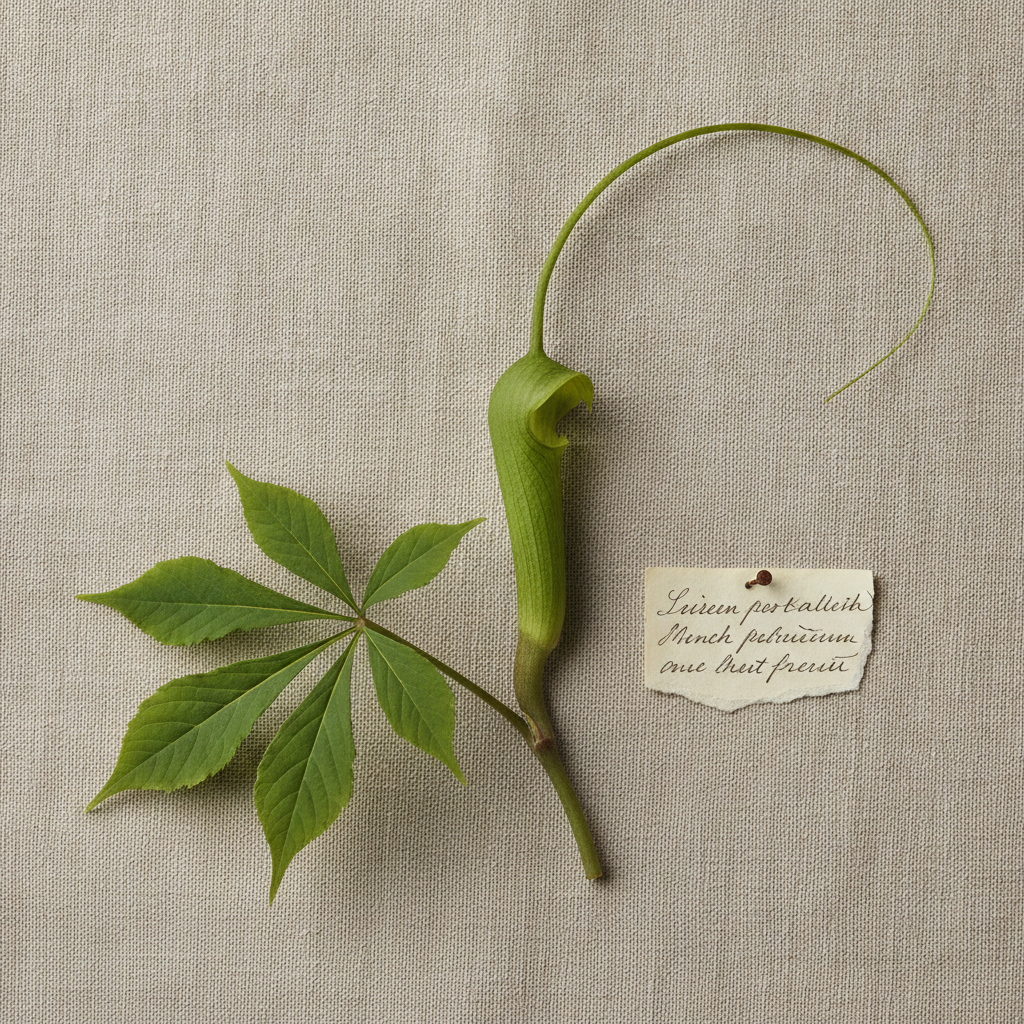
Green Form
The classic and most widely grown expression of the species, with a green mottled stalk and an all-green hooded spathe from which the long green spadix arches dramatically overhead. It is the form most people picture when they imagine the shepherd’s crook in flower.
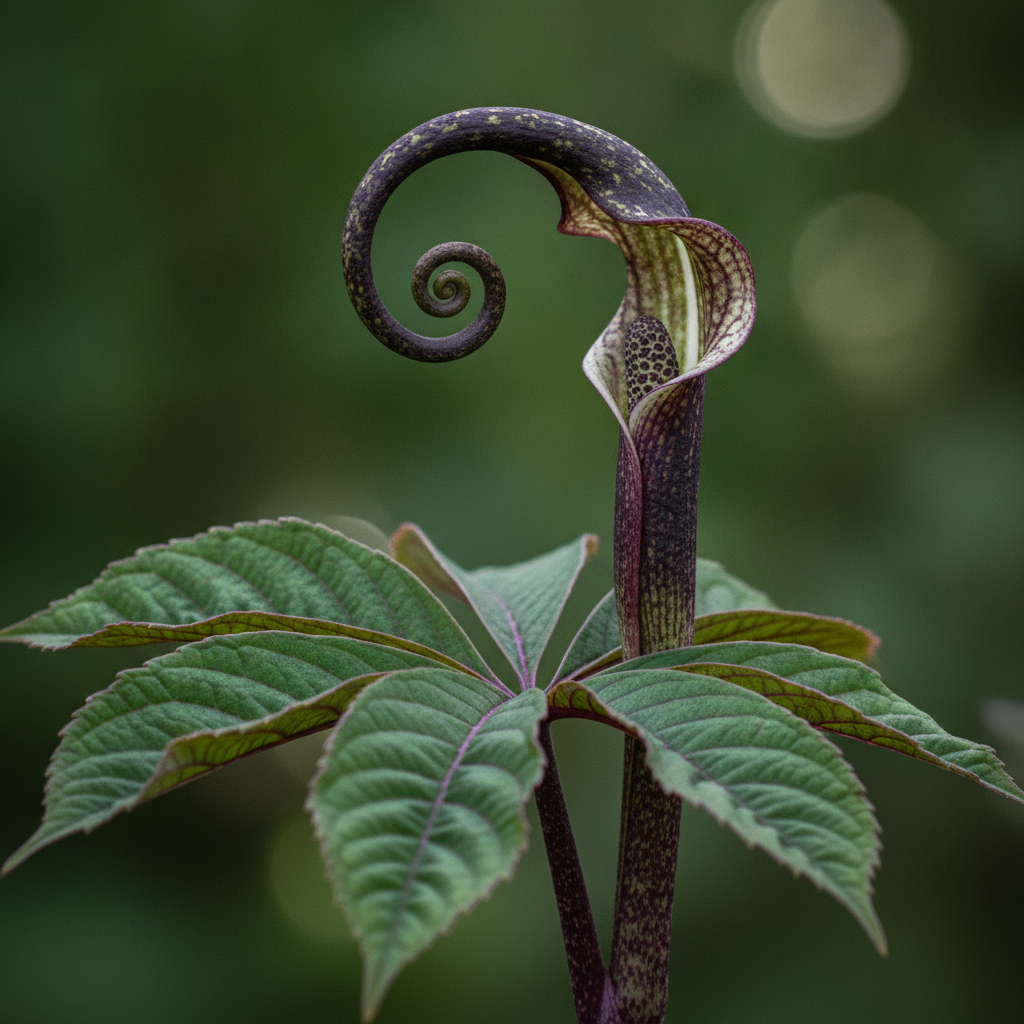
Purple-Stem Form
A darker, more dramatic expression with heavily purple-mottled petioles and a spathe flushed deep maroon, while retaining the same striking upward-arching spadix. It is sought after by collectors for the moody contrast between the dark stalk and the green leaflets.
Variety Profiles in Detail
Green Form (Arisaema tortuosum)
This is the typical wild plant and the benchmark for the species. A tall, green-to-faintly-mottled stalk supports the pedate leaf, and the green inflorescence carries the signature long spadix that bends up and over. It is robust, readily available from specialist bulb and aroid suppliers, and the best choice for a first Shepherd’s Crook.
Purple-Stem Form (Arisaema tortuosum)
Found among populations across the species’ range, this form shows pronounced purple mottling on the stalk and a maroon flush to the spathe. Cultivation is identical to the green form; it is simply a more ornamental colour expression that commands a little more attention from collectors.
Jack-in-the-Pulpit (Arisaema triphyllum)
A North American cousin frequently grown alongside the Shepherd’s Crook, this species has a three-part leaf and a green-and-purple striped hooded spathe rather than a long arching spadix. It shares the same tuberous habit and dormancy requirements, which makes it an easy companion for anyone already growing Arisaema tortuosum.
Choosing the Right Variety for Your Space
For most growers the green form of the true species is the right starting point: it is the most available, the most robust and the most dramatic in flower. If you can source it, the purple-stem form adds extra ornamental value for the same care. And once you are comfortable with the seasonal rhythm of one cobra lily, the wider genus opens up a whole collection of related tubers that all share the same dormant-then-spectacular pattern, letting you build a fascinating seasonal display from a single style of care.
Frequently Asked Questions
Why has my Shepherd’s Crook disappeared completely?
This is almost always natural dormancy rather than death. Arisaema tortuosum dies back entirely each year, retreating to its underground tuber and leaving no visible growth for months. Keep the pot cool and nearly dry, resist the urge to dig around, and the shoot should reappear the following spring.
Is the Shepherd’s Crook safe around cats and dogs?
No. Like all aroids it contains calcium oxalate crystals that cause painful burning and swelling of the mouth and throat if chewed, along with drooling and difficulty swallowing. Keep it out of reach of pets and children, and wear gloves when handling the tuber or any cut surfaces.
How often should I water it?
There is no fixed schedule because it depends entirely on the season. While the leaf is green and growing, keep the compost evenly moist, which may mean watering every few days in summer. Once the leaf yellows and dies back, stop almost completely and keep the dormant tuber barely moist until spring.
Why does my plant only have one leaf?
That is entirely normal. The Shepherd’s Crook typically produces a single, large pedately divided leaf on a tall stalk each season, which can look like many leaves but is one structure. A very large, mature tuber may occasionally produce more than one, but a single leaf is the usual and healthy state.
Why won’t my Shepherd’s Crook flower?
Flowering depends on the tuber reaching sufficient size and energy reserves. A young or under-fed tuber will produce only a leaf. Give the plant bright light and a regular dilute feed through every growing season, and as the tuber bulks up over the years it will begin to flower, eventually even switching sex from male to female.
Can it really change sex?
Yes, and it is one of the plant’s most intriguing features. Small or stressed tubers tend to produce male flowers, while large, well-nourished tubers switch to female and can set seed. The change is driven by the plant’s size and energy status, so improving its care can literally alter its sex from one year to the next.
Can I grow it from a cutting?
No. It has no creeping stem or nodes to root, so cuttings are not possible. Propagation is by separating the offset tubers the parent produces, done during dormancy, or more slowly by sowing fresh seed from a pollinated female plant.
Can it be grown outdoors?
In mild temperate climates it can be grown outdoors in a sheltered, partly shaded spot with free-draining soil, where the tuber rides out winter dormancy underground. In colder regions or where drainage is poor, it is safest grown in a container that can be kept cool, dry and frost-protected during its dormant rest.
My tuber feels soft. Can I save it?
Possibly, if you act quickly. Lift it, cut away all soft or discoloured tissue back to firm, healthy flesh with a sterile blade, dust the cuts with sulphur or cinnamon, and let them dry and callus in the air for a day or two. Replant in fresh, barely moist, very free-draining mix and water sparingly. The key lesson is to water far less, especially in dormancy.






